Russia ‘won’t allow’ another US military action in Syria based on false flag – OPCW envoy
RT | April 26, 2018
Russia’s envoy to the OPCW said it was crucial to avoid new false-flag attacks in Syria and that Moscow “won’t allow” US military action there, as he described details of Russian findings on the site of the alleged Douma incident.
New false-flag operations against Damascus are “possible, since our American partners are once again threatening to take military action against Syria, but we will not allow that,” Russia’s permanent representative to the Organization for the Prohibition of Chemical Weapons (OPCW), Aleksandr Shulgin, said during a press conference in The Hague on Thursday.
The meeting was called by Russia’s OPCW mission and featured witnesses of the April 7 alleged chemical incident in the city of Douma. It highlighted the findings of Russian military experts, who were among the first to reach the site of the purported attack and locate the “munitions” that supposedly hit the residential buildings.
“Russian experts performed a detailed analysis of the information on the ground,” Major-General Igor Kirillov, the head of Russia’s Nuclear, Biological and Chemical Protection (RKhBZ) Troops, said. “Two gas cylinders, allegedly dropped by the government forces from helicopters, were found in two apartments.”
The cylinders and the damage they supposedly caused did not fit the tale of an airstrike entirely, Kirillov said. One of the cylinders lacked any makeshift upgrades, such as fins, to make it usable as an aerial munition, and, surprisingly, it was not even deformed.
“An empty gas cylinder found at the top floor. The apartment was partially destroyed earlier by an aerial bomb explosion, parts of roof and outer wall were missing,” Kirillov stated. “Other walls were sprayed with shrapnel. It’s quite peculiar that the cylinder was not deformed, which doesn’t fit its purported fall from a big altitude on concrete floor.”
The other cylinder, while fitted with some crude fins, also remained in nearly pristine condition despite its “fall.” The device miraculously did little to no damage to the room it supposedly hit, besides a large hole in the ceiling, which, however, was unlikely made by the object, according to military specialists.
“The cylinder has partially retained impermeability and is almost undamaged, which is impossible after a fall from some 2,000 meters, the usual altitude used by the Syrian army helicopters,” Kirillov said. “A tail part of an unguided rocket has been uncovered on the roof near the gap in the ceiling. The munition was likely to make the hole, but we cannot rule out an artificial nature of the damage made to the roof, since we discovered a pinch bar at the stairwell of the building.”
The cylinder was likely hauled by the “authors of the staged video” from outside, the official stated, as “multiple chips and dragging marks at the stairwell” indicated. An apartment below was being used by its owner to breed chickens, and all the livestock miraculously “made through the so-called chemical attack alive,” according to Kirillov.
“Moreover, the RKhBZ troops have uncovered a booby-trapped chemical laboratory and chemical stockpile in the city of Douma, which was liberated from the militants. They’ve been presumably used by the terrorists to manufacture toxic substances,” the official said, adding that a chlorine-filled canister that was very similar to the purported munitions used during the Douma incident was recovered from the militant-run warehouse. OPCW-controlled substances, which can be used to produce mustard gas, have been also found there.
The Douma incident was featured in videos released by the controversial White Helmets group and spread through militant-linked social media accounts. It was seemingly taken at face value by the US and its allies, who promptly pinned the blame on Damascus and launched a massive missile strike on the country in “retaliation” on April 14. The attack came hours before the OPCW experts were set to embark on their fact-finding mission in Douma.
The experts have already visited the site of the purported incident. Shulgin, meanwhile, called on the OPCW to visit the chemical laboratories left behind by the militants to see for themselves who is actually behind the use of chemical arms in Syria.
“We urge the OPCW technical secretariat and experts to make use of their time in Syria and examine the undercover underground chemical laboratories of the militants, the terrorists, who used them, as we believe, to produce chemical munitions, including those used for all kinds of false flag attacks,” Shulgin stressed.
Never Let Anyone Call You Crazy For Doubting Establishment War Narratives

By Caitlyn Johnstone | April 25, 2018
There has still been no retraction or correction of The Guardian‘s demonstrably false and completely indefensible claim that two normal antiwar Twitter accounts were controlled not by real people but by bot programs based in Russia.
This is the sort of environment that has been created by the ongoing Russia panic that is plaguing the western world: one wherein mainstream news outlets can openly lie about dissenting voices and antiwar activists, refuse to retract or apologize for those lies, and suffer no consequences.
And yet they still have the gall to paint anyone who expresses doubt about the narratives they advance about Russia and Syria as crazy, kooky conspiracy theorists. Google the words “conspiracy” and “Syria” right now and you’ll come up with countless editorials with headlines like “Syria war: The online activists pushing conspiracy theories,” “Disinformation and Conspiracy Trolling in the Wake of the Syrian Chemical Attack,” and “SYRIA GAS ATTACK CONSPIRACY THEORIES FUELED BY TUCKER CARLSON AND FAR-RIGHT FRINGE.”
They’re using the highly stigmatized label “conspiracy theories” to paint healthy, normal skepticism of a notoriously untrustworthy power establishment as mentally unsound paranoia.
The other day I wrote an article about the shocking number of blatant attack editorials the mass media machine has been churning out on anyone who questions the establishment Syria narrative, and that output has not slowed down since. Warmongering empire loyalists like senior Huffington Post editor Chris York have been hard at work making sure the output of McCarthyite smear pieces remains on rapid fire, accusing anyone advocating skepticism of the same establishment which lied us into Iraq and Libya of being a tinfoil hat-wearing nut job.
This fits an established pattern which we have discussed previously, wherein proponents of US-led military intervention accuse those who question their narratives of being mentally unsound. There is a word for the tactic of convincing someone that they are crazy in order to manipulate and control them, and that word is gaslighting. It is a textbook abuse tactic, and it isn’t okay.
It isn’t okay for these war whore pundits to bully and deceive us so that we will feel unsure of the basis for our skepticism and consent to the longstanding western agenda of regime change in Syria. It isn’t okay for them to try to make people unsure of their mental health in order to pave the way toward public consent for broader bombing campaigns and no-fly zones in a sovereign nation under assault by western-backed jihadists. Never let anyone bully you into thinking that you are the strange, weird outlier for suspecting that a western empire who has sponsored actual, literal terrorist factions in Syria might lie about Iraq’s next-door neighbor like they lied about Iraq.
Doubting the official narrative being advanced by mainstream media is the sanest thing in the world. The US-centralized power establishment has an extensive and well-documented history of using lies, propaganda and false flags to manufacture public support for preexisting war agendas, so it is perfectly sane to express concern about the legitimacy of the stories we’re being told about Douma, the Skripal case, Russian hacking allegations etc. We’ve already got The Guardian lying unapologetically straight to our face right now about Russian bots while not one single mainstream editorial opposed the British, French and American bombing of Syria earlier this month, so it’s obviously very sane to think the mainstream media may be advancing the interests of this war like they do every other.
Intense, rigorous skepticism is the only sane response to these narratives we’re being pummeled with day in and day out, and they’re trying to make us believe that the exact opposite is true.
Ian Shilling, one of the two Twitter account owners falsely labeled a Russian bot by The Guardian, appeared on Sky News a few days ago to defend himself and debunk the claims made about him. It was a truly brilliant appearance, and despite the open hostility showed him by the two Murdoch muppets hosting the show he was able not just to defend himself but to use the space to attack the warmongering neoconservative agendas being advanced by the UK government. As a representative of the many many regular flesh-and-blood humans on Twitter who are routinely dismissed as “Russian bots” simply for questioning establishment narratives, Ian knocked it out of the park and then some. He not only proved his humanity, he proved his sanity.
With the benefit of hindsight and not having been the one in the crosshairs, however, there was one part I thought could be handled a little differently. At one point in the interview, Shilling was articulating exactly why it would make no sense for Assad to have used chemical weapons in Douma as he is accused of having done, and one of the Sky News hosts demanded to know “Well if not, who then?”
Shilling provided the entirely reasonable speculation that it would have been the terrorists occupying the area who had every incentive to stage such an attack, but in my opinion it isn’t necessary to even go that far. The burden of proof is on the party making the claim; it isn’t up to us to flesh out a positive narrative about what happened using the limited information and resources afforded to bloggers and tweeters, it’s up to the massive western power establishment to provide the kind of proof of their accusations that is required in a post-Iraq invasion world. This plainly has not happened.
You see this sneaky attempt to shift the burden of proof among empire loyalists all the time when debating such topics. A couple of months ago I wrote about how in a debate with Real News‘ Aaron Maté, John Feffer of Lobelog used the tactic of arguing that his belief in the still-unproven Russian hacking accusations arises from the absence of a better “counter-narrative” about what happened, the implication being that we should take the US intelligence community at their word unless presented with a more compelling case for what happened from somewhere else. We also saw it in the BBC’s recent interview of Lord West, whose skepticism of the establishment Douma narrative was met with protestations that he didn’t have any solid proof of anything else having happened than what we’ve been told by the western war machine.
Don’t let them shift the burden of proof like that. We can point out, in the case of Douma for example, that the area was crawling with known terrorists who had every incentive to stage such an attack and gain the benefit of the western empire’s air force bombing their sworn enemy over a crossed “red line”, but we should also point out that it isn’t our job to come up with a positive counter-narrative about what happened. The burden of proof is on the accuser, so it’s their job to present us with a very solid collection of evidence that the alleged chemical attack could only have been perpetrated by the Assad government. Until then, our position that these people lied to us about Libya and Iraq and have a longstanding agenda of regime change in Syria is sufficient to declare decisive victory in any debate.
Don’t let them shift the burden of proof, and don’t let them gaslight you. You have truth on your side, and their side has a whole, whole lot of work to do before they have enough substantial evidence to even debate you rationally. They use these deceitful tactics because they are losing the debate, and because war is very profitable and advantageous for a few very powerful individuals. That’s all that’s happening here.
Whether it’s Russiagate, Skripal or Syria, the Media Have Lost Their Grip on Reality
Despite a series of collapsing mainstream narratives, the establishment can’t help but doubling (and tripling) down on their official conspiracy theories.
By Paul Mansfield | 21st Century Wire | April 26, 2018
The “Blame Russia” for absolutely everything world we currently occupy has reached a point almost beyond return and is scaling heights that would turn Joseph McCarthy green with envy. Whether it is internally produced political turmoil and scandal, or because of generally reckless and failed foreign policy endeavours, the US and UK governments are more wiling than ever to pin the blame on Russia without fail.
The instant blame on Russia for the poisoning of Sergei and Yulia Skripal, or “highly likely it was Russia”, as Theresa May put it, proved grossly premature, graduating onto maybe not so likely at all – thanks to dedicated alt media and social media researchers and activists uncovering the development of Novichoks in multiple countries, making it entirely plausible that some country other than Russia may be responsible for the improbable Salisbury event.
No sooner did the Skripal Affair wind up, than another supposed ‘chemical attack’ unfolded, this time in Syria, where an alleged chemical weapons airstrike was said to have taken place in Douma on 7 April. Accounts of this incident were reliant entirely for its evidence on two dubious sources, the US and UK-backed White Helmets and the Syrian American Medical Society (SAMS). It didn’t take long before the official story started springing leaks though. The hilarity of seeing chlorine cylinders laying on a bed, rather than smashing through it, numerous witness statements there was no chemical attack, the testimony of over a dozen medical personnel at the medical centre concerned that the White Helmets caused a panic by shouting chemical attack when there was none and the interview of 11 year old Hassan Diab, who was not a chemical weapon victim, but certainly was a victim of an unwarranted drenching as part of a staged event, have all demolished yet another false flag instigated by western intelligence agencies and their White Helmets operatives. All this was irrelevant however to the criminal Troika, the US, UK and France, who bypassed the United Nations and bombed Syria in the early hours of 14 April, provoking Russia into an instant reaction which never came.
Some are of the opinion that the Troika and Russia reached an agreement beforehand and so therefore there was never the threat of outbreak of conflict which could escalate to a catastrophic WWIII.
Here is the White Helmets ‘hose-down’ video which triggered a western military intervention:
Faced with rapidly dwindling legitimacy and credibility, the UK government in particular set their attack dogs in the mainstream media on to alt media and social media activists. The result is a coordinated and intensive smear campaign against independent journalists, academics and social media activists with large followings. The gutter press of the UK have demonstrated that in terms of propaganda and disinformation, they are without peer. US media Russophobes almost look like babes in the woods in comparison.
What we are witnessing is a war on truth, vicious intimidation of dissenting voices, the negating of fierce independent voices as Russian puppets and bots and Assad apologists, and ad hominem attacks all designed to shut down a powerful narrative which shines a light on the warmongering narrative propagated by the mainstream media.
The campaign reached a level of absurdity beyond comprehension when Twitter activist @Ian56789 was asked by Sky News hosts if he was a bot as he was being interviewed live on air!

As disinformation against Russia soars off the fake news Richter Scale and independent journalists and activists are being personally targeted, one only has to revisit the recent Devon Nunes Memo story as an example of a real domestic US political scandal which the derelict US mainstream media attempted to transform into yet another Russian disinformation campaign.
You would have to be living under a rock to not know of the salacious, but unverified dossier on US President Donald Trump, which purportedly started out as a piece of opposition research during the 2016 election campaign, but quickly became the driving force behind allegations that Trump colluded with the Russian government in order to win the presidential election. In the mind of many a deep state adoring Democrat and mainstream media journalist, it is beyond dispute that Trump colluded with Russia. The major questions are how extensive the collusion was and does it amount to having committed federal crimes. To answer these questions, the Mueller investigation must continue expanding as far and wide as necessary.
Many Republicans believe the widely ridiculed and discredited dossier prepared by a former British spy, Christopher Steele, was the catalyst for the FBI decision to investigate allegations of Trump campaign collusion with Russia. A mocked and debunked dossier, which looked like it was concocted in a teenagers bedroom bought down on CNN and Buzzfeed a truck load of embarrassment when they decided to run with a story other media outlets balked at.
So how did it transform into such a vital document that initiated the Mueller probe into suspected Trump collusion with Russia?
We have had the mainstream media pumping this story 24/7. They will not let it go, determined that it bring about the downfall of Donald Trump. By gleefully accepting any lead from their highly coveted ‘sources’, the MSM begs to be subverted by the intelligence community, thereby subverting any prospect of a properly functioning US democracy and informed citizenry.
However, the revelations of #ReleaseTheMemo which alleged shocking FISA abuses by the FBI has raised the spectre of another alleged collusion; the FBI and the Obama DOJ colluding against Trump. The major accusation is that the FBI hid from the FISA court judge the fact that it was heavily relying on the dodgy Trump Dossier to obtain a surveillance warrant to spy on Trump, the man who was to become the future President. What is even more explosive is that it was not revealed to the judge that the Democratic National Committee and Hillary Clinton’s presidential campaign paid for the dossier. Dirty partisan politics has gone a step too far in this sordid affair, with the DNC and FBI duping the FISA court into unwittingly assisting them in their campaign against Trump.

And let’s be clear here; this is the work of the Obama administration and any rigorous investigation would pursue whether or not the collusion against Trump went all the way to former president Obama himself.
Republicans were outraged and demanded the release of the memo.
This is hardly a surprise, being shocked and alarmed at possible internal interference in the election by US intelligence agencies, the very agencies that told us it was Russia that undermined US democracy by its electoral interference.
It is crucial to grasp the fact that this affair is a case of internal interference in the election campaign and has generated intense reaction within the US political establishment and among many in the general public.
One may question then the spin the Hamilton 68 propaganda organ placed on the interest whipped up by the memo. It attempted to reframe calls to release the memo as yet another so-called Russian influence operation, using trolls and bots to amplify the message across cyberspace.
‘Hamilton 68’ doesn’t track propaganda. It is propaganda. Its “Council”? Stuffed with Bill Kristol, Michael Chertoff, Mike Morell, etc. Its funding? Opaque (see its 990s). Its methodology? Unfalsifiable–Twitter users put on ad-hoc secret lists based on political view. Appalling.
— Julian Assange ⌛ (@JulianAssange) January 19, 2018
Hamilton 68, a banal and comical operation, is projecting on to Russia the very thing it is doing itself; spreading disinformation aimed at undermining and destabilizing Russia, but also the US political system. On the strength of CNN’s dumpster diving, Hamilton 68 likes to tell us all about how the cryptic ‘Internet Research Agency’ in St. Petersburg is one big giant troll factory. Sorry, Hamilton 68, but you are one big NATO/Deep state cyberspace troll factory yourselves.
The Democratic Party Russophobia icons, Dianne Feinstein and Adam Schiff, quickly took the opportunity to deflect from the emerging memo scandal, pulling out the playbook of Russian subversion through social media for the umpteenth time. Quite comfortable with the fact that they have secured the social media giants as appendages of the US deep state, Feinstein and Schiff wrote to Twitter and Facebook asking them to investigate what they claimed are Russian bots spreading the #ReleaseTheMemo hashtag. The letter reads in part:
“… Several Twitter hashtags, including #ReleaseTheMemo, calling for release of these talking points attacking the Mueller investigation were born in the hours after the Committee vote. According to the German Marshall Fund’s Alliance for Securing Democracy, this effort gained the immediate attention and assistance of social media accounts linked to Russian influence operations. By Friday, January 19, 2018, the #ReleaseTheMemo hashtag was “the top trending hashtag among Twitter accounts believed to be operated by Kremlin-linked groups.” Its use had “increased by 286,700 percent” and was being used “100 times more than any other hashtag” by accounts linked to Russian influence campaigns. These accounts are also promoting an offer by WikiLeaks to pay up to $1 million to anyone who leaks this classified partisan memo.
If these reports are accurate, we are witnessing an ongoing attack by the Russian government through Kremlin-linked social media actors…”
Nice sleight of hand Hamilton 68, Schiff and Feinstein, but this is a scandal that whipped Republicans, not Russians into a frenzy. It is a stand-alone scandal that raised questions about the ethics, partiality and possible illegal acts of the US intelligence community and the Obama DOJ. It does not need any Russian trolls to inflate the gravity of the situation.
Florida Republican Rep. Ron Desantis tweeted, “Yesterday, I viewed a deeply troubling report compiled by House Intelligence that raises questions about Obama DOJ & the so-called collusion investigation.”
Desantis said it right there: collusion between the Obama DOJ and the FBI. If true, it is a shocking indictment on deep state interference in US politics, going all the way to the top in attempting to subvert the US presidential election.
So we have at least 2 allegations of collusion; the longstanding and tiresome Russiagate story, which the mainstream media will not give a moments rest and the newer, but equally shocking FBI/DOJ collusion emerging from the woodworks with the news of the classified memo.
You can read and watch RussiaGate stories in both US/Western MSM and Russian media. Fair enough, it was a big story, newsworthy and deeply concerning if it was true (the US media has overplayed their hand though to put it mildly). As time goes on and without a shred of evidence produced, it is time to put the whole issue to bed and move on. It is only the absurdity of the MSM insistence that collusion has been proved beyond doubt and any who question it are conspiracy theorists, that maintains the interest of the reasonable person, even if only to mock media figures and politicians who are the true conspiracy theorists.
The calls to release the Devon Nunes compiled memo also attracted huge coverage in both US and Russian media. However, US media framed it in terms of a partisan struggle between Democrats and Republicans; detracting from the implications of the abuse of the FISA system and placing the scandal into the realm of normal everyday, if somewhat dirty party politics.
There is nothing everyday about the possibility that this whole Russia investigation is in reality a conspiracy by top FBI officials and the DOJ to sabotage Trump and install Hillary Clinton (remember her?) as president. Look at Peter Strzok and Lisa Page as examples, whose texts made no secret of their contempt for Trump and their desire to see him lose the election.
So why did CNN, the New York Times and the supposedly reputable Business Insider deem it newsworthy to claim Russian influence networks were spreading the release the memo hashtag like wildfire across the social media landscape. Business Insider even implied the Nunes memo has been given wings by being amplified by Russian trolls and bots across the social media landscape.
The compiling of the memo by Republican aides on the House Intelligence Committee that led to the unfolding scandal was not initiated by Russia. The angry calls for action came from Republicans, not Russians.
We can’t even be sure if these so-called Russian networks of trolls are Russian at all. But let’s assume for a minute they are. Big deal if they spread the story. It is fascinating, very interesting and could have huge consequences of DOJ and FBI heads rolling. It also serves to relieve some of the pressure on Russia, so why wouldn’t they promote it heavily. They are merely acting in the interests of Russia, which no reasonable person could complain about.
Many people believe Americans are simply apathetic victims and that these supposed Russian trolls or bots are drowning them in disinformation, and that western media figures and politicians are powerless to stop it. That’s the mainstream’s moderate narrative. However, a look at the number of followers of some US media celebrities on Twitter should dispel that misinformation in a heartbeat. Rachel Maddow, with 9 million followers, retweeted a tweet by NBC reporter Ken Dilanian, a tweet which itself got 6K retweets and 19K likes. His tweet, included, “your #ReleaseTheMemo is the top trending hashtag among the Russian bots and trolls over the last 48 hours, and you might want to ask yourself why.”
So a media figure from NBC is clearly muddying the waters, throwing us a red herring in implying the nefarious hand of Russia is at play. Maddow gave Dilanian huge impetus in his attempt to try to flip the story to turn it into yet another opportunity to attack Russia. Deeply troubling allegations which could rock the foundations of the intelligence and justice communities are made a mockery of by a disreputable journalist who sees it as another chance to Russia bait. Before you know it, they will be telling us the #Memo was a joint venture put together by the FSB and Republicans, thus proving the collusion is still going as strong as ever. This level of hysteria is way beyond Cold War McCarthyism.
And when Rachel Maddow retweets something, how many likes and retweets does that generate. Enough to turn the Russian bots and trolls green (or should that be red) with envy.
Maddow herself is capitalizing very nicely on the Russophobia being generated by the whole Russiagate affair to boost her own ratings and affection within the political establishment. She has not got a single progressive bone in her body and epitomizes the dumbed down, hyped up claims about Russian interference in American political and social life. The spectacle is the theatre of the absurd, as Americans are subjected to Hollywood type entertainment to titillate and shock with the never ending “revelations” which roll out like clockwork. And, true to Hollywood style fiction, the more outrageous and sensational the better.
This is why Maddow is able to get away with calling Jill Stein a Kremlin puppet, and to feign seriousness and solemnity as she continues to call Trump a Putin puppet, putty in his hands, even as Trump has clearly embarked on a path which has plummeted US/Russian relations to their lowest point since the darkest days of the Cold War.

Maddow uses a technique for these claims which may enthrall Never-Trumpers and fill Le Resistance with fear, but it is straight from the neocon playbook. It is that any sign of Trump not being totally committed to overt and outright hostility to Russia proves that he is a Russian puppet. He must adopt the neocon attitude of Russia being the eternal enemy, the biggest threat the US faces and that it must be confronted and made to pay a price for its aggression, expansionist ambitions and meddling in US affairs.
Putin has Trump in a vice like grip with the “compromat” on him, using it to blackmail him in to doing Russia’s bidding according to Maddow. Putin is forcing Trump to declare war on the intelligence community, fomenting chaos in a crowning glory of undermining US national security. How better to leave the US vulnerable to the rapacious desires of Russia than by shattering the institutions of US national security.
Maddow believes Putin blackmailed Trump with the Golden showers tape to hire Paul Manafort as his campaign manager, to hire Rex Tillerson as Secretary of State, and to pressure him to withdraw US forces in Eastern Europe and the Baltics, (which hasn’t happened).
“Is the new President gonna take those troops out? After all the speculation, after all the worry, we are actually about to find out if Russia maybe has something on the new President? We’re about to find out if the new President of our country is going to do what Russia wants once he’s Commander-in-Chief of the US military starting noon on Friday. What is he gonna do with those deployments? Watch this space.”
In Maddows demented mind, anything less than the Trump administration universally standing poised to unsheathe their swords and land a mortal blow on Russia is proof of collusion with the Kremlin. Any conciliatory overtures are met by howls of derision by the Maddow/Hillary Clinton led “resistance.” Amid this red hot rhetoric and witch hunt for internal traitors, Maddow and her ilk are the ones to claim it is Russia sowing discord and discontent.
“This is international warfare against our country,” Maddow said on her show.
Maddow says she goes to bed every night wondering what new Russia scandal awaits the country the next morning, propelling the Russia hysteria all the way to election 2020 and bankrolling her show and career almost exclusively on one issue threadbare of any evidence. The McCarthy of the modern mainstream media some say. It’s Clickbait applied to cable TV you could also say:
“If the presidency is effectively a Russian op, if the American presidency right now is the product of collusion between the Russian intelligence services and an American campaign — I mean, that is so profoundly big, we not only need to stay focused on figuring it out. We need to start preparing for what the consequences are going to be if it proves to be true.”
‘If it proves to be true.’ That’s right, and we’re still waiting for the evidence.

Maddow and her fellow military industrial complex media mouthpieces don’t need evidence to believe Russia interfered in the election, as she spreads her poison to millions of viewers night after night. She sees Vladimir Putin as pure evil, the embodiment of the terrifying KGB and tells her viewers this repeatedly. She has become the torchbearer for an ever wilder conspiracy theory, whipping her audience into a frenzy, baying for Russian blood.
It is extraordinary that anyone listens to a word Maddow says after she produced her only evidence on Trump; his tax return which revealed he paid $38million in federal taxes on more than $150 million in income in 2005. Bombing out big time on alleged Trump tax cheating has clearly not stopped Maddow proceeding full steam ahead in accusing him of being a Kremlin installed puppet.
So who is running an influence campaign here, Moscow, or the US military industrial complex media?
What is never discussed outside of alt-media circles is how far were the FBI, the DOJ, and the Hillary Clinton campaign involved in what is increasingly looking every day more like FBIgate than Russiagate? What about the roles of powerful deep state actors like John Brennan and James Clapper, who are bound to have played a hand in concocting and promoting the official conspiracy theory? Clapper, who thinks it is in Russian DNA to hack things and Brennan who sees Russia as a long term threat intent on attacking US democracy, sternly warning the incoming President Trump not to ignore the huge threat Russia poses.
What was also not overtly acknowledged is that by pressuring for the release of the memo, Devon Nunes and other Republicans actually carried out a duty they were elected to perform; holding the intelligence community accountable. As former CIA analyst Ray McGovern of Consortium News said:
At this point, the $64 question is whether the various congressional oversight committees will remain ensconced in their customarily cozy role as “overlook” committees, or whether they will have the courage to attempt to carry out their Constitutional duty. The latter course would mean confronting a powerful Deep State and its large toolbox of well-practiced retaliatory techniques, including J. Edgar Hoover-style blackmail on steroids, enabled by electronic surveillance of just about everything and everyone. Yes, today’s technology permits blanket collection, and “Collect Everything” has become the motto.
The take-away from all of this is that no sin is too great, and no scandal can’t be flipped to pin the blame on Russia.
Meanwhile, any criminal or unethical conduct of Democrats and deep staters will not be plastered across the newspapers and cyberspace.
Don’t worry about it. Just say its Russian disinformation. Works every time.
How False Flag Operations Are Carried Out Today
By Philip M. GIRALDI | Strategic Culture Foundation | 26.04.2018
False Flag is a concept that goes back centuries. It was considered to be a legitimate ploy by the Greeks and Romans, where a military force would pretend to be friendly to get close to an enemy before dropping the pretense and raising its banners to reveal its own affiliation just before launching an attack. In the sea battles of the eighteenth century among Spain, France and Britain hoisting an enemy flag instead of one’s own to confuse the opponent was considered to be a legitimate ruse de guerre, but it was only “honorable” if one reverted to one’s own flag before engaging in combat.
Today’s false flag operations are generally carried out by intelligence agencies and non-government actors including terrorist groups, but they are only considered successful if the true attribution of an action remains secret. There is nothing honorable about them as their intention is to blame an innocent party for something that it did not do. There has been a lot of such activity lately and it was interesting to learn by way of a leak that the Central Intelligence Agency (CIA) has developed a capability to mimic the internet fingerprints of other foreign intelligence services. That means that when the media is trumpeting news reports that the Russians or Chinese hacked into U.S. government websites or the sites of major corporations, it could actually have been the CIA carrying out the intrusion and making it look like it originated in Moscow or Beijing. Given that capability, there has been considerable speculation in the alternative media that it was actually the CIA that interfered in the 2016 national elections in the United States.
False flags can be involved in other sorts of activity as well. The past year’s two major alleged chemical attacks carried out against Syrian civilians that resulted in President Donald Trump and associates launching 160 cruise missiles are pretty clearly false flag operations carried out by the rebels and terrorist groups that controlled the affected areas at the time. The most recent reported attack on April 7th might not have occurred at all according to doctors and other witnesses who were actually in Douma. Because the rebels succeeded in convincing much of the world that the Syrian government had carried out the attacks, one might consider their false flag efforts to have been extremely successful.
The remedy against false flag operations such as the recent one in Syria is, of course, to avoid taking the bait and instead waiting until a thorough and objective inspection of the evidence has taken place. The United States, Britain and France did not do that, preferring instead to respond to hysterical press reports by “doing something.” If the U.N. investigation of the alleged attack turns up nothing, a distinct possibility, it is unlikely that they will apologize for having committed a war crime.
The other major false flag that has recently surfaced is the poisoning of Sergei Skripal and his daughter Yulia in Salisbury England on March 4th. Russia had no credible motive to carry out the attack and had, in fact, good reasons not to do so. The allegations made by British Prime Minister Theresa May about the claimed nerve agent being “very likely” Russian in origin have been debunked, in part through examination by the U.K.’s own chemical weapons lab. May, under attack even within her own party, needed a good story and a powerful enemy to solidify her own hold on power so false flagging something to Russia probably appeared to be just the ticket as Moscow would hardly be able to deny the “facts” being invented in London. Unfortunately, May proved wrong and the debate ignited over her actions, which included the expulsion of twenty-three Russian diplomats, has done her severe damage. Few now believe that Russia actually carried out the poisoning and there is a growing body of opinion suggesting that it was actually a false flag executed by the British government or even by the CIA.
The lesson that should be learned from Syria and Skripal is that if “an incident” looks like it has no obvious motive behind it, there is a high probability that it is a false flag. A bit of caution in assigning blame is appropriate given that the alternative would be a precipitate and likely disproportionate response that could easily escalate into a shooting war.
Activists expose UK university’s links to Israel weapons manufacturer
MEMO | April 25, 2018
Relations between the University of Manchester (UoM) and Israeli arms manufacturers have been exposed in a new report by student activists. Members of the Boycott, Divestment and Sanctions movement revealed the web of connections between the university’s commercial arm and several weapons companies including Israel Aerospace Industries (IAI) which produced drones that were used during the Gaza onslaught of 2014.
In the report “Entangled Graphene, Arms, Israel and The University of Manchester”, the activists document several cases of collaboration and commercial ventures between companies tied to UoM and Israel.
UoM is said to be a pioneer in the research and development of Nanene, which is a particular type of graphene, a material that is thought to be 200x stronger than steel making it the strongest material known. According to the report, in October 2017 a contract was signed between Versarien, which is a commercial partner of UoM and Israel Aerospace Industries, the state corporation that was deeply involved in the attacks on Gaza.
UoM is alleged to have jointly participated in EU funded projects with the main Israeli drone producers including IAI and taken part in ventures with Elbit and Rafael.
The discovery was made through a series of Freedom of Information requests by students who revealed that it had taken six months as well as intervention by the Information Commissioner before the university answered any questions related to their investigation.
UoM had come under fire for its controversial links with Israeli institutions last year when the university disciplined students for protesting against Israel. The university claimed that the students were punished for “trespassing on a roof during Israeli Apartheid Week” but the students said their protest was meant to put pressure on UoM to “divest from firms that abet the apartheid regime of Israel”.
![UoM BDS Campaign - Cartoon [Latuff]](https://i0.wp.com/www.middleeastmonitor.com/wp-content/uploads/2017/09/University-of-Manchester-BDS-Campaign-Caterpillar-Israel-Palestine.jpg?resize=265%2C333&quality=75&strip=all&ssl=1)
UoM BDS Campaign – Cartoon [Latuff]
Trust between UoM and students broke down even further after the university refused to share details concerning its relation with Israeli institutions. The body regulating data protection in the UK, the Information Commissioner’s Office (ICO), found the university to be in violation of the government act issued in 2000 by not disclosing information requested by a student activist over its controversial ties.
In the latest chapter of the feud between UoM and pro-Palestinian student activists, the university’s controversial ties are further exposed. The report mentions the CEO of Versarien, who is reported to have admitted to the connection between the commercial arm of the university and Israeli companies. “Dealing with any Israeli company is challenging,” confessed Neill Ricketts, “and this is a defence company so there’s a huge amount of confidentiality and even to get a quote is a real achievement. What we have here is the ability to be able to take our materials and work closely with the guys in not only in aircraft but in defence projects and space projects and so on.”
Ricketts, who praised UoM for its production of the various methods and techniques in the development of graphene exuded: “This is massive news for us as a company and for the industry in general. The Israeli Aerospace Industry do not put press releases out as a rule, and they’ve been very kind to us in allowing us to name them. They’re extremely enthusiastic to use these next generation materials in their products”.
In its statement to MEMO concerning details raised in the report UoM said: “The University of Manchester partners with many different academic and industrial organisations. We have a robust partnership process and all the University’s research is tested against our nationally recognised ethical criteria.”
READ ALSO: Calls for UK to ensure arms supplies to Israel are used lawfully
Manchester University must reveal its relations with Israeli institutions
Douma: Part 1 – Deception In Plain Sight
Media Lens | April 25, 2018
UK corporate media are under a curious kind of military occupation. Almost all print and broadcast media now employ a number of reporters and commentators who are relentless and determined warmongers. Despite the long, unarguable history of US-UK lying on war, and the catastrophic results, these journalists instantly confirm the veracity of atrocity claims made against Official Enemies, while having little or nothing to say about the proven crimes of the US, UK, Israel and their allies. They shriek with a level of moral outrage from which their own government is forever spared. They laud even the most obviously biased, tinpot sources blaming the ‘Enemy’, while dismissing out of hand the best scientific researchers, investigative journalists and academic sceptics who disagree.
Anyone who challenges this strange bias is branded a ‘denier’, ‘pro-Saddam’, ‘pro-Gaddafi, ‘pro-Assad’. Above all, one robotically repeated word is generated again and again: ‘Apologist… Apologist… Apologist’.
Claims of a chemical weapons attack on Douma, Syria on April 7, offered yet another textbook example of this reflexive warmongering. Remarkably, the alleged attack came just days after US president Donald Trump had declared of Syria:
I want to get out. I want to bring our troops back home. I want to start rebuilding our nation.
The ‘mainstream’ responded as one, with instant certainty, exactly as they had in response to atrocity and other casus belli claims in Houla, Ghouta, Khan Sheikhoun and many other cases in Iraq (1990), Iraq (1998), Iraq (2002-2003), Libya and Kosovo.
Once again, the Guardian editors were sure: there was no question of a repetition of the fake justifications for war to secure non-existent Iraqi WMDs, or to prevent a fictional Libyan massacre in Benghazi. Instead, this was ‘a chemical gas attack, orchestrated by Bashar al-Assad, that left dead children foaming at the mouth’.
Simon Tisdall, the Guardian’s assistant editor, had clearly decided that enough was enough:
It’s time for Britain and its allies to take concerted, sustained military action to curb Bashar al-Assad’s ability to murder Syria’s citizens at will.
This sounded like more than another cruise missile strike. But presumably Tisdall meant something cautious and restrained to avoid the terrifying risk of nuclear confrontation with Russia:
It means destroying Assad’s combat planes, bombers, helicopters and ground facilities from the air. It means challenging Assad’s and Russia’s control of Syrian airspace. It means taking out Iranian military bases and batteries in Syria if they are used to prosecute the war.
But surely after Iraq – when UN weapons inspectors under Hans Blix were prevented from completing the work that would have shown that Saddam Hussein possessed no WMD – ‘we’ should wait for the intergovernmental Organisation for Prohibition of Chemical Weapons inspectors to investigate. After all, as journalist Peter Oborne noted of Trump’s air raids:
When the bombing started the Organisation for the Prohibition of Chemical Weapons (OPCW) was actually in Damascus and preparing to travel to the area where the alleged chemical attacks took place.
Oborne added:
Had we wanted independent verification on this occasion in Syria surely we ourselves would have demanded the OPCW send a mission to Douma. Yet we conspicuously omitted to ask for it.
Tisdall was having none of it:
Calls to wait for yet another UN investigation amount to irresponsible obfuscation. Only the Syrian regime and its Russian backers have the assets and the motivation to launch such merciless attacks on civilian targets. Or did all those writhing children imagine the gas?
The idea that only Assad and the Russians had ‘the motivation’ to launch a gas attack simply defied all common sense. And, as we will see, it was not certain that children had been filmed ‘writhing’ under gas attack. Tisdall’s pro-war position was supported by just 22% of British people.
Equally gung-ho, the oligarch-owned Evening Standard, edited by veteran newspaperman and politically impartial former Chancellor of the Exchequer, George Osborne, headlined this plea on the front page:
HIT SYRIA WITHOUT A VOTE, MAY URGED
Guardian columnist Jonathan Freedland, formerly the paper’s comment editor, also poured scorn on the need for further evidence:
Besides, how much evidence do we need?… To all but the most committed denialists and conspiracists, Assad’s guilt is clear.
Freedland could argue that the case for blaming Assad was clear, if he liked, but he absolutely could not argue that disagreeing was a sign of denialist delusion.
Time and again, we encounter these jaw-dropping efforts to browbeat the reader with fake certainty and selective moral outrage. In his piece, Freedland linked to the widely broadcast social media video footage from a hospital in Douma, which showed that Assad was guilty of ‘inflicting a death so painful the footage is unbearable to watch’. But when we actually click Freedland’s link and watch the video, we do not see anyone dying, let alone in agony, and the video is not, in fact, unbearable to watch. Like Tisdall’s claim on motivation, Freedland was simply declaring that black is white.
But many people are so intimidated by this cocktail of certainty and indignation – by the fear that they will be shamed as ‘denialists’ and ‘apologists’ – that they doubt the evidence of their own eyes. In ‘mainstream’ journalism, expressions of moral outrage are offered as evidence of a fiery conviction burning within. In reality, the shrieks are mostly hot air.
In the Observer, Andrew Rawnsley also deceived in plain sight by blaming the Syrian catastrophe on Western inaction:
Syria has paid a terrible price for the west’s disastrous policy of doing nothing.
However terrible media reporting on the 2003 Iraq war, commentators did at least recognise that the US and Britain were involved. We wrote to Rawnsley, asking how he could possibly not know about the CIA’s billion dollar per annum campaign to train and arm fighters, or about the 15,000 high-tech, US anti-tank missiles sent to Syrian ‘rebels’ via Saudi Arabia.
Rawnsley ignored us, as ever.
Just three days after the alleged attack, the Guardian’s George Monbiot was asked about Douma:
Don’t you smell a set up here though? Craig Murray doesn’t think Assad did it.
Monbiot replied:
Then he’s a fool.
Craig Murray responded rather more graciously:
I continue to attract attacks from the “respectable” corporate and state media. I shared a platform with Monbiot once, and liked him. They plainly find the spirit of intellectual inquiry to be a personal affront.
Monbiot tweeted back:
I’m sorry Craig but, while you have done excellent work on some issues, your efforts to exonerate Russia and Syria of a long list of crimes, despite the weight of evidence, are foolish in the extreme.
The idea that Murray’s effort has been ‘to exonerate Russia and Syria of a long list of crimes’ is again so completely false, so obviously not what Murray has been doing. But it fits perfectly with the corporate media theme of Cold War-style browbeating: anyone challenging the case for US-UK policy on Syria is an ‘apologist’ for ‘the enemy’.
If Britain was facing imminent invasion across the channel from some malignant superpower, or was on the brink of nuclear annihilation, the term ‘apologist’ might have some merit as an emotive term attacking free speech – understandable in the circumstances. But Syria is not at war with Britain; it offers no threat whatsoever. If challenging evidence of Assad’s responsibility is ‘apologism’, then why can we not describe people accepting that evidence as ‘Trump apologists’, or ‘May apologists’, or ‘Jaysh al-Islam apologists’? The term really means little more than, ‘I disagree with you’ – a much more reasonable formulation.
As Jonathan Cook has previously commented:
Monbiot has repeatedly denied that he wants a military attack on Syria. But if he then weakly accepts whatever narratives are crafted by those who do – and refuses to subject them to any meaningful scrutiny – he is decisively helping to promote such an attack.
Why Are These Academics Allowed?
The cynical, apologetic absurdity of questioning the official narrative has been a theme across the corporate media. In a Sky News discussion, Piers Robinson of Sheffield University urged caution in blaming the Syrian government in the absence of verifiable evidence. In a remarkable response, Alan Mendoza, Executive Director of the Henry Jackson Society, screeched at him:
Who do you think did it? Was it your mother who did it?
Again, exact truth reversal – given the lack of credible, verified evidence, it was absurd to declare Robinson’s scepticism absurd.
Mendoza later linked to an article attacking Robinson, and asked:
Why are UK universities allowing such “academics” – and I use the term advisedly because they are not adhering to any recognised standard when promoting material with no credible sourcing, and often with no citation at all – to work in their institutions?
In 2011, Mendoza wrote in The Times of Nato’s ‘intervention’ in Libya:
The action in Libya is a sign that the world has overcome the false lessons [sic] of Iraq or of “realism” in foreign policy.
The UN had ‘endorsed military action to prevent a humanitarian catastrophe unfolding’.
In fact, the unfolding ‘humanitarian catastrophe’ was fake news; Mendoza’s mother needed no alibi. A September 9, 2016 report on the war from the Foreign Affairs Committee of the House of Commons commented:
Despite his rhetoric, the proposition that Muammar Gaddafi would have ordered the massacre of civilians in Benghazi was not supported by the available evidence….
The Times launched a shameful, front-page attack on Robinson and other academics who are not willing to accept US-UK government claims on trust. The Times cited Professor Scott Lucas of Birmingham University:
Clearly we can all disagree about the war in Syria, but to deny an event like a chemical attack even occurred, by claiming they were “staged”, is to fall into an Orwellian world.
In similar vein, in a second Guardian comment piece on Douma, Jonathan Freedland lamented: ‘we are now in an era when the argument is no longer over our response to events, but the very existence of those events’. Echoing Soviet propaganda under Stalin, Freedland warned that this was indicative of an intellectual and moral sickness:
These are symptoms of a post-truth disease that’s come to be known as “tribal epistemology”, in which the truth or falsity of a statement depends on whether the person making it is deemed one of us or one of them.
And this was, once again, truth reversal – given recent history in Iraq and Libya, it was Lucas and Freedland who were falling into an Orwellian fantasy world. Mail on Sunday columnist Peter Hitchens made the obvious point:
Given the folly of the British government over Iraq and Libya, and its undoubted misleading of the public over Iraq, it is perfectly reasonable to suspect it of doing the same thing again. Some of us also do not forget the blatant lying over Suez, and indeed the Gulf of Tonkin.
Hitchens clearly shares our concern at media performance, particularly that of the Guardian, commenting:
Has Invasion of the Bodysnatchers been re-enacted at Guardian HQ? Whatever the dear old thing’s faults it was never a Pentagon patsy until recently. Rumours of relaunch as The Warmonger’s Gazette, free toy soldier with every issue.
Hitchens questioned Guardian certainty on Douma:
But if facts are sacred, how can the Guardian be so sure, given that it is relying on a report from one correspondent 70 miles away, and another one 900 miles away.. and some anonymous quotes from people whose stories it has no way of checking?
He added:
The behaviour of The Guardian is very strange & illustrates just what a deep, poorly-understood change in our politics took place during the Blair years. We now have the curious spectacle of the liberal warmonger, banging his or her jingo fist on the table, demanding airstrikes.
Indeed, in discussing the prospects for ‘intervention’ in the Guardian, Gaby Hinsliff, former political editor of the Observer, described the 2013 vote that prevented Britain from bombing Syria in August 2013 as ‘that shameful night in 2013’. Shameful? After previous ‘interventions’ had completely wrecked Iraq and Libya on false pretexts, and after the US regime had been told the evidence was no ‘slam dunk’ by military advisers?
In the New Statesman, Paul Mason offered a typically nonsensical argument, linking to the anti-Assad website, Bellingcat:
Despite the availability of public sources showing it is likely that a regime Mi-8 helicopter dropped a gas container onto a specific building, there are well-meaning people prepared to share the opinion that this was a “false flag”, staged by jihadis, to pull the West into the war. The fact that so many people are prepared to clutch at false flag theories is, for Western democracies, a sign of how effective Vladimir Putin’s global strategy has been.
Thus, echoing Freedland’s reference to ‘denialists and conspiracists’, sceptics can only be idiot victims of Putin’s propaganda. US media analyst Adam Johnson of FAIR accurately described Mason’s piece as a ‘mess’, adding:
I love this thing where nominal leftists run the propaganda ball for bombing a country 99 yards then stop at the one yard and insist they don’t support scoring goals, that they in fact oppose war.
Surprisingly, the Bellingcat website, which publishes the findings of ‘citizen journalist’ investigations, appears to be taken seriously by some very high-profile progressives.
In the Independent, Green Party leader Caroline Lucas also mentioned the Syrian army ‘Mi-8’ helicopters. Why? Because she had read the same Bellingcat blog as Mason, to which she linked:
From the evidence we’ve seen so far it appears that the latest chemical attack was likely by Mi-8 helicopters, probably from the forces of Syria’s murderous President Assad.
On Democracy Now!, journalist Glenn Greenwald said of Douma:
I think that it’s—the evidence is quite overwhelming that the perpetrators of this chemical weapons attack, as well as previous ones, is the Assad government…
This was an astonishing comment. After receiving fierce challenges (not from us), Greenwald partially retracted, tweeting:
It’s live TV. Something [sic – sometimes] you say things less than ideally. I think the most likely perpetrator of this attack is Syrian Govt.
We wrote to Greenwald asking what had persuaded him of Assad’s ‘likely’ responsibility for Douma. (Twitter, April 10, direct message)
The first piece of evidence he sent us (April 12) was the Bellingcat blog mentioning Syrian government helicopters cited by Mason and Lucas. Greenwald also sent us a report from Reuters, as well as a piece from 2017, obviously prior to the alleged Douma event.
This was thin evidence indeed for the claim made. In our discussion with him, Greenwald then completely retracted his claim (Twitter, April 12, direct message) that there was evidence of Syrian government involvement in the alleged attack. Yes, it’s true that people ‘say things less than ideally’ on TV, but to move from ‘quite overwhelming’ to ‘likely’, to declaring mistaken the claim that there is evidence of Assad involvement, was bizarre.
Political analyst Ben Norton noted on Twitter:
Reminder that Bellingcat is funded by the National Endowment for Democracy (NED), which is funded by the US government and is a notorious vehicle for US soft power.
Norton added:
It acts like an unofficial NATO propagandist, obsessively focusing on Western enemies.
And:
Bellingcat founder Eliot Higgins is a fellow at the Atlantic Council, which is funded by NATO, US, Saudi, UAE, etc.
And:
According to Meedan, which helps fund Bellingcat — along with the US government-funded NED — Bellingcat also works with the group Syrian Archive, which is funded by the German government, to jointly produce pro-opposition “research”.
And:
The board of the directors for Meedan, which funds Bellingcat, includes Muna AbuSulayman—who led the Saudi oligarch’s Alwaleed Bin Talal Foundation—and Wael Fakharany—who was the regional director of Google in Egypt & North Africa (US gov. contractor Google also funds Bellingcat)
And:
Bellingcat—which gets money from the US gov-funded NED and fixates obsessively on Western enemies—claims to be nonpartisan and impartial, committed to exposing all sides, but a website search shows it hasn’t published anything on Yemen since February 2017.
Although Bellingcat is widely referenced by corporate journalists, we are unaware of any ‘mainstream’ outlet that has seriously investigated the significance of these issues for the organisation’s credibility as a source of impartial information. As we will see in Part 2, corporate journalism is very much more interested in challenging the credibility of journalists and academics holding power to account.
Illegal foreign presence in Syria serves to revive terrorism front: Iranian official
Press TV – April 25, 2018
Iran’s top security official says the illegitimate military presence of certain countries in Syria is meant to put the Takfiri terrorists, who have suffered defeat in the region, back on their feet.
Secretary of Iran’s Supreme National Security Council Ali Shamkhani made the remarks on Tuesday during a meeting with his Russian counterpart, Nikolay Patrushev, in Sochi, where he is to attend a security conference of senior officials from more than 100 countries.
“Through their illegitimate military presence in Syria, some countries have only further complicated the circumstances on the ground there, and are practically taking steps towards the reinforcement of the defeated front of Takfiri terrorism,” he said.
The two officials discussed a wide range of issues, including bilateral anti-terror cooperation, insecurity in Afghanistan, and the threat facing the region from the relocation of terrorists to the Central Asian country following their defeat in Syria and Iraq.
Shamkhani also spoke in condemnation of an April 9 Israeli strike against the T-4 airbase in central Syria, which killed more than a dozen people, including seven Iranian military advisors.
He said the attack on the people, who are in Syria for anti-terrorism military advisory assistance at the request of the legal government, “exposed the identity of the real supporters of terrorists.”
The official also condemned a recent coordinated attack by the US, the UK, and France against Syria, saying the strikes showed the West is seeking out excuses to damage the standing mechanisms for finding a political solution to the crisis in the Arab country.
The Russian official, for his part, said the conference in Sochi is meant to explore ways to replace militarism and violence with dialog and understanding.
Some countries, he added, resent successful Iran-Russia cooperation, and have launched “full-scale and suspicious” efforts at hurting their ties.
Patrushev said the US is continuously trying to deliver economic and political blows to Iran and Russia to restrict their joint efforts to restore stability to the region, adding, however, that Washington will fail to achieve its goal.
Iran and Russia have been both assisting Syria in its counter-terrorism offensive and mediating, together with Turkey, a diplomatic process to help restore calm to the Arab country.
On the contrary, the United States and its allies have been launching attacks on Syria since 2014, claiming they seek to root out Daesh without getting the Syrian government’s approval or a UN mandate.
The US and its allies have defied the Damascus government’s call to leave Syrian soil despite the collapse of the Takfiri terror group late last year.
In recent months, Russia has on various occasions reported that the US military is allowing Daesh members to leave its former strongholds in the Middle East to Afghanistan, where the terrorists have carried out bloody acts of violence.
Iran has also censured the US for supporting Daesh, with Leader of the Islamic Revolution Ayatollah Seyyed Ali Khamenei saying in January that Washington has been transferring Daesh to Afghanistan to rationalize its military presence in the region.
Russia backs Iran deal
Elsewhere in his remarks, the Russian official condemned Washington for failing to stay committed to its obligations under the 2015 nuclear deal.
The Russian Federation decisively backs the preservation and implementation of the deal and believes that Iran should be able to enjoy the benefits of the accord, officially called the Joint Comprehensive Plan of Action (JCPOA).
Certain states play into hands of terrorists by using military force: Russia president
Press TV – April 25, 2018
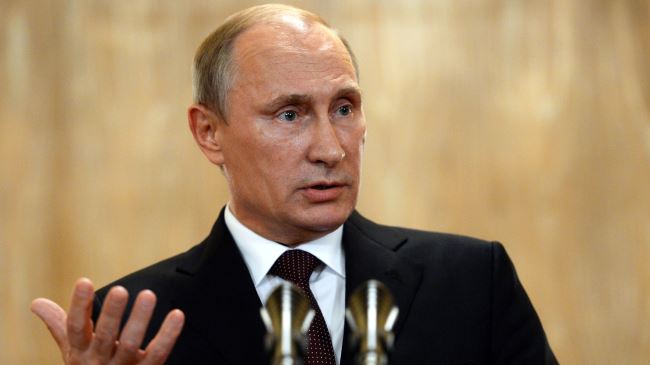
Russian President Vladimir Putin says certain countries play into the hands of terrorists and endanger regional security by bypassing international law and resorting to military force.
Putin made the remarks in a greeting message to the participants in a security conference in the Black Sea resort city of Sochi on Wednesday.
He stressed that the policy of unilateralism practiced by certain states is hindering efforts to ensure regional and global security.
“Some members of the international community have been increasingly trying to ignore the generally recognized norms and principles of the international law and resort to the use of military force bypassing the UN Security Council and refuse to hold talks as a key tool of resolving international disputes,” he said.
“This, in its turn, generates political and social instability and plays into the hands of terrorism, extremism and transnational crime, leading to the escalation of local conflicts and crises,” he added.
Earlier this month, the US, Britain and France launched a coordinated missile attack against sites and research facilities near Damascus and Homs with the purported goal of paralyzing the Syrian government’s “capability” to produce chemical arms.
The trio blamed the government of Syrian President Bashar al-Assad for a suspected gas attack in the Damascus suburb town of Douma on April 7.
Moscow said it has “irrefutable” evidence that the Douma incident was a “false flag” operation orchestrated by British spy services.
Elsewhere in his message, Putin expressed Russia’s readiness to engage in close security cooperation with foreign partners in both multilateral and bilateral formats.
The Russian president further noted that the Sochi conference will provide a good opportunity to discuss the options for countering various threats and challenges to international security.
The two-day event has gathered senior officials from more than 100 countries. Secretary of Iran’s Supreme National Security Council Ali Shamkhani is among the participants and is set to address the conference.
Corbyn set for showdown with Jewish groups that led protests against him
© Stephen Chung / Global Look Press
RT | April 24, 2018
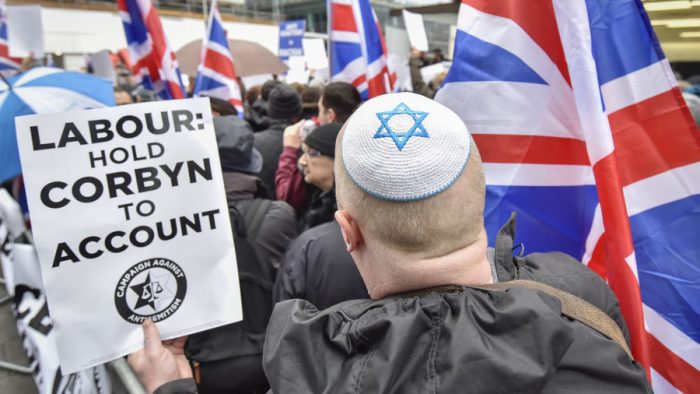
Jeremy Corbyn is set to face-off with Jewish leaders, weeks after they led protests against him, accusing him of failing to act against anti-Semitism and allowing pockets of anti-Semitism in the Labour Party.
The Jewish Leadership Council and Board of Deputies of British Jews, which will meet with Corbyn today, delivered a letter to the Labour leader in late March, condemning his “systematic failure to understand and deal with anti-Semitism.” The groups believe that Corbyn has been slow to act on the recommendations of the 2016 Shami Chakrabarti inquiry into anti-Semitism within the party.
The Jewish groups want disciplinary cases expedited and elected officials thrown out if they share a platform with anti-Semites. Labour has said there must be “zero tolerance” of anti-Semitism within the party.
Last month, Corbyn apologized for “pockets of anti-Semitism” in the party, and stated that he wanted to “rebuild” confidence among Jewish groups. He was also slammed by some in the Jewish community for spending Passover with members of left-wing group Jewdas in his Islington constituency.
He has condemned anti-Semitism on many occasions but his critics, including many of his own MPs, have called on him to back up his words with actions, including by expelling former London mayor Ken Livingstone. The ex-mayor was suspended from the party in 2016 for [correctly] claiming that Hitler supported a Jewish homeland in the 1930s.
Co-chair of Jewish Voice for Labour Jenny Manson said the report should be fully implemented but there should “not be a witch-hunt.” While Manson said it was a “misery and tragedy” that some MPs have “received nasty anti-Semitic comments,” she suspected that the majority of such comments had been made on social media. She told BBC Radio 4’s ‘Today’ program that “it has not been properly worked out” who made the remarks.
Referring to the “Enough is Enough” demonstration organized by their groups, leaders from the Jewish Leadership Council and Board of Deputies of British Jews wrote: “Last month’s protest was a necessary moment of catharsis, as painful for Labour as it was for our community, but we cannot now return to ‘business as usual.’
“We need this to be a genuine turning point and will do everything we can to make it so. We can achieve this together if Mr Corbyn can fulfil his pledge to be our ‘militant ally’ in the fight against anti-Semitism and demonstrate his understanding that what is now needed is firm action and not just words.”
The meeting will also be attended by Labour’s recently appointed General Secretary Jennie Formby.
Featured Video

AIDS Inc. by Gary Null (2007)
or go to
Aletho News Archives – Video-Images
From the Archives
Clash of Civilization, Iran Part II
By Jamal Kanj – Intifada-Palestine.com – January 14, 2011
Israel’s survival kit is: perpetuate conflict, insecurity to rationalize collective hate and finally playing victim.
Devoid of conflict, Israel implodes internally; without hate, Zionism loses its justification; and playing eternal victim to continue blackmailing the West. Absence of this holy trinity, Israel ceases to exist.
From its inception, the house of Zion has mastered exploiting adversarial powers to advance Israel’s cause. For instance, their influence over the Democratic Party in the US began with President Truman’s bid for 2nd term election in 1948.
Responding to strong opposition from Secretary of State General George Marshall and Department experts urging against recognition of Israel, President Truman replied: “I’m sorry gentlemen but I have to answer to hundreds of thousands [Jewish voters] who are anxious for the success of Zionism. I do not have hundreds of thousands of [voting] Arabs among my constituents”
Zionists influence over liberal American politics was matched with the doctrinal school of Conservative theoreticians aligning the Republican Party’s platform with Israel’s objectives. The Neoconservative Zionists, coined Zioncons, invented the “Clash of Civilization” concept to fight Israel’s wars. … continue
Blog Roll
 Aletho News
- 12 Things Your Psychiatrist Was Trained Not to Tell You
- From Unipolar Universalism to Multipolar Civilizational Distinctiveness
- RSF military group defects, joins Sudanese army: State media
- Ireland goalkeeper refuses to play ‘Israel’ as squad weighs boycott
- China pushes back against US on Cuba, Iran
- Ukrainian Soldiers, Potential Mercenaries: Have Gun, Will Travel!
- Burnham’s UN debut… A masterclass in British disinformation
- Iran flights continue despite US aviation sanctions
- Global Tipping Points Lead the World Into a State of Entropy
- The day-after at the White House: USA and Xi Jinping
- If Americans Knew
- Israel forces Gazans to live in constant peril – Daily Update
- Deconstructing Netanyahu’s pants-on-fire UN rant – Daily Update
- Trump betrayed voters with his campaign lies and prioritized a foreign country once he took office
- Netanyahu calls Israel’s war in Gaza ‘opposite of genocide’ in UN speech to near-empty hall
- Settler Kidnappings: Torture, Sexual Abuse and Terrorisation of Palestinian Abductees as Israel Deepens Annexation of West Bank
- Gaza winter nears as 162,000 tents become unusable, raising fears of humanitarian crisis
- Netanyahu says, “It’s the opposite of genocide”; UN says Gaza economy is world’s ‘most severe crisis on record’ – Daily Update
- Israel’s US-Backed Assault on Gaza Has Created the ‘World’s Most Severe Economic Crisis on Record’: UN
- ‘Protecting U.S. Citizens’… From Israel
- ‘This is where I live now, the back of a truck’: a day in the life of a grandmother in Gaza
- No Tricks Zone
- New Study: Earth And Venus Surface Warmth Largely Explained By Convection And Lapse Rate, Not CO2 Or Radiation
- 2025 Nature Paper Claiming Worsening Global Drought Gets RETRACTED …Heavily Flawed
- New Study: ‘Global Drought Shows No Detectable Recent Acceleration Under Climate Warming’
- Economic Masterminds: German Socialists Suggest Taxing Productivity Gains Stemming From Using AI
- The South China Sea Has Not Been Cooperating With The Climate Change Narrative
- Energy Crisis: Germany Enters Heating Season With Historically Low Gas Reserve Fill Levels
- New Study: The Antarctic Ice Sheet Gained Mass From 2020-2024 Due To Staggering Snow And Ice Accumulation
- Study: Ocean Heating Rates From Thousands Of Years Ago ‘Dwarf’ Modern Ocean Heating Rates
- Climate Extremists Target, Attack Large-Scale Power Grid Infrastructure In Germany!
- New Study: Antarctic Ice Melt Has Contributed Less Than 1 Centimeter To Sea Level Rise In The Last 30 Years

