WHITE HELMETS: The Guardian Protects UK FCO Destabilisation Project in Syria
By John Schoneboom | 21st Century Wire | December 20, 2017
Today in Too Long Don’t Read : It’s hard to tell what’s going on in the world, isn’t it? Whom do you believe when there are competing, totally irreconcilable narratives out there? Are the White Helmets heroes or villains? The mainstream narrative has them as a neutral, unarmed, grassroots (and Oscar-winning) humanitarian group with no political affiliations, nominated for a Nobel Peace Prize.
Independent journalists, notably Vanessa Beeley, Eva Karene Bartlett, Patrick Henningsen, and Khaled Iskef, among a few others, suggest a radically different picture, in which the White Helmets are nothing more than a propaganda front for terrorist groups like the Al Nusra Front.
The Guardian, in defense of the heroic narrative, just published a piece by Olivia Solon that turns the propaganda charge against the critics of the White Helmets and refers to them as “a network of anti-imperialist activists, conspiracy theorists and trolls with the support of the Russian government.”
I read this article with great interest, wondering whether it would actually back-up its claims and refute the allegations head on. That is what it would do if it were actual journalism. It would give a fair accounting of the allegations and assess the evidence behind them. If it found the evidence lacking, it would say why, it would offer context, additional evidence, show why the supposed facts were wrong, etc. That would be journalism.
Solon didn’t do that. She mentioned only one video, the so-called Mannequin Challenge piece, and dismissed it as simply the stupid mistake the White Helmets and their apologists said it was. As for the few cases of White Helmet involvement in terrorist activity that Solon did acknowledge, she dismissed these as a case of a few bad apples that left the overall courageous heroic narrative intact.
Watch White Helmets “Mannequin Challenge” spoof rescue video:
How can we tell what’s going on in the world? I feel that one way is to examine the way narratives are defended, and the way challenges are treated. What Solon has done is not journalism. Her work does nothing to examine or investigate seriously. It only tries to dismiss and defame with tired old negative buzzwords like “conspiracy theory” or new ones like “Russia” — never mind that the three main journalists she offers in support of her Russian operation CONSPIRACY THEORY are from the UK, Australia, and Canada.
There is no substantive analysis at all. Nothing. Meanwhile she uncritically and with a straight face describes the US-backed mayhem-generating team of mercenaries and fanatics as an effort to “stabilize” Syria. The piece also contains serious errors, e.g., Patrick Henningsen is NOT an editor at Infowars. Since it is not true, somebody had to have made it up. Is that an innocent mistake, or a cheap attempt to discredit? All of this tells us something about Solon and the Guardian and our media generally and these are clues to what is going on in the world. Look at what is and is not there. Listen to the dogs that are not barking here.
What else did she leave out? Was it anything important? I’ve taken the liberty of compiling a skeletal, condensed list of some of the important, credible allegations and facts that, to my mind, deserve more attention and investigation than the glib, contemptuous dismissals offered by the likes of Olivia Solon.
These are all taken from articles by Vanessa Beeley except where noted. If I’ve gotten anything wrong I hope she or someone else will correct me. Now, if you believe Solon, you’ll dismiss all of it in one fell swoop: “Well that’s Beeley! She’s appeared on RT for god’s sake!” And that is exactly the desired effect, I presume, of articles like Solon’s. To cancel out reams of evidence by impugning the messengers with what amounts to fear-mongering and slander.
But the thing is, you don’t have to take Beeley’s word for it. If you follow the links to her articles, you can see the photos and the videos and find the documentation yourself. For now, just have a look at the list. It’s simplified. You’ll have to follow the links if you want more details. But just have a look. These are things Solon couldn’t, wouldn’t, and didn’t deal with in her hack job hit piece. There may be alternative interpretations of some of the photos and videos, and they might make an interesting argument. Solon unfortunately chose not to do that, however, and while she couldn’t be expected to cover everything in one newspaper article, see if you think credible journalism would ignore all of this:
THE CONDENSED CASE AGAINST THE WHITE HELMETS
All from Vanessa Beeley’s two articles unless other sources are mentioned:
White Helmets & ‘Local Councils’ – Is the UK FCO Financing Terrorism in Syria with Taxpayer Funds?
WHITE HELMETS: State Sanctioned Terrorism and Hollywood Poster Boys for War
1: White Helmets were started and largely trained not in Syria but in Turkey and Jordan, by James le Mesurier, a former British military intelligence officer who went on to become Vice President for Special Projects at the Olive Group, “a private mercenary organization that has since merged with Blackwater-Academi into what is now known as Constellis Holdings.”
2: White Helmets receive substantial funding from the US, the UK, and the EU, at least $150 million over 3 years, from the same parties that are supporting the rebels/terrorists. No political ties?
3: White Helmets only ever operated in territory controlled by terrorist groups like Al Nusra Front, ISIS, and Nour Al Din Zinki, the latter are notorious for filming themselves torturing and beheading a 12-year-old boy. When those groups are forced to move, the White Helmets move with them, often in the same buses, as when they abandoned East Aleppo.

Mohammad Jnued, White Helmet and Nusra Front supporter. (Collage taken from his Facebook account)
4: The White Helmet leader, Raed Saleh, is tied to extremists, a fact acknowledged even by the State Department’s Mark Toner. Saleh was actually deported from the US out of Dulles Airport in April 2016, with no reason being disclosed. He is a close colleague of Mustafa Al Haj Yussef, another White Helmets leader, whose social media accounts show him openly declaring allegiance to Ahrar Al Sham, calling for unity with Al Nusra, advocating the shelling and execution of civilians and other equally charming practices. Actually a recent survey of social media activity carried out by the Syrian War Blog has conservatively identified 65 White Helmet operatives who have professed their membership of, or alliance with, extremist groups like Ahrar Al Sham and Nusra Front or even ISIS.
Also, Clarity of Signal – Massive White Helmets Photo Cache Proves Hollywood Gave Oscar to Terrorist Group
5: The White Helmet group in East Aleppo was established by the president of the UK-funded East Aleppo Council (EAC), Abdulaziz Maghrabi, often photographed with, offering support for, and maintaining active militant membership with terrorist groups Abu Amara and Nusra Front.

Abdulaziz Maghrabi (circled) with Abu Amara, one of the most brutal terrorist organisations in East Aleppo working as “security” for Nusra Front aka Al Qaeda in Syria. (Photo from Maghrabi’s Facebook account)
6: White Helmets in Idlib were photographed taking part in demonstrations and calling for the “burning and destruction” of the towns Kafarya and Foua, which resisted occupation by the terrorists and suffered a siege that deprived its citizens of food, water, and medicine in addition to attacks that killed some 1300 residents. White Helmets also participated in luring children evacuated from these towns off their buses to their death by a truck bomb in an event known as the Rashideen Massacre.

On the left White Helmets are carrying banners calling for burning of Kafarya and Foua, two Shia Muslim villages in Nusra Front controlled Idlib. On right post taken from the Facebook account of White Helmet, Abdul Halim al Shehab “Exterminate Kafarya”.
7: Muawiya Hassan Agha was present at Rashideen, and he later became infamous for his involvement in the execution of two prisoners of war in Aleppo. For this rogue bad appleness he was supposedly fired from the White Helmets, although he was later photographed still with them. He has also been photographed celebrating “victory” with Nusra Front in Idlib. There have been at least three other executions on video that show White Helmet involvement, not just being present and immediately cleaning up, but celebrating, mistreating bodies, and otherwise not acting in a manner consistent with being a neutral humanitarian group.

White Helmets in Idlib, celebrating with Nusra Front. Muawiya is on left in hi-viz jacket. (Photo: screenshot from Nusra Front video)
8: Videos show White Helmets participating in Nusra Front operations, e.g., joining in the beating and encirclement of a Syrian civilian, thoroughly mingling in with heavily armed Nusra terrorists.
9: The main White Helmets center in East Aleppo was integrated into the Nusra Front compound, and was adorned with a variety of graffiti and flags affirming the White Helmet affiliation to various terrorist groups, but predominantly Nusra Front.
Watch video by Pierre Le Corf showing the proximity of White Helmet centre in Sakhour to Nusra Front headquarters:
10: Numerous civilian witnesses from Aleppo were unfamiliar with the term White Helmets but knew the group as the Nusra Front Civil Defense and reported its participation in executions and atrocities.
11: On multiple occasions, the White Helmets have been exposed staging rescue scenes for both photo and video, recycling images in multiple propaganda pieces.
12: Swedish Doctors for Human Rights analyzed a White Helmets video report and concluded “the measures inflicted upon those children, some of them lifeless, are bizarre, non-medical, non-lifesaving, and even counterproductive in terms of life-saving purposes…[including measures that] would have resulted in the death of the child, if not already dead.” The implication is that the White Helmets may have actually killed children and/or were using already-dead children “as propaganda props.”
13: The White Helmets have been filmed describing Syrian Arab Army bodies as “trash” and one particular video shows them flashing “V” signs while standing on bodies of Syrian soldiers piled onto a truck.

14: Many photos show White Helmet operatives carrying arms or posing, armed, with rebel groups including Nusra Front. At least one of them, Mo’ad Baresh, who was killed fighting against the Syrian Army, was an active rebel/terrorist while also a member of White Helmets.
15: The White Helmets claim to have saved over 90,000 lives but there is zero documentation of these lives — no names, no records of any kind.
16: The White Helmets’ critics cannot be described or dismissed as comprising only “fringe” voices. Eminent prize-winning journalist and filmmaker John Pilger described the White Helmets as “a complete propaganda construct.”

These are all things that can be looked up and verified, much of it is in photographs and videos, other bits are first-hand accounts from Syrian people via reporters who bothered to go there instead of reprinting Pentagon press releases. Solon and the Guardian do not even hint at the existence of a body of evidence like this, let alone debunk it.
If they had only tried, and made an honest effort, then an informative debate might have ensued. I am all ears for counter arguments. Let us subject all of this to scrutiny, by all means. Maybe there are errors, mistranslations, missing context, mistakes. If truth is what we’re after, we confront criticism squarely, not weasel away from it or ignore it.
The once-respectable Guardian declines the invitation, preferring to smear and ignore, a choice that speaks sad volumes about the paucity of arrows in its quiver. The whole thing suggests, I think, that we ought to consider that what has happened before — in the Cold War, in Vietnam, in Iraq — is happening again: that people with an interest in war are offering a narrative of lies for hearts, minds, and resources. To put it another way, we might want to consider seriously the possibility that they are gaslighting the hell out of us.

Screenshot taken from UK Column report on the Guardian clumsy hit piece.
***
John Schoneboom is an author currently working on his PhD project at Northumbria University, Surrealpolitik and Cultural Gaslighting.
LEARN MORE ABOUT THE WHITE HELMETS BY READING THE FOLLOWING ARTICLES:
Geneva Press Club Event:
“They Dont Care About Us”: The White Helmet True Agenda
BBC and Guardian Whitewash of UK FCO Funding Scandal in Syria
What to Expect From BBC Panorama and Guardian’s Whitewash of UK Gov’t Funding Terrorists in Syria
White Helmets Evidence Presented at Geneva Press Club:
Vanessa Beeley Presents Exposé on White Helmets at Swiss Press Club in Geneva
‘Global Britain’ – UK Funding a Shadow State in Syria
‘Global Britain’ is Financing Terrorism and Bloodshed in Syria and Calling it ‘Aid’
White Helmets – Hollywood Poster Boys:
WHITE HELMETS: State Sanctioned Terrorism and Hollywood Poster Boys for War
21st Century Wire:
New Report Destroys Fabricated Myth of Syria’s ‘White Helmets’
Initial Investigation into White Helmets:
Who are Syria’s White Helmets?
21st Century Wire article on the White Helmets:
Syria’s White Helmets: War by Way of Deception ~ the “Moderate” Executioners
Who Funds the White Helmets?
Secret £1bn UK War Chest Used to Fund the White Helmets and Other ‘Initiatives’
Original investigative report:
The REAL Syria Civil Defence Exposes Fake White Helmets as Terrorist-Linked Imposters
Irish Peace Prize Farce
Tipperary’s White Helmets Peace Prize: A Judas Kiss to the Antiwar Movement and Syria
White Helmets Executions
WHITE HELMETS: Severed Heads of Syrian Arab Army Soldiers Paraded as Trophies
CNN Fabricate News About the White Helmets
A NOBEL LIE: CNN’s Claim That ‘White Helmets Center in Damascus’ Was Hit by a Barrel Bomb
White Helmets Links to Al Nusra
WHITE HELMETS: Hand in Hand with Al Qaeda and Extremist Child Beheaders in Aleppo
Report by Patrick Henningsen
AN INTRODUCTION: Smart Power & The Human Rights Industrial Complex
Open Letter by Vanessa Beeley
White Helmets Campaign for War NOT Peace – Retract RLA & Nobel Peace Prize Nominations
Staged Rescue Videos
(VIDEO) White Helmets: Miraculous ‘Rag Doll Rescue’
White Helmets Oscar Award Farce:
Forget Oscar: Give The White Helmets the Leni Riefenstahl Award for Best War Propaganda Film
Cory Morningstar report:
Investigation into the funding sources of the White Helmets, including Avaaz, Purpose, The Syria Campaign
Open letter to Canadian MPs from Stop the War Hamilton (Canada):
Letter from the Hamilton Coalition to Stop War to the New Democratic Party in Canada ref the White Helmet nomination for the Nobel Peace Prize:
Open letter to Canada’s NDP Leader on Nobel Prize:
Letter to NDP from Prof. John Ryan protesting White Helmet nomination for RLA and Nobel Peace Prize.
Analyst Dismisses White House Claims Pyongyang Behind WannaCry
Sputnik – 20.12.2017
In a Wall Street Journal op-ed Monday, White House Homeland Security Adviser Tom Bossert announced that North Korea is responsible for the May 2017 “WannaCry” global cyberattack that targeted Windows computers and was allegedly aided by leaked National Security Agency technology.
In the article titled, “It’s Official: North Korea Is Behind WannaCry,” Bossert points the finger at North Korea for being behind the cybercrime in which millions of users’ computer data was encrypted and then ransomed for bitcoins. The attack slowed down after a mistake in WannaCry’s code revealed a kill switch that prevented infected computers from spreading the virus.
“Cybersecurity isn’t easy, but simple principles still apply. Accountability is one, cooperation another,” Bossert wrote in his article. “They are the cornerstones of security and resilience in any society. In furtherance of both, and after careful investigation, the US today publicly attributes the massive ‘WannaCry’ cyber attack to North Korea.”
In a White House press briefing Tuesday morning, Bossert claimed that the US came to this conclusion after a “careful investigation.”
“We don’t do this lightly,” Bossert said during the briefing. “We do so with evidence and with partners,” adding that Canada, New Zealand, Japan, Australia and the United Kingdom all agree that North Korea is responsible.
“While victims received ransom demands, paying did not unlock their computers,” the homeland security adviser wrote. “It was cowardly, costly and careless. The attack was widespread and cost billions, and North Korea is directly responsible.”
On Radio Sputnik’s Loud & Clear, financial policy analyst Daniel Sankey asserted his belief that North Korea is not behind the cyberattack.
“I’m a little suspicious myself. The drums of war have been beaten against [North Korea] for some time now and it’s very convenient that now this severe cyberattack is being laid against the doors of North Korea,” Sankey told hosts John Kiriakou and Brian Becker.
“And of course, as usual, we can take the intelligence community’s word for it because they know better than us and they published it in the Wall Street Journal — so it must be North Korea,” he added sarcastically.
“I am a little skeptical because a big part of the virus was extorting various users to send bitcoin in exchange for access to their files again. In the end, they stole about $55,000 in bitcoin and that’s not enough money for North Korea to trouble itself with,” Sankey said.
“Also, what is North Korea going to do with bitcoin? They need commodities, they need cash, they need access to different markets. They don’t need bitcoin. How are they going to turn that into oil or coal or various other things they need? How are they going to convert that into a convertible currency? It’s really not feasible.”
Although Bossert said that the US did “not make the allegation lightly,” he didn’t provide any solid evidence and simply alluded to National Security Agency and Microsoft research. He also referred to the UK’s determination in October that North Korea was responsible for the attack.
In May, security firms discovered a link between the ransomware and southern China during an investigation of the code’s notes, which revealed that WannaCry’s creators were fluent in a form of Chinese very common in that region.
According to security firm Flashpoint, which conducted the analysis, “A typo in the note, “帮组” (bang zu) instead of “帮助” (bang zhu) meaning “help,” strongly indicates the note was written using a Chinese-language input system rather than being translated from a different version. More generally, the note makes use of proper grammar, punctuation, syntax, and character choice, indicating the writer was likely native or at least fluent.”
Although the linguistic analysis of the code did not reveal any Korean, the US has still confidently asserted that North Korea is responsible, and Sankey believes it’s because the underlying problem behind the attacks actually has nothing to do with the hackers but with intelligence communities, who may be actually be responsible for the crimes.
“I think that the real problem is that intelligence communities are becoming aware of vulnerabilities in these systems, and rather than working with the private sector to protect consumers and peoples’ data, they are just sitting on those vulnerabilities so that they can use them later to hack systems.”
In his editorial, Bossert concludes, “Mr. Trump has already pulled many levers of pressure to address North Korea’s unacceptable nuclear and missile developments, and we will continue to use out maximum pressure strategy to curb Pyongyang’s ability to mount attacks, cyber or otherwise.”
With the Trump administration’s increased use of aggressive language against North Korea’s continued nuclear weapon tests and with this new allegation that the country is responsible for WannaCry, it doesn’t appear that the relationship between the two is going to be getting better anytime soon.
Guardian Newspaper Pushing Fake News: ‘Putin Plotting to Cut Off UK Internet’
21WIRE | December 18, 2017
Although not as intense as the US mainstream media, the UK mainstream outlets are producing their share of fabricated narratives intended to stoke fear into the minds of the British public.
This latest fish tale comes from The Guardian newspaper, as “defense correspondent” Ewen MacAskil attempts to revive a two year-old mainstream media conspiracy theory about a secret Russian plot to cut transatlantic undersea internet cables which connect Britain and the United States. MacAskil writes:
“Russia could pose a major threat to the UK and other NATO nations by cutting underwater cables essential for international commerce and the internet, the chief of the British defence staff, Sir Stuart Peach, has warned.
Russian ships have been regularly spotted close to the Atlantic cables that carry communications between the US and Europe and elsewhere around the world.”
It turns out that this latest attempt by The Guardian to stoke fear in the minds of the British public – is a recycled version of a 2015 piece of mainstream fake news, apparently stitched together by the New York Times. It reads like something out of Cold War B movie, with shades of the Hunt for Red October:
“Russian submarines and spy ships are aggressively operating near the vital undersea cables that carry almost all global Internet communications, raising concerns among some American military and intelligence officials that the Russians might be planning to attack those lines in times of tension or conflict.
The issue goes beyond old worries during the Cold War that the Russians would tap into the cables — a task American intelligence agencies also mastered decades ago. The alarm today is deeper: The ultimate Russian hack on the United States could involve severing the fiber-optic cables at some of their hardest-to-access locations to halt the instant communications on which the West’s governments, economies and citizens have grown dependent.”
It seems that in the absence of an actual threat, mainstream media outlets like The Guardian and the New York Times are left with nothing else but to fabricate various Russian subversion narratives – with no actual evidence ever presented – in order to construct a public perception that Russia is somehow undermining all aspects of British and American society.
The Guardian Lies About Syria
McKaskel’s Red October article also has a conspicuous statement where the author attempts to bracket Russia’s legal (unlike the US and Britain’s illegal covert and fly-over ops) intervention in Syria with ‘hybrid warfare’ and ‘destablising NATO’. The propaganda value here is breathtaking:
“As well as conventional military involvement in Syria, Russia has been accused of engaging in hybrid warfare, including cyberwarfare, aimed at destabilising NATO.”
Rather than investigate and publish real news, it seems that the once respected liberal standard bearer The Guardian is firmly in the mainstream media’s fake new camp – promoting the NATO member state and US-UK establishment conspiracy theory that Russia is plotting to do all manner of evil and subterfuge in Europe and the US.
Meanwhile, editors at the Guardian refuse to do an real investigation in the the full scope of the UK government’s covert slush fund in Syria. As 21WIRE reported earlier this month:
“The BBC will be carrying out a controlled journalistic “explosion” on their Panorama programme, airing tonight in the UK. Their report, dramatically titled, “Jihadis You Pay For” is about to expose UK Foreign and Commonwealth Office (FCO) for the funding of extremist and terrorist groups in Syria via their “Free Syrian Police” project set-up in ‘rebel-held’ areas of Syria since 2014. To referee this virtual clash of the titans, The Guardian has been drafted-in to do the honours.”
“The report, Jihadis You Pay For, will claim that Foreign Office money paid to the FSP reached people with links to the extremist group al-Nusra Front.” ~ The Guardian
 In fact, it was The Guardian newspaper who actively campaigned on behalf of the UK and US government-funded pseudo “NGO” known as the White Helmets to win the Nobel Peace Prize in 2016. This, despite the fact that this western ‘first-responder’ construct has clear links to al Qaeda terrorists affiliates in Syria.
Here is good example of how The Guardian has been spinning blatant fake news about Syria. In their Nobel Prize promotional piece for the White Helmets, they printed a number of false and misleading statements. Here is one of them:
“In Aleppo, 300,000 people are exposed to a relentless barrage of airstrikes. The Syrian government and Russia now seem intent on crushing Aleppo, the opposition’s last stronghold, before a new American president takes office.”
What the Guardian conveniently fail to mention is the fact that the terrorists brigades backed by NATO members and Gulf-states – only occupied East Aleppo with an estimated remaining population of around 160,000. In contrast, there were some 1.4 million Syrians living under government protection in the much larger West Aleppo. These residents were under siege by terrorist Hell Cannons and random mortar fire which claimed at least 11,000 innocent lives during the terrorist occupation of East Aleppo. This was a common mainstream media trick which was more or less standard practice across most mainstream corporate outlets. Unlike the fabricated and totally undocumented and very likely falsified claims by the White Helmets that they “saved 90,000 lives” between late 2013 and 2017, the 11,000+ civilians deaths in West Aleppo at the hands of NATO and Gulf-backed terrorists are all documented by the Aleppo Medical Association.
The Guardian also claim that the White Helmets are “volunteers” – when in fact they are paid a regular salary which is much higher than the national average salary in Syria – a fact conveniently left out in the Guardian’s apparent foreign office propaganda piece:
“This is the backdrop against which the White Helmets operate – a western-funded Syrian search-and-rescue organisation whose members put their lives at great risk to save civilians, receiving only a monthly stipend of $150.”
The Guardian’s “journalists” would never dare mention that the White Helmet’s ‘monthly stipend’ is far in excess of the standard salary for a Syrian Army soldier who makes far below $100 per month.
To call any this journalism would be a gross overstatement.
By this account, The Guardian are guilty of the most egregious form of propaganda throughout its shameful coverage of Syria over the last 7 years.
Read more about the White Helmets here.
SEE ALSO: The Guardian Exposed – Conning Public into Financing ‘Independent Journalism’
VIDEO: Watch this Fake rescue video filmed and released by the White Helmets
$200bn to reconstruct war-torn Syria… the US and its partners should pay
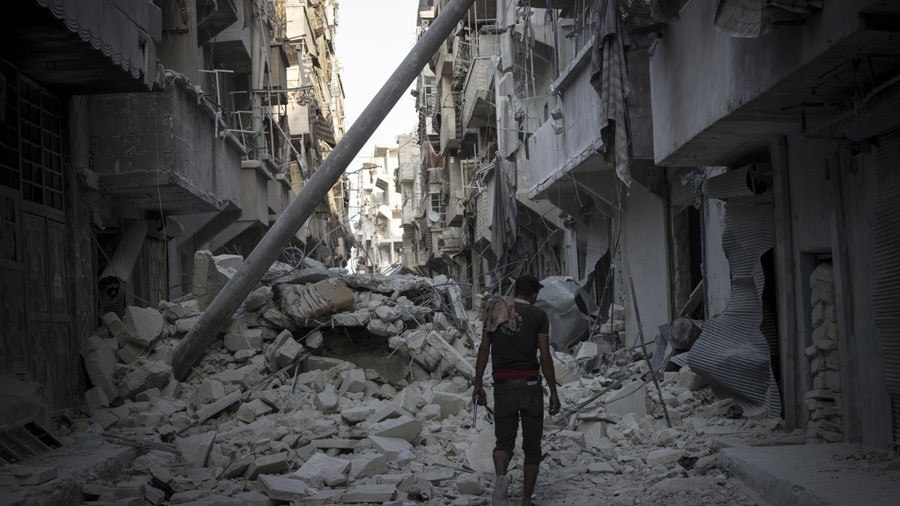
Aleppo, Syria © Karam Almasri / Global Look Press
By Finian Cunningham | RT | December 18, 2017
With Syria’s nearly seven-year war now virtually over, the process of rebuilding the devastated country comes to the fore, with the financial cost of that effort put at $200 billion. Who pays for it?
When you view the ruins of Aleppo alone, Syria’s second biggest city, plus the carnage across the entire country, from towns, villages, bridges, roads, public utilities, hospitals, schools, and so on, the real figure for reconstruction could be far higher than $200 billion.
Then there is the inestimable cost of human suffering and families decimated. All told, the reparations could amount to trillions of dollars.
Syria’s war was no ordinary civil war, as Western mainstream media tended to mendaciously depict it.
From the outset, the conflict was one of an externally driven covert war for regime change against the government of President Bashar Assad. The Arab Spring unrest of 2011 provided a convenient cover for the Western plot to subvert Syria.
The United States and its NATO allies, Britain, France, and Turkey, were the main driving forces behind the war in Syria, which resulted in up to 400,000 deaths and millions of citizens displaced from their homes. Other key regional players sponsoring the campaign against the Syrian government were Saudi Arabia, Qatar, and Israel.
Most of the militants who fought in Syria to overthrow the state authorities were not Syrian nationals. Self-styled jihadists from dozens of countries around the world made their way to Syria, where they were funded, armed and directed by covert forces from Western and Arab states.
The barbarian-like gravitation to Syria indicates the degree to which the effort to overthrow the Syrian government was orchestrated by foreign powers.
This was a planned, concerted project for regime change. The systematic violence imposed on Syria was very arguably due to an international criminal conspiracy perpetrated by the US and all of the above “partners.” The case can, therefore, be made for criminal responsibility.
That, in turn, means that financial reparations and damages can be sued by the Syrian state against those foreign powers which waged the war, albeit indirectly through proxy militant groups.
The bitter irony though is that the US and its Western allies are reportedly using Syria’s war-torn plight as leverage to pursue their political objective of ousting Assad. What these powers could not achieve on the battlefield with their terrorist mercenaries they now seem to be pursuing through their dominance over international financial institutions.
The Washington DC-based International Monetary Fund estimates the reconstruction of Syria’s devastated infrastructure will cost $200 billion. (As noted above, that’s probably a gross underestimate.)
As Bloomberg News reported last week: “The US and its European and Arab partners have for years insisted that Assad must go and are now using the carrot of funding for rebuilding the shattered nation in a final attempt to pressure the Syrian leader. The International Monetary Fund estimates the cost of reconstruction at $200 billion, and neither of Syria’s main allies, Russia and Iran, can afford to pick up the bill.”
It’s a moot point whether Russia and Iran cannot afford to help rebuild Syria. Who’s to say that those two powers along with China and other Eurasian nations could not club together to create a reconstruction fund for Syria, independent of Western countries and their Arab client regimes?
However, regardless of the source of funding for Syria, what Russia, China, Iran and other key international players should push for at the United Nations and other global forums such as the Non-Aligned Movement is the repudiation of Western efforts to link financial aid to future political change in Syria.
Alexander Lavrentiev, Russia’s envoy steering the peace process in Syria, has reiterated Moscow’s position that the political outcome for Syria must be determined by the Syrian people alone, free from external influence. That is also the position of several UN resolutions.
Lavrentiev says Bashar Assad should be free to run in next year’s presidential election if he chooses to and that it is unacceptable for the US and its allies to try to use financial aid as a bargaining tool.
“It’s a simplistic approach when some Western countries say that they’ll give money only when they see that the opposition comes to power or their interests are fully accommodated,” said the Russian envoy.
It’s not merely unacceptable for such Western conditioning. It’s outrageous. Far from quibbling about financial aid to Syria, the debate should be broadened out to hold governments to account for the destruction and loss of life in Syria.
To establish responsibility is not a mystery. Saudi Arabia, Qatar, and Turkey are known to have poured money and weapons into dozens of jihadist-styled groups, including Ahrar al-Sham and Jaysh al Islam under the umbrella of the Islamic Front or Army of Conquest. The precise distinction – if any – between these groups and the internationally proscribed terror organizations of Nusra Front (Hayat Tahrir al-Sham) and Daesh (Islamic State) is elusive and probably negligible.
American, British and French special forces are known to have trained militants under the faux banner of “moderate rebels” and “Free Syrian Army,” even when there is evidence these same groups were cooperating with Al-Qaeda-type extremist networks. Under President Barack Obama, the US government funneled $500 million into training “rebels” in Syria. Trump earlier this year closed down CIA training operations. This is, in effect, an admission of culpability by Washington of fueling the war.
The Americans and British forces were up to recently training the militant group Maghawir al Thawra at Al Tanf base on the Syrian-Iraqi border. The American government also funded another jihadist group Nour al-Din al Zenki, which came to notoriety in a video showing their members beheading a Palestinian boy.
Weapons caches recovered by the Syria Arab Army after the liberation of ISIS strongholds in Deir ez-Zor also show stockpiles of US-made arms and other NATO munitions, including anti-tank missiles.
The Western governments openly funded the fake emergency responders – the so-called White Helmets – who worked hand-in-hand as a propaganda front for Al-Qaeda-affiliated Nusra Front.
There have been systematic links between Western governments, their regional client regimes and the terror proxies who carried out the dirty war on their behalf in Syria over the past seven years.
It is an insult upon injury for Western governments to impose constraints on financial aid to Syria. Furthermore, the economic costs of reconstruction should not be levied on the Syrian people. Those costs should be paid in full by Washington and its partners who engaged in a criminal war on Syria.
Surely, Syria, Russia, Iran and other allied governments should form an international prosecution case for war crimes.
Not only should Washington, London, Paris and others be made to pay damages. Political and military leaders from these countries should be placed in the dock to answer personally for crimes against the Syrian people. To allow impunity is to let Washington and its rogue cohorts keep repeating the same crimes elsewhere, over and over.
Progress Report on the US-Russian War
The Saker • Unz Review • December 1, 2017
I am often asked if the US and Russia will go to war with each other. I always reply that they are already at war. Not a war like WWII, but a war nonetheless. This war is, at least for the time being, roughly 80% informational, 15% economic and 5% kinetic. But in political terms the outcome for the loser of this war will be no less dramatic than the outcome of WWII was for Germany: the losing country will not survive it, at least not in its present shape: either Russia will become a US colony again or the AngloZionist Empire will collapse.
In my very first column for the Unz Review entitled “A Tale of Two World Orders” I described the kind of multipolar international system regulated by the rule of law that Russia, China and their allies and friends worldwide (whether overt or covert) are trying to build and how dramatically different it was from the single World Hegemony that the AngloZionists have attempted to establish (and almost successfully imposed upon our suffering planet!). In a way, the US imperial leaders are right, Russia does represent an existential threat, not for the United States as a country or for its people, but for the AngloZionist Empire, just as the latter represents an existential threat to Russia. Furthermore, Russia represents a fundamental civilizational challenge to what is normally called the “West” as she openly rejects its post-Christian (and, I would add, also viscerally anti-Islamic) values. This is why both sides are making an immense effort at prevailing in this struggle.
Last week the anti-imperial camp scored a major victory with the meeting between Presidents Putin, Rouhani and Erdogan in Sochi: they declared themselves the guarantors of a peace plan which will end the war against the Syrian people (the so-called “civil war”, which this never was) and they did so without inviting the US to participate in the negotiations. Even worse, their final statement did not even mention the US, not once. The “indispensable nation” was seen as so irrelevant to even be mentioned.
To fully measure how offensive all this is we need to stress a number of points:
First, led by Obama, all the leaders of the West declared urbi et orbi and with immense confidence that Assad had no future, that he had to go, that he was already a political corpse and that he would have no role whatsoever to play in the future of Syria.
Second, the Empire created a “coalition” of 59 (!) countries, which failed to achieve anything, anything at all: a gigantic multi-billion dollar “gang that could not shoot straight” led by CENTCOM and NATO, which only proved its most abject incompetence. In contrast, Russia never had more than 35 combat aircraft in Syria at any time and turned the course of the war (with a lot of Iranian and Hezbollah help on the ground).
Next, the Empire decreed that Russia was “isolated” and her economy “in tatters” – all of which the Ziomedia parroted with total fidelity. Iran was, of course, part of the famous “Axis of Evil,” while Hezbollah was the “A-Team of terrorism”. As for Erdogan, the AngloZionists tried to overthrow and kill him. And now it is Russia, Iran, Hezbollah and Turkey who defeated the terrorists and will call the shots in Syria.
Finally, when the US realized that putting Daesh in power in Damascus was not going to happen, they first tried to break up Syria (Plan B) and then tried to create a Kurdish statelet in Iraq and Syria (Plan C). All these plans failed, Assad is in Russia giving hugs to Putin, while Iranian Revolutionary Guards Corp Quds Force Commander General Soleimani is taking a stroll through the last Syrian city to be liberated from Daesh.
Can you imagine how totally humiliated, ridiculed, and beaten the US leaders feel today? Being hated or resisted is one thing, but being totally ignored – now that hurts!
As for a strategy, the best they could come up with was what I would call a “petty harassment of Russia”: making RT sign up as a foreign agent, stealing ancient art from Russia, stripping Russian athletes from medals en masse, trying to ban the Russian flag and anthem from the Olympics in Seoul or banning Russian military aircraft from the next Farnborough airshow. And all these efforts have achieved is making Putin even more popular, the West even more hated, and the Olympics even more boring (ditto for Farnborough – the MAKS and the Dubai Air Shows are so much ‘sexier’ anyway). Oh, I almost forgot, the “new Europeans” will continue their mini-war against old Soviet statues to their liberators. It’s just like the US mini-war on the Russian representations in the US, a clear sign of weakness.
Speaking of weakness.
This is becoming comical. The US media, especially CNN, cannot let a day go by without mentioning the evil Russians, the US Congress is engaged in mass hysteria trying to figure out which of the Republicans and the Democrats have had more contacts with the Russians, NATO commanders are crapping their pants in abject terror (or so they say!) every time the Russian military organizes any exercise, the US Navy and Air Force representatives regularly whine about Russian pilots making “unprofessional intercepts”, the British Navy goes into full combat mode when a single (and rather modest) Russian aircraft carrier transits through the English Channel – but Russia is, supposedly, the “weak” country here.
Does that make sense to you?
The truth is that the Russians are laughing. From the Kremlin, to the media, to the social media – they are even make hilarious sketches about how almighty they are and how they control everything. But mostly the Russians are laughing their heads off wondering what in the world the folks in the West are smoking to be so totally terrified (at least officially) by a non-existing threat.
You know what else they are seeing?
That western political leaders are seeking safety in numbers. Hence the ridiculously bloated “coalitions” and all the resolutions coming out of various European and trans-Atlantic bodies. Western politicians are like schoolyard nerds who, fearing the tough kid, huddle together to look bigger. Every Russian kid knows that seeking safety in numbers is a surefire sign of a scared wimp. In contrast, the Russians also remember how a tiny nation of less than 2 million people had the courage to declare war on Russia and how they fought the Russians hard, really hard. I am talking about the Chechens of course. Yeah, love them or hate them – but there is no denying that Chechens are courageous. Ditto for the Northern Alliance in Afghanistan. The Russians were impressed. And even though the Nazis inflicted an unspeakable amount of suffering on the Russian people, the Russians never deny that the German soldiers and officers were skilled and courageous. There is even a Russian saying “I love/respect the courageous man in the Tatar/Mongol” (люблю молодца и в татарине). So Russians have no problem seeing courage in their enemies.
But US/NATO armies? They all act as if Conchita Wurst was their Commander in Chief!
Remember this:
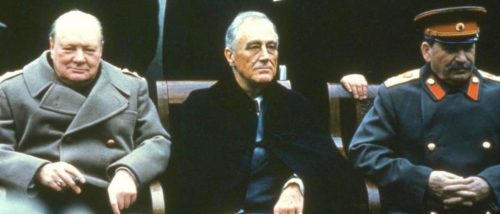
None of these men were kind or “nice” in any way. But they mattered. They were relevant. And they wielded some very real power.
Today, real power looks like this:
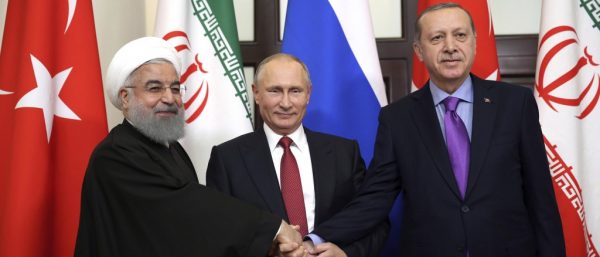
And you know what is really offensive to the AngloZionist leaders?
That this photo shows one Orthodox Christian and two Muslims.
Now that’s offensive. And very frightening, of course.
We are very, very far from the “birth of a new Middle East” promised by Condi Rice (it is a new Middle East alright, just not the one Rice and the Neocons had in mind!)
As for the “only democracy in the Middle East” it is now in full panic mode, hence its now overt plan to work with the Saudis against Iran and its clearly staged leaks about bombing all Iranian assets up to 40km from the Israeli border. But that train has already left the station: the Syrians won and no amount of airstrikes will change that. So just to make sure they still look really fierce, the Israelis are now adding that in case of a war between Israel and Hezbollah, Secretary General Hassan Nasrallah would be a target. Wow! Who would have thought?!
Can you hear the giggles coming out of Beirut?
The scary thing is that the folks in DC, Riyadh and Jerusalem hear them loud and clear which means that sooner or later they will have to do something about it and that “something” will be the usual nonsensical bloodbath this “Axis of Kindness” has been made famous for: if you can’t beat their military, make their civilians pay (think Kosovo 1999, Lebanon 2006, Yemen 2015). Either that or beat the shit out of a tiny, defenseless victim (Grenada 1983, Gaza 2008, Bahrain 2011). Nothing like a good massacre of defenseless civilians to make them feel manly, respected and powerful (and, for US Americans – “indispensable”, of course).
Setting aside the case of the Middle East, I think we can begin to see the outlines of what the US and Russia will be doing in the next couple of years.
Russia: the Russian strategy towards the Empire is simple:
- Try to avoid as much as possible and for as long as possible any direct military confrontation with the US because Russia is still the weaker side (mostly in quantitative terms). That, and actively preparing for war under the ancient si vis pacem para bellum strategy.
- Try to cope as best can be with all the “petty harassment”: the US still has infinitely more “soft power” than Russia and Russia simply does not have the means to strike back in kind. So she does the minimum to try to deter or weaken the effects of that kind of “petty harassment” but, in truth, there is not much she can do about it besides accepting it as a fact of life.
- Rather than trying to disengage from the AngloZionist controlled Empire (economically, financially, politically), Russia will very deliberately contribute to the gradual emergence of an alternative realm. A good example of that is the Chinese-promoted New Silk Road which is being built without any meaningful role for the Empire.
US: the US strategy is equally simple:
- Use the Russian “threat” to give a meaning and a purpose to the Empire, especially NATO.
- Continue and expand the “petty harassment” against Russia on all levels.
- Subvert and weaken as much as possible any country or politician showing any signs of independence or disobedience (including New Silk Road countries)
Both sides are using delaying tactics, but for diametrically opposite reasons: Russia, because time is on her side and the US, because they have run out of options.
It is important to stress here that in this struggle Russia is at a major disadvantage: whereas the Russians want to build something, the Americans only want to destroy it (examples include Syria, of course, but also the Ukraine or, for that matter, a united Europe). Another major disadvantage for Russia is that most governments out there as still afraid of antagonizing the Empire in any way, thus the deafening silence and supine submissiveness of the “concert of nations” when Uncle Sam goes on one of his usual rampages in total violation of international law and the UN Charter. This is probably changing, but very, very slowly. Most world politicians are just like US Congressmen: prostitutes (and cheap ones at that).
The biggest advantage for Russia is that the United States are internally falling apart economically, socially, politically – you name it. With every passing year the once most prosperous US is starting to look more and more like some backwater Third World country. Oh sure, the US economy is still huge (but rapidly shrinking!), but that is meaningless when financial wealth and social wealth are conflated into one completely misleading index of pseudo-prosperity. This is sad, really, a country that ought to be prosperous and happy is being bled to death by the, shall we say, “imperial parasite” feeding on it.
At the end of the day, political regimes can only survive by the consent of those they rule. In the United States this consent is clearly in the process of being withdrawn. In Russia it has never been stronger. This translates into a major fragility of the US and, therefore, the Empire (the US is by far the biggest host of the AngloZionist imperial parasite) and a major source of staying power for Russia.
All of the above applies only to political regimes, of course. The people of Russia and of the US have exactly the same interests: bringing down the Empire with the least amount of violence and suffering as possible. Like all Empires, the US Empire mostly abused others in its formative and peak years, but as any decaying Empire it is now mostly abusing its own people. It is therefore vital to always repeat that an “Empire-free US” would have no reason to see an enemy in Russia and vice-versa. In fact, Russia and the US could be ideal partners, but the “imperial parasites” will not allow that to happen. Thus we are all stuck in an absurd and dangerous situation which could result in a war which would completely destroy most of our planet.
For whatever it’s worth, and in spite of the constant hysterical Russophobia in the US Ziomedia, I detect absolutely no sign whatsoever that this campaign is having any success with the people in the US. At most, some of them naively buy into the “the Russians tried to interfere in our elections” fairy tale, but even in this case this belief is mitigated by “no big deal, we also do that in other countries”. I have yet to meet an American who would seriously believe that Russia is any kind of danger. I don’t even detect superficial reactions of hostility when, for example, I speak Russian with my family in a public place. Typically, we are asked what language we are speaking and when we reply “Russian” the reaction normally is “cool!”. Quite often I even hear “what do you think of Putin? I really like him”. This is in severe contrast with the federal government whom the vast majority of Americans seem to hate with a passion.
To summarize it all, I would say that at this point in time of the US-Russian war, Russia is winning, the Empire is losing and the US is suffering. As for the EU it is “enjoying” a much deserved irrelevance while being mostly busy absorbing wave after wave of society-destroying refugees proving, yet again, the truth of the saying that if your head is in the sand, your ass is in the air.
This war is far from over, I don’t even think that we have reached its peak yet and things are going to get worse before they get better again. But all in all, I am very optimistic that the Axis of Kindness will bite the dust in a relatively not too distant future.
Boris Johnson breathes new life into ‘Russian meddling’ fairy story – introducing Facebook trolls
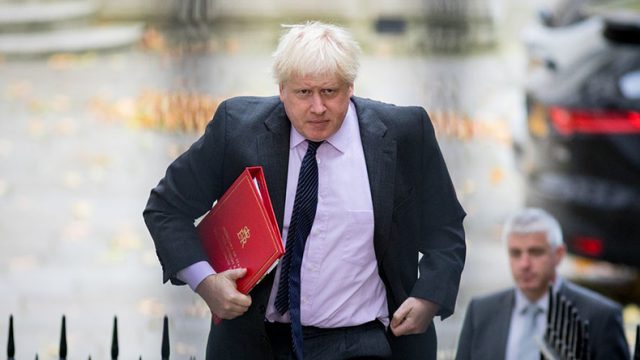
© Tom Nicholson / Global Look Press
RT | December 17, 2017
With the Russian Brexit meddling story unravelling almost as badly as Brexit itself, Boris Johnson has found a new angle. The latest dead cat to grace the table is a cabal of “Russian trolls” on Facebook.
“There’s some evidence that there has been Russian trolling on Facebook,” Johnson said, referring to Brexit, in an interview with the Sunday Times as he elucidated his brand new theory of the Russian meddling in the fateful vote. At the same time, he admitted that he had “seen no evidence” of the Russian alleged meddling affecting the referendum outcome in any way.
With less than a dollar spent, it is hardly surprising that the outcome of the referendum was unaffected. Indeed, an investigation conducted by Facebook at the request of no less than the UK Electoral Commission revealed that Russia spent as much as 73p ($0.97) on ads to allegedly influence Brexit. And that is without mentioning the fact that the ads themselves were about migration and the wider European context.
It is not the first time the British foreign secretary has been forced to admit that there is no evidence Russia has ever sought to interfere with British votes; even within the last month he has done so at least twice. In late November, he told the House of Commons that the government saw “no evidence of any country successfully interfering with our robust electoral system.”
At the beginning of the same month, he also said that he had not seen any evidence of the Russian meddling, adding that as far as he knows “[the Russians] have played no role” in Brexit. Characteristically, though, Boris is thinking outside the box and all these admissions have not stopped him from throwing various accusations at Moscow – without providing any evidence.
In late November, right after stating that no one had interfered in the British electoral system, Johnson stated vaguely that “we know of course that Russia seeks to undermine our institutions.” This time he decided not to hold back, and accused Moscow of a multitude of sins.
He went as far as to call Russia a “closed, nasty, militaristic and antidemocratic” state, comparing it with ancient Sparta at the time of the Peloponnesian war. Dismissing this latest remark, the Russian Foreign Ministry’s spokeswoman Maria Zakharova somewhat coldly noted on her Facebook page that “Russia has never been a militaristic country, unlike the European states.”
She added that Johnson was right about one thing: the ongoing issues sown and stirred up by the West, on the European continent in particular, weaken Western civilization in the same way the Peloponnesian war denuded the readiness of both Sparta and Athens to face external enemies.
Meanwhile, regardless of whether Johnson is speaking about Brexit, relations with Russia or any other subject, one might point out that he does a more than adequate job of trolling himself. He has done so on many occasions, such as showing empathy with the victims of colonialism by quoting Kipling in Burma.
Then there was his statesmanlike grasp of the importance of information management, telling a parliamentary committee what a British Citizen was doing in Iran and thereby getting her thrown in jail. And Johnson set a new standard for political car-crash BBC interviews, during which he was likened to a figure from a classic comedy skit. And all that in the past six months alone.
SYRIA: US War Crime in Jabal Al Tharda, Deir Ezzor and the Implausible Denials
By Prof. Tim Anderson | 21st Century Wire | December 17, 2017
On 17 September 2016 a carefully planned US-led air raid on Jabal al Tharda (Mount Tharda), overlooking Deir Ezzor airport, slaughtered over 100 Syrian soldiers and delivered control of the mountain to DAESH / ISIS. After that surprise attack, the terrorist group held the mountain for almost a year, but did not manage to take the airport or the entire city. US-led forces admitted the attack but claimed it was all a ‘mistake’. However uncontested facts, eye witness accounts and critical circumstances show that was a lie. This article sets out the evidence of this crime, in context of Washington’s historical use of mercenaries for covert actions, linked to the doctrine of ‘plausible deniability’.
Syrian eyewitness accounts from Deir Ezzor deepen and confirm this simple fact: the US-led air raid on Syrian forces at Jabal al Tharda on 17 September 2016 was no ‘mistake’ but a well-planned and effective intervention on behalf of the terrorist group ISIS (DAESH in Arabic). After days of careful surveillance a devastating missile attack followed by machine gunning of the remaining Syrian soldiers helped ISIS take control of the strategic mountain, that same day.

Colonel Kanaan on the mountain. October 2017. (Photo: Tim Anderson)
Mercenary forces – like ISIS and the other jihadist groups in Iraq and Syria – were a staple of US intervention during the early decades of the cold war, deployed in more than 25 conflicts, such as those of the Congo, Angola and Nicaragua. Whatever their claimed aims and ideologies, they allowed for the ‘multiplication’ of US power and were associated with the doctrine of ‘plausible deniability’, where the ‘formal’ denial of the mastermind role in covert operations minimised damage to domestic public opinion and international relations (Voss 2016: 37-40).
That doctrine was discussed during the 1976 Church Committee hearings into CIA covert operations (especially assassinations and coups) and resurfaced during the Iran-Contra scandal of the 1980s (Hart 2005; Dorn 2010). The key idea behind the doctrine is to be able “to use violence without directly incriminating the [contracting out] regime” (Ron 2002). The use of terrorist proxy armies in Iraq and Syria, both overtly and covertly supported by US forces, is thoroughly consistent with this history.
By September 2016 a US-led coalition had been active in both Iraq and Syria for more than two years, supposedly to help Iraq fight ISIS, but without permission to enter Syria. The foreign powers tried to side-step that legal problem by claiming the invitation from Iraq allowed them to conduct cross border raids against ISIS (Payne 2017). By this time the Russian air force had been assisting Syria for almost a year against multiple terrorist groups, all of them, as senior US officials would admit (Biden in RT 2014 and Usher 2014; Dempsey in Rothman 2014), armed and financed by the US and its allies.

Syrian solider at the front line against ISIS, on the Euphrates. (Photo: Tim Anderson)
Contrary to the stated aims, there is little evidence the US-led group did anything to fight ISIS in Syria. Washington’s group sat back and watched ISIS twice take over Palmyra (in 2015 and 2016), then did nothing to help the Syrian Army take back Palmyra and Deir Ezzor. Most US activity focused on bombing Syrian infrastructure and helping a Kurdish-led separatist force (the SDF) replace ISIS in the city of Raqqa. On the other hand, the 17 September air raid positively helped ISIS in attempts to wrest the remaining parts of Deir Ezzor from the Syrian Army.
US, Australian, British and Danish forces quickly admitted their role in that attack, but claimed the slaughter of over 100 Syrian soldiers was a ‘mistake’. Now mistakes in war do happen. However they are usually associated with a single, unprepared incident. This attack was well-planned, sustained and achieved a key objective in the attempt to drive ‘the Syrian regime’ from Deir Ezzor. Assisting extremists create an ‘Islamic State’ in eastern Syria, US intelligence wrote back in August 2012, was “exactly” what Washington wanted so as “to weaken the regime in Damascus” (DIA 2012).
One year later, as Syrian forces re-took the whole of Deir Ezzor city from ISIS, I spoke with the commanding officer at Jabal al Tharda on that day, Colonel Nihad Kanaan, one of 35 survivors of the US-led attack. He confirmed US admissions that surveillance aircraft had overflown the mountain days before. He also said that the Syrian Army had held the mountain for many months and that their position was clearly marked with Syrian flags. One year later he still showed shock at recalling attack aircraft return to finish off his wounded comrades, with line-of-sight machine-gunning (Kanaan 2017).
That Washington could block most western media from serious study of this treacherous attack, simply by saying ‘sorry, mistake’, is testament to the near absence of critical media voices, at a time of war. The surprise attack was treacherous, not only to the Syrians whom the US had promised to not attack, but to the western populations who mostly believed what their governments said: that they were in Iraq and Syria ‘to fight ISIS’.
It was not that the denials over the crime at Jabal al Tharda were particularly ‘plausible’, just that they had been made. Formal denial was enough, it seems, to stop the western corporate and state media in its tracks. The practice of ‘plausible deniability’ was never so much intended to fool those familiar with the facts, as it was to set up a shield of formal denial which might be used to deflect or discredit ‘potentially hostile’ investigations (Voss 2016: 40; Bogan and Lynch 1989: 205). In past and present propaganda wars, less importance is given to independent evidence than to insistent repetition, denunciation and distraction.
This paper is a prosecuted case, not reportage where one side says this and the other side says that. I have announced my conclusion at the outset and intend to demonstrate that case with evidence. I also support the idea that readers are entitled to see all evidence, including the cover story of the criminals. However in this case the crime and its authors, I suggest, can be convincingly established by uncontested facts. Review of the Syrian perspective simply helps deepen our understanding of the conflict.
1. Uncontested facts
There are eight elements of this massacre where the facts are virtually uncontested:
1: First, the attack was on the forces of a strategic opponent, whom the US wished to overthrow, weaken or ‘isolate’;
2: Second, there was no semblance of provocation;
3: Third, this was a well-planned operation, with days of advance surveillance;
4: Fourth, the attack was sustained and effective, meeting conventional military objectives;
5: Fifth, there was both immediate and longer term benefit to ISIS;
6: Sixth, the US gave false locality information to the Russians before the attack, and their ‘hotline’ to Russia was defective during the attack;
7: Seventh, the US made false claims about being unable to identify Syrian troops;
8: Eighth, the US ‘investigation’ was hopelessly partisan, self-serving and forensically useless; there was no attempt to even contact the Syrian side.
Let’s look at each element in a little more depth
ONE: the attack was on a strategic opponent
Syrian forces were seen as adversaries. This was no ‘friendly fire accident’. The political leadership of the US-led operation had called for the dismissal or overthrow of the Syrian Government and had provided material support to armed opponents of the Government since mid-2011. The terrorist group ISIS had a campaign to create an Islamic State in the region and that objective was shared by Washington. US intelligence, in August 2012, had expressed satisfaction at extremist plans for a “salafist principality” (i.e. an Islamic State) in eastern Syria, “in order to isolate the Syrian regime” (DIA 2012).
The US had not admitted providing finance and arms to ISIS / DAESH, but several senior US officials acknowledged in 2014 that their ‘Arab allies’ had done so (Anderson 2016: Ch.12). After the attack US and Australian officials referred to their victims as forces aligned with the ‘Syrian regime’ (Johnston 2016; Payne 2017), reinforcing the fact that the assailants did not recognise Syrian soldiers as part of a legitimate national army.
TWO: no suggestion of provocation
There was no suggestion of any provocation, as had happened in previous ‘mistakes’; for example where a pilot had mistaken gunfire or fireworks for a hostile attack. This attack was premeditated.
THREE: a well-planned operation, with substantial surveillance
All sides agree this was a carefully planned operation, with surveillance days in advance. Colonel Nihad Kanaan, the Syrian Arab Army commanding officer on ‘Post Tharda 2’ (a military post on the second of three peaks of Tharda mountain range) that day, told this writer that US-coalition surveillance aircraft were seen “repeatedly circling” the area on 12 September, 5 days before the attack (Kanaan 2017). US reports confirm this. On the day of the attack the New York Times cited US Central Command saying that “coalition forces believed they were striking a DAESH fighting position that they had been tracking for a significant amount of time before the strike” (Barnard and Mazzetti 2016). A US military report, some weeks after the attack, said a “remotely piloted aircraft” (RPA) was sent to “investigate” the area the day before and two RPAs revisited the same area on the 17th, identifying two target areas with tanks and personnel (Coe 2016: 1).

General Aktham at the bridge to Raqqa, one of many destroyed by US planes. (Photo: Vanessa Beeley)
Australian Defence Minister Marise Payne wrote that “target identification was based on intelligence from a number of sources”, and that the US-led group had “informed Russian officials prior to approving air strikes on the DAESH position” (Payne 2017). Australian Chief of Joint Operations Vice-Admiral David Johnston pointed out that his country’s contribution to the attack had included “an Australian E7 Wedgetail airborne early warning and control and 2 FA-18 hornet strike fighters” (Johnston 2016). The Wedgetail E-7 is based on a Boeing 737 and came into operation in 2015. It is an intelligence and control aircraft said to have “tonnes of electronic wizardry” (Military Shop 2014) and to be “the most advanced air battlespace management capabilities in the world” (RAAF 2017). All this speaks of a well-planned and technologically capable operation.
Further, surveillance of the area over two years meant the US group were well aware of the strategic troop placements. Kuwait based Journalist Elijah Magnier, who had followed the battles around Deir Ezzor, said that defence of the airport depended on ‘four interconnected Syrian army positions on the Thardah mountain range. Largely because of these elevated fire power positions the “daily attacks’ by ISIS on the airport had failed (Porter 2016: 6). Fabrice Balanche, a leading French expert on Syria, adds that the Syrian Army had held positions along the Tharda range “from March 2016 until the US air strikes”, when ISIS took control (in Porter 2016: 6).
FOUR: the attack was sustained and effective, meeting conventional military objectives
The attack was carried out for an extended period and destroyed the Syrian Arab Army post, killing more than 100 soldiers and destroying tanks and all heavy equipment (O’Neill 2016; Kanaan 2017). The Syrian commander says the attack “continued for 1.5 hours, from 5.30 to 7pm”, as night fell (Kanaan 2017). There is some disagreement over exact times. Syrian Army Command said the attack began at about 5pm while US CentCom said the attack began earlier but “was halted immediately when coalition officials were informed by Russian officials that it was possible the personnel and vehicles targeted were part of the Syrian military” (Barnard and Mazzetti 2016). However the US military confirms that this sunset attack was extended, lasting for just over an hour (Coe 2016: 1).
The Syrian command said at first that 62 soldiers had been killed and 100 injured (RT 2016). Within a short time the numbers killed had been raised to “at least 80” (Killalea 2016). In addition, three T-72 tanks, 3 infantry vehicles and anti-aircraft gun and 4 mortars were destroyed (MOA 2016). A surviving solider said he saw planes “finishing with machine guns our soldiers who tried to take refuge … I saw with my own eyes the death of about 100 soldiers” (SFP 2016).
Colonel Kanaan puts the final number of dead at 123, with 35 survivors (Kanaan 2017). The US side did not bother reporting numbers killed, with General Richard Coe at first mentioning “15 dead regime loyalists” (Watkinson 2016) then late simply saying “Syrian regime/aligned forces were struck” (Coe 2016: 2). There is no report of ISIS forces on the mountain being struck by the coalition aircraft that day; nor any day over the next year.
FIVE: the attack created immediate and longer term benefit to ISIS
The Syrian side made it clear that the massacre had allowed an almost simultaneous ISIS attack on and takeover of the hill. After planes had pounded the Army position on the mountain, ISIS quickly moved in and took full control of the mountain range (FNA 2016a). Within hours they had posted video of themselves standing on the bodies of the Syrian soldiers, killed by the air strikes (Charkatli 2016). The US side failed to comment on the immediate consequence of their attack, but they did not contradict the Syrian and Russian reports. Colonel Nihad Kanaan confirms that, as the US strikes were being carried out, ISIS attacked the Syrian Army post at Thardah 2. Survivors had to flee, as they did not have time to repel the DAESH attack (Kanaan 2017). Syrian Army defences meant that ISIS did not manage to take the airport, but Syrian forces did not retake the mountain until early September 2017, when the Syrian Army broke the siege and began to liberate the entire city (Brown 2017).

Victory! Father and son at Deir Ezzor markets. October 2017. (Photo: Tim Anderson)
SIX: false information to and delayed communications with Russia
The US military report admits that “incorrect information [was] passed to the Russians” about the locale of the attack. They said:
“the strikes would occur 9 kilometres south of DAZ ‘airfield’. However this information was incorrect, as the strikes were planned approximately 3 to 6 kilometres south of the airfield and 9 kilometres south of Dayr az Zawr city. This may have affected the Russian response to the notification and caused considerable confusion in the DT process” (Coe 2016: 3).
Brigadier General Richard Coe agreed with reporters that this misleading information prevented a Russian intervention: “had we told them accurately, they would have warned us”, he admitted (Porter 2016: 4). Providing false information to Russia was quite consistent with a plan to protect the attack from any unwanted interference.
After that, there was yet another ‘mistake’. The US military admits there was a half hour delay in responding to a Russian alarm (that the US was striking Syrian forces) on their specially constructed ‘hotline’. The US military tried to shift blame for this delay to the Russian caller:
“when the Russians initially called at 1425Z, they elected to wait to speak to their usual point of contact (POC) rather than pass the information immediately to the Battle Director. This led to a delay of 27 minutes, during which 15 of the 37 strikes were conducted” (Coe 2016: 3).
The less benign view of this event was that the ‘hotline’ was left unattended during the attack. Haddad (2017) reported that: “During the attack, a hotline between Russia and US forces was reportedly left unattended for 27 minutes” (Haddad 2017). Certainly Russia had to ring twice to pass on the urgent message (McLeary 2016) and, by that time, the attack was virtually complete.
SEVEN: the US made false claims about non-identification of Syrian forces
The US military apologia relies heavily on claims that, despite their several days of surveillance, they identified “irregular forces” on the mountain. US General Coe claims that “in many ways, the group looked and acted like the (Islamic State) forces we have been targeting for the last two years” (Dickstein 2016). Echoing this story, Australian Vice-Admiral David Johnston, Chief of Joint Operations said
“in many ways these forces looked and acted like DAESH fighters the coalition has been targeting for the last 2 years. They were not wearing recognisable military uniforms or displaying identifying flags or markings” (Johnston 2016).
Colonel Kanaan said they had flags flying. The US military confirms this, admitting that they received a report about sighting a “possible [Syrian] flag … 30 minutes prior to the strike”, but did nothing about it (Coe 2016: 2). Could ‘doing nothing’ have been just another ‘mistake’, in such a well-planned operation? It tends to corroborate the case for a deliberate strike, with some attempt at cover up, for “plausible deniability”.
EIGHT: the US ‘investigation’ was hopelessly partisan
A brief report issued in November exonerated US forces of any wrong doing. It did admit some critical facts, as noted above. But this was the US military investigating itself. US General Richard Coe said:
“We made an unintentional, regrettable error, based on several factors in the targeting process” (Watkinson 2016).
The ‘errors’ relied upon were a series of random or ‘human’ mistakes and misidentification of the Syrian troops, supposedly because they were dressed in an irregular way. No attempt was made to contact the Syrian side (Coe 2016; Dickstein 2016). By reference to principles of criminal law some admissions made in this report are important and would be admissible evidence in a criminal trial. But the conclusions of the US report are entirely ‘self-serving’ and ‘recent inventions’ after the event. For that reason they are forensically worthless.
Summing up, the US-led air attack was a pre-meditated, brutal and effective massacre of the armed forces of a declared opponent. It gave an immediate and longer term advantage to one of the terrorist groups the US and its allies (as Biden and Dempsey admitted) were covertly supporting.
Even before we consider the Syrian perspective, uncontested facts destroy the feeble claim that this well planned and treacherous crime was a ‘mistake’. The US military admits that it gave false information to its Russian counterparts, then admits that its ‘hotline’ did not function properly during the attack. Despite all their sophisticated technology and days of surveillance, they pretend they could not distinguish between entrenched Syrian troops and terrorist ISIS gangs. They admit they had a report of a Syrian flag, but claim they just neglected it.
Having carried out a devastating attack on Syrian forces that day, allegedly by ‘mistake’, they did not return even once over the following year to attack the ISIS encampment on the mountain. This is as flimsy a cover story as any criminal has ever presented in court. If the commanders of this appalling massacre ever faced criminal charges, no independent tribunal could fail to convict.

Syrian soldiers at the Eurphrates, October 2017. (Photo: Tim Anderson)
2. The cover story
The ‘defence’ case centres around three matters.
First, they say that the 2014 request for assistance against ISIS from the Government of Iraq gave authority to the US coalition to venture into Syria.
Second, they insist that there was no intent to kill Syrian soldiers.
Third, they argue that their slaughter of soldiers was due to poor intelligence and mistaken identification.
Other aggravating factors were random ‘errors’. Then, by way of general excuse, and alluding to the supposed bases of human error, there was reliance on the ‘complexity’ of the situation. US CentCom, in its apologia, said ‘Syria is a complex situation’ (RT 2016); a phrase echoed by Australian Prime Minister Turnbull who said “it is a very complex environment” (Killalea 2016). None of this is compelling but, as was mentioned at the outset, the history of ‘plausible deniability’ rests not so much on its actual plausibility as on formal denials; that is thought sufficient to distract, intimidate and raise doubts.
The US apologia was repeated by its collaborators. Australian involvement in Syria had already been criticised at home (Billingsley 2015). After the attack on Jabal al Tharda, this writer wrote to ask Australian Prime Minister Malcolm Turnbull about the massacre and the legal basis for Australian air force presence in Syria. Defence Minister Marise Payne responded on 4 May 2017, addressing the legal question in the following way. Australia’s presence in Syria, the Minister claimed, came from a request made by the Government of Iraq for international assistance against DAESH/ISIS:
“The legal basis for ADF operations against DAESH in Syria is the collective defence of Iraq … The Government of Syria has, by its failure to constrain attacks upon Iraqi territory originating from DAESH bases within Syria, demonstrated that it is unable to prevent DAESH attacks” (Payne 2017).
Indeed, two Iraqi ministers of foreign affairs had made requests to the UN Security Council in June 2014 (Zebari 2014) and again in September 2014 (al Ja’fari 2014). Those requests referred to “thousands of foreign terrorists of various nationalities” coming across the border from eastern Syria (Zebari 2014). Both requests also stressed the need to respect national sovereignty. So the US-led forces might have relied on this argument, had they helped Syria reclaim its eastern cities and regions from ISIS. However, as discussed above, they did not.
On the general legal authority question there is one relevant matter. The Australian side was not so confident about its own law, before the strike. Two weeks before the attack it was said that the chief of the Australian Defence Forces Mark Binskin had “fears that Australian Defence Force members could be prosecuted in Australian courts for military actions that are legal internationally [sic]” (Wroe 2016). It is not clear why they were considering this matter at that time, two years after they had committed forces to Iraq and Syria.
The general apologia for the massacre relied on a supposed lack of intent. “We had no intent to target Syrian forces,” said Air Force Brigadier General Richard Coe. He blames, in part, the soldiers’ form of clothing. “The group looked and acted like the (Islamic State) forces we have been targeting for the last two years” (Dickstein 2016). In addition, Coe claimed, the soldiers displayed “friendly” interactions with other groups in an Islamic State “area of influence.” He blamed the massacre on “human factors,” including miscommunications and an optimistic view of the intelligence (Dickstein 2016).
Taking the ‘mistake’ cover story at face value (i.e. assuming that the attack was aimed at ISIS, and defending Syrian forces), some western commentators quickly suggested the massacre of Syrian soldiers represented an alarming turn to US coalition air support for the ‘Syrian regime’. Time magazine said “the location of the strike in Deir al-Zour suggested the raid could have been a rare, even unprecedented attempt to assist regime forces battling ISIS”. Similarly, Faysal Itani, senior fellow at the Atlantic Council tweeted: “U.S. airstrikes on ISIS in such close proximity to regime positions are unusual. Arguably constitute close air support for regime” (Malsin 2016). Following the same logic, but in open disbelief, Russia’s UN Ambassador Vitaly Churkin asked:
“Why would, all of a sudden, the United States chose to help the Syrian Armed forces, defending Deir Ezzor? After all they did nothing when ISIL was advancing on Palmyra … All of a sudden the United States decides to come to the assistance of Syrian armed forces defending Deir Ezzor?” (Hamza 2016).
Of course, they did not decide to do that, nor did they ‘assist’ Syrian forces. Nor did Russia believe the attack was a mistake. Damascus was also under no such illusions. President Bashar al Assad, invoking the wider antagonistic role of the US, said the surprise attack “was a premeditated attack by the American forces … the raid continued more than one hour, and they came many times” (Haddad 2017).
The US report of November 2016 became the core of explanations from US collaborators in the attack. Australian Vice-Admiral David Johnston gave more detail on Australian involvement in the Jabal al Tharda attack before he presented the official US version of events (Johnston 2016). The coalition air contingent, which included Australian aircraft, had “conducted multiple air strikes against what was believed to be DAESH fighters near Deir Ezzor”, he said. The Australian contingent had included “an Australian E7 Wedgetail airborne early warning and control and 2 FA-18 hornet strike fighters”, along with aircraft from the US, UK and Denmark. These planes carried out the attack “under the coordination and control of the US combined air operations centre” (Johnston 2016). The Australians were thus deeply involved in intelligence and coordination.
Johnston repeated the self-exonerating conclusions of the US report: “The air strikes were conducted in full compliance with the rules of engagement and the laws of armed conflict”. The investigation found that the decisions that identified the targets as DAESH fighters were supported by the information available at the time … [there was] no evidence of deliberate disregard of targeting procedures or rules of engagement” (Johnston 2016). He repeated the line that situation on the ground in Syria was “complex and dynamic. In many ways these forces looked and acted like DAESH fighters … They were not wearing recognisable military uniforms or displaying identifying flags or markings” (Johnston 2016).
A typical shallow Australian media review of the incident would admit that “something went badly wrong”; but then asserted, based more on loyalty than anything else: “no credible person suggest the RAAF pilots committed war crimes; everyone knows things go wrong in war” (Toohey 2016). Yet some independent, more detailed western commentaries expressed stark disbelief at the cover story. David MacIlwain complained about the failure of media scrutiny of Australia’s role in Iraq and Syria, asking why US coalition forces had not returned immediately to the mountain to correct their “mistake” (Macilwain 2016). Lawyer James O’Neill said, far from a mistake, “what happened at Deir Ezzor is entirely consistent with the long-standing American aim of regime change in Syria” (O’Neill 2016).
This “error” which killed over 100 soldiers who were defending Deir Ezzor from ISIS, was the only serious attack on what US coalition forces “believed to be DAESH fighters” near Deir Ezzor city. US-led forces would do nothing to help liberate Deir Ezzor. The ‘innocent massacre’ story just does not accord with known facts
3. The Syrian Perspective
For those not bound by wartime propaganda attempts to demonise or prohibit the ‘enemy’ media (a demand which results in reliance on US, British and French media), a Syrian perspective on the crime at Jabal al Tharda helps deepen our understanding. Sources in this section are Syrian, Lebanese, Iraqi, Iranian and Russian. We can speak of a Syrian perspective from the wider view, concerning the particulars of the attack and of events after that attack.
In the wider view the Syrian side has seen the US as the mastermind of all terrorist groups in Syria, making use of regional allies in particular Saudi Arabia, Qatar, Israel and Turkey. The Syrian armed forces make little distinction between ISIS and the western jihadist groups, which collaborate from time to time and whose members pass from one to the other, depending mainly on pay rates (Lucente and Al Shimale 2015). When Aleppo was liberated ISIS flags were seen alongside those of the al Nusra led coalition (RT 2016). Both international terrorist groups fought together for many years with the other jihadist groups which western governments had tried to brand as ‘moderate rebels’ (e.g. Paraszczuk 2013; Mowaffaq 2015).
The Syrian Government has regularly expressed ‘strong condemnation’ of US attacks on civilians and infrastructure, calling the group a “rogue coalition” which had added “new bloody massacres” to its record of “war crimes and crimes against humanity” (RT 2017).
US forces mounted several direct attacks on Syrian forces, over 2015-2017. An online investigative group has compiled information of four such attacks, between mid-2015 and mid 2017: on Saeqa airbase in Deir Ezzor (December 2015); on Jabal al Tharda (September 2016); on Shayrat Airbase (April 2017) and an attack on an SU-22 aircraft near Tabqa (June 2017) (MMM 2017). In June 2017 the US group also attacked Syrian forces near the southern al Tanf border crossing (Islam Times 2017). All attacks had different pretexts.
US bombing in Deir Ezzor at the time of the Jabal al Tharda attack (in the name of anti-ISIS operations) was notable for its destruction of infrastructure, in particular the destruction of seven bridges across the Euphrates in September and October 2016 (Syria Direct 2016; SANA 2016). Syrian Army sources told Iranian media that the US aimed to extend its influence in the region and stop the Syrian Army’s advance, as also to cut supply routes between the provinces and separate Deir Ezzor’s countryside from the city’ (FNA 2016a). Syrian General Aktham told me that the US bombing of bridges was to isolate Deir Ezzor, when the city was under siege from ISIS (Aktham 2017).
Direct US support for ISIS had been reported many times in Iraq, over 2014-2015. This was mainly to do with arms drops and helicopter evacuation assistance, as Iraqi forces struggled to contain a strong ISIS offensive. Iraqi MP Nahlah al Hababi said in December 2014 that the US coalition was “not serious” about air strikes on ISIS; she added that “terrorists are still receiving aid from unidentified fighter jets in Iraq and Syria” (FNA 2015a).
In February 2015 there were multiple and more specific reports. The Salahuddin Security Commission said that “unknown planes threw arms … to the ISIL” in Tikrit city (FNA 2015c). Majif al Gharawi, an Iraqi MP on the country’s Security and Defence Commission said that the US was “not serious” in its anti-ISIS fight, and that it wanted to prolong the war to get its own military bases in Mosul and Anbar (FNA 2015b). Jome Divan, member of the Sadr bloc in the Iraqi parliament, said the US coalition was “only an excuse for protecting the ISIL and helping the terrorist group with equipment and weapons” (FNA 2015b). Khalef Tarmouz, head of the al Anbar Provincial Council, told Iranian media that his Council had discovered weapons that were made in the USA, Europe and Israel, in areas liberated from ISIS in the al Baghdadi region (FNA 2015b). Hakem al Zameli, head of the National Security and Defence Committee, reported that Iraqi forces had shot down two British planes carrying weapons for ISIS, and that US planes had dropped weapons and food for ISIS in Salahuddin, al Anbar and Diyala provinces (FNA 2015b).
In other words, within a few months of the US military re-entering Iraq in late 2014, on a ‘fight ISIS’ pretext, there were several reports of exactly the reverse, from senior Iraqi figures. Although these reports were in English, none of them reached the western media. Apparently those channels had no interest in listening to those actually affected by ISIS, or perhaps they just saw it as unthinkable that their own governments were lying to cover up their support for terrorism.
On the Jabal al Tharda massacre, the Syrian Government immediately said that the strike was no mistake but “a very serious and flagrant aggression” which had aided DAESH (Barnard and Mazzetti 2016). President Assad said the troops were deliberately targeted, pointing out that there had been an hour of bombing (Watkinson 2016). “It was a premeditated attack by the American forces, because ISIS was shrinking”, said the Syrian President (Haddad 2016). Russian President Vladimir Putin suggested the attack must have been deliberate:
“Our American colleagues told us that this airstrike was made in error. This ‘error’ cost the lives of 80 people and, also just ‘coincidence’, perhaps, ISIS took the offensive immediately afterwards … [But] how could they make an error if they were several days in preparation?” (Putin in RT 2016).
Russian spokesperson Maria Zakharova said the attack showed the world that “The White House is defending ISIS” (FNA 2016a). More detail was hinted at. President of the Syrian Parliament, Hadiya Khalaf Abbas, said that Syrian intelligence had intercepted an audio recording between the US and ISIS before the airstrike on Deir Ezzor (Christoforou 2016). Syrian UN Ambassador Bashar al Jaafari denounced the attack as a movement from proxy aggression to “personal aggression”, lamenting the US renunciation of the Russian-US agreement of 9 September to combat al Nusra and ISIS (Mazen 2016).

Col Kanaan at the attack site, at Jabal al Tharda. (Photo: Tim Anderson)
The detail of eye-witness evidence gives a fuller picture. In October 2017, as the Syrian Army was liberating Deir Ezzor city, Syrian film-maker Sinan Saed and I interviewed Colonel Nihad Kanaan at Jabal al Tharda, where the attack took place. He told us they had seen US coalition surveillance aircraft on 12 September. On the day of the attack:
“Five Coalition aircraft began attacking the site. The fifth aircraft had a synchronized [line of sight] machine gun … I had 2 T-72 tanks, 2 BMP tanks, a 57mm gun on its base, and a 60mm mortar on a base. The aircraft first began attacking the arsenal. They did this by circling the site at very close distance. Once they were done targeting the arsenal, they began targeting the soldiers with perfect precision” (Kanaan 2017).

Col Kanaan at the attack site, at Jabal al Tharda. (Photo: Tim Anderson)
He says the raid continued for 1.5 hours, using missiles, bombs and machine guns. As the attack took place, ISIS launched “a very heavy attack” from the north-west shoulder of the mountain, using:
“all types of weapons- 14.5 mm, mortars, BKC machine guns and every other weapon they had. This was happening at the same time. They [ISIS] were attacking the post while the aircraft were bombing from above” (Kanaan 2017).
ISIS was using the US-coalition air strikes as cover as they advanced on the army posts, showing “connection and coordination between the US Coalition and ISIS”. The post fell and the airport was then cut off from the Maqaber road. “Then 2 aircraft bombed the actual airport from the Tharda 2 post” (Kanaan 2017).

Col Kanaan at the attack site, at Jabal al Tharda. (Photo: Tim Anderson)
Colonel Kannan’s group was flying Syrian flags, as the US military would later admit:
“When the Coalition aircraft attacked the post, the post had 3 Syrian flags up – one at the entrance, one in the middle and one at the forefront, and the soldiers were wearing the official military uniforms of the Syrian Arab Army … It is not true what the media reported, that the attack was a mistake. It was very clear that their target was the Syrian army and the Syrian soldiers. The Syrian flags were there, and the Syrian army uniforms were showing, and the site was so obviously belonging to the Syrian army. At the same time, ISIS were attacking us under their cover; the Coalition aircraft didn’t even shoot one bullet at them” (Kanaan 2017).

Eyewitness to the attack, Dr al Abeid in surgery at Deir Ezzor hospital. October 2017. (Photo: Tim Anderson)
There were other eye witnesses. A wounded solider saw dozens of his comrades being finished off with aircraft machine gunning (SFP 2016). Two days before speaking with Colonel Kanaan I had met Doctor Abd al Najem al Abeid, surgeon and head of Deir Ezzor health. As he rushed to the surgery from a group meeting I asked him a question about which I was embarrassed:
‘have you seen any sign of the US coalition helping remove DAESH [ISIS] from Deir Ezzor?’
I asked it this way because I wanted the answer to an open question for a western audience. But as I asked I also apologised, because I knew that the question, to an educated Syrian, would be rather insulting. He immediately said that the US forces had only helped ISIS and that he had seen the attack on Jabal al Tharda. He watched in shock for more than half an hour, as the aircraft attacked the strategic mountain base he knew was guarding the city (Abeid 2017). After that he rushed off to surgery to dig ISIS drone shrapnel from the abdomen of a young boy.

Children in Deir Ezzor, after liberation by the Syrian Arab Army. October 2017. (Photo: Tim Anderson)
After the massacre, reports of US forces providing logistic and intel support to ISIS, aiding regroupings and evacuations came from all along the Euphrates in late 2017, as Syrian forces took back Deir Ezzor. In September Press TV reported that the US had evacuated 22 DAESH commanders from Deir Ezzor.
This writer was in the city for 4 days in late October, as it was being liberated. On 26 August a US air force helicopter was reported as taking two DAESH commanders “of European origin” with family members. On 28 August another 20 DAESH field commanders were also taken by US helicopters from areas close to the city (Press TV 2017a). Then in November Muhammad Awad Hussein told Russian media he had seen US helicopters evacuate more DAESH fighters, after an airstrike outside al Mayadin, a city south of Deir Ezzor (Press TV 2017b). The anti-Syrian Government and British-based ‘Syrian Observatory for Human Rights’ confirmed that US helicopters were transferring DAESH fighters out of eastern Syria. Four DAESH members, including three Egyptians, and a civilian were taken from a house in Beqres, a suburb of Deir Ezzor which had been used as an arms depot (UFilter 2017).
Lebanese and Iranian media corroborated these reports. US forces were backing up ISIS with intelligence during the Syrian Army troops’ operation to liberate the town of Albu Kamal in Southeastern Deir Ezzur, according to the Secretary-General of Iraq’s al-Nujaba Resistance Movement Sheikh Akram al-Ka’abi. The al-Mayadeen news network quoted Sheikh al-Ka’abi saying that the US forces tried hard to push the Syrian army’s operation in Albu Kamal towards failure, and that US forces were targeting pro-government resistance forces before the AbuKamal battle, in ultimately unsuccessful attempts to block their advances (FNA 2017).
In late 2017 the Russian Defence Ministry announced it had evidence that “the US-led coalition provides support for the terrorist group Islamic State”. The US military had twice rejected Russian proposals to bomb identified ISIS convoys retreating from al Bukamal, saying that they enjoyed the protection of international law. That shielding of the terrorist group and its heavy weapons allowed them to regroup and carry out new attacks (TNA 2017). At the same time the US backed deals by the Kurdish-led SDF militia to allow ISIS fighters and their families to leave Raqqa for other parts of the region (Paterson 2017).
A senior Syrian General in Deir Ezzor confirmed to me helicopter evacuations from three points on the east bank of the Euphrates: south Deir Ezzor, east al Mayadeen and al Muhassan. He also spoke of US satellite intelligence being passed to ISIS. From this catalogue of US coordination and collaboration I asked him: ‘you must feel that you are fighting a US command?’ “100%” he responded (General SR 2017).
4. Assessment
As the Syrian Army liberated eastern Syria, over 2016-2017, the US military tried to slow its advance by a series of covert and overt actions. The massacre of more than 100 soldiers at Jabal al Tharda was one of five direct US attacks on Syrian forces, since 2015. Mistakes do happen in war, but this was no isolated mistake. The US-led attack on this strategic anti-ISIS base, protecting Deir Ezzor city, was a pre-meditated slaughter of Syrian forces which allowed ISIS to advance its plan to take the city. As it happened, Syrian Army defences meant that they did not do that. A series of uncontested facts make it clear this was a well-planned and deliberate strike, in support of ISIS. The US military gave false information to its Russian counterparts about the attack, left their ‘hotline’ unattended and hid evidence that showed they knew Syrian forces held the mountain. Having destroyed Syrian forces on that base, they did not return to attack ISIS on the mountain. Their cover story was weak and, while it served to block investigation by the western media, does not hold up to any serious scrutiny.
No independent tribunal would fail to convict US coalition commanders of this bloody massacre.
US and Australian denials over their responsibility for the 17 September 2016 massacre at Jabal al Tharda are not credible, on any close examination. However they did serve their immediate purpose. Most of the western corporate and state media was stopped in its tracks. Yet the crime was “entirely consistent with the long standing American aim of regime change in Syria … [and] the Australian Government provided a willing chorus to the regime change demands of the Americans” (O’Neill 2016).
North American, British and Australian arms sales to the chief ISIS sponsors, the Saudis, could proceed without interruption or scrutiny (Begley 2017; Brull 2017). The cold war doctrine of ‘plausible deniability’, as on many previous occasions, helped deflect ‘potentially hostile’ investigations. Nevertheless, I urge closer examination of this crime, using conventional principles of criminal law, considering the uncontested evidence and ignoring the intimidation of war propaganda. Particularly adventurous western observers might even read the Syrian perspective, drawing on Syrian, Lebanese, Iraqi, Iranian and Russian sources. That would help deepen their understandings of the conflict.
Watch video with Prof Tim Anderson in Deir Ezzor, made by Sinan Saed and Nisreen Al Khadour:
…
Bibliography
Al Abeid, Abd al Najem (2017) Interview with this writer, Deir Ezzor Hospital, 21 October. Dr al Abeid was, at this time, head of Deir Ezzor Health and a surgeon at the city’s main hospital.
Al Ja’fari, Ibrahim al-Usharqir (2014) ‘Annex to the letter dated 20 September 2014 from the permanent representative of Iraq to the United Nations addressed to the President of the Security Council’, United Nations Security Council, S/201/691, 20 September, online: https://www.justsecurity.org/wp-content/uploads/2015/12/Iraq-Letter-Requesting-US-Help-09202014.pdf
Aktham, General (2017) Interview with this writer, 21 October, Deir Ezzor
Barnard, Anne and Mark Mazzetti (2016) ‘U.S. admits airstrike in Syria, meant to hit ISIS, killed Syrian troops’, New York Times, 17 September, online: https://www.nytimes.com/2016/09/18/world/middleeast/us-airstrike-syrian-troops-isis-russia.html
Begley, Patrick (2017) ‘Senate pressures Defence for answers on Saudi Arabian military deals’, Sydney Morning Herald, 30 March, online: http://www.smh.com.au/federal-politics/political-news/senate-pressures-defence-for-answers-on-saudi-arabian-military-deals-20170329-gv996s.html
Billingsley, Anthony (2015) ‘Australian bombs won’t bring peace to Syria, so why do it?’, The Conversation, 31 August, online: http://theconversation.com/australian-bombs-wont-bring-peace-to-syria-so-why-do-it-46674
Bogen, David and Michael Lynch (1989) ‘Taking Account of the Hostile Native: Plausible Deniability and the Production of Conventional History in the Iran-Contra Hearings’, Social Problems, Vol. 36, No. 3 June, pp. 197-224
Brown, Matt (2017) ‘Syria breaks Islamic State siege on eastern city, opens a new phase in the war’, ABC News, 6 September, online: http://www.abc.net.au/news/2017-09-06/syria-breaks-is-siege-deir-ezzor-opens-a-new-phase-in-the-war/8876668
Brull Michael (2017) ‘Christopher Pyne Spruiks Aussie Arms To Saudi Arabia As UN Warns Of Impending Yemen Famine’, New Matilda, 13 November, online:https://newmatilda.com/2017/11/13/christopher-pyne-spruiks-aussie-arms-to-saudi-arabia-as-un-warns-of-impending-yemen-famine/
Charkatli, Izat (2016) ‘Video: ISIS militants cheer atop Syrian soldiers killed by US air strikes’, Al Masdar, 18 September, online: https://www.almasdarnews.com/article/video-isis-militants-cheer-atop-syrian-soldiers-killed-us-air-strikes/
Christoforou, Alex (2016) ‘Syrian MP: ‘Syrian intelligence intercepted audio recording between US and ISIS before airstrike on Deir ez-Zor’, The Duran, 26 September, online: http://theduran.com/syrian-mp-syrian-intelligence-intercepted-audio-recording-between-us-isis-airstrike-deir-ez-zor/
Coe, Richard (2016) ‘Memorandum for USAFCENT/CC’, Centcom, 2 November, online: http://www.centcom.mil/Portals/6/media/REDACTED_FINAL_XSUM_Memorandum__29_Nov_16___CLEAR.pdf
DIA (2012) ‘Intelligence report ‘R 050839Z Aug 2012’, Levant Report, August, online: https://levantreport.com/2015/05/19/2012-defense-intelligence-agency-document-west-will-facilitate-rise-of-islamic-state-in-order-to-isolate-the-syrian-regime/
Dickstein, Corey (2016) ‘Investigation: US, coalition airstrikes likely killed Syrian government forces’, Stars and Stripes, 29 November, online: https://www.stripes.com/news/investigation-us-coalition-airstrikes-likely-killed-syrian-government-forces-1.441745
Dorn, Walter (2010) ‘Plausible Deniability Plausible Deniability or How Leaders May Try to or How Leaders May Try to Conceal Their Roles Conceal Their Roles’, ICC Prosecutor presentation, 18 May, Walter Dorn, online:http://walterdorn.net/pdf/PlausibleDeniability_PPT_ICC-OTP_Presentation_Dorn_ReducedSize_18May2010_10June2011.pdf
Fadel, Leith (2016) ‘US Coalition knew they were bombing the Syrian Army in Deir Ezzor’, Al Masdar News, 27 September, online: https://www.almasdarnews.com/article/us-coalition-knew-bombing-syrian-army-deir-ezzor/
FNA (2015a) ‘Iraqi Hezbollah: Unidentified Planes Supplying ISIL with Arms from Saudi Arabia’, Fars News Agency, 10 January, online: http://en.farsnews.com/newstext.aspx?nn=13931020001065
FNA (2015b) ‘Iraq’s Popular Forces Release Photo of Downed US Chopper Carrying Arms for ISIL’, Fares News Agency, 28 February, online: http://en.farsnews.com/newstext.aspx?nn=13931209001345
FNA (2015c) ‘Iraqi Army Downs 2 UK Planes Carrying Weapons for ISIL’, Fars News Agency, 23 February, online: http://en.farsnews.com/newstext.aspx?nn=13931204001534
FNA (2016a) ‘Syrian people to file lawsuit against US over Deir Ezzor massacre’, FARS News Agency, 5 October, online: https://www.sott.net/article/330331-JASTA-blowback-Syrian-people-to-file-lawsuit-against-US-over-Deir-Ezzur-massacre
FNA (2016b) ‘Source Discloses Coordination between US, ISIL in Attacking Syrian Army in Deir Ezzur’, Fars News Agency, 18 September, online: http://en.farsnews.com/newstext.aspx?nn=13950628000914
FNA (2017) ‘Iraqi leader accuses US of providing intel to terrorists’, Fars News Agency, 26 November, online: http://en.farsnews.com/newstext.aspx?nn=13960905001064
General SR (2017) Interview with this writer, Deir Ezzor, 22 October. I have kept this Syrian General’s name private.
Haddad, Tareq (2017) ‘At least 30 dead in Deir ez-Zour after Isis launches biggest attack in Syria for months’, International Business Times, 14 January, online: http://www.ibtimes.co.uk/least-30-dead-deir-ez-zour-after-isis-launches-biggest-attack-syria-months-1601091
Hamza (2016) ‘Russia’s ambassador Vitaly Churkin exposes US actions in Syria’, YouTube, 18 September, online: https://www.youtube.com/watch?v=i4LVLajdhek
Hart, Gary (2005) ‘Intelligence Abuse Déjà Vu’, Huff Post, 21 December, online: https://www.huffingtonpost.com/gary-hart/intelligence-abuse-deja-v_b_12686.html
Islam Times (2017) ‘US Attacks on Syrian Forces in Al-Tanf a Blatant International Law Breach’, 11 June, online: http://islamtimes.org/en/doc/article/644956/
Johnston, David (2016) ‘Vice Admiral David Johnston speaks about the investigation findings’, ABC TV, 30 November, online: http://www.abc.net.au/news/2016-11-30/vice-admiral-david-johnston-speaks-about-syria-investigation/8077656
Kanaan, Nihad (2017) Interview with this writer at Mount Tharda (Deir Ezzor, Syria), 23 October. Colonel Nihad Kanaan was the Syrian Arab Army commanding officer at Post Tharda 2 on 17 September 2016.
Killalea, Debra (2016) ‘Syria air strikes mistake: At least 80 dead, Russia, US cast blame’, News Corp, 19 September, online: http://www.news.com.au/world/middle-east/syria-air-strikes-mistake-at-least-80-dead-russia-us-cast-blame/news-story/9470b270a7b4fc3e260878475f8274b3
Lucente, Adam and Zouhir Al Shimale (2015) ‘Free Syrian Army decimated by desertions’, Al Jazeera, 11 November, online: http://www.aljazeera.com/news/2015/11/free-syrian-army-decimated-desertions-151111064831800.html
Macilwain, David (2016) ‘Australia clears itself of blame in Deir ez-Zor bombing, watches on as Palmyra falls to ISIS’, Russian Insider, 12 December, online: http://russia-insider.com/en/aleppo-palmyra/ri18136
Malsin, Jared (2016) ‘How a Mistaken U.S.-Led Air Attack Could End the Syria Cease-Fire’, Time, 18 September, online: http://time.com/4498493/how-a-mistaken-u-s-led-air-attack-could-end-the-syria-cease-fire/
Mazen (2016) ‘Al-Jaafari: US-led coalition aggression on Syria means moving from a proxy aggression into “personal aggression”, SANA, 21 September, online: http://sana.sy/en/?p=88633
McLeary, Paul (2016) ‘Russia Had to Call U.S. Twice to Stop Syria Airstrike’, Foreign Policy, 20 September, online: https://foreignpolicy.com/2016/09/20/russia-had-to-call-u-s-twice-to-stop-syria-airstrike/
Military Shop (2014) ‘WHEN THE “SHIT GOT REAL” FOR AUSTRALIA’S WEDGETAIL’, 1 October, online: https://www.militaryshop.com.au/blog/read/n/WHEN-THE-SHIT-GOT-REAL-FOR-AUSTRALIAS-WEDGETAIL.html
MMM (2017) “Mistakes” behind 4 US attacks on Syrian Forces’, Monitor on Massacre Marketing, 19 June, online: http://libyancivilwar.blogspot.com.au/2017/06/mistakes-behind-4-us-attacks-on-syrian.html
MOA (2016) ‘U.S. ALLIES ‘VOLUNTEER’ TO SHARE (millimetric) BLAME FOR DEIR EZZOR ATTACK’, WorldInWar, 20 September, online: http://www.worldinwar.eu/u-s-allies-volunteer-to-share-millimetric-blame-for-deir-ezzor-attack/
O’Neill, James (2016) ‘Was Syrian air strike a ‘mistake’? and why does Australia loyally plead guilty? Independent Australia, 22 September, online: https://independentaustralia.net/politics/politics-display/was-syrian-air-strike-a-mistake-and-why-does-australia-loyally-plead-guilty,9501
Paraszczuk, Joanna (2013) ‘Syria Analysis: Which Insurgents Captured Menagh Airbase — & Who Led Them?’, EA Worldview, 7 August, online: http://eaworldview.com/2013/08/syria-feature-which-insurgents-captured-the-menagh-airbase/
Paterson, Stewart (2017) ‘The Great ISIS exodus: investigation reveals 250 fighters and 3,500 of their family members were driven out of Raqqa in coalition deal and are now ‘spreading across Syria and beyond’, Daily Mail, 14 November, online: http://www.dailymail.co.uk/news/article-5078691/Hundreds-ISIS-fighters-smuggled-Raqqa.html
Payne, Marise (2017) Letter to this writer, 4 May, Marise Payne was at that time the Australian Minister for Defence
Porter (2016) ‘US strikes on Syrian troops: Report data contradicts ‘mistake’ claims’, Middle East Eye, 6 December, online: http://www.middleeasteye.net/news/us-strike-syrian-troops-report-data-contradicts-mistake-claims-1291258286
Press TV (2017a) ‘US Evacuates 22 DAESH commanders from Dayr al-Zawr: report’, 7 September, online: http://www.presstv.com/Detail/2017/09/07/534383/US-Syria-Daesh-Dayr-Zawr
Press TV (2017b) ‘US airlifted DAESH cmdrs. In Syria to safety: witnesses’, 8 November, online: http://www.presstv.com/Detail/2017/11/08/541403/Syria-Mayadin-Daesh-commanders-US-airlift
Putin in RT (2016) ‘Putin: West responsible for Middle East instability and terrorism in Europe’ Russian Television, 12 October, online: https://www.rt.com/news/362554-putin-west-syria-war/
RAAF (2017) ‘E-7A Wedgetail’, Royal Australian Air Force, online: https://www.airforce.gov.au/Technology/Aircraft/B737-Wedgetail/?RAAF-yFLAkgbpvuhRf7dG5J3kHi1Q4caywtso
Ron, James (2002) ‘Territoriality and Plausible Deniability: Serbian Paramilitaries in the Bosnian War’, in Bruce B. Campbell and Arthur D. Brenner (2000) Death Squads in Global Perspective: murder with deniability, Palgrave MacMillan, London
Rothman, Noah (2014) ‘Dempsey: I know of Arab allies who fund ISIS’, YouTube, 16 September, online: https://www.youtube.com/watch?v=nA39iVSo7XE
RT (2014) ‘Anyone but US! Biden blames allies for ISIS rise’, 3 October, online: https://www.youtube.com/watch?v=11l8nLZNPSY
RT (2016) ‘US-led coalition aircraft strike Syrian army positions, kill 62 soldiers – military’, Russia Today, 17 September, online: https://www.rt.com/news/359678-us-strikes-syrian-army/
RT (2016a) ‘RT crew’s footage reveals ISIS & Al-Nusra flags planted on Aleppo’s frontline’, Russian Television, 10 October, online: https://www.rt.com/news/362205-aleppo-isis-snipers-exclusive/
RT (2017) ‘Damascus denounces US-led coalition for adding ‘new bloody massacres’ to their ‘war crimes’ record’, Russian Television, 13 November, online: https://www.rt.com/news/409657-damascus-us-led-coalition-massacres/
Safadi, Mowaffaq (2015) ‘Don’t rely on Syria’s ‘moderate’ fighting force. It doesn’t exist’, The Guardian, 17 December, online: https://www.theguardian.com/commentisfree/2015/dec/16/dont-rely-syria-moderate-fighting-force-anti-isis
SANA (2016) ‘US-led coalition continues targeting Syrian infrastructure by destroying al-Syasia bridge in Deir Ezzor’, Syrian Arab News Agency, 7 October, online: http://sana.sy/en/?p=89914
SFP (2016) ‘A Syrian survivor soldier from Deir Ezzour attack: “The U.S.-coalition warplanes were finishing the wounded [Syrian soldiers] by machine gun”’, Syrian Free Press, 22 September, online: https://syrianfreepress.wordpress.com/2016/09/22/deirezzour-saa-survivor/
Syria Direct (2016) ‘US-led coalition destroys two bridges in IS-held Deir e-Zor, leaving civilians in the lurch’, 29 September, online: http://syriadirect.org/news/us-led-coalition-destroys-two-bridges-in-is-held-deir-e-zor-leaving-civilians-in-the-lurch/
TNA (2017) ‘US directly supports IS terrorists in Syria – Russian Defence Ministry’, Tasnim News Agency, 14 November, online: https://www.tasnimnews.com/en/news/2017/11/14/1574055/us-directly-supports-daesh-terrorists-in-syria-russian-defense-ministry
Toohey, Paul (2016) ‘A war crime in Syria with Aussie jets? Unlikely’, News Corp, 24 September, online: http://www.news.com.au/national/a-war-crime-in-syria-with-aussie-jets-unlikely/news-story/cb53e264badc0cc9d99fe747f67ee49f
UFilter (2017) ‘US helicopters transfer DAESH members from eastern Syria’, Uden Filter, 5 November, online: http://ufilter.blogspot.com.au/2017/08/us-helicopters-transfer-daesh-members.html
Usher, Barbara Plett (2014) ‘Joe Biden apologised over IS remarks, but was he right?’ BBC News, 7 October, online: http://www.bbc.com/news/world-us-canada-29528482
Voss, Klaas (2016) ‘Plausibly deniable: mercenaries in US covert interventions during the Cold War, 1964-1987, Cold War History, Vol 16, No 1, 37-60
Watkinson, William (2016) ‘The US-led coalition said it attacked troops loyal to Bashar al-Assad in error on 17 September’, International Business Times, 29 November, online: http://www.ibtimes.co.uk/us-military-admits-it-targeted-killed-loyalist-syrian-forces-by-mistake-deir-ez-zor-1594076
Wroe, David (2016) ‘ Australian forces to expand Islamic State strikes after fears military members could be prosecuted’, Sydney Morning Herald, 1 September, online: http://www.smh.com.au/federal-politics/political-news/australian-forces-to-expand-islamic-state-strikes-after-fears-military-members-could-be-prosecuted-20160831-gr605c.html
Zebari, Hoshyar (2014) ‘Annex to the letter dated 25 June 2014 from the Permanent Representative of Iraq to the United Nations addressed to the Secretary General’, United Nations Security Council, S/2014/440, online:http://www.securitycouncilreport.org/atf/cf/%7B65BFCF9B-6D27-4E9C-8CD3-CF6E4FF96FF9%7D/s_2014_440.pdf
Yemen: Saudi Airstrikes Kill Dozens
teleSUR | December 13, 2017
Renewed Saudi airstrikes against Yemen, mainly in the capital city of Sana’a, have resulted in the deaths of dozens of people.
At least 39 people died and 90 others were left injured, Reuters reported. Yemen’s al-Masirah TV reported that at least 51 people died and 80 were left injured.
The airstrikes reportedly targeted Yemen’s military police headquarters in Sana’a’s Shu’ab district. Some of the casualties included prisoners detained at the facility awaiting investigation.
In a separate series of attacks, Saudi planes levelled Yemen’s northwestern district of Sahar. Four civilians were wounded, one of whom later died from injuries. Eleven people were also killed during airstrikes in Maqbanah District of the southwestern province of Ta’izz.
Since the bombing campaign against Yemen began in 2015, the United Kingdom has licensed roughly US$4.2 billion dollars in weapons to Saudi Arabia, according to PressTV.
In early June, the U.S. Department of Defense also confirmed a US$750 million military sale to Saudi Arabia. It included U.S. made missiles, bombs, armored personnel carriers, warships, munitions and a “blanket order training program” for Saudi security forces receiving the military equipment both inside and outside the kingdom, Reuters reported.
Amid the bombing and devastation, which has killed tens of thousands of people and forced more than a million to flee their homes, Yemen also faces a severe cholera outbreak that has claimed the lives of at least 2,119 people, according to Alexandre Faite, head of the International Committee of the Red Cross. Another eight million are on the verge of starvation.
Wolfgang Jamann, head of the Cooperative for Assistance and Relief non-governmental humanitarian agency, described the ongoing crisis in Yemen as being an absolute “shame on humanity.” The United Nations referred to it as “the world’s worst humanitarian crisis.”
Qatar finalizes $8bn weapons deal with UK
Press TV – December 10, 2017
Qatar has signed a major weapons deal to buy 24 Typhoon fighters from the United Kingdom amid a political stand-off with former Arab allies of the Persian Gulf region.
Qatar’s Defense Minister Khalid bin Mohammed al-Attiyah and his British counterpart, Gavin Williamson, signed the deal on Sunday in the Qatari capital of Doha.
The agreement, worth USD 8 billion (6.8 billion euros), is the latest to come from Doha amid a diplomatic row with Saudi Arabia, the United Arab Emirates, Bahrain and Egypt. The four cut their diplomatic ties with Qatar six months ago over allegations of its support for terrorism. They have even warned of further action if Doha does not mend its regional policies.
Qatar has showed no sign that it is ready to bow to the pressures while maintaining that it would remain independent in its foreign policy. It has also rejected key conditions put forward by the four countries for normalization, including a downgrade in ties with regional power Iran and expulsion of Turkish troops from the Qatari soil.
The deal signed Sunday is Qatar’s second major military agreement this week. An agreement to buy 12 French Dassault Aviation warplanes worth of billions of dollars came on December 7.
Williamson, British defense chief, hailed the Sunday agreement with Qatar and said it was the biggest order for Typhoons in a decade. He said the fighter jets will support “stability in the region and delivering security at home”.
Arab countries of the Persian Gulf region are major customers for weapons made in the West. Spearheaded by Saudi Arabia, the countries have signed deals worth of tens of billions of US dollars with major western arm producers over the past years.
It’s time the international community stood up for Palestinian children
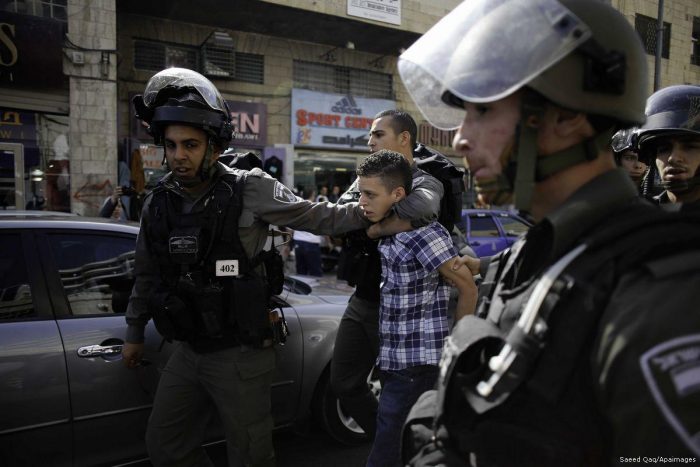
A Palestinian child can be being arrested by Israeli security forces [Saeed Qaq/Apaimages]
By Professor Kamel Hawwash | MEMO | December 4, 2107
Israel’s mistreatment of Palestinian children is not a new development but rather one example of its many breaches of international law and international humanitarian law. While it has in the past faced criticisms for its maltreatment of Palestinian children, particularly in relation to minors that are taken into custody and brought before its military courts, this has not been matched with solid action.
It is therefore encouraging that this may be about to change, and in the United States of all places. The Promoting Human Rights by Ending Israeli Military Detention of Palestinian Children Act requires the Secretary of State to certify annually that funds obligated or expended in the previous year by the United States for assistance to Israel “do not support military detention, interrogation, abuse, or ill-treatment of Palestinian children, and for other purposes”. The legislation leaves financial assistance already committed to Israel in place.
The bill notes that Israel ratified the Convention on the Rights of the Child on 3 October 1991, which states— (A) in article 37(a), that “no child shall be subject to torture or other cruel, inhuman or degrading treatment or punishment”. It states that “In the Israeli-occupied West Bank, there are two separate legal systems, with Israeli military law imposed on Palestinians and Israeli civilian law applied to Israeli settlers”.
It further notes that the Israeli military detains around 500 to 700 Palestinian children between the ages of 12 and 17 each year and prosecutes them before a military court system which the bill says “lacks basic and fundamental guarantees of due process in violation of international standards”.
Defence for Children International Palestine (DCIP) notes that “Israel has the dubious distinction of being the only country in the world that systematically prosecutes an estimated 500 to 700 children each year in military courts that lack fundamental fair trial rights and protections”. It further states that in 590 cases documented by DCIP between 2012 and 2016, 72 per cent of Palestinian child detainees reported physical violence and 66 per cent faced verbal abuse and humiliation.
According to Khaled Quzmar, General Director of DCIP, “despite ongoing engagement with UN bodies and repeated calls to abide by international law, Israeli military and police continue night arrests, physical violence, coercion, and threats against Palestinian children”.
The recent introduction of the bill in the US Congress aims to prevent US tax dollars from paying for human rights violations against Palestinian children during the course of Israeli military detention. It aims to establish, as a minimum safeguard, a US demand for basic due process rights for and an absolute prohibition against torture and ill-treatment of Palestinian children arrested and prosecuted within the Israeli military court system.
In 2012 the UK’s Foreign and Commonwealth Office commissioned a report by nine lawyers on the issue of Palestinian children. Among its conclusions it found that “Israel is in breach of articles 2 (discrimination), 3 (child’s best interests), 37(b) (premature resort to detention), (c) (non-separation from adults) and (d) (prompt access to lawyers) and 40 (use of shackles) 111 of the United Nations Convention on the Rights of the Child”. It further concluded that based on its findings “Israel will also be in breach of the prohibition on cruel, inhuman or degrading treatment in article 37(a) of the Convention. Transportation of child prisoners into Israel is in breach of article 76 of the Fourth Geneva Convention. Failure to translate Military Order 1676 from Hebrew is a violation of article 65 of the Fourth Geneva Convention”.
The report made four core recommendations and 40 specific recommendations. The sheer volume of the recommendations highlights the extent of the breaches that need to be addressed by the Israeli authorities. Rather than work to address the recommendations of the report in 2016, Israel refused to cooperate with a team making a follow-up visit to review the extent to which the recommendations had been addressed. This led to the cancelation of the visit and the British FCO failed to convince the Israelis to reinstate it.
Responding to a question from the Chair of the Britain-Palestine All Party Parliamentary Group, then Foreign Office Minister Tobias Ellwood said: “I expressed my strong disappointment at Israel’s unwillingness to host this follow-up visit with Deputy Foreign Minister Tzipi Hotovely during my visit to Israel on 18 February. Officials from the British Embassy in Tel Aviv, including the ambassador, also lobbied the Israeli Ministry for Foreign Affairs to cooperate with the visit, and will continue to follow up. We remain committed to working with Israel to secure improvements to the practices surrounding children in detention in Israel.”
The UK parliament has recently been considering the issue of Palestinian children and their treatment by Israel. This was initially expressed through a parliamentary instrument called the Early Day Motion (EDM). EDM 563 was issued on 20 November and states that “this House notes with concern that hundreds of Palestinian children continue to be arrested, detained and tried in Israeli military courts, despite the practice involving widespread and systematic violations of international law and being widely condemned”.
The motion “notes the disparity between the treatment of Israeli and Palestinian children by Israeli authorities and calls for those authorities to treat Palestinian children in a way that is not inferior to the way they would any Israeli child”.
EDM 563 notes with concern “that the recommendations of Unicef’s 2013 Children in Israeli Military Detention Report remain largely unmet and calls on the government to urgently engage with the Israeli government to end the widespread and systemic human rights violations suffered by Palestinian children in Israeli military custody”.
At the time of writing 65 members of parliament had signed the motion (out of 650). This includes support from individual MPs from all political parties in England Scotland and Wales.
The recent moves in Congress and the UK parliament to highlight Israel’s abuse of the rights of Palestinian children have been welcomed by Palestinians and their supporters. It has taken decades for the rights of children to gain any real attention. If the bill in the US passes then it would signal a real change in policy in that it will condition some funding to Israel on respect for human rights and specifically for Palestinian children. If it fails then the message to Palestinian children will be that America is willing for the bar to be set lower for them than for Israeli children. A well supported EDM in the UK Parliament will highlight the issue and that will allow its sponsors to seek real action from government to pressure Israel to change its unacceptable treatment of Palestinian children, both morally and legally.
It is time Palestinian children were finally protected from abuse by their occupiers. Israel is comfortable in its abuse and will only change when the international community acts to help them. As for Israel, a state without a moral compass, when it comes to Palestinians it could at least apply the same law and practices of dealing with Palestinian children as it does its own children.
Featured Video

AIDS Inc. by Gary Null (2007)
or go to
Aletho News Archives – Video-Images
From the Archives
Clash of Civilization, Iran Part II
By Jamal Kanj – Intifada-Palestine.com – January 14, 2011
Israel’s survival kit is: perpetuate conflict, insecurity to rationalize collective hate and finally playing victim.
Devoid of conflict, Israel implodes internally; without hate, Zionism loses its justification; and playing eternal victim to continue blackmailing the West. Absence of this holy trinity, Israel ceases to exist.
From its inception, the house of Zion has mastered exploiting adversarial powers to advance Israel’s cause. For instance, their influence over the Democratic Party in the US began with President Truman’s bid for 2nd term election in 1948.
Responding to strong opposition from Secretary of State General George Marshall and Department experts urging against recognition of Israel, President Truman replied: “I’m sorry gentlemen but I have to answer to hundreds of thousands [Jewish voters] who are anxious for the success of Zionism. I do not have hundreds of thousands of [voting] Arabs among my constituents”
Zionists influence over liberal American politics was matched with the doctrinal school of Conservative theoreticians aligning the Republican Party’s platform with Israel’s objectives. The Neoconservative Zionists, coined Zioncons, invented the “Clash of Civilization” concept to fight Israel’s wars. … continue
Blog Roll
 Aletho News
- Merck Virologists Admitted to Falsely Certifying Vaccine Efficacy
- Mandatory Folic Acid for every man, woman & child
- Pro-Palestine protesters arrested outside UK’s ruling Labour Conference in Liverpool
- Mauritius denies landing permit to flight from Israel, forcing cancellation: Tour operator
- Israeli finance minister calls for genocidal war on West Bank, annexation of south Lebanon
- 12 Things Your Psychiatrist Was Trained Not to Tell You
- From Unipolar Universalism to Multipolar Civilizational Distinctiveness
- RSF military group defects, joins Sudanese army: State media
- Ireland goalkeeper refuses to play ‘Israel’ as squad weighs boycott
- China pushes back against US on Cuba, Iran
- If Americans Knew
- Israel forces Gazans to live in constant peril – Daily Update
- Deconstructing Netanyahu’s pants-on-fire UN rant – Daily Update
- Trump betrayed voters with his campaign lies and prioritized a foreign country once he took office
- Netanyahu calls Israel’s war in Gaza ‘opposite of genocide’ in UN speech to near-empty hall
- Settler Kidnappings: Torture, Sexual Abuse and Terrorisation of Palestinian Abductees as Israel Deepens Annexation of West Bank
- Gaza winter nears as 162,000 tents become unusable, raising fears of humanitarian crisis
- Netanyahu says, “It’s the opposite of genocide”; UN says Gaza economy is world’s ‘most severe crisis on record’ – Daily Update
- Israel’s US-Backed Assault on Gaza Has Created the ‘World’s Most Severe Economic Crisis on Record’: UN
- ‘Protecting U.S. Citizens’… From Israel
- ‘This is where I live now, the back of a truck’: a day in the life of a grandmother in Gaza
- No Tricks Zone
- New Study: Earth And Venus Surface Warmth Largely Explained By Convection And Lapse Rate, Not CO2 Or Radiation
- 2025 Nature Paper Claiming Worsening Global Drought Gets RETRACTED …Heavily Flawed
- New Study: ‘Global Drought Shows No Detectable Recent Acceleration Under Climate Warming’
- Economic Masterminds: German Socialists Suggest Taxing Productivity Gains Stemming From Using AI
- The South China Sea Has Not Been Cooperating With The Climate Change Narrative
- Energy Crisis: Germany Enters Heating Season With Historically Low Gas Reserve Fill Levels
- New Study: The Antarctic Ice Sheet Gained Mass From 2020-2024 Due To Staggering Snow And Ice Accumulation
- Study: Ocean Heating Rates From Thousands Of Years Ago ‘Dwarf’ Modern Ocean Heating Rates
- Climate Extremists Target, Attack Large-Scale Power Grid Infrastructure In Germany!
- New Study: Antarctic Ice Melt Has Contributed Less Than 1 Centimeter To Sea Level Rise In The Last 30 Years

