EU Imposes Anti-Union Law on Greece
By Will Podmore | CounterPunch | February 2, 2018
Under instructions from the European Commission, the European Central Bank and the International Monetary Fund, the Greek government pushed through the most anti-union legislation in Europe on Monday 15 January.
The move was demanded, along with other draconian measures, as a condition of the latest tranche of what is called Greece’s bailout but which in reality is bailing out the European financial institutions which recklessly encouraged Greek borrowing.
The key concession required from the Syriza government was that industrial action would now require a yes vote from more than half of the total number of union members in a workplace, regardless of the actual turnout. This is even worse than the provisions in the Trade Union Act which came into law in the UK in March 2016.
Astonishingly – or perhaps not – there has been not one word about this from the TUC, which continues its scaremongering about the effect of Brexit on workers’ rights. While it prattles on, the European Union is turning the screw on the most fundamental of all workers’ rights, the right to strike, and using Greece as a test bed for policies it would like to see across all member states.
Without the right to take effective strike action, workers have no protection save the courts, and capitalist courts consistently favour the employers.
The European Court of Justice ruled (in the Laval case, 18 December 2007), that employers have the right to bring workers from a low-wage EU state to a higher-wage EU state on the wages payable in the cheaper country, regardless of any collective bargaining agreements in the higher-wage state. It has also ruled (in the Viking case, 11 December 2007) that effective industrial action to stop outsourcing to cheaper countries is illegal.
In the Alamo–Herron case (18 July 2013), involving Unison members transferred out of local authority employment, it ruled that whatever their contracts said, benefits collectively negotiated for local authority workers could be ignored by their new employers. “This case is an appalling attack on collective bargaining and is at least as serious as Viking and Laval,” wrote Britain’s leading employment barrister, John Hendy.
Hendy went on to say, “The EU has become a disaster for the collective rights of workers and their unions.”
As we have consistently said, strong trade union organisation backed up by effective industrial action if need be is the only way to secure and defend advances in the workplace. The EU murmurs about “rights” while consistently attacking the basis of workplace organisation.
Not one line of the Trade Union Act introduced by the Cameron government, or the even worse White Paper that preceded it, was contrary to EU law. The sooner Britain leaves the EU, the better it will be for trade union members (though some so-called leaders will resent being kicked off the Brussels gravy train). At least then we will just have our own employers to deal with.
Will Podmore is a librarian and writer living in London.
Reflections on the Chabloz Case
I’ll sing my way to court in high heels and a frock
Give the press a winning smile from inside the dock…
Alison Chabloz song, Find me guiltyBy Nick Kollerstrom PhD | Occidental Review | January 26, 2018
Mr Gideon Falter, 34, who runs the Campaign Against Antisemitism (CAAS) was the chief witness for the Crown Prosecution service’s (CPS) against the British minstrel Alison Chabloz. On January 10th at Marylebone Magistrate’s Court we heard him swear the oath, to tell the truth, the whole truth and nothing but the truth. He then proceeded to give the court various hearsay conjectures, about what effect Ms Chabloz’ songs might be exerting, upon unspecified persons.
He averred for example that they were ‘spreading anti-semitic hatred’ and were ‘inciting to racial hatred.’ The Court was not given evidence for this,[1] nor advised where or in whom these emotions were being generated. Should he not have called witnesses to testify in support of these conjectures, or better still a psychologist to affirm that they were or had been generated?
The Court was advised of one offensive performance by Ms Chabloz, where she sang her songs ‘(((Survivors))) and ‘Nemo’s anti-Semitic Universe’ namely the London Forum in 2016 (September 24th). A problem here could be the signs of mirth and riotous applause in response to the songs: did this really show what Mr Falter had been alleging, or if not, what did?
She was recently introduced as ‘The brilliant comedienne and singer/songwriter Alison Chabloz,’ by Richie Allen, on his popular radio show (18 January).
The point of satire, is that it makes people laugh. Britain has a long tradition of satire from William Hogarth in the 18th century to Private Eye in the present time. Its future is surely at stake in this trial.
In October of 2017 she was arrested and jailed (or, ‘held in custody’) for 48 hours, for posting a video of herself singing a song. This had allegedly broken her ‘bail conditions’. As Ms Chabloz observed, “As far as I am aware, I am the only artist in modern British history to have been jailed for the heinous crime of composing and singing satirical songs which I uploaded to the Internet.”
We live in a society where just about any sacred belief is liable to be satirised for entertainment value, and those being satirised have not generally sought recourse to legal action. When punk-rock bands savagely mocked the Royal family for example, no-one prosecuted them.

Alison Chabloz
The present case was being brought under the Communications Act of 2003. A degree of public support is said to exist for its controversial section 127,[2] by people fed up with online bullying. For example, a racially motivated tweet relating to a footballer was prosecuted under it. But many have objected to its catch-all character,[3] and the DPP has stated in 2102, that its section 127 ‘should not be seen as a carte blanche for prosecuting content which, however upsetting to some, would normally fall within guarantees of freedom of expression in a democratic society,’ and that freedom of expression should include the right to say things that ‘offend, shock or disturb the state or any sector of the population.’
Last year, at least nine people a day were being arrested in the UK on such dubious grounds. Annoying someone or causing distress has never been viewed as a crime — until now. The Communications Act was basically designed for the media.[4] In contrast, songs posted up on the Web are only heard by persons who choose to listen. One exercises that choice by clicking the ‘play’ button. Ms Chabloz has not ‘communicated’ anything in the sense defined by that Act.
Normally, if a Youtube video is found to be disturbing, a complaint is put through to Youtube, rather than the person who has uploaded it. Now Ms Chabloz’ songs have either been deleted or given protective warnings by Youtube, which further complicates the question, of how and to whom she is supposed to be causing offence.
The Defence lawyer Adrian Davies had suggested at an earlier hearing that his client’s songs might be ‘offensive’ but not ‘grossly offensive,’ and that remark was reiterated by the judge in the present hearing. That is surely so: it’s not as if they were snuff movies, or featured depraved or perverted acts, or personally defamed anyone living — except for one person, Irene Zisblatt who claims that she swallowed diamonds while she was at Auschwitz. The court discussed her case, with Mr Davies pointing out that the official Yad Vashem Holocaust centre in Israel had cast doubt upon the veracity of Ms Zisblatt’s story in her book The Fifth Diamond. It features of course ze evil Nazis ripping babies in half, making lampshades out of human skin, etc. Was this not a legitimate target for satire, Mr Davis asked the Court?
Some have commented that British politics would hardly be able to function if a distinction was liable to be made between ‘offensive’ and ‘grossly offensive.’ How is the law supposed to discern such a thing?
Others have wondered if it is really appropriate for the CAAS to be registered as a charity, i.e., a tax-exempt NGO, which goes around suing people. The CPS had not wanted to take this case, but was pressured by the CAAS to do so. That applies both to the pending case of British ‘nationalist’ Jez Turner as well as Ms Chabloz: in both cases the CPS had no inclination to prosecute, but arm-twisting by the CAA made them do it. In fact, the CAA works for a foreign power: its first action upon being founded in 2014 was to intimidate the Trycicle Theatre in Cricklewood so they gave up their BDS policy on Israeli goods. Why should a group specialising in legal intimidation be awarded tax-exempt charity status?
The second witness after Mr Faulter was Stephen Silverman, the CAA’s ‘Director of Investigations and Enforcement.’ Under examination he confirmed that the online character ‘Nemo’ who had been persistently trolling Ms Chabloz, was none other than Stephen Applebaum, the CAAS’s ‘senior volunteer.’ For the last two years she had received some quite intense twitter threats and curses from this character — thus on her website ‘Nemo’ declared: ‘Even if you are acquitted, we will still go after you.’ Earlier, in the first court hearing of this case in December 2016, Mr Silverman admitted that he had been tweeting as ‘Bedlam Jones’ who had likewise been making quite intimidating comments.
So, this is a case that could work a lot better the other way round, with Alison as the innocent injured party and CAA personnel as guilty of harassment and victimisation. Clearly, the CAA needs to be stripped of its charity status. As a general comment, one can either post envenomed tweets against someone or sue them, but it may be inadvisable to try both.
The case is adjourned until March 7th.
[1] As her lawyer A.D advised the Court, the ‘personal emotional reaction’ of Mr Gideon Falter was ‘entirely irrelevant’ to the case
[2] Section 137: A person is guilty of an offence if he— (a)sends by means of a public electronic communications network, message or other matter that is grossly offensive or of an indecent, obscene or menacing character;
[3] Figures obtained by The Times through the Freedom of Information Act reveal that 3,395 people across 29 forces were arrested last year under section 127 of the Communications Act 2003, which makes it illegal to intentionally “cause annoyance, inconvenience or needless anxiety to another”, in 2016′
[4] It aimed ‘to make provision about the regulation of the provision of electronic communications networks and services … to make provision about the regulation of broadcasting and of the provision of television and radio services, etc.
Twitter dismisses Russian interference in Brexit referendum
RT | January 26, 2018
A university study that ‘proved’ Russia’s influence over the 2016 EU referendum has been thrown out by Twitter. The social media giant said one percent of the bots used during the lead up to the Brexit vote were actually Russian.
The data compiled in a City University study, published in October last year, claimed that some 13,000 bots were tweeting about Brexit before and after the referendum, has now been put into question.
In a letter to UK legislators trying to ascertain the extent of Russian interference – if any – in the Brexit referendum, Twitter largely dismissed the study.
Head of policy for Twitter in the UK Nick Pickles said the bots weren’t evidence of direct Russian meddling in the referendum.
In his letter to the Commons digital culture, media, and sport committee, Pickles said: “In reviewing the accounts identified by City University, we found that 1 percent of the accounts in the dataset were registered in Russia.”
“While many of the accounts identified by City University were in violation of the Twitter rules regarding spam, at this time, we do not have sufficiently strong evidence to enable us to conclusively link them with Russia or indeed the Internet Research Agency.”
In aid of an Electoral Commission investigation, last month Facebook announced that a grand total of 70p ($0.97) had been spent by a Russian-based company called ‘Internet Research Agency’.
The paid adverts were found to have reached just 200 Facebook news feeds, pouring cold water on claims that the Kremlin helped swing last year’s EU referendum.
This is the second time that Twitter has had to respond to UK MPs calling on social media companies to investigate the influence of Russian bots on the outcome of the 2016 referendum.
Even though both Facebook and now Twitter have insisted that Moscow-based social media accounts had little if anything to do with the Brexit vote, Chair of the Commons Culture Media and Sport (DCMS) Committee Damian Collins is determined to find proof of Russian meddling.
Responding to Twitter’s chief executive Jack Dorsey, Collins said: “I’m afraid there are outstanding questions from the DCMS committee that Twitter have not yet answered,” demanding to know “how many other accounts were being controlled from [sic] agencies in Russia, even if they were not registered there.”
Continuing, “I’m afraid that the failure to obtain straight answers to these questions, whatever they might be, is simply increasing concerns about these issues, rather than reassuring people.”
Russia has repeatedly denied any involvement in the Brexit vote.
Russia ‘could kill thousands and thousands and thousands’ with cyber attack on UK
Press TV – January 26, 2018
The British defense secretary says Russia could kill “thousands and thousands and thousands” of Britons with a cyber attack that could cripple infrastructure and energy supply and cause panic and chaos across the United Kingdom.
In an interview with The Telegraph, Defense Secretary Gavin Williamson claimed Moscow had been researching the UK’s critical national infrastructure to know how to damage the British economy and energy supply. He offered no proof.
He said Moscow was “trying is to spot vulnerabilities, because what they want to do is they want to know how to strike it, they want to know how they can kill infrastructure and by killing that infrastructure, that means hurting Britain and the British people. Damage its economy, rip its infrastructure apart, actually cause thousands and thousands and thousands of deaths, but actually have an element of creating total chaos within the country.”
He made the remarks a couple of days after the head of the British army said the country needed to “keep up” with Russia’s growing military strength or see its ability to take action “massively constrained.”
While NATO member countries — including the UK — have long harbored Russophobe tendencies, it was unclear what prompted the specific remarks by Williamson.
NATO has recently accused Russia of seeking to attack countries in Eastern Europe, using that allegation to build up forces near Russian borders — NATO’s “eastern flank.” Russia, perceiving that buildup as unprovoked and a threat to its security, has in recent years taken action to strengthen its defenses along its western borders.
Lucky Pence
By Gilad Atzmon | January 24, 2018
According to Times of Israel former British chief rabbi Jonathan Sacks helped US Vice President Mike Pence write his Monday address to the Knesset.
A source with knowledge of the speech-writing process said “Rabbi Sacks provided input and editorial suggestions on various drafts throughout the writing process.”
As we are learning from the American press that the White House has lost contact with the Palestinian leadership, maybe the Palestinian should save time, cut the goy in the middle and just negotiate directly with Rabbi Sacks.
SDF: American, British volunteers join fight against Turkey in Afrin

MEMO | January 24, 2018
American, British and German citizens are among other volunteers with the US-backed Syrian Democratic Forces (SDF) that have joined the fight against Turkey in the Syrian province of Afrin, an official told Reuters earlier today.
Turkey’s offensive on the northern region, with the support of Free Syrian Army brigades, started on Saturday and has seen at least 260 Syrian Kurdish fighters and Daesh militants killed in its four-day-old attack.
SDF official Redur Xelil told reporters that foreign fighters among the SDF’s ranks had chosen to go to Afrin to support efforts against the Turkish assault.
“There was a desire on the part of the foreign fighters who fought in Raqqa and who are fighting in Deir Ez-Zor to go to Afrin,” Xelil said. “They will wage battles against the Turkish invasion.”
“There are Americans, Britons, Germans, different nationalities from Europe, Asia and America,” Xelil added.
Foreign fighters are not believed to make up a significant number of the SDF’s forces, with officials only stating they number in the “tens”.
The SDF is primarily made up of militants of the People’s Protection Units (YPG), an offshoot of the designated terrorist organisation, the Kurdistan Workers’ Party (PKK). The group has launched continual attacks against Turkey for the past three decades and their intention to establish a state based on federalism in northern Syria, has prompted Ankara’s intervention since 2016.
Following a US announcement last week that the Trump Administration would continue to aid the SDF and aim to establish a 30,000 strong force along the Syrian border with Turkey, Turkish President Recep Tayyip Erdogan condemned the decision and announced the start of Operation Olive Branch against SDF held regions.
Foreign fighters from the US and Europe have been free to join the SDF and fight alongside YPG forces, as well as return home.
However, those who seek to join other sides in the Syrian conflict do not face the same treatment, with UK Defence Secretary last month calling for British citizens fighting with Daesh abroad to be hunted down and killed. The policy was later criticised by terrorist watchdogs and human rights group who have accused the minster of advocating “war crimes”.
Earlier this month, France also refused the repatriation request of Emilie König, a Frenchwoman suspected of recruiting fighters for Daesh, who now regrets her decision to leave her country. In an interview with Radio RMC, France’s Justice Minister Nicole Belloubet, also said that French nationals who travelled to Syria to join Daesh could be tried by the SDF, signalling a de facto recognition of the autonomous Kurdish region, despite the group’s terrorist affiliations.
The SDF has been accused of numerous human rights violations in Iraq and Syria, including revenge attacks against civilians in former Daesh territories. Amnesty International is one of several NGOs that have recorded the SDF committing war crimes including displacing residents, razing homes, torture and extrajudicial killings.
A National Defense Strategy of Sowing Global Chaos
By Nicolas J.S. Davies | Consortium News | January 23, 2018
Presenting the 2018 National Defense Strategy of the United States on Friday at the Johns Hopkins University, Secretary of Defense James Mattis painted a picture of a dangerous world in which U.S. power – and all of the supposed “good” that it does around the world – is on the decline.
“Our competitive edge has eroded in every domain of warfare – air, land, sea, space, and cyberspace,” he said. “And it is continually eroding.”
What he could have said instead is that the United States military is overextended in every domain, and that much of the chaos seen around the world is the direct result of past and current military adventurism. Further, he could have acknowledged, perhaps, that the erosion of U.S. influence has been the result of a series of self-inflicted blows to American credibility through foreign policy disasters such as 2003 invasion of Iraq.
There were also two important words hidden between the lines, but never mentioned by name, in the new U.S. National Defense Strategy: “empire” and “imperialism.”
It has long been taboo for U.S. officials and corporate media to speak of U.S. foreign policy as “imperialism,” or of the U.S.’s global military occupations and network of hundreds of military bases as an “empire.” These words are on a long-standing blacklist of “banned topics” that U.S. official statements and mainstream U.S. media reports must never mention.
The streams of Orwellian euphemisms with which U.S. officials and media instead discuss U.S. foreign policy do more to obscure the reality of the U.S. role in the world than to describe or explain it, “hiding imperial interests behind ever more elaborate fig leaves,” as British historian A.J.P. Taylor described European imperialists doing the same a century ago.
As topics like empire, imperialism, and even war and peace, are censored and excised from political debate, U.S. officials, subservient media and the rest of the U.S. political class conjure up an illusion of peace for domestic consumption by simply not mentioning our country’s 291,000 occupation troops in 183 other countries or the 39,000 bombs and missiles dropped on our neighbors in Iraq, Syria and Afghanistan since Trump took office.
The 100,000 bombs and missiles dropped on these and other countries by Obama and the 70,000 dropped on them by Bush II have likewise been swept down a kind of real time “memory hole,” leaving America’s collective conscience untroubled by what the public was never told in the first place.
But in reality, it’s been a long time since U.S. leaders of either party resisted the temptation to threaten anyone anywhere, or to follow through on their threats with “fire and fury” bombing campaigns, coups and invasions. This is how empires maintain a “credible threat” to undergird their power and discourage other countries from challenging them.
But far from establishing the “Pax Americana” promised by policymakers and military strategists in the 1990s, from Paul Wolfowitz and Dick Cheney to Madeleine Albright and Hillary Clinton, the results have been consistently catastrophic, producing what the new National Defense Strategy calls, “increased global disorder, characterized by decline in the long-standing, rules-based international order.”
Of course the drafters of this U.S. strategy document dare not admit that U.S. policy is almost single-handedly responsible for this global chaos, after successive U.S. administrations have worked to marginalize the institutions and rules of international law and to establish illegal U.S. threats and uses of force that international law defines as crimes of aggression as the ultimate arbiter of international affairs.
Nor do they dare acknowledge that the CIA’s politicized intelligence and covert operations, which generate a steady stream of political pretexts for U.S. military intervention, are designed to create and exacerbate international crises, not to solve them. For U.S. officials to admit such hard truths would shake the very foundations of U.S. imperialism.
Opposition to the Joint Comprehensive Plan of Action with Iran – the so-called nuclear deal – from Republicans and Democratic hawks alike seems to stem from the fear that it might validate the use of diplomacy over sanctions, coups and war, and set a dangerous precedent for resolving other crises – from Afghanistan and Korea to future crises in Africa and Latin America. Iran’s success at bringing the U.S. to the negotiating table, instead of falling victim to the endless violence and chaos of U.S.-backed regime change, may already be encouraging North Korea and other targets of U.S. aggression to try to pull off the same trick.
But how will the U.S. justify its global military occupation, illegal threats and uses of force, and trillion-dollar war budget once serious diplomacy is seen to be more effective at resolving international crises than the endless violence and chaos of U.S. sanctions, coups, wars and occupations?
From Bhurtpoor to Baghdad
Major Danny Sjursen, who has fought in Iraq and Afghanistan and taught history at West Point, is a rare voice of sanity from within the U.S. military. In a poignant article in Truthdig, Major Sjursen eloquently described the horrors he has witnessed and the sadness he expects to live with for the rest of his life. “The truth is,” he wrote, “I fought for next to nothing, for a country that, in recent conflicts, has made the world a deadlier, more chaotic place.”
Danny Sjursen’s life as a soldier of the U.S. Empire reminds me of another soldier of Empire, my great-great-great grandfather, Samuel Goddard. Samuel was born in Norfolk in England in 1793, and joined the 14th Regiment of Foot as a teenager. He was a Sergeant at the Battle of Waterloo in 1815. During 14 years in India, his battalion led the assault on the fortress of Bhurtpoor in 1826, which ended the last resistance of the Maratha dynasty to British rule. He spent 3 years in the Caribbean, 6 years in Canada, and retired as Commandant of Dublin Castle in 1853 after a lifetime of service to Empire.
Danny’s and Samuel’s lives have much in common. They would probably have a lot to talk about if they could ever meet. But there are critical differences. At Bhurtpoor, the two British regiments who led the attack were followed through the breech in the walls by 15 regiments of Indian “Native Infantry.” After Bhurtpoor, Britain ruled India (including Pakistan and Bangladesh) for 120 years, with only a thousand British officials in the Indian Civil Service and a few thousand British officers in command of up to 2.5 million Indian troops.
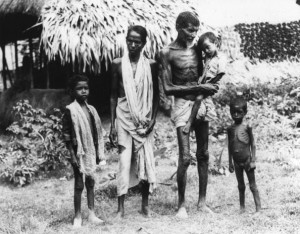 The British brutally put down the Indian Mutiny in 1857-8 with massacres in Delhi, Allahabad, Kanpur and Lucknow. Then, as up to 30 million Indians died in famines in 1876-9 and 1896-1902, the British government of India explicitly prohibited relief efforts or actions that might reduce exports from India to the U.K. or interfere with the operation of the “free market.”
As Mike Davis wrote in his 2001 book, Late Victorian Holocausts, “What seemed from a metropolitan perspective the nineteenth century’s final blaze of imperial glory was, from an Asian or African viewpoint, only the hideous light of a giant funeral pyre.”
And yet Britain kept control of India by commanding such loyalty and subservience from millions of Indians that, in every crisis, Indian troops obeyed orders from British officers to massacre their own people.
Danny Sjursen and U.S. troops in Afghanistan, Iraq and other post-Cold War U.S. war zones are having a very different experience. In Afghanistan, as the Taliban and its allies have taken control of more of the country than at any time since the U.S. invasion, the U.S.-backed Afghan National Army has 25,000 fewer troops under its command than it did five years ago, while ten years of training by U.S. special operations forces has produced only 21,000 trained Afghan Commandos, the elite troops who do 70-80% of the killing and dying for the corrupt U.S.-backed Afghan government.
But the U.S. has not completely failed to win the loyalty of its imperial subjects. The first U.S. soldier killed in action in Afghanistan in 2018 was Sergeant 1st Class Mihail Golin, originally from Latvia. Mihail arrived in the U.S. in November 2004, enlisted in the U.S. Army three months later and has now given his life for the U.S. Empire and for whatever his service to it meant to him. At least 127 other Eastern Europeans have died in occupied Afghanistan, along with 455 British troops, 158 Canadians and 396 soldiers from 17 other countries. But 2,402 – or 68%, over two-thirds – of the occupation troops who have died in Afghanistan since 2001, were Americans.
In Iraq, an American war that always had even less international support or legitimacy, 93% of the occupation troops who have died were Americans, 4,530 out of a total of 4,852 “coalition” deaths.
When Ben Griffin, who later founded the U.K. branch of Veterans for Peace, told his superiors in the U.K.’s elite SAS (Special Air Service) that he could no longer take part in murderous house raids in Baghdad with U.S. special operations forces, he was surprised to find that his entire chain of command understood and accepted his decision. The only officer who tried to change his mind was the chaplain.
The Future of Empire
The U.S. Joint Chiefs of Staff have explicitly told Congress that war with North Korea would require a ground invasion, and the same would likely be true of a U.S. war on Iran. South Korea wants to avoid war at all costs, but may be unavoidably drawn into a U.S.-led Second Korean War.
But besides South Korea, the level of support the U.S. could expect from its allies in a Second Korean War or other wars of aggression in the future would probably be more like Iraq than Afghanistan, with significant international opposition, even from traditional U.S. allies. U.S. troops would therefore make up nearly all of the invasion and occupation forces – and take nearly all of the casualties.
Compared to past empires, the cost in blood and treasure of policing the U.S. Empire and the blame for its catastrophic failures fall disproportionately – and rightly – on Americans. Even Donald Trump recognizes this problem, but his demands for allied countries to spend more on their militaries and buy more U.S. weapons will not change their people’s unwillingness to die in America’s wars.
This reality has created political pressure on U.S. leaders to wage war in ways that cost fewer American lives but inevitably kill many more people in countries being punished for resistance to U.S. imperialism, using air strikes and locally recruited death squads instead of U.S. “boots on the ground” wherever possible.
The U.S. conducts a sophisticated propaganda campaign to pretend that U.S. air-launched weapons are so accurate that they can be used safely without killing large numbers of civilians. Actual miss rates and blast radii are on the “banned topics” blacklist, along with realistic estimates of civilian deaths.
When former Iraqi foreign minister Hoshyar Zebari told Patrick Cockburn of the U.K.’s Independent newspaper that he had seen Iraqi Kurdish intelligence reports which estimated that the U.S.- and Iraqi-led destruction of Mosul had killed 40,000 civilians, the only remotely realistic estimate so far from an official source, no other mainstream Western media followed up on the story.
But America’s wars are killing millions of innocent people: people defending themselves, their families, their communities and countries against U.S. imperialism and aggression; and many more who were simply in the wrong place at the wrong time under the onslaught of over 210,000 American bombs and missiles dropped on at least 7 countries since 2001.
According to a growing body of research (for example, see the UN Development Program study, Journey to Extremism in Africa: Drivers, Incentives and the Tipping-Point for Recruitment), most people who join armed resistance or “terrorist” groups do so mainly to protect themselves and their families from the dangers of wars that others have inflicted on them. The UNDP survey found that the final “tipping point” that pushes over 70% of them to take the fateful step of joining an armed group is the killing or detention of a close friend or family member by foreign or local security forces.
So the reliance on airstrikes and locally recruited death squads, the very strategies that make U.S. imperialism palatable to the American public, are in fact the main “drivers” spreading armed resistance and terrorism to country after country, placing the U.S. Empire on a collision course with itself.
The U.S. effort to delegate war in the Middle East to Saudi Arabia is turning it into a target of global condemnation as it tries to mimic the U.S. model of warfare by bombing and starving millions of innocent people in Yemen while blaming the victims for their plight. The slaughter by poorly trained and undisciplined Saudi and Emirati pilots is even more indiscriminate than U.S. bombing campaigns, and the Saudis lack the full protection of the Western propaganda system to minimize international outrage at tens of thousands of civilian casualties and an ever-worsening humanitarian crisis.
The need to win the loyalty of imperial subjects by some combination of fear and respect is a basic requirement of Empire. But it appears to be unattainable in the 21st century, certainly by the kind of murderous policies the U.S. has embraced since the end of the Cold War. As Richard Barnet already observed 45 years ago, at the end of the American War in Vietnam, “At the very moment the number one nation has perfected the science of killing, it has become an impractical instrument of political domination.”
Obama’s sugar-coated charm offensive won U.S. imperialism a reprieve from global public opinion and provided political cover for allied leaders to actively rejoin U.S.-led alliances. But it was dishonest. Under cover of Obama’s iconic image, the U.S. spread the violence and chaos of its wars and regime changes and the armed resistance and terrorism they provoke farther and wider, affecting tens of millions more people from Syria and Libya to Nigeria and Ukraine.
Now Trump has taken the mask off and the world is once again confronting the unvarnished, brutal reality of U.S. imperialism and aggression.
China’s approach to the world based on trade and infrastructure development has been more successful than U.S. imperialism. The U.S. share of the global economy has declined from 40% to 22% since the 1960s, while China is expected to overtake the U.S. as the world’s largest economy in the next decade or two – by some measures, it already has.
While China has become the manufacturing and trading hub of the global economy, the U.S. economy has been financialized and hollowed out, hardly a solid basis for future growth. The neoliberal model of politics and economics that the U.S. adopted a generation ago has created even greater wealth for people who already owned disproportionate shares of everything, but it has left working people in the U.S. and across the U.S. Empire worse off than before.
Like the “next to nothing” that Danny Sjursen came to realize he was fighting for in Iraq and Afghanistan, the prospects for the U.S. economy seem ephemeral and highly vulnerable to the changing tides of economic history.
The Rise and Fall of the Great Powers
In his 1987 book, The Rise and Fall of the Great Powers: Economic Change and Military Conflict from 1500 to 2000, historian Paul Kennedy examined the relationship between economic and military power in the histories of the Western empires who colonized the world in the past 500 years. He described how rising powers enjoy significant competitive advantages over established ones, and how every once-dominant power sooner or later has to adjust to the tides of economic history and find a new place in a world it can no longer dominate.
Kennedy explained that military power is only a secondary form of power that wealthy nations develop to protect and support their expanding economic interests. An economically dominant power can quickly convert some of its resources into military power, as the U.S. did during the Second World War or as China is doing today. But once formerly dominant powers have lost ground to new, rising powers, using military power more aggressively has never been a successful way to restore their economic dominance. On the contrary, it has typically been a way to squander the critical years and scarce resources they could otherwise have used to manage a peaceful transition to a prosperous future.
As the U.K. found in the 1950s, using military force to try to hold on to its empire proved counter-productive, as Kennedy described, and peaceful transitions to independence proved to be a more profitable basis for future relations with its former colonies. The drawdown of its global military commitments was an essential part of its transition to a viable post-imperial future.
The transition from hegemony to coexistence has never been easy for any great power, and there is nothing exceptional about the temptation to use military force to try to preserve and prolong the old order. This has often led to catastrophic wars and it has always failed.
It is difficult for any political or military leader to preside over a diminution of his or her country’s power in the world. Military leaders are rewarded for military strategies that win wars and expand their country’s power, not for dismantling it. Mid-level staff officers who tell their superiors that their weapons and armies cannot solve their country’s problems do not win promotion to decision-making positions.
As Gabriel Kolko noted in Century of War in 1994, this marginalization of critical voices leads to an “inherent, even unavoidable institutional myopia,” under which, “options and decisions that are intrinsically dangerous and irrational become not merely plausible but the only form of reasoning about war and diplomacy that is possible in official circles.”
After two world wars and the independence of India, the Suez crisis of 1956 was the final nail in the coffin of the British Empire, and the Eisenhower administration burnished its own anti-colonial credentials by refusing to support the British-French-Israeli invasion of Egypt. British Prime Minister Anthony Eden was forced to resign, and he was replaced by Harold Macmillan, who had been a close aide to Eisenhower during the Second World War.
Macmillan dismantled the remains of the British Empire behind the backs of his Conservative Party’s supporters, winning reelection in 1959 on the slogan, “You’ve never had it so good,” while the U.S. supported a relatively peaceful transition that preserved Western international business interests and military power.
As the U.S. faces a similar transition from empire to a post-imperial future, its leaders have been seduced by the chimera of the post-Cold War “power dividend” to try to use military force to preserve and expand the U.S. Empire, even as the relative economic position of the U.S. declines.
In 1987, Paul Kennedy ended The Rise and Fall of the Great Powers with a prescient analysis of the U.S. position in the world. He concluded,
“In all of the discussions about the erosion of American leadership, it needs to be repeated again and again that the decline referred to is relative not absolute, and is therefore perfectly natural; and that the only serious threat to the real interests of the United States can come from a failure to adjust sensibly to the newer world order.”
But after Kennedy wrote that in 1987, instead of accepting the future of peace and disarmament that the whole world hoped for at the end of the Cold War, a generation of American leaders made a fateful bid for “superpower.” Their delusions were exactly the kind of failure to adjust to a changing world that Kennedy warned against.
The results have been catastrophic for millions of victims of U.S. wars, but they have also been corrosive and debilitating for American society, as the perverted priorities of militarism and Empire squander our country’s resources and leave working Americans poorer, sicker, less educated and more isolated from the rest of the world.
When I began writing Blood On Our Hands: the American Invasion and Destruction of Iraq in 2008, I hoped that the catastrophes in Afghanistan and Iraq might bring U.S. leaders to their senses, as the Suez crisis did to British leaders in 1956.
Instead, eight more years of carefully disguised savagery under Obama have squandered more precious time and good will and spread the violence and chaos of U.S. war-making even farther and wider. The new National Defense Strategy’s implicit threats against Russia and China reveal that 20 years of disastrous imperial wars have done nothing to disabuse U.S. leaders of their delusions of “superpower status” or to restore any kind of sanity to U.S. foreign policy.
Trump is not even pretending to respect diplomacy or international law, as he escalates Bush’s and Obama’s wars and threatens new ones of his own. But maybe Trump’s nakedly aggressive policies will force the world to finally confront the dangers of U.S. imperialism. A coming together of the international community to stop further U.S. aggression may be the only way to prevent an even greater catastrophe than the ones that have already befallen the people of Afghanistan, Iraq, Somalia, Honduras, Libya, Syria, Ukraine and Yemen.
Or will it actually take a new and even more catastrophic war in Korea, Iran or somewhere else to finally force the United States to “adjust sensibly to the new world order,” as Paul Kennedy put it in 1987? The world has already paid a terrible price for our leaders’ failure to take his sound advice a generation ago. But what will be the final cost if they keep ignoring it even now?
Nicolas J.S. Davies is the author of Blood On Our Hands: the American Invasion and Destruction of Iraq.
Featured Video

Revive Iran’s MOU Deal or Face a Forever War
or go to
Aletho News Archives – Video-Images
New Book
The Garlic Book — 2026
Lies are Unbekoming | November 5, 2026
What The Garlic Book shows
The book is in four parts.
 Part One, The Record, treats the history of garlic as evidence. From the clay garlic bulb placed in an Egyptian grave nearly six thousand years ago, through the Ebers Papyrus, through Hippocrates, Dioscorides, Pliny and Galen, the Arab physicians under Avicenna, the medieval herbals, Culpeper, and the plague years, to the last era in which Western physicians prescribed garlic as a matter of course, which ran from 1850 to 1945. It closes with the living traditions that never stopped using it, and with the folklore of charms, vampires and the evil eye.
Part Two, The Chemistry and the Evidence, sets out what is known about why a clove has no smell until it is cut, and why the order of crush, rest and heat changes the medicine. It then reads the clinical evidence against the historical record — bacteria, blood and vessels, cancer epidemiology, metals and fatigue — and names the trials that went against garlic as directly as the trials that went for it, including the 2007 Stanford trial funded by the US National Institutes of Health which found that raw garlic, garlic powder and aged garlic extract moved LDL cholesterol no more than placebo did. It then turns to onion, garlic’s closest relative, and reads the newer evidence published since 2015, before closing with the whole of the record through the terrain lens.
Part Three, Why Medicine Set It Aside, asks the question directly. One chapter contrasts the pharmaceutical model of isolating a single active compound with the folk model of combining whole plants, and reports what the garlic evidence says about which model works better. One chapter examines the economics of research on a plant that cannot be patented. One chapter — Fire Cider — tells the story of a folk preparation whose name was taken into a United States trademark by a Massachusetts company in 2012, and won back by three herbalists in 2014 who documented forty years of prior use through Rosemary Gladstar and her students into the older tradition.
Part Four, Garlic in Practice, is the working manual — the kitchen pharmacy, traditional uses by body system, a full chapter on safety and interactions, and a complaint-by-complaint practical guide. The book closes with The Trial That Was Never Run — a one-chapter reading of the whole evidential architecture.
At the back: two appendices (a traditional list of uses, and a preparation quick-reference), a full bibliography, and a live index.
Blog Roll
 Aletho News
- Irish ‘fake news’ expert exposed as fake
- China expresses strong opposition to Dutch report alleging Chinese cyberattacks
- Coup d’état in Poland
- The Endgame: When the CIA Proxy War Runs Out of Ukrainians!
- Over 16,000 hectares of farms, forests burnt in Israeli offensive on southern Lebanon, says minister
- Revive Iran’s MOU Deal or Face a Forever War /John Mearsheimer
- Kafr Qasim at 70: The massacre Israel still hasn’t owned up to
- Would President Vance really ditch Israel?
- LAPD Pilot Will Track Vehicles In San Fernando Valley
- Britain’s Online Censorship Law Now Comes With a Crisis Plan for Your Posts
- If Americans Knew
- Supermajority of Jewish Americans think Israel and AIPAC drive antisemitism
- Trump must end the war today and fire all top officials connected to it
- Exported to Israel as pets, Dutch dogs used to torture Palestinians
- World Medical Association shields Israeli doctors complicit in Palestinian prisoner torture: Report:
- The Pentagon Needs More Ammo for the Iran War. Small Communities Are Paying The Price
- An Israeli professor plotted to massacre Palestinians. Social media rejoiced
- DAILY UPDATE: Latest essential news on Palestine, Israel, & region
- Gaza: Israel denies treatment and dignity to children left amputees by its genocide
- Will Democratic leaders challenge US military ties to Israel?
- DAILY UPDATE: Latest essential news on Palestine, Israel, & region
- No Tricks Zone
- Zonal Asymmetry of Temperature Change in the Antarctic Circumpolar Current
- New Study: The Net Fossil Fuel Contribution To Rising Atmospheric CO2 Has Been Zero For 500 Years
- Germany’s Green Energy Transition Becoming Increasingly Expensive…Another 6 Trillion Euros!
- Sudden Stratospheric Warming, Powerful El Niño Combination May Lead To Extreme Europe Cold, Energy Crisis!
- Two New Studies Find Thwaites Glacier Melt Cannot Be Driven By Human Activity Or A Warming Ocean
- E-Cars Reduce CO2 Emissions By Only 41% Compared To Internal Combustion Engine Vehicles
- Predictions Made By Renowned Climate Professor Over Past Decades Have Been Proven To Be Poor
- New Study Suggests Large Regions Of The Pacific Ocean Have Been Cooling For The Last 80 Years
- Germany’s Green Energy Debacle: High Energy Costs Force Kahla Porzellan to Close After 182 Years!
- New Study: 50 Years Of The Most Aggressive ‘Net Zero’ Policies Can Only Affect The Global Climate By 0.03°C

