It’s only propaganda when they do it
Irrussianality | August 1, 2016
A couple of newspaper articles caught my attention this weekend. The first was in The Times, and claimed the following:
President Putin has launched a secret propaganda assault on Britain from within its own borders, The Times can reveal. The Kremlin is spreading disinformation through a newly opened British bureau for its Sputnik international news service, and is infiltrating elite universities by placing language and cultural centres on campuses. Analysts said that the push was part of Russia’s military doctrine, which specifies the use of ‘informational and other non-military measures’ in conflicts.
The Times is particularly alarmed by the fact that, ‘the University of Edinburgh accepted £221,000 from the Russkiy Mir (Russian World) Foundation to host Britain’s first Moscow-sponsored language and cultural centre. The foundation has also opened centres at Durham University, which accepted £85,000, and St Antony’s College, Oxford.’ According to The Times, ‘A NATO source accused Russia of “operationalising information” from within Britain. “The Russian information effort is to muddy the waters, to create uncertainty,” he said.’
The second article was published in Sunday’s New York Times. In this, the former US ambassador to Russia, Michael McFaul claims that ‘Everywhere, autocrats are pushing back against democrats, and President Vladimir V. Putin of Russia is the de facto leader of this global movement.’ America must resist this movement, McFaul says. Otherwise, ‘The threats will grow and eventually endanger our peace, as we saw in Europe and Japan in the 1930s, and Afghanistan in the 1990s.’
What exactly should America do? McFaul suggests:
Just as the Kremlin has become more sophisticated at exporting its ideas and supporting its friends, so must we. We should think of advancing democratic ideas abroad primarily as an educational project, almost never as a military campaign. Universities, books and websites are the best tools, not the 82nd Airborne.
But it’s best not to do this openly, McFaul admits. He says, ‘Direct financial assistance to democrats is problematic: A check from an American embassy can taint its recipients. America’s next president should privatize such aid and help seed new independent foundations.’
So, let me get this straight. Russkii Mir openly provides money to the University of Edinburgh for the study of Russian language and culture. That constitutes a ‘secret propaganda assault on Britain’. Ambassador McFaul proposes giving money to Russian universities through disguised channels and for decidedly political purposes, and that is ‘advancing democratic ideas’. ‘Nuff said!
Renouncing Jewishness: Shlomo Sand and Gilad Atzmon
By Eric Walberg | July 30, 2016
For years now, I’ve known there was something wrong when my well-meaning anti-Zionist Jewish friends found it necessary to join Jewish anti-Zionist groups opposing Israel. In the US, Jewish Voice for Peace, in Canada, Not in Our Name; in Britain, Jews Against Zionism — every country has its group, usually more than one. “I am a Jewish witness against Israel,” I would be told. Sounds good, even brave. Sand’s latest deconstruction of Jewishness and Israel, How I Stopped Being a Jew (2014), makes it clear why my suspicions were well founded.
Barely 100 pages, it is a page-turner, a precis of his earlier more scholarly works, arguing that the romantic, heroic age of Jewish nationalism, as embodied in the creation of a Jewish state, is coming to an end. Israel will not disappear, but it is an anachronism, an embarrassment in the postmodern age. A reminder of the horrors of Nazism, but not as the Zionist crafters of the “holocaust industry”, or “holocaust religion”, would have it. The Zionist project is exposed by Norman Finkelstein, Noam Chomsky, Gilad Atzmon, Israel Shamir and many more Jewish critics as reenacting the same policies of yesteryear. A flawed answer that is doomed, “an insidious form of racism“.
For the Israeli Sand, the Jewish “national” identity is a fraud (an Israeli identity is fine); the only viable Jewish identity is a religious one, and as a nonbeliever, he logically concludes, “Cogito, ergo non sum.”
Gilad Atzmon takes Sand’s logic further. He tore up his Israeli passport, becoming an ex-Israeli as well as an ex-Jew.
What’s so wrong with a secular, ethnic Jewish identity? Well, it can be based on only one of two things: persecution (being “forced” into being a Jew whether one likes it or not, as in the Nazi’s racial laws) or being “born” into the Jewish people. The former is no longer an issue and the latter is full of holes, and based on a dangerous myth.
 When was the Jewish People invented?
Sand’s answer is simple: “At a certain stage in the 19th century, intellectuals of Jewish origin in Germany, influenced by the folk character of German nationalism, took upon themselves the task of inventing a people ‘retrospectively’, out of a thirst to create a modern Jewish people.” For Jews, this required a homeland, and the westernized Jewish elite were able to provide this. As the West suffered one mortal blow after another (WWI&II), Zionism took on a new meaning. Voila! Israel.
But the exile legend is a myth. Sand is a historian and couldn’t find any texts supporting it. The Romans did not exile peoples. “Judaic society was not dispersed and was not exiled.” Jews continued to live in the Holy Land through thick and thin, freer under Muslim rule than Christian, but even the latter never “ethnically cleansed” them. Most converted to Christianity or Islam. Voila! The (Christian, Muslim) Palestinians. However, a tiny core stuck stubbornly to the original monotheism, nurtured by the Babylonian exile in the 6th century BC (the only bona fide exile–from which they returned, the earlier Egyptian exile legend being crafted much later, when the Torah was written down and collected in the 3rd century BC).
Jews are not a race but rather a collective of many ethnic groups who were hijacked by a late 19th century ‘national’ movement. There is no racial or ethnic basis for being Jewish any more than there is for being Christian or Muslim. The great majority of those who today consider themselves Jewish are descended from converts in Central Asia, eastern Europe and north Africa, not from ancient Hebrews expelled from the Holy Land by the Romans. They are not ethnic “Semites”, of near eastern origin, or ethnic anything else.
Atzmon is a noted jazz musician, and deconstructs a popular 1970s Israeli pop song by Shlomo Artzi: All of a sudden a man wakes up in the morning. He feels he is people and to
everyone he comes across he says shalom. Artzi’s youth suggests Jews suddenly became “people” thanks to the state of Israel, conflating being Jewish with being Israeli, suggesting only Israelis can really feel free as Jews. What Artzi ignores is that feeling proud to be an Israeli is only for those Israelis who have “Jew” stamped in their passport, and, among them, only those who are blind to the bloody colonial basis for this privilege. Hardly a recipe for a healthy feeling.
Can a liar tell the truth?
Israel is a “democratic and Jewish state” according to Israeli law. The “Jewish” nature was first defined in the Declaration of Independence of 1948. The “democratic” character was added by the Knesset in 1985. This is a contradiction in terms, as Jewish by definition determines the state according to race, making it undemocratic for those in the state not Jewish. In cartesian lingo, both ‘A’ and ‘not A’ are true.
This flawed logic now lies at the heart of what it means to call oneself a secular Jew, either Israeli or ‘diaspora’. Sand joins other ex-Jews, Gilad Atzmon, Israel Shamir, and Will Self, who have renounced Jewishness, either as secularists, or as converts to Christianity, shedding a contradictory, now empty, signifier. Given what Israel has become, “democratic” and “Jewish” are no longer compatible. Sand rejects the faux Jewish nationalism served up by Zionism, which excludes non-Jews from the narrative, and is left with nothing except himself, his books, his sense of right and wrong. A lonely world.
Atzmon takes Sand’s attack on identity politics a step further, arguing in The Wandering Who that secular Jewish anti-Zionism feeds into the Zionist narrative, the do-gooder counterpoint to the more sinister role of the diaspora, taking Sand’s concerns to an even more uncomfortable conclusion: The Jewish Diaspora is there to mobilize lobbies by recruiting international support. The Neocons transform the American army into an Israeli mission force. Anti-Zionists of Jewish descent (and this may even include proud self-haters such as myself) are there to portray an image of ideological plurality and ethical concern.*
Sand dismisses both religion and nationalism as the basis for his identity. Atzmon argues both are legitimate, though they both are perverted in the case of the Israeli state. Nationalism is an authentic “bond with one’s soil, heritage, culture, language”, a cathartic experience, not at all “empty” as a signifier. Though nationalism may well be an invention, it is still “an intrinsically authentic fulfilling experience”. It can be misused, is often suicidal, but nonetheless, “it sometimes manages to integrate man, soil and sacrifice into a state of spiritual unification.”
What is especially moving about ex-Jews like Sand, and ex-Israel ex-Jews like Atzmon, is that they are trapped by their own Israeli heritage, whether or not they emigrate. Reading Sand’s book in Hebrew, writes Atzmon, “is for me, an ex-Jew and ex-Israeli, a truly authentic experience that brings me closer to my roots, my forgotten homeland and its fading landscape, my mother tongue or shall I simply say my Being.” He is confronted not by some “‘identity’ or politics but rather the Israeliness, that concrete nationalist discourse that matured into Hebraic poetry, patriotism, ideology, jargon, a dream and a tragedy to follow.” Israel’s present state has “robbed him of that Israeliness which was once to him a home.”
Hollow identity
Most still yearn to keep a diaspora Jewish identity alive. Judith Butler’s Parting Ways: Jewishness and the Critique of Zionism (2013) is by a liberal-leaning Jew who feels she must salvage her Jewishness from Israel’s nationalism and occupation policies. “A new Jewish identity might emerge that connects Tel Aviv with New York’s Upper West Side, Berlin, Paris, London and Buenos Aires — and all of them on an equal footing,” writes Carlo Strener in his review.
For Sand and Atzmon, there is no “new Jewish identity” possible, because there is no diaspora. French Jews are French. Canadian ones are Canadian. It’s fine to be a believing ‘person of the Book’, and even an Israeli, speaking Israeli (really a new language) and being a citizen of a well-behaved multi-ethnic nation state, based on universal norms, like France or Canada. But everyone eats matzo balls already.
Assimilation is not like extermination, despite Golda Meir’s cries of “Wolf!” Non-religious Jewishness will continue to evaporate, along with Christian and Muslim identities for those who abandon their faith. There is no shame in calling oneself an ex-Christian or ex-Muslim.
Occam’s Razor: less is more
Anti-Zionists “rightly see [Zionist] policies as threatening the renewal of Judeophobia” that identifies all Jews as a “certain race-people, and confuses them with Zionists.”** Yes, but, as Atzmon argues, this “confusion” is part of the agenda, pushing Jews outside of Israel to support Israel unthinkingly and accept the resultant resentment they experience as “anti-Semitism”.
And even if they protest–as Jews–they inadvertently support the “Zionist world conspiracy”:
If those who call themselves anti-Zionist Jews without having lived in Israel, and without knowing its language or having experienced its culture, claim a particular right, different from that of non-Jews, to make accusations against Israel, how can one criticize overt pro-Zionists for granting themselves the privilege of actively intervening in decisions regarding the future and fate of Israel?*
The Jewish signifier undermines the anti-Zionist one. Slots muddy things. Medea Benjamin, a “one percenter, a nice little Jewish girl” founded the now legendary peace group Codepink. QAIA (Queers against Israeli apartheid) folded when its organizers realized by highlighting their ‘gay’ signifier, they were doing more harm than good. The queers don’t have the luxury of renouncing their queerness, but thoughtful Jews like Benjamin similarly downplay their own tribalism, and Sand and Atzmon have renounced it, as the honorable way out of their Catch-22.
* Gilad Atzmon, The Wandering Who?, Zero Books, 2011, p70.
** Shlomo Sand, How I Stopped being a Jew, Verso, 2014, p94–95.
‘Special forces shadow wars’ face legal threat from Corbyn
RT | August 1, 2016
Special forces operations should be subject to proper democratic oversight through a new War Powers Act, which would prevent troops being risked in Britain’s ‘shadow wars,’ according to Labour leader Jeremy Corbyn.
He told Middle East Eye on Friday of his concerns over the repeated use of a legal loophole to deploy troops from the secretive SAS unit into war zones such as Iraq and Libya without a democratic mandate.
The prime minister is currently able to deploy special forces without a vote, a capability which is buttressed by the UK’s long-standing but increasingly controversial policy of refusing to comment on clandestine military activities.
“I’m very concerned about this because [former Prime Minister] David Cameron – I imagine [Prime Minister] Theresa May would say the same – would say parliamentary convention requires a parliamentary mandate to deploy British troops. Except, and they’ve all used the ‘except,’ when special forces are involved,” Corbyn said.
He said this backdoor method of using elite troops has a long and dubious history, drawing a comparison between today’s operations and those of the US military during the Vietnam War.
“The question of this of course goes back a long way to Vietnam in 1963, when the US managed to have I think 50,000 advisers to the South Vietnamese government before the Congress was even invited to vote on whether or not it should be involved in the Vietnam War. I think the parallel is a very serious one,” he said.
His comments were immediately attacked by former soldier-turned-Tory MP Bob Stewart, who told the Times on Wednesday the PM must have the opportunity to deploy troops “when they think it’s crucial.”
However, scholars and other Tory MPs have questioned the UK’s shadowy approach in recent times.
In May, Tory Foreign Affairs Committee chair Crispin Blunt told RT the government should simply come clean because British citizens are fully aware of the UK’s not-so-secret special forces shadow wars.
Blunt said there is no formal parliamentary process for overseeing SAS missions and “there’s obviously an issue as to whether the intelligence and security committee would be the proper vehicle for oversight of these kinds of operations, but we are not there at the moment.”
In a July paper on the issue published by the Remote Control Project, which investigates clandestine modes of warfare, security expert John Moran pointed out that many of the UK’s major military allies – including the US and Australia – are much franker with their citizens about the work of special forces.
BBC, other MSM guilty of ‘clear & consistent bias’ against Corbyn, study finds
RT | July 29, 2016
British news channels are blatantly biased against Jeremy Corbyn, giving far more airtime to commentators who openly criticize the Labour Party leader than those who support him, a second study of the phenomenon shows.
New research by the Media Reform Coalition and Birkbeck University of London shows there has been a “clear and consistent bias” both online and on television against Corbyn since the coup against his leadership was launched after the EU referendum.
Similar conclusions were drawn earlier in July by a similar London School of Economics (LSE) study.
Birkbeck academics studied news reports published in the wake of the June 23 vote, when a series of shadow cabinet members resigned en masse in the hope of forcing Corbyn to stand down.
Outlets, including the BBC, were found to have given Corbyn opponents double the airtime afforded to Corbynistas.
The report found “a marked and persistent imbalance in favour of sources critical of Jeremy Corbyn, the issues that they sought to highlight, and the arguments they advanced.”
It also found a “strong tendency within the main BBC evening news bulletins for reporters to use pejorative language when describing Jeremy Corbyn and his supporters, including words like ‘hostile’ and ‘hard core.’”
Media critic Roy Greens said the findings should force reporters and editors to face “the reality of their bias.”
Compiled by Dr. Justin Schlosberg, the study compared news pieces about Corbyn’s leadership struggle as seen through the lens of the BBC, ITV, the Daily Mail, the Huffington Post, IBTimes, the Mirror, the Independent, the Guardian and the Telegraph.
And as far as opinion pieces were concerned both the Telegraph and the Daily Mail failed to publish any article supportive of the leader of the opposition.
The outlet most sympathetic with Corbyn was the Huffington Post, which divided its coverage between 50 percent pro-Corbyn comment and 50 percent critical or unclear.
“Amidst the social fracturing and polarisation of democratic life post-Brexit, the need for a more plural and inclusive mainstream news media has never been more urgent,” Schlosberg said.
“We hope that broadcasters and editors will respond positively to our call to consider the impact of imbalanced reporting on the democratic process.”
Earlier research by LSE echoed Schlosberg’s conclusions, finding that three quarters of newspaper reporting on Corbyn in his first months as leader either ignored or “distorted his views.”
“Allowing an important and legitimate political actor, i.e. the leader of the main opposition party, to develop their own narrative and have a voice in the public space is paramount in a democracy,” LSE’s Dr. Bart Cammaerts said.
A jolly bit of tender

Crimes Of Britain | July 28, 2016
Churchill has been chosen by the Bank of England’s to be the face on their new £5 note set to be in circulation from September 2016.
The Governor of the Bank of England stated “Our banknotes acknowledge the life and work of great Britons. Sir Winston Churchill was a truly great British leader, orator and writer. Above that, he remains a hero of the entire free world. His energy, courage, eloquence, wit and public service are an inspiration to us all. I am proud to announce that he will appear on our next banknote”.
Churchill is fawned over in Britain. He was voted ‘Greatest Briton’ of all time in a poll run by the BBC in 2002. He is praised across the political spectrum, held up as the man who stopped Brits speaking German. When the truth is Churchill was never an opponent of fascism. He was a white supremacist who talked of the need of non-Anglo Saxons to “recognise the superiority of race”. In 1927 he praised Mussolini, “What a man! I have lost my heart!… Fascism has rendered a service to the entire world”. He went on to hold Hitler up as the ideal figure to lead Britain if they were to be defeated, “If our country were defeated, I hope we should find a champion as indomitable to restore our courage and lead us back to our place among the nations”.
Winnie was still swilling champagne when he engineered a famine in Bengal which saw at least 4 million men, women and children to starve to death. Food literally taken from the mouths of starving people to ship it where it wasn’t even needed. The Black and Tan thugs were his brainchild. An advocate for the use of poison gases whilst Secretary for War and Air. He assisted greatly in the looting of Iran which kept Britain afloat. And when the government of Mohammad Mosaddegh threatened British ‘interests’, Churchill was there ready to desecrate democracy. He believed that Kenya’s fertile highlands should be only for white colonial settlers, and approved the removal of the local population. Over 150,000 men, women and children were forced into concentration camps. It was Churchill who arranged for Ibn Saud to receive a subsidy of £100,000 a year in 1922. He later gifted the founder of Saudi Arabia a Rolls Royce and lamented that his “admiration for him was deep, because of his unfailing loyalty to us”. When the democratically elected government in ‘British Guiana’ rolled out their nationalisation plan Churchill sent war ships and 700 British troops to put a stop to that. He assisted Zionism and was rewarded with a bust in Al Quds for his contribution in helping create the colonial settler state of ‘Israel’. Winston and his cabinet were deeply concerned about British people viewing Black American GIs favourably in WW2. He was obsessed so much that he wanted to get the Americans to stop sending Black soldiers to Britain. His racism didn’t stop there, when debating the adoption of new laws limiting immigration from the Caribbean he suggested the use of the motto “Keep England White”. All of Churchill’s wars were for defending and preserving the thieving British Empire.
I am releasing an in depth piece on his genocidal campaigns in the coming weeks. The British press have churned out a few articles here and there on Churchill but have glossed over the true extent of his crimes. Presenting them as OK because he led the Brits in their ‘finest hour’.
It really is no surprise that he is to decorate English currency, he is your archetypal Brit at the end of the day.
How the Australian, British, and US Governments Shamelessly Helped Kill Countless People in Indonesia in 1965
Asia-Pacific Research – July 23, 2016
The Hague-based International People’s Tribunal has ruled that the Indonesian regime that replaced Indonesian President Sukarno committed crimes against humanity in 1965. The governments of Australia, Britain, and the United States have also been pronounced guilty as complicit partners in the massacre of 500,000 to 1000,000 people or more in Indonesia. People were murdered in Indonesia due to their principles, political ideology, ethnic backgrounds, and opposition to foreign influence. Albeit the ruling is an important historical acknowledgment, the assistance that the Australian, British, and US governments provided to the coup and played in the massacres is not a secret.
Asia-Pacific Research presents these excerpts from the Australian journalist John Pilger’s book The New Rulers of the World, which was published by Verso in 2002, in the interest of providing the historical background about the massacres that took place in Indonesia. Reading them will educate one on the despicable and criminal roles that Australia, Britain, and the US played. ”There were bodies being washed up on the lawns of the British consulate in Surabaya, and British warships escorted a ship full of Indonesian troops down the Malacca Straits so that they could take part in this terrible holocaust,” for example Pilger writes. In his work John Pilger also notes that the US was directly involved in the operations of the death squads and helped compile the lists of people to be murdered while the Australian, British, and US media were used as propaganda tools to whitewash the coup and bloodbaths in Indonesia. A key point, however, that is emphasizes is that the underlying economic motivations and plunder hidden behind the ideological discourse of the Cold War that really motivated the massacres in Indonesia. – Mahdi Darius Nazemroaya, Asia-Pacific Research Editor, 22 July 2016.

Indonesians preparing to die in a mass grave
Excerpts from The New Rulers of the World (Verso)
John Pilger, 2002
… according to a CIA memorandum, Prime Minister Harold Macmillan and President John Kennedy had agreed to ‘liquidate President Sukarno, depending on the situation and available opportunities’. The CIA author added, ‘It is not clear to me whether murder or overthrow is intended by the word liquidate.’
Sukarno was a populist, the founder of modern Indonesia and of the non-aligned movement of developing countries, which he hoped would forge a genuine ‘third way’ between the spheres of the two superpowers. In 1955, he convened the ‘Asia-Africa Conference’ in the Javanese hill city of Bandung. It was the first time the leaders of the developing world, the majority of humanity, had met to forge common interests: a prospect that alarmed the western powers, especially as the vision and idealism of nonalignment represented a potentially popular force that might seriously challenge neo-colonialism. The hopes invested in such an unprecedented meeting are glimpsed in the faded tableaux and black-and-white photographs in the museum at Bandung and in the forecourt of the splendid art deco Savoy Hotel, where the following Bandung Principles are displayed:
I – Respect for fundamental human rights and the principles of the United Nations Charter.
2 – Respect for the sovereignty and territorial integrity of all nations.
3 – The recognition of the equality of all peoples.
4 – The settlement of disputes by peaceful means.
Sukarno could be a democrat and a demagogue. For a time, Indonesia was a parliamentary democracy, then became what he called a ‘guided democracy’. He encouraged mass trade unions and peasant, women’s and cultural movements. Between 1959 and 1965, more than 15 million people joined political parties or affiliated mass organisations that were encouraged to challenge British and American influence in the region. With 3 million members, the PKI was the largest communist party in the world outside the Soviet Union and China. According to the Australian historian Harold Crouch, ‘the PKI had won widespread support not as a revolutionary party but as an organisation defending the interests of ‘the poor within the existing system’. It was this popularity, rather than any armed insurgency, that alarmed the Americans. Like Vietnam to the north, Indonesia might ‘go communist’ .
In 1990, the American investigative journalist Kathy Kadane revealed the extent of secret American collaboration in the massacres of 1965-66 which allowed Suharto to seize the presidency. Following a series of interviews with former US officials, she wrote, ‘They systematically compiled comprehensive lists of communist operatives. As many as 5,000 names were furnished to the Indonesian army, and the Americans later checked off the names of those who had been killed or captured.’ One of those interviewed was Robert J Martens, a political officer in the US embassy in Jakarta. ‘It was a big help to the army,’ he said. ‘They probably killed a lot of people and I probably have a lot of blood on my hands, but that’s not all bad. There’s a time when you have to strike hard at a decisive moment.’ Joseph Lazarsky, the deputy CIA station chief in Jakarta, said that confirmation of the killings came straight from Suharto’s headquarters. ‘We were getting a good account in Jakarta of who was being picked up,’ he said. ‘The army had a “shooting list” of about 4,000 or 5,000 people. They didn’t have enough goon squads to zap them all, and some individuals were valuable for interrogation. The infrastructure [of the PKI] was zapped almost immediately. We knew what they were doing . . . Suharto and his advisers said, if you keep them alive you have to feed them.’
Having already armed and equipped much of the army, Washington secretly supplied Suharto’s troops with a field communications network as the killings got under way. Flown in at night by US air force planes based in the Philippines, this was state-of-the-art equipment, whose high frequencies were known to the CIA and the National Security Agency advising President Johnson. Not only did this allow Suharto’s generals to co-ordinate the killings, it meant that the highest echelons of the US administration were listening in and that Suharto could seal off large areas of the country. Although there is archive film of people being herded into trucks and driven away, a single fuzzy photograph of a massacre is, to my knowledge, the only pictorial record of what was Asia’s holocaust.
The American Ambassador in Jakarta was Marshall Green, known in the State Department as ‘the coupmaster’. Green had arrived in Jakarta only months earlier, bringing with him a reputation for having masterminded the overthrow of the Korean leader Syngman Rhee, who had fallen out with the Americans. When the killings got under way in Indonesia, manuals on student organising, written in Korean and English, were distributed by the US embassy to the Indonesian Student Action Command (KAMI), whose leaders were sponsored by the CIA.
On October 5, 1965, Green cabled Washington on how the United States could ‘shape developments to our advantage’. The plan was to blacken the name of the PKI and its ‘protector’, Sukarno. The propaganda should be based on ‘[spreading] the story of the PKI’s guilt, treachery and brutality’. At the height of the bloodbath, Green assured General Suharto: ‘The US is generally sympathetic with and admiring of what the army is doing.” As for the numbers killed, Howard Federspiel, the Indonesia expert at the State Department’s Bureau of Intelligence and Research in 1965, said, ‘No one cared, as long as they were communists, that they were being butchered. No one was getting very worked up about it.’
The Americans worked closely with the British, the reputed masters and inventors of the ‘black’ propaganda admired and adapted by Joseph Goebbels in the 1930s. Sir Andrew Gilchrist, the Ambassador in Jakarta, made his position clear in a cable to the Foreign Office: ‘I have never concealed from you my belief that a little shooting in Indonesia would be an essential preliminary to effective change.’ With more than ‘a little shooting’ under way, and with no evidence of the PKI’s guilt, the embassy advised British intelligence headquarters in Singapore on the line to be taken, with the aim of ‘weakening the PKI permanently’ .
Suitable propaganda themes might be: PKI brutality in murdering Generals and [Foreign Minister] Nasution’s daughter . . . PKI subverting Indonesia as agents of foreign Communists . . . But treatment will need to be subtle, e.g. (a) all activities should be strictly unattributable, (b) British participation or co-operation should be carefully concealed.
Within two weeks, an office of the Foreign Office’s Information Research Department (IRD) had opened in Singapore. The IRD was a top-secret, cold war propaganda unit headed by Norman Reddaway, one of Her Majesty’s most experienced liars. It would be salutary for journalists these days to study the critical role western propaganda played then, as it does now, in shaping the news. Indeed, Reddaway and his colleagues manipulated the press so expertly that he boasted to Gilchrist in a letter marked ‘secret and personal’ that the story he had promoted – that Sukarno’s continued rule would lead to a communist takeover – ‘went all over the world and back again’ . He described how an experienced Fleet Street journalist agreed ‘to give exactly your angle on events in his article … . i.e. that this was a kid glove coup without butchery.’
Roland Challis, the BBC’s South-East Asia correspondent, was a particular target of Reddaway, who claimed that the official version of events could be ‘put almost instantly back to Indonesia via the BBC’. Prevented from entering Indonesia along with other foreign journalists, Challis was unaware of the extent of the slaughter. ‘It was a triumph for western propaganda,’ he told me. ‘My British sources purported not to know what was going on, but they knew what the American plan was. There were bodies being washed up on the lawns of the British consulate in Surabaya, and British warships escorted a ship full of Indonesian troops down the Malacca Straits so that they could take part in this terrible holocaust. It was only much later that we learned the American embassy was supplying names and ticking them off as they were killed. There was a deal, you see. In establishing the Suharto regime, the involvement of the IMF and the World Bank was part of it. Sukarno had kicked them out; now Suharto would bring them back. That was the deal.’
With Sukarno now virtually powerless and ill, and Suharto about to appoint himself acting president, the American press reported the Washington-backed coup not as a great human catastrophe, but in terms of the new economic advantages. The massacres were described by Time as ‘The West’s Best News in Asia’. A headline in US News and World Report read: ‘Indonesia: Hope . . . where there was once none’. The renowned New York Times columnist James Reston celebrated ‘A gleam of light in Asia’ and wrote a kid-glove version that he had clearly been given. The Australian Prime Minister Harold Holt, who was visiting the US, offered a striking example of his sense of humour: ‘With 500,000 to a million communist sympathisers knocked off,’ he said approvingly, ‘I think it’s safe to assume a reorientation has taken place.’
Holt’s remark was an accurate reflection of the complicity of the Australian foreign affairs and political establishment in the agony of its closest neighbour. The Australian embassy in Jakarta described the massacres as a ‘cleansing operation’. The Australian Ambassador, KCO Shann, enthused to Canberra that the Indonesian army was ‘refreshingly determined to do over the PKI’, adding that the generals had spoken approvingly of the reporting on Radio Australia, which he described as ‘a bit dishonest’.’ In the Prime Minister’s Department, officials considered supporting ‘any measures to assist the Indonesian army … cope with the internal situation’.
In February 1966, [British] Ambassador Gilchrist wrote a report on the scale of the massacres based on the findings of the Swedish Ambassador, who had toured central and eastern Java with his Indonesian wife and had been able to speak to people out of earshot of government officials. Gilchrist wrote to the Foreign Office: ‘The Ambassador and I had discussed the killings before he left [on the tour] and he had found my suggested figure of 400,000 quite incredible. His enquiries have led him to reconsider it a very serious under-estimate. A bank manager in Surabaya with twenty employees said that four had been removed one night and beheaded . . . A third of a spinning factory’s technicians, being members of a Communist union, had been killed … The killings in Bali had been particularly monstrous. In certain areas, it was felt that not enough people [emphasis in the original] had been killed.’
On the island of Bali, the ‘reorientation’ described by Prime Minister Holt meant the violent deaths of at least 80,000 people, although this is generally regarded as a conservative figure. The many western, mostly Australian, tourists who have since taken advantage of cheap package holidays to the island might reflect that beneath the car parks of several of the major tourist hotels are buried countless bodies.
The distinguished campaigner and author Carmel Budiardjo, an Englishwoman married to a tapol and herself a former political prisoner, returned to Indonesia in 2000 and found ‘the trauma left by the killings thirty-five years ago still gripping many communities on the island’. She described meeting, in Denpasar, fifty people who had never spoken about their experiences before in public. ‘One witness,’ she wrote, ‘who was 20 years old at the time calmly told us how he had been arrested and held in a large cell by the military, 52 people in all, mostly members of mass organisations from nearby villages. Every few days, a batch of men was taken out, their hands tied behind their backs and driven off to be shot. Only two of the prisoners survived . . . Another witness, an ethnic Chinese Indonesian, gave testimony about the killing of 103 people, some as young as 15. In this case, the people were not arrested but simply taken from their homes and killed, as their names were ticked off a list.’
[…]
‘In the early sixties,’ he said, ‘the pressure on Indonesia to do what the Americans wanted was intense. Sukarno wanted good relations with them, but he didn’t want their economic system. With America, that is never possible. So he became an enemy. All of us who wanted an independent country, free to make our own mistakes, were made the enemy. They didn’t call it globalisation then; but it was the same thing. If you accepted it, you were America’s friend. If you chose another way, you were given warnings, and if you didn’t comply, hell was visited on you. But I am back; I am well; I have my family. They didn’t win.’
Ralph McGehee, a senior CIA operations officer in the 1960s, described the terror in Indonesia from 1965 – 66 as a ‘model operation’ for the American-run coup that got rid of Salvador Allende in Chile seven years later. ‘The CIA forged a document purporting to reveal a leftist plot to murder Chilean military leaders,’ he wrote, ‘[just like] what happened in Indonesia in 1965.’ He says Indonesia was also the model for Operation Phoenix in Vietnam, where American-directed death squads assassinated up to 50,000 people. ‘You can trace back all the major, bloody events run from Washington to the way Suharto came to power,’ he told me. ‘The success of that meant that it would be repeated, again and again.’
[…]
Indonesia, once owing nothing but having been plundered of its gold, precious stones, wood, spices and other natural riches by its colonial masters, the Dutch, today has a total indebtedness estimated at $262 billion, which is 170 per cent of its gross domestic product. There is no debt like it on earth. It can never be repaid. It is a bottomless hole.
Copyright © Asia-Pacific Research, Asia-Pacific Research, 2016
The dangers of Western military action in Libya
By Jessica Purkiss | MEMO | July 22, 2016
In April, the French and British foreign ministers visited Tripoli to show support for Libya’s UN-backed unity government. France’s Foreign Minister Jean-Marc Ayrault urged Libya’s neighbours to get behind the government, adding, “There is no other possible path.” Reports have however recently surfaced showing that Western forces, including France, have been assisting General Khalifa Haftar – a figure who has been threatened with EU sanctions for refusing to support the unity government and who has been fighting some groups involved in the Western-backed campaign against Daesh.
Earlier this month, air traffic control recordings obtained by the Middle East Eye showed that British, French, Italian and US troops, have been coordinating air strikes in support of Haftar. On Wednesday, the death of three French soldiers led to the first official confirmation that French special forces are operating in Libya, something the unity government say they were not informed of. France’s presence in the country was first reported by Le Monde in February, with reports claiming that a detachment was aiding Haftar in his battle against Daesh from a base at Benghazi airport. Earlier this year, the Pentagon said its units were deployed to “partner” local militias against Daesh and Britain has admitted sending RAF reconnaissance flights over the country.
Since the fall of the Libyan leader Muammar Gadaffi in 2011, the country has struggled to stay on course. Today Libya is in the middle of a civil war and is split between two warring parliaments. The political vacuum has allowed for the powerful militant group Daesh to gain a foothold and criminal networks to flourish.
General Khalifa Haftar, who leads the Libyan National Army (LNA), has been the key force fighting against Libya Dawn, an umbrella of several armed groups who have supported Omar Al-Hassi’s General National Congress (GNC). The GNC was replaced by the House of Representatives (HoR) following an election but political opponents of the new parliament challenged its legitimacy and revived the GNC in Tripoli. Fighters from Libya Dawn forced the government of Prime Minister Abdullah Al-Thani and the HoR to Tobruk. Haftar’s crackdown is known as Operation Dignity.
The UN-backed unity government, effectively Libya’s third parliament, was formed in Tunisia in December 2015, with the aim of bringing an end to the conflict. It has the difficult task of replacing the two governments, bringing unity to the fractured country and dealing with security concerns arising from the presence of Daesh.
But it has faced endless opposition. The government only managed to sail into Tripoli in March 2016 as opposition groups prevented them from flying in. Daesh has also made things difficult – in the run-up to the January 16 2016 deadline for its formation, the militant group led a sustained attack against Libya’s vital infrastructure. While the unity government does have the mandate to call for the UN to militarily intervene, unsanctioned military actions by Western countries only works to undermine the already very thin veneer of legitimacy it has.
In Libya, the response to the news of the French soldiers has been strong, with condemnations from the UN-backed government and angry protests in Tripoli. As Fayez Serraj, the Prime Minister of Libya, said in a recent op-ed, “Islamic State of Iraq and the Levant (Daesh) is not our greatest enemy. National division is.” The divisions within Libya have allowed it to veer into civil war, with groups such as Daesh managing to exploit the cleavages in the country. The growth of Daesh is a symptom of conflict in Libya not the cause.
Serraj continues, “The stark lesson from the past five years of turmoil is that when Libyans fail to work together they empower those who would destroy our country… terrorists will be defeated by our Armed Forces uniting under civilian command, not rival militias rushing to claim a political prize.” This applies to achieving peace in Libya- by backing one side politically while supporting another militarily, divides that are preventing peace only widen. In supporting Haftar whose power base is in the east, it undermines the unity government’s struggle to gain control of this heavily divided area.
Aside from the implications of peace for the country, there is also a question of the legality of the action. As Libya’s Supreme State Council put it, it is a “clear deception by a permanent member of the UN Security Council and a sponsor of the [December 2015] political agreement”. Stop the War Coalition’s Chris Nineham told RT: “They are not backed by the UN, these interventions. They are not checked anywhere. They are just unilateral acts of military aggression.” Some have gone even further. “This is a sort of coup against the political process and against the democratic path chosen by the Libyan people,” Mansour Al Hasadi, a member of the GNA, told Al Jazeera.
Britain and France took the lead in pushing for military intervention in 2011. While the intervention led to rapid results and was initially considered successful, the country now contends with three parliaments, the growing presence of Daesh and continued violence. Peace seems a distant prospect. Yet the same international powers have not learned from their mistakes.
Union boss claims state undercover agents sabotaging Corbyn’s Labour leadership
RT | July 22, 2016
Union boss Len McCluskey has accused British intelligence agencies of using agents provocateurs to undermine Labour leader Jeremy Corbyn.
The Unite general secretary said he believed spies were using “dark practices” in an attempt to “stir up trouble” and suggested they could be behind the abuse of MPs on social media.
McCluskey told the Guardian he thought the truth would come out in 30 years, when classified government documents are released into the public domain.
Asked if he believed online abuse of Corbyn’s critics was posted by people trying to discredit his supporters, he said: “Of course, of course. Do people believe for one second that the security forces are not involved in dark practices?
“We found out just a couple of years ago that the chair of my union then, the Transport and General Workers Union, was an MI5 informant at the time that there was a strike taking place that I personally as a worker was involved in. [In] 1972, I was on strike for six weeks. And 30 years later it comes out that the chair of my union at that time was an MI5 informant.”
When asked again if he believed classified documents would reveal the involvement of British intelligence agents in Corbyn’s leadership strife, McCluskey said: “Well I tell you what, anybody who thinks that that isn’t happening doesn’t live in the same world that I live in.
“Do you think that there’s not all kinds of rightwingers who are not secretly able to disguise themselves and stir up trouble? I find it amazing if people think that isn’t happening.”
Labour MP Angela Eagle, who dropped out of the leadership race to back ‘unity candidate’ Owen Smith, dismissed McCluskey’s comments as “over the top.”
“These are serious issues. Rape threats, death threats and organized bullying are not something to be ignored or minimised. We have a democracy and we need Labour politics of solidarity to avoid the kind of anger and hostility that the politics of division inspires,” she said.
There is a historical precedent to provocateurs both in the UK and the US.
In 2009, Liberal Democrat MP Tom Brake accused the police of using undercover agents to incite the crowds at the G20 protests in London.
In the US, the FBI ran a secret program called COINTELPRO from 1956 to 1971 which infiltrated groups such as the Black Panther Party and peace activists such as Martin Luther King Jr.
The FBI conducted systematic plots and surveillance to discredit and harass King, including false allegations he was influenced by communists and a threatening letter sent by agents in 1964 calling him “an evil, abnormal beast,” just one year after he delivered his famous “I Have A Dream” speech.
Guardian’s Corbyn survey
By Seamus Padraig | OffGuardian | July 21, 2016
Here we go again!
Ever since Jeremy Corbyn won the leadership of Labour last September in a record-breaking landslide victory, the Blairites have tried every desperate ruse and tactic imaginable to oust or undermine him. First, there were the baseless accusations of misogyny; then came even more baseless accusations of ‘anti-semtism’; and then, after the Brexit referendum, Corbyn was absurdly blamed for the defeat of Remain, prompting his own shadow cabinet to resign en masse and try, unsuccessfully, to oust him. It seems about the only thing the Blairites haven’t tried yet to get rid of Corbyn is a car-bomb! (On second thought, we probably shouldn’t say that out loud; it might give them ideas.)
And all the while, The Guardian (with a few honourable exceptions, such as Gary Younge) has consistently operated as the house organ of the Blairites, eager to spread the latest slander and calumny against Corbyn. Their latest hit-piece on him, like so many others, desperately tries to convince us that night is day and day is night. Bearing the authoritative sounding title, ‘Labour supporters have cooled on Corbyn, Guardian survey finds’, the article spends a considerable amount of time implying that Labour Party members are now turning against him: “Enthusiasm for Jeremy Corbyn has waned since the start of the year among Labour supporters, according to a survey of more than 100 constituencies across the country.” The article later lists a veritable catalogue of calamities—present and future—for which Corbyn, presumably, should be held responsible:
The survey also reveals:
- A reluctance to acknowledge that the party might split, though some expressed fear that this is an inevitable outcome of the current divisions.
- Fears that Ukip could exploit the chaos, especially in seats where they are the second largest party after Labour.
- Complaints that many of the new members were not turning up at constituency party meetings or helping with leafleting.
- Reports of intimidation and bullying – widespread across the country.
- Little support so far for deselection of MPs.
As usual, there are plenty of catty-sounding quotes from party officials who’d probably never supported him to start with, such as:
Samantha Atkinson, chair of the CLP (constituency Labour party) in Clacton, which is held by Ukip, expressed pessimism about Labour’s chances at the next general election if Corbyn remains in charge. “If Jeremy Corbyn is re-elected, then I think we’ll fail. In a way, I hope that there’s a snap election and we fail. That way we have a chance to build again.”
But after twenty-two paragraphs of trying to convince us that Corbyn is responsible for just about every misfortune on earth—with possible exception of the Ebola virus—we finally come to this little gem:
James Schneider, a Momentum spokesman, said of the survey: “There does appear to be a disparity between the CLP secretaries and executive officers and the membership as a whole. If you look at the YouGov poll, support for Jeremy Corbyn is up.”
That’s right! This Guardian’s survey is only a survey of Labour’s elites—who, we already know, detest Corbyn: “The Guardian interviewed Labour chairs, secretaries and other office-holders, past and present, as well as councillors from 101 of the 632 constituencies in England, Scotland and Wales on Thursday, Friday and Monday.”
The ordinary rank-and-file members love him as much as ever, while new members are still flocking to the party (and Momentum) just to support him. And readers’ comments—not censored for once!—largely reflect this fact:

Scots express safety concerns after UK submarine collides with merchant ship off Gibraltar

By Stuart Rodger | CommonSpace | July 21, 2016
ANTI-NUCLEAR activists have claimed that a recent incident off the coast of Gibraltar in which a nuclear-powered submarine made a “glancing collision” with a merchant vessel shows the “risks” of the technology.
A statement on the Ministry of Defence website said the collision took place at approximately 1.30pm yesterday, with the submarine suffering “some external damage”, but claimed the nuclear reactor was was left undamaged while none of the submarine’s crew were injured.
The statement says the MoD were in contact with the merchant ship and that “initial indications are that it has not sustained damage”, and that the submarine – HMS Ambush – would be entering Gibraltar for further checks.
“It is yet another example of the risks of nuclear submarines operating out of Faslane.” John Ainslie
HMS Ambush is part of the Royal Navy’s Astute-class, of which there are seven in development. They are distinct from the Vanguard-class of submarines which carry the UK’s Trident nuclear missiles.
John Ainslie, co-ordinator with the Scottish Campaign for Nuclear Disarmament (CND), said: “You can’t have a minor incident on a nuclear submarine, there’s no such thing. It’s a question of what follows on. Clearly from the picture there’s major damage to the conning tower. The shock of that will have upset everything on the submarine.”
Ainslie questioned whether it was genuinely a “glancing” collision, pointing out that similar incidents have taken place in the past: “The MoD describe this as a ‘glancing’ collision but HMS Triumph ran aground in Skye at high speed and the description of the circumstances was pretty scathing.
“One of the main risks on a nuclear submarine is fire. The reactor may have automatically shut down, as a result of the shock, but these submarines carry an over-ride system which can over-ride the shutdown.
“We have consistently campaigned against nuclear-powered submarines as well. The whole thing is linked in. All the nuclear armed submarines are all nuclear-powered. It is yet another example of the risks of nuclear submarines operating out of Faslane.”
Picture couresty of: Ministry of Defence
5,000 terrorists entered Aleppo via Turkey in 2 months: Assad
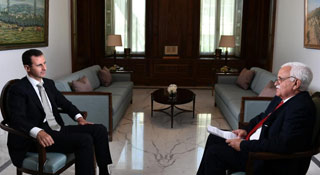
Prensa Latina | July 21, 2016
Prensa Latina transmits below the full text of the exclusive interview with Syrian President Bashar Al Assad:
PRENSA LATINA: Mr. President, thanks for giving Prensa Latina this historic opportunity of conveying your point of views to the rest of the world about the reality in Syria, because as you know, there is a lot of misinformation out there about your country, about the foreign aggression that is taking place against this beautiful country.
Mr. President, how would you evaluate the current military situation of the external aggression against Syria, and what are the main challenges of Syrian forces on the ground to fight anti-government groups? If it is possible, we would like to know your opinion about the battles or combats in Aleppo, in Homs.
President Assad: Of course, there was a lot of support to the terrorists from around the world. We have more than one hundred nationalities participating in the aggression against Syria with the support of certain countries like Saudi Arabia and Qatar with their money and Turkey with the logistical support, and of course with the endorsement and supervision of the Western countries, mainly the United States, France, and the UK, and some other allies.
But since the Russians decided to intervene in supporting legally the Syrian Army in fighting the terrorists in Syria, mainly al-Nusra and ISIS and some other affiliated groups, the scales have been tipped against those terrorists, and the Syrian Army has made many advancements in different areas in Syria.
And we are still moving forward, and the Syrian Army is determined to destroy and to defeat those terrorists. You mentioned Homs and Aleppo.
Of course, the situation in Homs, since the terrorists left Homs more than a year ago, the situation has been much, much better, more stable.
You have some suburbs of the city which were infiltrated by terrorists. Now there is a process of reconciliation in those areas in which either the terrorists give up their armaments and go back to their normal life with amnesty from the government, or they can leave Homs to any other place within Syria, like what happened more than a year ago in the center of the city.
For Aleppo it is a different situation, because the Turks and their allies like the Saudis and Qataris lost most of their cards on the battlefields in Syria, so the last card for them, especially for Erdogan, is Aleppo.
That is why he worked hard with the Saudis to send as much as they can of the terrorists – the estimation is more than five thousand terrorists – to Aleppo.
PRENSA LATINA: Through the Turkish borders?
President Assad: Yes, from Turkey to Aleppo, during the last two months, in order to recapture the city of Aleppo, and that didn’t work.
Actually, our army has been making advancement in Aleppo and the suburbs of Aleppo in order to encircle the terrorists, then, let’s say, either to negotiate their going back to their normal life as part of reconciliation, or for the terrorists to leave the city of Aleppo, or to be defeated. There’s no other solution.
PRENSA LATINA: Mr. President, which are the priorities of the Syrian Army in the confrontation with the terrorist groups? What is the role that the popular defence groups are playing in the theatre of operations?
President Assad: The priority of the Syrian Army, first of all, is to fight ISIS, al-Nusra and Ahrar al-Cham and Jaish al-Islam. These four organizations are directly linked to Al Qaeda through the ideology; they have the same ideology, they are Islamic extremist groups who want to kill anyone who doesn’t look or doesn’t feel or behave like them.
But regarding what you called the popular militia groups, actually, at the beginning of the war, the terrorists started an unconventional war against our army, and our army is a traditional army, like any other in the world, so the support of those popular defence groups was very important in order to defeat the terrorists in an unconventional way.
That was very helpful to the Syrian Army, because those fighters, those national fighters, they fight in their regions, in their cities, in their villages, so they know the area very well, they know the region very well, I mean the pathways, the terrain, let’s say, very well.
So, they can be very huge assets for the Syrian Army. That is their role.
PRENSA LATINA: Mr. President, how does the resistance of the Syrian people take place in the economic front to foreign aggression, I mean the economy, and please, what is your opinion on which sectors of the Syrian economy have remained functioning despite the war, economic blockade, looting, and so forth?
President Assad: Actually, the war on Syria is a full-blown war; it is not only supporting terrorists. They support the terrorists, and at the same time they launched a political war against Syria on the international level, and the third front was the economic front, in which they dictate to their terrorists, to their surrogate mercenaries, to start destroying the infrastructure in Syria that helped the economy and the daily needs of the Syrian citizens.
At the same time, they started an embargo directly on the borders of Syria through the terrorists and abroad through the banking systems around the world. In spite of that, the Syrian people were determined to live as much normal life as they can.
That prompted many Syrian businessmen or the owners of, let’s say, the industry, which is mainly medium and small industry, to move from the conflict areas and unstable areas toward more stable areas, on a smaller scale of business, in order to survive and to keep the economy running and to keep the needs of the Syrian people available.
So, in that regard, most of the sectors are still working. For example, the pharmaceutical sector is still working in more than 60 percent of its capacity, which is very important, helpful, and very supportive to our economy in such circumstances.
And I think now we are doing our best in order to re-expand the base of the economy in spite of the situation, especially after the Syrian Army made many advancements in different areas.
PRENSA LATINA: Mr. President, let’s talk a little bit about the international environment, please, give me your opinion about the role of the United Nations in the Syrian conflict, the attempts of Washington and its allies to impose their will on the Security Council and in the Geneva peace talks.
President Assad: Talking about the role of the United Nations or Security Council could be illusive, because actually the United Nations is now an American arm, where they can use it the way they want, they can impose their double standards on it instead of the Charter.
They can use it like any other institution within the American administration. Without some Russian and Chinese stances in certain issues, it would be a full American institution.
So, the Russian and Chinese role has made some balance within these institutions, mainly regarding the Syrian issue during the last five years. But if you want to talk about their role through their mediators or their envoys, like recently de Mistura, and before that Kofi Annan, and in between Brahimi, and so on. Let’s say that those mediators are not independent; they reflect either the pressure from the Western countries, or sometimes the dialogue between the main powers, mainly Russia and the United States.
So, they’re not independent, so you cannot talk about the role of the United Nations; it is a reflection of that balance. That is why so far, there is no United Nations role in the Syrian conflict; there is only Russian and American dialogue, and we know that the Russians are working hard and seriously and genuinely in order to defeat the terrorists, while the Americans always play games in order to use the terrorists, not to defeat them.
PRENSA LATINA: Mr. President, how do you see at the present time the coexistence among Syrian ethnic and religious groups against this foreign intervention? How do they contribute or not in this regard?
President Assad: The most important thing about this harmony between the different spectrums of the Syrian fabric, is that it is genuine, because that has been built up through the history, through centuries, so for such a conflict, it cannot destroy that social fabric.
That is why if you go around and visit different areas under the control of the government, you will see all the colors of the Syrian society living with each other.
And I would say, I would add to this, that during the conflict, this harmony has become much better and stronger, and this is not rhetoric; actually, this is reality, for different reasons, because this conflict is a lesson.
This diversity that you have, it is either to be a richness to your country, or a problem. There’s no something in the middle. So, the people learned that we need to work more on this harmony, because the first rhetoric used by the terrorists and by their allies in the region and in the West regarding the Syrian conflict at the very beginning was sectarian rhetoric.
They wanted people to divide in order to have conflict with each other, to stoke the fire within Syria, and it didn’t work. And the Syrians learned that lesson, that we had harmony; we had had harmony before the conflict, in the normal times, but we have to work more in order to make it much stronger.
So, I can say without any exaggeration that the situation regarding this part is good. In spite of that, I would say the areas under the control of the terrorists – and as you know those terrorists are mainly extremist groups affiliated to Al Qaeda – in which they worked very hard in order to indoctrinate the young generation with their dark ideology, and they succeeded in some areas, this dark ideology with the killing and beheading and all these horrible practices.
With the time, it is going to be more difficult to deal with this new generation of young people who have been indoctrinated with Al Qaeda and Wahabi doctrine and ideology. So this is the only danger that we are going to face regarding our society, harmony, and coexistence that you just mentioned.
PRENSA LATINA: Mr. President, I would like to go again to the international arena. What is in your opinion the role of the U.S.-led international coalition in relation to the groups that operate in northern Syria, in particular regarding the Kurds group. I mean the bombing of the American airplanes and the coalition in the northern part of the country. What to do you think about that?
President Assad: You know, traditionally, the American administrations, when they had relations with any group or community in any country, it is not for the sake of the country, it is not for the interest of the people; it is for the agenda of the United States.
So, that is what we have to ask ourselves: why would the Americans support any group in Syria? Not for Syria. They must their agenda, and the American agenda has always been divisive in any country. They don’t work to unite the people; they work to make division between the different kinds of people.
Sometimes they choose a sectarian group, sometimes they choose an ethnical group in order to support them against other ethnicities or to push them in a way that takes them far from the rest of the society.
This is their agenda. So, it is very clear that this American support is not related to ISIS, it is not related to al-Nusra, it is not related to fighting terrorism, because since the beginning of the American intervention, ISIS was expanding, not shrinking. It has only started to shrink when the Russian support to the Syrian Army took place last September.
PRENSA LATINA: Mr. President, what is your opinion about the recent coup d’état in Turkey, and its impact on the current situation in that country, and on the international level, and on the Syrian conflict also?
President Assad: Such a coup d’état, we have to look at it as a reflection of instability and disturbances within Turkey, mainly on the social level. It could be political, it could be whatever, but at the end, the society is the main issue when you have instability.
Regardless of who is going to govern Turkey, who is going to be the president, who is going to be the leader of Turkey; this is an internal issue. We don’t interfere, we don’t make the mistake to say that Erdogan should go or should stay. This is a Turkish issue, and the Turkish people have to decide.
But what is more important than the coup d’état itself, we have to look at the procedures and the steps that are being taken by Erdogan and his coterie recently during the last few days, when they started attacking the judges; they removed more than 2,700 judges from their positions, more than 1,500 professors in the universities, more than 15,000 employees in the education sector. What do the universities and the judges and that civil society have to do with the coup d’état?
So, that reflects the bad intentions of Erdogan and his misconduct and his real intentions toward what happened, because the investigation hasn’t been finalized yet. How did they take the decision to remove all those?
So, he used the coup d’état in order to implement his own extremist agenda, Muslim Brotherhood agenda, within Turkey, and that is dangerous for Turkey and for the neighboring countries, including Syria.
PRENSA LATINA: Mr. President, how do you evaluate the Syrian government’s relations with the opposition inside Syria? What is the difference between these opposition organizations and those based outside Syria?
President Assad: We have good relations with the opposition within Syria based on the national principles. Of course, they have their own political agenda and they have their own beliefs, and we have our own agenda and our beliefs, and the way we can make the dialogue either directly or through the ballot boxes; it could be a different way of dialogue, which is the situation in every country.
But we cannot compare them with the other oppositions outside Syria, because the word “opposition” means to resort to peaceful means, not to support terrorists, and not to be formed outside your country, and to have grassroots, to have real grassroots made of Syrian people.
You cannot have your grassroots be the foreign ministry in the UK, Franceor the intelligence in Qatar and Saudi Arabia and the United States. This is not opposition, this is called, in that case, you are called a traitor.
So, they call them oppositions, we call them traitors. The real opposition is the one that works for the Syrian people and is based in Syria and its agenda derived its vision from the Syrian people and the Syrian interests.
PRENSA LATINA: Mr. President, how do you evaluate the insistence of the U.S. and its allies that you leave power in addition to the campaign to distort the image of your government?
President Assad: Regarding their wish for me to leave power, they have been talking about this for the last five years, and we never responded even with a statement.
We never cared about them. Actually, this is a Syrian issue; only the Syrian people can say who should come and go, who should stay in his position, who should leave, and the West knows our position very well regarding this.
So, we don’t care and don’t have to waste our time with their rhetoric. I am here because of the support of the Syrian people. Without that, I wouldn’t be here. That is very simple.
About how they defame, or try to demonize certain presidents, this is the American way, at least since the second World War, since they substituted British colonization in this region, and maybe in the world, the American administrations and the American politicians haven’t said a single honest word regarding anything.
They always lie. And as time goes by, they are becoming more inveterate liars, so this is part of their politics. So, to demonize me is like how they tried to demonize President Vladimir Putin during the last two years and they did the same with the Cuban leader Fidel Castro during the last five decades.
This is their way. So, we have to know that this is the American way. We don’t have to worry about it. The most important thing is to have good reputation among your own people. That is what we have to worry about.
PRENSA LATINA: Mr. President, what is your opinion on Syria’s relation with Latin America, particularly the historical links with Cuba?
President Assad: In spite of the long distance between Syria and Latin America, we are always surprised how much the people in Latin America, not only the politicians, know about this region. I think this has many reasons, but one of them is the historical similarities and commonalities between our region, between Syria and Latin America.
Latin America was under direct occupation for long time ago but after that it was under the occupation of the American companies, and the American coup d’états and the American intervention.
So, they know what is the meaning of being independent or not to be independent. They understand that the war in Syria is about independence.
But the most important thing is the role of Cuba. Cuba was the spearhead of the independence movement within Latin America and Fidel Castro was the iconic figure in that regard.
So, on the political level and the knowledge level, there is a strong harmony between Syria and Latin America, especially Cuba. But I do not think we work enough to improve the other part of the relation; to be on the same level mainly on the educational and the economic level.
That was my ambition before the crisis and that is why I visited Latin America, Cuba, Venezuela, Argentine and Brazil, in order toinvigorate this relation. Then, we had this conflict started and it was a big obstacle to do anything in that regard, but I think that we have not to restrain the relation on the historical and the political levels. That is not enough. You have so many other sectors, people should know more about each other. The long distance could be an obstacle, but it shouldn’t because we have strong relations with the rest of the world, east and west.
So, it is not an obstacle in these days. So, I think if we overcome this crisis and this war, we should work harder in order to invigorate the different sectors of this relation with Latin America and especially with Cuba.
PRENSA LATINA: Mr. President, would you tell me your opinion about the electoral process in the United States mainly for the president? Now, there are two candidates; the Republican one is Mr. Donald Trump and the Democrat one is Mrs. Hillary Clinton, what is your opinion about this process, about the result of this process and how it could impact the conflict here, in the war in Syria?
President Assad: We resumed our relation with the United States in 1974. Now, it has been 42 years since then and we witnessed many American presidents in different situations and the lesson that we have learned is that no one should bet on any American president, that is the most important thing. So, it is not about the name.
They have institutions, they have their own agenda and every president should come to implement that agenda in his own way, but at the end he has to implement that agenda.
All of them have militaristic agendas, and the only difference is the way. One of them sends his army like Bush and the other one sends mercenaries and proxies like Obama, but all of them have to implement this agenda.
So, I do not believe that the president is allowed completely to fulfill his own political convictions in the United States, he has to obey the institutions and the lobbies, and the lobbies have not changed and the institutions’ agenda has not change.
So, no president in the near future will come to make a serious and dramatic change regarding the politics of the United States.
PRENSA LATINA: Mr. President, one final question: what message would you send using this interview with Prensa Latina to the governments and people of Latin America, the Caribbean, and also why not the American people, about the importance of supporting Syria against terrorism?
President Assad: Latin America is a very good and important example to the world about how the people and their governments regain their independence.
They are the backyard of the United States as the United States sees, but this backyard was used by the United States to play its own games, to implement its own agenda and the people in Latin America sacrificed a lot in order to regain their independence and everybody knows that.
After regaining their independence, those countries moved from being developing countries, or sometimes under-developed countries, to be developed countries. So, independence is a very important thing and it is very dear for every Latin American citizen.
We think they have to keep this independence because the United States will not stop trying to topple every independent government, every government that reflects the vast majority of the people in every country in Latin America.
And again, Cuba knows this, knows what I am talking about more than any other one in the world; you suffered more than anyone from the American attempts and you succeeded in withstanding all these attempts during the last sixty years or more just because the government reflected the Cuban people.
So, holding strongly to this independence, I think, is the crucial thing, the most important thing for the future of Latin America. Regarding Syria, we can say that Syria is paying the price of its independence because we never worked against the United States; we never worked against France or the UK. We always try to have good relations with the West.
But their problem is that they do not accept any independent country and I think this is same for Cuba. You never tried to do any harm to the American people but they do not accept you as an independent country.
The same is true for other countries in Latin America and that’s why you always have coup d’états mainly between the sixties and the seventies.
So, I think preserving the independence of a certain country is not only an isolated case; if I want to be independent, I have to support the independence in the rest of the world. So, the independence anywhere in the world, including Latin America, will support my independence. If I am alone, I will be weak.
Supporting Syria will be mainly in the international arena. There are many international organizations, mainly the United Nation, in spite of its impotence, but at the end, their support could play a vital role in supporting Syria and, of course, the Security Council; it depends on who is going to be the temporary member in the Security Council, and any other organization supporting Syria will be very important.
PRENSA LATINA: Mr. President, we know you are a very busy person, that is why I appreciate very much your time that you have dedicated to Prensa Latina interview in this moment. I hope this would not be the last interview that we have with you.
President Assad: You are welcome anytime.
Featured Video

New positive ivermectin evidence
or go to
Aletho News Archives – Video-Images
From the Archives
Fanatical Followers of the Covid Regime: A Jim Jones-Style Cult?
By Professor Roger Watson and Dr. Niall McCrae | The Daily Sceptic | November 15, 2021
As scholars at leading British universities over recent decades, we witnessed the replacement of critical thinking and debate by narrative: facts are discrimination and scientific method is imperialism; truth, instead, is derived from ‘progressive’ values. This educational trend may be a major contributory factor to the ease in which society has been inculcated to the Covid ‘new normal’ of masking, testing, and repeated doses of vaccines for a disease of similar risk to severe influenza.
One doesn’t need much critical reasoning to observe the flawed logic of some vaccination enthusiasts, such as people who respond to experiencing any side effects, however debilitating, by saying “at least I know it’s working”, or, after contracting the disease despite their promised inoculation (over 90% effective, according to initial drug company claims), “I’d have been worse off without the jab.” … continue
Blog Roll
 Aletho News
- EU Council Advances Chat Control 2.0 Scanning Proposal
- Ex-Greek MEP files complaint against Israeli spyware firm over alleged Pegasus surveillance
- Troubling ideas throughout the Torah, Talmud, Mishneh Torah and Tanya
- ‘Grave, alarming’: Iran mission on Trump’s UNGA ‘annihilation’ threats
- Najaf airport to reopen to Iranian flights within 24 hours: Ambassador
- From ‘How Will This End For Iran’ to ‘When America Walks Away’: A tale of two Economist covers
- Tehran blasts ‘baseless’ speculation linking Iran to alleged bomb plot at UK air base
- The Rise And… Rise Of ‘Color Revolutions’
- The Coming GOP Bloodbath?
- Arctic Scare Stories Melt Away
- If Americans Knew
- Netanyahu Asked UAE Leader to Deny Report on Oct. 7 Warning in Secret Visit, Sources Say
- CNN Chief Int’l Correspondent Clarissa Ward on Journalists in Gaza
- Democratic Party Consultants Surround Troy Jackson with Pro-Israel Donors
- Christian Leader Responds To Netanyahu’s Claims Regarding Palestinian Christians
- In Gaza, ‘Whoever Survives the Bombing Won’t Survive the Rubble’
- Israel kills more Palestinians, amid push to resettle Gaza – Daily Update
- Israel forces Gazans to live in constant peril – Daily Update
- Deconstructing Netanyahu’s pants-on-fire UN rant – Daily Update
- Trump betrayed voters with his campaign lies and prioritized a foreign country once he took office
- Netanyahu calls Israel’s war in Gaza ‘opposite of genocide’ in UN speech to near-empty hall
- No Tricks Zone
- New Study: Earth And Venus Surface Warmth Largely Explained By Convection And Lapse Rate, Not CO2 Or Radiation
- 2025 Nature Paper Claiming Worsening Global Drought Gets RETRACTED …Heavily Flawed
- New Study: ‘Global Drought Shows No Detectable Recent Acceleration Under Climate Warming’
- Economic Masterminds: German Socialists Suggest Taxing Productivity Gains Stemming From Using AI
- The South China Sea Has Not Been Cooperating With The Climate Change Narrative
- Energy Crisis: Germany Enters Heating Season With Historically Low Gas Reserve Fill Levels
- New Study: The Antarctic Ice Sheet Gained Mass From 2020-2024 Due To Staggering Snow And Ice Accumulation
- Study: Ocean Heating Rates From Thousands Of Years Ago ‘Dwarf’ Modern Ocean Heating Rates
- Climate Extremists Target, Attack Large-Scale Power Grid Infrastructure In Germany!
- New Study: Antarctic Ice Melt Has Contributed Less Than 1 Centimeter To Sea Level Rise In The Last 30 Years

