Kremlin Regrets UK Prime Minister May’s Statement on Russian Threat
Sputnik – July 19, 2016
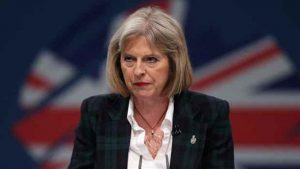 Russia regrets British Prime Minister Theresa May’s latest statements on the perceived Russian threat to the United Kingdom, Kremlin spokesman Dmitry Peskov said Tuesday.
May cited a “very real” threat from Russia and North Korea that the UK faced, as she advanced her argument on Monday in favor of renewing the aging Trident nuclear deterrent. British lawmakers voted later that day to approve the multibillion-dollar program to build four Vanguard-class nuclear submarines.
“The Kremlin regards these statements with regret. Apparently Mrs. Prime Minister has not yet fully caught up with the course of international affairs. Russia, in fact, is one of the main guarantors of international stability and nuclear security, strategic security, and this is an absolutely indisputable fact,” Peskov told reporters.
Peskov, noting Russia’s active role in the non-proliferation process, voiced hope that “an objective point of view with regard to our country would prevail” within May’s administration.
‘Thoroughly Delegitimized’: UK Media Slammed Over ‘Vicious’ Corbyn Coverage
Sputnik – July 18, 2016
UK Labour party leader Jeremy Corbyn has long been a critic of his coverage in the British press, and now a new study has found that three-quarters of newspaper stories about the Labour leader’s first months of leadership either distorted or failed to represent his actual views.
Academics from the London School of Economics (LSE) undertook a review of Corbyn-related stories in national newspapers from September 1 to November 1 last year, concluding that the Labour leader had been “thoroughly delegitimized” as a result of the coverage he received.
The research concluded that in 52 percent of articles about the Labour leader, Corbyn’s views were not included in the story, while in a further 22 percent of articles his views were “present but taken out of context.”
Meanwhile, out of the more than 800 articles analyzed, 15 percent presented and challenged Corbyn’s views, while just 11 percent presented the Labour leader’s views without challenge or alteration.
“Our analysis shows that Corbyn was thoroughly delegitimized as a political actor from the moment he became a prominent candidate and even more so after he was elected as party leader,” LSE project director Dr Bart Cammaerts said.
Concerns Over Impact on Democracy
Researchers also pointed to the impact this distorted coverage of Corbyn’s views was having on British democracy.
“These results relating to sources and ‘voice’ are evidently troublesome from a democratic perspective,” Cammaerts added.
“Allowing an important and legitimate political actor, ie the leader of the main opposition party, to develop their own narrative and have a voice in the public space is paramount in a democracy.
“Denying such an important political actor a voice or distorting his views and ideas through the exercise of mediated power is highly problematic.”
The LSE team said Corbyn had been “systematically attacked” ever since coming to prominence last summer, and that the British media had “played an attackdog, rather than a watchdog, role.”
Crazy Marxist and Terrorist Friends
The report highlighted particular examples where Corbyn was portrayed as being a radical leftist or as someone with links to terrorist groups such as the IRA, Hamas and Hezbollah.
“Corbyn is systematically ridiculed, scorned and the object of personal attacks by most newspapers. Even more problematic were a set of associations which deligitimised Corbyn as a politician, calling him loony, unpatriotic, a terrorist friend and a dangerous individual,” the report concluded.
Broadcaster Sky News removed an article from its website last year that referred to Corbyn as “Jihadi Jez” following widespread public criticism.
Corbyn has himself hit out at the media following his portrayal over the past 12 months, banning journalists from asking questions outside the front of his home.
“We have a party under attack from much of the media in this country like it has never been under attack before,” he said earlier this year.
The study featured publications with views ranging all across the political spectrum and included The Sun, The Daily Express, The Daily Telegraph, The Daily Mail, the Evening Standard, the Independent, the Daily Mirror and the Guardian.
Labour Coup falls back on dishonesty, identity politics and smears
OffGuardian | July 17, 2016
The Labour Coup just won’t die. It has become the masked killer from a b-list horror film. Lurching from one unlikely scenario to another, staunchly surviving an endless series of self-inflicted wounds, each one alone capable of felling a lesser being. Most observers knew it was all over the moment Corbyn refused to resign, if it survived that it was only by clinging to faint hope that they could keep him off the ballot. The NEC’s vote effectively put a stake through its heart. It is over.
The frantic struggling, as the traitors in the PLP and their media accomplices refuse to go quietly, is frankly undignified. The weasel-worded insinuations, and laughably obvious attempts to rig the rules, are pathetic. If the vote is anything even vaguely approaching fair, then Corbyn will win. The slimy tactics of his opponents will only drive people to the other side.
That Smith and Eagle have turned on each other demonstrates the values on display here. This isn’t about “saving Labour”, this is about grabbing power, about the basic principle that no real person of principle should ever be allowed influence, and about the preservation of a corrupt parliament where every smiling suit and skirt – from either side – is part of the same club. These are people of such low moral character that they can’t even act to preserve their own way of life, without layering in the need to polish their own gargantuan sense of self-import. Shallow egos that have gutted and cannibalized their own “movement” in its cradle.
The Guardian, or The Observer, are determined not to give up the fight. As of this morning they have an interview with Owen Smith, an article by Peter Walker, a column by Tom Watson, a polemic by Angela Eagle and some kind of… offering from Nick Cohen (I’m not sure what to call it…but reading it made me need to take a shower). They all say the same thing in slightly different words.
The message is same as it has been for 10 months – confused, ephemeral, abusive. There is no discussion of policy. There is narry a mention of political issues at all. There’s certainly no references to the LSE research into media bias against Corbyn.
Eagle’s column is especially disingenuous. She writes:
“… the party is as divided and disunited as I can remember. The current leadership has settled into a sectarian comfort zone – the effect of this has been to provoke personal attacks on MPs, a string of death and rape threats and bricks through windows.”
… neglecting to mention that the “disunity” came when the PLP deliberately plotted to remove the democratically chosen leader of the party, not through a straight leadership challenge, but through emotional blackmail and political leverage. It is the actions of her faction, sideways thinkers and sideways actors, that split the party open.
That she mentions the threats that have never been confirmed, and then proceeds to pluralise the bricks as if it were a campaign as opposed to a single incident, is absurd. There’s nothing to suggest Momentum, or any Corbyn supporter, had anything to do with the brick (singular). For all we know the “rape and death threats” are as real as the “threatening phone calls” that cancelled her Luton event, or the “homophobic abuse” that never happened. It’s perfectly possible these acts, if they are real, are being paid for by rich Labour donors in order to undermine Corbyn. It’s perfectly possible they simply didn’t happen at all.
But let’s say they did. It isn’t Corbyn, or his supporters, who have “provoked personal attacks on MPs”. Neither Corbyn nor McDonnell have collapsed into ad hominem rhetoric as much as the coup-plotters. You know what provokes people? You know what makes people angry? Being ignored. Being insulted. Being told that they don’t matter and have no power. That’s what makes people angry.
Democracy, as its core concept, is about the even distribution of influence. A democratic system cuts power into millions of tiny pieces, and hands one piece out to each person. “Here, this is your voice”, it says “you can make yourself heard”. In this way you put a halt to violence, you cap people’s frustrations by telling them that THEY have the power to change things. If you take away that influence, if you shout down their voices, if you tell people that they are wrong, that they don’t understand, that you know better than them…. then you are attempting to seize their portion of power. You are silencing their voice. You are fuelling their anger.
That’s when bricks start flying.
It is not Corbyn, or McDonnell, or Momentum or Unite that have provoked the public, it is the 172 MPs who brazenly declared war on the democratic process. It is a political class who, for years, have padded their expenses and voted for pay increases and claimed for second homes, and all the while pretended to be working for us… and then ignored our voices.
On top of all that, the idea someone who voted for the Iraq war can claim the moral high-ground because somebody threw a brick into an empty office is pretty appalling. I’m not sure how many windows got broken in Baghdad, but it was probably more than one.
Her article contains no policies except “inclusiveness”, no arguments except “I’m a gay, working class woman”. Vague patriotic slogans, self-pity, justifications and plenty of criticising Corbyn, including this beauty [my emphasis]:
Jeremy appeared to think that by appearing on television and saying he was seven out of 10 in favour of staying in Europe this would appeal to people who were not sure themselves. Instead it just gave them permission to vote Leave.
If we’ve learned anything about Angela Eagle in the last few weeks, it’s that she doesn’t believe in people having permission to vote for things. Not a great quality in an MP. We don’t need Corbyn’s permission to vote for, or against, anything. We don’t need permission at all. That’s kind of the whole point of the system. This phrase demonstrates just how in line with modern political thinking Eagle is, it reveals a core of authoritarian contempt for the electorate. It would not be out-of-place in a speech from another uncharismatic blond, running for office on the other side of the Atlantic. The “progressive left”, it seems, may have named themselves ironically.
All of that may be entirely moot, of course, because it seems Eagle is old news. Too tainted by the Iraq war, too embarrassed by her squib of a campaign launch, and frankly too atrociously poor at pubic relations herself to merit further discussion. She will soon consign herself to the dustbin of history… probably on the promise of being Smith’s Shadow Chancellor should he win the leadership. A sort of Poundland version of the deal done between Obama and Hillary Clinton in 2008. Polly Toynbee, Eagle’s lone cheerleader, has shuffled off to buy more gin and complain about twitter to anybody with the patience to listen.
Owen Smith is now where it’s at. You can tell because, not only does he get a puff-piece interview which tries to make him look ordinary and principled, he then gets an article (by Zoe Williams) about how ordinary and principled he is. Neither of them mention his efforts, while a PR rep for Pfizer, to promote the privatisation of the NHS. Both of them pretend he had no hand in the planning or execution of the coup… despite openly acknowledging this tweet from John Mann MP:
https://twitter.com/JohnMannMP/status/753126292183285760?ref_src=twsrc%5Etfw
Both articles repeat Smith’s story about John McDonnell saying that he’ll split the Labour party “if that’s what it takes”, without reference to the fact that McDonnell has categorically denied he ever said any such thing. They portray Smith as a reluctant challenger. A decent man, called to action against Corbyn. Despite being an “enthusiastic convert to Corbynism”, he was compelled to run for leader because he “shared the doubts of his colleagues about the person leading them”.
What follows is an avalanche of anecdotes, all from one side, designed to make Corbyn look like a doddering incompetent. They paint a picture of man who can barely function, one wonders how Corbyn manages to dress himself, let alone be an MP for 40 years. Once again, there’s not single piece evidence any of this ever happened. This interesting nugget of information is buried at the end:
A mysterious group called Saving Labour, which declines to comment on its leadership or funding – allegedly for fear of being abused– is organising over a hundred street stalls, paying for content on Facebook and even mounting an advertising campaign in the pages of the Guardian and the Observer in order to collect voters who will oppose Corbyn.
There’s a “mysterious group” backing the anti-Corbyn movement, it has no named leader and no known sources of funding. You would think, then, that a newspaper would investigate further. You would think any journalist worth his salt would delve a little deeper. The subject is never expanded upon.
This is Saving Labour’s website. It claims to be a group of “concerned citizens” interested in “saving democracy”. That’s it. No names. No list of backers. No policies. No candidates. That such an “organisation” can be used as a source by newspapers is astounding – it follows in the recent tradition of Guardian sources on that score. Bellingcat, the “citizen journalist organisation” is actually an unemployed admin assistant with no journalistic or photographic training, and no talent for either. The “Syrian Observatory for Human Rights”, is one man living above a corner-shop in Coventry. Saving Labour? Nobody knows. It is from such sources that our “news” is produced. Why? Because they produce handy soundbites that conform to the pre-written narrative.
Just like Owen Smith.
And so we come to Nick Cohen, and his festering wound of a column, demonstrating everything wrong with a Western political establishment that long ago abandoned truth as an ideal. The Western world, and the media especially, no longer talk of morality as an abstract absolute of black and white, or even a subtle spectrum of shades of grey.
No, in the modern world, Cohen’s world, morality is an absolute in the worst possible sense. He is moral, so everything he does is moral. Morality is a condition of an adherence to the consensus. That’s Nick Cohen’s world. In that universe it’s perfectly possible for a “good person” to be pro-war, to slander people, to lie both actively and by omission.
That is modern political thought – expressed through Blair and Obama and… pretty soon… Hilary Clinton. It is a total reversal of the accepted paradigm, going back thousands of years. Where once a person was defined by their actions, now actions are defined by the people who do them.
We are good, they are bad. Hence, we do right, they do wrong.
That is the premise upon which every Nick Cohen article is based. That is the premise that allows him, here, to admit to campaigning for an illegal war which cost at least a million lives… and yet claim moral authority over anti-war protesters because they went on Iranian television.
He writes about the “insane conspiracy theories against Labour MPs”. A vague accusation, so lacking in specifics that you have to make an assumption in order to offer a refutation. Let’s assume he is referring to the claims that the coup was plotted weeks or months in advance. These are hardly insane considering the Telegraph printed a story about the coup 10 days before it happened, that Angela Eagle’s leadership website was registered 2 days before she resigned, and John Mann was approached about backing Owen Smith for leader 6 months ago. Not forgetting all the ties to Portland Communication.
Again we see the total disregard for truth, or evidence, or reason. The same attitude marks Western coverage of Ukraine, of Syria, and of Brexit. The attitude that you can lie something into existence, and deny a fact until it goes away. It is the attitude of people who believe, as Karl Rove said:
We’re an empire now, and when we act, we create our own reality.”
I have written about the modern media’s struggle to enforce fake reality on a world in which they are increasingly obsolete. It is a struggle, much like the Corbyn coup, which the Guardian refuses to acknowledge is over. Katherine Viner wrote a long article a few days back, in essence a 6000 word plea for money. It was headlined:
How technology disrupted the truth – Social media has swallowed the news, threatening the funding of public-interest reporting and ushering in an era when everyone has their own facts.”
The basic point, aside from “We are struggling PLEASE send us cash!”, was that the world needs “proper journalism”, because social media is unreliable and allows people “pick their own facts”. More honestly she would say social media allows people to get all the facts and make up their own minds. That the media are losing their ability to shape our certitudes.
The coverage of Corbyn is a perfect illustration of this.
This isn’t about the leader of the Labour party, this is about a political establishment panicking in the face of an important realisation: They are not in control. They thought they could control Ukraine. They thought they could control Syria. They thought they could control Corbyn. They thought they could control Brexit. One by one the small plans have twisted and corrupted and become unrecognisable, the grander scheme – if a coherent one ever truly existed – has been scattered to the winds. The world is refusing to cooperate, and all they can do is carry on repeating lines from an increasingly irrelevant script.
What we have here is more than just an attempted, domestic coup. What we have here is microcosm of a political and media establishment that is slowly going insane. What we have here is their last recourse, their attempt to control reality by equal measures of fear, denial, abuse and dishonesty. And what we have here, perhaps reassuringly, is an abject failure.
Mainstream Media’s Main Source on Syrian Conflict Is a T-Shirt Shop – No, Seriously
By Darius Shahtahmasebi | ANTIMEDIA | July 14, 2016
Western media regularly quotes the so-called Syrian Observatory for Human Rights (SOHR) on statistics regarding the current Syrian conflict. Take, for example, this recent article from the Guardian, which reported the “UK-based monitor says dozens have died after [an] attack near [the] border with Turkey.” Referring to the SOHR as a “monitor” or “monitoring group” is a common practice corporate media employs to lend the organization legitimacy.
So who—or what—is the Syrian Observatory for Human Rights?
The truth is stranger than fiction.
At the time of this article’s publication, the official SOHR website has been down for several days. However, an archived version last captured on July 5, 2016, reveals details about the organization. Founded in May 2006, the SOHR is a group of people—not associated with or linked to any political body—that documents the Human Rights situation in Syria. They assert their goals and aspirations are democracy, freedom, justice and equality. The founder and director of SOHR is Rami Abdulrahman, a Sunni Muslim who fled to the United Kingdom after being arrested numerous times in Syria. He never returned.
In December 2011, Reuters provided some insight into how this so-called Observatory, “arguably Syria’s most high-profile human rights group,” operates:
‘Are there clashes? How did he die? Ah, he was shot,’ said Rami Abdulrahman into a phone, the talk of gunfire and death incongruous with his two bedroom terraced home in Coventry, from where he runs the Syrian Observatory for Human Rights.
Reuters further stated:
“[W]hen he isn’t fielding calls from international media, Abdulrahman is a few minutes down the road at his clothes shop, which he runs with his wife.”
According to the New York Times, Abdulrahman relies on four men from inside Syria to help collate and report data from more than 230 activists on the ground. The Times admitted the SOHR is, essentially, “a one-man band” operating out of a “semi-detached red brick house on an ordinary residential street” using the “simplest, cheapest Internet technology available.”
He relies on money from his clothes business, as well as small subsidies from the European Union and one European country he refuses to identify.
According to an interview with RT published last year—in which the SOHR director proved to be very elusive before he was eventually tracked down by the reporter—Abdulrahman acknowledged he personally has not been back to Syria in over 15 years, adding:
But I know some of the Observatory activists through common friends. This organization only takes new members following a six-month trial period and the candidate has to be familiar to someone from the organization or to a reliable outside contact.
To date, his informants remain anonymous, and he is the only individual listed as working for SOHR. Abdulrahman has no journalistic or legal qualifications, is not based in Syria, and relies on phone calls–yet the corporate media quotes his reports without question. This is particularly damning for Russia, as prominent outlets like the International Business Times have released articles treating the SOHR as an authority:
SOHR, which collects information from several ground sources in Syria, in a statement on its website, accused the regime and Russian air forces of bombing areas without distinguishing between the civilian and militant targets.
The ridiculousness of this reporting has been, in turn, chastised by Russia. As stated by the Russian Foreign Ministry through its spokesperson, Maria Zakharova:
“This information appears with reference to the Syrian Observatory for Human Rights based in London. As we all understand, it is very ‘convenient’ to cover and observe what is happening in Syria without leaving London and without the ability to collect information in the field.”
Sounds reliable.
However, it could be the case that Abdulrahman scrutinizes every piece of information from his sources to the best of his ability. It could be the case that his sources are the most reliable sources inside Syria and are not trying to push a particular agenda. However, statements like, “I came to Britain the day Hafez al-Assad died, and I’ll return when Bashar al-Assad goes” seem to suggest the “Observatory” may not always be a neutral source.
But how would we know, anyway? How does the corporate media know to trust these reports?
They don’t, yet they quote this so-called Observatory on a regular basis, peddling a pro-war agenda in the process. The media treats its coverage of Syria like war is a game—as if innocent lives won’t be lost and the repercussions of a war with Syria are not massive.
When did the corporate media become so lazy? The fact that Western media resorts to quoting a t-shirt shop stationed thousands of miles from the Syrian conflict reveals something about the availability of actual evidence, especially when such reports purport to document the atrocities the Syrian and Russian regimes are committing inside Syria. This is not to say Russian and Syrian forces have not caused widespread damage and inflicted suffering on many Syrians. But surely, if the credible evidence existed to support those peddling anti-Assad propaganda, news outlets would likely not use a t-shirt shop in England as a regular source.
That being said, my girlfriend’s family has a barbecue business at the front of their house; perhaps I can start documenting human rights abuses in the Middle East for the establishment media, as well.
Brexit: A Workers’ Response to Oligarchs, Bankers, Flunkies and Scabs
By James Petras :: 07.14.2016
The European Union is controlled by an oligarchy, which dictates socio-economic and political decisions according to the interests of bankers and multi-national business. The central organs of power, the European Commission (EC), the European Central Bank (ECB) and the International Monetary Fund (IMF) have systematically imposed austerity programs that have degraded working conditions, welfare programs, and wages and salaries.
EU policies demanding the free immigration of non-unionized workers to compete with native workers have undermined wage and workplace protections, union membership and class solidarity. EU financial policies have enhanced the power of finance capital and eroded public ownership of strategic economic sectors.
The European Union has imposed fiscal policies set by non-elected oligarchs over and against the will and interests of the democratic electorate. As a result of EU dictates, Greece, Spain, Portugal and Ireland have suffered double-digit unemployment rates, as well as massive reductions of pensions, health and educational budgets. A huge transfer of wealth and concentration of decision-making has occurred in Europe.
Rule by EU fiat is the epitome of oligarchical rule.
Despite the EU’s reactionary structure and policies, it is supported by Conservatives, Liberals, Social Democrats, Greens and numerous Leftist academics, who back elite interests in exchange for marginal economic rewards.
Arguments for the EU and their Critics
The pro-EU power elite base their arguments on concrete socio-economic interests, thinly disguised by fraudulent ideological claims.
The ideological arguments backing the EU follow several lines of deception.
They claim that ‘countries’ benefit because of large-scale transfers of EU payments. They omit mentioning that the EU elite secures the privatization and denationalization of strategic industries, banks, mass media and other lucrative national assets. They further omit to mention that the EU elite gains control of domestic markets and low wage labor.
The EU argues that it provides ‘free movements’ of capital, technology and labor – omitting the fact that the flows and returns of capital exclusively benefit the powerful imperial centers to the detriment of less advanced countries and that technology is controlled and designed by the dominant elites which also monopolize the profits. Furthermore, the ‘free flow of labor’ prejudices skilled productive sectors in less developed countries while reducing salaries, wages and benefits among skilled workers in the imperial centers.
The EU : A Self-Elected Dictatorship of Empire Builders
‘Integration into the EU’ is not a union of democratic participants; the decision-making structure is tightly controlled by non-elected elites who pursue policies that maximize profits, by relocating enterprises in low tax, low wage, non- unionized regions.
European integration is an integral part of ‘globalization’, which is a euphemism for the unimpeded acquisition of wealth, assets and financial resources by the top 1%, shared, in part, with their supporters among the top 25%.
The EU promotes the concentration of capital through the merger and acquisition of multi-national firms which bankrupt local and national, medium and small scale industries.
Political and Academic Satraps of the EU Elites
The European Union’s oligarchy has organized a small army of highly paid politicians, functionaries, advisers, experts and researchers who support the European Union in a manner not unlike NGO workers in the developing world – answerable only to their ‘foreign’ paymasters.
Numerous Social Democrats draw stipends, travel expenses, lucrative fees and salaries as members of commissions and serve on impotent ‘legislative’ assemblies.
Academics advise, consent —and draw duplicate salaries from membership in the EU bureaucracy. Journalists and academics ‘front’ for the EU oligarchy by playing a leading propaganda role. For example, they have been busy slandering British pro-democracy, anti-EU voters by (1) calling for a new referendum and (2) questioning the right of the working class electorate to vote on issues like the recent EU referendum.
The leading financial press adopts a demagogic pose accusing the pro-democracy voters of being ‘racists’, ‘nativists’, or worse, for ‘opposing Eastern European immigration’.
In fact, the vast majority of workers do not oppose immigrants in general, but especially those who have taken once-unionized jobs at wages far below the going rates for established workers, on terms dictated by employers and with no ties or commitment to the community and society. For decades British workers accepted immigrant labor from Ireland because they joined unions at wage rates negotiated by union leaders, won by long workers struggle and voted with the majority of English workers. Under the EU, Britain was flooded with Eastern European workers who acted as ’scabs’ displacing skilled British workers who were told it was ‘progress’. This acted to destroy the prospects of their own children entering a stable, skilled labor market.
The financial press’s lurid descriptions of the British workers’ anti-EU ‘racism’ against Polish immigrant labor ignores the long history of Warsaw’s virulent hostility to immigrants–namely the refugees from the wars in the Middle East. The Polish government and population exhibit the most furious opposition to sheltering the thousands of Middle East and African war refugees, while claiming that they are not ‘Christians’ or might pose cultural or even terrorist threats against the ethnically pure Polish population.
Some of the British workers’ hostility toward Polish workers has a recognized historical basis. They have not forgotten that Polish strike breakers took the side of ‘Iron Lady’ Thatcher’s militarized assault against unionized UK miners during the great coal strikes and even offered to export coal to aid the Conservative government in breaking the strike. As such, EU-Polish immigrant workers are not likely to integrate into the militant British working class culture.
The Polish regime’s aggressive promotion of the economic sanctions against Russia has further undermined English jobs linked to that large and growing market.
The financial press ignores the fact that Polish immigrants ’scab’ on unionized British workers in the construction industry, undercutting long-established UK plumbers, electrical workers, carpenters and laborers – who have multiple generational ties to their communities and work. The EU elites use the importation of Polish workers to strengthen the reactionary labor policies of the employers
After the fall of Communism, Polish workers backed a succession of right-wing regimes in Warsaw, which privatized and denationalized industries and eroded their welfare system leading to their own impoverishment. Poles, instead of fighting against these neo-liberal regimes at home, headed for England and have been helping the British bosses ever since in their own anti-labor campaigns to reduce wages and decrease worker access to decent, affordable housing, public services, education and medical care.
The Eastern Europeans became the willing recruits of the EU reserve army of labor to raise profits for industrial and finance capital thus further concentrating wealth and power into the hands of the British oligarchs.
To label British workers’ antipathy to these EU policies over the free entry of cheap immigrant labor, as ‘racist’, is a blatant case of blaming workers for opposing naked capitalist profiteering. It is not hard to imagine how the Poles would react if skilled Syrian electricians were taking their jobs!
The pro-EU prostitute press claims that the pro-democracy voters are ‘anti-globalization’ and a threat to England’s living standards and financial stability.
In fact, labor votes in favor of trade but against the relocation of English industry overseas. Labor votes for greater investment in the UK and greater regional diversity of productive, job-creating sectors, as opposed to the concentration of capital and wealth in the parasitic finance, insurance and real estate sectors concentrated in the City of London.
The EU-City of London-financial oligarchy have priced labor out of the housing market by promoting the massive construction of high-end luxury condos for ‘their kind of immigrant’, i.e. the millionaire and billionaire Chinese, Russian, Indian, Eastern European and US plutocrats who flock to London’s famous tax-evasion and money-laundering expertise.
The scribes of the EU-City oligarchy who claim that exit from the EU will lead to a cataclysmic breakdown are blatantly scaremongering. In fact, the stock and bond market, which declined for less than a week, rebounded sharply, as trade, production and demand were scarcely affected by the vote.
The hysteria-peddlers among the financial press resounded . . . in the minds and pockets of the City of London speculators. They rightly feared that their own lucrative financial operations could relocate overseas.
Conclusion
If and when the EU – City end their oligarchical control over the British economy, workers will gain an opportunity to debate and elect freely their own representatives and have a say in their own government. Leaving the EU is just the first step. The next move will be to change the rules for immigrant labor to accord with the standards of wages and conditions set by UK trade union organizations.
The following steps would include subordinating the banks to the needs of industry, investment in public housing for workers and the development of local technology for domestic producers.
The cleavage between productive labor and the EU parasites and their political hangers-on requires a new political leadership with a democratic foreign policy, which precludes overseas wars and imperial alliances.
The break with the EU logically and persuasively argues for a break with NATO and an opening toward free trade with Russia, China and the new dynamic global markets. The end of the EU can help weaken the strategic partnership between the European and City of London oligarchs. No doubt, the latter will not go without a class war of unprecedented ferocity, involving financial lockouts, manufactured fiscal crises, street mobs and parliamentary coups at the top of their agenda.
Only if the democratic electoral majority becomes a cohesive and combative class movement, in and out of Parliament, can they convert the referendum from a temporary electoral win to a stable basis for structural transformation.
Only a democratic majority can implement a fair and equitable immigration policy that strengthens labor and welfare policies and which would be based on the traditional values of British trade unionism and not on some criteria parroted by the ‘house servants’ for the lords of the EU-London ‘Downton Abbey’.
Blair justified Iraq War with ‘discredited’ child mortality data
RT | July 14, 2016
Ex-Prime Minister Tony Blair cited dubious child mortality figures as part of his justification for invading Iraq when he was grilled by MPs, the Chilcot report has revealed.
In the run up to the Iraq War, Blair claimed Iraq’s child mortality rate was 130 deaths per 1,000, a figure he obtained from a long-discredited source, the Iraq Child and Maternal Mortality Survey (ICMMS).
This is despite the Foreign & Commonwealth Office (FCO) telling Downing Street there were no reliable figures for Iraq’s infant mortality rate.
The former PM repeated the claim when testifying before the Chilcot inquiry in 2010, after he was asked whether the invasion had been good for the Iraqi people.
“In 2000 and 2001 and 2002 they had a child mortality rate of 130 per 1,000 children under the age of five,” Blair told the Chilcot inquiry.
“The figure today is not 130, it is 40. That equates to about 50,000 young people, children, who, as a result of a different regime that cares about its people – that’s the result that getting rid of Saddam makes.”
According to economist Professor Michael Spagat, Blair was wrong about the figures and should have known better the first time he used them to justify war in 2003.
Writing for the Conversation, Spagat said the ICMMS data was flawed and hugely unreliable.
“As the Chilcot report notes, no fewer than four subsequent surveys plus the 1997 Iraqi census failed to confirm the ICMMS data, which found a massive and sustained spike in child mortality in the closing years of the 20th century,” Spagat wrote.
The former PM was also told by one of his own government department’s that the figures could not be trusted.
In February 2003, Downing Street asked the FCO for data on child mortality rates in Iraq in a bid to strengthen the argument for war.
The FCO replied, in now declassified correspondence, that there were “no truly reliable figures for child mortality rate” in Iraq. It went on to describe the ICMMS statistics as having “relied on some Iraqi figures” and been “proved questionable.”
According to Spagat, Blair’s private secretary then “iron[ed] out the nuances in the FCO’s spot-on analysis,” leaving the former PM to reference the discredited child mortality figures in his party speech in 2003.
Spagat said “there was no excuse” for Blair to repeat the incorrect claim in 2010, because the figures were already widely discredited.
“All in all, this affair is a remarkably good example of how complex information can end up being manipulated thanks to political imperatives and time limitations,” Spagat writes.
“But it still doesn’t explain why Blair held onto the discredited figure for so long.”
Blair’s Former Propagandist: “Referendums are Dangerous in a Parliamentary Democracy”
By Steven MacMillan – New Eastern Outlook – 14.07.2016
 In an interview with Hala Gorani of CNN, the man who served as Tony (the war criminal) Blair’s Director of Communications from 1997 to 2003, Alastair Campbell, denounced referendums as a danger to democracy. Campbell is clearly enraged that the British people had the audacity to vote against the wishes of the establishment; and his remarks are the epitome of elitist thinking – which holds that ordinary people are too stupid to make important decisions on their own.
We pick the conversation up just after Campbell discusses the surge in working class people who voted for Brexit in the UK, and are supporting Donald Trump in the US:
Gorani: “Is that a failure of the establishment in not having responded for decades to real concerns of how globalisation has hurt common, ordinary workers?”
Campbell: “Absolutely it is. But the point is… this is why referendums… I said this the day after the last general election; I was on BBC Question Time and the first question was will Britain leave the EU? I said I hoped not, because I hope the British people will save the politicians from themselves; and I said then and was howled down for being anti-democratic: referendums are dangerous in a parliamentary democracy.”
Gorani: “Why is that?”
Campbell: “Because we’ve had a referendum in one of the most ill-informed, lying debates that I can ever recall anywhere in the world. We’ve been like a banana republic in the last few days; this has been a joke.”
So in Campbell’s view, the Brexit referendum is “dangerous” because the people of Britain had been lied to by the leave campaign in the run-up to the vote. This is coming from the man who was a pivotal figure in disseminating the tsunami of lies, fear and war propaganda in order to convince the public that Britain had to launch the most destructive war of the 21st century: the illegal invasion of Iraq in 2003. The man who was an integral part of pushing the slogan that the West was ‘bringing democracy to the Middle East;’ believes a democratic vote in Britain is “dangerous.”
Campbell was responsible for circulating the two fraudulent dossiers – the September and the Iraq – into the mainstream media in order to convince the British people that Iraq had ‘weapons of mass destruction.’ It was revealed in 2010 that Campbell had ordered the September dossier to be altered to fit more in line with a speech from George (the war criminal) Bush in 2002, after Bush stated that Iraq would be able to build a nuclear bomb within a year, whereas the initial draft of the British dossier said it would be at least two years.
Campbell is also regurgitating the Orwellian propaganda line that is being spread throughout the Western media: that somehow a democratic referendum is undemocratic. Just because the vote flew in the face of the British establishment, the presstitutes are engaging in intellectual jujitsu in order to demonise the leave vote. Would they be doing so if Britain voted to remain in the EU? I think not.
The Guardian (which was pro-remain) is at the forefront of pushing this narrative. This is evident in their article titled: Can we have our parliamentary democracy back please? The article actually quotes former British PM, Clement Attlee, who said referendums have too “often been the instrument of Nazism and fascism.” It’s just ridiculous; this is spin on steroids – trying to associate a democratic referendum with fascism.
Considering the fact that Britain commits incessant crimes overseas in the name of democracy, it is abhorrent that the democratic wishes of the British people are being marginalized by the establishment.
The establishment is terrified of direct democracy, and giving the people votes on issues that actually matter. The majority of parliamentarians in the UK are in the pocket of special interests, and represent the interests of the people in no way, shape, or form.
In Britain’s ‘great parliamentary democracy,’ the people were taken into a war (despite widespread public opposition) that killed and destroyed the lives of millions of innocent people in 2003. Britain’s ‘great parliamentary democracy’ has brought the people a surveillance state beyond the Stasi’s wildest dreams, in addition to involving Britain in Libya, Syria and countless other abominations. How can the people do any worse than our great parliamentarians?
The Western elite are terrified of democracy, and they view the wishes of the people as a danger to their rule. If the British people voted in favour of remaining within the EU, the establishment would not be demonising the vote as “dangerous” and fascistic.
Steven MacMillan is an independent writer, researcher, geopolitical analyst and editor of The Analyst Report.
British politics: The Establishment versus Democracy
By Neil Clark | RT | July 13, 2016
With the dramatic withdrawal of the pro-Brexit Andrea Leadsom from the Conservative Party leadership race, the coronation of Theresa May, who supported ’Remain’ in the EU Referendum, is confirmed.
Ms. May is expected to be handed the keys to 10, Downing Street on Wednesday.
At the same time, the pro-Iraq war Labour MP Angela Eagle has launched her leadership challenge to the anti-war Labour Party leader Jeremy Corbyn.
It’s not hard to see the connection between these two developments. May and Eagle, who says that she thinks ‘Tony Blair has suffered enough’, are the clear choices of the Establishment power brokers; Leadsom and Corbyn are most definitely not. Their appeal is with their party’s membership and the wider public and not with the Westminster/media elites.
What we are seeing played out before our very eyes is an attempt by said elites to reverse the democratization of Britain’s ‘Big Two’ political parties and to restore the power of Establishment insiders to shape the direction which those parties and the country takes. Party members who think differently must be put in their place. They must be seen, not heard.
The aim of this anti-democratic counter-revolution is simple. It‘s to make sure there is no major deviation from elite-friendly, neo-liberal, crony capitalist pro-war policies, whether it be a populist left-wing deviation, which promises re-nationalisation of the railways, wealth taxes and a less aggressive stance on foreign affairs, or a populist right-wing one, which wants the UK to Brexit without further delay and which opposes Blairite ‘liberal interventionism’ in foreign policy.
Anyone who threatens to take us away from the ‘extreme centre’ (a phrase used by Miriam Cotton and Tariq Ali) of crony capitalism, endless war and the cynical use of identity politics as a cover for the most regressive policies, is targeted for destruction.
One only has to consider the relentless smears and attacks that the anti-status quo Jeremy Corbyn has been subject to from the extreme centre since he announced he was standing for the vacant Labour leadership last summer. The attacks intensified after he was elected leader. The plotters of the current ‘Chicken Coup’ against Corbyn, clearly hoped to oust the Labour leader by a procedural technicality – they hoped that Labour’s National Executive Committee (NEC) would decide that Corbyn needed the nomination of 51 MPs or MEPs in order to stand. However, the NEC voted by 18-14, that Corbyn, as the incumbent, should automatically be on the ballot.
The fact that Labour’s coup supporters tried to keep Corbyn (who was elected with a huge mandate by the party’s members and supporters only last summer) off the ballot shows the utter contempt for party democracy that these people have. Blairites support bombing other countries to smithereens to promote ‘democracy’- but they hate it in their own party!
The coup plotters say that Corbyn is a disaster, yet he has been responsible for a massive surge in Labour party membership – which now stands at over 500,000 – its highest in modern history.
But instead of welcoming the recent membership surge, the anti-democratic Blairites seem appalled that the ‘great unwashed’ are signing up. For supporting Corbyn, Labour members have been called ‘wide-eyed loonies’, ‘rabble’ and even ‘scum’. But of course, let’s just focus on Momentum and Corbyn supporters being rude to Blairites who insult them, shall we?
The arguments given by those representing the extreme center for replacing Corbyn as Labour leader are as bogus as the claims the same people made about Iraq having WMDs in 2003.
We’re told Corbyn has to go because he’s ‘unelectable’ – in fact Labour were the most popular party in May’s local elections. Labour lost millions of traditional supporters during the Blair/Brown years, while Corbyn has encouraged these people – genuine Labour people – to return to the fold.
It’s also patently absurd to argue that in order to ‘reconnect’ with the electorate, Labour needs to ditch Corbyn – who accepts Brexit – and instead have a Blairite or Brownite who is in love with the EU as its leader. And in the very week following Chilcot, it’s an insult to the 1m people killed to have an MP who voted consistently for the Iraq war – and against an inquiry into it – challenging a principled MP (Corbyn) who opposed it.
Although Corbyn will be on the ballot for the leadership campaign, his opponents have done their best to tilt things in the contest in their favour. The NEC decided that only members who signed up before 12th January and those prepared to pay a £25 fee as a ‘registered supporter’ will be able to vote.
In last year’s election the fee for being a registered supporter was just £3: the thinking behind the change is clearly to deter poorer people- who more likely to support Corbyn, from voting.
However, Unite the Union, which supports Corbyn, and is affiliated to Labour, offers 50 pence a week community membership, providing a way for Corbyn supporters to make their voices heard.
If Corbyn is toppled this summer, then we can expect new leadership rules to be introduced by the party to make sure that a popular left-winger who promises a genuine move away from the ‘extreme centre’ can never again lead the party.
In the Conservative Party leadership election, we’ve witnessed a master-class in how the Establishment engineers the result it desires. Theresa May was obviously the anointed one, but in order for her to be crowned a few things had to happen first. The maverick Boris Johnson, who was decidedly dodgy on foreign policy, as I explained here, had to be knocked out of the race. And then, after she had beaten Murdoch’s favourite, Michael Gove, onto the final short-list it was time for the Establishment’s attack-dogs to be unleashed on Mrs. Andrea Leadsom.
Revealingly, the newspaper which did it for Leadsom is also the newspaper that’s been the most unrelentingly and obsessively hostile to Jeremy Corbyn. Rupert Murdoch’s Times is an Establishment organ that regards any deviation from the extreme Blairite/Cameronite center as a heresy that needs to be firmly stamped on. All of course in the interests of ‘democracy’ and ‘moderation’!
Rather naively, Leadsom, who supported Brexit, and said she’d send off Article 50 to the EU in September if she became Prime Minister, consented to be interviewed by the pro-Remain Times.
It was the biggest mistake of her political life.
Deeply shocked when she saw the Times headline on Saturday, she accused the paper of ‘gutter journalism’ for the way they presented the interview. The Times, in response, released a partial audio recording of the interview, but still hasn’t released a full one. The journalist who interviewed Leadsom, Rachel Sylvester, was accused of contradicting her own story about not raising the subject of family and motherhood to her interviewee.
A day later, the Sunday Times, intensifying the pressure on Leadsom, reported that up to 20 Tory MPs would quit the party if she won – in effect warning her that she would have the same problems in Westminster as Jeremy Corbyn. But this report was later denied by MPs.
One doesn’t have to share her politics to acknowledge that Leadsom was stitched up by Murdoch’s Establishment mouthpiece.
She became the target of some pretty unpleasant attacks by Parliamentary colleagues, inside-the-tent journalists and some liberal-leftists too who were only too keen to support The Times against her – not to mention the newspaper’s shameful record of neocon/Blairite warmongering.
It was no surprise that after a tearful weekend,
Leadsom pulled out of the Tory leadership race on Monday. Her campaign manager Tim Loughton said: “It is absolutely not the job of media commentators to ‘big up’ politicians whether in this leadership contest or elsewhere in politics. But neither should it be their compulsion constantly try to trip them up”.
With Leadsom successfully tripped up, and the Tory party’s 150,000 members deprived of having their democratic say in their party’s leadership election, Rachel Sylvester moved on to another outsider who threatens the status quo – Jeremy Corbyn – with an article in Tuesday’s Times charmingly entitled ‘Corbyn’s Labour must be tested to destruction’.
Destroy. Destruction. Weapons of Mass Destruction. These are words the Establishment loves to use in its war against its enemies.
Meanwhile, the fear of ‘the mob’ from those inside-the-tent is there for all to see. ‘If we don’t tame Twitter, we’ll face mob rule’ was the title of one Times comment piece on Monday.
Meanwhile, Tony Blair himself is concerned about ‘the mob’, and the way the extreme centre, which he personifies, is currently threatened. “It was already clear before the Brexit vote that modern populist movements could take control of political parties. What wasn’t clear was whether they could take over a country like Britain. Now we know they can”, he bemoaned in the New York Times.
Blair and his disciples – in both Labour and the Conservative parties – want to get back to ‘business as usual, that is, a situation where they and not us are in control. People power has already gone way too far for the party elites and they desperate to put a stop to it.
The coronation of Theresa May boosts their cause, but the Extreme Center also needs to topple Jeremy Corbyn if they‘re to succeed in their One Party Britain anti-democratic project.
The stakes really could not be any higher.
Follow Neil Clark on Twitter @Neil Clark
Scottish Nationalism & the Yinon Plan
By Barbara McKenzie | July 13, 2016
The Scottish National Party, under Alex Salmond, has long been associated with opposition to illegal and immoral wars. Salmond was one of the few MPs who opposed the bombing of Serbia, and campaigned actively against the invasion of Iraq, subsequently supporting Plaid Cymru’s Adam Price in his attempt to impeach Tony Blair. Like Jeremy Corbyn he has been responding to the publication of the Chilcot report; like Jeremy Corbyn he is calling for Blair to be charged with war crimes.
What exactly is the position of the Scottish National Party with regard to global peace and justice?
The foremost objective of the Scottish National Party is Scottish independence. Beyond that, it has been obliged to position itself as the centre-left party of Scotland, there being scarcely room on the right along with Labour and the Tories, and espouses certain left-wing causes such as the question of upgrading Britain’s nuclear missile system, Trident. However a commitment to Scottish independence and opposition to nuclear weapons do not in themselves add up to an ethical view on global affairs.
Despite Salmond’s stance on Iraq, the SNP, with Salmond as party leader, voted with the Government and Labour Opposition to bomb Libya in 2011. It should be noted that both Jeremy Corbyn and John McDonnell voted against the motion, along with 11 other MPs. The reasons given for their No vote are varied and convincing. That of Caroline Lucas, Green MP for Brighton Pavilion, went : ’Given the West’s colonial past, its history of adventurism and support for dictatorship in the region, its failure to enforce UN resolutions in Palestine and the legacy of the invasion of Iraq in 2003, I think its motives in Libya will always be in doubt.’ Quite so.
The SNP clearly did not see it that way. As Steve James puts it:
Since coming to power in Edinburgh in 2007, the [SNP] has repeatedly made clear it is willing to support British military actions, particularly if a UN flag is flying over the slaughter of the day—including in Libya. […] The SNP has repeatedly made clear that they support NATO, the European Union, a struggle against Russia, and increased spending on frigates, fast jets and long-range reconnaissance aircraft.
The SNP’s line on Syria could be seen as being consistent with its position on Iraq, in that it opposed the overt bombing of the country (ostensibly ISIS in Syria) in December, 2015. When talking to the press after the vote was passed Salmond made a lot of sense (as he usually does), pointing out the lack of a proper strategy to deal with Islamic State.
However the elephant present in the chamber when the bombing of Syria was debated was the UK government’s known support for the extremist militants fighting the legitimate government in Syria, see here and here. Neither Salmond’s statement on the ‘bomb Syria’ vote nor Nicola Sturgeon’s contain any proposal for the obvious moral alternative, to stop supporting armed extremists, mostly imported, and instead help the Syrian people fight these terrorists. There is nothing said by either politician to suggest that the SNP does not support in principle the proxy war on Syria and enforced regime change.
It is obvious to all and sundry that there is a gross contradiction between the West’s claims to see terrorism and the growth of ISIS as a major threat, while in real terms prioritising the overthrow of the Syrian government who is actually fighting them on the ground. By not pressing the UK government and the EU to actually help the Syrian people fight jihadi extremists, instead of providing those same extremists with moral and material support, the SNP has shown itself to be just as compromised as the Labor and Conservative parties.
The Yinon Plan
Many active users of social media who follow global events will be familiar with General Wesley Clark’s revelation in 2007 about the US plan, after having already invaded Afghanistan, to take out 7 further countries in 5 years. It was made known to Wesley Clark a couple of weeks after 9/11 that the US planned to invade Iraq, Syria, Lebanon, Libya, Somalia, Sudan and finally Iran.
Likewise, many people will be familiar with Oded Yinon’s ‘Strategy for Israel in the Nineteen Eighties’, a proposal to further Israel’s interests by destabilising the whole of the Middle East. The plan operates on two essential premises. To survive, Israel must 1) become an imperial regional power, and 2) must effect the division of the whole area into small states by the dissolution of all existing Arab states.
The objectives of the proposal articulated by Wesley Clark clearly further those of the second premise of the Yinon Plan. Furthermore, leaked documents (such as Clinton’s emails) confirm that Israel’s interests are paramount for US foreign policy. The same documents show that the decision to take out Syria had been made at least by 2006, but probably much earlier.
Given the catastrophic progression of wars from Afghanistan, Iraq, Libya to Syria, all strongly promoted and either actively waged or heavily sponsored by the West, Israel and their ally Saudi Arabia, there is no moral or intellectual justification for seeing these wars as anything but a cold-blooded plan to destabilise the greater Middle East and fulfill the Yinon plan.
There is little in the actions of the SNP (and many of their supporters) to suggest that they do not support in principle this path of destruction. Nicola Sturgeon declared her unequivocal support for the Israel lobby by putting on a blue nose to celebrate Yom Ha’atzmaut, which translates as something like ‘Destroy Palestine Day’.

Support for Israel, and for the Israel-backed programme of regime change in the Middle East, is a thread that runs through the Scottish independence movement.
The main Scottish ‘leftist’ pro-independence blogs, while they probably opposed the Iraq war, have abandoned any pretense at a moral perspective when it comes to global affairs. Rev. Stuart Campbell, the editor of Wings over Scotland and a strong supporter of the SNP, has wisely avoided commenting on issues such as the Syria conflict, focusing on what he knows best, i.e. Scottish affairs. However Campbell forms a mutual admiration society with one Stephen Daisley, a journalist with STV News who has been termed a ‘hate-filled and crazed right-winger’ by ex-UK ambassador Craig Murray. Daisley authored a quite extraordinary article attacking those who criticise Israel, which fully justifies Murray’s categorisation, offering such objective analysis as, ‘Why deny the Holocaust when you can throw it back in the Jews’ faces by fictionalising Gaza as a concentration camp? Why hurl rocks at a Jew in the street when you can hurl endless vexatious UN resolutions at Israel?’
Daisley’s article was published 24 August 2015. On the same day Wings over Scotland tweeted (not, I hasten to add, in reference to Daisley’s article, but also not for the first time)

Daisley promoted Wings over Scotland’s crowd fundraiser in February 2015, while until late last year his blog was listed among the suggested links on Wings over Scotland’s Home Page.
The other major pro-indy blog, Bella Caledonia, which has been praised by such notable Scots as Irvine Welsh, has come out strongly in support for enforced regime change in Syria, posting, for example, an article What is to be Done about Syria by determined propagandist for the ‘revolution’, Mohammed Idrees Ahmed. To be fair to Scotland, the article attracted a number of negative (or appalled) comments, but editor Mike Small responded to criticism by digging himself into an ever deeper hole, and disappointed readers were left in no doubt of his support for illicit regime change in Syria.
Who’s next?
It is widely assumed that the next country in the sights of the NATO/Israel alliance will be Iran (although with all the recent sabre-rattling about Russia, one could be forgiven for thinking that country may be next in the firing line). It has also been widely assumed that the progression to war on Iran, either through direct military intervention or via a bogus revolution on the Syria model, is impeded by the failure so far to achieve a resolution in Syria that satisfies the NATO/Israel alliance, and that the ‘West’ will not move its attentions to Syria until the Syrian situation is resolved.
Quite how long Iran is safe from the predatory NATO/Israel alliance is hard to say. But those wanting to move against Iran sooner rather than later met in Paris on 9-10 July 2016, at a rally called Free Iran: Our Pledge Regime Change. This is an annual event convened by the People’s Mujahedeen of Iran (PMOI), more commonly known as the Mujahedeen-e-Khalq or MEK, which was until 2012 on the US prescribed terrorist list. Daniel Larison in the hardly left-wing American Conservative described MEK in less than glowing terms.
… the MEK is probably best-known for its role fighting on the side of Saddam Hussein in the Iran-Iraq war against their own country. That is one of the chief reasons why the group is still loathed by almost all Iranians in Iran and around the world. The idea that this group speaks for dissident Iranians is nonsensical and insulting to the latter, and the fantasy that such an abusive, totalitarian cult has any interest in the freedom of Iranians is laughable even by Washington’s low standards.
The touted 100,000 participants included a number of politicians and other dignitaries such Prince Turki al-Faisal, ex-intelligence chief from Saudi Arabia, who talked of the importance of overthrowing an oppressive regime, but obviously could not go too deeply into the question of human rights, and Newt Gingrich, a potential running mate for Donald Trump.
It is well known that the MEK has close ties with pro-Israel lobby groups, so perhaps it should not surprise that convenor Maryam Rajavi paid a special tribute to Elie Wiesel, who won a Nobel Prize for his book on his holocaust experience. Now Elie Wiesel is considered by all except the most hardened Zionists as a fraud and a hypocrite, and certainly nothing like the great messenger for humanity described by Rajavi. Again, it is difficult to see such concern for the priorities of the Israel lobby resonating with the people of Iran.
The sentiments of the conference are also supported by a number of Anglican bishops. This episcopal empathy with Iranian Christians might inspire more conviction if the same had been shown for Syrian Christians. However a Google search for such an outpouring of compassion found only an article in the very unlikely Spectator, asking that Cameron Should Listen to Syrian Bishops Not the Anglican Ones. My search for “UK Bishops grateful to Hezbollah for protecting Syrian Christians” was no more successful.
Very proud to be sharing a platform with such august company as Prince Turki al-Faisal and Newt Gingrich were three MPs from the Scottish National Party:

Despite all these years of bloody war in the greater Middle East, the implications of attending a conference dedicated to regime change were clearly lost on the SNP representatives.

The PMOI/MEK have an unsavoury reputation as terrorists and manipulators. The rally itself was a blatant display of hypocrisy of the highest order, with participants giving standing ovations to Turki al-Faisal of the Kingdom of Saudi Arabia, as he lectured on oppressive regimes. His hostess Maryam Rajavi, who aspired to ‘win the hearts and minds of the Iranian diaspora’, stood on the same platform as al-Faisal and spoke of Iran as the source of terrorism and extremism, completely disregarding the fact that Iran (unlike Saudi Arabia) support no terrorist groups, but the legitimate government of Syria. Participation in such an event does the organisations that the delegates represent no favours.
Anyone who puts too much trust in the integrity and consistency of politicians is headed for disappointment. But for the Scottish National Party to allow three of its MPS to be associated with an organisation and event of such ill repute is an exceptional display of poor judgement, quite apart from what this says about the party’s values.
It is likely that when the decision is made to go for Iran, the NATO/Israel alliance will go for the more deniable ‘revolution’ option, though they will be hoping for more credible partners than the MEK. The chances of such an organisation ever managing to acquire credibility as an Iranian opposition within Iran are minimal. However the case of Syria has shown that as long as their governments are not actually invading or bombing, the British and American publics are quite happy to put up with blatant hypocrisy and hardly less blatant support for murderous extremists.
Whatever method is chosen to wipe out Iran, we needn’t look to the Scottish National Party to stand in the way.
Arms firms profiting from refugee crisis bought ‘access’ to Scottish politicians
RT | July 13, 2016
Arms firms like Airbus, which are cashing in on border security deals to hold back refugees, paid for exclusive access to ministers of the Scottish Parliament (MSPs), a new report claims.
Airbus, the seventh-largest arms producer in the world, makes jets, helicopters and even drones, which are marketed for border security purposes.
The ‘Border Wars’ report by Dutch group Stop Wapenhandel claims that arms firms, including Airbus, “provide the equipment to border guards, the surveillance technology to monitor frontiers, and the IT infrastructure to track population movements.
“Most perverse of all, it shows that some of the beneficiaries of border security contracts are some of the biggest arms sellers to the Middle East and North African region, fueling the conflicts that are the cause of many of the refugees,” the group said.
The report claims that such businesses are cynically “creating the crisis are then profiting from it.”
“Moreover they have been abetted by European states who have granted the licenses to export arms and have then granted them border security contracts to deal with the consequences.”
Airbus allegedly enjoyed privileged access to MSPs as part of its membership of the Scottish Parliament and Business Exchange (SPBE).
The SPBE does not regard itself as a lobbying group and is a registered charity in Scotland, however firms must pay to sign up. Companies involved in the past include security giant Serco and energy firm Shell.
Speaking to the Ferret investigative news website on Wednesday, Mark Akkerman of Stop Wapenhandel said arms firms are determined to influence “national government and politicians in European countries.”
“Even though the lobbying by Airbus in Scotland is probably not focused on military or border security issues, I think the company’s business of fueling conflicts and profiting from the refugee crisis should be reason enough to be very cautious about maintaining any relationship with it.”
Campaign Against Arms Trade (CAAT) spokesman Andrew Smith told the Ferret that Airbus “has sold military equipment to regimes with appalling human rights records. The Eurofighter, which it has worked closely on, has been central to the Saudi-led devastation of Yemen.”
He warned that arms firms enjoy a “totally disproportionate voice in the corridors of power” and that the Scottish Parliament should reject their advances.
Scotland’s Holyrood parliament canceled its own membership of the SPBE in March.
Featured Video
New positive ivermectin evidence
or go to
Aletho News Archives – Video-Images
From the Archives
Fanatical Followers of the Covid Regime: A Jim Jones-Style Cult?
By Professor Roger Watson and Dr. Niall McCrae | The Daily Sceptic | November 15, 2021
As scholars at leading British universities over recent decades, we witnessed the replacement of critical thinking and debate by narrative: facts are discrimination and scientific method is imperialism; truth, instead, is derived from ‘progressive’ values. This educational trend may be a major contributory factor to the ease in which society has been inculcated to the Covid ‘new normal’ of masking, testing, and repeated doses of vaccines for a disease of similar risk to severe influenza.
One doesn’t need much critical reasoning to observe the flawed logic of some vaccination enthusiasts, such as people who respond to experiencing any side effects, however debilitating, by saying “at least I know it’s working”, or, after contracting the disease despite their promised inoculation (over 90% effective, according to initial drug company claims), “I’d have been worse off without the jab.” … continue
Blog Roll
 Aletho News
- EU Council Advances Chat Control 2.0 Scanning Proposal
- Ex-Greek MEP files complaint against Israeli spyware firm over alleged Pegasus surveillance
- Troubling ideas throughout the Torah, Talmud, Mishneh Torah and Tanya
- ‘Grave, alarming’: Iran mission on Trump’s UNGA ‘annihilation’ threats
- Najaf airport to reopen to Iranian flights within 24 hours: Ambassador
- From ‘How Will This End For Iran’ to ‘When America Walks Away’: A tale of two Economist covers
- Tehran blasts ‘baseless’ speculation linking Iran to alleged bomb plot at UK air base
- The Rise And… Rise Of ‘Color Revolutions’
- The Coming GOP Bloodbath?
- Arctic Scare Stories Melt Away
- If Americans Knew
- Netanyahu Asked UAE Leader to Deny Report on Oct. 7 Warning in Secret Visit, Sources Say
- CNN Chief Int’l Correspondent Clarissa Ward on Journalists in Gaza
- Democratic Party Consultants Surround Troy Jackson with Pro-Israel Donors
- Christian Leader Responds To Netanyahu’s Claims Regarding Palestinian Christians
- In Gaza, ‘Whoever Survives the Bombing Won’t Survive the Rubble’
- Israel kills more Palestinians, amid push to resettle Gaza – Daily Update
- Israel forces Gazans to live in constant peril – Daily Update
- Deconstructing Netanyahu’s pants-on-fire UN rant – Daily Update
- Trump betrayed voters with his campaign lies and prioritized a foreign country once he took office
- Netanyahu calls Israel’s war in Gaza ‘opposite of genocide’ in UN speech to near-empty hall
- No Tricks Zone
- New Study: Earth And Venus Surface Warmth Largely Explained By Convection And Lapse Rate, Not CO2 Or Radiation
- 2025 Nature Paper Claiming Worsening Global Drought Gets RETRACTED …Heavily Flawed
- New Study: ‘Global Drought Shows No Detectable Recent Acceleration Under Climate Warming’
- Economic Masterminds: German Socialists Suggest Taxing Productivity Gains Stemming From Using AI
- The South China Sea Has Not Been Cooperating With The Climate Change Narrative
- Energy Crisis: Germany Enters Heating Season With Historically Low Gas Reserve Fill Levels
- New Study: The Antarctic Ice Sheet Gained Mass From 2020-2024 Due To Staggering Snow And Ice Accumulation
- Study: Ocean Heating Rates From Thousands Of Years Ago ‘Dwarf’ Modern Ocean Heating Rates
- Climate Extremists Target, Attack Large-Scale Power Grid Infrastructure In Germany!
- New Study: Antarctic Ice Melt Has Contributed Less Than 1 Centimeter To Sea Level Rise In The Last 30 Years

