Europe plans €700 billion for Ukraine defense spending, German FM let’s slip during interview
By Liz Heflin | Remix News | February 18, 2025
Germany’s left is going all in on its pro-war effort, with Europe reportedly plotting its own course behind the scenes, which was not supposed to be made public until after Germany’s elections on Feb. 23. The Berliner Zeitung has reported that German Defense Minister Annalena Baerbock, of the Green Party, let slip the details of Europe’s plan to provide weapons to Ukraine on its own, with a projected allocation of some €700 billion for such purchases, with much of the money coming from Germany.
“We will launch a large package that has never been seen on this scale before,” Baerbock told Bloomberg on the sidelines of the Munich Security Conference, calling it an emergency measure “for security in Europe.”
Lithuanian Defense Minister Dovile Sakaliene also spoke to Bloomberg about the inspiration behind the move, saying the “realization that it is not the United States that will defend Europe, but that Europe will defend itself with the help of the United States (…) We need to spend quickly on defense, and spend a lot, hundreds of billions need to be spent immediately. We will all need to act quickly, including Germany.”
It is interesting that Sakaliene notes “with the help of the United States.” The question is: Will the U.S. want anything to do with Europe’s plan for massive arms procurements to Ukraine when Trump has made clear the only goal is peace. Of course, Trump has also been adamant that Europe ups its own defense spending, but that has nothing to do with U.S. “help,” in fact, it is meant to cut it.
The plans to boost defense spending at a historic scale came just after an emergency meeting hosted by French President Macron in Paris, Macron got behind the idea of a “security force” to be deployed behind the future ceasefire line. While British Prime Minister Keir Starmer said the U.K. was ready to send troops to Ukraine if necessary, other countries are more reluctant.
“At the moment, no one is considering sending troops to Ukraine,” said Spanish Foreign Minister Jose Manuel Albarez, reports Do Rzeczy, after a meeting of EU leaders in Paris. Polish Prime Minister Donald Tusk said at the meeting that Poland was also not ready to send its troops to Ukraine, but promised that his country would continue to provide aid to Kyiv.
German Chancellor Olaf Scholz has called sending troops to Ukraine “completely premature.”
“It is a difficult situation for Europe. We welcome the talks about peace for Ukraine. But it must be a fair and sustainable peace. And: Ukraine must be part of these talks. Europe will keep on supporting Ukraine. This is what I stressed in my meetings with Volodymyr Zelensky,” he wrote on his X account.
Just an hour later, Scholz also wrote: “NATO is based on the fact that we always act together and share risks. This must not be called into question. There must be no division of security and responsibility between Europe and the USA.”
In terms of enforcing any eventual peace agreement, President Trump has said the United States will send zero troops.
Present at the meeting were France, U.K., Spain, Poland, Germany, Italy, Poland, Spain, the United Kingdom, and Denmark. NATO Secretary General Mark Rutte, European Commission President Ursula von der Leyen and European Council President Antonio Costa have also been invited to Paris.
An area of agreement among all parties was the need for greater defense spending across Europe, with joint financing also discussed.
On X, Tusk wrote: “If we, Europeans, fail to spend big on defense now, we will be forced to spend 10 times more if we don’t prevent a wider war. As the Polish PM, I’m entitled to say it loud and clear, since Poland already spends almost 5% of its GDP on defense. And we will continue to do so.”
Of course, it is hard to draw any sort of consensus on what Europe wants or expects when the vast majority of EU countries were not even at this latest meeting. As Fidesz MEP Andrász László posted on X: “If the 8 countries who gathered in Paris on Monday for a crisis summit supposedly represent ‘EU unity’, what should the two-thirds of EU countries think, who were not invited?” He then called the meeting an “absolute clownshow.”
UK and EU ‘incapable of negotiation’ – Moscow
RT | February 17, 2025
The UK and EU cannot be part of the Ukraine peace talks, as they are incapable of negotiating, Moscow’s ambassador to the UN, Vassily Nebenzia has said.
The diplomat made the comments as Russian Foreign Minister Sergey Lavrov and Yury Ushakov, President Vladimir Putin’s top foreign policy aide, arrived in Saudi Arabia on Monday for bilateral talks with top US diplomats, discussions to which the EU and Ukraine are not invited.
“The Minsk guarantors, and in general EU states and the UK are incapable of negotiation and cannot be a party to any future agreements on regulating the Ukrainian crisis,” Nebenzia told the UN Security Council on Monday.
Both are blinded by “a manic desire to defeat Russia on the battlefield at the hands of the surviving Ukrainians,” the diplomat said. Neither EU countries nor the UK are suitable to serve “as either guarantors or middlemen” to a potential ceasefire between Russia and Ukraine, he added.
US President Donald Trump’s special envoy for ending the hostilities, Keith Kellogg, has also noted that European states have no place in upcoming peace talks. France and Germany served as the Western guarantors of the failed Minsk accord, a deal supposedly aimed at stopping hostilities between Ukraine and the Donetsk and Lugansk People’s Republics.
Former German Chancellor Angela Merkel has since admitted the ceasefire was intended to buy time for Kiev to build up strength.
While previously both the US and its allies in Europe have shown a united front in backing Ukraine in its conflict with Russia since its escalation in 2022, Washington has touted a pivot under Trump. The new US president has promised to bring a swift end to the hostilities, while simultaneously signaling that Europe should begin to shoulder more of the cost of its own security, as well as Ukraine’s.
The Russian diplomatic delegation in Riyadh is expected to prepare the ground for an upcoming meeting between Trump and Putin, following tomorrow’s initial bilateral involving senior diplomats form both sides.
Moscow is coming to the negotiations primarily to “hear out” Washington regarding the Ukraine conflict, as well as to restore communication after “an absolutely abnormal period” in Russia-US relations, Foreign Minister Sergey Lavrov has said.
The top diplomat has previously stressed that Moscow will reject any attempt to temporarily freeze the Ukraine conflict, as Kiev’s Western backers would use such a measure to rearm Kiev. Any solution to the hostilities would need to have an ironclad legal basis and address the root causes of the conflict, Lavrov has said.
UK Refuses to Weaken Online Censorship Laws Despite US Pressure
Britain reaffirms its commitment to stringent online censorship, rejecting any compromises in the face of US trade talks or political pressure.
By Cindy Harper | Reclaim The Net | February 16, 2025
The UK government has firmly stated that its online censorship laws will not be softened to appease US President Donald Trump or to facilitate trade negotiations with the United States. Technology Minister Peter Kyle repeated Britain’s stance on maintaining strict digital speech regulations, shutting down any speculation of a shift in policy toward American AI firms.
During the Paris AI summit, Kyle dismissed claims that Downing Street was considering relaxing sections of the Online Safety Act in discussions with the US. Refuting a report from The Daily Telegraph, he asserted: “Safety is not up for negotiation. There are no plans to weaken any of our online safety legislation.”
The Online Safety Act, one of the strictest online speech crackdowns in a democratic nation, is set to come into force this year.
Industry moguls such as Elon Musk have voiced hopes that a Trump-led administration might resist global regulatory pressures on US-based tech companies.
Despite these concerns, Kyle expressed confidence that Trump would not obstruct Labour’s forthcoming AI legislation, which mandates that leading AI firms undergo “safety” evaluations before rolling out new software. He confirmed that voluntary safety pledges would now be replaced with enforceable mandates, ensuring strict compliance.
Ukraine lacks sovereignty – Kremlin
RT | February 16, 2025
Russia will need to take Ukraine’s lack of independence into account in any future negotiations, Kremlin spokesman Dmitry Peskov has said.
Given that in the past, Kiev backtracked on its promises at the behest of other countries, Moscow will need to consider this lack of autonomy in any upcoming talks, Peskov said in an interview published by Russia 1 TV journalist Pavel Zarubin on Sunday.
“That country cannot really answer for its words,” the spokesman said. “Each time it is necessary to make a certain adjustment when negotiating with them, for their deficit of sovereignty and the deficit of trust in them. Which will not go anywhere,” Peskov added.
The Kremlin spokesman cited the ill-fated 2014-2015 Minsk Agreements and the failed negotiations Moscow and Kiev held in Istanbul in 2022, soon after the full-blown escalation of the Ukraine conflict.
The Minsk ceasefire, which was ostensibly intended to freeze the conflict between Kiev and the Donetsk and Lugansk People’s Republics, was in fact only “an attempt to give Ukraine time” to build strength, former German Chancellor Angela Merkel admitted to Die Zeit in 2022.
“Ukraine would have been whole,” if the Minsk agreements had been followed, “and there would have been no civil war, and Russian people in the Donbass would have had no desire to separate from Ukraine,” Peskov claimed.
Similarly, Moscow and Kiev had already agreed on several points during the initial peace talks in Istanbul in 2022, the spokesman added.
“The [papers] were ready, they were ready to be signed. Then another side said, no, you can’t. And they were thrown out,” he said.
According to Ukrainian MP David Arakhamia, who was Kiev’s chief negotiator at the talks, then UK Prime Minister Boris Johnson came in person to demand that nothing be signed and that Ukraine continue fighting.
Moscow has ruled out any temporary solution akin to the Minsk agreements, insisting on a permanent, legally binding solution that addresses the core causes of the conflict. Any such settlement would need to be based on the points previously agreed upon in Istanbul, adjusted for the territorial “realities on the ground,” Russia has stated.
RAF operated surveillance flights over Gaza on captives release days
Al Mayadeen | February 16, 2025
The Royal Air Force (RAF) conducted surveillance flights near Gaza on each of the five days during the ceasefire when Palestinian Resistance released Israeli captives, Declassified UK revealed.
No such planes were observed heading toward the Strip on the remaining days of the truce.
No information is available on whether the sixth exchange saw similar reconnaissance flights.
The latest flight, operated by a Shadow R1 spy plane, took place on February 8, the same day three Israeli captives— Eli Sharabi, Or Levy, and Ohad Ben Ami — were released. Evidence uncovered by Declassified suggests the plane was airborne at the time of the release.
Other captives were freed on February 1 and on January 19, 25, and 30 as part of the ceasefire deal between “Israel” and Hamas. Among them was British-Israeli Emily Damari. RAF aircraft were also active during these releases, according to flight data.
The surveillance planes take off from Britain’s RAF Akrotiri base in Cyprus, heading toward Gaza before switching off their transponders.
Before the ceasefire, these reconnaissance missions occurred almost daily, with the UK government claiming they were assisting “Israel” in locating captives.
‘What intelligence is RAF Akrotiri sharing with Israel?’
Labour MP Brian Leishman said, as quoted by Declassified, “The ongoing use of a British military base in Cyprus with spy planes flying near Gaza is concerning. The purpose of these flights, the activities they undertake, and what happens with any information they gather should be both questioned and explained.”
Campaigners in Cyprus are also skeptical of the UK government’s justification for the continued surveillance.
Melanie Steliou, a Cypriot actress and spokesperson for Social Alliance — a movement affiliated with Cyprus’ main opposition party AKEL — told Declassified, “The explanation that the flights from RAF Akrotiri are only for rescuing captives is not convincing.”
“Why are these flights continuing during a ceasefire? Why are they near Gaza during captive releases? What intelligence is RAF Akrotiri sharing with Israel?”
“Are they only sharing intelligence, or is the involvement of the bases at a greater level, creating even more risks for Cyprus and its people? These are legitimate questions,” Steliou said.
A spokesperson for Britain’s Ministry of Defense (MoD) also said, as quoted by Declassified, “The UK’s operational mandate has been narrowly defined to focus on securing the release of the captives only.”
They claimed that RAF flights in the Eastern Mediterranean during the truce “did not enter Gazan airspace and at all times operated in accordance with the ceasefire and captive release agreement between Israel and Hamas.”
However, the UK military may be violating the spirit, if not the letter, of the ceasefire agreement. The original text of the deal between “Israel” and Hamas stipulated that during the first phase, “all aviation (military and reconnaissance) in the Gaza Strip shall cease for 10 hours a day, and for 12 hours on the days when captives and prisoners are being exchanged.”
This condition was meant to provide Palestinians with respite from Israeli bombardment and assure Hamas that “Israel” would not collect intelligence on captive movements or locations for use if the ceasefire collapsed.
The potential for the UK military to gather intelligence on Hamas during these releases raises concerns that “Israel” could later use such information to resume its offensive against Gaza. The Shadow R1 planes are capable of collecting data for “target acquisition”.
Cypriot concerns grow over British military presence
The surveillance flights from Cyprus have sparked protests outside Akrotiri air base, where Britain retained 3% of the island following its independence in 1960.
Steliou stated, “What has been going on at the bases for the past 16 months has basically opened a Pandora’s box for the actual existence of the British bases in Cyprus. Cypriot citizens who in the past might have turned a blind eye to the activities on the British bases are now more aware than ever of the implications and the dangers these activities entail for the entire population.”
“We have a right as citizens of this island to know how the British bases are involved in the ongoing genocide of the Palestinians in Gaza. These activities, amongst others, make the bases a target which consequently lead to Cyprus being a target,” Steliou added.
She stressed that Social Alliance, AKEL, and other groups on the island have urged Cypriot President Nikos Christodoulides to demand answers from the British government.
Meanwhile, UK Prime Minister Keir Starmer visited Akrotiri in December and thanked RAF personnel there, saying, “Quite a bit of what goes on here can’t necessarily be talked about all of the time. We can’t necessarily tell the world what you’re doing.”
Secret terror blueprints for US NSC to ‘help Ukraine resist’ exposed
By Kit Klarenberg | The Grayzone | February 16, 2025
Newly-leaked documents reveal a crew of military academics pitching the US National Security Council a series of extreme strategies for Ukraine, from IED’s inspired by Iraqi insurgents to sabotaging Russia’s infrastructure to propaganda “from ISIS’ playbook.”
Conceived under the auspices of the UK’s University of St. Andrews, the plans were outsourced through third parties to ensure “plausible deniability.”
Explosive leaked documents reviewed by The Grayzone show how a shady transatlantic collective of academics and military-intelligence operatives conceived schemes which would lead to the US “helping Ukraine resist,” to “prolong” the proxy war “by virtually any means short of American and NATO forces deploying to Ukraine or attacking Russia.”
The operatives assembled their war plans immediately in the wake of Russia’s invasion of Ukraine in February 2022, and delivered them directly to the highest-ranking relevant US National Security Council official in the Biden administration.
Proposed operations ranged from covert military options to jihadist-style psychological operations against Russian civilians, with the authors insisting, “we need to take a page from ISIS’ playbook.”
ISIS was not the only militant outfit upheld as a model for Ukraine’s military. The intelligence cabal also proposed modernizing IEDs, like those staged by Iraqi insurgents against occupying US troops, for a potential stay-behind guerrilla army in Russia, which would attack rail lines, power plants and other civilian targets.
Many of the cabal’s recommendations were subsequently enacted by the Biden administration, dangerously escalating the conflict and repeatedly crossing Russia’s clearly-stated red lines.
Included among the proposals were providing extensive training to “Ukrainian expatriates” in using Javelin and Stinger missiles, enabling “cyberattacks on Russia by ‘patriotic hackers’ with deniability,” and flooding Kiev with “unmanned combat air vehicles.” It was also foreseen that “replacement fighter aircraft” would be provided by “many sources,” and that “non-Ukrainian volunteer pilots and ground crews” would be recruited to fight air battles in the manner of the Flying Tigers, a World War II-era force composed of American Air Force pilots, which was formed in April 1941 to help the Chinese oppose Japan’s invasion before Washington’s formal entry into the conflict.
The document was written and cosigned by a quartet of academic armchair warriors with colorful pasts. They included historian Andrew Orr, the director of the University of Kansas Institute for Military History. His recent academic contributions include a chapter in an obscure academic volume entitled, “Who is a Soldier? Using Trans Theory to Rethink French Women’s Military Identity in World War II.”
Joining him was Ash Rossiter, assistant professor of international security at the United Arab Emirates’ Khalifa University, and described as “ex-British Army Intelligence Corps.” Also participating was Marcel Plichta, then a doctoral candidate at St. Andrews. He’s described as a veteran of the US Defense Intelligence Agency, and his LinkedIn profile indicates he interned at NATO before working in roles with Pentagon contractors, then joined the DIA as an intelligence analyst. Along the way, Plichta claims to have “[nominated] known or suspected terrorists to the national watchlisting and screening community.”
Also involved in the academic cabal was Zachary Kallenborn, a self-styled US Army “mad scientist” currently pursuing his PhD in War Studies at King’s College London, with a focus on drones, WMD, and other edgy forms of modern warfare. Kallenborn, who has moonlighted at the DC-based Center for Strategic and International Studies, contributed to the Ukraine war planning by offering proposals for Iraqi insurgent-style “smart” IED attacks on Russian targets, and planting bombs on Russian trains and railways.

St. Andrews University senior lecturer Marc Devore
The cabal appears to have been led by Marc R. DeVore, a senior lecturer at Britain’s St. Andrews University. Little about his personal or professional background can be ascertained online, although his most recent academic publications discuss military strategy. Around the time the secret proposal document was being drafted, he published an article with Orr for the Pentagon’s in-house Military Review journal entitled “Winning by Outlasting: The United States and Ukrainian Resistance to Russia.” Moreover, he is a fellow at the elite Royal Navy Strategic Studies Centre, a Ministry of Defence-run “think tank.”
Emails show DeVore passed the group’s handiwork directly to Col. Tim Wright, who was the Director for Russia in the Biden administration’s National Security Council (NSC) at the time the emails were sent, according to his LinkedIn profile. Since July 2022, Wright has been the Assistant Head for Research and Experimentation in the Futures Directorate of the British Army.
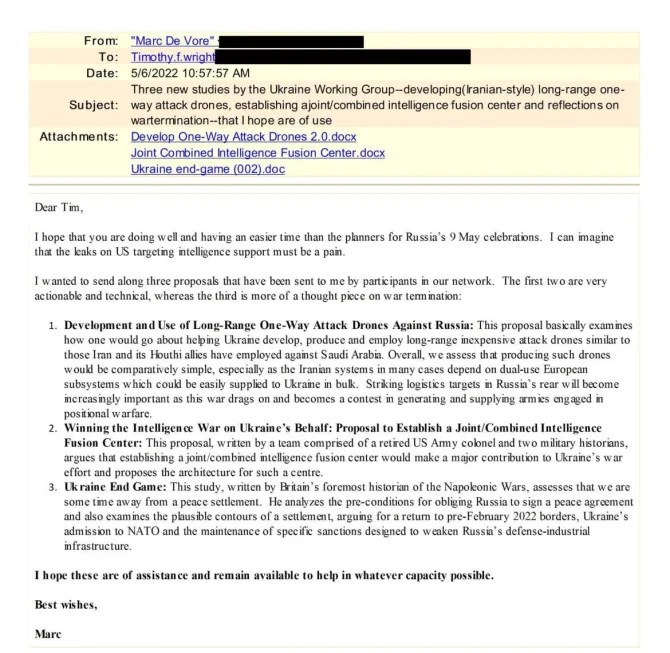
The Grayzone attempted to contact Orr, Rossiter, and Devore by phone and email in order to solicit comment about their role in proxy war scheme, and about whether St. Andrews University was aware it was being used as a base for planning terror attacks against Russia. None have responded to our requests.
Surging the Ukrainian diaspora to the front
Once the Ukraine proxy war erupted with full force in February 2022, the cabal of military academics quickly laid out what they described as “ideas of varying practicality that may not have been considered that Western states can collectively take to strengthen Ukraine’s ability to resist and hopefully preserve its independence.” Dedicated sections spelled out five suggestions, along with “background for such action and possible avenues for implementing them.” They boasted that the “fastest proposals” in the document were “executable in little over a week.”
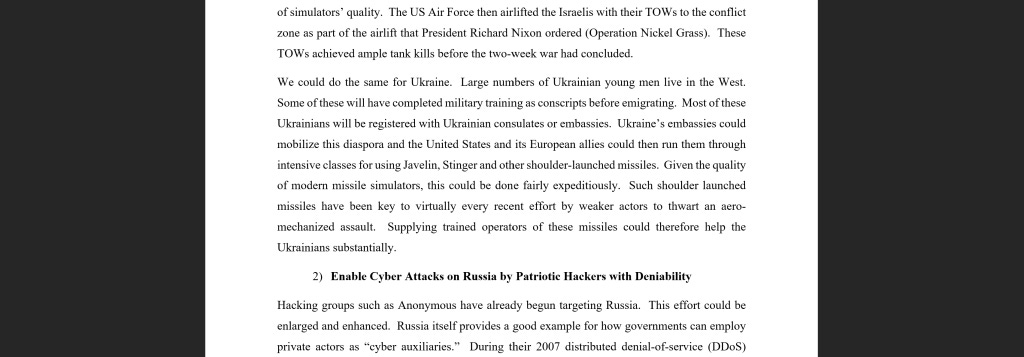
First on the list was arming Ukrainian emigres with anti-tank and anti-aircraft missiles, due to Kiev’s lack of “trained crews to operate the large numbers of missiles” being shipped to them by the West. They cited the little-known October 1973 Operation Nickel Grass as a means of “providing trained crews along with the hardware.” Under that mission’s auspices, Tel Aviv’s embassy in Washington “mobilized Israeli students studying at American universities,” who were then “rushed… through a rapid training program” by the US military.
This included teaching the conscripts how to use weapons similar to Javelin and Stinger missiles. The Israelis were then airdropped onto the frontlines of the 1973 Yom Kippur War against Syria and Egypt, where they “achieved ample tank kills before the two-week war had concluded.” The academics proposed doing “the same for Ukraine,” due to “large numbers of Ukrainian young men” living in the West, some of whom would have completed compulsory military training before emigrating.
This diaspora, it was believed, could easily be identified and recruited due to their registration with Ukrainian “consulates or embassies” in the West, then given “intensive classes” in using “shoulder-launched missiles” before being dispatched to Kiev.
“Volunteer cyber warriors” conceal state hacking
The quartet’s plans extended into the realm of cyberware, calling for “Western intelligence agencies” to “provide cyber tools and suggestions” to “volunteer hackers who want to strike their blow for Ukrainian independence, while also warning them what targets we do not want attacked.”
A “major task for these volunteer cyber warriors,” the four wrote, “could be to make certain that videos of Russian indiscriminate attacks, the use of objectionable weapons such as thermobarics, Ukrainian civilian casualties, Russian casualties and poor befuddled captured Russian conscripts” were made available to Russian audiences. Simultaneously, “patriotic hackers” could seek to bombard Russians with propaganda “about domestic opposition to the war.”
The intelligence cabal made clear they aimed to achieve the same psychological impact as the world’s most notorious terrorist organization, declaring, “we need to take a page from ISIS’ playbook in agilely communicating our message to Russians.”
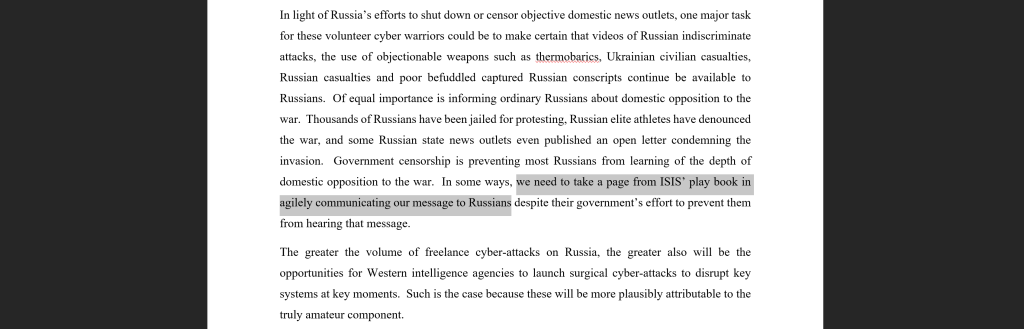
The activities of these “volunteer cyber warriors” were designed to provide cover for more formal, state-level hack attacks on Russian cyber infrastructure. “The greater the volume of freelance cyber-attacks on Russia, the greater also will be the opportunities for Western intelligence agencies to launch surgical cyber-attacks to disrupt key systems at key moments… because these will be more plausibly attributable to the truly amateur component,” the four academics evangelized.
The description offered strongly resembles the so-called “IT Army of Ukraine,” a volunteer cyber militia propped up in the days after Russia’s invasion. Since then, it’s been overseen by Mikhailo Federov, the Ukrainian digital czar credited by the BBC with pressuring Samsung and Nvidia to cease operations in Moscow, and getting PayPal to de-bank all its Russian clients.
Ukraine’s cyber army collaborates closely with Anonymous, the once-countercultural online hacker collective whose work now tracks closely with the objectives of the CIA. The authors of the proposal to the NSC hinted at the relationship, writing, “Hacking groups such as Anonymous have already begun targeting Russia. This effort could be enlarged and enhanced.”
The Ukrainian cyber army has taken credit for various acts of online vandalism. However, it also appears to have been involved in hacks targeting Russia’s power grids and railways. An attack on Russian taxi service Yandex that caused a large September 2022 traffic jam in Moscow was jointly attributed to both Ukraine’s ‘IT Army’ and Anonymous.

US Army “mad scientist” and self-proclaimed “war doctor in training” Zak Kallenborn
“Modern” IEDs for blowing up Russian infrastructure
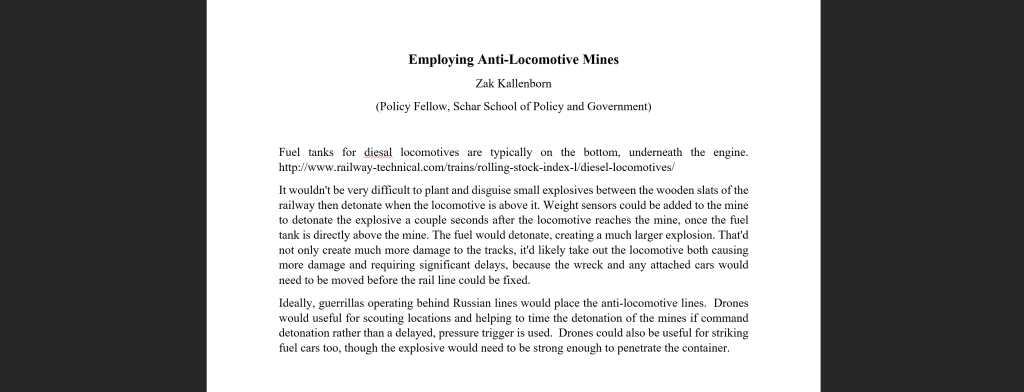
The academic cabal’s plans for attacking Russia through unconventional means extended explicitly into the realm of terrorism. A series of detailed recommendations for attacking Russian railway systems and roads with improvised explosive devices was put forward by Zachary Kallenborn, a self-described “PhD Student in War Studies at King’s College London researching risk analysis, perception, management, and theories with topical focuses in global catastrophe, drone warfare, WMD, extreme terrorism, and critical infrastructure.”
“Fuel tanks for diesel locomotives are typically on the bottom, underneath the engine,” Kallenborn wrote. “It wouldn’t be very difficult to plant and disguise small explosives between the wooden slats of the railway then detonate when the locomotive is above it… Ideally, guerrillas operating behind Russian lines would place the anti-locomotive lines.”
Throughout 2023, a group of self-described Russian and Belarussian anarchists conducted a series of attacks on railways, cell towers, and infrastructure inside Russia. Calling themselves BOAK, or the Combat Organization of Anarcho-Communists, the group of radical saboteurs earned glowing promotion in Western media. It is unclear if it received any outside assistance, however.
Kallenborn’s proposal, drafted in conjunction with the US War Department’s Joint IED Defeat Organization, suggested the US and its allies could “draw upon the lessons they painfully learned in Iraq and Afghanistan to help Ukraine orchestrate an IED campaign behind Russia’s lines.”
With the Taliban and Iraqi insurgents as models, Kallenborn proposed two technologies, “public-private key ring cryptography and ‘smart’ IEDs… to greatly increase the effectiveness of such a campaign.”
To wreak havoc inside Russia, Kallenborn envisioned a modern “stay behind” force similar to those unleashed onto Europe during Cold War era Operation Gladio, when the CIA and NATO organized fascist gangs and mafiosi to conduct anti-communist terrorist attacks.
Meanwhile, “smart” IEDs with “modern components” such as “microcontrollers,” which are now “abundant and cheap,” would allow Ukrainian attackers to “exercise additional discretion, reducing potential for collateral damage,” and “detonate the IED regardless of what the targets do.”
“The circuitry of microcontrollers can internalize most of the circuitry that would originally have been hard-wired into IED initiation switches,” Kallenborn wrote. “All microcontrollers have multiple inputs and outputs allowing multiple inputs, all while controlling multiple devices. Because microcontrollers are programmable, attackers can automate complicated algorithms to maximize an IEDs effects, and reduce collateral damage. Microcontrollers can even, relatively easily, circumvent many common countermeasures.”

Secretly employing contractors to pilot drones
While taking inspiration from non-state actors like ISIS and the Taliban, the Western academics plotting on the Ukrainian government’s behalf had elaborate plans for conventional warfare as well.
They assessed that drones had already “proven effective thus far” in the proxy war, so they urged greater deliveries of Turkish-made Bayraktar TB2s, which they said were “virtually the only airborne platform with which Ukraine is successfully striking Russian ground forces.” They proposed flooding Kiev with “additional TB2s,” pointing out that since Ukraine was already openly using them, and “had more on order before the conflict began,” Turkey’s role in supplying yet further drones could be concealed, leaving its neutrality publicly intact.
Ankara “could potentially transfer significant numbers of TB2s rapidly” from a variety of sources, the academics assumed, and fly them using local “private sector contractors.” If Turkey was unwilling or unable to go along with this plan, alternatives could be sought. “Given how commonly UCAVs are operated by private sector contractors, these could all be remotely piloted by private sector personnel employed by Ukraine, rather than uniformed members of NATO armed forces,” they noted.
Since drones can be operated “from considerable distances away from the frontline (potentially with pilots operating from neighboring countries),” they offered the further “advantage” over contract pilots, in that they would “be comparatively safe and certainly unlikely to be captured and paraded in front of Russian cameras.” While US-produced unmanned systems such as Predators and Reapers were an option, and could be provided “in large numbers,” they “would appear the most provocative” from Russia’s perspective, and make active US involvement too obvious.
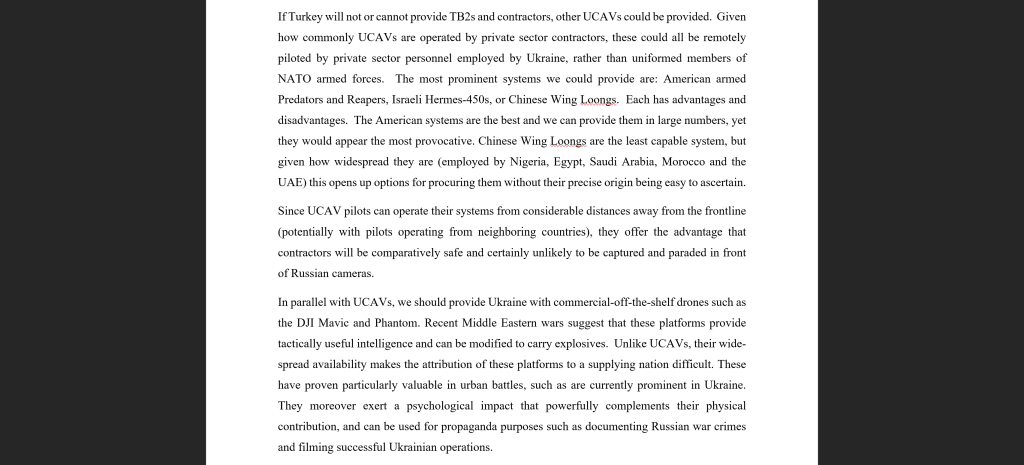
Prophetically, the paper noted Ukraine could be provided instead with “commercial-off-the-shelf drones such as the DJI Mavic and Phantom,” which not only had recording equipment capable of producing “tactically useful intelligence,” but could “be modified to carry explosives.” Moreover, “their wide-spread availability” made “attribution of these platforms to a supplying nation difficult.” It is surely no coincidence that ever since, both drones have been deployed extensively by Kiev to slow Russian advances and swarm military and civilian infrastructure.
By contrast, despite alleged initial successes, Bayraktar TB2s quickly vanished from the skies of Donbass. As several Ukrainian officials have admitted, Russian innovation in air defense and electronic warfare rendered the drones effectively useless. Conversely, the paper noted that while Ukraine’s Air Force was still conducting missions, Kiev would soon “run out of aircraft.” The prescribed remedy was to re-equip the country with Soviet-produced MiG-29 fighters, which “Ukrainian pilots know how to operate” already.
This plan, however, required a number of countries to hand over their ancient fleets of MiG-29s. The academics expressed concern that Central and Eastern European states might be “reticent” due to the risk of “Russian retaliation,” which could be circumvented by “promising gifts” to them, such as weapon upgrades. A year later, in March 2023, Slovakia granted Kiev its entire squadron of thirteen MiG-29s in exchange for a US promise of twelve Bell AH-1Z attack choppers equipped with Hellfire missiles.
Poland initially promised to match Slovakia’s splurge, but only wound up delivering a token amount. The deal has remained on hold since Krakow’s August 2024 announcement that it wouldn’t provide any further MiG-29s until it received a fleet of F-35s, which aren’t expected to arrive until 2026. Peru, likewise tapped by the academics as a potential source for the aircraft, reportedly initially greenlit supply of its MiG-29s to Ukraine, but then reneged. Latin American governments more widely have refused to dispatch any arms whatsoever to Ukraine, despite US pressure.
Air wars waged against Russia by “non-Ukrainian” pilots
Perhaps the most disquieting passage of the document is its last, in which its authors survey historical examples of air forces employing foreign pilots in major conflicts. The paper notes that the aforementioned Flying Tigers “were discharged from the US armed forces” to fight Japan in China, “with the clear understanding that they would be welcomed back thereafter.” Also cited was Finland’s employment of an “entirely” foreign squadron in its 1940 war with Moscow, as well as Zionist settlers’ reliance on an air force “comprised almost entirely of foreign volunteers” during their military campaign against indigenous Palestinian and Arab forces in 1948.
The academics wished to apply these precedents to the Ukraine proxy conflict, creating “volunteer fighter groups today to bolster Ukraine’s air defense” composed of “a reasonable number of Western pilots.” They wrote that these airmen “might volunteer if their national armed forces offered leaves of absence” – as might their civilian counterparts, if US commercial airlines could be “pressured into allowing their pilots, who are fighter-qualified Air Force Reserve or Air National Guard pilots, to take such leaves of absence.” The document boasted that “volunteer fighter groups could substantially disjoint Russia’s air campaign.”
F-16s were considered “the most logical option” due to “the number of NATO members that use F-16s,” including Poland. Accordingly, “Polish spare parts could be trucked into Ukraine comparatively quickly,” with the US “airlifting replacements” to Warsaw. From almost the first day of the proxy war, its most hawkish supporters have demanded that Kiev be provided with these fighter jets, referring to the planes as a “game changer” which would tip the conflict’s scales decisively in favor of Ukraine.
Despite much initial fanfare, when F-16s finally arrived in Kiev in late July of 2024, President Volodomyr Zelensky almost immediately complained the country had only received a handful of jets, and did not have enough pilots trained to fly them. The panic spread to Washington, where Sen. Lindsey Graham publicly urged any “retired F-16 pilot… looking to fight for freedom” to sign up. By the month’s end, the first of F-16s had crashed in uncertain circumstances.
While references to Ukraine’s “game changing” use of F-16s have all but disappeared from the media in the months since, the leaked proposal’s contents raise serious questions on how many supposedly Ukrainian strikes deep inside Russia were actually perpetrated by Western military operatives, acting at the behest of, and with material assistance from, NATO and the US.
“Western European and American fighter pilots tend to fly substantially more hours and train more realistically than their Russian or Ukrainian counterparts,” the academics claimed, meaning they were ideal candidates for conducting “combat missions” against Moscow’s positions, forces, and territory. However, the academics cautioned against Western pilots flying close to the frontline, for fear that “foreign volunteers fall into Russian custody, where an example could be made of them, or they could be paraded in front of the camera.” This was perhaps a nod to CIA pilots Gary Powers and Eugene Hassenfus, whose capture by the Soviet Union and Nicaragua, respectively, humiliated US intelligence.
It’s still unclear how much these proposals determined the course of operations by Ukrainian forces against their Russian foes. But the leaks reviewed by The Grayzone reveal for the first time how, in just a matter of weeks, a small cabal of academics secretly furnished some fairly unconventional war plans on a platter for the CIA and MI6.
Just as Britain did with its Project Alchemy, the Biden administration appears to have outsourced responsibility for crafting its battlefield strategy in Ukraine to a nexus of pinheads with dubious backgrounds, situated thousands of miles from the frontline and its gruesome realities. Almost three years later, with a generation of Ukrainians lost to the proxy war’s meat grinder, the authors of these battle plans are likely still pecking away at their laptops somewhere in the musty halls of academia.
Macron calls emergency summit amid Ukraine peace talks – Warsaw
RT | February 16, 2025
French President Emmanuel Macron has called an emergency summit of European leaders after Moscow and Washington agreed to hold Ukraine peace talks in Saudi Arabia, sidelining the EU.
US President Donald Trump and Russian President Vladimir Putin spoke by phone on Wednesday, marking their first known direct conversation since the escalation of the Ukraine conflict in February 2022.
On Saturday, the countries’ top diplomats followed up with a call to discuss “preparations for a potential high-level Russian-American summit.” Later that day, US Special Envoy Keith Kellogg stated that the EU nations would not be included in the negotiations.
Speaking at the Munich Security Conference, Polish Foreign Minister Radoslaw Sikorski welcomed Macron’s initiative and confirmed that the summit will take place in France on Monday.
“I’m very glad that President Macron has called our leaders to Paris,” Sikorski said, as quoted by Politico, adding that he expects European leaders to discuss “in a very serious fashion” the challenges posed by Trump.
According to Sikorski, Polish Prime Minister Donald Tusk has accepted the invitation and will travel to France next week to “show our strength and unity.”
While the list of invitees was not revealed, The Guardian has reported that UK Prime Minister Keir Starmer will also be attending.
Macron has previously insisted on EU involvement in negotiations, telling the Financial Times that Ukraine must lead discussions on its own sovereignty, but Brussels has a key role in discussing “security guarantees and, more broadly, the security framework for the entire region.”
Meanwhile, Ukrainian President Vladimir Zelensky, who previously banned his government from engaging in direct negotiations with Putin, admitted that Kiev’s representatives were not invited to discussions in Saudi Arabia either. “Maybe there is something at the table, but not on our table,” he told journalists on the sidelines of the Munich Security Conference.
Neither a French government spokesperson nor Foreign Minister Jean-Noel Barrot immediately responded to a request for comment when approached by Politico.
Larry Ellison Pushes for AI-Powered National Data Centralization and Mass Surveillance
By Didi Rankovic | Reclaim The Net | February 14, 2025
Oracle co-founder and the company’s executive chairman and chief technology officer Larry Ellison is trying to persuade governments to descend deep into AI-powered surveillance dystopia by centralizing the entirety of their national data in a single place.
And when he says everything should go into this “unified” database, Ellison means everything. That includes health-related data, such as diagnostic and genomic information, electronic health records, DNA, data on agriculture, climate, utility infrastructure…
Once in there, it would be used to train AI models, such as those developed by Oracle – Ellison shared with former UK Prime Minister Tony Blair during a panel at the World Governments Summit in Dubai.
As for why any government would do such a thing – his “sell” is that it would allow AI to be used to provide better services. But this time, he left out how this centralization would also represent an exceptional opportunity to “turbocharge” mass government surveillance, even though there is little doubt that many governments are hearing him loud and clear on that point as well.
In September, Ellison wasn’t so coy regarding this angle when he spoke in favor of introducing real-time population surveillance. And naturally, that would be done with Oracle’s machine learning tech.
“As long as countries will put their data – all of it – in a single place we can use AI to help manage the care of all of the patients and the population at large,” Ellison told Blair.
As over the top, as all this may sound, Ellison appears to figuratively and literally mean business: he revealed that his company is building a 2.2 gigabyte data center to train AI models and spending “between 50 and 100 billion dollars” on these endeavors.
And, he suggested that massive amounts of data would not be the only thing centralized in a handful of places, going forward – the same is true of the AI model training, because of the high price tag attached.
In other words, Ellison’s vision of the future is complete control over everyone’s data in the hands of governments and a select number of super-rich companies capable of building and running this infrastructure for them.
Ellison also told Blair about Oracle’s AI-powered biometric ID that’s currently used only to log into the company’s system:
“The computer recognizes you. It recognizes your voice. It might ask you to put your index finger on the return key. And we know, we’re absolutely certain it’s you. There’s no reason to enter a password.”
Panic Grips European Leaders as EU Left Out of Trump-Putin Call
By Svetlana Ekimenko – Sputnik – 13.02.2025
Russian President Vladimir Putin and his US counterpart Donald Trump discussed Ukraine, the Middle East, energy issues, and the exchange of citizens in a telephone call that lasted for one and a half hours, Kremlin Spokesman Dmitry Peskov revealed.
The phone conversation between Vladimir Putin and Donald Trump has triggered a litany of reactions from European politicians.
Britain’s Foreign Secretary David Lammy posted a joined statement by several European states that read: “Our shared objectives should be to put Ukraine in a position of strength. Ukraine and Europe must be part of any negotiations.”
UK Defense Secretary John Healey claimed that no peace talks could be done “about Ukraine without Ukraine.”
Boris Pistorius, Germany’s defense chief, lamented the development as “regrettable” arguing that the Trump administration had made “concessions” to Russia, while asserting that “it would have been better to speak about a possible NATO membership for Ukraine or possible losses of territory at the negotiating table.”
Joining the bandwagon, Germany Foreign Minister Annalena Baerbock added that “peace can only be achieved together. And that means: with Ukraine and with the Europeans.”
In addition, Polish Prime Minister Donald Tusk declared that “All we need is peace… Ukraine, Europe and the United States should work on this together.”
For his part, French top diplomat Jean-Noel Barrot insisted that “There will be no just and durable peace in Ukraine without Europeans.”
Meanwhile, Estonian Defense Minister Hanno Pevkur chimed in, saying: “Europe is investing in Ukrainian defense, and Europe is rebuilding Ukraine with European Union money, with our bilateral aid – so we have to be there.”
And finally, NATO Secretary General Mark Rutte called for turbo-charging defense production among member states, adding: “We have to make sure that Ukraine is in a position of strength.”
BBC Rides to the Rescue as Scientists Inconveniently Find the Gulf Stream Isn’t Getting Weaker

By Chris Morrison | The Daily Sceptic | February 6, 2025
Last month a group of scientists published a paper in Nature stating that the Atlantic Meridional Overturning Circulation (AMOC) had shown no decline in strength since the 1960s. Helped by publicity in the Daily Sceptic, the story went viral on social media, although it was largely ignored in narrative-driven mainstream publications. The collapse of the Gulf Stream, a key component of the AMOC, is an important ‘tipping point’ story used to induce mass climate psychosis and make it easier to impose the Net Zero fantasy on increasingly resentful and questioning populations. Obviously, reinforcements to back up such an important weaponised scare needed to be rushed to the front and the BBC has risen to the challenge. The AMOC “appears to be getting weaker” state BBC activists Simon King and Mark Poynting. Their long article is a classic of its kind in trying to deflect scientific findings that blow holes in the ‘settled’ narrative.
In the Nature paper, three scientists working out of the Woods Hole Oceanographic Institution stated that they came to their conclusion showing the stability of the AMOC after examining heat transfers between the sea and the atmosphere. It was noted that the AMOC had not weakened from 1963 to 2017, “although substantial variability exists at all latitudes”. This variability is the basis for much of the Gulf Stream fear-mongering. The BBC notes that the presence of larger grains of sediment on the ocean floor suggests the existence of stronger currents, pointing to a “cold blob” in the Atlantic that appears to have cooled of late. Thin pickings, it might be thought, to run an article titled ‘Could the UK actually get colder with global warming?’ The Woods Hole scientists note that records “are not long enough to differentiate between low frequency variability and long-term trends”.
The Nature story is not the only recent scientific finding that suggests the Day After Tomorrow alarm about the AMOC is a tad overdone. In 2023, Georgina Rannard of the BBC reported that “scientists say” a weakening Gulf Stream could collapse as early as 2025. There was no later reporting, needless to say, of subsequent work from a group of scientists at the US weather service NOAA that discovered the huge flow of Gulf Stream tropical water through the Florida Straits had remained “remarkably stable” for over 40 years.
Of course the BBC, along with most of the legacy media, has form as long as your arm when it comes to producing deflective copy seemingly designed to head off inconvenient scientific findings. The Great Barrier Reef (GBR) is the largest and best observed collection of tropical coral in the world. Any sign of ill health is a boon for green propogandists who argue that warming measured in tenths of a degree centigrade will destroy an organism that has survived for millions of years in temperatures between 24-32°C. For the last three years, coral on the GBR has hit recent record levels with scarcely a mention in mainstream media. Days before last year’s record was announced, the places where journalism goes to die were full of stories from a paper that conveniently noted climate change posed an “existential threat” to the reef. “The science tells us that the GBR is in danger and we should be guided by the science,” Professor Helen McGregor from the University of Wollongong told Victoria Gill of BBC News. Professor McGregor’s statement was an opinion readily broadcast by the BBC, a courtesy that does not appear to have been extended to the fact that coral on the GBR was at its highest level since detailed observations began.
It beggars belief that the BBC and all its fellow alarmists can run this stuff with a straight face knowing that crucial scientific information is missing from their reports. Important findings from reputable sources emerge about the current stability of the Gulf Stream and the response is to blow more smoke around that raises wholly unnecessary fears.
The main concern is that the AMOC “could suddenly switch off”, state King and Poynting. To back up their statement and provide the inevitable political message they note the comment of Matthew England, Professor of Oceanography at the University of South Wales: “We’re playing a bit of a Russian roulette game. The more we stack up the atmosphere with greenhouse gases, the more we warm the system, the more chance we have of an AMOC slowdown and collapse.” Now look what you plebs have done with your steak chomping, gas-guzzling central heating and naff holidays in Benidorm, is an unpleasant subtext here.
Of course, keen and dedicated followers of climate alarmists will note a master craftsman at work. In 2023, aided by 35 million computer hours and using an improbable rise in temperature of up to 4°C in less than 80 years, Professor Matthews suggested that there was a dramatic slowdown in deep Antarctica ocean currents. Melting Antarctica ice could lead to a 40% slowdown in just 30 years. The fact that Antarctica has barely warmed in 70 years is ignored.

Who needs Hollywood sci-fi blockbusters when we have the BBC.
Britain: Operation Gladio’s Secret ‘Headquarters’
By Kit Klarenberg | Al Mayadeen | February 11, 2025
Operation Gladio was a covert NATO program using clandestine units for false flag attacks and political destabilization, with Britain and the CIA playing a central role.
‘Operation Gladio’ is the collective name for a notorious Cold War-era program whereby Anglo-American intelligence services and NATO, in conjunction with mafia elements and fascist paramilitaries, constructed a pan-European nexus of clandestine “stay behind” armed resistance units. Their ostensible purpose was to remain ever-poised to respond to potential future Soviet invasion. In reality, these guerrilla factions carried out false flag attacks, assassinations, robberies, mass casualty bombings, and other incendiary acts to discredit the Western left, while fomenting a “strategy of tension”. Their objective was simple:
“You were supposed to attack civilians, women, children, innocent people from outside the political arena. [This would] force the public to turn to the state and ask for greater security… People would willingly trade their freedom for the security of being able to walk the streets, go on trains or enter a bank. This was the political logic behind the bombings. They remain unpunished because the state cannot condemn itself.”
This candid explanation was provided by an Italian fascist, jailed for life in 1984 for a car bombing 12 years earlier that killed three police officers, and injured two. The attack was intended to be blamed on the Red Brigades, a left-wing militant group. This false flag’s unraveling played a significant role in subsequently blowing the Operation wide open publicly. However, three-and-a-half decades later, much remains unclear and uncertain about Gladio, and the evidential trail went cold long ago.
Perhaps the most striking feature of Operation Gladio is also its least well-known. The effort is typically understood and widely portrayed as a primarily CIA-led effort. In reality, Britain served as the inspiration, headquarters and training ground for all Europe’s “stay behind” secret armies throughout the Cold War, with MI6 taking the lead on arming these factions and directing their incendiary activities. This little-acknowledged history has enormous contemporary relevance, given London secretly continues to perpetuate the Gladio model overseas today.
In November 2024, The Grayzone exposed how a cloak-and-dagger Ministry of Defence-created cell of military and intelligence veterans, dubbed Project Alchemy, is charged with “keeping Ukraine fighting… at all costs”.
Since the proxy war’s first days, the unit has strategised and orchestrated a vast array of belligerent acts, both covert and overt, to escalate the conflict and prevent a negotiated settlement. Chief among their initial recommendations was the creation of a “stay behind”, Gladio-style force, to carry out assassinations and sabotage in Russian territory.
‘The Meanest’
Uniquely revealing insight into Britain’s central role in Operation Gladio is provided by interviews with Francesco Cossiga, published in November 2010 by Bulletin of Italian Politics, a political science journal. A prominent politician throughout Rome’s bloodspattered “years of lead” and beyond, the journal notes Cossiga had “always been proud of his association” with Gladio, and took personal credit “for the creation of anti-terrorist rapid response units in Italy”, tied to Rome’s “stay behind” paramilitaries.
During the interviews, Cossiga revealed these “special services” were born following a tour of Europe, where he studied “different models” of special forces units for inspiration. Repeated visits to the base camp of Britain’s SAS, where he was shown “mock-up villages” used to train soldiers deployed to Northern Ireland during London’s brutal “counterinsurgency” against the province’s Catholic minority, convinced him to “opt for the British model”. Cossiga explained, “the meanest of all were the British” – and besides, if Gladio’s activities ever came to public light:
“I could always defend myself by saying I had chosen the model used in the oldest parliamentary democracy in the world.”
Moreover, Cossiga testified, Britain was “the headquarters” of every European “stay behind” organisation. Namely, Fort Monckton, where MI6 operatives are trained in every covert discipline, including surveillance, sabotage, assassinations, entrapment, and other black ops. According to Cossiga, Italy’s Gladio legions and “special services” similarly received instruction in these murderous dark arts at the facility, and from the SAS. A secret base in Sardinia was also “made available to the CIA and to other intelligence services,” to enhance “stay behind” operations in the country and beyond.
Despite all this, and a 1959 Italian intelligence agency report stating plainly “domestic threats” were a dedicated “stay behind” target, Cossiga vehemently refuted any suggestion Operation Gladio was ever “intended to combat subversion” by local political elements. Its sole purpose, he insisted, was to “resist invasion” by the Soviet Union, which never materialised. Yet, Cossiga’s unconvincing veil of denial slipped somewhat when asked whether he believed it possible for security and intelligence agencies “to act without the implicit or explicit approval of a government”:
“Yes it is. A certain autonomy exists, and it’s not as if an intelligence service has to tell its government what it does. The government sets objectives but it doesn’t have to know the means by which the service goes about achieving those objectives. Nor does it want to know. An intelligence service that respects the rules doesn’t exist. It’s a contradiction in terms. If MI5 had to obey the law it might as well use Scotland Yard’s Special Branch [Britain’s political police].”
‘Repressive Backlash’
Cossiga’s discussion of the murder of Aldo Moro – purportedly his “confidant and friend”, with whose “political philosophy” he ardently adhered – raises further alarm bells. Moro was a veteran centre-right Italian statesman, who served as the country’s prime minister five times during the 1960s and 70s. Highly respected then and now, he was kidnapped by the Red Brigades in March 1978, en route to a historic meeting where he would greenlight a coalition administration, formally bringing Italy’s Communist party into government for the very first time.
After 55 days in captivity, Moro was executed, his bullet-riddled corpse left in a car trunk in central Rome to rot, and for authorities to find. According to Cossiga – then-interior minister – official rescue efforts were exhaustive and wide-ranging. “We tried everything,” he proclaimed, including “air patrols… fitted with infrared sensors that would pick up heat from human bodies” in order to find the abducted premier. Cossiga also supposedly prepared the SAS-trained Comsubin, an Italian special forces unit, to conduct raids to find Moro.
Cossiga recounted how “one evening” during Moro’s captivity, authorities “received information” he “might be in a certain place.” Comsubin was thus mobilised, with a doctor charged with “[throwing] himself over Moro if there was a shootout.” Cossiga excitedly noted the medical professional in question was not only his “classmate at school”, but “later became the effective commander of Gladio!” That extraordinary coincidence may account for why, as Bulletin of Italian Politics reports, Comsubin in fact “did not conduct any raids” whatsoever while Moro was imprisoned.
This glaring contradiction tends to confirm the conclusions of Italian security and intelligence veteran Roberto Jucci – that the hunt for Moro was set up to fail. In March 2024, he publicly exposed how the formal, foreign-advised committee established to save Moro was “composed largely” of individuals tied to Propaganda Due – aka P2 – a CIA-tied Masonic lodge inextricably linked with Operation Gladio. These rabidly anti-Communist actors were, per Jucci, determined to destroy Moro “politically and physically”, therefore preventing the development of radical politics locally.
Jucci’s disclosures caused domestic and international shockwaves at the time. Yet, declassified British Ministry of Defence files dating to November 1990, in the immediate wake of Operation Gladio’s public exposure, show officials in London were well-aware of the mephitic role played by P2 in sabotaging the mission to rescue Moro. The Masonic lodge was described as just one “subversive” force in Italy employing “terrorism and street violence to provoke a repressive backlash against Italy’s democratic institutions,” in service of a “strategy of tension.”
Those documents also note that “circumstantial evidence” indicated “one or more of Moro’s kidnappers was secretly in touch” with Rome’s “security apparatus at the time,” and Italian spooks “deliberately neglected to follow up leads which might have led to the kidnappers and saved Moro’s life.” One might reasonably ask how London’s secret state could’ve been possessed of such knowledge. An obvious answer is that, given Britain’s enduring status as Operation Gladio’s “headquarters”, MI6 was, one way or another, embroiled in the plot to neutralise Moro.
Featured Video

Houthis Keep Advancing as the Red Sea Crisis Deepens
or go to
Aletho News Archives – Video-Images
From the Archives
Clash of Civilization, Iran Part II
By Jamal Kanj – Intifada-Palestine.com – January 14, 2011
Israel’s survival kit is: perpetuate conflict, insecurity to rationalize collective hate and finally playing victim.
Devoid of conflict, Israel implodes internally; without hate, Zionism loses its justification; and playing eternal victim to continue blackmailing the West. Absence of this holy trinity, Israel ceases to exist. … continue
Blog Roll
 Aletho News
- ‘We are not like everyone else’ laws that bind other nations do not apply to Israel, says Likud lawmaker
- Report: Saudi Arabia seeks allies’ assistance as missiles deplete amid war on Yemen
- Fuel Crisis Deepens: Pakistan Warns Tanker Attack in Red Sea Would Be an ‘Act of War’
- ‘Bucha massacre’ a false flag orchestrated by UK – Moscow
- China Rejects Outside Pressure on Trade Ties After New US Russia Sanctions Bill
- Houthis Keep Advancing as the Red Sea Crisis Deepens
- Iran spent $1 million to wipe out $30 billion in data center plans, and take down Amazon in the ME
- Zionist billionaire pressure to silence Macklemore sparks exodus from Ed Sheeran tour
- House Votes to End Iran War for Third Time
- North Korea Slams US Plan for ‘AUKUS 2.0’ with South Korea and Japan
- If Americans Knew
- Biden’s Genocide Accomplices Targeted by New Accountability Campaign
- AIPAC’s Network Has Already Spent $67.2 Million to Shape the Midterm Elections
- Jewish Supremacist Manufacturing a Civilizational Threat to License Bigotry
- US bans Palestinian president from speaking at the UN
- Israeli Forces Detain Journalist Alaa al-Rimawi amid Widespread West Bank Raids
- Even a pro-Israel Congress member has put a hold on 40,000 one-ton bombs to Israel
- As Gaza crumbles, Israel preps new ground invasion – Daily Update
- ‘We are not like everyone else’ laws that bind other nations do not apply to Israel, says Likud lawmaker
- Trump’s govt makes ‘treasonous’ claim of weapons shortages
- Palestinian-American Journalist Naqaa Hamed Imprisoned by Israeli Forces After Settlers Targeted Her
- No Tricks Zone
- New Study: ‘Global Drought Shows No Detectable Recent Acceleration Under Climate Warming’
- Economic Masterminds: German Socialists Suggest Taxing Productivity Gains Stemming From Using AI
- The South China Sea Has Not Been Cooperating With The Climate Change Narrative
- Energy Crisis: Germany Enters Heating Season With Historically Low Gas Reserve Fill Levels
- New Study: The Antarctic Ice Sheet Gained Mass From 2020-2024 Due To Staggering Snow And Ice Accumulation
- Study: Ocean Heating Rates From Thousands Of Years Ago ‘Dwarf’ Modern Ocean Heating Rates
- Climate Extremists Target, Attack Large-Scale Power Grid Infrastructure In Germany!
- New Study: Antarctic Ice Melt Has Contributed Less Than 1 Centimeter To Sea Level Rise In The Last 30 Years
- Fear Of Debate: Alarmist German Climate Scientist Calls On Mainstream Media To Discredit Skeptic Voices
- End-Of-August Arctic Sea Ice Extent Hasn’t Fallen In 20 Years, Official Data Show!
 Aletho News