Stepan Bandera’s Sinister MI6 Alliance Exposed
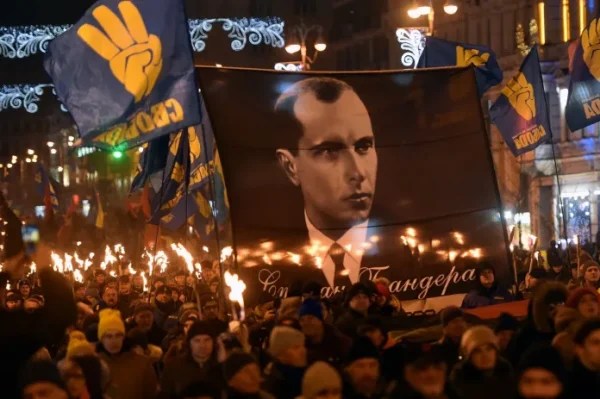
[Source: ar.inspiredpencil.com]
By Kit Klarenberg | Covert Action Magazine | March 20, 2025
October 15, 2024, marked the 65th anniversary of Organization of Ukrainian Nationalists (OUN-B) and Ukrainian Insurgent Army (UPA) founder Stepan Bandera’s assassination by the KGB in Munich, in then-West Germany.
The date passed without mention anywhere. This may reflect how prior public commemorations of the life and death of Nazi collaborator Bandera—widely credited as the father of Ukrainian nationalism—in Kyiv sparked significant controversy and condemnation across Central and Eastern Europe, particularly neighboring Poland.
The complicity of Bandera and the fascist movements he birthed during World War II is well-documented. His influence over modern-day ultranationalist and Neo-Nazi factions in Ukraine, such as the Azov Regiment, has also been acknowledged in the mainstream media.
Yet, Bandera’s secret Cold War bond with British intelligence has never been seriously explored by Western news outlets. Now, examination of little-known declassified CIA records by CovertAction Magazine exposes the malign contours of a long-running, ruthless conspiracy between Bandera and MI6 to destabilize the Soviet Union.
This dark handshake only expired because MI6’s fascist asset was resistant to joining forces with other Ukrainian anti-Communist forces, therefore jeopardizing plans by Washington and London for all-out war with the Soviets in Donbas. That plot, intended to ultimately collapse the entire USSR, has eerie, direct echoes of the current Ukraine proxy war. So too Britain’s willingness, then and now, to go even further than the U.S. in building alliances with the most reactionary, dangerous Ukrainian ultranationalist elements, in service of balkanizing Russia.
“Bandit Type”
MI6 first contacted Bandera while he was exiled in post-war West Germany in 1948, via Gerhard von Mende. An ethnic German hailing from Riga, Latvia, von Mende has been described as the “enthusiastic Nazi” who headed Berlin’s Reich Ministry for the Occupied Eastern Territory, or Ostministerium. Among other connivances, von Mende was charged with recruiting fifth columnists from the USSR’s Central Asian republics, to undermine and attack Communist authorities. He has been credited with influencing subsequent British and American support for Islamic extremists.

Per a declassified CIA biography, after Nazi Germany’s defeat, von Mende was “interned as a ‘guest’” at the Agency’s Camp King, where Nazi officials and soldiers were interrogated and tortured. In some cases, inmates were unwittingly dosed with LSD under PROJECT BLUEBIRD, a forerunner to the CIA’s notorious MK-ULTRA mind-control program. Subsequently, von Mende became an asset for West Germany’s Nazi-riddled BND, the CIA, and MI6, continuing his spy recruitment in the USSR via a front company.
Through this position, von Mende was kept abreast of UPA activities and capabilities, and maintained an intimate personal relationship with Bandera. The Ukrainian fascist ideologue’s thuggish West German network was by then hard at work killing hundreds of local citizens suspected by the CIA and MI6 of harboring Communist sympathies. While the OUN-B chief’s “ask” of British intelligence was initially judged too high, that perspective rapidly changed. By 1949, MI6 was helping Bandera airdrop his chaos agents into Ukraine.
A year later, Britain’s foreign spy agency began formally training these operatives to gather intelligence and carry out sabotage and assassinations on Soviet soil. This sinister compact was established despite stern CIA and State Department opposition. At this point, the Agency had identified a comparatively moderate alternative to Bandera’s murderous ultranationalist mob, the Ukrainian Supreme Liberation Council (UHVR). The group was led by Ukrainian-Greek Catholic priest Ivan Hrinioch, a “longtime CIA asset” and former high-ranking OUN-B operative Mykola Lebed.
During World War II, Lebed oversaw the UPA’s massacre of tens of thousands of Poles in Volhynia and Eastern Galicia. However, he subsequently disavowed this genocidal carnage, and led UHVR’s push to unite Ukrainian émigrés, who had fractured due to bloody, internecine squabbles toward the conflict’s end. Under the auspices of Operation AERODYNAMIC, for decades the Agency exploited the UHVR to foment “nationalist flare-ups” throughout the Soviet Union, “particularly” in Ukraine, and “encourage divisive manifestations among” the population, to “exert pressure on the Soviet regime.”
By this time, Bandera had fallen out of favor with many Ukrainian nationalists, and was even renounced by what remained of OUN-B’s Kiev-based leadership. This, his genocidal past, and overt anti-U.S. actions and statements due to Washington’s refusal to publicly advocate for Ukrainian independence, all deterred the CIA from employing him. However, MI6 was unperturbed and pushed ahead with its Bandera operations. This created a ludicrous situation, with London and Washington supporting bitterly antagonistic Ukrainian nationalist factions, which frequently undermined and attacked each other.
As a British intelligence memorandum on “the crisis over Bandera” noted, by 1950 Ukrainian nationalist leaders had “become aware of the fact that the British and Americans were backing rival groups,” putting the agencies’ joint anti-Soviet project at risk. It was decided to dispatch a co-signed message to UPA headquarters via Ukrainian CIA and MI6 agents parachuted into Lviv, calling for an end to “present disagreements” between opposing nationalist factions, which London and Washington professed to “deplore and earnestly hope may be resolved.”
It signed off with the now-infamous, Bandera-coined nationalist slogan, “Glory to Ukraine” (“Slava Ukraini”). The memo’s MI6 author, moreover, recalled an in-person meeting they had with Bandera in London. The spy described him thusly:
“Convincing and sincere… a professional underground worker with a terrorist background and ruthless notions about the rules of the game, acquired by hard experience, along with a thorough knowledge of the Ukrainian people… a bandit type if you like, with a burning patriotism which provides an ethical background and a justification for his banditry.”
The MI6 operative cheerfully added that genocidal mass murderer Bandera was “no better and no worse than others of his kind I have had dealings with in the past,” and “genuinely grateful for the help given to him” by British intelligence, “but at the same time is certainly trying to get all he can out of it.” The CIA begged to differ, however, commissioning a study of London and Washington’s conflicting positions on the “Ukrainian underground” and Bandera, and how to resolve this divergence.
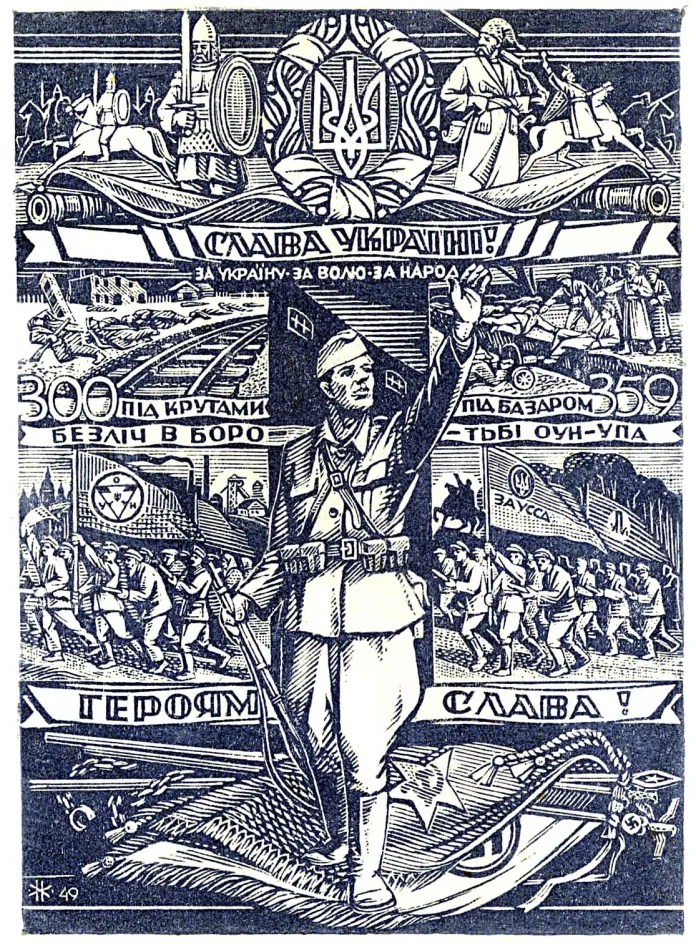
UPA poster from the 1940s. OUN/UPA’s formal greeting is written on two of the horizontal lines “Glory to Ukraine!” “Glory to the Heroes!” The soldier is standing on the banners of the Soviet Union and Nazi Germany. [Source: euromaidanpress.com]
“Political Overtones”
A subsequent appraisal repeatedly declared Bandera and OUN-B to be “completely unacceptable” to the CIA, “both from the political and the operational standpoints.” It proposed the Agency and MI6 take joint ownership of the UHVR and its anti-Soviet wrecking project in Ukraine, and “exchange political, operational and intelligence data resulting from these operations.” Meanwhile, the CIA would “take independent action to neutralize” OUN-B’s “present leadership,” including Bandera himself. It is unknown if this was pitched to MI6, although London’s steadfast opposition was inevitable.
The “British position,” as described in the study, was Bandera’s “importance” had been perennially “underestimated by the Americans, as a rallying symbol in the Ukraine, as leader of a large émigré group [and] as a leader favored by the homeland headquarters.” This did not conform to the reality on the ground as detected by the CIA, but MI6 had a vested interest in maintaining the fascist demagogue as an agent. An April 1951 Agency memo summarizing recent “talks” with British intelligence “on operations against the USSR” noted:
“[MI6 is] seeking progressively to assume control of Bandera’s lines… [MI6 argues] Bandera’s name still carried considerable weight in the Ukraine… [and OUN-B is] the strongest Ukrainian organization abroad, is deemed competent to train party cadres, [and] build a morally and politically healthy organization.”
By contrast, the CIA observed Soviet authorities “had been successful to a remarkable degree in transforming the mentality of the younger generation” of Ukrainians, resulting in them vehemently rejecting Bandera and his brand of rabid nationalism. While the Agency, therefore, favored “political neutralization of Bandera as an individual,” MI6 balked, as this “would lead to a drying up of recruits” and “disrupt British operations.” However, the declassified paper trail shows London eventually tired of their fascist asset.
In February 1954, a senior MI6 official who led liaison with OUN-B for two decades made a “final attempt to bring Bandera to reason” in London, due to the genocidaire’s refusal to reconcile and unite with opposing Ukrainian nationalist elements. The high-ranking British spook offered him “one last chance” to make amends with émigré leaders. Bandera “refused this suggestion with arrogant finality,” thus making “the break” between Bandera and MI6 “complete.”
All British intelligence-run Ukrainian agents who remained loyal to Bandera were duly jettisoned. MI6 informed other nationalist leaders the agency “would not resume” its relationship with him “under any circumstances.” Bandera remained exiled in Munich, West Germany, and continued to run belligerent cloak-and-dagger operations against the Soviet Union, while ratcheting up his anti-Western rhetoric. The CIA and MI6 viewed these activities as a significant problem, with no obvious solution.
As CIA records of a January 1955 “joint U.S.-UK conference” put it, despite the “unanimous desire” of British and American intelligence to “‘quiet’ Bandera,” it was equally vital the KGB was “not allowed to kidnap or kill him.” This could make Bandera “a martyr” among Ukrainian ultranationalists, a prospect to be avoided if at all possible. Hence, London and Washington kept him alive and well, while permitting West Germany’s BND to run him as an agent. Their old friend Gerhard von Mende was his handler.
West German authorities wished to punish Bandera and his in-country network for crimes including kidnapping, but von Mende consistently intervened to insulate his compatriot from prosecution. A July 1959 CIA report noted the BND’s use of Bandera was such a “closely held” secret within the agency, it was not even formally cleared with the West German government “due to political overtones.” Despite this omertà (code of silence), the BND moved to secure Bandera a U.S. visa.
It was hoped he would connect with Ukrainian émigrés Stateside, while ingratiating himself with the CIA and State Department. Per an October 5, 1959, Agency memo, the BND believed “it should be a simple matter” for the CIA “to influence the issuing of a visa” for Bandera, as “many less desirable and less ‘exploitable’ individuals” had already visited the country via Agency assistance. A formal request was submitted to Washington. Just ten days later, though, the KGB finally caught up with him.
Despite their mutual wish that Bandera not be “martyred” by Soviet intelligence, it is likely that the CIA and MI6 breathed a collective sigh of relief upon hearing of his death. The OUN-B and UPA founder’s destabilizing, disruptive influence within the Ukrainian anti-Communist underground was a significant impediment to Anglo-American spying agencies’ implementation of a far grander plan than has hitherto been tried. Namely, fomenting all-out war against the Soviet Union, using Ukrainian ultranationalists as foot soldiers.
This is the first instalment of a two-part investigation. Stay tuned.
Who is opposing peace in Ukraine?
By Dmitri Kovalevich – Al Mayadeen – March 20, 2025
March 2025 marks the beginning of a fourth year of the military conflict in Ukraine. Kiev, its sponsors in Europe and the United States, are proving unwilling to end the war being waged despite mounting evidence they are facing a major political and military defeat.
Zelensky vs Trump?
The five-year, electoral mandate dating from May 2019 of Volodymyr Zelensky as president of Ukraine expired ten months ago. Yet on February 28, Zelensky staged a widely publicized quarrel with the new US administration in Washington headed by Donald Trump. The administration reacted, in turn, with a dramatic suspension of US arms shipments and sharing of intelligence and satellite data. Without this data, Ukrainian troops are ‘blinded’ because US military specialists have played a key role in helping choose Russian targets and helping operate complex rocket and missile weaponry. Particularly valuable are the images provided, with US government approval, by US commercial satellite imaging company Maxar.
The ‘suspensions’ were very short-lived. A meeting in Saudi Arabia on March 11 between the Kiev government and the Trump administration saw a renewal of the briefly-disrupted partnership between the two after its brief interruption in supplying military data and equipment. The meeting issued a proposal to Russia (better described as a threat) prepared in advance by Washington for a 30-day ‘ceasefire’. Critics in Russia and abroad say the proposal would allow the Ukraine Armed Forces to rest and regroup. If Russia turned it down, the Western powers could then condemn it for refusing peace.
Every serious analyst is pointing out that the ceasefire proposal does not at all address Russia’s well-publicized minimum conditions for a peace settlement. In other words, the plan is something of a trap for Russia. For that reason, it will not see the light of day.
Zelensky was absent from the Ukraine delegation in Saudi Arabia. He remains apprehensive over the prospect that Trump may wish to replace him and could do so at any time. Ukrainian political analyst Kost Bondarenko, who now lives abroad, explained on Telegram on March 4 that Zelensky is no longer listening to anyone, including those in his personal entourage. “He is acting hysterically and capriciously, recognizing only his own claimed righteousness. He doesn’t even listen to Yermak [head of the Office of the President of Ukraine]. His egocentrism has made Ukraine hostage to his whims.”
Europe benefits from the war
Zelensky is seeking more support from his patrons in the European Union and becoming more dependent on them, especially on the government of Great Britain. The latter continues to encourage him to sacrifice the people of Ukraine in a losing war against Russia.
Former Ukrainian (now Russian) political scientist Rostislav Ishchenko said in an interview on March 7 that the only difference between the Trump regime in Washington and the leading governments of the European Union is that ‘liberal’ Europe wants a consolidated West under a ‘liberal’ image while the right-wing, conservative Trump regime wants a united West focused on weakening and paralyzing Russia while simultaneously weakening China.
“Trump’s goal is not to make life easier for Russia. Trump’s goal is to get a peace that is acceptable to America. So far, everything that Trump formulates is absolutely unacceptable to us.”
Another former Ukrainian and now Russian political analyst Andrey Vajra told a Crimea news broadcast in February that the war in Ukraine has helped the European elites to appropriate billions of euros. “Europeans understand perfectly well that the war is lost. But the European elite needs to continue stealing [from weapons supplying and the multitude of forms of ‘aid’]. I have already explained how it is possible to continue stealing billions of euros so long as the killings continue in Ukraine. Far more millions of euros can be had. That’s why the European leaders are clinging to a warmaking Ukraine.”
In early March, the head of German intelligence, Bruno Kahl, stated in an interview with the state-run Deutsche Welle that it would be ‘safer’ for Europe if the war in Ukraine continued for another five years. He criticized the Trump administration, saying the kind of swift end to the war being voiced by Trump “would enable the Russians to focus their energy against Europe”. This suggested ‘long war’ against Russia is the new, official theme of EU leaders as they strive to convince their populations of the need to massively expand military spending.
Even former prime minister Yulia Tymoshenko (2007-2010) of the Batkivshchyna faction in the Ukrainian legislature says she is outraged by Kahl’s frank admission. “Bruno Kahl for the first time officially confirmed what we were so reluctant to believe: At the cost of thousands of Ukrainian lives and the very existence of Ukraine, some people decided on a war to ‘deplete’ Russia and thereby enhance the security in Europe? I did not think that they would dare to say it so officially and openly. This explains a lot,” Tymoshenko doth protest too much. She was a key fomentor of the violent, Maidan coup in February 2014 and an ardent advocate since then of military and political confrontation with Russia.
Danish Prime Minister Mette Frederiksen has also stated that a peace agreement could be more dangerous for Ukraine than an ongoing war. “I understand that many people believe that a peaceful solution or a ceasefire is a good idea, but we run the risk that peace in Ukraine would actually be more dangerous than the war that is ongoing now.”
Such pro-war stances are not only due to the fact that Western companies are getting rich on fulfilling military orders. A permanent war in Ukraine appeals to many Western leaders because this would weaken and pre-occupy Russia. “Israel” has long acted on the same principle in the Middle East. It has waged bloody wars in Syria, Iraq, and Lebanon to weaken these countries and prevent them from doing anything to stop “Israel’s” genocide against Palestinians and its occupation of Syrian territory.
Those who justify continued war in Ukraine make two contradictory assertions. On the one hand, they argue that the war has greatly weakened Russia and that the government there may soon collapse. Ukrainians should therefore fight just a little longer to secure ‘victory’. On the other hand, they say that Russia has become too strong and is a threat to overrun more European countries in the future. Ukrainian social networks have coined an ironic term for this contradictory belief system, calling it ‘Russophrenia’ (derived from the word ‘schizophrenia’).
The end of Ukraine’s adventure in Kursk
Disaster has befallen the Ukraine Armed Forces present in the Kursk border region of Russia. Large numbers of Ukrainian troops have become encircled—as many as 10,000 according to some Western media outlets. A March 8 report in a Ukrainian media outlet nervously reassured that the situation in Kursk “is not yet catastrophic”.
The Ukrainian military command did not issue any orders to retreat from threatened encirclements in Kursk. This repeats the experiences with earlier military encirclements in Donbass. These have allowed the Russian army to make steady and continued military advances there.
As reported by the online Politnavigator on March 7, a former advisor to the office of Zelensky, Alexei Arestovich, sees a familiar pattern to events in Kursk. “In dire conditions where encirclement is threatened, only the introduction of reserve troops can help. So we [the Ukraine Armed Forces] proceed as usual: drop in a few reserves removed from other threatened locations. These will most likely be unable to stabilize for any length of time because there are few reserves to draw upon. No one is left. Even worse is to keep the army in encirclements or threatened encirclements for too long, waiting for the political leadership to give an order to retreat. But those orders do not come. This scenario has repeated itself over and over again. We need to stop playing by such scenarios.”
Arestovich lives in exile somewhere in Europe and has said he would be a candidate in a forthcoming election for president of Ukraine should a free election take place.
On March 8-9, Russian troops managed rather easily to contain the remaining Ukrainian forces in Kursk Oblast and cut off re-supply routes. This was partly helped by the spring thaw because Western-supplied military equipment becomes booged down in mud; it is designed primarily for use on paved or improved gravel roads.
Ukrainian opposition blogger Anatoliy Shariy writes that the losses of the AFU in Kursk are huge – some of the biggest losses that Ukrainian servicemen can remember.
The Ukrainian grouping in Kursk was centered around the border town of Suzdha. It is the site of an important pumping and transit station for a natural gas pipeline built during the Soviet era which connects the vast gas fields of eastern Russia to markets in Ukraine and further west in Europe. In January, Ukraine shut down pipeline shipments through Suzdha, drawing sharp protests and threats of counter-measures from Hungary and Slovakia.
An ironic consequence of Ukraine shutting down the pipeline was that Russian soldiers were able to use the now-empty pipeline to advance some 15 kilometers directly into the center of the Ukrainian grouping in Suzdha. They waited days for orders. Russia then surprised and overwhelmed the embedded Ukrainian forces with a multi-pronged attack beginning on March 8. Many Ukrainian soldiers and allied mercenaries ended up stampeding into surrounding minefields.
Russian military correspondent Anna Dolgareva spoke to Russian military scouts in Suzdha and reported, “For six days, the Russian fighters sat inside the pipeline awaiting orders to move. They spent some 24 hours of difficult walking to get there. The pipeline still contained traces of methane gas and so holes were cut in the pipe along the way for ventilation.”
This operation was made possible because Ukraine shut off gas transit causing European countries to buy much more expensive liquefied gas from producers in the United States. Western sanctions against Russia have cost Europe its supply of relatively cheap Russian gas, replaced by shipments of expensive liquefied natural gas from the United States as well as gas from Norway and Algeria shipped by pipeline.
Ukrainian elite on ‘starvation rations’
Representatives of the Ukrainian political elite are today extremely worried about Zelensky’s quarrel with the new US administration that exploded into view in Washington on February 28. For most, funding from the United States is their main source of income.
Since the early 1990s, Ukraine has developed an entire class of government officials and politicians who have ‘monetized’ Russophobia and anti-communism. A key piece of moving up the career ladder has been to act the loudest in stigmatizing the former Soviet Union and modern Russian Federation, and figuring out how best to draw Western funding for such efforts. This scheme has worked well for decades, but now the apparent chaos being sown by the new Trump regime in Washington has upset the old arrangements. The chaos is merely the expression of a governing U.S. regime facing a looming defeat of its proxy war in Ukraine along with its European partners.
Some legislators realize that Zelensky’s harsh outbursts and confrontation with Trump and Trump’s vice president in Washington on February 28 could cost the country dearly, but others are betting on maintaining an aggressive, pro-war rhetoric. They are looking to the British government to help out.
Alexei Arestovich writes that Zelensky’s ‘disobedience’ is based solely on his desire to extract security guarantees for himself and his entourage. He says the problem for the White House is that “providing personal guarantees to thieves risks setting yourself up before American justice.”
Ukrainian economist Oleksiy Kushch writes that for the Ukrainian elite, the era when it could act as a child and demand money from the ‘adult uncles’ in the West is coming to an end. The West is so used to that arrangement that Zelensky’s apparent conflicts with the U.S. administration are bewildering, a kind of ‘revolt against the boss’.
Kushch summarizes Ukraine’s situation after Zelensky’s quarrel with Trump in this way, “Like a teenager who ‘unexpectedly’ has a child and finds all responsibility now rests on him, ‘daddy’ U.S. may threaten to stop helping out as punishment for any ‘disobedience’ while ‘mommy’ Europe promises to continue giving money but not forever.”
The Ukrainian elite has been thoroughly corrupted by years of generous Western ‘aid’ handouts. It no longer knows how to earn revenue and wealth on its own. So if some character named Zelensky becomes an obstacle to the continued flow of ‘daddy’s’ money, he becomes expendable. So much the worse for him.
Demonstrations in American, European cities condemning Israeli crimes in Gaza
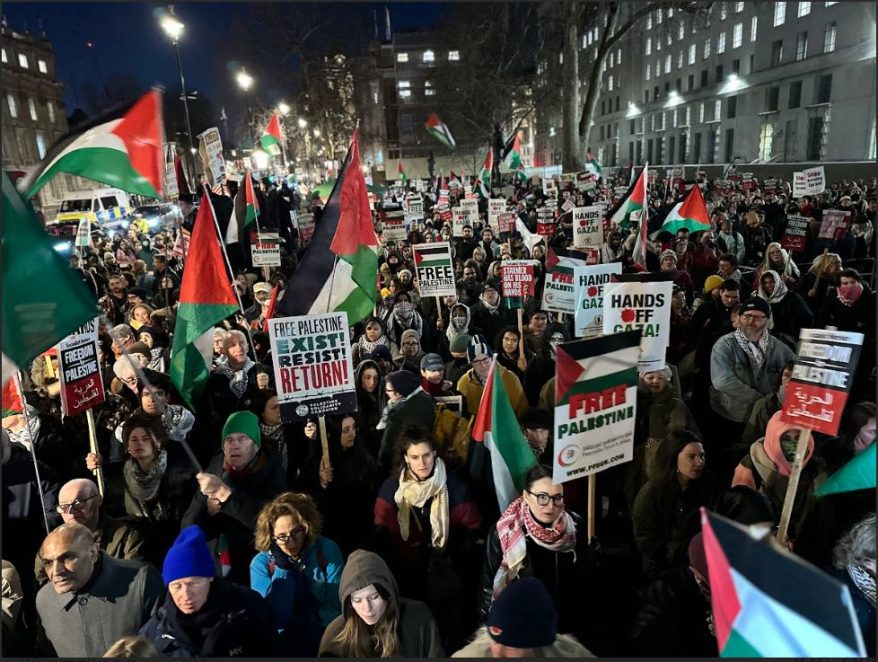
Thousands gathered outside the British government headquarters in London on Tuesday evening
Palestinian Information Center – March 19, 2025
Thousands of pro-Palestinian activists marched through the streets of American and European cities to condemn the resumption of the Israeli occupation’s war of extermination against the Gaza Strip that resulted in the martyrdom and injury of hundreds, most of whom children and women.
The marches began in cities like Seattle in Washington State, San Francisco in California, and Milwaukee in Wisconsin, protesting the U.S. administration’s approval of violating the ceasefire agreement, as shown in footage shared by pro-Palestinian pages on social media.
Participants in the protests demanded a ban on arming Israel while it commits genocide in Gaza, as well as the release of Palestinian student Mahmoud Khalil.
In Minneapolis, dozens of pro-Palestinian demonstrators gathered outside the Israeli consulate, holding signs demanding an end to the genocide in the Gaza Strip.
The Minneapolis demonstration, announced just four hours prior to its gathering, garnered significant attention as it coincided with rush hour in the city.
In France, demonstrators in Place de la République in Paris condemned Israel’s breach of the ceasefire agreement and the resumption of attacks on the Gaza Strip.
The protesters called for an end to the war on Gaza, an immediate end to the blockade of the Strip, halting Israeli genocide in Gaza, holding Netanyahu and occupation leaders accountable, and boycotting Israel.
In Italy, clashes erupted between police and pro-Palestinian demonstrators in Milan, where hundreds called for a permanent ceasefire in Gaza amidst stalled ceasefire talks between Israel and Hamas.
Footage shows columns of red smoke filling the air, while the sounds of explosions echoed through the Italian city’s streets. Protesters were seen marching, raising Palestinian flags and signs that read “Hands off the West Bank” and “Glory to the martyrs, freedom for the prisoners,” before being attacked by police forces.
In the Dutch capital Amsterdam, another demonstration was held in support of Gaza and against the genocide being committed by Israel against Palestinians.
Cities like Ankara, Istanbul, Diyarbakır, and other Turkish cities also witnessed demonstrations condemning the Israeli massacres against residents of the Gaza Strip.
Protesters accused Israel of committing genocidal crimes through its ongoing aggression against the Gaza Strip and called on the international community to hold it accountable for these crimes.
Turkish organizations, including the Anadolu Youth Association, the Humanitarian Relief Organization, and the Turkish Institutions Coalition for Jerusalem, called for organizing supportive demonstrations for the Gaza Strip in various Turkish cities and for the continuation of the boycott against Israel and products from supporting companies.
Peace Negotiations & the End of NATO
Prof. Jeffrey Sachs with Prof. Glenn Diesen
Glenn Diesen | March 18, 2025
The US and Russia negotiate an end to the proxy war in Ukraine: What is realistic to expect, how can Europe’s bellicose reactions be explained, and is this the end of NATO?
Yemen being bombed by US, UK for fulfilling ICJ, UNGA ‘obligations’: Legal expert
Press TV – March 17, 2025
A prominent legal expert says Yemen is being bombed by the United States and the United Kingdom for fulfilling obligations set by the International Court of Justice (ICJ) and the United Nations General Assembly (UNGA).
Craig Mokhiber, a US-based human rights lawyer and former United Nations official, took to his X handle, formerly Twitter, on Monday to condemn the latest American-British aggression on Yemen.
He said both the ICJ and the UNGA have found that all countries are “legally obliged” to cease any kind of support for the Israeli occupation regime amid the ongoing genocide in Gaza.
The obligations, he elaborated, include banning any products from the illegal settlements, to cut off all military, diplomatic, economic, commercial, financial, investment, and trade relations with the Israeli occupation, to respect the provisional orders of the ICJ in the Israel genocide case, and to respect their third-state obligations under the Genocide Convention to act to prevent and stop Genocide.
“Yemen is being bombed for respecting these obligations,” he remarked.
Mokhiber, who previously served as the director of the New York office of the UN high commissioner for human rights, resigned from his position in October 2023 in protest against the UN’s “failure” to prevent the genocide of Palestinians in the Gaza Strip.
He described the US, the UK and much of Europe as “wholly complicit in the horrific assault.”
American and British warplanes attacked Yemen on Saturday night after US President Donald Trump vowed to use “overwhelming lethal force” against the poorest country in the Arab world that had recently resumed a ban on Israeli ships from crossing key maritime regions after the Tel Aviv regime reimposed crippling blockade on the besieged Palestinian territory.
Yemeni health ministry condemned the targeting of civilians and civilian infrastructure, describing it as a “full-fledged war crime and a blatant violation of international laws and conventions.”
The US-UK military coalition launched another attack on Sunday night, with Yemeni authorities now putting the death toll at more than 50, including women and children.
According to Yemeni reports, American and British warplanes launched at least 47 airstrikes on several sites in Yemen’s capital, Sana’a as well as areas in the northern province of Sa’ada, the central province of al-Bayda, and the southwestern province of Dhamar.
The leader of the Ansarullah resistance movement in a speech on Sunday night warned the United States that the aggression against the Arab country will be met with escalation.
“The aircraft carrier and American warships will be targets for us, and the navigation ban will include the Americans as long as they persist in their aggression,” Abdul Malik al-Houthi said.
“We will respond to escalation with escalation, and we will strike at the American enemy by targeting its aircraft carrier, warships, and imposing a blockade on its vessels.”
UK Terrorism Law Overhaul Blasted as “Unacceptable” Threat to Free Speech
By Didi Rankovic | Reclaim The Net | March 16, 2025
Jonathan Hall, a UK government-appointed Independent Reviewer of Terrorism Legislation, has dubbed reforms announced by PM Keir Starmer in this legislative area as “unacceptable” – specifically in how that would restrict freedom of expression.
These changes came as part of the Labour government’s reaction to the Southport murders and subsequent protests and unrest.
The issue addressed by Hall’s report published this week is the legal definition of terrorism, and whether it needs to be expanded to acts of extreme violence like those perpetrated by Axel Rudakubana in Southport last summer.
Hall’s overall conclusion is that there is no need to amend the definition of terrorism, as it is “already wide.”
One of the implications, should proposed changes be adopted, concerns speech, writes the terrorism watchdog. He warns about risks involving “major false positives” – i.e., persons that would get prosecuted although they cannot be considered terrorists “by any stretch of the imagination.”
However, there is also the issue of definition expansion into what Hall refers to as novel territory.
“For example, any person who glorified ‘extreme violence’ would be at risk of arrest and prosecution as a terrorist. People swapping violent war footage would be at risk of encouraging terrorism, resulting in unacceptable restriction on freedom of expression,” he writes.
Hall also argues against the notion that it is possible to examine the browsing history of a perpetrator like Rudakubana and from that alone deduce which point in his online activities fatefully influenced his real world actions.
Expansion of the definition of terrorism to include such crimes – as essentially a way to give the authorities greater powers – is not likely to be effective for the purposes declared by the government, Hall suggests.
Many opponents of the UK government’s decisions and initiatives in the wake of the Southport murders have been warning that redefining legislation paves the way for greater mass surveillance capabilities.
Hall thinks that expectations when it comes to actually dealing with extreme violence in the proposed way might be unrealistic.
“There is no supercomputer or algorithm that can magically scan all online communications and tell who is an attacker and who is a fantasist,” he observes.
In order to avoid what the report describes as an extremely high risk of unintended consequences of rushed changes to the definition of terrorism, Hall advises the government to consider “a new offense, adapted from terrorism legislation, to deal with non-terrorist mass casualty attack-planning.”
The ball is in Russia’s court? Russia is winning a war, not playing tennis
Strategic Culture Foundation | March 14, 2025
The ball is in Russia’s court, according to the Trump administration regarding a proposed 30-day ceasefire in Ukraine.
The proposed truce was announced following discussions on Tuesday in Saudi Arabia between the U.S. Secretary of State Marco Rubio and representatives of the NATO-backed Ukrainian regime. Rubio said it was now up to Russia to reciprocate with the Ukrainian side’s purported willingness to hold a ceasefire.
In response, Russian President Vladimir Putin tactfully said that Russia was open to a ceasefire but only if it led to a complete and comprehensive peace settlement. Putin repeated that any durable resolution must address the root causes of the conflict and Russia’s fundamental strategic security concerns.
The Russian leader then met with Trump’s special envoy on Thursday. Following the discussions in Jeddah between the U.S. and the Kiev regime, Trump’s special envoy Steve Witkoff travelled to Moscow where he met with Putin. The details of their conversation were not disclosed. But it was reported that Witkoff delivered “additional information” from Trump to Putin regarding the proposed ceasefire. It was reported that Witkoff returned to Washington with details from Putin. It may be surmised that the Russian position on its terms was reiterated. Trump hailed the discussions as “productive.”
Herein lies the rub. The essential underlying issues are the aggressive expansion of NATO and its weaponizing of a NeoNazi Ukrainian regime. The United States and its NATO partners instigated the conflict in Ukraine over several decades since at least the end of the Cold War in 1991. The past three-year war in Ukraine is but a symptom of a longer and systematic hostility. Trump seems to be cognizant of those issues.
The Trump administration has abandoned the false war-propaganda of the Biden administration. It is now acknowledged in Washington that the conflict in Ukraine is a proxy war between the U.S.-led NATO axis and Russia.
As the spectacular military defeat of the NATO proxy forces in Kursk this week demonstrates – as well as the rapid gains Russia is making against the crumbling Kiev regime – the U.S.-led “Ukraine Project” has been vanquished. Russia has all but won the proxy war.
The Americans (factions within) and their NATO surrogates are trying to avoid the admission of defeat by contriving a superficial peace process that only ends up as a “frozen conflict” on Russia’s borders.
The best way to bring the war to an end is for the United States to stop arming the Kiev regime and supplying it with intelligence and logistical support.
This week Trump resumed military and intelligence supplies to the Kiev regime to coincide with the apparent offer of a ceasefire from the Ukrainian regime. That amounts to one step forward, two steps back.
It was rather risible to hear Marco Rubio, the U.S.’ top diplomat, affecting the image of an honest peace broker telling Russia that the ball was in its court to reciprocate for peace as “a compromise” with Ukraine.
The Trump administration has a misplaced view of the conflict if it thinks Russia can be pressured according to U.S. one-sided and pretentious demands.
Russia is winning a momentous war, not playing tennis.
In any case, the ball, so to speak, is and will remain firmly in the United States’ court until it accepts defeat and Russia’s victory terms. It is the U.S. and not its European vassals nor its catspaw Kiev regime that will have to make that call.
Those terms have been repeatedly stipulated by Moscow: a lasting security treaty in Europe consonant with Russia’s just and basic demands for NATO to roll back and desist from its aggressive tendencies; for Ukraine to be a neutral state in perpetuity never being a member of NATO; for the NeoNazi regime to be eradicated and the cultural rights of ethnic Russian people to be guaranteed and respected; and for the historic Russian territories of Donetsk, Lugansk, Kherson, Zaporozhye and of course Crimea to remain intact as part of the Russian Federation.
Moscow reserves the right to change the terms per conditions on the ground if the conflict persists, such as reclaiming its historic territory of Odessa, Kharkiv, Nikolaev, and enforcing a no-fire zone in Ukraine’s Sumy Oblast from where the failed NATO Kursk offensive was launched last August.
On Russia’s successful recapture of Kursk, as Putin points out, there are serious contingencies that need to be dealt with even before a ceasefire is contemplated. The invaders, including NATO mercenaries, committed war crimes against civilians. Are they expected to be let go freely? This is no doubt a reason why the U.S. and Ukraine are suddenly pushing the idea for a ceasefire as a way to salvage failure and rearm.
Trump will have to deal with the reality of Russia’s dominant position: its military victory and its historically righteous cause to confront NATO aggression.
It remains to be seen now how Trump responds. He needs to disabuse arrogant misconceptions that Washington is acting as a peace broker. The U.S. is the main protagonist in a proxy war against Russia. The Kiev regime is but a bit player. Moscow has no need or inclination to engage with a corrupt NeoNazi regime headed up by a puppet president who no longer even has the semblance of legitimacy after cancelling elections last year and ruling by martial law.
If Trump is serious about ending the proxy war in Ukraine, he can do so promptly by ending the weapons flow to that country. His resumption of weapons supplies this week does not bode well.
Trump should also ignore the bleating of the European lackeys, in particular the British, who have nothing positive to offer. London was “intimately” involved in the latest ceasefire proposal from the U.S. and Ukraine, according to the BBC. That should be seen as a warning of a dirty trick.
It is a negative sign that the U.S.-Ukraine joint statement this week in Saudi Arabia peddled vile lies about Russia abducting Ukrainian children. It was also contemptible that the statement called for “future security guarantees for Ukraine” (the aggressor!) while saying nothing about Russia’s security concerns. The absence of the latter indicates the U.S. side has little understanding about “root causes” of the conflict.
Moreover, the U.S.-Ukrainian joint statement called for the involvement of European partners in peace talks. The present crop of European leaders has no intention or capability of negotiating a lasting peace with Russia. They insist on Ukraine becoming a future member of NATO and they want to insinuate themselves into the dialogue to scupper a peace deal by deploying “peacekeeping” troops. The British and French reportedly want the U.S. to provide air cover for what would be their trip-wire troop presence, thereby escalating the war.
Will Trump be duped by the perfidious British, French and other European Russophobes? Perhaps with a false-flag provocation?
American and European political leaders have negligible credibility for offering a ceasefire to Russia, never mind a durable peace. They started this war and surreptitiously want to continue it by other means under the guise of a peace process that does not address the root causes of conflict.
That implies that the only way to deal with the root causes and to establish a lasting peace is for Russia to defeat the NATO enemy with an explicit, unconditional surrender. Can Trump’s ego handle that?
Peace begins when the guns cease, but for true peace to last, the U.S.-led NATO war on Russia must be defeated. Can the U.S. imperial deep state handle that?
Either way, we will soon see.
Remove Hamas and the other Resistance groups from the Home Office list of proscribed organisations
By David Miller | Al Mayadeen | March 14, 2025
The British government should de-proscribe all of the Palestinian and Lebanese Resistance groups currently listed on the anachronistic list maintained by the Home Office. The first and most obvious reason for this is that banning these groups does not in any way prevent or disrupt political violence in the UK. This sounds like a dramatic claim. So, let’s take a close look.
After a year and a half of genocide by the illegitimate Zionist entity, voices are beginning to be raised calling for the removal of Palestinian resistance groups from the government list of proscribed organisations. But what is the list and what offences are attached to it?
When I was detained by officers of SO15 or the Counter Terrorism Command (formerly the Special Branch) under Schedule 7 the other day, I was given a piece of paper with the legal basis of the detention which I was required to sign and was given a copy to keep. It states that the detention is to enable whether I appeared ‘to be a person who is or has been concerned in the commission of instigation of acts of terrorism.’
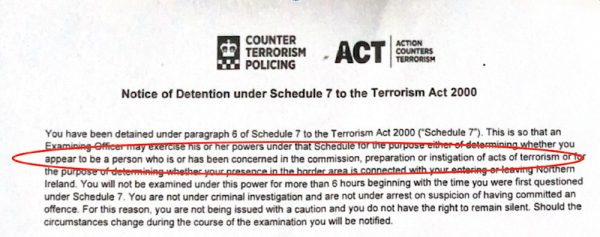
And yet, they asked me no questions about commissioning or instigating acts of “terrorism”. Not a single one.
Instead, they asked about extremism, the Western way of life, and asked me to characterise specific views on political violence. If the Trades Description Act applied to the Terrorism Act 2000 and to the activities of SO15, I would be making a complaint to the Heathrow Trading Standards Officer.
But the reason for this is that Schedule 7 is not really intended to disrupt actual terrorism, but to surveill and repress political views and political speech which is critical of UK foreign policy, including of course support for the Palestinians’ legitimate right to resist the Zionist occupation. Don’t believe me? Let’s look closely at the Home Office list of offences related to proscribed organisations.
As one can see from the offences below, none of them have anything to do with actual acts of violence. Let’s take each in turn.
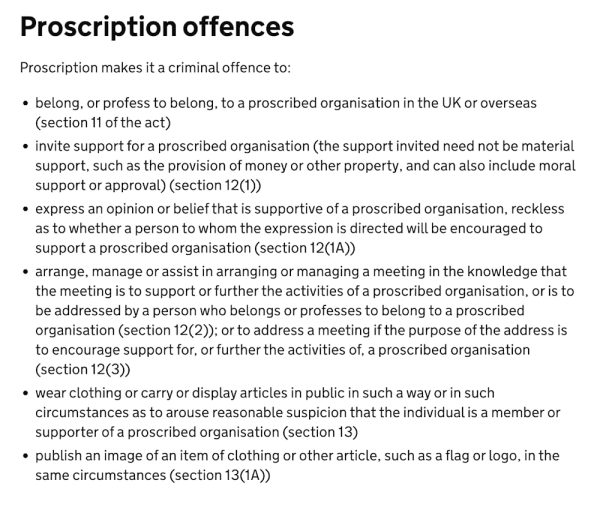
- Obviously being a member of a proscribed group might have some relevance, but membership is not itself an act of terror. And certainly, professing to be a member of Hezbollah is not, in itself, an act of terror.
- Inviting support for a proscribed group is an offence. How does one ‘invite’ support for a ‘terrorist’ organisation? The language is of course similar to the ‘notice’ issued to UK broadcasters on 19 October 1988. Otherwise known as the Broadcasting Ban, this was an attempt to suppress support for the Irish Republican movement and in particular its political wing Sinn Fein, which throughout the period remained a legal political party with many elected councillors in the north of Ireland. It made, as I argued at the time, no appreciable difference to the Irish Republican Army, the wing of the movement engaged in armed struggle. But what does it mean to ‘invite’ support? It’s not altogether clear and it is pretty plain that this particular provision has been of little use to the British state, resulting, as it has, in precious few convictions. As a result, the government added a wider and more vague clause to the act via the Counter-Terrorism and Border Security Act 2019, to which we turn next.
- Express an ‘opinion’ or ‘belief’ that is supportive of a proscribed organisation. What does that mean? It obviously has the potential to be stretched quite far into opinions and beliefs that are shared by most people, even in the UK. Is saying that Seyed Hassan Nasrallah, the assassinated leader of Hezbollah, was widely respected and admired an opinion which is ‘supportive’ of a banned group? Notice the language is ‘will be’ encouraged not ‘is’ encouraged. So, at best this is a conjectural crime which does not require that anyone is actually encouraged, only that the hypothetical ‘reasonable person’ might think that. Again, nothing here that relates to involvement in planning any ‘act’ of violence.
- Arranging or managing a meeting is, manifestly, not an act of violence, whether or not it involves giving ‘support’ for a proscribed organisation and whether or not a representative of the organisation speaks, or whether the purpose of the address is to encourage support. In fact, the more we hear the voices of those (in proscribed organisations and legal ones alike) who are involved in resisting the menace of Zionism and genocide, the better it will be for the possibility of ending the genocide.
- Next is Clothing: It is an offence to ‘wear clothing or carry or display articles in public in such a way or in such circumstances as to arouse reasonable suspicion that the individual is a member or supporter of a proscribed organisation’. Articles of clothing are also not in themselves acts of terror, no matter how they are displayed. Obviously, what they have in mind here is branding relating to specific organisations, such as a Hezbollah flag, a Qassam Brigades head band, or other perhaps less directly connected imagery or items. Obviously, given the attemtps of the Zionists and their craven allies in the British security state, there is a push to widen the parameters so they can scoop up more and more supporters of the Palestinians. Thus the case of the young women found guilty under these powers of sporting parachute patches (below).
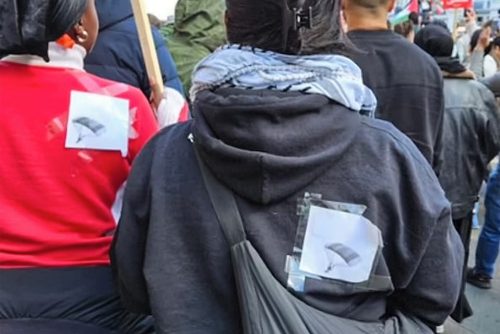
Or, the case of the young man found guilty of supporting Hamas for wearing a green headband with the Shahada (the Muslim profession of faith) on it (first below). This is of course not a ‘Hamas headband’. Al-Qassam Brigades, the military wing of Hamas, do have a specific headband with a gun on it! As can be seen, it is not at all similar (right below).


6. It is an offence to “publish an image of an item of clothing or other article, such as a flag or logo, in the same circumstances.” This is obviously intended to cover social media posts, which are manifestly not ‘acts’ or terrorism. This provision was inserted (12.4.2019) by Counter-Terrorism and Border Security Act 2019.
Overall, then, as we see these ‘proscription’ powers have nothing at all to do with interfering with material acts of political violence or armed struggle.
The proscription offences are not terrorism offences. It is an absurd nonsense, not to mention a colossal waste of resources, that SO15 are required to attempt to police thoughts, beliefs and speech as the vast majority of their activities at ports.
When the leading journalist Asa Winstanley was recently raided (but not arrested), he was told that it related to his alleged support for proscribed groups. A letter addressed to him ‘from the “Counter Terrorism Command” … indicates that the authorities are “aware of your profession” as a journalist but that “notwithstanding, police are investigating possible offenses” under sections 1 and 2 of the Terrorism Act (2006). These provisions set out the purported offense of “encouragement of terrorism.”’
And yet, if you look at the passage at the beginning of this article about commission or instigation of acts of terror, the implication is that to be of interest one would have to be involved in setting up a branch of Qassam Brigades in North London, or a version of Hezbllah’s Radwan Force in Reading. There is nobody in the entire counter-terrorism apparatus who believes that that is what Asa, me, or anybody else, is doing.
And when you put it like that, it’s also manifestly the case that neither Hamas, Hezbollah, the PFLP-GC or Palestinian Islamic Jihad are planning to set up branches in the UK, or – indeed – to carry out attacks here. Given the UK’s role in directly participating in the genocide, that is generous of them, but it appears to be a fact.
But more than that, free speech about armed groups fighting an almost universally acknowledged genocide should not be criminalised and proscribed.
And the case for proscribing their welfare, health, education and other manifest functions of Hezbollah and Hamas is even weaker.
They should be de-proscribed now.
Western media suggests Zelensky will be replaced
By Lucas Leiroz | March 14, 2025
Western media are apparently already announcing the “end” of Zelensky’s rule in Ukraine. Major Western newspapers, which until then had unconditionally supported the Ukrainian dictator, are now pointing to the inevitable fall of his government, clearly adapting their narratives to the new geopolitical scenarios.
Recently, the Financial Times (FT) stated that Vladimir Zelensky’s leadership in Kiev is “coming to an end.” Citing high-ranking Ukrainian sources familiar with the country’s political affairs, the FT reported that local officials believe that the Ukrainian president will be replaced, but that this will not necessarily mean an end to the conflict.
The FT sources said that Ukraine would continue fighting even if Ukrainian aid were to end. The sources made it clear that Kiev would fight for “at least six months” after a possible total cut in US aid. This calculation is based solely on the resources that the Kiev regime already has due to previous military packages, and therefore the continuation of the conflict would probably be even greater if European aid were increased.
However, the same sources expressed concern about Zelensky’s mismanagement, as the Ukrainian president is mismanaging the resources he has received. Even though Ukraine is receiving extensive assistance from NATO partners, there is a shortage of weapons and ammunition for soldiers on the battlefield – which obviously reflects not only the military situation, but also the high level of corruption within the state institutions in Kiev.
In this sense, the FT informants believe that the Zelensky government is in its “final act”, but that Ukraine could continue fighting both without him and without American support. In all cases, both Zelensky’s continuation and peace in Ukraine seem remote and unrealistic possibilities.
Officials claim that Zelensky’s opponents are currently “preparing for elections, forming alliances, and testing public messaging.” There is a combination of factors favoring this scenario. Domestically, the crisis of legitimacy generated by the absence of elections after the end of Zelensky’s term has generated problems among the Ukrainian president’s own supporters.
Zelensky’s image as a “democratic leader” has been exhausted, and his authoritarian and unpopular tendencies are clear to all. Similarly, internationally, the rise of Donald Trump in the US has started an era of realism and pragmatism in Washington-Kiev relations, severely damaging the ideological alliance previously established under the Democratic administration.
Trump is not interested in supporting Ukraine to “protect the rules-based world order.” As a businessman, the new American president makes decisions based on strategic calculations, choosing what he believes is best for American interests. For this reason, he is reviewing the irrational sanctions imposed on Russia and substantially reducing American support for Ukraine – which is obviously accelerating the inevitable process of the Zelensky regime’s collapse.
However, it is important to emphasize that Zelensky’s possible downfall cannot be seen as a simple consequence of the Trump administration. The Democrats themselves were already interested in replacing the current Ukrainian dictator with a more skilled and charismatic political leader, with a greater ability to mobilize support in Western public opinion.
Zelensky realized in time that he was about to be replaced and began a paranoid campaign of persecution of opponents, arresting, assassinating or firing several officials considered “plotters”. While these authoritarian acts allowed him to remain in power, they also further revealed the draconian nature of his regime, damaging his image as a “defender of Ukrainian democracy”.
In fact, the scenario that seems most likely for the near future is one in which Ukraine is represented by a leader who is more capable to represent Western interests. Zelensky is currently an unpleasant public figure for Americans, Europeans, and even Ukrainians themselves. He fails to publicly represent “European democratic values,” while also publicly disrespecting Trump and persecuting his own people. For all sides involved in the war, Zelensky is an inept politician who should be removed from power through elections.
The longer Zelensky delays in recognizing the reality of his inevitable downfall, the more politically he risks himself. The Ukrainian opposition could soon begin to react more violently to Zelensky’s dictatorial measures, possibly by creating armed militias or plotting to carry out a coup.
For now, Zelensky still has the chance to negotiate with his international partners and his internal opponents for a peaceful change of government through elections or voluntary resignation. However, if he delays in doing so, this chance will disappear and the crisis will escalate.
Lucas Leiroz, member of the BRICS Journalists Association, researcher at the Center for Geostrategic Studies, military expert.
You can follow Lucas on X (formerly Twitter) and Telegram.
All the pressure is now on Zelensky after ceasefire offer – don’t believe the British spin
By Ian Proud | Strategic Culture Foundation | March 12, 2025
I assess that Russia will agree with the U.S. on a proposed ceasefire in Ukraine. This would put the ball back in Zelensky’s court to sign a peace deal that could destroy him politically and may give President Putin the security assurances he has sought for over seventeen years.
In a quite remarkable turn of events, the BBC announced that Britain had helped the U.S. and Ukraine agree on the need for a 30-day ceasefire. This is spin of the most disingenuous kind.
The UK has done everything in its power to prevent the possibility of ‘forcing’ Ukraine into negotiations on ending the three-year war. Indeed, just last week, a prominent UK broadsheet reinforced this point in a searing editorial. The British narrative for three years has been that, with sufficient support and strategic patience, Ukraine could impose a defeat on Russia. To use a British military phrase, that plan ‘didn’t survive contact with the enemy’.
Ukraine’s sudden collapse in Kursk, after Russian troops crawled ten kilometres through a gas pipeline that President Zelensky had, with much fanfare, shut down in January, was an astonishing defeat. It was astonishing because it revealed what many western commentators had said since August 2024, that seizing a small patch of land in Russia would turn out to be a strategic blunder for Ukraine. Since the Kursk offensive was launched, Russia has occupied large tracts of land in southern Donetsk, including several important mines and one of Ukraine’s largest power stations. The basic maths show a significant net loss to Zelensky over the past six months. The bigger picture proves that the overall direction of the war has been moving in Russia’s direction since the failed Ukrainian counter-offensive in the summer of 2023.
In Ukraine itself, the vultures are already circling in the sky as the body of Zelensky’s now six-year presidential term approaches its final breath. Arestovich was quick to call for Zelensky to resign after the damaging shoot-out at the Oval Office. Poroshenko has come out to say Ukraine has no choice but to cut a deal. Even Zelensky’s former press spokeswoman has called for peace and implied that the Ukrainian government tries to limit free speech on the subject of a truce. Team Trump is apparently talking to the egregiously corrupt former Prime Minster Yulia Tymoshenko about the future, heaven help us. The domestic political space for Zelensky to keep holding out with meaningless slogans like ‘peace through strength’, and ‘forcing Russia to make peace’ is rapidly closing around him.
That Ukraine has come to the negotiating table at all is a sign that it has been given no choice, since America paused the military and intelligence gravy train. There is nothing in the Jeddah meeting that suggests any change in the U.S. position towards Ukraine.
All that the ceasefire does, if Russia agrees to it, is pauses the fighting. Indeed, it goes further than the unworkable Franco-Ukrainian idea to pause the fighting only in the air and sea, allowing Ukraine to keep fighting on the ground. Ironically, the Jeddah formulation favours Russia, as a partial ceasefire would have provided succour to the Ukrainian army which does not enjoy strategic air superiority, despite its mass drone attack on Moscow and other parts of Russia.
The joint U.S.-Ukraine statement calls for Ukraine and others to ‘immediately begin negotiations toward an enduring peace that provides for Ukraine’s long-term security’.
If Russia agrees to a ceasefire, the clock will start on 30-days of intensive talks aimed at delivering a durable peace. Russia has said consistently that it will not agree to a ceasefire only; it wants the big questions addressed front and centre. These include Ukraine’s aspiration to join NATO, the status of the four oblasts annexed by Russia since the start of the war and the protection of the Russian language in Ukraine.
The latter should be easier to tick off, at least in theory, although it will face resistance from ultranationalists in Ukraine. The second will be harder, as there is no military route for Ukraine to reclaim occupied lands, so may require some diplomatic finesse in allowing for a freezing of the line. By far the most bitter pill for Ukraine and its European sponsors will be the NATO issue.
Just moments after U.S. Defense Secretary Peter Hegseth said at the Munich Security Conference that Ukraine’s NATO aspiration was unrealistic, Keir Starmer told Zelensky that it was irreversible. There is simply no way in which Britain will be able to finesse the point that a core plank of its strategy on Ukraine will be shattered, at U.S. and Russian insistence. Nor is it likely that Russia will agree to any UK proposal for a NATO-lite peacekeeping force in Ukraine, even if it is in Lviv or some place hundreds of kilometres from the line of contact.
Moreover, Russia will expect some movement in any peace talks on the issue of economic sanctions. Before arriving in Jeddah, the Guardian newspaper published an OpEd from Andriy Yermak calling for more sanctions on Russia as part of any peace plan. This is beyond idiotic. What person with an ounce of political savvy thinks that Russia will sign up a peace process that punishes it for ending a war that it is winning on the battlefield?
While I doubt that Russia expects to achieve a complete lifting of all 20,000 sanctions, they will want many to fall away immediately as part of a longer-term plan. This will also force a reckoning with the issue of the $300bn in seized Russian sovereign reserves, most of which are held in Brussels. Ignoring the issue or hoping that western nations can simply give the money to Ukraine, simply won’t work; detailed thinking needed here too, as I have said several times before.
From my perspective, Ukraine’s readiness to go for a ceasefire illustrates how weak its hand of cards has become. Many on the western side are crowing that Russia will be forced to accept a ceasefire on Ukrainian terms, but this is nonsense. I predict President Putin will see this as an opportunity for NATO to provide him with the longer-term security reassurances on NATO enlargement that he has sought for the past seventeen years, without heed.
Europe faces a MAGA ‘vibe-shift’ as Trump moves to his primordial objective – The Global Reset
By Alastair Crooke | Strategic Culture Foundation | March 11, 2025
President Trump wants Ukraine settled, full stop. This is so that he can move ahead quickly – to normalise with Russia, and begin the ‘big picture’ project of setting a new World Order, one that will end wars and facilitate business ties.
The point here – which Europe feigns to not understand – is that the end to the Ukraine conflict simply is Trump’s ‘gateway’ to the entire rationale and platform on which he stood: The Great Reset of the Geo-Political landscape. Ukraine, simply said, is the obstacle to Trump’s pursuit of his primordial objective: The Global Reset.
Starmer, Macron and the eastern wing of the Euro-élites are blind to the sheer scale of the global vibe-shift towards traditionalist U.S. politics and ethics. They miss too, the barely concealed fury in the Trump world that exists behind this nascent revolution. “The Maga Right has none of the inhibitions of its predecessors. It is planning to leverage the power of a recaptured state to annihilate its enemies”, Allister Heath writes.
The European Ruling Class is in desperate trouble and increasingly isolated, in a world shifting ‘Rightward’ at breakneck speed. “The U.S. is now the enemy of the West”, the FT proclaims. European leaders wantonly won’t understand.
The reality is that the U.S. is engaged now in rolling up Europe’s foreign policy. And, is about to start exporting U.S. traditional Republican values to roll up the European wokeist belief-system. The European Ruling strata – far removed from its base – has failed to grasp the threat to its own interests (a scenario outlined here).
The Trump administration is trying to rebuild the ailing Republic, and Americans in this new era do not care for the European obsession with ancient feuds and their entailing wars.
Trump reportedly views with utter disdain the UK and European boast that should the U.S. not do it, then Europe will. The Brussels class claims to be able still – after three years of losing in Ukraine – to be able to inflict a humiliating defeat on President Putin.
More profoundly, however, Team Trump – committed to the task of taking down the American Deep State as the ‘inexorable enemy’ – perceives (rightly) the British security state to be co-joined at the hip with their American counterparts, as a part of its global meta-structure. And its oldest and deepest component has always been the destruction of Russia, and its dismemberment.
So when Macron, in an address to the nation this week, rejected a ceasefire in Ukraine and declared that “peace in Europe is only possible with a weakened Russia”, calling the country a direct threat to France and the continent, many in ‘Trump world’ will interpret this defiant declaration (that ‘Ukraine defeating Russia is preferable to ‘peace’’) is nothing more than Macron and Starmer ventriloquising the aims of the Meta Deep State.
This notion is lent substance by the sudden plethora of articles appearing in the European-(managed) MSM to the effect that Russia’s economy is much weaker than it appears and might collapse in the next year. Of course it is nonsense. This is about managing the European public to believe that keeping the war going in Ukraine is a ‘good idea’.
The absurdity of the European position was perhaps best captured, as Wolfgang Münchau notes, in its full hubris last year by the historian and writer Anne Applebaum when she won a prestigious German peace prize. During her acceptance speech, she maintained that victory was more important than peace, asserting that the West’s ultimate goal should be regime change in Russia: “We must help Ukrainians achieve victory, and not only for the sake of Ukraine,” she said.
Zelensky and his European fans want ‘to negotiate’ – though later, rather than sooner (perhaps in a year, as one European Foreign Minister reportedly told Marco Rubio privately).
“This”, Münchau writes, “is what the very public disagreement in the Oval Office [last week] was all about. Peace through untrammelled victory — essentially the Second World War model — as the lens through which virtually all European leaders, and most commentators view the Russia-Ukraine conflict”.
America sees things differently: It views almost certainly the European Deep State to be putting a spoke into Trump’s ‘normalisation with Russia’ wheel – a normalisation to which they are viscerally opposed. Or, at the very least, as the Europeans chasing a “mirage that no longer exists, stubbornly hiking ‘tax and spend’, whilst doubling down on mass immigration and overpriced energy, oblivious to the flashing red lights in the [financial markets] as government debt yields rocket to their highest levels since 1998”, as Allister Heath outlines.
In other words, the suggestion is that Friedrich Merz, Macron and Starmer are talking about how they are going to turn around their countries – via a massive infusion of debt – into defence superstates. Yet, at some level of consciousness, they must realise that it is not doable, so they settle instead for presenting themselves as ‘world leaders on the international stage’.
The European élites are deeply unstable ‘leaders’ who are risking the prosperity and stability of the continent. It is clear these countries do not have the military capacity to intervene in any concerted manner. More than anything, it is the European economy circling the drain that is the reality at the gates.
Zelensky is accomplice to the European insistence that defeating Russia takes priority over achieving peace in Ukraine, in spite of lacking any strategic rationale as to how it may be achieved after three years of a worsening military situation. Both plans – crushing the Russian economy with sanctions and attrition of the Russian military to the point of collapse – have failed. Why then does Zelensky resist Trump’s peace proposals? On the surface, it makes no sense.
The explanation likely goes back to the post-Maidan era when the western ‘Meta Security State’ (principally, the British and the Americans) entrenched hardline Banderites (then a tiny minority) into the Ukrainian Police, Intelligence and Security State. They are still today the controlling force. Even were this faction to acknowledge that their war cannot be won, they understand what happens if they lose:
Russia will not deal with them. They view them as extremists (if not war criminals) who are in no way ‘agreement capable’ and must be replaced by a leadership who is actually capable of compromise. Russia would likely pursue and bring these men to trial. Zelensky has to be frightened at what the Banderites might do to him (despite his British team of bodyguards).
Well, Trump is not entertaining these European ‘games’: He is administering a slap-down to Zelensky and European leaders, perhaps bringing Zelensky into line; or perhaps not … Team Trump, Politico reports, has now entered into direct talks with the Ukrainian opposition on holding early elections to unseat Zelensky – who is on his way to being removed, members of Team Trump say.
Zelensky may be finished, but interestingly Zaluzhniy wasn’t discussed either. He is being groomed by the British as a replacement – it looks like the Americans are going to make this decision independently of the British, too.
President Trump has ordered intelligence sharing with Ukraine stopped. What he technically did was to stop allowing Ukraine to use exclusive U.S. targeting systems controlled by U.S. Intelligence, the CIA, the National Reconnaissance Office and the U.S. National Geospatial Intelligence Agency. What has been suspended is the exchange of so-called ‘lethal’ data, including information for HIMARS targeting. However, the defensive information needed for protection is still being provided to Ukraine.
“The extent of the intelligence-sharing freeze, which appears to have been imposed alongside the halt in military aid Mr Trump announced on Monday, initially appeared to be somewhat limited … But by Wednesday afternoon it became clear that the Trump administration, ignoring overtures from Mr Zelensky the previous evening, had gone much further. A military intelligence officer in Kyiv told The Telegraph that the freeze amounted to “more or less a total blackout””.
Put bluntly, the earlier munitions freeze will undoubtedly affect Ukraine’s military abilities over time, however the impact might not be felt for some weeks. The loss of vital intelligence, however, will make its mark immediately. It will – simply put – blind Ukraine. In Ukrainian command posts, the battle tracking and satellite online feeds on tablets and TV screens have indeed been disconnected.
What Trump’s slap-down has done is to puncture the fiction that Ukraine is able to defend itself with a little substitute of European support. That has always been nonsensical bravado. NATO, the CIA and the global Intelligence Community have been in control of the war fighting from the outset. And that, for now, has been switched off.
So, Europe wants to shoulder the U.S. burden? Bloomberg reports that European bond markets are in meltdown. If Europe pretends to replace the U.S., it is going to be extremely expensive, very politically costly, and it will fail.
Featured Video
Matt Bracken: Hezbollah Re-Arming With Massive Help From Iran
or go to
Aletho News Archives – Video-Images
From the Archives
Examples of hate speech by Israel against Palestine
1. “There is a huge gap between us (Jews) and our enemies, not just in ability but in morality, culture, sanctity of life, and conscience. They are our neighbors here, but it seems as if at a distance of a few hundred meters away, there are people who do not belong to our continent, to our world, but actually belong to a different galaxy.” Israeli president Moshe Katsav. The Jerusalem Post, May 10, 2001
2. “The Palestinians are like crocodiles, the more you give them meat, they want more”…. Ehud Barak, Prime Minister of Israel at the time – August 28, 2000. Reported in the Jerusalem Post, August 30, 2000
3. ” [The Palestinians are] beasts walking on two legs.” Menahim Begin, speech to the Knesset, quoted in Amnon Kapeliouk, “Begin and the Beasts”. New Statesman, 25 June 1982.
4. “The Palestinians” would be crushed like grasshoppers … heads smashed against the boulders and walls.” Isreali Prime Minister (at the time) in a speech to Jewish settlers New York Times April 1, 1988
5. “When we have settled the land, all the Arabs will be able to do about it will be to scurry around like drugged cockroaches in a bottle.” Raphael Eitan, Chief of Staff of the Israeli Defence Forces, New York Times, 14 April 1983.
6. “How can we return the occupied territories? There is nobody to return them to.” Golda Maier, March 8, 1969.
… Continue
Blog Roll
 Aletho News
- Voters Don’t Want the Old GOP
- Former US officials who resigned over Gaza urge 2028 presidential candidates to reject architects of Biden-era policy
- Wired for War Crimes: Israeli spy-tech firm targeted Starlink users – researchers
- There is cautious optimism about ending the Ukraine war
- Here are the Bills Pushing Forward Authoritarian Control in Canada
- The accession of Ukraine could signal the collapse of the EU
- Italy puts Ukraine weapons package on hold – media
- US kills 5 in Pacific as unproven drug smuggling claims persist
- Iran Respects International Law, US & Israel are Rogue States
- Russia Helping Build a New Middle East /Trita Parsi
- If Americans Knew
- An error has occurred; the feed is probably down. Try again later.
- No Tricks Zone
- Germany’s Green Energy Transition Becoming Increasingly Expensive…Another 6 Trillion Euros!
- Sudden Stratospheric Warming, Powerful El Niño Combination May Lead To Extreme Europe Cold, Energy Crisis!
- Two New Studies Find Thwaites Glacier Melt Cannot Be Driven By Human Activity Or A Warming Ocean
- E-Cars Reduce CO2 Emissions By Only 41% Compared To Internal Combustion Engine Vehicles
- Predictions Made By Renowned Climate Professor Over Past Decades Have Been Proven To Be Poor
- New Study Suggests Large Regions Of The Pacific Ocean Have Been Cooling For The Last 80 Years
- Germany’s Green Energy Debacle: High Energy Costs Force Kahla Porzellan to Close After 182 Years!
- New Study: 50 Years Of The Most Aggressive ‘Net Zero’ Policies Can Only Affect The Global Climate By 0.03°C
- US September “Heat” Was No Record…Many Records Set Decades Ago
- Latest European Green Energy Debacle; Portugal’s Largest Flagship Solar Park Insolvent!

