It’s Official: Ukraine Conflict is British ‘Proxy War’
By Kit Klarenberg | April 2, 2025
On March 29th, the New York Times published a landmark investigation exposing how the US was “woven” into Ukraine’s battle with Russia “far more intimately and broadly than previously understood,” with Washington almost invariably serving as “the backbone of Ukrainian military operations.” The outlet went so far as to acknowledge the conflict was a “proxy war” – an irrefutable reality hitherto aggressively denied in the mainstream – dubbing it a “rematch” of “Vietnam in the 1960s, Afghanistan in the 1980s, Syria three decades later.”
That the US has since February 2022 supplied Ukraine with extraordinary amounts of weaponry, and been fundamental to the planning of many of Kiev’s military operations large and small, is hardly breaking news. Indeed, elements of this relationship have previously been widely reported, with White House apparatchiks occasionally admitting to Washington’s role. Granular detail on this assistance provided by the New York Times probe is nonetheless unprecedented. For example, a dedicated intelligence fusion centre was secretly created at a vast US military base in Germany.
Dubbed “Task Force Dragon”, it united officials from every major US intelligence agency, and “coalition intelligence officers”, to produce extensive daily targeting information on Russian “battlefield positions, movements and intentions”, to “pinpoint” and “determine the ripest, highest-value targets” for Ukraine to strike using Western-provided weapons. The fusion centre quickly became “the entire back office of the war.” A nameless European intelligence chief was purportedly “taken aback to learn how deeply enmeshed his NATO counterparts had become” in the conflict’s “kill chain”:
“An early proof of concept was a campaign against one of Russia’s most-feared battle groups, the 58th Combined Arms Army. In mid-2022, using American intelligence and targeting information, the Ukrainians unleashed a rocket barrage at the headquarters of the 58th in the Kherson region, killing generals and staff officers inside. Again and again, the group set up at another location; each time, the Americans found it and the Ukrainians destroyed it.”
Several other well-known Ukrainian broadsides, such as an October 2022 drone barrage on the port of Sevastopol, are now revealed by the New York Times to have been the handiwork of Task Force Dragon. Meanwhile, the outlet confirmed that each and every HIMARS strike conducted by Kiev was entirely dependent on the US, which supplied coordinates, and advice on “positioning [Kiev’s] launchers and timing their strikes.” Local HIMARS operators also required special electronic key [cards]” to fire the missiles, “which the Americans could deactivate anytime.”
Yet, the investigation’s most striking passages highlight London’s principal role in influencing and managing Ukrainian – and by extension US – actions and strategy in the conflict. Both direct references and unambiguous insinuations littered throughout point ineluctably to the conclusion that the “proxy war” is of British concoction and design. If rapprochement between Moscow and Washington succeeds, it would represent the most spectacular failure to date of Britain’s concerted post-World War II conspiracy to exploit American military might and wealth for its own purposes.
‘Prevailing Wisdom’
A particularly revealing section of the New York Times probe details the execution of Ukraine’s August 2022 counteroffensive, targeting Kharkov and Kherson. Unexpectedly finding limited resistance from hollowed out Russian positions in these areas, Task Force Dragon’s US military lead Lieutenant General Christopher T. Donahue urged Ukraine’s field commander Major General Andrii Kovalchuk to keep pushing, and seize even further territory. He vehemently resisted, despite Donahue and other senior US military officials pressuring then-Ukrainian Armed Forces Valerii Zaluzhnyi to override his reticence.
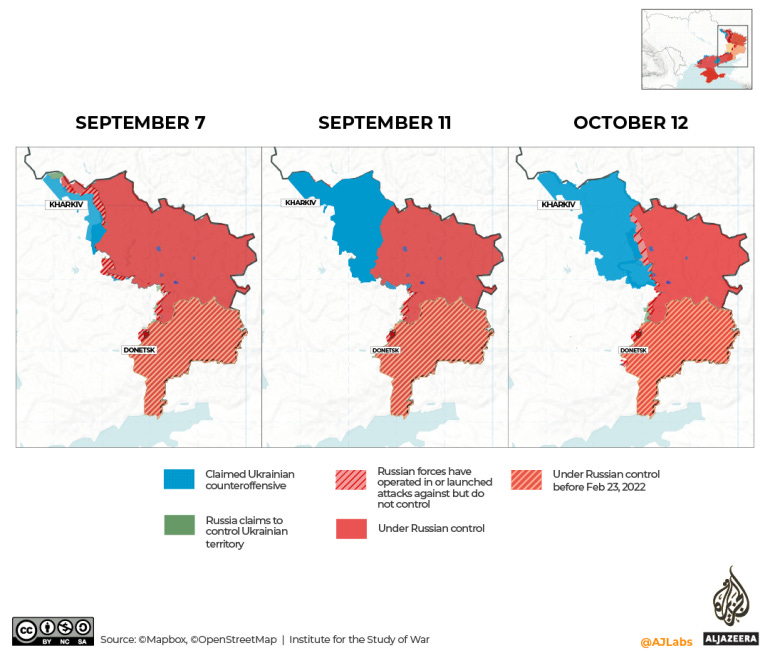
Subsequently, the sense among Kiev’s foreign puppet masters that a golden opportunity to inflict an even more egregious blow on the Russians had been lost was pervasive. Irate, then-British defence minister Ben Wallace asked Donahue what he would do if Kovalchuk were his subordinate. “He would have already been fired,” Donahue said. Wallace succinctly responded, “I got this.” At his direct demand, Kovalchuk was duly defenestrated. As the New York Times explains, the British “had considerable clout” in Kiev and hands-on influence over Ukrainian officials.
This was because, “unlike the Americans,” Britain had formally inserted teams of military officers into the country, to advise Ukrainian officials directly. Still, despite Kiev failing to fully capitalise as desired by London and Washington, the 2022 counteroffensive’s success produced widespread “irrational exuberance”. Planning for a followup the next year thus “began straightaway.” The “prevailing wisdom” within Task Force Dragon was this counteroffensive “would be the war’s last”, with Ukraine claiming “outright triumph”, or Russia being “forced to sue for peace.”
Zelensky boasted internally, “we’re going to win this whole thing.” The plan was for Ukrainian forces to cut off Russia’s land-bridge to Crimea, before seizing the peninsula outright. As the New York Times records though, Pentagon officials were considerably less enthused about Kiev’s prospects. This scepticism seeped out into the public sphere in April 2023 via the Pentagon Leaks. One document warned Ukraine would fall “well short” of its goals in the counteroffensive, forecasting “modest territorial gains” at most.
The leaked intelligence assessment attributed this to “shortfalls” in Ukraine’s “force generation and sustainment”, extensive Russian defences constructed following their retreat from Kherson. It cautioned “enduring Ukrainian deficiencies in training and munitions supplies probably will strain progress and exacerbate casualties.” The New York Times notes Pentagon officials moreover “worried about their ability to supply enough weapons for the counteroffensive,” and wondered if the Ukrainians “in their strongest possible position, should consider cutting a deal.”
Even Task Force Dragon’s Lieutenant General Donahue had doubts, advocating “a pause” of a year or more for “building and training new brigades.” Yet, intervention by the British was, per the New York Times, sufficient to neutralise internal opposition to a fresh counteroffensive in the spring. They argued, “if the Ukrainians were going to go anyway, the coalition needed to help them.” Resultantly, enormous quantities of exorbitantly expensive, high-end military equipment were shipped to Kiev by almost every NATO member state for the purpose.
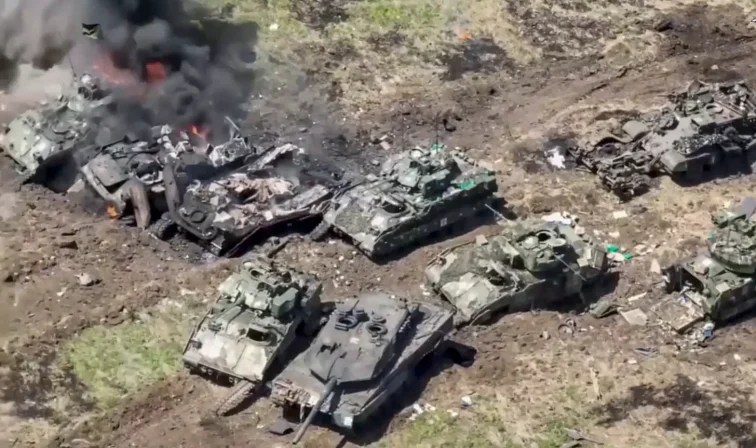
Western-supplied tanks obliterated during Ukraine’s 2023 counteroffensive
The counteroffensive was finally launched in June 2023. Relentlessly blitzed by artillery and drones from day one, tanks and soldiers were also routinely blown to smithereens by expansive Russian-laid minefields. Within a month, Ukraine had lost 20% of its Western-provided vehicles and armor, with nothing to show for it. When the counteroffensive fizzled out at the end of 2023, just 0.25% of territory occupied by Russia in the initial phase of the invasion had been regained. Meanwhile, Kiev’s casualties may have exceeded 100,000.
‘Knife Edge’
The New York Times reports that “the counteroffensive’s devastating outcome left bruised feelings on both sides,” with Washington and Kiev blaming each other for the catastrophe. A Pentagon official claims “the important relationships were maintained, but it was no longer the inspired and trusting brotherhood of 2022 and early 2023.” Given Britain’s determination to “keep Ukraine fighting at all costs”, this was bleak news indeed, threatening to halt all US support for the proxy war.
Still, there was one last perceived ace up London’s sleeve to keep Washington invested in the proxy conflict, and potentially escalate it into all-out hot war with Moscow. The New York Times reports that in March 2023, the US discovered Kiev “was furtively planning a ground operation into southwest Russia.” The CIA’s Ukraine chief confronted General Kyrylo Budanov, warning “if he crossed into Russia, he would do so without American weapons or intelligence support.” He did so anyway, “only to be forced back.”
Rather than deterring further incursions, Ukraine’s calamitous intervention in Russia’s Bryansk region was a “foreshadowing” of Kiev’s all-out invasion of Kursk on August 6th that year. The New York Times records how from Washington’s perspective, the operation “was a significant breach of trust.” For one, “the Ukrainians had again kept them in the dark” – but worse, “they had secretly crossed a mutually agreed-upon line.” Kiev was using “coalition-supplied equipment” on Russian territory, breaching “rules laid down” when limited strikes inside Russia were greenlit months earlier.
As this journalist has exposed, Ukraine’s Kursk folly was a British invasion in all but name. London was central to its planning, provided the bulk of the equipment deployed, and deliberately advertised its involvement. As The Times reported at the time, the goal was to mark Britain as a formal belligerent in the proxy war, in the hope other Western countries – particularly the US – would follow suit, and “send more equipment and give Kyiv more leeway to use them in Russia.”
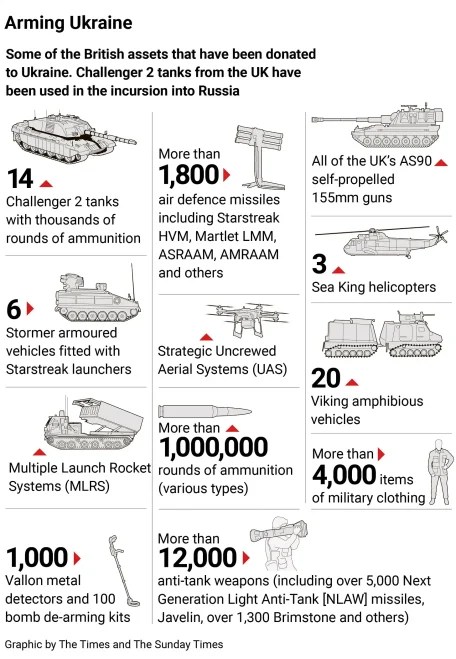
Initially, US officials keenly distanced themselves from the Kursk incursion. Empire house journal Foreign Policy reported that the Biden administration was not only enormously unhappy “to have been kept out of the loop,” but “skeptical of the military logic” behind the “counterinvasion”. In a further rebuke, on August 16th Washington prohibited Ukraine’s use of British-made, long-range Storm Shadow missiles against Russian territory. Securing wider Western acquiescence to such strikes was reportedly also a core objective behind Kiev’s occupation of Kursk.
However, once Donald Trump prevailed in the November 2024 presidential election, Biden was encouraged to use his “last, lame-duck weeks” to make “a flurry of moves to stay the course… and shore up his Ukraine project.” In the process, per the New York Times, he “crossed his final red line,” allowing ATACMS and Storm Shadow strikes deep inside Russia, while permitting US military advisers to leave Kiev “for command posts closer to the fighting.”
Fast forward to today, and the Kursk invasion has ended in utter disaster, with the few remaining Ukrainian forces not captured or killed fleeing. Meanwhile, Biden’s flailing, farewell red line breaches have failed to tangibly shift the battlefield balance in Kiev’s favour at all. As the New York Times acknowledges, the proxy war’s continuation “teeters on a knife edge.” There is no knowing what British intelligence might have in store to prevent long-overdue peace prevailing at last, but the consequences could be world-threatening.
British intel sought to silence West’s top Russia academic, leaks reveal
UK intelligence operatives groomed British politicians to silence skeptical academics
By Kit Klarenberg | The Grayzone | April 1, 2025
Leaked emails reviewed by The Grayzone reveal a high-level British intelligence plot to smear and silence British political scientists such as Richard Sakwa, who is widely regarded as one of the English-speaking world’s foremost authorities on Russia.
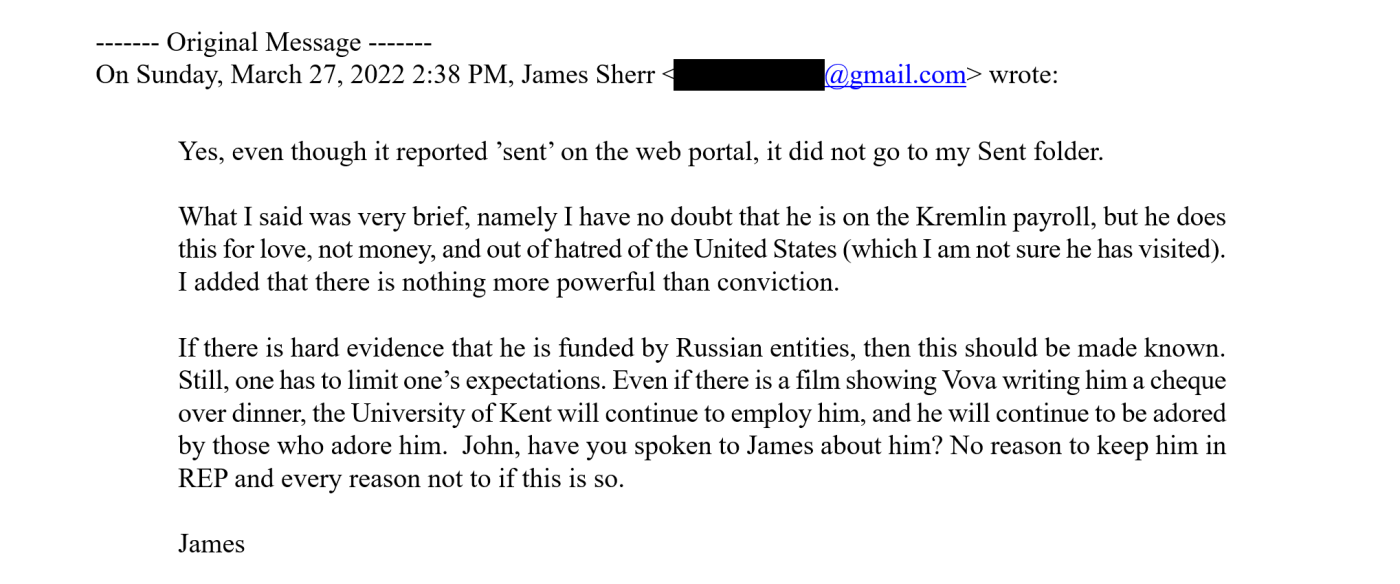
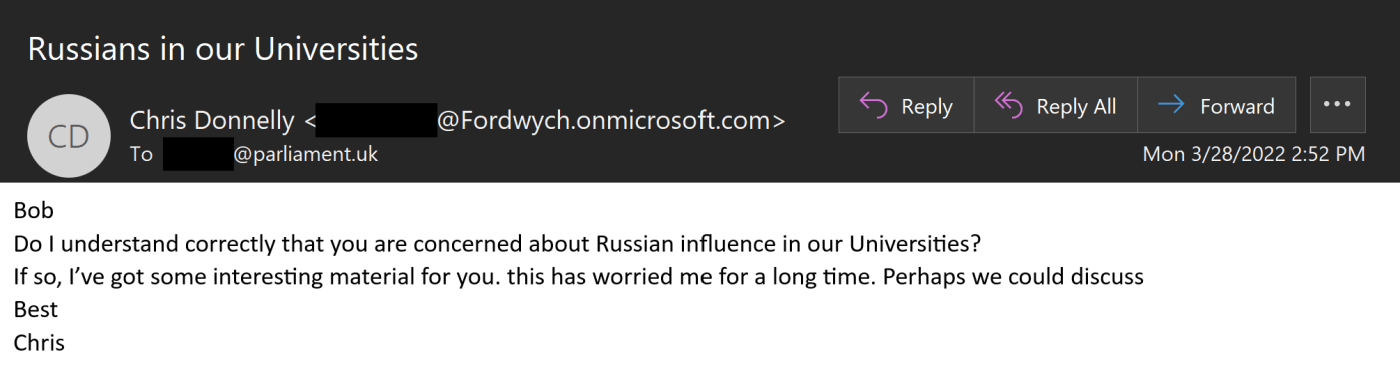
In a March 2022 email entitled “Russians in our Universities,” British military intelligence officer and former senior NATO advisor Chris Donnelly accused Sakwa of being a Russian “fellow traveller” who’d been “gradually breaking cover,” insisting the professor was “far too well-informed about Russian strategy to be called just ‘a useful idiot.’” Another email reveals Donnelly fantasizing about publicly exposing Sakwa for being “funded by Russian entities” – a claim the professor strenuously denies.
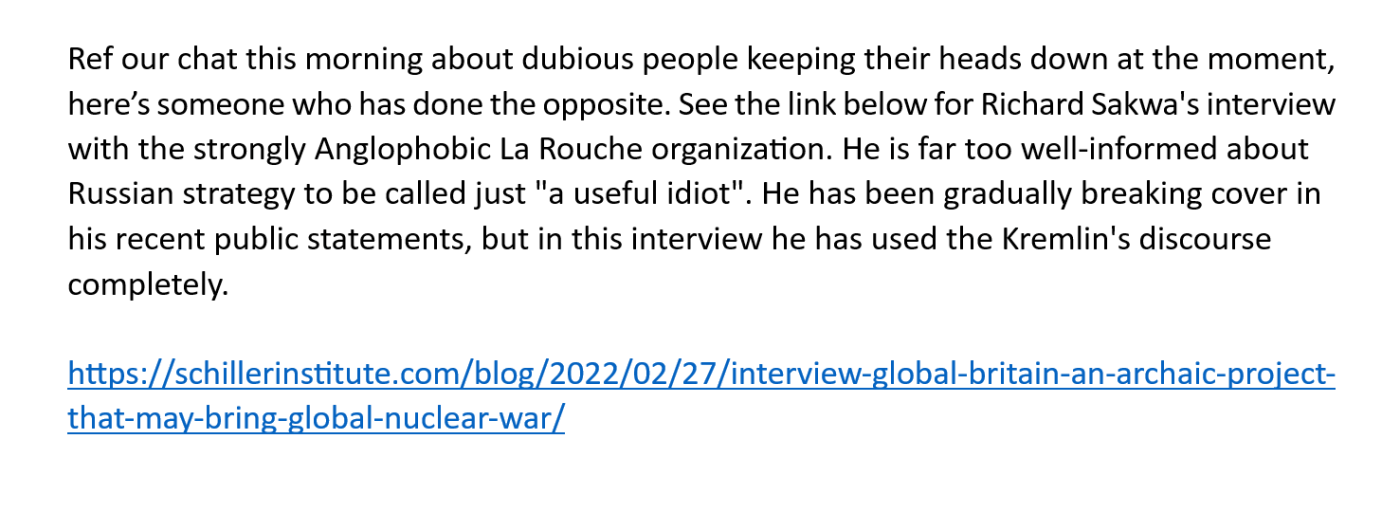
Donnelly fired off the emails just two weeks after the UK’s then-Education Secretary Nadhim Zahawi pledged that the British government was “already on the case and is contacting [their] universities,” after being asked whether the UK government would intervene directly to stop anti-war academics from “acting as useful idiots for President Putin’s atrocities in Ukraine.”
The Grayzone has revealed Donnelly as a key figure behind a secret British military and spying cell dubbed Project Alchemy, which was created in early 2022 to keep Ukraine fighting “at all costs.” A core component of that effort was to silence journalistic voices and media outlets – including this one – deemed a threat to London’s control of the proxy war’s narrative.
The newly-exposed messages show that Donnelly was conducting similar operations in the academic world as well. Though Professor Sakwa has long challenged dominant Western narratives on Putin’s Russia, criticizing both NATO’s rampant expansionism and its refusal to include Moscow in the European security structure following the Soviet Union’s 1991 collapse, he was effectively disappeared from mainstream debates on the conflict since the Ukraine proxy war erupted.
The leaked emails strongly suggest the direct intervention of Donnelly, a known British intelligence asset, may have been responsible for marginalizing Sakwa. Messages show Donnelly contacted influential UK lawmakers to stamp out the “influence” of Sakwa, whom he called his “number one” target, while calling for the blacklisting of other academics who might expose inconvenient truths about the conflict in Ukraine.
Donnelly’s determination to silence the professor apparently extended beyond the duration of the conflict. In private, he fretted that once “fighting slows down” in Ukraine, “appeasers” would “start talking about lifting the sanctions,” and “the Sakwas of this world will be spearheading the effort to change Western strategy.” In other words, even when the war ended in failure for Kiev and its proxy backers, Connelly and his associates would remain determined to prevent any public reconsideration of the West’s relationship with Russia.
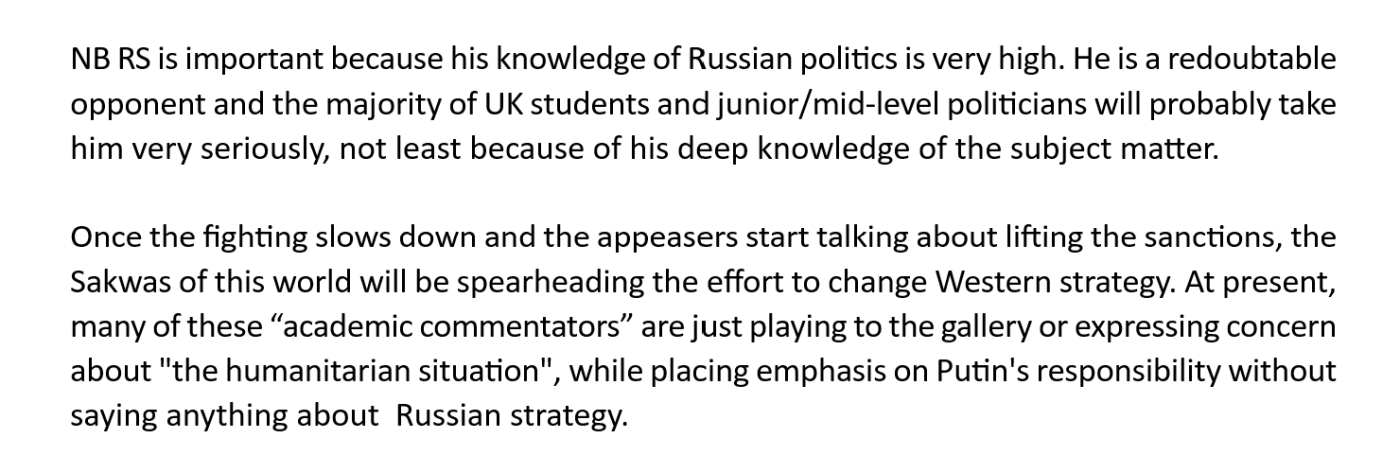
Sakwa “a redoubtable opponent” who’s taken “very seriously”
While recently smeared as a Kremlin apologist and “disinformation” peddler in certain quarters, Sakwa’s works have historically elicited glowing mainstream reviews. Even after the Ukraine proxy war erupted, the Council on Foreign Relations’ Foreign Affairs journal positively appraised the professor’s recent books dissecting the Russiagate fraud, and the origins of the Ukraine conflict. Clearly, it was Sakwa’s credibility and formidable body of knowledge that made him a target of British intelligence following the outbreak of war in Ukraine.
In emails exchanged with James Sherr, a career think tank staffer who once headed the Russia and Eurasia program at the British government-linked think tank Chatham House, Donnelly expressed discomfort about the prospect of Sakwa’s ideas reaching impressionable Western audiences. Sakwa’s “knowledge of Russian politics is very high,” Donnelly warned Sherr, making him “a redoubtable opponent” whom the “majority” of British students and “junior/mid-level politicians” would likely take “very seriously.”
Sherr responded that he had “no doubt” Sakwa was “on the Kremlin payroll,” but insisted the academic criticized NATO expansion “not [for] money,” but “out of hatred of the United States.” If there was “hard evidence” that Sakwa was “funded by Russian entities, then this should be made known,” Sherr added, but even if footage existed of Vladimir Putin personally “writing [Sakwa] a cheque over dinner… the University of Kent will continue to employ him, and he will continue to be adored by those who adore him.”
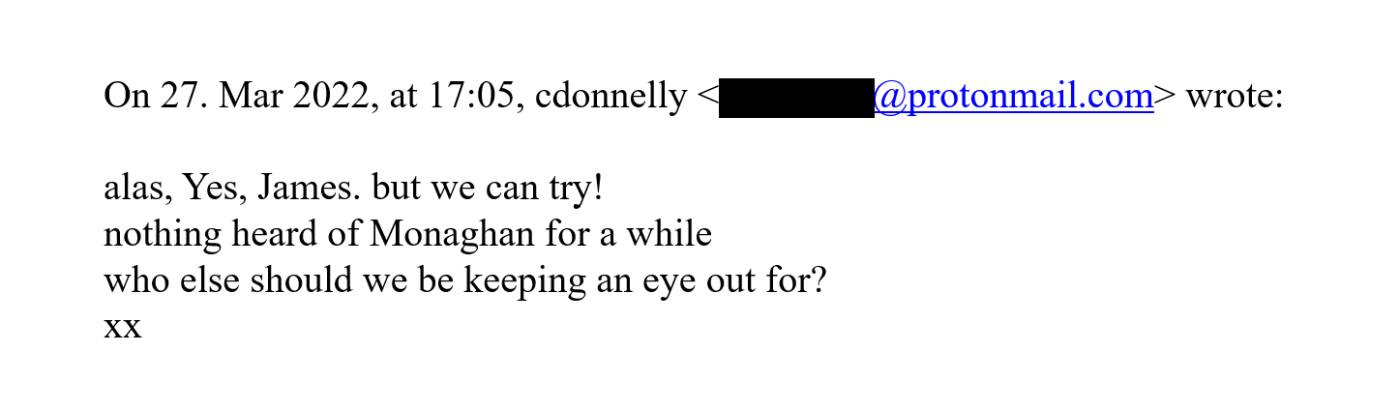
Donnelly agreed with his friend’s false assessment, but was evidently undeterred from pursuing Sakwa, telling Sherr, “we can try!” He added that Andrew Monaghan, another academic who had long warned of the perils of military confrontation with Russia, hadn’t been heard from “for a while,” and asked Sherr: “who else should we be keeping an eye out for?” A day later, Donnelly posed the same question to his longtime associate Victor Madeira, an academic closely connected to former MI6 chief Richard Dearlove.
This followed another email by Donnelly to Conservative MP Bob Seely, a hawkish military veteran and then-member of parliament’s foreign affairs committee. Donnelly asked Seely whether he was “concerned about Russian influence in our Universities,” because “if so, I’ve got some interesting material for you.” Forwarding the unsolicited email to Madeira, Donnelly boasted, “l may have an opportunity to get this addressed,” and bragged that he would soon be discussing the subject with the then-chair of British Parliament’s education select committee.
“cells in the British governmental apparatus… which subvert the fundamental principles of British democracy”
In comments to The Grayzone, Sakwa said Donnelly’s actions were “extremely disturbing,” and suggested the emails indicate “there are cells in the British governmental apparatus who are working in ways which subvert the fundamental principles of British democracy, tolerance of divergent political views, and the encouragement of open debate and dialogue.”
The professor argues that “by traducing scholars and civic activists,” Donnelly and his collaborators “precisely undermine the values which they are ostensibly trying to defend,” and “practice guilt by association.”
“The assumption [that] questioning official policy on a particular issue must be motivated by mercenary concerns, in this case being in the pay of Moscow, is a dreadful manifestation of the McCarthyism we had hoped we put behind us with the end of the Cold War,” Sakwa adds.
“In fact, it demonstrates [that] Cold War II is potentially more dangerous than the first, with the attempt to blacken the reputation of critical voices, and thus assumedly weaken their public impact. This is not only morally and politically wrong in itself, but also damages the possibility of coherent, informed and dispassionate analysis, and thus weakens the coherence of intelligent policy-making in its entirety.”
When Sakwa retired from his university position in August 2022, he was unaware that British intelligence operatives had waged a plot to silence him for over a year. Now, however, the professor wonders whether an incident that occurred two months prior may have been related. That June, the Canterbury anti-war movement organized an event at which Sakwa was the guest speaker. “To our astonishment, about 20 Ukrainians and associates picketed the meeting, with banners condemning me and the organizers,” he told The Grayzone.
Rather than being turned away, the protesters were invited in – “minus placards,” Sakwa noted. However, “they then proceeded to try to disrupt the meeting,” until the event chair warned them “that if their anti-democratic behavior continued, they would be asked to leave.” Following the warning, the event continued in peace. Sakwa said “most” attendees felt his address “struck the appropriate balance between sympathy for the plight of the Ukrainian people, and political analysis of the situation.”
The incident likely would have ended there, but counter-demonstrators seized on leaflets calling for an official inquiry into the ever-mysterious Bucha incident which were distributed by another attendee. Ukrainian officials and their British backers charge that Russian forces carried out a massacre of innocent civilians in the city of Bucha, but have blocked attempts at UN investigation, and refused to release names of purported victims.
While Sakwa believes calls for such a probe to be “not unreasonable”, he said he had nothing to do with the leaflets’ production, and was unaware of their contents at the time. He only learned of their existence when one of the Ukrainian activists who disrupted the event accused him of condoning “conspiracy theories,” leading the University of Kent to open an internal inquiry.
“To the University of Kent’s credit, they dismissed any potential charge of misconduct, and defended the principle of freedom of speech. The institution lived up to its reputation for collegiality and the robust defence of academic freedom,” Sakwa says. “However, the initial charge was clearly malicious and malevolent, and demonstrates the danger of ‘Ukraine syndrome’ damaging the quality of civic life in England.”
Today, “Ukraine syndrome” remains alive and well in Britain as Prime Minister Keir Starmer proudly declares his desire to deploy troops and aircraft to Kiev to participate in hostilities despite UK military chiefs warning that London lacks the men and materiel to even consider such a mission. A depressing official review of the British Army has prompted the head of the Financial Times’ editorial board to conclude “their forces would struggle to fight a European war lasting more than a few weeks.”
While Richard Sakwa and other genuine regional experts warned over many years that transforming Ukraine into an anti-Russian bastion would lead to disaster for all involved, Western leaders turned instead to the paranoid pronouncements of spies like Chris Donnelly for guidance on how to respond to Moscow’s forcefully stated opposition to Ukraine joining NATO. And before the belligerent plans of Donnelly and his cadre could be discredited, they made certain that no one would be left to call them out.
Welcome to Britain, Where Critical WhatsApp Messages Are a Police Matter

By Cam Wakefield | Reclaim The Net | March 30, 2025
You’d think that in Britain, the worst thing that could happen to you after sending a few critical WhatsApp messages would be a passive-aggressive reply or, at most, a snooty whisper campaign. What you probably wouldn’t expect is to have six police officers show up on your doorstep like they’re hunting down a cartel. But that’s precisely what happened to Maxie Allen and Rosalind Levine — two parents whose great offense was asking some mildly inconvenient questions about how their daughter’s school planned to replace its retiring principal.
This is not an episode of Black Mirror. This is Borehamwood, Hertfordshire, 2025. And the parents in question—Maxie Allen, a Times Radio producer, and Rosalind Levine, 46, a mother of two—had the gall to inquire, via WhatsApp no less, whether Cowley Hill Primary School was being entirely above board in appointing a new principal.
What happened next should make everyone in Britain pause and consider just how overreaching their government has become. Because in the time it takes to send a meme about the school’s bake sale, you too could be staring down the barrel of a “malicious communications” charge.
The trouble started in May, shortly after the school’s principal retired. Instead of the usual round of polite emails, clumsy PowerPoints, and dreary Q&A sessions, there was… silence. Maxie Allen, who had once served as a school governor—so presumably knows his way around a budget meeting—asked the unthinkable: when was the recruitment process going to be opened up?
A fair question, right? Not in Borehamwood, apparently. The school responded not with answers, but with a sort of preemptive nuclear strike. Jackie Spriggs, the chair of governors, issued a public warning about “inflammatory and defamatory” social media posts and hinted at disciplinary action for those who dared to cause “disharmony.” One imagines this word being uttered in the tone of a Bond villain stroking a white cat.
For the crime of “casting aspersions,” Allen and Levine were promptly banned from the school premises. That meant no parents’ evening, no Christmas concert, no chance to speak face-to-face about the specific needs of their daughter Sascha, who—just to add to the bleakness of it all—has epilepsy and is registered disabled.
So what do you do when the school shuts its doors in your face? You send emails. Lots of them. You try to get answers. And if that fails, you might—just might—vent a little on WhatsApp.
But apparently, that was enough to earn the label of harassers. Not in the figurative, overly sensitive, “Karen’s upset again” sense. No, this was the actual, legal, possibly-prison kind of harassment.
Then came January 29. Rosalind was at home sorting toys for charity—presumably a heinous act in today’s climate—when she opened the door to what can only be described as a low-budget reboot of Line of Duty. Six officers. Two cars. A van. All to arrest two middle-aged parents whose biggest vice appears to be stubborn curiosity.
“I saw six police officers standing there,” she said. “My first thought was that Sascha was dead.”
Instead, it was the prelude to an 11-hour ordeal in a police cell. Eleven hours. That’s enough time to commit actual crimes, be tried, be sentenced, and still get home in time for MasterChef.
Allen called the experience “dystopian,” and, for once, the word isn’t hyperbole. “It was just unfathomable to me that things had escalated to this degree,” he said. “We’d never used abusive or threatening language, even in private.”
Worse still, they were never even told which communications were being investigated. It’s like being detained by police for “vibes.”
One of the many delightful ironies here is that the school accused them of causing a “nuisance on school property,” despite the fact that neither of them had set foot on said property in six months.
Now, in the school’s defense—such as it is—they claim they went to the police because the sheer volume of correspondence and social media posts had become “upsetting.” Which raises an important question: when did being “upsetting” become a police matter?
What we’re witnessing is not a breakdown in communication, but a full-blown bureaucratic tantrum. Instead of engaging with concerned parents, Cowley Hill’s leadership took the nuclear option: drag them out in cuffs and let the police deal with it.
Hertfordshire Constabulary, apparently mistaking Borehamwood for Basra, decided this was a perfectly normal use of resources. “The number of officers was necessary,” said a spokesman, “to secure electronic devices and care for children at the address.”
Right. Nothing says “childcare” like watching your mom get led away in handcuffs while your toddler hides in the corner, traumatized.
After five weeks—five weeks of real police time, in a country where burglaries are basically a form of inheritance transfer—the whole thing was quietly dropped. Insufficient evidence. No charges. Not even a slap on the wrist.
So here we are. A story about a couple who dared to question how a public school was run, and ended up locked in a cell, banned from the school play, and smeared with criminal accusations for trying to advocate for their disabled child.
This is Britain in 2025. A place where public institutions behave like paranoid cults and the police are deployed like private security firms for anyone with a bruised ego. All while the rest of the population is left wondering how many other WhatsApp groups are one message away from a dawn raid.
Because if this is what happens when you ask a few inconvenient questions, what’s next? Fingerprinting people for liking the wrong Facebook post? Tactical units sent in for sarcastic TripAdvisor reviews?
It’s a warning. Ask the wrong question, speak out of turn, and you too may get a visit from half the local police force.
EU ‘preparing for war’ – Hungarian FM
RT | March 29, 2025
Hungarian Foreign Minister Peter Szijjarto has accused Brussels bureaucrats of clinging to a “failed pro-war policy” in a desperate attempt to delay the moment when European taxpayers begin asking where the money spent on bankrolling Kiev has gone.
The European Union recently advised its 450 million inhabitants to stockpile essential supplies for at least 72 hours, with EU Commissioner for Crisis Management Hadja Lahbib warning on Wednesday that the Ukraine conflict threatens the bloc’s overall security.
Szijjarto said he initially thought the warning was some kind of joke or “trolling,” after Lahbib posted a bizarre video showing Europeans what to pack in a 72-hour survival kit.
“But why, in the 21st century, should EU citizens prepare a survival kit? There’s only one explanation: Brussels is preparing for war,“ Szijjarto wrote in a post on X on Friday. “At a time when there’s finally a real chance for a ceasefire and meaningful peace talks with [President Donald Trump’s] return to office, Brussels is going in the opposite direction, clinging to a failed pro-war policy.”
“Why? Because as long as the war continues, pro-war European politicians can avoid taking responsibility for three years of failure, and avoid answering an extremely uncomfortable question: where is the money that was sent to Ukraine?”
EU institutions in Brussels and individual member states have spent over €132 billion over the past three years supporting Kiev, and have pledged an additional €115 billion that has yet to be allocated, according to data from Germany’s Kiel Institute.
Since taking office, US President Donald Trump has pushed for a diplomatic resolution and sought to recoup what he estimates to be over $300 billion in US taxpayer money that his predecessor “gifted” to Kiev. Washington recently brokered a limited ceasefire between Ukraine and Russia, placing a moratorium on attacks on energy infrastructure. Kiev, however, has repeatedly breached the ceasefire terms, according to Moscow.
Despite the ongoing peace process, the EU has continued to push a hawkish agenda. European Commission President Ursula von der Leyen recently unveiled an €800 billion plan to ramp up military spending through loans.
Meanwhile, France and the UK continue to advocate for the deployment of a military contingent to Ukraine. Speaking after a summit in Paris on Thursday, French President Emmanuel Macron announced that a so-called “coalition of the willing” will seek to deploy a “reassurance force” to Ukraine after a peace deal with Russia is reached.
The proposal to send troops has already been rejected by several EU members. The “coalition of the willing” – a phrase originally coined by the US in 2003 to describe countries backing the invasion of Iraq – now mostly refers to states that have pledged to continue supporting Kiev militarily, without necessarily committing to troop deployments.
A Third Way to end the war in Ukraine
By M. K. BHADRAKUMAR | Indian Punchline | March 29, 2025
In an unguarded moment, perhaps, ex-UK Prime Minister Boris Johnson blurted out recently in an interview that the ultranationalist elements who rule the roost in Kiev are a formidable obstacle to ending the war in Ukraine. For Johnson, this might be a blame game to absolve himself of responsibility, given his own dubious role as then PM (in cahoots with President Joe Biden) in undermining the Istanbul agreement in April 2022 to rev up the simmering conflict and turn it to a full-fledged US-led proxy war against Russia.
What Johnson will not admit, though, is that the ascendance of the MI6, Britain’s intelligence agency, in the power structure in Kiev goes back by several years. MI6 was responsible for the personal security of President Zelensky. MI6 took advantage by positioning itself to choreograph the future trajectory of the war and subsequently in the planning and execution of major covert operations directed against the Russian forces — and ultimately to carry the war into Russian soil itself.
According to reports, the UK intends to establish a base in the Odessa region on the Black Sea coastline. See my article The Hundred Years War Donald Trump should know about, Deccan Herald, January 29, 2025.
So, indeed, the MI6’s unholy alliance with the notorious Azov militia units comprising Ukrainian ultra-nationalists fired up by neo-Nazi ideology who wield control of the power apparatus in Kiev even today, is a key factor in the war, which complicates the prospects for President Trump’s efforts to end the war. Suffice to say, Britain’s strategic defiance of Trump with PM Keir Starmer string up of an insurgency among Europeans to pre-empt any US-Russia rapprochement is a calculated strategy.
Hopefully, President Trump’s decision Tuesday to order the FBI to forthwith declassify files concerning Crossfire Hurricane investigation may throw some light on the so-called Steele dossier (named after an ex-MI6 officer) containing doctored ‘evidence’ that had formed the basis of Hillary Clinton’s fake allegation that the Trump campaign colluded with Russia to influence the 2016 US election cycle.
Reports had appeared, incidentally, that incumbent president Barack Obama and then vice-president Biden were very much in the loop on the Russia hoax.
The point is, the entrenched neo-Nazi groups in Kiev, with Zelensky as their frontman, are not in the least interested in budging from their maximalist demands on a total Russian withdrawal and so on for ending the war, which are backed by the Europeans unconditionally who would know fully well that such hopelessly unrealistic demands are deal breakers. The Kiev regime and European leaders are joined at the hips as interest groups in the war continuing.
Put differently, so long as the regime in Kiev remains in power (although Zelensky’s presidential term has expired), any forward movement in the peace process will remain a pipe dream.
The best course of action would be that Zelensky steps down on his own volition and a fresh election is allowed to be held under the supervision of the parliament speaker but all that is too much to expect. Given the massive scale of war profiteering, Zelensky holds a dream job.
The alternative will be Zelensky’s ouster through coercive means as the US once did to an equally corrupt proxy, Ngo Dinh Diem, in 1963 during the Vietnam War. But Trump is unlikely to do that. And in any case, the deep state is hostile towards Trump and Zelensky gets political support from Democrats.
Besides, Zelensky’s violent exit may only bring in another figure with neo-Nazi backing to power. In fact, the ex-army chief Valerii Zaluzhnyi, who also has MI6 support, is waiting in the wings in London serving as Ukraine’s envoy.
In such a dismal scenario, the only way out seems to be a Third Way. Russian President Vladimir Putin may have proposed just that in a speech in Mumansk on Thursday possibly to draw Trump’s attention, as the Riyadh talks are not getting anywhere and Zelensky shows no signs of interest in a ceasefire.
Putin said at the outset, “I would like to state – first and foremost – that, in my view, the newly elected President of the United States sincerely wishes to end this conflict for a number of reasons – I will not list them now, as they are numerous. But in my opinion, this aspiration is genuine.”
He then worked his way to the issue of the neo-Nazi formations who receive western weaponry and financial aid and have the resources to recruit new personnel, holding de facto power in Kiev and are effectively running the country. Putin stated: “This raises the question: how is it possible to conduct negotiations with them?”
Clearly, the Russians are sceptical of the outcome of the expert level talks in Riyadh last Monday. The European summit in Paris 3 days later had vowed not to relax the sanctions against Russia or to give Russian banks access to the SWIFT clearing system. In short, the exports of Russian agricultural products and fertilisers to the world market is not going to be feasible. Kiev has already raised objection to the US-Russian understanding in this regard.
Simply put, an important element in the so-called Black Sea initiative is not workable. How to cut the Gordian knot?
Taking stock of Kiev’s all-round resistance to ending the war, Putin said:
“In such situations, international practice follows a well-established path. Within the framework of the United Nations peacekeeping operations, there have been several cases of what is termed external governance or temporary administration. This occurred in East Timor, I believe in 1999, in parts of the former Yugoslavia, and in New Guinea. In short, such precedents exist.
“In principle, it would indeed be possible to discuss, under UN auspices with the United States and even European countries – and certainly with our partners and allies – the possibility of establishing a temporary administration in Ukraine. To what end? To conduct democratic elections, to bring to power a competent government that enjoys public trust, and only then to begin negotiations on a peace treaty and sign legitimate agreements that would be recognised worldwide as consistent and reliable.
“This is just one option; I do not claim that others do not exist. They certainly do. At present, there is no opportunity – and perhaps no possibility – to lay out every detail, as the situation is evolving rapidly. But this remains a viable option, and such precedents exist within UN practice…”
What Putin didn’t mention but is equally relevant is that the war in Ukraine will meet with sudden death the moment UN governance in Ukraine gets established. Indeed, let the UN decide the composition of any peacekeeping forces to be deployed in Ukraine for conducting elections. There won’t be any need for a ‘coalition of the willing’ of Europeans for deployment in Ukraine, either.
Of course, the big losers will be MI6 and the politicians in power in the EU countries who lined up behind Biden as his retinue to wage a doomed proxy war against Russia and eventually ended up bringing the roof down on Europe’s economy. These decrepit politicians need the war as a distraction since they will be held horribly accountable by their public for creating conditions under which the welfare state is no longer affordable.
The Chinese foreign minister Wang Yi is expected to visit Moscow next week on Tuesday. It is entirely conceivable that the topic of UN governance in Ukraine will figure in Wang Yi’s talks.
UK, France involved in Kiev’s latest attack on Russian energy infrastructure – Moscow
RT | March 28, 2025
France and the UK actively aided Kiev in a strike on the Sudzha pipeline infrastructure in Russia’s Kursk Region on Friday, Foreign Ministry spokeswoman Maria Zakharova has told journalists. Earlier the Russian Defense Ministry said that a metering facility was “de facto destroyed” in a Ukrainian HIMARS attack.
“[We] have reasons to believe that targeting and navigation were facilitated through French satellites and British specialists input [target] coordinates and launched [the missiles],” Zakharova said, commenting on the strike.
“The command came from London,” she said, branding the attack part of a Ukrainian “terror” campaign targeting Russian energy infrastructure. The spokeswoman added that such actions demonstrate that Kiev is “impossible to negotiate with.”
Although Ukraine’s Vladimir Zelensky “publicly supported” a temporary suspension of strikes on energy infrastructure agreed by Moscow and Washington, he “did nothing to observe it,” according to Zakharova.
Moscow ordered that attacks on Ukraine’s energy infrastructure cease on March 18, following a phone call between presidents Vladimir Putin and Donald Trump. Russia and the US also agreed on a list of energy facilities that should not be targeted as part of a truce earlier this week. The list included gas facilities.
Kiev also agreed to a US-proposed 30-day partial ceasefire following talks between Ukrainian and American delegations in Saudi Arabia on March 15. Zelensky hailed the development and even described it as a diplomatic “victory” for Ukraine, but did not publicly mention any relevant orders to the Ukrainian military.
The Russian Defense Ministry has regularly reported on Ukrainian attacks on Russian energy infrastructure over the past few weeks. Earlier on Friday, Kremlin spokesman Dmitry Peskov told journalists that the strike suggested that the Ukrainian military no longer follows Kiev’s orders due to a “total lack of supervision.”
Paris and London have emerged as the staunchest supporters of Ukraine in the face of a gradual shift in Washington’s position under the new Trump administration. In early March, British Prime Minister Keir Starmer and French President Emmanuel Macron said that their nations were ready to lead a “coalition of the willing”—a group of pro-Ukrainian countries prepared to support Kiev with troops and aircraft.
Russia has vehemently rejected any possibility of NATO-aligned European troops deploying to the conflict zone. It has accused France and Britain of hatching plans for “military intervention in Ukraine,” which could lead to a direct armed clash between Russia and NATO.
Macron and Starmer’s coalition of the killing amid Europe’s insane war footing
Strategic Culture Foundation | March 28, 2025
If there were a prize for Orwellian-named conferences, then the one held this week in Paris would surely be a top contender.
Over the past month, there has been a slew of such gatherings in London, Brussels, and Paris. They have been conducted in a frenzy to thwart peace and prolong war – under the guise of “seeking security” against Russia.
Some 30 nations attended the latest Paris summit, convened by France’s Emmanuel Macron, and entitled “Building a Robust Peace for Ukraine and Europe”.
Europe is being gaslighted to view war as peace and accept that all economic resources must be dedicated to militarism. It is an insane war footing that is beyond any democratic or moral rationale.
European Union member states participated as well as NATO and non-EU nations Britain, Norway, and Canada. We should clarify that it was the elitist leaders of these countries who were present. Their lack of democratic mandate and authority is all too obvious to the people of Europe.
Some EU nations, such as Hungary and Slovakia, have protested commendably about the unwavering belligerence and obscene waste of public resources for fueling a proxy war in Ukraine.
Notably, too, the United States was not represented at the Paris summit. Coincidentally, this week, a leaked private group conversation between senior members of the Trump administration revealed their contempt for “loathsome” European leaders. One can understand why.
In the grandeur of Élysée Palace, Macron hailed the non-entity gathering as the “Coalition of the Willing”. With this self-appointed virtue, the French leader was referring to countries that are willing to deploy military forces to Ukraine or maintain the supply of weapons.
Macron has been assiduously supported in this military venture by Britain’s Prime Minister Kier Starmer.
The French and British leaders have intensified their efforts to directly insinuate Europe and NATO militarily in the three-year conflict between Ukraine and Russia. Their efforts are a result of American President Donald Trump engaging with Russian President Vladimir Putin to end the proxy war between the U.S.-led NATO alliance and Russia.
Trump’s diplomatic overtures with Moscow have sidelined the European states and have left them with an acute political problem of how to justify continuing military support for a failing Ukraine Project.
The French, British and other European Russophobes do not want the war to end. That’s because they are wedded to the false narrative about defending Ukraine from “Russian aggression”. They are also committed to strategically defeating Russia using Ukraine as a proxy.
In Orwellian fashion, the European and NATO warmongers cannot openly state their nefarious objective. That would be politically fatal. Hence, they are cynically dressing up their motives with virtuous-sounding schemes, such as deploying “peacekeeping troops” in the event of any ceasefire deal that the Americans and Russians might negotiate.
The relentless demonizing of Russia as a threat to Europe is amplified by a near-constant drumbeat of war. European citizens – 500 million of them – are being subjected to non-stop messaging about the “need” to militarize their societies to “defend” against “Russian expansionism”.
This week, the EU began urging citizens to stockpile emergency rations in their homes. Russia was not explicitly invoked as a threat, but it was palpably obvious that fear of war was being inculcated. While European states are slashing billions in social welfare, their elitist, Russophobic leaders are ramping up billions for militarism. Europe is on a war footing based on paranoia and the pathological fears of a ruling clique.
Macron and Starmer are also pushing the idea of integrating Ukraine into a first line of defense against alleged future Russian aggression toward Europe. In reality, this is about reconfiguring offense.
Their pretensions of “building a robust peace for Ukraine and Europe” are a reckless gambit to prolong the war. At its worst, the conflict could explode into an all-out world war.
It is cringe-making that failed European politicians who are mired in internal political and economic messes are seeking to aggrandize their images through high-stakes posturing against Russia.
Macron has said that his coalition of willing wants to have American backing for security. He added this week that if European troops in Ukraine come under fire from Russian forces, they will retaliate.
Moscow has already stated categorically that no European or NATO troops deployed to Ukraine are acceptable. They will be targeted as combatants.
That means that if Paris and London go ahead with their military venture in Ukraine, a wider war is almost inevitable.
It is alarming that Macron has lately said that European troops may be dispatched to Ukraine “with or without American support.”
Laughably, though, neither the French nor the British have the military power for a serious intervention. French forces have been serially kicked out of several African countries that were former colonies. Meanwhile, British military chiefs have warned Starmer that his deployment plans are ill-conceived and amount to “political theater”.
Even the much-vaunted summit in Paris this week showed open cracks between allies. Several European states have stated they are not willing to join any military intervention in Ukraine. Italy, Poland, and Greece have expressed deep concern about where Macron and Starmer’s logic is leading.
It seems that the extreme delusions of grandeur harbored by former imperialist powers are beginning to unnerve even supposed partners.
Hopefully, it is becoming transparent that Britain and France are gambling with world security to satisfy their own egos.
Two world wars in the last century stemmed from European intrigue and duplicity.
Has-been European powers are at it again with their Orwellian doublespeak about ensuring “lasting peace”.
The reality is Russia has won the proxy war that NATO instigated. Even the normally gung-ho Americans realize that.
NATO has been caught with blood on its hands as the culprit of an epic war crime against Russia, using Ukraine as a pawn. Trump seems to want to extricate the Americans from the debacle. He can try to offload the blame onto the previous Biden administration.
However, the European elitist leaders can’t do that. They are the same lackeys who promulgated the criminal proxy war. Their only perceived option is to keep it going… until the European public wakes up and takes retribution on their criminal leaders.
Oxford city council passes boycott divestment, sanctions motion
Press TV – March 26, 2025
The Oxford City Council has passed a motion supporting the Boycott, Divestment, and Sanctions (BDS) movement against Israel, in accordance with International Court of Justice (ICJ) rulings.
On Monday, the members of Oxford City Council unanimously voted for an “ethical investment and procurement” process against Israel.
The motion calls on the Oxford City Council to avoid cooperation and trade with entities complicit in human rights violations and international law.
In January 2024, the ICJ delivered an interim ruling that said it was plausible that Israel was committing genocide in Gaza. The court called on Israel to refrain from impeding the delivery of aid into Gaza
Amongst other orders, ICJ also ordered Israel to avoid acts of genocide in the besieged enclave and punish incitement to genocide.
The Israeli regime not only has continued to ignore the ICJ’s rulings but also has committed numerous acts of genocide against the people of Palestine, including the restriction of the delivery of international aid into the besieged enclave.
Given Israel’s disregard for the Court’s orders, Oxford councilor Hosnieh Djafari-Marbini said councilors had “unanimously passed a boycott and divestment motion citing the ICJ rulings on Palestine.”
One of the motion’s proponents, councilor Barbara Coyne, said in a press release, “I hope this motion will be thoroughly implemented, and that its passage may pave the way for other councils to take decisive action.”
In addition, the Council has called on the Oxfordshire Investment Fund to divest more than 157 million pounds from companies complicit in the Israeli regime’s apartheid, genocide, occupation, and settler colonialism.
The people of Palestine have long called for boycott, divestment, and sanctions, including an arms and energy embargo, against the occupying regime.
The BDS movement demands that Israel, under international law, withdraw from the occupied territories, remove the separation barrier in the West Bank, and respect the rights of Palestinian refugees to return to their homes and properties.
War, doublethink and the struggle for survival: the geopolitics of the Gaza Genocide
By Ramzy Baroud | MEMO | March 26, 2025
In a genocidal war that has spiralled into a struggle for political survival, Israeli Prime Minister Benjamin Netanyahu’s coalition and the global powers supporting him continue to sacrifice Palestinian lives for political gain. The sordid career of Israel’s extreme far-right National Security Minister, Itamar Ben-Gvir, epitomises this tragic reality.
Ben-Gvir joined Netanyahu’s government coalition following the December 2022 election. He remained in the coalition after 7 October, 2023, and the start of Israel’s war and the Gaza Genocide, with the understanding that any ceasefire in Gaza would force his withdrawal from the government. As long as the killing of Palestinians and the destruction of their cities continued, then Ben-Gvir stayed on board. Neither he nor Netanyahu had any real “next-day” plan, though, other than to carry out some of the most heinous massacres against a civilian population in recent history.
On 19 January, Ben-Gvir left the government immediately when a ceasefire agreement came into effect, which many argued would not last. Netanyahu’s untrustworthiness, along with the collapse of his government if the war ended completely, made the ceasefire unfeasible.
Ben-Gvir duly returned to the coalition when the genocide resumed on 18 March. “We are back, with all our might and power!” he tweeted.
Israel lacks a clear plan because it cannot defeat the Palestinians.
While the Israeli army has inflicted suffering on the Palestinian people like no other force has against a civilian population in modern times, the Gaza Genocide endures because the Palestinians refuse to surrender.
And yet, Israel’s military planners know that a military victory is no longer possible. Former Defence Minister Moshe Ya’alon added his voice to the growing chorus recently, saying during an interview on 15 March that, “Revenge is not a war plan.”
The Americans, who supported Netanyahu’s violation of the ceasefire — and gave the green light for the resumption of the killings — also understand that the war is almost entirely a political struggle, designed to keep extreme far-right figures like Ben-Gvir and Finance Minister Bezalel Smotrich in Netanyahu’s coalition.
Although “war is the continuation of politics by other means,” as Prussian General Carl von Clausewitz once surmised, in Israel’s case, the “politics” behind the war is not about Israel as a state, but about Netanyahu’s own political survival. He is sacrificing Palestinian children to stay in power, while his extremist ministers do the same to expand their support among right-wing, religious and ultra-nationalist constituencies.
This logic — that Israel’s war on Gaza reflects internal politics, ideological warfare and class infighting — extends to other political players as well. The Trump administration supports Israel as payback for the financial backing it received from Netanyahu’s supporters in the US during the past few presidential election campaigns. Britain, meanwhile, remains steadfast in its commitment to Tel Aviv, despite the political shifts in Westminster, thus continuing to align with US-Israeli interests while disregarding the wishes of its own population. Meanwhile, Germany, it’s said, is driven by the guilt of its past crimes, while other Western governments pay lip service to human rights, all the while acting in ways that contradict their stated foreign policies.
This mirrors the dystopian world of George Orwell’s book 1984, wherein perpetual war is waged based on cynical and false assumptions; where “war is peace… freedom is slavery… and ignorance is strength.”
These elements are indeed reflected in today’s equally dystopian reality.
However, Israel substitutes “peace” with “security” (its own; nobody else’s), the US is motivated by dominance and “stability”, and Europe continues to speak of “democracy”.
Another key difference is that Palestinians do not belong to any of these “super states”. They are treated as mere pawns, their deaths and enduring injustice used to create the illusion of “conflict” and to justify the ongoing prolongation of the war.
The number of Palestinians killed — now more than 50,000 — is reported widely by mainstream media outlets, yet rarely do they mention that this is not a war in the traditional sense, but a genocide, carried out, financed and defended by Israel and Western powers for domestic political reasons. Palestinians continue to resist because it is their only legitimate option in the face of utter destruction and extermination.
Netanyahu’s war, however, is not sustainable in the Orwellian sense either. For it to be sustainable, it would need infinite economic resources, which Israel, despite US generosity, cannot afford. It would also need an endless supply of soldiers, but reports indicate that at least half of Israel’s reserves are not rejoining the army.
Furthermore, Netanyahu does not merely seek to sustain the Gaza Genocide; he aims to expand it. This could shift regional and international dynamics in ways that neither Israeli leaders nor their allies fully understand.
Aware of this, Arab leaders met in Cairo on 4 March to propose an alternative to the Netanyahu-Trump plan to ethnically cleanse Palestinians from Gaza. However, they have yet to take meaningful action to hold Israel accountable if it continues to defy international and humanitarian laws, as it has since the Arab summit.
The Arab world must escalate its response beyond mere statements.
If they don’t, then the Middle East may endure further wars, all to prolong Netanyahu’s coalition of extremists a little longer.
As for the West, the crisis lies in its moral contradictions. The situation in Gaza embodies Orwell’s concept of “doublethink”, holding two contradictory beliefs in one’s mind simultaneously and accepting both. Western powers claim to support human rights while simultaneously backing genocide. Until this dilemma is resolved, the Middle East will continue to endure suffering for years to come.
Putin’s Senior Aide Patrushev Shared Some Updates About The Arctic & Baltic Fronts
By Andrew Korybko | March 23, 2025
Putin’s senior aide Nikolai Patrushev, who ran the FSB for nearly a decade (1999-2008) before chairing the Security Council for over 15 years till recently (2008-2024), shared some updates about the Baltic and Arctic fronts of the New Cold War in a recent interview with Russia’s National Defense magazine. He began by blaming the Brits for orchestrating Baltic tensions in order to disrupt the incipient Russian-US normalization process and associated talks on Ukraine.
In connection with that, he also warned that some NATO members (presumably led by the British) are practicing cyberattacks against Russian ships’ navigation equipment and suggested that they might have been responsible for recent claims of sabotage in the Baltic, which prompted a larger naval presence. This same expanded presence poses a threat to Russia’s interests and could manifest itself through terrorist attacks against its underwater pipelines, tankers, and dry cargo ships.
Russia plans to defend against this through unmanned underwater systems and strengthening its Baltic Fleet. As for one of the worst-case conventional threats, that of Finland and Estonia teaming up to blockade Russia inside the Gulf of Finland, Patrushev expressed confidence that his country could overcome that plot and punish the aggressors. This segued the conversation into a discussion about Finland, which Patrushev said has a friendly population, unlike its government.
He mentioned how the authorities there distort history to avoid talking about the goal of “Greater Finland”, which took the form of occupying Northwestern Russia, placing its inhabitants into concentration camps, and exterminating the Slavs there. Just like Finland was used by the Nazis as a springboard for aggression against the USSR, so too did Patrushev warn that plans might be afoot for NATO to use it as a springboard potential aggression against Russia.
He then said a few words about how the Arctic is opening up as a new front of competition, mostly due to its resources, but reaffirmed that Russia wants peace and cooperation there instead of rivalry. The Northern Sea Route (NSR), which commemorates its 500th-year conceptualization this year, can help bring that about. Russia will continue developing regional infrastructure and building ice-class vessels for facilitating transit through these waters year-round. It was on that note that the interview ended.
Reviewing Patrushev’s briefing, the first part about blaming the Brits for tensions in the Baltic aligns with what Russia’s Foreign Spy Service (SVR) recently claimed about how the UK is trying to sabotage Trump’s envisaged “New Détente”. It might therefore very well be that they’re attempting to open up this front for that purpose, first through unconventional acts of aggression like “plausibly deniable” terrorist attacks and then possibly escalating to a joint Finnish-Estonian blockade of the Gulf of Finland.
Exposing these plots and expressing confidence in Russia’s ability to overcome them were meant to respectively ensure that the Trump Administration is aware of what the UK is doing and to deter the UK’s regional proxies from going along with this since the US and even the UK might hang them out to dry. Patrushev’s words about Finland were important too in the sense of reminding everyone that governments don’t always reflect the will of the people on the foreign policy front.
At the same time, however, everyone should also be aware of the Finnish government’s historical distortions and the threat that its reckless foreign policy poses to its own people. Wrapping everything up, Patrushev pointed to the Arctic’s importance in Russia’s future planning, and his reaffirmation of its peaceful intentions could be interpreted as a willingness to partner with the US there like their representatives discussed last month in Riyadh. The NSR can also become a vector for cooperation too.
Putting everything together, the Arctic front of the New Cold War is thawing a lot quicker than the Baltic one since the first is where the US could prospectively cooperate with Russia while the second is where the UK could try to provoke a crisis with Russia, but it remains to be seen whether any of this will unfold. Russian-US cooperation in the Arctic is likely conditional on a ceasefire in Ukraine whereas a Russian-NATO conflict in the Baltic orchestrated by the Brits is conditional on them misleading the US about this.
Putin’s interest in a lasting political solution to the Ukrainian Conflict bodes well for the Arctic scenario just like Trump’s criticism of NATO bodes ill for the Baltic one so both ultimately come down to their will. They’re the two most powerful people on the planet so their ties will greatly determine what comes next on those fronts and every other one too. It’s precisely for this reason why the British want to ruin their relations, but after Patrushev just exposed their Baltic plot, that’s a lot less likely to succeed than before.
Ian Proud: Britain Will Slowly Adjust to the US Position on Ukraine to Remain Relevant
Glenn Diesen | March 24, 2025
Ian Proud was a member of His Majesty’s Diplomatic Service from 1999 to 2023. Ian was a senior officer at the British Embassy in Moscow from July 2014 to February 2019, at a time when UK-Russia relations were particularly tense. He performed a number of roles in Moscow, including as Head of Chancery, Economic Counsellor – in charge of advising UK Ministers on economic sanctions – Chair of the Crisis Committee, Director of the Diplomatic Academy for Eastern Europe and Central Asia and Vice Chair of the Board at the Anglo-American School.
Follow Prof. Glenn Diesen: Substack: https://glenndiesen.substack.com/
Support the channel: PayPal: https://www.paypal.com/paypalme/glenn…
Go Fund Me: https://gofund.me/09ea012f https://eng.globalaffairs.ru/articles…
UK military slams Ukraine ‘peacekeeping’ plan as ‘political theater’ – Telegraph
RT | March 24, 2025
UK military officials have dismissed Prime Minister Keir Starmer’s proposal for deploying Western troops to Ukraine as part of a ‘peacekeeping force’ to oversee a potential ceasefire, The Telegraph reported on Sunday. Senior military sources told the outlet that Starmer had “got ahead of himself.”
Starmer announced the initiative earlier this month, aiming to build a “coalition of the willing” to support Ukraine militarily. Last week, he claimed that multiple countries backed the idea of sending in a peacekeeping force of up to 10,000 troops, despite Moscow’s opposition to any Western deployments in the conflict zone.
London hosted planning talks last week with military officials from partner nations. However, military sources dismissed the plans as premature and politically motivated.
“There is no defined military end-state or military-strategic planning assumptions. It’s all political theater,” one senior army official told the news outlet.
“Starmer got ahead of himself with talk of boots on the ground before he knew what he was talking about.”
The discussions have reportedly shifted their focus from boots on the ground to air and naval support. The Telegraph reported that RAF fighter jets could be deployed to patrol Ukrainian airspace, while British Typhoons could provide air cover for ground forces, though the size and role of any ground deployment remain unclear.
“It’s politics. There’s no military sense in it,” another defense source said, noting that neither Russia nor the US support the coalition. He also pointed to a lack of clarity on mission goals.
“What is a 10,000-international force based in the west of the country over 400km from the front line meant to do? It cannot even protect itself,” he argued. “What is the mission? What is its legitimacy? What are the rules of engagement? How is it commanded, supplied and housed? How long is it there for and why? No one knows.”
Further planning talks are expected in London on Monday between British and French defense officials. French President Emmanuel Macron is reportedly considering invoking the UN to authorize a European troop presence in Ukraine. However, Russia has repeatedly rejected the idea of Western peacekeepers in Ukraine, noting that it would require UN Security Council approval, where Moscow holds veto power.
Featured Video
Matt Bracken: Hezbollah Re-Arming With Massive Help From Iran
or go to
Aletho News Archives – Video-Images
From the Archives
Examples of hate speech by Israel against Palestine
1. “There is a huge gap between us (Jews) and our enemies, not just in ability but in morality, culture, sanctity of life, and conscience. They are our neighbors here, but it seems as if at a distance of a few hundred meters away, there are people who do not belong to our continent, to our world, but actually belong to a different galaxy.” Israeli president Moshe Katsav. The Jerusalem Post, May 10, 2001
2. “The Palestinians are like crocodiles, the more you give them meat, they want more”…. Ehud Barak, Prime Minister of Israel at the time – August 28, 2000. Reported in the Jerusalem Post, August 30, 2000
3. ” [The Palestinians are] beasts walking on two legs.” Menahim Begin, speech to the Knesset, quoted in Amnon Kapeliouk, “Begin and the Beasts”. New Statesman, 25 June 1982.
4. “The Palestinians” would be crushed like grasshoppers … heads smashed against the boulders and walls.” Isreali Prime Minister (at the time) in a speech to Jewish settlers New York Times April 1, 1988
5. “When we have settled the land, all the Arabs will be able to do about it will be to scurry around like drugged cockroaches in a bottle.” Raphael Eitan, Chief of Staff of the Israeli Defence Forces, New York Times, 14 April 1983.
6. “How can we return the occupied territories? There is nobody to return them to.” Golda Maier, March 8, 1969.
… Continue
Blog Roll
 Aletho News
- Voters Don’t Want the Old GOP
- Former US officials who resigned over Gaza urge 2028 presidential candidates to reject architects of Biden-era policy
- Wired for War Crimes: Israeli spy-tech firm targeted Starlink users – researchers
- There is cautious optimism about ending the Ukraine war
- Here are the Bills Pushing Forward Authoritarian Control in Canada
- The accession of Ukraine could signal the collapse of the EU
- Italy puts Ukraine weapons package on hold – media
- US kills 5 in Pacific as unproven drug smuggling claims persist
- Iran Respects International Law, US & Israel are Rogue States
- Russia Helping Build a New Middle East /Trita Parsi
- If Americans Knew
- An error has occurred; the feed is probably down. Try again later.
- No Tricks Zone
- Germany’s Green Energy Transition Becoming Increasingly Expensive…Another 6 Trillion Euros!
- Sudden Stratospheric Warming, Powerful El Niño Combination May Lead To Extreme Europe Cold, Energy Crisis!
- Two New Studies Find Thwaites Glacier Melt Cannot Be Driven By Human Activity Or A Warming Ocean
- E-Cars Reduce CO2 Emissions By Only 41% Compared To Internal Combustion Engine Vehicles
- Predictions Made By Renowned Climate Professor Over Past Decades Have Been Proven To Be Poor
- New Study Suggests Large Regions Of The Pacific Ocean Have Been Cooling For The Last 80 Years
- Germany’s Green Energy Debacle: High Energy Costs Force Kahla Porzellan to Close After 182 Years!
- New Study: 50 Years Of The Most Aggressive ‘Net Zero’ Policies Can Only Affect The Global Climate By 0.03°C
- US September “Heat” Was No Record…Many Records Set Decades Ago
- Latest European Green Energy Debacle; Portugal’s Largest Flagship Solar Park Insolvent!

