The CIA/MI6 Skripal Conspiracy Exposed
By Kit Klarenberg | Global Delinquents | November 17, 2024
On October 14th, a much-delayed inquiry into the mysterious death of Dawn Sturgess, a British citizen who died in July 2018 after reputedly coming into contact with Novichok nerve agent left in England by a pair of Russian assassins, finally commenced. Already, the public show trial has unearthed tantalising evidence gravely undermining the official narrative of the poisoning of GRU defector Sergei Skripal and his daughter Yulia in Salisbury, in March that year.
These revelations emerged despite the British state’s best efforts to sabotage the inquiry, and curtail its ability to ascertain the truth. For one, the Skripals have been prevented from testifying, despite formally requesting to do so. Such is the apparent risk of Russian intelligence attempting to target the pair anew, not even their video-recorded police interviews from the time can be entered into evidence. Meanwhile, the urgent question of what British intelligence and security services knew, and when they knew it, will not be explored.
Yet, primary source evidence British spies and their American counterparts were well-aware the two Russians accused of attempting to murder the Skripals were visiting Britain in advance of their arrival has lain in plain sight for years. Whether such foreknowledge implies the CIA and MI6 were in reality behind the abortive hit remains a matter of interpretation – but that the CIA and MI6 sought to exploit the Russian presence in Salisbury for their own malign purposes is beyond doubt.
In January 2021, US watchdog group American Oversight released hundreds of pages of emails sent to and from the personal address of Mike Pompeo, CIA director January 2017 – April 2018. In many cases, the emails were official Agency communications discussing matters of extreme sensitivity, conducted off-books. The records – heavily redacted under the US National Security Act – show that on March 1st 2018, Pompeo was approached by two high-ranking CIA operatives, who asked for a meeting on a “very urgent matter”. They added:
“A very positive opportunity is within reach but requires your engagement because of the urgency…I am convinced that this is a very promising opportunity.”
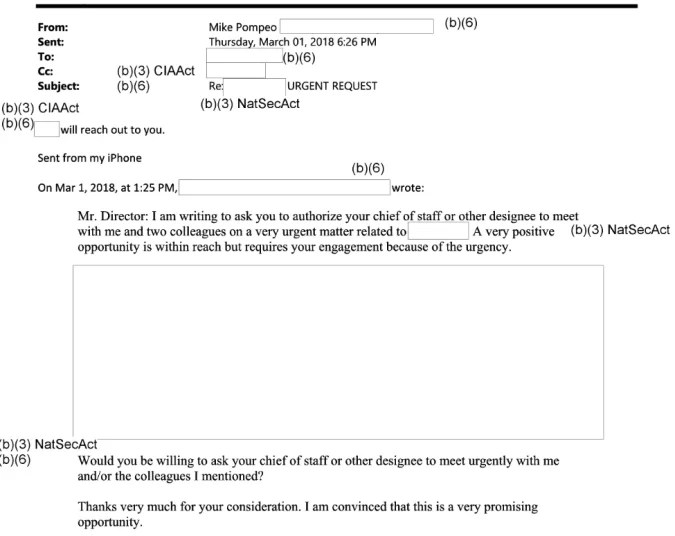
Pompeo responded in the affirmative, and the meeting went ahead early the next morning. Underlining their covert summit’s importance, the emails indicate CIA staffers were preparing to pitch the “positive opportunity” to the Agency’s chief from the early hours of March 2nd. Eerily, the email requesting Pompeo’s signoff on the proposal was sent less than half an hour after Ruslan Boshirov and Alexander Petrov, Skripal’s alleged assassins, purchased plane tickets from Moscow to London Gatwick for their Salisbury visit.

‘Strong Option’
Who emailed Pompeo is redacted, although then-CIA deputy director Gina Haspel is an obvious candidate. A longstanding Russia hawk, who cut her Agency teeth recruiting spies in the Soviet Union in the years before its collapse, she twice served as the CIA’s London station chief twice – from 2008 – 2011, and 2014 – 2017. Sergei Skripal arrived in Britain in July 2010 via a grand spy swap during her first tenure, which was negotiated by Haspel’s longtime collaborator Daniel Hoffman, then-CIA Moscow station chief. He was among the very first sources to publicly blame Russia for the Salisbury incident.
During Haspel’s “unusual” second spell in London, Skripal’s enduring connection to his homeland, and yearning to return, would’ve been well-known to British intelligence. Serendipitously, BBC veteran Mark Urban serendipitously interviewed the GRU defector in the year prior to his poisoning. He recorded that Skripal was “an unashamed Russian nationalist, enthusiastically adopting the Kremlin line in many matters, even while sitting in his MI6-purchased house.” Coincidentally, Urban once served in the same tank regiment as Pablo Miller, Skripal’s MI6 recruiter/handler, and Salisbury neighbour.
Moreover, former Kremlin official Valery Morozov, an associate of the GRU defector likewise exiled to Britain, claimed days after the poisoning that Skripal remained in “regular” contact with Moscow’s embassy in London, and met with Russian military intelligence officers there “every month”. He also flatly repudiated any suggestion the purported nerve agent attack on Sergei and Yulia was the work of Russian spies:
“Putin can’t be behind this. I know how the Kremlin works, I worked there. Who is Skripal? He is nothing for Putin. Putin doesn’t think about him. There is nobody in Kremlin talking about former intelligence officer [sic] who is nobody. There is no reason for this. It is more dangerous for them for such things to happen.”
That this information was not shared with Haspel stretches credulity. The Washington Post has reported how her time in Britain made her the personal “linchpin” of the CIA’s relationship with MI6, the Agency’s “most important foreign partner.” Her British colleagues gushed to the outlet, “she knows them so well… they call her the ‘honorary UK desk officer’.” Haspel regularly drew on this experience to “stabilize the transatlantic alliance” between London and Washington, which was frequently strained while she was CIA director May 2018 – January 2021.
This friction resulted in no small part from Trump legitimately accusing British chaos agents of “conspiring with American intelligence to spy on his presidential campaign,” charges that “rattled the British government at the highest levels.” Strikingly, a cited example of Haspel stabilising CIA relations with MI6 provided by WaPo was convincing a highly reluctant President to back the Western-wide expulsion of Russian diplomats, encouraged by London in the Salisbury incident’s wake.
How Haspel pressed Trump over Salisbury was revealed in April 2019. The New York Times reported that the President at first downplayed Skripal’s alleged poisoning and refused to respond, believing the apparent attack to be “legitimate spy games, distasteful but within the bounds of espionage.” However, Haspel successfully lobbied Trump to take the “strong option” of expelling Russian embassy staff in the US, by providing him with British-sourced “emotional images”:
“Haspel showed pictures the British government had supplied her of young children hospitalized after being sickened by the Novichok nerve agent that poisoned the Skripals. She then showed a photograph of ducks British officials said were inadvertently killed by the sloppy work of the Russian operatives… Trump fixated on the pictures of the sickened children and the dead ducks. At the end of the briefing, he embraced the strong option.”
‘Operation Foot’
The New York Times exposé caused a stir upon release, not least because the “emotional images” described had never hitherto been published or referred to in the mainstream media. While the Skripals giving bread to three local boys to feed ducks in Salisbury’s Avon Playground on March 4th 2018 was initially widely reported, no media outlet, government minister, spokesperson, health professional or law enforcement official had ever previously claimed children and/or waterfowl were “sickened” after coming into contact with Novichok. The reverse, in fact.
On March 26th that year, the Daily Mail recorded that the boys given bread by the Skripals – one of whom apparently ate some – were “rushed to hospital for blood tests amid fears they’d been poisoned,” but promptly discharged after being given “the all-clear.” Moreover, two days after the New York Times article was published, British health officials issued a statement not only refuting the report entirely, but denying any children were admitted to hospital in Salisbury as a result of Novichok exposure at all.
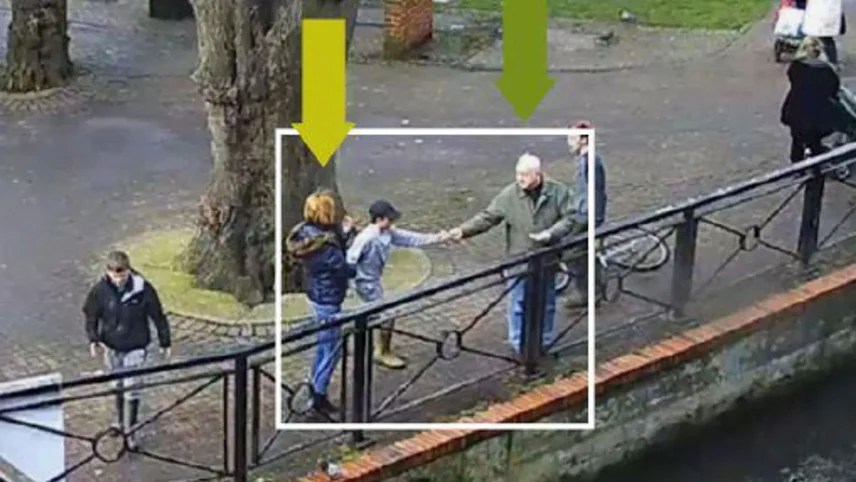
Subsequently, the New York Times radically amended its piece, removing any suggestion Haspel showed Trump photos of Novichok victims provided by the British. In fact, the newspaper reverse-ferreted, she had “displayed pictures illustrating the consequences of nerve agent attacks, not images specific to the chemical attack in Britain.” The question of whether the aforementioned images did exist, and were forged by British intelligence for the explicit purpose of bouncing Trump into a hostile anti-Russia stance, remains thoroughly open five-and-a-half years later.
After all, British spies had been planning and hoping for a mass defenestration of Russian diplomats globally, as a prelude to all-out war with Moscow, for years by that point. In January 2015, MI6/NATO front the Institute for Statecraft (IFS) a document setting out “potential levers” for achieving “regime change” in Russia, spanning “diplomacy”, “finance”, “security”, “technology”, “industry”, “military”, and even “culture”. One “lever”, which IFS listed thrice, stated:
“Simultaneously expel every [Russian] intelligence officer and air/defence/naval attaché from as many countries as possible (global ‘Operation Foot’).”
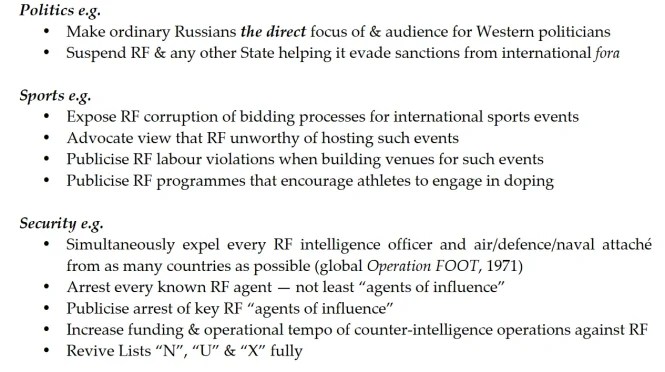
Operation Foot saw 105 Soviet officials deported from Britain in September 1971. Several mainstream media outlets referenced this incident when reporting on London successfully corralling 26 countries – including, of course, the US – into expelling over 150 Russian diplomatic staff in response to the Salisbury incident in March 2018. As a result, IFS got one step closer to its longstanding objective of “armed conflict of the old-fashioned sort” with Russia, which “Britain and the West could win.”
Fast forward to today, and Britain and the West are on the verge of losing that conflict once and for all. Meanwhile, the Salisbury incident’s ever-fluctuating official narrative continues to shift radically, in ways large and small. Contrary to all prior media reports on the matter, the Dawn Sturgess Inquiry has now been told one boy given bread by the Skripals to feed ducks actually “got sick” as a result, and he and his friends “were unwell for a day or two afterwards.”
This fresh rewriting neatly ties in with the highly controversial claim, unflinchingly clung to by British authorities, that the Skripals were poisoned with Novichok smeared on the doorknob of Sergei’s home on the morning of March 4th 2018, before heading into Salisbury. As subsequent investigations will show, available evidence – including Yulia Skripal’s own hospital bed testimony – points unmistakably to the pair being attacked elsewhere, at another time and by another means entirely, with British and American intelligence square in the frame.
Yulia Skripal Reveals the Biggest Secret of All at Novichok Show Trial…
… the Attack Was a British Operation, Not a Russian One
By John Helmer | Dances With Bears | November 16, 2024
Yulia Skripal communicated from her bedside at Salisbury District Hospital on March 8, 2018, four days after she and her father Sergei Skripal collapsed from a poison attack, that the attacker used a spray; and that the attack took place when she and her father were eating at a restaurant just minutes before their collapse on a bench outside.
The implication of the Skripal evidence, revealed for the first time on Thursday, is that the attack on the Skripals was not perpetrated by Russian military agents who were photographed elsewhere in Salisbury town at the time; that the attacker or attackers were British agents; and that if their weapon was a nerve agent called Novichok, it came, not from Moscow, but from the UK Ministry of Defence chemical warfare laboratory at Porton Down.
Porton Down’s subsequent evidence of Novichok contamination in blood samples, clothing, car, and home of the Skripals may therefore be interpreted as British in source, not Russian.
This evidence was revealed by a police witness testifying at the Dawn Sturgess Inquiry in London on November 14. The police officer, retired Detective Inspector Keith Asman was in 2018, and he remains today the chief of forensics for the Counter Terrorism Policing (CTPSE) group which combines the Metropolitan and regional police forces with the Secret Intelligence Service (MI6) and the Security Service (MI5).
According to Asman’s new disclosure, Yulia Skripal had woken from a coma and confirmed to the doctor at her bedside that she remembered the circumstances of the attack on March 4. What she remembered, she signalled, was not (repeat not) the official British Government narrative that Russian agents had tried to kill them by poisoning the front door-handle of the family home.
The new evidence was immediately dismissed by the Sturgess Inquiry lawyer assisting Anthony Hughes (titled Lord Hughes of Ombersley), the judge directing the Inquiry. “We see there,” the lawyer put to Asman as a leading question, “the suggestion, which we now know not to be right, of course”. — page 72.
Hughes then interrupted to tell the witness to disregard what Skripal had communicated. “If the record that you were given there is right, someone suggested to her ‘Had you been sprayed’. She didn’t come up with it herself.” — page 73. Hughes continued to direct the forensics chief to disregard the hearsay of Skripal. “Anyway the suggestion that she had been sprayed in the restaurant didn’t fit with your investigations? A. [Asman] No, sir. LORD HUGHES: Thank you.”
So far in in the Inquiry which began public sessions on October 14, this is the first direct sign of suppression of evidence by Hughes.
Hearsay, he indicates, should be disregarded if it comes from the target of attack, Yulia Skripal. However, hearsay from British Government officials, policemen, and chemical warfare agents at Porton Down must be accepted instead. Hughes has also banned Yulia and Sergei Skripal from testifying at the Inquiry.
The lawyer appointed and paid by the Government to represent the Skripals in the inquiry hearings said nothing to acknowledge the new disclosure nor to challenge Hughes’s efforts to suppress it.
Asman described his career and credentials in his witness statement to the Inquiry, dated October 23, 2024. His rank when he retired from the regular police forces in 2009 was detective inspector. He was then promoted to higher ranking posts at the operations coordinating group known as Counter Terrorism Policing for the Southeast Region (CTPSE). By 2018 Asman says he was “head of the National Counter Terrorism Forensics Working Group since 2012, and was the UK Counter Terrorism Chemical, Biological, Radiological and Nuclear (CBRN) forensic lead.” In June 2015 Asman was awarded the Order of the British Empire (MBE) “for services to Policing.”
At page 19 of his recent witness statement, this is what Asman has recorded for the evening of March 8, 2018:
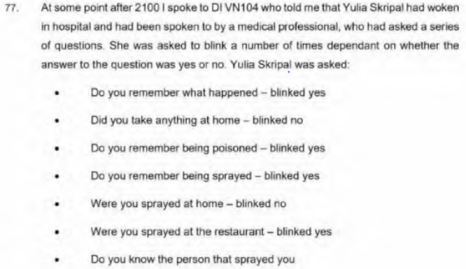
Source: https://dsiweb-prod.s3.eu-west-2.amazonaws.com/uploads/INQ006140_strong-compression.pdf — page 19.
Asman’s went on to claim in this statement: “At this point Yulia Skripal was described as being emotional and fell unconscious. I made notes of my conversation with DI [Detective Inspector] VN104 in one of my notebooks, and in addition this information was confirmed to me in writing the next morning. The information she provided about being sprayed at the restaurant [Zizzi] was seemingly inconsistent with the presence of novichok at the Mill public house and 47 Christie Miller Road. On hearing this, I personally wondered whether Yulia Skripal knew more about it than she had alluded to and therefore whilst being fully cognisant of the SIO’s [Senior Investigative Officer] hypothesis and the need to be open-minded continued to prioritise her property.”
THE SCENE OF THE NOVICHOK CRIME

The Skripals reportedly spent 45 minutes at lunch in Zizzi’s restaurant. Witnesses described Sergei Skripal as upset when he left with Yulia to walk to the bench. Source: https://www.dailymail.co.uk/
THE EVIDENCE THE CRIME WAS BRITISH

Left: Yulia Skripal in May 2018, the scar of forced intubation still visible; read more here. Centre; Dr Stephen Cockroft who recorded the exchange with Skripal at her bedside on March 8, 2018; that was followed, Cockroft has also testified, by forced sedation and tracheostomy – read more. Right: read the only book on the case evidence.
Open-minded was not what the judge and his lawyers wanted from Asman when he appeared in public for the first time on Thursday, November 14. Referring precisely to the excerpt of Skripal’s hospital evidence, Francesca Whitelaw KC for the Inquiry asked Asman: “ We can take that [witness statement excerpt] down, but this information as well, was it consistent or inconsistent with what you had found out in terms of forensic about the presence of Novichok at The Mill and 47 Christie Miller Road? A. [Asman] It, I would say, was inconsistent on the basis that she said she was sprayed in the restaurant.” — page 73.
Asman was then asked by Whitelaw to comment on Yulia Skripal’s exchange with Cockroft. “My question for you is: how, if at all, this impacted on your investigations? A. It only very slightly impacted on it… It was information to have but not necessarily going to change my approach on anything.” — page 73.

Left, Francesca Whitelaw KC, counsel assisting Hughes, asked Asman about Yulia Skripal’s hospital evidence – click to watch from Minute 2:01:27. Right: Hughes interrupting the witness to dismiss Skripal’s evidence from Min 2:03:23. On Hughes’s order, Asman’s face was not transmitted during his testimony, and the audio record was delayed by ten minutes before broadcast.
In the Inquiry record of hearings and exhibits since the commencement of the open sessions on October 14, there have been eleven separate exhibits of documents purporting to record what Yulia and Sergei Skripal have said; they include interviews with police and witness statements for the Inquiry; they are dated from April 2018 through October 2024. Most of them have been heavily redacted. None of them is signed by either Skripal.
Neither Yulia nor Sergei Skripal has been asked by the police, by the Inquiry lawyers, or by Hughes to confirm or deny whether Yulia’s recollection of March 8, 2018, of the spray attack in Zizzi’s Restaurant is still their evidence of what happened to them.
Top Ukrainian academic claims British publisher censoring truth
A Canada-based professor says Routledge is demanding that he include Western-backed conspiracy theories in a new book
RT | November 15, 2024
A leading academic on Ukraine has accused prominent British publisher Routledge of attempting to censor his new book, claiming the company demands he include “alternative” perspectives in his analysis of the Russia-Ukraine conflict.
Ivan Katchanovski, a University of Ottawa professor originally from Western Ukraine, is known for his forensic debunking of popular myths around the so-called Maidan coup in Kiev, and a critical stance towards Kiev’s pro-Western, post-Maidan government.
In a series of X posts on Thursday, Katchanovski claimed that Routledge, under contract to publish his book “From the Maidan to the Russia-Ukraine War,” is refusing to release it unless he revises the manuscript to include Western-backed conspiracy theories.
He specifically mentioned the publisher’s request to reflect “alternative sources” on contentious issues such as the Nord Stream bombing and the blocking of peace talks in 2022, which Katchanovski says were hindered by the US and the UK.
Katchanovski wrote: “Routledge states that my book cannot be published unless I would revise the entire manuscript… and would use other perspectives and alternative sources concerning the Russia-Ukraine war, the peace deal, the Nord Stream bombing, and all other issues I examine, including the Maidan massacre.” He argues that the demands are politically motivated and prevent him from presenting his findings based on the facts.
According to the academic, his book has garnered support from several experts. One unnamed peer reviewer described it as “an important contribution” to the study of the Russia-Ukraine conflict, noting its “unsurpassed broad empirical base.” Another reviewer stated that Katchanovski’s work has “withstood criticism” and is highly respected within the academic community.
The professor built his reputation on his evidence-based research, including an analysis of the 2014 Maidan sniper incident, which he claims, using forensic video analysis, was a false flag operation used to justify the ousting of Ukraine’s then president, Victor Yanukovich. This theory, which contradicts the official Western narrative, was met with criticism from pro-Maidan voices when first proposed, but Katchanovski continues to be cited by scholars and analysts.
Katchanovski says he faces the choice of either revising his manuscript to fit Routledge’s requirements or canceling the contract altogether. He refuses to commit “academic fraud,” stating, “I cannot base my book on politically convenient narratives and sources propagated by any government and media.”
Routledge, a major academic publishing house, has yet to comment on Katchanovski’s allegations. The publisher is known for its books in the humanities and social sciences, but has been accused of yielding to political pressure in recent years.
Katchanovski has suggested that he may seek alternative publishers if Routledge continues to block the release, though this could delay publication of his work by up to a year.
Congressional Investigation into Authors of ‘Disinformation Dozen’ Intensifies
By Michael Nevradakis, Ph.D. | The Defender | November 15, 2024
The Center for Countering Digital Hate (CCDH), authors of the “Disinformation Dozen,” faces a Nov. 21 deadline to provide Congress with documents related to its alleged collusion with the Biden administration and social media platforms to censor online users.
Rep. Jim Jordan (R-Ohio), chairman of the House Judiciary Committee, on Nov. 7 subpoenaed CCDH as part of an ongoing congressional investigation, launched in August 2023, into the nonprofit’s censorship-related activities.
The subpoena requests all communications and documents “between or among CCDH, the Executive Branch, or third parties, including social media companies, relating to the identification of groups, accounts, channels, or posts for moderation, deletion, suppression, restriction, or reduced circulation.”
The subpoena also requests all records, notes, and other “documents of interactions between or among CCDH and the Executive Branch referring or relating to ‘killing’ or taking adverse action against Elon Musk’s X social media platform.”
https://twitter.com/elonmusk/status/1854563397859193136
CCDH previously included Kennedy on its “Disinformation Dozen” list, published in March 2021, of the 12 “leading online anti-vaxxers.”
Leaked CCDH documents released last month by investigative journalists Paul D. Thacker and Matt Taibbi revealed that CCDH sought to “kill” Twitter and launch “black ops” against Robert F. Kennedy Jr., President-elect Donald J. Trump’s nominee for secretary of the U.S. Department of Health and Human Services (HHS).
CCDH included Kennedy, founder of Children’s Health Defense (CHD), on its list of “The Disinformation Dozen” when he was still chairman of CHD.
“Black ops” are defined as a “secret mission or campaign carried out by a military, governmental or other organization, typically one in which the organization conceals or denies its involvement.”
A subsequent report by Taibbi and Thacker showed that CCDH employed tactics it initially developed to help U.K. Prime Minister Keir Starmer and the U.S. Democratic Party, to target Musk, Kennedy and others.
CCDH used ‘explicit military terminology’ to target speech
Thacker told The Defender the leaked documents “definitely spurred” Jordan’s subpoena.
Sayer Ji, the founder of GreenMedInfo, was also listed among “The Disinformation Dozen.” He said the leaked documents were “chilling” and that CCDH’s efforts were part of “the largest coordinated foreign influence operation targeting American speech since 1776.”
Ji told The Defender :
“The leaked documents confirm what we experienced firsthand: CCDH wasn’t just targeting 12 individuals — we were test cases for deploying military-grade psychological operations against civilians at scale.
“Just as the British Crown once used seditious libel laws to silence colonial dissent, CCDH’s operation expanded to silence hundreds of millions globally, from doctors sharing clinical observations to parents discussing vaccine injuries.”
Ohio physician Dr. Sherri Tenpenny, also on “The Disinformation Dozen” list, told The Defender, “The exposure of the manipulation that went on behind the scenes to silence us is what we suspected, and now we know … We have the sad last laugh against their attacks. They are the ones with blood on their hands.”
Ji said CCDH’s internal communications reveal not just bias, “but explicit military terminology — ‘black ops,’ ‘target acquisition,’ ‘strategic deployment’ — coordinated between Five Eyes networks and dark money interests to target constitutionally protected speech.”
Writing on GreenMedInfo, Ji said, “CCDH’s ‘black ops’ approach includes coordinated media smears, economic isolation, and digital censorship.” Ji said CCDH’s activities represent “a new level of institutionalized power directed at civilian targets, often bypassing constitutional safeguards.”
Thacker said Jordan’s investigation should expand to include CCDH’s “black ops.”
“I don’t want to speculate on what CCDH was doing with ‘black ops’ against Kennedy,” Thacker said. “I think that should be explored by a congressional committee, with CCDH CEO Imran Ahmed put under oath,” Thacker said.
CCDH facing multiple lawsuits, possible Trump administration investigation
Jordan’s subpoena is the latest in a series of legal challenges for CCDH. According to GreenMedInfo, the organization faces several lawsuits and government investigations.
Following last month’s CCDH document leak, the Trump campaign said an investigation into CCDH “will be at the top of the list.”
The campaign also filed a complaint against the Harris campaign with the Federal Election Commission, “for making and accepting illegal foreign national contributions” — namely, from the U.K. Labour Party.
This followed the release of evidence indicating that the Biden administration coordinated with the U.K. Foreign Office as part of what GreenMedInfo described “as a systematic censorship regime involving CCDH and affiliated organizations.”
A lawsuit Musk filed against CCDH in July 2023 for allegedly illegally obtaining data and using it in a “scare campaign” to deter advertisers from X will likely proceed on appeal. A federal court initially dismissed the lawsuit in March.
Discovery in the Missouri v. Biden free speech lawsuit may also “shed further light and legal scrutiny on the critical role that CCDH played in allegedly suppressing and violating the civil liberties of U.S. citizens,” according to GreenMedInfo.
CCDH, others flee X in protest
Earlier this week, CCDH deleted its account on X, the platform it wanted to “kill.”
Writing on Substack, Ji said CCDH’s departure from X, during the same week Trump nominated Kennedy to lead HHS, represents a “seismic shift” and marks “a watershed moment, signaling the unraveling of entrenched systems of control and the rise of a new era for health freedom and open discourse.”
Several other left-leaning organizations and individuals, including The Guardian and journalist Don Lemon, also said they will stop using X, after Trump tapped Musk to lead a federal agency tasked with increasing government efficiency.
According to NBC News, many ordinary users are also fleeing X, citing “bots, partisan advertisements and harassment, which they all felt reached a tipping point when Donald Trump was elected president last week with Musk’s support.”
But according to Adweek, X’s former top advertisers, including Comcast, IBM, Disney, Warner Bros. Discovery and Lionsgate Entertainment, resumed ad spending on the platform this year, but at “much lower rates” than before.
“Elon Musk’s ties with Donald Trump might spur some advertisers to think spending on X is good for business,” Adweek reported.
Thacker said CCDH’s deletion of its X account was “aligned” with the departure of “other organizations and ‘journalists’ aligned with the Democratic Party.” He said it appears to have been a “coordinated protest.”
Ji said organizations like CCDH view X “as an existential threat.” He added:
“Having experienced both Twitter 1.0’s AI-driven censorship system and X’s more open environment, I understand exactly why CCDH sees X as an existential threat. X represents what Twitter 1.0’s embedded censorship infrastructure was designed to prevent: a truly free digital public square.
“Under Musk’s commitment to free speech, their tactical advantage disappeared. They’re not leaving because X is toxic. They’re leaving because they can’t control it.”
Online censorship ‘may no longer be sustainable under intensified scrutiny’
According to GreenMedInfo, CCDH’s departure from X “appears to reflect an internal recognition that their operational model — characterized by critics as a US-U.K. intelligence ‘cut-out’ facilitating unconstitutional suppression of civil liberties — may no longer be sustainable under intensified scrutiny.”
In recent months, several mainstream media outlets have corrected stories that relied upon CCDH reports claiming “The Disinformation Dozen” was responsible for up to two-thirds of vaccine-related “misinformation” online.
According to Thacker, this reflects an increasing awareness by such outlets that readers are turning their backs on such reporting.
“The outlets that promoted CCDH propaganda are being investigated by their own readers, who are fleeing in droves. Readers are voting against this type of propaganda by refusing to subscribe to these media outlets,” Thacker said.
Yet, “many outlets continue to host these demonstrably false narratives without correction,” Ji said.
According to Ji, these false narratives resulted in medical professionals fearing the loss of their licenses for expressing non-establishment views, self-censorship among scientists “to avoid career destruction,” suppression of “critical public health discussions” and the labeling of millions of posts as “misinformation.”
“This isn’t just about suppressing speech. It’s about establishing a new form of digital control that echoes the colonial-era suppression our founders fought against,” Ji said.
“CCDH has polluted political discourse by pretending there is some absolute definition of the term ‘misinformation’ and that they hold the dictionary,” Thacker said. “That’s nonsense. They spread hate and misinformation to attack perceived political enemies of the Democratic Party.”
Ji called upon Congress to investigate “The full scope of those silenced beyond the ‘Disinformation Dozen,’” the “systematic suppression of scientific debate,” “media organizations’ role in amplifying foreign influence operations” and “dark money funding networks” supporting such organizations.
Thacker said Congress should examine possible CCDH violations of the Foreign Agents Registration Act. “We need to also look at how much foreign money they took in and whether we as a nation are comfortable with foreign influence trying to alter the law and political discussions.”
“The fight isn’t just about correcting past wrongs or personal vindication. It’s about preserving fundamental rights to free speech and scientific inquiry in the digital age,” Ji said. “If we don’t address this systematic abuse of power, we risk surrendering the very freedoms our founders fought to establish.”
This article was originally published by The Defender — Children’s Health Defense’s News & Views Website under Creative Commons license CC BY-NC-ND 4.0. Please consider subscribing to The Defender or donating to Children’s Health Defense.
British Premier tells UK Parliament there is no genocide in Gaza
MEMO | November 13, 2024
UK Prime Minister, Keir Starmer, has told the Parliament on Wednesday that Israel is not committing genocide against the Palestinians in Gaza, Anadolu Agency reports.
During the Prime Minister’s Questions at the House of Commons, Independent lawmaker, Ayoub Khan, raised from Foreign Secretary, David Lammy, who recently claimed that the term genocide referred to “when millions of people lost their lives in comments like Rwanda, the Second World War in the Holocaust” and that using it to describe Gaza “now undermines [its] seriousness”.
Khan then said Lammy’s words are not acceptable.
“Article two of the United Nations Genocide Convention makes it explicitly clear that genocide is not about numbers, it’s about intent. The intent of the Israeli government and the IDF has been explicitly clear in words and in actions over the past 400 days, killed more than 45,000 innocent men, women and children.”
The lawmaker said the Foreign Minister explicitly denied that genocide was even taking place and “suggested that the Israeli army had not yet killed enough Palestinians” to constitute genocide.
“Will the Prime Minister share his definition of genocide with this House?” he asked.
In his response, Starmer said: “It would be wise to start a question like that by reference to what happened in October of last year. I’m well aware of the definition of genocide, and that is why I’ve never described this as and referred to it as genocide.”
Francesca Albanese, the UN Special Rapporteur on the Occupied Palestinian Territories who is currently on a UK visit, has repeatedly affirmed her belief that what is happening qualifies as genocide.
European lackeys in panic mode as Trump signals detente with Russia
By Finian Cunningham | Strategic Culture Foundation | November 12, 2024
It’s early days yet. However, there are signs that President-elect Trump is moving toward a detente with Russia over Ukraine.
One good sign is that Trump will not invite Mike Pompeo or Nikki Haley to join his cabinet when he is inaugurated as the 47th U.S. president on January 20. Both of these figures were rabid anti-Russia hawks during Trump’s previous administration. There were suggestions that Pompeo and Haley might return with senior posts in his second administration. But Trump has announced the pair will not be offered new positions.
Another positive sign is from people close to Trump’s inner circle who are letting the Kiev regime know – rudely – that the U.S. military aid spigot is being turned off.
Donald Trump has yet to hold a phone call with Russian President Vladimir Putin, according to the Kremlin. But both leaders have already expressed a willingness to negotiate a peaceful settlement over the Ukraine conflict.
Another promising sign of potential detente between the United States and Russia is the sheer panic among European leaders. The news of Trump’s election last week has caused most European elites to scramble like scared children on hearing “boo!”.
European Commission President Ursula von der Leyen and French President Emmanuel Macron are consoling themselves by urging Europe to “come together” in the wake of Trump’s stunning election victory. The collapse of Germany’s coalition government of Chancellor Olaf Scholz is an early casualty of the Trump impact.
European leaders fear that if Trump pulls the plug on military aid to the Kiev regime they will be left holding the can to fund the proxy war against Russia, which the weak European economies have no chance of sustaining.
It’s no secret that the main European states were betting on Democrat candidate Kamala Harris winning the race to the White House. Harris would have ensured the continuation of NATO’s backing for the Kiev regime. With Trump becoming president, all bets are off.
The political price will be ruinous for European leaders who have invested huge political capital in waging war to “defend Ukraine from Russian aggression.” Trump has shown skepticism toward that false narrative. He has told Europe to go it alone if it wants to. And the European Russophobes know they can’t do that.
If Trump follows through on his election promise to negotiate with Putin on a settlement in Ukraine, then the Europeans are going to be left with serious amounts of egg on their faces.
One thing about Trump that is of concern to the Europeans is his frustration with them as being, in his view, freeloaders on American protection. Another is Trump’s vindictive streak. He’s not going to forget that most of the European leaders wanted him to lose the election.
Take Britain’s Prime Minister Keir Starmer. His Labour Party sent volunteers over to the U.S. to advise Harris on winning the election. The British Foreign Secretary David Lammy has also been reminded that he previously disparaged Trump as a racist “sociopath.”
Trump’s election is bad news for Britain and there is no doubt that Starmer is now trying to repair post-Brexit relations with Europe as a hedge against the expected chill from Washington during the next four years.
When Britain pulled out of the European Union after its 2016 Brexit referendum, there were high hopes that it could negotiate a special trade deal with the U.S. That deal didn’t work out and looks even less likely now. Hence, Starmer has been busy since taking office in Downing Street trying to restore relations with the EU.
This week, the British leader attended the Armistice ceremony in Paris to commemorate the end of the First World War. The last time a British leader honored that event in Paris was in 1944 when Winston Churchill visited the French capital following its liberation from Nazi occupation.
Macon invited Starmer to lay wreaths in the Champs-Elysee and the Arc de Triomphe.
The choreographed caper of European unity is a reflection of the panic gripping European leaders in the aftermath of Trump’s return to the White House.
But everything is up in the air for the European politicians. Starmer was bending over backward to renew relations with Germany as a way to forge a warmer connection between London and the European Union after years of post-Brexit bitterness, only for that to be thrown into doubt.
Last month saw a landmark security deal between Britain and Germany in which German arms maker Rheinmetall would open a new factory in Britain, and the German Luftwaffe would be able to fly warplanes from an RAF base in Scotland. The deal was touted as “a sign of joint European security in the face of Russian threat.”
With the collapse of the government in Berlin over the unbearable financial costs of the Ukraine war to the German economy, the British security treaty may not materialize. That means a big setback to Starmer’s reset plans with Europe.
Hungary’s Viktor Orban and Slovakia’s Robert Fico are in the minority of European politicians who genuinely welcomed Trump’s election as an opportunity to wind down the NATO proxy war in Ukraine against Russia.
On the other hand, the ardent NATO warmongers in Europe, including Britain, Germany, France, Poland and the Baltic states now face a desperate dilemma. Along with EU leaders like Von der Leyen and the Dutch NATO chief Mark Rutte, they have all nailed their colors to the mast for continuing the reckless proxy war against Russia.
Trump seems to be showing good sense in calling off that proxy war and finding a way to negotiate sensibly with Russia on detente. Moscow wants its long-term security demands to be met. That means no NATO membership for Ukraine, an end to the NeoNazi regime in Kiev, and recognition of its historical lands in Crimea and the Donbass.
This is all eminently negotiable, and Trump might just be ready to cut a deal to avoid World War Three, as he has repeatedly indicated he would do. That would mean Trump dumping the false narrative that Biden, Harris and the Democrats – and their European vassals – contrived about “defending Ukraine”.
That would leave the European lackeys in a disastrous lurch. How will they explain to their electorates the three-year slaughter in Ukraine? How will they justify the tens of billions of Euros and Sterling wasted on pushing a war that not only destroyed millions of lives but their economies as well?
The stupid European leaders are in panic mode, and that’s a good thing.
The truth is out there, behind all the lies
By Yvonne Ridley | MEMO | November 12, 2024
There is nothing more noble than telling the truth, and yet for simply delivering nothing but the truth Palestinian journalists are being killed; they — and their families — are targeted by Israeli soldiers in Palestine and Lebanon. The death toll of journalists in Gaza alone has risen to 177, with not one newsroom left standing in the enclave.
Meanwhile, professional liars from the Zionist State’s diplomatic corps deny that its army targets journalists deliberately, even when presented with irrefutable evidence. According to Irish journalist Frank McDonald, “These shameless men and women lie on behalf of a country that is itself built on lies, mythology, terrorism, land theft and deep denial of historical truths, especially about Palestine and what successive Israeli governments have done to the Palestinians.”
Despite the rising death toll of journalists and other civilians across Gaza, the occupied West Bank (including Jerusalem) and Lebanon, Israel never tires of telling the world that it is “the only democracy” in the Middle East; we know that is simply not true on several levels, due to the fact that major human rights bodies have said that it has passed the legal threshold for classification as an apartheid state, including B’Tselem, Human Rights Watch and Amnesty International. Moreover, one of the keystones of democracy is a free press, but since October last year, 21 local radio stations, 15 local and international news agencies, 15 TV stations, six local newspapers, three broadcasting towers, eight print media and 13 media institutions have been destroyed in Gaza.
The Israeli government’s policy of terrorising and killing journalists and its ban on foreign media makes it impossible for journalists like me to get into Gaza so that we can do our jobs and report the truth of what we witness. Not that we would do that any better than the courageous Palestinian journalists, but wherever journalists are banned we all know that it is because powerful people in powerful places do not want anyone shining the light of publicity on their activities.
Meanwhile, Israel pumps out lies on a daily basis using its militarised propaganda machine as well as paid-for stooges who earn a nice living out of promoting the Zionist State as a peace-loving nation and a victim of anti-Semitism.
They are given a free ride by organisations like the BBC.
Any journalist who calls out the egregious lies and victim blaming from the apartheid state’s representative of choice is likely to disappear from public view in what is a time of unprecedented censorship.
A few days ago, we got a close up view of the slick Zionist propaganda machine in action as the notorious Maccabi Tel Aviv football fans wreaked havoc in Amsterdam. Journalists and politicians lined up to condemn the violence in the city of Anne Frank, the Jewish girl who documented her life in hiding from the Nazis during the German occupation of the Netherlands before she was sent to Bergen-Belsen concentration camp where she died.
For two days, these football fans, who have a long and grubby history of violence and racism at home and abroad, took their vile, racist antics to the Arab community in the Dutch capital. The response was one of which any community under fire would be proud; they fought back and defended themselves. The global reaction to this, though, was perverse.
European Commission president Ursula von der Leyen, aka “Frau Genocide”, expressed her outrage in the media without checking the facts. It was enough for her to know that Arabs had resisted Israeli abuse and violence in the home city of Anne Frank so it must be the fault of the immigrant community and not the foul-mouthed yobs from Tel Aviv.
The truth was just an inconvenient fact for von der Leyen and her deputy, as well as the reviled Dutch politician Geert Wilders and Free Press editor Barry Weiss. The latter two referred, somewhat hysterically, to the violence as a “pogrom” against Jews.
Even though elected members of Amsterdam’s city council confirmed to Al Jazeera that the Maccabi fans had ignited the violence, by that time British and European mainstream media were toeing the Tel Aviv line of “Jews under attack”. Words like “pogrom” were employed even though the Zionist narrative was far from the truth.
I am disgusted at the reaction of my colleagues from the mainstream media who fell for the Zionist propaganda.
While heroic Palestinian journalists are risking life and limb to bring cold hard facts to the table, their western counterparts are destroying their own integrity by putting out false information about what happened in Amsterdam last week (and what happens in Palestine under Israeli occupation).
Shameless politicians also sent out messages on social media, with bogus claims of anti-Semitism and helpless Jews under attack in Amsterdam. Investigative journalist and former Labour MP Chris Mullin saw through the lies, though, and asked: “How on earth did these people manage to present themselves as victims?”
The other question we need to ask is whether the Israeli-led violence in Amsterdam was a spillover from the impunity with which Israel is allowed to act in the occupied Palestinian territories, Lebanon, Syria and Iran. Do the Israeli thugs in Maccabi Tel Aviv colours, around 80 per cent of whom are thought to be serving in the occupation army which stands accused of committing genocide and war crimes, now feel empowered and entitled to take their thuggery wherever they like? Many may well have mental health issues arising from their experiences in Gaza and the West Bank. Having thugs running amok in Europe boasting about killing Palestinian babies just adds to the evidence lawyers need to prosecute these lawless individuals.
This is something that Frau van der Leyen might want to consider because the more she excuses and justifies the violence of Israelis on Europe’s streets, the more we will be expected to accept such aggression from these psychopaths, and the more danger we will all face.
Predictably, political thugs like Israeli Prime Minister Benjamin Netanyahu have weaponised anti-Semitism, ignoring the racism and violence of the Israeli football fans which kicked it all off in Amsterdam. When Netanyahu said that he would send the army and aircraft to get the violent Maccabi Tel Aviv fans out of Amsterdam as quickly as possible, it was an exercise in damage limitation, not out of concern for their safety in this bogus “pogrom”.
While I am sure that the 7 October Hamas-led cross-border incursion and its aftermath have had significant emotional and behavioural impacts on the Israeli public, the need for a psychological intervention has increased. If the Western media and politicians were true friends of Israel they’d realise that this is a nation with severe psychological problems that are easily triggered by the very sight of a Palestinian flag. Why else did they attack homes in Amsterdam which had such flags on display?
While it’s increasingly difficult to show any empathy or sympathy for Israeli citizens without comparing and contrasting the cause and effects of 75 years of brutality against the Palestinians, the world needs to open its eyes to the psychotic nature of the settler-colonial state and those who run its brutal military occupation. In the immediate aftermath of 7 October, there was a reported 30 per cent rise in demand for psychiatric drugs. As many as 35 per cent of war-related casualties were also found to be related to psychological issues. It is now clear that the individual mental health needs of Israelis have increased, with talk of an impending mental health “pandemic”.
Israeli Health Minister Uriel Buso has admitted that the rogue state is in the midst of its worst-ever mental health crisis since its establishment. Buso made the comment at the Enosh Mental Health 2024 Conference in Tel Aviv in September.
The crisis can be seen in Israeli football stadiums where, according to this report, the most violent fans come from Beitar Jerusalem, Hapoel Tel Aviv and Maccabi Haifa. While many hoped that 7 October would lead to a change in the mentality that had taken root on the terraces, the reality is completely opposite. Racism, violence and social polarisation have become commonplace in many football stadiums in Israel, says news journalist Ben Goldfriend. His eight-page report on the phenomenon, written in Hebrew, is depressing and strengthens the argument that Israeli football clubs should be banned from UEFA competitions and the national team should be banned from UEFA and FIFA international tournaments.
So far, 112,000 people have signed this petition calling for Israel to be suspended from all international sporting competitions. “In recent years, we have witnessed how the violent and racist atmosphere on the pitches is becoming more and more serious,” said Matan Segal, the director of the Israeli programme to kick racism and violence out of football. “The attempts to address the problems with the same means that were tried in the past have proven to be ineffective.”
The Israeli football season so far has been blighted with numerous incidents of racist chants, including — and this is astonishing — derogatory chants about the Holocaust.
I wonder what Frau Genocide or British Prime Minister Keir Starmer have to say about that.
If our leaders really are concerned about the safety of their own citizens in Europe then a travel ban should be imposed immediately on all Israeli teams and football fans, especially those serving in the rogue Israel Defence Forces. Editors across the media should instruct their best feature writers and investigative reporters to expose the violence of the Zionist State’s sports fans in exactly the same way that they exposed the true nature of English football hooliganism during the 1970s.
Israel’s National Security Council claimed on Sunday that pro-Palestinian groups were calling for attacks on Israelis and Jews in multiple European cities. Including some in the UK, “under the pretence of demonstrations and protests”. As usual, Israel has provided not one jot of evidence for its blatant lie and yet the UK Government and Sir Keir Starmer duly went along with it. “There is no place for anti-Semitism on our streets and we will not allow cultural and sporting events to be hijacked by those who seek to promote hate,” intoned Starmer. “Those who push this poison — offline and online — will face the full force of the law. Police and the security services continue to work to ensure the safety of every community in this country.”
If Starmer was genuine about protecting “every community in this country” he would ban every sporting event involving any team and fans from Israel.
Just consider this: if the Labour Home Secretary Yvette Cooper could ban the grandson of Nelson Mandela from speaking on a UK-wide speaking tour promoting peace and justice, then I’m sure that every legal mechanism is in place to crack down on Israel sports fans who feel emboldened enough to act with impunity and wreak havoc and violence on our streets.
Russia Will Not Tolerate Powers Alien to Black Sea to Establish Permanent Naval Presence There
Sputnik – 11.11.2024
Moscow is not going to allow powers alien to the Black Sea to maintain a permanent naval presence there, Russian presidential aide Nikolai Patrushev has said.
Russia has no intention of letting anyone weaken its positions in the region in question, Patrushev said during an interview with a Russian newspaper, adding that permanent naval presence of non-Black Sea countries in the waters “in violation of the Montreux Convention” will not be tolerated.
He further pointed out that the Russian Black Sea Fleet still retains its combat capabilities and is ready to repel all naval threats, despite the fact that Kiev’s “aggressive actions” in the region are being “coordinated by NATO specialists.”
 In the meantime, Patrushev pointed out, the US and the UK have since lost much of their once-considerable naval power.
The British navy, for example, suffers from a severe deficit of sailors because naval service is simply no longer prestigious there, he said.
“The signs of naval power decline are seen in the US as well,” Patrushev added. “They have a massive fleet on paper, but in reality there is low morale among the seamen, chronic lack of personnel, the lack of repair capabilities and shipyard workers.”
Russia, on the other hand, maintains its status as one of the world’s leading naval powers and the Russian navy continues to perform all its duties, “including the most important one – nuclear deterrence.”
“Our opponents should know that Russia’s naval nuclear shield always stands guard over our country,” Patrushev stated.
He mentioned during the interview that while the US and its European allies pursue militarization of the Baltic Sea, Russia is taking additional measures to protect itself after Sweden and Finland joined NATO and against the backdrop of the Nord Stream blasts.
“Currently, ensuring security in the Baltic is the most important military and political task. Since the accession of Sweden and Finland to NATO, as well as against the background of the Nord Stream blasts, Russia has been taking additional measures to protect its territorial integrity and economic sovereignty,” Patrushev told the newspaper.
US Lawmakers Investigate Biden White House-Affiliated UK Censorship Group’s Plot To “Kill” Elon Musk’s X
By Didi Rankovic | Reclaim The Net | November 8, 2024
Among the investigations currently carried out by the US House Committee on the Judiciary and its Select Subcommittee on the Weaponization of the Federal Government is the one into a case involving UK-based “censorship group” – the Center for Countering Digital Hate (CCDH).
In a letter dated November 7, Committee chairman Jim Jordan is asking CCDH CEO Imran Ahmed to, by November 21, comply with a subpoena issued on August 30, 2023.
We obtained a copy of the letter for you here.
According to Jordan, it covers the group’s activities as well, including documents showing the Biden-Harris administration’s alleged collusion with Big Tech to censor Americans’ lawful online speech.
Another point the letter makes is the plan to “kill Musk’s Twitter” – which communications recently revealed suggest was being hatched by CCDH. And Jordan reminds Ahmed that this, too, is with the subpoena’s scope.
On August 3, 2023, the Committee asked CCDH to present it with communications it had had with the US government as well as third parties regarding “moderation of online content” – and what role the government played in this (by exerting pressure on social platforms).
The letter then cites internal CCDH documents that recently came to light – particularly emails that show “killing Musk’s Twitter” was made a priority for the group this year.
Prior to that, the letter notes, CCDH in 2020 communicated with Twitter – then under its previous ownership – to identify content and accounts that should be censored, while earlier this year, CCDH “held a private event tat included (US) Executive Branch personnel.”
Last month, UK media reported about CCDH’s effort against X, as well as a formal request from then presidential candidate Donald Trump’s campaign suggesting the ruling Labour party was essentially interfering in US elections.
Not only were Labour advisers dispatched to the US to help Kamala Harris’ effort to remain in the White House – it was also revealed that CCDH has ties to UK Prime Minister Kier Starmer’s party.
Namely, Paul Thacker and Matt Taibbi’s Disinformation Chronicle named Starmer’s chief of staff Morgan McSweeney as the (co) founder of CCDH. And it just so happened that “strengthening ties with senior Democrats” features as one of the controversial group’s priorities, right along with, “killing Musk’s Twitter.”
Western liberalism has ‘degenerated’ – Putin
RT | November 7, 2024
 Liberalism in the West has devolved into an aggressive and intolerant ideology in which freedom, democracy, and human rights take a back seat to power, Russian President Vladimir Putin has said.
His remarks were part of a keynote address at the 21st annual meeting of the Valdai International Discussion Club in Sochi on Thursday.
“Today’s Western liberalism, in my opinion, has degenerated into extreme intolerance and aggression towards any alternative, towards any sovereign and independent thought, and now justifies neo-Nazism, terrorism, racism and even mass genocide of the civilian population,” Putin said.
Moscow has traditionally considered the “collective West” to consist of the US and its allies in North America, Europe, Australia and East Asia. Their once-liberal governments have transformed their guiding ideology into something “totalitarian in essence,” the Russian president argued.
“Democracy is increasingly being interpreted as minority rule rather than rule of the majority, and traditional democracy is even being put at odds with some abstract freedom, for the sake of which – as some believe – democratic procedures, elections, the opinion of the majority, freedom of speech and impartiality of the media can be disregarded, or even sacrificed,” said Putin.
The Russian president called this trend towards tyranny as one of the biggest threats to the emerging multipolar world order.
The plenary session at which Putin spoke was titled ‘Security for Everyone. Together – Into a New World’. This year’s Valdai meeting is taking place under the motto ‘A Lasting Peace – On What Basis? Universal Security and Equal Opportunities for Development in the 21st Century’.
UK government crackdown on pro-Palestine support may turn to lawfare against political dissidents
By Muhammad Hussein | MEMO | November 6, 2024
Throughout the past year of Israel’s war against the Palestinians in the Gaza Strip and the purported objective of wiping out Hamas, many governments across Europe have served as a kind of buffer for Tel Aviv, stopping at nothing to crush pro-Palestine protests. Demonstrators have been arrested and protests have been banned. The shameless labelling of all and any advocates for Palestinian rights as “Hamas sympathisers” and “anti-Semites” has exposed the obvious bias of European policymakers and police forces towards Israel and the Zionist narrative.
After around a year of such incidents and power games, the UK — the quiet repressor of dissent and rare expresser of policy positions — stepped up its own crackdown, arresting journalists or raiding their homes because of their support for Palestine and its people, as well as their criticism of Israel and its genocide in Gaza.
Last month, for example, British counter-terrorism police raided the home of journalist Asa Winstanley as part of “Operation Incessantness”, reportedly linked to his pro-Palestine social media posts. Although the specific posts were not detailed by reports, the authorities claimed that they were possible offences under sections 1 and 2 of the 2006 Terrorism Act, which pertain to the “encouragement of terrorism”.
Others to fall foul of this official crackdown in the UK include Palestine solidarity activists Mick Napier and Tony Greenstein, who were arrested last year over their expressions of support for legitimate Palestinian armed resistance and resistance movement Hamas itself. More recently, activist Sarah Wilkinson had her home raided by counter-terrorism police, and journalist Richard Medhurst was detained under the Terrorism Act upon arrival at Heathrow Airport.
Such raids, arrests and detentions by the British authorities are part of the wider repression of civil, political and press freedoms across the West as a whole.
First glimpsed during the “war on terror” years, we have seen the implementation of legislation granting governments greater freedom to monitor their citizens. The crackdown on hard-won freedoms was felt more heavily during the Covid pandemic. Many people who had not felt the weight of counter-terrorism policies realised suddenly that they too might not be exempt from being subject to pressure from the state, overreach and enforcement.
Today, with Western governments crushing expressions of support for the Palestinian cause or opposition to the Israeli occupation and genocide in Gaza, we are witnessing the next level of repression, symbolised by the way that the Establishment is protecting a rogue state which treats international laws and conventions with contempt — Israel — and the war crimes and crimes against humanity which are the inevitable result of such protection.
The repression is expected to get worse, with the UK in particular on a very worrying downward trajectory.
Following the election in July of the new Labour government under Prime Minister Sir Keir Starmer, there was a brief moment when it looked as if the UK was ready and to offer more diplomatic and humanitarian support to the Palestinian people. There was even hope that the British government would not intervene to stop the International Criminal Court’s (ICC) arrest warrants sought for Israeli Prime Minister Benjamin Netanyahu and (now former) Defence Minister Yoav Gallant.
Now, though, we see the Labour government putting the brake on soon-to-be applicable legislation in order to cancel pro-Palestine activism on university campuses. The Higher Education (Freedom of Speech) Act 2023 was passed by the previous Conservative government in order to protect freedom of speech in universities and student unions by obliging them to take “reasonable steps” to promote free speech at the risk of facing legal action.
According to Labour’s Secretary of State for Education, Bridget Phillipson, the government is applying the brake just days before the legislation is due to come into force, “In order to consider options, including its repeal.” She claimed that it “could expose students to harm and appalling hate speech on campuses.”
Despite the UK government insisting that it remains “absolutely committed” to freedom of speech, it is suspected by many of seeking to avoid at all costs the possibility of higher education institutions, figures and even officials being held to account over censorship of pro-Palestinian views and criticism of Israel.
Tragically, the state crackdown in the UK and other parts of the Western world could have serious implications for campaigners who refuse to stop advocating for Palestinian rights. The days of assassination, indefinite detention without trial or state-sponsored kidnapping of dissidents’ family members have generally long passed in the Western world — for now, at least — but so-called “extraordinary renditions” of dissidents to more brutal Western allies around the world are not unknown.
Western states and intelligence agencies have another trick up their sleeves, however, and one that is perhaps more powerful due to its facade of legitimacy: lawfare. False allegations, heavy-handed investigations and legal action under draconian laws look like being the bludgeon of choice for governments to attack political and other dissidents, including journalists and activists. Anything is possible in the clamour to protect the Zionist state of Israel.
Character assassinations are likely, and even so-called “sexpionage”.
The Western media is already largely complicit in such acts, being very pro-Israel in any case, so they would come as no surprise to anyone engaged in pro-Palestine, pro-justice activism.
Individuals and organisations in Britain have already faced such attempts to discredit them. No evidence is ever produced; it is enough for Israel to say “terrorist” and Western governments and media join the fray. Once the “terrorist” genie is out of the bottle, it is very difficult to get it back in. Mud sticks, whether thrown legitimately or not. The intention, of course, is to intimidate people into submission, so that Israel can continue to act with total impunity, free from criticism.
Even ICC chief prosecutor Karim Khan has faced allegations of sexual misconduct recently. Is it coincidental that these allegations have surfaced when he is seeking the aforementioned arrest warrants against Israeli leaders over war crimes, and shortly after a pro-Israel group threatened him with legal action if he failed to reconsider his efforts?
Another key example of political lawfare in contemporary times is none other than Donald Trump, who has faced countless allegations, lawsuits and character assassinations that have never truly stuck. He may not be the finest moral example, nor is he any great advocate for the Palestinians, but it is naive not to acknowledge that many of the attempts to discredit him have been politically-motivated.
According to US Senator Chuck Schumer in 2017, Trump was “being really dumb” for taking on the US intelligence community regarding its analyses of Russia’s reported cyber activities. “Let me tell you, you take on the intelligence community, they have six ways from Sunday at getting back at you,” said Schumer in as clear an admission you can hear that if the government and its agencies truly decide to discredit anyone, they can and will do so.
That is true for most Western states, including the UK. If allegations of Anti-Semitism and support for Hamas don’t stop pro-Palestine activists, then lawfare surely will. That’s the Starmer government’s hope, anyway. And given that very few individuals have the same wealth, tenacity and popular support as someone like Trump to help them fight against the allegations, self-confessed Zionist Starmer is probably right to be optimistic. We are heading into dark times, and all in order to protect an alien state engaged in genocide. It’s a shocking and disgraceful situation.
Lavrov warns NATO of missiles red line
RT | November 5, 2024
Moscow would not hesitate to respond to “aggressive actions” by NATO, Russian Foreign Minister Sergey Lavrov has warned. Allowing the Ukrainian military to use Western-supplied long-range weapons for strikes deep inside Russia would be treated as one such step, the diplomat told Rossiya Segodnya on Tuesday.
Kiev’s forces would not be able to operate such weapons independently, and would require the presence of NATO specialists as well as intelligence data obtained through the bloc’s satellite systems, Lavrov stated.
“If such weapons are used, that would mean that not just Ukraine but the NATO nations are openly at war with Russia,” the diplomat stressed. “The nature of this conflict, which the Western leaders sought to conceal… would literally come out.”
According to Lavrov, Moscow is well aware of the US-led military bloc’s aggressive policies. It has designated Russia as the biggest direct threat to its security, and NATO troops are being trained to launch offensive operations based on this, the diplomat added.
“Europe is being militarized at a quickened pace,” Lavrov stated.
“Our opponents should not be mistaken. In case of any aggressive actions by NATO or its member states against our nation, adequate retaliatory measures will be taken in full compliance with Russia’s right for self-defense embodied in the UN Charter,” the diplomat said, adding that Moscow would use “any means to ensure its security.”
“No one will be able to sit it out either beyond the Atlantic or the English Channel,” the minister warned.
Russia has repeatedly stated that it would treat Ukrainian attacks deep inside its territory using Western-supplied long-range missiles as a direct assault by the countries that supplied those weapons. Last month, President Vladimir Putin expressed hope that NATO had “heard” Moscow’s warning about the possible consequences of such actions.
Moscow would have to respond accordingly, the president said at that time, adding that “our military is thinking about this and will be offering various options.”
Kiev has for months been pushing the US and its allies to lift a ban on strikes deep inside Russia with Western-supplied long-range weapons. Ukraine’s Vladimir Zelensky included this request in his so-called ‘victory plan’. The recently unveiled wish list for a conclusion to the ongoing conflict has been met with caution by many Western leaders.
The New York Times reported in late October that Zelensky had secretly asked Washington for Tomahawk missiles in order to strike deep into Russia. With a range of up to 1,500 miles (2,400km), Tomahawks have a greater reach than any of the Western-made weapons previously supplied to Kiev.
The Kremlin responded to the news by saying that Kiev is only seeking to drag its Western backers “into war as quickly as possible.”
Featured Video
Houthis Keep Advancing as the Red Sea Crisis Deepens
or go to
Aletho News Archives – Video-Images
From the Archives
Clash of Civilization, Iran Part II
By Jamal Kanj – Intifada-Palestine.com – January 14, 2011
Israel’s survival kit is: perpetuate conflict, insecurity to rationalize collective hate and finally playing victim.
Devoid of conflict, Israel implodes internally; without hate, Zionism loses its justification; and playing eternal victim to continue blackmailing the West. Absence of this holy trinity, Israel ceases to exist. … continue
Blog Roll
 Aletho News
- Macgregor: We Haven’t Seen the Worst of the Iran War Yet
- ‘We are not like everyone else’ laws that bind other nations do not apply to Israel, says Likud lawmaker
- Report: Saudi Arabia seeks allies’ assistance as missiles deplete amid war on Yemen
- Fuel Crisis Deepens: Pakistan Warns Tanker Attack in Red Sea Would Be an ‘Act of War’
- ‘Bucha massacre’ a false flag orchestrated by UK – Moscow
- China Rejects Outside Pressure on Trade Ties After New US Russia Sanctions Bill
- Houthis Keep Advancing as the Red Sea Crisis Deepens
- Iran spent $1 million to wipe out $30 billion in data center plans, and take down Amazon in the ME
- Zionist billionaire pressure to silence Macklemore sparks exodus from Ed Sheeran tour
- House Votes to End Iran War for Third Time
- If Americans Knew
- Biden’s Genocide Accomplices Targeted by New Accountability Campaign
- AIPAC’s Network Has Already Spent $67.2 Million to Shape the Midterm Elections
- Jewish Supremacist Manufacturing a Civilizational Threat to License Bigotry
- US bans Palestinian president from speaking at the UN
- Israeli Forces Detain Journalist Alaa al-Rimawi amid Widespread West Bank Raids
- Even a pro-Israel Congress member has put a hold on 40,000 one-ton bombs to Israel
- As Gaza crumbles, Israel preps new ground invasion – Daily Update
- ‘We are not like everyone else’ laws that bind other nations do not apply to Israel, says Likud lawmaker
- Trump’s govt makes ‘treasonous’ claim of weapons shortages
- Palestinian-American Journalist Naqaa Hamed Imprisoned by Israeli Forces After Settlers Targeted Her
- No Tricks Zone
- New Study: ‘Global Drought Shows No Detectable Recent Acceleration Under Climate Warming’
- Economic Masterminds: German Socialists Suggest Taxing Productivity Gains Stemming From Using AI
- The South China Sea Has Not Been Cooperating With The Climate Change Narrative
- Energy Crisis: Germany Enters Heating Season With Historically Low Gas Reserve Fill Levels
- New Study: The Antarctic Ice Sheet Gained Mass From 2020-2024 Due To Staggering Snow And Ice Accumulation
- Study: Ocean Heating Rates From Thousands Of Years Ago ‘Dwarf’ Modern Ocean Heating Rates
- Climate Extremists Target, Attack Large-Scale Power Grid Infrastructure In Germany!
- New Study: Antarctic Ice Melt Has Contributed Less Than 1 Centimeter To Sea Level Rise In The Last 30 Years
- Fear Of Debate: Alarmist German Climate Scientist Calls On Mainstream Media To Discredit Skeptic Voices
- End-Of-August Arctic Sea Ice Extent Hasn’t Fallen In 20 Years, Official Data Show!
 Aletho News