UK and France unveil troop commitments for Ukraine
RT | January 7, 2026
The leaders of the UK and France have announced that they’ve agreed to deploy forces in Ukraine if Kiev reaches a peace deal with Russia, despite Moscow categorically ruling out the presence of NATO forces in the country under any pretext.
The agreement was unveiled on Tuesday at a meeting of the so-called ‘coalition of the willing’ group in Paris. UK Prime Minister Keir Starmer said the three countries had signed a “Declaration of Intent” on deploying forces “in the event of a peace deal.” He called the agreement “a vital part of our iron-cast commitment,” while asserting it would create a legal framework for British, French, and partner forces to operate on Ukrainian soil.
Starmer said that “following a ceasefire,” Britain and France would establish “military hubs” throughout Ukraine and build protected facilities for weapons and equipment, while also joining US-led monitoring of the truce.
French President Emmanuel Macron described the proposed contingent as a non-combat force consisting of “potentially thousands” of troops, while stressing they would be stationed “a long way behind the contact line.”
However, neither Starmer, nor Macron, nor Ukrainian leader Vladimir Zelensky cited exact troop numbers, deployment locations, or timelines.
Meanwhile, Zelensky claimed Ukraine had had “very substantive discussions” with the American team on the issue. “America is ready to work on this,” he said, adding that the sides have made progress on documents concerning security guarantees.
US envoy Steve Witkoff, who also attended the Paris talks, did not confirm a US commitment to deploy troops, but spoke of tough “security protocols” meant to deter attacks on Ukraine.
Russia has repeatedly opposed foreign troop presence in Ukraine, warning that these forces would be treated as “legitimate targets.” Moscow has also said that Ukraine’s ambition to join NATO and host the military alliance’s troops was one of the key reasons for the conflict in the country
Britain’s Secret Role In Yugoslavia’s Destruction
By Kit Klarenberg | Global Delinquents | January 6, 2026
December 23rd marked the 35th anniversary of an independence referendum in Slovenia, then a Yugoslav republic. In all, 88.5% of registered voters – 95.7% of participants – said “da” to secession. The plebiscite prompted Ljubljana’s formal declaration of independence, and ensuing Ten Day War between Slovene territorial defence forces and the Yugoslav federal army. This was the spark that triggered bitter, bloody interethnic conflicts throughout Yugoslavia over the subsequent decade, and the multiethnic socialist federation’s ultimate destruction.
In May 2000, Britain’s Observer exposed how in the Ten Day War’s leadup, London secretly supplied Slovenia with tactical military communications equipment worth millions, to assist Ljubljana’s impending battle against the Yugoslav military. The disclosure elicited outcry, as London was officially at the time committed to preserving Yugoslavia, leading international efforts to prevent the country descending into fractious civil wars. The clandestine provision was at direct odds with this public-stated policy, which included unbending support for an arms embargo on the region.
Responding to the news, former British Foreign Secretary David Owen, who served as the EU’s lead peace negotiator during the Bosnian war, said he was “surprised” London covertly undermined her formal commitment to keeping Yugoslavia “together”. He nonetheless downplayed the assistance, noting what Britain supplied “was not aggressive” – “radios not guns”. Owen therefore argued the shipment “sails close to the border but does not cross it.” By contrast, the Observer reported the communications equipment “played a vital role” in Slovenia’s victory over Yugoslav forces.
This was because Ljubljana won the Ten Day War not via conventional military means, but a wide-ranging, devastatingly effective international propaganda campaign. In physical terms, the brief conflict consisted exclusively of minor skirmishes, and was largely bloodless, with just 44 Yugoslav soldiers and 18 Slovene territorials killed. One would not have known this from contemporary Western media reporting though, which relentlessly portrayed Slovenia as fighting countless grand military engagements against Belgrade’s barbarous invaders, and pluckily prevailing.
British military communications equipment greatly facilitated this informational onslaught. The psychological battlefield’s centrality to Ljubljana’s successful independence struggle had a resounding impact on Slovenia’s fellow breakaway Yugoslav republics. Engendering maximum international sympathy while demonising Belgrade became a core component of Albanian Kosovar, Bosniak and Croat war strategies. In Sarajevo, secessionist authorities deliberately immiserated the local population to create emotionally impactful images for global broadcast. Meanwhile, its military routinely carried out false flags, including targeting civilians with sniper fire. As Canadian UN peacekeepers on-the-ground directly observed:
“The [Bosniaks] are not above firing on their own people or UN areas and then claiming the Serbs are the guilty party in order to gain further Western sympathy. The [Bosniaks] often site their artillery extremely close to UN buildings and sensitive areas such as hospitals in the hope that Serb counter-bombardment fire will hit these sites under the gaze of the international media.”
Ljubljana’s triumph left an enduring impression upon the British too. In multiple proxy conflicts since, London has taken the lead on psychological warfare, in particular atrocity propaganda, vilifying official enemies and justifying intervention and regime change. Since February 2022, a secret Ministry of Defence-created military and intelligence cell, Project Alchemy, has endeavoured to “keep Ukraine fighting at all costs.” Fundamental to this effort are “information operations” designed to convince Western citizens, and Ukrainians themselves, Kiev can somehow defeat Russia, by grossly distorting reality on-the-ground.
‘Quite Incredible’
A memory-holed July 1991 report from now-defunct British newspaper The European – “Lies Win Balkan War Of Words” – lays out in forensic detail how Slovenia’s propaganda war was fought and won. The operation’s “nerve-centre” was “an underground conference complex deep below the streets of Ljubljana.” Here, dozens of Slovene Information Ministry apparatchiks “worked tirelessly” to provide over 1,000 foreign journalists with a relentless barrage of information about the conflict – particularly Yugoslav war crimes, and Slovene military victories – supposedly taking place above ground.
Wild figures on reported “tanks hit, shots fired, prisoners taken” by Ljubljana were supplied hourly. Meanwhile, the Slovenes struck up a chummy rapport with their overseas guests, portraying themselves “as clean-limbed, tanned church-goers who only wanted to live peacefully and democratically in their Alpine idyll of mountains, lakes and meadows.” They claimed to be under attack by “ruthless Communists… dirty, unshaven brutes who dropped cluster bombs on innocent civilians… [and] sought to inflict [their] intolerant religious fanaticism and alphabet of squiggly lines on Europe.”
Ljubljana “needed a bloody, dramatic conflict to ensure the world did not lose interest” in their independence crusade. Thus, “they showered the media with details of battles that had often never taken place,” frequently “enlivening the day” with lurid, often unfalsifiable assertions, such as Belgrade landing “squads of special troops in plain clothes” across the country “to terrorise the population,” or plotting to target a local nuclear power plant and create a Chernobyl-style disaster. Journalists dutifully amplified these dubious claims as fact internationally.
Such was the deluge, “it was possible to report the war without ever venturing above ground” – “but, for those who did venture into the sunlight, the bunker war often seemed a fantasy.” For example, Western news outlets widely covered a purportedly “major battle” at Jezersko, a municipality near Austria. When The European visited the area subsequently, “greatly surprised” local Slovene militiamen instead described a brief tussle with a few Yugoslav soldiers over a borderpost in which “no one had been hurt.”
Throughout the Ten Day War, the Western-backed separatist government of neighbouring Croatia was “carefully analysing” Ljubljana’s informational offensive. They concluded the conflict’s “decisive engagements, which virtually guaranteed Slovenia’s independence, took place in the pages of the foreign media and, even more important, in the news bulletins of the major television networks.” Zagreb duly launched its own “propaganda blitz”. Croat officials were instructed “to hold twice-daily press conferences, which should be as colourful and dramatic as possible,” while Western journalists were given tours by soldiers:
“Everywhere, in town halls, hotel foyers and crouching nervously behind roadblocks, Croat mayors, police chiefs and militia officers… hold press conferences or hand out neatly-typed news bulletins to tell the world of the latest atrocities by Serbian extremists and of unprovoked attacks by the [Yugoslav] army… The Croats’ strategy today is clear. They are bombarding the world with information, which is usually so petty it seems it must be true.”
For example, Croatia’s state media agency Hina pumped out “extraordinarily detailed accounts of the fighting allegedly taking place in the countryside,” with an emphasis on “trivial” incidents. Typically, it was “impossible to check most of these reports precisely because the clashes were so minor that, even if they happened, they left no mark.” This inconsequential, unverifiable cavalcade was occasionally interspersed with “quite incredible allegations”, such as Belgrade having flooded the republic with “hired assassins” drawn from the ranks of Romania’s notorious Communist-era Securitate.
‘Managed Understanding’
The “grotesque caricatures” of Yugoslav forces, and Serbs more generally, as uniquely bloodthirsty monsters peddled by “brilliant” propagandists in Ljubljana and Zagreb took “hold of the public imagination in the West”, transforming “complex” interethnic struggles “into a straightforward battle between the forces of light (Slovenes and Croats) and darkness (Serbs).” This fraudulent dichotomy was exploited even more perniciously during the Bosnian civil war, and subsequent Kosovo ‘crisis’, during which atrocity propaganda served to justify and sustain NATO’s criminal 78-day-long bombing of Belgrade in 1999.
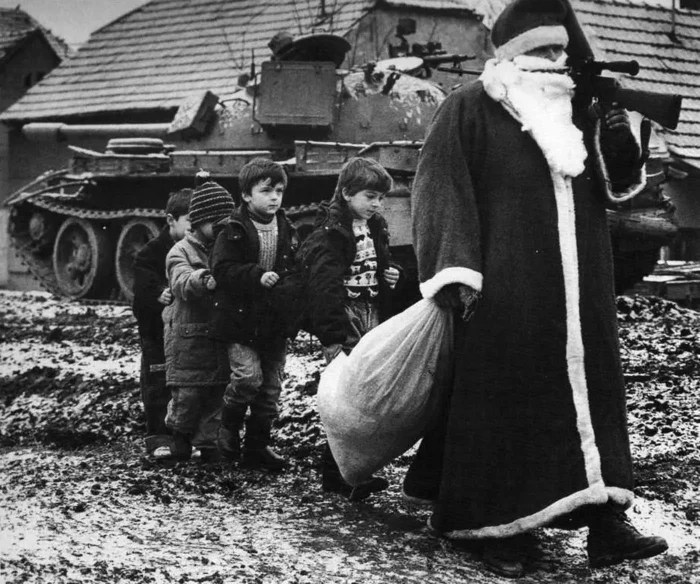
An impactful staged photo, Croatia, Christmas 1992
The European concluded by noting reliance on psychological manipulation to win wars created a “major problem”. Namely, while “a daily publicity blitz of exaggerations and lies may win international support… it will do nothing to heal the divisions which are ripping the country apart.” Locking-in overseas sympathy made Western-backed leaders in the former Yugoslavia less willing to accept negotiated settlements, and keep brutal internecine battles grinding on, safe in the knowledge further carnage only strengthened their position, in information warfare terms.
Notably, a key propaganda strategy for Croats and Slovenes, per The European, was to portray Yugoslav forces “as incompetent and thuggish.” An identical disinformation dynamic played out during the first 18 months of the Ukraine proxy war. As a November 2023 NATO paper on “Humour In Online Information Warfare” revealed, the military alliance and its Kiev puppets specifically sought to weaponise “humour and mockery”, emphasising “Russian failures” and “Ukrainian determination” in media reporting and online, from the conflict’s inception.
These efforts augmented “the responsiveness and impact” of Ukraine’s “information campaigns,” proving “instrumental” in Kiev securing “US-made F-16 combat aircraft” in August 2023, among other Western arms shipments. The NATO paper makes clear weaponisation of mockery is a long-running objective for the alliance, citing a 2017 study, “Stratcom Laughs”, which outlines methods of exploiting “humour” as a military “communications tool”. Four years later, an official Ukrainian government website entry boasted of how such methods can “influence your opinion”:
“How does propagandistic humor work? Relieves tension, makes perception less critical. Uses common contexts to convey messages with which the audience agrees. Simplifies everything to the ‘obvious’. Creates clear groups: strong and intelligent ‘we’ and clumsy and stupid ‘they’. Of course, the audience associates itself with the former and begins to despise the latter. Simplified managed understanding is easily disseminated by the audience and creates the necessary social context for propagandists.”
Atrocity propaganda has also played a crucial role in prolonging the unwinnable quagmire at unsustainable economic, human, and material cost. In April 2022, British intelligence exploited the ever-mysterious Bucha incident to sabotage fruitful peace talks between Kiev and Moscow, framing the apparent killing of innocent civilians in the town as somehow genocidal. At the time, a US Defense Intelligence Agency apparatchik lamented how the “Bucha Effect” had “led to frozen negotiations and a skewed view of the war” – apparently unaware this was London’s precise objective.
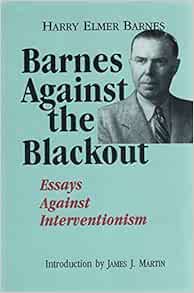
Barnes Against the Blackout
By Spencer J. Quinn | The Occidental Observer | January 2, 2026
In short, there is no unique or special case against Nazi barbarism and horrors unless one assumes that it is far more wicked to exterminate Jews than to massacre Gentiles. While this latter value judgment appears to have become rather generally accepted in the Western world since 1945, I am personally still quaint enough to hold it to be reprehensible to exterminate either Jews or Gentiles.”
—Harry Elmer Barnes
INTRODUCTION
Anyone still questioning the relevance of World War II revisionism to politics today should realize how often our liberal, globalist elites not only invoke World War II, but also ignore, suppress, or besmirch revisionism. Whenever a mainstream personality invites a revisionist on his program, he gets swiftly rebuked and called a Nazi not only by the Left but also by people presumably on the Right. Recently, Jewish commentator Mark Levin invoked the massacre of German civilians during World War II to justify the ethnic cleansing of Gaza. Clearly, whenever someone questions the authority of our liberal elites, they fire back with World War II. Since Adolf Hitler and the Nazis represent the most extreme form of evil and since globalist liberalism is the ideological opposite of Nazism, any form of oppression and aggression by globalist liberals is justifiable—as long as it is aimed against so-called “Nazis.” And if you happen to be against liberalism or globalism these days, it’s only a matter of time before you get dubbed a “Nazi.”
Historian Harry Elmer Barnes understood this perfectly over seventy years ago and promoted revisionism in the face of eerily similar oppression and backlash. Nine of his most incisive essays on the topic—written between 1951 and 1962—are collected in Barnes Against the Blackout, which was published by the Institute for Historical Review in 1991. Several important themes run through these essays. First, Barnes wishes to proselytize revisionism, and does so by constantly referencing and summarizing the great American works of revisionism of his day. These include:
- American Foreign Policy in the Making, 1932-1940 (1946) and President Roosevelt and the Coming of the War, 1941 (1948) by Charles Beard
- America’s Second Crusade (1950) by William Chamberlin
- The Roosevelt Myth (1948) by John T. Flynn
- Pearl Harbor: The Story of the Secret War (1947) by George Morgenstern
- The Tragedy of Europe (1940-1945) and Makers of War (1950) by Francis Neilson
- Design for War (1951) by Frederic Sanborn
- Back Door to War: The Roosevelt Foreign Policy 1933-1941 (1952) by Charles Tansill
Given the suffocating interventionist hysteria of the time, major publishers declined to publish these volumes despite how many of them had been written by prominent, well-respected historians. Either the publishers were ardent interventionists themselves, or they feared backlash from anti-revisionists who wielded great power in America, just as they do today. Except for the Neilson volumes, which were self-published, these works found only two small publishing houses brave enough to publish them: Regnery and Devin-Adair.
Two later volumes which Barnes discusses often are The Origins of the Second World War (1961) by AJP Taylor and The Forced War (1961) by David Hoggan. (See part one of my three-part review of Hoggan here.) These prove to be slight exceptions to Barnes’ America-centric approach since Taylor was British, and, although Hoggan was American, his work was only available in German at the time.
Another crucial theme running through Barnes Against the Blackout is the presentation of the evidence for revisionism. How do we know the official war narratives are less correct than what the revisionists offer? Barnes is never shy about sharing this information—and there is a lot of it. As with many essay collections from a single author about a single topic, there’s much overlap. And that’s okay. It’s never too much of a good thing revealing how President Franklin Delano Roosevelt “lied the United States into war.”
Describing exactly how the establishment suppressed revisionism in Barnes’ day emerges as another important theme. Barnes focuses on it most in his first two essays, both published in 1953: “Revisionism and the Historical Blackout” (which also serves as the first chapter in his collection Perpetual War for Perpetual Peace from the same year) and “The Court Historians Versus Revisionism.”
Barnes’ final theme is also his most speculative: extending revisionism into the Cold War and postulating how it might avert a nuclear Armageddon. Here is where we find Barnes at his most stunningly prescient but also were he winds up, in spots, to be somewhat dated. Through it all, he utilizes George Orwell’s 1984, which never fails to produce a parallel for whatever point Barnes wishes to make. He explores this novel’s uncanny mirroring of reality in the book’s final essay, 1952’s “How ‘Nineteen Eighty-Four’ Trends Threaten American Peace, Freedom, and Prosperity.”
Barnes Against the Blackout is also interesting for its seemingly negligible treatment of the Jews. Barnes says very little about them directly. However, this amounts to what I call an anti-theme because any reader familiar with Jewish power and supremacy can fill in the blanks where Barnes could have opined about the Jews, but didn’t—or at least didn’t seem to. This adds an extra layer of meaning to Barnes Against the Blackout.
THE EVIDENCE
The evidence for World War II revisionism which Barnes compiles appears in two distinct yet related branches of history: Pearl Harbor revisionism and Western European revisionism. For the former, he relies greatly on Tansill, Sanborn, and Morgenstern, and demonstrates how the U.S. not only goaded the Japanese into attacking as a “back door to war” against Japan’s ally Nazi Germany, but also knew where the attack would occur and approximately when, thereby outraging the American public into supporting military intervention. Barnes believes this “constituted one of the major public crimes of human history.”
The major facts line up as so:
- Roosevelt floated war with the Japanese as early as 1933 during one of his first cabinet meetings.
- The U.S. aided and encouraged Chiang Kai Shek to fight against the Japanese in China during the 1930s.
- Days before the Pearl Harbor attack, Roosevelt ignored Japanese Prince Fumimaro Konoye’s peace overtures which proposed humiliating concessions for Japan in return for “a little time and a face-saving formula.”
- In early 1941 Ambassador Joseph Grew had clearly warned that Pearl Harbor would be the likeliest point of attack. Despite agreements from Washington, US forces at Pearl Harbor remained unprepared for it.
- Secretary of War Henry Stimson stated on November 25, 1941 that, “the question was how we should maneuver them [the Japanese] into the position of firing the first shot without too much danger to ourselves.”
- The US had intercepted the “East Wind Rain” message three days before the attack, which clearly signaled Japanese intentions. Yet Admiral Husband Kimmel and Lieutenant General Walter Short, who were responsible for Pearl Harbor, were kept in the dark about it.
Barnes presents most of this information while piercing holes in the specious logic of pro-interventionist works written by what he calls “court historians.” The two most relevant to Pearl Harbor are Herbert Feis, who wrote The Road to Pearl Harbor (1950), and Basil Rouch, who wrote Roosevelt from Munich to Pearl Harbor (1950). Barnes demonstrates how these historians either ignored, distorted, or misconstrued the above evidence. His point is clear: if the notions of Pearl Harbor being a surprise attack and Roosevelt’s naïve innocence about it were lies, there’s no telling what other lies had been told. It turns out there were many.
As for Western Europe, the facts are equally damning, if perhaps more voluminous. All of them cannot be included a single review, but the points Barnes most often bangs home include:
- The diplomatic history of the 1930s, as collected by Taylor and Hoggan, shows that Adolf Hitler did not want war and did what he could to avoid it.
- The diplomatic history also reveals that Hitler had made reasonable requests to Poland regarding the “international” (yet very German) city of Danzig; yet Polish leaders refused to negotiate at the urging of Lord Halifax in England who had given Poland a “blank check” assurance of English military support against Germany.
- In his last report as Chief of Staff in 1945, General George Marshall had claimed that Hitler “far from having any plan of world domination, did not even have any well-worked-out plan for collaborating with his Axis allies in limited wars, to say nothing of the gigantic task of conquering Russia.”
- Hitler had allowed tens of thousands of British troops to escape at Dunkirk “to promote peace sentiments in Britain.”
- Hitler had excellent reasons to invade the Soviet Union since the Soviets had “practiced sabotage, terrorism, and espionage against Germany, had resisted German attempts to establish a stable order in Europe, had conspired with Great Britain in the Balkans, and had menaced the Third Reich with troop concentrations.”
- Documentary evidence, such as “The German White Paper” found by the Germans after their conquest of Poland, demonstrates the extent to which American ambassador William Bullitt had assured Poland of American military support in the event of war with Germany. This was corroborated by Czechoslovak president Eduard Benés who claimed in his autobiography that on May 29th, 1939 Roosevelt himself had assured him that if war broke out in Europe, America would join the fight against Germany.
- The Lend-Lease program, the “Destroyer Deal” between Britain and the United States, the secret Tyler Kent documents, and Roosevelt’s 1941 meeting with Winston Churchill in Newfoundland offer circumstantial evidence that Roosevelt had clear belligerent intentions well before war was declared.
As with Pearl Harbor, Barnes often presents this evidence while reviewing books written by court historians. The most prominent of these is The Struggle Against Isolation, 1937–1940 (1952) by William Langer and SE Gleason. Despite never proclaiming Hitler’s innocence, Barnes repeatedly stresses that the man’s sole responsibility for starting the war is a complete falsehood—a falsehood which is the foundation of all post-1945 politics. In his 1962 essay “Revisionism and Brainwashing,” he states with characteristic flourish:
It is unlikely that there has been any vested interest in dogma, opinion, and politics since the birth, death, and resurrection of Jesus Christ equal in intensity to that built up around the allegation that Hitler was solely responsible for the outbreak of war in 1939.
One interesting side note: Barnes implies more than once that it was Hitler’s actions in East Asia rather than Europe which truly antagonized Roosevelt. This contradicts some of Barnes’ other claims about Roosevelt’s opposition to Hitler vis-à-vis Europe. Take, for example, this paragraph from the essay “Rauch on Roosevelt”:
Indeed, it was only in 1938, when Hitler recalled his military mission from China, where Nazi officers had been directing the forces of Chiang Kai-shek against the Japanese, that Roosevelt became actually hostile to Hitler in his policies, whatever the previous rhetoric. Right down through the Spanish Civil War, Mr. Roosevelt condoned when he did not favor, most of Hitler’s policies. Even as late as August, 1939, it appears from the Nazi Soviet Relations that Roosevelt was inclined to put nothing in the way of Hitler if he abandoned support of Japan, sent his military back to help Chiang, and delivered arms to the Chinese.
This is an interesting conundrum considering that Barnes brings up Benés’ recollection from May 1939 in the same essay.
THE BLACKOUT
Barnes spills a lot of ink outlining the ways in which revisionism was suppressed and marginalized after 1945. This often resulted from mainstream historians either having vested professional interests in perpetuating the “good war” myth of World War II—since they themselves promoted it while it was happening—or they sought the wealth, fame, and opportunity afforded to academics who adhered to the official narrative of the war.
In “Revisionism and the Historical Blackout” Barnes enumerates the following methods of suppression:
- Excluding revisionists from official documents, while allowing state-approved court historians free access to them
Barnes describes how revisionist historians had been barred from viewing many sensitive documents and in some cases had had their own notes confiscated after viewing the ones they were allowed to see. Barnes concedes that Charles Tansill did ultimately view more documents than other revisionists, but Tansill did not enjoy the free reign of information afforded to court historians like Langer and Feis.
- Intimidating publishers into not publishing revisionism
Barnes describes how political pressure groups not only ensured that revisionist volumes would not sell, but made it clear that publishers releasing such material would face business-crippling backlash. Barnes recalls how a major publisher explained this to him despite his personal sympathies towards revisionism. Libraries, book clubs, and nationwide periodicals also contributed to this blackout. Barnes mordantly notes that the post-1945 “Blackout Boys” outdid the Nazis in suppressing honest intellectual inquiry.
- Ignoring revisionist works that do get published
Barnes demonstrates how the majority of revisionist works simply did not get reviewed in important mainstream publications—or when they did, as with the case of Charles Beard, they received either cursory attention or were maliciously panned. It almost goes without saying that this silent treatment was not afforded to court historians, whose works received ample praise everywhere. Barnes relays the following recollection from journalist Oswald Garrison Villard to illustrate his point:
I myself rang up a magazine which some months previously had asked me to review a book for them and asked if they would accept another review from me. The answer was, “Yes, of course. What book had you in mind?” I replied, “Morgenstern’s Pearl Harbor.”
“Oh, that’s that new book attacking F.D.R. and the war, isn’t it?”
“Yes.”
“Well, how do you stand on it?”
“I believe, since his book is based on the records of the Pearl Harbor inquiry, he is right.”
“Oh, we don’t handle books of that type. It is against our policy.”
- Smearing revisionists personally
Barnes offers several examples of ad hominem attacks upon revisionist historians by the “Smearbund,” as he calls them. Often “isolationism” itself became a slur, as if labeling a person thusly were reason enough to dismiss him. More often, however, reviewers would attempt to ruin a revisionist’s reputation by imputing some evil or underhanded motive rather than argue the facts. Barnes notes how reviewers used phrases such as “bitterly partisan” or “blind anger” when describing Morgenstern while ignoring their own partisan anger. He also notes how one reviewer attempted to discredit Beard because he was hard of hearing and lived on a farm. One reviewer freely admitted to lambasting The Forced War without having read a word of it.
THE COLD WAR AND BEYOND
In his 1954 essay “The Chickens of the Interventionist Liberals Have Come Home to Roost,” Harry Elmer Barnes introduces the idea of the “totalitarian liberal.” Such men (as exemplified by Arthur Schlessinger Jr.) distinguished themselves from pre-World-War-II liberals in their lust for power and abandonment of principled anti-interventionism. Such men make up James Burnham’s managerial elite as described in his 1941 work The Managerial Revolution, which Barnes discusses. Such people reject “the coexistence of conflicting political and economic systems,” and in so doing promote a “we or they psychosis” which enables elites to wage war in the name of “collective security,” a notion which Barnes finds utterly spurious. This is how it was during World War II and it was no different during the Cold War, according to Barnes, except that both sides were mutually deterred by nuclear weapons.
Barnes further extends revisionism into the Cold War in his 1958 essay “Revisionism and the Promotion of Peace.” He remembers how despite standing against World-War-II intervention, patriotic political organizations like America First later fell in line with Cold War intervention “because of the business advantages in industry, trade and finance which an extravagant armament program provided.” President Eisenhower’s “military industrial complex,” in other words. In light of this, Barnes’ passionate belief in the critical importance of revisionism becomes crystal clear. If standing against intervention in 1939 could have spared tens of millions of lives, standing against it during the Cold War could spare humanity a nuclear Armageddon. Indeed, the specter of World War III haunts much of Barnes Against the Blackout.
The final essay in the collection, “How ‘Nineteen Eighty-Four’ Trends Threaten American Peace, Freedom, and Prosperity” takes the Cold War comparison even further. The “we or they psychosis” becomes the “war psychology,” which led to the absurdity of “perpetual war through perpetual peace.” This is straight out of Orwell’s 1984, which Barnes calls “the keenest and most penetrating work produced in this generation on the current trends in national policy and world affairs.” In the novel, Big Brother (whom Barnes considers a totalitarian liberal) manufactures phony outrages to prolong phony wars designed ultimately to consolidate very real power for himself and the elite classes. And the masses are either hypnotized enough by propaganda, intimidated enough by government, or distracted enough by entertainment to go along with it. Meanwhile, all reliable historical material is destroyed to disconnect the people from their past—just like what the Blackout Boys tried to do with revisionist accounts of World War II. Barnes sees 1984 as a direct mirror to reality.
And there is much truth to this, as shown by how Barnes uses his “Orwell Formula” to predict the Vietnam War as early as 1952:
The declining public interest in the Korean War has made President Truman and his associates the more willing to accept Churchill’s proposal to shift the main psychological impact of the cold war to Indochina, where it may both revive flagging American fear and excitement and also more directly protect adjacent British interests. The Orwell formula has been faithfully worked out in first directing fear and hatred against Nazi Germany, then against Soviet Russia, next shifting antagonism more toward Communist China, and then moving the chief center of interest in the struggle against the latter from Korea to Indochina.
Despite the clarity and prescience of this essay, Barnes makes a few questionable calls. In keeping with his aversion to the Orwellian doublethink of Cold War psychology and hysteria, he impugns the Truman Doctrine as a sham meant to “rehabilitate Mr. Truman’s fast-fading political prospects.” He also paints the USSR in a more benign light than it deserves—as if the United States were the aggressor during the Cold War and had no legitimate reason to employ deterrence or containment strategies against Communism. And in 1952, perhaps the Soviets did seem to some as unlikely to pose a real threat to American interests. But this was before they detonated their first hydrogen bomb in 1953. This was before their invasion of Hungary, and the Berlin Wall, and the Cuban Missile Crisis, and a host of other threatening actions. While Barnes makes excellent points about the injustice of blacking out revisionism, this was nothing compared to the psychological warfare the Soviets waged for decades against its own people which culminated in the terror famines, the Great Terror, and the gulags.
It seems that the Soviet Union during the Cold War made for a much more appropriate nemesis than did Nazi Germany. That Barnes seems to disagree, however, is not my bone of contention here. For all I know, Barnes is correct. However, the time he should have spent dispensing with counterarguments from seasoned cold warriors like George Kennan (who barely gets a mention in Barnes Against the Blackout) was instead spent admiring the life-imitating-art impact of 1984. Interesting and enlightening for sure, but hardly the final word on the subject.
THE JEWS
Direct treatment of the Jews in Barnes Against the Blackout rarely rises above incidental. Many of the “court historians” and “Blackout Boys” Barnes mentions do happen to be Jewish—Herbert Feis, Max Lerner, and Selig Adler are some obvious examples. However, just as many if not more are gentiles, such as William Langer, Samuel Eliot Morison, and Samuel Flagg Bemis. In his essays, Barnes never singles a person out as being Jewish. This certainly protects him from the charge of Jew-baiting, but it also prevents him from drawing conclusions from the fact that while a substantial proportion of anti-revisionists were Jews, none of the nine major revisionists mentioned in Part 1 were—clearly a meaningful data point.
When he does mention American Jews directly, it’s only to let them off the hook for pushing Roosevelt into war. In 1962’s “Blasting the Historical Blackout,” he states flatly that:
Roosevelt did not need any pressure from the Jews to create his interventionism and war policy. There is little evidence that he was deeply disturbed by Hitler’s anti-Jewish policy; he was much more annoyed by the fact that Hitler’s “New Deal” had succeeded in spectacular fashion while his own had failed to bring prosperity to the United States.
Maybe this is true, but it does not mean that influential Jews in media, finance, academia, and politics were not enthusiastic if not crucial facilitators of Roosevelt’s war policy. In his 2013 work How the Jews Defeated Hitler Benjamin Ginsburg describes how American Jews professed fierce loyalty to Roosevelt and did what they could to embroil the United States in a war with Germany. As I stated in my review:
Ginsburg describes how Jews in the private sector also war mongered during this time. The heavily Jewish Century Group called for a declaration of war against Germany following the surrender of France in 1940. The press also aided Jewish belligerence through its pro-Jewish bias. For example, when Lindbergh and the Century Group’s General John Pershing were giving speeches around the same time, the Jewish-owned New York Times gave Pershing front-page coverage and relegated Lindbergh to the back pages.
The Fight For Freedom Committee was more “all out” in its pro-war activities than the Century Group.
The FFF organized a nationwide effort –with the tacit support of the White House and the behind-the-scenes support of the British Embassy—to discredit isolationists and to mobilize public opinion against Germany and in support of American participation in the war.
And by “discredit,” of course, Ginsburg means ruthlessly slander and smear. The FFF thought nothing of labeling leading isolationists and America-Firsters like Lindbergh as Nazis, fascists, or dupes of the Axis. Ironically, they would often question the patriotism of such people as a form of intimidation which preceded the McCarthy era by over a decade. For example, because Senator Burton Wheeler wished to prevent the slaughter of American lives in an unnecessary war, the FFF declared that he was a “twentieth century Benedict Arnold.” The FFF also spied upon and collected compromising information on isolationists in Congress, such as Hamilton Fish. As it turned out, the FFF discovered that Fish’s people were distributing pro-German literature and were in contact with German agents. One of Fish’s secretaries went to prison for that. At the same time, however, Ginsburg informs us that the FFF was in constant contact with British agents. Just as insidiously, the FFF and other groups planted moles at isolationist rallies in order to disrupt them.
So perhaps President Roosevelt didn’t need Jews to change his mind, but he certainly needed them to change the minds of the millions of Americans he tried to deceive. Unfortunately, Barnes entirely avoids this point. His minimal treatment of the Jewish Holocaust in Barnes Versus the Black also deserves comment. He exerts almost no effort in placing it within his blackout vs. revisionists framework. Instead, he brushes it aside by saying that the Germans ultimately suffered more than the Jews did. He’s also skeptical that the Jewish Holocaust was the enormous atrocity it was purported to be:
There is little in the history of mankind more horrible than the sufferings of the Germans expelled from their eastern provinces, the Sudeten area, and other regions, some four to six millions perishing from butchery, starvation, exposure, and disease in the process. Their sufferings were obviously far more hideous and prolonged than those of the Jews said to have been exterminated in great numbers by the Nazis. The tragedy of Lidice was re-enacted by the Czechs hundreds of times at the expense of the Sudeten Germans during the expulsion. The Morgenthau Plan, which was inspired by Stalin and his associates and passed on to Henry Morgenthau by Harry Dexter White and other Soviet sympathizers, envisaged the starvation of between twenty and thirty million Germans in the process of turning Germany into a purely agricultural and pastoral nation.
Barnes never voices any support or approval of Adolf Hitler. He admits the man was at times cruel and erratic; then again so were Churchill and Roosevelt. As far as honest statesmanship goes, however, Hitler was actually on a higher plane than any of the Allied leaders. This is a demonstrable fact, one that is borne out by the diplomatic history of the 1930s as revealed by Hoggan. One does not have to love or even like Hitler to see that of all the major world leaders of the time, he was the least responsible for war. Barnes also refuses to demonize Hitler, and actually gives space for arguments claiming that Hitler had been too soft while conducting the war. To Hitler haters, this may sound like apologism, but it really isn’t. In “Blasting the Historical Blackout” Barnes dismisses Hitler’s Jewish policy as “folly” and correctly notes that it was this, rather than any foreign policy, which engendered anti-German hatred in Allied countries. He also recalls proudly how Rabbi Stephen Wise—the rabid, Hitler-hating Jew who led the worldwide Jewish boycott against Nazi Germany—once reprinted articles by him decrying Hitler’s anti-Semitism. Barnes even states that for a decade after 1945—which is smack dab in the middle of the Barnes Against the Blackout timeline—he had wished that Hitler had been assassinated in 1938 or early 1939, which would have avoided the catastrophe of a second world war.
In light of this, it cannot be said that within the pages of Barnes Against the Blackout Harry Elmer Barnes is anti-Semitic. He’s not philo-Semitic either. Instead, like any true historian, he’s anti-Falsehood and pro-Truth. Of course, he may be right or wrong, but never does he relinquish the discipline and objectivity required of great historians to keep civilization tethered to its past so it cannot go astray in its future.
CONCLUSION
There are many minor themes running through Barnes Against the Blackout which contribute to its value. Most notable is the topic of World War I revisionism, for which Barnes was an outright champion. His 1926 work Genesis of World War made him famous in this regard. Barnes often compares and contrasts revisionism from both World Wars and demonstrates how suppression and groupthink after the latter was much more insidious and comprehensive. He also offers examples of revisionism going back to antiquity.
Like Orwell, Barnes likes to invent neologisms and slogans. My favorites are “perpetual war for perpetual peace,” “globaloney,” the “Blackout Boys,” and the “Smearbund.” His 1962 essay “Revisionism and Brainwashing” is especially poignant in its descriptions of how modern Germans had been brainwashed into accepting their own culpability and shame. Some of the most ardent anti-revisionists of Barnes’ day were post-war Germans themselves, whom, Barnes suspects, feared the equivalent of a third Punic War. Barnes also drops historical Easter eggs everywhere. Did you know that the Roman theologian Paulus Orosius smeared the ancient pagans just as outrageously as court historian Herbert Feis smeared the Japanese? Or how about how Renaissance Scholar Lorenzo Valla proved that the 4th-century Donation of Constantine decree, which solidified the secular power of the Pope, was in fact an 8th-century forgery? It took Europe 350 years to come around to this fact. Barnes hopes it won’t take Europeans nearly as long to come around to the forged history of World War II.
If Harry Elmer Barnes has any personal bias in Barnes Against the Blackout it’s one that favors peace and an honest accounting of history. Because the so-called leaders of the free world gave us neither in the 1930s and 1940s, tens of millions needlessly perished. And with globalist liberalism still supreme today, being the root cause for mass third-world immigration into America and Europe, we continue to suffer from the effects of the catastrophe of World War II. Barnes himself said it best: “Revisionism is not only the major issue in the field of historical writing today but also the supreme moral and intellectual concern of our era.”
How Intelligence, Politics, and Foreign Interests Shaped America’s Religious Movements
By Freddie Ponton | 21st Century Wire | December 30, 2025
Christianity is back at the centre of American life, but not necessarily in the way most believers imagine. Churches are fuller, Christian language saturates politics, and faith-based identity has become a mobilising force once again. Yet beneath this revival lies a more unsettling reality: for decades, U.S. government agencies have treated religion not as sacred ground, but as strategic terrain.
This is not theory. During the Cold War, the U.S. State Department and intelligence agencies, most notably the CIA, recognised theology, doctrine, and religious institutions as instruments of influence. Faith was studied, guided, and at times quietly reshaped to serve geopolitical aims. The goal was rarely to destroy belief outright; rather, it was to domesticate it, align it, and render it strategically useful.
DOCUMENT: CIA’s use of journalists and clergy in intelligence operations – Select Committee On Intelligence Of The United States Senate One Hundred Fourth Congress, Second Session, July 17, 1996 (Source to download full pdf: US Senate Select Committee on Intelligence)
Initiatives like the Doctrinal Warfare Program illustrate the scale of this engagement. Churches with mass followings, moral authority, and transnational reach were not simply tolerated; they were targeted for influence. Orthodox congregations in the U.S. and abroad were monitored to ensure alignment with Western interests. Catholic seminaries became conduits for doctrinal shaping, funding networks, and leadership development favourable to U.S. objectives. Even Protestant and Evangelical movements, decentralised and spontaneous, were quietly steered through cultural engagement, philanthropic networks, and selective amplification of certain voices.
Sincere people seeking truth, purpose, and transcendence found themselves caught in influence systems they neither designed nor understood. Their worship, community, and faith became tools in a broader psychological and cultural battle they never consented to.
Doctrinal Warfare: When Theology Became a Battlefield
The CIA’s Doctrinal Warfare Program, particularly its work with Roman Catholic institutions, offers a rare glimpse into how intelligence agencies approach faith. Unlike cinematic portrayals of spies manipulating events, this program operated through subtler, more effective channels.
Influence was exerted via:
- Funding pipelines and philanthropic foundations, directing resources to seminaries, clergy travel, and publications
- Theological conferences and academic exchanges, creating opportunities to propagate ideas aligned with U.S. interests
- Publishing houses, journals, and media networks, shaping what doctrines and interpretations were elevated
- Selected intermediaries, often clergy or theologians, who could subtly shift discourse without appearing coerced
The program’s goal was not to dictate belief directly but to frame the boundaries of acceptable belief. Anti-communism, Western liberal ideals, and American exceptionalism were integrated into theological narratives. Over time, certain interpretations were elevated while others, particularly liberationist, socialist, or anti-Western emphases, were sidelined.
This structural influence was not limited to Catholics. Orthodox churches in the diaspora, particularly in Eastern Europe and North America, were monitored for political alignment. Protestant and Evangelical networks, decentralised and emotionally charged, presented different challenges. Leaders resisted hierarchical oversight, yet strategic use of media, donor support, and conferences quietly aligned these movements with larger political and global objectives.
The CIA and allied agencies like the Israeli MOSSAD also monitored global religious developments, from Latin America to Africa, mapping networks of clergy, seminaries, and youth movements. Influence became a form of psychological warfare: it did not coerce, but conditioned; it did not command, but subtly steered. And it thrived where people least expected manipulation, within trusted communities, sacred spaces, and moral authority.
VIDEO: David Wemhoff discusses his book John Courtney Murray, Time/Life, and the American Proposition: How the CIA’s Doctrinal Warfare Changed the Catholic Church. (Source: thkelly67 | Youtube)
Calvary Chapel, Charismatic Leaders, and the Power of Movements
Few movements illustrate both the promise and vulnerability of modern American Christianity like Calvary Chapel.
Founded in the mid‑1960s by Chuck Smith in Costa Mesa, California, Calvary Chapel emerged amidst the counterculture and the Jesus Movement. Smith welcomed surfers, hippies, and spiritual seekers alienated by both secular culture and institutional religion. Informal, emotionally open, culturally adaptive—and extraordinarily successful—it grew from a small congregation into a network of more than 1,800 churches worldwide.
Despite the ongoing debate about whether Calvary Chapel was created by individuals controlled by intelligence agencies or by charismatic individuals, the movement demonstrates a lesson intelligence agencies recognised decades ago: youth-driven religious networks are powerful instruments of social, political and cultural influence.
Figures like Lonnie Frisbee, a magnetic and unconventional evangelist, helped ignite the Jesus Movement and played a decisive role in Calvary Chapel’s early expansion. Frisbee’s countercultural persona, preaching on beaches, leading communal outreaches, and drawing thousands of young converts, was a force institutions could admire, attempt to understand, but never fully control.
Similarly, Paul Cain, a prophetic figure in charismatic networks, influenced theological subcultures with a focus on vision, revelation, and spiritual authority. According to reports, Cain was also a consultant to the Paranormal Division of the Central Intelligence Agency and the FBI. Like Frisbee, Cain became controversial, not because he was a confirmed intelligence operative, but because charismatic authority challenges hierarchical control, making it both influential and unsettling.
Calvary Chapel and these figures illustrate a key pattern: movements can grow organically, capture attention, and mobilise communities, making them valuable, and sometimes threatening, to political and intelligence structures. While the direct manipulation claims and the CIA militant connection remain debatable, historical examples like the Doctrinal Warfare Program prove that states do seek to shape religious institutions at scale, often through indirect methods rather than overt control, hence the lack of evidence thereof.
From Pews to Power: Evangelical Politics, Israel, TPUSA, and the Cost of Capture
By the late 20th century, Evangelical Christianity had evolved into a political powerhouse. Networks that began as spiritual awakenings now functioned as engines of political mobilisation, with youth-oriented, media-savvy outreach bridging the gap between churches and the political arena.
TPUSA and Charlie Kirk
Organisations like Turning Point USA (TPUSA) drew from these ecosystems, churches, conferences, campus ministries, and donor networks that had been shaped by decades of cultural, doctrinal, and ideological influence. Faith-language blended seamlessly with nationalism, free-market rhetoric, and civilizational anxiety, mobilising millions of voters.
The 2024 U.S. presidential election highlighted the real-world impact: Evangelical networks were decisive in returning Donald Trump to the White House. For believers, this was framed as a moral imperative or spiritual duty. For observers, it revealed how religious movements could be strategically leveraged within political frameworks.
The assassination of Charlie Kirk, co-founder of TPUSA, shocked the nation and intensified national reflection. While there is no direct evidence ( at least not yet), linking churches or religious movements to the attack, the public reaction underscores a critical truth: powerful social networks rooted in faith become conduits of influence, whether intended or incidental.
As unsettling as it may be for the US government, it is worth noting that an intense social-media rift has emerged between TPUSA and podcaster Candace Owens, with competing narratives and accusations fueling distrust of official accounts surrounding the Charlie Kirk killing at UVU. Interestingly, some critics, Candace Owens among them, contend that the assassination of Charlie Kirk carries the hallmarks of a sophisticated intelligence-style operation, raising uncomfortable questions about whether certain figures within TPUSA may have been more deeply entangled in the events than the public has been led to believe. A decentralised, global network of self-styled citizen journalists is currently crowdsourcing footage, timelines, and open-source data, arguing that gaps and inconsistencies warrant deeper scrutiny beyond mainstream reporting. This phenomenon has amplified public pressure on agencies such as the FBI and on TPUSA to clarify unanswered questions and reconcile discrepancies in their account of the events of September 10, 2022.
Much like the unresolved shadows that followed the JFK assassination, Charlie Kirk’s killing has placed intelligence agencies, the military, the FBI, and even foreign actors like Israel at the center of a fraught public controversy, not through proven culpability (at least not yet), but through the swirl of suspicion and unanswered questions that inevitably surround the death of a defining religious and political figure in the American conservative sphere, leaving many to ask whether this is coincidence or something more troubling left unexplained.
Christian Zionism and Israeli Influence
No discussion of modern Evangelical power is complete without considering the strategic relationship between U.S. Evangelicals and the State of Israel.
This alliance is public and well-documented. Evangelical Christians, especially in the United States, became one of the most reliable pro-Israel voting blocs, influenced not just by policy arguments but by theological frameworks, Christian Zionism, which frames Israel as divinely central to biblical prophecy.
Israeli political leaders and advocacy organisations have cultivated this alignment via:
- Pastors’ conferences in Israel
- Evangelical media networks and tours
- Donor networks and lobbying partnerships
Organisations such as Christians United for Israel (CUFI) mobilise millions of voters, influence Congressional votes, and amplify foreign policy priorities. During the Trump administration, these networks helped drive decisions like the Jerusalem embassy relocation, Iran policy shifts, and strengthened U.S.-Israel alignment.
Yet this partnership is not uncontested. Younger conservatives and Evangelicals, particularly those aligned with independent thinkers like Charlie Kirk, increasingly question whether faith-based loyalty to foreign policy interests undermines America-first priorities. This generational tension highlights a growing divergence within conservative Christianity: between inherited religious-political alliances and emerging calls for national sovereignty, prudence, and domestic priority.
Moreover, the case of Turning Point USA illustrates how foreign influence can intersect with faith-based movements to shape political power. TPUSA’s open alignment with pro-Israel advocacy networks, from educational trips and conferences to donor engagement, demonstrates how theological and ideological commitments can be leveraged to advance strategic interests. This organisational alignment and associated messaging reveal a clear pattern of external actors using popular religious and political networks to sway domestic policy and voter priorities in the United States. This dynamic mirrors broader trends seen in movements like Calvary Chapel, where charismatic leaders and faith communities, intentionally or not, become conduits for shaping societal and political behaviour, highlighting how belief can be instrumentalised as a tool of influence. Believers are constantly reminded by pastors such as Garid Beeler, of VISION Calvary Chapel in Irvine, CA, that they need to unconditionally embrace the so-called God’s plan for Israel, which in their eyes legitimises Israel’s occupation of Palestine, and the subsequent genocide, on the basis that the Lord specifically gave the Hebrews the land thousands of years ago.
Believers as Collateral in the Machinery of Influence
The story of institutional capture is not about disloyal Christians or malign churches. It is about power exploiting vulnerability.
The State Department, CIA, and allied actors like Israel did not invent faith crises, but they mastered the art of steering movements. They understood that belief motivates action, doctrine shapes identity, and institutions built on trust are uniquely vulnerable to manipulation.
Jay Dyer’s analysis, which we are featuring today, frames this landscape without demonising believers: faith itself is not the enemy, but it has been treated as a resource, managed, redirected, and at times hollowed out by forces whose goals are strategic, political and financial, rather than spiritual.
If Christianity is to withstand this era with integrity intact, it will require discernment, humility, vigilance, and, of course, the ability to separate the Gospel from the machinery of power. The war was never against believers, but belief, as an institution, has been under attack all the same.

Jay Dyer writes about the historical and geopolitical factors of state and private interference in ecclesial and religious affairs…
Institutional Capture Explained: The State Dept, CIA & Orthodox, Roman Catholic & Protestant Churches
The notion of state interference in the life of the Church is well known to students of Church history: Arian Emperors, Imperial support for iconoclasm, the Frankish and Germanic control of the papacy, as well as the investiture controversy should all come to mind. These famous scandals demonstrate the persistent cunning on the part of the state to install, influence and control religiosity in the realm, and to students of geopolitics this should also come as no surprise. What is odd, however, is that when this concept arises in modern discussions, it is relegated immediately to the domain of “conspiracy theory,” unless of course you are talking about the KGB and NKVD relationship to Russian clerics in the 20th century.
It only turns out to be a “conspiracy theory” when one points to the US State Department, the CIA, various foundations, NGOS and academic institutions (often closely linked to the intelligence apparatus) – all of whom openly seek to alter and change Orthodox theology, as well as the theological positions of the Roman Catholic and Protestant communions. First, it is worth noting that missionary work is a classic espionage cover: Obviously, I don’t mean all missionaries are spies, but that it has famously been a useful cover for espionage work, which is precisely why Russia has recently banned groups like the Jehovah’s Witnesses and Scientology. These entities can be used as a form of soft power or even more covert intelligence operations. Similarly, classic cover for foreign operations of this sort has used aid organisation cover, such as the Red Cross or USAID.
In fact, even mainline publications regularly report this fact, though it seems to be lost on so many, especially among the intelligentsia who pride themselves on grasping the practicality of realpolitik. Christianity Today writes:
“Many of America’s first spies were missionaries or came from missionary backgrounds. Often enough, they were the only Americans who had lived abroad—not just among locals but as locals. While other American spies learned about the world through books and couldn’t really grasp its full range of quirks and complexities—“like tourists who put ketchup on their tacos,” as Sutton puts it—missionaries spoke several languages and knew the subtle differences between local dialects. They understood local cultures and faiths from the ground up and knew intuitively how to navigate between them. They knew, in short, “how to totally immerse themselves in alien societies.” But they always identified first and foremost as Christians and as Americans, and when they were called to serve the nation, they did not hesitate to do so.”
This was not unique or new; Orthodox monastic spies were also used by British intelligence in the infamous case of “Father Dimitrios”:
“The story of Father Dimitrios, or David Balfour, who turned out to be a British spy in pre-World War II Greece, is a fascinating yet relatively little-known chapter in modern Greek history.”
Father Dimitrios, the monk with the voice of an angel, turned out to be a spy for the British Intelligence Service. That’s a shame because the mission and wartime actions of the British priest could make a nail-biting spy novel or film.
From 1937 to 1939, the English spy, wearing his priest’s robes and his long, bifurcated beard, performed his ecclesiastical duties close to Greece’s royal family. His relations with King George II, the successor to King Paul and Princess Frederica, were especially close. His access to the royal palace undoubtedly gave him access to valuable information.
British Intelligence must have learned a great deal about the Greek royal family during these crucial prewar years. King George II was a paternal first cousin of Queen Elizabeth’s husband, Prince Philip, the Duke of Edinburgh.
Members of the royal family often confessed to their beloved priest. At the same time, Balfour, under the cover of Father Demetrios, forged important acquaintances with high-ranking military officers and politicians with the blessings of the palace.
During World War 2, for example, dozens of missionaries were using their clerical cloaks as their espionage cloak, spying for the Allies. Time Magazine explains:
“His [Protestant Missionary Alfred Eddy] most audacious undertaking included a plot to “kill,” as he described it, “all members of the German and Italian Armistice Commission in Morocco and in Algeria the moment the landing takes place.” In a straightforward and matter-of-fact memo, he told OSS head William Donovan that he was targeting dozens of people. He additionally ordered the executions of “all known agents of German and Italian nationality.” Never one to mince words, he called the proposal an “assassination program.”
To orchestrate his bloodthirsty plot, Eddy hired a team of Frenchmen. He planned to frame the executions as a “French revolt against Axis domination.” “In other words,” he explained to Donovan, “it should appear that the dead Germans and Italians were ‘the victims’ of a French ‘reprisal against the shooting of hostages by the Germans and other acts of German terror,” and not an OSS operation.
At about the same time that he was recruiting French hitmen, he wrote to his family about the sacrifices he was making for Lent. He described the Easter season as “abnormal” this year. “I am certainly abstaining from wickedness of the flesh,” he confessed. With his wife thousands of miles away, that was not too difficult. “I haven’t even been to a movie since Lisbon, I don’t overeat anymore, and I allow myself a cocktail at night, but never before work is all done.”
And,
“American intelligence leaders had stumbled upon the fact that missionaries make great spies. They have excellent language skills, they know how to disappear into foreign cultures, and they are masters at effecting change abroad. But while missionary spooks believed that their wartime work was necessary, they also wrestled with the moral ambiguities inherent in their actions.”
This is just one example among countless, but it serves to illustrate the point – in this case, the supposed man of the cloth is engaged in assassination missions. A fortiori, the US Government would also see the power in utilising religion for the promotion of Americanism. During the Cold War this was ramped up to extreme degrees as CIA operatives and strategists like C.D. Jackson allied with media magnate and Skull & Bonesman Henry Luce – of Time Magazine, to recruit various prominent academics and Jesuits like John Courtenay Murray to help ensure the Vatican and in particular the Second Vatican Council, would include in its dogmatic degrees new doctrinal statements that were amenable to Americanism. This unique style of interference was even highlighted by a congressional investigation in 1996 into the CIA’s use of ministers and journalists here (including Peace Corps Volunteers).
This was combined with separate operations from Helliwell, Angleton, Donovan & Colby to utilise Opus Dei, the Vatican Bank and drug running for black operations funding in the now infamous Operation Gladio, which also saw the See of Rome aligning itself with organised crime to supposedly “save the world from communism.” However, as Catholic lawyer David Wemhoff has demonstrated in his masterful and unparalleled 800-page, vastly sourced tome, John Courtney Murray, Time/Life Magazine and the American Proposition, Jackson’s now declassified “Doctrinal Warfare Program” led the Roman Church into the hands of new masters at the US State Department and the CIA.
Indeed, this is precisely why Pre and Post-Vatican 2 popes, from Pius XII to Paul VI to John Paul 2 were meeting with Colby, Kissinger and William Casey on a consistent basis during the Cold War. And, if you are a perceptive reader, you can already piece together the blackmail and compromise operations that the world has seen through the Epstein saga were simply a window into how these institutions were similarly blackmailed and compromised, which is why there have been so many scandals in the Roman Church concerning pedo crimes, and likely relates to why Benedict resigned.
In regard to the Protestant Churches, the Rockefeller family is quite proud of, and openly brags about their influence and dominance of the Protestant religious world, through their donations and tax-free foundation offerings. These offerings, of course, come with strings attached, such as the decision to push the newly formed “social gospel” concept of the early 20th century. Eventually, the Rockefellers were creating entire seminaries and universities dedicated to the promotion of David’s influences from Keynesian/Fabian and Austrian economic theory, as well as Malthusianism and eventually technocracy, through the recruitment of Zbigniew Brzezinski after the publication of his seminal 1970 text, Between Two Ages: America’s Role in the Technetronic Era.
Few know David Rockefeller himself spent time in intelligence work and transferred this knowledge of networking and banking operations into his business ventures, as he discusses in his Memoirs. In fact, Brzezinski’s book also includes chapters discussing the role of the Post-Vatican 2 Roman Catholic Church in the promotion of Americanism and technocratic hegemony. It should also be noted that the Rockefellers didn’t merely have an interest in steering the Protestant and evangelical churches into liberalism and modernism, but also set their sights on Rome and Orthodoxy, as Wemhoff notes.
For the Orthodox World, the price of siding between two thieves came at a high cost, as the Orthodox England blog notes, concerning the place of the Russian Orthodox Church between the KGB and the CIA. Similarly, it has recently been declassified that the OSS placed pressure on the Patriarch of Constantinople, as the CIA said:
“In an OSS interoffice memo dated March 26, 1942, an intelligence agent named Ulius L. Amoss wrote this to a fellow OSS agent named David Burns:
The Archbishop was extremely pleased at having met and lunched with you. He has told me that the entire facilities of his organisation are at our disposal. He put it in these words: “I have three Bishops, three hundred priests and a large and far-flung organisation. Everyone under my order is under yours. You may command them for any service you require. There will be no questions asked, and your directions will be executed faithfully. Please tell Mr Burns for me that this is so.”
A month later, on April 25, the 56-year-old Greek Archbishop attempted to enlist in the U.S. Army. He was turned down.
A few weeks after that, on May 14, Ulias Amoss, the same intelligence agent who wrote the March 26 memorandum, wrote a letter to Athenagoras, thanking him for the Greek Archdiocese’s ongoing cooperation, saying, in part, “The care with which your Bishops and Priests have cooperated has impressed everyone and the report that, perhaps, as many as a hundred thousand names will be returned to us is astounding.” On the same day, William J. Donovan himself — the head of the OSS — also wrote to Athenagoras, “The reports and descriptions of Greek-American youth of military age so kindly undertaken by you are coming in in splendid volume. The care with which Your Grace has managed this important service is of great interest to our armed services, and I wish to express my deep appreciation for your loyal and patriotic assistance.”
This special relationship with US intelligence never ended and continues to this day as the backdrop to the actions of the Phanar and GOARCH in the US:
“Archbishop Elpidophoros, the head of the Patriarchate of Constantinople’s Greek Orthodox Archdiocese of America, was the honoured guest at the National Intelligence University in Maryland earlier this week, where he delivered an address to the U.S. intelligence community.
The university brings together faculty and students from all 18 of the nation’s intelligence communities.
As the Greek Archdiocese notes, the Archbishop’s talk on “Russia’s Weaponisation of Religion in the Ukraine Conflict” was the first-ever address from a GOARCH leader to the U.S. intelligence community. At the same time, the Patriarchate of Constantinople has a long history of cooperation with the U.S. intelligence community, as detailed in documents released by the CIA.”
While it may seem like a far-off footnote in a dusty history book on Byzantium or the Borgia Papacy, the reality of state and private interference (and control!) in religion is a stark reality. The goal of the state is the maintenance and projection of power, simply put. Religion is a tremendous force for control and power in the world, both good and evil, but for the state, religion is simply another domain of human culture for the projection of power, and in today’s world, that is most often projected as soft power.
If you have not read Joseph Nye’s famous essay on Soft Power, I recommend it here. Understanding soft power gives a window into the attitude of the power elite and their perspective on religions and sects as tools – pawns on the grand chessboard, to use Brzezinski’s terminology. One need only think of Brzezinski’s own recruitment and usage of what would become Al Qaeda in the Soviet War in Afghanistan in Operation Cyclone – the usage of a radical religious sect for US objectives – as a classic example.
Stanislav Krapivnik: Massive Escalation – Attack on Putin’s Residence
Glenn Diesen | December 30, 2026
Stanislav Krapivnik is a former US Army officer, supply chain exec and military-political expert, now based in Russia. He was born in Lugansk during the Soviet times, migrated to the US as a child and served in the US army. Krapivnik discusses the attack on Putin’s residence.
Follow Prof. Glenn Diesen:
Substack: https://glenndiesen.substack.com/
X/Twitter: https://x.com/Glenn_Diesen
Patreon: / glenndiesen
Support the research by Prof. Glenn Diesen:
PayPal: https://www.paypal.com/paypalme/glenn…
Go Fund Me: https://gofund.me/09ea012f
The Epstein Saga: Chapter 4, Good Old Robert
By Lorenzo Maria Pacini | Strategic Culture Foundation | December 30, 2025
Epstein’s connections with British and Israeli intelligence were facilitated by a key figure known as Robert Maxwell, father of Ghislaine, Jeffrey’s wife.
Robert Maxwell was one of the most controversial media moguls of the 20th century: a Holocaust survivor who enlisted in the British army, he became a publishing tycoon, a Labour MP, and a figure at the center of financial scandals and alleged links to various secret services, including MI6 and Mossad. His biography intertwines his very poor origins, his meteoric rise, his relationships with heads of state, and, after his death at sea in 1991, the discovery of enormous fraud involving his companies’ pension funds.
Born Ján Ludvík Hyman Binyamin Hoch in 1923 in Slatinské Doly (now Solotvyno, Ukraine), then Czechoslovakia, into an Orthodox Yiddish-speaking Jewish family, he emigrated to Great Britain during World War II and fought in the British army.
After the war, he entered scientific publishing and founded Pergamon Press, transforming it into a major publisher of technical and academic texts, the basis of his future media empire.
By the 1980s, he controlled a vast empire: Maxwell Communication Corp, Pergamon, Macmillan, the Daily Mirror tabloid, and other publications in the UK and abroad, in direct competition with Rupert Murdoch.
He died on November 5, 1991, after falling from his yacht Lady Ghislaine off the coast of the Canary Islands. After his death, it emerged that he had diverted hundreds of millions of pounds from the Mirror Group’s pension funds to cover financial shortfalls.
So… He sold textbooks to American schools. He rubbed shoulders with kings, queens, presidents, and popes. And, away from the spotlight, he may have contributed to the activities of one of the world’s most secretive intelligence agencies, engaged in surveilling half the planet. To some, he was a brilliant innovator; to others, an unscrupulous impostor.
For his daughter Ghislaine—whose later life would become intertwined with that of sex trafficker Jeffrey Epstein—he was the man who opened the doors to high society and perhaps, unwittingly, to future ruin. Maxwell rose to the top to become a powerful media entrepreneur in the UK, building an empire comparable to that of Rupert Murdoch.
When he founded Pergamon Press, an academic publishing house specializing in history and science textbooks distributed in US schools, often criticized for a pro-Israel stance consistent with Maxwell’s strong Zionism, his competitors would not have expected such success.
In 1984, he bought the Daily Mirror, transforming it into a giant of popular journalism. At the height of his expansion, he controlled Maxwell Communication Corporation, Macmillan, Pergamon, and numerous international newspapers. Ghislaine, his favorite daughter, was educated at Oxford, prepared for the salons of the elite, and often at his side at social events in London and New York. Maxwell was photographed in the company of Queen Elizabeth, Prince Charles, Princess Diana, Margaret Thatcher, and even Mother Teresa. Other images show him alongside US Presidents George W. Bush and Donald Trump.
Several sources indicate that the British Foreign Office suspected Maxwell of being a double or triple agent, with links to MI6, the Soviet KGB, and the Israeli intelligence agency Mossad… My source, whom I consulted while writing this text, confirms his membership in the British services, with a key role in relations with companies and other agencies, particularly with regard to activities involving politicians (American but not only).
Maxwell moved with ease between the White House, the Kremlin, Downing Street, and the political leaders of France, Germany, and Israel, something that is not at all easy, nor “comfortable” to maintain.
In the 1960s, he served two terms as a Labour MP for Buckingham, while leading an extremely luxurious lifestyle. At his residence in Headington Hill, near Oxford, he organized lavish parties which, according to persistent rumors, were used as seductive traps to gather compromising information on influential figures.
The most serious allegations link him to the PROMIS software scandal, which we discussed in Chapter 3 of our Saga.
Originally a program of the U.S. Department of Justice, PROMIS was allegedly stolen, modified with an Israeli “back door,” and then distributed to numerous intelligence agencies, armed forces, and companies around the world, allowing Israel to monitor virtually every country that used it. According to various whistleblowers, including former Israeli agent Ari Ben-Menashe, Robert Maxwell allegedly served as the main global promoter of this digital Trojan horse. These allegations are partly corroborated by circumstantial evidence: strong support for Israel, business in sensitive sectors, close ties to Israeli leadership, and a state funeral in Israel in 1991, attended by Prime Minister Yitzhak Shamir, President Chaim Herzog, and senior intelligence officials, with public praise that Maxwell “did more for Israel than can be said.”
The last years of his life were marked by financial collapse. After his death, investigators discovered a £460 million hole in the Mirror Group’s pension fund. Maxwell had stolen his own employees’ pension savings to support an empire now submerged in debt. His sons Ian and Kevin Maxwell were arrested and charged with fraud (and later acquitted), while the British public exploded with anger at the betrayal of thousands of pensioners.
Overnight, Maxwell went from being a respected tycoon to a hated figure. Protesters renamed him “Robber Bob.”
On November 5, 1991, he disappeared from his 180-foot yacht off the Canary Islands. He was found dead a few hours later, face up in the ocean. The official version spoke of a heart attack followed by accidental drowning. His daughter, however, believed he had been murdered.
The autopsy revealed that Maxwell already suffered from serious heart and lung conditions.
He was given a state funeral in Israel, attended by then-Prime Minister Yitzhak Shamir and numerous intelligence officials.
Epstein met Ghislaine Maxwell in the 1990s, and their relationship began as a brief romantic affair before turning into a very intense professional and personal alliance. Ghislaine became Epstein’s chief assistant, managing his properties, organizing his staff, and playing a central role in recruiting victims for sexual abuse.
The ties with his father, Robert, were important from the outset, although perhaps even more so after his death: Epstein was introduced to Mr. Maxwell’s circle thanks to the family’s contacts and networks. A reconstruction reported by the Telegraph in 2022 claims that Epstein may have helped Robert Maxwell hide some of the money stolen from the Mirror Group’s pension funds using offshore channels.
Robert was instrumental in introducing Epstein to the world of Israeli intelligence, where he was also able to make his own way.
The source consulted, who comes from the world of intelligence, revealed to me that Ghislaine is also central to this story: following in her father’s footsteps, she made her way into British and Israeli intelligence, weaving relationships, cover stories, and favors for her beloved Jeffrey.
After all, what could be better than marrying the daughter of a “spy” with the guarantee of inheriting his “legacy”? Without Ghislaine, Epstein would not have had access to many of the VIPs with whom he established regular relationships, and above all, he would not have had the cover necessary to operate undisturbed for many years.
Drone Attack on Putin’s Residence Could Have Triggered a Nuclear War: Here’s Why
Sputnik – 30.12.2025
The 91-drone attack on the presidential residence in Novgorod region was an extremely dangerous provocation. And one that “could not have been carried out without the participation of European hawks” because “Zelensky would not have dared to plan or carry out such an operation on his own,” military expert Alexey Leonkov told Sputnik.
Intricate planning was required, and the timing – while Zelensky was in the US for talks with Trump, was designed to give him an alibi, “which he is now using, claiming Ukraine had nothing to do with it,” Leonkov said.
The provocation “wasn’t simply an attack on the president,” the observer emphasized. “It was a strike on a nuclear weapons control center, as each such residence contains communications nodes through which the head of state can issue the command to use the country’s nuclear forces.”
“It was intended to provoke a conflict between the US and Russia,” Leonkov said. “This was precisely the calculation: at worst, provoking a global conflict; at a minimum, disrupting the negotiation process between the US and Russia. And it’s clear that European hawks favor only this scenario,” particularly Britain.
While he issues denials now, Zelensky essentially blabbed about the attack ahead of time twice in the past two weeks: a press conference on December 18, when he said “politicians change, somebody lives, somebody dies,” and on Christmas eve, when he openly called on Ukrainians to wish for Putin’s death.
“All this suggests Zelensky was aware of the impending attack, but was playing his assigned role – pretending he had nothing to do with it and ‘advocating for peace’,” Leonkov emphasized.
Analyzing Moscow’s public reaction carefully, Leonkov said two things are certain: first, Russia will respond appropriately, and the targets and time of the response have already been determined; second, the response will be carried out in such a way as not to affect the negotiation process between Russia and the US.
Ireland’s Simon Harris to Push EU-Wide Ban on Social Media Anonymity
By Cindy Harper | Reclaim The Net | December 29, 2025
Ireland’s next term leading the European Union will be used to promote a new agenda: an effort to end online anonymity and make verified identity the standard across social media platforms.
Tánaiste Simon Harris said the government plans to use Ireland’s presidency to push for EU-wide rules that would require users to confirm their identities before posting or interacting online.
Speaking to Extra.ie, Harris described the plan as part of a broader attempt to defend what he called “democracy” from anonymous abuse and digital manipulation.
He said the initiative will coincide with another policy being developed by Media Minister Patrick O’Donovan, aimed at preventing children from accessing social media.
O’Donovan’s proposal, modeled on Australian restrictions, is expected to be introduced while Ireland holds the EU presidency next year.
Both ideas would involve rewriting parts of the EU’s Digital Services Act, which already governs how online platforms operate within the bloc.
Expanding it to require verified identities would mark a major shift toward government involvement in online identity systems, a move that many privacy advocates believe could expose citizens to new forms of monitoring and limit open speech.
Harris said his motivation comes from concerns about the health of public life, not personal grievance.
Harris said he believes Ireland will find allies across Europe for the initiative.
He pointed to recent statements from French President Emmanuel Macron and UK Prime Minister Keir Starmer, who he said have shown interest in following Australia’s lead. “If you look at the comments of Emmanuel Macron… of Keir Starmer… recently, in terms of being open to considering what Australia have done… You know this is a global conversation Ireland will and should be a part of,” he said.
Technology companies based in Ireland, many of which already face scrutiny under existing EU rules, are likely to resist further regulation.
The United States government has also expressed growing hostility toward European efforts to regulate speech on its major tech firms, recently imposing visa bans on several EU officials connected to such laws.
Despite this, Harris said Ireland does not want confrontation. “This is a conversation we want to have now. We don’t want to have it in an adversarial way. Companies require certainty too, right?” he said, emphasizing that Ireland remains committed to being a reliable home for international tech firms.
He also spoke in support of O’Donovan’s age-verification proposal, comparing it to other legal age limits already enforced in Ireland. “We have a digital age of consent in Ireland, which is 16, but it’s simply not being enforced,” he said.
From a civil liberties standpoint, mandatory identity checks could fundamentally alter the online world.
Requiring proof of identity to speak publicly risks silencing individuals who rely on anonymity for safety, including whistleblowers, activists, and those living under political pressure.
Once created, systems of digital identity are rarely dismantled and can easily be adapted to track or restrict speech.
Harris said that voluntary cooperation by technology companies could make legislation unnecessary. “These companies are technology companies. They have the ability to do more, without the need for laws,” he said, suggesting platforms could use their own tools to manage bots, algorithms, and age verification.
Drone Attack on Putin’s Residence Planned by Forces Trying to Torpedo Ukraine Peace Push: Expert
Sputnik – 29.12.2025
“They do not consider it possible to step back and allow the situation on our border region to be stabilized. Therefore, they are making gradual attempts to torpedo the negotiation process,” military analyst Alexander Stepanov told Sputnik, commenting on the attack on Putin’s residence in Novgorod region by 91 drones Sunday night.
“We’ve seen this attitude in the openly-stated positions of key EU leaders. Now, we’re seeing it in the intentions of intelligence agencies, mostly likely British, who are clearly continuing to develop plans to launch terrorist strikes on strategically significant targets, to carry out targeted terrorist attacks against high-ranking Russian military personnel, de facto transforming the war into permanent proxy-hybrid mode using the tools of state terrorism,” Stepanov, an expert from the Institute of Law and National Security at the Russian Presidential Academy of National Economy and Public Administration, explained.
Naturally, these efforts serve to further “delegitimize” the Kiev regime, Stepanov said. They make it clear that Ukraine’s authorities are “war criminals and, more broadly speaking, international terrorists, who have neither the right to govern this territory nor the right to control the lives of its citizens.”
Negotiating with such actors is “impossible, and does not fit into any normative framework of international relations,” the observer stressed.
Stepanov expects a “maximum reduction” in US-Ukraine military-technical and intelligence cooperation, including for navigation and targeting systems, in the wake of Sunday’s attack.
If US statements “are backed by real will, it would be possible to remotely disable the control systems of virtually all weapons supplied through Western channels, including American ones, and to end the presence of US military specialists who, at certain stages, support the operation of both sophisticated Patriot air defense systems and long-range HIMARS tactical systems,” Stepanov said.
Same goes for Starlink, which could leave Ukraine’s military blind “within a few hours.”
As far as Russia is concerned, Sunday night’s attack on Putin’s residence will “likely entail reclassifying” those held responsible “as terrorists, subject to capture or elimination,” Stepanov believes.
US Under Secretary of State Slams UK and EU Over Online Speech Regulation, Announces Release of Files on Past Censorship Efforts
By Cindy Harper | Reclaim The Net | December 27, 2025
American Under Secretary of State for Public Diplomacy Sarah Rogers has sharply criticized British and European speech regulators for attempting to extend their laws to US-based platforms, calling it a direct challenge to the First Amendment.
Speaking during an appearance on The Liz Truss Show, Rogers said Washington intends to respond to the UK’s communications regulator Ofcom after it sought to bring the website 4chan under its jurisdiction.
She said the situation “forced” the US to defend its constitutional protections, warning that “when British regulators decree that British law applies to American speech on American sites on American soil with no connection to Britain,” the matter can no longer be ignored.
Rogers called it “a perverse blessing” that the dispute is forcing a renewed transatlantic conversation about free expression, observing that “Britain and America did develop the free speech tradition together.”
Rogers announced that the State Department will soon publish a collection of previously unreleased internal emails and documents describing earlier US government involvement in social media moderation efforts.
The release is part of what she termed a “truth and reconciliation initiative” that will include material linked to the now-defunct Global Engagement Center, which she said had coordinated with outside organizations to identify content for takedown.
That operation was “immediately dismantled” after she assumed her current post.
She argued that foreign governments have moved from cooperation to coercion in their dealings with US companies. “Europe and the UK and other governments abroad are… trying to nullify the American First Amendment by enforcing against American companies and American speakers and American soil,” Rogers said, referring to the EU’s fine against X and Ofcom’s recent enforcement campaigns.
On domestic policy, she criticized the UK’s Online Safety Act, saying that it is being sold as child protection legislation but in practice functions as a speech control measure.
“These statutes are just censoring adult political speech is not the best way to protect kids and it’s probably the worst way,” she said.
Rogers noted that under such laws, even parliamentary remarks about criminal networks could be censored if regulators deem them harmful.
Turning to Ofcom’s ongoing 4chan case, Rogers said its legal position effectively claims authority over purely American websites.
She offered a hypothetical: “I could go set up a website in my garage… about American political controversies… and Ofcom’s legal position nonetheless is that if I run afoul of British content laws, then I have to pay money for the British government.”
Rogers said she expects the US government to issue a response soon.
Throughout the interview, Rogers framed the current wave of global online regulation as an effort to suppress what she called “chaotic speech” that emerges with every major communications shift.
“People panic and they want to shove that innovation back in the bottle,” she said, warning that such attempts have “never worked.”
Her remarks mark one of the strongest rebukes yet from a senior American official toward the growing European model of compelled content moderation.
Rogers suggested that this model not only undermines open debate but also sets a precedent for governments worldwide to police political speech beyond their borders.
More: EU Launches New Push For Digital ID Age Checks and Big Tech Probe Under Digital Services Act
Featured Video

Chinese jet fuel and the myth of energy independence
or go to
Aletho News Archives – Video-Images
From the Archives
The Dirty Little Secret behind the “Global Terrorism Index”
The Omission of Israeli Terrorism in the Occupied Palestinian Territories
By Karin Brothers | Global Research | December 6, 2014
… The Israeli settlements — all of which are illegal – have been identified as a major impediment to peace. The refusal of a major “global” terrorism report to name the Israeli settlers as one of the groups most responsible for terrorism not only misrepresents a major source of regional violence but exposes the Global Terrorism Index as a propaganda tool that supports a U.S. agenda.
In recent years, governments have been attempting to thwart terrorism by blocking supportive fund-raising. When it comes to Israeli settlements, however, the US and Canada actually encourage fund-raising by giving organizations (such as Christian Friends of Israeli Communities (CFOIC) and the Jewish National Fund) financial support in the form of donor tax-deductions.
Charities which provide funds for the Israeli settlements should be regarded as terror-financing organizations. They should not only lose their tax-deductible status, but they should be banned because they support the violation of international humanitarian law. The terror-financing laws that are being strictly enforced for Muslim charities should be applied to Christian and Jewish charities as well. … Read full article
Blog Roll
 Aletho News
- Chinese jet fuel and the myth of energy independence
- Ukraine Sea Drone Fired From Libya Hit Russian Tanker in Mediterranean
- IRGC: Iranian forces launched no attacks during ceasefire hours
- Trump Administration Moves To Automate U.S. Military Draft Registration
- Spain orders reopening of Tehran embassy, condemns Israel’s carpet bombing of Lebanon
- Israel faces ‘unsustainable’ strategic crisis following 40-day war against Iran: Analyst
- Iran restricts Hormuz access to 15 vessels per day under ceasefire terms: Report
- The ‘Opposition Party’ Has Done Nothing to Stop the Iran War and Much to Goad Trump Into Continuing It
- Moscow backs Tehran on status of Lebanon in US-Iran deal
- How UK Regulator Ofcom Quietly Bypassed International Law to Police American Speech
- If Americans Knew
- Amnesty: Urgent – Protect Lebanese civilians from brutal escalation in Israeli attacks
- Is The War Against Iran Over?
- Inside the Israeli army’s propaganda wing
- Hundreds of Gaza Amputees Stranded in Legal Limbo
- The gallows law: Israel moves toward executing Palestinian children
- Tucker Carlson: The Path to Peace requires ending ‘special alliance’ with Israel
- This is ceasefire? Israel’s biggest massacre yet in Lebanon, another journalist killed in Gaza – Daily Update
- Tucker Carlson on Israel: This Is the Behavior of an Ally? Really?
- Gazans face a triple crisis: severe shortages of water and bread, healthcare in tatters
- NY Times reports how Netanyahu took the US into Iran War
- No Tricks Zone
- An Inconvenient Tree: Uncovered In Alps… Europe Much Warmer Than Today 6000 Years Ago
- New Study Reports A 60% Slowdown In Greenland’s Ice Loss Rate In The Last Decade
- Low Intensity Tornado Wrecks Major Solar Farm, Creating A Potential Toxic Dump
- New Study Finds Warming Saves Lives…Cold Temperatures 12 Times More Deadly Than Excess Heat
- German Science Blog Accuses PIK Climate Institute Of Hallucinating Climate Tipping Points
- Devastating Assessment Of Comirnaty Vaccine By Former Senior Pfizer Europe Toxicologist
- New Study: CO2 Is ‘Effectively Negligible’ As An Explanatory Climate Change Factor Since 2000
- Former Pfizer Toxicologist Dr. Helmut Sterz Tells Bundestag Hearing Pfizer Vaccine Should Have Never Been Approved
- Energy Expert: Germany’s Nuclear Phaseout Was A “500 Billion Euro Mistake”
- New Research: South Australia’s Mid-Holocene Sea Surface Temperatures Were 4°C Warmer Than Today
 Aletho News