UK withholds files on Israeli firm accused of meddling in Scottish election, citing national security
MEMO | August 12, 2026
The UK government has refused to release information relating to an Israeli influence firm accused of interfering in Scotland’s parliamentary election, invoking national security and warning that disclosure could damage Britain’s relations with other countries, according to a report by The National.
The Scottish newspaper reported that the Cabinet Office withheld all material requested under Freedom of Information (FOI) legislation concerning BlackCore, an Israeli firm linked by France’s foreign interference watchdog to an alleged digital influence operation targeting Scottish First Minister John Swinney and the Scottish National Party (SNP).
The controversy follows findings by Viginum, France’s service for protection against foreign digital interference, which said in June that it had identified BlackCore-linked operations affecting elections in Scotland, France, New York City, Angola and Togo.
In Scotland, Viginum identified the “mobilisation of at least 256 accounts” which posted around 1,400 comments, primarily targeting Swinney, the SNP and the Scottish Government. Of those, 652 targeted Swinney personally, according to the French investigation.
BlackCore removed its online presence after being publicly identified, while the identity of those behind the alleged campaign has not been established publicly.
Following the revelations, The National reported that it submitted identical FOI requests to the UK and Scottish governments seeking “any correspondence (including emails and letters) mentioning the French government agency Viginum and discussing its findings regarding alleged Israeli-linked influence operations affecting Scotland or Scottish elections”.
The UK government initially delayed its response, telling the newspaper: “We have established that your request engages Section 24 of the [FOI] act, which relates to information that must not to be disclosed in order to safeguard national security.”
The Cabinet Office subsequently refused to release any of the requested information, citing national security as well as the need to protect relations with foreign governments.
According to The National, officials said that withholding the documents was necessary to “avoid giving offence to other nations and retain the trust of our international partners”.
The Cabinet Office stated: “We have weighed these public interests against a very strong public interest in safeguarding national security. It is important that this sensitive information is protected, as disclosure of information would damage national security. This interest could only be overridden in exceptional circumstances.
“Taking into account all the circumstances of this case, we have determined that the balance of the public interest favours withholding this information.”
The refusal leaves unanswered questions over what the UK government knew about the alleged Israeli-linked operation, when it became aware of it and what action officials took before or after the Scottish election.
The Scottish Government also withheld some documents on national security grounds but, unlike Westminster, released other correspondence, according to The National.
Scottish ministers and officials are thought to have learned about BlackCore through media reports rather than receiving advance warning from the UK government or security agencies.
In one email released under the request, an official wrote: “You might not have seen this (both [REDACTED] and I only had sight this morning) but, given the link to the recent Scottish Elections, I thought it best you were sighted.”
Revealing that details of the influence campaign were passed on to First Minister John Swinney, John Webster, principal private secretary to the first minister, said: “I have shared this with FM – anticipating that he will want to understand more about this report, what we/UKG and security apparatus know/knew about it, and what actions remedial and future / proactive are being taken.”
Other correspondence showed Scotland’s Europe Minister Stephen Gethins requesting a letter to the UK defence secretary concerning “the Israeli tech firm accused of targeting FM”.
One document said: “This is an update on action taken in response to the report by Viginum, the French Disinformation Service.” The substance of that update was redacted on national security grounds.
Scottish Greens co-leader Gillian Mackay described the allegations as potentially a serious attack on Scottish democracy.
“These allegations of meddling in elections from BlackCore represent a potentially extremely serious attack on Scotland’s democracy,” Mackay told The National.
“It is also deeply concerning to see reports that the Scottish Government appears to have learned about them through the press, while the UK Government is refusing to disclose what it knew on grounds of national security and international relations.
“The public deserves to know whether warnings were missed before polling day, and what action has been taken since. All governments should do their part to provide clear assurances that Scotland’s democratic processes are being protected.”
Putin warns West over ship seizures
RT | August 12, 2026
Russia could seize ships carrying Western cargo in retaliation for similar actions against Russian maritime trade, President Vladimir Putin has warned.
There have been several incidents in recent months in which Western militaries have seized vessels that their governments accused of being part of a so-called Russian ‘shadow fleet’. Putin warned on Wednesday during a meeting with Pacific Fleet commanders that Moscow could take retaliatory measures wherever it deemed necessary.
“Some nations are violating the Law of the Sea by trying to restrict the movement of our civilian traders. They recently came up with the idea of seizing our ships and selling off our plundered property. This is certainly nothing short of piracy and robbery,” Putin said.
“If such a policy is implemented in practice, we will be forced to take mirror responses. And not necessarily in the waters where our ships are being raided. We’ll do it wherever and anywhere we see fit,” he added.
Pacific Fleet Commander Adm. Viktor Liina reported in response that the Russian military has detailed information about Western commercial traffic.
“From April 24 to August 6 of 2026, 1,001 ships passed through the Russian exclusive economic zone, including 379 with flags of unfriendly nations,” he said. “That includes 273 general cargo ships and 71 tanks, including 26 under the British flag and nine under the French flag.”
The UK and France have carried out several interdictions of supposed Russian ‘shadow fleet’ vessels. In June, The Telegraph reported that British authorities were considering selling around 100,000 tons of Russian crude seized from a sanctioned tanker and using the proceeds to benefit Ukraine.
The term ‘shadow fleet’ is used by Western governments to describe vessels they accuse of helping Russia circumvent sanctions, particularly the price cap imposed on Russian oil. Moscow rejects the designation, saying it has no basis in international law and violates Russia’s right to conduct maritime trade.
Western governments have targeted hundreds of vessels with unilateral sanctions and have increasingly resorted to physically intercepting and detaining some of them.
Kiev has also broadened its use of the “shadow fleet” label, applying it to various Russian commercial vessels targeted in Ukrainian drone strikes, including tankers and cargo ships.
Notable ‘shadow fleet’ detentions
At least a dozen vessels have been detained by Western nations since last year as part of their campaign targeting Russian trade. The list of incidents includes:
- In March 2025, Germany seized the tanker Eventin carrying some 100,000 tons of crude. German courts later blocked the government’s attempts to sell the Panama-flagged ship.
- In April 2025, Estonia detained oil tanker the Kiwala, claiming it had no valid flag. Weeks later the ship was released.
- An oil tanker going by the names the Pushpa, Kiwala, Boracay, and others was targeted by France in September 2025, but resumed its voyage towards the Suez Canal the next month. Western media claimed it was linked to the mass hysteria over “mystery drone sightings” in Europe.
- In March 2026, French-backed Belgian forces boarded the oil tanker Ethera. It reportedly remains impounded under a €10 million ($11.6 million) bail.
- Sweden seized the cargo ship Caffa in March 2026 for allegedly carrying “stolen Ukrainian grain.” Earlier this month the country’s top court agreed to the government’s request to transfer the ship to Ukraine.
- British forces for the first time directly seized a ‘shadow fleet’ ship in June, 2026, when they targeted the oil tanker Smyrtos. Previously, the UK only provided assistance to France for such operations. The ship’s Indian master, Ajay Pant, remains in British custody pending a criminal trial for violating the UK’s anti-Russian measures.
Britain and Germany Among Largest Suppliers of Parts for Ukrainian Drones – Russian Diplomat
Sputnik – 11.08.2026
The United Kingdom is the most active supplier of main units and components for unmanned aerial vehicles used as killer drones against civilians. Germany supplies weapons in large quantities, and Sweden is also involved. Canada plays an active role, Russian Foreign Ministry Ambassador-at-Large Rodion Miroshnik told Sputnik.
“At the very least, these countries, even in their official rhetoric, emphasize as much as possible that they are supplying the Ukrainian regime in Kiev with unmanned aerial vehicles, which have caused civilian deaths in the Russian cities of Nizhnekamsk and Belgorod,” Miroshnik stressed.
“Ukrainian forces have fired more than 7,000 munitions at civilian facilities in Russia in the past week, killing 43 civilians and injuring 376 more, the Russian diplomat said.
He added that Ukrainian troops used large quantities of “weapons with shrapnel and high-explosive fragmentation warheads with the aim of causing maximum harm to civilians.”
The enemy attacked residential areas, infrastructure facilities, industrial and logistics hubs in 16 Russian regions located far from the front lines, according to Miroshnik.
He also said that a Ukrainian drone operator deliberately directed a UAV at a beach with civilians in Arkhipo-Osipovka, Krasnodar Region, which should be classified as a grave war crime under international humanitarian law.
Disregarding the norms and principles of international humanitarian law, the enemy carried out deliberate strikes on medical facilities and medical transport, including those located in the Donetsk People’s Republic, Miroshnik pointed out.
When sanctions become piracy with a government stamp
By Dan-Viggo BERGTUN – steigan.no – July 29, 2026
Vladimir Putin has recently announced that attacks, harassment, and unlawful interference with Russian commercial shipping will be met in the same manner as piracy. This statement will naturally be portrayed as yet another Russian threat. But before European politicians dismiss it as propaganda, they should consider a far more uncomfortable question: What do we call it when states stop merchant ships, board them, seize cargo, or attempt to determine who is allowed to sail the world’s oceans?
Since 2022, the European Union has built up an increasingly comprehensive sanctions regime against Russia. More and more vessels have been linked to what the EU terms the Russian “shadow fleet.” The ships may be denied access to European ports and face prohibitions on insurance, financing, technical assistance, and other maritime services.
These are serious measures, but it is important to be precise: A European port ban is not the same as a general right to board foreign vessels on the high seas. Nor is there any automatic right to seize cargo from a ship simply because the EU believes the trade violates European sanctions.
But the development is dangerous. The United Kingdom and several European countries are discussing increasingly offensive measures against vessels alleged to be circumventing sanctions. The ships are accused of complex ownership structures, inadequate insurance, false flag registrations, poor technical standards, or concealing cargo and movements. Some of the concerns may be genuine. Old tankers without sufficient insurance can pose a serious risk to the environment and other shipping.
But suspicion is not the same as a conviction.
The EU calls this a “shadow fleet.” Russia rejects the designation. The term is politically effective because it creates the impression that the ships are virtually lawless ghost vessels that any Western navy can intervene against. But a ship that flies a valid flag, has a crew, a registered owner, and sails outside other states’ territorial waters does not automatically lose its rights simply because its cargo is Russian or because the EU disapproves of the trade.
Nor are European countries alone in acting this way. The United States has for several years seized oil that it claims has been transported in violation of U.S. sanctions against Iran. American courts have issued forfeiture orders, and U.S. authorities have taken over, sold, or seized oil from foreign tankers.
As early as 2020, the U.S. Department of Justice announced that the United States had confiscated approximately 1.1 million barrels of Iranian petroleum products from four foreign-flagged tankers. U.S. authorities stated that the seizure was carried out with the assistance of foreign partners. In 2023, over 980,000 barrels of oil from the tanker Suez Rajan were seized and later sold. In 2026, U.S. authorities obtained forfeiture of the tanker Skipper and approximately 1.8 million barrels of oil originating from Iran and Venezuela.
The United States portrays this as legal enforcement of sanctions, counter-terrorism financing efforts, and the forfeiture of illicit cargo. But from the perspective of other countries, it may look quite different: One state uses its own laws and its own courts to take control of other countries’ commercial goods far outside its own territory.
What would the United States say if an Iranian or Chinese court decided to seize American oil en route to Europe? What would Norwegian authorities say if a Norwegian ship were stopped on the high seas because its cargo violated another country’s unilateral sanctions?
We would hardly call that ordinary law enforcement. We would call it theft, abuse of power, or piracy.
It must be emphasized, however, that not all U.S. seizures have occurred through armed hijackings on the high seas. Some have been carried out in cooperation with shipowners, operators, flag states, or foreign authorities. Others have been based on claims that the ship was stateless, used a false flag, or had ties to the U.S. financial system. But this does not change the fundamental problem: The United States is attempting to give its national sanctions effect across large parts of the world.
The law of the sea is built on the principle of freedom of navigation on the high seas. The ship’s flag state has both the right and the duty to exercise control over the vessel. The registration ties the ship to a state that also has the right to protect it under international law.
This does not mean that merchant ships can do whatever they want. Piracy, human trafficking, statelessness, false registration, and other serious offenses may provide grounds for intervention. Coastal states also have extensive authority in their own territorial waters and ports. But economic sanctions adopted by the United States or the EU are not automatically world law.
As a veteran union representative, I myself have met Admiral Aleksandr Moiseyev on veteran affairs. He is now Commander-in-Chief of the Russian Navy. During our meeting, he gave a detailed account of the rescue efforts following the sinking of the nuclear submarine Kursk in the Barents Sea in August 2000. He described the enormous technical challenges, the time pressure, and the human drama surrounding the attempt to reach the crew. All 118 people on board lost their lives.
The conversation made a strong impression on me. It reminded me that the sea is not merely an arena for military power, sanctions, and political posturing. It is also a merciless workplace where even the mightiest navies can be put to the test, and where cooperation between nations can be the difference between life and death.
Norwegian and British experts were eventually brought in to assist with the Kursk operation. This is precisely why it is tragic that the relationship between Norway, Russia, and the rest of Europe is now moving in the opposite direction. Where we once could cooperate on rescue, safety, and human lives in the High North, we now risk encountering each other with warships, boarding parties, and weapons aimed at merchant vessels.
The lessons from the Kursk should have taught us that incidents at sea can quickly escalate into catastrophes. Communication failures, prestige, secrecy, and delayed decisions can cost lives. If European or American forces stop Russian-affiliated merchant ships while Russian naval vessels are ordered to protect them, a single misunderstanding could have consequences no politician has planned for.
This lies at the heart of Putin’s recent warning.
If Western naval vessels attempt to board Russian-affiliated merchant ships, Russia may respond with escort vessels, military presence, or attempts to prevent the boarding. In such a scenario, very little is needed—a warning shot, a navigational error, or a misinterpreted order—to lead to armed confrontation, and even a nuclear conflict.
Thus, we could end up in a situation where nuclear powers face each other around a civilian tanker in the North Sea, the Baltic Sea, the Barents Sea, or the English Channel.
Europe and the United States must ask themselves what principle they are establishing. If Western countries can stop ships because their cargo violates Western sanctions, China could later stop European ships citing Chinese sanctions. Iran could do the same in the Persian Gulf. Russia could draw up its own lists of Western vessels and claim they support hostile activities.
Do we really want a world order where the strongest navy determines what constitutes legal trade?
The conflict in Ukraine can be criticized and condemned without simultaneously tearing down the international legal rules governing global shipping. Sanctions must not become a shortcut to state-sanctioned piracy.
Norway is a maritime nation and should be among the first to demand clarity. The government must clearly state whether Norway will participate in boardings, seizures, or military stops of merchant vessels outside Norwegian territorial waters. It must also explain what international legal basis such intervention would supposedly rest upon.
Because when the great powers grant themselves the right to stop ships, seize oil, and sell the cargo, it is no longer just about sanctions. It is about who has the biggest warships.
When merchant ships become military targets, the path from economic war to actual war has become alarmingly short.
British trade union leaders urge PM to stop UK support for illegal US-Israeli war on Iran
Press TV – August 7, 2026
British trade union leaders have urged UK Prime Minister Andy Burnham to stop rendering support to the United States and Israel in their illegal war on Iran, demanding he reverse his decision to allow the use of UK bases for aggression against Iran.
In an open letter to the PM run by the media on Friday, leaders of ten British trade unions, representing more than 2.3 million workers, urged Burnham to stop rendering support to the illegal US-Israeli war on Iran, and instead focus on the nation’s cost of living crisis.
“[T]he US and Israel’s devastating, illegal war on Iran is deepening the cost of living crisis faced by our members and the British public,” the open letter to Burnham stated, pointing out in continuation that the disruption caused by the war is worsening the cost of living crisis in the UK.
“Disruption to the world’s food and energy supplies is hurting communities here in Britain and having a catastrophic impact in the global south,” it said.
British trade union leaders said they were encouraged by the new Labour government’s focus on the cost of living crisis, but voiced deep concern over any authorization granted to the US to use its bases against Iran.
“We are encouraged by the new government’s focus on the cost of living and the measures it is taking to make life more affordable. However, we are deeply concerned that the same government has authorized US air strikes to be conducted from bases on British territories as part of the war against Iran,” the representative of the large group of British laborers said in the letter to the UK Labour Party prime minister.
They called on Burnham to put pressure on US President Donald Trump to bring the US-Israeli war on Iran to a quick end.
Burnham, right after he took office last month, allowed the use of RAF Fairford in Gloucestershire and the Indian Ocean territory of Diego Garcia to assist the US in the illegal war of aggression against Iran.
On July 21, Burnham approved the continued use of British military bases by the United States for military aggression against Iran, maintaining a policy established under his predecessor, Keir Starmer.
Burnham’s approval of ongoing contribution to American aggression against the Islamic Republic came after another hostile decision by the British government to designate the Islamic Revolution Guards Corps (IRGC) under Britain’s so-called “State Threats legislation.”
Late last month, Iran’s Foreign Minister Abbas Araghchi warned the UK against contributing support to the aggressors waging war against the Islamic Republic.
Iran’s top diplomat issued the warning in a direct telephone call to his British counterpart Ed Miliband on July 31.
Ceuta and immigration as a hybrid warfare weapon
By Raphael Machado | Strategic Culture Foundation | August 6, 2026
In the past week, images of tens of thousands of Moroccans—at least 60,000—invading the Spanish city of Ceuta, breaking through the border barriers with Morocco, took over social media. The autonomous city, which has only 80,000 inhabitants, had to deal with attempted home invasions and various other crimes by the invaders, who were then confronted by security forces and some self-organized groups of citizens.
These 60,000 invaded Ceuta all together, and some images and videos on social media show trucks dumping immigrants near the Spanish border. Photos revealed Moroccan police officers trying to prevent some invaders from returning to their own country. Still, thanks to the action of Spanish security forces and citizens, most of the invaders appear to have already returned to Morocco—and many of them did so voluntarily shortly after entering Ceuta.
The case had a great global impact, especially in Europe, with several governments reinforcing their own borders and Italy recommending that Spain be removed from the Schengen Area.
Several aspects of this event are noteworthy, however.
First, to lay the groundwork: contrary to the many “progressives” who sympathized with the invasion under the argument of “decolonizing” Ceuta, the reality is that Ceuta is not a colony. The city was conquered by Portugal in 1415, passed to Spain in 1580, and since then it has been an uninterrupted Spanish possession. But even the period before 1415 is linked to Europe. Let us recall that from the year 40 to the year 709, Ceuta was governed, in succession, by the Romans, the Vandals, the Byzantines, and the Visigoths, until it was conquered by the Arabs—who, let us also remember, are also foreign invaders in North Africa. After that, Ceuta changed hands several times between Arab and Berber kingdoms until, as already mentioned, it was conquered by Portugal in the context of the reconquest of the Iberian Peninsula after 700 years of Moorish military occupation and to put an end to Mediterranean piracy.
To speak of returning Ceuta to its “true owners,” therefore, makes no sense. If Spanish rule over Ceuta is illegitimate, then all territorial changes, expansions, conquests, and occupations on the planet over the last 600 years are illegitimate.
Nevertheless, Morocco claims Ceuta (as well as Melilla) on rather dubious grounds. First, for the reasons already pointed out. Second, because Morocco as a state is quite recent, being less than 100 years old, and has never owned Ceuta or Melilla. This is not Morocco’s only dubious territorial claim; after all, its government also claims Western Sahara, which has been fighting for its independence for decades. Western Sahara is supported by Algeria against Morocco, while Spain defends the completion of the territory’s decolonization and the granting of at least autonomy to the region.
Only two countries in the world, however, recognize Morocco’s sovereignty over Western Sahara unconditionally: the USA and Israel.
It is difficult, therefore, not to start connecting the dots between the recent events in Ceuta and the entire recent panorama of tensions between Pedro Sánchez’s Spanish government and the governments of the USA and Israel. Spain, under Sánchez, has been the most vocally critical country of Israel, especially during the ethnic cleansing in Gaza. Furthermore, the country did not allow the U.S. to use its territory to carry out attacks against Iran. As a result, Spain earned the enmity of both countries, which have been making veiled threats for some time now.
A few years ago, even Benjamin Netanyahu’s son made a social media post recommending that Muslims take Ceuta and Melilla.
Another factor that may have influenced this crisis is the fact that in July of this year, Spain and Algeria resumed normal diplomatic relations after several years of rupture. Moreover, Spain decided to increase imports of Algerian gas, as well as putting other possible joint projects on paper. Algeria, as we have pointed out, is a geopolitical enemy of Morocco, just as Spain is.
It is necessary, however, to point out that Sánchez and the Spanish judiciary are also partially responsible for the migration chaos. A few months ago, Sánchez legalized more than 1 million illegal immigrants, in practice demonstrating that invading Spain pays off. Spain’s Supreme Court, in turn, prohibited authorities from carrying out summary expulsions of immigrants who arrived in the country by boat. For all intents and purposes, the decisions of the Executive and the Judiciary facilitated the work of agencies that promote migration.
By embracing cosmopolitanism, Sánchez and the Spanish elite have made the country an easy target for the use of migratory flows as hybrid warfare weapons—because that is what this is about. It is time to overcome the humanist naivety that sees mass immigration as a humanitarian phenomenon in which victims of imperialism flee desperately in search of a better life.
In fact, migratory flows as seen in Europe over the last 20 years are clearly artificial, and considering Israel’s role in promoting “diversity” and even the action of Israeli NGOs helping immigrants reach Europe, it is difficult to ignore the agents who wield this instrument.
Mainstream Western institutions view Jewish lives as more important than Palestinian Lives

By Caitlin Johnstone | August 3, 2026
The BBC recently interviewed an Israeli settler who said that all the Palestinians in four surrounding villages should be exterminated to avenge an Israeli who was killed while terrorizing a Palestinian village last month, adding that just a single Jewish life is worth ten million Palestinian lives.
“I think now after they kill one Israeli people, we need to kill all the people in Tal and Sarra, even Jit and Farata,” lawyer Yehuda Shimon told the BBC.
“It sounds like you’re saying one Jewish life is worth hundreds or thousands of Palestinian lives,” replied the BBC’s Lucy Williamson in the interview.
“Million,” Shimon corrected her. “One Jewish life, it’s ten million, okay?”
“That just sounds racist,” Williamson responded, to which Shimon replied, “Yes, I know, I know. But this is the truth.”
The interaction has been going viral on social media as people react to the blatant display of the extremist ideology held by the settlers who are working to gradually squeeze Palestinians off their land in the West Bank. And while it is true that Shimon’s comments are extremely evil and racist, that’s not what I personally found interesting about the interview. What I found interesting was Williamson’s response.
I mean, it is a bit rich watching a BBC reporter act shocked and offended by somebody saying they think Jewish lives are worth more than Palestinian lives. After all, the premise that Jewish lives are worth more than Palestinian lives has colored every aspect of Western news media reporting on Israel and Palestine for generations.
[IAK notes: See this]
That’s why the Western press expressed disproportionately more shock and horror at October 7 than the far more egregious Israeli abuses which led up to it and the far more egregious Israeli abuses which followed. It’s why you saw howling outrage at the Bondi shooting in Sydney last year when the same number of Palestinians getting killed on any given day in Gaza never even makes a blip in the news.
On the 26th of March 2025, 15 Palestinians were killed by the IDF during a ceasefire in Gaza. On the 14th of December that same year, 15 people were killed at Bondi Beach in Sydney in a mass shooting by ISIS members directed at Jewish Australians.
Two instances of mass murder. Same exact number of victims. But you only heard about one of them.
Why did you only hear about one of them? Because only one of them made the news.
The mainstream press spent weeks urgently reporting on the Bondi shooting, frenetically working to falsely associate an ISIS terrorist attack with pro-Palestine demonstrations by uniformly repeating the line “This is what globalize the intifada looks like” in news outlets throughout the Western world. Report after report after report was published about how Jews are being attacked, how Jews are feeling unsafe, and what new laws and free speech restrictions must be rolled out in order to stomp out pro-Palestine sentiment to protect the Jews.
Nothing remotely similar happened on the 26th of March, 2025. As far as the Western press were concerned, 15 Palestinians getting killed in Gaza was just another Wednesday.
This is because all mainstream Western media outlets hold the same racist opinions about Palestinians as those that were voiced by Yehuda Shimon. So do all mainstream Western political parties. So do all other mainstream Western institutions. So do all supporters of the state of Israel. They all believe Jewish lives are worth more than Palestinian lives, as evidenced by the policies they support and the news stories they pay attention to.
The BBC has a well-documented history of extensive pro-Israel bias, with its own reporters complaining that they’ve been performing PR for the Israeli government and its own editor losing a libel lawsuit against a journalist who exposed his pro-Israel slant. They spent years running cover for an active genocide with “Hamas-run health ministry says” headlines and passive-language verbal gymnastics to protect Israeli information interests, so you know that when Lucy Williamson objects “That sounds racist!” to an Israeli settler claiming Jewish lives are worth far more than Palestinian lives, she’s not actually upset at his belief system. She just knows you’re not supposed to say such things out loud.
British academic and Press TV co-host David Miller wins legal battle as UK court protects anti-Zionist beliefs

British academic and Press TV co-host David Miller (File)
Press TV – August 4, 2026
A British appeals tribunal has upheld a landmark ruling in favor of British academic David Miller, confirming that anti-Zionist beliefs are protected under UK equality law and dismissing almost all of the University of Bristol’s appeal against findings of unlawful discrimination and unfair dismissal.
The Employment Appeal Tribunal (EAT) overwhelmingly rejected the University of Bristol’s challenge to an earlier Employment Tribunal judgment that found Miller, a producer and co-host of Press TV’s weekly show ‘Palestine Declassified’, had been unlawfully discriminated against and unfairly dismissed because of his anti-Zionist philosophical beliefs.
The Tuesday ruling establishes a binding legal precedent that anti-Zionist beliefs are protected under the Equality Act 2010, making it unlawful to discriminate against individuals because they hold the belief that Zionism is inherently racist, imperialist and colonial, and ought to be opposed.
Miller, a professor of political sociology specializing in propaganda, lobbying and state power, was dismissed by the University of Bristol in October 2021 following a sustained campaign over his criticism of Zionism, Israel and pro-Israel lobbying organizations.
The appeal court upheld the tribunal’s findings that Miller’s expression of his anti-Zionist beliefs had a “material impact” on the university’s decision to dismiss him, while reaffirming that protection of free speech is particularly important in cases involving political speech.
Rejecting the university’s argument that Miller’s views amounted only to political opinions, the EAT ruled that his critique of Zionism constitutes a protected philosophical belief under Section 10 of the Equality Act.
In a key passage, the tribunal said it was coherent to describe as “racist” an ideology promoting the establishment of a state for only “one race of people” in territory inhabited by another population, while also affirming the legitimacy of describing the migration of that group into the territory with the support of an imperial power as “colonial and imperialistic.”
The court also reiterated the earlier finding that Miller “did not oppose or have antipathy towards Jews or Judaism,” noting that the university itself had not alleged during the original proceedings that his statements were antisemitic.
In a statement following the ruling, Miller said, “For years, the University of Bristol capitulated to an intimidation campaign by genocidal Zionist groups to criminalise my sociological research.”
“The court has made it clear: universities ‘ought to be prepared to face and to weather criticism and reputational damage which flows from the exercise by its academics of their rights to speak and think freely and lawfully’ [Para 47],” said the professor, adding, “The court has also declared that it is clear, coherent and legitimate to describe Zionism as racist, colonial and imperialist. Zionist claims to the contrary have been comprehensively rebuffed.”
‘Legal precedent’
“The binding legal precedent we have established in my case,” he maintained, “means no vice-chancellor can ever again lawfully sack an academic or suspend a student simply for identifying the structural racism, colonialism and imperialism inherent in the Zionist project. Nor can any other employer. This victory belongs to the global movement for the liberation of Palestine and the final dismantling of Zionism.”
He noted that he is looking forward to returning to his work at the University of Bristol in his post as professor of political sociology. “It is important that my career is reinstated and that I am therefore free to work in higher education without fear of intimidation or reprisal.”
The judgment is expected to have significant implications for universities and employers across the United Kingdom by reinforcing legal protections for philosophical beliefs and academic freedom.
Massive Attack says Singapore detained band after Gaza chants
Al Mayadeen | August 3, 2026
British band Massive Attack said its members were detained and questioned by Singapore police following a concert in the city-state after audience members chanted pro-Palestine slogans.
In a statement posted on social media, the band said the incident occurred after its performance at the Star Theatre on July 29, describing the authorities’ response as unexpected and disappointing.
According to the band, all members were detained by police, separated for questioning, and subjected to individual interrogations.
The group said some members also had their hotel rooms searched, while others temporarily had their passports confiscated before being allowed to continue their travel.
Band links detention to pro-Palestine chants
Massive Attack said concertgoers had spontaneously begun chanting slogans in support of Palestine both before and after the performance.
The band thanked the audience for expressing solidarity with Palestine and questioned why its members were detained following the event.
Massive Attack has been among the most outspoken music groups in expressing support for Palestine and has frequently used its social media platforms to criticize the Israeli occupation’s war on Gaza.
The band has previously called for an end to the assault on the Gaza Strip and has shared statements condemning Israeli military actions against Palestinians.
Band frontman among 500 arrested at Palestine Action protest
Massive Attack frontman Robert Del Naja was previously detained during the mass protest against the ban on Palestine Action in central London in early April, as reported by The Guardian.
Del Naja, also known as 3D, was seen holding a sign that read: “I Oppose Genocide, I Support Palestine Action” in Trafalgar Square before police approached and carried him away from the demonstration as other protesters cheered.
In footage of his arrest, the musician can be heard saying, “I’m being unlawfully arrested” when asked why he was being detained.
Before his arrest, Del Naja told the Press Association he had concerns about how an arrest could affect his ability to travel and obtain visas for the band’s upcoming summer tour.
“Being a musician, obviously, there was a lot of trepidation around how we might not be able to travel and get visas,” he said. “But I thought ‘this is ridiculous’ and then the police making that U-turn to arrest people again, I thought that is even more ridiculous. So I’m going to hold a sign today.”
He added that he believed the actions of Palestine Action were “highly patriotic because they were pretty much protecting our country from getting involved in serious war crimes and breaking international law.”
“How much more patriotic can you be than that?” he said.
The Latest Wildfire Panic is Refuted by Data
By Kit Knightly | OffGuardian | July 28, 2026
Wildfires are in the news. With a hot, dry summer it was bound to happen. And, naturally, this is bringing with it talk of climate change.
The Independent is screaming and rending its garments:
Europe is on fire – will the continent’s climate change deniers finally wake up?
The Guardian has an opinion piece calling for prosecutions for climate crimes. Twitter experts are calling for changes to the way we live our lives.
Prince William is saying stuff:
Wildfires ‘stark reminder’ of extreme climate challenge, says William
I suppose we should make the usual point, that wildfires are a natural phenomenon that are an important part of the life cycle of many ecosystems. And that some years are bound to be worse than others.
But there’s just one issue, wildfire activity is actually down.
A new study from the University of East Anglia, published in May, found that 2025 was 16% below the average in terms of burnt area, and that’s despite policies known to increase both the chance of wildfires starting and the area they will burn.
But that was last year, this year must be different given the coverage, right?
Wrong.
Data from the EU’s Copernicus Atmosphere Monitoring Service shows that, to the end of June, this year had substantially lower wildfire activity – across every continent – than any year since they began collecting data in 2003.
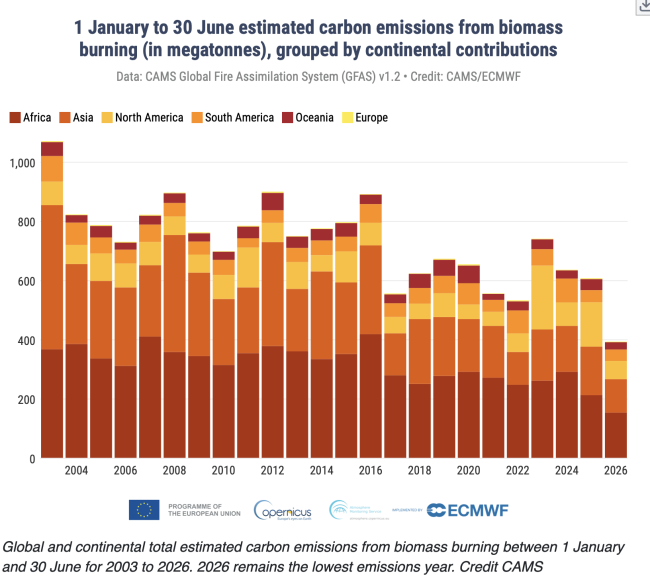
Of course, this data does not yet include the fires from the past couple of weeks, and there is a chance that 2026 will not remain a record-breaking low in fire terms, but this is largely due to the known effect of El Nino years.
The authors note in the conclusion [emphasis added]:
The record low total biomass burning emissions for the first half of 2026 continues the overall downward trend related to changes in savanna fires in tropical Africa and Asia. However, the observed onset of many large-scale wildfires across Eurasia and North America in the last couple of weeks of June, could increase the global total emissions through the rest of the summer. Looking further ahead, the predicted El Niño conditions have the potential to increase global fire emissions, as we observed during the previous El Niño years of 2015 and 2019 when persistent biomass burning in Indonesia caused widespread regional haze and severely degraded air quality.
In fact, the yearly global area burnt by wildfires has been steadily decreasing for over a century (we recommend following Bjorn Lomborg on X, a great source of data):
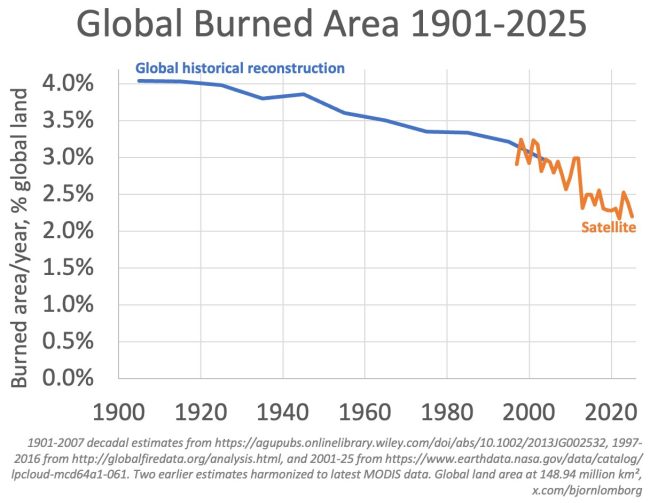
So, why the panic?
The caveat here – according to the University of East Anglia paper – is that while the number of fires, and total area burnt is down, “severity” is up.
In short, less overall wildfire activity seems to be somehow translating to greater human cost, both in lives and money. Evacuations are allegedly up, insurance costs are allegedly up, and fatalities are allegedly up:
A new analysis of global wildfire activity in 2025 reveals the world experienced some of the most destructive and deadly fire events in recent history, despite the second lowest area burned since 2002. It highlights a continued trend toward fires becoming increasingly extreme, costly, and disastrous—both economically and in lives lost.
Now, first instinct would be this is either linguistic or statistical manipulation designed to camouflage research that failed to correctly serve the climate change agenda.
A case of cope to cover misbehaving data: “Fine, wildfires are down, but the ones we’ve had are SO much more DESTRUCTIVE!”.
That’s entirely possible. But supposing the stated data is accurate, what does this mean?
Well, there are several potential explanations
It could be the predictable result expanding human habitation and growing population.
It could be that the areas of fire activity shifting to more populated areas by some as yet not understood natural process.
It could be that fires being deliberately started close to inhabited areas in order to create fear.
It could be that these statistics are manipulated or fabricated.
…Or it could be any or all or a mixture of several.
We don’t know, but we can’t rule anything out at this stage.
The data is clear though, there’s no need to panic. No matter what the press says.
Lobbying for Zionism reviewed by David Miller
By David Miller | July 30, 2026
Did Zionism begin as a Christian project which was only later a Jewish movement?
This is what Ilan Pappé says in the book Lobbying for Zionism.
In my review of the book, I show this is wrong.
Here is an excerpt:
The contribution of the first section of the book is to unearth the hidden history of the Christian Zionist movement. This is a fascinating and useful account of the contribution of a certain fraction of practical British imperialism to the idea of the construction of a Jewish state in the historic territory of Palestine.
In the conclusion, Pappé mentions that ‘Christian fundamentalists, who, as I’ve shown, were the first Zionists in the modern era’. He also states that ‘Zionism began as a Christian project, and thus the early lobbyists were what we would call Christian Zionists today.’ He goes on to criticise Mearsheimer and Walt, saying they ‘described this Christian lobby as a junior partner in the overall lobbying effort in the USA. This appeared to be the case in 2007 — but the picture was very different nearly a decade later during the Trump era.’
But of course, the picture was not very different either during Trump’s first or second presidency. Christian Zionists do have greater numbers of foot soldiers than do Jewish Zionists, but they have only a handful of representatives at the top of the Trump power matrix (for example, Pence and Pompeo in the first period, and Hegseth and Huckabee in the second). As reporting in the Forward, or JFeed, shows, it is Jews that dominate in terms of power players and finance.
Pappé’s conclusion is predicated on his analysis at the start. The opening words of the book are: ‘Zionism began as an evangelical Christian concept and later an active project.’
The main progenitors of the idea were, according to Pappé, Lord Shaftesbury, Colonel Henry Churchill, and Sir George Gawler from the 1830s onward. Though Jewish Zionists of the time are mentioned, such as Sir Moses Montefiore, this all predates the moment when, as Pappé writes, ‘the first settlers arrived [in Palestine] on 6 July 1882’, a group of 14 Russian Jews who arrived at Jaffa Port.
But, as Pappé surely knows, Jewish settlement in Palestine long pre-dates 1882 (see below). Except for Montefiore, none of these figures are mentioned in Pappé’s index and Pappé does not mention Montefiore’s numerous visits to Palestine, or his role in financing Jewish settlement.
In the end, then, the book appears to be advancing a case which is not supported either by the known facts on Jewish settlement in Palestine or by empirically grounded research on the activities of the Zionist movement.
Read the full review via The Column, the new magazine from @ukcolumn .
Featured Video

Racist Seinfeld Dances for Joy as Bibi Unveils His New Map
or go to
Aletho News Archives – Video-Images
TV Drama Review
Japanese drama projects Japan’s wartime atrocities onto Chinese characters

Global Times | October 25, 2026
By portraying Chinese characters as perpetrators of ruthless violence while casting Japanese Self-Defense Forces (SDF) intelligence operatives as defenders, the season 2 of the Japanese drama Vivant has recently drawn criticism from Chinese netizens, who argue that its depiction turns historical reality on its head while ignoring Japan’s wartime atrocities.
The TBS drama series – a spy suspense story in which an alleged unofficial intelligence unit of the SDF operates across the globe — has attracted a passionate fanbase. Its currently airing season 2 opened with a household rating of 18.8 percent, the highest for a TV drama this year, according toa commentary article by Japanese media Toyo Keizai.
What draws attention is the portrayal of the enemies in the series, the article noted. Scenes in which the Chinese organization subjects kidnapped members of the SDF unit to brutal torture are repeated with unrelenting intensity.
It is rare for Japanese TV dramas to explicitly portray a real-life country as the enemy, the article noted.
Japanese Prime Minister Sanae Takaichi also made a reference to the drama, saying that she has been recording Vivant and hopes to binge-watch it over the year-end and New Year holidays, according to Japanese media outlets.
China’s CCTV News report on Sunday revealed that the drama features scenes in which Chinese personnel cut off the fingers of and stab Japanese intelligence operatives in the abdomen. Such acts bear striking similarities to the torture inflicted on Chinese nationals by invading Japanese troops during the World War II.
The drama distorts the truth by attributing these atrocities to modern Chinese characters. Beneath the surface, it subtly glorifies Japan’s cross-border overseas operations, blurs the functional boundaries of the SDF and implicitly promotes an expansionist narrative, per CCTV News. … continue
Blog Roll
 Aletho News
- EU facing trillion-euro debt hole while seeking more cash for Kiev
- How US, Europe, Persian Gulf states exhausted missile stockpiles, splurged billions to defend Israel
- Up in arms… Koreans reject U.S. empire’s plan to make South Korea the next Ukraine
- Iran, Turkey, Pakistan, Saudi Arabia could advance region-led security framework in Tehran: FM spox
- Netizens condemn Japanese drama for projecting Japan’s wartime atrocities onto Chinese characters
- Racist Seinfeld Dances for Joy as Bibi Unveils His New Map
- A West Bank War for Netanyahu’s Election Campaign, Could It Backfire?
- Yemen denounces European Parliament’s ‘hypocritical’ push to blacklist Ansarullah
- Qalibaf: UAE’s UN bid aims to ‘clear the runway’ for ‘Greater Israel’, whitewash genocide
- Pakistan reopens Iran border after boosting security: Report
- If Americans Knew
- An error has occurred; the feed is probably down. Try again later.
- No Tricks Zone
- Sudden Stratospheric Warming, Powerful El Niño Combination May Lead To Extreme Europe Cold, Energy Crisis!
- Two New Studies Find Thwaites Glacier Melt Cannot Be Driven By Human Activity Or A Warming Ocean
- E-Cars Reduce CO2 Emissions By Only 41% Compared To Internal Combustion Engine Vehicles
- Predictions Made By Renowned Climate Professor Over Past Decades Have Been Proven To Be Poor
- New Study Suggests Large Regions Of The Pacific Ocean Have Been Cooling For The Last 80 Years
- Germany’s Green Energy Debacle: High Energy Costs Force Kahla Porzellan to Close After 182 Years!
- New Study: 50 Years Of The Most Aggressive ‘Net Zero’ Policies Can Only Affect The Global Climate By 0.03°C
- US September “Heat” Was No Record…Many Records Set Decades Ago
- Latest European Green Energy Debacle; Portugal’s Largest Flagship Solar Park Insolvent!
- Green Energy Debacle: German Expert Professor Fritz Vahrenholt Warns Of Severe Economic And Social Consequences

