Iran dismisses NATO allegation it supplies ballistic missiles to Russia to be used in Ukraine war
Press TV – July 11, 2024
Iran has categorically rejected allegations it is providing ballistic missiles and related technology to Russia, raised by the North Atlantic Treaty Organization (NATO), to be used in the military campaign against Ukraine.
In a statement on Thursday, Iranian Foreign Ministry spokesman Nasser Kan’ani said NATO has made “totally baseless and politically-motivated” claims.
In their declaration issued on Wednesday, the NATO leaders claimed that North Korea and Iran were fuelling Russia’s military operation against Ukraine by providing direct military support to Moscow, such as munitions and uncrewed aerial vehicles (UAVs), which they said impacted Euro-Atlantic security and undermined the global non-proliferation regime.
They said any transfer of ballistic missiles and related technology by Iran to Russia would represent a substantial escalation.
The Iranian spokesman, in reaction, said the ongoing developments in Ukraine are the result of NATO’s “provocative” policies and measures led by the United States.
Kan’ani added that any attempt to link the war in Ukraine to the cooperation between Iran and Russia is “politically-motivated” with the aim of legitimizing the West’s interference and their military aid to Ukraine.
He once again reiterated Iran’s unwavering strategy to play a constructive role in promoting durable security in the region and across the world.
Iran has never provided Russia with any type of drones during the military conflict in Ukraine and still emphasizes the importance of settling the crisis and establishing lasting peace through political channels, the diplomat pointed out.
Iran has repeatedly rejected accusations that it has supplied weapons to Russia for direct use in the war in Ukraine. It has also discarded allegations of supplying weapons to anti-Israeli and anti-US groups in the region.
Meanwhile, Russia has repeatedly warned that a flow of Western weapons to Ukraine will only prolong the conflict.
Since the start of the war in Ukraine, the US, alone, has provided approximately $51.4 billion in military assistance to Kiev, the US State Department said in early July.
Why France’s Snap Election Proves EU’s Warmongering Agenda Flopped
By Ekaterina Blinova – Sputnik – 10.07.2024
Despite surviving the runoff vote, Emmanuel Macron sustained a crushing and unexpected defeat during the snap election, Fabien Chalandon, French political commentator and writer, told Sputnik. What’s more, the parliament’s new composition may put the brakes on Macron’s bellicosity.
The outcome of the snap election in the French National Assembly has left no party with a majority, leading to uncertainty regarding the formation of a coalition. This raises the question of whether the left-wing and centrist parties will be able to collaborate effectively in order to establish a functional parliament.
“This is the key question,” Fabien Chalandon, chevalier of the French Legion d’Honneur, investor, and writer, told Sputnik. “No party has any majority, and any government can be deposed at any time by a combination of the two other groups. The parliament is therefore in a gridlock and ungovernable. In addition, the left-wing New Popular Front (NFP) is a coalition of small parties all deeply opposed on any subject, including Ukraine, and which have only one common ground: their hate of the National Rally (RN), which cannot provide a common set of practical objectives for an effective governing alliance.”
The NFP, a broad left-wing coalition which brought together Socialists, Communists, Greens and the hardline leftist France Unbowed Party (La France Insoumise), was hastily founded on June 10 with the sole aim of defeating the right-wing RN in the snap legislative election.
According to the commentator, the likelihood of the NFP coalition passing the test of time is “remote as it may explode on the issue of loss of real income, when finally politicians admit that the bulk of the current impoverishment of French middle and poor class has been stoked by inflation directly derived from the Ukrainian conflict.”
Macron’s Bellicosity Backfired During Elections
Meanwhile, it appears that the new composition of the parliament could disrupt French President Emmanuel Macron’s “tour de force” for European leadership.
Over the past several months, Macron has made a series of controversial statements, ranging from putting NATO boots on the ground in Ukraine to doubling the EU budget and promoting the idea of a “major European loan” to finance the bloc’s rearmament effort.
Macron’s sudden transformation into a “Ukraine hawk” – given that France has been ranked 15th in terms of military aid to Kiev – raised questions in the European mainstream press. According to the Spectator, one of the causes of Macron’s bellicosity was his desire to “embarrass” the National Rally in the European elections, “not to mention their predicted victory in the 2027 presidential race.”
The French president’s scheme appeared to have boomeranged. His Renaissance party secured just 15.2 percent of the vote during the EU parliamentary elections last month, while the National Rally got a whopping 31.5 percent.
In the snap election, announced by Macron after the humiliating defeat, the centrist-liberal Ensemble (Together) party survived by pure luck and due to its unholy formal alliance with Les Republicains (LR) and the NFP to obstruct “at all costs” the National Rally in the second round, according to Chalandon.
“Compared to the 2022 elections, the Macron presidential party ‘Together’ lost 100 seats to 168,” the political commentator noted.
“This [snap] election is therefore a second crushing defeat for M. Macron,” the pundit said. “Macron did not expect such a damning result after the first round. In fact, this snap election is overwhelmingly portrayed in the French press and social media as a ‘childish’ decision following the RN tsunami during the previous European elections.”
The election outcome would continue to undermine Macron’s warmongering posture, including his push for rearmament and increased military support to Ukraine, according to the commentator.
“On Ukraine, the NFP is clearly against the EU and EU support of Ukraine. But so is the Unbowed France Party… Any proposal for additional funding to Ukraine may not be approved if these two coalesce to block it, even if they do not coordinate,” Chalandon said.
While the EU’s bureaucracy could circumvent the legislative gridlock in its member states by stealthily boosting its funding to Ukraine within its general budget, the crux of the matter is that Europeans and especially young people across the continent have increasingly started to realize the collective West’s hypocrisy with regard to Ukraine, according to the pundit.
Chalandon notes that Europeans are steadily recognizing the West’s 20-year provocations against Russia, as well as the sabotage of the Istanbul agreement in April 2022 led by the US and UK.
“Moreover, the cause of the recent sharp decline of Europe’s purchasing power is starting to be attributed to the Ukrainian conflict, so far, a taboo subject among politicians. Ukraine’s war and open-ended funding will not continue unabated and may progressively appear for what it is: the main cause of Europe’s recent economic downfall,” the commentator emphasized.
How Could US Political Debacle Affect Europe’s Ukraine Policy
Nonetheless, the EU elites are unwilling to change their stance on the Ukraine conflict, especially given their political dependency on their peers in Washington.
However, US neocons have recently found themselves on the horns of a dilemma given that their major “pro-war” presidential candidate Joe Biden appears to be “unsellable” to American voters, as Wall Street analyst Charles Ortel noted in an earlier interview with Sputnik.
“The key factor which could affect French and Europe’s attitude in the Ukrainian conflict is if M. Trump wins the US election and decides to force Ukraine to negotiate by interrupting its military aid,” Chalandon said, referring to the Republican frontrunner’s plan to stop the fighting and look into peace negotiations.
The political commentator noted, however, that despite Trump’s high-powered numbers across US nationwide polls, his victory is not a done deal given the lawsuits brought forward by his political opponents.
Likewise, the Biden camp is also teetering in the balance as the Democratic Party is waging a behind the scenes battle over a possible replacement for the aging Biden. This potential change could allegedly shift Washington’s attitude on the Ukraine conflict.
“Since European efforts towards Ukraine cannot survive a withdrawal by the US, Europe and France will be left with no other option than to cave in,” the French political commentator remarked.
Chalandon concluded that if a new US context were to arise, Europe’s determination to carry on with the ongoing military “solution” to the Ukrainian conflict would amount to nothing more than empty posturing.
In parallel to his investment banking career, Chalandon co-founded and ran a French political think tank, Fondation Concorde, and was awarded the French Legion d’Honneur in 2000 and wrote for leading French newspapers on political issues. His father, Albin Chalandon, served as minister of various governments under President Charles de Gaulle and Georges Pompidou and then minister of justice between 1986 and 1988 in a Jacques Chirac-led government under then President Francois Mitterrand.
US Provides $2 Billion Military Aid Package to Warsaw
By Connor Freeman | The Libertarian Institute | July 8, 2024
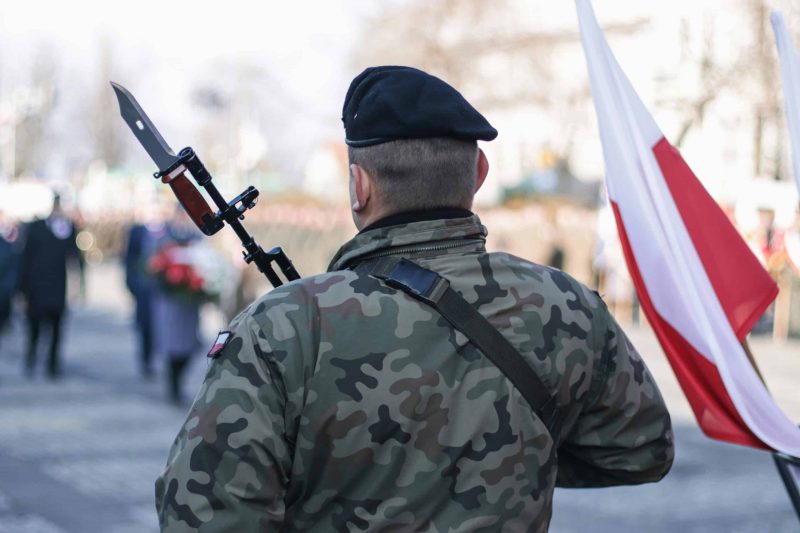
Washington is providing its NATO ally Poland with a second $2 billion foreign military financing (FMF) package in less than a year, Breaking Defense reports. In recent weeks, Warsaw has given Kiev a green light to use Polish-provided weapons to strike the Russian mainland as well as signed a bilateral military pact with Ukraine, agreeing to shoot down some Russian missiles.
A State Department official boasted to the outlet of how the two FMF loans are benefiting the US arms industry as well as strengthening the Washington-led bloc embroiled in its Ukraine proxy war with Moscow. “It’s impressive that it hasn’t even been a year and they [Poland] are moving out pretty quickly… We’re happy with the process. We see it as a success. We’re happy that they’ve been able to move out quickly — not only does it help NATO, it helps the US defense industry as well, the US economy. So, we’re definitely happy with the process.”
As with typical FMF loans, the funds furnished by the State Department to a foreign government must be spent on American-made weaponry and equipment. What makes this loan unique, however, is instead of a grant to purchase arms, this loan includes interest which Warsaw must repay. The US is putting up $60 million to guarantee the loan and cover initial fees. The official said details regarding how the funds will be spent, on what kinds of weapons, will not be shared during this week’s NATO summit. Instead, he insisted the Poles “[have] a list of things they want to achieve” and said to expect future announcements.
The official noted the previous FMF loan, issued last September, has either been totally spent or is earmarked for purchases including four aerostat-based early warning systems which accounts for approximately half the first loan. The unusual loan-based structure allows “the interagency to get FMF funding to foreign allies without needing to wait on the appropriations process,” the outlet notes, adding Congress extended the authority to issue these loans through the end of the 2025 fiscal year.
Asked if other countries will receive such loans, the official answered “We are looking at it, and there are other countries that remain competitive… The reason you’re seeing Poland is, of course, the situation with the ongoing war in Ukraine. They’re ready to move out.” The official emphasized that talks with multiple countries are ongoing, while repeatedly praising Warsaw’s high military spending and deeming Poland “the tip of the spear on this for us right now.”
The State Department stated “Poland is a leader in NATO, currently spending four percent of GDP on defense, the highest in the Alliance. Poland hosts thousands of U.S. and Allied forces, including U.S. V Corps Headquarters (Forward) in Poznan.” The US has roughly 10,000 troops stationed in Poland. Since Russian forces invaded Ukraine, Warsaw has announced plans to buy a myriad of American arms including Abrams tanks, Black Hawk and Apache helicopters, HIMARS rocket launchers. Poland is seeking more Patriot air defense batteries as well.
This latest financial and military infusion comes after Ukraine and Poland signed a bilateral military pact this week which includes a mechanism for Warsaw to shoot down Russian missiles and drones. This provision entails the potential to provoke a NATO-Russia war, something Ukrainian President Volodymyr Zelensky has long sought.
During a joint presser with Polish Prime Minister Donald Tusk on Monday, Zelensky declared “We are especially grateful for the special arrangements, and this is reflected in the security agreement. It provides for the development of a mechanism to shoot down [by Poland] Russian missiles and drones fired in the airspace of Ukraine in the direction of Poland.”
In November 2022, after a Ukrainian air defense missile killed two people in Poland, Zelensky and his top advisors said it was a Russian strike and demanded NATO take action. “Hitting NATO territory with missiles. … This is a Russian missile attack on collective security! This is a really significant escalation. Action is needed,” Zelensky railed in a video address.
This assessment was completely at odds with those made by the US, Poland, and NATO which determined the Polish casualties were not the result of a Russian missile strike. At the time, a diplomat from a NATO member state told Financial Times “The Ukrainians are destroying [our] confidence in them. Nobody is blaming Ukraine and they are openly lying. This is more destructive than the missile.”
New ‘Volunteer’ Legion in Poland: Blatant Scam to Force Ukrainians to Front Lines
Sputnik – 09.07.2024
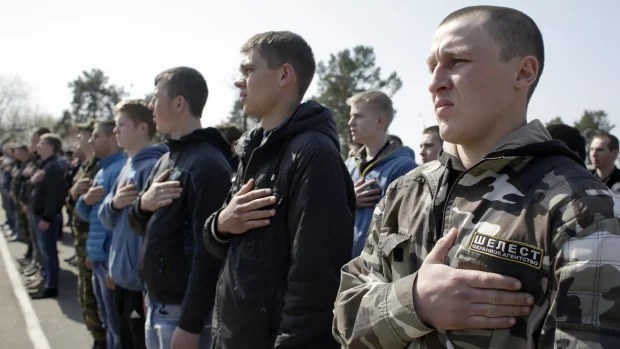
A security pact inked by Ukraine’s Volodymyr Zelensky and Polish Prime Minister Donald Tusk on Monday outlines the creation and training of a so-called Ukrainian Legion. This new formation will recruit Ukrainian “volunteers” living in Poland and other EU countries.
“Among the citizens of Ukraine who fled to EU countries, there are no volunteers seeking to participate in the hostilities,” Igor Korotchenko, editor-in-chief of the National Defense magazine, told Sputnik. “Everyone who theoretically had the motivation to participate in the conflict would have returned to Ukraine a long time ago and, accordingly, would have joined combat units on the contact line.”
“Therefore, I think that this is an artificial simulacrum. They will forcefully recruit Ukrainian draft dodgers into this legion, one way or another, under pressure from local intelligence services and police forces,” the pundit continued.
In April, Poland and Lithuania signaled that they would assist the Kiev regime by sending potential draft dodgers home, despite demonstrating reluctance to extradite conscript-aged Ukrainians last year.
Polish Defense Minister Wladyslaw Kosiniak-Kamysz asserted on April 24 that “Ukrainian citizens have obligations towards the state,” while his Lithuanian counterpart Laurynas Kasciunas insisted that evading conscription was “not fair to those citizens who are fighting for their country.”
For months, EU member states had rejected Kiev’s request for repatriating Ukrainian men eligible for mobilization, citing European conventions that do not permit extradition in cases of desertion or draft evasion.
Speaking to reporters in April, Kosiniak-Kamysz and Kasciunas asserted that there were multiple ways the authorities could repatriate Ukrainians without resorting to deportation. These included implementing bans on social benefits, work permits, and necessary documentation, in addition to enacting specific legislation aimed at Ukrainian refugees.
Apparently, the Ukrainian Legion is yet another “legal” loophole to send Ukrainian refugees to the battlefield, according to Korotchenko.
“We are not talking about forced extradition, we are talking about forced enlistment in this foreign legion,” he stressed. “Human rights activists will obviously not be interested in whether [Ukrainians] enlist voluntarily. These procedures would de facto mean forced extradition after they join the legion. The mechanism that is taking shape is absolutely illegal, but has a veneer of legitimacy,” he explained.
Ukraine violates Chemical Weapons Convention – Russian MoD
RT | July 9, 2024
Russia has found evidence that Ukraine has violated the Chemical Weapons Convention, a top military commander stated on Monday.
Lieutenant General Igor Kirillov, who leads Russia’s chemical and biological defense forces, said that the engineering troops discovered a laboratory that was apparently used to produce hydrogen cyanide – an extremely dangerous and highly toxic agent that had been used as a chemical weapon during World War I.
The facility is located near Avdeevka, a fortified Donbass town liberated by Russia in February, the general said. The improvised laboratory itself was found inside a partially destroyed building in an industrial area, which also had a chemical processing plant. The facility had a rotary evaporator and several chemical reactors. Protective clothes, including US-made gas masks and Polish hazmat suits, were found on the site.
According to Kirillov, the samples taken from the facility and analyzed in Russian military laboratories contained traces of sulfuric acid and sodium cyanide, which can be used to produce hydrogen cyanide. Traces of cyanide anions – poisonous chemical compounds of the cyano group – were on multiple equipment, the general said.
The evidence “clearly shows that the laboratory was used to manufacture poisonous substances,” Kirillov stated. According to the Russian Defense Ministry’s estimates, the facility was capable of producing at least three kilograms of chemical agents per day if operated by just two or three people. Hydrogen cyanide can kill a person if they inhale just 70 to 80 milligrams of the agent.
During his briefing, Kirillov noted hydrogen cyanide is among the Chemical Weapons Convention’s so-called “Schedule 3 chemicals” – agents with large-scale industrial uses that have the potential of being used for chemical warfare. He added that, in May 2024, civilians in the Avdeevka region showed symptoms consistent with the hydrogen cyanide poisoning after Ukrainian military drones dropped bombs in the area. Another case was reported in Russia’s Belgorod Region, where Ukrainian ammunition fragments were found that had traces of hydrogen cyanide, Kirillov said.
Kirillov also cited a Ukrainian POW, whom he identified as Sergey Batyr, as confirming that laboratories that stored chemical agents were also used to make kamikaze drones.
In March 2022, Russia accused Ukraine of running a secret biological weapons program with the help of the US. Kiev has denied having biological weapons or other weapons of mass destruction. The Pentagon has described Russia’s claims as “absurd” and “laughable.”
Civil War in Donbass 10 Years On
Scroll down for video
By Kit Klarenberg | Global Delinquents | July 8, 2024
July 1st marked the 10th anniversary of a brutal resumption of hostilities in the Donbass civil war. Perhaps unsurprisingly, it passed without comment in the Western media. On June 20th 2014, far-right Ukrainian President Petro Poroshenko called a ceasefire in Kiev’s “anti-terrorist operation”. Launched two months prior following vast protests, and violent clashes between Russian-speaking pro-federal activists and authorities throughout eastern Ukraine, the intended lightning strike routing of internal opposition to the Maidan government quickly became an unwinnable quagmire.
Ukrainian forces were consistently beaten back by well-organised and determined rebel forces, hailing from the breakaway “People’s Republics” in Donetsk and Lugansk. Resultantly, Poroshenko outlined a peace plan intended to compel the separatists to put down their arms, during the ceasefire. They refused to do so, prompting the President to order an even more savage crackdown. This too was a counterproductive failure, with the rebels inflicting a series of embarrassing defeats on Western-sponsored government forces. Kiev was ultimately forced to accept the terms of the first Minsk Accords.
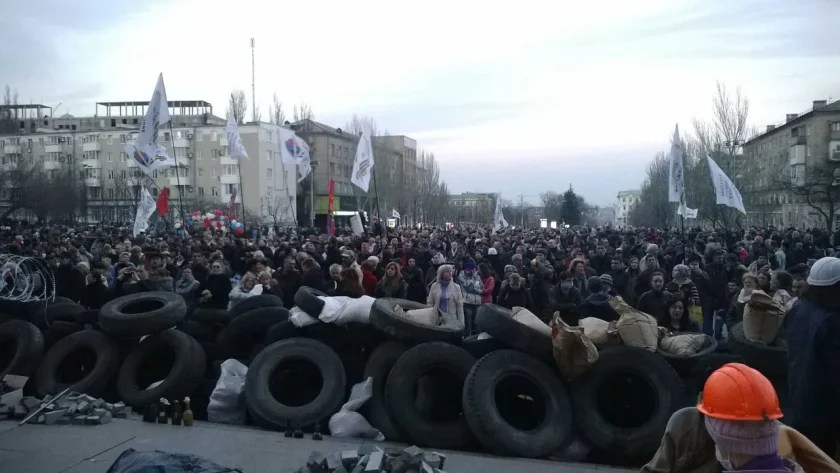
Anti-Maidan protesters gather in front of the occupied Donetsk Oblast regional administration building, April 2014
This agreement, like its successor, did not provide for secession or independence for the breakaway republics, but their full autonomy within Ukraine. Russia was named as a mediator, not party, in the conflict. Kiev was to resolve its dispute with rebel leaders directly. Successive Ukrainian governments consistently refused to do so, however. Instead, officials endlessly stonewalled, while pressuring Moscow to formally designate itself a party to the civil war.
No wonder – had Russia accepted, Kiev’s claims that its savage assault on the civilian population of Donbass was in fact a response to invasion by its giant neighbour would’ve been legitimised. In turn, all-out Western proxy war in eastern Ukraine, of the kind that erupted in February 2022, could’ve been precipitated. Which, it is increasingly clear, was the plan all along.
‘Grassroots Movement’
In the days prior to the April 2014 launch of Kiev’s “anti-terrorist operation” in Donbass, notorious war hawk Samantha Power, now USAID chief, openly spoke on ABC of “tell-tale signs of Moscow’s involvement” in the unrest. “It’s professional, coordinated. Nothing grassroots about it,” she alleged. Such framing gave Ukrainian officials, their foreign backers, and the mainstream media licence to brand the brutal operation a legitimate response to a fully-fledged, if unacknowledged, “invasion” by Russia. It is referred to as such in many quarters today.
Yet, at every stage of the Donbass conflict, there were unambiguous indications that the Ukrainian government’s claims of widespread Russian involvement – endorsed by Western governments, militaries, intelligence agencies, pundits and journalists – were fraudulent. One need look no further than the findings of a 2019 report published by the George Soros-funded International Crisis Group (ICG), Rebels Without A Cause. Completely unremarked upon in the mainstream, its headline conclusions are stark:
“The conflict in eastern Ukraine started as a grassroots movement… Demonstrations were led by local citizens claiming to represent the region’s Russian-speaking majority.”
ICG noted that Russian leaders were from the start publicly and privately sympathetic to Russian-speakers in Donbass. Nonetheless, they issued no “clear guidance” to businessmen, government advisers or the domestic population on whether – and how – they would be officially supported by Moscow in their dispute with the Maidan government. Hence, many Russian irregulars, encouraged by “what they regarded as the government’s tacit approval, made their way to Ukraine.”
Per ICG, it was only after the conflict started that the Russian government formalised a relationship with the Donbass rebels, although the Kremlin quickly changed tack on what they should do. A Ukrainian fighter told the organisation that he “began hearing calls for restraint in rebel efforts to take control of eastern Ukrainian towns and cities” in late April 2014. However, “the separatist movement in Donbass was determined to move ahead.”
Due to this lack of control, and repeated calls for direct intervention in the conflict from the rebels, Russia replaced the Donetsk and Lugansk rebel leadership with hand-picked figures, who took an explicitly defensive posture. But the Kremlin was ultimately “beholden” to the breakaway republics, not vice versa. It could not even reliably order the rebels to stop fighting. A Lugansk paramilitary told ICG:
“What do you do with 40,000 people who believe that, once they put down their arms, they will all be shot or arrested? Of course, they are going to fight to the death.”
Elsewhere, the report cited data provided by “Ukrainian nationalist fighters”, which showed rebel casualties to date were “overwhelmingly” Ukrainian citizens. This was at odds with the pronouncements of government officials, who invariably referred to them as “Russian mercenaries” or “occupiers”. More widely, figures within Poroshenko’s administration had routinely claimed Donbass was wholly populated by Russians and Russia-sympathisers.
One Ukrainian minister was quoted in the report as saying he felt “absolutely no pity” about the extremely harsh conditions suffered by Donbass civilians, due to the “legal, political, economic and ideological barriers isolating Ukrainian citizens in rebel-held territories” constructed by Kiev. This included enforcing a crippling blockade on the region in 2017, which created a “humanitarian crisis”, and left the population unable to claim pensions and welfare payments, among other gruelling hardships.
Several Donbass inhabitants interviewed by ICG expressed nostalgia for the Soviet Union. Most felt “under attack” by Kiev. A pensioner in Lugansk, whose “non-combatant son” was killed by a Ukrainian sniper, asked how Poroshenko could claim the territory was “a crucial part” of Ukraine: “then why did they kill so many of us?”
‘Worst Option’
In conclusion, ICG declared the situation in Donbass “ought not to be narrowly defined as a matter of Russian occupation,” while criticising Kiev’s “tendency to conflate” the Kremlin with the rebels. The organisation expressed optimism newly-elected President Volodymyr Zelensky could “peacefully reunify with the rebel-held territories,” and “[engage] the alienated east.” Given present day events, its report’s conclusions were eerily prescient:
“For Zelensky, the worst option… would be to try to forcibly retake the territories, as an all-out offensive would likely provoke a military response from Moscow and a bloodbath in Donbass. It could even lead Moscow… to recognise the statelets’ independence. The large-scale military option is mainly advocated by nationalists, not members of Ukraine’s political establishment. But some prominent mainstream politicians refuse to rule it out.”
Zelensky did initially try to resolve the Donbass conflict through diplomatic means. In October 2019, he moved to hold a referendum on “special status” for the breakaway republics in a federalized Ukraine, while personally meeting with representatives of Azov Battalion, begging them to lay down their arms and accept the compromise. Mockingly rebuffed and threatened by the Neo-Nazi group’s leaders, while rocked by nationalist protests against the proposed plebiscite in Kiev, the plans were dropped. So then the President picked the “worst option”.
In March 2021, Zelensky issued a decree, outlining a “strategy for the de-occupation and reintegration” of “temporarily occupied territory.” Falsely characterising Crimea and the Donbass as “occupied by the armed forces of the aggressor state,” it sketched a clear blueprint for a hot war to recapture both territories. Immediately, Ukrainian forces began to mass in the south and east of the country in preparation.
This activity inevitably spooked the Kremlin, leading to a huge military buildup on its border with Ukraine, and extensive wargame exercises, plotting scenarios including encirclement of Ukrainian forces in Donbass, and blocking Kiev’s Black Sea access. Suddenly, the Western mainstream became awash with warnings of imminent Russian invasion, and British and US surveillance flights in the region surged. Media reporting either neglected to mention or outright denied this was explicitly triggered by Kiev’s escalation.
Things quietened down thereafter, although the situation on-the-ground remained tense. In October that year, a Ukrainian drone struck rebel positions in Donbass. Moscow, and German officials, charged that the attack violated Minsk, while Zelensky’s then-right hand man Oleksiy Arestovych denied this was the case. He had by this time openly stated on many occasions war with Russia was Kiev’s price for joining the EU and NATO.
Fast forward four months, and at the start of February 2022, French President Emmanuel Macron reaffirmed his commitment to Minsk. He claimed Zelensky provided personal assurances its terms would be fulfilled. Yet, on February 11th, talks between representatives of France, Germany, Russia and Ukraine collapsed without tangible results, after nine hours. Kiev rejected demands for “direct dialogue” with the rebels, insisting – yet again – Moscow formally designate itself a party to the conflict.
Then, as documented in multiple contemporary eyewitness reports from OSCE observers, mass Ukrainian artillery shelling of Donbass erupted. On February 15th, unnerved representatives of the Duma, led by the influential Communist Party, formally requested the Kremlin to recognise the Donetsk and Lugansk People’s Republics. Vladimir Putin initially refused, reiterating his commitment to Minsk. The shelling intensified. A February 19th OSCE report recorded 591 ceasefire violations over the past 24 hours, including 553 explosions in rebel-held areas.
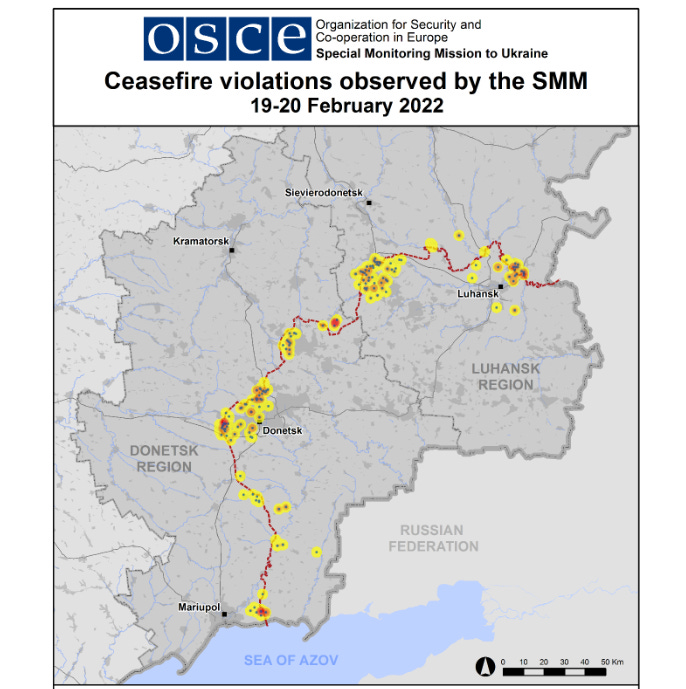
Civilians were harmed in these attacks, and civilian structures, including schools, targeted deliberately. Meanwhile, that same day, Donetsk rebels claimed to have thwarted two planned sabotage attacks by Polish-speaking operatives on ammonia and oil reservoirs on their territory. Perhaps not coincidentally, in January 2022 it was revealed the CIA had since 2015 been training a secret paramilitary army in Ukraine to carry out precisely such strikes, in the event of Russian invasion.
So it was on February 21st, the Kremlin formally accepted the Duma’s request from a week earlier, recognising Donetsk and Lugansk as independent republics. And now here we are.
Poland to shoot down Russian missiles – Zelensky
RT | July 8, 2024
A newly signed pact between Warsaw and Kiev contains provisions that would allow Poland to shoot down Russian missiles and drones in Ukrainian airspace, Vladimir Zelensky has said.
Zelensky spoke in Warsaw on Monday, after signing the security deal with Polish Prime Minister Donald Tusk. The government in Kiev has been making bilateral pacts with NATO member states over the past several months, in lieu of formally joining the US-led bloc.
The agreement “provides for the development of a mechanism [for Poland] to shoot down Russian missiles and drones fired in the airspace of Ukraine in the direction of Poland,” Zelensky said, according to Ukrainian media.
He added that Warsaw and Kiev “will work together to work out how we can quickly implement this point” of the deal.
Tusk confirmed the existence of the provision but said it merely “indicates the need for talks on this matter,” according to Polish media.
“We need clear cooperation within NATO here, because such actions require joint NATO responsibility,” the Polish PM added, explaining that it would be in the interest of both Poland and Ukraine to get a “stamp” of international solidarity first.
“We will include other NATO allies in this conversation. So we treat the matter seriously as open, but not yet finalized,” Tusk said, according to Poland’s RMF24 Radio.
Zelensky has been asking NATO to shoot down incoming Russian missiles for several months already. He has compared it to what the US and UK did for Israel in mid-April, during an Iranian reprisal bombardment, and argued that it would not directly involve the bloc in the conflict.
“NATO will not become part of the conflict,” the bloc’s secretary-general, Jens Stoltenberg, replied at the time. “There are no plans to send NATO troops to Ukraine or to extend NATO’s air-defense shield to Ukraine,” he added.
While US and EU officials shot down Zelensky’s comparison with Israel, they agreed to other things he asked for, from additional Patriot missile launchers and rockets to permitting Ukraine to use the weapons they supplied to strike deep into Russian territory.
During his visit to Warsaw, Zelensky also announced that Poland would raise, train and equip a ‘Ukrainian Legion’, made up of volunteers. “Every Ukrainian citizen who decides to join the legion will be able to sign a contract with the Ukrainian armed forces,” he added.
Tusk did not comment on the legion business, but said that every word in the security pact meant something and that it’s about “practical mutual commitments, not empty promises.”
Russia Hits Ukrainian Military Targets in Retaliation, Labels Kiev’s Civilian Strike Claims as False
Sputnik – 08.07.2024
The Kiev regime’s provocative statements about alleged Russian strikes on civilian targets are related to the NATO summit and the pursuit of further funding, the Russian Ministry of Defense has said.
The Russian military conducted coordinated strikes using long-range precision weapons on Ukrainian military-industrial targets and air bases on Monday in retaliation for Kiev’s attempts to damage Russian energy and economic facilities, the Russian Defense Ministry has stated.
“This morning, in response to the Kiev regime’s attempts to damage Russian energy and economic facilities, the Armed Forces of the Russian Federation conducted a coordinated strike with long-range precision weapons on Ukrainian military-industrial targets and air bases. The strike objectives have been achieved, and the designated targets have been hit,” the military department stated in its report.
Commenting on the Ukrainian claims of an intentional Russian strike on civilian targets, the ministry said they are a blatant lie, adding that the destruction was caused by a falling Ukrainian air defense missile.
“Claims by Kiev representatives about an alleged intentional Russian missile strike on civilian objects are completely untrue,” the statement said.
It was noted that numerous published photos and videos from Kiev clearly confirm that the destruction resulted from a falling Ukrainian air defense missile launched from within the city.
“We particularly emphasize that similar hysterics from the Kiev regime have been occurring for years, especially before each NATO summit. The goal of such provocations is to secure further funding for the Kiev regime and to continue the war to the last Ukrainian,” the Russian Defense Ministry highlighted.
Parody of a Statesman: Antony Blinken, Secretary of War
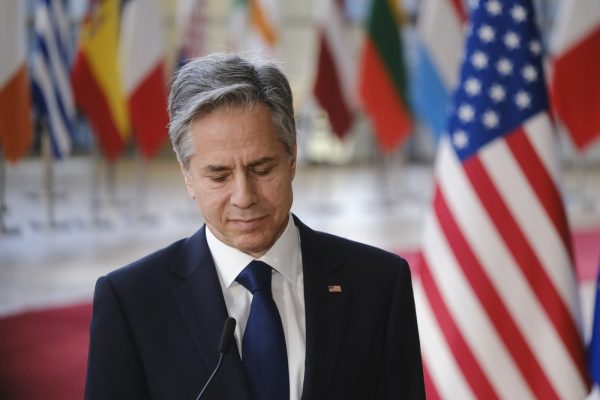
By Laurie Calhoun | The Libertarian Institute | July 8, 2024
For Halloween last year, the United States’ highest ranked diplomat, Secretary of State Antony Blinken, dressed his son and daughter up as Ukrainian President Volodomyr Zelensky and the Ukrainian flag, respectively. At a White House event on that day, Blinken’s children were photographed soliciting candy from President Joe Biden. Meanwhile, Zelensky himself had been doing his usual media circuit, appearing progressively more desperate to extract a fresh supply of “candy” from U.S. taxpayers by way of their nonrepresentative elected officials, most of whom, it would seem, have little if any interest in what their voting constituents have to say. In one poignant performance, the embattled Ukrainian commander-in-chief and former professional dancer lamented that the crisis in Israel was drawing attention away from Ukraine. In another widely disseminated video clip, Zelensky implored the audience that, if they could not give him more money, then they should at least extend him some credit, which he promised Ukraine would pay back.
It seemed as though the end was nigh for Zelensky, who was looking more and more like would-have-been Venezuelan “president” Juan Guaidó. When, during one of the primary debates, former Republican presidential candidate Vivek Ramaswamy characterized Zelensky as a “Nazi” and a “comedian in cargo pants,” he boldly articulated an impolite sentiment shared by at least some of the people who have grown weary of seeing the Ukrainian president parade around in mud-green garb and hobnobbing with the likes of Sean Penn, Greta Thunberg, Ursula von der Leyen, and every politician under the sun on the military-industrial complex gravy train. And yet, Zelensky clings on to power, having canceled what was supposed to be the 2024 presidential election with the full blessing of both halves of the War Party duopoly.
In a more recent performance, on May 14, 2024, Secretary Blinken belted out Neil Young’s ballad, “Rockin’ in the Free World,” at a basement bar in Kiev. Blinken displayed his prowess on the electric guitar while doing his best to demonstrate that he personally relates to the people of Ukraine, who have endured uncertainty regarding their future and prospects for a return to any semblance of normal life since the Russian invasion on February 24, 2022. Dead people have obviously lost all of their freedom, so Blinken’s audience comprised a select group among the survivors savoring their tenuous existence, and the fact that they are not currently being pursued, as many unfortunate draft dodgers are, by the conscription police—at least not for now. The government of Ukraine has lowered the requirements for and lifted restrictions on the military conscription of unwilling citizens, while postponing the presidential election indefinitely, on the grounds that “We are at war.” Martial law remains in place, with Ukrainians living in what is tantamount to a dictatorship under Zelensky, notwithstanding Blinken’s heartfelt crooning about freedom and democracy.
Before becoming secretary of state, while an advisor to Biden’s campaign, Antony Blinken appears to have earned the esteem of whoever would come to run the Biden administration by setting in motion the composition of the now-discredited letter signed by fifty-one members of the “intelligence community” expressing doubts about the authenticity of the Hunter Biden laptop. The computer in question, discovered before the 2020 election, contained a surprising array of photos of Hunter and, more importantly, what looked to be texts documenting shady backroom deals between foreign governments—Ukraine and China—and the Biden family. The FBI eventually acknowledged that the contents of the Hunter Biden laptop were genuine, not a “Trump campaign product,” as Nina Jankowicz, later slated to be Biden’s czarina of the Disinformation Governance Board, had so colorfully characterized it prior to the 2020 election. Ironically, the Steele dossier which served as the basis for allegations of collusion between the Russian government and the Trump campaign had itself been a Clinton campaign product.
In the light of this history, Blinken’s appointment as secretary of state can be viewed as his reward for helping to maintain the markedly anti-Russia bias of U.S. citizens, including politicians, stoked for years by the media through the now-debunked Russiagate narrative, and which inclines self-styled liberals to support the prolongation rather than the resolution of the conflict in Ukraine.
Under ordinary circumstances, when two nation states are in conflict, the less powerful of the two tends to be more receptive to attempts to resolve the matter through peaceful negotiation, such as Russian President Vladimir Putin’s recent proposal, which was immediately and categorically rejected in a knee-jerk response by NATO Secretary General Jens Stoltenberg, of all people. In the case of Ukraine, which has been artificially bolstered through a seemingly endless infusion of arms by the U.S. military behemoth, the war has no foreseeable limit—beyond the sacrifice of every able-bodied person in the land. (The case bears similarities to the artificial maintenance of the current U.S. president as head of state through the infusion of pharmaceutical products, even as rigor mortis appears to be setting in.) Reality in fact imposes limits, and they will be reached, sooner or later.
Those Ukrainians who comprehend the qualitative power disparity between nations in possession of nuclear warheads and those devoid of such means, have declined to volunteer to serve in the U.S.-maintained meatgrinder war, which is precisely why a policy of forced conscription was imposed. What good is a quasi-infinite supply of weapons, if no one is willing to fire them? Alas, any Ukrainian who has had enough of media-darling Zelensky’s panhandling from every wealthy nation on the planet is out of luck, for he remains in power, martial law firmly in place, and has indicated that he will stay there for so long as “it” takes, whatever his overlords construe that to mean.
It’s not just the U.S. government funding the war in which Ukrainian citizens are being chewed up and spit out by the insatiable war machine as military industry profits soar. NATO officials have naturally seized the opportunity to justify the existence of their institution, the source of their gainful employment, just as they have been scrambling to do since the fall of the Berlin Wall: Yugoslavia, Afghanistan, Libya, Ukraine—there’s always something for NATO to destroy! That the North Atlantic Treaty Organization was established to counteract the danger of a communist takeover of the world by the now non-existent USSR is brushed aside as somehow irrelevant by its ardent supporters and beneficiaries alike.
As the world becomes progressively more bellicose, following the infelicitous example of the U.S. military state, stentorian calls to shore up and consolidate military capacities have been heard from figures such as European Union Commission President Ursula von der Leyden, with similar jingoistic rhetoric issued also by the president of France, Emmanuel Macron. On its face, this is a puzzling development, given the twenty-year catastrophe better known as the Global War on Terror, which in no way served democracy or freedom, but instead destroyed and/or severely degraded the lives of millions of human beings. In keeping with the United States’ muscular but myopic and amnesiac approach to foreign policy, leaders of the European Union agreed in February 2024 to provide yet another $54 billion of “aid” to Ukraine, with NATO throwing in another $40 billion more recently. There’s a lot of profit at stake, and all of the usual suspects want their piece of the pie, no matter how many hapless Ukrainians will have to die. That European, British and American leaders have no interest in resolving the conflict is nowhere better illustrated than by the “Summit on Peace in Ukraine,” held in Switzerland, in June 2024, to which Russia, one of the two parties to the dispute, was not invited.
Barring nuclear holocaust, the dispute between Ukraine and Russia can only end at a negotiation table, an outcome which any competent diplomat would have worked relentlessly from the beginning to realize rather than frustrate. Instead, Antony Blinken spends his time making public appearances and issuing one-sentence slogans for spam distribution across social media platforms in an effort to appease the citizens footing the bill for the human misery and massacre to which his failure as a diplomat has led. Unable or unwilling to process the obvious implications of a war between a nuclear power and a nonnuclear power (spoiler alert: the former will win, if only through a Pyrrhic victory), Blinken daftly persists in pretending that democracy is at stake, even as Ukrainians are enslaved to fight the U.S. proxy war. The thousands of young Ukrainian men being sacrificed are just the price that must be paid. Freedom is free, but weapons are not.
It should come as no surprise that the same “diplomat” talks out of both sides of his mouth in claiming to sympathize with both the Israeli government and the Palestinians, as though furnishing some of the very weapons being used to murder thousands of civilians is easily counterbalanced with promoting the “humanitarian” treatment of those being incessantly terrorized, so long as the survivors of razed neighborhoods are provided with a bit of food and water now and then. The Blinken-Biden approach to this vexed conflict can be summed up in a piece of commonsense folk wisdom: “If you try to be all things to everyone, you’ll end by being nothing to anyone.”
Notwithstanding the frankly frightening recent public appearances of “the leader of the free world” (at the G7 meetings and elsewhere, including the disastrous debate), President Biden’s progressively deteriorating poll numbers over the course of the past several months have probably had something to do with his repeated assertion that there would be no “pause” or “ceasefire” in Israel. From the protests on campuses all over the United States, it has become clear that the antiwar left has reawakened, after eight years of slumber under Barack Obama, to abandon Biden. From the beginning, Biden materially supported Israel’s modus operandi of firing missiles at schools and mosques, homes, hospitals, and refugee camps, in an ardent quest to “Finish Hamas,” even as they embedded themselves among nonviolent civilians. When four Israeli hostages were rescued on June 8, 2024, Biden & Co. celebrated the news while downplaying, when not entirely omitting, the unsavory truth that two hundred Palestinians were killed in the process. Some people are more equal than others.
Antony Blinken has appeared occasionally to issue sincere acknowledgments of the humanity of the Palestinian people from one side of his mouth, while insisting on the right of Israel to self-defense from the other, as though slaughtering thousands of children has made anyone safe. The circus acts of such pseudo-diplomats would be amusing, if they were not so pathetic—and if the consequences for real, live, sentient human beings were not so devastating. All of foreign policy is not, as figures such as Blinken appear to believe, merely a matter of theater. No, the worst part of all of the shameless performances and photo-ops is that they entirely ignore the human reality of the wars being prolonged and provoked by the U.S. military state, as though bombing victims were mere fictions, and the soldiers coerced to fight were the currency of elites to expend.
The peace plan for Gaza recently drawn up by the Biden administration (certainly not Biden himself, who often appears to be unaware of where he is) could have been proposed back in October 2023, and, conjoined with a firm refusal to arm the killers, might well have saved the lives of some 40,000 persons—nearly half of which have been children—and prevented the wounding of many times more Palestinians. The U.S. government instead continues to condone Israel’s decision to follow the post-9/11 template of annihilating multiple times the number of the criminals sought, dismissing all of the innocent victims as “collateral damage.”
Blinken’s atrocious failures in the Ukraine and Israel conflicts notwithstanding, I confess to have experienced a tinge of sympathy for him the day he was caught on film wincing as President Biden answered a reporter’s question about his previous characterization of Chinese president Xi Jinping. Biden replied, in an unedited and brash—dare I say?—Trump-like fashion, “Look, he is. He is a dictator…” Mind you, this proclamation occurred immediately subsequent to what had been billed Biden’s “historic” White House meeting with the Chinese leader, supposedly intended to ease tensions between the two nations.
Surely, given the diminished mental acuity of his boss, Blinken’s job is extraordinarily difficult to execute, as is that of Press Secretary Karine Jean-Pierre, who is constantly in the position of concocting extemporaneous word salad responses to incisive questions posed by White House journalists. (The press secretary dismissed some of the recent videoclips showcasing a zombie-like Biden on the world’s stage as “cheap fakes”.) But Blinken’s willingness to serve not as a diplomat but as a promoter of endless war, his refusal to work diligently toward peaceful solutions to conflict, is inexcusable.
Blinken apologists may counter that every previous secretary of state during his lifetime, too, served not the cause of diplomacy and peace but the war machine. In other words, Blinken has dutifully adopted some of his most prominent predecessors as mentors.
While serving as the CIA director under President Trump, Mike Pompeo reportedly went so far as to pursue the murder of Wikileaks founder Julian Assange, denounced as a traitor and a spy, for exposing the ignoble comportment, including war crimes, of the U.S. government. Pompeo’s reward? Appointment as secretary of state, in which position Pompeo aggressively pushed for war with Iran.
Under President Obama, Secretary of State Hillary Clinton persuaded her boss to bomb Libya, chanting, “Gaddafi must go!” beforehand, and later cackling “We came, we saw, he died!” when the Libyan president was sodomized with a bayonet and murdered by an angry mob. Libya, which once boasted the best education and healthcare systems in Africa, is today a failed state, a place where people have been literally enslaved. With regard to Wikileaks founder Julian Assange, Secretary Clinton reportedly inquired during a November 23, 2010, meeting over which she presided, “Can’t we just drone this guy?”
Moving a bit further back, Condoleezza Rice had already served in the administration of President George H.W. Bush, who initiated the forever wars in the Middle East with his Operation Desert Storm. In the aftermath of the 1991 Gulf War, Bush Sr. bragged that he had “kicked” the “Vietnam syndrome”; that is, the disinclination of Americans to become embroiled in foreign wars in the years following the U.S. military’s retreat from Saigon. Rice came later to serve as national security advisor to President George W. Bush, during which tenure she went on a war-marketing blitz media circuit in which she repeatedly intoned, “We don’t want the smoking gun to be a mushroom cloud.” Rice was rewarded for her war promotion efforts with an appointment as secretary of state.
Under President Bill Clinton, Secretary of State Madeleine Albright rallied to make the 1999 NATO bombing of Kosovo happen. In a conversation with General Colin Powell (relayed in his memoir), Albright once asked, “What’s the point of having this superb military you’re always talking about, if we can’t use it?”
Under President George W. Bush, Secretary of State Colin Powell expressed caution about invading Iraq when the idea was first proposed by Cheney & Co. But Powell abruptly changed his tune (for reasons which remain unclear to this day) and ended up being one of the most vocal supporters of the ill-fated 2003 invasion. Powell’s most notorious moment, and for which he has earned a place in the annals of history, was his attempt to persuade the UN General Assembly to support the second U.S. war on Iraq. In his presentation, Powell laid out all of the pretexts later debunked as bogus: the imminent threats of Saddam Hussein’s “mobile chemical labs” and the purchase of “yellow cake” from Niger, supposedly demonstrating the existence of a robust WMD program, among other ersatz evidence buttressing the claim that war had become a last resort. When it became clear that the United Nations would not support the invasion, Powell withdrew his resolution, and the war proceeded unimpeded, at which point Powell and others pivoted to insist that the war was permitted under previous U.N. resolutions allegedly violated by Saddam Hussein.
Last, but certainly not least, we would be remiss to omit the case of Henry Kissinger, the godfather of all warmongering secretaries of state, who served under Presidents Richard Nixon and Gerald Ford, first as national security advisor and then as secretary of state. Kissinger’s savage foreign policies for southeast Asia culminated in the deaths of millions of human beings, not only in Vietnam, but also in Laos and Cambodia, the societies of which have not to this day recovered from what was done to them by the United States government in the name of democracy. Among those sacrificed were some 57,000 U.S. soldiers and the many veterans who returned home but whose lives were wrecked by their harrowing experiences in Vietnam.
Never one to insist on causation where correlation will suffice, I nonetheless feel compelled to observe that nearly all of these secretaries of state have derived a good part, if not all, of their personal wealth from having served on the boards of, or even established, defense-contracting and consulting firms. In Blinken’s case, in 2017, after a stint as deputy secretary of state (having previously served as deputy national security advisor, also under Obama), he and Michèle Flournoy, among other former employees of the federal government, launched WestExec Advisors, from which he derived $1.2 million. Blinken (along with Secretary of Defense Lloyd Austin) has also been a partner of private equity firm Pine Islands, which has invested heavily in military industries. When The New York Times, in an ever-more rare moment of critical journalism, dared to publish an editorial questioning Blinken’s seeming conflicts of interest, this was brushed aside by members of the War Party, who proceeded to approve his appointment as secretary of state.
Perhaps, then, in view of the long series of war promoters who have served as “top diplomat” for the United States, rather than take Antony Blinken to task, singling him out for criticism, the official title of his position should simply be emended from secretary of state to secretary of war, so as to reflect the reality of what such persons actually do.
“Our” Man in Israel

By Ted O’Keefe | The Occidental Observer | July 7, 2024
The issue of dual loyalty is an ancient one. As noted in a previous TOO article,
[Stephen] Walt points out that [Dennis] Ross has a long involvement with pro-Israel activist organizations, such as being director of WINEP [Washington Institute for Near East Policy, a pro-Israel think tank headquartered in Washington, DC].
But Ross’s ties to Israel are even deeper than that. Until his appointment as Middle East envoy in the Obama Administration, from 2002–2009 Ross was Chairman of the Board of Directors of the Jewish People Policy Planning Institute. This organization has assumed the role of long term planning for the Jewish people, not only in Israel but also the Diaspora. The JPPPI is an independent think tank that reports to the Israeli government and has close ties with other Jewish organizations. Its mission is “to promote the thriving of the Jewish people via professional strategic thinking and planning on issues of primary concern to world Jewry. JPPPI’s work is based on deep commitment to the future of the Jewish people with Israel as its core state.”
The JPPPI’s report Facing Tomorrow 2008 is interesting because it focuses on the threat of Iran and but also because it sees people like Stephen Walt as a threat to Israel:
The Jewish people must, as the highest priority, develop an appropriate response to the Iranian nuclear threat to Israel and to global stability as a whole. While there is no ambiguity about the need to do so in Israel, it is necessary to mobilize Jewish opinion around the world as well. The American Jewish community cannot be intimidated either by a post Iraq syndrome in the United States, or by the false and pernicious allegations of Professors Walt and Mearsheimer, or former President Carter.
In other words, Jews around the world are encouraged to mobilize to combat the threat to Israel represented by Iran. The assumption is that Jews have common interests as Jews no matter what country they happen to live in. Dennis Ross is doing his best to promote exactly this view within the Obama administration.
One might think that such a view would leave Jews in the Diaspora open to the charge of disloyalty, but the problem is easily finessed: Jews in the Diaspora are told to frame Israel’s concerns about Iran as a global threat, not simply as a threat to Israel.
Of course, that’s what we are seeing now. But we needn’t be naïve. Jews like Dennis Ross are clearly far more loyal to Israel than to the US. Speaking as a psychologist, they wouldn’t be able to see a conflict of interest between the US and Israel if it was staring them in the face. Indeed, as Gore Vidal said of Norman Podhoretz, they are unregistered agents of a foreign government.
In a sane society, there would be a huge groundswell of public opposition to Ross’s appointment–as there has been for a number of Obama’s appointments. But that won’t happen.
Since there has been no groundswell of media or public opposition to pro-Israel operatives like Ross at the highest levels of the U.S. government, it’s not surprising that the practice continues. Amos Hochstein is a good contemporary example. Israel and the powerful Lebanon-based Shiite Hezbollah militia are on the brink of open warfare, conflict that could trigger U.S. intervention and escalate to a regional or even a world war. To date these dangers have attracted little notice from the American mass media, ever eager to divert and dissemble from the direr consequences of the Washington regime’s one-sided support for Israel. Small wonder, then, that the media should evince the same reluctance in investigating the shadowy past and dubious allegiance of Hochstein, the emissary the U.S. recently dispatched to “mediate” between Hezbollah and Israel. The following is a brief foray into the workings of the Israel Lobby in the Biden Administration, as well as a primer on the perks of being Jewish in America.
Hochstein’s importance
To be sure, media reports have not slighted Hochstein’s great influence in the Biden White House or his meteoric career. He has been described as “one of President Biden’s closest confidantes [who] has worked with him for many years,” while another Washington insider calls Hochstein “the person who bridges State, Treasury, the White House and Energy”
Fittingly, one of Hochstein’s titles is “Special Presidential Coordinator.”
Yet the media have underplayed, and often ignored, a key fact about Hochstein in his role as an impartial arbiter between Hezbollah and Israel: his birth, youth, and military service in Israel.
Beyond those bare facts about his origins, Hochstein has been remarkably unforthcoming about his life before he arrived in the United States in 1974. While nearly every successful denizen of the D.C. is eager to brandish Ivy League/Seven Sisters (or the equivalent) educational credentials, one may scour the internet (including his page on the usually resume-rich LinkedIn job-hunting site) without finding anything about Hochstein’s education, college or secondary.
Just as murky are the circumstances by which Adam Hochstein, a 21-year-old immigrant with unknown credentials, became a congressional staffer within a year of his arrival in this country, working for Rep. Sam Gejdenson (D-CT) who, like Hochstein, is a Jew.
Despite his youth and inexperience, Hochstein carried out important assignments for Gejdenson. Not yet 25, he traveled to North Korea in 1997 to report on its economic and military situation; still in his twenties, he undertook negotiations with the Iraqi government (against the advice of the U.S. State Department) aimed at “resettling” thousands of Palestinians there in exchange for loosening some of the crippling sanctions then in force there.
Well before 9/11, Hochstein advocated acting against Iraq for harboring “weapons of mass destruction” in a press release issued by Congressman Gejdenson, and soon afterward he was serving as senior advisor to a senator and a governor. Like many members of the permanent government, Hochstein has used hiatuses between his party’s dominance to work in lobbying and industries close to government, in his case capitalizing on energy policy expertise that he seems to have acquired with no expertise in the field. He’s evidently done well, at some point becoming a partner in two D.C. restaurants and a movie theater.
Under Obama, Hochstein (without known diplomatic training or experience) rapidly climbed the ladder at the State Department to become America’s chief energy negotiator, deeply involved in efforts to block Russian natural gas from Europe and to facilitate Israeli access to energy.
During the Trump presidency, Hochstein served on the board of Ukraine’s natural gas company, Naftogaz.
Hochstein’s knowledge of the ins and outs of Ukraine’s shady corrupt energy industry is evidently considerable. In his testimony to the U.S. House of Representatives, Hunter Biden stated that Hochstein had advised him merely to be “very careful” in serving on the board of the notoriously corrupt Burisma corporation.
Hochstein also seems to have had a role in the “whistle blowing” that led to Trump’s first impeachment resulting from a phone call interpreted by Democrats as pressuring Zelensky to investigate Biden family corruption in Ukraine, and to have been advising Zelensky before his election.
It’s also interesting that there is a lack of definitive information on Hochstein’s current citizenship:
According to one report, a State Department source has claimed that he is “not a dual national,” but refused to state if he has renounced his Israeli citizenship, and in fact gave no [details as to Hochstein’s American citizenship.] So the question raised, unanswered— Hochstein’s citizenship is evidently a “carefully guarded secret.” Not acknowledging Hochstein’s Israeli citizenship would be useful because, for example, in Lebanon, where Hochstein has been involved as an American negotiator on the Israeli conflict with Hezbollah, “it is normally illegal for an Israeli” to visit Lebanon.
Even Hezbollah at the time did not comment on the mediator’s nationality or military past, with leader Hassan Nasrallah saying they will “not express an opinion or position related to the demarcation of borders”.
Given all this, it’s hard to disagree with this quote originally from Ha’aretz:
… the American brokerage farce, whose players are almost all American Jews, some of them former or future Israelis. If the United States is a side in the conflict, then it should say so and conduct the negotiation as though Israel is its protégé. And if it really wants to be an honest broker, then come on – Amos Hochstein?…
Ukraine asks West for submarines
RT | July 7, 2024
Ukraine needs Western submarines to bolster its military capabilities in the Black Sea, Navy chief Admiral Aleksey Neizhpapa, has said.
He argued that deploying underwater craft could strategically improve Ukraine’s positions across the Black Sea during the conflict with Russia.
“We are thinking about it, submarines are necessary for us, they should be part of the navy,” Neizhpapa said in an interview with journalist Natalya Moseychuk, posted on her YouTube channel on Saturday.
The head of the Ukrainian navy added that the country does not need large submarines, as “they are useless in the Black Sea.”
“Locating only near Odessa means having nothing, we should look further, spread the fleet throughout the Black Sea and use its entire area,” he said, expressing hope that Ukraine would turn “from a coastal state into a maritime power.”
Since the Russia-Ukraine conflict erupted in February 2022, Western states have supplied vast quantities of weapons to Kiev, while denying direct involvement in the hostilities. However, with the fighting well into its third year, there have been numerous reports of dwindling support, with delays in arms and ammunition deliveries.
Earlier this week, Ukraine’s Vladimir Zelensky said in an interview with Bloomberg that US weapons were taking too long to reach the country, despite Congress approving a $61 billion assistance package in April.
NATO diplomats told the agency that the US-led military bloc had agreed to provide at least €40 billion ($43 billion) in military aid for Ukraine per year, without specifying how long the aid would continue.
Featured Video

The Truth About the Trump Shootings with Ken Silva
or go to
Aletho News Archives – Video-Images
From the Archives
The Geopolitics behind the War in Yemen (I)
By Mahdi Darius NAZEMROAYA | Strategic Culture Foundation | 30.03.2015
The United States and the Kingdom of Saudi Arabia became very uneasy when the Yemenese or Yemenite movement of the Houthi or Ansarallah (meaning the supporters of God in Arabic) gained control of Yemen’s capital, Sanaa/Sana, in September 2014. The US-supported Yemenite President Abd-Rabbuh Manṣour Al-Hadi was humiliatingly forced to share power with the Houthis and the coalition of northern Yemenese tribes that had helped them enter Sana. Al-Hadi declared that negotiations for a Yemeni national unity government would take place and his allies the US and Saudi Arabia tried to use a new national dialogue and mediated talks to co-opt and pacify the Houthis.
The truth has been turned on its head about the war in Yemen. The war and ousting of President Abd-Rabbuh Manṣour Al-Hadi in Yemen are not the results of «Houthi coup» in Yemen. It is the opposite. Al-Hadi was ousted, because with Saudi and US support he tried to backtrack on the power sharing agreements he had made and return Yemen to authoritarian rule. The ousting of President Al-Hadi by the Houthis and their political allies was an unexpected reaction to the takeover Al-Hadi was planning with Washington and the House of Saudi. … continue
Blog Roll
 Aletho News
- Pakistan-Iran talks secure LNG shipment to Islamabad through Hormuz
- Black Sea grain crisis puts global wheat supplies under pressure
- IRGC air defenses destroy another US MQ-1 drone over Strait of Hormuz
- Imran Khan’s entire immediate family detained in Pakistan ahead of mass protest demanding his release
- EU nation detains former presidential frontrunner
- Leaked: Britain’s Sham Conviction Of Hashim Thaci
- Seyed M. Marandi: U.S. Strike Imminent – Toward Total War in the Middle East
- Russia Voted Under Fire. Washington Is Loading the Tankers.
- 12 Things Your Oncologist Was Trained Not to Tell You
- Anthrax Attacks Paved Way for COVID-Era ‘Junk Drugs and Vaccines’
- If Americans Knew
- Huckabee aide solicited cash gifts from Israelis
- This isn’t sci-fi, AI is already killing people
- ‘The Most Brutal Thing’: Investigation Reveals Execution of Elderly Woman in Rafah
- Inside Israel’s ‘soft’ ethnic cleansing plan for Gaza through the eyes of its victims
- New online database tracks pro-Israel political donations in the United States
- Israeli president pardons soldier convicted for killing wounded Palestinian
- Singer Ed Sheeran says his ‘heart broken’ by Gaza devastation, addresses Macklemore controversy
- Israel Has Imprisoned Female Journalist Bushra Al-Tawil Without Trial Or Charge In Solitary Confinement For Past Month
- Israel poised to teach West Bank a lesson after one Israeli killed – Daily Update
- Salah Sarsour’s Legal Team Says DHS Has Not Met Its Burden to Prove He Is Deportable
- No Tricks Zone
- 2025 Nature Paper Claiming Worsening Global Drought Gets RETRACTED …Heavily Flawed
- New Study: ‘Global Drought Shows No Detectable Recent Acceleration Under Climate Warming’
- Economic Masterminds: German Socialists Suggest Taxing Productivity Gains Stemming From Using AI
- The South China Sea Has Not Been Cooperating With The Climate Change Narrative
- Energy Crisis: Germany Enters Heating Season With Historically Low Gas Reserve Fill Levels
- New Study: The Antarctic Ice Sheet Gained Mass From 2020-2024 Due To Staggering Snow And Ice Accumulation
- Study: Ocean Heating Rates From Thousands Of Years Ago ‘Dwarf’ Modern Ocean Heating Rates
- Climate Extremists Target, Attack Large-Scale Power Grid Infrastructure In Germany!
- New Study: Antarctic Ice Melt Has Contributed Less Than 1 Centimeter To Sea Level Rise In The Last 30 Years
- Fear Of Debate: Alarmist German Climate Scientist Calls On Mainstream Media To Discredit Skeptic Voices
 Aletho News