Father of American journalist jailed in Ukraine blames Biden
RT | December 9, 2023
The administration of US President Joe Biden was complicit in the arrest of an American journalist who has been jailed and tortured in Ukraine for criticizing the Kiev government, the father of Gonzalo Lira has claimed. He believes his son may have sealed his fate when he also spoke out against Washington.
Gonzalo Lira was apprehended by Ukrainian authorities for the third time in August while trying to escape to Hungary after being released on bail. The Chilean-American writer had repeatedly criticized the government of Ukrainian President Vladimir Zelensky, arguing that Kiev had provoked its conflict with Russia and had no chance of winning.
“This that is happening to my son, he’s a victim of this Biden government and his relation with that puppet Zelensky,” Gonzalo Lira Sr. said on Saturday in an interview with US journalist and political commentator Tucker Carlson. “Zelensky is a man that has made opponents, political opponents, disappear.”
The 80-year-old father said his son had bravely reported on about a dozen Zelensky opponents who had been “disappeared.” The younger Gonzalo Lira also predicted correctly that the Russian economy would be relatively unscathed by Western sanctions and that NATO members would suffer a boomerang effect from their efforts to arm Ukraine and punish Moscow.
However, it was only after the blogger sharply criticized Biden and US Vice President Kamala Harris that he was arrested for a second time in May, Gonzalo Lira Sr. told Carlson.
“Isn’t it odd that four days later, after condemning Joe Biden and Kamala Harris, Gonzalo was arrested?” the father asked. “Why was he not detained earlier? When he was let go the previous year, he continued the same criticism against the war.” He added, “The USA government, with its silence in the face of this scandalous incident, suggests a degree of complicity, or at least tacit approval of Gonzalo’s arrest.”
Lira contrasted the Biden administration’s “conspicuous lack of response” to his son’s arrest to Washington’s aggressive efforts to secure the release of Evan Gershkovich, a Wall Street Journal reporter who was arrested in Russia on espionage charges in March.
The younger Lira is relying on a court-appointed Ukrainian attorney who speaks no English for his legal defense. Just before being captured in August, he warned his audience that if he failed to get safely into Hungary and be granted political asylum, he would likely die in a Ukrainian labor camp.
Gonzalo Lira Sr. has called his son a political prisoner and has argued that his case illustrates the absurdity of US claims that the world must defend “freedom and democracy” in Ukraine. “If we are going to protect democracy in the world, let’s start by taking out that puppet called Zelensky,” he said.
Biden regime touts ‘year of suffering’ for Russian troops
RT | December 8, 2023
The White House wants to keep funding Ukraine in its conflict with Russia because it believes that in a year Moscow may be willing to concede to Kiev’s demands, an aide to Jake Sullivan, the US national security adviser, said in an interview on Tuesday.
Jon Finer, Sullivan’s principal deputy, discussed the White House Ukraine strategy at an event hosted by the Aspen Institute, an influential US think-tank. On Wednesday, President Joe Biden’s request to allocate over $110 billion in foreign security aid, including for Ukraine, was blocked from a vote in the Senate.
Finer made a case for releasing the funds despite Kiev’s inability to secure any major successes on the battlefield during its summer counteroffensive. He said he disagreed with the notion that the operation “not going as far as people wanted reflects some degree of Ukrainian failure.” If Washington keeps bankrolling Kiev’s war effort for the next year, the Ukrainian government will maintain “a degree of parity” with Russia, he promised.
“Another year of funding and another year in which Russia will have to suffer on the battlefield is fundamentally a better position than we are in today without that funding,” Finer said. “I think there is no way to dispute that.”
By the end of 2024, Western nations will have ramped up arms production and be helping Ukraine do the same, the White House expects. Then Russia will have to either “come to the negotiating table on terms that would be acceptable to Ukraine” or face a stronger opponent, according to Finer’s expectations.
Kiev’s demands for peace include full control over pre-2014 Ukrainian territory, war reparations and a tribunal for the Russian leadership, as detailed last year by President Vladimir Zelensky. Moscow has dismissed it from the start as detached from reality.
Moscow has cited NATO expansion in Europe and the promised inclusion of Ukraine into the US-led military bloc as a threat to its national security. Preventing that outcome is imperative, senior Russian officials have said.
In the first weeks of hostilities, Ukraine and Russia came to a preliminary agreement on a truce, which would have seen Kiev drop its NATO aspirations and pledge neutrality. Then UK Prime Minister Boris Johnson told Kiev to “make war instead,” David Arakhamia, who led the Ukrainian delegation at the talks in Istanbul, confirmed in a recent interview.
What Would Happen If the US Stopped Supporting Ukraine?
By Connor O’Keeffe – Mises Wire – 12/06/2023
Over the weekend, border-policy negotiations between Senate Democrats and Republicans fell apart. The talks were meant to firm up Republican support for the president’s massive $105 billion military support proposal ahead of Wednesday’s vote by including additional funds for border security in the spending package. Now, with no imminent approval of further aid to Ukraine, hawks in government and the media are trying to stoke panic about what will happen if Kyiv is cut off from US support.
In a letter to Congress Monday, White House budget director Shalanda Young told Congress the funds will dry up by the end of the year:
I want to be clear: without congressional action, by the end of the year we will run out of resources to procure more weapons and equipment for Ukraine and to provide equipment from U.S. military stocks. There is no magical pot of funding available to meet this moment. We are out of money—and nearly out of time.
Young goes on to forecast disaster for Ukraine if more money isn’t allocated. But is that really accurate? Are the Ukrainian people doomed if Washington stops funding the war?
If we’re going to understand what might happen in the absence of US involvement in Ukraine, we must first understand Washington’s actual effect on the war, the true nature of which has been laid out brilliantly in a series of recent columns by Ted Snider.
Russia’s invasion of Ukraine began with a bombardment of cruise missiles on February 24, 2022. Later that day, infantry and armored divisions rolled in from Russia, Belarus, and Crimea while paratroopers dropped in around the capital city of Kyiv.
Days later, as the shock and confusion of the initial offensive began to dissipate, Ukrainian president Volodymyr Zelensky attempted to set up indirect talks with Russian president Vladimir Putin. Zelensky called then–Israeli prime minister Naftali Bennett and asked him to contact Putin and to serve as a mediator. Bennett agreed.
Over the next week, Bennett had a series of phone calls with Putin before traveling to Moscow and Berlin to help organize diplomatic communication channels. His effort culminated in a March 10 meeting between the Russian and Ukrainian foreign ministers in Turkey.
In the series of talks that followed, Bennett described both sides as making “huge concessions” in pursuit of a ceasefire.
But Kyiv’s Western backers were resistant to the truce. At a special summit on March 24, NATO decided not to support or approve the peace negotiations. Still, Zelensky and Putin kept at it. And on March 29, the two sides reached an agreement.
According to a draft unsealed this past June, Russia had agreed to pull its forces back to prewar boundaries. In exchange, Ukraine had agreed it would not seek NATO membership.
So why didn’t it happen? Well, it may have started to. In early April, Russia withdrew its forces from northern Ukraine, around Kyiv—an action Putin later said was related to the Istanbul agreement.
But then, according to Bennett, former German chancellor Gerhard Schröder, Turkish foreign minister Mevlüt Çavuşoğlu, and the leader of the Ukrainian delegation to the talks, David Arakhamia, the West pressured Zelensky to abandon negotiations and fight.
Assuming the best intentions, it’s possible officials in Washington and Brussels believed the Ukrainians could win enough battles to improve their leverage in future negotiations. But that is not what happened.
Instead, Washington bankrolled a horrifying twenty-one-month war of attrition that has cost the people of Ukraine greatly in land, lives, and limbs. After talks broke down, Russia laid permanent claim to tens of thousands of square miles of Ukrainian territory that it had earlier agreed to relinquish.
Last summer, Ukrainian forces began attempting to retake this land by force in the so-called counteroffensive. But they have since lost more territory than they have gained. Ukraine keeps its casualty count classified, but by the end of August US estimates had put it north of two hundred thousand. And it has likely climbed substantially with the ongoing struggle to break through heavy Russian minefields.
As their supply of military-aged men has dwindled, the average age of a Ukrainian soldier has climbed to forty-three. And now there is a push within the Ukrainian government to lower the draft age to begin conscripting those who have so far been too young to be eligible.
The Ukrainian people are being put through hell. And now even senior Ukrainian military officials admit there is no military path out.
If the purpose of stifling the Istanbul agreement was to help the Ukrainians gain more leverage, the West must admit failure before Ukraine loses even more.
And if Washington’s intentions were more nefarious—as comments from officials like Mitch McConnell, who have framed the war as an easy way to burden Russia without spilling American blood, suggest—that’s all the more reason to call off this horrific project.
That brings us back to the original question. What would happen if the United States stopped supporting Ukraine? We already know. Ukraine and Russia would work toward a deal. It won’t go as well for Ukraine as it did almost two years ago when they were stronger. But it’s not a path to fear. Because the alternative is that the White House gets its way and this brutal, unnecessary war carries on. And that’s so much worse.
Moscow rejects US narrative on aid for Kiev
RT | December 7, 2023
Claims in Washington that Russian President Vladimir Putin may attack NATO, unless Congress allocates tens of billions of dollars in additional Ukraine funding are “bogeyman stories,” Moscow’s ambassador in the US capital Anatoly Antonov said on Wednesday.
White House officials, including President Joe Biden, have claimed that by withholding aid from Kiev, American lawmakers were increasing the risk of a direct US-Russia war.
“If Putin takes Ukraine, he won’t stop there,” Biden said in an address on Wednesday, in which he made a last-ditch appeal to lawmakers to appropriate over $110 billion in assistance to Ukraine, Israel and Taiwan.
Touting the scenario of a Russian attack on NATO, Biden stressed that then American troops will have to get involved directly. The Russian leadership has not expressed an intention to “take Ukraine,” let alone invade any NATO member.
Antonov dismissed the narrative, accusing those who repeat it of “myth-making and [the] propagation of dangerous lies” about his nation.
“In an attempt to ‘add fuel’ to the fire of the Ukrainian proxy war, [US] authorities have finally lost touch with reality,” he claimed in remarks posted by the embassy.
“Washington and [the] insatiable US military-industrial complex are direct beneficiaries of the bloodshed in Ukraine,” Antonov added.
In his pitch to Congress, Biden claimed that the Russian leader’s ambition was to “dominate Ukraine” and warned that “the entire world is watching” Washington’s actions. America is “the reason Putin has not totally overrun Ukraine and moved beyond that,” he claimed.
Moscow has cited NATO’s expansion in Europe and the pledge that Ukraine will eventually join the US-led military bloc among the causes of the crisis. It was willing to seal a truce with Kiev in the early phase of the conflict in exchange for Ukrainian neutrality.
However, Russia’s opponent ditched a proposed peace agreement and opted for continued hostilities, after then-UK Prime Minister Boris Johnson told the country to “just make war,” according to David Arakhamia, who headed the Ukrainian delegation at the Türkiye-mediated negotiations.
Biden accused Republican opponents of his request of being willing to “literally kneecap Ukraine on the battlefield” and “give Putin the greatest gift he could hope for and abandon our global leadership not just to Ukraine.”
Nevertheless, Republican senators voted unanimously against the aid, which was bundled in a spending package, later in the day. The GOP legislators insisted that the White House and Democratic lawmakers make concessions on immigration reform and border security before they were willing to approve additional tens of billions of aid to Kiev.
UK special forces secretly operated in Ukraine – media
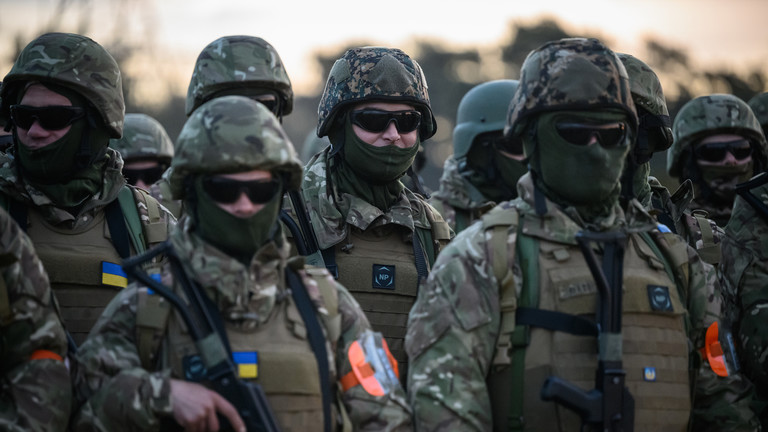
Ukrainian soldiers getting training from British troops in South East England, February 24, 2023. © Leon Neal / Getty Images
RT | December 6, 2023
British special forces operators were embedded with Ukrainian troops in the early days of the conflict, Declassified UK reported on Wednesday, citing the newly published book by Polish journalist Zbigniew Parafianowicz.
Parafianowicz is the Ukraine correspondent for the Polish daily Dziennik Gazeta Prawna. His latest work, ‘Polska na Wojnie’ (Poland at War), examines Warsaw’s role in the neighboring conflict.
According to Declassified, at one point, a Polish government minister – who is not named – told Parafianowicz about a time in March 2022 when he was traveling from Kiev to Zhitomir.
“It was a time when the Russians were still standing in Bucha, and the route was a gray zone. It was possible to run into Russians. We passed the last checkpoint. The Ukrainians told us that we continue at our own risk,” the unnamed minister reportedly said. “Well, and who did we meet next? Ukrainian soldiers and … British special forces. Uniformed. With weapons.”
According to Parafianowicz’s source, the British and the Ukrainians worked together, driving around the countryside with artillery tracking radars, “learning about this war.”
The same official also said that Polish special forces based in Lublin had been in Brovary, a suburb of Kiev, “on the first day” of the hostilities. Poles – along with Brits and Americans – had been training the Ukrainian special forces since 2014, the minister said. According to Parafianowicz, Britain’s Special Air Service (SAS) had trained President Vladimir Zelensky’s security detail as well.
Another source, identified only as a high-ranking Polish officer, said that these commandos did not return to Poland, but “went in the opposite direction” – to Kharkov and parts of Donbass controlled by Ukrainians.
“They cooperated with the British,” the officer said. “Later, we worked out a formula for our presence in Ukraine … we were simply sent on paid leave. Politicians pretended not to see this.”
According to Declassified, some of these Polish commandos may have trained members of the neo-Nazi ‘Azov’ movement – specifically the ‘Kraken’ unit based in Kharkov – in the use of British-supplied NLAW rocket launchers. Social media posts identified them only as “instructors from NATO countries.”
Parafianowicz’s book appears to confirm previous media reports about NATO commandos fighting alongside Ukrainian troops. In April 2022, the French daily Le Figaro claimed that SAS and Delta Force operators had waged a “secret war” on behalf of Ukraine since the beginning of Russia’s military operation. Shortly after those revelations, The Times said a number of SAS operators had returned to Ukraine to teach Kiev’s soldiers how to operate British-made anti-tank rockets. Last December, a British military publication admitted that up to 300 Royal Marines had been deployed to Ukraine for “discrete operations.”
Classified Pentagon documents that were leaked in April this year also showed at least 50 British special forces operators were still active in Ukraine as of March.
Top Defense Official: US Can Handle Middle East, Russia and China All at Once
By Kyle Anzalone | The Libertarian Institute | December 5, 2023
Vice Chairman of the Joint Chiefs of Staff Adm. Christopher Grady said the Pentagon was prepared to fight a proxy war against Russia in Ukraine, aid the Israeli onslaught in Gaza, and arm Taiwan for a potential war with China. The Admiral argued all the military efforts could be completed simultaneously and the Navy was not stretched thin.
At an Atlantic Council event, Grady said, “You look at what is required to support Ukraine, look at what might be required to support our partner in Israel, and then, of course, you put Taiwan on top of that—we have the construct that we do with combatant commanders and the rest that should allow us to command and control those three things all at one time.” He continued, “It’s part of our campaigning process, which is central to the national defense strategy. Is it challenging? Sure.”
After Russia invaded Ukraine in February 2022, the Biden administration pledged to give Ukraine the weapons needed to win the war. Over the past 19 months, Washington has sent Kiev tens of billions in arms.
Over the past two months, Washington has sent Tel Aviv 15,000 bombs and 57,000 artillery shells. Israel has targeted civilian homes with American-made bombs. However, the White House has refused to place any conditions on the aid it sends to Tel Aviv.
The transfers have stretched American weapons depots to their redline levels. The shortage has led the White House to send cluster variants of artillery shells to both Ukraine and Israel.
In addition to arms transfers, the US has deployed tens of thousands of soldiers to Eastern Europe to train Ukrainian troops and facilitate weapons shipments to Kiev. In the Middle East region, the White House deployed two aircraft carrier strike groups.
Grady’s belief that the US could fight a three-front war is White House policy. President Joe Biden is pushing Congress to pass a $106 billion funding package to fund arming Ukraine, Israel, and a military buildup in the Asia-Pacific.
The Admiral also indicated that military-to-military talks between the US and China may start soon. “So we’re ready when they are and I suspect we’ll see that shortly, “he said.
During a meeting between Biden and Chinese President Xi Jinping last month, the two leaders agreed to resume military-to-military communications. However, the US has engaged in a pair of provocative naval maneuvers in the South China Sea to challenge Beijing’s territorial claims.
US House Speaker issues Ukraine ultimatum to Biden
RT | December 5, 2023
Getting the Republican-majority House of Representatives to approve additional funding for Ukraine would require first securing the US border with Mexico, Speaker Mike Johnson told the White House on Tuesday.
The Louisiana Republican was responding to Monday’s public letter from Office of Management and Budget (OMB) Director Shalanda Young, who warned that the US was “out of money—and nearly out of time” in terms of aid to Ukraine and Israel. Young argued that cutting off US aid would “kneecap Ukraine on the battlefield” and increase the “likelihood of Russian military victories.”
Johnson first addressed Israel, noting that the House approved the Israel Security Supplemental Appropriations Act (HR 6126) on November 2, but that Democrats who control the Senate “voted to block consideration of the bill.”
As for Ukraine, Johnson wrote, the Republican position has remained unchanged since his meeting with Young and National Security Advisor Jake Sullivan on October 26, when he laid out “two essential prerequisites: security at our border, and critical answers regarding the funds requested.”
Six days prior, President Joe Biden had announced the proposal to bundle the funding for Israel, Ukraine, Taiwan and immigration and border enforcement in a $106 billion package, of which about $60 billion would go to Kiev.
Additional funding for Ukraine is “dependent upon enactment of transformative change to our nation’s border security laws,” Johnson wrote on Tuesday. The House passed the Secure the Border Act of 2023 (HR 2), “more than six months ago,” he noted, but the Senate Democrats have “refused to act” on it.
Pointing to over 6.5 million “illegal alien encounters” along the southern US border since Biden took office, of which 294 involved people “on the terrorist watchlist,” Johnson called the situation “an unconscionable and unsustainable catastrophe.”
In addition to “madness” on the border, Johnson noted that the White House still owed Congress “a full accounting of how prior US military and humanitarian aid” to Ukraine was spent “and an explanation of the president’s strategy to ensure an accelerated path to victory.” He accused Biden of “failure thus far to present clearly defined objectives,” and to provide Kiev the weapons it needed on time.
“Rather than engaging with Congressional Republicans to discuss logical reforms, the Biden Administration has ignored reality, choosing instead to engage in political posturing,” the House speaker said.
Talks on a border security bill in the Senate collapsed earlier in the day, as Democrats denounced the Republican proposal as “extreme,” claiming it would “end asylum as we know it.”
Peace Talks With Russia? UK & US Seeking Quick Face-Saving Exit From Ukraine Debacle – CIA Vet
By Ekaterina Blinova – Sputnik – 05.12.2023
There is a rumor in British diplomatic circles about forcing Ukraine to negotiate a way out of the conflict with Russia, per the UK podcast Politics at Jack and Sam’s. Could the reported chatter be real, and if so, what’s behind it?
The Western press is citing Ukrainian politicians expressing criticism with regard to President Volodymyr Zelensky’s failed counteroffensive, with British observers suggesting that the Kiev regime could soon be forced to sit down with Russia and hold talks. As it recently turned out, it was then-UK Prime Minister Boris Johnson who encouraged Zelensky to tear up the preliminary peace agreement with Moscow in 2022. Is London’s position on Ukraine changing?
“Well, their opinion is going to have to change, because the events on the ground are going to dictate it, with Ukraine losing militarily and neither the US nor the UK being in a position to supply any kind of significant weaponry,” retired CIA intelligence officer and State Department official Larry Johnson told Sputnik. “And even if they did, who’s going to use it? That’s Ukraine’s fundamental problem right now – it’s a lack of manpower. And over the last couple of weeks, we’ve seen more and more stories, more independent evidence that Ukraine has just suffered massive losses, both killed and wounded, that are incapable of returning to the fight. So, I think this flood of information will keep pouring out. And each day it’s going to add to the problems that Zelensky faces in trying to hang on to power.”
This is not the first time the rumor of potential Russo-Ukrainian negotiations has made its way to the press. In late November, the German newspaper Bild alleged a plot between Washington and Berlin to twist Zelensky’s arm into holding talks with Russia by substantially diminishing military aid to Kiev. According to the German publication, there is also a plan B envisaging a frozen conflict that would solidify a new “quasi-border” between Ukraine and Russia along the contact line.
Per Johnson, even if the West is ready for negotiations over Ukraine, they should bear in mind that nobody in Russia would allow them to fool Moscow after the derailed Istanbul talks of March 2022 and the Bucha hoax widely circulated by the Western press. However, it’s still unclear what the US and its NATO allies really want: a sustainable peace, or merely a frozen conflict.
“Well, again, this is the problem,” the former CIA analyst pointed out. “There has been no negotiation of any substance between the United States and Russia for now more than two years. The last time Putin entered into negotiations to negotiate a peace – that was a year ago, in April. And the West, Biden, Boris Johnson, they sabotaged it. They destroyed it. They made sure that the Ukrainians knew that they were not to agree to any deal. And that’s how they treat it. My own perception is that the Russians are still smarting over that betrayal, because they legitimately thought they had an agreement in place. And then within days, as they’re pulling back their forces from north of Kiev, the tank forces, the United States and the United Kingdom launched this propaganda campaign, accusing Russia of war crimes in Bucha. It was a blatant lie, it wasn’t true. But again, the truth didn’t matter anymore.”
Meanwhile, The Economist, a British magazine, has drawn attention to the fact that Zelensky’s approval rating is in free fall after the botched counteroffensive attempt, while Ukrainian Armed Forces Commander-in-Chief Valery Zaluzhny commands 70% support. Per the media, the two are at odds, as Zelensky apparently fears that Zaluzhny may be picked as his successor.
“Well, the Americans are trying to figure out how to get rid of Zelensky,” Johnson said. “And I think this is just a natural outgrowth of the various plotting and scheming. I think part of it is wishful thinking on the part of Americans. They launched this war as a proxy war against Russia, fully expecting Ukraine to defeat Russia. It was going to cause the collapse of Vladimir Putin and could ultimately lead to the breakup of Russia. And instead, it’s not turned out that way at all. It has completely backfired.”
“So what you’re getting now are these, let’s call them crazy ideas. People keep thinking that, ‘Okay, we can engineer this in such a way that maybe we will replace Zelensky with Zaluzhny.’ [… ] But these are the kinds of rumors that are circulating. What’s clear is that Zelensky does not have a secure hold on the presidency in Ukraine. And right now, there is a meeting underway in Washington with, I guess, the next in line for the presidency, probably because Zelensky himself didn’t feel secure leaving Ukraine right now to go beg for more money. And so he’s sticking close to home in order to just, I think, try to preserve his position.”
The Real Problem With US Foreign Policy…

By Ron Paul | December 4, 2023
Over the weekend Defense Secretary Lloyd Austin explained to the American people what’s really wrong with US foreign policy. Some might find his conclusions surprising.
The US standing in the world is damaged not because we spent 20 years fighting an Afghan government that had nothing to do with the attacks on 9/11. The problem has nothing to do with neocon lies about Iraq’s WMDs that led untold civilian deaths in another failed “democratization” mission. It’s not because over the past nearly two years Washington has taken more than $150 billion from the American people to fight a proxy war with Russia through Ukraine.
It’s not the military-industrial complex or its massive lobbying power that extends throughout Congress, the think tanks, and the media.
Speaking at the Reagan National Defense Forum in California’s Simi Valley, Austin finally explained the real danger to the US global military empire.
It’s us.
According to Secretary Austin, non-interventionists who advocate “an American retreat from responsibility” are the ones destabilizing the world, not endless neocon wars.
Austin said the US must continue to play the role of global military hegemon – policeman of the world – because “the world will only become more dangerous if tyrants and terrorists believe that they can get away with wholesale aggression and mass slaughter.”
How’s that for reason and logic? Austin and the interventionist elites have fact-checked 30 years of foreign policy failures and concluded, “well it would have been far worse if the non-interventionists were in charge.”
This is one of the biggest problems with the neocons. They are incapable of self-reflection. Each time the US government follows their advice into another catastrophe, it’s always someone else’s fault. In this case, as Austin tells us, those at fault for US foreign policy misadventures are the people who say, “don’t do it.”
What would have happened if the people who said “don’t do it” were in charge of President Obama’s decision to prop-up al-Qaeda to overthrow Syria’s secular leader Assad? How about if the “don’t do it” people were in charge when the neocons manufactured a “human rights” justification to destroy Libya? What if the “don’t do it” people were in charge when Obama’s neocons thought it would be a great idea to overthrow Ukraine’s democratically-elected government?
Would tyrants and terrorists have gained power if Washington did NOT get involved? No. Tyrants and terrorists got the upper hand BECAUSE Washington intervened in these crises.
As Austin further explained, part of the problem with the US is democracy itself. “Our competitors don’t have to operate under continuing resolutions,” he complained. What a burden it is for him that the people, through their representatives, are in charge of war spending.
In Congress, “America first” foreign policy sentiment is on the rise among conservatives and that infuriates Austin and his ilk. He wants more billions for wars in Ukraine and Israel and he wants it now!
And our economic problems? That is our fault too. Those who “try to pull up the drawbridge,” Austin said, undermine the security that has led to decades of prosperity. Prosperity? Has he looked at the national debt? Inflation? Destruction of the dollar?
There is a silver lining here. The fact that Austin and the neocons are attacking us non-interventionists means that we are gaining ground. They are worried about us. This is our chance to really raise our voices!
NATO chief admits Ukrainian failure
By Lucas Leiroz | December 4, 2023
Increasingly, military leaders are admitting Ukraine’s inability to carry out the fight under its current military circumstances. In a recent statement, the head of the alliance, Jens Stoltenberg, stated that the West needs to be prepared to receive “bad news” from Ukraine, belatedly recognizing the reality that many analysts had already reported before.
Stoltenberg made pessimistic comments, lamenting Ukraine’s poor military progress. According to him, Moscow has a great advantage in the conflict, in addition to accumulating a large number of weapons for the military scenario in the winter. The secretary stated that the Russian defense industry is producing weapons “on war footing”, operating in an accelerated manner in order to achieve the country’s military results.
He also said that the front lines have remained almost unchanged in recent months, but that it is necessary to be prepared for bad news regarding Ukrainian positions. However, for him, support for Ukraine is vital and must be maintained, even if expectations are negative.
“We have to be prepared for bad news. Wars move in phases, but we must stand by Ukraine in good and in bad times alike”, he said.
Another interesting topic commented on by Stoltenberg was the inability of Western countries to produce enough weapons to support Ukraine. He admitted that the West is weakened industrially, unable to meet Ukrainian demands.
He compared the capabilities of Russian and European industrial production and concluded that Moscow is working better in this sector, which explains some difficulties of the Ukrainian military in achieving good results on the battlefield. In addition, the secretary stated that the Russians plan to continue attacking Ukrainian energy infrastructure in order to harm the country’s ability to produce weapons and equipment domestically during the winter.
“I think one of the main problems that we must address is the fragmentation of the European defense industry. We are not capable of working so closely together as we should (…) Russia has amassed a large missile stockpile ahead of winter, and we see new attempts to strike Ukraine’s power grid and energy infrastructure”, he added.
In fact, Stoltenberg’s words come at a serious moment, in which the vulnerability of Ukraine can no longer be hidden. The country is suffering many losses since its failed “counteroffensive” attempt. Also, the mainstream media is running out of arguments to disguise the defeat of the Kiev regime, which makes the speeches of Western propagandists become more realistic.
In addition, there is another important factor to understand this process, which is the escalation in Palestine. With Israel suffering from various problems on the battlefield and in need of broad Western support, NATO needs to take the focus of public opinion away from Ukraine and begin to justify a policy of support for the Zionist state. For this reason, it is already becoming commonplace for Western leaders and media to be realistic about the Ukrainian situation. The objective is to explain that this war is impossible to be won, having no longer any need to maintain unrestricted support.
In other words, Western officials and journalists are preparing public opinion for the unavoidable defeat of the neo-Nazi regime and trying to focus on Israel as a new “emergency.” In addition, excuses such as “low industrial production” or “Russian attacks on infrastructure” are inappropriately used to try to justify Ukraine’s situation. But, indeed, the real reason is simply Russian military superiority.
In fact, the West has proven unable to produce weapons fast enough to defend Ukraine. In the same sense, Moscow has launched several heavy artillery and aviation strikes against Ukrainian critical infrastructure. But these are only a few factors that do not fully explain the outcome of the war. Kiev’s failure is mainly due to the factor that the Russians are militarily much superior and have a more efficient military strategy. Even at times when Kiev was receiving large amounts of weapons from NATO on a daily basis the regime’s forces were not able to achieve positive results because the Russians always had a greater military power and a more appropriate strategy. So, Stoltenberg does not explain the real reasons for the defeat by talking only about industrial production.
Finally, it must be emphasized how admitting defeat is also a moral blow against the West. NATO is clearly demoralized due to the frustration in Ukraine. The pro-Kiev propaganda machine has not been able to substantiate any of its narratives, having now to admit that its predictions were wrong. It is very likely that the mainstream media and Western officials will lose their credibility, with public opinion simply ceasing to believe what is said by them.
Lucas Leiroz, journalist, researcher at the Center for Geostrategic Studies, geopolitical consultant.
Tycoon urges Russia to meet US energy threats head-on
RT | December 3, 2023
Moscow should take the US threat to halve Russia’s energy revenues seriously, billionaire Oleg Deripaska said on Saturday. To make his point the businessman cited last year’s sabotage of the Nord Stream pipelines and a recent train derailment in Siberia.
The Russian aluminum magnate urged the government to focus on transport networks and port infrastructure in the country’s Far East, and the development of the North-South Transport Corridor in the Caspian region.
“Threats of blocking the Danish straits and the Bosporus have already been voiced,” Deripaska wrote on his Telegram channel.
“Russia is wholly up to the task of creating alternative routes via the Baltic and Turkish directions over four years,” he said, adding that the plan’s implementation should be monitored on a daily basis.
Earlier this week, a senior US official told the Financial Times that Washington would pursue its sanctions on Russian energy “for years to come” with the goal of halving Moscow’s oil and gas revenues by 2030.
On Wednesday, a freight train caught fire as it passed through the Bessolov Severomuysky tunnel, the longest in Russia, located in Buryatia. The incident was caused by an unidentified explosive device, Russian business daily RBK reported on Friday citing a local police source.
Russia’s Investigative Committee earlier opened an investigation into a similar incident, in which 19 freight cars carrying mineral fertilizers derailed on November 11 in Ryazan Region, around 200km southeast of Moscow. Later, the case was reclassified as a “terrorist act.” Earlier this week, law enforcement agencies reported the arrest of a man in relation to the attack, saying it had been carried out on behalf of Ukraine.
Several Western media outlets previously reported, citing an unnamed Ukrainian source, that operatives working for the Security Service of Ukraine (SBU) had detonated explosives in the rail tunnel in Siberia, targeting the route due to its alleged use for transporting military supplies.
In September 2022, the Nord Stream 1 and 2 gas pipelines, connecting Russia and Germany under the Baltic Sea, were sabotaged by explosions. Berlin has yet to identify the perpetrators of the attack, which Moscow claimed was orchestrated by US intelligence agencies. Meanwhile, several Western media outlets have suggested that the pipelines were blown up by Ukraine-linked saboteurs.
Featured Video

EUROPE FEARS RUSSIA’S NEXT MOVE / Ian Proud
or go to
Aletho News Archives – Video-Images
New Book
New Book: No Autoimmunity The Body Doesn’t Attack Itself
Lies are Unbekoming | September 24, 2026
 The label for Humira, once the best-selling drug in the world, lists its risks in plain print. One of them, in the label’s own words, is new “autoimmune” disease.
A drug prescribed for a condition labelled autoimmune carries a warning that it can cause a condition labelled autoimmune. That contradiction sits in every box, on a folded paper almost nobody reads.
My new book starts there.
No Autoimmunity: The Body Doesn’t Attack Itself
For seventy years, “your body is attacking itself, and we don’t know why” has ended the conversation for people diagnosed with multiple sclerosis, lupus, rheumatoid arthritis, Hashimoto’s, Type 1 diabetes, Crohn’s and psoriasis. More than eighty conditions now carry the autoimmune label. The diagnosis comes with a prescription for life. It almost never comes with a question about cause.
This book asks the question and answers it from the framework’s own records: its drug labels, its journals, its regulatory filings, and its own experiments. … continue
Blog Roll
 Aletho News
- Merz regime wants ‘secret police’ – opposition
- Israeli settlers terrorize West Bank Palestinians with state-provided drones: Report
- They see them, then kill them: Israeli quadcopters track, deliberately target civilians in Gaza
- Debunked: Trump’s egregious UNGA claims on war against Iran crumble under scrutiny
- Europe was part of the infrastructure of US aggression against Iran: Deputy FM
- New evidence on the Bucha Massacre
- Italy and France debunk reports CIA issued ‘Russian drone threat’ warning
- How Russia is Rewiring the Global South
- Britain’s elites want you ready to die for a war they keep imagining
- Inside Ukraine’s propaganda operation targeting Americans
- If Americans Knew
- Trump betrayed voters with his campaign lies and prioritized a foreign country once he took office
- Netanyahu calls Israel’s war in Gaza ‘opposite of genocide’ in UN speech to near-empty hall
- Settler Kidnappings: Torture, Sexual Abuse and Terrorisation of Palestinian Abductees as Israel Deepens Annexation of West Bank
- Gaza winter nears as 162,000 tents become unusable, raising fears of humanitarian crisis
- Netanyahu says, “It’s the opposite of genocide”; UN says Gaza economy is world’s ‘most severe crisis on record’ – Daily Update
- Israel’s US-Backed Assault on Gaza Has Created the ‘World’s Most Severe Economic Crisis on Record’: UN
- ‘Protecting U.S. Citizens’… From Israel
- ‘This is where I live now, the back of a truck’: a day in the life of a grandmother in Gaza
- In UN Speech, Iran’s President Displays Pictures of Children Killed by US, Brings Attention to Israel’s Nuclear Arsenal
- Israel displaces hundreds of Palestinians amid wave of demolitions in West Bank
- No Tricks Zone
- New Study: Earth And Venus Surface Warmth Largely Explained By Convection And Lapse Rate, Not CO2 Or Radiation
- 2025 Nature Paper Claiming Worsening Global Drought Gets RETRACTED …Heavily Flawed
- New Study: ‘Global Drought Shows No Detectable Recent Acceleration Under Climate Warming’
- Economic Masterminds: German Socialists Suggest Taxing Productivity Gains Stemming From Using AI
- The South China Sea Has Not Been Cooperating With The Climate Change Narrative
- Energy Crisis: Germany Enters Heating Season With Historically Low Gas Reserve Fill Levels
- New Study: The Antarctic Ice Sheet Gained Mass From 2020-2024 Due To Staggering Snow And Ice Accumulation
- Study: Ocean Heating Rates From Thousands Of Years Ago ‘Dwarf’ Modern Ocean Heating Rates
- Climate Extremists Target, Attack Large-Scale Power Grid Infrastructure In Germany!
- New Study: Antarctic Ice Melt Has Contributed Less Than 1 Centimeter To Sea Level Rise In The Last 30 Years

