A Western Media Outlet Just Exposed Kiev’s Propaganda Machine
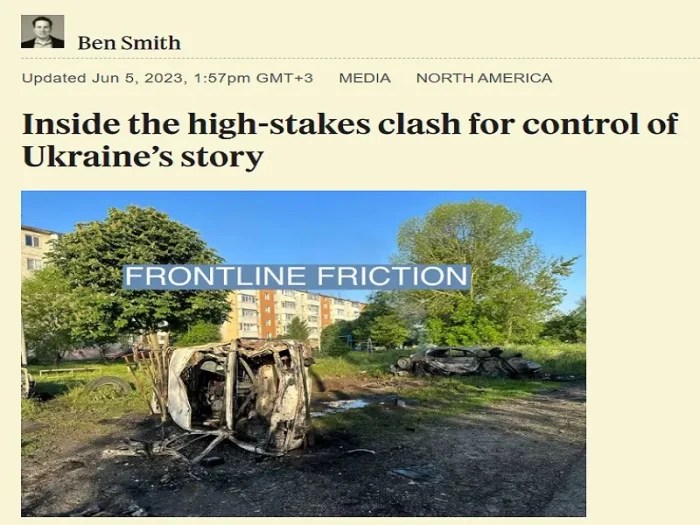
BY ANDREW KORYBKO | JUNE 8, 2023
Semafor is a Western online media outlet co-founded by Ben Smith and Justin B. Smith, whose claim to fame are that they used to be the founding editor-in-chief of Buzzfeed News and the former CEO of Bloomberg Media. Neither they nor their joint platform can credibly be accused of being so-called “Russian agents” or “Russian propaganda”, which is important to remember when reading Ben’s recent piece that dives deep “Inside the high-stakes clash for control of Ukraine’s story”.
He exposed the dark truth about Kiev’s infowar operations that cynics have long suspected. Ben revealed that “Articles and broadcasts from outlets including NBC News, The New York Times, CNN, The New Yorker, and the Ukrainian digital broadcaster Hromadske have led to journalists having their credentials threatened, revoked, or denied over charges they’ve broken rules imposed by Ukrainian minders.” He also cited sources who spoke anonymously due to fear of having their press credentials revoked.
The other important part of Ben’s piece was when he informed readers that “[Ukraine’s] military press office vets journalists and issues passes which allow them to travel to certain areas, often with press handlers, and to interview officials, after signing a document stating that journalists will abide by rules outlined by the military.” Kiev quite clearly doesn’t believe in freedom of the press, which the West claims is sacred, yet its state patrons looked the other way out of narrative convenience until recently.
In late April, Politico cited unnamed Biden Administration officials who expressed concern about the potential consequences if the Western public’s expectations of Kiev’s NATO–backed counteroffensive aren’t met. The only reason why they were unrealistically high to begin with, however, was precisely because the US turned a blind eye to Kiev churning out countless pieces of propaganda through the control that it exerts over foreign media.
Efforts have since been made to bring Western perceptions closer to reality, but they might be too little too late to make much of a difference for some people after the psychological damage was already done. Moreover, the root cause of the problem still hasn’t been resolved and might never be. If Ukraine began telling the truth about the NATO-Russian proxy war, then there’d likely be a serious crisis of confidence among its people and throughout the rest of the West more broadly.
The Washington Post gave readers a glimpse of just how poorly Kiev’s forces are faring in their detailed report that was published in mid-March, which illustrated the logistical and organizational challenges that still remained despite the over $165 billion that their side received from NATO. For as informative as it is, this piece of journalism represented the exception rather than the rule. In general, Westerners have been fed nothing but propaganda about this conflict since the start of Russia’s special operation.
That’s a problem for anyone in those countries who cares about how their taxpayer funds are being spent. It’s important for the public to be accurately apprised of the progress in this proxy war in order to determine whether it’s worth financing indefinitely. Furthermore, they shouldn’t have been gaslighted about “politically inconvenient” facts such as the prevalence of Nazi symbols among Kiev’s fighters by being told that it’s “Russian propaganda” until the New York Times just ran a story proving that it’s true.
Slowly but surely, Westerners are becoming aware that mostly everything they’d hitherto thought about this proxy war was the result of literal propaganda. They might still support Kiev’s cause in principle for whatever their personal reasons may be, but they’re increasingly unlikely to take whatever positive news they hear about it at face value like before. People will start questioning everything more, which is a positive trend that every honest person should appreciate.
The Kakhovka dam has been destroyed and the Dnieper River is flooded: How will this affect the military conflict?
By Vladislav Ugolny | RT | June 8, 2023
On Tuesday night, the Kakhovka Hydroelectric Power Plant (HPP), now part of southern-western Russia and formerly on Ukrainian territory, was partially damaged and 11 of its 28 spans were destroyed. Torrents of water from the reservoir rushed downstream through the broken dam and into the Dnieper River. This has led to a humanitarian disaster affecting residents of both banks of the river, significantly impacted the environment, and altered the deployment of military forces in the region.
Who benefits most from the catastrophe and how will it impact on the ongoing conflict?
Prerequisites for disaster
The Kakhovka HPP has been under the control of Russian troops since day one of the offensive, in February 2022. Along with the Antonov automobile and railway bridges, it was one of the key points used for their advance and positioning in the then southern part of Ukraine. Later, the bridge over the dam was used for supplying troops in Kherson and Nikolaev regions.
After receiving long-range weapons from NATO, the Armed Forces of Ukraine (AFU) attacked the routes to prevent Russian use of them. On the night of August 12, 2022, the AFU fired at the hydroelectric dam using rocket artillery. The bombing of the dam was confirmed at the time by Vladislav Nazarov, a spokesman for Ukraine’s Operational Command South. It was applauded by Western experts and the Ukrainian media.
While the former were busy assessing whether the shelling guaranteed the Russian Army’s isolation, the latter tried to outdo each other with “humor.” One of Ukraine’s main propaganda outlets, the “Trukha” Telegram channel (with over 2.7M subscribers) joked about “inflatable ducks.” However, after the destruction of the dam, their narrative changed and the post was deleted.
On December 29, The Washington Post, citing Ukrainian General Andrey Kovalchuk, reported that the Ukrainian army had conducted test strikes on the floodgates of the HPP with HIMARS launchers – apparently, to see whether this would cause a rise in water levels downstream. The plan was to flush Russian crossings with a torrent of water from the damaged dam.
This is in fact what exactly happened on June 6. However, the Russians had departed from the right bank by that time. In November of last year, Moscow retreated from the area due to the AFU’s constant strikes and the risk of the collapse of the Kakhovka HPP.
The constant shelling didn’t just damage the structure of the hydroelectric power plant. It also made maintenance increasingly difficult, and this played a part in the catastrophe. Since Ukraine became independent in 1991, the Dnieper reservoir cascade (a series of HPPs along the Dnieper River) has not been sufficiently funded, which led to multiple negative assessments of the HPP’s condition, in particular by the US Army Corp of Engineers (USACE).
The final contributing factor was the water level in the Kakhovka reservoir. It rose from 14 meters in February to 17.5 meters in early June due to Ukraine opening the floodgates of the Dnieper HPP, located upriver in Zaporozhye. Previously the reservoir water level rarely exceeded 16.5 meters. Moreover, Ukrainian shelling prevented staff of the Kakhovka HPP from undertaking repairs and regulating water discharge.
The current situation
Novaya Kakhovka and the surrounding villages under Russian control were the first to suffer from the destruction of the hydroelectric power plant. After assessing the situation, the local authorities implemented a flood emergency evacuation plan. However, many residents refused to evacuate and stayed in their flooded homes. By the morning of June 7, the water level in Novaya Kakhovka began to subside.
In the coastal villages located downstream, the situation was more severe. The village of Korsunka is completely flooded, and Dneprani, Krynki, and Kazachiyi Lageri are partially submerged. Floodwaters also reached Alyoshka, an important city for the Russian army. A state of emergency has been declared in the part of Kherson region controlled by Moscow. Currently, seven people have been reported missing.
The flood has also affected territories controlled by Ukraine. The city of Kherson was partially flooded, and over a thousand people have been evacuated. According to the Ukrainian authorities, the floodwaters began subsiding on Wednesday morning
The Kakhovka hydroelectric power plant is currently completely submerged. This poses a further threat to the HPP, especially as Ukrainians continue discharging water into the Kakhovka reservoir. Russian President Vladimir Putin’s press secretary, Dmitry Peskov, has claimed that Kiev is responsible for the catastrophe, and that the Kakhovka HPP shows signs of deliberate sabotage by Ukraine, undertaken due to the failure of its much-hyped counteroffensive.
Putin himself has decried the “barbaric act of destroying the Kakhovka hydroelectric power plant in Kherson region,” which, according to the Russian President, has led to a “massive ecological and humanitarian catastrophe” downstream.
Ukraine blamed Russia for the disaster, accusing it of terrorism and a cynical attitude towards people in territory it controls in the Kherson region.
The humanitarian aspect
For the past six months, active battles have been raging in the territories affected by the current flood. As a result, both Russia and Ukraine regularly carried out civilian evacuations. Many internally displaced persons and refugees moved to other Russian regions from the flood plain. However, it represents yet another calamity for the local population and has made moving very relevant for the few people who have remained in their homes.
Consequently, the emergency response measures have been rather limited. After more than a year of battles, both sides have become accustomed to accommodating refugees and this new challenge hasn’t taken them by surprise.
Eventually, the water will recede and destroyed homes will again be accessible. However, returning will be difficult, even for those who are willing to risk living under constant shelling. To support refugees and motivate them to leave the war zone, Russia is issuing housing certificates and providing a one-time payment of 100,000 rubles for evacuees (about $1,200 at the current exchange rate).
Major damage has been done to the region’s water supply in the territories both under Ukrainian and Russian control. The authorities have already imposed restrictions in Krivoy Rog, a large Kiev-controlled city that receives its water from the Kakhovka reservoir.
Crop irrigation is also endangered across a large area, but the full extent of the damage from this disaster is yet to be expertly assessed.
Threat to the ZNPP
Another danger is the imminent drop in the water level of the Kakhovka reservoir, should the HPP collapse completely. Some believe that this could disrupt the cooling of the Zaporozhye Nuclear Power Plant (ZNPP) reactors – a process that relies on water from Kakhovka.
However, Russian experts do not believe that the ZNPP is endangered since the cooling pond is isolated from the reservoir from which it collects water. There is enough water to cool the two operating reactors. If additional volumes of water are needed and the water levels in the reservoir drop (which has not been observed yet), the pipes can be extended.
Officials assess the situation in a similar way. “The Zaporozhye NPP has not been impacted in any way as a result of this undoubtedly unfortunate event. The cooling system is not endangered,” said Renat Karchaa, adviser to the head of Rosenergoatom. He noted that specialists use “other technical means” to compensate for the decrease in the water levels of the Kakhovka reservoir.
The failed battle for the Dnieper river islands
After the withdrawal of the Russian Army from Kherson and the establishment of the front along the Dnieper River, both sides engaged in artillery duels. Ukraine’s army was in a more favorable position because of its location on the higher bank. However, the Russian side had the advantage of superior firepower and air forces.
Moreover, sabotage and reconnaissance groups became active at this section of the front. Small groups from both sides crossed the river on combat missions, and this led to collisions on the islands formed by the Dnieper delta.
The Russian side did not initially bother to establish full control over the islands, which was a difficult task due to the swampy terrain and high water levels. As a result, the AFU got the upper hand and gradually advanced. This worried the Russian units positioned in the area and several military correspondents.
All these efforts by both armies came to a halt on June 6. The islands in the Dnieper delta were flooded, and both sides hastened to evacuate their troops. At the same time, artillery units attempted to impede the evacuation of the enemy. This confusion might suggest that neither Moscow or Kiev really planned to destroy the dam and create a deluge.
The potential landing operation and the ‘Priazovsk Battle’
In addition to the local battles for the islands, which mostly resembled minor tactical operations, this section of the front was considered one of the main potential directions for the Ukrainian counteroffensive. According to some pundits, the AFU planned to carry out several landing operations across the river to constrain Russia’s “Dnieper” unit.
This strategy could have been used by the Ukrainians to pressure Russian troops positioned next to the “Vostok” unit, which controls the section of the front from the Kakhovka reservoir to Ugledar in the Donetsk People’s Republic. The main attack of the Ukrainian counteroffensive was projected to be inflicted on the “Vostok” to draw it into the so-called “Priazovsk Battle,” aimed at cutting off the land corridor to Crimea and Russia’s access to the Sea of Azov.
If Ukraine chose to attempt to cut through the defense of the “Vostok” unit and attack Melitopol or Berdyansk, a flanking strike by the “Dnieper” unit from Crimea and Kherson regions would pose significant danger. In order to avoid this and delay Russian reserves, the Ukrainians likely planned on conducting several landing operations.
The Ukrainian army, however, has no successful experience of conducting large-scale landing operations. The attempts to seize the Kakhovka reservoir in the summer of 2022 ended badly for them. Additionally, Ukrainian engineering units have no track record in implementing pontoon crossings in combat conditions, and small maritime vessels cannot be used to supply a large number of troops.
All this makes it highly unlikely that the Armed Forces of Ukraine could carry out a landing operation that could force the Russian Armed Forces to retreat from the coastal line. However, such a maneuver could assist the advance in the Zaporozhye region.
In present conditions, a landing operation is even less likely to take place until the water recedes. The problem isn’t just that the Dnieper has become wider, but that a large strip of the coast has essentially become a swamp, with the water level less than a meter deep.
In addition, mines earlier placed by both sides to halt the enemy’s sabotage and reconnaissance groups are now floating about in the waters. Washed away into the river, they may end up in unexpected places downstream.
In military terms, this is a great loss for Russia as many of the defensive positions, including the first line of defense, were flooded and the Russian army will have to hastily restore them after the situation returns to normal.
Who is to blame?
There’s currently no logical argument that the destruction of the Kakhovka HPP was directly beneficial for either side. The actions of the militaries on the Dnieper Delta islands and officials in coastal settlements indicate that the events took both Ukraine and Russia by surprise. These factors, along with the lack of any video footage depicting the explosions alleged to have destroyed the hydroelectric power plant on June 6, indirectly confirm the version that the disaster was the long-term consequence of Ukraine’s HIMARS strikes on the dam. This is supported by satellite images taken from May 31 to June 4, showing part of the dam having been damaged by water pressure.
The only mystery remains as to why the Ukrainians raised the water level in the Kakhovka reservoir to a record high, thereby increasing pressure on the HPP, while maintenance personnel couldn’t do their jobs properly due to strikes from Kiev’s forces. One of the versions is that the entire Dnieper reservoir cascade has become worn out and the Ukrainians were attempting to save their hydroelectric power plants, since their destruction could lead to serious consequences for Kiev.
Meanwhile, further destruction of the Kakhovka HPP is probable due to increasing water pressure and regular shelling which prevents access for repair crews. If this activity continues, the consequences are likely to become even more serious.
Vladislav Ugolny is a a Russian journalist born in Donetsk.
RFK Jr. Reveals Terrible Truth About Ukraine Pentagon ‘Concealed From Americans’
By Ilya Tsukanov – Sputnik – 08.06.2023
Democratic presidential candidate Robert F. Kennedy, Jr. has characterized the Russia-US proxy war in Ukraine as an “abattoir” that has killed hundreds of thousands of Ukrainian troops for a geopolitical goal which has “nothing to do with Ukraine.”
“What we’re doing in Ukraine now is just a massive assault on Ukrainians. We have trapped Ukraine in a proxy war against [Russia] and they are being devoured by the geopolitical machinations of neocons in the White House who have this comic book depiction that a lot of Americans have swallowed about what is happening,” RFK Jr. said, speaking to Canadian psychologist and media commentator Jordan Peterson.
Explaining what separates his position on Ukraine from that of the incumbent, Joe Biden, RFK Jr. said that although he understood many ordinary Americans’ support for Ukraine out of “compassion” and as a “humanitarian mission,” in reality, “every step we have taken, every decision we have made appears to have been intended to prolong the war and to increase the bloodshed.”
RFK Jr. recalled Joe Biden’s slip of the tongue that the US’s real goal in Ukraine was to cause regime change in Moscow – an aspiration which he recalled neoconservative advisors in Washington have been pushing for “decades” now.
“Zbigniew Brzezinski… their doyen and philosopher said that US strategy should be to suck Russia into a series of wars in little countries where we can then exhaust them. Lloyd Austin, who is president Biden’s defense secretary, in April 2022 said our purpose in being in Ukraine is to degrade the Russian army, to exhaust it and degrade its capacity to fight anywhere in the world. Well that is the opposite of a humanitarian mission. That is a war of attrition, and that’s what it’s turned out to be. We have now turned Ukraine into an abattoir that has devoured 350,000 young Ukrainians. They are lying about how many people have died, they’re concealing it from us – the Pentagon’s concealing it from the American people. Ukraine is concealing it from their people… We have turned that poor little nation into a killing field for these idealistic young kids in order to advance a geopolitical agenda that has nothing to do with Ukraine,” RFK Jr. said.
The candidate also characterized the conflict as a “money-laundering scheme” for the US military-industrial complex.
Asked what he would do as president to bring the Ukrainian crisis to a close as president, RFK Jr. said the solution was “obvious,” and that he would work to achieve it on “day one.”
“The Russians have wanted to settle this from the beginning and they’ve been very clear about what they want. They want NATO to make a pledge to not come into Ukraine, which we should have done. We shouldn’t have put NATO into fourteen countries [in Eastern Europe, ed.]. We told the Russians when they dismantled the Soviet Union in 1991 and they moved 400,000 troops out of East Germany, and they allowed NATO to reunify Germany under NATO – and they said ‘our condition for doing that for this tremendous conciliation that we’re making is that you never move NATO to the East’. And George Bush told them ‘we will not move NATO one inch to the East’. And in 1997 Zbigniew Brzezinski laid out the plan which is that we moved it not one inch but a thousand miles to the East, 14 nations and then we put AEGIS missile systems in Poland and Romania which are nuclear capable. So they’re a few minutes from Russia – they can decapitate the entire Russian leadership if we wanted to start a preemptive war. That is inexcusable,” RFK Jr. said.
The candidate pointed out that Washington wouldn’t let a foreign power do anything similar in the Western Hemisphere, recalling that his uncle, John F. Kennedy “didn’t live with that” during the 1962 Cuban Missile Crisis, when the USSR and the USA were brought to the brink of war over Soviet missiles in Cuba, and US missiles in Turkiye.
RFK Jr also briefly delved into the roots of the Ukrainian crisis, recalling that Washington “overthrew the democratically government of Viktor Yanukovych in 2014,” and “spent $5 billion – CIA, through USAID and the National Endowment for Democracy, to violently overthrow that government – which was democratically elected. So we destroyed this democracy and put in our own government which we now know the neocons in the White House – Victoria Nuland selected two months before in a telephone [call]. We handpicked the new government before the coup. We put a new government in that immediately makes a civil war against the Russian population of Donbass, killing 14,000 of them, that bans the Russian language and then starts training with NATO.”
RFK Jr. is running as peace candidate in the 2024 race for the Democratic nomination for president. This week, his campaign’s press team told Sputnik that in addition to working to resolve the Ukrainian crisis, the politician would seek to sign new arms control treaties with Moscow if elected.
Kennedy’s stance on foreign policy, plus his attacks against White House Medical advisor Anthony Fauci and fierce criticism of mandatory coronavirus vaccinations, have led to mainstream media censorship and smear campaigns against his campaign. The Biden campaign has indicated that it will not hold primary debates against Kennedy and Marianne Williamson, the other Democrat who has thrown her hat into the 2024 race so far. Kennedy has characterized this no debate policy as a grave mistake on Biden’s part, saying it’s not only undemocratic, but would leave the incumbent vulnerable against his prospective Republican rivals, particularly former president Donald Trump.
Deaths confirmed in frontline dam rupture
RT | June 8, 2023
At least five people were killed and 41 were injured in the wake of the breach of the Kakhovka dam, the mayor of the city hosting the damaged structure has said.
“Reports came today that out of the seven people, who were grazing cattle, five died. We are in the process of evacuating the other two,” Novaya Kakhovka Mayor Vladimir Leontyev reported during an interview on Thursday.
The mayor previously advised that seven people were missing in the wake of the frontline dam breach, which occurred early on Tuesday morning. Ukraine and Russia accused each other of destroying it and exposing thousands of people living downstream near the Dnieper River to flooding.
Novaya Kakhovka is located on the left shore of the river and is controlled by Russia, while Ukraine controls the opposite side of the Kherson region. Ukrainian officials said there were some fatalities after the flooding on the right shore as well.
Water levels in the city rose by 12 meters after the dam was breached, before starting to slowly recede by Tuesday evening. Russian authorities estimated that 14 settlements were in the impact area. In addition to the direct damage to buildings, infrastructure and fields, the incident caused the draining of a water reservoir, which was used to feed a canal transporting fresh water to Russia’s Crimea.
Kiev claimed that Russian troops blew up the dam to prevent a possible amphibious operation across the Dnieper in Kherson Region. Ukrainian officials say that charges were planted inside the dam, which the Russian Defense Ministry has denied.
Moscow in turn blamed the Ukrainians, citing their record of shelling the strategically important facility. A Ukrainian general last year confirmed to The Washington Post that Kiev’s forces used US-supplied rocket artillery to hit one of the dam’s floodgates as a dry run for future attacks, should the military deem it necessary to cause a flood.
Top 5 completely absurd lies about Russia since SMO started
By Drago Bosnic | June 8, 2023
Russophobia and anti-Russian propaganda run very deep, particularly in the political West. For centuries, various European invaders have been portraying Russia in the worst possible light. Over time, this became extremely intricate and even found its way into the mainstream. However, more recently, particularly since the start of the special military operation (SMO) in Ukraine, Russophobic propaganda became completely absurd. Choosing the top 5 of these certainly wasn’t an easy task, as the amount of ludicrous claims is absolutely mind-boggling. From the “Ghost of Kiev” and “the last stand of the Snake Island defenders” to pickle jar air defenses and the “Goat of Kiev”, you get a pretty good idea of just how laborious such a task could’ve been. However, in terms of being completely devoid of any logic, here are the top 5, in chronological order.
Russia destroys its own Nord Stream pipelines
According to the “free press”, on September 26, 2022, Moscow was extremely bored with all the windfall coming from rising natural gas prices, so it decided to blow up its Nord Stream 1 and 2 pipelines after spending the previous 17 years building them. Interestingly, Russia decided to do this only a day after Poland and Norway opened the Nord Stream’s primary competitor, the Baltic Pipe, running through Denmark and bringing in gas from the North Sea. Obviously, in order to make the task more difficult, but also more fun, Russia decided to conduct the attack within the exclusive economic zones (EEZ) of Denmark and Sweden, instead of its own.
For months, various “conspiracy theorists” kept claiming that Russia didn’t actually destroy its own pipelines. However, the “free press” had “conclusive evidence” that the “cartoonishly evil Kremlin”, previously accused of “weaponizing” its vast energy reserves against the European Union, decided to destroy it and help the US profit immensely from the EU’s weaning off Russian natural gas. US President Joe Biden openly threatening to destroy Nord Stream, as well as Victoria Nuland’s snarky boastfulness about the pipelines becoming “a hunk of metal at the bottom of the sea” mean absolutely nothing and are just Russian propaganda.
The destruction of its own pipelines came approximately a month after some in the EU suggested using the Nord Stream 2 pipeline to increase Russian energy imports and also “coincided perfectly” with the manifold surge in US LNG shipments to the EU, which surpassed Russian natural gas deliveries for the very first time. This resulted in even the usually compliant Brussels bureaucrats complaining that the US is engaged in war profiteering.
Russia blows up the Crimean Bridge
On October 8, the “evil dictator Putin” was sick and tired of seeing the Crimean Bridge whole, so he decided to blow it up. Unfortunately, the men he entrusted this task with failed and managed to “only” partially damage the bridge which is crucial for Russian logistics. Once again, in order to make it more fun, Putin ordered the saboteurs to try and reach Crimea through Romania, Bulgaria, Turkey and Georgia, then go through southern Russia and reach the bridge from the east. Repeated snarky remarks by Zelensky’s adviser Mykhailo Podolyak who boasted about the attack, as well as similar statements from the Kiev regime’s Defense Ministry and even Zelensky himself were just another piece of Russian propaganda and they could never in any way implicate anyone else.
Russia wants to irradiate itself by attacking the Zaporozhye NPP
After Russian forces took over the Zaporozhye nuclear power plant (NPP), “evil Putin” realized that his troops there didn’t have much to do, so he decided to order the nearby Russian artillery unit to start shelling their own comrades in the NPP. Apparently, this was the only way to extract the sensitive US nuclear technologies from there, as Russia lacks such advanced high-tech due to its extremely underdeveloped nuclear energy industry. According to undeniably truthful reporting by the “free press”, Russian shelling is ongoing as President Putin wants to make sure his forces there also get irradiated in case of a catastrophic detonation of one or all reactors. The only reason this hasn’t happened yet is the chronic lack of shells and the poor precision of the Russian artillerymen.
Russia regularly attacks itself with drones
The escalating drone attacks across western parts of Russia, including the capital city of Moscow, clearly cannot be the fault of its neighbor to the southwest. Which begs the question of where do these mysterious unmanned flying machines come from? Once again, the only logical conclusion could be President Putin’s unrelenting boredom. Because Moscow is too safe, this significantly amplifies the monotony, resulting in the Russian president’s orders for repeated attacks on the capital city. This is also a good way to make sure Russian air defense units in and around Moscow have something to do. However, Putin might have gone a bit too far recently, as he ordered a drone strike on the Kremlin and possibly on himself. The “free press” reports that this might have something to do with his rapidly deteriorating physical and mental health, as clearly indicated by the way Putin sits and places his hands.
Russia blows up its own dam in order to flood itself
On the morning of June 6, Russia realized it has had enough of the Kakhovka dam being too whole, so it decided to blow it up. The “evil Kremlin” went ahead with this plan after realizing it would result in catastrophic flooding of the areas under its control and also endanger hundreds of defensive positions of the Russian military. In addition, the water supply for Crimea is now at risk, once again clearly implying that Putin had every reason to order the destruction of the dam, as Crimeans were obviously too bored with all the water they’ve been getting since the Northern Crimean Canal was reactivated. Another important piece of evidence pointing to Moscow is that this also endangers the Zaporozhye NPP, which Russia clearly wants to destroy in order to irradiate itself (see point four).
However, although several Kiev regime’s top officials, such as Major General Andriy Kovalchuk, stated they’ve been planning to attack Kakhovka and even conducted “test strikes”, this is obviously just Russian propaganda by rabidly pro-Kremlin outlets such as the Washington Post. Interestingly, some Western analysts and experts, particularly those from the “free press” such as CNN and NBC have suggested this might have something to do with Russia finally acknowledging that the Normandy landings were much more important than the Eastern Front during the Second World War, as the event “coincided” with the 79th anniversary of the D-Day.
Drago Bosnic is an independent geopolitical and military analyst.
The US Officially Regards It As A Sanctionable Offense To Teach Foreigners How To Protest

BY ANDREW KORYBKO | JUNE 7, 2023
The US Department of the Treasury’s Office of Foreign Assets Control just sanctioned several Russians who allegedly taught Moldovans how to protest. According to their press release from earlier this week, “These actors provoked, trained, and oversaw groups in democratic countries that conduct anti-government protests, rallies, marches, and demonstrations.” These punitive measures represent the US’ latest repudiation of the same so-called “rules” that it claims to support across the world.
Organizations such as the US-funded “National Endowment for Democracy” and George Soros’ infamous “Open Society Foundations” regularly teach countless foreigners across the world about the late Gene Sharp’s protest-related works such as his 198 methods of non-violent action. These operations are aimed at cultivating anti-government cadre that can then be employed to pressure countries that refuse to comply with the US’ demands of them.
All national models of democracy incorporate a degree of public opinion when formulating policy, which is why training some of their people as professional protesters is such an effective means of influence for their foreign patron who funds these lessons. The subsequent organization of large-scale demonstrations and predictably resultant scuffles with police generate headlines at home and abroad, which in turn piles pressure on the targeted government to do the external state’s bidding.
This cost-effective method of advancing its interests abroad explains why America has done so for decades, especially when remembering that its return on investment is sometimes historically significant such as when US-sponsored protests overthrew the Ukrainian government in 2014. Back then, peaceful demonstrations morphed into violent riots on command after President Yanukovich refused to relent during the first phase of this US-backed Color Revolution, thus leading to February’s coup.
The Ukrainian Civil War that followed was exploited by the US to contain Russia, which set the basis for its special operation after Washington refused to seriously consider Moscow’s proposals for peacefully resolving their security dilemma that emerged in the aftermath of this regime change. Most recently, the case can be made that the US was also behind the planned coup that was just foiled in Kyrgyzstan, which could have opened up a second front against Russia amidst Kiev’s NATO–backed counteroffensive.
It deserves to be said that Russia suspects the US of intending to open another front in Moldova by ordering Chisinau and/or Kiev to attack its peacekeepers in Transnistria. This is the military-strategic context within which Washington just sanctioned several of its citizens for teaching that country’s people how to protest. Unlike the regime change that the US orchestrated in Ukraine, the demonstrations that Russia is accused of organizing in Moldova are meant to avert conflict, not catalyze it.
Another difference is that most Moldovans are aware of the US’ proxy war plans and vehemently oppose them, while few Ukrainians could have countenanced what was to come less than a decade later as a direct result of the anti-government protests that America helped manage back in the day. Had they known the destruction that awaited their country after it was exploited as a Hybrid War proxy against Moscow, then it’s unlikely that “EuroMaidan” would have succeeded.
Considering this, Russia is basically being accused of training Moldovan protesters who want to prevent their country’s involvement in a regional conflict. These activists are concerned that invading Transnistria could backfire, which is a credible fear for them to have since the Russian peacekeepers that their government is plotting to attack will fire back out of self-defense. Not only that, but Chisinau could become the new Kiev if Moscow launches drone and missile strikes against military targets in that city.
The abovementioned sequence of events is easily predictable and not the product of so-called “Russian propaganda”, which is why Moldovans are already protesting on their own without Moscow having to train any of them. In fact, no controvertible proof has ever been publicly presented in support of the claim that Russia is replicating the US’ modus operandi in that country, thus meaning that the entire basis upon which some of its citizens were just sanctioned could possibly be false.
It might even be that the US wants to delegitimize genuinely grassroots anti-war protests in Moldova by concocting another “Russiagate” conspiracy theory for this purpose. That wouldn’t be surprising either since it makes perfect sense for American policymakers to establish the pretext for justifying Chisinau’s potentially violent dispersal of its peacefully demonstrating people in order to ensure that they don’t get in the way of Washington’s proxy war plans.
Whatever the truth may be, it’s hypocritical for the US to sanction Russians for doing the exact same thing that Americans and Europeans have done abroad for decades. Teaching foreigners how to protest isn’t anything new, but it’s now apparently a criminal offense if their government is pro-Western. These double standards are similar in spirit to those applied against Georgia after it sought to promulgate a US-inspired foreign agents law last spring.
America has no problem training other countries’ people to protest and mandating that those of its own citizens who receive foreign funding register with the authorities since these policies serve its interests, but the moment that others do the same in advance of their own interests, it ruthlessly opposes them. This undeniable observation exposes the US’ latest anti-Russian sanctions as a charade intended to prevent peacefully protesting Moldovans from stopping their country’s march towards war.
Russo-Ukrainian War: Dam!
A different kind of leak
BIG SERGE THOUGHT | JUNE 7, 2023
It is probably safe to say that the current week (June 5-11, 2023) is shaping up to be one of the most significant of the entire Russo-Ukrainian War. On Monday, all eyes were on the Ukrainian Armed Forces and their much anticipated summer counteroffensive, which began with a series of battallion level attacks across the breadth of the theater. After these initial assaults in the Ugledar, Bakhmut, and Soledar sectors began to collapse with heavy losses, it looked like the topic of discussion for the forseeable future would be Ukraine’s prospects for breaching strongly held Russian defenses.
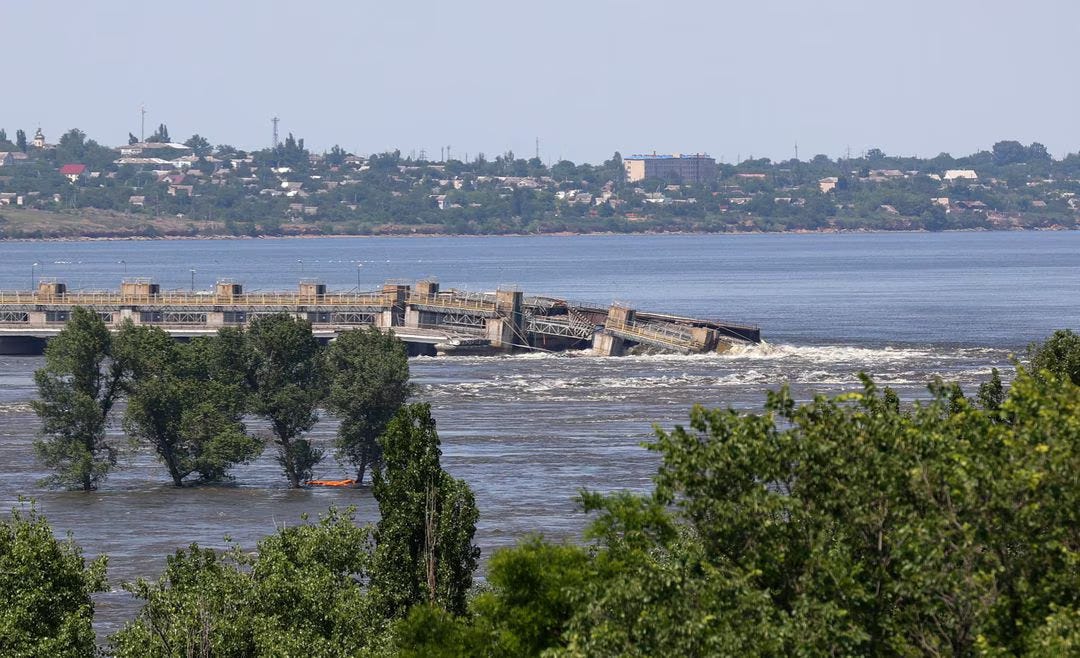
Instead, the entire Ukrainian offensive was overshadowed by the sudden and entirely unexpected failure of the dam at Nova Kakhovka on the lower Dneiper.
Let’s be clear about one thing: the destruction of this dam marks a qualitative change in the course of the war; a dam represents an entirely different tier of target. There is a broad sense that dams are not legitimate military targets, as they fall in the category of “objects containing dangerous forces”, along with things like sea walls, dykes, and nuclear power plants. However, attacks on dams are not without precedent, and the legality of such attacks is a complicated and thorny topic – it is not so simple as to say “attacking dams is a war crime” in all circumstances.
In any case, the legalities are not the main point here. The destruction of dams has the potential to impact civilians on a scale which is an order of magnitude higher than anything which has yet occured. The reality of the war in Ukraine is that, due to the fact that most of the fighting is occuring in depopulated areas (along with Russia’s use of precision standoff weapons) civilian casualties have been mercifully low. Through May of this year, there were fewer than 9,000 recorded civilian deaths in Ukraine (including both Ukrainian and Russian controlled territories). This is a thankfully low number, compared (for example) to the war in Syria, where over 30,000 civilians are killed annually, or Iraq, where nearly 18,000 civilians died per year in the years following the American invasion in 2003.
A breaking dam, however, massively escalates the threat to civilians. Tens of thousands of civilians are in the flood path and have to be evacuated – but perhaps even more significantly, the destruction of the dam creates a major threat to agriculture. There are also rising escalation risks, and the last thing anybody wants is for dams to become a permanent menu item.
In this article, I want to conduct a preliminary assessment of the destruction of the dam, its consequences, and its potential causes. In particular, I want to sort through the evidence and get a sense of whether Ukraine or Russia is a more likely culprit. As it currently stands, the situation is in flux and it is not as if we will find either Zelensky’s or Putin’s fingerprints on the detonator, but we can at least put some puzzle pieces roughly into position and get a sense of what the picture looks like.
One thing that I want to mention, first off, is that we do not need to assume that the dam was intentionally destroyed. For example, in a now infamous Washington Post article, we learn that Ukraine experimented with hitting the dam with GMLRS rockets in an attempt to blow a hole and create a controlled flood. The sense that one gets here is that Ukraine did not necessarily intend to destroy the dam altogether, but rather that they wanted to create a limited breach and by extension a limited flood.
We will keep such possibilities in mind and consider them to be a distinction without difference. It’s entirely possible that one party or the other attempted to create a limited breach and accidentally brought about a much larger dam failure, but from our perspective this isn’t particularly different from intentionally bringing the whole thing down.
With this little distinction in mind, let’s begin to sort through what we know about this whole dam thing.
Water World
What on earth is (or was) the Kakhovka dam and what was its relation to the larger geography of the surrounding steppe?
To begin with, let’s make a brief note about the Dnieper. In its natural state, the Dnieper is a deeply difficult and turbulent river, characterized by a series of essentially unnavigable rapids. In fact, the Dnieper’s fiesty nature is precisely why the city of Kiev is where it is. 1200 years ago, when enterprising traders came rowing down the Dnieper (trying to get to the Black Sea, and thence to Constantinople), they found that certain portions of the river were impassable, and it was necessary to “portage” their boats – which means dragging them out of the river and overland to get past the rapids.
Portaging a boat on the middle Dnieper in 800 AD was dangerous. While disembarked and laboriously dragging the boat downstream, a trading party would be highly vulnerable to attack by the various warlike tribes which inhabited the region at the time. So it became necessary to build some sort of outpost stronghold which could serve as a waypoint to make passage down the river at least acceptably safe. Hence, Kiev – buit originally as a timber fortified trading post to ease passage along the middle Dnieper.
This is perhaps interesting, but as an aside it illustrates the basic point that for most of human history the Dnieper was not a friendly or easily navigable river akin to the Mississippi or the Rhine, and in the Soviet era a major effort was undertaken at last to tame it, in the form of a series of hydroelectric dams. These dams stiffled the rapids, generated electricity, smoothed the river’s course, and created enormous resevoirs, of which the Kakhovka resevoir is the largest by volume.
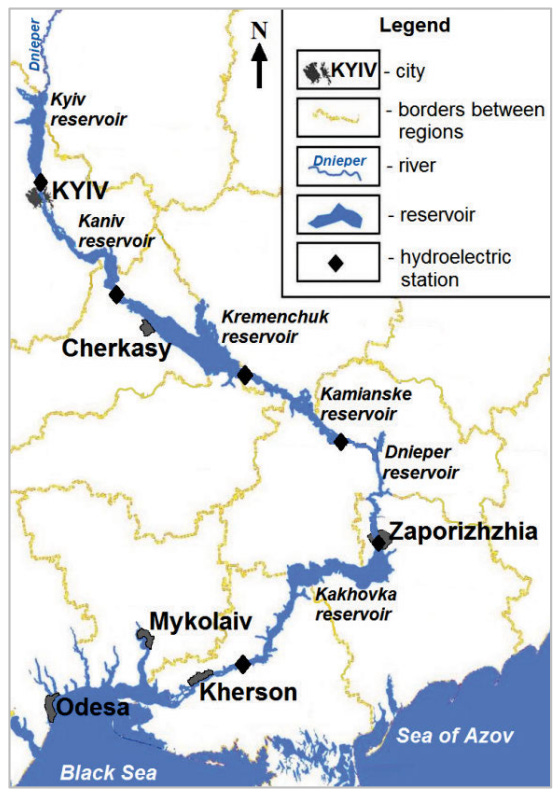
The Resevoirs and Dams of the Dneiper
The creation of the Kakhovka resevoir was also vitally linked to a series of canals which are fed from the resevoir. The most important of these is the Crimean canal, which carries Dnieper water to Crimea, but there are also a series of irrigation works which are vital to agricutlure in Kherson and Zaporizhia oblasts.

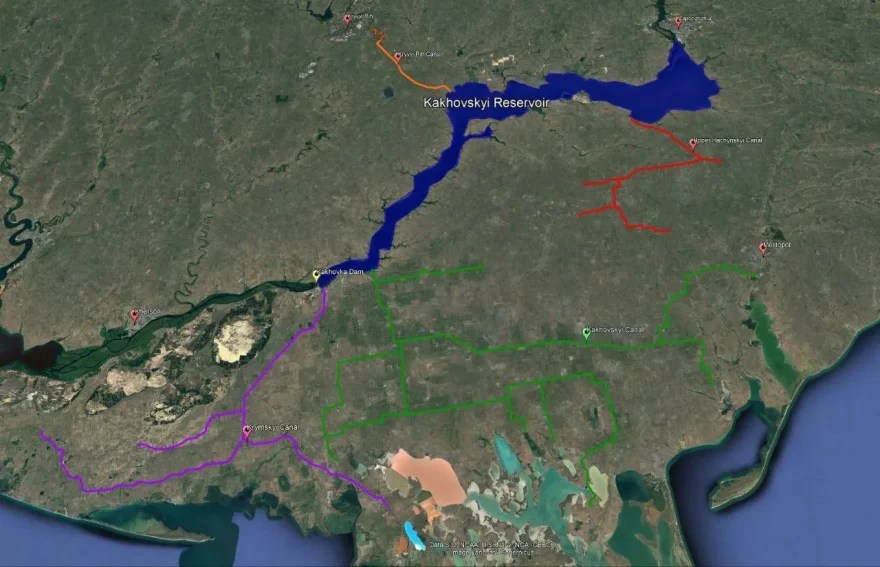
Canals fed by the Kakhovka Resevoir System
So that is the basic structure of the region’s hydrology. We can therefore enumerate both upstream and downstream effects from the dam’s breaching. Upstream effects relate to the draining of the Kakhovka resevoir, which will in time lead to insufficient flow through the canals, depriving both Crimea and regional farmland of water. Downstream effects are those of the enormous flooding which is currently taking place.
A threat to the Kakhovka dam first entered the discourse last autumn, when General Surovikin made the stunning decision to withdraw Russian forces from west bank Kherson – a decision which he said was prompted by the fear that Ukraine might destroy the dam and create a flood which would trap Russian troops on the far shore. That decision certainly looks prescient now, but thanks to this earlier discussion there was already a bevy of analysis conducted predicting what the flood path might look like.
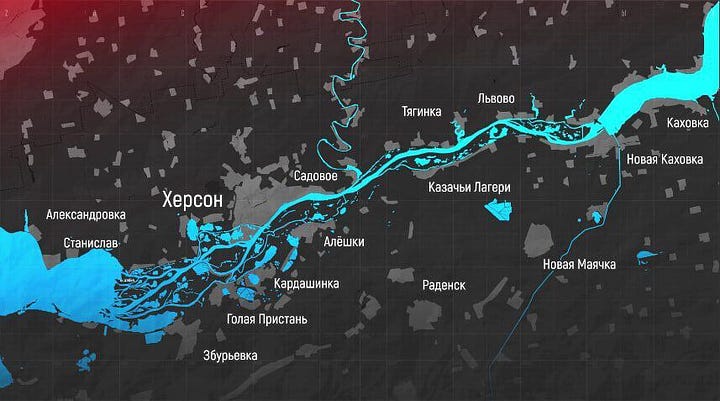
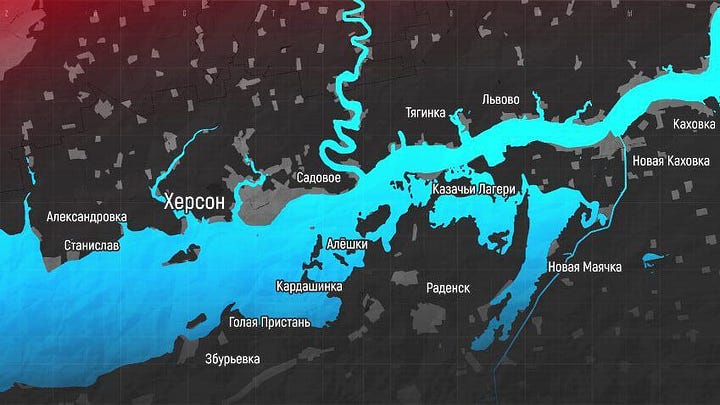
Before and After
As per the latest information as of this writing, the river has not yet crested and water levels continue to rise, but this has already turned into a vast and extremely disruptive flood. This is a severe humanitarian and ecological disaster with implications for the military situation in Ukraine. The question is – who did it?
Incriminating Evidence
Let’s start by looking at the most direct evidence potentially implicating Russia or Ukraine. I’d like to start by looking at an allegedly damning (haha) video which has been circulating rapidly, which purports to confirm that Russia blew the dam.
The video in question allegedly shows a Russian soldier giving an interview in December in which he boasts that the Russin army mined the Kakhovka dam and plan to destroy it to create a cascading flood and wash away the Ukrainian troops downstream.
Not to be blunt, but this is an egregiously bad bit of trickery and it’s difficult to believe that people are falling for it. To begin with, this is an interview with a Ukrainian blogger and youtuber who goes by the screen name “Edgar Myrotvorets” – interestingly naming himself after the infamous Ukrainian kill list. The “Russian soldier” who he is interviewing is allegedly a gentleman named Yegor Guzenko. Yegor seems to be an interesting fellow – he pops up on social media periodically largely to confess to stereotyped Russian war crimes, like kidnapping civilians and executing Ukrainian prisoners, and of course blowing up dams.
Essentially, we are being asked to believe that there is a Russian soldier out there who is giving interviews to Ukrainian media in which he confesses to all of Russia’s nefarious activities, and then goes about his duties without being stopped or punished. It should be pretty obvious that Yegor is actually Yehor, and is not a Russian soldier at all but a Ukrainian impersonator – funnily enough, Yegor also has a beard even though the Russian MOD has been cracking down on facial hair.
In any case, Yegor’s explosive interview is the main piece of direct evidence which is being used to prove that Russia blew up the dam.
In contrast, the evidence implicating Ukraine is pretty straightforward: they openly talked about experimenting with ways to breach the dam, and have actively shot rockets and artillery shells at it in the past. We refer back to the infamous WaPo article, and in particular the key passage:
Kovalchuk [commander of Ukrainian Operative Commandment South] considered flooding the river. The Ukrainians, he said, even conducted a test strike with a HIMARS launcher on one of the floodgates at the Nova Kakhovka dam, making three holes in the metal to see if the Dnieper’s water could be raised enough to stymie Russian crossings but not flood nearby villages.
The test was a success, Kovalchuk said, but the step remained a last resort. He held off.
We even have footage of Ukraine striking the dam (particularly the roadway on top of it) from last year – footage which was incorrectly shared this week as being video of the strike that destroyed the dam on monday.
There is also a variety of circumstantial evidence worth sorting through.
A popular point being raised by the Ukrainian infosphere is the fact that the Kakhovka dam was under Russian control – therefore, they argue that only Russia could therefore have planted explosives to createa breach (at this point, we do not know the technical method used to create the breach).
I rather think that Russia’s control of the dam makes it much less likely that they are responsible, for the following basic reason. First, having control over the dam’s gates means that Russia had the power to manipulate water levels downstream at will. If they wanted to create flooding, they could have simply opened all the gates. With the dam now breached, they have lost this control.
The situation is very much akin to the destruction of the Nordstream pipeline (which now seems to be being blamed on Ukraine, rather predictibly). Both Nordstream and the Kakhovka dam were tools that Russia had the power to swing in one direction or the other. These were levers that Russia could move from on to off and back again. The destruction of these tools actually robs Russia of control, and in both cases we are asked to believe that Russia intentionally disabled its own levers.
Cui Bono?
Ultimately, any analysis would be incomplete without asking a very basic question: who benefits from the destruction of the dam? This is where it gets a bit complicated, largely because there are so many concerns at cross-currents to each other. Let’s enumerate a few.
First, the flooding disproportionately affects the Russian side of the river. This has been pretty thoroughly established. The eastern bank of the river is lower and thus more affected by flooding. We knew this in the academic sense, and now satellite imagery confirms that it is indeed the east bank that has suffered most of the flooding.
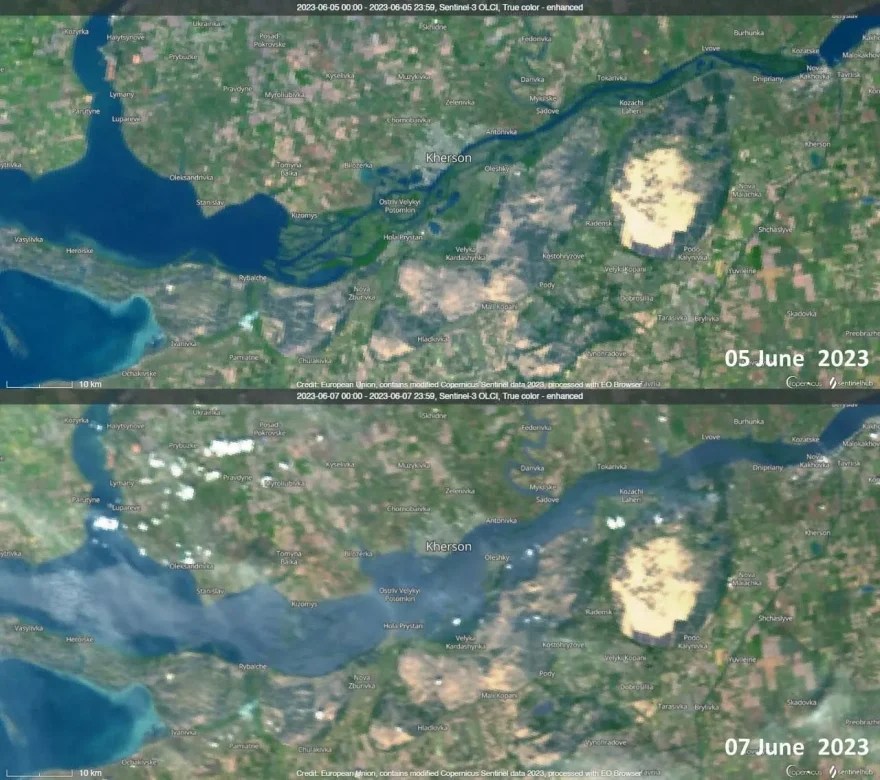
This has had the effect of washing out prepared Russian defenses, including minefields, and forcing withdrawls out of the flood zone, with plenty of imagery coming in of Russian soldiers standing in water up to their waists.
Secondly, the Upstream effects disroportionately affect Russia as well. Remember, the implications of the dam breach are not just downstream flooding, but also the draining of the resevoir, and this is particularly bad for Russia. First, in the long run this endangers the water flow through the Crimean Canal, which undermines a key Russian war aim. One of Russia’s primary motivations for launching this war in the first place was precisely to secure the Crimean Canal, which Ukraine had dammed up in order to choke off the peninsula’s water supply. Any analysis of the issue needs to aknowledge that, if you believe Russia blew the dam, you are essentially saying that they voluntarily trashed one of their primary war aims.
But it’s not just the Crimean Canal – there are also the variety of irrigation canal networks which sustain agriculture in east-bank Kherson and Zaporizhia oblasts – oblasts which Russia has annexed and which are firmly under Russian control.
The only way to spin all this (and there are some people, like Peter Zeihan, trying to spin it this way) as being in Russian interests is to argue that Russia expects to lose control of all this territory (including Crimea) and is going scorched earth in anticipation of defeat. But to believe this, you need to believe that Russia is badly losing the war and is on the verge of total defeat, and if you believe this I have nothing to say to you except to direct you to this link.
Third, we need to note the effects that this will have on a potential amphibious operation. In the short term, this obviously turns the lower Dneiper into a dangerous morass, and as the water subsides it will leave plenty of mess and mud which will make a river crossing very difficult for several weeks. In the long run, however, crossing the river may actually be easier – and here is where I want to make what I think is a critical point.
As long as Russia had control of the Kakhovka dam, they had the power to create flooding downstream at will. The optimal time to do this would be while Ukraine was attempting an amphibious assault out of Kherson. If you created flooding during such an assault, you would be complicating the crossing and washing out Ukraine’s beachheads. Obviously, Russia has now lost the ability to do this.
We already know that Russia understands how and why to manipulate the water levels to its advantage. Earlier this year, they were actually keeping the Kakhovka resevoir levels extremely low, most likely to minimize the threat of Ukraine breaching the dam (as Surovikin was apparently quite worried about). However, in recent weeks they closed up the gates and filled the resevoir up to the top.
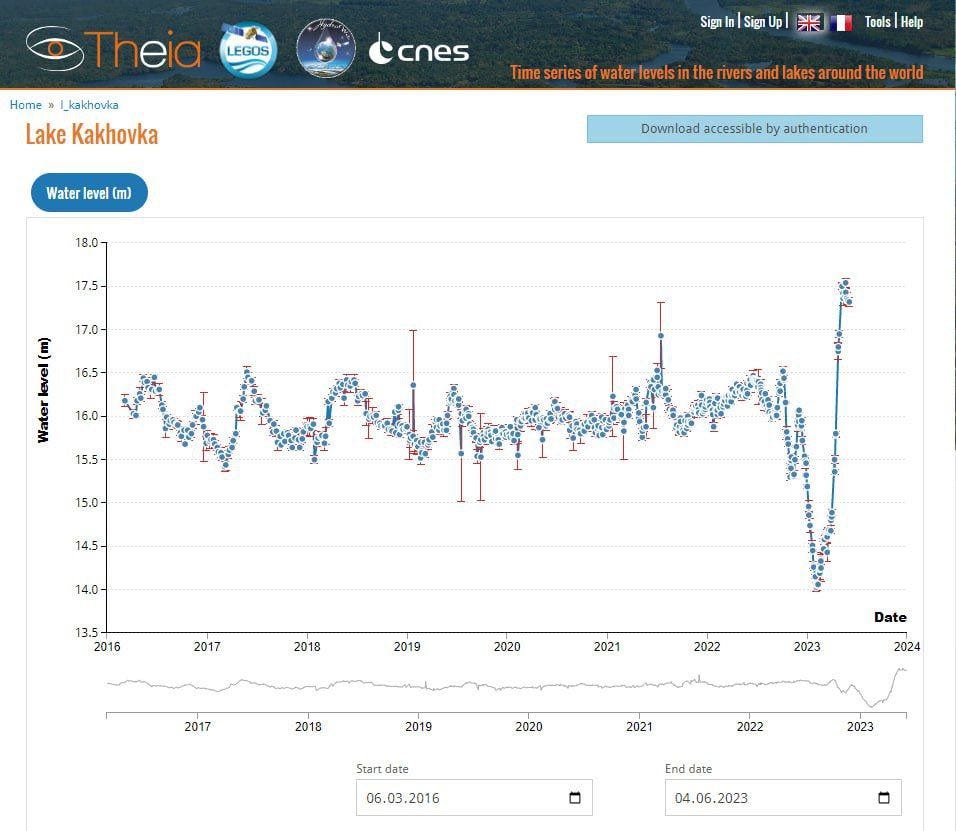
Kakhova Resevoir Levels
Why would they do this? It seems likely that Russia would want to retain water so that they could create a surge (not by destroying the dam, but by opening the gates up) to disrupt any Ukrainian attempt to cross the river. Again, the appeal of the dam for Russia is that it is a lever which can be throttled up and down as the situation calls for it. The breach of the dam, however, robs them of this tool.
This brings us to the corollary point, which is that the breach has two major benefits for Ukraine. Not only is it washing out Russian defenses and disproportionately disrupting the Russian side of the river, but Russia has now lost the ability to create a flood at the opportune moment later on.
If I had to make my guess about what happened to the dam, it would be as follows:
I believe Russia was retaining water to maintain the power to create flooding in the event of a Ukrainian amphibious assault across the lower Dnieper. Ukraine attempted to nullify this tool with a limited breach of the dam (of the sort which they rehearsed last December) but the dam failure cascaded beyond what they intended due to A) the resevoir being at extremely high levels, putting excessive stress on the strucure, and B) previous damage to the structure from prior Ukrainian shelling and rocketry attacks. Indeed, images of the dam seem to suggest that it failed in stages, with a single span leaking before the collapse metastasized.

I find the idea that Russia destroyed the dam to be very difficult to believe, for the following reasons (in recap):
- Flooding disproportionately affected the Russian side of the river and destroyed Russian positions.
- The loss of the dam does severe damage to core Russian interests, including Crimean water access and agriculture on the steppe.
- The dam, while intact, was a tool which Russia was using to manipulate the water level freely.
- Of the two beligerent parties, only Ukraine has openly shot at the dam and talked about breaching it.
We may learn, of course, that there was some accidental failure of some kind, potentially due to the water tug of war being waged between Russia and Ukraine as they try to balance the flow of the river. But in a wartime situation, when a major infrastructure object is destroyed, it is most rational to assume intentional destruction, and in this situation the costs to critical Russian infrastructure and the loss of a valuable tool for controlling the river make it extremely difficult to believe that Russia would blow up its own dam.
Ultimately, perhaps your judgement on the matter simply reflects your larger belief about who is winning the war. Breaching a dam is, after all, rather a desperation move – so maybe the question to ask is: who do you think is more desperate? Whose back is against the wall here – Russia, or Ukraine?
Turkiye’s Proposal For A Kakhovka Dam Investigation Committee Is A Genius Soft Power Move
BY ANDREW KORYBKO | JUNE 7, 2023
Turkish President Erdogan proposed the creation of a multilateral committee for investigating the Kakhovka Dam explosion during a call with President Putin on Wednesday. He suggested that it could comprise the two conflicting parties, the UN, and members of the international community such as his country, which has experience mediating between Moscow and Kiev during their grain deal talks. This was a genius soft power move that’ll powerfully shape global perceptions about this incident.
Russia and Ukraine blame one another for this terrorist attack, and while many might have predicted that the US would take its proxy’s side, National Security Council spokesman John Kirby said on Tuesday that “we cannot say conclusively what happened at this point.” This stance is almost certainly attributable to the fact that Ukrainian Major General Andrey Kovalchuk boasted to the Washington Post in December about how Kiev tested blowing up the dam with US-supplied HIMARS missiles late last year.
Russian Foreign Ministry spokeswoman Maria Zakharova made sure that the entire world knew about this too by bringing it up during a press briefing the day after.
She rhetorically asked US officials “Were you aware of how American weapons, the weapons that are being supplied to Ukraine, are used? That trial tests of a terrorist attack against civilian infrastructure in third countries are being made? These are the questions that we directly pose in the public space before the White House; you must answer them.”
Considering that the US officially regards the dam’s destruction as a war crime, which its Alternative Representative to the UN for Special Political Affairs Robert Wood emphasized during Tuesday’s Security Council meeting about this, it has every reason to support the investigation that Turkiye just proposed. As for Kiev, it insists that Russia was to blame, so refusing to participate in a truly neutral multilateral investigation would come off as incredibly suspicious by suggesting that it has something to hide.
The US and Ukraine, which are the principal antagonists in the NATO-Russian proxy war, are therefore pressured to go along with this initiative from their mutual Turkish partner lest they risk stoking speculation that they’re afraid of a dark truth emerging. Neither can credibly imply that Ankara has any ulterior motives in proposing this investigation either since it’s a NATO ally that’s consistently voted against Russia at the UNGA and has even armed Kiev with drones for use against Moscow’s troops.
Therein lies the reason why President Erdogan’s proposal was such a genius soft power move since it puts those two in a dilemma. Going along with the investigation risks revealing incontrovertible evidence that Kiev blew up the Kakhovka Dam while declining to participate makes them look guilty in the court of public opinion. Regardless of whatever they choose to do, Turkiye comes off as responsible member of the international community, which boosts its global prestige and especially that of its multipolar leader.
Following Ukraine steps, Poland now uses Russophobia to crush dissent
By Uriel Araujo | June 7, 2023
President Andrzej Duda has signed a law which allows Warsaw to conduct political repression against the opposition, by creating a commission to “investigate Russian influence on Polish politics that could ban people from public office for a decade” – Duda and the the Law and Justice (PiS) party argue this is necessary to neutralize “Moscow agents”, but the opposition fear this could trigger a civil war, as journalist Wojciech Kość wrote for POLITICO. This could complicate Warsaw’s relations with Brussels, as well – “with the European Commission freezing billions in EU pandemic recovery cash over worries the Polish government is backsliding on the bloc’s democratic principles”, writes Kość.
Poland’s relations with the European bloc have been complicated for a while: in 2021, the European Court of Human Rights (ECHR), which is part of the Council of Europe (not the EU) condemned the Central European country over the removal of judges from office and their arrest. Warsaw has been on a collision route with Brussels as well over a number of issues regarding the rule of law (from the European Commission perspective), and also free press, LGBT rights, and so on.
Poland’s diplomacy, since 1989, has been largely shaped by its aspiration to join both NATO and the EU. Since at least 2015, Warsaw has maintained its alliance with Washington, while becoming, on the other hand, increasingly isolated within Europe and becoming kind of adrift. In 2021, Polish Foreign Minister Zbigniew Rau urged the US to support the Three Seas Initiative (3SI) projects, arguing that it could become a strategic “American economic footprint” in the Adriatic, Baltic, and Black Sea region and a “counterweight to investments in critical infrastructure by actors who do not share our democratic value.”
Since 2022, the ongoing Russian-Ukrainian confrontation has opened a kind of window of opportunity for Warsaw. In December last year, Estonian Ambassador to the EU Aivo Orav, stated that the “political center of influence” in Europe no longer was “in Berlin and Paris” (only), but now “also lies in Eastern and Central European Countries as well, including the Baltic countries, together with U.S. support.” Such a possible outcome would be very much welcomed by Washington, especially considering how both France and Germany today flirt with the idea of strategic autonomy.
As I’ve written, Warsaw has been antagonizing Berlin while trying to project its own influence within the continent – clearly with Washington’s crucial support, as the US seems to be “fed up” with Germany. Poland’s legal campaign against Germany over WWII reparations and its attempts to absorb neighboring Ukraine in a confederacy should be seen as part of this larger agenda. The Polish renaming of Kaliningrad, as I also wrote, is yet another instance of the current memory war which haunts Europe today.
Germany, in turn, on May 8 this year banned Soviet and Russian flags during its “World War II commemorations”. The Allied Forces triumph over Nazi-Fascism has been celebrated for half a century as the fundamental victory of democracy and true Western values. This Western narrative is short-circuiting as the West has seen fit to rewrite History, by preposterously erasing Russia from it while white-washing the blatant neo-Nazism of Ukraine’s Azov regiment and its human rights infringements.
In Ukraine too “anti-Russian” measures have been advanced by the current regime to persecute the opposition and civil society. Since at least December last year Zelensky has been advancing moves to outlaw Orthodox communities, something which even Archbishop Sviatoslav Shevchuk of Kyiv-Halych, head of the Ukrainian Catholic Church, has denounced.
No less than 11 political parties have been banned there since 2022 over their “pro-Russia” stances. According to Volodymyr Ishchenko, a research associate at the Institute of East European Studies (Freie Universität Berlin), these measures have more to do with “post-Euromaidan polarization” than with “genuine security concerns”.
Since the ultranationalist 2014 Maidan Revolution, and the ongoing civil war in Donbass, “pro-Russia” has become an accusatory category to label and marginalize, according to Ishchenko, “anyone calling for Ukraine’s neutrality” as well as “state-developmentalist, anti-Western, illiberal, populist, left-wing, and many other discourses.” In the Eastern European nation, there has always been a political camp which calls for closer integration with neighboring Russia rather than the West – which is no wonder, considering that in this strongly bilingual nation, at least 34% of the population speaks Russian, with a high degree of intermarriage.
In short, in a kind of neo-McCarthyism, anti-Russia discourse and the re-writing of history is used today both by Kiev and Warsaw as a pretext to persecute and even outlaw dissent.
In other words, the problem is that being at war over the past (and at war with the past itself) can always backfire: Polish-Ukrainian bilateral relations and their ambitious plans towards a confederacy have always been hampered by differences precisely about World War II. How can there be strong ties of friendship between two nations when one of them today celebrates as heroes those who supported the genocide of the other?
Last February, while Ukrainian Parliament celebrated Stepan Bandera, Poland’s Prime Minister Mateusz Morawiecki in turn expressed his disapproval of all who commemorate Bandera, describing as “genocide” the brutal murder of between 100,000 to 200,000 ethnic Poles. Here, Polish and Ukrainian nationalism clash. And both regimes clash with the democratic values which the Western bloc purportedly champions – while Europe now welcomes the specter of far-right nationalism and even neo-Nazism.
As non-alignmentism and multi-alignmentism are on the rise, the US-led Western global order has been in decline not just due to de-dollarization or to the potential end of the US-Saudi relationship – in a deeper level, its hypocritical weaponization of human rights is losing force as are its most cherished narratives and political myths.
Western journalists face huge censorship in Ukraine – media
RT | June 6, 2023
The Ukrainian government imposes severe restrictions on Western reporters, forcing them to show only what the military wants them to see and stripping the credentials of those who tell uncomfortable truths, the news site Semafor reported on Monday.
Journalists from NBC News, the New York Times, CNN, and The New Yorker have all clashed with the Ukrainian government after they strayed outside the strict limits imposed on their work by Kiev, Semafor reported.
“The authorities only allow press tours with press officers, where they show off in front of the camera and are afraid to show the real situation,” Ukrainian photographer Maxim Dondyuk wrote on Instagram in May after Ukrainian authorities threatened to strip his press accreditation. Dondyuk had taken pictures of the dire conditions in Ukrainian trenches for a New Yorker article.
New York Times journalist Thomas Gibbons-Neff has had his credentials revoked on several occasions, including after he reported that Ukrainian forces were using banned cluster munitions. Magnum photographer Antoine d’Agata had his access denied after documenting the psychological suffering of Ukrainian soldiers in a mental health facility. An NBC News crew had their press passes revoked after they traveled to Crimea and interviewed locals who were happy to live in Russia and supported the Russian military.
Journalists working in Ukraine have to sign a document stating that they will follow rules set by the military, and can only interview approved officials and visit approved areas. Furthermore, three journalists working in Kiev told Semafor that reporters have been asked “to take lie detector tests to prove they aren’t Russian agents.”
Reporters have no choice but to comply, or be left out of work. One anonymous journalist said that Ukrainian authorities “might snatch my press credential” if they found out he complained about the situation to Semafor. Others have been more eager to accept the bargain, with Semafor noting that “most Western news outlets treat Ukrainian soldiers as, at some level, ‘our boys’.”
Some Ukrainian reporters, however, feel that the restrictions are counterproductive. Dondyuk said that they inevitably lead to “only stupid propaganda” making it out of Ukraine, while Nastya Stanko, a correspondent for Ukrainian news site Hromadske, said: “It’s more important to have journalists who can honestly show what happens on the front lines, and I’m not sure it’s clear to everyone in the army.”
Aside from losing accreditation, journalists who anger the Ukrainian government can face more serious consequences. After reporting from Crimea, NBC News correspondent Keir Simmons found his name published on the ‘Mirotvorets’ (Peacemaker) blacklist for “crimes” against the country. Linked to the Ukrainian state, Mirotvorets posts the names and personal details of Ukraine’s “enemies,” some of whom have been murdered after their inclusion in the database. When someone on the list is killed or dies in other circumstances, text reading “liquidated” is imposed over the individual’s photograph on the site.
Ukraine blew up Kakhovka dam as revenge for failed offensive – Kremlin
RT | June 6, 2023
Ukrainian forces sabotaged the Kakhovka hydroelectric dam in Russia’s Kherson Region in a bid to deprive Crimea of drinking water and distract from its faltering counteroffensive, Kremlin spokesman Dmitry Peskov claimed on Tuesday.
The dam was partially destroyed early on Tuesday morning, sending torrents of water downstream and flooding towns and villages along the path of the Dnieper River.
“We are talking about a deliberate sabotage by the Ukrainian side,” Peskov told reporters. “This sabotage could potentially lead to very serious consequences for several tens of thousands of inhabitants of the region, environmental consequences and consequences of a different nature, which have yet to be established.”
Peskov claimed that one of the key goals of the attack was to deprive Crimea of water. Crimea’s 2 million residents largely receive their water from the North Crimean Canal, which is fed from the reservoir above the Kakhovka dam.
“This sabotage is also connected with the fact that, having launched large-scale offensive operations two days ago, the Ukrainian armed forces are not achieving their goals,” Peskov continued. Russia’s Defense Ministry has said it repelled several large-scale attacks in the southern sector of the front in recent days. These “offensive actions are choking,” Peskov stated.
Ukrainian officials and their European backers have accused Russia of blowing up the dam, with European Council President Charles Michel calling the attack “a war crime.” Moscow “strongly rejects” the accusation, Peskov said.
While the flooding now makes it difficult for Ukrainian forces to cross the Dnieper and attack Russia’s defensive lines, the destruction of the dam also appears to aid a number of Ukraine’s key objectives. The flooding mostly threatens the eastern bank of the river, where Russian troops withdrew to last year amid concerns that the Ukrainian military would blow up the dam.
With the dam destroyed, the level of the Dnieper has fallen further upstream, including at the Zaporozhye Nuclear Power Plant. Ukrainian troops made several attempts to cross the river to recapture the plant from Russian forces last year, and lowering the water level would remove a major obstacle to future attempts. Additionally, the Soviet-era plant depends on water from the Dnieper to cool its reactors and its spent fuel rods.
The Ukrainian military conducted a test strike on the dam using an American-supplied HIMARS launcher last year, Ukrainian General Andrey Kovalchuk told the Washington Post in December.
Two months earlier, Russia’s envoy to the United Nations, Vassily Nebenzia, warned the UN Security Council that Kiev’s forces were considering a “reckless” attack on the dam with sea mines or missiles. “The authorities in Kiev and their Western backers will bear full responsibility for all the consequences of such a devastating scenario,” Nebenzia cautioned.
Featured Video

Seyed Marandi: Trump lost the Iran war – Must sell it as victory
or go to
Aletho News Archives – Video-Images
From the Archives
The Balfour Declaration – A Century of Jewish Power
By Gilad Atzmon | May 17, 2017
This year, Palestinians and their supporters mark the 100th anniversary of The Balfour Declaration, a written statement from the United Kingdom’s Foreign Secretary, Arthur James Balfour, to Walter Rothschild, a leader of the British Jewish community, in favour of the establishment of a Jewish national home in Palestine.
For Palestinians, The Balfour Declaration was the beginning of their plight: a century of ethnic cleansing at the hands of European newcomers who claim Palestine as their historic home. Yet, for some reason, supporters of the Palestinians are desperate to suppress discussion of the motivation for the Balfour Declaration – how and why did it come about? … continue
Blog Roll
 Aletho News
- Larry Sanger Said Wikipedia Punishes Dissent. Then It Banned Him.
- How Darializa Avila Chevalier Is Different From Other Elected Progressives
- Israel Declares 464 Dunams in Sinjil as “State Land”
- Strait of Hormuz as strategic red line: Why Iran must confront Oman’s corridor plan and Trump’s threats
- House to vote on proposal ending $3.3bln in military aid to ‘Israel’
- Mission unaccomplished – Part I: America failed to achieve every war objective against Iran
- Iranian Victory- Gulf States Creating ‘Regional Security Framework’ With Iran
- IRGC Navy rejects new Strait of Hormuz shipping routes
- Seyed M. Marandi: Trump Lost the Iran War – Must Sell It as a Victory
- Iran, Saudi FMs hold phone talks as Persian Gulf states rethink US ties
- If Americans Knew
- Victories by Pro-Palestinian Democrats Show the Party’s Shift on Israel
- Massie moves to strike $3.3B in Israel military aid from the budget
- How Jeffrey Epstein’s Israeli Network Shaped Congo’s Deadly Mineral Trade
- Gaza officials warn of ‘silent famine’ as aid deliveries fall far below planned levels
- Wheat harvest becomes act of defiance as West Bank farmers race to outrun Israeli settler attacks
- The ICC must investigate Israel’s genocidal use of sexual violence
- The Myth of Israeli Self-Sufficiency
- Internal Documents Show Trump’s “Board of Peace“ Moving to Crush Palestinian Self-Determination
- Israel Blocks Hunfreds of Gaza Students from Scholarships Abroad
- Gaza faces Israel-imposed “silent famine”; cost of Israel’s wars since Oct. 7 $200B+ – Daily Update
- No Tricks Zone
- 3 New Studies Find Increasing Trends In Solar Radiation Since The 1980s – Easily Explaining Warming
- THE TRANSCEIVER PARADOX: Why Organoid Intelligence (OI) Could Become Our Ultimate Alien Predator
- German Wind Turbines Face Regulatory Shutdown Due To Excessive Noise
- New Study: Chile’s Relative Sea Level Was 3.2 Meters Higher Than Today During The Mid-Holocene
- Beyond The Pitch: Why FIFA’s World Cup Is One Of Humanity’s Best Investments
- Climate Alarmists Now Using Natural Phenomena To Support Their Claims
- New Study: Significant CO2 Fluxes From Non-Volcanic Sources Are Largely Neglected In Carbon Budgets
- Women Climate Scientists Being Harassed, Insulted By Skeptics, Claims Berkeley Earth Researcher
- Germany’s Longterm Spring Climate Data Show “No Climate Trend”
- New Study: Solar Photovoltaic, Wind Power Fail To Meet Annual Energy Demands 62% Of The Time
 Aletho News