A Bonfire of the Vanities
By Alastair Crooke | Strategic Culture Foundation | July 17, 2023
Hubris consists in believing that a contrived narrative can, in and of itself, bring victory. It is a fantasy that has swept through the West – most emphatically since the 17th century. Recently, the Daily Telegraph published a ridiculous nine minute video purporting to show that ‘narratives win wars’, and that set-backs in the battlespace are incidentals: What matters is to have a thread of unitary narrative articulated, both vertically and horizontally, throughout the spectrum – from the special forces’ soldier in the field through to the pinnacle of the political apex.
The gist of it is that ‘we’ (the West) have compelling a narrative, whilst Russia’s is ‘clunky’ – ‘Us winning therefore, is inevitable’.
It is easy to scoff, but nonetheless we can recognise in it a certain substance (even if that substance is an invention). Narrative is now how western élites imagine the world. Whether it is the pandemic emergency, the climate or Ukraine ‘emergencies’ – all are re-defined as ‘wars’. All are ‘wars’ that are to be fought with a unitary imposed narrative of ‘winning’, against which all contrarian opinion is forbidden.
The obvious flaw to this hubris is that it requires you to be at war with reality. At first, the public are confused, but as the lies proliferate, and lie is layered upon lie, the narrative separates further and further from touched reality, even as mists of dishonesty continue to swathe themselves loosely around it. Public scepticism sets in. Narratives about the ‘why’ of inflation; whether the economy be healthy or not; or why we must go to war with Russia, begin to fray.
Western élites have ‘bet their shirts’ on maximum control of ‘media platforms’, absolute messaging conformity and ruthless repression of protest as their blueprint for a continued hold in power.
Yet, against the odds, the MSM is losing its hold over the U.S. audience. Polls show growing distrust of the U.S. MSM. When Tucker Carlson’s first ‘anti-message’ Twitter show appeared, the noise of tectonic plates grinding against each other was unmissable, as more than 100 million (one in three) Americans listened to iconoclasm.
The weakness to this new ‘liberal’ authoritarianism is that its key narrative myths can get busted. One just has; slowly, people begin to speak reality.
Ukraine: How do you win an unwinnable war? Well, the élite answer has been through narrative. By insisting against reality that Ukraine is winning, and Russia is ‘cracking’. But such hubris eventually is busted by facts on the ground. Even the western ruling classes can see their demand for a successful Ukrainian offensive has flopped. At the end, military facts are more powerful than political waffle: One side is destroyed, its many dead become the tragic ‘agency’ to upending dogma.
“We will be in a position to extend an invitation to Ukraine to join the Alliance when Allies agree and conditions are met … [however] unless Ukraine wins this war, there’s no membership issue to be discussed at all” – Jens Stoltenberg’s statement at Vilnius. Thus, after urging Kiev to throw more (hundreds of thousands) of its men into the jaws of death to justify NATO membership, the latter turns its back on its protégé. It was, after all, an unwinnable war from the beginning.
The hubris, at one level, lay in NATO’s pitting of its alleged ‘superior’ military doctrine and weapons versus that of a deprecated, Soviet-style, hide-bound, Russian military rigidity – and ‘incompetence’.
But military facts on the ground have exposed the western doctrine as hubris – with Ukrainian forces decimated, and its NATO weaponry lying in smoking ruins. It was NATO that insisted on re-enacting the Battle of 73 Easting (from the Iraqi desert, but now translated into Ukraine).
In Iraq, the ‘armoured fist’ punched easily into Iraqi tank formations: It was indeed a thrusting ‘fist’ that knocked the Iraqi opposition ‘for six’. But, as the U.S. commander at that tank battle (Colonel Macgregor), frankly admits, its outcome against a de-motivated opposition largely was fortuitous.
Nonetheless ‘73 Easting’ is a NATO myth, turned into the general doctrine for the Ukrainian forces – a doctrine structured around Iraq’s unique circumstance.
The hubris – in line with the Daily Telegraph video – however, ascends vertically to impose the unitary narrative of a coming western ‘win’ onto the Russian political sphere too. It is an old, old story that Russia is military weak, politically fragile, and prone to fissure. Conor Gallagher has shown with ample quotes that it was exactly the same story in World War 2, reflecting a similar western underestimation of Russia – combined with a gross overestimation of their own capabilities.
The fundamental problem with ‘delusion’ is that the exit from it (if it occurs at all) moves at a much slower pace than events. The mismatch can define future outcomes.
It may be in the Team Biden interest now to oversee an orderly NATO withdrawal from Ukraine – such that it avoids becoming another Kabul debacle.
For that to happen, Team Biden needs Russia to accept a ceasefire. And here lies the (largely overlooked) flaw to that strategy: It simply is not in the Russian interest to ‘freeze’ the situation. Again, the assumption that Putin would ‘jump’ at the western offer of a ceasefire is hubristic thinking: The two adversaries are not frozen in the basic meaning of the term – as in a conflict in which neither side has been able to prevail over the other, and are stuck.
Put simply, whereas Ukraine structurally hovers at the brink of implosion, Russia, by contrast, is fully plenipotent: It has large, fresh forces; it dominates the airspace; and has near domination of the electromagnetic airspace. But the more fundamental objection to a ceasefire is that Moscow wants the present Kiev collective gone, and NATO’s weapons off the battle field.
So, here is the rub: Biden has an election, and so it would suit the Democratic campaign needs to have an ‘orderly wind-down’. The Ukraine war has exposed too many wider American logistic deficiencies. But Russia has its’ interests, too.
Europe is the party most trapped by ‘delusion’ – starting from the point at which they threw themselves unreservedly into the Biden ‘camp’. The Ukraine narrative broke at Vilnius. But the amour propre of certain EU leaders puts them at war with reality. They want to continue to feed Ukraine into the grinder – to persist in the fantasy of ‘total win’: “There is no other way than a total win – and to get rid of Putin … We have to take all risks for that. No compromise is possible, no compromise”.
The EU Political Class have made so many disastrous decisions in deference to U.S. strategy – decisions that go directly against Europeans’ own economic and security interests – that they are very afraid.
If the reaction of some of these leaders seems disproportionate and unrealistic (“There is no other way than a total win – and to get rid of Putin”) – it is because this ‘war’ touches on a deeper motivations. It reflects existential fears of an unravelling of the western meta-narrative that will take down both its hegemony, and the western financial structure with it.
The western meta-narrative “from Plato to NATO, is one of superior ideas and practices whose origins lie in ancient Greece, and have since been refined, extended, and transmitted down the ages (through the Renaissance, the scientific revolution and other supposedly uniquely western developments), so that we in the west today are the lucky inheritors of a superior cultural DNA”.
This is what the narrators of the Daily Telegraph video probably had at the back of their minds when they insist that ‘Our narrative wins wars’. Their hubris resides in the implicit presumption: that the West somehow always wins – is destined to prevail – because it is the recipient of this privileged genealogy.
Of course, outside of general understanding, it is accepted that notions of ‘a coherent West’ have been invented, repurposed and put to use in different times and places. In her new book, The West, classical archaeologist Naoíse Mac Sweeney takes issue with the ‘master myth’ by pointing out that it was only “with the expansion of European overseas imperialism over the seventeenth century, that a more coherent idea of the West began to emerge – one being deployed as a conceptual tool to draw the distinction between the type of people who could legitimately be colonised, and those who could legitimately be colonizers”.
With the invention of the West came the invention of Western history – an elevated and exclusive lineage that provided an historical justification for the Western domination. According to the English jurist and philosopher Francis Bacon, there were only three periods of learning and civilization in human history: “one among the Greeks, the second among the Romans, and the last among us, that is to say, the nations of Western Europe”.
The deeper fear of western political leaders therefore – complicit in the knowledge that the ‘Narrative’ is a fiction that we tell ourselves, despite knowing that it is factually false – is that our era has been made increasingly and dangerously contingent on this meta-myth.
They quake, not just at a ‘Russia empowered’, but rather at the prospect the new multi-polar order led by Putin and Xi that is sweeping the globe will tear down the myth of Western Civilisation.
No more security guarantees for Black Sea navigation – Russian FM
RT | July 17, 2023
Russia will no longer provide security guarantees for civilian vessels traversing the formerly exempted corridor in the Black Sea, the country’s foreign ministry has announced. Earlier on Monday, the Kremlin stated that it would not extend the Black Sea grain agreement since its own food and fertilizer exports are still being blocked.
In a statement released on Monday, the Foreign Ministry said that this latest decision “means the recall of maritime navigation security guarantees, the discontinuation of the maritime humanitarian corridor [and] the reinstatement of the ‘temporarily dangerous area’ regime in the north-western Black Sea.” Russian diplomats went on to accuse Ukraine of using the humanitarian corridor to carry out attacks on Russian targets.
As for the Ukrainian grain shipments that were facilitated by the deal, the ministry claimed that the vast majority of those ended up in Europe, with several countries there allegedly lining their pockets.
The statement pointed out that the whole mechanism, which was launched last summer, had ostensibly been designed to help avert famine in poorer nations.
According to Moscow, key points in the Russia-UN memorandum, which was signed in lockstep with the Black Sea Initiative, have remained unfulfilled to date.
As a result, the ministry explained, Russian bank transactions, insurance and logistics were effectively paralyzed, meaning that Moscow could not sell its own produce and fertilizers on the international market. In one case cited in the statement, a shipment of Russian fertilizers donated free of charge to several African countries was blocked in the EU.
The foreign ministry concluded that in light of all these issues, the agreement no longer makes sense.
Moscow has suggested European nations should allow Ukraine to transfer its grain via their territory and potentially face the wrath of local farmers, or take action and address Russia’s grievances.
Should this happen, Moscow would be ready to return to the implementation of the agreement, the statement noted.
Earlier on Monday, Kremlin spokesperson Dmitry Peskov announced the termination of the deal. He also reiterated Russia’s readiness to return to the mechanism; however, he added that this would only happen if its interests were respected.
Last week, Russian President Vladimir Putin warned that Moscow would “suspend participation in this deal,” describing the arrangement as a “one-sided game all along.”
Kiev’s Latest Attack Against The Crimean Bridge Was A Desperate Distraction
BY ANDREW KORYBKO | JULY 17, 2023
Kiev’s NATO–backed counteroffensive has failed despite the tens of billions of dollars invested in this endeavor as confirmed by US Defense Intelligence Agency Chief of Staff John Kirchhofer’s candid admission late last week that “we are at a bit of a stalemate.” Ukraine can’t count on much more American aid either after Biden earlier revealed that the US is “low” on ammo after depleting its stockpiles, which National Security Advisor Jake Sullivan later told CNN will take years to replenish.
It was against this backdrop that the US decided to give Ukraine cluster munitions despite previously describing their alleged use by Russia as a “war crime” since it simply doesn’t have much else left to send. President Putin had earlier assessed that the export of provocative weapons like depleted uranium shells was precisely due to the aforesaid predicament, which he reaffirmed in light of the latest news. Quite clearly, the NATO chief’s “race of logistics”/”war of attrition” with Russia isn’t going as planned.
The counteroffensive has failed so spectacularly that Ukrainian Deputy Defense Minister Anna Malyar was forced to inform her audience that reports about Russia going on the offensive near Kupyansk in Kharkov Region are true but sugarcoated it by claiming that Kiev is “putting up strong resistance.” With Russia regaining the military initiative, it was only a matter of time before Ukraine resorted to terrorism out of desperation to distract from these dynamics, ergo why it once again attacked the Crimean Bridge.
Monday morning’s incident killed at least two people and showed that shortcomings still exist when it comes to defending this strategic piece of infrastructure. Nevertheless, its temporary closure in the aftermath of this attack likely won’t affect Russia’s frontline operations, especially since its rail portion hasn’t been damaged. Even so, this is still a symbolic victory for Kiev that’ll be spun by the Mainstream Media to make it seem like the counteroffensive has finally achieved something significant.
In reality, however, this latest attack has nothing to do with that campaign. It was presumably planned for a while and won’t shift the military-strategic dynamics of this conflict, neither in the broader sense when it comes to Russia’s edge over the West in the “race of logistics”/”war of attrition” nor in the specific one with respect to its offensive in the Kupyansk direction. All that this attack will do is distract from the preceding facts that are too “politically inconvenient” for Kiev’s supporters to acknowledge.
As they indulge in the latest “copium” pushed by the Mainstream Media and online trolls, the fact remains that Kiev’s counteroffensive spectacularly failed and talks will therefore likely resume with Moscow by sometime later this year as explained in detail here. Instead of obsessing over this incident and getting the hopes of Kiev’s supporters unrealistically high, it would be much more responsible to precondition everyone to expect the aforementioned diplomatic development, which appears inevitable.
The New York Times’ Latest Smear Piece Against Tucker Shows That Liberals Have Lost The Plot
BY ANDREW KORYBKO | JULY 16, 2023
The New York Times’ (NYT) Jonathan Weisman lost the plot in the article that he wrote in response to Tucker Carlson asking Republican presidential candidates about Ukraine. Titled “Tucker Carlson Turns a Christian Presidential Forum Into a Putin Showcase”, this self-described “veteran journalist” wanted to manipulate his audience’s perceptions about his much more popular peer by getting them to think that he’s shilling for the Russian leader. Instead, Weisman came off as cringey, desperate, and hateful.
Right at the start, the NYT’s correspondent declared that “Jesus is out. Vladimir V. Putin is in”, which was meant to make it seem like the Christians at Friday’s Family Leadership conference in Des Moise abandoned their god for a false idol. Nobody who sincerely respects Christians would ever imply what Weisman just did, which suggests that he was so triggered by Tucker’s questions about Ukraine that he lost his cool by attacking all of his target’s fellow believers as a form of collective punishment.
This wouldn’t be the first time that he couldn’t control his emotions either since he was demoted in August 2019 after an ethno-misogynist bigotry scandal that he sparked on social media. Weisman therefore has a track record of lashing out against certain identity groups in response to being offended by something that one of their representatives said or did, which extends credence to the abovementioned interpretation of what he intended to convey in that particular passage of his article.
Moving along, Weisman described Tucker as “confrontational” for reacting to former Vice President Mike Pence’s criticism of the Biden Administration’s supposedly slow dispatch of military aid to Ukraine after he wondered aloud why that Republican presidential candidate is so distressed about this. There’s nothing “confrontational” in asking why a person running for the country’s top office cares more about a foreign country than their own, however, which is another example of Weisman’s false framing.
The next one came right after when he wrote that “For good measure, Mr. Carlson called Ukraine an American ‘client state,’ accused Ukraine’s Jewish leader, Volodymyr Zelensky, of persecuting Christians and strongly indicated Mr. Pence had been conned, despite evidence to the contrary.” Weisman wanted his audience to think that Tucker was just peddling conspiracy theories, but the reality is that it’s this NYT correspondent who was yet again attempting to manipulate his audience by falsely framing everything.
To debunk each of his points in the order that they were shared: 1) Ukraine’s top commander Valery Zaluzhny complained to the Washington Post on the same day as Weisman’s article that Kiev’s allies have placed conditions on the use of the weapons they’ve provided; 2) Kiev is cracking down against the Ukrainian Orthodox Church (UOC) on the pretext that it’s a ‘fifth column’; and 3) Zelensky’s former advisor Alexey Arestovich recently admitted that Ukraine only has “emotional” influence over the West.
Expanding on the above: 1) No truly sovereign state would ever accept anyone telling them what they can do with weapons in the hands of their own soldiers; 2) Pope Francis’ and the UN’s public expressions of concern over this crackdown prove that it’s not just the Kremlin that’s critical of Kiev’s campaign against the UOC; and 3) Arestovich, who can’t credibly be described as a so-called “Russian agent”, has a solid point about the means that Ukraine employs to manipulate Western perceptions about the conflict.
It should also be said that Weisman’s reference to Zelensky’s Jewish faith doesn’t discredit Pope Francis’ and the UN’s concern about Kiev’s latest campaign against a particular Christian community, which is being carried out for Russophobic reasons, not any other ones. In fact, drawing attention to the Ukrainian leader’s religion risks being interpreted by anti-Semites as a dog whistle prompting them to remind everyone that local Jews were responsible for the Romans putting Jesus to death.
This observation is tragically ironic since Weisman’s brief NYT bio mentions that he’s the author of “(((Semitism))): Being Jewish in America in the Age of Trump”, which warns about what he claims is the revival of anti-Semitism in the US. He previously told NPR that he was inspired to write it after being viciously trolled by fascists on Twitter, yet now he might have just unwittingly provoked them into more online hatemongering after falsely implying that Zelensky’s faith means that Kiev can’t be anti-Christian.
Nobody’s identity immunizes them from being bigoted towards anyone else, which Weisman himself knows for a fact as proven by his previously cited ethno-misogynist bigotry scandal. Likewise, Zelensky’s Jewish faith is irrelevant to his regime’s anti-Christian policies, just like any particular aspect of an anti-Semite’s identity is irrelevant to their hatred of Jews. Had Weisman not been so triggered by Tucker getting Pence to discredit himself before voters, then he’d likely never have suggested otherwise.
His train wreck of an article then continued after he declined to address the indisputable fact brought up by his much more popular peer in his question to Senator Tim Scott about why he cares more about dead Ukrainians than about his own fellow Americans who are killed by fentanyl from Mexico. All that Weisman could muster in response was to describe Tucker’s question as “a signature dismissive response”, which was actually another example of he himself attempting to dismiss Tucker’s valid point.
He then tries to explain away his efforts thus far to manipulate his audience’s perceptions by writing that “The divide in the Republican Party between traditional conservatives who favor the projection of American military might and a new, more isolationist wing that leans toward Russia is nothing new. But the Family Leadership Summit was supposed to be a showcase of Christian values, where social issues like abortion and transgender rights were expected to be center stage.”
What Weisman either can’t countenance due to his hardcore liberal bias or is too dishonest to openly admit is that Tucker’s questions about Ukraine are inextricably connected to Christian values from the Republican base’s perspective. As they see it, pumping a country with tens of billions of dollars’ worth of taxpayer-provided weapons to fight a proxy war that’s impossible for their side to win perpetuates the internecine slaughter of tens of thousands of fellow believers, which is anti-Christian to the core.
While he has the right to see things differently, it was extremely disrespectful for him to mock Christians in the way that he did in his response to Tucker, which shows that Weisman was once again unable to remain calm after being triggered by a contrarian opinion. The NYT’s editors should have caught his thinly disguised attack against that entire religious community, especially considering his earlier bigotry scandal, but it’s likely that they agree with him and that’s why they declined to remove that part.
The takeaway is that liberals have lost the plot now that they’re attacking Christians like Weisman just did in his piece for the NYT after one the world’s most popular journalists questioned Republican presidential candidates about their support for NATO’s proxy war on Russia in Ukraine. They can’t accept that Kiev’s counteroffensive failed and peace talks will thus likely resume by year’s end since it goes against their ideology, which is why they’re attacking an entire religion out of cognitive dissonance.
Russian forces ruin one-third of Ukraine’s Bradleys – media
RT | July 16, 2023
The vaunted Bradley Fighting Vehicle (BFV), which was touted as a potential “game-changer” when Washington agreed to give dozens of the machines to Ukraine earlier this year, has reportedly had trouble staying in action amid fierce resistance from Russian forces during Kiev’s counteroffensive.
At least 34 Bradleys “have now been visually confirmed as having been abandoned, damaged or destroyed,” Business Insider reported on Saturday, citing “open-source” data from military research firm Oryx. The US has supplied as many as 109 BFVs to Ukraine, the outlet added, and they were first deployed on the battlefield in April.
Most of the losses occurred during the early days of the counteroffensive, which began last month, as Ukrainian forces tried to cross territory that was heavily mined by Russian troops, Business Insider said. The latest loss estimate was similar to that in a report on Saturday by the New York Times, which said Ukraine’s NATO-trained 47th Mechanized Brigade had lost 30% of its Bradleys in just two weeks.
The BFV is a tracked and lightly armored vehicle with the capability to transport about ten soldiers and mount weaponry such as a 25mm cannon and a TOW anti-tank missile launcher.
When the administration of President Joe Biden agreed in January to send BFVs to Kiev, the Pentagon touted the vehicles as “tank-killers” and claimed they would provide “a level of firepower and armor that will bring advantages on the battlefield.” US media outlets such as Newsweek cited military experts as saying the Bradleys “could become a game-changer,” potentially even enabling Ukraine to retake Crimea. Russian officials warned that the BFVs and other Western-supplied weaponry would “only prolong the suffering of the Ukrainian people.”
With dozens of Bradleys and other hardware being knocked out of action by Russian forces, Ukrainian units have been forced to abandon their armored vehicles and advance slowly on foot, the Washington Post reported on Saturday. “You can no longer do anything with just a tank with some armor because the minefield is too deep, and sooner or later, it will stop, and then it will be destroyed by concentrated fire,” Ukraine’s top general, Valery Zaluzhny, told the newspaper.
Nevertheless, a new $800 military aid package for Ukraine announced by the Biden administration earlier this month includes an additional 32 BFVs. The US also agreed to send cluster bombs to Kiev, citing disappointment with the counteroffensive.
Russian President Vladimir Putin has warned that US shipments of cluster munitions to Ukraine would constitute a war crime. As for captured Western weaponry, such as BFVs, Russian specialists will use “reverse engineering” to adopt any military technology that might be useful to Moscow, Putin said in an interview aired on Sunday.
Russia Could Reverse Engineer Its Trophy NATO Weapons – Putin
By Ilya Tsukanov – Sputnik – 16.07.2023
The Western alliance has sunk tens of billions of dollars’ worth of weaponry into Ukraine over the past year, including everything from outdated 1960s junk to the latest high-tech systems. Russian forces have managed to capture some of this equipment in fierce battles with Ukrainian forces and mercs.
Russian President Vladimir Putin doesn’t rule out the reverse engineering of NATO equipment captured in Ukraine in cases where doing so could improve Russia’s own weapons.
“There’s the expression ‘reverse engineering’. We’ll see what happens, because modern equipment… we have it, and it’s very effective, let’s take the T-90 Proryv tank for example, which is the best tank in the world without any exaggeration. But the enemy also produces modern equipment. And if there’s an opportunity to look inside and see if there’s something there that we can use, well, why not?” Putin said in an interview with Russian television on Sunday.
The United States and its European and Asian allies have committed over $94.5 billion in military aid to Ukraine over the past 18 months, far outstripping the size of Russia’s entire defense budget of $56.6 billion. These expenditures, which included the delivery of some of NATO’s most cutting-edge, battle-tested equipment, have nevertheless failed to enable Ukrainian forces to puncture Russian defensive lines in the Donbass, Zaporozhye and Kherson.
NATO powers have committed everything from Leopard 2 tanks (including some of their latest modifications) to Bradley infantry fighting vehicles, Stryker armored fighting vehicles, ATACMS rocket launchers, Caesar howitzers, Storm Shadow cruise missiles, NASAMS and Patriot air defense systems, with some countries sending virtually their entire stockpiles of some of these weapons. NATO has also sent a range of modern man-portable weapons, including Panzerfaust and Javelin anti-tank missiles, Stinger anti-aircraft missiles, and a range of drones, jamming equipment, radar, engineering and other equipment.
Some of these weapons, including everything from Javelins and Stingers to Bradleys and Leopards, have been captured by Russian forces, with some equipment now serving with Russian forces.
The Incredible Shrinking NATO

By Dmitry Orlov | July 15, 2023
I’ve been waiting for the hubbub to die down since the NATO conference in Vilnius, Lithuania, on 11-12 July 2023, waiting for someone — anyone — to point out the obvious reason for why the Ukraine’s cocaine-sniffing mascot-president Zelensky, having been lionized only a year ago, has suddenly fallen into disfavor with this organization. Yes, the Ukraine might still some day be invited to start the long and arduous process of joining NATO, but only after some undefined number of NATO members decide that it has done enough to comply with “NATO standards” (I’ll explain what those are later) and various other vague things. Keeping in mind that back on 20 September 2018 the Ukrainian parliament approved amendments to the constitution that would make the accession of the country to NATO and the EU a central goal and the main foreign policy objective, such a turn of events is most embarrassing for the mascot president and his backers and handlers.
Oh, the vicissitudes of fortune! Lots of analysis and commentators offered ready explanations for this turn of events. Yet not a single one of them saw it fit to dig just the tiniest bit and discover the glaringly obvious reason for this momentous shift. Perhaps all of them, for a variety of reasons, loathe to admit the reality of what NATO is, what it does, and why the Ukraine is suddenly a threat rather than a boon to its core mission. You may want to read all of that commentary at your leisure — if you have trouble falling asleep. The official NATO Summit Communiqué, fantastically verbose and filled with irrelevancies, makes for particularly somniferous reading.
So, what did the Ukraine do to fall into such disfavor? Perhaps it did something that jeopardized NATO’s core mission? That seems like a good guess. But then what is NATO’s core mission?
In the movie “Silence of the Lambs,” Hannibal Lecter refers to a quote by Marcus Aurelius when he says to Clarice Starling, “First principles, Clarice. Simplicity. Read Marcus Aurelius. Of each particular thing ask: what is it in itself? What is its nature?” The quote is from Book Three of “Meditations” by Marcus Aurelius, and it emphasizes the importance of understanding the essence of things.
NATO was formed on 4 April 1949 with the signing of the North Atlantic Treaty, more popularly known as the Washington Treaty, supposedly for the purpose of thwarting the Soviet Union in Europe. The USSR responded by forming the Warsaw Treaty Organization (also known as the Warsaw Pact) — a political and military alliance established on May 14, 1955 between the Soviet Union and several Eastern European countries for the express purpose of defending them from NATO. The Warsaw Pact was dissolved on 1 July 1991 and, shortly thereafter, on 26 December 1991, the USSR itself followed suit, but NATO continues to exist. By this point, the Warsaw Pact had existed for slightly less than NATO has existed, and the USSR had existed for only slightly more than that. Clearly, the communist threat as a rationale for NATO’s existence was but a ruse, a smokescreen… a red herring.
So, what was NATO’s real purpose? There are many ways to answer this question, but the Ukraine’s sudden fall from grace offers what is perhaps the most graphic explanation.
• Was it that the war there was dragging on? No, a slow burn would be exactly what the Pentagon ordered, so that it would have a chance to keep up with Russia’s hectic pace of weapons and ammunition deliveries.
• Was it that the Ukraine was losing the war? No, the Ukraine wasn’t losing; it just wasn’t winning. In particular, its attacks on Russia’s defensive lines, which the Russian troops termed “meat attacks” because of the huge and useless losses they incurred on the Ukrainian side, seemed rather futile.
• Was it that the Ukraine was about to be defeated? Again, no, the Russians were happy to advance a few kilometers here and there, with their main objective the establishment of a buffer zone wide enough so that Ukrainian artillery would stop shelling what are now Russian civilian districts.
• Was it that NATO ran out of weapons and ammo to give to the Ukrainians? Again, no, there is still quite a lot of semi-obsolete junk that could be handed over to the Ukrainians.
So, what did the Ukrainians do to raise the ire of the Pentagon so suddenly, and as a direct consequence, fall into disfavor with NATO? In short, the Ukrainians demonstrated that NATO’s weapons are crap. Evidence of this built up slowly over time. First, it turned out that various bits of US-made shoulder-fired junk — anti-aircraft Stingers, anti-tank Javelins, etc — are rather worse than useless in modern combat. Next, it turned out that the M777 howitzer and the HIMARS rocket complex are rather fragile and aren’t field-maintainable.
The next wonder-weapon thrown at the Ukrainian problem was the Patriot missile battery. It was deployed near Kiev and the Russians quickly made a joke of it. They attacked it with their super-cheap Geranium 5 “flying moped” drones, causing it to turn on its active radar, thereby unmasking its position, and then fire off its entire load of rockets — a million dollars’ worth! — after which point it just sat there, unmasked and defenseless, and was taken out by a single Russian precision rocket strike.
This was sure to have seriously pissed off US Secretary of Defense Lloyd Austin, whose major personal cash cow happens to be Raytheon, the maker of the Patriot. Yes, the Patriot proved useless using the First Gulf War, where it failed to protect Israel against ancient Iraqi Scud missiles; and it proved useless later on when it failed to protect Saudi oil installation against ancient Yemeni Scud missiles… but you aren’t supposed to advertise that fact. And now this!
And to top it all off, the German-donated Leopard 2 tanks and the US-donated Bradley infantry vehicles, not to mention the silly French wheeled non-tanks, performed absolutely miserably during the recent Ukrainian efforts to approach, never mind penetrate, Russia’s first line of defense. Rubbing salt into the wounds, Putin remarked off-the-cuff that Western armor burns rather more easily than the old Soviet-made stuff.
The latest desperate move would be to give the Ukrainian air force (which, by the way, no longer exists) some older F-16 fighter jets. These can be anywhere up to 50 years old and are peculiar in having an air intake that’s very close to the ground, making them very effective as runway vacuum cleaners during takeoff. They cannot operate from the dirty and pitted runways that are typical in the Ukraine because the debris would get sucked into the engine and destroy it. If the Ukrainians attempt to pave new runways for them, the Russians would instantly spot this from the geosynchronous satellite that is permanently pointed at Ukrainian territory. Rather than put some fresh bomb craters on these new runways, they could do something more subtle: use one of their super-cheap Geranium 2’s to spread metal shaving for the F-16’s engines to vacuum up… and burn up in flight. And since these are single-engine planes, there is no possibility of limping home on the remaining engine: the pilot would have to catapult and the plane would crash. But there is an even more important reason why the idea of giving F-16’s for the Ukraine is unworkable: these planes are able to carry nuclear bombs and Russia has already announced that it would see this step as a nuclear escalation. But provoking a nuclear conflict with Russia is verboten, so F-16’s are a no-go.
Why is the failure of relentlessly propagandized Western weaponry more important than just about anything else, including the increasingly dire state of Western finances, the ridiculous failure of anti-Russian sanctions, the obscenely huge numbers of Ukrainian casualties or the general Western fatigue with all things Ukrainian and especially with the flood of Ukrainian refugees that the West can no longer cope with?
The reason is simple: NATO is not a defensive organization (remember, USSR has been gone for over 30 years); nor is it an offensive organization (well, it did bomb Serbia and a few other relatively defenseless countries, but it can’t possibly think about facing off against Russia or any other well-armed nation).
Rather, NATO is a captive buyers’ club for US-made weapons. That is what vaunted NATO standards, with which the Ukraine must comply before it is deemed worthy to be invited to join NATO, are all about: to comply with these standards, your weapons have to be mostly US-made. That is also the reason for all of the various wars of choice, from Serbia to Iraq to Afghanistan to Libya and Syria: these were demonstration projects for US weapons, with the additional goal of using up the weapons and the munitions so that the Pentagon and the rest of NATO would have to reorder them. The geopolitical rationales for these military conflicts are mere rationalizations. For instance, between 1964 and 1973, the U.S. dropped more than 2.5 million tons of bombs on Laos during 580,000 bombing sorties—equal to a planeload of bombs every eight minutes, 24 hours a day, for nine years. What was the geopolitical rationale? Nobody can even remember if there ever was one. But those bombs were about to expire and needed to be used up and reordered to keep the money flowing.
In response to such strange inducements, US-made weapons tend to be overly complex (so that their makers can charge more for the useless extra features) and rather fragile (never tested against a peer adversary like Russia or China, or even against Iran), developed slowly (to clean up on R&D funding), built slowly (because what’s the rush?) and very high-maintenance (so that US defense contractors can get even richer delivering spare parts and service). These weapons were supposed to be tested ever so gently by giving hell to backward tribesmen armed with old Kalashnikovs and RPGs.
Ukraine is a different story altogether. There, the Ukrainians, with their mismatched hand-me-down Western armor, are being asked to penetrate three lines of hardened Russian defenses. After about a month of effort and staggering losses of men and equipment, they haven’t yet been able to reach the first defensive line. The sight of Western armor ablaze does not make good advertising. Consequently, the US defense contractors must be very eager to stop this steady stream of negative advertising for their products to stop right this second — before their reputations end up completely ruined; hence the unseemly haste with which the entire Ukrainian project is being orphaned.
The alternative to active warfare, now that that’s failed, is what in the West is usually called “negotiation” but in reality would involve acceding to Russian demands made in November of 2021 (which include NATO rolling back its weapons to where they were in 1997), plus more recent requirements, such as denazification, demilitarization and neutrality for what remains of the Ukraine, recognition of Russia’s new borders (which include Crimea, Kherson, Zaporozhye, Donetsk and Lugansk regions) and prosecution for all of the Ukrainian war criminals, including all the ones that have been torturing prisoners of war and shelling civilians since 2014. Oh, and the lifting of all the insipid sanctions would be required as well.
But this is rather a lot to take in at a single sitting, and so NATO has decided to take lots of bite-sized pieces. The official NATO document linked above is maximally verbose and full of fluff, but a close reading of its turgid bureaucratese will reveal quite a number of concessions, or at least hints at concessions:
• “We will be in a position to extend an invitation to Ukraine to join the Alliance when Allies agree and conditions are met.” To use a vernacular Russian saying, this will happen “when a crawfish up on a mountain whistles” — i.e., never. That is, the Ukraine will never become part of NATO.
• “The circumstances in which NATO might have to use nuclear weapons are extremely remote.” Translation: We’re standing down! Please don’t kill us! Apparently, NATO heads have been briefed on the capabilities of Russia’s new strategic weapons, both offensive and defensive, and don’t want to even consider any sort of direct military confrontation with Russia.
• “We urge all countries not to provide any kind of assistance to Russia’s aggression…” Translation: we wish they would stop, although we’ve asked enough times already and they haven’t listened and so we aren’t holding out much hope that they will listen now.
• “The deepening strategic partnership between the PRC and Russia and their mutually reinforcing attempts to undercut the rules-based international order run counter to our values and interests.” But the deepening strategic partnership is entirely congruent with both Russia’s and China’s values and interests and they aren’t about to ask anyone for permission. Yammering on about the “rules-based international order,” even though it no longer exists, is a bit pathetic, but what else is there left for them to do? Boo-hoo!
• “Russia’s deepening military integration with Belarus, including the deployment of advanced Russian military capabilities and military personnel in Belarus, has implications for regional stability and the defence of the Alliance.” Well, that’s exactly what that military integration was designed to accomplish and it’s good that they’ve noticed. The implication is that NATO will never mess with Belarus again.
• “We remain willing to keep open channels of communication with Moscow to manage and mitigate risks, prevent escalation, and increase transparency.” That’s welcome news indeed! Phone the Kremlin any time you want to hear a recitation of Russia’s security demands, to refresh your memory.
• “The People’s Republic of China’s stated ambitions and coercive policies challenge our interests, security and values.” And NATO’s interests and values challenge the PRC and its security, so we’re at an impasse. In other news, Russia just passed a law banning all sex change operations; how does that comply with “Western values”? Come on, shake your tiny fists in impotent rage!
• “NATO does not seek confrontation and poses no threat to Russia. In light of its hostile policies and actions, we cannot consider Russia to be our partner.” And in light of NATO’s hostile policies and actions, Russia considers NATO countries to be hostile nations (and certainly not partners). How does giving weapons to Ukrainian Nazis not pose a threat to Russia?
• “We reiterate our clear determination that Iran must never develop a nuclear weapon. We remain deeply concerned about Iran’s escalation of its nuclear programme.” So, Iran is the only country that toothless old NATO can still find the courage to bark at. That seems safe, since by now Iran can’t even hear them.
And that’s where it stands. Europe looks in horror at the US, which is still its weapons purveyor and security guarantor, but is headed by a barely functioning senile old man whose furious outbursts are causing his cabinet members to shy away from the Oval Office, and whose only possible replacement — the imbecilic, cackling Kamala — would hardly be any better. It may be slowly dawning on some of the more lucid European leaders that a way of backing out of the Russophobic cul-de-sac, of their own creation, in which they now find themselves, must somehow be found, but they see no way of achieving that without a massive loss of face. Let’s give it another year and see whether by then they still have a face to save.
No fertilizer exported from Russia under grain deal – media
RT | July 15, 2023
Not a single vessel carrying Russian fertilizer has been dispatched since the adoption of the Black Sea grain deal last year, Russian news agencies reported on Saturday, citing the Joint Coordination Center (JCC) for the initiative.
Enabling fertilizer exports from the sanctioned country was one of the conditions for the UN-brokered agreement that allowed for the safe passage of ships carrying Ukrainian grain via the Black Sea. The deal was extended several times and is due to expire on Monday.
“The agreement of July 22, 2022 allows the export of [Russian] fertilizers, including ammonia, however not a single ship with fertilizers has been dispatched within the framework of the initiative,” the JCC said, as quoted by RIA Novosti.
The Coordination Center also reportedly noted that fertilizer exports depend on the condition of a key ammonia pipeline on Ukrainian territory. A section of the Togliatti-Odessa pipeline was sabotaged last month, and according to the report, “at the moment its status is unknown.”
The conduit has been inactive since the start of the Ukraine conflict last year, and Moscow has repeatedly demanded that Kiev unblock the pipeline as a condition for renewing the grain deal. The route has big significance for agriculture, as ammonia is crucial to fertilizer production.
Russian President Vladimir Putin said on Saturday that the grain deal has failed to remove the barriers to the export of Russian grain and fertilizer. Talking to South African President Cyril Ramaphosa, Putin added that the pact has also failed to deliver on its goal of supplying grain to the poorest nations.
Earlier this week, the Russian leader said that Moscow may suspend its participation in the grain deal until Western sanctions on its agricultural exports are lifted.
The Joint Coordination Center on the Black Sea Grain Initiative was founded in July 2022 in Istanbul. JCC comprises representatives of Ukraine, the Russian Federation, Türkiye, and the United Nations.
‘20% of Ukrainian weapons destroyed in just two weeks’
RT | July 15, 2023
The Ukrainian military lost 20% of the equipment it sent to the battlefield during the first two weeks of its counteroffensive, the New York Times reported on Saturday. This high attrition rate was reportedly a key factor in Kiev’s decision to pause the operation.
Beginning in early June, Ukrainian forces launched a series of attacks all along the front line from Kherson to Donetsk. Advancing through minefields and without air support, the Ukrainian military lost 26,000 men and more than 3,000 pieces of military hardware, according to the latest figures from the Russian Ministry of Defense.
Ukrainian losses were at their highest during the initial two weeks of the offensive, the New York Times claimed, citing unnamed American and European officials. These officials said that up to 20% of Ukraine’s tanks and armored vehicles were destroyed in this period, including many Western-provided vehicles.
For some units, Western equipment was lost at an even higher rate, the Times continued, citing figures from a pro-Ukrainian organization. Ukraine’s 47th Mechanized Brigade – a NATO-trained unit – apparently lost 30% of its 99 Bradley Infantry Fighting vehicles in two weeks, while the 33rd Mechanized Brigade lost nearly a third of its 32 German-made Leopard tanks in a single week.
“They all burned,” said one Ukrainian soldier who witnessed at least six Western vehicles destroyed in a single Russian artillery barrage. Another Ukrainian fighter told the Times that his unit’s Bradleys run over anti-tank mines on a daily basis. While the troops inside often survive, the vehicles are left immobilized long before they reach Russian lines.
According to Russian President Vladimir Putin, Russian forces have destroyed a total of 311 Ukrainian tanks since June 4. “At least a third of them, I believe, were Western-made tanks, including Leopards,” Putin told Russia 24 TV on Thursday.
After the first two weeks, Ukrainian commanders decided to pause the counteroffensive, and losses subsequently dropped to 10%, the Times claimed. President Vladimir Zelensky acknowledged the pause this week, but blamed the West for failing to supply him with enough weapons and equipment for a successful operation.
With little territorial gain to show for Kiev’s losses, Western officials have expressed disappointment at the pace of the offensive, according to a steady trickle of media reports since mid-June. Zelensky and some of his top officials still insist that the decisive phase of their counteroffensive has yet to begin.
Meanwhile, Ukraine’s Western backers are running low on ammunition, particularly 155mm artillery shells. US President Joe Biden admitted this week that “we’re low” on these shells, explaining that the shortage compelled him to send controversial cluster munitions in their stead. The US has also stalled on approving the training of Ukrainian pilots on F-16 fighter jets, something that Kiev insists will help restart the faltering counteroffensive.
U.S. Soldiers Don’t Belong in Ukraine
By Eve Ottenberg | CounterPunch | July 14, 2023
So how many American soldiers fight in Ukraine? The Biden bunch is careful not to reveal or refer to their presence, mercenary or otherwise, but the question keeps coming to mind. It popped up again June 27, when Russia bombed what the Ukraine press called simply a restaurant in Kramatorsk. However, this supposedly innocuous restaurant was part of a hotel complex that apparently attracted lots of western men of fighting age, specifically American soldiers and others from NATO countries. We know this because eyewitnesses heard them speaking American English and saw their U.S. military tattoos (3rd Ranger Battalion) and the American flags on their helmets. Also, American mercenaries were reported dead in twitter accounts. We also know that this missile attack killed 50 Ukrainian officers and two generals and at least 20 of the westerners, including Americans, proving yet again that one American soldier in Ukraine is one too many.
The problem is that we don’t know how many U.S. soldiers – to say nothing of American mercenaries – are in Ukraine. The Russian ministry of defense estimates that there have been over 900 American mercenaries in Ukraine. Meanwhile Washington remains mum, closely guarding its knowledge of this secret for the obvious reason that not doing so might provoke an open confrontation with Moscow. And since they don’t want a nuclear World War III, the white house and pentagon nurture an intense interest in concealing facts about the U.S. military footprint in Ukraine and their possible encouragement of it. Even if large numbers of American NATO officers were killed there, we, back in the so-called homeland, would doubtless be kept in the dark.
The scraps of news we do get indicate that the fighting goes poorly for U.S. troops. “This is my third war I’ve fought in, and this is by far the worst one,” Troy Offenbecker told the Daily Beast July 1. “You’re getting fucking smashed with artillery, tanks. Last week I had a plane drop a bomb next to us, like 300 meters away. It’s horrifying shit.”
The Daily Beast quotes another U.S. soldier, David Bramlette: “The worst day in Afghanistan or Iraq is a great day in Ukraine.” Regarding reconnaissance missions, he said, “if two of them get injured… there’s no helicopter coming to get you… shit can go south really, really frickin’ quickly.” In other words, this is a different enemy, a very competent one, and U.S. soldiers in Ukraine sub rosa could die in large numbers that people back home never hear about.
Take the case of the March missile attack on Lvov. We have no idea if the rumors swirling around this assault, rumors of hundreds of NATO dead, including Americans, were true or not. Insofar as they mentioned this alleged catastrophe at all, U.S. press outlets hastened to impugn these reports’ veracity. So this attack received little to zero western coverage. Savvy observers like Moon of Alabama steered clear of it, presumably because the fog of war was just too thick. However, a regular commentor on that site, Oblomovka Daydream, did post an account on the Moon of Alabama open thread on April 15. It’s worth a look for its elsewhere unreported details. But caveat lector: little is known about Oblomovka Daydream’s track record.
According to this source, back in March Russia launched “Daggers” – Kinzhal missiles – at a NATO command center in the Lvov region. This secret facility, at a depth of one hundred meters, was “a reserve command post of the former Carpathian military district… well protected and equipped with modern communication systems.” NATO generals and colonels chose it. They felt so safe, they dropped their guard: “Sometimes dozens of cars gathered at the entrance to the headquarters even in broad daylight.”
The Dagger was chosen “because such a bunker is invulnerable to conventional missiles.” The Russian assault left no survivors. “And there were more than 200 of them. Including, say some ‘informed’ Western journalists, several American generals and senior officers. And also – British, Polish, Ukrainian.” According to the Greek portal ProNews, which is close to the Greek ministry of defense and was quoted in this post, “dozens of foreign officers were killed” when the Kinzhal hypersonic missiles hit the secret facility. This was “a disaster for NATO forces in Ukraine.”
As aforementioned, western news outlets hastened either not to report one word of this or to cast doubt on these accounts’ credibility. According to Newsweek March 31, claims that a NATO command center had been hit were “baseless.” Newsweek singled out ProNews as “highly questionable,” nonetheless conceding that on the night of March 9 Russia retaliated for sabotage in Bryansk, with Kinzhals, and that one targeted region was Lvov.
So it’s unclear what happened. Oblomovka Daydream cites some convincing details: “Some Kiev sites have also blabbed: after the emergency, representatives of the Ministry of Defense and the General Staff of the Armed Forces of Ukraine were called to the carpet at the U.S. Embassy, where they were reprimanded ‘for the poor security of the control center,’ and at the same time handed a list of the dead senior American officers and ordered ‘to get them at least from the underground.’”
The point is this: dozens of Americans could have been killed and if so, you can be sure, we’d never hear a peep about it. That’s because this is a proxy war and the U.S. supposedly has nothing to do with it. Even though billions of American dollars and lots of U.S. military hardware have disappeared who knows where into Ukraine. Even though Americans fight and die there. And even though no one, outside of their families and government officials, knows who they are.
But never doubt that Americans have been in Ukraine since the start of this war. Reports surfaced on twitter July 9 quoting an Azov commander, Volyn, to Turkish media that the U.S. and Russia arranged the Azov surrender at Azovstal last year in exchange for the withdrawal of several “high-ranking U.S. officers” from the facility. Indeed, there were rumors of Americans at Azovstal at the time. This Turkish interview would appear to confirm them. Far from objecting, many Americans would support this. But then again, many Americans discount the threat of nuclear war with Russia, something no sane person wants to gamble with.
All of which adds up, yet again, to the argument that Washington should retract its claws and try to bargain. Moscow has said it will strike command centers. How long before a large contingent of American NATO “trainers” are killed and can’t be concealed? Then what? Oopsies… we didn’t mean to start World War III? Washington should look for a negotiated settlement. A peace plan, like the one arranged by neutral countries in spring 2022, which western geniuses scuttled. Or Washington could swallow its pride and follow up on the Chinese peace proposal. If there was the slightest concern for human life, bigwigs in the imperial capital would do so. One can only conclude there is not.
US could stop Ukraine conflict instantly – Hungary
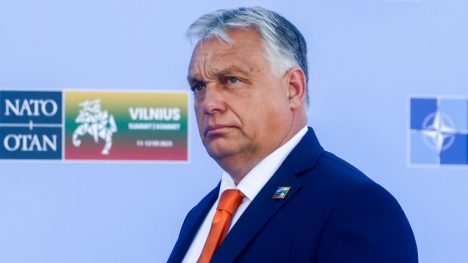
Hungarian Prime Minister Viktor Orban at the NATO summit in Lithuania © Beata Zawrzel / NurPhoto via Getty Images
RT | July 14, 2023
The US wants the conflict in Ukraine to continue and has failed to explain its reasons to NATO allies, Hungarian Prime Minister Viktor Orban has said.
Orban told national broadcaster Kossuth Radio that if Washington wished, it could stop the fighting at a moment’s notice, as Kiev is fully dependent on the West in the fight against Russia.
The Hungarian leader was speaking on Friday morning, after returning from the NATO summit in the Lithuanian capital, Vilnius. During the event, the US-led military bloc declined to extend to Kiev a roadmap for membership. Hungary has stood out among members of the alliance by consistently criticizing Western policies on the Ukraine crisis.
“If the Americans wanted it, peace would come the next morning. Why Americans don’t want that is a question that puzzles the entire world,” Orban said. “We didn’t get an answer at the NATO summit.”
At this point, “Ukraine has lost any real sovereignty,” Orban claimed, citing Kiev’s devastated economy, and heavy dependence on Western allies for funding and weaponry.
Justifying its support for Ukraine, Washington has accused Russia of launching an “unprovoked war of aggression” against Kiev. US officials have said that inflicting a “strategic defeat” on Moscow is a primary goal.
Moscow, in turn, has accused the US of triggering the crisis by ignoring Russia’s long-running concerns over NATO expansion in Europe, while fostering a regime in Kiev that is hostile to Moscow. The Kremlin perceives the conflict as part of a US-led proxy war against Russia.
Orban went on to warn that if NATO were to admit Ukraine now, it would trigger a world war. He also highlighted the risks incurred by Western states sending increasingly sophisticated military hardware to Kiev.
The Hungarian leader also accused Kiev of using moral blackmail to receive Western support, but added that he does not blame Ukrainian President Vladimir Zelensky for acting the way he does, as he is “fighting for the survival of his people.”
The prime minister predicted that the conflict will drag on, and EU nations – including Hungary – will bear the economic cost, including high inflation.
Drone Crashes Close to Kursk Nuclear Plant, No Damage Reported
Sputnik – 14.07.2023
VORONEZH, Russia – A drone crashed in the Russian town of Kurchatov a few kilometers from the Kursk NPP, no one was injured and no critical facilities were damaged, Kursk Region Governor Roman Starovoit said Friday.
“At night, a UAV crashed in the town of Kurchatov. Fortunately, none of the residents were hurt. Critical objects were not damaged as a result of the drone’s crash and its subsequent detonation,” Starovoit wrote in his social media account.
According to available information, an aircraft-type drone that exploded near a residential building in the city Kurchatov fell a few kilometers from the Kursk NPP. ️The head of Rosatom – Russian atomic agency – assured that all measures to ensure the safety of Russian nuclear power plants had been taken, and “the situation is under control.”
Earlier, in April, a drone attack on the Kursk NPP was repelled by air defense forces.
Another three drones were intercepted by air defenses in the Voronezh Region on Thursday, governor Alexander Gusev said.
“Yesterday, air defense systems detected and destroyed three UAVs several kilometers off Voronezh. There are no victims, injured or destruction. I keep the situation under personal control,” Gusev wrote on Telegram on Friday.
Kremlin Slams Ukrainian Drone Attack
Ukraine does not stop attempts to strike, but Russian air defense systems are working effectively, appropriate measures are being taken, Kremlin spokesman Dmitry Peskov commented on the situation.
“Well, it is obvious that the enemy does not give up attempts to strike. But all our air defense systems are working, working efficiently, demonstrating their effectiveness over and over again, and appropriate measures are being taken,” Peskov told reporters.
Featured Video

Death Spikes & Rising Cancer In Our Youth Explained
or go to
Aletho News Archives – Video-Images
From the Archives
Politicians lie
By Mazin Qumsiyeh | Popular Resistance | August 18, 2013
There is no way to say this truth nicely: Politicians lie. That includes Japanese, American, Egyptian, Israeli, and Palestinian politicians! Is there something more common sense than that? Yet, so many citizens around the world believe their own politicians or wistfully acknowledge lies but think it is part of the job needed to run things. They believe even when politicians contradict themselves blatantly. This phenomenon is rather remarkable. It is a dissonance and disconnect from reality that many seem oblivious to. It is very dangerous because it can lead to accepting rationales for going to war. These can be deadly wars that lead to millions of lives lost as happened in what was called World War 1 and WW2. Even when incredible and declassified evidence abound, politicians continue to lie and old mythologies refuse to die. Here are just a few of the countless lies told to us over the past few decades… continue
Blog Roll
 Aletho News
- China pushes back against US on Cuba, Iran
- Ukrainian Soldiers, Potential Mercenaries: Have Gun, Will Travel!
- Burnham’s UN debut… A masterclass in British disinformation
- Iran flights continue despite US aviation sanctions
- Global Tipping Points Lead the World Into a State of Entropy
- The day-after at the White House: USA and Xi Jinping
- The Geopolitical Balance in the Red Sea: The UAE Being Displaced by New Players
- Iraqi resistance group vows to stage airport sit-ins over Iran aerial blockade
- Turkish parliament to review Saudi-Pakistan defense pact next month
- DEATH SPIKES & RISING CANCER IN OUR YOUTH EXPLAINED
- If Americans Knew
- Deconstructing Netanyahu’s pants-on-fire UN rant – Daily Update
- Trump betrayed voters with his campaign lies and prioritized a foreign country once he took office
- Netanyahu calls Israel’s war in Gaza ‘opposite of genocide’ in UN speech to near-empty hall
- Settler Kidnappings: Torture, Sexual Abuse and Terrorisation of Palestinian Abductees as Israel Deepens Annexation of West Bank
- Gaza winter nears as 162,000 tents become unusable, raising fears of humanitarian crisis
- Netanyahu says, “It’s the opposite of genocide”; UN says Gaza economy is world’s ‘most severe crisis on record’ – Daily Update
- Israel’s US-Backed Assault on Gaza Has Created the ‘World’s Most Severe Economic Crisis on Record’: UN
- ‘Protecting U.S. Citizens’… From Israel
- ‘This is where I live now, the back of a truck’: a day in the life of a grandmother in Gaza
- In UN Speech, Iran’s President Displays Pictures of Children Killed by US, Brings Attention to Israel’s Nuclear Arsenal
- No Tricks Zone
- New Study: Earth And Venus Surface Warmth Largely Explained By Convection And Lapse Rate, Not CO2 Or Radiation
- 2025 Nature Paper Claiming Worsening Global Drought Gets RETRACTED …Heavily Flawed
- New Study: ‘Global Drought Shows No Detectable Recent Acceleration Under Climate Warming’
- Economic Masterminds: German Socialists Suggest Taxing Productivity Gains Stemming From Using AI
- The South China Sea Has Not Been Cooperating With The Climate Change Narrative
- Energy Crisis: Germany Enters Heating Season With Historically Low Gas Reserve Fill Levels
- New Study: The Antarctic Ice Sheet Gained Mass From 2020-2024 Due To Staggering Snow And Ice Accumulation
- Study: Ocean Heating Rates From Thousands Of Years Ago ‘Dwarf’ Modern Ocean Heating Rates
- Climate Extremists Target, Attack Large-Scale Power Grid Infrastructure In Germany!
- New Study: Antarctic Ice Melt Has Contributed Less Than 1 Centimeter To Sea Level Rise In The Last 30 Years

