Biden mobilizes reservists
RT | July 14, 2023
President [?] Joe Biden announced on Thursday that up to 3,000 members of the US military’s Selected Reserve will be activated as part of Operation Atlantic Resolve, the informal designation for Washington’s efforts to support Kiev in the ongoing conflict.
Biden has authorized the Defense and Homeland Security departments to “order to active duty any units, and any individual members not assigned to a unit organized to serve as a unit of the Selected Reserve, or any member in the Individual Ready Reserve mobilization category and designated as essential” by the department regulations.
The number of mobilized reservists is “not to exceed 3,000 total members at any one time, of whom not more than 450 may be members of the Individual Ready Reserve,” according to the White House.
Biden’s executive order cites section 12304 of Title 10 of US Code (General Military Act), allowing the president to call up reservists for situations “other than during war or national emergency,” including named operations or cases of “a use or threatened use of a weapon of mass destruction; or a terrorist attack or threatened terrorist attack” in the US that results or could result in “significant loss of life or property.”
The US military, however, described the mobilizations as merely expanding entitlements and access to funding. Army Lieutenant General Douglas Sims, the Joint Staff director of operations, told the reporters at the Pentagon on Thursday that the order “benefits troops and families with increases in authorities, entitlements and access to the reserve component forces and personnel.”
“This will not change current force-posture levels in Europe,” European Command (EUCOM) spokesman, Navy Captain Bill Speaks, said in a statement about the order, explaining that it is intended to “ensure long-term resilience in EUCOM’s continued heightened level of presence and operations.”
Operation Atlantic Resolve is the informal name for actions the US military has taken since April 2014, after Crimea rejoined Russia following the Washington-backed coup in Kiev.
The Selected Reserve consists of personnel who can be immediately mobilized in the event of an emergency. Members of the IRR are trained soldiers, some of whom have recently left active duty, but still have reserve obligations. Homeland Security is involved because the US Coast Guard is under its jurisdiction.
Putin comments on the future of the grain deal
RT | July 13, 2023
Russia is considering putting its participation in the UN-facilitated grain deal on hold until its food and fertilizer exports are unblocked, President Vladimir Putin said on Thursday. None of the promises made to Moscow under the agreement have been fulfilled as of yet, he said, adding that the deal has been a “one-way street case.”
Moscow may no longer be willing to extend the agreement just out of hope that the Western nations and the UN fulfill their end of the bargain, the president said. “We can suspend our participation in this deal,” he said, adding that “everyone is once again telling [us] that all the promises made will be kept.” “Let them deliver on this promise first; then we’ll immediately return to the deal again,” Putin maintained.
Formally known as the Black Sea Initiative, the agreement between Moscow and Kiev was mediated by the UN and Türkiye back in summer 2022. The deal was accompanied by a Russia-UN memorandum aimed at facilitating unimpeded Russian agricultural exports.
The goals of the memorandum included allowing Russia’s major agricultural lender, Rosslekhozbank, back onto the SWIFT payments system, enabling deliveries of spare parts for agriculture machinery, reanimating the Tolyatti-Odessa ammonia pipeline, sorting out insurance and logistics, as well as “unfreezing” Russian assets.
According to Putin, none of those aims have been achieved as of now. “Nothing – and I want to underscore it – nothing has been done. That was a one-sided game all along. Not a single goal linked to the interests of the Russian Federation was met,” he said, adding that Moscow had repeatedly extended the deal in good faith despite those facts.
The president also said he had not seen a letter UN Secretary General Antonio Guterres sent him earlier this week. The UN said earlier that the letter contained suggestions aimed at fulfilling the Russia-UN memorandum and preserving the deal. The international body also said that Moscow had allegedly received the letter and was reviewing it.
The deal was originally touted as a way to avoid a food crisis by steering grain toward poor nations. Yet, according to Moscow, only a tiny percentage of the grain exported from Ukraine as part of the agreement was shipped to such nations, while the bulk of it ended up in Europe.
“Out of all the foodstuffs and grain in particular shipped away from the Ukrainian territory, only slightly more than three percent were delivered to the world’s poorest nations,” the Russian president said on Thursday. Now, many European nations have started forgoing Ukrainian grain, he told the Russian media, adding that it is the West and not Russia that “started discriminating against Ukrainian grain.”
Originally intended to last three months, the deal was prolonged numerous times over the past year, despite growing concerns repeatedly voiced by Moscow over its failure to provide any benefits for Russia. The Kremlin has repeatedly warned over the past month that it sees no reason to extend the deal, which is set to expire on July 17.
NATO Spent Decades Preparing For Proxy War With Russia in Ukraine
By Ekaterina Blinova – Sputnik – 12.07.2023
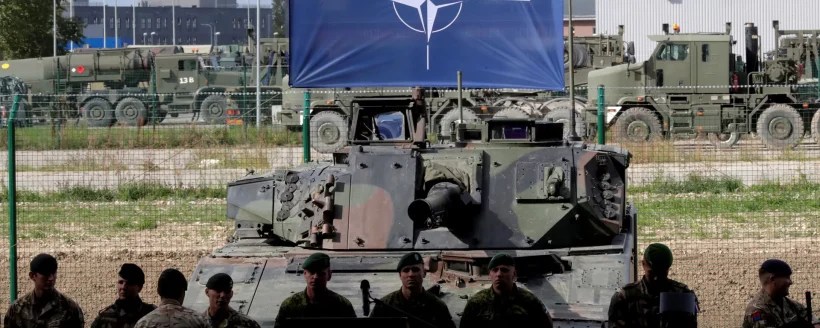
Even before the Ukraine conflict escalated in February 2022, Britain, Sweden, Canada, and the United States were investing in Ukraine and building up their capabilities, the UK defense minister has stated at the NATO summit in Vilnius. Does it mean NATO has long prepared for a proxy war with Russia?
The US neocons and their likeminded NATO allies have long been apparently seeking to knock Russia out of the political arena before trying to crack down on China in a bid to preserve the US dominance, retired US Air Force Lt. Col. Karen Kwiatkowski believes.
“I think that the US officials and advisors (along with those in NATO) believe that they must be able to exploit Russian resources prior to any direct confrontation with China,” Kwiatkowski, who is also a former analyst for the US Department of Defense, told Sputnik. “The neoconservative ideology that over half of Congress embraces, and that the US defense and security complex embraces, envisions and demands a unipolar globe, with the US and its debt-funded governmental system, at the top. For them, this is an existential issue, albeit most Americans don’t see it that way.”
It seems that Ukraine appeared a convenient candidate for the role of a “hammer” against Russia.
For How Long Has Ukraine Received Western Military Assistance?
Ukraine has been a leading recipient of Western military supplies since the early 1990s when the country gained independence, with the US spearheading the initiative. In the first ten years after independence, Ukraine received almost $2.6 billion in assistance from the US. Until 2014, Ukraine had been receiving an estimated $105 million per annum, including foreign military financing.
NATO’s North Atlantic Cooperation Council embraced Ukraine as a “partner country” in 1991 and included it in the Partnership for Peace program in 1994. Washington’s NATO ally, the UK, played an important role in the effort, holding joint military exercises with the Ukrainians, as well as providing training and funding to the nation’s armed forces.
Thus, the first joint Ukrainian-British military exercises “Cossack steppe” were held in the second half of the 1990s as part of NATO’s Partnership for Peace program. The NATO-Ukraine Commission was established in 1997 with the aim of developing the relationship between the nation and the bloc and directing cooperative activities.
As per UK government documents, the Ministry of Defense spent approximately £3.9 million supporting Ukraine through the Defense Assistance Fund and the Conflict Pool between 2009 and 2014.
Many of the activities funded through these mechanisms supported “command, control and communications capabilities (C3).” In particular, the UK held joint exercises with the Ukrainian military, provided military education to the nation’s specialists, and “contributions to NATO coordinated activities.” Both UK civilian and military personnel had been deployed to Ukraine during that period of time while Ukrainian personnel were sent to the UK.
Following the illegitimate coup d’etat in Kiev in February 2014, the West stepped up military assistance to the new Ukrainian authorities.
Between 2014 and 2021, the United States provided over $2.5 billion in military assistance to Ukraine, which included the provision of trainers, selected weaponry systems (such as counter-mortar radars), and Javelin anti-tank missiles.
The boost in military assistance was justified by NATO member states by the alleged “Russian invasion” in Donbass. However, it is well documented that Donbass declared independence in response to the illegitimate coup d’etat in Kiev fomented with the assistance of nationalist and neo-Nazi paramilitary groups and subsequent Russophobic policies of the new government. The Donbass breakaway Donetsk and Lugansk Republics started largely forming militias after the interim Kiev government kicked off what it called “anti-terrorist” operations (ATO) against the region.
“Kiev had been on the offensive with the Donbass with Western support, for a number of years, even before 2014, and this is well documented,” explained Kwiatkowski. “Other Eastern and Southern European countries had been ‘encouraged’ by Western powers, as we saw with Yugoslavia, to break up into smaller national and ethno-cultural countries, and the peaceful divide between the Czech Republic and Slovakia was also allowed and supported. This is primarily because the newly smaller countries added potential members to NATO and the EU – all controlled and controllable by the US-EU elites.”
Moscow came up with the idea of the Minsk Agreements to stop hostilities in Eastern Ukraine. Russia, France and Germany played the role of guarantors of the accords.
Nonetheless, as ex-German Chancellor Angela Merkel and former French President François Hollande admitted last year, the Minsk agreements were signed by Western powers to buy time in order to bolster the Ukrainian military capacity.
“In the case of the political separation desired by the Donbass, and the Minsk agreements that were designed to allow that autonomy, the Russian-speaking East, if autonomous, would not have chosen to be a part of the NATO borg,” said the former Pentagon analyst. “Hence, that independence would not be allowed. Yes, NATO and the US supported such an offensive, and were preparing for it actively, as comments from many US and European officials and diplomats have confirmed. Assistant US Secretary of State Victoria Nuland and former German Chancellor Angela Merkel have publicly confirmed this, as have many others.”
Ukraine Extensive Training and Naval Provocations
US allies jumped on the bandwagon, forwarding their military assistance to Ukraine through the NATO-Ukraine Commission, and through initiatives such as the US/Canada/UK/Ukraine Joint Commission for Defense Reform and Security Cooperation which was established in July 2014.
In particular, Britain kicked off and then expanded Operation Orbital, envisaging extensive training of the Ukrainian military including combat actions in urban environments.
These activities included:
· medical, infantry and survival skills training;
· countering improvised explosive devices;
· training for defensive operations in an urban environment;
· operational planning;
· engineering;
· countering attacks from snipers, armored vehicles and mortars.
It meant that those Ukrainian soldiers that had undergone training under the program would pass on their knowledge and techniques to their military peers. Britons also expanded the scope of the training package to embrace all branches of Ukraine’s Armed Forces.
In June 2020, Ukraine was offered Enhanced Opportunity Partner status with NATO which provided Ukraine with preferential access to NATO’s exercises, training and exchange of information and situational awareness. The status envisaged increasing interoperability between Ukraine and NATO member states. In September 2020, Ukraine hosted the Exercise Joint Endeavour with British, US and Canadian troops, held within the framework of Ukraine’s new enhanced NATO status.
In June 2021, the UK, Ukraine and industry signed a Memorandum of Implementation to a new Naval Capabilities Enhancement Program (NCEP). The program in particular included:
· Ukraine’s acquisition of two refurbished Royal Navy Sandown-class minehunters;
· the sale and integration of missiles on new and in-service Ukrainian Navy patrol and airborne platforms, including a training and engineering support package;
· The UK’s assistance in building new naval bases in the Black and Azov Seas;
· the development and joint production of eight fast missile warships;
· The participation in the Ukrainian project to deliver a modern frigate capability.
The same month, the UK Carrier Strike Group led by HMS Defender was deployed in the Black Sea “in a show of solidarity with Ukraine” and illegally entered Russian waters off Crimea and proceeded to sail through, prompting Russian warships and aircraft to surround the ship and fire warning shots in its vicinity to force it to leave. Even though the UK initially denied that it resorted to deliberate provocations, leaked British government documents proved otherwise.
Russia’s Draft Security Agreements
Russia has repeatedly raised the red flag over the NATO-Ukraine rapprochement and the transatlantic bloc’s enlargement. In accordance with its Declaration of State Sovereignty (July 16, 1990) Ukraine pledged to permanently remain a neutral country. In addition, in the early 1990s, Western powers asserted to Moscow that NATO wouldn’t expand towards Russia. At the same time, the US and its allies refused to consider Russia’s bid to join NATO while encouraging former Soviet Republics and Warsaw Pact member states to join.
Russia outlined its longstanding concerns with regard to Ukraine’s military buildup on its doorstep and NATO’s expansion in draft security agreements which were handed over to the US and NATO in December 2021.
The agreement particularly sought guarantees of NATO’s non-enlargement and non-admission of Ukraine to the bloc. The US and NATO rejected the major provisions of the agreement leading to Russia’s special military operation aimed at de-militarizing and de-Nazifying Ukraine in February 2022.
Ukraine Conflict is US/NATO Proxy War Against Russia
Even though in March 2022, Ukraine and Russia struck a preliminary deal in Istanbul to stop hostilities, the US and the UK openly opposed the agreement, pledging more weapons to Kiev and declaring the goal of bleeding Russia white.
“The US is waging a proxy war, because that is what the US has been waging against various named enemies, for the past 70 years, and it is how we are organized to fight,” said Kwiatkowski. “It is an open secret that the Pentagon, even with close to a trillion dollar budget, does not and, at this point, cannot defend US territory. The US elites and the US defense establishment self-perpetuation is wholly disconnected from the people here who pay its bills. Poor and non-strategic US leadership placed the US in a lose-lose situation.”
According to the US military expert, three problems have emerged in the result of Washington’s misreading of the Russia and Ukraine conflict:
· First, that intent of weakening and isolating Russia did not play out “as it must have done in Jake Sullivan’s brainstorming sessions.”
· Second, the supplies have illustrated a variety of strategic weaknesses in US and NATO defense industrial production, where we see Joe Biden actually stating the obvious that the “US is out of ammunition.”
· Third, taking the Ukraine-Russia destruction project on at a time when the US is experiencing financial weakness, with very limited reserves of gold, guns and “war spirit” demonstrates that the “war planning” of the White House and Pentagon has been done in a vacuum, and under false assumptions.
As per Kwiatkowski, peace is possible but it may require a difficult re-evaluation of the US role in the world while neocons and war profiteers do not accept this re-evaluation.
“Their ideology is mated to unipolar US power,” the US military veteran said. “I suspect some leaders in the West are beginning to understand that there is a way to peace, and it starts with acceptance of the truth of all sides, and negotiations based on that truth. Imagine a sane US government, a concerned NATO, a true patriot of Ukraine in Kiev, and the Russians all speaking honestly. As Trump stated months ago, this war could be ended in one day.”
Germany creates equity in Western Ukraine
BY M. K. BHADRAKUMAR | INDIAN PUNCHLINE | JULY 13, 2023
The hypothesis that the Anglo-Saxon axis is pivotal to the proxy war in Ukraine against Russia is only partly true. Germany is actually Ukraine’s second largest arms supplier, after the United States. Chancellor Olaf Scholz pledged a new arms package worth 700 million euros, including additional tanks, munitions and Patriot air defence systems at the NATO summit in Vilnius, putting Berlin, as he said, at the very forefront of military support for Ukraine.
German Defence Minister Boris Pistorius stressed, “By doing this, we’re making a significant contribution to strengthening Ukraine’s staying power.” However, the pantomime playing out may have multiple motives.
Fundamentally, Germany’s motivation is traceable to the crushing defeat by the Red Army and has little to do with Ukraine as such. The Ukraine crisis has provided the context for accelerating Germany’s militarisation. Meanwhile, revanchist feelings are rearing their head and there is a “bipartisan consensus” between Germany’s leading centrist parties — CDU, SPD and Green Party — in this regard.
In an interview in the weekend, the CDU’s leading foreign and defence expert Roderich Kiesewetter (an ex-colonel who headed the Association of Reservists of the Bundeswehr from 2011 to 2016) suggested that if conditions warrant in the Ukraine situation, NATO should consider to “cut off Kaliningrad from Russian supply lines. We see how Putin reacts when he is under pressure.” Berlin is still smarting under the surrender of the ancient Prussian city of Königsberg in April 1945.
Stalin ordered 1.5 million Soviet troops supported by several thousand tanks and aircraft to attack the crack Nazi Panzer divisions deeply entrenched in Königsberg. The capture of the heavily fortified stronghold of Königsberg by the Soviet army was celebrated in Moscow with an artillery salvo by 324 cannons firing 24 shells each.
Evidently, Kiesewetter’s remarks show that nothing is forgotten or forgiven in Berlin even after 8 decades. Thus, Germany is the Biden Administration’s closest ally in the war against Russia. The German government has stated its understanding for the Biden administration’s controversial decision to supply Ukraine with cluster ammunition. The government spokesman commented in Berlin, “We are certain that our US friends did not make their decision lightly, to deliver this sort of munition.”
President Frank-Walter Steinmeier remarked, “In the current situation, one should not obstruct the USA.” Indeed, the top CDU figure Kiesewetter suggested in an interview with the Green Party-affiliated daily taz that not only should Ukraine be given “guarantees, and if necessary, even provided with nuclear assistance, as an intermediary step to NATO membership.”
Coinciding with the NATO summit in Vilnius (July 11-12), Rheinmetal, the great 135-year old German arms manufacturing company, has disclosed that it is opening an armoured vehicle plant in western Ukraine at an undisclosed location in the next twelve weeks. To begin with, German Fuchs armoured personnel carriers will be built and repaired while there are plans afoot to manufacture ammunition and possibly even air defence systems and tanks.
Rheinmetall’s CEO told CNN on Monday that like other Ukrainian arms factories, the new plant could be protected from Russian air attack. Germany has more than doubled the 2022 allocation of €2 billion for upgrading Ukraine’s armed forces. It now touches around €5.4 billion with further plans to increase to €10.5 billion.
Now, is this all about Russia? Germany cannot be unaware that Ukraine has simply no hope on earth to defeat Russia militarily. Germany is playing the long game. It is creating equity in western Ukraine where it is not Russia but Poland that is its contender. Ever since the Tsarist army advanced into Galicia in 1914, Russia has had a difficult history with Ukrainian nationalists. If the current war in Ukraine spreads to western Ukraine, that cannot be Russia’s choice but out of some necessity forced upon it.
The Soviet victory in Ukraine in October 1944, the Red Army’s occupation of eastern Europe, and Allied diplomacy resulted in a redrawing of Poland’s western frontiers with Germany and Ukraine’s with Poland. Simply put, with compensation of German territories in the west, Poland agreed to the cession of Volhynia and Galicia in western Ukraine; a mutual population exchange created for the first time in centuries a clear ethnic, as well as political, Polish-Ukrainian border.
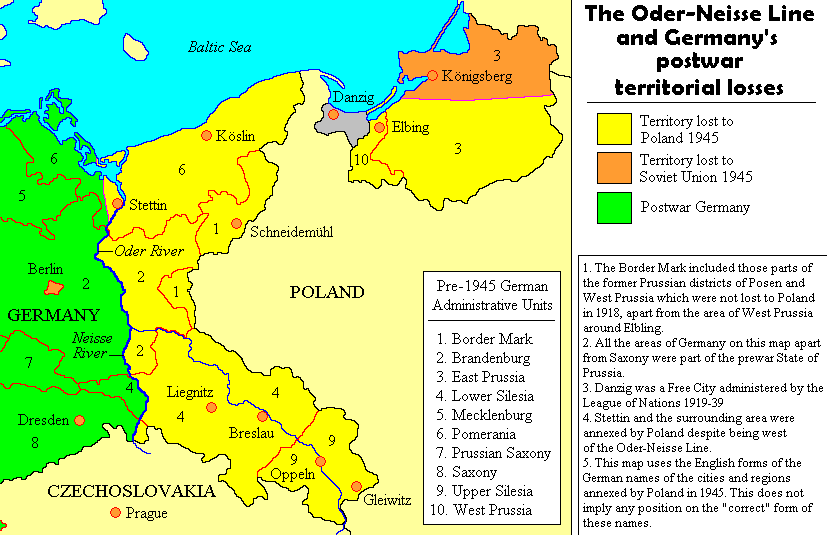
It is entirely conceivable that the ongoing Ukraine war will radically change the territorial boundaries of Ukraine in the east and south. Possibly, it can re-open the post-WW II settlement with regard to western Ukraine as well. Russia has repeatedly warned that Poland aims to reverse the cession of Volhynia and Galicia in western Ukraine. Such a turn of events will most certainly bring to the fore the issue of the German territories that are part of Poland today.
Perhaps, it was in anticipation of turbulence ahead that last October, eight months after the Russian intervention began in in February, Warsaw demanded WWII reparations from Berlin — an issue which Germany says was settled in 1990 — to the tune of €1.3 trillion.
Under the Potsdam Conference (1945), the “former eastern territories of Germany” comprising nearly one quarter (23.8 percent) of the Weimar Republic with the majority ceded to Poland. The remainder, consisting of northern East Prussia including the German city of Königsberg (renamed Kaliningrad), was allocated to the Soviet Union.
Make no mistake about the importance of the Eastern border for German culture and politics. Indeed, there is always something volatile about a “handicapped” Great Power when a whole new intensity appears in political, economic and historical circumstances, which prompts those in power to turn ideas into reality, and revanchist and imperialistic discourses that were quietly but steadily streaming below the surface of the carefully considered diplomatic efforts begin to probe pan-nationalist expansion.
In retrospect, Germany’s — in particular, then foreign minister and current president Steinmeier’s — diabolical role to align Germany with the neo-Nazi elements during the regime change in Kiev in 2014 and the subsequent German perfidy in the implementation of the Minsk Agreement (“Steinmeier formula”), as admitted recently in February by former Chancellor Angela Merkel should not be forgotten.
Suffice to say, even as Russia is winning the Ukraine war, the concern of the German foreign policy makers once again faces the need to redefine what was German. Thus, the war in Ukraine is only the means to an end. Recent reports suggest that Berlin may be moving, finally, toward meeting Ukraine’s pending demand for Taurus cruise missiles with a range exceeding 500 kms and unique “multi-effect war head” that can be a game changer in the combat dynamics on the battlefield and create the prerequisites for victory.
Equally, German soldiers already comprise about half of the NATO battlegroup already present in Lithuania. Defense Minister Boris Pistorius said two weeks ago while on a visit to Vilnius that Germany is preparing the infrastructure to permanently base 4,000 soldiers (“a robust brigade”) to Lithuania so as to have the capability to maintain military flexibility at the Eastern flank. The decision has support from both Germany’s governing coalition and its main opposition.
The CDU foreign policy expert and member of the Bundestag, Kiesewetter called the idea of establishing a German base in the Baltics a “decision of reason and reliability.” Indeed, there have been past attempts, historically speaking, to create German rule in the Baltics based on revisionist claims towards the new states of Estonia, Latvia and Lithuania where German colonists had settled as far back as in the 12th and 13th centuries.
Stoltenberg admits NATO began preparing Ukraine for war with Russia since 2014
By Ahmed Adel | July 13, 2023
NATO Secretary General Jens Stoltenberg admitted that the alliance had prepared Ukraine for war with Russia since 2014. At the same time, French Defence Minister Sébastien Lecornu announced on July 12 that the French military has already trained 5,200 Ukrainian troops and plans to train a total of 7,000 troops by year’s end.
“France’s support for Ukraine is not weakening. […] Almost 5,200 Ukrainian soldiers have already been trained by France, including 1,600 in Poland. There will be almost 7,000 by the end of the year,” Lecornu tweeted.
According to Lecornu, Ukrainian troops are learning how to operate French military equipment transferred to them and practice modern combat tactics, such as forming battalions that can manoeuvre as a coherent tactical unit.
Meanwhile, the British government announced that more than 19,000 Ukrainian soldiers had been trained in the country over the past six months and that Ukraine can expect more material support.
“In the past six months, the UK has also expanded its military training programme for Ukrainian recruits. This programme has trained more than 19,000 soldiers to date and training for Ukrainian pilots in the UK will begin this summer,” the British government said in a statement.
The UK, through NATO, also plans to establish a medical rehabilitation centre “to support the recovery and return of soldiers to Ukraine’s lines of defence after being injured in combat.”
“[The British PM announced a] major new tranche of support for Ukraine, including thousands of additional rounds of Challenger 2 ammunition, more than 70 combat and logistics vehicles and a £50m support package for equipment repair,” the statement added.
Although these announcements are recent revelations, NATO training of the Ukrainian military is not new. Stoltenberg said that the Alliance began supporting the Ukrainian military long before the start of the war.
“I welcome the military support that Allies have provided now for months, actually starting back in 2014,” Jens Stoltenberg told a press conference after the first day of the Alliance summit.
The NATO chief had previously confessed that Western military preparations began nine years ago.
“Since 2014 […] NATO has implemented the biggest reinforcement of our collective defence in a generation. With, for the first time in our history, combat ready troops in the eastern part of the Alliance, with higher readiness, with more exercises, and also with more defence spending,” he said on May 24. “So when President Putin launched his full-fledged invasion last year, we were prepared.”
In a joint statement after the first day of the summit in Vilnius, NATO leaders declared that the deepening partnership between China and Russia is contrary to the values and interests of the alliance.
For his part, Russian President Dmitry Peskov said, before referencing NATO as an alliance that is “aggressive in nature,” that Moscow-Beijing relations “have never been aimed against third countries or alliances in any way”
Peskov said that NATO “is not an alliance that was conceived, created, and built with the goal of ensuring stability and security. It is an offensive alliance. It is an alliance that breeds instability and aggression.”
During the NATO summit’s first day, member countries agreed to bring Ukraine closer to the alliance. However, the concrete provisions proposed to achieve this disappointed Ukraine. It was not lost on major outlets, such as the New York Times, that Zelensky criticised NATO’s attitude.
Zelensky regretted in a tweet the “uncertainty” and “weakness” of NATO before the summit even started. “It seems there is no readiness neither to invite Ukraine to NATO nor to make it a member of the Alliance,” the tweet added.
Considering the humiliation Zelensky has experienced for being photographed isolated and alone at the NATO summit while member leaders talked amongst themselves, the Kiev regime should have realised that they are being used as nothing more than pawns in a now failed attempt to weaken and contain Russia.
It is evident that NATO is doing all it can to support Ukraine, short of using member states’ conventional militaries, and will continue with such a policy until at least the end of 2023, as the French and British announcements demonstrate.
Nonetheless, despite this support from France and Britain, Zelensky chastised NATO’s wider admission policy as “absurd,” prompting even UK Secretary of Defence Ben Wallace to highlight that Kiev does not express enough “gratitude” for the support it receives. Yet, this constant humiliation and the complete destruction of its military and economy has not been enough for the Kiev regime to realise that it is nothing more than an expendable proxy for NATO.
Ahmed Adel is a Cairo-based geopolitics and political economy researcher.
France’s Le Pen Slams Macron for Pledging Long-Range Missiles to Ukraine
Sputnik – 13.07.2023
Marine Le Pen, former president of the French right-wing National Rally party and the current chairwoman of its parliamentary faction, said it was “irresponsible” of the French president to pledge long-range missiles to Ukraine.
“I do not understand why Emmanuel Macron is not integrally focused on organizing a conference for peace to put an end to this [conflict],” Le Pen was quoted as saying by French media.
The leader of the National Rally group in the lower house of parliament spoke to the press on Wednesday during a trip to the riot-hit city of Beauvais, north of Paris.
She warned that a strike “on a third country can trigger a third world war … We do not know how a third country would react if it were hit by a weapon supplied by France.”
Macron’s decision to supply Ukraine with SCALP missiles, the French equivalent of the United Kingdom’s Storm Shadows, prompted a strong reaction from both sides of the political aisle in France. The right-wing Republicans slammed it as escalatory while the leftist France Unbowed warned of a possible direct conflict with Russia.
US cluster bombs already in Ukraine – military
RT | July 13, 2023
Kiev has already received cluster munitions promised by the US, a Ukrainian general has told CNN. Washington has attempted to justify the delivery of the controversial arms by claiming that Ukraine would minimize the long-term threat to civilians when using them.
“We just got them, we haven’t used them yet, but they can radically change [the battlefield],” Brig. Gen. Aleksandr Tarnavsky told the US news network on Thursday. He added that he expects Ukrainian troops to push Russian forces back from their defensive positions thanks to the delivery.
Cluster bombs discharge dozens of submunitions over a large area. Some of the bomblets fail to detonate and can maim or kill years after their deployment. Over 100 nations, including many NATO members, have banned their production and use.
The US decided to supply Ukraine with old 155mm artillery shells with cluster payloads stockpiled during the Cold War. President Joe Biden described the move as a stopgap, claiming that Kiev’s foreign backers had no regular munitions of that caliber left to share, and that they were in the process of ramping up production.
The US is not party to the 2008 convention on cluster munitions, but still had to bypass its own rules, which normally ban exports of cluster bombs with a dud rate of over 1% (meaning more than one in 100 submunitions fail to explode).
The Dual-Purpose Improved Conventional Munitions (DPICMs) which the US has sent to Ukraine demonstrated an average dud rate of 14% during a 2000 study. The Pentagon, however, has claimed that less than 2.35% of bomblets would fail in the version supplied to Kiev’s forces.
Tarnavsky insisted Ukraine would not fire cluster shells at settlements held by Russia.
Ukraine has a stockpile of Soviet cluster munitions and has used them in places where unexploded bomblets posed a threat to civilians, according to Human Rights Watch. The international watchdog was among those to urge Washington to reconsider its plans.
Russian Defense Minister Sergey Shoigu said this week that Moscow has the means to respond in kind to Ukraine’s use of American arms.
“Russia has cluster munitions, as they say, for all occasions,” the minister warned, adding that the Russian arsenal is superior in capability and diversity.
More grumbling from Zelensky because NATO doesn’t want direct war with Russia
By Drago Bosnic | July 13, 2023
In early October last year, Kiev regime frontman Volodymyr Zelensky called on NATO to launch a “preemptive nuclear strike” on Russia in order to “rule out the possibility of using nuclear weapons”. At the time, the mainstream propaganda machine tried everything in its power to present his words as allegedly “misinterpreted”, but since there is actual footage of it, we’ll let you decide if he genuinely said so:
“What should NATO do? Eliminate the possibility of Russia using nuclear weapons. But what is important, I once again appeal to the international community, as it was before February 24: pre-emptive strikes, so that they know what will happen to them if used. And not vice versa – wait for Russia’s nuclear strikes, then to say: ‘Oh, you are so, well, keep it from us!’ Reconsider the application of their pressure, the procedure for applying,” Zelensky said during a video conference with the Australian Lowy Institute.
While the aforementioned propaganda narrative tried to whitewash (a standard practice for virtually anything the Neo-Nazi junta does) his statement about these “preemptive strikes” by claiming these supposedly “wouldn’t be nuclear”, this is openly implied in the comment itself. How else would it be possible to launch strikes against a nuclear power, much less the one with the world’s most powerful thermonuclear arsenal?
Why is this relevant now, approximately ten months later? Zelensky’s unhinged commentary is deeply dividing for virtually all NATO members, as none of them wants to be destroyed in minutes for the sake of a corrupt Neo-Nazi regime. The ongoing NATO summit in Vilnius makes Zelensky look no less delusional, as he threw yet another tantrum, complaining that the political West is “not doing enough” because it doesn’t want to make a firm promise to let the Kiev regime into NATO. Apparently, he is “deeply frustrated” with the regular pattern of the belligerent alliance making “pledges”, giving billions in so-called aid (over $170 billion, to be exact), promising to deliver F-16 fighter jets, while also expanding its military infrastructure in Eastern Europe.
Although NATO promised it will remove the Membership Action Plan (MAP) requirement for the Neo-Nazi junta, an unprecedented move by the aggressive alliance, Zelensky was still “furious at the alliance’s soft language on full membership”. He threw a fit at NATO, particularly at the United States, for refusing to lay out “a clear path” for the Kiev regime’s membership. NATO Secretary-General Jens Stoltenberg previously promised to push for a fast-tracked process that would be implemented at some point in the future, when the belligerent alliance decides “it’s ready to seriously consider” the Neo-Nazi junta’s membership application. This explains why the MAP requirement was dropped.
What makes the move unprecedented is the fact that the MAP was a virtually mandatory agreement that all other NATO candidates had to implement since 1999. However, once again, this was “not enough” for Zelensky. Just before arriving in Vilnius and meeting there with Biden, Zelensky grumbled at all those “not ready” to make the membership happen as soon as possible (which is “now” according to his “logic”):
“This looks like there’s neither readiness to invite Ukraine to NATO nor make it a member of the alliance.”
He stated that “such an unprecedented and absurd outcome leaves an opportunity to make Ukraine’s NATO membership bid a trading chip in potential negotiations with Russia”, adding that “certain wording is being discussed without Ukraine” and that “all of this only plays into Russia’s hands”. He effectively accused his geopolitical masters of “opening the door for Russia to continue its terror”, saying:
“While at the same time vague wording about ‘conditions’ is added even for inviting Ukraine. It seems there is no readiness neither to invite Ukraine to NATO nor to make it a member of the Alliance. This means that a window of opportunity is being left to bargain Ukraine’s membership in NATO in negotiations with Russia. And for Russia, this means motivation to continue its terror. Uncertainty is weakness. And I will openly discuss this at the summit.”
Amid the embarrassingly disastrous performance of NATO weapons in the failed counteroffensive by the Kiev regime forces, the summit serves to present the belligerent alliance as “united”, although it’s more than clear that there are no battlefield successes the political West was desperate for its favorite puppet regime to achieve. Thus, yet another bureaucratic “success” was presented as “crucial” for the Neo-Nazi junta’s “eventual membership”, after “all conditions are met”. And the condition is – Kiev must defeat Moscow. This means that the much-touted NATO membership will certainly not happen at the Vilnius summit or anytime soon, as the belligerent alliance simply cannot give the Neo-Nazi junta any sort of security guarantee.
President Biden himself stated that the membership plan cannot be seriously considered until after the conflict is over, clearly implying that NATO’s Article 5 would be the main obstacle in the Kiev regime’s bid for membership.
“I don’t think there is unanimity in NATO about whether or not to bring Ukraine into the NATO family now, at this moment, in the middle of a war,” Biden told CNN just before going to Vilnius, adding: “For example, if you did that, then, you know – and I mean what I say – we’re determined to commit every inch of territory that is NATO territory. It’s a commitment that we’ve all made no matter what. If the war is going on, then we’re all in war. We’re at war with Russia, if that were the case.”
Rationality and Joe Biden are certainly not words one would expect to see in the same sentence, but in this case, at least some credit should be given to the US president, as this stance is the only rational one a leader of a global power can be expected to have. However, precisely this is what Zelensky is criticizing as a supposed “weakness”. For him, the “only rational” thing NATO should do is go into a full-scale war with Russia.
Drago Bosnic is an independent geopolitical and military analyst.
Here’s why the US may never allow Ukraine to join NATO
Kiev has to face up to some bad news – for the first time, NATO enlargement has become a threat to Washington itself
By Timofey Bordachev | RT | July 12, 2023
The Ukrainian crisis marks the first time in history that the United States has exposed itself to serious risks in defining the limits of its military presence in Europe. Any genuine move by Washington to invite Kiev into NATO would imply a willingness to enter into a direct military confrontation with Russia. A less risky option, many believe, would be to promise the Vladimir Zelensky regime some special bilateral guarantees.
The NATO military bloc was created on the basis of the real division of Europe into zones of influence between the US and the USSR after the Second World War. As a result of the greatest armed confrontation in the history of mankind, the bulk of European states lost forever the ability to determine fundamental issues of their national policy. These included, first and foremost, defense and the ability to form alliances with other countries. Europe was divided between the real winners of the conflict – Moscow and Washington. Only Austria, Ireland, Sweden, Finland and a small part of Switzerland were outside their zone of dominance.
Both of the great powers had an informal right to determine the internal order of the territories under its control. This was because the countries concerned had lost their sovereignty as such. Even France, which continued to demonstrate freethinking for several decades, had no doubt on whose side it would fight in the event of a new global conflict.
NATO was created in 1949 to formally deprive American allies of the ability to make their own foreign policy decisions and military doctrines. In this respect, the alliance was no different from the Warsaw Pact that had emerged in the USSR’s sphere of influence.
The relationship between the United States and other NATO countries has never been an alliance in the traditional sense. In the last century, classic alliances ceased to exist altogether – the gap in military capabilities between the nuclear superpowers and every other country in the world became too great.
A military alliance between relative equals is possible, as it was until the middle of the last century, but nuclear weapons have made this impossible. The former sovereign states of Europe became a territorial base from which the great powers could negotiate in peace and act in war. The creation of NATO and the subsequent accession of countries such as Greece, Turkey, Spain and West Germany to the alliance was a formalization of the boundaries of US dominance that the USSR had already agreed to in bilateral relations.
After the Soviet collapse, extending American rule to Moscow’s former allies in Eastern Europe and even the Baltic republics was also not a policy that posed serious risks for Washington. Incidentally, this is why NATO has an informal rule of not admitting countries with unresolved territorial disputes with third states – the US has never been willing to occupy land whose ownership is disputed. NATO’s post-Cold War expansion was based on deception, with the US promising Moscow that it would not expand NATO to Russia’s borders. But, initially, Russia did not have the physical strength to resist. This meant that the US could occupy “unclaimed” states without the threat of immediate military conflict. The US approach to NATO remained true to the philosophy of the 1945 victors: there are no sovereign states, only controlled territories.
Once the decision was taken in Washington, it was only a matter of strategy to ensure that local governments made the “right” decisions. This was all the more so as the accession of new countries to NATO in the 1990s and 2000s was ‘packaged’ with the enlargement of the European Union. This gave local elites every reason to aspire to join the bloc, from which they expected tangible material benefits. For some – the Baltic states and Poland – membership in the club also provided the possibility of solving internal problems through an aggressive anti-Russian policy by fostering fear of the big neighbor to the east. In the Baltic states, the status of an American outpost was also used by elites to combat any local opposition from radical nationalists.
For the countries that joined the bloc, NATO became a guarantee of internal stability. Since the most important decisions for them were taken outside their national political systems, there was no reason for internal competition and no danger of serious destabilization.
Of course, no country is safe from minor internal political disturbances, such as those caused by a change of government – especially if the one in power is not liked by the US. But radical changes, which generally involve foreign policy issues, have become impossible.
In this sense, Western Europe increasingly resembles Latin America, where the quality of life of the population doesn’t have dramatic consequences for the elites. There, geographical proximity to the US has long been a reason for almost total American control. The only exceptions have been Cuba and, in recent decades, Venezuela. In Western Europe, because of Russia’s proximity, this control is of a formal nature, which should in principle rule out any surprises.
Joining NATO is an exchange of state sovereignty for the indefinite retention of power by the ruling elite. This is the secret of every political regime’s desire to join the bloc: it gives them the possibility of “immortality” in spite of any domestic or economic failures. The regimes in Eastern Europe and the Baltics immediately realized that they would not last long in power without being under Washington’s control – the break with Moscow and the peripheral position of their countries promised them too many problems. And the reason Finland joined NATO is that the local elites no longer have confidence in their ability to hold power on their own.
For the United States itself, as we have seen, the expansion of its presence has never posed any serious threat or risk. At least until now. This is precisely what is being pointed out by those in America who are calling for a careful approach to be taken in response to the demands of the authorities in Kiev for membership. A call which is supported by some members of the bloc.
It is understood that a military clash between Moscow and NATO would mean global nuclear war. Nevertheless, back in the Soviet period, the US believed that any conflict with the USSR could be confined to Europe and would not involve direct attacks on each other’s territory. There is reason to believe that Moscow felt the same way during the Cold War.
NATO’s eastward expansion after the Cold War was a case of acquiring territories for which no one wanted to fight. However, in the situation of Ukraine, for the US is not a question of gaining territory, but rather of taking it from a rival power that wants to keep Washington out. This has never happened in the history of NATO, and one can understand those in Western Europe and the US who are calling for serious consideration of the likely consequences.
Inviting Kiev to join NATO could mean something entirely new for American foreign policy – a willingness to fight a peer adversary like Russia. Throughout their history, Americans have shied away from this, using other players as battering rams willing to sacrifice and suffer for American interests. This was the case in both the First and Second World Wars. The most likely scenario, therefore, is that the US will limit itself to promising to address the issue of Ukraine and NATO after the Kiev regime has resolved its problems with Russia in one way or another. In the meantime, it will only be promised some “special” terms on a bilateral basis.
Timofey Bordachev is the Valdai Club Programme Director.
Western analysts support NATO’s direct participation in Ukraine
By Lucas Leiroz | July 12, 2023
Western analysts are encouraging NATO’s direct participation in the conflict. On July 8, foreign affairs commentator Simon Tisdall published an article in The Guardian called “Defeat for Ukraine would be a global disaster. Nato must finally step in to stop Russia“. He argues that Ukraine’s entry into NATO should be accelerated, with a process similar to the one that guaranteed Finland’s accession. According to him, this is the proper way to avoid Kiev’s defeat and the failure of the “counteroffensive”, since the direct support of the alliance supposedly would make a Ukrainian victory possible.
“There’s a risk, if the current counteroffensive produces no breakthrough, weapons supplies run short, a new winter energy crisis strikes and western public support drops further, that Zelenskiy will be forced into negotiations – even into trading territory for peace. Secret, informal US-Russia talks are already under way. If Ukraine were already a NATO member, as promised 15 years ago, all this would not be happening”, he said.
The author believes in the possibility of accepting Ukraine even during the situation of the conflict. One of Tisdall’s arguments is that there are “historical precedents” for the Ukrainian case. Then, he reminds West Germany’s accession to NATO, which took place in the 1950s, still during the absence of German national unity.
“But there are precedents. West Germany gained NATO protection in 1955 even though, like Ukraine, it was in dispute over occupied sovereign territory – held by East Germany, a Soviet puppet. In similar fashion, NATO’s defensive umbrella could reasonably be extended to cover the roughly 85% of Ukrainian territory Kyiv currently controls”, he added.
Tisdall criticizes the posture of American and Western European leaders, who have been cautious, avoiding hasty decisions. The author does not see any validity in the existence of concerns about the possible impacts of Ukraine joining the bloc, stating that the actions of Western politicians are “rooted in American and west European fears that Putin, provoked, might attack the west”.
On the other hand, the analyst praises the posture of the NATO’s Eastern European countries. According to him, Bulgaria, Czech Republic, Estonia, Hungary, Latvia, Lithuania, Poland, Romania and Slovakia – the so called “Bucharest Nine” – have a “thankfully more robust” stance than Westerners. With this, Tisdall endorses the fanatical anti-Russian state ideology that currently prevails in that region.
In addition, Tisdall mentions in a positive way the opinion of former NATO Secretary General Anders Rasmussen. In June, Rasmussen stated that, if the NATO summit in Vilnius does not manage to change the Ukrainian situation, the eastern countries will certainly start to take individual actions to support Ukraine with troops on the ground.
“If NATO cannot agree on a clear path forward for Ukraine, there is a clear possibility that some countries individually might take action. We know that Poland is very engaged in providing concrete assistance to Ukraine. And I wouldn’t exclude the possibility that Poland would engage even stronger in this context on a national basis and be followed by the Baltic states, maybe including the possibility of troops on the ground … I think the Poles would seriously consider going in and assemble a coalition of the willing if Ukraine doesn’t get anything in Vilnius”, Rasmussen said on the occasion.
Indeed, considering all these factors, what appears to be happening in this case is an attempt by the pro-war western media to pressure NATO’s decision makers to advance the direct intervention agenda during the summit in Vilnius. From a strategic point of view, the pressure is meaningless and does not seem to have any effect, as NATO obviously does not plan to sacrifice its regular forces in favor of a proxy state. However, Tisdall and other pro-war international “experts” have no military experience, being just fanatical defenders of the so-called [Western] “rules-based order”, supporting any military measure necessary to prevent relevant geopolitical changes.
There is a clear absence of a realistic perspective in Tisdall’s words, with several mistakes in his analysis. For example, he tries to show a similarity of cases between present-day Ukraine and Germany in the 1950s, which does not exist. Although divided, Germany at the time was not in a situation of open conflict, which invalidates his narrative.
However, it must be admitted that in fact the direct involvement of Poland and the Baltics seems to be close to reality, as warned by Rasmussen. While analysts like Tisdall approve this anti-Russian disposition of some Eastern European countries, in reality it only tends to do them harm. Some post-communist states went through a process of extreme anti-Russian collective indoctrination, resulting in phenomena such as the rehabilitation of Nazism and the real desire for war against Moscow.
The problem is that NATO does not seem interested in helping them in such a work. For the alliance, what matters is keeping aggression against Russia restricted to non-member countries, which is why the bloc arms Ukraine and incites violence in Georgia and Moldova to open new flanks. The involvement of Western regular troops would be negative, as a direct war against Russia does not seem to be winnable.
Polish and Baltic authorities, however, seem willing to take irrational and anti-strategic actions to defend the Kiev regime. They believe that if it escalates, NATO will defend them from Russian responses, but this does not seem so sure to happen, as the alliance wants to avoid involving its troops in direct war. It remains to be seen how the other NATO countries would react to seeing the alliance disrespecting the collective defense pact.
Indeed, supporting NATO’s direct intervention is supporting the start of WW3. And, in the same vein, by supporting Poland and the Baltics individually going to war with Russia, Western analysts are unwittingly defending the path that could lead to the end of the alliance. The most rational and logical alternative is simply for NATO to accept the defeat in Ukraine and agree to negotiate with the emerging powers a new geopolitical reality.
Lucas Leiroz, journalist, researcher at the Center for Geostrategic Studies, geopolitical consultant.
US Legislator Tables Motion to Withdraw America from NATO
Sputnik – 12.07.2023
Republican Congresswoman Marjorie Taylor Greene from Georgia argues that the US should “only fund our country’s defense, not another country’s war.”
US Congresswoman Marjorie Taylor Greene has proposed a series of amendments to the proposed fiscal year 2024 defense budget, including one calling on President Joe Biden to begin the country’s withdrawal from NATO and suspend supplies to Kiev until the Ukrainian conflict is over.
A US House special committee earlier held hearings on the National Defense Authorization Act (NDAA), which would provide some $886 billion in funding for US military needs. Lawmakers introduced hundreds of tabled amendments to the bill, including those initiated by scandal-plagued Congresswoman Green.
In particular, one of the proposed amendments mandates the American president to “take such steps as may be necessary” to withdraw the United States from NATO. The other imposes a ban on the allocation of US federal funds to Ukraine until Biden can confirm to Congress that the conflict in that country has been resolved through diplomatic means.
In addition, the congresswoman looked to amend the draft national defense budget to prohibit the delivery of fourth-generation F-16 fighter jets and long-range missiles to Ukraine.
“The NDAA should only fund our country’s defense, not another country’s war,” Greene tweeted about her initiatives.
The day before, Matt Gaetz, a Republican congressman from Florida, made a statement that he intended to co-sponsor an amendment to the budget that would prohibit Washington from sending cluster munitions to Ukraine or any other country. At the same time, he expressed confidence that the delivery of such munitions would not end the conflict in Ukraine.
Featured Video

Death Spikes & Rising Cancer In Our Youth Explained
or go to
Aletho News Archives – Video-Images
From the Archives
Politicians lie
By Mazin Qumsiyeh | Popular Resistance | August 18, 2013
There is no way to say this truth nicely: Politicians lie. That includes Japanese, American, Egyptian, Israeli, and Palestinian politicians! Is there something more common sense than that? Yet, so many citizens around the world believe their own politicians or wistfully acknowledge lies but think it is part of the job needed to run things. They believe even when politicians contradict themselves blatantly. This phenomenon is rather remarkable. It is a dissonance and disconnect from reality that many seem oblivious to. It is very dangerous because it can lead to accepting rationales for going to war. These can be deadly wars that lead to millions of lives lost as happened in what was called World War 1 and WW2. Even when incredible and declassified evidence abound, politicians continue to lie and old mythologies refuse to die. Here are just a few of the countless lies told to us over the past few decades… continue
Blog Roll
 Aletho News
- RSF military group defects, joins Sudanese army: State media
- Ireland goalkeeper refuses to play ‘Israel’ as squad weighs boycott
- China pushes back against US on Cuba, Iran
- Ukrainian Soldiers, Potential Mercenaries: Have Gun, Will Travel!
- Burnham’s UN debut… A masterclass in British disinformation
- Iran flights continue despite US aviation sanctions
- Global Tipping Points Lead the World Into a State of Entropy
- The day-after at the White House: USA and Xi Jinping
- The Geopolitical Balance in the Red Sea: The UAE Being Displaced by New Players
- Iraqi resistance group vows to stage airport sit-ins over Iran aerial blockade
- If Americans Knew
- Deconstructing Netanyahu’s pants-on-fire UN rant – Daily Update
- Trump betrayed voters with his campaign lies and prioritized a foreign country once he took office
- Netanyahu calls Israel’s war in Gaza ‘opposite of genocide’ in UN speech to near-empty hall
- Settler Kidnappings: Torture, Sexual Abuse and Terrorisation of Palestinian Abductees as Israel Deepens Annexation of West Bank
- Gaza winter nears as 162,000 tents become unusable, raising fears of humanitarian crisis
- Netanyahu says, “It’s the opposite of genocide”; UN says Gaza economy is world’s ‘most severe crisis on record’ – Daily Update
- Israel’s US-Backed Assault on Gaza Has Created the ‘World’s Most Severe Economic Crisis on Record’: UN
- ‘Protecting U.S. Citizens’… From Israel
- ‘This is where I live now, the back of a truck’: a day in the life of a grandmother in Gaza
- In UN Speech, Iran’s President Displays Pictures of Children Killed by US, Brings Attention to Israel’s Nuclear Arsenal
- No Tricks Zone
- New Study: Earth And Venus Surface Warmth Largely Explained By Convection And Lapse Rate, Not CO2 Or Radiation
- 2025 Nature Paper Claiming Worsening Global Drought Gets RETRACTED …Heavily Flawed
- New Study: ‘Global Drought Shows No Detectable Recent Acceleration Under Climate Warming’
- Economic Masterminds: German Socialists Suggest Taxing Productivity Gains Stemming From Using AI
- The South China Sea Has Not Been Cooperating With The Climate Change Narrative
- Energy Crisis: Germany Enters Heating Season With Historically Low Gas Reserve Fill Levels
- New Study: The Antarctic Ice Sheet Gained Mass From 2020-2024 Due To Staggering Snow And Ice Accumulation
- Study: Ocean Heating Rates From Thousands Of Years Ago ‘Dwarf’ Modern Ocean Heating Rates
- Climate Extremists Target, Attack Large-Scale Power Grid Infrastructure In Germany!
- New Study: Antarctic Ice Melt Has Contributed Less Than 1 Centimeter To Sea Level Rise In The Last 30 Years

