Ground beneath Zelensky’s feet is shifting
BY M. K. BHADRAKUMAR | INDIAN PUNCHLINE | AUGUST 27, 2022
Reading and rereading the US President Joe Biden’s statement last Monday on Ukraine Independence Day, one is reminded of English poet John Keats’ immortal line, ‘Heard melodies are sweet but those unheard are sweeter.’ Three things are striking.
Biden repeatedly invoked the abiding nature of the US’ relationship with the Ukrainian people. But in the entire statement, he never once mentioned the Ukrainian government or the leadership of President Volodymyr Zelensky. A careless omission?
Second, Biden underplayed to the point of ignoring the intense US-Ukraine partnership at state-to-state level. Third, most important, Biden was silent on the war as such, which is at a decisive stage at present.
When he spoke of the latest tranche of arms for Ukraine worth $2.98 billion, Biden expressed the hope that the weapon systems may ensure that Ukraine “can continue to defend itself over the long term.” (Emphasis added.)
This merits attention. American analysts estimate that the $2.98 billion weapons package is radically different in its dispensation mechanism. Thus, while military aid hitherto was drawn from pre-existing stockpiles of US weaponry and equipment, this time around, the aid package will be purchased or ordered from defence contractors.
John Kirby, the spokesman for the National Security Council, admitted to reporters that some of the aid in the latest package could be dispensed more slowly than other parts of the package depending on defence contractors’ current stocks. He vaguely said, “It’s going to depend, quite frankly, on the item that we’re talking about. Some stuff probably will still need some production time to develop.”
In effect, the military-industrial complex may have more to celebrate in Biden’s announcement than Zelensky. The Biden administration is moving away from depleting US current stockpiles, as European allies are also doing.
According to Mark Cancian, Senior Adviser, International Security Program at the CSIS, Biden’s latest $2.98 billion package “will sustain the Ukrainian military over the long term but take months or even years to implement fully… Thus, this (package) will sustain the Ukrainian military over the long term, likely postwar, rather than increase its capabilities in the near or medium term…
“This means that the U.S. ability to provide equipment rapidly may be diminishing… The administration may need to ask Congress for more money soon. Although the bipartisan consensus for supporting Ukraine remains strong, there may be a fight with the progressive left and isolationist right about the wisdom of sending money abroad when there are pressing needs at home.”
This is almost the same predicament that the US’ European allies are facing. The prestigious German think tank, Kiel Institute for the World Economy reported last week: “The flow of new international support for Ukraine has dried up in July. No large EU country like Germany, France, or Italy, has made significant new pledges.”
It said the EU commission is pushing for larger and more regular aid packages to Ukraine, but the enthusiasm is lacking at the member country level — “Major EU countries such as France, Spain, or Italy have so far provided very little support or remain very opaque about their aid.”
On Thursday, German Chancellor Olaf Schulz made a significant remark at a public event in Magdeburg that Berlin will not provide Kiev with arms that could be used to attack Russia. Scholz explained that Berlin’s goal in sending weapons is to “support Ukraine” and “prevent an escalation of the war into something that would be very different.” He said he was echoing Biden’s thinking.
Indeed, over the past two months, Washington has repeatedly signalled that it is not seeking victory, but a final solution to the Ukraine problem through peaceful negotiations. As in Germany, there is a huge amount of anti-war pressure in the US too, especially among Democratic Party and the academic elite, as well as retired high-ranking officials and business executives, calling on the administration to stop heating up the situation around Ukraine.
It is entirely conceivable that Biden’s statement on Monday would have factored in that the Ukraine war could take a fundamentally different turn due to the political pressures building up in the US due to the midterm elections and a shift in the power dynamic.
Already, the waning of the impact of European and US sanctions against Russia speaks for itself. The Economist, which is a virulent critic of the Kremlin, admitted this week that the expected knockout blow from anti-Russia restrictions “has not materialised.”
The magazine wrote: “Energy sales will generate a current-account surplus of $265 billion this year (for Russia), the world’s second-largest after China. After a crunch, Russia’s financial system has stabilised and the country is finding new suppliers for some imports, including China.” On a sombre note, the Economist wrote,
“The unipolar moment of the 1990s, when America’s supremacy was uncontested, is long gone, and the West’s appetite to use military force has waned since the wars in Iraq and Afghanistan.”
Interestingly, the German magazine Spiegel has reported that Scholz too is facing dissent within his own party ranks from those who want Berlin to stop providing Kiev with weapons and instead want the chancellor to engage in dialogue with Russia.
Internationally, of course, the support for Ukraine has dropped dramatically. Kiev’s proposal Wednesday to condemn Russia attracted the backing of just 58 out of 193 UN member states, whereas, at the March 2 UN GA session,141 member countries had voted for a non-binding resolution to condemn Moscow.
Equally, Zelensky’s teflon coating is peeling off. His drug addiction is out in public view. The regime is shaky, as the wave of purges in the Ukrainian security establishment shows. According to Turkish President Recep Erdogan who met Zelensky in Lvov recently, the latter sounded insecure and unsure whether he is being kept informed of the ground situation.
Zelensky’s erratic behaviour is not exactly endearing him, either. Pope Francis is the latest figure to be chastised by Kiev — because the Pontiff remarked that Darya Dugina was “innocent.” The Vatican ambassador was summoned to the foreign ministry to receive Kiev’s protest.
The German daily Handelsblatt wrote today that the “internal cohesion” of the Ukrainian government “is in danger. There are serious allegations against the president… At home, the Ukrainian president, who is celebrated abroad as a war hero, is under pressure… The comedian has become a warlord… The 44-year-old has so far been able to switch and act freely with his team, which is partly made up of colleagues from his television production company. But the grace period now seems to have expired.” The daily forecast an approaching political upheaval by winter.
Biden carefully distanced himself from the Kiev regime and focused on the people-to-people relations. Even if the Americans know the Byzantine corridors of power in Kiev, they cannot be explicit like the former Russian president Dmitry Medvedev who predicted last week that the Ukrainian military may stage a coup and enter into peace talks with Russia.
Ukraine Independence Day: Is Ukraine Killing her Own People?
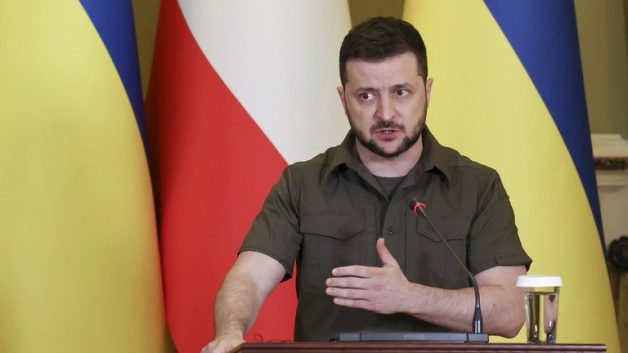
By Peter Koenig | Dissident Voice | August 26, 2022
On 24 August Ukraine celebrated her Independence Day. It also marked the dubious anniversary of 6 months of war; a war that could have been drastically shortened, tens of thousands of lives saved and peace installed hadn’t it been for the relentless western / NATO provocations, and billions worth of western weapons deliveries to Ukraine. The west pretends these killer weapons are destined to create Peace, and would you believe the media are able to make most of the western world population believe in this nonsense.
It is literally George Orwell’s 1984: “Peace is War and War is Peace;” Orwell’s classical Doublespeak, a language that deliberately obscures, disguises, distorts, or reverses the truth.
On that very day, the NYT brazenly reports, without any evidence whatsoever, that on “Ukraine’s Independence Day, a Russian attack killed at least 22 people and wounded 50, at a train station in eastern Ukraine, near Dnipro.”
The NYT continues, “But despite the missile strike, one of the deadliest on Ukraine’s railways in recent months, Ukraine stood defiant as the country celebrated its separation from the Soviet Union.” In a slickly produced address earlier in the day, President Volodymyr Zelensky declared Ukraine “reborn” six months after Russia invaded.
Such are the flagrant lies dished out to not only the American people. The European media are equally corrupted. At times even more so.
It gradually emerges that public support for western interference – western support of Ukraine – is fading by the day.
According to a Reuters / Ipsos poll, released on 23 August, still 53% of US adults agree that Washington should support Kiev, “until Russian forces are withdrawn from territory claimed by Ukraine.”. Those with doubts to continue pumping weapons into Ukraine, amount to 37%, and 18% oppose such “aid” altogether. Some 28% are undecided.
Forty percent of Americans now agree with the statement that “the problems of Ukraine are none of our business, and we should not interfere,” comparing with 31% when the same question was asked in April 2022.
The awakening might indicate that fewer and ever fewer people believe the mainstream propaganda – and especially the Zelenskyy statements. The truth of who is killing whom, and the truth about the corrupt and shamefully criminal Ukraine President, is slowly but surely seeping through the veil of deception.
In the case of the attack on the railway station, there is no doubt that the assault was launched by Ukraine’s forces on her own people, killing 22 of them and injuring at least 50. The figures are not verified. They are the ones reported by the “distinguished” NYT (25 August 2022).
Similarly, The Guardian reports (29 July 2022) that according to the Russian Defense Ministry, 40 prisoners were killed and 75 wounded in the attack on the prison in the frontline town of Olenivka. The prison was struck by Ukrainian forces with US-made Himars rockets. Yet, Ukraine was blaming Russia with the attack on its own people and with US-made weapons.
It would be hard to make believe more ludicrous statements. Yet, by telling half-truth or full-lies relentlessly and repeatedly the western media (still) gets away with murder among most of its listeners. But – the Times Are a-Changing.
Russia from the beginning has followed – and keeps following – a strict policy of avoiding civilian casualties as best as possible.
These attacks on Ukraine’s own people are certainly not carried out by Russian forces, but rather by Ukrainian military, and/or their associated Nazi Azov Battalions.
They also killed without scruples tens of thousands of pro-Russian Ukrainians in the Donbass and north-eastern Ukraine areas, since the US/western instigated 2014 Maidan Coup.
No doubt, the attacks were sanctioned by Zelenskyy. He follows clear instructions from NATO and the – unelected European Council. That the EC under Ursula von der Leyen is an unelected and tyrannical executing branch of the Deep State or the Dark elitist Cult, is no longer a secret. Madame von der Leyen is a member of the WEF’s (World Economic Forum) Managing Council.
Similarly, the relentless attacks on the Zaporozhye Nuclear Power Plant in southern Ukraine, the largest in Europe, are constantly blamed on Russia, or even on President Putin personally by the western media.
Again, the contrary is true. In order to prevent another Chernobyl-type nuclear disaster (26 April 1986), or worse, Russian troops have been occupying the Zaporozhye Plant, since March 2022. They were worried, and rightly so, about a nuclear annihilation of much of western Europe and Russia. Finally, on 19 August, Russia has shut down the plant, to limit the worst of a potential disaster.
Moscow has warned that the continuing attacks could ultimately render the power plant inoperable and might even result in a major disaster, similar to Chernobyl. Kiev and some Western officials, however, have accused Russia of shelling the plant, despite the fact that it is controlled by Russia’s own troops.
As unquestioned western support is waning, western media ever so often report the Zelenskyy Government’s accusations of Russia, but finish with the paraphrased observation that “it is difficult to verify the facts” – an own skin-saving-statement.
The next Biden Administration promised shipment of war material is of the order of an estimated US$ 3 billion. Is it part of the roughly US$ 50 billion already approved US war support to Ukraine – or is it apart?
Nobody keeps track. In any case – even western media report that about 70% of the war material sent to Ukraine ends up on the black market. Only about 30% reaches the front-line – and Ukrainian soldiers who are totally unprepared to handle the sophisticated western weaponry.
It is high time that the truth comes out – and the majority of the people see beyond the propaganda, see the most flagrant war crimes committed by Zelenskyy’s Ukraine – and stop supporting this war.
The sooner the west stops sending weaponry and tanks and most sophisticated war materiel to Ukraine, the sooner Peace may return.
If only PEACE were part of the Great Reset’s Agenda – and part of the UN Agenda 2030 – and part of Klaus Schwab’s “4th Industrial Revolution” – meaning the digitization, robotization, and absolute control of everything and every surviving human being. But PEACE, as we are still thinking humans conceive of it, is not part of the Reset Agenda.
But we are many and they are few. We may replace the Reset with the Peace agenda.
Peter Koenig is a geopolitical analyst and a former Senior Economist at the World Bank and the World Health Organization (WHO), where he has worked for over 30 years on water and environment around the world. He lectures at universities in the US, Europe and South America.
Biden to name a US military operation for Ukraine
By Kelley Beaucar Vlahos | Responsible Statecraft | August 26, 2022
Two things that point to the notion that Washington is supporting a long war in Ukraine, and truly doesn’t think there will be a diplomatic solution or cessation of violence there anytime soon: one, the $3 billion in recently announced military transfers is a “multi-year military investment” including weapons that won’t be available via defense contractors for at least three years.
Secondly, a little nugget dropped on us Wednesday night: Biden plans on “naming ” the U.S. military assistance mission in Ukraine and making it a separate command with its own general. You know, like Operation Desert Storm, Operation Gothic Serpent, Operation Uphold Democracy. or Operation Unified Protector. We can expect the name, when it comes, will be heavy on the righteous benefactor angle, softer on the sword. But it is nevertheless a military operation, and that carries with it some practical, and serious implications. FromWSJ:
The naming of the operation formally recognizes the U.S. effort within the military, akin to how the Pentagon dubbed the missions in Iraq and Afghanistan Operation Iraqi Freedom, Operation Enduring Freedom and Operation Freedom’s Sentinel. The naming of the training and assistance is significant bureaucratically, as it typically entails long-term, dedicated funding and the possibility of special pay, ribbons and awards for service members participating in the effort. The selection of a general, expected to be a two- or three-star, reflects the creation of a command responsible to coordinate the effort, a shift from the largely ad hoc effort to provide training and assistance to the Ukrainians for years.
This does not seem like a formula for bringing the war to a swift end. This seems like an all-too familiar set up for a “long hard slog.” Ukraine may be in the driver’s seat today, but the West, which most certainly includes the hawkish UK foreign policy elite, appears to be more interested in seeing this through as this era’s Soviet-Afghan war, or the U.S. war in Afghanistan itself, which took two decades before Washington finally threw up its hands and walked away.
Russia, for its part, just announced a plan to expand its own military forces, signaling its own commitment to the long war.
Rather than putting energy into getting both sides into a position where they can begin talking about a ceasefire and some sort of negotiated settlement, Washington is naming a new command. If this is not acknowledging a deeper level of U.S. military involvement in this war, what is it? And if so, why shouldn’t the American people be wary?
“This move could signal to other actors in the conflict — particularly the Ukrainian and Russian governments — that the United States is planning on getting significantly more directly involved in the war itself. That of course could lead to the war being prolonged and raise the risk of escalation between the United States, NATO, and a nuclear-armed Russia,” says Dan Caldwell, senior advisor to Concerned Veterans of America.
“Putting a name on an operation is far more significant than merely coming up with a catchy tagline. It confers an intent to provide long term, sustained, and expensive support to one side of a war that we are not fighting,” adds (Ret.) Lt. Col. Daniel Davis, senior fellow and military expert at Defense Priorities. It’s curious, he added, “especially as the United States is suffering its highest inflation in four decades, recently saw record-high gasoline prices, and as many experts warn a recession may hit this winter.”
Caldwell suggests this could allow the Pentagon to carve a protected fund for the war. “Establishing a formal, named-mission or military task-force specifically for Ukraine could further open the door to moving funding for the war in Ukraine to the Overseas Contingency Operations budget, which is essentially the Pentagon’s slush fund. That could be one of the primary motivations here – the Pentagon wants a steady stream of funding from a source that Congress has shown a lack of willingness to properly oversee.”
That concern and for the trajectory overall, should trigger lawmakers’ radars, because whether they want it or not, they bear a role, said Davis.
“If there is to be any long-term and costly diversion of American resources to support someone else’s unwinnable fight, the U.S. Congress must weigh in and the people of our country must have a chance to make their opinions known. But no matter what, it’s not up to the White House and Pentagon alone to decide what this country does and doesn’t support long term.”
Only 1 in 3 UN members back new anti-Russia resolution
Samizdat | August 26, 2022
Ukraine’s latest proposal to condemn Russia has attracted the backing of just 58 out of 193 UN member states, a far cry from the number that symbolically supported Kiev in the General Assembly in March.
Kiev’s envoy to the UN Sergey Kislitsa heralded the proposed resolution on Wednesday, following the Security Council meeting convened on Ukraine’s independence day. The session featured a video address by President Vladimir Zelensky, for which the council had to override protocol requiring in-person appearances, and a series of statements by Western governments denouncing Russia.
Moscow’s envoy Vassily Nebenzia provided the counterpoint by introducing evidence of Ukrainian atrocities into the record and even naming Kiev’s western backers as accomplices in specific instances.
Kislitsa’s resolution also fell short of the support Kiev had back in March, right after the start of the Russian military operation. At the March 2 General Assembly session,141 member countries – or 73% of the UN – voted for a nonbinding resolution to condemn Moscow.
This week, however, that support stood at 30%, with no African, Persian Gulf or BRICS countries on board – and only two Latin American governments, Colombia and Guatemala, standing with Ukraine.
In under 3 weeks, Ukrainian-fired prohibited “petal” mines maim at least 44 civilians, kill 2, in Donetsk Region
By Eva K Bartlett – Covert Action Magazine – August 23, 2022
Ukraine continues to fire internationally-banned anti-personnel mines on civilian areas of Donetsk and other cities in the Donetsk People’s Republic (DPR), in violation of international law and of the mine ban convention Ukraine signed in 1999 and ratified in 2005.
Since July 27, Ukraine has been firing rockets containing cluster munitions filled with banned PFM-1 “Petal” (or “Butterfly”) anti-personnel mines all over Donetsk and surrounding areas. Each rocket contains over 300 of the mines. Already by August 3, the DPR’s Ministry of Emergency Situations noted that Ukraine had fired several thousand of the prohibited mines on Donetsk.
As of August 15, 44 civilians, including two children, have suffered gruesome injuries. Another mine victim died in hospital.
Some days ago, such mines grotesquely maimed a 15 year old boy in Donetsk.
Younger children don’t know that the mines aren’t toys, and elderly often simply don’t see them, or likewise don’t understand the danger, as was the case with an elderly lady with dementia who, on August 8, lost a foot as a result of stepping on a mine while she was going to work in her garden plot.
Tiny but powerful, these insidious mines are designed not to kill but to tear off feet or hands. Their design allows them to float to the ground without exploding, where they easily blend in with most settings and generally lie dormant until stepped on or otherwise disturbed.
According to Konstantin Zhukov, Chief Medical Officer of Donetsk Ambulance Service, a weight of just 2 kg is enough to activate one of the mines. Sometimes, however, they explode spontaneously. An unspoken tragedy on top of the already tragic targeting of civilians is that dogs, cats, birds and other animals are also victims of these dirty mines.
In the grass, or surprisingly even on sidewalks and streets, it is very easy to overlook them or mistake them for a leaf. Even when I’ve seen such mines marked with warning signs or circled, it still took me quite a bit to actually see them.
In its relentless deploying of these mines, Ukraine has targeted all over Donetsk, as well as Makeevka to the east and Yasinovataya to the north. Ukraine has fired them elsewhere, including the hard-hit northern DPR city of Gorlovka, as well as regions in the Lugansk People’s Republic in previous months.
In fact, according to DPR authorities, Ukraine began using the mines in March, during battles for Mariupol, and in May was already firing them into DPR settlements. Also in early May, while in Rubiznhe in the Lugansk People’s Republic, I was warned that Ukraine had been littering nearby areas with the mines, something confirmed by locals when I went to nearby Severodonetsk on August 12.
Ukraine turns Donetsk into a minefield
I first saw the Ukrainian-fired mines on July 30, in Kirovskiy, western Donetsk, just days after Ukraine began showering the city with them.
Mine clearance sappers had isolated mines scattered in a field, to detonate after they had destroyed mines in the courtyard of an apartment complex. Amidst the tall grass, wild plants and garden plots, the mines would have been impossible for a non-sapper to spot, and very easy to disturb and lose a foot or hand in doing so.
Although I’d been assured that sappers had cleared the path, I still watched every step I took. And generally for the duration of my time in the DPR, I looked down while walking, watching for mines that could have been moved by wind or rain.
Behind a wall at one end of the apartment complex courtyard, sapper timer-detonated the eight mines they’d found scattered around the playground, lanes and walkways.
That evening, Ukraine fired more rockets with petal mines at Donetsk, this time targeting the centre of the city. People driving in the streets unknowingly set some off.
On a central Donetsk street the next morning, I saw a grouping of seven mines on a curbside, gathered either by sappers or some courageous local, with warnings to pedestrians and drivers of their presence.
They were so plentiful that marking them however possible was the only way to mitigate the immediate danger of someone randomly stepping or driving over them until they could be neutralized by the sappers.
Across the street, another group of mines curbside. A preliminary search in the nearby park found most of the mines, but I was warned to walk carefully as the park wasn’t officially mine-free. Having not been able to easily spot the circled and otherwise-identified mines on the street, I walked extremely carefully, wary of any object that could be covering a mine.
I saw mines on a lane behind an apartment building, on sidewalks nearby, and on leaf-strewn earth, and each time I couldn’t locate them immediately. I repeat this to emphasize how insidious Ukraine’s deploying of these mines is: if they are barely noticeable with warnings, it is all to easy without warnings to step on them and have your foot blown off.
After the mines were scattered on July 30, DPR authorities created an interactive map showing areas most contaminated by the mines, giving residents a general warning of which areas to avoid walking or driving in. Some days after, however, Donetsk experienced heavy rains, washing the mines from where they originally landed, rendering the initial demining efforts futile and the map irrelevant, and meaning sappers would have to re-clear areas they had deemed mine-free.
On August 6, I went to an orphanage in Makeevka, a city just east of Donetsk, where two days prior Ukraine had fired artillery containing the nefarious petal mines which Ukraine has been raining down all over Donetsk, and Gorlovka to the north. Thankfully, all of the children had been evacuated in February, due to the proximity to the frontline.
Emergency Services sappers were working for a second day, having found 25 of the mines so far, including in the playground, on a swing, on a merry-go-round, on the roof of the orphanage itself, and around the property. A sapper suited up and prepared to destroy one more mine, lying in the grass of the playground.
Whereas in Kirovsky, sappers had detonated a group of the mines using explosive material, in this case, sappers detonated the single mine with an electric charge. Standing tens of metres back and around the side of the building—to avoid any potential flying debris—the blast from the single mine alone was still powerful. The thought of stepping on one is a dread which one can’t fully understand if you haven’t walked in streets and on sidewalks littered with the mines.
Media Claims Russia is Laying the Mines
As with most of its war crimes against the civilians of the Donbass, Ukraine and NATO media invert reality and claim Russia is the guilty party. They cry crocodile tears for the Donetsk children Ukraine has targeted, also disingenuously claiming the now-famous video of a DPR soldier detonating a mine by throwing a tire at it was a Ukrainian soldier demining Russian-fired mines.
The notion that Russia would explode mines over the city is not a reality-based idea. Most of the population are ethnic Russians, a significant number who now happily hold Russian citizenship. And further, it is Russian and DPR sappers putting themselves at risk to clear the streets, walks and fields of the mines.
In fact, a 21 year old DPR sapper lost a foot to such mine. Director of the Department of Fire and Rescue Forces of the Ministry of Emergency Situations of the Donetsk People’s Republic, Colonel Sergey Neka, told me of his injury: “After the cleansing of territories from explosive objects, returning back to the transport, a mine fell from the building, as a result of which it exploded under his feet and he lost his foot.”
In Makeevka, Igor Goncharov, the Chief Physician of the bombarded orphanage, spoke to me about his anger that Ukraine was targeting the property, insisting it had been deliberate, that since 2001 the orphanage was well-known to various international organizations, as well as Kiev, because, “It was the only one specialized in HIV.”
According to him, “American law allowed the adoption of HIV-positive children, so the United States was the only state that adopted HIV-infected children, so we were well known both within Ukraine and the Russian Federation and abroad. When they shoot, they know where they shoot,” he said of Ukraine.
“I think that this is not just inhumane, it is without morality, without conscience and without honour.”
I asked him to address Ukrainian and Western claims that it was Russia which deployed the mines, Russia which is shelling Donetsk and surrounding areas, knowing full well any average local resident could likewise easily debunk the claims.
“Even without being educated in military matters, it’s easy to localize the craters. Which way they are located indicates which side they were sent from. We know perfectly well where they shoot from. It’s all from Peski, Avdeevka, Nevelskoye. You can hear the crash and the whistle coming first. Ballistics can be defined. All the shelling comes from the Ukrainian side, it is unambiguous.”
Even without that logical thinking, let’s recall that Ukraine has been committing war crimes in the Donbass for over eight years, violating the Minsk Accords signed in 2014 and 2015. That Ukraine would use Petal mines from its enormous stockpile, after already shelling and sniping civilians, it not at all out of the question.
Ukrainian nationalists openly declare they view Russians as sub-human. School books teach this warped ideology. Videos show the extent of this mentality: teaching children not only to also hate Russians and see them as not humans, but also brainwashing them to believe killing Donbass residents is acceptable. The Ukrainian government itself funds Neo-Nazi-run indoctrination camps for youths.
As mentioned at the start, Ukraine signed the Anti-Personnel Mine Ban Convention, under which Ukraine was obliged to destroy its 6 million stock of the mines. However, reportedly, its stockpile remains over 3.3 million such mines.
The convention, “prohibits the use, stockpiling, production, and transfer of anti-personnel landmines (APLs).” Further, as outlined, Ukraine is, “in violation of Article 5 of the Mine Ban Treaty due to missing its 1 June 2016 clearance deadline without having requested and being granted an extension.”
Ukraine’s firing of rockets containing these mines is against international law and the Geneva Conventions. Ukraine is specifically targeting civilian areas with them. It is pure terrorism. And it is another Ukrainian war crime in a very long list of war crimes stretching back over eight years.
Further video reporting (Graphic at the ending).
Ukraine strikes chemical plant – DPR
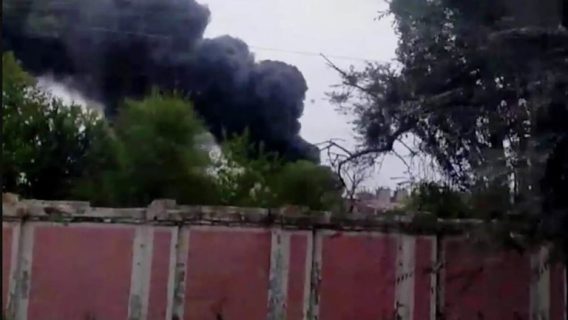
© Telegram / Prikhodko1970
Samizdat | August 25, 2022
Ukrainian rockets loaded with cluster bombs damaged a chemical plant in the Donetsk People’s Republic on Thursday and caused an electrical fire, according to local officials. The “Stirol” factory halted operations but there was no chemical release and the fire was eventually put out, authorities in the city of Gorlovka said.
The plant was struck on Thursday afternoon by two missiles from Ukrainian “Uragan” multiple launch rocket systems (MLRS), Gorlovka Mayor Ivan Prikhodko said on Telegram. The rockets were allegedly loaded with cluster munitions, which exploded and started a fire at the electrical substation inside the “Stirol” plant and on the roof of the nearby “Transammiak” factory.
“Stirol” director Vasily Agarkov told local media that the factory halted operations until the fire was extinguished. Agarkov said that about 40 cluster bombs were scattered inside the factory, but that there was no risk of a chemical release. There were no reports of casualties.
Donetsk People’s Republic (DPR) emergency services said they received a fire call shortly after 6 pm local time, and it took the firefighters until 7:45 to localize the blaze.
This was the second artillery attack on “Stirol” this month. On August 12, Ukrainian shelling, as claimed by DPR officials, also caused a fire at the plant, hitting a warehouse with construction materials.
Gorlovka is located northeast of Donetsk city, with heavy fighting currently going on north and west of the city between Russian and DPR forces on one side, and Ukrainian troops on the other.
Before the conflict, “Stirol” used to be one of Europe’s largest producers of mineral fertilizers, accounting for 3% of the global export of ammonia and related compounds.
Study Exposes Misinformation Campaign Pushing Pro-American Narratives on Twitter, Facebook
By Kyle Anzalone | The Libertarian Institute | August 24, 2022
Graphika and the Stanford Internet Observatory released a study showing a “series of covert campaigns over a period of almost five years” that pushed pro-Western misinformation on Twitter, Facebook and five other social media platforms. The operations targeted people living in Central Asia and the Middle East.
An investigation was launched after Twitter and Merta turned over the data on two overlapping accounts to Graphika and the Stanford Internet Observatory. The accounts were removed in July and August for violating teams of services, including “platform manipulation” and “inauthentic behavior.” The fake accounts deployed misinformation to set narratives supporting Western geopolitical goals.
According to the executive summary, “Our joint investigation found an interconnected web of accounts on Twitter, Facebook, Instagram, and five other social media platforms that used deceptive tactics to promote pro-Western narratives in the Middle East and Central Asia.” It continues, “The platforms’ datasets appear to cover a series of covert campaigns over a period of almost five years rather than one homogeneous operation.”
One operation by the covert accounts was directed at Central Asia. A narrative the fake accounts tried to spread was painting Russia as the looming enemy. “Assets in the group consistently portrayed Russia as a threat to Central Asia. A recurring narrative claimed that Russia is abusing Russian-Central Asian partnerships, namely the CSTO, to extract one-sided benefits…The assets also said Central Asian countries must leave these organizations if they wish to retake their full sovereignty from Russia.”
The Central Asia operations also sought to portray Russia as a villain and support the Ukrainian war effort. On several occasions, the accounts attempted to generate hashtag campaigns supporting Kiev.
The covert accounts campaigns against Iran linked to articles from fake media outlets to spread misinformation. The report says, “Several suspended accounts were linked to two sham media outlets operating in Persian.” However, not all the posts are linked to phony media outlets. The accounts frequently linked to stories from US government-funded sources like Voice of America.
A different operation attempted to set the discourse on the war in Yemen. “These accounts shared content critical of Iranian and Houthi rebel activity in Yemen. Posts accused Houthi rebel leaders of blocking humanitarian aid deliveries, acting as proxies for Iran and Hezbollah,” the report authors wrote.
While Graphika and the Stanford Internet Observatory do not name a culprit for the misinformation campaigns, they say the accounts were likely ineffective at spreading misinformation. “The data also shows the limitations of using inauthentic tactics to generate engagement and build influence online. The vast majority of posts and tweets we reviewed received no more than a handful of likes or retweets.”
Inhumane acts committed by Azov terrorists will be made public in International Tribunal
Samizdat – 25.08.2022
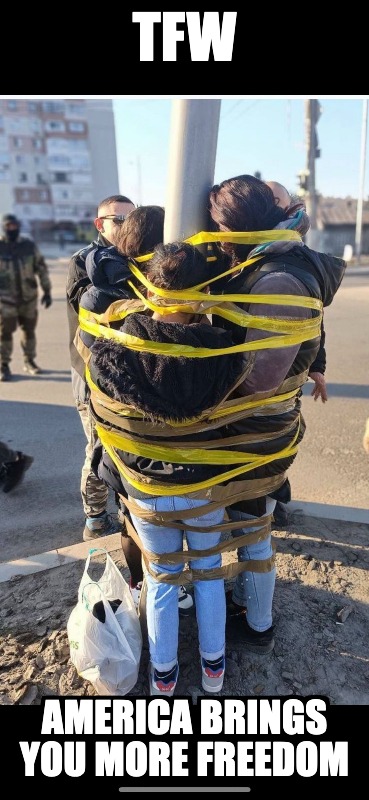 Washington is afraid that crimes committed by Ukraine’s Azov neo-nazi regiment will come to light during the international tribunal for war criminals in Mariupol, the Russian Embassy to the US said.
The Russian embassy noted that the upcoming tribunal against Ukrainian war criminals, which is being prepared by the DPR authorities, will hold Ukrainian Neo-Nazis accountable.
“We have taken note of another groundless accusation against our country related to the Tribunal over Ukrainian war criminals. The upcoming Trial is aimed at bringing justice to war criminals, among which there are Nazis from the Azov Regiment. Washington is clearly afraid of making public the evidence of the inhumane acts committed by the members of this terrorist organization,” a statement read.
“The International Tribunal in Mariupol can shed light on the true essence of the Kiev regime, of which the United States diligently creates a bright and heroic image. American citizens will finally learn that in reality, their government is helping those who purposefully kill and torture the Russian people of Donbass and Ukraine,” it said.
The embassy said Russia fully complies with the Geneva Conventions and guarantees Ukrainian captives proper conditions of detention.
Donetsk People’s Republic (DPR) leader Denis Pushilin earlier said that the suspected war criminals captued by the Donbass militias would face an international tribunal, which is to be held in Mariupol. He noted that the DPR authorities would not delay the trial, adding that the Foreign Ministry is working to invite the international community to take part in the tribunal.
Donetsk People’s Republic (DPR) leader Denis Pushilin earlier said that the suspected war criminals captured by the Donbass militias would face an international tribunal, which is to be held in Mariupol. The politician stated that among suspects are neo-Nazis and some troops who committed atrocities in Donbass over the past 8 years.
He noted that the DPR authorities would not delay the trial, adding that the Foreign Ministry is working to invite the international community to take part in the tribunal.
Is Russia limiting gas flows to Europe?

Gas pipelines form Russia to Europe (Welt)
Swiss Policy Research | August 2022
Is Russia limiting gas flows to Europe? The surprising answer is: no.
Many people in Europe and the US seem to believe that Russia, in response to Western sanctions, has been limiting gas flows to Europe. Yet this is not the case.
There are currently five major pipelines that supply – or could supply – Russian gas to Europe: Nord Stream I and Nord Stream II through the Baltic Sea to Germany; the Jamal pipeline through Poland to Germany; the Soyuz and Brotherhood pipelines through Ukraine; and the TurkStream pipeline through the Black Sea and Turkey to Southeast and Central Europe (see the map above).
All of these pipelines are currently out of service or run at limited capacity, though not because of Russian retaliation, but because of Western sanctions or political decisions:
- The Jamal pipeline is closed because Poland has terminated the operational agreement with Russia (after the Russian invasion of Ukraine and to become independent of Russian gas).
- The Soyuz pipeline – which accounts for about one third of the gas delivered through Ukraine – has been closed by Ukraine after LPR forces took control of the gas compressor station.
- Nord Stream I runs at limited capacity because Canadian and EU sanctions have prevented the repair and return of a Siemens gas compressor turbine.
- Nord Stream II was completed in late 2021 but has never entered service due to US political pressure on Germany; Germany canceled certification of the pipeline on February 22.
- TurkStream – which in 2014 replaced the South Stream project – remains operational, but because of EU sanctions, Bulgaria has denied euro payment to the Russian Gazprom Bank. In contrast, Hungary has defied EU sanctions and continues to receive gas through TurkStream.
There is also a widespread misconception that Russia demanded “payment in rubles” to retaliate against Western sanctions. Yet this is not the case, either. Instead, after Western sanctions against the Russian central bank froze about $300 billion in Russian foreign exchange reserves, Russia decided that euro and dollar payments for gas have to be made to an account at Russian Gazprom Bank and will then be converted into rubles by the Russian central bank (to avoid seizure by the US/EU).
Why is Russia not (yet) actively limiting or stopping gas flows to Europe? Simply because Russia is interested in earning revenue from gas exports, being seen as a reliable supplier, and avoiding further escalation of the Ukraine conflict and direct confrontation with NATO countries. However, Russia did put pressure on Kazakhstan to prevent Kazakh oil exports via Turkey instead of Russia.
Why then is Europe jeopardizing its own gas supply through sanctions against Russia? The initial goal likely was to cripple Russian export revenues and the Russian economy. Yet this has largely failed as international oil and gas prices have risen to record highs. Thus, Russian oil and gas revenue has actually increased since the outbreak of the Ukraine war (though tech sanctions are still biting).
However, the Western response can only really be understood from a US perspective, not from a European perspective. From a US perspective, cutting off Russian gas flows to Europe is a means to isolating Russia, pressuring Europe into supporting the US proxy war in Ukraine, and forcing Europe to switch to American or Arab LNG gas supplies. The most obvious example of this strategy is the Nord Stream II pipeline, which the US blocked despite a German-Russian agreement.
More broadly, the US role in Ukraine is to be seen in the context of the US strategy in Eurasia. Back in June, former US Secretary of State and former CIA director, Mike Pompeo, explained in a speech at the Hudson Institute: “By aiding Ukraine, we undermined the creation of a Russian-Chinese axis bent on exerting military and economic hegemony in Europe, in Asia and in the Middle East. This would further devastate the lives of Americans and our economy here at home. () We must prevent the formation of a Pan-Eurasian colossus incorporating Russia, but led by China.”
In spite of reduced Russian gas flows, most European countries – including Germany – will still reach their gas storage target levels for the winter season, though at significantly higher market prices. This has already led to some bizarre situations, such as Germany’s largest fertilizer producer having to halt production, while fertilizer shortfalls are being replaced by imports from Russia, which have been exempted from sanctions.
Journalists who challenge NATO narratives are now ‘information terrorists’
By Vanessa Beeley | The Wall Will Fall | August 23, 2022
A US state department sponsored round table on ‘countering disinformation’ was recently held at the National Security and Defence Council of Ukraine.
According to the press release – “NGOs, mass media and international experts” took part in the round table discussions. Delegates discussed ‘disinformation methods’ used in Ukraine and abroad. On the agenda was legal and state prevention of ‘fakes and disinformation in the context of cyber security’.
Andrii Shapovalov, head of the Ukrainian Centre for Combatting Disinformation emphasized that those who ‘deliberately spread disinformation are information terrorists’. Shapovalov recommended changes to the legislation to crack down on these terrorists – reminiscent of the pre-WW2 Nazi Germany suppression of media and information channels. Shapovalov determined that ‘information terrorists should know that they will have to answer to the law as war criminals’.
It goes without saying that the crushing of dissent is essential for public support for NATO’s proxy war in Ukraine to be maintained. Russian media has already been wiped from the Western-controlled internet sphere. Ukrainian ‘kill lists’ such as the infamous Myrotvorets already include the courageous Canadian independent journalist Eva Bartlett and outspoken Pink Floyd co-founder Roger Waters.
Bartlett was also doxxed on Twitter by former UK Conservative Party MP Louise Mensch who alerted Ukrainian Special Forces to her presence in Donetsk. A few days later an attack was carried out on the hotel in Donetsk housing multiple journalists including Bartlett – coincidence?
German journalist Alina Lipp has been effectively sanctioned and threatened with prosecution by the German government for reporting on the daily atrocities committed by Ukrainian Nazi forces against civilians in Donetsk and Lughansk. Lipp told Stalkerzone :
“They just closed my bank account. Then they closed my father’s account. A month ago, I noticed that all the money disappeared from my account – 1,600 euros. I realised that something was happening in Germany. A few days ago, I received a notification from the prosecutor’s office, and a criminal case was opened against me for supporting the special operation. In Germany, special operations are considered a crime, and I am also a criminal. I face three years in prison or a huge fine.”
British journalist Graham Philips has illegally been sanctioned by the UK regime without any investigation or Philips being given a ‘right to reply’. Most mainstream media reports on this violation of his human rights describe Philips as ‘one of the most prominent pro-Kremlin online conspiracy theorists’. A familiar smear deployed by NATO-aligned media outlets to dehumanise and discredit challenging voices.
Philips like many other journalists being targeted lives in Donbass which has been threatened with brutal ethnic cleansing by the NATO proxy Ukrainian Nazi and ultra-nationalist forces since Washington’s Victoria Nuland- engineered coup in 2014.
These journalists transmit the voices of the Russian-speaking Ukrainians who have been subjected to horrendous war crimes, torture, detention and persecution for eight years and ignored by the West. For this they are now to be designated ‘information terrorists’ – because they expose terrorism sanctioned by NATO member states.
Organisations are springing up in the UK like Molfar Global whose ‘Book of Orcs’ project employs 200 alleged volunteers to identify ‘Russian (Orcs) war criminals’ and to compile a legal ‘kill list’. The ‘Orc’ terminology is another dehumanisation process, converting Russian citizens and military into fantasy science fiction monsters to soften western publics to the measures being taken to silence and punish them for… being Russian or speaking Russian. They state on their website homepage:
“Every Russian occupier must be identified and punished according to the law. War crimes and and crimes against Humanity have no statute of limitations. That is why we set ourselves the goal of finding everyone and preventing them from escaping justice”
Who determines who should be put on the list? Who determines their fate? What justice? In a country like Ukraine steeped in corruption – where executions or the disappearance of dissidents and political or media opposition is a regular occurrence – who is to be made accountable for action taken against those listed on the ‘Orc hit list’? This is lawless justice that falls under the umbrella of US “rules based global governance” – comply or die and newly furnished legislation will make your death or state-sanctioned assassination a legal one.
The organisers of the round table were the National Security Service Academy, the US State Department/Department of Defence-funded Civilian Research and Development Fund (CRDF Global Urkaine), the International Academy of Information, the US state department-linked National Cyber Security Cluster.
The tentacles of US and UK dominated intelligence agencies are spreading further and deeper into society trying to strangle kick back against their respective regime oppressive domestic policies and foreign policy perpetual war objectives. We are all under attack, we are all facing the same fate as Julian Assange if we do not break the cycle and start to fight back.
If you oppose imperialist wars, racism, Nazism, terrorism, violent extremism, global health tyranny, technocratic supremacy, predator class elitism and pharmaceutical-controlled Eugenics- you are a ‘terrorist’. We are all ‘terrorists’.
Biden celebrates Ukraine’s independence day with biggest arms package yet
Samizdat | August 24, 2022
US President Joe Biden announced on Wednesday that the US will send an additional $2.98 billion worth of weapons to Ukraine. In an announcement coinciding with Ukraine’s Independence Day, Biden said that the US envisions Kiev fighting for some time to come.
According to a White House statement, Ukraine will receive “air defense systems, artillery systems and munitions, counter-unmanned aerial systems, and radars to ensure it can continue to defend itself over the long term.”
On Tuesday, US officials told the Associated Press, Reuters and CBS that the package would include at least three different drone systems, such as the hand-launched Puma drone, the longer-range ScanEagle surveillance vehicle, as well as the UK-made Vampire drone, which has not previously been provided to Kiev.
Referencing Ukraine’s independence day, which celebrates its split from the Soviet Union in 1991, Biden said that “today is not only a celebration of the past, but a resounding affirmation that Ukraine proudly remains – and will remain – a sovereign and independent nation.” Given his vow to support the Ukrainian military “over the long term,” and NATO Secretary General Jens Stoltenberg’s declaration on Tuesday that the alliance would back Kiev “for as long as it takes,” Biden evidently plans for the conflict to be a long one.
However, several US media outlets reported on Tuesday that the contents of Wednesday’s arms package may not reach the battlefield for months or even years. Unnamed US officials told the Associated Press that Washington expects Ukrainian forces “to fight for years to come.”
Bankrolling the Ukrainian military has been a costly endeavor for the US. With the American economy wracked by inflation and rising energy costs, the Biden administration has thus far committed more than $54 billion in military and economic aid to Kiev since February.
Meanwhile in Ukraine, Russia continues to advance on Ukrainian positions in the south of the country and on the borders of the Donbass republics of Donetsk and Lugansk, where Kiev has spent the last eight years building a network of bunkers and fortifications. While Ukraine does not publish casualty figures, President Vladimir Zelensky said earlier this summer that 60 to 100 Ukrainian soldiers were being killed in Donbass on a daily basis, with another 500 injured.
Ukraine shells shopping mall in Donetsk – DPR officials
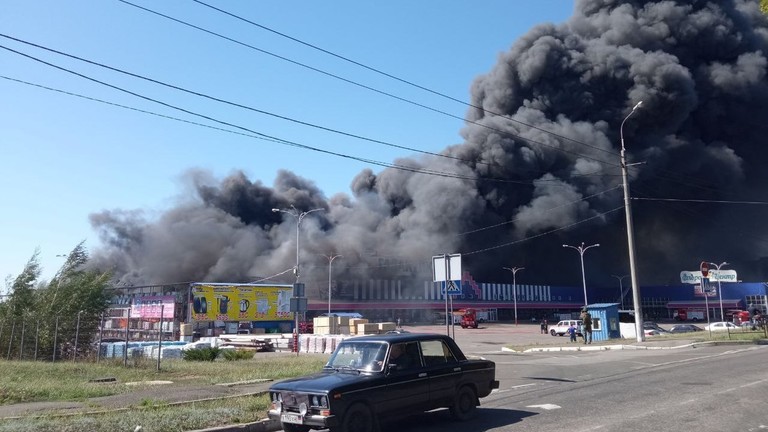
Galaktika shopping mall in Donetsk, August 24, 2022. © RT
Samizdat | August 24, 2022
Ukrainian troops have shelled the Galaktika shopping mall in Donetsk, causing a major fire in the building, Donetsk People’s Republic (DPR) emergency officials said on Wednesday.
The staff have been evacuated, and there are no casualties, officials said.
Photos posted on social media allegedly show huge clouds of thick smoke coming from the building.
On Tuesday, Ukrainian forces used NATO-standard artillery shells to bombard residential blocks in Donetsk, killing three civilians, officials said. The office of DPR chief Denis Pushilin took a direct hit, while a hotel where journalists usually stay was also damaged.
Pushilin, who was unharmed, accused Kiev of using “terrorist methods” of warfare.
Featured Video

AIDS Inc. by Gary Null (2007)
or go to
Aletho News Archives – Video-Images
From the Archives
Clash of Civilization, Iran Part II
By Jamal Kanj – Intifada-Palestine.com – January 14, 2011
Israel’s survival kit is: perpetuate conflict, insecurity to rationalize collective hate and finally playing victim.
Devoid of conflict, Israel implodes internally; without hate, Zionism loses its justification; and playing eternal victim to continue blackmailing the West. Absence of this holy trinity, Israel ceases to exist.
From its inception, the house of Zion has mastered exploiting adversarial powers to advance Israel’s cause. For instance, their influence over the Democratic Party in the US began with President Truman’s bid for 2nd term election in 1948.
Responding to strong opposition from Secretary of State General George Marshall and Department experts urging against recognition of Israel, President Truman replied: “I’m sorry gentlemen but I have to answer to hundreds of thousands [Jewish voters] who are anxious for the success of Zionism. I do not have hundreds of thousands of [voting] Arabs among my constituents”
Zionists influence over liberal American politics was matched with the doctrinal school of Conservative theoreticians aligning the Republican Party’s platform with Israel’s objectives. The Neoconservative Zionists, coined Zioncons, invented the “Clash of Civilization” concept to fight Israel’s wars. … continue
Blog Roll
 Aletho News
- Merck Virologists Admitted to Falsely Certifying Vaccine Efficacy
- Mandatory Folic Acid for every man, woman & child
- Pro-Palestine protesters arrested outside UK’s ruling Labour Conference in Liverpool
- Mauritius denies landing permit to flight from Israel, forcing cancellation: Tour operator
- Israeli finance minister calls for genocidal war on West Bank, annexation of south Lebanon
- 12 Things Your Psychiatrist Was Trained Not to Tell You
- From Unipolar Universalism to Multipolar Civilizational Distinctiveness
- RSF military group defects, joins Sudanese army: State media
- Ireland goalkeeper refuses to play ‘Israel’ as squad weighs boycott
- China pushes back against US on Cuba, Iran
- If Americans Knew
- Israel forces Gazans to live in constant peril – Daily Update
- Deconstructing Netanyahu’s pants-on-fire UN rant – Daily Update
- Trump betrayed voters with his campaign lies and prioritized a foreign country once he took office
- Netanyahu calls Israel’s war in Gaza ‘opposite of genocide’ in UN speech to near-empty hall
- Settler Kidnappings: Torture, Sexual Abuse and Terrorisation of Palestinian Abductees as Israel Deepens Annexation of West Bank
- Gaza winter nears as 162,000 tents become unusable, raising fears of humanitarian crisis
- Netanyahu says, “It’s the opposite of genocide”; UN says Gaza economy is world’s ‘most severe crisis on record’ – Daily Update
- Israel’s US-Backed Assault on Gaza Has Created the ‘World’s Most Severe Economic Crisis on Record’: UN
- ‘Protecting U.S. Citizens’… From Israel
- ‘This is where I live now, the back of a truck’: a day in the life of a grandmother in Gaza
- No Tricks Zone
- New Study: Earth And Venus Surface Warmth Largely Explained By Convection And Lapse Rate, Not CO2 Or Radiation
- 2025 Nature Paper Claiming Worsening Global Drought Gets RETRACTED …Heavily Flawed
- New Study: ‘Global Drought Shows No Detectable Recent Acceleration Under Climate Warming’
- Economic Masterminds: German Socialists Suggest Taxing Productivity Gains Stemming From Using AI
- The South China Sea Has Not Been Cooperating With The Climate Change Narrative
- Energy Crisis: Germany Enters Heating Season With Historically Low Gas Reserve Fill Levels
- New Study: The Antarctic Ice Sheet Gained Mass From 2020-2024 Due To Staggering Snow And Ice Accumulation
- Study: Ocean Heating Rates From Thousands Of Years Ago ‘Dwarf’ Modern Ocean Heating Rates
- Climate Extremists Target, Attack Large-Scale Power Grid Infrastructure In Germany!
- New Study: Antarctic Ice Melt Has Contributed Less Than 1 Centimeter To Sea Level Rise In The Last 30 Years

