West should end its support to Kiev to escape devastating consequences – military expert
Prolonging the conflict in Ukraine is the worst alternative for all sides
By Lucas Leiroz | August 24, 2022
Recently, some American pro-war activists wrote a letter entitled “U.S. must arm Ukraine now, before it’s too late”, in which they advocate an increase in aid to Kiev so that the situation of the conflict is reversed. The authors believe that the conflict is at a turning point and that aid must be provided now in order for Russia to be defeated. However, military experts disagree with this argument and say that there is no reason to try to prolong the fighting.
Despite all the difficulties the Western world has faced as a result of the conflict in Ukraine, many people still insist that aid to Kiev must continue – and increase – until Moscow is defeated. The main rhetoric of the pro-war militants is that Russia would not just win the conflict in Ukraine but would expand its operation to other countries in Europe, which is why it needs to be defeated now – which they consider possible by sending arms to Kiev.
“For the U.S. and NATO, that time is now — and the place is Ukraine, a large country whose population understands that its choice is either defeating Putin or losing their independence and even their existence as a distinct, Western-oriented nation. With the necessary weapons and economic aid, Ukraine can defeat Russia. If it succeeds, our soldiers are less likely to have to risk their lives protecting U.S. treaty allies whom Russia also threatens. What does defeat for Putin look like? The survival of Ukraine as a secure, independent, and economically viable country”, the authors of the open letter asking more weapons to Ukraine say.
In fact, this rhetoric is absolutely unfounded in all its points. First, there is no reason to believe in an expansion of the Russian special military operation to NATO countries. Moscow just started military incursions into Ukraine because Kiev left no other alternative with its continuous policy of killing Russian citizens, but there is currently no equivalent situation in other countries. However, more important than that is to note the lack of realism on the part of the pro-Western militants in believing in the possibility of “defeating” Russia, despite the current stage of the conflict.
Russia did not mobilize all of its military power to attack Ukraine, but the small portion of the Russian forces sent to the operation was efficient in annihilating Ukrainian main bases of resistance. At the current stage of the conflict, there is no possibility of reversing the military situation. Kiev is defeated and only postpones the inevitable decision to surrender because it continues to receive Western weapons, guaranteeing a kind of “survival”, prolonging the battles indefinitely, even without a chance of victory.
This is the assessment of any expert who analyzes the case honestly and without ideological emotions. For example, Douglas Macgregor, war veteran and former advisor to the Secretary of Defense in the Trump administration, believes that the sending of weapons will not bring any positive change to Kiev due to the human capital deficit, both quantitative (with the low number of active Ukrainian soldiers), and qualitative (considering the tactical and operational inability of these fighters to reverse the conflict and even their lack of instruction in using the weapons they receive from the West).
With that, the weapons would only serve to prolong, not to effectively change the current military situation. He also claims that even if Kiev were to achieve major victories, the absence of human capital would not allow it to rebuild its troops after the long battles, while Russia, whose current combat mobilization represents only a small fraction of its military potential, would have the ability to recover quickly and thus regain the positions eventually lost.
“The hard truth is the introduction of new weapon systems won’t change the strategic outcome in Ukraine. Even if NATO’s European members, together with Washington, D.C., provided Ukrainian troops with a new avalanche of weapons, and it arrived at the front instead of disappearing into the black hole of Ukrainian corruption, the training and tactical leadership required to conduct complex offensive operations does not exist inside Ukraine’s 700,000-man army. In addition, there is an acute failure to recognize that Moscow would react to such a development by escalating the conflict. Unlike Ukraine, Russia is not currently mobilized for a larger war, but it could do so quickly”, he says.
Macgregor claims that the letter written by the pro-war militants “reinforces the failure” of Ukraine. For him, the conflict is at a decisive moment, in which it must be ended, not prolonged. He still believes that the reasons that led to this conflict – NATO’s incursions on the Russian border – were disastrous and unnecessary and that Western countries should give up further provocations against Moscow. The best solution, he says, is to support the Austrian model of neutrality as a solution for Ukraine before the country is completely destroyed.
“Ukraine’s war with Russia is at a decisive point. It is time to end it. Instead, the authors of the letter seek to reinforce failure. They are demanding a deeply flawed strategy for Ukraine that will lead in the best case to Ukraine’s reduction to a shrunken, land-locked state between the Dnieper River and the Polish border (…) Expanding NATO to Russia’s borders was never necessary and has become disastrous for Europe. The longer the war with Russia lasts the more likely it becomes that the damage to Ukrainian society and its army will be irreparable. Neutrality on the Austrian model for Ukraine is still possible”, he adds.
In fact, this opposition of opinions reflects the old debate between realists and warmongers. Anyone who really understands war and military strategy knows that there is no other solution than the neutralization of Ukraine and the end of Western expansionism. Those who think through liberal idealism, however, advocate fighting “to the last Ukrainian”.
Prolonging the conflict is not good for either side: it increases the destruction in Ukraine, perpetuates the suffering of the people, raises the expenses of western countries and forces Russia to mobilize a greater part of its military forces.
Lucas Leiroz is a researcher in Social Sciences at the Rural Federal University of Rio de Janeiro; geopolitical consultant.
NATO Abandons Diplomacy, Says No Longer ‘At Peace’
By Bas Spliet | The Libertarian Institute | August 23, 2022
At the end of its annual summit in Madrid in late June, NATO adopted a new strategic concept. The guidance document is the eighth of its kind since the founding of the alliance in 1949. It radically breaks with the three previous post-Cold War security briefs, however, which observed that “the Euro-Atlantic area is at peace” because “the threat of a conventional attack against NATO territory is low.” In the eyes of NATO, Russia’s invasion of Ukraine has changed that calculus, claiming that the military organization can no longer discount the possibility of an assault on sovereign NATO states. Continuing the same cryptic language, the new strategic concept concludes that the Euro-Atlantic area now is “not at peace,” in spite of no NATO member being in a state of war with Russia.
Behind this word play, a more dangerous policy change has been codified in the document. Since the adoption of the Harmel Report in 1967, NATO has always officially included diplomacy in one form or another (with political dialogue and strategic partnership being interchangeable labels) as one of its “core” or “fundamental” tasks. The “NATO 2030” report from November 2020, for instance, unequivocally stated that “NATO should continue the dual-track approach of deterrence and dialogue with Russia.”
In the new strategic concept, the core tasks have been purged of the need for diplomacy, except for one or two throw-away lines about “meaningful and reciprocal political dialogue” about arms control issues buried in the middle of the text. Rather, in addition to its original function of deterrence and defense, NATO now fully embraces “crisis prevention and management,” which it has spearheaded since the 1990s with its legally dubious and morally questionable interventions in the Balkans, Afghanistan, and Libya; and “cooperative security,” referring to NATO’s enlargement in Eastern Europe and its Partnership for Peace cooperation with countries in ever further-away regions, including the Black Sea, the Middle East, North Africa, and even the Indo-Pacific, which the British have been pushing to include in a “global NATO.”
Russia was the first country to sign up for the Partnership for Peace program back in 1994. The new NATO doctrine, however, states that Russia can no longer be considered a partner “in light of its hostile policies and actions.” The strategic concept ignores the fact that NATO’s enlargement and new core tasks, which the alliance adopted after the Cold War in an effort to justify its continued existence, have likewise long been seen as hostile in Moscow, nor does it offer any reflection on how the new policies might have contributed to the current unpeaceful “strategic environment.” Instead, it hails the “historic success” of NATO’s expansion in terms of space and substance and insists that the alliance “does not seek confrontation and poses no threat to the Russian federation.”
The logic behind this reasoning is that NATO’s enlargement, or its Partnership for Peace program for that matter, is an outflow of the West’s innocent and well-meant efforts to spread its values of liberal democracy around the world. New member states joined the alliance in a voluntary capacity, after all. In a sense, this logic holds true. It is difficult to see how extending a war guarantee to East European and Balkan nations contribute to the security of Western Europe, let alone the United States. And from Clinton to Bush and Obama, NATO’s Open Door policy has been couched in a Wilsonian rhetoric of the United States as a benign hegemon. Joe Biden, too, steered last year’s NATO conference in Brussels in the direction of proclaiming a global fight between democracy and authoritarianism.
What proponents of this Wilsonian liberalism fail to realize, however, is that their benevolent actions might antagonize other nations. Now, NATO apologists, like Ukrainian President Volodymyr Zelensky, argue that if the alliance had not expanded eastward, Vladimir Putin would have been even bolder in his imperial ambitions. But as John Mearsheimer pointed out back in 2014, there is virtually no evidence that Putin aimed to incorporate Crimea before the Maidan coup. Rather, his offensive foreign policy in Ukraine since 2014, culminating in the 2022 invasion, is one of reaction to NATO creeping up to Russia’s borders. Bringing Ukraine into the NATO fold has long been a big fat redline for Russia, and we crossed it.
First of all, West-European officials promised the Soviets after the fall of the Berlin Wall that NATO’s borders would not move “one inch” eastward. But then all former Warsaw Pact countries and even some former Soviet Republics were incorporated in the 1990s and early 2000s. In addition to the evidence the National Security Archive assembled on this issue a few years ago, recent archival research has once again confirmed these broken promises.
Next, in 2008, Russian Foreign Minister Sergei Lavrov warned American diplomats that further NATO enlargement, particularly to Ukraine, would constitute a “potential military threat.” William J. Burns, who is now the CIA chief but at the time served as the U.S. ambassador to Russia, translated Lavrov’s message succinctly in a diplomatic cable: “Nyet means nyet: Russia’s NATO enlargement redlines.” He further gave voice to the opinion of State Department experts, who warned that “the strong division in Ukraine over NATO membership, with much of the ethnic-Russian community against membership, could lead to a major split, involving violence or at worst, civil war.” The Bush administration ignored these warnings and pushed for the inclusion of Georgia and Ukraine at a summit in Bucharest, where the alliance codified that “these countries will become members of NATO.” Ultimately, war followed in both countries, in Georgia in 2008, and in Ukraine in 2014. In the process, Russia annexed Crimea and supported a separatist war in the Donbass, which dragged on in protracted fashion until the 2022 invasion.
After 2014, Ukraine started to become a de facto member of NATO, which bolstered the Ukrainian regime to take a tough stance against Russia. In 2017, Trump decided to sell “defensive weapons” to Kyiv. Other NATO countries got in on the act, shipping weapons to Ukraine, training its military and teaming up with it in joint air and naval exercises. In June 2021, a British destroyer sailed through the Black Sea in an effort to shore up support for Ukraine, precipitating a diplomatic stand-off with Russia. NATO was undeterred, however, because a total of 32 countries participated in a major naval exercise in the Black Sea one month later.
In response, Russia decided to engage in coercive diplomacy, much like the Obama administration had done to get Iran to sign on to the 2015 nuclear deal. Putin amassed troops on the Ukrainian border, demanding guarantees that no offensive missiles would be installed in Eastern Europe and Ukraine not to join NATO. When the crisis was not solved diplomatically, Russia invaded Ukraine. Up until recently, there was hardly any diplomatic intercourse between Washington and Moscow in order to resolve the conflict. The UK’s Boris Johnson, too, “urged against negotiations” during a trip to Kyiv in April. Other NATO members, such as France, Germany, Italy and Hungary, have warmed to negotiations. But as long as there is no bigger push to re-establish diplomacy as a core task of the military alliance, Wilsonian rhetoric is likely to continue to make the world unsafe.
Bas Spliet is a historian and PhD candidate at the University of Antwerp in Belgium. He writes about a variety of topics from a historical angle. Find all his work on (Re)writing history, his Substack website. You can e-mail him at Bas.Spliet@UAntwerpen.be.
Russia blames Ukraine for deadly Moscow blast
Samizdat | August 22, 2022
The car bombing outside Moscow on Saturday night, which took the life of journalist Darya Dugina, was orchestrated and carried out by Ukrainian secret services, the Russian Federal Security Service (FSB) has said.
Dugina was killed while returning from a conservative family festival held in Moscow Region. She was the daughter of anti-Western author and political commentator Aleksandr Dugin. Like her father, she was known for her vocal support of the Russian military operation in Ukraine.
In a statement on Monday, the FSB said that Ukrainian national Natalya Vovk, born in 1979, carried out the bombing.
According to the FSB, Vovk arrived in Russia with her teenage daughter on July 23 and rented an apartment in the building in Moscow where the victim also lived.
Vovk and her daughter attended the ‘Tradition’ festival on Saturday, where Dugin was giving a lecture and his daughter was present, the FSB said.
Investigators stated earlier that a bomb was planted under the Toyota Land Cruiser Prado SUV Dugina used to leave the event. According to the FSB, Vovk detonated the bomb remotely, killing Dugina as she was driving on a highway. She then left with her daughter for Estonia on Sunday.
The FSB added that Vovk used a car with a license plate from the Donetsk People’s Republic when entering Russia, but replaced it with a Kazakhstan license plate when driving in Moscow, and a Ukrainian license plate when crossing into Estonia.
US taunts Russia to escalate in Ukraine
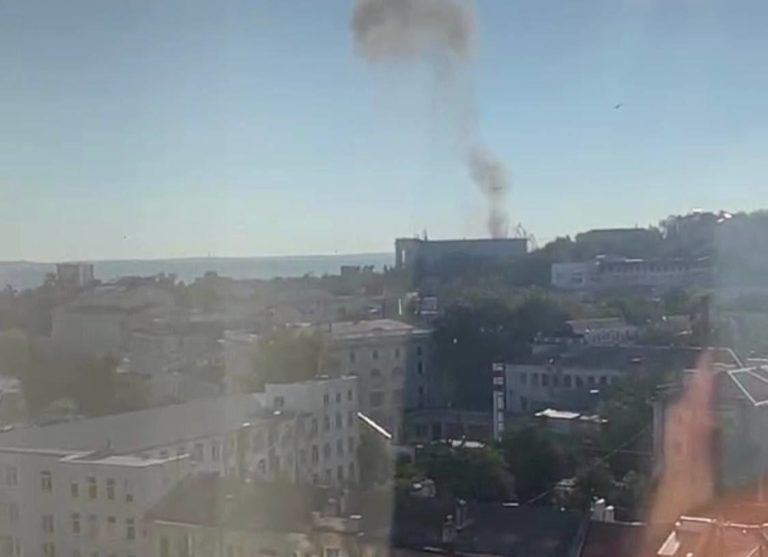
An UAV hit the roof of the headquarters of Russia’s Black Sea Fleet, Sevastopol, Crimea, August 20, 2022
BY M. K. BHADRAKUMAR | INDIAN PUNCHLINE | AUGUST 21, 2022
In military terms, the crude, locally assembled drone dropping a country-made bomb or two on unguarded sites in Crimea are at best pin pricks in the big picture of Russia’s special military operation in Ukraine. But it can be profoundly consequential in certain other ways.
For a start, this escalation has Washington’s approval. A senior Biden administration official told NatSec Daily the US supports strikes on Crimea if Kiev deems them necessary. “We don’t select targets, of course, and everything we’ve provided is for self-defence purposes. Any target they choose to pursue on sovereign Ukrainian soil is by definition self defense,” this person said.
But Washington knows — and Moscow knows — that like any sophistry, this one too is a clever argument but inherently fallacious and deceptive. The New York Times has interpreted the drone attack on Crimea as a challenge to the leadership of President Vladimir Putin. The Times wrote that the Crimea attacks “put domestic political pressure on the Kremlin, with criticism and debate about the war increasingly being unleashed on social media and underscoring that even what the Russian government considers to be Russian territory is not safe.”
The Times claimed that “as images of antiaircraft fire streaking through the blue Crimean sky ricocheted through social media, the visceral reality of war was becoming more and more apparent to Russians — many of whom have rallied behind the Kremlin’s line, hammered home in state media, that the “special military operation” to save Ukraine from Nazi domination is going smoothly and according to plan.”
The paper quoted a prominent establishment think tanker in Moscow acknowledging that the Crimean attack is a “serious” development insofar as “People are beginning to feel that the war is coming to them.” The Ukrainian president Volodymyr Zelensky claimed in a nationwide address on Saturday, “One can literally feel in the air of Crimea that the occupation there is temporary, and Ukraine is returning.”
Once again, while Russia is steadily winning the ground war in Ukraine, the US is determined not to lose the information war. In Washington’s reckoning, in this Internet Age, the war is to be ultimately won in the Russian people’s minds. Therefore, this studied escalation by Washington puts Moscow in a dilemma, since if it is unanswered, Zelensky may target the 19-km long Crimean Bridge connecting the Taman Peninsula of Krasnodar in mainland Russia with the Kerch Peninsula of Crimea.
In fact, it is a near certainty. The point is, the Kerch bridge is “Putin’s bridge” in the Russian people’s consciousness. While formally opening the bridge to car traffic in May 2018, Putin was quoted as telling the workers, “In different historical epochs, even under the tsar priests, people dreamed of building this bridge. Then they returned to this in the 1930s, the 40s, the 50s. And finally, thanks to your work and your talent, the miracle has happened.”
Therefore, there is no better way to puncture the halo around Putin than by despatching at least a bit of the Kerch bridge to the bottom of the Black Sea. Meanwhile, from the US perspective, Kiev’s drone attacks on Crimea already serve three purposes.
First, this is meant to be a blow to the Russian morale. Indeed, Putin’s towering popularity within Russia has become an eyesore for the Biden Administration. Putin’s masterly navigation of the Russian economy out of crisis mode is an incredible feat that defied all logic of power in the American calculus — inflation is steadily falling (in contrast with the European countries and the US); the GDP decline is narrowing; foreign reserves are swelling; the current account is on the plus side; and lo and behold, the Biden Administration’s so-called “nuclear option” — Russia’s removal from the SWIFT messaging system — failed to cripple foreign trade.
Second, both Washington and Kiev are desperately scrambling for “success” stories to distract attention. The Times playing up the story speaks for itself. In reality, Russia’s Donbass offensive has created a new momentum and is steadily grinding the Ukrainian forces. Within the week, Russian forces will have encircled the lynchpin of the Ukrainian defence line, Bakhmut city, which is a communication hub for troop movements and supply logistics in Donbass. Russian forces have reached the city outskirts from the north, east and south. The fall of Bakhmut will be a crushing defeat for Zelensky.
On the other hand, even two months after Zelensky promised a “counteroffensive” on Kherson near Crimea, it is nowhere in sight. Even his most ardent votaries in the western media feel let down. To be sure, there is growing disenchantment in Europe.
The Hungarian PM Viktor Orban, undoubtedly the smartest European politician today (with an economy registering over 6% growth when the rest of the continent is mired in recession), told German magazine Tichys Einblick in an interview last week that this war marked the end of “western superiority.” Interestingly, he named Big Oil as “war profiteers” and singled out that Exxon doubled its profits, Chevron quadrupled, and ConocoPhillips’ profits have shot up manifold. (Of course, all three are American companies.) Orban’s message was clear: America has weakened the EU. This thought must be troubling many a European politician today.
Third, Washington has thrown down the gauntlet in a measured way. But there is no way the war can be brought into the drawing rooms of the average Americans the way Times says is happening in Russia. Twenty Americans were killed in Kharkiv two days ago in a high-precision Russian missile strike, but there aren’t going to be any body bags returning to Arlington Cemetery; nor does it make headlines in the cooperative American media.
The US plans to go further up on the escalation ladder. Escalation is the Biden Administration’s last chance to stall a Russian victory. The American strategic thinker and academic John Mearsheimer has written that the risk of a disastrous escalation is “substantially greater than the conventional wisdom holds. And given that the consequences of escalation could include a major war in Europe and possibly even nuclear annihilation, there is good reason for extra concern.”
Moscow’s preference is to avoid any escalation, since the special military operation is achieving results. Whereas, it is the US that is in some visible despair, and in immediate terms, Russia’s plans to hold referendums in Kherson and Zaporozhye in September must be stalled. Herein lies the danger.
The US’ current build-up over Zaporozhye Nuclear Power Plant points toward a hidden agenda to intervene in the war at some point directly. Kiev’s attempt to arrange a nuclear explosion in Zaporozhye can only be seen in this light. Moscow seems to anticipate such an eventuality.
Defence Minister Sergey Shoigu disclosed yesterday that Russia has begun mass production of Tsirkon hypersonic cruise missiles and is already deploying them. The US lacks the capability to counter Tsirkon, which is estimated to be 11 times faster than Tomahawk with far superior target-penetration characteristics. Shoigu may have given a stark warning that Russia will not be cowed down if there’s a NATO intervention in Ukraine.
Russian soldiers in Ukraine hospitalized with severe chemical poisoning – Moscow
Samizdat – August 20, 2022
Several Russian soldiers involved in the military operation in Ukraine have been hospitalized with severe chemical poisoning, the Russian Defense Ministry said on Saturday.
Traces of Botulinum toxin Type B, which is an “organic poison of artificial origin,” have been discovered in samples taken from the servicemen, the ministry said, accusing Kiev of “chemical terrorism.”
The Russian troops were “hospitalized with signs of severe poisoning” after being stationed near the village of Vasilyevka in Zaporozhye Region on July 31, the statement said.
“The Zelensky regime has authorized terrorist attacks with the use of toxic substances against Russian personnel and civilians” following a string of military defeats in Donbass and other areas, the ministry insisted.
Moscow plans to send laboratory tests from the soldiers to the Organization for the Prohibition of Chemical Weapons (OPCW).
Botulinum toxin, often called the “miracle poison,” is one of the most toxic biological substances known to science. Produced by the Clostridium botulinum bacteria, it blocks the release of the acetylcholine neurotransmitter, causing muscle paralysis.
Botulinum toxin Type A has been used in medicine in small doses in recent decades, especially to treat disorders characterized by overactive muscle movement. It’s also well known in cosmetology under its shortened name, Botox.
However, Botulinum toxin poses a major threat as a bioweapon due its ease of production and distribution, and the high fatality rate resulting from poisoning. Recovery is only possible after a lengthy period of intensive care.
US on verge of becoming party to Ukrainian conflict, Moscow warns
Samizdat | August 19, 2022
Washington’s continued support for Kiev during Moscow’s military operation has put the US on the verge of becoming party to the Ukrainian conflict, Russia’s deputy Foreign Minister, Sergey Ryabkov has said.
“We don’t want escalation. We’d like to avoid a situation, in which the US becomes a party to the conflict, but so far we don’t see any readiness of the other side to take these warnings seriously,” Ryabkov told Rossiya 1 TV channel on Friday.
Moscow rejects Washington’s explanation, that providing Ukraine with weapons and other aid is justified by Kiev’s right to self-defense, he pointed out.
“Excuse me, what kind of self-defense is it if they are already openly talking about the possibility of attacking targets deep in the Russian territory, in Crimea?” the deputy FM wondered.
According to Ryabkov, such statements are being made by the Ukrainian side “not just under the blind eye of the US and NATO, but with the encouragement of this kind of sentiment, approaches, plans and ideas directly from Washington,” Ryabkov insisted.
“The ever more obvious and deeper involvement in Ukraine in terms of countering our military operation, in fact, puts this country, the US, on the verge of turning into a party to the conflict,” he reiterated.
The US has been the strongest supporter of Kiev amid its conflict with Russia, providing Kiev with billions of dollars in military and financial aid, as well as intelligence data. Washington’s deliveries to the Ukrainian military have included such sophisticated hardware as HIMARS multiple rocket launchers, M777 howitzers and combat drones.
Reuters reported on Friday that US President Joe Biden is about to announce another lethal aid package for Kiev of around $800 million.
An unnamed official from the Biden administration told Politico on Thursday that the White House had no problem with Ukraine attacking Crimea, which became part of Russia after a 2014 referendum staged in response to a violent coup. The US believes that Kiev can strike any target on its territory, and “Crimea is Ukraine,” the American official insisted.
There have recently been a number of explosions near a Russian ammunition depot and at a military airfield in Crimea, which the Defense Ministry said were acts of “sabotage.” However, Ukrainian authorities haven’t officially confirmed involvement in the attacks.
Russia sent troops into Ukraine on February 24, citing Kiev’s failure to implement the Minsk agreements, designed to give the regions of Donetsk and Lugansk special status within the Ukrainian state. The protocols, brokered by Germany and France, were first signed in 2014. Former Ukrainian President Pyotr Poroshenko has since admitted that Kiev’s main goal was to use the ceasefire to buy time and “create powerful armed forces.”
In February 2022, the Kremlin recognized the Donbass republics as independent states and demanded that Ukraine officially declare itself a neutral country that will never join any Western military bloc. Kiev insists the Russian offensive was completely unprovoked.
Europe decreasing support to Ukraine
Data shows that European countries did not offer new military aid to Kiev in July
By Lucas Leiroz | August 18, 2022
Apparently, European countries are understanding that the path to peace in Ukraine requires stopping military aid. Data show that in July the six major European powers abstained from making new military agreements with Kiev. It was the first month without European aid pledges to Ukraine since the beginning of the Russian special military operation, in February. In fact, this indicates that Western support is on decline, leaving only Kiev to decide whether or not to continue with the conflict.
The news was announced by the Kiel Institute for the World Economy – more specifically through Ukraine Support Tracker, which operates within the Institute. According to the researchers, European authorities have become unable to keep up with the speed with which the US, UK and Poland send military aid. This situation has led to a slow decline in the supply of money, weapons and equipment, resulting in July’s absolute absence of support contracts.
The decline has been occurring since April. Looking from a realistic point of view it is possible that the Russian advance may have discouraged European leaders from maintaining high spending on the conflict, considering it as simply “lost”. Also, the discouragement may have been intensified especially after the Russian victory at the battle of Azovstal in May, when Western analysts finally began to admit that Kiev is losing the conflict.
More than geopolitical realism, there is also the direct pragmatic factor: Europe cannot promise Kiev more than it currently promises simply because it cannot give Kiev more than it currently does. Americans, British and Poles are managing to fulfill their promises because they have taken the Ukrainian situation as a national emergency and are mobilizing their productive forces to meet this demand. However, the EU has many other priorities that make it impossible to give more help to Kiev. In other words: whatever is happening at the front, Europe is not promising Kiev any more aid simply because it can no longer help.
Obviously, the situation will not lead to an abrupt interruption of aid, but a gradual decline. Certainly, the end of support will not be definitive or linear, having expectations for modest resumptions and new interruptions again. For example, at the beginning of August, there was a meeting between European authorities in Copenhagen to re-discuss aid strategies. It was decided that an amount of 1.5 billion euros would be sent. Although the act somehow means that Europeans still “care” about Ukraine, the number is far lower than previous conferences’ packages.
Commenting on the topic, Christoph Trebesch, head of the team compiling the Ukraine Support Tracker, said: “Despite the war entering a critical phase, new aid initiatives have dried up. (…) When you compare the speed at which the checkbook came out and the size of the money that was delivered, compared to what is on offer for Ukraine, it is tiny in comparison (…) I would say [current European support is] surprisingly little considering what is at stake (…)“.
Trebesch believes that the correct European stance would be to invest in the Ukrainian conflict the same amount of money invested in overcoming previous events, such as the eurozone crisis and the new coronavirus pandemic. Trebesch’s opinion reiterates that of many other pro-Kiev activists, who believe that a Russian victory would be an absolute disaster for the entire Europe and lead to the bloc’s collapse, which is why every possible effort should be made now in order to prevent Moscow from reaching its goals.
And even though political realism is growing among Europeans, many authorities still think like Trebesch. For example, Latvian Defense Minister Artis Pabriks asked: “If we are wanting the war to end as soon as possible, they need to ask themselves, are they doing enough?”.
In fact, realism may overcome ideological or humanitarian arguments. The EU certainly has other priorities to address. The conflict itself brings with it many problems, such as the energy and food supply crisis. Thinking about solutions to problems that affect Europeans should be a priority over thinking about strategies to reverse the military scenario.
Furthermore, the argument that the current crisis should receive the same investment funds from previous crises is unfounded. The conflict in Ukraine, as much as it worries the EU, is a foreign matter and cannot be a priority now. If the US, UK and Poland keep Ukraine as a priority, it is because these countries maintain a geopolitical and ideological rivalry against Russia, which is not the case in Europe.
Lucas Leiroz is a researcher in Social Sciences at the Rural Federal University of Rio de Janeiro; geopolitical consultant.
‘Dirty bomb’ in Ukraine would affect nine countries
Samizdat – August 16, 2022
A total of nine countries could be contaminated if the Russian-controlled Zaporozhye nuclear power plant in southern Ukraine is hit by multiple launch rocket systems, a former chief inspector of the USSR’s nuclear authority told RT.
Russian troops established control of the Zaporozhye NPP, Europe’s largest facility of the kind, early on in the course of military operations in Ukraine. Since then, Russia has repeatedly accused Kiev of launching artillery and drone strikes on the facility. Ukrainian officials claimed that the Russians were shelling themselves to discredit Kiev.
In an interview published on Tuesday, Vladimir Kuznetsov warned that if the plant is hit by volley fire, with numerous missiles striking the storage facility that holds spent nuclear fuel, chances are that more than one container would be damaged. This scenario would entail radiation escaping “into the environment – hence the contamination of not only the industrial site but also the Dnepr river which is nearby,” the expert noted.
Kuznetsov also pointed out that such a strike would most likely be accompanied by a fire, and “God knows where the wind would send the combustion products.”
The former chief inspector surmised that should 20 to 30 containers be breached in such an attack, the “radiation would affect approximately nine countries: Turkey, Bulgaria, Romania, Slovakia, the Czech Republic, Poland, the Baltic states and obviously Western Ukraine.”
Russian forces took over the Zaporozhye nuclear power plant in early March, within the first two weeks of Moscow’s military campaign against its neighbor.
In recent weeks, the Russian military has accused Ukraine of deliberately targeting the facility multiple times and warned that a major nuclear disaster, akin to that at Chernobyl in 1986, or even worse, could happen if such attacks continue unchecked.
Kiev, meanwhile, denies these allegations and claims that it is Russian forces that are shelling the power plant to frame the Ukrainian military – a point of view shared by the US and EU. The UN has called the attacks “suicidal” and proposed sending an International Atomic Energy Agency delegation to the site to provide “technical support” and help avoid a further escalation.
On Tuesday, local government administration member Vladimir Rogov told Russian media that Ukrainian forces had fired multiple rockets directly at the coolant systems and nuclear waste storage site inside the facility.
Since the storage site is out in the open, any hit would result in the release of nuclear waste ranging from dozens to hundreds of kilograms and lead to contamination of the area, the official explained.
“In plain language, that would be like a dirty bomb,” said Rogov.
Ukraine bombs nuclear waste storage site inside Zaporozhye NPP – official
Samizdat – August 16, 2022
Ukrainian artillery has fired multiple rockets directly at the coolant systems and nuclear waste storage site inside the Zaporozhye Nuclear Power Plant in Energodar, local government administration member Vladimir Rogov told Russian media on Tuesday, warning that a successful strike may result in a radiation release equivalent to a “dirty bomb.”
“One of the guided missiles hit just 10 meters” from the barrels with spent nuclear fuel,” Rogov told Soloviev Live. “Others hit a bit farther away, 50 to 200 meters.”
Since the storage site is out in the open, any hit will result in the release of nuclear waste ranging from dozens to hundreds of kilograms and contamination of the area, the official explained. “In plain language, that would be like a dirty bomb,” said Rogov.
While the reactor itself can only be destroyed with a tactical nuclear weapon, the coolant systems and waste storage are far more vulnerable and damage to them could easily cause a disaster, the official said. Ukrainian troops have already fired “several dozen” heavy projectiles at the cooling systems, Rogov added. If they succeed in disabling such a system, it could produce a meltdown bigger than the 1986 catastrophe at Chernobyl.
Russian troops established control of the Zaporozhye NPP, Europe’s largest facility of the kind, early on in the course of military operations in Ukraine. Russia and Ukraine have been accusing each other of shelling the facility, warning that combat in the area could trigger a nuclear disaster. Russia accused Ukraine of launching artillery and drone strikes on the facility, denouncing the operations as “nuclear terrorism.” Ukrainian troops claimed that the Russians were shelling themselves to discredit Kiev.
Russian requests to the UN and the International Atomic Energy Agency (IAEA) to inspect the site firshand have been met with excuses that inspectors can only access the station via Kiev, and Ukraine can’t guarantee their safe passage.
On Monday, Rogov accused the UN of blocking the IAEA visit because it was covering for Kiev. If the inspectors actually showed up, he said, they would be forced to conclude that Ukraine and not Russia was shelling the power plant.
“It is obvious, it’s all been documented, and not only that, it’s also well known who is being supplied with American guided missiles. Obviously, not Russia, but the Zelensky regime,” he said.
Russia warns of ‘direct military clash’ with US
Samizdat | August 16, 2022
Washington’s behavior on the world stage risks direct conflict between the nuclear states, the Russian embassy in the US has warned.
“Today, the United States continues to act with no regard to other countries’ security and interests, which contributes to an increase in nuclear risks,” the embassy said in a statement on its Telegram channel.
“The [US’] steps to further engage in a hybrid confrontation with Russia in the context of the Ukrainian crisis are fraught with unpredictable escalation and a direct military clash of nuclear powers.”
The embassy noted that Washington has recently withdrawn from two key arms control agreements, the 1987 Intermediate Range Nuclear Forces Treaty, which banned certain classes of land-based missiles, and the 1992 Treaty on Open Skies, which allowed for surveillance flights over each other’s territories.
The embassy urged the US to “take a closer look at its own nuclear policy instead of making unfounded accusations against the countries whose worldviews do not coincide with the American ones.”
“Our country faithfully fulfills its obligations as a nuclear-weapon state and makes every effort to reduce nuclear risks,” the diplomats said.
The statement comes after the US accused Moscow of using the Zaporozhye nuclear power plant in southern Ukraine as cover for its soldiers. The plant, the largest in Europe, was seized by Russian troops during the early stages of Moscow’s military operation in Ukraine, which was launched in late February. It continues to operate with Ukrainian personnel under Russian control.
US Secretary of State Antony Blinken called Russia’s action at the facility “the height of irresponsibility.” Russia and Ukraine, meanwhile, have been accusing each other of shelling the plant. According to Moscow, artillery fire by Ukrainians forces caused several fires and partial power outages this month.
Russia initiated a UN Security Council meeting last week regarding the situation around the Zaporozhye power plant. Russian envoy Vassily Nebenzia said that Moscow supports the International Atomic Energy Agency (IAEA) to inspect the facility as quickly as possible.
Featured Video

AIDS Inc. by Gary Null (2007)
or go to
Aletho News Archives – Video-Images
From the Archives
Clash of Civilization, Iran Part II
By Jamal Kanj – Intifada-Palestine.com – January 14, 2011
Israel’s survival kit is: perpetuate conflict, insecurity to rationalize collective hate and finally playing victim.
Devoid of conflict, Israel implodes internally; without hate, Zionism loses its justification; and playing eternal victim to continue blackmailing the West. Absence of this holy trinity, Israel ceases to exist.
From its inception, the house of Zion has mastered exploiting adversarial powers to advance Israel’s cause. For instance, their influence over the Democratic Party in the US began with President Truman’s bid for 2nd term election in 1948.
Responding to strong opposition from Secretary of State General George Marshall and Department experts urging against recognition of Israel, President Truman replied: “I’m sorry gentlemen but I have to answer to hundreds of thousands [Jewish voters] who are anxious for the success of Zionism. I do not have hundreds of thousands of [voting] Arabs among my constituents”
Zionists influence over liberal American politics was matched with the doctrinal school of Conservative theoreticians aligning the Republican Party’s platform with Israel’s objectives. The Neoconservative Zionists, coined Zioncons, invented the “Clash of Civilization” concept to fight Israel’s wars. … continue
Blog Roll
 Aletho News
- Merck Virologists Admitted to Falsely Certifying Vaccine Efficacy
- Mandatory Folic Acid for every man, woman & child
- Pro-Palestine protesters arrested outside UK’s ruling Labour Conference in Liverpool
- Mauritius denies landing permit to flight from Israel, forcing cancellation: Tour operator
- Israeli finance minister calls for genocidal war on West Bank, annexation of south Lebanon
- 12 Things Your Psychiatrist Was Trained Not to Tell You
- From Unipolar Universalism to Multipolar Civilizational Distinctiveness
- RSF military group defects, joins Sudanese army: State media
- Ireland goalkeeper refuses to play ‘Israel’ as squad weighs boycott
- China pushes back against US on Cuba, Iran
- If Americans Knew
- Israel forces Gazans to live in constant peril – Daily Update
- Deconstructing Netanyahu’s pants-on-fire UN rant – Daily Update
- Trump betrayed voters with his campaign lies and prioritized a foreign country once he took office
- Netanyahu calls Israel’s war in Gaza ‘opposite of genocide’ in UN speech to near-empty hall
- Settler Kidnappings: Torture, Sexual Abuse and Terrorisation of Palestinian Abductees as Israel Deepens Annexation of West Bank
- Gaza winter nears as 162,000 tents become unusable, raising fears of humanitarian crisis
- Netanyahu says, “It’s the opposite of genocide”; UN says Gaza economy is world’s ‘most severe crisis on record’ – Daily Update
- Israel’s US-Backed Assault on Gaza Has Created the ‘World’s Most Severe Economic Crisis on Record’: UN
- ‘Protecting U.S. Citizens’… From Israel
- ‘This is where I live now, the back of a truck’: a day in the life of a grandmother in Gaza
- No Tricks Zone
- New Study: Earth And Venus Surface Warmth Largely Explained By Convection And Lapse Rate, Not CO2 Or Radiation
- 2025 Nature Paper Claiming Worsening Global Drought Gets RETRACTED …Heavily Flawed
- New Study: ‘Global Drought Shows No Detectable Recent Acceleration Under Climate Warming’
- Economic Masterminds: German Socialists Suggest Taxing Productivity Gains Stemming From Using AI
- The South China Sea Has Not Been Cooperating With The Climate Change Narrative
- Energy Crisis: Germany Enters Heating Season With Historically Low Gas Reserve Fill Levels
- New Study: The Antarctic Ice Sheet Gained Mass From 2020-2024 Due To Staggering Snow And Ice Accumulation
- Study: Ocean Heating Rates From Thousands Of Years Ago ‘Dwarf’ Modern Ocean Heating Rates
- Climate Extremists Target, Attack Large-Scale Power Grid Infrastructure In Germany!
- New Study: Antarctic Ice Melt Has Contributed Less Than 1 Centimeter To Sea Level Rise In The Last 30 Years

