Samizdat – August 16, 2022
Russia’s military campaign in Ukraine has served to dispel the myth of Western ‘superweapons’, Defense Minister Sergey Shoigu said during an international security conference on Tuesday.
Speaking at the forum, part of the ongoing Army 2022 expo near Moscow, Shoigu claimed that the weapons provided to Kiev have not had a significant effect on the battlefield, as has been claimed by the West.
“Initially, it was about the supply of Javelin anti-tank systems and some unique drones. More recently, HIMARS multiple launch rocket systems and long-range howitzers were being promoted to the role of superweapons by Westerners. However, all of these weapons are being ground up in battle,” the minister said.
Shoigu added that Russian forces are “carefully examining” the Western weapon systems seized on the battlefield in Ukraine, and are “taking into account the features and specific qualities” of these weapons when planning combat operations.
The minister’s statement comes after US Defense Secretary LLoyd Austin announced last week that the weapons sent to Kiev by Washington have proven themselves effective on the battlefield and pledged to send more arms to Ukraine for “as long as it takes.”
The US has approved more than $54 billion of economic and military aid to Ukraine since February, while the UK has committed nearly $3 billion in military aid alone, and the EU has spent another $2.5 billion on arms for Kiev.
A large range of equipment, from rifles and grenades to anti-tank missiles and multiple launch rocket systems, has left Western armories for Ukraine, with most entering the country through Poland.
Moscow, meanwhile, has repeatedly warned the West against sending weapons to Kiev, saying it only prolongs the conflict and increases the number of casualties.
August 16, 2022
Posted by aletho |
Militarism | NATO, UK, Ukraine, United States |
Leave a comment
By Lucas Leiroz | August 15, 2022
The West continues to insist on indefinitely prolonging the suffering of the Ukrainian people. The policy of sending military aid seems to have no limits. In addition to financial remittances and arms shipments, Western countries are also mobilizing to give military instructions to Kiev. Considering the war crimes and human rights violations repeatedly committed by Ukrainian forces, supporting Kiev militarily means co-participating in the crimes – and the West must be judged responsible for that.
On 12 August, Canada and Sweden announced that they had sent teams of military instructors to participate in a joint program with the UK to train Ukrainian troops. Currently, London leads a project of military assistance to Ukraine by training soldiers with Western instructors. The objective is to pass on the technical and practical knowledge necessary for the Ukrainians to use the military equipment received from the West in the best possible way, thus helping Kiev to continue its “resistance” against the Russian special military operation.
Canadian Defense Minister Anita Anand said that 225 Canadian Armed Forces (CAF) officers will be sent to the UK to participate in the project. The first phase of participation would consist of a four-month period of joint military actions, in which Ukrainian combatants would be instructed in knowledge “related to frontline combat, weapons handling, first aid, field craft, patrol tactics, and include the law of armed contact”. She also made it clear that, in addition to training soldiers, Ottawa will also be contributing by sending 39 armored vehicles to Kiev.
On the same day, the Swedish government also made it clear that it intends to actively participate in this London-led international mobilization. Stockholm announced the deployment of 120 military instructors to participate in the program. The act follows a previous announcement, in which Finland also committed to act in the training, albeit in a more moderate way, sending about 20 instructors. This is just another step towards militarization, revealing the bellicose turn that both countries have taken since the beginning of the Russian special military operation in Ukraine, when Sweden and Finland started to react irrationally to Moscow’s measures, even asking for NATO membership.
In fact, it must be noted that countries like Canada, Sweden and Finland are historically weak nations from a military point of view, whose security has always depended on two key factors: neutrality or automatic alignment. In the case of the Scandinavian nations, neutrality has always been a central factor, which began to be reversed as local governments adopted more favorable stances towards NATO – culminating in the current application for membership. In the Canadian case, however, the pillar of defense policy has always been automatic alignment with the US, complying with all decisions taken by Wasington in exchange for a place in the security umbrella.
These countries remain militarily weak. Their participation in the program does not imply real changes. Most Canadian, Swedish and Finnish military officers do not even have real war experience, which shows the practical irrelevance of being participants in the UK-led project. More than that: the very existence of a training program is of questionable relevance. Although the UK and other NATO countries have great military expertise and undoubtedly have qualified instructors to train their allies, the short training time makes it almost impossible for soldiers to prepare properly.
British military assistance to Kiev with training of personnel is not new. Since 2014 London has been assuming projects to train Ukrainian soldiers. Some of these programs took place publicly, while others were conducted secretly – such as the clandestine “Operation Orbital”, in which more than 22,000 Ukrainian troops were trained by British agents. What the UK is doing now is simply continuing its actions of the last eight years, with the only difference that now NATO’s plans for Ukraine have already failed. The aim is no longer to arm Kiev so that it can become a local power against Russia – it is simply to prolong the conflict indefinitely in order to “postpone” Russian victory.
For the UK, continuing the instruction is an opportunity to encourage the use of Western military equipment and thus trying to extend the conflict. For Canada, Sweden and Finland, it is a mere gesture of “political goodwill”, without any relevance. But, above all, those involved in this training and in all forms of military aid to Kiev share in becoming co-responsible for the Ukrainian atrocities. Since it is proven that Western-trained Ukrainian soldiers use Western weapons against civilians in Donbass, then the West itself is a participant in these crimes and should be sanctioned for doing so.
Lucas Leiroz is aresearcher in Social Sciences at the Rural Federal University of Rio de Janeiro; geopolitical consultant.
August 15, 2022
Posted by aletho |
Militarism, War Crimes | Canada, Finland, NATO, Sweden, UK, Ukraine |
Leave a comment
Samizdat | August 15, 2022
Members of the UN are blocking a visit by the International Atomic Energy Agency (IAEA) to the Zaporozhye nuclear power plant (ZNPP) so they can avoid confirming Kiev shelled the Russian-controlled facility, local official Vladimir Rogov told RT in an interview on Monday.
Rogov, a member of the Zaporozhye military-civil administration, insisted that the ZNPP is always prepared to welcome the atomic energy watchdog, which has repeatedly expressed a desire to visit the facility, but noted that the UN has “directly started to block the possibility of an IAEA inspection.”
The official suggested that if the agency does visit the plant, it would be forced to conclude that it had been shelled by Kiev’s forces. “It is obvious, it’s all been documented, and not only that, it’s also well known who is being supplied with American guided missiles. Obviously, not Russia, but the Zelensky regime.”
The Zaporozhye nuclear power plant – the largest in Europe – has repeatedly come under attack over the past few weeks. While none of the reactors have so far been struck, the shelling has partially damaged a nearby thermal power plant as well as equipment used to cool the nuclear reactors.
Moscow has accused Ukraine of using rockets, artillery and drones to attack the ZNPP and has described Kiev’s actions as “nuclear terrorism” and holding the whole of Europe hostage.
Rogov stated that Western countries have “completely lost their instinct of self-preservation” in an economic, geopolitical and ecological sense, as a disaster at the ZNPP would spell trouble for European countries first and foremost.
“Nevertheless, we do not hear a single adequate statement, not a single voice of reason, either from Germany or from France,” he noted.
Kiev, meanwhile, has denied responsibility for shelling the plant and insists that it is Russia that has been targeting it in a plot to discredit Ukraine. The US State Department has taken Zelensky’s side and has called for a withdrawal of Russian forces from the area and the creation of a demilitarized zone around the plant.
While that solution has been supported by the UN and the EU, Rogov insists that the West should instead be working to establish a ceasefire there. Russia’s Permanent Representative to the UN, Vassily Nebenzia, has pointed out that if Russian forces were to leave the power plant it would be vulnerable to action by Kiev.
“Those who propose the withdrawal of Russian troops should be aware of the consequences that this object will be left without protection and can be used by Kiev and nationalist groups for the most monstrous provocations,” said the Russian ambassador, stressing that Moscow does not use nuclear facilities for military purposes.
August 15, 2022
Posted by aletho |
Environmentalism, Nuclear Power, War Crimes | Ukraine |
Leave a comment
Samizdat – August 13, 2022
Ukrainian soldiers that were captured as prisoners of war by Russia have decided to remain in the territory controlled by Moscow and allied forces, expressing reluctance to continue fighting, Russia’s Ministry of Defense claimed on Saturday.
“Ukrainian prisoners of war belonging to the units of the Naval infantry, National Guard, air assault and ground forces chose to stay in the territory controlled by Russia because of their reluctance to fight and fear of being sent to the frontlines again,” the ministry wrote on its Telegram channel.
The Defense Ministry said the Ukrainian POWs do not want to be used as “cannon fodder” and die on the battlefield while “carrying out criminal orders” issued by Kiev.
The Russian military also posted a video of what appears to be an interview with a Ukrainian POW who said he laid down his arms voluntarily and turned himself in to the allied forces.
According to the prisoner, he has been treated well and does not want to return to Ukraine as part of any future swaps.
Few soldiers manage to surrender voluntarily due to a crackdown by Ukraine’s nationalist battalions, the ministry claimed, noting that the nationalists threaten to shoot any soldiers that seek to abandon their combat positions.
According to the ministry, the POWs have told of rampant corruption among the Ukrainian ranks, the use of intimidation tactics by Kiev, and “barbaric treatment of civilians who are used by [the] nationalists as human shields on a regular basis.”
Earlier this month, Moscow claimed that it scrupulously observes the Geneva Convention on the treatment of prisoners of war, while Kiev’s forces have tortured, starved, and deprived of medical care Russian POWs. At the time, Russian Deputy Defense Minister Aleksandr Fomin also condemned the West’s unwillingness to hold Kiev accountable for these violations and crimes.
In July, Moscow blamed Kiev, and Ukranian President Vladimir Zelensky personally, for the fatal shelling of a detention facility in the Donetsk People’s Republic. According to the Russian Defense Ministry, a missile strike using the US-made HIMARS multiple rocket launcher killed 50 Ukrainian POWs, injuring another 73.
August 13, 2022
Posted by aletho |
War Crimes | Russia, Ukraine |
Leave a comment
Europe’s biggest nuclear power plant is under repeated missile attacks by the NATO-backed Kiev regime. Let that appalling fact sink in for a moment. Can anything more criminal and reckless at this time be imagined?
Bear in mind that the very governments (regimes really) responsible for this abysmal situation are the same ones who proclaim “rules-based order” and “liberal democracy”. Evidently, their rhetoric is just a sick facade for totalitarianism and lawlessness.
What is going on is nuclear terrorism by the Nazi-infested Kiev regime and its Western sponsors. The missiles hitting the Zaporozhye nuclear plant (ZNPP) are supplied by the United States and its NATO allies. The power station has been under sustained artillery or drone attack since last week. A fire at the installation has already been reported although the Russian military and the Ukrainian civilian operators at the Zaporozhye plant managed to put the blaze out. The ZNPP is reckoned to contain hundreds of tonnes of enriched uranium and other spent nuclear fuel. Situated on the mighty Dnieper River in southeast Ukraine that flows into the Black Sea, if the ZNPP is fatally hit the damage would be catastrophic for Europe and the rest of the world. The resulting radioactive contamination would far exceed that of Chernobyl or the Fukushima disaster. The world is on the brink of a deliberately orchestrated cataclysm.
UN Secretary-General Antonio Guterres and the UN international nuclear supervising agency, the IAEA, have both condemned the attacks on Zaporozhye as “suicidal”. They have appealed for demilitarization of the area. The UN is being cowardly in its restraint by not specifically condemning the NATO-weaponized Kiev regime. The UN is hiding behind cynical claims that there are “conflicting reports” of who is to blame for the shelling of the nuclear plant.
The United States and its Kiev proxy are blaming Russia for the military strikes. Displaying twisted logic, they say Russia is carrying out the attacks in order to smear the Ukrainian regime. They also claim that Russia is using the plant as a cover for its military forces.
Russian forces commandeered the Zaporozhye NPP in early March, days after they invaded Ukraine on February 24. Russia’s military operation was compelled by the relentless build-up of NATO’s offensive threat in neighboring Ukraine since the CIA coup d’état in 2014. Securing the ZNPP was a top priority given the criminal recklessness of the NATO-backed Kiev regime. Now the United States and its Kiev catspaw are absurdly making out that Russia is hitting its own forces and territory under its control, including the vitally important ZNPP.
The trajectory of missiles fired on the ZNPP clearly shows that the attacks are coming from the territory under the control of the Ukrainian forces and its NATO accomplices. The rational suspicion is that the long-range multiple-launch rocket systems supplied and overseen by the U.S., Britain and Germany are involved.
Washington and its NATO allies are calling on Russia to relinquish control of the nuclear plant and give it back to the Kiev regime.
That preposterous demand exposes who the nuclear terrorists are. The United States and its NATO axis are responsible for holding Europe and the world hostage with the threat of nuclear catastrophe.
We should note that anything claimed by the Kiev regime and its Western handlers, including the entire news media acting as propaganda outlets, cannot be taken remotely seriously. This week, the Kiev puppet president Vladimir Zelensky admitted through his aide Mikhail Podolyak that all public statements are “information warfare” designed to deceive Russia. The alleged Russian massacres at Bucha and Mariupol, allegations of mass rapes by Russian soldiers, and allegations of bombing civilians all fit into this admission of lies.
The furor over a report by Amnesty International last week blaming the Kiev regime for using civilian centers such as hospitals, schools and homes as military shields is just the tip of a very dirty iceberg. But it illustrates the depravity and corruption of the NATO-backed Kiev regime.
The risible accusations that Russia is shelling the Zaporozhye nuclear power plant as some kind of propaganda stunt betray the guilt of projecting onto others what the accusers themselves are capable of doing.
Russian forces have secured Europe’s largest nuclear power station and up to now have averted disaster by protecting it. It is Russia that summoned the UN Security Council to convene this week in an emergency session to highlight the extreme danger. Moscow is calling for demilitarization and for IAEA inspectors to be allowed access to the ZNPP in order to report the circumstances. It is the Kiev regime and its Western sponsors who are preventing those calls. The United States and its NATO axis are supplying more and more long-range missiles to Ukraine and slandering Russia with claims of “nuclear terrorism”. The U.S. axis is in effect giving a green light to the Kiev regime to continue its criminal offensive.
This week saw the 77th anniversary of the U.S. atomic bombings of Hiroshima and Nagasaki. That horror was carried out as a criminal act of state terrorism. American justifications for the crimes on August 6 and 9, 1945, have always been known – albeit not widely known due to Western media lies – to be baseless propaganda. The intended effect of the U.S. imperial regime then was to terrorize the rest of the world into submitting to its presumed global dominance.
The same abominable, lawless logic is on show again with the situation in Ukraine over the Zaporozhye nuclear plant. The United States is using its Kiev proxy to hold the world hostage to its imperial objectives.
The psychopathic gambling by the U.S. regime is heinous. Russia has warned that if its territory comes under threat it will use nuclear forces to defend itself. Nuclear war is an increasing risk. If the U.S.-sponsored Kiev regime makes a fatal blow on Zaporozhye causing untold radioactive contamination of Europe, Russia and the rest of the world, what do the Americans expect Moscow to do? Yet this madness by Washington is being pursued.
A diplomatic end to the crisis over Zaporozhye as with the general war in Ukraine is being thwarted by NATO’s militarism. The world’s foremost nuclear terrorist regime – in Washington – is playing with fire and acting as the perverse God of Death again, holding the whole world to ransom for its pernicious ends.
A simple, urgent test beckons: stop the military attacks on Zaporozhye. Now, who is objecting?
August 13, 2022
Posted by aletho |
Nuclear Power, Timeless or most popular, War Crimes | NATO, Ukraine, United States |
Leave a comment
By Aleksandar Pavic | Samizdat | August 13, 2022
In crisis after crisis, Western narrative control kicks into overdrive to shift blame, whitewash culprits, or make sure inconvenient lines of questioning are never pursued
Soon after US House Speaker Nancy Pelosi’s recent descent on Taiwan, the Russian Foreign Ministry’s spokeswoman, Maria Zakharova, called out Nicholas Burns, America’s ambassador to China, for “keeping an embarrassed silence” regarding the “insolent stunt.”
The silence was quite a change from how vocal Burns had been a mere month prior at the World Peace Forum in Beijing, where he demanded that China stop relaying “Russian propaganda” by “accusing NATO of starting” the conflict in Ukraine. He used the opportunity to accuse the Chinese Foreign Ministry’s spokesperson of “telling lies about American bioweapons labs, which do not exist in Ukraine.”
But that was then and this is now in the West’s ‘rules-based order’, where each occasion requires a new set of rules. Thus, it goes without saying that, for the time being, Burns will also keep an ‘embarrassed silence’ about another potentially tectonic event – the latest, even more damning statement regarding alleged US-run biolabs in Ukraine made by the Russian Defense Ministry on August 4. Lieutenant-General Igor Kirillov, the head of the Nuclear, Biological and Chemical Protection Troops of the Russian Armed Forces, said Moscow was assessing the possibility of US involvement in the Covid-19 pandemic, as well as investigating US-funded research of various other pathogens.
The reason for Burns’ silence is not difficult to guess – the serious allegations made in Kirillov’s presentation, if properly investigated and proven true, could serve as an indictment of what could be America’s use of Ukraine as a vast pathogen testing ground. And since the Western media mostly chose to ignore it, the ambassador was certainly not going to make a statement they would have to quote, drawing attention to the issue. And now that Twitter has suspended the Russian Foreign Ministry’s account for daring to quote key parts of Kirillov’s media presentation about the possible origins of Covid-19, Burns and company don’t have to say anything at all. If it’s memory-holed by the social media, then it’s as if it never happened.
That’s the modus operandi of the Western elites – it’s not the truth that matters, but successfully managing the narrative so that it doesn’t leave room for doubt in people’s minds. In other words, they think they can do whatever they want.
Perhaps we should remind ourselves of the post-Cold War Western formula announced during the heady days of the early 2000s, an era marked by another famous American political quote, Karl Rove’s “we’re an empire now and, when we act, we create our own reality.” As Tony Blair’s policy adviser, Robert Cooper, nonchalantly put it on the pages of The Guardian in April 2002: “The challenge to the postmodern world is to get used to the idea of double standards. Among ourselves, we operate on the basis of laws and open cooperative security. But when dealing with more old-fashioned kinds of states outside the postmodern continent of Europe, we need to revert to the rougher methods of an earlier era – force, pre-emptive attack, deception, whatever is necessary to deal with those who still live in the 19th century world of every state for itself. Among ourselves, we keep the law but when we are operating in the jungle, we must also use the laws of the jungle.”
Two decades later, despite the rise of both China and Russia and the world’s inexorable evolution to multipolarity, imperial habits die hard – usually until they hit a wall of reality, as is currently happening in Ukraine and is bound to happen in Taiwan. But back to Burns for a moment. He’s far from new in enforcing double standards in the ‘jungle’. Before his present work on poking the Dragon regarding Taiwan, and the Bear regarding just about everything, he distinguished himself as a partisan and apologist of NATO’s illegal aggression against Serbia back in the 1990s, which resulted in Kosovo’s unilateral secession.
Meanwhile, in 2009, when he was the US under-secretary of state for political affairs, Burns explained to the media that the recognition of Pristina’s independence was in fact an expression of the US’ “interest in good relations with Serbia.” Will he, in due time, express himself similarly vis-à-vis China and Taiwan? Outside the West, it’s all still a jungle to Burns and his ilk, and the ‘natives’ are to be dealt with accordingly. So, in Burns-talk, Pelosi’s Taiwan sojourn and pledge of continuing US support for the island is actually a sign of America’s interest in good relations with China.
Another notable Anglo-American figure visible across the Kosovo-China-Ukraine crisis landscape is the Englishman Geoffrey Nice, who gained international notoriety as a prosecutor of the International Criminal Tribunal for the former Yugoslavia (ICTY), whose sole purpose was to shift the blame for the Western-inspired bloody breakup of that multinational country solely onto the Serbs. In addition to his selective prosecution of former Serbian President Slobodan Milosevic for ‘crimes against humanity’, Nice’s ICTY legacy also includes accusations of destroying evidence related to human organ trafficking in Kosovo.
Nice subsequently offered his legal services to former Kosovo President Hashim Thaci, one of the main figures in not just the trafficking but the alleged “forcible extraction” of human organs of still-living, mostly Serb prisoners, as outlined in a stunning Council of Europe 2011 report, ‘Inhuman treatment of people and illicit trafficking in human organs in Kosovo’. The report also cites anti-drug agencies of “at least five countries” as saying Thaci “exerted violent control over the trade in heroin and other narcotics.” Nice’s subsequent attempt to discredit the report was, however, brilliantly dissected and exposed by American journalist Diana Johnstone as the latest attempt by a representative of “self-righteous Western democracies” to reserve the privileges of a “culture of impunity” exclusively for themselves and their clients. Of course, the clients in the ‘jungle’ still have to pay for the imperial ‘double standards’ umbrella, so in the end, Nice reportedly accused Thaci of owing him “almost a half a million euros” for his work for the Kosovo government.
Zakharova just recently more fully described the house of horrors over which Thaci allegedly presided: “Kosovo is the territory of ‘black’ transplantation. People were dissected alive, taking out internal organs for sale to those people in the West… In the West they stood in line for organ transplant operations. And they began to receive these organs when Kosovo turned into a terrible black hole in which people disappeared, who were not just killed, but killed to sell their internal organs.”
To paraphrase Franklin D. Roosevelt’s immortal words justifying US support for Nicaraguan dictator Anastasio Somoza, they may be sons of b****es, but they’re the West’s sons of b****es.
August 13, 2022
Posted by aletho |
Deception, Timeless or most popular, War Crimes | Russia, Ukraine, United States |
Leave a comment
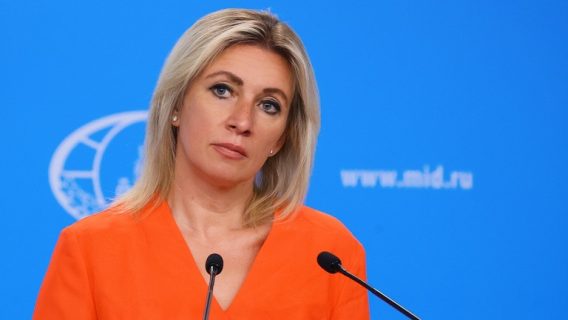
Russia blames Israel for the latest three-day military offensive against the Palestinians in the Gaza Strip, the Foreign Ministry in Moscow has announced.
“The new escalation was caused by the Israeli army firing into the Gaza Strip on 5 August,” said ministry spokesperson Maria Zakharova. She pointed out that the Palestinian factions responded to this escalation by firing rockets indiscriminately towards Israeli territory.
“We are observing with profound worry how events are evolving,” added Zakharova. “The resumption of a full-scale military confrontation [would see the] already deplorable humanitarian situation in Gaza deteriorate further.”
The ministry official reaffirmed Russia’s “principled and consistent position, reflected in the relevant resolutions of the UN General Assembly and the Security Council, in support of a comprehensive and long-term settlement of the Palestinian-Israeli conflict in accordance with the two-state principle.
“It is possible to put an end to cyclical violence only within the framework of the negotiation process, the result of which should be the realisation of the legitimate national rights of the Palestinian people to establish an independent state within the 1967 borders.”
Zakharova’s statements come at a time when relations between Israel and Russia are tense.
Meanwhile, the Ukrainian Ambassador to Israel, Yevgeny Kornichuk, declared his solidarity with the occupation state: “As a Ukrainian whose country is under brutal attack by its neighbour, I feel great sympathy for the Israeli public. An attack against children and women is an abominable thing. Terror and a malicious attack against civilians are the daily reality of Israelis and Ukrainians and this appalling threat must be stopped immediately.”
Kornichuk made his comments before the Egyptian-brokered ceasefire between Gaza and Israel came into effect.
Although the occupation state declared that it was targeting the Palestinian Islamic Jihad movement, the Palestinian Ministry of Health has confirmed that 44 citizens were killed as a result of the Israeli offensive, including 15 children and four women. Another 360 Palestinian civilians were wounded. Moreover, many homes and residential buildings were destroyed.
August 9, 2022
Posted by aletho |
Ethnic Cleansing, Racism, Zionism, Illegal Occupation, War Crimes | Human rights, Israel, Palestine, Russia, Ukraine, Zionism |
Leave a comment
Samizdat | August 8, 2022
The White House on Monday called on Russia to “return full control” of the Zaporozhye nuclear power plant near Energodar to the Kiev authorities. Meanwhile, the Russian Defense Ministry accused Ukrainian forces of “nuclear terrorism” for bombarding the Russian-held facility twice since Friday.
“Fighting near a nuclear plant is dangerous,” White House press secretary Karine Jean-Pierre told reporters aboard Air Force One on Monday, flying with President Joe Biden to Kentucky to tour areas damaged by flooding.
“We continue to call on Russia to cease all military operations at or near Ukrainian nuclear facilities and return full control to Ukraine,” Jean-Pierre added. “We are also aware of the reports of mistreatment of the staff and we applaud the Ukrainian authorities and operators for their commitment to nuclear safety and security under trying circumstances.”
On Monday, the government in Kiev called for a demilitarized zone to be established around Europe’s largest power plant. The Zaporozhye facility has been in Russian hands since February, with its Ukrainian staff continuing to operate and supply Ukraine with electricity.
Russia has accused Ukraine of “nuclear terrorism” over the repeated attacks on the facility. Ukraine’s 44th Artillery Brigade fired at the plant on Sunday from the village of Marganets, on the opposite side of the large Kakhovka water reservoir, General Igor Konashenkov said in a briefing on Monday. It was the second time Ukrainian shelling has caused a fire and a partial power outage at the plant since Friday, he added. Ukrainian troops targeted the Zaporozhye plant with several suicide drones in late July.
Kiev has claimed that Russian troops were using the facility as a staging area – but also that the Russians were shelling themselves. Moscow has rejected both of those accusations. The Kremlin has called on “countries which have an absolute influence on the Ukrainian leadership” to command Kiev to end the shelling.
UN Secretary-General Antonio Guterres has condemned the “suicidal” attacks on the plant, expressing hope that international inspectors will be able to access the facility soon.
August 9, 2022
Posted by aletho |
Militarism, Nuclear Power, Timeless or most popular | Ukraine, United States |
Leave a comment
Samizdat | August 8, 2022
The US Department of Defense has announced its largest military aid package for Kiev since the Russia-Ukraine conflict began in February, planning an additional $1 billion in weapons shipments to the former Soviet republic.
The latest batch of weaponry was approved under President Joe Biden’s so-called “drawdown authority,” the 18th such package for Ukraine, the Pentagon said on Monday. It will include more ammunition for the High Mobility Artillery Rocket System (HIMARS) launchers that the US previously sent to Ukraine, as well as 1,000 Javelin anti-tank missiles, C-4 explosives, Claymore anti-personnel mines, and tens of thousands of artillery and anti-aircraft rounds.
The Pentagon also plans to provide 50 armored medical treatment vehicles, plus more pallets of medical supplies and equipment. Biden has now approved about $9.8 billion in military aid to Kiev since he took office in January 2021, including $9 billion since Russian tanks rolled across Ukraine’s borders. Congress approved $40 billion in overall new aid to Ukraine in May after previously providing $13.6 billion.
“To meet Ukraine’s evolving battlefield requirements, the United States will continue to work with its allies and partners to provide Ukraine with key capabilities calibrated to make a difference,” the Pentagon said. The latest aid package includes the types of weaponry “the Ukrainian people are using so effectively to defend their country.”
Ukrainian officials have touted the effectiveness of the US-made HIMARS system, calling it a “game-changer” on the battlefield. However, the Russian Defense Ministry has claimed to have destroyed six of the 16 HIMARS launchers that the US has sent to Ukraine, as well as ammunition stockpiles.
Only about 30% of the weapons sent to Ukraine by the US and its allies have actually made it to the front lines, according to a CBS News investigative report that was released on Thursday. Getting weapons to the troops involves navigating a complex network of “power lords, oligarchs [and] political players,” the outlet cited Lithuanian aid group founder Jonas Ohman as saying. However, facing pressure from the Ukrainian government and its supporters, CBS censored itself on Sunday, deciding to cancel a documentary that it had planned to broadcast on the issue and revising the text version of its report.
August 8, 2022
Posted by aletho |
Corruption, Militarism | Ukraine, United States |
Leave a comment
Samizdat | August 8, 2022
Ukrainian forces have “had the American military at their side” from the start of the conflict with Russia, the magazine Causeur cited a “well-placed analyst” in French intelligence as saying. Pentagon-hired contractors are allegedly “everywhere on the battlefield.”
The claim was published by the right-leaning outlet last week in an analysis of the five-month-long Russia-Ukraine conflict, which, it stated, “is not the fight of David against Goliath,” contrary to what many people believe.
“In Ukraine, the Pentagon for the first time subcontracted large-scale warfare,” the magazine cited its source as saying. These “mercenaries” come in addition to the “gigantic” military aid provided to Kiev by Washington, and are not necessarily frontline fighters, according to Causeur.
As an example of ‘subcontracted’ warfare, it cited the widely-publicized supply of SpaceX satellite internet access for Ukrainian military officials. CEO Elon Musk initially framed this as an act of charitable support, but media reports later revealed that it was paid for with US taxpayer money.
The US decided not to involve its troops in Ukraine, claiming it did not want a direct confrontation with Russia. However, the French magazine said Washington is apparently ignoring the threat of escalation as it pours weapons and private manpower into Ukraine for the sake of “bleeding” Russia, which, the US government hopes, will result in a strategic defeat for Moscow.
The magazine also said that Russia appears to be slowly gaining the upper hand over Ukraine as its superior firepower is prevailing over Kiev’s eight-year preparations for a fight for Donbass. The heavy damage caused by Russian artillery and aerial forces have led to dissertations and insubordination among the Ukrainian troops, it said. If the Russian forces progress beyond the heavily urbanized Donbass with its unfavorable terrain, the balance of power could quickly shift in Moscow’s favor, the report said.
Russia sent troops into Ukraine on February 24, citing Kiev’s failure to implement the Minsk agreements, designed to give the regions of Donetsk and Lugansk special status within the Ukrainian state. The protocols, brokered by Germany and France, were first signed in 2014. Former Ukrainian President Pyotr Poroshenko has since admitted that Kiev’s main goal was to use the ceasefire to buy time and “create powerful armed forces.”
In February 2022, the Kremlin recognized the Donbass republics as independent states and demanded that Ukraine officially declare itself a neutral country that will never join any Western military bloc. Kiev insists the Russian offensive was completely unprovoked.
August 8, 2022
Posted by aletho |
Militarism | Ukraine, United States |
Leave a comment
The cultural and historical elements that determine the relations between Russia and Ukraine are important. The two countries have a long, rich, diverse, and eventful history together.
This would be essential if the crisis we are experiencing today were rooted in history. However, it is a product of the present. The war we see today does not come from our great-grandparents, our grandparents or even our parents. It comes from us. We created this crisis. We created every piece and every mechanism. We have only exploited existing dynamics and exploited Ukraine to satisfy an old dream: to try to bring down Russia. Chrystia Freeland’s, Antony Blinken’s, Victoria Nuland’s and Olaf Scholz’s grandfathers had that dream; we realized it.
The way we understand crises determines the way we solve them. Cheating with the facts leads to disaster. This is what is happening in Ukraine. In this case the number of issues is so enormous that we will not be able to discuss them here. Let me just focus on some of them.
Did James Baker make Promises to Limit Eastward Expansion of NATO to Mikhail Gorbachev in 1990?
In 2021, NATO Secretary General Jens Stoltenberg stated that “there was never a promise that NATO would not expand eastward after the fall of the Berlin Wall.” This claim remains widespread among self-proclaimed experts on Russia, who explain that there were no promises because there was no treaty or written agreement. This argument is a bit simplistic and false.
It is true that there are no treaties or decisions of the North Atlantic Council (NAC) that embody such promises. But this does not mean that they have not been formulated, nor that they were formulated out of casualness!
Today we have the feeling that having “lost the Cold War,” the USSR had no say in the European security developments. This is not true. As a winner of the Second World War, the USSR had a de jure a veto right over German reunification. In other words, Western countries had to obtain its agreement, in exchange for which Gorbachev demanded a commitment to the non-expansion of NATO. It should not be forgotten that in 1990 the USSR still existed, and there was no yet question to dismantle it, as the referendum of March 1991 would show. The Soviet Union was therefore not in a weak position and could prevent the reunification.
This was confirmed by Hans-Dietrich Genscher, the German Foreign Minister, in Tutzing (Bavaria) on 31 January 1990, as reported in a cable from the U.S. embassy in Bonn:
Genscher warned, however, that any attempt to expand [NATO’s] military reach into the territory of the German Democratic Republic (GDR) would block German reunification.
German reunification had two major consequences for the USSR: the withdrawal of the Group of Soviet Forces in Germany (GSFG), the most powerful and modern contingent outside its territory, and the disappearance of a significant part of its protective “glacis.” In other words, any move would be at the expense of its security. This is why Genscher stated:
… The changes in Eastern Europe and the process of German unification should not “undermine Soviet security interests.” Therefore, NATO should exclude an “expansion of its territory to the East, i.e. to get closer to the Soviet borders.”
At this stage, the Warsaw Pact was still in force and the NATO doctrine was unchanged. Therefore Mikhail Gorbachev expressed very soon his legitimate concerns for USSR national security. This is what prompted James Baker, the American Secretary of State, to immediately begin discussions with him. On 9 February 1990, in order to appease Gorbachev’s concerns, Baker declared:
Not only for the Soviet Union but also for other European countries, it is important to have guarantees that if the United States maintains its presence in Germany within the framework of NATO, not one inch of NATO’s current military jurisdiction will spread eastward.
Promises were thus made simply because the West had no alternative, to obtain the USSR’s approval; and without promises Germany would not have been reunified. Gorbachev accepted German reunification only because he had received assurances from President George H.W. Bush and James Baker, Chancellor Helmut Kohl and his Foreign Minister Hans-Dietrich Genscher, British Prime Minister Margaret Thatcher, her successor John Major and their Foreign Minister Douglas Hurd, President François Mitterrand, but also from CIA Director Robert Gates and Manfred Wörner, then Secretary General of NATO.
Thus, on 17 May 1990, in a speech in Brussels, Manfred Wörner, NATO Secretary-Geenral, declared:
The fact that we are prepared not to deploy a NATO army beyond German territory gives the Soviet Union a solid guarantee of security.
In February 2022, in the German magazine Der Spiegel, Joshua Shifrinson, an American political analyst, revealed a declassified SECRET document of March 6, 1991, written after a meeting of the political directors of the foreign ministries of the United States, Great Britain, France and Germany. It reports the words of the German representative, Jürgen Chrobog:
We made it clear in the 2+4 negotiations that we would not extend NATO beyond the Elbe. Therefore, we cannot offer NATO membership to Poland and the others.
The representatives of the other countries also accepted the idea of not offering NATO membership to the other Eastern European countries. So, written record or not, there was a “deal,” simply because a “deal” was inevitable. Now, in international law, a “promise” is a valid unilateral act that must be respected (“promissio est servanda“). Those who deny this today are simply individuals who do not know the value of a given word.
Did Vladimir Putin disregard the Budapest Memorandum (1994)
In February 2022, at the Munich Security Forum, Volodymyr Zelensky referred to the 1994 Budapest Memorandum and threatened to become a nuclear power again. However, it is unlikely that Ukraine will become a nuclear power again, nor will the nuclear powers allow it to do so. Zelensky and Putin know this. In Fact, Zelensky is not using this memorandum to get nuclear weapons, but to get Crimea back, since the Ukrainians see Russia’s annexation of Crimea as a violation of this treaty. Basically, Zelensky is trying to hold Western countries hostage. To understand that we must go back to events and facts that are opportunistically “forgotten” by our historians.
On 20 January 1991, before the independence of Ukraine, the Crimeans were invited to choose by referendum between two options: to remain with Kiev or to return to the pre-1954 situation and be administered by Moscow. The question asked on the ballot was:
Are you in favor of the restoration of the Autonomous Soviet Socialist Republic of Crimea as a subject of the Soviet Union and a member of the Union Treaty?
This was the first referendum on autonomy in the USSR, and 93.6% of Crimeans agreed to be attached to Moscow. The Autonomous Soviet Socialist Republic of Crimea (ASSR Crimea), abolished in 1945, was thus re-established on 12 February 1991 by the Supreme Soviet of the Ukrainian SSR. On 17 March, Moscow organized a referendum for the maintenance of the Soviet Union, which would be accepted by Ukraine, thus indirectly validating the decision of the Crimeans. At this stage, Crimea was under the control of Moscow and not Kiev, while Ukraine was not yet independent. As Ukraine organized its own referendum for independence, the participation of the Crimeans remained weak, because they did not feel concerned anymore.
Ukraine became independent six months after Crimea, and after the latter had proclaimed its sovereignty on September 4. On February 26, 1992, the Crimean parliament proclaimed the “Republic of Crimea” with the agreement of the Ukrainian government, which granted it the status of a self-governing republic. On 5 May 1992, Crimea declared its independence and adopted a Constitution. The city of Sevastopol, managed directly by Moscow in the communist system, had a similar situation, having been integrated by Ukraine in 1991, outside of all legality. The following years were marked by a tug of war between Simferopol and Kiev, which wanted to keep Crimea under its control.
In 1994, by signing the Budapest Memorandum, Ukraine surrendered the nuclear weapons of the former USSR that remained on its territory, in exchange for “its security, independence and territorial integrity.” At this stage, Crimea considered that it was—de jure—no longer part of Ukraine and therefore not concerned by this treaty. On its side, the government in Kiev felt strengthened by the memorandum. This is why, on 17 March 1995, it forcibly abolished the Crimean Constitution. It sent its special forces to overthrow Yuri Mechkov, President of Crimea, and de facto annexed the Republic of Crimea, thus triggering popular demonstrations for the attachment of Crimea to Russia. An event hardly reported by the Western media.
Crimea was then governed in an authoritarian manner by presidential decrees from Kiev. This situation led the Crimean Parliament to formulate a new constitution in October 1995, which re-established the Autonomous Republic of Crimea. This new constitution was ratified by the Crimean Parliament on 21 October 1998 and confirmed by the Ukrainian Parliament on 23 December 1998. These events and the concerns of the Russian-speaking minority led to a Treaty of Friendship between Ukraine and Russia on 31 May 1997. In the treaty, Ukraine included the principle of the inviolability of borders, in exchange—and this is very important—for a guarantee of “the protection of the ethnic, cultural, linguistic and religious originality of the national minorities on their territory.”
On 23 February 2014, not only did the new authorities in Kiev emerge from a coup d’état that had definitely no constitutional basis and were not elected; but, by abrogating the 2012 Kivalov-Kolesnichenko law on official languages, they no longer respected this guarantee of the 1997 treaty. The Crimeans therefore took to the streets to demand the “return” to Russia that they had obtained 30 years earlier.
On March 4, during his press conference on the situation in Ukraine a journalist asked Vladimir Putin, “How do you see the future of Crimea? Do you consider the possibility that it joins Russia?” he replied:
No, we do not consider it. In general, I believe that only the residents of a given country who are free to decide and safe can and should determine their future. If this right has been granted to the Albanians in Kosovo, if this has been made possible in many parts of the world, then no one is excluding the right of nations to self-determination, which, as far as I know, is laid down in several UN documents. However, we will in no way provoke such a decision and will not feed such feelings.
On March 6, the Crimean Parliament decided to hold a popular referendum to choose between remaining in Ukraine or requesting the attachment to Moscow. It was after this vote that the Crimean authorities asked Moscow for an attachment to Russia.
With this referendum, Crimea had only recovered the status it had legally acquired just before the independence of Ukraine. This explains why it renewed its request to be attached to Moscow, as in January 1991.
Moreover, the status of force agreement (SOFA) between Ukraine and Russia for the stationing of troops in Crimea and Sevastopol had been renewed in 2010 and to run until 2042. Russia therefore had no specific reason to claim this territory. The population of Crimea, which legitimately felt betrayed by the government of Kiev, seized the opportunity to assert its rights.
On 19 February 2022, Anka Feldhusen, the German ambassador in Kiev, threw a spanner in the works by declaring on the television channel Ukraine 24 that the Budapest Memorandum was not legally binding. Incidentally, this is also the American position, as shown by the statement on the website of the American embassy in Minsk.
The whole Western narrative about the “annexation” of Crimea is based on a rewriting of history and the obscuring of the 1991 referendum, which did exist and was perfectly valid. The 1994 Budapest Memorandum remains extensively quoted since February 2022, but the Western narrative simply ignores the 1997 Friendship Treaty which is the reason for the discontent of the Russian-speaking Ukrainian citizens.
Is the Ukrainian Government Legitimate?
The Russians still see the regime change that occurred in 2014 as illegitimate, as it was not done through constitutional process and without any support from a large part of the Ukrainian population.
The Maidan revolution can be broken down into several sequences, with different actors. Today, those who are driven by hatred of Russia are trying to merge these different sequences into one single “democratic impulse”: A way to validate the crimes committed by Ukraine and its neo-Nazis zealots.
At first, the population of Kiev, disappointed by the government’s decision to postpone the signing of the treaty with the EU, gathered in the streets. Regime change was not in the air. This was a simple expression of discontent.
Contrary to what the West claims, Ukraine was then deeply divided on the issue of rapprochement with Europe. A survey conducted in November 2013 by the Kyiv International Institute of Sociology (KIIS) shows that it was split almost exactly “50/50” between those who favored an agreement with the European Union and those favoring a customs union with Russia. In the south and east of Ukraine, industry was strongly linked to Russia, and workers feared that an agreement excluding Russia would kill their jobs. That is what would eventually happen. In fact, at this stage, the aim was already to try to isolate Russia.
In the Washington Post, Henry Kissinger, Ronald Reagan’s National Security Advisor, noted that the European Union “helped turn a negotiation into a crisis.”
What happened later involved ultranationalist and neo-Nazis groups coming from the Western part of the country. Violence erupted and the government withdrew, after signing an agreement with the rioters for new elections. But this was quickly forgotten.
It was nothing less than a coup d’état, led by the United States with the support of the European Union, and carried out without any legal basis, against a government whose election had been qualified by the OSCE as “transparent and honest” and having “offered an impressive demonstration of democracy.” In December 2014, George Friedman, president of the American geopolitical intelligence platform STRATFOR, said in an interview:
Russia defines the event that took place at the beginning of this year [in February 2014] as a coup organized by the US. And as a matter of fact, it was the most blatant [coup] in history.
Unlike European observers, the Atlantic Council, despite being strongly in favor of NATO, was quick to note that the Maidan revolution had been hijacked by certain oligarchs and ultra-nationalists. It noted that the reforms promised by Ukraine had not been carried out and that the Western media stuck to an acritical “black and white” narrative.
A telephone conversation between Victoria Nuland, then Assistant Secretary of State for Europe and Eurasia, and Geoffrey Pyatt, the U.S. ambassador to Kiev, revealed by the BBC, shows that the Americans themselves selected the members of the future Ukrainian government, in defiance of the Ukrainians and the Europeans. This conversation, which became famous thanks to Nuland’s famous “F*** the EU!”
The coup d’état was not unanimously supported by the Ukrainian people, either in substance or in form. It was the work of a minority of ultra-nationalists from western Ukraine (Galicia), who did not represent the whole Ukrainian people. Their first legislative act, on 23 February 2014, was to abrogate the 2012 Kivalov-Kolesnichenko law, which established the Russian language as an official language along with Ukrainian. This is what prompted the Russian-speaking population to start massive protests in the southern part of the country, against authorities they had not elected.
In July 2019, the International Crisis Group (funded by several European countries and the Open Society Foundation), noted:
The conflict in eastern Ukraine began as a popular movement. […]
The protests were organized by local citizens claiming to represent the Russian-speaking majority in the region. They were concerned both about the political and economic consequences of the new government in Kiev and about that government’s later abandoned measures to prevent the official use of the Russian language throughout the country [“Rebels without a Cause: Russia’s Proxies in Eastern Ukraine,” International Crisis Group, Europe Report N° 254, 16 juillet 2019, p. 2].
Western efforts to legitimate this far-right coup in Kiev led to hide the opposition in the southern part of the country. In order to present this revolution as democratic, the real “hand of the West” was cleverly masked by the imaginary “hand of Russia.” This is how the myth of a Russian military intervention was created. Allegations about a Russian military presence were definitely false, an event the chief of the Ukrainian Security service (SBU) confessed in 2015 that there were no Russian units in Donbass.
To make things worse, Ukraine didn’t gain legitimacy through the way it handled the rebellion. In 2014-2015, poorly advised by NATO military, Ukraine waged a war that could only lead to its defeat: it considered the populations of Donbass and Crimea as enemy foreign forces and made no attempt to win the “hearts and minds” of the autonomists. Instead, its strategy has been to punish the people even further. Bank services were stopped, economic relations with the autonomous regions were simply cut, and Crimea didn’t receive drinking water anymore.
This is why there are so many civilian victims in the Donbass, and why the Russian population still stands in majority behind its government today. The 14,000 victims of the conflict tend to be attributed to the “Russian invaders” and the so-called “separatists.” However, according to the United Nations—more than 80% of civilian casualties are the result of Ukrainian shelling. As we can see, the Ukrainian government is massacring its own people with the help, funding and advice of the military of NATO, the countries of the European Union, which defends its values.
In May 2014, the violent repression of protests prompted the population of some areas of the Donetsk and Lugansk regions of Ukraine to hold referendums for Self-Determination in the Donetsk People’s Republic (approved by 89%) and in the Lugansk People’s Republic (approved by 96%). Although Western media keeps calling them referendums of “independence,” they are referendums of “self-determination” or “autonomy” (самостоятельность). Until February 2022, our media consistently talked about “separatists” and “separatist republics.” In reality, as stated in the Minsk Agreement, these self-proclaimed republics didn’t seek “independence,” but an “autonomy” within Ukraine, with the ability to use their own language and their own customs.
Is NATO a Defensive Alliance?
NATO’s rationale is to bring European Allies under the US nuclear umbrella. It was designed as a defensive alliance, although recently declassified US documents show that the Soviets had apparently no intention to attack the West.
For the Russians, the question about whether NATO is offensive or defensive is beside the point. To understand Putin’s point of view, we have to consider two things that are usually overlooked by Western commentators: the enlargement of NATO towards the East, and the incremental abandonment of international security’s normative framework by the US.
In fact, as long as the US didn’t deploy missiles in the vicinity of its borders, Russia didn’t bother so much about NATO extension. Russia itself considered to apply for membership. But problems started to appear in 2001, as George W. Bush decided to unilaterally withdraw from the ABM Treaty and to deploy anti-ballistic missiles (ABM) in Eastern Europe. The ABM Treaty was intended to limit the use of defensive missiles, with the rationale of maintaining the deterrent effect of a mutual destruction by allowing the protection of decision-making bodies by a ballistic shield (in order to preserve a negotiating capacity). Thus, it limited the deployment of anti-ballistic missiles to certain specific zones (notably around Washington DC and Moscow) and prohibited it outside national territories.
Since then, the United States has progressively withdrawn from all the arms control agreements established during the Cold War: the ABM Treaty (2002), the Open Skies Treaty (2018) and the Intermediate-range Nuclear Forces (INF) Treaty (2019).
In 2019, Donald Trump justified his withdrawal from the INF Treaty by alleged violations by the Russian side. But, as the Stockholm International Peace Research Institute (SIPRI) notes, the Americans never provided proof of these violations. In fact, the US was simply trying to get out of the agreement in order to install their AEGIS missile systems in Poland and Romania. According to the US administration, these systems are officially intended to intercept Iranian ballistic missiles. But there are two problems that clearly cast doubt on the good faith of the Americans:
- The first one is that there is no indication that the Iranians are developing such missiles, as Michael Ellemann of Lockheed-Martin stated before a committee of the American Senate.
- The second one is that these systems use Mk41 launchers, which can be used to launch either anti-ballistic missiles or nuclear missiles. The Radzikowo site, in Poland, is 800 km from the Russian border and 1,300 km from Moscow.
The Bush and Trump administrations said that the systems deployed in Europe were purely defensive. However, even if theoretically true, it is technically and strategically false. For the doubt, which allowed them to be installed, is the same doubt that the Russians could legitimately have in the event of a conflict. This presence in the immediate vicinity of Russia’s national territory can indeed lead to a nuclear conflict. For in the event of a conflict, it would not be possible to know precisely the nature of the missiles loaded in the systems—should the Russians therefore wait for explosions before reacting? In fact, we know the answer: having no early-warning time, the Russians would have practically no time to determine the nature of a fired missile and would thus be forced to respond pre-emptively with a nuclear strike.
Not only does Vladimir Putin see this as a risk to Russia’s security, but he also notes that the United States is increasingly disregarding international law in order to pursue a unilateral policy. This is why Vladimir Putin says that European countries could be dragged into a nuclear conflict without wanting to. This was the substance of his speech in Munich in 2007, and he came with the same argument early 2022, as Emmanuel Macron went to Moscow in February.
Finland and Sweden in NATO—A Good Idea?
The future will tell if Sweden’s and Finland’s decision to apply for NATO membership was a wise idea. They probably overstated the value of the nuclear protection offered by NATO. As a matter of fact, it is very unlikely that the US will sacrifice its national soil by striking Russian soil for the sake of Sweden or Finland. It is more likely that if the US engages nuclear weapons, it will be primarily on European soil and only as a last resort on Russian territory, in order to preserve its own territory from nuclear counter-strike.
Further, these two countries, which met the criteria of neutrality that Russia would want for its direct neighbors, deliberately put themselves in Russia’s nuclear crosshairs. For Russia, the main threat comes from the Central European theater of war. In other words, in the event of a hypothetical conflict in Europe, Russian forces would be engaged primarily in Central Europe, and could use their theater nuclear armies to “flank” their operations by striking the Nordic countries, with virtually no risk of a U.S. nuclear response.
Was it Impossible to Leave the Warsaw Pact?
The Warsaw Pact was created just after Germany joined NATO, for exactly the same reasons we have described above. Its largest military engagement was the invasion of Czechoslovakia in August 1968 (with the participation of all Pact nations, except Albania and Romania). This event resulted in Albania withdrawing from the Pact less than a month later, and Romania ceasing to participate actively in the military command of the Warsaw Pact after 1969. Therefore, asserting that no one was free to leave the treaty is not correct.
Jacques Baud is a widely respected geopolitical expert whose publications include many articles and books, including Poutine: Maître du jeu? Gouverner avec les fake news, and L’Affaire Navalny.
© 2017-2022 The Postil
August 8, 2022
Posted by aletho |
Civil Liberties, Timeless or most popular | Crimea, Human rights, NATO, Russia, Ukraine |
Leave a comment
By Ilya Tsukanov | Samizdat | August 8, 2022
CBS News has curiously deleted a bombshell documentary which uncovered that just “30%” of the military assistance sent to Ukraine by Western countries during the first months of the conflict with Russia actually reached the front lines.
Upon clicking on the link to the documentary, called “Arming Ukraine,” users are greeted with a “The page cannot be found” error.
CBS News announced Monday that it had “removed a tweet promoting” the doc, assuring that since it was filmed, control over deliveries had improved. “Additionally, the US military has confirmed that defense attache Brigadier General Garrick M. Harmon arrived in Kiev in August for arms control and monitoring. We are updating our documentary to reflect this new information and air at a later date,” the network explained.
Ukraine Foreign Minister Dmitry Kuleba nevertheless declared that the US network had “misled a huge audience by sharing unsubstantiated claims and damaging trust in supplies of vital military aid to a nation resisting aggression and genocide.”
“There should be an internal investigation into who enabled this and why.”
In the documentary, Jonas Ohman, CEO of Blue-Yellow, a Lithuania-based group involved in the delivery of military equipment to Ukraine, told CBS News correspondent Adam Yamaguchi that just one third of the tens of billions of dollars’ worth of support sent to Ukraine by the US and its NATO allies was reaching the Ukrainian military.
“You know all this stuff goes to the border, and then kind of like something happens and kind of like, 30 percent maybe reaches its final destinations,” Ohman told CBS News in a preview of the documentary.
Ohman offered hints about what happens to the rest of the equipment, saying that “there are like power lords, oligarchs, political players” operating in the country. “The system itself, it’s like, ‘we are the armed forces of Ukraine. If security forces want it, well, the Americans gave it to us.’ It’s kind of like power games all day long, so eventually people need the stuff, and they go to us.”
The CEO also offered a novel explanation for why the West needs to ensure that Ukraine “wins” in the conflict with Russia. “If we lose the war, if we have this kind of gray zone, semi-failed state scenario or something like that. If you do this – you funnel lots of lethal resources into a place and you lose – then you will have to face the consequences,” he said.
Blue-Yellow has been funneling everything from body armor to night vision equipment and light drones into Ukraine since 2014, when the country was thrust into a civil war sparked by a US- and EU-backed coup in Kiev. The coup led to civil unrest in eastern Ukraine after the new authorities announced a crackdown on the Russian language and began pulling the country into EU and NATO orbit, ultimately culminating in the February 22, 2022 Russian recognition of the Donetsk and Lugansk People’s Republics as independent states and the launching of a special operation to “demilitarize” Ukraine two days later.
The United States has committed over $23 billion in military assistance to Ukraine since February, on top of billions delivered to the country between 2014 and 2021. The UK, Germany, Poland, and other NATO members have committed over $7 billion more.
Andy Milburn, a retired US Marine colonel and founder of the Mozart Group, a US private military company engaged in the training of Ukrainian troops, suggested the problem with supplies not reaching the front was organizational, and that the West should be more involved in putting “people in place” on the ground to “supervise the country” to prevent pilfering.
“If you provide supplies, or a logistics pipeline, there has got to be some organization to it, right? If the ability to which you’re willing to be involved in that stops at the Ukrainian border, the surprise isn’t that, oh, all this stuff isn’t getting to where it needs to go – the surprise is that people actually expected it to,” he said.
Last week, Sputnik Arabic got an inside look into the nitty-gritty details of the arms smuggling operations taking place in Ukraine, contacting a Ukrainian weapons merchant on the dark web who expressed readiness to sell US-made M4S assault rifles, ammunition, and frag grenades hidden in barrels of motor oil to a Sputnik correspondent posing as a Yemeni arms buyer. The weapons dealer referred to middlemen “allies” in Poland and Portugal ready to assist in the shipment.
Russia has spent months warning the US and its allies about the dangers posed by the shipment of weapons to Ukraine and the threat that they could wind up on the international arms black market thanks to the corruption and instability which have wracked the country.
Washington and Brussels have ignored these warnings, with Kiev assuring them that the arms would not be transferred to third parties or countries. Last month, the European Union Agency for Law Enforcement Cooperation (Europol) announced that it was “working closely” with Kiev to prevent weapons smuggling after discovering that there was evidence of firearms and military equipment from Ukraine appearing in EU countries.
August 8, 2022
Posted by aletho |
Full Spectrum Dominance, Mainstream Media, Warmongering | CBS, Ukraine, United States |
Leave a comment

 Aletho News
