Most Ukraine aid is a ‘scam’ – US lawmaker

Samizdat | August 7, 2022
Republican lawmakers are feeling vindicated for opposing a $40 billion Ukraine aid package after a CBS News report showed that only 30% of the Western weapons flooding into the country are actually making it to the front lines in Kiev’s conflict with Russia.
“This [is] one of the reasons I voted ‘no,’” US Representative Marjorie Taylor Greene (R-Georgia) said on Twitter in a retweet of the CBS News post. Greene was among 57 House Republicans who voted against the massive aid bill, which passed overwhelmingly in May with the support of all Democrats and most GOP lawmakers. Eleven Republicans opposed the bill in the Senate, where it passed by an 86-11 margin.
The CBS story noted that with nearly $60 billion in US and Western European aid approved for Ukraine since Russia’s military offensive began in February, most of the weaponry has failed to get through to Ukrainian fighters. Getting weapons to the troops involves navigating a complex network of “power lords, oligarchs [and] political players,” the outlet cited Lithuanian aid group founder Jonas Ohman as saying. Amnesty International senior crisis adviser Donatella Rovera told CBS that “there is really no information” on where the weapons are going.
Representative Lauren Boebert (R-Colorado) said such scrutiny had been dismissed prior to the CBS report. “How many people were called Russian bots for saying this exact same thing since March? Now, when CBS says it, it’s perfectly fine. Whatever the case, glad the facts are out now. The majority of the Ukraine aid is a scam.”
US Senator Rand Paul (R-Kentucky) delayed the Senate’s vote on the Ukraine aid bill by insisting on adding a provision appointing an inspector general to monitor how the money was being spent. His colleagues refused to include the oversight requirement and passed the massive package a few days later. A US intelligence official told CNN in April that arms shipments were dropping “into a big black hole” once they reached Ukraine.
Greene, Boebert and other lawmakers who voted against the aid bill were pilloried by critics for failing to support Ukraine. After Greene argued that the US government was focused on sending billions of dollars in aid to Ukraine at a time when American mothers couldn’t even buy formula for their babies, Democrats accused her of standing “with President Putin in the face of Russian aggression.” Representative Jamie Raskin (D-Maryland) said she was “repeating Putin’s propaganda and disinformation” and “appeasing imperialist assaults on sovereign nations.”
The Georgia lawmaker also tussled with a fellow Republican after Representative Dan Crenshaw (R-Texas) defended the Ukraine aid package by saying “investing in the destruction of our adversary’s military, without losing a single American troop, strikes me as a good idea.” Greene replied, “So you think we are funding a proxy war with Russia? You speak as if Ukrainian lives should be thrown away, as if they have no value. Just used and thrown away.”
Russia offers monthly donation of 40,000 tons of wheat for Lebanon
Lebanon has been dealing with bread shortages over recent months, in the latest dilemma to hit the crisis-hit nation
The Cradle | August 6, 2022
The Russian Ambassador to Lebanon, Alexander Rudakov, has reportedly obtained initial approval from Moscow to provide Lebanon with a donation of 40,000 tons of wheat per month until the end of the year.
This deal could be extended past December to help the Levantine nation overcome a worsening food crisis, according to information obtained by Al-Akhbar.
Russia’s offer comes just days after Beirut cleared the Syrian-owned Laodicea vessel to depart the port of Tripoli, despite protests from the Ukrainian embassy, which claimed the ship was carrying “stolen grain.”
However, customs officials revealed to The Cradle that the ship’s grain cargo originated in Russia.
Lebanon’s top prosecutor allowed the ship to leave after revealing Kiev failed to present evidence to back their claim of theft against Russia and Syria.
Before the ship’s release, the Ukrainian embassy offered to retract their claim if Beirut paid them for the Russian grain.
Since 2019, Lebanon has been faced with the dire consequences of a severe economic meltdown.
The situation has pushed over 80 percent of the population below the poverty line and all but wiped out the value of the local currency.
Lebanon used to import as much as 80 percent of its wheat from Ukraine, but since the start of the Russian war, it now faces a major food crisis.
Another factor that limits Lebanon’s wheat supply is the destruction of the country’s grain silos during the Beirut Port blast of 2020 — considered to be the largest non-nuclear explosion in history.
As all of this unfolds inside the country, Lebanon is facing a serious threat of war from Israel; the two nations are mired in a dispute for control of an offshore gas field that could provide billions in revenue.
The West is silent as Ukraine targets civilians in Donetsk using banned ‘butterfly’ mines
The use of PFM-1 explosives against civilians is prohibited by the Geneva Conventions – but this evidently isn’t stopping Ukraine
By Eva Batlett | Samizdat | August 7, 2022
On Saturday night, just after 9 pm, thunderous explosions rocked central Donetsk. Shortly after, there were announcements that air defense had shot down Ukrainian-fired missiles containing “Butterfly” (or “Petal”) mines. Given that over 300 of these explosives. are packed into each of the Ukrainian-fired rockets, central Donetsk could literally become a minefield if they successfully landed.
Social media and Telegram warnings urged residents to stay inside, to wait for Emergency Services to clear the streets and sidewalks – which they began doing during the night. But come daylight, untold numbers of these tiny devices still remained. More warnings were issued to stay at home – better to be late for work than lose a leg. Residents that absolutely have to go out are advised to keep their eyes down to watch where they step, avoid grassy areas, and walk extremely carefully.

© Eva Batlett
While Ukraine has been using these mines on Donbass for many months, in recent days, they have intensely bombarded neighbourhoods with them. Initially targeted were the hard-hit districts of Kievskiy in the north, Kirovsky in the southwest, and Kuibyshevkiy in the west. But as of Saturday night, Ukraine hammered central Donetsk with them.
And now, walking in the city center is a nightmare, one I had to endure to document how widespread these mines are here: in central streets and walkways, near apartments, in parks.
Difficult to spot, easy to trigger
As it turns out, the ‘petals’ are not only widespread but often very difficult to spot – even if warning signs have been placed right next to them. Their small shape and dull color blends in with the surroundings and if you aren’t actively looking at the spot they’re in, you could easily miss them.
When walking, you learn to avoid any objects that could be covering a mine, and tread only on bare streets or sidewalks.
The first bunch of mines I saw were circled in chalk, a warning sign placed in front to keep cars from driving over them, and people from stepping on them. This was on a central Donetsk street, a residential area with shops and a park nearby. The entire area was littered with the ‘petals’. DPR sappers worked methodically, clearing area by area. But, given that hundreds of the mines were dropped all over the city, this is painstaking work.
Near some apartment blocks, numerous mines had been found and warning signs put out: “danger, mines,” it said by the tiny explosive circled with chalk or a tire or whatever was available to draw the eye to its presence.

Warning sign saying “Caution, mines!” placed next to some “butterfly” mines in Donetsk © Eva Batlett
But, on many occasions, looking at the area designated as containing a mine, it took me a good while to actually see it. Now imagine if there were no signs at all … a bloodbath for civilians, and animals too, since it doesn’t take significant weight to set them off.
Butterfly mine basics
Around the size of an average lighter, the ‘petals’ are tiny but still very powerful. A clip shared on Telegram illustrates this: A soldier chucks a tire at one of the mines, and the tire is flung high in the air from the blast. It doesn’t take a powerful imagination to estimate what would happen if a person stepped foot on one of them. The explosives are placed via remote delivery methods – meaning they can be spread by mortar, missile, or artillery, dropped by helicopters and planes.
According to DPR Emergency services, Ukraine is using Hurricane MLRS-fired rockets to spread the mines. Each contains 12 cluster munitions, each cluster has 26 mines inside. So each bomb has 312. The cluster explodes in the air, disseminating them widely, scattering in different directions. Their butterfly-like design enables them to glide and land without exploding, usually. Then they lie in wait for someone with bad luck to step on them.
Some of these anti-personnel mines have a self-destruct timer. Others, including the ones Ukraine is firing, have a years-long shelf life. They do pretty much no damage to military vehicles, and as such their use in Donbass is insidious – deliberately targeting civilians, to leave them maimed.
On July 30, in a densely-inhabited working-class district of western Donetsk, in a field with garden plots for nearby apartment residents, I saw the same nefarious mines. Originally scattered, they had been collected and awaited destruction by DPR Emergency Services.
In the large courtyard of an apartment complex, I watched from a safe distance as Emergency Services timer-detonated eight mines they had found around the grounds. The day prior, they destroyed 26. Another 150 were located and destroyed using a radio-controlled minesweeper. But there remains much to be done to restore the streets and courtyards to safety.
Since the mines were scattered on Saturday evening, the DPR Representative Office at the JCCC has created an interactive map showing the areas most contaminated by the mines, giving residents a general warning of which areas to avoid while walking or driving in. While some cars have been lucky enough to only have a tire blown out, were the mine to detonate near the gas tank, the entire vehicle could explode.
Multiple civilians have been killed by the mines since they were scattered over Donetsk, and, even now, wounded civilians are still coming to the city’s hospitals. According to Vadim Onoprienko, the deputy director of a trauma surgery center, ten amputations have been performed over the last week – victims of Saturday’s mines and ones that had been dropped earlier, one of whom was an 83-year-old man.
All evidence points to Ukraine
Pro-Ukrainian commentators are, unsurprisingly, blaming Russia. Journalists claiming to care about civilians are perpetuating Ukrainian propaganda saying that Moscow’s forces are scattering the mines over civilian areas, nevermind the fact that these territories are controlled by Russia’s allies. Among them is the would-be war hero Malcolm Nance, who temporarily abandoned his job as a notoriously anti-Russian MSNBC analyst to apparently actually fight the Russians in Ukraine.
This is the kind of projection I have seen ad nauseam when reporting from Syria and dealing with the Western propaganda there. Ukrainian nationalists openly admit they do not see the Donbass people as human and encourage their murder. Ukraine has been killing and maiming civilians in the Donetsk and Lugansk People’s Republic for over eight years, including firing cluster munitions into the heart of cities, targeting hospitals, markets, schools and busy streets. Given all of this, scattering butterfly mines over Donetsk is hardly surprising. It’s criminal, but not surprising.
One argument used by pro-Ukrainian commentators is that Kiev has been destroying these mines under the Anti-Personnel Mine Ban Convention, which it signed in 1999. However, out of the six million such mines Ukraine initially declared in its possession, only two million have reportedly been destroyed as of 2018.
Ukraine has good reason to believe it will not be held accountable for using them against civilians, given its Western backers’ and their allies’ penchant for using prohibited weapons on civilians without repercussions – including Agent Orange in Vietnam, depleted uranium in Iraq and Syria, and white phosphorous and dart bombs in Gaza.
The fact the Western media turns a blind eye is also a boon to Kiev.
Eva Bartlett is a Canadian independent journalist. She has spent years on the ground covering conflict zones in the Middle East, especially in Syria and Palestine (where she lived for nearly four years).
Ukrainian city launches witch hunt for ‘disloyal’ residents
Samizdat | August 7, 2022
The southern Ukrainian city of Nikolaev resorted to drastic measures this weekend to expose what the local authorities call “collaborators” and “separatists” – people who harbor pro-Russian sentiments or help Moscow’s forces in any way.
On Friday, the head of the local military administration, Vitaly Kim, placed the entire city – home to almost half a million people before the start of the Russian military operation – on a two-day lockdown. Kim announced a “prolonged curfew,” which came into force Friday evening and is expected to last until Monday.
During this time, residents of Nikolaev are prohibited from going outside or visiting any public places without special permits. In case of an emergency, a police escort is provided, Ukrainian news agency UNIAN said.
Law enforcement agencies will use this time to search for “collaborators” and “separatists,” Anna Zamazeeva, the head of the Nikolaev regional council, said. The operation is already in full swing, and the police will reveal the results no sooner than Monday, according to the official.
“All Nikolaev residents are undergoing checks now,” she told UNIAN on Saturday. Those who planned to leave the city and bought train or bus tickets in advance were allowed to leave, the official said, adding that they were checked at security outposts on their way out.
According to Zamazeeva, police are conducting door-to-door searches in apartments throughout the city. “They are searching everyone; check the ID, mobile phones, everything,” she said.
The official argued that the “collaborators” would be much safer behind bars since locals could “lynch” them if the police simply reveal their identity. “It is better for them to remain in prison until we win,” she added.
Earlier, Kim offered $100 to anyone that provides information about “spotters” – people that Ukrainian officials believe supply target coordinates to Russian artillery and aviation. Earlier, the local authorities reported they had detained at least four spotters.
On Tuesday, Russian forces reported striking a temporary base of the Ukrainian International Legion near the city of Nikolaev, using high-precision weapons. Up to 250 foreign mercenaries were killed in the attack, according to the report.
Russia sent troops into Ukraine on February 24, citing Kiev’s failure to implement the Minsk agreements, designed to give the regions of Donetsk and Lugansk special status within the Ukrainian state. The protocols, brokered by Germany and France, were first signed in 2014. Former Ukrainian President Pyotr Poroshenko has since admitted that Kiev’s main goal was to use the ceasefire to buy time and “create powerful armed forces.”
In February 2022, the Kremlin recognized the Donbass republics as independent states and demanded that Ukraine officially declare itself a neutral country that will never join any Western military bloc. Kiev insists the Russian offensive was completely unprovoked.
Ukrainian Troops Shell Zaporozhye Nuclear Power Plant Overnight: Local Authorities
Samizdat – 07.08.2022
Ukrainian troops launched an attack against the Zaporozhye nuclear power plant overnight, using an Uragan multiple rocket launcher, with shrapnel and a rocket engine falling at 400 meters (1,312 feet) from the station’s operating power unit, the military and civil administration of the city of Energodar said.
“Last night, the Ukrainian armed forces carried out a strike using a 220 millimeter Uragan rocket launcher,” the administration spokesperson said.
The missile unfolded and released shrapnel warheads as it approached the power units, the spokesperson noted.
“The area of the dry storage facility for processed nuclear fuel and the automated control post of the radiation situation appeared to be in the strike zone. Administrative buildings and the adjacent territory of the storage facility were damaged by the cluster munitions. It is important to note that the fallen shrapnel warheads and the rocket engine itself fell no more than 400 meters from the active power unit,” the spokesperson added.
Since March, the Zaporozhye nuclear power plant has been under full control of Russian forces, but Ukrainian forces have repeatedly attacked it by drones, prompting Russia to seek assistance from the International Atomic Energy Agency (IAEA) in addressing the plant’s security concerns.
Sanctions on Russia ‘irresponsible’, adviser to Brazil’s Lula says
Samizdat | August 6, 2022
Celso Amorim, Brazil’s former foreign minister and current foreign policy adviser to presidential frontrunner Luiz Inacio Lula da Silva, has condemned the West’s sanctions on Russia and said that should Lula take office, Brazil would chart a different course.
In an interview with Bloomberg published on Friday, Amorim claimed that the West’s response to Russia’s military operation in Ukraine – sanctions on Russia and billions of dollars worth of weapons for Ukraine – have made nuclear war a real possibility.
“For the first time since the Cuban missile crisis we see articles about the risk of nuclear weapons published on a weekly basis,” he said, arguing that “it’s irresponsible not to seek peace.”
Amorim’s argument mirrors that of Lula himself. Back in May the former Brazilian leader told Time magazine that he sees Ukrainian President Vladimir Zelensky as equally responsible for the conflict in Ukraine, and condemned Washington for encouraging him to oppose Russia.
“The United States has a lot of political clout. And Biden could have avoided [the conflict], not incited it,” Lula argued at the time.
From the perspective of the US, Amorim questioned the logic of driving Russia into a deeper partnership with China, another economic and military rival of America.
“I have nothing against China,” he stated, adding that both are part of the BRICS group, but said that he “can’t understand the interest of the US in strengthening the China-Russia relationship.”
This relationship aside, Amorim told Bloomberg that an economy as large as Russia’s is “too big and strategic” to isolate, and that Lula’s administration would not pursue such policies if the two-term leftist president is elected in October. Speaking to Time in May, Lula said that “many different countries” are having to “foot the bill” for Washington’s hardline anti-Russia policies, and that if he is elected, “Brazil will again become a protagonist on the international stage and we will prove that it’s possible to have a better world.”
Lula is currently polling 11 points ahead of incumbent President Jair Bolsonaro, according to an aggregate compiled by the US-based Americas Society. Should he triumph in October, Amorim will likely be influential in setting his administration’s foreign policy, having served as Brazil’s foreign minister during Lula’s two terms in office from 2003 until 2010.
Bolsonaro has not followed the US’ lead on Ukraine either. Despite Brazil voting in the UN General Assembly to condemn Russia over the conflict, the president has refused to sanction Moscow and announced his intention to keep purchasing fertilizer from Russia and sign a new deal to import Russian diesel.
Like Lula, Bolsonaro also partly blamed Kiev for the conflict. Ukrainians, he said in February, had “trusted a comedian with the fate of a nation,” referring to Zelensky.
Ukrainian strike in Donetsk kills three civilians – officials

Multiple casualties were reported after a bus was hit by a projectile
Samizdat – August 5, 2022
At least three civilians were killed in Ukrainian shelling of northwestern Donetsk, the local territorial defense force claimed on Friday. One of Kiev’s projectiles hit a regular bus carrying people home from work, the authorities said, adding that the vehicle was “destroyed.”
Photos and videos which surfaced on social media show the charred wreckage of the bus. It was apparently moving along a street in the city when it was hit by a Ukrainian projectile fired by a Grad multiple rocket launcher.
Three people died in the incident and five more received injuries, the local authorities said.
Earlier on Friday, Donetsk authorities claimed that Ukrainian forces had shelled several areas in the city, including a hospital. At least one rocket made a direct hit through the roof, images from the scene indicate. The attacks left at least one person dead and 14 others injured, officials in the Donetsk People’s Republic (DPR) said.
Kiev denies the accusations that its forces launch daily artillery attacks on civilian targets in Donetsk. It claims the shelling is done by DPR and Russian forces to discredit the Ukrainian troops.
The First Cracks in the Biden-Zelensky Relationship Appear. But Why Now?
By Martin Jay | Strategic Culture Foundation | August 4, 2022
You might have easily missed it. The reference, for the first time by the left-wing press in the US which supports Biden, that corruption exists and is a real problem in the administration of President Zelensky in Ukraine.
The article, penned by the Washington Post’s top foreign affairs correspondent and award-winning journalist Thomas L Friedman, was really about hinting that relations between the Biden camp and Zelensky’s was hardly one on firm ground. Perhaps it never was. But for the moment, this narrative is being fed into the system – via Friedman – is that relations are not quite what they are perceived to be by most western media.
The timing is interesting as I have long argued that the US is looking for a way to distance itself from Zelensky and may well be considering how to remove him (even by assassination which could be blamed on the Russians). Is the Biden camp preparing the ground for such a move with this article?
Friedman described Zelensky’s decision to fire Prosecutor General Irina Venediktova and the head of the State Security Service (SBU), Ivan Bakanov, in mid-July as “funny business going on in Kiev” adding that he hadn’t yet seen any reporting in the US media that “convincingly explains” the reasons behind the largest shakeup in the Kiev government since the beginning of the war. He then hits us with the kill shot.
“It is as if we don’t want to look too closely under the hood in Kiev for fear of what corruption or antics we might see, when we have invested so much there,” he wrote.
Is this a hint of some sort? Is Biden warning Zelensky to clean his backyard up and to keep the lid on re-selling of US arms to the black market of weapons, which often means selling to terrorist groups in Syria – or else.
Or is he saying to the rest of the media, that this is the theme which we would like you to carry on? Certainly, to start with the Washington Post and using someone like Friedman would be a deft media move to create a momentum on the given theme of graft getting out of control. But equally, it would be an erudite move to send a message to Zelensky himself. We will soon know in the coming weeks.
It’s quite possible that Biden’s camp knew about the Ukraine military selling off huge amounts of the military sent to the Ukraine and were quite happy with it, as long as Zelensky played ball on a number of matters which revolved around the same theme: the White House calls the shots on the day-to-day events of the war. This feeds into the thousands of satirical memes on social media which portray Zelensky as some kind of sex slave, complete with PVC underwear.
But here are the five scenarios which explain the corruption and weapons being resold
- Money laundering. Biden is sending the hardware and Zelensky is selling half of it to the arms market. The money is being kept by Zelensky on behalf of Biden. Zelensky is simply a bank manager for Biden whose family have many murky business deals in the country anyway.
- Biden is aware of the arms being sold on and Zelensky keeping the profits in return for keeping a number of business deals which the Biden family have there.
- The Ukrainian military is selling the equipment and keeping the profits themselves and Zelensky is not part of it, although he gives tacit approval to it.
- The cash from the arms re-selling and also money from US taxpayers is being held in a ‘dirty bank’ account, controlled by Zelensky which the Biden family are keeping for their own purposes.
- The Biden camp are using such profits to arm and fund its own terrorist groups in the Middle East or other hotspots in the world. This dirty money can be useful for Biden in exactly the same way that Reagan used 30 million dollars from the Iranians in the 80s, used in part to fund the ‘Contras’ in Nicaragua.
Has Biden figured that the way to divert opprobrium from the US media is to get out of the war in Ukraine and look at a second phase later on? He could quickly reduce the levels of military packages and cash citing concerns over accountability while directing media to the new ‘threat’ of China, which of course, was completely manufactured by him and Pelosi. Is this the win-win scenario where he can continue to shove scores of billions of US taxpayers’ money to the military industrial complex which some sceptical hacks might assume are giving him and his family huge kickbacks in return – while at the same time try to hoodwink the US public that a military standoff with China is going on and he alone is saving America? That should bring him nicely up to the midterms and perhaps voters will not notice 5 dollar a gallon gas and America in the deepest recession since 1929, right? Watch very closely how US journalists now slowly turn on Zelensky and start looking at his government and actions through clearer, non rose-tinted specs. ‘Graft’ is about to become the new Ukraine subject for western media. About time.
Children among injured after shelling of Donetsk hospital – DPR
Samizdat – August 5, 2022
A Ukrainian artillery attack on Donetsk has left at least one person dead and several others injured, officials in the Donetsk People’s Republic (DPR) said. One of the buildings targeted on Friday was a hospital. Ten people, including children, were injured DPR Deputy Information Minister Daniil Bezsonov said.
Two neighborhoods in Donetsk came under fire by Ukrainian forces on Friday, DPR self-defense forces reported. The damaged hospital is located in the Kuibyshev district of the city. At least one rocket made a direct hit through the roof, images from the scene suggest.
Local emergency services said the missile started a fire, which was quickly dealt with.
Bezsonov published a video on his Telegram channel, showing one of the victims, saying that she heard at least two projectiles landing nearby as she and her child were visiting the hospital. Investigators said that a second rocket landed outside the building and that the debris from the explosion hit a car and injured a man.
The victim added that she was with her son when the attack started. She shielded the child with her body, managing to save him from serious injury, while she was hit by flying debris.
Kiev denies the accusations that its forces launch daily artillery attacks on civilian targets in Donetsk. It claims the shelling is done by the DPR and Russian forces to discredit Ukrainian troops.
The DPR said the latest attack came from Avdeevka, a satellite city located just north of Donetsk that has become a Ukrainian stronghold. There has been intensive fighting in the area this week, with Ukrainian troops reportedly ceding territory.
UK policy on Ukraine must change before the public suffer any more
By Anthony Webber | TCW Defending Freedom | August 5, 2022
It is increasingly evident that the UK government under Boris Johnson got its policy over the Russia-Ukraine war wrong from the start. What good it did for world security and stability for our government to be involved in stirring up tensions in Ukraine is open to serious questions.
With hindsight it seems that Nato miscalculated: we should have left well alone and not interfered in this area of the world beyond encouraging talks with Russia.
Our failure to do that has brought calamity for Ukraine, and energy and food consequences which dramatically affect Europe and much of the rest of the world. It has allowed a US-led Nato to be influenced by globalist vested interests whose stated aim has been to bring down Russia, arguably to control the vast natural resources of both Russia and Ukraine.
Looking at the facts, Ukraine has 5 per cent of the world’s natural and mineral resources. Its reserves of lithium are amongst the largest in Europe. In terms of extraction, it is second globally in gallium, fifth in germanium, sixth in titanium, seventh in iron and eighth in manganese.
Ukraine has the second biggest gas reserves in Europe, apart from Russia-Asia (much of it not exploited). Europe is dependent on 40 per cent of its supplies from Russia, which Russia also supplies about 13 per cent of the world’s crude oil.
Ukraine produces 50 per cent of the world trade in sunflower oil, 14 per cent of rapeseed, 12 per cent of the maize and 9 per cent of barley. It produces 9 per cent of the world’s wheat. Russia itself is the world’s third largest producer of wheat.
Ukraine supplies 0.8 per cent of the world’s fertilisers, while Russia supplies 15 per cent.
This brief glance shows the importance of these commodities to the rest of the world. It is clear that a shortage in any of these areas will send up prices. So it should have also been clear that any sanctions against such a major supplier as Russia would only rebound on the sanctioning countries, harming them far more.
The damage done to Ukraine’s economy is inestimable. The dire effects on the economies of major European countries are reported daily. Spain is controlling the use of air conditioning. The lights have gone out in Berlin. Germany’s entire manufacturing industry is threatened. This winter will see serious energy rationing as well as unprecedented price rises and inflation
Much of this could have been avoided had not Europe committed itself to suicidal net zero policies. But there is no doubt that Britain and the EU’s intransigent position and refusal to countenance a diplomatic solution has acted as a catalyst of this crisis.
The deep irony is that it looks as if Zelensky’s Ukrainian government will have no choice but to open talks with Russia and have unnecessarily put their country through destruction, turmoil and loss of territory. At the same time the ‘Western’ countries, especially the UK, are putting their citizens through an entirely avoidable nightmare.
Johnson’s involvement with the Zelensky cause in Ukraine was always suspect. He needed a convenient distraction from the ‘partygate’ scandal. The man who never visited Afghanistan when he went along with Nato’s sell out ‘deal’ with the Taliban, letting down millions of Afghans and of course all the veterans who were sacrificed there, was ready to go to Ukraine for freedom fighting photo opportunities. There were no British interests involved in Ukraine and no defence obligations.
As this foreign proxy war progressed into a disastrous mess the media encouraged continued involvement, telling the public that Russia was hopeless and Ukraine were winning though the truth is they had been losing since day one, at a cost to the UK of more than £4.5billion, most in military aid.
The best thing the UK government under a new PM can do now is to carry out an urgent damage-limitation exercise. This means adopting a neutral position in the Ukraine conflict, stopping sanctions against Russia, and encouraging a peaceful resolution. The UK must look after its economic interests, which are not served by taking sides in this region. This is essential to halt the escalating energy, fuel and food crisis.
About a week ago the two Conservative leadership contenders had the opportunity to change their Ukraine policy when the issue came up at a debate. They both failed miserably and instead had the gall to say that they expected the public to contend with more suffering to support their Ukraine policy.
The public does not have to stand by silently. A Parliamentary petition has been started that makes the simple point that the policy on Ukraine has no electoral mandate. It states that it is the British public who must be given the right by referendum to decide on this issue if the government will not change the policy themselves.
Please click this link, sign, share and promote this: it involves the future of our country.
Today, Ukraine bombed a Donetsk hotel full of journalists – here’s what it felt like to be there

Victim of recent shelling lies in the street of Donetsk, Donetsk People’s Republic. © RIA Novosti
By Eva Bartlett | Samizdat | August 4, 2022
At 10:13 am today (Thursday), Ukraine began shelling central Donetsk. There were five powerful blasts in the space of ten minutes. The last explosion blew out my hotel’s ground-floor glass, including a sitting room – where journalists often congregate before and after going out to do field reporting – and the lobby. About one minute earlier, I had passed through the latter. A cameraman’s assistant who was there at the time of that fifth explosion suffered a concussion from the force of the blast.
A woman walking outside the building was killed, as were at least four others, including a child. Donetsk Telegram channels are filled with videos locals have taken, of the dead, the injured and the damage, and of grief-stricken people. One such hard-to-watch Telegram post (warning: graphic footage) features a man in shock at the gruesome sight of the bodies of his murdered wife and grandchild on a street two blocks from the hotel.
The total number of injured is still not known, as I write. First estimates placed the number at at least ten, among them two ambulance workers: a paramedic and a doctor.
Reading the news, you have the luxury of graphic image warnings and the choice not to look at the pictures and videos of the carnage that occurred today, as well as over the past eight years of Ukraine’s war on Donbass. The people here on the ground don’t get a warning, or a choice as to whether they will see the mutilated remains of a loved-one or stranger. As uncomfortable as it is to see such footage, it does need to be shown if the world is to know the truth of what’s going on in Donbass, to give voice to the locals, killed and terrorized by Ukrainian forces as Western corporate media looks elsewhere or covers up these crimes.
Chronology of a bomb strike
When the shelling started, I was in my room editing footage from the previous day – from the aftermath of another shelling of a Donetsk district. You wouldn’t know it from most Western media coverage but explosions are so common here that I didn’t think much of the blast other than it was louder than usual and the car alarms were going off.
Seven minutes later, another explosion, much louder and much closer. From the window, smoke could be seen rising to the north, probably 200 meters away. This would have been right near the Opera House, where the funeral ceremony for Donetsk People’s Republic (DPR) Colonel Olga Kachura, killed yesterday, was commencing.
A minute later, another loud blast sent me running from the room, which faced the direction of incoming artillery. Luckily, the only damage ended up being a broken window.
Downstairs, journalists who had been in the hotel and others who had been outside ready to go out reporting, took shelter in the hallway for the time being, ready to run to the basement if things escalated.
One told me he had been preparing to go film and was about 10 meters away from where the last shell struck. “I believe they were trying to target the funeral. And journalists also,” he said. He also said there was a woman outside who had lost a leg, and that she was probably dead by now.
One could assume that Kiev’s forces’ only intended target was the funeral service for Colonel Kachura, aiming perhaps to send a message to the DPR military and the civilians who support it. While that would be egregious by itself, it is likely that a hotel housing journalists was not just ‘collateral damage,’ either.
Ukraine routinely persecutes, censors, imprisons, tortures, and targets media personnel, putting us on kill lists.
Kiev’s forces know a lot of journalists stay at this hotel for its central location and strong wifi. Many frequently do their live reports from outside the hotel. And those staying here, as well as in other central Donetsk neighborhoods, have been loudly reporting on Ukraine’s showering of Donetsk with the insidious, internationally-prohibited ‘butterfly’ anti-personnel mines of late – the latest, until today, in the list of Kiev’s war crimes. These explosives are designed to rip off feet and legs, and Ukraine has repeatedly fired rockets containing them, intentionally dropping them on civilian areas in Donetsk and other Donbass cities.
After the explosions rang out in central Donetsk today, Emergency Services arrived at the scene and, following a period of calm, journalists went out to document the damage and the dead. The woman I’d been told about lay in a pool of blood, covered with what appeared to be a curtain from one of the blown-out windows.
The calm didn’t last long. Ukraine soon resumed shelling, and journalists outside ran back inside as we received another four attacks. “It’s like a common thing, they shoot one place and shoot it again. So we’re in the middle of that process right now,” a Serbian guy near me said. The chief of a local Emergency Services headquarters told me Kiev also makes triple strikes, not only double.
It is said that Ukraine used NATO-standard 155mm caliber weapons in today’s attack. If that is true, this is another instance of Ukraine using Western-supplied weapons to slaughter and maim civilians in the Donetsk and Lugansk People’s Republics.
If by bombing a hotel full of journalists Kiev wanted to intimidate them away from reporting on Ukraine’s war crimes, it won’t work. Most journalists reporting from on the ground here do so because, unlike the crocodile tears of the West for conflicts they create, we actually care about the lives of people here.
Eva Bartlett is a Canadian independent journalist. She has spent years on the ground covering conflict zones in the Middle East, especially in Syria and Palestine (where she lived for nearly four years).
Ukraine claims it needs $750 billion more to ‘Build Back Better’
Kiev economics school assessment is funded by USAID
By Jordan Schachtel | The Dossier | August 3, 2022
A new US-funded report out of Kiev assesses $108.3 billion in economic damages for Ukraine, but requests a 7x replenishment of $750 billion so that the country can “Build Back Better.”
The Kyiv School of Economics has released a new assessment claiming that Ukraine will need hundreds of billions of dollars to “Build Back Better” from its war against Russia.
As of August 1, 2022, the new update from the Ukrainian institution assesses $108.3 billion in economic damages from the war, roughly the equivalent of the country’s gross domestic product in 2020.
But as you’ll see in a moment, those damages are rookie numbers. In this era of money printing madness, Ukraine has much more ambitious plans than simply replacing damaged infrastructure. These “expert” economists are about to send the tab soaring.
The study says Ukraine will need a bare minimum of $185 billion, almost twice the amount in damages, in order to repair the nation, citing what they refer to as the “Build Back Better principle.” The slogan was popularized by The World Economic Forum, and is used by governments to refer to their plans to impose digital tyranny and accomplish ESG-compliant objectives.
Ukraine is seeking the “modernization of assets that have not suffered damage and destruction,” the report adds That request will mark up the economic aid request to the tune of $750 billion dollars.
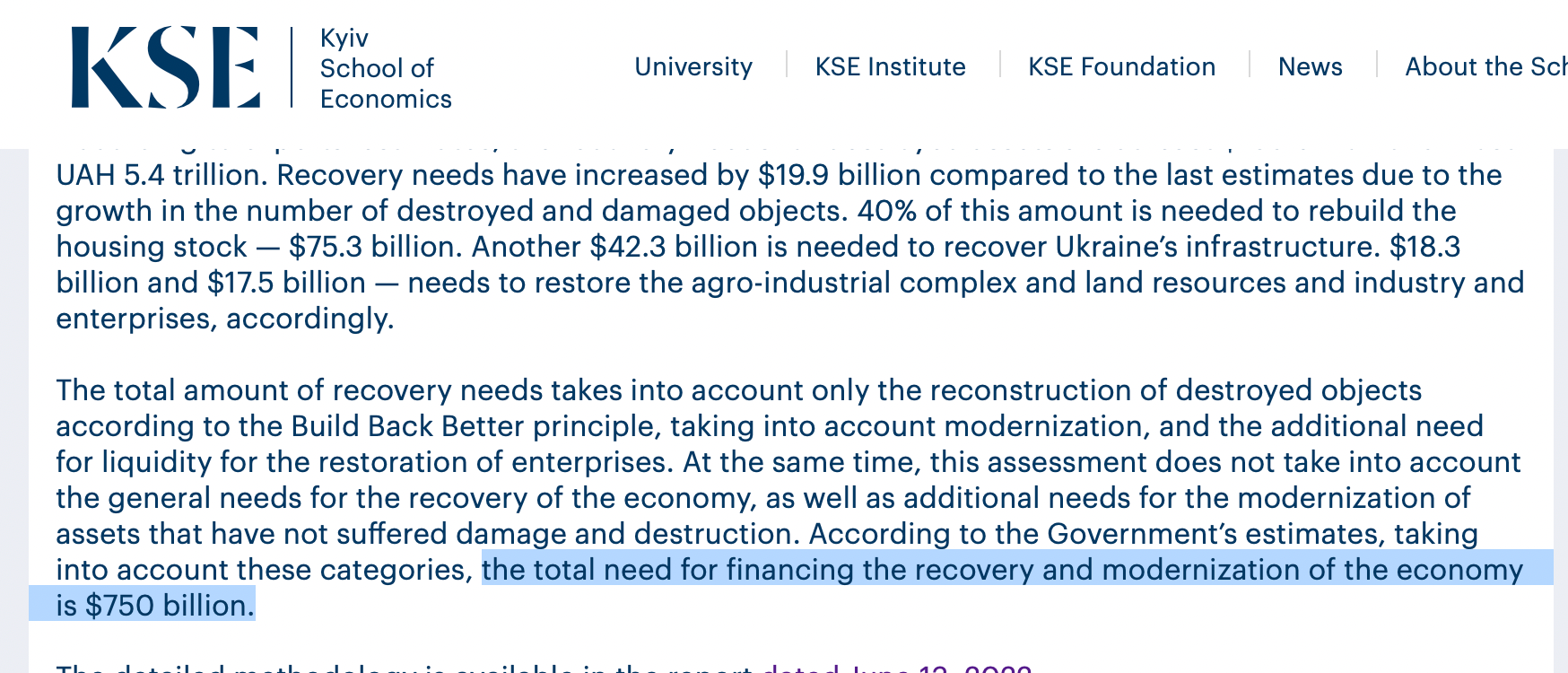
Notably, President Volodomyr Zelensky’s office has previously cited the exact $750 billion number, but claimed it was the total cost of losses. “Now we are working on a long-term plan for the recovery of Ukraine. It defines the list of national reconstruction programs. We have incorporated the Build Back Better principle into this plan,” Zelensky’s deputy said last month.
At the end of the report, we find that the robust damages assessment is not an independent effort. In fact, it is funded by the U.S. taxpayer, through the U.S. Agency for International Development (USAID).
The “assessment” is just the latest document that advances the continuing global campaign to solicit funds for the rebuilding, reconstruction, and “modernization” of Ukraine, despite the fact that the war is ongoing. There has been a concerted effort in the D.C. lobbying and military contracting space to score massive funds for the “reconstruction” effort.
Meanwhile in D.C., Congress is beginning to whip the votes for a new funding round for Ukraine, yet very few lawmakers having any idea where the first $40 billion ended up.
The Biden Administration continues to send regular military assistance to Ukraine, depleting U.S. stockpiles in the process, and it hasn’t helped the country turn the tide of the war. On Monday, the White House authorized an additional $550 million in weaponry for Kiev.
Featured Video

AIDS Inc. by Gary Null (2007)
or go to
Aletho News Archives – Video-Images
From the Archives
Fanatical Followers of the Covid Regime: A Jim Jones-Style Cult?
By Professor Roger Watson and Dr. Niall McCrae | The Daily Sceptic | November 15, 2021
As scholars at leading British universities over recent decades, we witnessed the replacement of critical thinking and debate by narrative: facts are discrimination and scientific method is imperialism; truth, instead, is derived from ‘progressive’ values. This educational trend may be a major contributory factor to the ease in which society has been inculcated to the Covid ‘new normal’ of masking, testing, and repeated doses of vaccines for a disease of similar risk to severe influenza.
One doesn’t need much critical reasoning to observe the flawed logic of some vaccination enthusiasts, such as people who respond to experiencing any side effects, however debilitating, by saying “at least I know it’s working”, or, after contracting the disease despite their promised inoculation (over 90% effective, according to initial drug company claims), “I’d have been worse off without the jab.” … continue
Blog Roll
 Aletho News
- Merck Virologists Admitted to Falsely Certifying Vaccine Efficacy
- Mandatory Folic Acid for every man, woman & child
- Pro-Palestine protesters arrested outside UK’s ruling Labour Conference in Liverpool
- Mauritius denies landing permit to flight from Israel, forcing cancellation: Tour operator
- Israeli finance minister calls for genocidal war on West Bank, annexation of south Lebanon
- 12 Things Your Psychiatrist Was Trained Not to Tell You
- From Unipolar Universalism to Multipolar Civilizational Distinctiveness
- RSF military group defects, joins Sudanese army: State media
- Ireland goalkeeper refuses to play ‘Israel’ as squad weighs boycott
- China pushes back against US on Cuba, Iran
- If Americans Knew
- Israel forces Gazans to live in constant peril – Daily Update
- Deconstructing Netanyahu’s pants-on-fire UN rant – Daily Update
- Trump betrayed voters with his campaign lies and prioritized a foreign country once he took office
- Netanyahu calls Israel’s war in Gaza ‘opposite of genocide’ in UN speech to near-empty hall
- Settler Kidnappings: Torture, Sexual Abuse and Terrorisation of Palestinian Abductees as Israel Deepens Annexation of West Bank
- Gaza winter nears as 162,000 tents become unusable, raising fears of humanitarian crisis
- Netanyahu says, “It’s the opposite of genocide”; UN says Gaza economy is world’s ‘most severe crisis on record’ – Daily Update
- Israel’s US-Backed Assault on Gaza Has Created the ‘World’s Most Severe Economic Crisis on Record’: UN
- ‘Protecting U.S. Citizens’… From Israel
- ‘This is where I live now, the back of a truck’: a day in the life of a grandmother in Gaza
- No Tricks Zone
- New Study: Earth And Venus Surface Warmth Largely Explained By Convection And Lapse Rate, Not CO2 Or Radiation
- 2025 Nature Paper Claiming Worsening Global Drought Gets RETRACTED …Heavily Flawed
- New Study: ‘Global Drought Shows No Detectable Recent Acceleration Under Climate Warming’
- Economic Masterminds: German Socialists Suggest Taxing Productivity Gains Stemming From Using AI
- The South China Sea Has Not Been Cooperating With The Climate Change Narrative
- Energy Crisis: Germany Enters Heating Season With Historically Low Gas Reserve Fill Levels
- New Study: The Antarctic Ice Sheet Gained Mass From 2020-2024 Due To Staggering Snow And Ice Accumulation
- Study: Ocean Heating Rates From Thousands Of Years Ago ‘Dwarf’ Modern Ocean Heating Rates
- Climate Extremists Target, Attack Large-Scale Power Grid Infrastructure In Germany!
- New Study: Antarctic Ice Melt Has Contributed Less Than 1 Centimeter To Sea Level Rise In The Last 30 Years

