The Guardian inadvertently shakes up Bucha narrative
By Drago Bosnic | April 28, 2022
When the events in Bucha were first reported, Ukrainian and Western mainstream media were unanimous – Russian Armed Forces were the alleged “perpetrators of the Bucha massacre”, while some even called it a “genocide”. The Ukrainian side claims Russian troops killed at least 412 people, while so-called “independent” sources state there were 50 victims. The peculiar claims were completely unsupported by any actual official investigation by any neutral side. The Kiev regime and their Western sponsors flatly refused to allow an international investigation, while any claims contrary to the official narrative were immediately suppressed. If anyone dared to question the narrative, they would be labeled “conspiracy theorists”, “genocide deniers” and “Putin’s propagandists”.
It is more than clear that such a blunt approach to the events in Bucha is designed to silence not just those opposing the official narrative, but even those who are not invested with either side and simply want answers to legitimate questions regarding the veracity of mainstream media reports. This completely removes any sort of public debate, limiting it to one-sided talkshows where so-called “pundits” are called to brainwash the public into thinking that the Russian military is entirely composed of alleged rapists, murderers, alcoholics, drug addicts, etc. By pushing this narrative, the mainstream media are “normalizing” Russophobia and anyone trying to denounce it is promptly silenced.
However, lies are still lies. And they are significantly harder to sustain than the truth. The truth is just truth, it stands by itself. Lies require the liar to circumvent and twist facts. In other words, more lies are necessary to sustain just one. It’s a neverending rabbit hole which inevitably spirals out of control. And precisely this happened on 24 April, when The Guardian published an article about new findings regarding the events in Bucha. According to the UK-based daily, “independent” investigators found evidence of fléchettes used by artillery (supposedly Russian) in Bucha.
“Independent” pathologists and coroners who are carrying out postmortems on bodies found in mass graves in the region north of Kyiv, where “occupying” Russian forces have been accused of alleged atrocities, said they had found small metal darts, called fléchettes, embedded in people’s heads and chests, the report stated.
“We found several really thin, nail-like objects in the bodies of men and women and so did others of my colleagues in the region,” Vladyslav Pirovskyi, a Ukrainian forensic doctor, told The Guardian. “It is very hard to find those in the body, they are too thin. The majority of these bodies come from the Bucha-Irpin region.”
“Independent” weapons experts who reviewed pictures of the metal arrows found in the bodies, seen by The Guardian, confirmed that they were fléchettes, an anti-personnel weapon widely used during the First World War.
These small metal darts are contained in tank or field gun shells. Each shell can contain up to 8,000 fléchettes. Once fired, shells burst when a timed fuse detonates and explodes above the ground. Fléchettes, typically between 3cm and 4cm in length, release from the shell and disperse in a conical arch about 300m wide and 100m long. On impact with a victim’s body, the dart can lose rigidity, bending into a hook, while the arrow’s rear, made of four fins, often breaks away causing a second wound.
“According to a number of witnesses in Bucha, fléchette rounds were fired by Russian artillery a few days before forces withdrew from the area at the end of March,” the report added.
As with all cases of Western-reported alleged crimes, there are always numerous witnesses, independent international experts, anonymous whistleblowers, etc. We just never get to see them. Which means we should simply take the claims of these people, whose very existence we cannot verify, at face value. And any sort of view opposing this narrative is immediately shut down.
According to Neil Gibson, another “Independent” weapons expert at the UK-based Fenix Insight group, who has reviewed the photos of the projectiles seen, they include the 122mm 3Sh1 artillery round, in use by Russian artillery and which are filled with fléchettes. What Mr. Gibson conveniently “forgot” to mention is that these same shells are used in all post-Soviet countries, including Ukraine. More specifically, the shells fit the D-30 howitzers, which are in service with both Russia and Ukraine, as well as dozens of other countries.
A spokesperson for the Ukrainian Ground Forces was quick to state that Ukraine’s military “does not use shells with fléchettes”. However, facts beg to differ, as surgeons in eastern Ukraine have reported the use of fléchettes by Ukrainian artillery in Donbass warzone since at least 2014. It’s obvious the Ukrainian and Western media find it convenient to use Soviet-era weapons as “proof” of alleged Russian war crimes, while ignoring the fact that these same weapons are used by Ukraine. What’s more, Ukraine is more likely to use them, since they have produced little to no new weapons and munitions since the collapse of the USSR.
Russian forces left Bucha on March 30. It took only a few days for the “independent” pathologists and coroners to file the reports from Bucha. At first, the reports claimed Russian forces allegedly shot civilians at point-blank range. Satellite image company Maxar Technologies claimed its photos provided “critical evidence that mass killings of civilians in the Ukrainian city of Bucha must have occurred when Russian forces were occupying the territory in mid to late March”. Combined with the report about fléchettes, this would mean the Russian artillery fired at the city while Russian troops were there, which defies any military logic.
If the reports about the usage of fléchettes are true, the only logical conclusion is that the Ukrainian military shelled Russian positions after the decision to withdraw from the Kiev and Chernigov regions. Russian forces deployed in Bucha certainly didn’t shell their own positions. Since we now know that the Ukrainian forces have and use fléchettes in their artillery shells, what conclusion can we draw except that the civilians were killed by the side which shelled the city while Russian troops were there?
Drago Bosnic is an independent geopolitical and military analyst.
Ukraine Says Austria “Indulging Putin” For Rejecting EU Membership Bid
BY TYLER DURDEN | ZERO HEDGE | APRIL 25, 2022
Austria has just broken from what was looking like an emerging EU consensus on Ukraine’s membership bid, with Foreign Minister Alexander Schallenberg announcing Vienna’s opposition on Sunday at the 14th European media summit.
Underscoring Austria’s commitment to neutrality as a central element to Ukraine’s “self-definition”, he asserted that Ukraine’s application for candidate status should be rejected by the 27-country economic and political union.
“We don’t belong to any military alliance and we don’t want to,” he stressed in the speech, instead urging a “different way” for Ukraine to deepen its ties with Europe, strongly suggesting that EU membership for Ukraine would unnecessarily deepen Europe’s involvement in the conflict amid the Russian invasion.
He called Austria “militarily neutral, but not politically” on the issue of the Russian war in Ukraine. Additionally, Schallenberg went so far as to spell out that Ukraine shouldn’t be granted membership even in the future.
As part of current rules and procedures dictating the process, to even start Ukraine’s candidate status, all EU governments would have to unanimously agree.
Schallenberg suggested an alternative that would look something like the EU relationship with Balkan countries:
Austrian publication Heute reported that Mr Schallenberg called for models other than full membership and for more flexibility.
Mr Schallenberg justified his position by saying there are countries in the Western Balkans, who the EU calls “enlargement countries,” who have come a long way without full membership.
As expected, Ukraine’s foreign ministry was quick to slam the statements, calling FM Schallenberg’s position “short-sighted” and ultimately “not in the interests of the united Europe.”
“Such statements also ignore the fact that the vast majority of the population of the EU founding member states support Ukraine’s membership,” Ukrainian Foreign Affairs Ministry spokesperson Oleg Nikolenko said.
Kiev also suggested that somehow the government under Austrian Chancellor Karl Nehammer – who came under some degree of criticism in EU corners for his April 11th meeting with President Putin for “direct, open and tough” talks – is being ‘influenced’ by Russia. Nikolenko suggested Schallenberg’s stance represents Austria “indulging Putin’s aggressive plans.”
Current polling in reporting, however, points to the Austrian public generally wanting to avoid confrontation with Russia:
But around 40% of Austrians consider the government’s position on Ukraine as “on the whole correct,” while 23% believe the government is “too pro-Ukraine” and 17% “too pro-Russia,” according to Heute.
At the same time, once-neutral EU governments like Germany have flipped – going from expressing a strictly neutral status on Ukraine to shipping heavier and heavier arms to Kiev.
Moldova turns down Kiev’s suggestions on Transnistria
Samizdat | April 27, 2022
Moldova has turned down the “offer” to capture its breakaway region of Transnistria by force floated by Kiev, stating that it seeks to reintegrate the self-proclaimed republic only through political means.
“The settlement of the Transnistrian issue can be achieved by political means and only on the basis of a peaceful solution, excluding military and other forcible actions, as well as on the basis of the principles of democratization and demilitarization of the region, [and] respect for the sovereignty and territorial integrity of Moldova,” the country’s office for reintegration told RIA Novosti on Wednesday.
The statement came in response to remarks made by Alexey Arestovich, an adviser to Ukrainian President Volodymyr Zelensky. The official suggested the country was capable of “capturing” Transnistria should Chisinau formally request Kiev’s help in conquering the breakaway region.
“Yes, [we] would have managed somehow, but this is the territory of sovereign Moldova, [it could happen] only after the appeal of the Moldovan side,” he said.
Arestovich’s remarks garnered condemnation in Moscow as well, with Kremlin spokesman Dmitry Peskov describing such statements as “quite provocative.”
The international attention towards Transnistria comes as the breakaway nation endured a string of mysterious incidents over the past few days. On Monday, Transnistria’s Ministry of State Security was attacked by three unknown assailants, who fired shoulder-mounted rocket launchers at the building, blowing out its windows and damaging its façade.
The attack was followed back-to-back by explosions at a local broadcasting center on Tuesday morning. While no one was hurt, the facility had its biggest antennas – transmitting Russian radio stations – destroyed.
The president of the self-proclaimed republic of Transnistria, Vadim Krasnoselsky, blamed the incidents he described as “terror attacks” on Ukrainian nationals and urged Kiev to investigate the armed groups that had allegedly infiltrated his region.
Transnistria, officially known as the Pridnestrovian Moldavian Republic (PMR), is a self-proclaimed state located along a narrow strip of land between the Dniester River and the Ukrainian border in the eastern part of Moldova.
The region broke away from Moldova in the early 1990s shortly after the collapse of the Soviet Union. The region maintains close ties with Moscow, with Russian peacekeepers stationed there and a sizable portion of local residents holding Russian citizenship.
US wants EU to sanction China for its Ukraine-Russia policy
By Paul Antonopoulos | April 27, 2022
Washington is trying to convince Europe that it has the ability to influence China’s relationship with Russia. However, Beijing’s stance on Ukraine and associated threats from the West are unlikely to deter it from deepening cooperation with Moscow.
US Deputy Secretary of State Wendy Sherman visited Brussels from April 19 to 22 and forced the Europeans to listen to Washington’s arguments about the possibility of imposing sanctions on China if it provided material support for Russia’s military campaign in Ukraine. At an event organised by the US and EU-funded “Friends of Europe” group, Sherman again warned that China would face sanctions similar to those being imposed on Russia.
After Sherman’s meeting with Bjoern Seibert, Chief of Staff for European Commission President Ursula von der Leyen, the State Department said the two sides agreed that they must urge China not to circumvent sanctions against Moscow or offer any support for Russia’s special operation in Ukraine.
Effectively, the US is instructing Europeans on the policies they must adopt to counter Russia’s action in Ukraine, making a mockery of the efforts by French President Emmanuel Macron to create a “strategically autonomous” Europe. Macron’s emboldened announcement of Europe’s “strategic autonomy” from the US was exposed as being nothing more than a buzzword with the outbreak of the war in Ukraine as Paris immediately abandoned all efforts of diplomacy after ignoring Moscow’s years-long complaints regarding Ukraine’s illegal and provocative actions in Donbass. This is on top of imposing sanctions that negatively affect the average European citizen.
For all this talk of “strategic autonomy”, Brussels has just once again demonstrated that it is obedient and submissive to Washington. However, despite the EU imposing sanctions, closing its airspace to Russian planes and delivering weapons to Ukraine, the US is clearly not satisfied and sent Sherman to Brussels to ensure that tougher policies against China are also implemented.
The US at the very minimum hopes to divide European countries as many are still unwilling to provoke China due to trade relations. In the context of the US ignoring all international communication norms and continuing its threats of sanctions against China, Beijing unlikely views this as just renewed verbal attacks.
China is using various channels to convey to its European partners its views on the crisis in Ukraine, as well as on efforts to help the conflicting parties resolve the war peacefully. It is recalled that Beijing sent a diplomatic mission led by Huo Yuzhen, China’s special representative for the China-Central and Eastern Europe Investment Cooperation Fund (CEEC). On April 25, the delegation began its European tour in the Czech Republic, with visits to Hungary, Lithuania, Poland, Slovakia, Slovenia, Croatia and Estonia also included.
The visit to the Czech Republic is significant since the country will hold the Presidency of the Council of the European Union from July 1 to December 31. In this way, perhaps the comments by Czech Deputy Foreign Minister Martin Tlapa were too hasty when he made de facto statements on behalf of EU members. At a meeting with the Chinese delegation in Prague, he warned that China’s cooperation with Russia could damage its relations with the EU.
Clearly, the Czech diplomat’s desire to please and appease the US overshadowed his own obligation to follow rudimentary political submissions, or perhaps the EU has amended this principle like many other ethical and legal norms due to the crisis in Ukraine?
Although EU officials concede China is unlikely to enforce the broad sanctions imposed on Moscow by a minority of the world’s recognized UN member states, this has not deterred their efforts to lambast and shame countries for their position. Brussels falsely hoped that Beijing could influence Moscow to stop its demilitarization of Ukraine, but hopes were quickly dispelled at an EU-China virtual summit on April 1 that left Western leaders frustrated and angry that they are international pariahs on the Ukraine issue.
A joint EU-US statement following Sherman’s talks in Brussels vowed to push Chinese leaders on issues such as the inadmissibility of sanctions circumvention, and “reaffirmed that such support would have consequences for our respective relationships with China”.
However, Sherman and EU foreign service chief Stefano Sannino avoided answering a journalist’s question on what potential repercussions could be for China. This suggests that the West actually does not have a clear idea on how and why they could punish China for its relationship with Russia and instead it hopes that threats of sanctions could deter their cooperation.
This of course is extremely naïve as sanctions have never made state leaderships of Middle Powers, like North Korea and Iran, collapse or capitulate. Given this fact, there is little prospect that sanctions will achieve the West’s hopes against Great Powers like Russia and China, especially as only just days before the US-EU forum, Chinese vice foreign minister Le Yucheng assured Russian ambassador Andrey Denisov of Beijing’s aim to “deepen bilateral comprehensive strategic coordination”.
Paul Antonopoulos is an independent geopolitical analyst.
The White House is Turning the War in Ukraine into a New Gold Rush
By Valery Kulikov – New Eastern Outlook – 27.04.2022
The Americans have a saying that every new president needs his own “splendid little war.” They understand perfectly that a war of that kind will enrich the incoming political and military establishment and also solve many social and financial problems in the country, not least unemployment, and help reduce foreign debt.
The political establishment has found it easy to arrange matters behind the back of the indecisive and ailing 46th US president, Joe Biden (about whose mental acuity many, both in the US and internationally, are now seriously concerned), and continue the work of previous administrations in drawing Russia deeper into the Ukrainian crisis.
As a result, Washington clearly has no interest in finding a peaceful solution to the conflict, and in provoking its escalation into outright war the White House has found itself forced to put together an anti-Russian coalition and supply more and more consignments of arms to the Ukrainian government.
On March 2, 2022 Dmytro Kuleba, Ukrainian Foreign Minister, claimed that Ukraine had “mobilized an international anti-war coalition, which already has at least 86 states and 15 international organizations” and that “19 countries are giving weapons to Ukraine.” And in a briefing on March 8 Pentagon Press secretary John Kirby confirmed that Ukraine was receiving weapons form 15 countries, including the USA.
The press briefing, published on the official web site of the US Department of Defense, stated that the United States had committed more than $4 billion in military assistance to Ukraine since the beginning of the Biden administration, including $3.4 billion since the beginning of Russia’s special operation! According to the briefing, the US had provided security assistance including 700 Switchblade drone systems, 16 Mi-17 helicopters, more than 1,400 shoulder-launched Stinger anti-aircraft missile systems, 183,000 155mm Howitzer artillery rounds and 72 tactical vehicles to tow them, 200 armored personnel carriers, 121 Phoenix Ghost tactical drones and more than 7,000 small arms. The Pentagon is also providing the Ukrainian armed forces with 5,100 Javelin anti-tank missiles and more than 14,000 “other anti-tank systems.”
As for the claim that representatives of the US military and political establishment have a financial stake in the Ukrainian conflict, it is enough to take the example of the Javelins. According to a number of US experts and industry publications, the US has provided Ukraine with approximately a third of its stock of Javelin anti-tank missiles. Significantly, US Defense Secretary Lloyd Austin has taken personal charge of supplying the Javelins to Ukraine. The reason is clear – he has long been closely linked to the manufacturer, and is now able to place government orders for these weapons. And with Javelin stocks steadily decreasing, the US army has requested new supplies, which means that Lloyd Austin is placing new orders, and may soon be making a big profit from these transactions.
Let us now look at the articles that have appeared in the US media – clearly planted by the Pentagon – suggesting that the transfer of the US’s supplies of Javelins may damage its own defense readiness, as there is the risk that remaining stocks may be insufficient to respond in the event of an “unexpected conflict.” Naturally, articles of this type are a form of propaganda, aimed at promoting the interests of the Department of Defense and of its head, Lloyd Austin. Currently the US army is not directly engaged in conflict, and is therefore able to replace its reserves of these weapons without difficulty. And by stepping up production volumes, Washington is able to boost its profits and create new jobs.
Many of the Javelins that have fallen into the hands of the Russian, PRD and PRL armies during the current conflict have an expiry date of 2022. Many media have reported on an embarrassing incident in the Yavoriv training ground, while US military specialists were instructing Ukrainian soldiers in the operation of the Javelin system – using a Javelin whose service life had expired. After firing the missile, the missile, fortunately without its warhead attached, fell to earth, almost under its users’ feet.
In other words, the war in Ukraine will, for a long time to come, boost the wealth of members of the United States’ political and military elite, including Pentagon officials, as they offload old stock, attract new orders from other countries, and embroil Washington in the “remote conflict” of their own creation. As for the European governments, US puppets who are supplying more and more of their own arms to Ukraine at Washington’s behest, they will, in the end, start to realize that this policy is harming them. By providing military assistance they are merely serving to draw out Russia’s military operation and tighten the financial noose around their own necks – which is one of the USA’s main goals. For, as a result of Washington’s rush to pressurize them into supplying Kiev with “sponsored military support,” in the end the European nations’ own arms reserves will run low, and they will be forced to restock by ordering new armaments from the USA.
It should therefore come as no surprise that the US government is standing on the sidelines and watching on with glee – it knows that when Europe and Nato need to replenish their arsenals, it will be the US military industrial complex that gets the contracts. And, in their joy the heads of the armament industry are drinking themselves into oblivion.
According to a recent article in The Independent, the arms companies are rushing to cash in on this new “gold rush” triggered by the escalation of the conflict in Ukraine. While to pickings from supplying arms to Kiev may be fairly modest, remilitarizing Europe would bring the US arms manufacturers huge profits. And the arms bosses have already started making promises to their shareholders and talking to the media about the profits to be gained from this project. Countries such as Germany, committed to a policy of pacifism since the end of World War II, are now trying to reform their militaries. Germany has already ordered 35 F-35 fighters, the most modern combat aircraft, from the American manufacturer Lockheed Martin, as well as 60 Chinook CH-47F heavy transport helicopters from the US aerospace giant Boeing.
Poland’s Ministry of Defense has signed a contract for the purchase of 250 US-made Abrams M1A2 SEPv3 tanks, the latest version of this vehicle. It has also signed an agreement for logistical and training support, including training for tank teams. In total, it has budgeted some $6 billion for the purchase of these tanks. According to the Polish army, this is its largest arms purchase since the Second World War.
To make sure no-one else benefits from this new Gold Rush the US intends to coordinate the international supply of arms to Ukraine, and to this end is organizing a conference on Ukraine at the United States European Command in Stuttgart, as reported by the German news television channel Welt.
U.S.-Led NATO Is at War Against Russia
By Finian Cunningham | Strategic Culture Foundation |April 26, 2022
We are now in the realm of World War Three. The abysmal situation is such that the war is in danger of going nuclear in which case the future of the planet is at stake.
Incredibly, to warn of this danger leaves a person open to the accusation that they are peddling Russian propaganda. Blindly, the Western governments are doubling down on the powder-keg.
The U.S.-led NATO alliance is flooding Ukraine with heavy offensive weaponry capable of hitting Russia, and the British government this week has openly called for Ukraine to target Russia’s “depth” with NATO weapons.
Russia’s Foreign Minister Sergey Lavrov commented that the U.S. military alliance is now fully-fledged in a proxy war against Russia. He said there is a “serious danger” of confrontation spiraling into a nuclear conflagration.
Only a fool or an insane person could remain insouciant about the dynamic unfolding.
Ominously, there is evidently no diplomatic will from Washington and its allies to address the background to the war in Ukraine or Russia’s long-held security concerns. The United Nations Secretary-General Antonio Guterres is being vilified for even attempting to negotiate a peace settlement by going this week to Moscow before traveling on to Kiev.
There is a palpable sense that the U.S. and NATO are recklessly pushing a military showdown with Russia – albeit under the cynical guise of “defending Ukraine”. All the while, the Western public is being kept in the dark by a complicit corporate-controlled news media.
This week saw the United States host what can only be called a war conference at its European command center in the Ramstein airbase, Germany, where NATO military chiefs coordinated their weapons delivery to Ukraine. This is a war footing.
U.S. Secretary of Defense Lloyd Austin said the United States and its NATO allies would “move heaven and earth” to get more weapons into Ukraine to defeat Russia’s military intervention in that country. Austin’s rhetoric was a disturbing malapropism with apocalyptic resonance.
But it does reveal the determination to take on Russia that is now openly visceral. The conflict in Ukraine is emerging for what it is – a war between the U.S.-led NATO bloc and Russia. Moscow has long held that the U.S. and NATO are a hostile entity tacitly aiming to subjugate Russia. Such claims have been derided as Russian paranoia. However, it’s now apparent that the actual intent is hostility and defeat of Russia.
Austin stated at the Ramstein conference that America’s allies are now openly exploiting an opportunity to “weaken Russia” and pursue the regime change objective in Moscow that U.S. President Biden referred to in his controversial Warsaw speech last month.
Earlier this week, U.S. Secretary of State Antony Blinken accompanied Austin, the Pentagon’s civilian chief, on a secret visit to the Ukrainian capital, Kiev. American news media dutifully complied with an embargo on reporting the Sunday visit which shows that these media are complicit in conforming to Washington’s agenda of belligerence.
The American envoys held three-hour discussions with Ukrainian President Vladimir Zelensky during which they pledged more military support on top of the huge arsenal already provided by the U.S. The meeting is a stark signal to Moscow of what the real American intentions are. This is not about resolving Russia’s grievances over NATO expansionism and the neutrality of Ukraine. That discourse was never taken seriously by the United States anyway. No, now relations are in the framework of the U.S. waging a war against Russia, with Ukraine merely the present battleground.
When the top American officials returned to Poland they held a press conference Monday at a warehouse shipping NATO weapons to Ukraine. At one stage, Austin told reporters about the earlier meeting with Zelensky: “So our focus in the meeting was to talk about those things that would enable us [sic] to win the current fight and also build for tomorrow [sic].”
Unable to contain his enthusiasm for confrontation, the Pentagon chief went on to make the direct U.S. involvement more apparent: “In terms of our – their ability to win, the first step in winning is believing that you can win. And so they believe that we can win; we believe that they – we can win – they can win if they have the right equipment, the right support. And we’re going to do everything we can – continue to do everything we can to ensure that that gets there.”
When Russian President Vladimir Putin ordered what he called “the special military operation” in Ukraine on February 24, he said Russia had no choice but to defend the Russian-speaking people of the Donbass who had endured eight years of a deadly offensive by the NATO-backed Kiev regime forces.
The United States, NATO, and the Kiev regime have shown no will whatsoever to resolve the civil war in Ukraine peacefully by implementing the Minsk accords negotiated in 2015.
It is more apparent than ever that the conflict in the Ukraine was never a localized civil war but rather was always a front line in a bigger geopolitical confrontation between the U.S.-led NATO bloc and Russia, as Bruce Gagnon explained in a recent interview for Strategic Culture Foundation.
Instead of an earnest effort to genuinely resolve the conflict, the NATO-backed Kiev regime and its openly Nazi regiments are mobilizing in a general war footing against Russia.
The rationale is now explicitly stated as the U.S. and its allies wanting to defeat Russia and subjugate it.
British armed forces minister James Heappey even went as far as telling the BBC this week that Ukrainian forces should strike Russia’s depth with NATO weaponry.
Russia’s military defense doctrine forgoes first-use of nuclear weapons but it reserves the right to use such weapons if the country comes under existential threat even from conventional military assault.
The United States and its NATO allies have willfully ignored Russia’s decades-long concerns about its security and in particular the use of Ukraine as a cat’s paw to destabilize and dissipate Russia. The full-on U.S. imperial war agenda of targeting Russia for defeat is now coming into focus. The crazies are in charge of the asylum. And shouting about it too.
The NATO Lie
By Jacob G. Hornberger | FFF | April 26, 2022
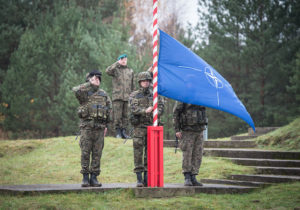
Russia’s invasion of Ukraine has brought to the forefront the NATO treaty to which the United States is a party. President Biden and the Pentagon have steadfastly maintained that a Russian attack on any NATO member automatically obligates the United States to go to war against Russia. That, of course, would necessarily mean the virtual certainly of all-out nuclear war between Russia and the United States, a war that would, needless to say, end up destroying both countries and killing hundreds of millions of people in the process.
There is one big problem with the Biden/Pentagon position: It’s a lie. In fact, the NATO treaty does not obligate the United States to automatically come to the defense of any NATO member in the event Russia attacks that particular country. That’s because the NATO treaty does not operate to amend the U.S. Constitution.
The Constitution is the document that the American people used to call the federal government into existence. The Constitution established a federal government of limited powers. The government was divided into three branches — executive, legislative, and judicial — with enumerated powers being delegated to each branch of government.
With respect to war, the Framers delegated the power to declare war to Congress and the power to wage war to the president. What that meant was that the president is prohibited from waging war against another nation without first securing a declaration of war from Congress.
When the U.S. government was converted from a limited-government republic to a national-security state after World War II, a fourth branch was effectively added to the federal government: the national-security branch, consisting of the Pentagon, the CIA, and the NSA.
While it has been said that these entities are actually part of the executive branch, as Michael Glennon has pointed out in his excellent book National Security and Double Government (which I cannot recommend too highly), the national-security section of the federal government, owing to its overwhelming power, is actually the part that is running the show, with the other parts of the federal government operating deferentially in support.
The Constitution provides for the specific ways to amend the Constitution. Quoting whitehouse.gov: “An amendment may be proposed by a two-thirds vote of both Houses of Congress, or, if two-thirds of the States request one, by a convention called for that purpose. The amendment must then be ratified by three-fourths of the State legislatures, or three-fourths of conventions called in each State for ratification.”
Notice something important: The Constitution does not provide that it can be amended by treaty. The Framers did not want federal officials to have the power to amend the Constitution by simply entering into treaties with other nations that changed the terms and conditions of the Constitution.
Therefore, the NATO treaty cannot operate to amend the constitutional provision that requires a congressional declaration of war before the president can legally wage war. Thus, if Russia attacks, say, NATO member Poland, the Constitution requires the president to secure a declaration of war from Congress against Russia before the president, the Pentagon, and the CIA can wage war against Russia.
Now, take a look at an article entitled “The NATO Treaty Does Not Give Congress a Bye on World War III” by Michael Glennon, who I mentioned above. It’s posted at a website entitled lawfareblog.com. This is one of the most important articles that you will read in your lifetime. I cannot emphasize too highly why you should read this article and, equally important, share it with everyone you know and, equally important, ask them to share it with everyone they know.
Glennon is professor of international law at The Fletcher School of Law and Diplomacy at Tufts University. From 1977-1980, he served as counsel to the Senate Foreign Relations Committee. You can read more about his credentials on Wikipedia by clicking here.
Glennon’s article makes the scholarly but easily readable case that the NATO treaty does not — and cannot — automatically obligate the United States to go to war in the event Russia (or any other nation) attacks a NATO member.
Of course, there is a much more fundamental question that Americans must confront: Why is the United States in NATO at all? NATO was established after World War II to ostensibly protect Western Europe from an attack by the Soviet Union, notwithstanding the fact that there was never any real likelihood that the Soviet Union, which was totally devastated in World War II, had any interest in going to war with Western Europe (and a nuclear-armed United States).
Regardless of whether NATO was necessary or whether it was just part of the Cold War racket, one thing is crystal clear: Once the Soviet Union dismantled, NATO’s mission became moot. At that point, this Cold War dinosaur should have been dismantled and sent into extinction.
Instead, what the NATO bureaucrats did was keep this dinosauric entity in existence and, even worse, began using it to absorb former members of the Soviet Union, which enabled the Pentagon to establish its nuclear missiles ever closer to Russia’s borders. It was when the Pentagon, operating through NATO, announced an intention to absorb Ukraine that Russia decided to invade Ukraine, as the Pentagon knew it would, in order to prevent the Pentagon from establishing its nuclear missiles (and military bases, troops, tanks, and other weaponry) on Russia’s border.
Thus, one of the keys to getting America back on the right track — toward liberty, peace, prosperity, and harmony with the people of the world — is to immediately withdraw from NATO, which would bring the immediate dissolution of this Cold War dinosauric entity, as well as bring U.S. troops home from Europe (and everywhere else). It is U.S. foreign interventionism that is a root cause of the loss of liberty and prosperity in America as well as America’s disharmony with the people of the world.
In the meantime, it is in the interest of every American to understand the nature of the NATO lie, a lie that holds that the NATO treaty automatically obligates the U.S. government to go to war against Russia in the event of an attack by Russia on another member of NATO. That’s why, again, I highly recommend reading Michael Glennon’s article and sharing it with everyone you know and asking them to share it with everyone they know.
Germany to supply Ukraine with heavy weaponry
Samizdat | April 26, 2022
The German government has given the green light for the delivery of self-propelled anti-aircraft guns to Ukraine, the country’s Defense Minister Christine Lambrecht said on Tuesday.
Speaking at US-hosted defense talks at the American airbase Ramstein in Germany’s Rhineland-Palatinate state, Lambrecht said that the leadership in Berlin made the decision on Monday. She emphasized that Germany was “determined to help the Ukrainian people with unified resolve in this existential emergency.”
The minister explained that “Ukraine will order” hardware from German manufacturers and “Germany will pay.” Berlin would earmark some 2 billion euros to that end, Lambrecht added.
The armored vehicles in question are Gepard self-propelled anti-aircraft guns, which were decommissioned by the German military back in 2010. Designed to take out cruise missiles and aircraft, Gepards can also be used against targets on the ground. As many as 50 heavy vehicles could reportedly be delivered to Ukraine. Defense firm Krauss-Maffei Wegmann will now refurbish the equipment before transferring it on to Kiev, Germany’s dpa news agency reported. It is, however, not known when exactly Ukraine can expect delivery of the anti-aircraft systems.
Lambrecht also announced that Berlin “has initiated a swap scheme with our partners in eastern Europe” that is ensuring that “Ukraine is quickly obtaining heavy weaponry that doesn’t require lengthy training.” But, according to the minister, Germany could do a lot more in this respect.
On top of that, Berlin will be cooperating with the US and the Netherlands when it comes to providing training to Ukrainian troops on German soil in the use of various artillery systems.
Lambrecht made the announcements during a meeting of defense ministers from 40 countries hosted by US Defense Secretary Lloyd Austin on Tuesday.
Earlier this month, several German outlets reported that Germany’s Rheinmetall arms manufacturer was prepared to sell 88 decommissioned Leopard tanks, as well as ammunition, spare parts and tools to repair the hardware. Training on the equipment would also be provided to Ukrainian troops. The company was awaiting the German government’s approval, the media said at the time.
Moscow has repeatedly condemned NATO arms supplies to Kiev, saying they only destabilize the situation on the ground and hamper the prospect for peace. It also warned that any equipment deliveries will be considered a legitimate military target for the Russian forces once they cross into Ukrainian territory.
“NATO is essentially going to war with Russia through a proxy and arming that proxy. War means war,” Russia’s Foreign Minister said on Monday.
Kiev says ready to attack Crimean Bridge at first opportunity
By Lucas Leiroz | April 25, 2022
The Ukrainian government seems to be willing to further increase its military actions just to continue a conflict in which it has no chance of winning. On April 21, a Kiev official announced that they are about to bomb and destroy the Crimean Bridge.
In a recent speech, Secretary of the National Security and Defense Council, Oleksiy Danilov, revealed that Kiev’s armed forces are ready to attack the bridge at any time, having plans to act at the first possible opportunity. His words during an interview with Radio NV leave no doubt about the Ukrainian intentions: “If we had the ability to do it, we would have already done it. If there is an opportunity to do it, we will definitely do it”. Danilov also commented on the reasons behind the plan, mentioning the strategic value of the bridge, which destruction would largely obstruct the movement of Russian troops.
There are many problems with Danilov’s statement. In fact, it is possible to speak of a “strategic value” in its destruction of the Crimean Bridge, but this is far from implying any justification. Many anti-humanitarian measures have “strategic value” but should be avoided simply because they are legally and ethically wrong procedures. For example, it is precisely to avoid unreasonable civilian casualties and damage to historical heritage that Moscow refrains from excessive use of air force during the special military operation in Ukraine. No doubt there would also be strategic value in escalating the use of air force.
Carefully measuring one’s own acts to avoid mass victims should be the attitude of any side during a conflict. And this is what should be expected of Kiev, considering that the destruction of the bridge would cause civilian casualties, since non-military people still circulate in the region and would completely obstruct the flow of goods between Crimea and the rest of the Russian territory, which could lead to large supply deficits and social crises.
But, apart from the humanitarian and ethical argument, the main factor is another: Kiev is announcing military attacks on the sovereign territory of the Russian Federation. Both Kerch and Taman, cities connected by the bridge, are part of Russia, so the attack would hit a non-border Russian zone and its respective marine territory, generating a serious provocation. The risk of escalating the conflict into Russia’s sovereign territory may be too high for the Ukrainian side.
The words of Dmitry Medvedev, deputy chairman of the Russian Security Council, confirm this prediction of reaction in the event of an attack: “I hope he [Oleksiy Danilov] understands what Russia would target in retaliation”. Earlier, Kremlin spokesman Dmitry Peskov had already announced that Moscow would interpret a bombing of the bridge as a terrorist attack and announced that Moscow is already acting to prevent any Ukrainian action in this regard: “Such a statement [about the potential bombing of the Crimean Bridge] is nothing but an announcement of a possible terrorist act; this is unacceptable (…) All the necessary security measures and precautions by the relevant service are being taken around the bridge and all strategic facilities”.
Still, it is necessary to emphasize the omission of Western countries and international organizations in this case. Kiev announces that it is organizing terrorist-like attitudes and Moscow condemns it, but with no statement of the rest of international society. Ignoring Kiev’s threats seems to have become standard, commonplace action in recent years while, on the other hand, actions of the Russian army are automatically condemned.
Finally, Kiev is on the verge of an escalation of the conflict in which it will not be able to deal with the consequences. If there’s really a plan going on to destroy the bridge, the best thing to do is to abort it.
Lucas Leiroz is a researcher in Social Sciences at the Rural Federal University of Rio de Janeiro; geopolitical consultant.
Dutch Party Asks Zelensky to Account for $850 Mln Personal Wealth
By Ilya Tsukanov | Samizdat | April 26, 2022
Last year, a Pandora Papers leak revealed that Mr Zelensky, who campaigned on promises to “break the system” of oligarchic control and corruption in Ukraine, set up a spider web of offshore companies in 2012. Zelensky’s office justified the move by saying they were a form of “protection” against former President Viktor Yanukovych.
A Dutch political party has taken an interest in Ukrainian President Volodymyr Zelensky’s personal finances.
“Zelensky has a fortune: various estimates put his wealth at around $850 million. He amassed most of it after taking office as president. Where does the money come from? And more importantly, where is it going?” the Forum for Democracy asked in posts on its Twitter and Telegram accounts on Monday.
The Dutch national conservative and hardline Eurosceptic party boycotted Zelensky’s speech to the Dutch parliament last month, denouncing it as a violation of nearly two centuries of democratic tradition, which forbid foreign heads of state from speaking before the House of Representatives.
The party also expressed concerns about Zelensky’s ban of political parties, including the main opposition party, and the shuttering of TV channels critical of his regime.
The Forum for Democracy did not specify where it got its $850 million estimate.
Ilya Kiva, a Ukrainian opposition lawmaker who was stripped of his mandate last month, alleges that “hundreds of millions of dollars” are being wired to accounts controlled by the president’s office, where they are being plundered, not just by Zelensky and his staff, but by “Western politicians who get kickbacks for their [countries’] assistance”. Kiva has suggested that Zelensky’s earnings have recently jumped to about “$100 million a month”.
Before becoming president in 2019, Zelensky co-owned the Kvartal 95 television entertainment company, which he co-founded in 2003. Last week, Volodymyr Landa, deputy editor-in-chief of Forbes Ukraine, said that the company earns about $20-$30 million per year, with Zelensky owning a 25 percent stake.
Before the 2019 election, Zelensky’s family also earned a 25 percent stake in the Maltex Multicapital Corp, a tax shelter in the British Virgin Islands, through a separate Belize-registered shell company, Film Heritage, according to the Organized Crime and Corruption Reporting Project. Zelensky insisted after the election that he had dropped his share in the company, and has not mentioned the company in any of his tax declarations since 2018.
However, in October 2021, the OCCRP reported that the president, his family, and members of his inner circle have held on to Maltex, and operate an entire network of shady offshore companies, at least two of them used to buy property in London near the famous 221B Baker Street and the Houses of Parliament.
Ihor Kolomoisky, a Ukrainian oligarch who heavily sponsored Zelensky’s campaign in 2019, has himself been accused of stealing $5.5 billion from PrivatBank, Ukraine’s largest commercial lender, and funnelling it offshore.
Pressed by media over the offshore-related revelations late last year, Mykhailo Podoliak, an adviser to Zelensky’s chief of staff, assured that the president had been forced to create the offshores to “protect” income from the “aggressive actions” of the “corrupt” government of President Viktor Yanukovych. “Journalists have de facto confirmed the president’s absolute respect for the standards of anti-corruption legislation”, Podoliak said.
Yanukovych was ousted in a Western-backed coup in 2014, giving rise to the Ukraine crisis which continues to this day.
Ukraine wants $2bn per month from US
Samizdat | April 26, 2022
Ukraine’s finance minister, Sergey Marchenko, has solicited at least $2 billion per month in emergency economic aid from the Biden administration. The official also revealed that Kiev hopes to raise an additional $3 billion per month from other sources.
Speaking to the Washington Post, Marchenko said that Ukraine needs “to cover this gap right now to attract the necessary finance and win this war.”
During his visit to Washington, DC last week, Marchenko met with a number of senior US officials, warning them that absent the requested financial support, Ukraine would likely not be able to cope with the humanitarian crisis brought on by Russia’s military offensive. A total of $5 billion per month is needed to cover Ukraine’s immediate needs in April, May, and June, the minister explained. In addition to that, Kiev is expected to request another tranche down the road to help Ukraine recover from all the damage incurred.
Last Thursday, the minister also reportedly attended a private dinner hosted by Deputy Treasury Secretary Wally Adeyemo, which included representatives from top US firms such as Goldman Sachs, and the Business Roundtable lobbyist association. Moreover, Marchenko met with Treasury Secretary Janet Yellen during the G20 summit in Washington last Wednesday.
Since the start of Russia’s military offensive in Ukraine in late February, the US has already shelled out approximately $1 billion in economic aid for Kiev. An additional $500 million was cleared by the Biden administration last week, on top of the generous military aid.
Yellen told reporters last Thursday that America has to “find ways to meet Ukraine’s needs.” She added that this “will involve going back to Congress with a supplemental request.” Her comments came shortly after President Joe Biden made it clear that he would ask Congress to give the green light to more financial assistance for Ukraine – something an anonymous US official described to the Washington Post as one of the administration’s top priorities.
Several members of Congress and senior Ukrainian officials alike have repeatedly suggested handing frozen assets belonging to Russia’s central bank over to Ukraine. However, the Biden administration has stopped short of making any promises so far. Yellen described this potential handover as something she “wouldn’t want to do so lightly,” telling reporters that “it’s something that I think our coalition and partners would need to feel comfortable with and be supportive of.”
The Ukrainian finance minister told the Washington Post that his country needs the money to provide care to millions of internally displaced Ukrainians, as well as paying pensions to retirees and salaries to medical and education professionals.
Marchenko concluded by saying that Washington has become “more cooperative” over time, adding that support from the US is “becoming greater and greater.”
Moscow lays blame for stalled Ukraine talks
London and Washington made Zelensky backtrack on Istanbul deal, Russian FM Sergey Lavrov says
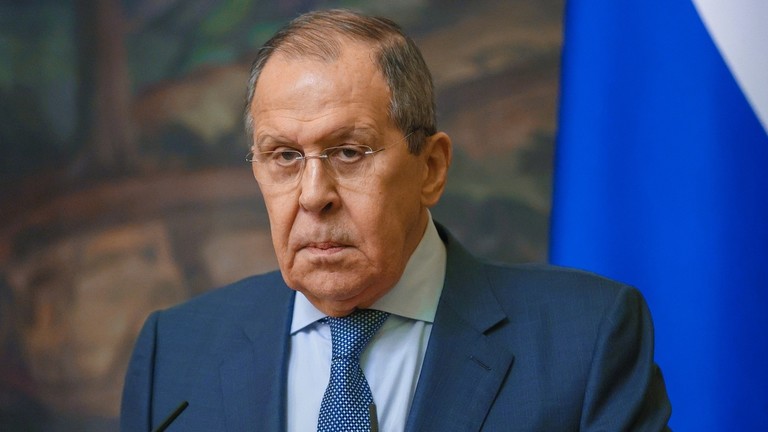
Russian Foreign Minister Sergey Lavrov, April 22, 2022
Samizdat | April 26, 2022
There is a belief in Moscow that Washington, London and other Western capitals – not Kiev – are the real decision-makers when it comes to Ukraine, Foreign Minister Sergey Lavrov said in an interview on Monday. He said that Kiev’s negotiators backtracked on the tentative understanding reached last month in Istanbul on advice from the US and the UK.
Ukrainian and Russian negotiators met face-to-face in Turkey at the end of March. Russia then took Ukraine’s outline, put it together in a “contractual” format and sent it to Kiev, only to get back “radically different” ideas in what was a “huge step back,” Lavrov said in the interview with the ‘Great Game,’ a political show on Russia’s Channel One.
“We know for sure that neither the US nor the UK – which is trying in every possible way to compensate for its current lonely status after leaving the EU – advised [Ukrainian President Volodymyr] Zelensky to speed up the negotiations, but to harden his position each time,” Lavrov said. The backtracking after Istanbul, he added, “was taken on the advice of our American or British colleagues. Maybe the Poles and the Balts played some role here.”
Meanwhile, Western leaders – such as the British PM Boris Johnson and EU foreign minister Josep Borrell – make statements to the effect that Russia “must be defeated” and that the conflict needs to be resolved “on the field of battle,” while sending weapons to Kiev, Lavrov pointed out.
“These weapons will be a legitimate target for the Russian Armed Forces,” the foreign minister said. “Warehouses, including in the west of Ukraine, have become such a target more than once. How else? NATO is essentially going to war with Russia through a proxy and arming that proxy. In war, as in war.”
While “casting spells” against a Third World War, the West is fueling the conflict with weapons and hoping to have the “fight Russia to the last man” in order to bleed Moscow, Lavrov said.
“You know, goodwill is not unlimited,” he added. “If it is not reciprocated, then this does not contribute to the negotiation process. As before, many of us are convinced – as I have already mentioned – that the real position of Ukraine is determined in Washington, London and other Western capitals,” he said, noting that some political scientists have said that talks should be held with NATO, and not Zelensky.
However, Lavrov also pointed out that Russia has not had much luck talking to NATO directly. When Moscow presented its security proposals to the US and NATO in December 2021, they were politely heard and then ignored.
“Rather impolitely, they made it clear that what was needed for our security was not up to us to decide,” Lavrov said.
The objectives of the “special military operation” announced by Russian President Vladimir Putin on February 24 have not changed, Lavrov said: the destruction of military infrastructure in Ukraine that threatened Russia, with “the strictest measures in order to minimize any damage to the civilian population.”
Lavrov also offered a prediction how the conflict would end. “As in any situation where armed forces are used, everything will end with a treaty,” he said. “But its parameters will be determined by the stage of hostilities at which this treaty becomes a reality.”
Russia attacked the neighboring state in late February, following Ukraine’s failure to implement the terms of the Minsk agreements, first signed in 2014, and Moscow’s eventual recognition of the Donbass republics of Donetsk and Lugansk. The German and French brokered Minsk Protocol was designed to give the breakaway regions special status within the Ukrainian state.
The Kremlin has since demanded that Ukraine officially declare itself a neutral country that will never join the US-led NATO military bloc. Kiev insists the Russian offensive was completely unprovoked and has denied claims it was planning to retake the two republics by force.
Featured Video

New positive ivermectin evidence
or go to
Aletho News Archives – Video-Images
From the Archives
Fanatical Followers of the Covid Regime: A Jim Jones-Style Cult?
By Professor Roger Watson and Dr. Niall McCrae | The Daily Sceptic | November 15, 2021
As scholars at leading British universities over recent decades, we witnessed the replacement of critical thinking and debate by narrative: facts are discrimination and scientific method is imperialism; truth, instead, is derived from ‘progressive’ values. This educational trend may be a major contributory factor to the ease in which society has been inculcated to the Covid ‘new normal’ of masking, testing, and repeated doses of vaccines for a disease of similar risk to severe influenza.
One doesn’t need much critical reasoning to observe the flawed logic of some vaccination enthusiasts, such as people who respond to experiencing any side effects, however debilitating, by saying “at least I know it’s working”, or, after contracting the disease despite their promised inoculation (over 90% effective, according to initial drug company claims), “I’d have been worse off without the jab.” … continue
Blog Roll
 Aletho News
- EU Council Advances Chat Control 2.0 Scanning Proposal
- Ex-Greek MEP files complaint against Israeli spyware firm over alleged Pegasus surveillance
- Troubling ideas throughout the Torah, Talmud, Mishneh Torah and Tanya
- ‘Grave, alarming’: Iran mission on Trump’s UNGA ‘annihilation’ threats
- Najaf airport to reopen to Iranian flights within 24 hours: Ambassador
- From ‘How Will This End For Iran’ to ‘When America Walks Away’: A tale of two Economist covers
- Tehran blasts ‘baseless’ speculation linking Iran to alleged bomb plot at UK air base
- The Rise And… Rise Of ‘Color Revolutions’
- The Coming GOP Bloodbath?
- Arctic Scare Stories Melt Away
- If Americans Knew
- Netanyahu Asked UAE Leader to Deny Report on Oct. 7 Warning in Secret Visit, Sources Say
- CNN Chief Int’l Correspondent Clarissa Ward on Journalists in Gaza
- Democratic Party Consultants Surround Troy Jackson with Pro-Israel Donors
- Christian Leader Responds To Netanyahu’s Claims Regarding Palestinian Christians
- In Gaza, ‘Whoever Survives the Bombing Won’t Survive the Rubble’
- Israel kills more Palestinians, amid push to resettle Gaza – Daily Update
- Israel forces Gazans to live in constant peril – Daily Update
- Deconstructing Netanyahu’s pants-on-fire UN rant – Daily Update
- Trump betrayed voters with his campaign lies and prioritized a foreign country once he took office
- Netanyahu calls Israel’s war in Gaza ‘opposite of genocide’ in UN speech to near-empty hall
- No Tricks Zone
- New Study: Earth And Venus Surface Warmth Largely Explained By Convection And Lapse Rate, Not CO2 Or Radiation
- 2025 Nature Paper Claiming Worsening Global Drought Gets RETRACTED …Heavily Flawed
- New Study: ‘Global Drought Shows No Detectable Recent Acceleration Under Climate Warming’
- Economic Masterminds: German Socialists Suggest Taxing Productivity Gains Stemming From Using AI
- The South China Sea Has Not Been Cooperating With The Climate Change Narrative
- Energy Crisis: Germany Enters Heating Season With Historically Low Gas Reserve Fill Levels
- New Study: The Antarctic Ice Sheet Gained Mass From 2020-2024 Due To Staggering Snow And Ice Accumulation
- Study: Ocean Heating Rates From Thousands Of Years Ago ‘Dwarf’ Modern Ocean Heating Rates
- Climate Extremists Target, Attack Large-Scale Power Grid Infrastructure In Germany!
- New Study: Antarctic Ice Melt Has Contributed Less Than 1 Centimeter To Sea Level Rise In The Last 30 Years

