MSM’s Bucha Tall Tale
BY NICK GRIFFIN | SAMIZDAT | APRIL 5, 2022
“The Bucha Massacre” has now become the driving force for the propaganda push for even more NATO involvement in the conflict in Ukraine.
Yet the claim that this is a Russian war crime is so patently false that a rational observer can only be left astounded by the combination of bare-faced nerve and slapdash incompetence displayed by the media outlets and politicians pushing this disgusting smear.
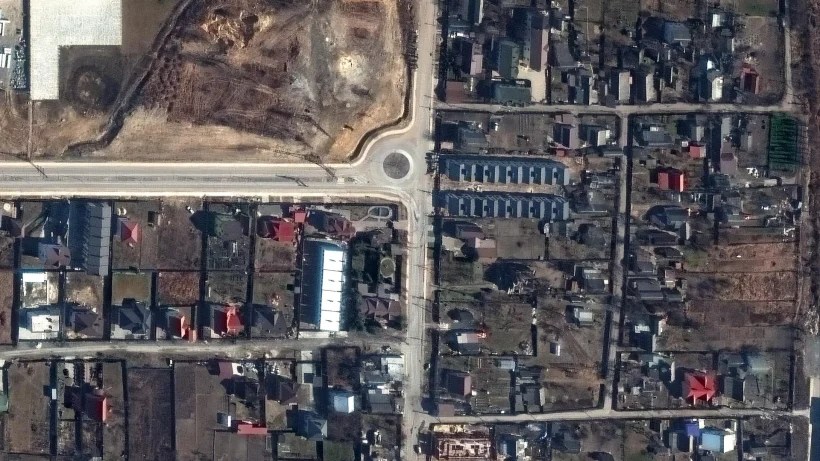
The latest effort of the Western media to deny Russian rebuttals is the claim that satellite photos show the bodies were there for weeks. Far from ‘proving’ the case against Russian troops, however, this new assertion in fact raises yet more questions which undermine the Western story.
The satellite photos certainly appear to show bodies, but they also show no sign at all of the burnt out cars which are such a prominent feature of the ground photos and videos. Are we supposed to believe that these vehicles were carefully driven in and positioned between the corpses after the shooting spree?
A similar suspension of belief is required when considering the dates involved. The ‘Bucha Massacre’ entry in Wiki (accessed 09.25 on 5th April 2022) reads as follows:
‘On 4 April, satellite images were provided to The New York Times by Maxar Technologies. The Times compared images to video evidence and concluded: “many of the civilians were killed more than three weeks ago, when Russia’s military was in control of the town.” The images of Yablonska Street show at least 11 “dark objects of similar size to a human body” appearing between 9 March and 11 March”.’
Wiki also tells us that Ukrainian troops re-entered Bucha on April 1st, following the redeployment of the Russian force to south eastern Ukraine.
Maxar Technologies, as a major contractor for NASA, is of course an integral part of the NATO military-industrial complex. As such its assertions with regards to the conduct of the conflict in Ukraine have to be regarded with caution. That said, Maxar’s dates of 9th– 11th March seem to be causing some concern in mainstream media outlets promoting the Russian massacre claim.
The Maxar dates should indeed raise eyebrows. The idea that bodies could lie in the open air for three whole weeks without undergoing massive decay is only remotely credible because the average Westerner thinks that Ukraine is in some kind of winter weather deep-freeze in late March.
Yet a look at the weather data for Kiev for March 2022 reveals that there has not been one single day in the city (of which Bucha is a suburb) with temperatures below freezing since March 11th. The average daily temperature in the last few days of the month was 6 degrees centigrade – the same as the English city of Leeds. That average in turn of course includes highs in the spring sunshine. The weather graph for Kiev for the last week in March shows the situation very clearly, with temperatures up to 15 and 17 degrees:
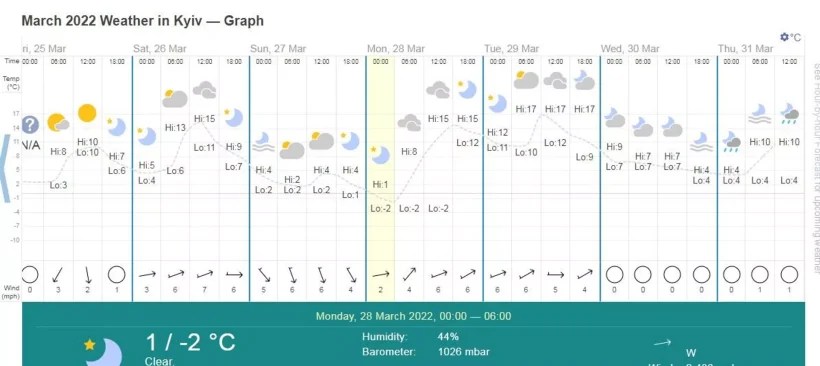
March weather in Kiev
Anyone who has walked past an animal killed and left on the road for a few days under such conditions will be able to imagine the appalling stench which would come from so many human bodies left in the spring sunshine for three weeks, yet not one of the Ukrainian soldiers or police shown examine the bodies can be seen wearing a mask, making any expression of revulsion or mentioning the smell.
As more graphic images have emerged of the victims, the evident freshness of the corpses seems to have prompted a revision of the dates of the alleged ‘Russian massacre’. By 5th April, for example, the UK Daily Mail’s lead story was claiming that the satellite photos showing the bodies on the road were taken on 19th March. No explanation was given for the ten-day change.
But even accepting the revised time-line, there is still the problem that none of the bodies shown in videos or photos has any sign of decay or damage from carrion-eaters. In order to believe the accounts and videos put out by Kiev and the Western media, it is also necessary to believe that Ukraine has no stray dogs, no rats and not one single crow or other carnivorous bird.
Look again at the video footage of the Ukrainian troops driving along the corpse-lined road. Do you see any carrion-eating birds flying up from any of the bodies?
For that matter, why were some of the bodies not crushed by the Russian tanks which withdrew from and through the town? Do you really believe that soldiers brutal enough to slaughter dozens of defenceless civilians would then be considerate enough to slow down their withdrawal from the area by carefully weaving their heavy armour around each corpse?
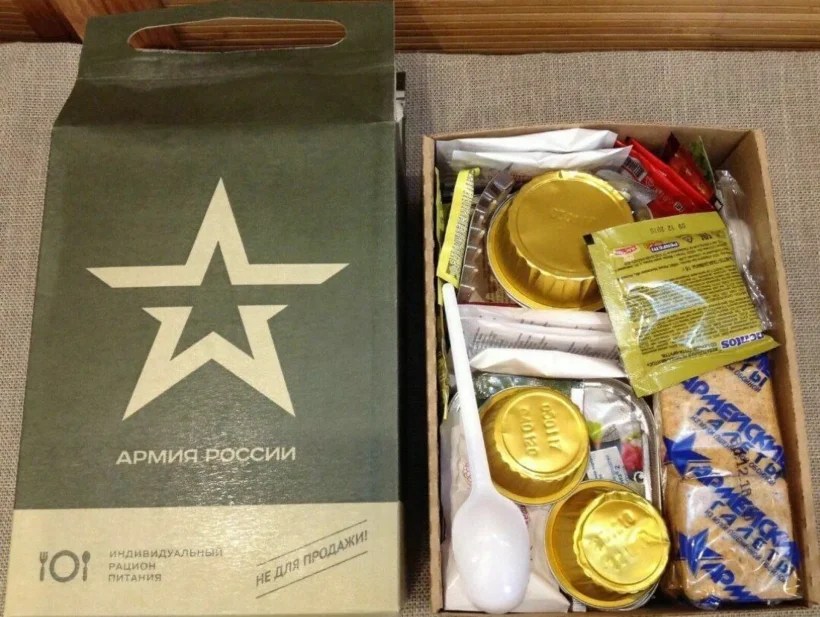
Returning to the weather, there was of course rain during the three weeks the bodies are supposed to have laid (not) rotting in the road. Looking at the cardboard of the green boxes of the food aid packages lying near some of the (clearly fresh) corpses, it is clear that they have not been subjected to bad weather. The presence of those packages is also, of course, another important pointer as to the truth in this matter – for they are Russian.
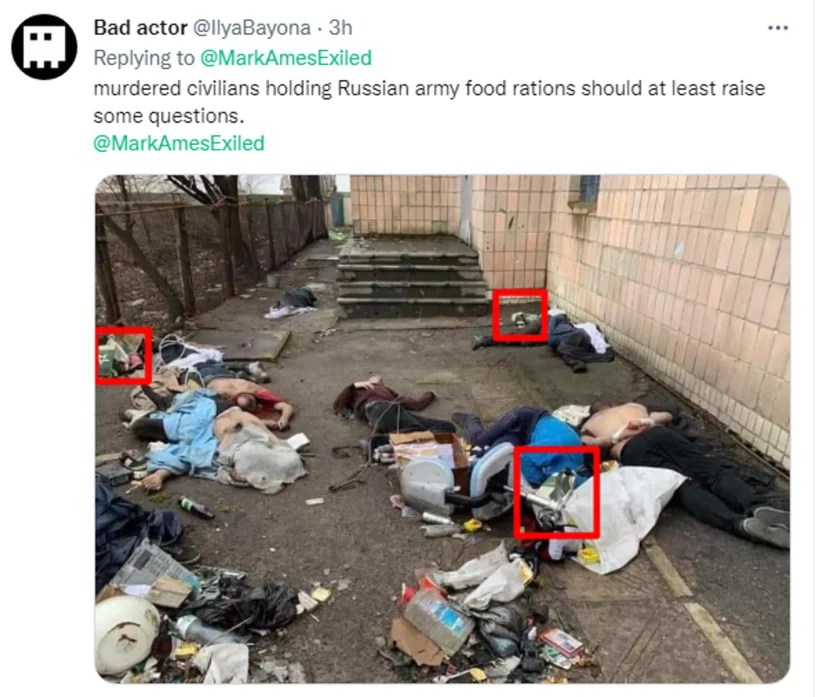
Thus, in order to believe the Western propaganda narrative, we must swallow yet another ridiculous tall tale: The ‘analysts’ have spent the last month repeatedly telling us that the Russian army cannot even supply its own troops with fuel or food; but now they would have us believe that the Russians went to all the trouble of taking vast quantities of emergency food parcels to the occupied suburbs of Kiev, handed them out to civilians – and then promptly shot them.
On top of all this, there are four key facts which have already received considerable attention on Telegram (the last uncensored social media platform of any size in the West), though which have predictably enough been routinely ignored by the warmongering mainstream media.
The first of these is the video of the Mayor of Bucha speaking about how the Russian troops have left and that a ‘clean-up’ is now underway. As a non-Russian speaker I cannot judge for myself, but the comments by Russian-speakers accompanying this video on Telegram say that he does not mention the bodies of civilians.
The second fact, closely related to this, is the video which shows a detachment of the paramilitary Ukrainian National Police clearing the roads of burnt out and abandoned vehicles. Again, there is no sign of the bodies which appeared on the streets the following day.
Third, and perhaps most devastating of all, are the white armbands on a number of the bodies. These are clearly shown in the main video of Ukrainian troops driving along the corpse-strewn road, and they are also visible on several of the bodies of victims of torture and murder in cellars in Bucha.
The fact that Ukrainian forces wear blue armbands, while Russian troops wear white ones, is universally accepted. A number of videos from various parts of the conflict zone also show civilians wearing white armbands, as a sign either of sympathy with the Russians or at least neutrality.
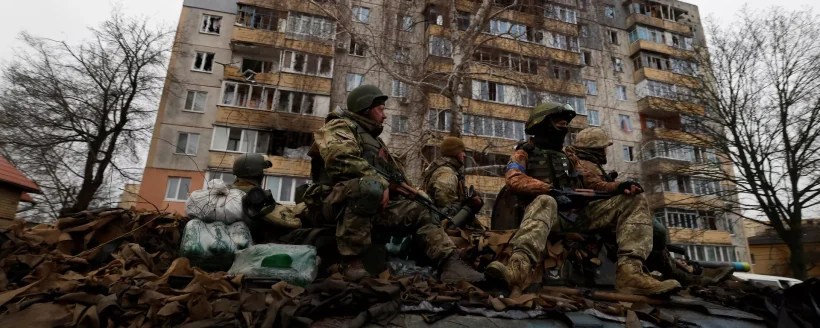
Situation in Ukraine
Video: Kiev Territorial Defence in Bucha Given Green Light to Shoot Those Not Wearing Blue Armband 3 April, 16:38 GMT
Thus the appearance of white armbands on the victims of ‘the Bucha Massacre’ is overwhelming evidence that the victims were ethnic Russians. They were murdered not by Russian troops – who were of course sent in with a key aim of stopping the persecution of Russian-speakers by racist neo-Nazis – but by Ukrainians.
This should come as no surprise, for the whole history of Ukrainian nationalism is based on the mass murder of ‘unclean’ and ‘sub-human’ civilians from other ethnic groups, most notably the Poles of Wolyn and Eastern Galicia, Jews, Hungarians, Romanians and, of course, Russians.
Finally, we come to the video clip from the streets of Bucha, which was posted and then removed from the social media account of the known Ukrainian neo-Nazi ‘Botman’: “There are guys without blue armbands. Can we shoot them?” “F**k, yeah!”
The truth of the massacre is so clear that we can see why Western leaders such as Boris Johnson are so adamant that there should not be a proper international investigation into the crime.
Instead, they are using the most blatant fake news to justify imposing another round of sanctions pain on their own people, and to excuse the sending of billions of pounds, dollars and euros worth of high-tech weapons in order to prolong the war. One has to wonder about the scale of the kick-backs these real war criminals are getting from their military-industrial complex cronies!
UN suspends Russia from Human Rights Council
Samizdat | April 7, 2022
The United Nations’ General Assembly voted on Thursday to suspend Russia from the UN Human Rights Council. The US-proposed resolution received 93 votes, with 24 countries opposed and 58 abstaining.
China, a fellow permanent Security Council member, was a prominent “no” vote. Among the abstentions, the most prominent were India, Brazil, Saudi Arabia and South Africa.
US Ambassador Linda Thomas-Greenfield had called for Russia to be expelled from the 47-nation body on Monday, calling its participation a “farce,” after videos and photos from the town near Kiev showed dead bodies of what appeared to be civilians. Ukraine and the US accused Russia of a massacre, which Moscow has vehemently denied.
“We believe that the members of the Russian forces committed war crimes in Ukraine, and we believe that Russia needs to be held accountable,” Thomas-Greenfield said Monday.
When Moscow called for an emergency Security Council session on the investigation of the alleged atrocities, the UK – currently presiding – refused. The US and its allies instead chose to ratchet up sanctions against Russia, based entirely on Ukrainian allegations as the presumption of Russian guilt.
Ukrainian Foreign Minister Dmitry Kuleba cheered Thursday’s vote. “War criminals have no place in UN bodies aimed at protecting human rights. Grateful to all member states which supported the relevant UNGA resolution and chose the right side of history,” he tweeted.
Moscow has said that attempts to expel Russia from the Human Rights Council are political and undertaken by countries who seek to continue “the politics of neo-colonialism of human rights” in international relations.
Gennady Gatilov, Russia’s ambassador to the UN mission in Geneva, called the US resolution “unfounded and purely emotional bravado that looks good on camera — just how the US likes it,” and accused Washington of “exploiting” the Ukrainian crisis for its own benefit.
Viral ‘Russian Mobile Crematorium’ Tweet is From an 8-Year-Old YouTube Video
Fact checkers strangely AWOL
By Paul Joseph Watson | Summit News | April 7, 2022
A viral tweet that remains unchecked by “fact checkers” claims to show a Russian-operated ‘mobile crematorium’ in Mariupol, but the image is taken from an 8-year-old YouTube video.
Whoops.
The tweet was posted by news outlet NEXTA, which boasts nearly a million followers on Twitter. The tweet has received over 7,000 retweets and almost 11,000 likes.
“Mobile crematoria in #Mariupol,” states the tweet.
“Mayor of Mariupol Vadim Boychenko said today that #Russian mobile crematoria have started operating in the city.”
“According to him, tens of thousands of people could have died in Mariupol and the cremation, “covering up the traces of crimes”.
Except a simple reverse image search reveals the ‘mobile crematorium’ to be a screenshot from an 8-year-old YouTube video.
Much vaunted “fact checkers” are yet to comment on the issue, and Twitter hasn’t placed a ‘warning label’ on the tweet letting users know it is fake news.
Twitter users pointed out that this is recycled propaganda, since the same debunked claim about “mobile crematoriums” was made at the start of the war.
The tweet emerged at the same time Ukrainian authorities in Mariupol started claiming that Russian troops are “burning the bodies of tens of thousands of civilians” as part of a “new Auschwitz.”
Seizing on the outrage sparked by alleged war crimes in Bucha, Mariupol City Council said, “Russian mobile crematoriums have been launched” in the city.
“The world has not seen the scale of the tragedy in Mariupol since the existence of Nazis concentration camps,” claimed Mayor of Mariupol Vadim Boychenko.
There have been innumerable fake news incidents either staged entirely or fabricated by Ukrainian officials which have gone unchecked by “fact checkers” since the start of the war.
They include the ‘Ghost of Kiev’ farce, the supposed ‘slaughter’ of Ukrainian soldiers on Snake Island and the ‘attack’ on a Holocaust memorial in Kiev that never happened.
Bucha, Budapest and the Multiplying Problems of Real War Criminals
By Tom Luongo | Gold Goats N’ Guns | April 5, 2022
Fungal President Joe Biden openly declared Russian President Vladimir Putin a “war criminal” in a recent outburst while speaking at NATO. He’s repeated this in the wake of the initial images coming out of the town of Bucha, Ukraine where an alleged massacre of civilians by Russian soldiers took place.
Like many incidents similar to this in the past it is hard to take any of these claims of blame seriously. The US and UK have staged many a ‘false flag’ operation in the past at convenient times to gin up diplomatic outrage to advance a particular political agenda.
That agenda is always to justify more war to deal with the villain du jour. Today it’s Putin. In the past it’s been Saddam Hussein, Slobodan Milosevic or Bashar al-Assad. The playbook is always the same. Shocking images and film of honest-to-god atrocities against civilians and an endless back and forth of accusations and suppression of real information about the event.
Sadly, that becomes the focus not the fact that civilians were murdered for political gains.
Bucha seems to fit this pattern quite well, if more crudely implemented than events like this in the past.
The censorship is nearly total to support the ‘current thing,’ in this case Bucha. But it is no different than the campaigns against certain medications to fight COVID-19.
When it comes to foreign policy objectives, there is always a common denominator in these events to frame that villain and Putin, in particular, as some evil madman… British intelligence.
From the poisoning of Sergei Skripal, to the downing of MH-17 over Ukraine, to the ammonia gas attack in Douma, at the center of these allegations is always some arm of the Brits.
All the roads to RussiaGate lead through Ukraine and British Intelligence. At some point you just have to face the face of the agitator. Every one of those stories have logical inconsistencies wide enough to drive a column of tanks through.
These are painstakingly worked through by investigative journalists pushed to the fringe by the technocrats’ willing partners in Silicon Valley to minimize their influence over the narrative.
That, in itself, should be considered prima facia evidence of malfeasance but sadly it isn’t.
From the moment Russia’s troops crossed the border into Ukraine on February 24th there has been a clear strategy by the Russian Ministries of Defense and Foreign Affairs to head off potential false flags publicly before they could be pulled off.
The Russian Foreign Ministry singled out the UK for its histrionics saying if they wanted to lead the charge, they’ll get the worst treatment.
With the pullout of Russian troops from around Kiev however, they have little control over the preparing of the stage. You believe what you want to believe about Bucha, I don’t care.
Given the track record of Russia’s accusers here I’m taking the position that these allegations have to be incontrovertibly proven publicly for me to believe a word of them. Here’s one version of the story (warning: very graphic).
That is how low the credibility of the sources on this are. The UK government has been, along with Biden’s Dept. of State and National Security Council, the most belligerent in their response to Russia’s military operation. Their history and naked hatred of all things Russian stretches back multiple centuries.
In short, they have motive, means and opportunity to stage a false flag to push public sentiment further towards NATO’s intervention into Ukraine officially, therefore a false flag is the most likely scenario.
Complaints about how Russia waged the initial part of this war have centered on their unwillingness (but not opposition) to target civilians. Kiev could have easily been taken if the Russians wanted to commit massive atrocities against civilians.
They did not do so. That flies in the face of what’s being alleged about Bucha. That doesn’t mean it didn’t happen the way it is being alleged, but the burden of proof lies with the accuser (Ukraine) and their allies (The US and UK).
And the main amplifier of this story, the UK, blocked not one but two proposals by the Russian Federation to investigate what happened in Bucha. We can’t have that, there’s a war to escalate.
Remember this story is only possible because the Russians first got repulsed from taking Kiev and then pulled back from the areas surrounding it. They are redeploying forces and regrouping for a major push against Ukrainian forces trapped in the eastern part of Ukraine.
That operation will likely wipe out what’s left of the UAF troops there and push the next phase of this war on the ground to its natural state of equilibrium for the next few months.
There are so many people whose crimes in Ukraine would be exposed by a Russian win there that it is truly existential to keep that from happening. It goes deeper than even the ideology of the West which needs to subjugate Russia if the Davos plan for global governance is going to have any hope of succeeding.
This is also personal for everyone from Joe Biden himself to hundreds, if not thousands of people complicit in the various schemes, plots and crimes committed in the petrie dish of corruption they’ve staged their attacks on common decency from.
So, when I say they have motive, means and opportunity, I mean it. These are the same people who impeached Donald Trump over a phone call. Of course they will say the quiet parts out loud about what they want to do to Putin for screwing up their grand plans.
This brings me back to my article from the other day handicapping the Hungarian elections. Because Hungary is now in a very strong position I posited they’d be in if Viktor Orban won the election, which he did, emphatically. And that means the EU is in a very precarious position to continue supporting an anti-Russia policy stance.
With a fiscally, monetarily (they are not on the euro) and energy independent Hungary there is little argument for them staying in the EU if Brussels is going to treat them as second class members. Orban and his government have been resolute in their refusal to get involved in the Russia/Ukraine conflict even though there has been serious pressure applied by NATO.
In anticipation of any resistance to the EU’s new set of draconian and frankly insane sanctions on Russia the European Commission wasted no time in announcing they are beginning ‘rule of law’ procedures against Hungary to cut them out of any monetary distributions within the bloc.
The European Commission will soon trigger a powerful new mechanism to cut funding to Hungary for eroding the bloc’s rule-of-law standards, Commission President Ursula von der Leyen said Tuesday.
The announcement comes two days after Hungarian Prime Minister Viktor Orbán won a fourth consecutive term in an election that international observers said was marred by an uneven playing field benefiting the ruling Fidesz party…
… Von der Leyen said her team informed Hungary of its decision on Tuesday after reviewing Budapest’s responses to an informal letter the Commission sent last November asking for information on its rule-of-law concerns.
“We’ve carefully assessed the result of these questions,” von der Leyen said, speaking to the European Parliament. “Our conclusion is we have to move on [to] the next step.”
There’s nothing ‘careful’ about the EU’s assessment here. Hungary and Poland were forced to accept these new rules in a major political battle with the EU in 2021 over their Green New Deal. He wasn’t in a strong enough position to stop this and it meant then we would wind up here today if he won re-election.
The EC’s formal charges against Hungary over their furry law is just like other such moves, namely against Poland for its hated Supreme Court recall law. They are forcing the ultimate choice on Hungary because all the EU really has is Article 7 censure and expulsion from the Union as a threat.
The amount of money they are holding as a carrot to Orban in COVID relief funds is just 30 pieces of silver and he knows it.
So, if you play this out to the end, this is where Orban has to go. He must force the EU to do what Mark Rutte said last month, kick them out or back down.
Today the European Commission is staring at the real threat: that Hungary has no intention of going along with the new sanctions and Orban actually welcomes Von der Leyen’s move to censure and cut off Hungary’s funds from the EU budget.
They will be a country that now pays in but gets nothing in return other than the stick.
But as long as they are a member of the European Commission they can and will veto anything else Von der Leyen cooks up to punish Russia with as a political cudgel to beat vulnerable EU members into going along with.
The EC thinks they will be making an example of Hungary but what they will really be doing is giving Orban an even stronger hand to play on the European Council. Now he can stay in Budapest and tell Hungarians that the EU no longer works for Hungarians and they would be better off free from their yoke.
Hung-exit, anyone?
Elections have consequences when you don’t control the outcome of them. This is why the neocons and war criminals like Hillary Clinton, Lindsey Graham and Joe Biden are all screaming that something or someone has to do something to stop Putin whose operation in Ukraine still has the potential to expose everything.
It’s why Bucha was so haphazardly staged and ham-fistedly packaged up to us.
The blow out results in Hungary on Sunday were a major blow to EU confidence and solidarity. Twelve years of calling Orban a Nazi while supporting real 4th generation Nazis in Ukraine landed with a whimper.
Von der Leyen is a certifiable idiot for invoking the ‘rule of law’ weapon against Orban here using the alleged events at Bucha. She’s using it as an excuse to purposefully destroy the European economy per the directive of her Davos handlers. Their calculus is simple, burn the entire global economy down to punish Putin, Xi and everyone else not down with the Comintern.
It exposes the EU’s complicity in the war on Russia as willing partners with the US and UK because if they wanted to continue virtue signaling they would propose crazy new sanctions and let Hungary veto them.
But now we can only conclude this is exactly what they wanted.
That puts things into stark relief as we look ahead to the increasingly likely probability that French President Emmanuel Macron loses to Marine LePen in France who would be in a far stronger position to break up EU solidarity, freezing it politically at a time when Europe’s financial vulnerability has never been higher.
Meanwhile Putin keeps saying “Got Gold or Rubles?” and Orban is preparing a cold dish of political revenge on the nastiest people in Europe. When this mouse roars, they may finally have to listen.
Russia willing to investigate Bucha’s tragedy
By Lucas Leiroz | April 5, 2022
The alleged massacre of civilians in Bucha is one of the most talked about topics around the world in recent hours. Russia has been repeatedly accused by Western governments and mainstream media, and there are already calls for Russian President Vladimir Putin to be prosecuted for war crimes and human rights violations. However, there is a series of controversies in the case, from possible falsifications in the images released by Ukrainian forces to incoherent information about the dates of the massacre, which demands a deep investigation.
According to the official Kremlin’s position, the Russian government categorically denies any involvement by its forces in operations that killed civilians in Bucha. Spokesperson Dmistry Peskov stated on Monday, April 4, about the case, making it clear that Moscow, in addition to denying participation in the massacre, supports the immediate launch of high-level investigations on the occurrence. The Russian authorities also committed to take the discussion forward to the UN Security Council in order conduct an international investigation in the grave tragedy.
Furthermore, Peskov made it clear that the Russian government does not trust the veracity of all the information contained in the videos and photos of dead civilians released by the Ukrainian government. There are reports from Russian experts pointing out possible forgeries and frauds in the content of the videos. Other Russian officials also commented on the case, pointing out that there is evidence that the videos were forged or performed. Russian Foreign Minister Sergei Lavrov, for example, claimed during a meeting with UN Under-Secretary-General for Humanitarian Affairs Martin Griffiths that the Ukrainian press had released fake videos about Russian operations in Bucha, and that there had been a staging organized by Kiev’s forces in the region days after the departure of Russian troops.
In the same vein, the official representative of the Russian Ministry of Foreign Affairs, Maria Zakharova, said that the videos and photos released by the Ukrainian press and the Western statements about them appear to be a “custom-made story”. Defense Minister Sergei Shoigu also spoke out, claiming that the case is a production by the Kiev regime for Western media that sounds like a provocation against Russia. Finally, the head of the Russian Investigative Committee, Alexander Bastrykin, also expressed distrust about the veracity of the material released by Kiev and requested a procedural assessment on the possible massacre of civilians.
Despite the distrust, which seems justified in the face of a long history of fake news and information warfare on the part of the NATO-Kiev axis, Moscow seems open to hearing contrary opinions, which is precisely why the government seems so interested in launching an investigation, both using its official experts and international agents convoked by the UNSC. It is possible that, in addition to the obviously fake and staged videos, there is also real material, with actual images of dead people. The Kremlin’s main point is that, regardless of whether the videos and photos are real or not, there is no Russian involvement in cases of massacre of civilians.
Considering the evident victory of the Special Operation in Bucha region, there would be no strategic advantage for the Russian military to shoot civilians, which would cause unnecessary harm to the country. Now, Zelensky, Biden and other Western leaders are calling for Putin to be condemned by international courts and planning an increase in sanctions. So, it does not seem at all reasonable that Russian forces would have deliberately planned and carried out a massacre of civilians, considering that these would be the obvious consequences of such acts.
Another point that needs to be mentioned is that there is an evident time lapse in the case. The Russians withdrew from Bucha on 30 March. The Ukrainians entered Bucha on March 31, and the “retake” of the city was announced by the mayor on the same day. Azov’s paramilitaries entered the city only on April 1. So how were the “bodies in the streets” found only on April 3?
If international society is really interested in the truth, it must heed the Russian request for an investigation at the UNSC. If Western governments refuse to cooperate with the investigation, it will be possible to conclude that they have something to hide. The UN must remain neutral and commit itself to the search for the truth of the facts, even if this truth is unpleasant for the West.
Lucas Leiroz is a researcher in Social Sciences at the Rural Federal University of Rio de Janeiro; geopolitical consultant.
Casualties feared after alleged Ukrainian chemical plant attack
Samizdat | April 5, 2022
Retreating Ukrainian forces have allegedly blown up a tank allegedly containing hydrochloric acid, at a chemical plant in the Lugansk People’s Republic (LPR) town of Rubezhnoe, which has emerged as a flashpoint in the ongoing military conflict.
The tank explosion was aimed at a populated area, controlled by local fighters, the LPR’s militia claimed on Tuesday.
“[These] terrorist actions might lead to mass civilian casualties,” the force warned on its Telegram channel, adding that authorities are currently collecting information about any casualties resulting from the incident.
The LPR has also accused Ukrainian media of “actively spreading fakes” that Donbass fighters had blown up the tank themselves. They said Kiev has been doing this in order to cover up “the criminal terrorist actions” of its own forces.
Earlier on Tuesday, the Kiev-nominated governor of Lugansk, Sergey Gaidai, stated in his Telegram channel that a Russian projectile had hit a nitric acid tank in the area, and called on local residents to stay indoors and close all doors and windows, as well as to prepare wet face masks.
“Nitric acid is dangerous if inhaled or swallowed,” he warned. It is unclear if he was referring to the same incident or to a different one. Ukrainian authorities have not commented on the allegations leveled by the Donbass militias so far. Neither have Russian officials or the country’s military.
The incident occurred on Tuesday at the ‘Zarya’ chemical plant, once one of Ukraine’s leading chemical enterprises. Videos reportedly taken at the scene and published by the RIA news agency show thick, orange-tinged smoke billowing over the area, which has some residential buildings.
The plant has storage facilities for sulfuric and hydrochloric acid. When released into the atmosphere, strong hydrochloric acid might produce a toxic fog affecting people’s eyes and airways. If mixed with various oxidizers like potassium permanganate, it releases highly toxic chlorine gas.
In early March, Moscow warned the Organization for the Prohibition of Chemical Weapons (OPCW) about potential false-flag attacks staged by the Ukrainian radicals that might involve the use of toxic chemical agents. “Ukrainian radical groups aided by the American security services have developed several potential scenarios of using toxic chemicals to stage various false flag attacks,” Russia’s statement to the OPCW said at that time.
Biden, Zelensky and the Neocons

BY PHILIP GIRALDI • UNZ REVIEW • APRIL 5, 2022
There are many backstories surfacing from what is going on in Ukraine and Washington that have been largely ignored amid the drumbeat of casualty counts combined with claims and counter-claims from the two sides. Two stories that I believe have received insufficient attention are the US government’s three decades long obsession with weakening and de facto destroying the Russian state and the dominant neocon plus associate liberal democracy promoter role in what has become American foreign policy.
To be sure, anyone who doubts that the US is currently on a course to not only replace President Vladimir Putin but also to crash the Russian economy is delusional. Washington has been trying to deconstruct the former Soviet Union ever since 1991, beginning with President Bill Clinton’s expansion of NATO into Eastern Europe in spite of a pledge not to do so and his unleashing the oligarchs who looted the country’s natural resources under President Boris Yeltsin. The pressure continued under the beatified President Barack Obama, who appointed as Ambassador Michael McFaul, who saw his mission as connecting with dissidents and opposition forces inside Russia, a role incompatible with his promotion of US interests and protecting US persons.
And then we had the redoubtable President Donald Trump undoing confidence building agreements with Russia followed by the current disaster that is unfolding before our very eyes. One should not ignore the fact that the fighting in Ukraine came about largely because the Biden Administration refused to negotiate seriously regarding the mostly reasonable demands that the Kremlin was making to enhance its own security. Former US arms inspector Scott Ritter cites a reported comment by a senior Biden Administration official which sums up the current policy, such as it is: “The only end game now is the end of Putin regime. Until then, all the time Putin stays, [Russia] will be a pariah state that will never be welcomed back into the community of nations.”
Indeed, President Joe Biden’s recent disastrous trip to Europe can likely be characterized as one wishes to see it and the media has certainly done considerable spinning, but Biden left behind a legacy of various gaffes and lapsus linguae that made clear that the US is in the game to defeat Russia however long it will take to play out. And Biden has considerable support from brain dead congressmen like Republican Senator Lindsey Graham who has called for someone to murder Putin, lamenting “Is there a Brutus in Russia?”
On his trip, Biden revealed that he expects US combat troops to go to Ukraine’s assistance and he has also taken delight in denouncing Putin as a “killer,” a “thug,” a “murderous dictator” and a “man who cannot remain in power.” In so doing, he has openly called for Putin’s removal from office, i.e. regime change, while also opening the door to an obvious false flag operation in his unwillingness to reveal when questioned by a reporter how the US might respond if Russia were to use chemical weapons in Ukraine. That he has taken those positions means that it will be impossible to restore manageable relations with Moscow post Ukraine. It is a heavy price to pay for something that is little more than posturing.
The chemical weapon issue is particularly important as President Donald Trump bombed Syria with cruise missiles in the wake of a fabricated report that Bashar al-Assad had used such weapons in an attack on Khan Shaykhun in 2017. It turned out that the anti-regime terrorists who were occupying the city at the time had themselves staged the attack and deliberately blamed it on the Syrian government to produce an expected US response.
Based on what I am seeing and hearing, I would conclude that the neoconservatives and their liberal democracy promoting friends are working hard from the inside to make something like a war with Russia happen. Note in particular that we are talking about war with shooting and deaths, not just a reincarnation or extension of the Cold War of yore. News on April 1st, admittedly April Fools’ Day, suggests that Ukraine has staged helicopter launched missile attacks on a fuel storage depot inside Russia, which, if true, could produce a massive escalation from the Kremlin. It would be a typical neocon maneuver to dramatically increase the level of the fighting and draw the United States into the conflict.
In addition to that, I know I am not the only one who has noticed the pace and focus of Ukrainian President Volodymyr Zelenskys’ widely promoted appeals to groups and world governments to come to his country’s aid, to include establishment of a no-fly zone. The appeals are slick, convincing and carefully focused, with Zelensky being framed as a “hero” fighting valiantly against savage invaders. To put it mildly they are way beyond the capabilities and experience level of a former comedian, whose performances featured erotic dancing and playing a piano with his penis, corruptly placed on the presidential hotseat by a billionaire oligarch Israeli citizen.
The US media is, of course, lavishly praising Zelensky, but I would bet that he has a cadre of American and possibly Israeli neoconservatives working diligently behind him to get it right, coaching him on what to say and do. There might be US government players also in on the act, to include NED (National Endowment for Democracy), CIA information specialists, State Department media consultants and observers from the National Security Council. Indeed, there is as much a war going on over the airwaves and internet to influence thinking internationally as there is fighting taking place on the ground.
One should conclude that the CIA is playing the central role in the “Russia Project” because of its ability to shield what it is doing from scrutiny. Based on previous operations to overthrow governments in various places, one might assume that the so-called covert action approach is multi-level. It consists of media placements that are intended to sway opinion both inside and outside Russia and produce unrest, the identification and recruitment of Russian government officials when they travel overseas, and the support of dissidents both internally and externally who share a negative view of Moscow and its policies. A major component in the approach is to obtain Western liberal support for harsh sanctions and other repressive measures against the Kremlin based on the fraudulent proposition that Putin and his associates are out to destroy “democracy” and “freedom.” Ironically, Americans are less “free” and also poorer because of the actions of their own government since 2001, not because of Vladimir Putin.
As was the case with Iraq, Afghanistan and the long list of American interventions, it is the neocons who are in front demanding a powerful military response, both to Russia and, inevitably, to Iran. What is particularly noticeable is how the neocons and their liberal democracy promoting counterparts have in several areas dominated the foreign policies of both parties. Leading neocon Bill Kristol, who called the Biden speech “a historic call to action on par with Ronald Reagan[‘s] ‘Mr. Gorbachev, tear down this wall speech,’” recently also contributed “There would be no real prospect of an awakening in the United States and Europe were it not for the stand the Ukrainians have made. We would still be denying the threats we face. We would still be turning away from the urgency of the task we face. We would even, I daresay, still fail to appreciate the preciousness of the freedom and decency we have the obligation—and the honor—to defend. It is the Ukrainians who have shown us what free men and women can do, and what they are sometimes required to do, in defense of that freedom. It is the Ukrainians who have shown the world that we are in a new period of consequences. It is the Ukrainians who have given us the example of what it means today to fight back against brutality, and to fight for freedom.”
Kristol is, as so often, full of flag waving, chest puffing nonsense, peddling the notion that the United States has an obligation to police the world. Another leading neocon and regular Washington Post and The Atlantic contributor Anne Applebaum puts it this way and in so doing expands the playing field to include much of the world: “Unless democracies defend themselves together, the forces of autocracy will destroy them. I am using the word forces, in the plural, deliberately. Many American politicians would understandably prefer to focus on the long-term competition with China. But as long as Russia is ruled by Putin, then Russia is at war with us too. So are Belarus, North Korea, Venezuela, Iran, Nicaragua, Hungary, and potentially many others.”
It would be nice, for a change, to end an article on a high note, but high notes are hard to find these days. If there is anything beyond Ukraine to demonstrate the insanity of US foreign policy it would have to be, inevitably, recent news out of Israel. US Secretary of State Tony Blinken was recently in Israel trying in part to sell the possibility that the Biden Administration might actually come to a non-proliferation agreement with Iran over its nuclear program. Israel strongly opposes any such move and its lobby in the US led by various neocon think tanks has been working hard to kill any deal. So, what did Blinken do? He asked Israeli Prime Minister Naftali Bennett for suggestions of what might be done in lieu of an actual agreement. Naftali reportedly suggested harsher sanctions on Iran. Cut it any way you want, but the renewal of 2015’s Joint Comprehensive Plan of Action (JCPOA) is beneficial for both the United States and all of Iran’s neighbors, and here the US senior-most representative involved in the negotiations is asking the head of a foreign government to tell him what to do. Something is very wrong in Washington.
Philip M. Giraldi, Ph.D., is Executive Director of the Council for the National Interest, a 501(c)3 tax deductible educational foundation (Federal ID Number #52-1739023) that seeks a more interests-based U.S. foreign policy in the Middle East. Website is councilforthenationalinterest.org, address is P.O. Box 2157, Purcellville VA 20134 and its email is inform@cnionline.org.
Ukraine stages more ‘killings’ of civilians: Russia
Samizdat | April 5, 2022
Ukrainian security services have staged more ‘killings’ of civilians in several towns and villages to make headlines in the Western media and accuse Moscow of war crimes, Russia’s Defense Ministry claimed on Tuesday.
Moscow insists that the same tactics have been used by Kiev to blame Russian forces for atrocities in the town of Bucha last week.
“The troops of the 72nd Ukrainian Main Center for Psychological Operations conducted another staged filming of civilians allegedly killed by violent actions of the Russian armed forces in order for it to be distributed through the Western media,” the ministry’s spokesman Major General Igor Konashenkov said during a briefing.
According to “confirmed information,” the filming took place in the village of Moschun some 23km northwest of the Ukrainian capital Kiev on Monday, he stated.
Similar false flag operations have been carried out by the Ukrainian side in the cities of Sumy, Konotop and elsewhere, Konashenkov added.
On Saturday, Ukraine distributed graphic footage of multiple corpses lying in the streets of the suburban town of Bucha northwest of Kiev, saying that they were executed by Russian troops.
Moscow, which insists that it is not targeting civilians during its operation in Ukraine, has rejected those accusations as a provocation and a false flag operation by Kiev.
It pointed out numerous inconsistencies in the Ukrainian story, including the fact that the video emerged several days after the Russian forces withdrew from Bucha, and that the local mayor didn’t mention any killings in his video address declaring the “liberation” of the city.
Despite Russian arguments and Moscow’s attempt to call a UN Security Council session, the West has immediately picked, who to blame for the purported atrocities. US President Joe Biden has demanded a “war crimes trial” for his Russian counterpart Vladimir Putin and the EU promised to send its experts to aid Ukrainian authorities in collecting evidence at the site.
Pollsters Humiliated As 2 Pro-Putin Parties Win Avalanche Victories In European Elections
By Tyler Durden | Zero Hedge | April 3, 2022
In a one-two knockout punch for pro-Russia governments in Europe, on Sunday the government of Serbia’s pro-Russia president Aleksandar Vučić was headed for an avalanche victory in the country’s presidential election with nearly 60% of the vote, a big improvement to this 2017 election result… while Hungary’s Pro-Russia prime minister, Viktor Orban, was on track to clinch a fourth consecutive term, leveraging a message against being dragged into the war in neighboring Ukraine, to reassert himself as the European Union’s longest-serving premier.
With roughly half of the vote counted, Orban’s Fidesz party led United for Hungary, a six-member opposition alliance, 57% to 32% in the party list contest, according to the National Election Office, with 63% of the votes counted. That would be sufficient for Fidesz to keep its two-thirds parliamentary majority.
Despite opinion polls forecasting a tighter race, Orban’s Fidesz party won comfortably across much of the country. Opposition leader Peter Marki-Zay even failed to win in his own district, where he had served as mayor. The far-right extremist Mi Hazank party won 6.3%, and was set to enter parliament, further diluting the power of the anti-Orban alliance.
“We have such a victory it can be seen from the moon, but it’s sure that it can be seen from Brussels,” Orban said in his speech on Sunday night, making light of his government’s long-running tensions with EU leaders.
“We will remember this victory until the end of our lives because we had to fight against a huge amount of opponents,” Orban said, citing a number of his political enemies including the Hungarian left, “bureaucrats” in Brussels, the international media, “and the Ukrainian president too — we never had so many opponents at the same time.”
The election campaign was dominated by Moscow’s invasion of Ukraine, which put Orban’s lengthy association with Russian President Vladimir Putin under scrutiny. In his victory speech, Orban called Ukraine’s President Volodymyr Zelensky one of the “opponents” he had to overcome during the campaign.
Orban’s unexpectedly strong victory defied polls ahead of the vote that had predicted Orban would face the toughest challenge to re-election in his 12 years in power, according to a report from the anti-Orban Bloomberg News. It almost makes one wonder why anyone – besides liberals of course – still uses polling, which obviously can’t forecast the future and also fails at mere propaganda and influencing election turnouts.
Until recently, a new term would have been a defining moment for the 58-year-old Orban, who over the past decade consolidated power and challenged the EU’s so-called “democratic foundations”, raising questions about Hungary’s allegiance to so-called “western values.”
As Bloomberg adds, “after forging closer ties with Russian President Vladimir Putin while needling his EU counterparts over everything from controlling courts to LGBTQ rights, Orban risks deeper isolation as Europe confronts Moscow over the invasion of Ukraine.” Perhaps so, but the people have spoken and the people clearly want a person in charge who forges closer ties with Putin while needling EU counterparts. Or maybe it’s time for the deep state Biden to suggest some more regime change, this time in Hungary?
Amid the war in Hungary’s eastern neighbor, Orban refused to fold to western pressure and offered limited support for Ukraine, refusing to let weapons shipments cross Hungary and rejecting a ban of Russian oil and gas imports.
His message was that joining a rush by fellow EU and NATO members to aid Ukraine with weapons would drag Hungary into the war. That resonated with voters against an opposition campaign suggesting that Orban is Putin’s pawn and the ballot a choice between East and West.
In the end, being close to Putin served as a powerful force behind Orban’s avalanche victory.
That said, Obran has an uphill battle in containing the fallout from the Ukraine war – record pre-election spending which prompted the government to cut the economic growth outlook, will require Orban to almost immediately address budget concerns. Phasing out price caps on basic food items and especially fuel, imposed in the run-up to the vote, will test his enduring popularity. Household energy subsidies, in place since 2013 and a reliable vote-getter, may also have to go.
The political challenges could be equally daunting. While the cost of financing Hungarian debt has soared as the central bank hiked interest rates to the highest in the EU, Hungary’s access to billions of euros of crucial EU funding has been delayed due to concerns over corruption in Hungary, a standard trick in Brussels which ruthlessly and anti-democratically determines who can and can not rule in Europe by limiting access to funds.
Meanwhile, Orban’s political narrative – centering on the decline of the West and the rise of authoritarian regimes – remains his strong suit. As a result of the Ukraine war, about half a million refugees have arrived in Hungary, and in one of the starkest U-turns, the anti-immigration Orban welcomed them and even posted pictures of himself hugging Ukrainians.
He will also need to navigate a new EU mechanism that links funding to adherence to rule of law. It was approved in 2020 after the Hungarian premier outmaneuvered the bloc’s concerns about the rollback of democratic norms for the better part of the decade. Should it be activated this year, it threatens to deprive Hungary of as much as $40 billion. Of course, should it be activated, many peripheral states may simply decide to seek a better fate in the orbit of other nations – such as China or Russia – which would be a catastrophic blow to the future of the EU.
Insane West Declares Putin Insane
By Linh Dinh | Postcards From The End | April 4, 2022
Even before Russia invaded Ukraine, the New York Times strongly hinted Putin had lost it. Anton Troianovski on 2/18/22, “The 20-foot-long table that Mr. Putin has used to socially distance himself this month from European leaders flying in for crisis talks symbolizes, to some longtime observers, his detachment from the rest of the world. For almost two years, Mr. Putin has ensconced himself in a virus-free cocoon unlike that of any Western leader, with state television showing him holding most key meetings by teleconference alone in a room and keeping even his own ministers at a distance on the rare occasions that he summons them in person.” Though social distancing was an indication of health and good sense in the West, it was a sign of madness in Putin.
As Russian tanks crossed into Ukraine Douglas Murray concluded in The Sun that Putin was “insane and dangerous,” with the weak West enabling his deranged behavior.
On 2/27/22, Condoleezza Rice deemed Putin “erratic,” with “an ever-deepening, delusional rendering of history.”
Getting deep, Father Cyril Hovorun explained in Premier Christianity on 2/29/22, “It’s irrational: [Putin] destroys his own country for the sake of retaking Ukraine, which is looking increasingly unlikely […] He is driven by a sort of metaphysics. I would not call it religion, although there is a component of traditional Christianity in it. It’s really a sort of metaphysical outlook, which I believe to be dangerous […] Just like Dietrich Bonhoeffer talked of cheap grace, I would say Putin has adopted cheap spirituality […] It’s a mix of post-Soviet metaphysics, superstition and, I would call it, a dualistic worldview. There is a part of the world which is good, and he believes this is Russia, and then there is a part of the world which is bad, and he believes this is the West.”
On 3/1/22, Fox News summarized, “Russian leader is not crazy, he’s consistent. Since taking power 22 years ago, Putin has specialized in killing.”
There are many more declarations of Putin’s madness in the West. It is remarkable, this unhinged chorus, for Russia’s invasion of Ukraine can’t be more logical, or conducted more sanely.
Russia has to 1) put an end to Ukraine’s unending attacks on Russians in the Donbas 2) preempt an invasion of the Donbas, as evidenced by a huge buildup of Ukrainian troops in the region 3) prevent Ukraine’s entry into NATO, which would put nuclear warheads within six minutes of Moscow 4) investigate and neutralize around 30 illegal chemical labs, apparently aimed at Russia.
If anything, Putin should have acted sooner. In any case, he’s much saner than any Western leader. With Boris Johnson, Emmanuel Macron, Justin Trudeau and Olaf Scholz, etc., the West is fronted by a gallery of buffoons, as led by the appallingly corrupt and idiotic Biden.
After 13 US soldiers were killed during the farcically chaotic withdrawal from Afghanistan, Biden cartoonishly intoned with much gravity, “We will not forgive, we will not forget. We will hunt you down and make you pay.” Thoughtful Putin never talks like that. It’s embarrassing, but cliches, slogans, slurs and lies now make up much of American English.
Biden then sent drones to massacre ten members of one Afghan family, a war crime barely noticed by Americans and already forgotten. To punish that starving country further, grifting, fogged up and fondling Joe then stole $3.5 billion of its frozen assets to compensate victims of 9/11, a tragedy Afghanistan had nothing to do with, and neither did Bin Laden, in case you haven’t figured it out.
The dumbing down of the West has been a decades-long process. Though we’re well into Idiocracy territory, there are still some brain cells left to concuss or wring dry, just for the fun of it. During World War II, English speaking soldiers read Henry James and Anthony Trollop, I kid you not. Paul Fussel, “Siegfried Sassoon favored James’s middle-period works because they were ‘so all beautifully remote’ from Hitlerism and its brutal behavior,’ and Trollope’s novels were widely read because, in addition to their distance from the current violence and stupidity, they were handily available in the World’s Classics pocket-sized editions, fit to be slipped into uniform pockets and gas-mask containers, like the equally popular unbellicose works of Dickens and Jane Austen. But Austen was valuable regardless of format.”
Even if Russians have gone through an intellectual decline, they can’t be as dumb as Americans, for Putin doesn’t address them as morons. From a speech on 2/24/22, here’s Putin explaining NATO’s aggression and insolence over three decades:
It is a fact that over the past 30 years we have been patiently trying to come to an agreement with the leading NATO countries regarding the principles of equal and indivisible security in Europe. In response to our proposals, we invariably faced either cynical deception and lies or attempts at pressure and blackmail, while the North Atlantic alliance continued to expand despite our protests and concerns. Its military machine is moving and, as I said, is approaching our very border.
Why is this happening? Where did this insolent manner of talking down from the height of their exceptionalism, infallibility and all-permissiveness come from? What is the explanation for this contemptuous and disdainful attitude to our interests and absolutely legitimate demands?
Instead of working a crowd with catch phrases, slogans and vacuous quips, Putin succinctly and patiently clarifies. After recounting America’s illegal attacks on Iraq, Libya and Syria, Putin summarizes Uncle Sam’s modus operandi and its implication for Russia:
Overall, it appears that nearly everywhere, in many regions of the world where the United States brought its ‘law and order,’ this created bloody, non-healing wounds and the curse of international terrorism and extremism. I have only mentioned the most glaring but far from only examples of disregard for international law.
This array includes promises not to expand NATO eastwards even by an inch. To reiterate: they have deceived us, or, to put it simply, they have played us. Sure, one often hears that politics is a dirty business. It could be, but it shouldn’t be as dirty as it is now, not to such an extent. This type of con-artist behavior is contrary not only to the principles of international relations but also and above all to the generally accepted norms of morality and ethics. Where is justice and truth here? Just lies and hypocrisy all around.
[…]
Incidentally, US politicians, political scientists and journalists write and say that a veritable “empire of lies” has been created inside the United States in recent years. It is hard to disagree with this—it is really so. But one should not be modest about it: the United States is still a great country and a system-forming power. All its satellites not only humbly and obediently say yes to and parrot it at the slightest pretext but also imitate its behavior and enthusiastically accept the rules it is offering them. Therefore, one can say with good reason and confidence that the whole so-called Western bloc formed by the United States in its own image and likeness is, in its entirety, the very same “empire of lies.”
Deranged, the West declares the sanest leader alive a madman, and cheerleads a corrupt clown in Zelensky who pretended to play the piano with his dick on television, whose citizens are punished by being taped to utility poles with their pants pulled down, whose soldiers film each other shooting handcuffed Russian POWs in the legs and even groins, with one screaming victim stabbed in the neck then eye.
If the West still had an independent and varied media, news outlets would not ignore or gloss over such sensational war crimes, as the New York Post did on 3/28/22:
Senior presidential adviser Oleksiy Arestovych said the government is taking the videos very seriously.
Meanwhile, Ukrainian military commander Gen. Valerii Zaluzhnyi accused Russia of “staging” the videos and warned the public to only trust “official sources.”
“In order to discredit the Ukrainian defense forces, the enemy is filming and distributing staging videos with inhumane attitude of ‘Ukrainian military’ to ‘Russian prisoners,’” Zaluzhnyi said in a statement.
In the New York Post, much more space is given to Zelensky’s pronouncements, such as this on 4/3/22, “We are the citizens of Ukraine. We have more than a hundred nationalities. This is about destruction and extermination of all these nationalities. We don’t want to be subdued to the policy of the Russian Federation. This is the reason we are being destroyed and exterminated. And this is happening in the Europe of the 21st century. So this is the torture of the whole nation.”
If Russia is exterminating “all these nationalities,” then it’s a Holocaust, isn’t it, but we can’t use that word, for it’s reserved for Jews. Zelensky, though, sure knows how to evoke that mythical genocide to confirm, once again, that Putin is a Hitler.
Even if Russian troops did massacre civilians in Bucha, it’s obviously not Putin’s intention, for if he wanted to exterminate Ukrainians, then Kiev, Kharkov, Odessa and Lviv, etc., would have been razed already. Instead, there’s still electricity, water and Wifi in all those cities. To allow civilians to escape the war, Putin never destroyed Ukraine’s rail system. Instead, it’s Zelensky’s troops who hold them hostage as human shields. What the US and UK did to Germans and Japanese at the end of WWII was far, far worse, but even that didn’t qualify as extermination, and how many massacres of civilians did the US commit in Vietnam?
Uniformity of opinions has become the law of the land in the Jewjerked empire of lies, so Jewish Zelensky is preposterously declared a new Churchill, and his propaganda, no matter how crude, is embraced. In one video, a sunglasses wearing Ukrainian beauty with perfect skin and makeup coolly walks from a supposed battle, amid wrecked tanks, with smoke and flames in the background. Nonchalantly, she flashes a victory sign. An assault rifle is slung over her shoulder, and, get this, she sports a Palestinian keffiyeh!
This cool leftist fashion statement deflects from the fact the Ukraine fiasco is a Jewish Fascist operation. Jews orchestrated this war, and now that it’s started, want it to last, if not spread. Jews hate Slavs as much as they hate Arabs, so a smoldering Syria in Europe is overflowing champagne to them. Again, you always know what the Jewish agenda is by what the Jewjacked media is pushing.
Ukrainian Police Said They Conducted “Clearing Op” in Bucha a Day Before Dead Body Videos Emerged
Narrative fail
By Paul Joseph Watson | Summit News | April 4, 2022
Ukrainian police posted on Facebook that they had conducted a “clearing op” in Bucha the day before videos emerged showing dead bodies scattered around the settlement, as the war of words over the alleged “war crime” continues.
NATO powers and pro-Ukraine commentators have seized upon the alleged atrocity in a bid to escalate the war, with MSNBC hosts and guests even asserting that it justifies directly attacking Russia and putting American boots on the ground in Ukraine.
MSNBC host Ali Velshi demanded “direct military involvement,” something that would almost inevitably kick off World War III, in response to the alleged incident.
Former Army Major John Spencer also appeared on the same show to demand American “boots on the ground” in Ukraine.
Moscow has vehemently denied involvement, claiming Ukraine shelled the city after Russian troops had already withdrawn.
The only evidence offered so far pointing to Russian responsibility is the claims of Ukrainian authorities, with are being breathlessly amplified by the mainstream media without an ounce of skepticism.
Margaret Brennan of CBS admitted that Ukrainian President Zelensky’s team had “handed” her the videos and they were broadcast, as journalist Michael Tracey wrote, with “zero independent corroboration.”
The notion that Ukrainian authorities, who have been caught staging innumerable incidents already in a bid to lobby for more NATO military involvement, would lie about this is seemingly not even a consideration.
A timeline provided from reporting by the New York Times suggests that pro-Ukrainian Azov neo-nazi militants entered Bucha after Russian troops left and after the Mayor of Bucha had announced the town’s liberation with no mention of any atrocities.
One member of Azov was reportedly heard asking if he could shoot individuals who weren’t wearing blue armbands.
Another report asserts that Ukrainian national police posted on Facebook how they had conducted a “clearing operation” in Bucha before the alleged atrocities occurred accompanied by a video of their men walking around the town.
“Today, on 2 April, in the liberated city of Bucha, Kiev region, special units of the Ukrainian National Police began clearing the area of saboteurs and accomplices of Russian troops,” the Facebook post said.
As ever, with propaganda on both sides, it is virtually impossible to know what happened in Bucha, but to claim it’s an open and shut case of “war crimes” as the western media proclaims without any independent evidence is clearly ludicrous.
Fake news in Kiev heralds cruel April
BY M. K. BHADRAKUMAR | INDIAN PUNCHLINE | APRIL 4, 2022
An indignant Moscow has angrily demanded a United Nations Security Council meeting on Monday over the allegations of atrocities by Russian troops in areas around Kiev through the past month. Prima facie, this allegation is fake news but it can mould misperceptions by the time it gets exposed as disinformation.
A Tass report says: “The Russian Defense Ministry said on Sunday that the Russian Armed Forces had left Bucha, located in the Kiev region, on March 30, while “the evidence of crimes” emerged only four days later, after Ukrainian Security Service officers had arrived in the town. The ministry stressed that on March 31, the town’s Mayor Anatoly Fedoruk had confirmed in a video address that there were no Russian troops in Bucha. However, he did not say a word about civilians shot dead on the street with their hands tied behind their backs.”
Even more surprising is that within minutes of the “breaking news”, western leaders — heads of state, foreign ministers, former politicians — popped up with statements duly kept ready and only based on the videos, seconds-long videos and a clutch of photos, ready to pour accusations. No expert opinion was sought, no forensic work was done, no opportunity given to the accused to be heard.
French President Emmanuel Macron broke his election campaign where he’s in a dead heat with Marine Le Pen for reelection in next Sunday’s poll to brand the alleged Russian atrocities as “war crime”. So did German Chancellor Olaf Scholz who is in big trouble too as Germany is posting inflation at +7.3 percent in March.
There’s nothing unusual about beleaguered politicians catching hold of bogeymen. Intelligent minds like Macron and Scholz’s must be realising by now their flawed policies leading inexorably to such a strategic defeat at the hands of Russia. But the big question is: Why such theatrics just at this point?
The fake news surfaced even as the Phase 2 of Russia’s special operation is slated to begin within the week in the eastern Donbass region. Something like 60-80000 Ukrainian troops, rated to be the best units of the armed forces, have been encircled in Donbass.
The Russian feint paid off in pinning down the Ukrainian forces in Kiev through past month. By the time the truth dawned on the Kiev set-up (and their western “advisors), the damage was done. The enormity of the resultant situation needs some explanation.
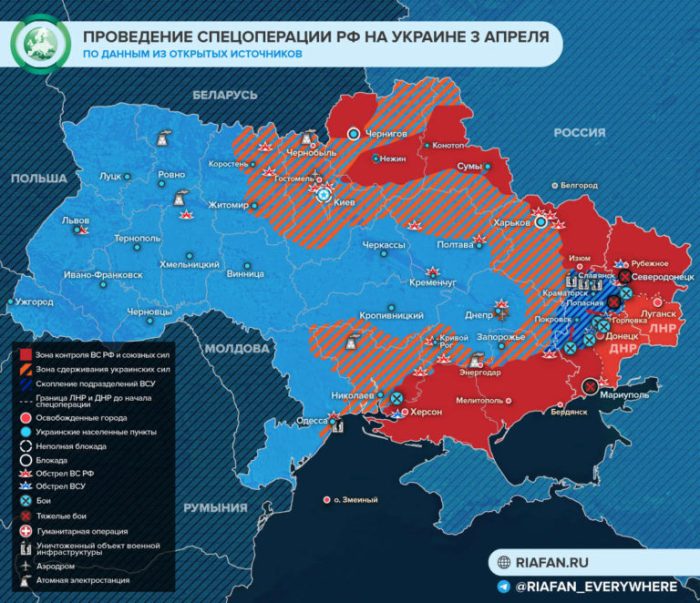
The above map reproduced from the Novosti (unfortunately, in Russian language) on the exact ground situation as of April 3 and the commentary by Ivan Andreev, an experienced war correspondent who covered the Russian operations in Syria, gives the salience of the cauldron in Donbass where the crème de la crème of the Ukrainian forces numbering several divisions are entrapped, isolated by opposing forces from their logistical base and other friendly forces.
The cauldron is fairly large, marked in blue and black stripes on the map in the upper reaches of the Donbass region in the direction of Kharkiv. The massive Russian column that retreated from the Kiev region a week ago is manoeuvring in a big arc toward that cauldron bypassing Chernihiv in the north and the cities of Sumy and Kharkiv (near the Russian border in the northeast).
The Ukrainian forces are well-armed and have fortified themselves heavily but are unable to escape from the entrapment. Nor is it feasible for Kiev to send reinforcements as the countryside to the west consists of largely open farmlands (all the way to the Dniepr River). The Russians have air supremacy and it is impossible to hide any enemy movements from their roving eyes.
The Russian forces have put out of action all nearby airports and destroyed the nearby Ukrainian oil reserves systematically through Phase 1 of the operation. As I wrote in a previous blog, three days ago, Russian forces dealt a devastating blow: “Notably, the Mirgorod military airfield in central Poltava Region, a strategically important hub, has been taken out of action and several Ukrainian combat helicopters and aircraft found in its camouflaged car parks, as well as fuel and aviation weapons depots have been destroyed.”
Equally, Kharkiv has been surrounded and “in a high-precision strike with the Iskander operational-tactical missiles on the defence headquarters in the city on Thursday, more than 100 nationalists and mercenaries from Western countries were confirmed as killed.”
Nonetheless, the Ukrainian forces are expected to put up a good fight rather than surrender — although surrounded, without air cover, and having no scope to rotate forces or enough fuel to engage in maneuver warfare and with ammunition running out.
To be sure, a major battle is approaching, the most decisive in the entire Russian special operation so far. The catch is, the cauldron also has plentiful settlements of ethnic Russian population (including Russian passport holders) and the offensive will be a long grind patiently executed to avoid civilian casualty or destruction of civilian infrastructure.
That is to say, Phase 2 may last anywhere up to a month or so to be completed. Make no mistake, the Russians have to win here (which they will) as they will also be breaking the back of the Ukrainian armed forces. Despite all the bluster by Zelensky, Kiev will realise the enormity of the defeat and his western mentors will see the writing on the wall too.
To be sure, a whole month lies ahead where the western strategy will be to incessantly manufacture fake news, intensify the information war. Even some false flag operation may be staged under the supervision of western intelligence operatives.
In a worst case scenario, Kiev may even play its last card — chemical weapons. Russia has publicised details of locations where Ukraine has kept stockpiles of chemical weapons. The US is known to have supplied as military aid special gear (gas masks, protective clothing, etc.) to cope with chemical weapons and given special training for collective protection.
The alacrity with which Macron and Scholz consumed the fake news is a harbinger of a new phase in the information war. Succinctly put, there is a sober awakening in Paris and Berlin that the Russian operation is successfully meeting the set objectives.
“April”, TS Eliot wrote in his masterpiece The Wasteland, “is the cruellest month, breeding Lilacs out of the dead land, mixing Memory and desire, stirring Dull roots with spring rain.” But the dark irony of this year’s “Aprilness” is going to be that the fecundity and renewal here will be about Russia’s regeneration in a world of both history and the myths spawned by quarantined western minds.
Featured Video
New positive ivermectin evidence
or go to
Aletho News Archives – Video-Images
From the Archives
Fanatical Followers of the Covid Regime: A Jim Jones-Style Cult?
By Professor Roger Watson and Dr. Niall McCrae | The Daily Sceptic | November 15, 2021
As scholars at leading British universities over recent decades, we witnessed the replacement of critical thinking and debate by narrative: facts are discrimination and scientific method is imperialism; truth, instead, is derived from ‘progressive’ values. This educational trend may be a major contributory factor to the ease in which society has been inculcated to the Covid ‘new normal’ of masking, testing, and repeated doses of vaccines for a disease of similar risk to severe influenza.
One doesn’t need much critical reasoning to observe the flawed logic of some vaccination enthusiasts, such as people who respond to experiencing any side effects, however debilitating, by saying “at least I know it’s working”, or, after contracting the disease despite their promised inoculation (over 90% effective, according to initial drug company claims), “I’d have been worse off without the jab.” … continue
Blog Roll
 Aletho News
- EU Council Advances Chat Control 2.0 Scanning Proposal
- Ex-Greek MEP files complaint against Israeli spyware firm over alleged Pegasus surveillance
- Troubling ideas throughout the Torah, Talmud, Mishneh Torah and Tanya
- ‘Grave, alarming’: Iran mission on Trump’s UNGA ‘annihilation’ threats
- Najaf airport to reopen to Iranian flights within 24 hours: Ambassador
- From ‘How Will This End For Iran’ to ‘When America Walks Away’: A tale of two Economist covers
- Tehran blasts ‘baseless’ speculation linking Iran to alleged bomb plot at UK air base
- The Rise And… Rise Of ‘Color Revolutions’
- The Coming GOP Bloodbath?
- Arctic Scare Stories Melt Away
- If Americans Knew
- Netanyahu Asked UAE Leader to Deny Report on Oct. 7 Warning in Secret Visit, Sources Say
- CNN Chief Int’l Correspondent Clarissa Ward on Journalists in Gaza
- Democratic Party Consultants Surround Troy Jackson with Pro-Israel Donors
- Christian Leader Responds To Netanyahu’s Claims Regarding Palestinian Christians
- In Gaza, ‘Whoever Survives the Bombing Won’t Survive the Rubble’
- Israel kills more Palestinians, amid push to resettle Gaza – Daily Update
- Israel forces Gazans to live in constant peril – Daily Update
- Deconstructing Netanyahu’s pants-on-fire UN rant – Daily Update
- Trump betrayed voters with his campaign lies and prioritized a foreign country once he took office
- Netanyahu calls Israel’s war in Gaza ‘opposite of genocide’ in UN speech to near-empty hall
- No Tricks Zone
- New Study: Earth And Venus Surface Warmth Largely Explained By Convection And Lapse Rate, Not CO2 Or Radiation
- 2025 Nature Paper Claiming Worsening Global Drought Gets RETRACTED …Heavily Flawed
- New Study: ‘Global Drought Shows No Detectable Recent Acceleration Under Climate Warming’
- Economic Masterminds: German Socialists Suggest Taxing Productivity Gains Stemming From Using AI
- The South China Sea Has Not Been Cooperating With The Climate Change Narrative
- Energy Crisis: Germany Enters Heating Season With Historically Low Gas Reserve Fill Levels
- New Study: The Antarctic Ice Sheet Gained Mass From 2020-2024 Due To Staggering Snow And Ice Accumulation
- Study: Ocean Heating Rates From Thousands Of Years Ago ‘Dwarf’ Modern Ocean Heating Rates
- Climate Extremists Target, Attack Large-Scale Power Grid Infrastructure In Germany!
- New Study: Antarctic Ice Melt Has Contributed Less Than 1 Centimeter To Sea Level Rise In The Last 30 Years

