Russia demands UN Security Council meeting over Bucha massacre
Samizdat | April 3, 2022
Moscow will convene an extraordinary meeting of the UN Security Council over the incident in the Ukrainian town of Bucha, Russia’s deputy permanent representative with the organization, Dmitry Polyansky said Sunday. Ukraine has accused Russia of massacring civilians in the town, while Moscow dismissed the incident as staged by the Kiev forces.
“In light of the blatant provocation by Ukrainian radicals in Bucha, Russia has demanded a meeting of the UN Security Council to be convened on Monday, April 4. We will bring to light the presumptuous Ukrainian provocateurs and their Western patrons,” Polyansky said in a Telegram post.
Graphic footage from Bucha, a town to the northwest of Kiev, emerged over the weekend, showing multiple bodies clad in civilian clothing scattered around. Kiev was quick to blame Russian military for the incident, with Ukrainian foreign minister Dmytro Kuleba alleging it was a “deliberate massacre”.
“The Bucha massacre was deliberate. Russians aim to eliminate as many Ukrainians as they can. We must stop them and kick them out. I demand new, devastating G7 sanctions NOW,” Kuleba said on Twitter.
Top Western politicians were quick to back and amplify Kiev’s claims, with NATO chief Jens Stoltenberg branding the incident “a brutality against civilians we haven’t seen in Europe for decades.”
“And it’s horrific, and it’s absolutely unacceptable that civilians are targeted and killed, and it just underlines the importance of, that this war must end. And that is President Putin’s responsibility, to stop the war,” Stoltenberg told CNN.
Similar stance has been voiced by many other officials, with some explicitly pinning the blame for the ‘massacre’ on Moscow. French President Emmanuel Macron said, for instance, that “Russian authorities will have to answer for these crimes”.
Moscow, however, has firmly rejected any involvement, accusing Kiev of staging the whole affair to frame Russian troops. The country’s Defense Ministry said that Russian troops pulled out of the town on March 30, with local mayor confirming it in a video address a day after without mentioning “any local residents laying shot in the streets.” The purported “evidence” of the incident emerged only four days after the withdrawal, when Ukrainian intelligence and “representatives of Ukrainian television arrived in the town,” the military added, stressing that multiple inconsistencies show that the affair “has been staged by the Kiev regime for Western media.”
NATO reveals scale of its involvement in training Ukrainian troops
Samizdat | April 3, 2022
Several NATO states have been providing military training to the Ukrainian army “for years” prior to Russia’s military campaign against the eastern European country, the alliance’s secretary general has said.
Speaking to CNN’s Dana Bash on Sunday, Jens Stoltenberg said that “NATO allies have supported Ukraine for many, many years,” adding that military aid has been “stepped up over the last weeks since the invasion.” The official clarified that “NATO allies like the United States, but also the United Kingdom and Canada and some others, have trained Ukrainian troops for years.”
According to Stoltenberg’s estimates, “tens of thousands of Ukrainian troops” had received such training, and are now “at the front fighting against invading Russian forces.” The secretary general went on to credit the Brussels-based alliance with the fact that the “Ukrainian armed forces are much bigger, much better equipped, much better trained and much better led now than ever before.”
In fact, Stoltenberg’s remark came after the host asked him to comment on recent reports that the alliance was allegedly planning to provide Ukraine with “Soviet-era tanks,” despite French President, Emmanuel Macron last month describing such a move as a “red line” which could potentially make NATO a “co-belligerent in the war.” When asked the same question again directly, the NATO chief refused to either confirm or deny the claims, adding that it would be unwise for him to go into detail regarding the kind of military aid the alliance was supplying Ukraine with.
Stoltenberg simply noted that “allies provide support with modern advanced weapons systems,” which are “making a difference on the battlefield every day.” The official emphasized that it was thanks to the “systems they receive from NATO allies” that the Ukrainian military was “able to take out Russian armored vehicles, Russian planes.” He also noted that NATO member states had confirmed, during the March 24 summit in Brussels, their commitment to providing support to Kiev.
Since February 24, when Russian forces crossed the Ukrainian border, several NATO member states, including the US, UK, Germany and a few others, have been delivering large amounts of ammunition and lethal weapons to Ukraine, including anti-tank and anti-aircraft missile systems.
Following the coup in 2014, several consecutive administrations in Kiev had pronounced NATO membership as one of the key foreign-policy objectives of Ukraine. The country’s military has participated in a number of joint military drills with alliance forces.
Russia considers the prospect of NATO military bases popping up on its border as a threat to its security.
Ukraine has now apparently given up on its NATO aspirations, as members of both Russian and Ukrainian negotiating teams have revealed that the two warring nations agreed in principle to a future neutral status for Ukraine, akin to those of Austria and Sweden.
Accusations of Bucha massacre by Russian forces are fake news: Moscow
Samizdat | April 3, 2022
The Russian military has firmly denied accusations of mass killings of civilians in Bucha, a Ukrainian town northwest of Kiev. The claims have been raised by Ukraine itself, some Western media outlets and human rights groups, after Moscow had withdrawn its troops from the outskirts of Ukraine’s capital.
“All photographs and video materials published by the Kiev regime, allegedly showing some kind of “crimes” by Russian military personnel in the town of Bucha, Kiev region, are yet another provocation,” the Russian Ministry of Defense said Sunday.
Russian troops had been pulled out from the area on March 30, the military said, pointing out that “the so-called ‘evidence of crimes’ in Bucha appeared only on the fourth day” after the withdrawal, when Ukrainian intelligence and “representatives of Ukrainian television arrived in the town.”
“Moreover, on March 31 the mayor of Bucha, Anatoly Fedoruk, confirmed in his video address that there was no Russian military in the town, but did not even mention any local residents laying shot in the streets with their hands tied,” the Russian military also pointed out.
“It’s particularity concerning that all the bodies of people whose images were published by the Kiev regime, after at least four days, have not stiffened, do not have characteristic cadaveric spots, and have fresh blood in their wounds,” the military noted, adding that all these inconsistencies show that the whole Bucha affair “has been staged by the Kiev regime for Western media, as was the case with the [fake news from the] Mariupol maternity clinic.”
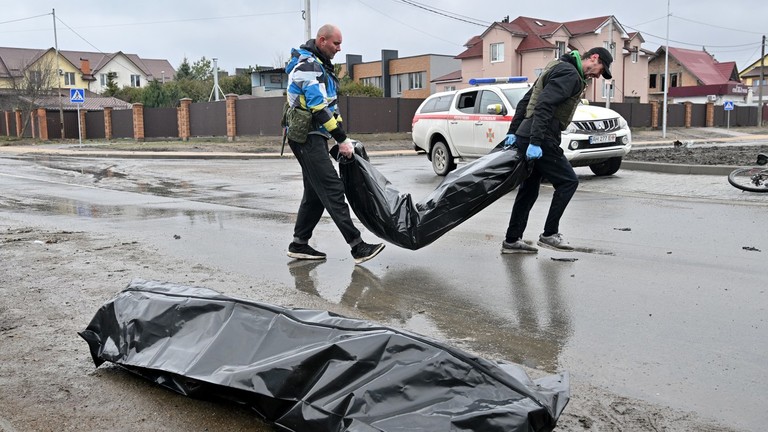
Graphic footage from Bucha shows multiple bodies in civilian clothing lying in the middle of a street. Some of the dead apparently had their hands tied, while others were white armbands, commonly used by Russian forces and civilians in areas under Russian control.
Kiev has blamed the Bucha killings on Moscow, with Ukrainian foreign minister Dmytro Kuleba claiming it was a “deliberate massacre” by Russian troops.
“The Bucha massacre was deliberate. Russians aim to eliminate as many Ukrainians as they can. We must stop them and kick them out. I demand new, devastating G7 sanctions NOW,” Kuleba wrote on Twitter.
Top Western politicians have backed Kiev’s assessment of Bucha, with some explicitly pinning the blame for the killings on Moscow as well. “Russian authorities will have to answer for these crimes,” French President Emmanuel Macron said.
A similar stance was voiced by the UK, with Foreign Secretary Liz Truss stating that such “indiscriminate attacks” on civilians should be probed as war crimes. “We will not allow Russia to cover up their involvement in these atrocities through cynical disinformation,” she said.
Moscow launched a large-scale offensive against its neighbor in late February, following Ukraine’s failure to implement the terms of the Minsk agreements signed in 2014, and Russia’s eventual recognition of the Donbass republics in Donetsk and Lugansk. The German- and French-brokered protocols had been designed to regularize the status of those regions within the Ukrainian state.
Russia has now demanded that Ukraine officially declare itself a neutral country that will never join the US-led NATO military alliance. Kiev insists the Russian offensive was completely unprovoked and has denied claims it was planning to retake the two rebel regions by force.
Donbass still remains key battleground
BY M. K. BHADRAKUMAR | INDIAN PUNCHLINE | APRIL 3, 2022
The Russian General Staff gave an in-depth briefing on March 30 on the military strategy behind the special operation in Ukraine culminating in the decision to decrease the military activities in the Kiev and northern Chernihiv regions.
Broadly, the MOD messaging is that the twin objectives have been realised — namely, pinning down Ukrainian forces and military assets to the Kiev region and, secondly, preventing the transfer of Ukrainian forces from the western and central regions to the east by “using the absolute air dominance” and also by deploying modern high-precision weapons.
The MOD spokesman said: “All major lines of communication, supply and reserve approach are taken under full control. Ukraine’s air defence systems, airfield infrastructure, major military depots, training and mercenary concentration centres have been destroyed… Thus, all the main tasks of the Russian Armed Forces in Kiev and Chernigov directions have been completed.”
Clearly, the western analysts and media largely lost the plot from Day 1 by branding the Russian special operation a “failure.” They erred basically in prejudging it to be a “Russian invasion”, whereas, Moscow was very precise in giving the rubric of “special operation” to its offensive.
An invasion demands quantifiable, visible results, whereas special operation has a dynamic of its own where the outcome becomes an amalgam of the Donbass region’s restoration to its original boundaries, the security and welfare of the Russian population, the systematic elimination of the neo-Nazi forces who were on rampage in that part of Ukraine through the past 8-year period with the support of the state and encouragement from the western intelligence and complicity of the authorities in Kiev — and all the while, not taking the eye off the the wearing down of Ukraine’s military assets and fighting capabilities as a whole.
What emerges today is that there is a better understanding of the “special operation” — and it goes all the way to the NATO chief Jens Stoltenberg and the US President Joe Biden. The Russian operation’s focus (as of now at least) is almost entirely on the eastern Donbass region where in Luhansk, over 93% of the territory has been “liberated”, while in Donetsk close to 60% of the territory is under control of Russian forces and the residual resistance in Mariupol port city is expected to be mopped up within the week.
The above characterisation is of course with reference to the liberation of entire territories that originally belonged in the pre-2014 period to the Donbass republics (which had shrunk by two-thirds through the past 8-year period of security operations ordered from Kiev.)
A variety of factors made this operation an uphill task — principally, a high concentration of Ukrainian forces in Donbass with neo-Nazi elements embedded in all military units, blockaded settlements, use of “human shields” of ethnic Russians, etc.
Above all, the Ukrainian forces themselves were in a state of combat readiness with some of their best units deployed in the region already when the Russian operation began on February 24, with their own secret plan drawn up for launching offensive actions by strike groups in the Donbass region by the end of the month.
To be sure, the Ukrainian forces continue amassing forces in the area. The Russian military is also continuing its precise strikes on military targets, which are intended to prevent reinforcements reaching the Ukrainian forces as a major battle looms ahead in Donbass where tens of thousands of Ukrainian forces are facing encirclement.
Thus, during April 2, the Russian operational-tactical aviation hit 28 military assets of the Ukrainian Armed Forces, including 2 depots of missile and artillery weapons and ammunition, as well as 23 areas of concentration of Ukrainian weapons and military equipment.
Notably, the Mirgorod military airfield in central Poltava Region, a strategically important hub, has been taken out of action and several Ukrainian combat helicopters and aircraft found in its camouflaged car parks, as well as fuel and aviation weapons depots have been destroyed.
Equally, Maj. Gen. Igor Konashenkov, spokesman for the Russian Ministry of Defense, announced yesterday that in a high-precision strike with the Iskander operational-tactical missiles on the defence headquarters in the city of Kharkiv on Thursday, “more than 100 nationalists and mercenaries from Western countries” were confirmed as killed.
In general, the Russian operation is currently concentrating on regrouping and resupplying their units in Donbass. The next stage of the Russian advance in the eastern region is linked to the full liberation of Mariupol. The liquidation of the residual resistance in Mariupol is crucial as it will free significant forces for redeployment in the upcoming offensive in Donbass.
The resistance has shrunk to three main centres in Mariupol: the central district, the Azovstal plant and the port area. The neo-Nazi forces are largely confined to the Azovstal plant, which is one of Europe’s biggest iron and steel plants, with military headquarters, warehouses and barracks. Repeated attempts to evacuate the Neo-Nazi commanders by helicopter have been thwarted — Russian forces shot down two helicopters yesterday.
Chechen forces deployed near the Azovstal are preparing for an assault. The head of Chechnya Republic, Ramzan Kadyrov has given an ultimatum to the remnants of the Azov regiment: “I suggest that they soberly assess their remaining resources and give up. You can give up today. If this does not happen, tomorrow, April 2, all the militants will be destroyed.”
Overall, the receding frontline near Kyiv and Chernihiv signals the regrouping of Russian forces. The Russian side was not planning to storm Kyiv city itself in the near future. This redeployment of forces may be seen as the run-up to the upcoming intensification of offensive operations in the east.
On Wednesday, Maj. Gen. Igor Konashenkov said the Russian forces were regrouping in order to “intensify operations in priority areas and, above all, to finish the operation for the complete liberation of Donbass.” To be sure, the upcoming phase of special operation holds profound implications for the eventual conclusion of a peace agreement.
US reveals another huge batch of military aid to Ukraine
Samizdat | April 2, 2022
The US will be sending an additional $300 million in military aid to Ukraine, Pentagon press secretary John Kirby announced on Friday.
He added that the package will include laser-guided rocket systems, switchblade tactical drones which are capable of taking out armored vehicles, Puma surveillance drones, armored Humvees, ammunition, night-vision devices, machine guns, communications equipment, medical supplies, and other items.
“This decision underscores the United States’ unwavering commitment to Ukraine’s sovereignty and territorial integrity in support of its heroic efforts to repel Russia’s war of choice,” Kirby said.
The secretary explained that the Ukraine Security Assistance Initiative allows the US government to procure supplies and equipment directly from defense industry contractors, rather than taking it from the Defense Department’s own stockpiles.
The US has so far committed over $2.3 billion in security assistance to Ukraine since Russia launched its military operation in the country last month.
Earlier, UK Defence Secretary Ben Wallace announced that Britain and its partners agreed to send more lethal aid to Ukraine after a conference involving 35 countries, explaining that Ukrainian soldiers need different weapons depending on the tactics on the ground.
Last month, US President Joe Biden signed a government spending bill that approved $13.6 billion in military and humanitarian aid for Ukraine, while some members of the Senate demanded the US spend even more to assist the country.
Russia, Ukraine and the Law of War: War Crimes
By Scott Ritter | Consortium News | April 1, 2022
During his recent four-day European tour, U.S. President Joe Biden made headlines when, during a meeting with Polish President Andrzej Duda, he described Russian President Vladimir Putin as “a man who I quite frankly think is a war criminal,” adding “I think it will meet the legal definition of that as well.”
Putin’s spokesperson, Dmitry Peskov, condemned Biden’s comment as “unacceptable and unforgivable rhetoric on the part of the head of a state whose bombs have killed hundreds of thousands of people around the world.”
Biden made his remarks following a statement issued by Secretary of State Antony Blinken in which Blinken announced that the State Department had made a formal assessment that the Russian military had committed war crimes in Ukraine. “Based on information currently available,” Blinken said, “the U.S. government assesses that members of Russia’s forces have committed war crimes in Ukraine. “Our assessment,” Blinken added, “is based on a careful review of available information from public and intelligence sources.”
According to Blinken, “Russia’s forces have destroyed apartment buildings, schools, hospitals, critical infrastructure, civilian vehicles, shopping centers, and ambulances, leaving thousands of innocent civilians killed or wounded. Many of the sites Russia’s forces have hit have been clearly identifiable as in-use by civilians.” Blinken declared that this category “includes the Mariupol maternity hospital” as well as “a strike that hit a Mariupol theater, clearly marked with the Russian word for ‘children’ — in huge letters visible from the sky.”
Blinken’s accusations echo those made by the Ukrainian government and organizations such as Amnesty International. Karim Khan, the lead prosecutor for the International Criminal Court, has announced that his office will begin investigating allegations of Russian war crimes committed during its ongoing military operation in Ukraine.
The narrative that paints Russia and the Russian military as perpetrators of war crimes, however, runs afoul of actual international humanitarian law and the laws of war. The issue of jus in bello (the law governing conduct during the use of force) set forth a framework of legal concepts which, when allied to specific actions, help determine whether an actual violation of the law of war has occurred.
Jus in bello is derived from treaties, agreements, and customary international law. Two sets of international agreements, the Hague Conventions of 1899 and 1907, and the four Geneva Conventions of 1949, serve as the foundation for the modern understanding of jus in bello, regulating, respectively, what is permissible in the execution of war, and the protections provided to non-combatants, including civilians and prisoners of war. “Grave breaches” of jus in bello can be prosecuted in courts of relevant jurisdiction as war crimes.
Starting from the proposition that war is little more than organized murder, the issue of how to define what constitutes murder sufficient to be categorized a being of a criminal nature is far more difficult than one might think. Michael Herr gave voice to this reality in his book, Dispatches, about America’s war in Vietnam, when he observed that, “Charging a man with murder in this place was like handing out speeding tickets at the Indy 500.”
Distinction, Intention, Necessity
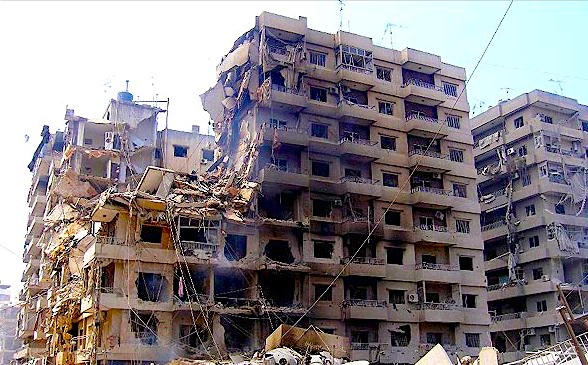
Israeli air and artillery attacks against apartment building, Beirut 2006. (Hamed Talebi/Mehr News Agency/Wikimedia Commons)
One of the key considerations that distinguishes a legitimate act of war, and a war crime, is the notion of “military necessity.” According to the precepts set forth in the law of war, military necessity “permits measures which are actually necessary to accomplish a legitimate military purpose and are not otherwise prohibited by international humanitarian law. In the case of an armed conflict the only legitimate military purpose is to weaken the military capacity of the other parties to the conflict.”
Working hand in glove with the concept of military necessity is the issue of “humanity”, namely that a military operation cannot inflict suffering, injury, or destruction that is not necessary to accomplish a legitimate military objective. While “humanity” is difficult to define (is there ever a humane way to take a human life during war?), it does relate to another principle of international humanitarian law, “proportionality.”
Proportionality in wartime has yet to be strictly codified, but in basic terms it revolves around “the idea that military means should be proportionate to their anticipated ends.”
In short, if there is an enemy sniper in a room on the third floor of an apartment building, proportionality would be met if the force necessary to eliminate the sniper in the room in question was used; if there were any civilians in the room at the time, this would not constitute a violation of the laws of war, as the civilians would unfortunately (and tragically) fall under the notion of “collateral damage.”
If, however, force is applied that results in the destruction of the entire apartment complex, killing scores if not hundreds of civilians, then a case could be made that the use of force was disproportionate to the expected military result, and as such constitutes a war crime.
The final principle of note is that of “distinction”, which holds that parties to an armed conflict must “at all times distinguish between the civilian population and combatants and between civilian objects and military objectives and accordingly shall direct their operations only against military objectives.” Distinction prohibits “indiscriminate attacks and the use of indiscriminate means and methods of warfare,” such as carpet bombing, or an artillery bombardment which lacked a specific military purpose.
From these basic precepts and principles, the international community has codified specific acts that constitute war crimes in the form of the Rome Statute of the International Criminal Court, in particular Article 8 (War Crimes). Here we find enumerated various actions which give rise to most, if not all, of the accusations made by Biden and Blinken when leveling their accusations of war crimes at Putin and the Russian military:
- Intentionally directing attacks against the civilian population as such or against individual civilians not taking direct part in hostilities;
- Intentionally directing attacks against civilian objects, that is, objects which are not military objectives;
- Intentionally directing attacks against personnel, installations, material, units, or vehicles involved in a humanitarian assistance or peacekeeping mission in accordance with the Charter of the United Nations, as long as they are entitled to the protection given to civilians or civilian objects under the international law of armed conflict; and
- Intentionally launching an attack in the knowledge that such attack will cause incidental loss of life or injury to civilians or damage to civilian objects.
The Elements
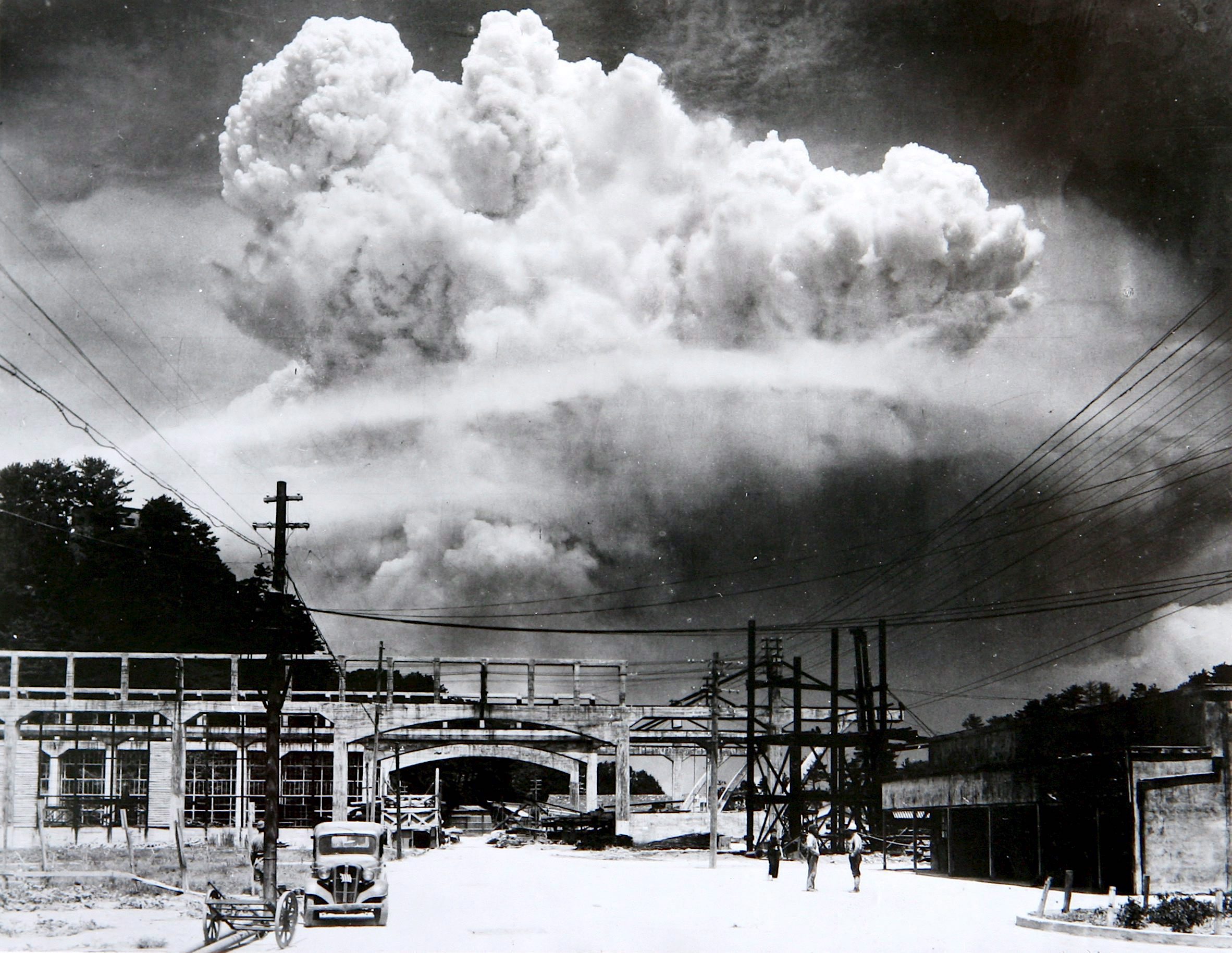
Extreme example of lack of proportionality with intent: The bombing of Nagasaki as seen from the town of Koyagi, about 13 km south. (Hiromichi Matsuda/Wikimedia Commons)
Each of the crimes listed above consist of two elements, each of which must be proved as a matter of law, before the accusation of a war crime can be cognizable. These are the physical element, or actus reaus, namely the act itself, and the mental element, or mens rea, which constitutes specific intent, or dolus specialis, to commit the act in question.
Even if you can prove the physical element of an alleged crime, such as the bombing of a hospital or apartment complex, unless one can prove the actual intent behind the attack (i.e., not just directing attacks against a civilian population, but rather intentionally directing these attacks), no crime has been committed.
One of the main mitigating circumstances against most alleged war crimes is the principle of “military necessity.” Take, for example, the act of bombing a hospital. If a bomb strikes a hospital, one has established de facto actus reas. Now, let’s say there exists a written order from a commander to a pilot ordering the pilot to bomb the hospital in question—dolus specialis has now been established, and a war crime has been committed.
Not so fast.
While the law of war prohibits direct attacks against civilian targets, such as housing, schools, and hospitals, as the International Committee of the Red Cross makes clear, “a hospital or school may become a legitimate military target if it contributes to specific military operations of the enemy and if its destruction offers a definite military advantage for the attacking side,” or if it is “being used as a base from which to launch an attack, as a weapons depot, or to hide healthy soldiers/fighters.”
Herein lies the rub. “Increasingly,” a recent article published in The Washinton Post noted, “Ukrainians are confronting an uncomfortable truth: The military’s understandable impulse to defend against Russian attacks could be putting civilians in the crosshairs. Virtually every neighborhood in most cities has become militarized, some more than others, making them potential targets for Russian forces trying to take out Ukrainian defenses.”
Moreover, “Ukraine’s strategy of placing heavy military equipment and other fortifications in civilian zones could weaken Western and Ukrainian efforts to hold Russia legally culpable for possible war crimes.”
Who is Guilty?
The bottom line is that if Russia has intelligence that Ukraine is using an otherwise protected civilian target for military purposes, and if a decision is made to attack the target using force deemed proportional to the threat, then no war crime has been committed.
Indeed, given what The Washington Post has documented, it appears that it is Ukraine, not Russia, which is committing war crimes. According to Richard Weir, a researcher in Human Rights Watch’s crisis and conflict division quoted in the Post article, the Ukrainian military has “a responsibility under international law” to either remove their forces and equipment from civilian areas, or to move the civilian population from the areas where military personnel and equipment are being stored.
“If they don’t do that,” Weir said, “that is a violation of the laws of war. Because what they are doing is they are putting civilians at risk. Because all that military equipment are legitimate targets.”
The bottom line is that while the Ukrainian government, American politicians, and human rights groups can make allegations of war crimes by Russia in Ukraine, proving these allegations is a much more difficult task.
Moreover, it appears that, upon closer examination, the accuser (at least when it comes to the Ukrainian government) might become the accused should any thorough investigation of the alleged events occur.
If the Ukrainian government contends that specific sites struck by Russia fall into a protected category, and that by attacking them Russia has committed a war crime, then it must be assumed that any undertaking by Ukraine to place military personnel and equipment in the vicinity of these targets constitutes “an intentional co-location of military objectives and civilians or persons hors de combat with the specific intent of trying to prevent the targeting of those military objectives.”
That is the legal definition of a human shield, which is in and of itself a violation of the laws of war.
Scott Ritter is a former U.S. Marine Corps intelligence officer who served in the former Soviet Union implementing arms control treaties, in the Persian Gulf during Operation Desert Storm and in Iraq overseeing the disarmament of WMD.
NATO should have been dissolved after Soviet collapse: China
Press TV – April 1, 2022
China has criticized the eastward expansion of NATO, saying that the US-led military alliance should have been dissolved after the collapse of the Soviet Union more than three decades ago.
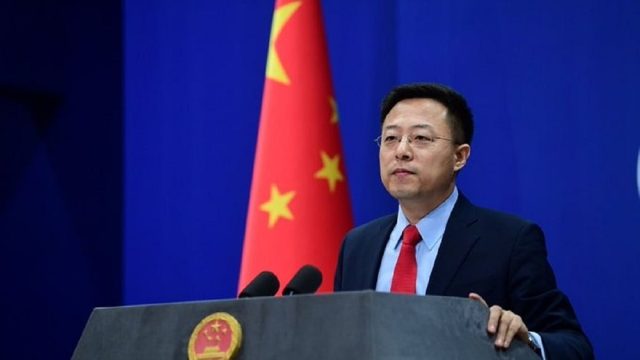
Chinese Foreign Ministry spokesman Zhao Lijian said at a news conference on Friday that the North Atlantic Treaty Organization (NATO), as a product of the Cold War, should have become history when the Soviet Union dissolved in 1991.
“In the early 1990s, then-US Secretary of State James Baker promised to former Soviet leader Mikhail Gorbachev that NATO would not expand even an inch eastward,” Zhao said.
As the initiator and biggest “behind-the-scene planner” for the Ukraine conflict, the US has led NATO to engage in five rounds of eastward expansion in over 20 years, he added.
“The number of NATO members increased from 16 to 30, advancing more than 1,000 kilometers eastward to the Russian border,” Zhao said.
He said that the world does not need a new Cold War, neither does Europe. He called on NATO to reflect on its role in the Ukraine crisis and the security of Europe itself.
NATO was formed in 1949 by 12 countries, including the US, Canada, the UK and France. Following the collapse of the Soviet Union, a number of former Warsaw Pact countries switched sides and joined the military alliance. It currently consists of 30 independent member countries, who are committed to protect each other.
NATO’s eastward expansion has long been a concern for world powers China and Russia, who have constantly warned that the move would lead to a war.
Russia has constantly been warning against membership of many parts of the old Soviet Bloc in NATO, especially the prospective membership of Ukraine in the Western military alliance, something that eventually pit Moscow against the Kiev government.
Russian President Vladimir Putin, who ordered the military campaign in Ukraine in February 24, has been clear for many years that if continued, the expansion would likely be met with serious resistance by the Russians.
Before the military conflict, Moscow had put forward a set of security proposals to de-escalate the tensions, including a guarantee that Ukraine will not join NATO.
The proposals were rejected.
Russia responds to claims of mines in the Black Sea
Samizdat | March 31, 2022
Ukraine’s President Volodymyr Zelensky lied to Norwegian lawmakers when he accused Moscow of deploying mines in the Black Sea to block foreign civilian ships from leaving Ukrainian ports, the Russian defense ministry said on Thursday, accusing Ukraine of being the culprit.
The rebuke came in response to Zelensky’s Wednesday address to the Norwegian parliament, during which the Ukrainian leader accused the Russian military of “creating the worst threat to international security since World War II” through its “insidious” operations in the Black Sea.
“About a hundred ships cannot leave to the Mediterranean. Some ships have been simply seized in acts of piracy aimed at stealing the cargo. Some ships were attacked,” Zelensky said.
“But the blockade of the ports was done by Russia not only through use of naval forces. They have deployed mines in the sea. And now the mines set up by the Russian forces are drifting in the sea. They pose a threat to anyone, to ships and ports of every nation in the Black Sea region.”
Mining its shores and territorial waters has long been part of Ukraine’s strategy of defending against a Russian attack from the Black Sea, which it started implementing after the hostilities broke out. On March 5, its armed forces warned residents of the Odessa region to stay away from the sea because of the mines being deployed by the military.
“We call on fishermen and owners of boats not to move near the shore of the Odessa region to avoid the risk of being fired upon or contacting mine barriers,” the message said.
According to the Russian defense ministry, Ukraine deployed some 420 old YaM-1 moored naval mines along its shores, including 370 in the Black Sea. About ten of them went adrift after their cables snapped during a storm earlier this month, the Russian military believes.
At least two apparent mines were reported found and have since been destroyed: one by the Turkish military and one in Romanian territorial waters. “Nobody knows where the rest of them are drifting,” the Thursday statement said, adding that Kiev’s mining operations created a major threat to shipping in the Black Sea.
The Russian ministry said that the second charge voiced by Zelensky during his video address was likewise “a lie”. The reality is that Ukraine is preventing 68 foreign ships from sailing from its ports of Chernomorsk, Odessa, Nikolaev and Yuzhny, while the Russian Navy is offering daily opportunities of safe passage to them.
“Crews of the ships radioed us and said any attempt by a foreign vessel to depart the Ukrainian ports is banned by the authorities under a threat of immediate sinking,” General Igor Konashenkov, the spokesman for the defense ministry, said.
Zelensky is currently on a virtual tour to whip up support for his nation, with addresses made to various Western nations each day. On Tuesday, he told the Danish parliament that transition to renewable energy is a moral imperative for the EU, because otherwise it would not be able to punish Russia by stopping buying its energy.
Russia warns about Ukrainian use of UN vehicle
Samizdat | March 30, 2022
Russia has raised concerns over the apparent use of an official UN vehicle in combat by Ukrainian forces. It’s the latest of numerous incidents of civilian transport being seized for the war effort by Kiev, Moscow’s envoy to the UN Security Council complained on Tuesday.
Vassily Nebenzia warned that it created a situation where, for example, medical vehicles could be used to deliver Western weapons into the country.
“We are expecting a response to our latest inquiry about the UN vehicle with the diplomatic number DP210015, which was also taking part in Kharkov in combat operations of the Ukrainian nationalists, according to witness accounts,” he said.
The vehicle he mentioned was apparently spotted in a video released by Ukrainian fighters to show off the shooting down of an aircraft. It was reportedly used to transport anti-aircraft missiles.
The diplomat said there were credible reports that official vehicles of the UN and the OSCE were used by Ukrainian forces. He called on both organizations to “give fair assessments of such facts.”
Nebenzia also mentioned evidence of DHL delivery vans being used for combat in Ukraine. A video showing a Ukrainian mortar team apparently using such a vehicle to move around was published on Reddit last weekend.
One of the fighters shown in the video claimed the van was one of six voluntarily donated to the war effort by the Ukrainian branch of the German company. DHL shut down all operations in the country in early March. It told Russian media that the Ukrainian authorities had confiscated corporate transport.
The Russian diplomat said cases such as these have disturbing ramifications in terms of telling apart civilian and military targets in Ukraine.
“We cannot rule out that vehicles of these organizations or vehicles marked as medical transport could be used to deliver to Ukraine from neighboring states the very same weapons that the West has generously promised to Kiev,” he said.
Moscow has repeatedly warned that it will consider any arms shipments to Ukraine as legitimate military targets.
US Top Commander In Europe Attempts To Rebut Latest Biden Remarks
Samizdat | March 30, 2022
The head of US forces in Europe has said he is not aware of a program to train Ukrainian soldiers in Poland, after President Joe Biden appeared to suggest such a mission was underway while clarifying a previous gaffe made last week.
Speaking to lawmakers during a Senate Armed Services Committee hearing on Tuesday, General Tod Wolters – the commander of the US European Command (EUCOM) and NATO’s Supreme Allied Commander Europe – insisted there is no training mission in Poland “at this time.”
“I do not believe we are in the process of currently training military forces from Ukraine in Poland,” Wolters told Republican Senator Tom Cotton (Arkansas).
However, the general added that there have been “liaisons” with Ukrainian troops in Poland and that they are “being given advice,” but argued “that’s different than I think [what] you’re referring to with respect to training.” He did not offer details on what those ‘liaisons’ include.
Wolter’s comments come after President Biden attempted to walk back prior remarks about the conflict in Ukraine, having told American soldiers stationed in Poland last week that they would soon “see” the country, appearing to suggest they would be deployed there. On Monday, Biden insisted he was “talking about helping train … the Ukrainian troops that are in Poland,” again landing himself in hot water as White House officials raced to clarify that US forces are not, in fact, training foreign troops on Polish soil.
During a press briefing later on Monday, White House communications director Kate Bedingfield told reporters “there is regular interaction between Ukrainian soldiers in Poland and the US troops that the president saw on the trip,” insisting that Biden did not accidentally reveal “compromised information.”
“The troops that he met with in Poland routinely interact with Ukrainians. That is something that’s known,” she continued, though also declined to get into specifics about what interactions the troops have had.
Asked about US forces currently stationed in Europe, Wolters said American troop levels have swelled from 60,000 to 100,000 since Russia began its military operation in Ukraine in late February. Nearly half of those soldiers are deployed to Germany, and of those, the general noted that 70% would have a direct combat role should they be activated, calling them the “teeth” of the US presence. Some of the troops may be stationed on the continent permanently, Wolters added, stating that European defense contributions in the coming months would determine EUCOM’s next steps.
While Washington and other NATO states have worked to bolster Kiev’s defenses with arms shipments, the allies have repeatedly stated they will not get directly involved in the war in Ukraine, instead committing to defend the territory of member states only. Though prior US administrations have declared that Ukraine would someday be admitted into the bloc, it remains outside of NATO, and the Biden administration has warned that American intervention could kick off an armed confrontation with Moscow, or even World War III.
Featured Video

New positive ivermectin evidence
or go to
Aletho News Archives – Video-Images
From the Archives
Fanatical Followers of the Covid Regime: A Jim Jones-Style Cult?
By Professor Roger Watson and Dr. Niall McCrae | The Daily Sceptic | November 15, 2021
As scholars at leading British universities over recent decades, we witnessed the replacement of critical thinking and debate by narrative: facts are discrimination and scientific method is imperialism; truth, instead, is derived from ‘progressive’ values. This educational trend may be a major contributory factor to the ease in which society has been inculcated to the Covid ‘new normal’ of masking, testing, and repeated doses of vaccines for a disease of similar risk to severe influenza.
One doesn’t need much critical reasoning to observe the flawed logic of some vaccination enthusiasts, such as people who respond to experiencing any side effects, however debilitating, by saying “at least I know it’s working”, or, after contracting the disease despite their promised inoculation (over 90% effective, according to initial drug company claims), “I’d have been worse off without the jab.” … continue
Blog Roll
 Aletho News
- EU Council Advances Chat Control 2.0 Scanning Proposal
- Ex-Greek MEP files complaint against Israeli spyware firm over alleged Pegasus surveillance
- Troubling ideas throughout the Torah, Talmud, Mishneh Torah and Tanya
- ‘Grave, alarming’: Iran mission on Trump’s UNGA ‘annihilation’ threats
- Najaf airport to reopen to Iranian flights within 24 hours: Ambassador
- From ‘How Will This End For Iran’ to ‘When America Walks Away’: A tale of two Economist covers
- Tehran blasts ‘baseless’ speculation linking Iran to alleged bomb plot at UK air base
- The Rise And… Rise Of ‘Color Revolutions’
- The Coming GOP Bloodbath?
- Arctic Scare Stories Melt Away
- If Americans Knew
- Netanyahu Asked UAE Leader to Deny Report on Oct. 7 Warning in Secret Visit, Sources Say
- CNN Chief Int’l Correspondent Clarissa Ward on Journalists in Gaza
- Democratic Party Consultants Surround Troy Jackson with Pro-Israel Donors
- Christian Leader Responds To Netanyahu’s Claims Regarding Palestinian Christians
- In Gaza, ‘Whoever Survives the Bombing Won’t Survive the Rubble’
- Israel kills more Palestinians, amid push to resettle Gaza – Daily Update
- Israel forces Gazans to live in constant peril – Daily Update
- Deconstructing Netanyahu’s pants-on-fire UN rant – Daily Update
- Trump betrayed voters with his campaign lies and prioritized a foreign country once he took office
- Netanyahu calls Israel’s war in Gaza ‘opposite of genocide’ in UN speech to near-empty hall
- No Tricks Zone
- New Study: Earth And Venus Surface Warmth Largely Explained By Convection And Lapse Rate, Not CO2 Or Radiation
- 2025 Nature Paper Claiming Worsening Global Drought Gets RETRACTED …Heavily Flawed
- New Study: ‘Global Drought Shows No Detectable Recent Acceleration Under Climate Warming’
- Economic Masterminds: German Socialists Suggest Taxing Productivity Gains Stemming From Using AI
- The South China Sea Has Not Been Cooperating With The Climate Change Narrative
- Energy Crisis: Germany Enters Heating Season With Historically Low Gas Reserve Fill Levels
- New Study: The Antarctic Ice Sheet Gained Mass From 2020-2024 Due To Staggering Snow And Ice Accumulation
- Study: Ocean Heating Rates From Thousands Of Years Ago ‘Dwarf’ Modern Ocean Heating Rates
- Climate Extremists Target, Attack Large-Scale Power Grid Infrastructure In Germany!
- New Study: Antarctic Ice Melt Has Contributed Less Than 1 Centimeter To Sea Level Rise In The Last 30 Years

