A Breach in the Anti-Putin Groupthink
By Gilbert Doctorow | Consortium News | March 21, 2017
Realistically, no major change in U.S. foreign and defense policy is possible without substantial support from the U.S. political class, but a problem occurs when only one side of a debate gets a fair hearing and the other side gets ignored or marginalized. That is the current situation regarding U.S. policy toward Russia.
For the past couple of decades, only the neoconservatives and their close allies, the liberal interventionists, have been allowed into the ring to raise their gloves in celebration of an uncontested victory over policy. On the very rare occasion when a “realist” or a critic of “regime change” wars somehow manages to sneak into the ring, they find both arms tied behind them and receive the predictable pounding.
While this predicament has existed since the turn of this past century, it has grown more pronounced since the U.S.-Russia relationship slid into open confrontation in 2014 after the U.S.-backed coup in Ukraine overthrowing elected President Viktor Yanukovych and sparking a civil war that led Crimea to secede and join Russia and Ukraine’s eastern Donbass region to rise up in rebellion.
But the only narrative that the vast majority of Americans have heard – and that the opinion centers of Washington and New York have allowed – is the one that blames everything on “Russian aggression.” Those who try to express dissenting opinions – noting, for instance, the intervention in Ukrainian affairs by Assistant Secretary of State Victoria Nuland as well as the U.S.-funded undermining on Yanukovych’s government – have been essentially banned from both the U.S. mass media and professional journals.
When a handful of independent news sites (including Consortiumnews.com) tried to report on the other side of the story, they were denounced as “Russian propagandists” and ended up on “blacklists” promoted by The Washington Post and other mainstream news outlets.
An Encouraging Sign
That is why it is encouraging that Foreign Affairs magazine, the preeminent professional journal of American diplomacy, took the extraordinary step (extraordinary at least in the current environment) of publishing Robert English’s article, entitled “Russia, Trump, and a new Détente,” that challenges the prevailing groupthink and does so with careful scholarship.
In effect, English’s article trashes the positions of all Foreign Affairs’ featured contributors for the past several years. But it must be stressed that there are no new discoveries of fact or new insights that make English’s essay particularly valuable. What he has done is to bring together the chief points of the counter-current and set them out with extraordinary writing skills, efficiency and persuasiveness of argumentation. Even more important, he has been uncompromising.
The facts laid out by English could have been set out by one of several experienced and informed professors or practitioners of international relations. But English had the courage to follow the facts where they lead and the skill to convince the Foreign Affairs editors to take the chance on allowing readers to see some unpopular truths even though the editors now will probably come under attack themselves as “Kremlin stooges.”
The overriding thesis is summed up at the start of the essay: “For 25 years, Republicans and Democrats have acted in ways that look much the same to Moscow. Washington has pursued policies that have ignored Russian interests (and sometimes international law as well) in order to encircle Moscow with military alliances and trade blocs conducive to U.S. interests. It is no wonder that Russia pushes back. The wonder is that the U.S. policy elite doesn’t get this, even as foreign-affairs neophyte Trump apparently does.”
English’s article goes back to the fall of the Soviet Union in the early 1990s and explains why and how U.S. policy toward Russia was wrong and wrong again. He debunks the notion that Boris Yeltsin brought in a democratic age, which Vladimir Putin undid after coming to power.
English explains how the U.S. meddled in Russian domestic politics in the mid-1990s to falsify election results and ensure Yeltsin’s continuation in office despite his unpopularity for bringing on an economic Depression that average Russians remember bitterly to this day. That was a time when the vast majority of Russians equated democracy with “shitocracy.”
English describes how the Russian economic and political collapse in the 1990s was exploited by the Clinton administration. He tells why currently fashionable U.S. critics of Putin are dead wrong when they fail to acknowledge Putin’s achievements in restructuring the economy, tax collection, governance, improvements in public health and more which account for his spectacular popularity ratings today.
English details all the errors and stupidities of the Obama administration in its handling of Russia and Putin, faulting President Obama and Secretary of State (and later presidential candidate) Hillary Clinton for all of their provocative and insensitive words and deeds. What we see in U.S. policy, as described by English, is the application of double standards, a prosecutorial stance towards Russia, and outrageous lies about the country and its leadership foisted on the American public.
Then English takes on directly all of the paranoia over Russia’s alleged challenge to Western democratic processes. He calls attention instead to how U.S. foreign policy and the European Union’s own policies in the new Member States and candidate Member States have created all the conditions for a populist revolt by buying off local elites and subjecting the broad populace in these countries to pauperization.
English concludes his essay with a call to give détente with Putin and Russia a chance.
Who Is Robert English?
English’s Wikipedia entry and biographical data provided on his University of Southern California web pages make it clear that he has quality academic credentials: Master of Public Administration and PhD. in politics from the Woodrow Wilson School of Public and International Affairs at Princeton University. He also has a solid collection of scholarly publications to his credit as author or co-editor with major names in the field of Russian-Soviet intellectual history.
He spent six years doing studies for U.S. intelligence and defense: 1982–1986 at the Department of Defense and 1986-88 at the U.S. Committee for National Security. And he has administrative experience as the Director of the USC School of International Relations.
Professor English is not without his political ambitions. During the 2016 presidential election campaign, he tried to secure a position as foreign policy adviser to Democratic hopeful Sen. Bernie Sanders. In pursuit of this effort, English had the backing of progressives at The Nation, which in February 2016 published an article of his entitled “Bernie Sanders, the Foreign Policy Realist of 2016.”
English’s objective was to demonstrate how wrong many people were to see in Sanders a visionary utopian incapable of defending America’s strategic interests. Amid the praise of Sanders in this article, English asserts that Sanders is as firm on Russia as Hillary Clinton.
By the end of the campaign, however, several tenacious neocons had attached themselves to Sanders’s inner circle and English departed. So, one might size up English as just one more opportunistic academic who will do whatever it takes to land a top job in Washington.
While there is nothing new in such “flexibility,” there is also nothing necessarily offensive in it. From the times of Machiavelli if not earlier, intellectuals have tended to be guns for hire. The first open question is how skilled they are in managing their sponsors as well as in managing their readers in the public. But there is also a political realism in such behavior, advancing a politician who might be a far better leader than the alternatives while blunting the attack lines that might be deployed against him or her.
Then, there are times, such as the article for Foreign Affairs, when an academic may be speaking for his own analysis of an important situation whatever the political costs or benefits. Sources who have long been close to English assure me that the points in his latest article match his true beliefs.
The Politics of Geopolitics
Yet, it is one thing to have a courageous author and knowledgeable scholar. It is quite another to find a publisher willing to take the heat for presenting views that venture outside the mainstream Establishment. In that sense, it is stunning that Foreign Affairs chose to publish English and let him destroy the groupthink that has dominated the magazine and the elite foreign policy circles for years.
The only previous exception to the magazine’s lockstep was an article by University of Chicago professor John Mearsheimer entitled “Why the Ukraine Crisis is the West’s Fault” published in September 2014. That essay shot holes in Official Washington’s recounting of the events leading up to the Russian annexation of Crimea and intervention in the Donbass.
It was a shock to many of America’s leading foreign policy insiders who, in the next issue, rallied like a collection of white cells to attack the invasive thinking. But there were some Foreign Affairs readers – about one-third of the commenters – who voiced agreement with Mearsheimer’s arguments. But that was a one-time affair. Mearsheimer appears to have been tolerated because he was one of the few remaining exponents of the Realist School in the United States. But he was not a Russia specialist.
Foreign Affairs may have turned to Robert English because the editors, as insider-insiders, found themselves on the outside of the Trump administration looking in. The magazine’s 250,000 subscribers, which include readers from across the globe, expect Foreign Affairs to have some lines into the corridors of power.
In that regard, the magazine has been carrying water for the State Department since the days of the Cold War. For instance, in the spring issue of 2007, the magazine published a cooked-up article signed by Ukrainian politician Yuliya Tymoshenko on why the West must contain Russia, a direct response to Putin’s famous Munich speech in which he accused the United States of destabilizing the world through the Iraq War and other policies.
Anticipating Hillary Clinton’s expected election, Foreign Affairs’ editors did not hedge their bets in 2016. They sided with the former Secretary of State and hurled rhetorical bricks at Donald Trump. In their September issue, they compared him to a tin-pot populist dictator in South America.
Thus, they found themselves cut off after Trump’s surprising victory. For the first time in many years in the opening issue of the New Year following a U.S. presidential election, the magazine did not feature an interview with the incoming Secretary of State or some other cabinet member.
Though Official Washington’s anti-Russian frenzy seems to be reaching a crescendo on Capitol Hill with strident hearings on alleged Russian meddling in the presidential election, the underlying reality is that the neocons are descending into a fury over their sudden loss of power.
The hysteria was highlighted when neocon Sen. John McCain lashed out at Sen. Rand Paul after the libertarian senator objected to special consideration for McCain’s resolution supporting Montenegro’s entrance into NATO. In a stunning breach of Senate protocol, a livid McCain accused Paul of “working for Vladimir Putin.”
Meanwhile, some Democratic leaders have begun cautioning their anti-Trump followers not to expect too much from congressional investigations into the supposed Trump-Russia collusion on the election.
In publishing Robert English’s essay challenging much of the anti-Russian groupthink that has dominated Western geopolitics over the past few years, Foreign Affairs may be finally bending to the recognition that it is risking its credibility if it continues to put all its eggs in the we-hate-Russia basket.
That hedging of its bets may be a case of self-interest, but it also may be an optimistic sign that the martyred Fifteenth Century Catholic Church reformer Jan Hus was right when he maintained that eventually the truth will prevail.
Gilbert Doctorow is a Brussels-based political analyst. His latest book, Does Russia Have a Future? was published in August 2015.
Joe Biden Fears for the Democratic World Order!
By Phil Butler – New Eastern Outlook – 04.03.2017
“The progressive democratic world order is at risk of collapse”, former Vice President Joe Biden spoke these words in his last speech to a waiting public. This is the same man whose son took up an executive role in Ukraine before the embers of revolution had stopped smoldering. In this same speech Biden also named Russia as the prime antagonist of this new global order. Here’s a look at one of the world’s top public enemies.
Joe Biden loves Bill and Hillary Clinton, he loves them so much he wants to be just like them. Why he’s already started his own money machine, The Biden Foundation, which looks like the spitting image of the Clinton Foundation. Like the Clinton Foundation, Biden’s new NGO is into all those things that people are most concerned about. It’s also into all those things people donate money for, like lobbying. The sparkling new Biden endeavor professes care for women’s issues, health, protecting little kids and equality too, just like Bill’s and Hillary’s altruism. The ex-Vice President’s new site drips with lovingkindness. It’s amazing, hopeful, and chock full of smiling faces to take your heart, breath, and money away. It’s even got “Pillars” like one of those ancient Greek temples of wisdom! And knowing what Joe Biden is really about, it makes my stomach churn.
Domestic Hypocrisy
The first thing Joe and Dr. Jill Biden did on launching their new foundation was to make a statement. It went something like this, with Joe quoting his father:
“My dad used to have an expression: “It’s a lucky person who gets up in the morning, puts both feet on the floor, knows what they’re about to do and thinks it still matters.” Jill and I have been very lucky these past decades.”
Indeed. But for the lowest income people in America the Obama-Biden White House brought nothing but more misery. Despite the juggled numbers this Administration and the “new order” cooked up, poverty in America is far worse. In the richest country on Earth there are 36% more people on food stamps than when these “saviors” took office. The Federal debt in America has more than doubled too, as pork barrel and military spending that helped only the banks prevailed. Corporate profits under Obama and Biden rose to 144% over previous wins, while home ownership and other key metrics for most Americans fell dramatically. The America Donald Trump inherited is a socio-economic piñata with deadly candies tucked away inside now, and he has said as much.
A look at the division in attitudes shows one divide, but the deeper scars of this nation may soon be weighed in catastrophe. Biden, the poster boy of hypocrites in the swamp of Washington, represents a more clear and present danger to Americans now, than he did as VP. Biden and his wife are lucky, when many Americans feel blessed to have a bed to get up out of, or even a roof over their heads. As is the case with any set of statistics, how one slices the numbers determines the reality. For Biden and the elites, this new Democratic order has been a boom. But for those who are not elites, the distribution of wealth shows a different truth. Put in a nutshell, Biden and his ilk feathered the beds of the upper-middle class and the ultimate elites, with the proceeds of a lower class fleeced once again. Don’t take my word, do you own research starting here. The “have nots” paid for Joe and Jill’s beautiful American Dream, and for Joe’s Dad’s deep, deep vision too. And as to copy-cat NGOs, Biden Foundation is already on the pharma scene for an upcoming medical conference. I am reminded of Bill and Hillary and how they started the speaking bonanza we heard so much about. This from MedCity:
“Now that Biden has decided to set up shop — at least part-time — at the University of Pennsylvania as head of the new Penn Biden Center for Diplomacy and Global Engagement, the Philadelphia health tech community sees him as a unique asset. Several health IT and digital health interests in Southeast Pennsylvania are trying to get the former VP down to HIMSS17 in Orlando, Florida.”
Foreign Policy Fun
It is interesting for me that the first category listed on the Biden Foundation website under “Our Pillars” is Foreign Policy. Cancer nor kids are not first in these people’s minds, the Freudian slip has hit them between their beady little eyes too. The ideas and endeavors of the Bidens is not thought out alphabetically even. If this were the case, then “Community Colleges and Military Families” would be first, even though I cannot figure out why those two are lumped together. So, it is foreign policy issues this spanking new NGO intends to address first! The dogma for Biden Foundation foreign policy is tough talking too! It goes something like this:
“The Biden Foundation will find new ways to build upon Joe Biden’s longstanding commitment to preserve the liberal international order.”
How does Joe Biden intend to accomplish his stated mission? One way will be through the longstanding strategy of integrating a man and a mission inside institutions worldwide. The first such institution the prestigious University of Pennsylvania, where Biden will lead the Penn Biden Center for Diplomacy and Global Engagement. This new center in Washington D.C. will focus on “diplomacy, foreign policy, and national security.” Like the malignancy that former National Security Adviser Zbigniew Kazimierz Brzezinski has been, Biden follows the entrenchment path to foreign policy fame. Unfortunately for Biden, he has nowhere near the evil genius of Carter’s policy adviser.
However feeble his strategic mind might be, Biden has tentacles in other academic halls like the University of Delaware, and connections with a vast network of hyper-liberals from California to Florida. The Bidens have even secured a famous talent agency to get their show on the road. The scary thing about Biden and his feet in foreign policy is the fact he handled the Ukraine portfolio for the same White House that made a war zone where none existed. Who can forget when Biden’s son joined the biggest natural gas company in Ukraine only weeks after the Euromaidan set the country alight? The fact Ukraine’s ruler/oligarch Petro Poroshenko and Joe Biden are personal friends only adds further dismay alongside any idea the Biden Foundation will do more than make matters worse. Only if the price (or donation) were right, could any kind of sane détente come from such an NGO.
No Shame In the NWO
Finally, news Joe and Jill Biden have officially given their blessing to a controversial relationship (affair) between the widow of their deceased son Beau, and their son Hunter, it punctuates the hypocrisy and circus lunacy of the Biden circle. Even the announcement of this “blessing” oozes Biden drama, as it frames Joe Biden as the “president who never was”, owing continually to his love and devotion to family. Watching these people and Washington the last 8 years has been a continual soap opera. Joe Biden appears to those with open eyes, as the laughing hyena among jackals with no shame. This is Trump’s “Washington Swamp” at the utter bottom.
An article entitled, “Behind the Putin Fantasies” makes the rest of my argument for keeping away from anything Joe Biden is involved in. As we know, several Trump campaign advisers had business ties to Russia, and there’s been no end to the upheaval over this in Washington. However, the visits of Joe Biden and his boss Barack Obama to Russia have gotten zero press these last few weeks. But Biden continuing to side with Poroshenko and Kiev muddles the mind. “The Donald Trump administration should be a strong supporter and partner of Ukraine”, Biden told Trump last month after a visit to see his pal Poroshenko. Strangely, the New York Times and CNN failed to accuse the former administration of regime change and under the table business deals on the suggested innuendo? This is the fantasy land that the Obama administration created! Or was it created by Bill and Hillary Clinton? I cannot say truthfully, for this New Democratic Order is an enigmatic and powerful beast – one we should all hope is in dire danger of collapsing!
Phil Butler, is a policy investigator and analyst, a political scientist and expert on Eastern Europe.
House bill would slash US lethal military aid to Ukraine by half
RT | March 3, 2017
Amid a recent spike in violence in eastern Ukraine, a new bill to be introduced in the US House of Representatives proposes dramatically cutting military aid to Kiev, including lethal weapons, as well as logistical and intelligence support.
Reducing military-related costs inherited from the Obama administration is said to be the bottom line of the new 2017 Defense Appropriations bill, according to the House Appropriations Committee’s press release published on Thursday. The bill is due to be heard in the House next week.
Among other cost-saving measures, the bill proposes allocating only $150 million for “training, equipment, lethal weapons of a defensive nature, logistics support, supplies and services, sustainment, and intelligence support to the military and national security forces of Ukraine.”
While still sizeable, the figure is only half that transferred to Ukraine by the US last year. Under the 2016 National Defense Authorization Act, the US paid out $300 million to assist Kiev “in defending itself against actions by Russia and Russian-backed separatists.”
Notably, the use of funds “to procure or transfer man-portable air defense systems” is prohibited in the 2017 bill.
Low-intensity violence in eastern Ukraine quickly escalated in early February after Ukrainian government forces shelled the town of Avdeevka, which lies just 10 kilometers from Donetsk. Tanks, heavy armor, artillery, and multiple-launch rocket systems were used in what Ukrainian Deputy Defense Minister Igor Pavlovsky called a “meter-by-meter, step-by-step” advance towards Donetsk.
Reports from the OSCE’s Special Monitoring Mission (SMM) also confirmed that heavy weapons, which have long been banned under the landmark Minsk agreement, had been moved closer to the disengagement line.
Kiev has blamed the escalation on the rebels, while the OSCE says both sides of the conflict have violated the truce. In its latest report on Wednesday, the SMM said it had recorded “more ceasefire violations in both Donetsk and Luhansk regions, including more than twice as many explosions compared with the previous reporting period.”
In a February interview with Ukrainian and Russian media outlets, including RT, Ukrainian President Viktor Yanukovich, who was toppled in the 2014 Euromaidan coup, said that Kiev’s crackdown on eastern Ukraine amounted to a declaration of war on its own people.
“Of course, everyone who took part in this decision must be held responsible. This is a crime against their own people,” Yanukovich said. “The current authorities did not make a single attempt to talk to the people, who were against the coup,” he argued, adding that, instead, Kiev simply “divided the country into winners and losers,” prompting the alienation of the eastern regions.
Despite the rising civilian death toll in eastern Ukraine, the US and its NATO allies have been actively integrating Kiev’s forces into Western military structures. US Army-run exercises dubbed ‘Rapid Trident’ have been held in western Ukraine annually since 2014, while Ukrainian soldiers are often seen at various NATO-led war games in the Baltics and eastern Europe.
Read more:
Obama’s Ukraine legacy is in dangerous drift

By M K Bhadrakumar | Indian Punchline | February 28, 2017
Moscow refused to join issue with the US State Department’s strident statement on Sunday blaming Russia for the renewed violence in the Donbass region of eastern Ukraine. Washington had stressed that it was “imperative” that the “combined-Russian separatist forces” in Donbass halted their attacks and “immediately” observe the ceasefire.
The Russian reaction came on Monday at the level of the presidential spokesman Dmitry Peskov who was dismissive of the US allegation but wouldn’t be drawn into the blame game, either, and instead would call on Washington to be “more attentive in judging the situation.” Peskov said he’s reiterating for “a hundredth time” that Russia is not party to the conflict in Ukraine. It was a restrained reaction, albeit a rebuttal of the US charge – and just stopped short of offering Russia’s helping hand.
This puts Washington in a quandary: What next? The point is, the Donald Trump administration is still to put on track a Russia policy. Ukraine is a potential crisis on Europe’s doorstep which demands that Trump has a one-on-one with President Vladimir Putin as early as possible. But then, the Trump administration must also know what to discuss with Moscow.
Meanwhile, the Donbass situation is developing in a way that Washington needs to contend with newer and newer facts on the ground. Moscow announced a week ago its “humanitarian” move to recognize identity documents issued in the separatist-held areas of eastern Ukraine. This followed a blunt statement by Moscow that “We’re not returning our territory, Crimea is part of Russian Federation” (which in turn was provoked by a remark by the White House press secretary that Trump had been taking a tough line on Russia and that he expected Moscow to withdraw from Crimea, which it occupied after a “full-scale invasion” in 2014.)
Putin ordered last week that the Russian government will temporarily recognize identification, education and qualification documents and other certificates as well as car licence plates issued in the self-declared “people’s republics”, ie., parts of the Donetsk and Lugansk regions that are not under the control of Kiev.
Europe is unsure whether or not see the Russian move as a warning shot by the Kremlin – although it will be a rush to judgment that Moscow is heading in the direction of granting recognition to the self-declared “people’s republics” in Donbass. Moscow maintains with a straight face that the move aims at facilitating travel and allowing Donbass residents to work and study in Russia and that it has a “strict temporary limit – until the implementation of the Minsk agreements.”
On Monday, Russian media reported that another new fact on the ground is struggling to be born in Donbass. This time around, the Lugansk “People’s Republic” has reportedly announced that from March 1, Russian Ruble will become the region’s official currency. Now, things are becoming serious, aren’t they?
And all this is unfolding against the backdrop of the far-right Ukrainian nationalist groups imposing a blockade for the past month on the movement of coal from Donbass to western Ukraine, which threatens serious economic dislocation. These “neo-Nazi” elements also captured a water purification plant with the intent to cut off water supplies to the Donetsk region under separatist control. The authorities in Kiev cannot or will not crack down on the far-right groups.
Pressure is mounting on Kiev from multiple sides. Importantly, President Petro Poroshenko doesn’t know where exactly he stands in the US foreign policy calculus in the Trump era. The popular mood in Ukraine is increasingly disenchanted with all that happened in the country through the 3-year period since the regime change following the ouster of the elected president Viktor Yanukovych in a “colour revolution” in February 2014.
A recent poll by the Kiev International Sociology Institute shows that in retrospect, a majority of people now see the 2014 “colour revolution” as more of a western coup d’etat and blame Kiev (rather than Moscow) for the lackadaisical implementation of the Minsk agreements. Evidently, the ground is shifting beneath the feet of the “pro-US” set-up installed in power in Kiev by the Barack Obama administration. Popular discontent is cascading with three-quarters Ukrainians estimating that living conditions have only worsened. The most worrisome factor is of course the ascendancy of the far-right groups – and they happen to be well-armed and include ex-servicemen.
With Europe preoccupied with own problems and the US caught up in a civil war – Trump told Fox News last night that he saw Obama’s hidden hand behind the media leaks and protests against him – the West is not paying attention to the dangerous drift in Ukraine. The point is, the Ukrainian political process is steadily becoming violent, threatening the country’s stability. Russia’s cooperation becomes a must to salvage the situation.
However, engagement with Russia is possible only if the Trump administration musters the steam to override the formidable resistance from the US foreign-policy and security establishment (and the US Congress), which is not going to be easy. What Obama visualized as his finest foreign-policy legacy in “post-Soviet” Eurasia is turning out to be a can of worms for the West. Read an overview of the developing crisis featured in The Duran.
How Trump Could Be a Truth-teller
By Robert Parry | Consortium News | February 23, 2107
One positive thing about a change in party control of the White House is that the new occupants sometimes release information that the old residents kept hidden because the facts were politically embarrassing or did not support some favored policy.
We saw this in the first days of the Obama administration when President Barack Obama declassified some documents relating to President George W. Bush’s internal policy debates about torture and other abuses from the “war on terror.”
However, as yet, we have seen nothing similar from the Trump administration even though some truth-telling might work very well for President Donald Trump, especially given his reputation for getting facts wrong. A commitment to transparency – giving some truth to the American people on important topics – could change Trump’s image for the better.
Plus, by releasing information that was unjustifiably kept hidden during Obama’s second term, Trump could underscore how Obama grew increasingly obsessive about secrecy the longer he remained in the White House, treating the American people as objects to be manipulated rather than citizens to be informed.
For instance, Obama kept the clamps on CIA analyses relating to the Ukrainian crisis, even regarding the shoot-down of Malaysia Airlines Flight 17 over eastern Ukraine on July 17, 2014, killing 298 people and leading to a dangerous escalation in the New Cold War with Russia.
After the crash, the Obama administration quickly steered the Western media toward blaming President Vladimir Putin and got the European Union to join in economic sanctions against Russia.
However, after exploiting the rush to judgment against Putin, the Obama administration went silent, withholding U.S. intelligence evidence even from the official crash investigators. The more the administration learned about the tragic event and who was responsible the less it wanted to say.
At the time, I was told that the reason was that some senior CIA analysts were uncovering evidence that went in an inconvenient direction, suggesting a rogue Ukrainian operation connected to a hardline oligarch with the intent of shooting down a Russian jetliner, possibly even the one carrying Putin back from a state visit in South America, but instead brought down MH-17, which had similar markings.
To spread confusion and create some deniability for the attack, the scheme supposedly called for launching the missile from as deep inside “rebel-controlled” territory as possible.
A Closed File
The source described getting this briefing from U.S. intelligence analysts, but I was unable to get the CIA or the Office of Director of National Intelligence to provide any guidance. Instead, they clammed up, claiming that they didn’t want to “prejudice” the official Dutch-led investigation (although I pointed out that the hasty U.S. finger-pointing at Russia had already done that).
The refusal of the Obama administration to open its MH-17 files allowed the “Dutch-led” Joint Investigation Team (JIT) to be effectively taken over by Ukraine’s unsavory SBU intelligence agency, which oversaw the care and feeding of Dutch and Australian investigators who decamped for long periods in Kiev.
The SBU’s “evidence” became central to the JIT’s investigation although the SBU was deeply involved in the war against the ethnic-Russian Ukrainian rebels and was even denounced by United Nations investigators for blocking access to alleged SBU torture centers. Beyond that, part of the SBU’s mandate was to protect Ukrainian government secrets, so the SBU had obvious conflicts of interest.
Nevertheless, the JIT relied on SBU-provided telephone “intercepts” of cryptic Russian-language conversations to base its conclusion that Russia provided the rebels a Buk missile system on the night of July 16, 2014, which was then taken on a strangely circuitous route far to the west before circling back to the east to a location far from the battlefront where it shot down MH-17 on July 17 and then was driven back to Russia that evening, again taking an unnecessarily long way home.
Though there were numerous holes in the SBU’s evidence and serious questions about why the Buk would have taken its bizarrely long ride – when a much more direct and discreet route was available – the Western media again showed no skepticism, simply accepting Russian guilt as established fact and dismissing any alternative explanation as “fanciful.”
The Value of Truth
However, whatever the truth is – whether the Russians and their rebel allies were responsible for the tragedy or whether a rogue Ukrainian operation brought down MH-17 – there is no reason why President Trump shouldn’t instruct CIA Director Mike Pompeo to release as much of the U.S. intelligence analysis as possible.
First, the families of the dead deserve all the help that the U.S. government can provide to identify the killers and bring them to justice. Second, by releasing the MH-17 file, President Trump can demonstrate that he does care about truth in contrast to President Obama who mysteriously withheld this information for 2½ years and thus gave the culprits, whoever they are, time to escape and cover their tracks.
Further, if the file blames the Russians, releasing it would show that Trump is not in Putin’s pocket, as many people in Official Washington claim. And, if the file implicates an element of the Ukrainian government – even a rogue faction – that might relieve geopolitical tensions with Russia and open possible paths for resolving the Ukrainian crisis.
The Trump administration also could consider other topics for declassification, such as the circumstances surrounding the U.S-backed coup that ousted elected Ukrainian President Viktor Yanukovych on Feb. 22, 2014. U.S. intelligence surely was following those events closely and could clarify the roles of Assistant Secretary of State Victoria Nuland, U.S. Ambassador to Ukraine Geoffrey Pyatt and Sen. John McCain, who all cheered on and encouraged violent protests that preceded the coup.
Obama also hid the intelligence regarding the mysterious sarin gas attack outside Damascus, Syria, on Aug. 21, 2013, which Secretary of State John Kerry and others blamed on the Syrian government although later evidence seemed to implicate jihadist rebels who wanted to trick the U.S. military into intervening directly in the war on their side.
Given the importance of those turning-point moments – and the Obama administration’s attempts to exploit them for geopolitical ends – the American people deserve to know what the U.S. intelligence analysts ultimately concluded and whether President Obama’s team was telling the truth or had gotten lost in the Orwellian idea of “perception management.”
President Trump might find that he can begin to turn around his reputation as a person who doesn’t care about the truth by becoming a truth-teller.
Investigative reporter Robert Parry broke many of the Iran-Contra stories for The Associated Press and Newsweek in the 1980s.
Yanukovych Calls for Donbass Status Referendum if Kiev Fails Minsk Deal
Sputnik – February 22, 2017
 Ex-President of Ukraine Viktor Yanukovych wrote a letter to Russian President Vladimir Putin, US President Donald Trump, German Chancellor Angela Merkel, French President Francois Hollande, Polish President Andrzej Duda, as well as the heads of European bodies.
Ex-President of Ukraine Viktor Yanukovych calls for a referendum on the status of the southeast Ukrainian region known as Donbass if Kiev does not comply with a set of ceasefire agreements.
“In the event of current Ukrainian authorities failing to observe the Minsk agreements, it is needed to initiate a referendum on the status of Donbass,” Yanukovych wrote in a letter to world leaders obtained by Sputnik.
He offered to include the leaders of the Donetsk and Lugansk People’s Republics in the reconciliation format comprising Russia, France, Germany and Ukraine.
Yanukovych also calls on world leaders to “initiate the creation of a special commission of the Council of Europe to monitor the investigation of crimes committed on the Maidan.”
The letter was addressed to Russian President Vladimir Putin, US President Donald Trump, German Chancellor Angela Merkel, French President Francois Hollande, Polish President Andrzej Duda, as well as the heads of European bodies.
The Donbass conflict erupted in April 2014 as a local counter-reaction to the West-sponsored Maidan coup in Kiev that had toppled legitimate President Viktor Yanukovych in February. Residents of the Donetsk and Lugansk regions held independence referendums and proclaimed the People’s Republics of Donetsk and Lugansk. Kiev has since been conducting a military operation, encountering stiff local resistance.
In February 2015, Kiev forces and Donbass independence supporters signed a peace agreement in the Belarusian capital of Minsk. The deal stipulates a full ceasefire, weapons withdrawal from the line of contact in Donbass, as well as constitutional reforms that would give a special status to the Donetsk and Lugansk People’s Republics. Despite the agreement, the ceasefire regime is regularly violated, with both sides accusing each other of multiple breaches, undermining the terms of the accord.
SEE ALSO:
Why Kiev’s Shelling Raids on Donbass Coincide With Poroshenko’s Foreign Tours
Ambassador Nikki Haley is Completely Clueless
By Daniel McAdams | Ron Paul Institute | February 21, 2017
Just when we thought the great national embarrassment of a UN Ambassador Samantha Power was over, we are suddenly faced with a new US Ambassador to the United Nations, Nikki Haley, who almost makes Ms. Power look like a giant in world affairs and diplomacy.
Addressing the UN Security Council Open Debate on Conflicts in Europe today, Ambassador Haley managed to get nearly every single point spectacularly wrong while mixing in the most banal of platitudes to further deaden the delivery.
Said Haley:
It can be tempting to take Europe’s peace and security for granted. Europe is a continent of strong, stable democracies. And Europe is a continent of flourishing economies that benefit from close cooperation.
But Europe faces serious challenges – most acutely, Russia’s attempts to destabilize Ukraine and infringe upon Ukraine’s sovereignty and territorial integrity.
How exactly is Russia attempting to destabilize Ukraine? It was Russia, after all, and not the US, which called together the opposing sides two years ago to hammer out the “Minsk II” ceasefire and reconciliation agreement. Was not that in fact a stabilizing move rather than a destabilizing move?
Haley continues:
More than three years ago, the Ukrainian people took to the streets to speak out against political oppression and corruption. These protesters demanded freedom, democracy, and respect for the rule of law, and they succeeded in creating a new Ukraine.
That is not all what happened. It was the “protestors” who started the killing. They targeted police officers to provoke a response and thus add fuel to the simmering flame of months long protests in 2014. Russian propaganda, you say? Not at all. The killers went on television to brag about it!
Here is the story of one of the cop killers, Ivan Bubenchik, as reported in Foreign Policy magazine (hardly a pro-Russia outlet) and told on camera to Ukraine’s Hromadske TV station:
To create a word of mouth effect, you have to shoot two or three [police] commanders I only picked two. And after that, there was no need to kill anyone else, so I aimed at the legs.
Does Nikki Haley support killing police officers?
Another report — this time in the BBC — told the same story. It was Nikki Haley’s peaceful protestors who started the violence by shooting at police:
The protest leaders, some of whom now hold positions of power in the new Ukraine, insist full responsibility for the shootings lies with the security forces, acting on behalf of the previous government.
But one year on, some witnesses are beginning to paint a different picture.
‘I was shooting downwards at their feet,’ says a man we will call Sergei, who tells me he took up position in the Kiev Conservatory, a music academy on the south-west corner of the square.
‘Of course, I could have hit them in the arm or anywhere. But I didn’t shoot to kill.’
Sergei says he had been a regular protester on the Maidan for more than a month, and that his shots at police on the square and on the roof of an underground shopping mall, caused them to retreat.
Does Nikki Haley believe shooting police officers is justified as long as you’re demanding “respect for the rule of law”?
In fact, the overthrow of the government in Ukraine was not at all set in motion by the Ukrainian people. It was planned in Washington and executed in the streets of Kiev, where US policymakers openly urged an overthrow of the elected Ukrainian government.
It is established fact that US Assistant Secretary of State Victoria Nuland was on the streets of Kiev with US Ambassador to Ukraine Geoffrey Pyatt meeting with the protesters, encouraging them, and handing out food. Later she was caught in a phone call with the US Ambassador plotting in detail the overthrow of the government and how to replace it with Washington’s picks.
Senator John McCain (R-AZ) was also on the streets of Kiev during the early stages of the coup. He was actively supporting the overthrow of Ukraine’s legal government. Said McCain:
We are here to support your just cause, the sovereign right of Ukraine to determine its own destiny freely and independently. And the destiny you seek lies in Europe…
Later on CNN, McCain admitted his role in the coup, stating:
What we’re trying to do is try to bring about a peaceful transition here…
How would Senator McCain react were a Russian member of parliament appear in the midst of a Washington, D.C. riot urging “a peaceful transition here”?
Trump’s Ambassador to the UN continued:
But Russia has tried to prevent the change that the Ukrainian people demanded. Russia occupied Crimea and attempted to annex this piece of Ukrainian territory – an act the United States does not recognize.
That is also demonstrably false. Russia did not “occupy” Crimea because the Russian military was already in Crimea! Russia had leased the naval base in Crimea from the Ukrainian government until 2042. The troops were already there. Russia did not attempt to annex Crimea, but rather a referendum was held in which, according to the BBC, 90 percent of the residents voted to rejoin Russia (of which they had been a part since the 18th century).
Surely this is fake news! Why would Crimeans vote to leave Ukraine and join Russia? In fact Russians make up more than 65 percent of the population of Crimea and when the US-backed coup brought to power a vehemently anti-Russian government in Kiev was it really so surprising that the people would look for the exit signs?
Haley continues:
Russia then armed, financed, and organized separatist forces in eastern Ukraine, leading to a devastating and senseless conflict that has cost more than 10,000 lives.
Again untrue. The rebellion in eastern Ukraine was fueled by the US-backed coup in Kiev. Eastern Ukraine is predominantly Russian-speaking and in some parts of the region 96 percent voted for the president ousted with US support. As one might expect, unrest follows when one’s president is overthrown with assistance from an outside power. And it was the US who did the arming, financing, and organizing the unelected coup forces who took power in Kiev.
More Haley:
The scenes of destruction from the town of Avdiivka in recent weeks show the consequences of Russia’s ongoing interference in Ukraine.
Avdiivka fell under attack after the Kiev forces advanced into the no-man’s land separating the opposing sides. Ukrainian deputy defense minister Pavlovaky admitted that “meter by meter, step by step, whenever possible our boys have been advancing.”
You get the point. US Ambassador to the UN Nikki Haley has no clue what is happening in eastern Ukraine and so has just dusted off the dusty old talking points of the Obama Administration.
While on the campaign trail last year, Donald Trump sharply (and correctly) criticized the Obama Administration’s militaristic foreign policy. At the time Trump said:
…unlike other candidates for the presidency, war and aggression will not be my first instinct. You cannot have a foreign policy without diplomacy. A superpower understands that caution and restraint are really truly signs of strength.
He continued by calling for new people and new approaches to foreign policy:
My goal is to establish a foreign policy that will endure for several generations. That’s why I also look and have to look for talented experts with approaches and practical ideas, rather than surrounding myself with those who have perfect résumés but very little to brag about except responsibility for a long history of failed policies and continued losses at war. We have to look to new people.
Well, Mr. President, I am sorry to have to inform you of this, but when it comes to Ambassador Nikki Haley, you may technically have “new people” in positions but you most certainly do not have new ideas. You have failed former ambassador Samantha Power’s stale, regurgitated talking points. Enough!
Challenging Klobuchar on Ukraine War
As Democrats compete to become the new War Party – pushing for a dangerous confrontation with nuclear-armed Russia – some constituents are objecting, as Mike Madden did in a letter to Sen. Amy Klobuchar.
From Mike Madden (of St. Paul, Minnesota) | February 19, 2017
Dear Senator Klobuchar, I write with concern over statements you have made recently regarding Russia. These statements have been made both at home and abroad, and they involve two issues; the alleged Russian hack of the presidential election and Russia’s actions in the aftermath of the February 22, 2014 coup in Kiev.
U.S. intelligence services allege that President Vladimir Putin ordered an influence campaign to denigrate Hillary Clinton and help elect Donald Trump. The campaign is purported to include the production of fake news, cyber-trolling, and propaganda from Russian state-owned media. It is also alleged that Russia hacked the email accounts of the Democratic National Committee and Clinton campaign chair John Podesta, subsequently providing the emails to WikiLeaks.
Despite calls from many quarters, the intelligence services have not provided the public with any proof. Instead, Americans are expected to blindly trust these services with a long history of failure. Additionally, the former Director of National Intelligence, James Clapper, and the former Director of the Central Intelligence Agency, John Brennan, have both been known to lie to the public and to Congress, Mr. Clapper doing so under oath.
Meanwhile, WikiLeaks founder Julian Assange maintains the emails did not come from Russia (or any other state actor) and his organization has an unblemished record of revealing accurate information in the public interest that would otherwise remain hidden. While responsible journalists continue to use the word ‘alleged’ to describe the accusations, Republicans with an ax to grind against Russia, and Democrats wishing to distract from their own failings in the campaign, refer to them as fact. Indeed, on the ‘Amy in the News’ page of your own website, Jordain Carney of The Hill refers to the Russian meddling as “alleged”.
A congressional commission to investigate the alleged Russian hacking is not necessary. Even if all the allegations are true, they are altogether common occurrences, and they certainly don’t rise to the level of “an act of aggression”, “an existential threat to our way of life”, or “an attack on the American people” as various Democratic officials have characterized them. Republican Senator John McCain went full monty and called the alleged meddling “an act of war”.
Joining War Hawks
It is of concern that you would join Senator McCain and the equally belligerent Senator Lindsey Graham on a tour of Russian provocation through the Baltics, Ukraine, Georgia, and Montenegro. The announcement of your trip (December 28, 2016) on the ‘News Releases’ page of your website renewed the unproven claim of “Russian interference in our recent election”. It also claimed that the countries you were visiting were facing “Russian aggression” and that “Russia illegally annexed Crimea”.
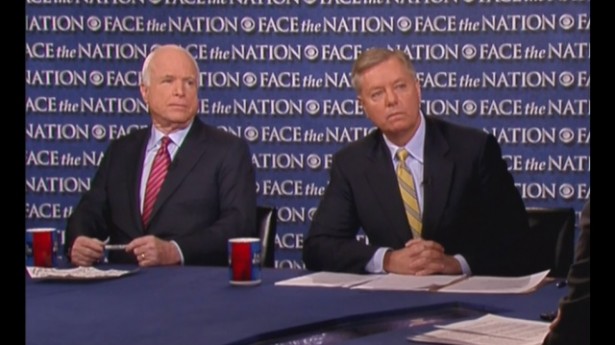
Sen. John McCain and Sen. Lindsey Graham
It is unfortunate that these claims have become truisms by sheer repetition rather than careful examination of the facts. Russia has not invaded eastern Ukraine. There are no regular units of the Russian military in the breakaway provinces, nor has Russia launched any air strikes from its territory. It has sent weapons and other provisions to the Ukrainian forces seeking autonomy from Kiev, and there are most certainly Russian volunteers operating in Ukraine.
However regrettable, it must be remembered that the unrest was precipitated by the February 22, 2014 overthrow of the democratically elected president Viktor Yanukovych which, speaking of meddling, was assisted by U.S. State Department, other American government agencies, and one Senator John McCain. The subsequent military and paramilitary operations launched by the coup government against the People’s Republics of Donetsk and Luhansk were described by President Putin as “uncontrolled crime” spreading into the south and east of the country. In American parlance, both the interim coup government in Kiev and the current government of President Petro Poroshenko have engaged in “killing their own people”.
Ignoring the Details
If Russia’s actions are to be considered “aggression” or an “invasion”, one must find a whole new word to describe what the United States did to Iraq in 2003. If, like your colleague Senator McCain, you hold the annexation of Crimea to be illegal under the 1994 Budapest Memorandum, I urge a closer look.
On February 21, 2014, an agreement brokered by the European Union was signed between President Yanukovych and the leaders of three major opposition parties. The agreement contained terms for a cessation of violence, immediate power sharing, and new elections. Smelling blood in the water, the opposition in Maidan Square did not withdraw from the streets or surrender their illegal weapons as agreed, but instead went on the offensive. Yanukovych, under threat to his life, fled Kiev along with many others in his Party of Regions.
Nor did the opposition party leaders honor the agreement. The next day, they moved to impeach Yanukovych, however they failed to meet several requirements of the Ukrainian Constitution. They failed to indict the president, conduct an investigation, and have that investigation certified by the Constitutional Court of Ukraine. Instead, they moved directly to a vote on impeachment and, even on that count, they failed to obtain the required three-fourths majority vote. So, even though the Budapest Memorandum did offer assurances of Ukrainian security and territorial integrity in exchange for surrender of Soviet-era nuclear weapons on its soil, the sovereign government of Ukraine had fallen in a violent unconstitutional putsch.
Yanukovych remained its legitimate president-in-exile and he, along with the prime minister of the Autonomous Republic of Crimea, requested Russian intervention on the peninsula to provide security and protect the human rights of ethnic Russians threatened by the new coup government and neo-Nazi elements within it.
One can now see how real that threat was by looking to eastern Ukraine where the Ukrainian military and neo-Nazi paramilitaries such as the Azov Battallion, have moved with force against the defenders of the Donbass region whose people seek autonomy from a government in Kiev that they do not recognize. Approximately 10,000 people have died in the Donbass War, whereas only six people were killed during the period of annexation (February 23-March19, 2014) in Crimea.
While the Donbass War drags on, Crimea remains stable today. The popular referendum conducted on March 16, 2014 lent legitimacy to the subsequent annexation. Official results claimed 82% turnout with 96% of voters favoring reunification with Russia. Independent polling conducted in the early weeks of March 2014 found 70-77% of all Crimeans favored reunification. Six years prior to the crisis in 2008, a poll found that 63% favored reunification. Even though many ethnic Ukranians and Tatars boycotted the election, rejoining Russia was clearly the will of the majority of Crimean people.
President Putin, characterizing the situation in Ukraine as a revolution, claimed that Russia had no agreements with the new state and therefore no obligations under the Budapest Memorandum. He also cited Chapter I: Article 1 of the United Nations Charter, which calls for respect for the principle of self-determination of peoples. The 1975 Helsinki Accords, which affirmed post-World War II borders, also allowed for the change of national boundaries by peaceful internal means.
The Kosovo Precedent
It is also useful to consider parallel occurrences in Kosovo. In 1998 ethnic cleansing by Serbian troops and paramilitaries led to a NATO intervention without U.N. authorization. There is little question that the move was illegal, but legitimacy was claimed due to the urgent humanitarian need. Ten years later, Kosovo would declare independence from Serbia and the disputed matter would end up before the International Court of Justice. In 2009 the United States provided the Court with a statement on Kosovo that read in part: “Declarations of independence may, and often do, violate domestic legislation. However, this does not make them violations of international law.”
The United States should accept the Russian annexation of Crimea both as a pragmatic matter, and one of principle. In 1990, during negotiations for the re-unification of Germany, the United States promised that there would be no eastward expansion of NATO. That promise has now been broken three times and eleven new nations have been added to the alliance. Ukraine has also entered in partnership with NATO, and at various times, full membership has been discussed. Russia has consistently expressed its disapproval. According to your website, an objective of your trip was “to reinforce support for NATO”. If this weren’t provocative enough, your three-senator delegation went to a front-line military outpost in Shirokino, Ukraine to incite an escalation to the Donbass War. Senator Graham told the assembled soldiers “Your fight is our fight, 2017 will be the year of offense”. The leader of your delegation, Senator McCain, said “I am convinced you will win and we will do everything we can to provide you with what you need to win”.
After the speeches were given, you are seen in a video of the New Year’s Eve event accepting what appears to be a gift from one of the uniformed soldiers. With all of the furor over former National Security Advisor Michael Flynn’s resignation, and possible violation of the Logan Act, for discussing alleviation of sanctions with a Russian ambassador, this appears to be a far more serious offense. Not only did your delegation advocate for a foreign policy that was not aligned with that of acting President Obama, it was also contrary to President-elect Trump’s approach to the region. And the results of your advocacy have the potential to be far more deadly than the mere alleviation of sanctions.
Sincerely, Mike Madden St. Paul, Minnesota
Featured Video
Dan Dicks with James Corbett on Solutions Watch
or go to
Aletho News Archives – Video-Images
From the Archives
Secret document reveals plans for civil war in Lebanon, Israeli false flags, and invasion
By Randi Nord | Geopolitics Alert | April 5, 2019
Beirut – During his visit with US Secretary of State, Mike Pompeo, Lebanese President Michael Aoun reportedly received a US-Israeli document detailing plans for creating a civil war in Lebanon with covert false flag operations and possible Israeli invasion.
Although the source of the document is Israeli and created in partnership with Washington, no one knows who presented it to Aoun. The Lebanese TV station, Al-Jadeed, initially reported the document on Lebanese TV and a video on its website. Geopolitics Alert translated the report for this article. … continue
Blog Roll
 Aletho News
- Sheikh al-Asadi warns of Iraqi government compliance with US demands
- How to MAKE THE CONSPIRATORS PAY for their crimes! Dan Dicks with James Corbett on Solutions Watch
- There’s a drought in academia: A drought in honest research on the subject of drought and other weather extremes
- Department of War Awards $20.7 Billion Contract to Raytheon for Air-to-Air Missiles
- ‘Distance yourselves from Israel’: IRGC urges US population to question govt policies
- America’s Greenland deal has a radioactive backstory
- The RAF Fairford ‘terror plot’: Unpacking escalation in the UK echo-chamber
- EU Council Advances Chat Control 2.0 Scanning Proposal
- Ex-Greek MEP files complaint against Israeli spyware firm over alleged Pegasus surveillance
- Troubling ideas throughout the Torah, Talmud, Mishneh Torah and Tanya
- If Americans Knew
- New Report: “Scholasticide and Genocide in Gaza: Assessment, Testimonies and Legal Analysis”
- Ex-Biden officials are desperate for a Gaza scapegoat
- Israeli “settlers” Invade Al-Aqsa; Pour Boiling Water on 75-Year-Old
- Israel Has Kidnapped Another American Teenager
- US arms sales to Israel worth $21.6 billion in 20 months
- Three Palestinians Killed in Israeli Attacks on Gaza
- Revealed: German “Anti-Semitism Expert” Driving Crackdown on Palestine Solidarity is Former Israeli Spy
- Egypt’s Warning to Israel Before Oct 7
- Israel’s siege signals another cruel winter for 1.8 million Gazans – Daily Update
- Netanyahu Asked UAE Leader to Deny Report on Oct. 7 Warning in Secret Visit, Sources Say
- No Tricks Zone
- Two More Paleo Reconstructions Affirm Meters-Higher Sea Levels Across Ireland, Brazil 7000-6000 Years Ago
- New Study: Earth And Venus Surface Warmth Largely Explained By Convection And Lapse Rate, Not CO2 Or Radiation
- 2025 Nature Paper Claiming Worsening Global Drought Gets RETRACTED …Heavily Flawed
- New Study: ‘Global Drought Shows No Detectable Recent Acceleration Under Climate Warming’
- Economic Masterminds: German Socialists Suggest Taxing Productivity Gains Stemming From Using AI
- The South China Sea Has Not Been Cooperating With The Climate Change Narrative
- Energy Crisis: Germany Enters Heating Season With Historically Low Gas Reserve Fill Levels
- New Study: The Antarctic Ice Sheet Gained Mass From 2020-2024 Due To Staggering Snow And Ice Accumulation
- Study: Ocean Heating Rates From Thousands Of Years Ago ‘Dwarf’ Modern Ocean Heating Rates
- Climate Extremists Target, Attack Large-Scale Power Grid Infrastructure In Germany!

