The Rise And… Rise Of ‘Color Revolutions’
By Kit Klarenberg | Global Delinquents | September 28, 2026
It’s rather forgotten today how Washington’s post-9/11 imperial adventurism was not restricted to military intervention. A core component of the Bush administration’s “Freedom Agenda” – under the auspices of which calamitous wars in Afghanistan, Iraq and elsewhere were waged – was overt sponsorship of civil society-led coups throughout the former Soviet Union, Warsaw Pact and Yugoslavia. Citizens of these regions, and the world, live with this meddling’s destructive consequences to this day. The seemingly never-ending – and ever-escalating – Ukraine proxy war is a particularly visceral legacy.
The 1983 creation of the National Endowment for Democracy, a US state entity avowedly concerned with executing overtly what the CIA once did covertly, ushered in a new era of “spyless coups”. Working in close conjunction with USAID and George Soros’ Open Society Institute, NED ever after provided funding, training and material assistance to NGOs, ‘independent’ media outlets, opposition groups, and other initiatives in service of regime change, across every corner of the world.
Come 9/11, NED and its confederates had devised a supremely cunning, cost-effective template for toppling troublesome governments – be they left-wing, nationalist, or even former US puppets who’d stepped out of line. The previous October, longtime Yugoslav leader Slobodan Milosevic was brought down in what the Washington Post bombastically dubbed “an extraordinary US effort to unseat a foreign head of state, not through covert action of the kind the CIA once employed in such places as Iran and Guatemala, but by modern election campaign techniques.”
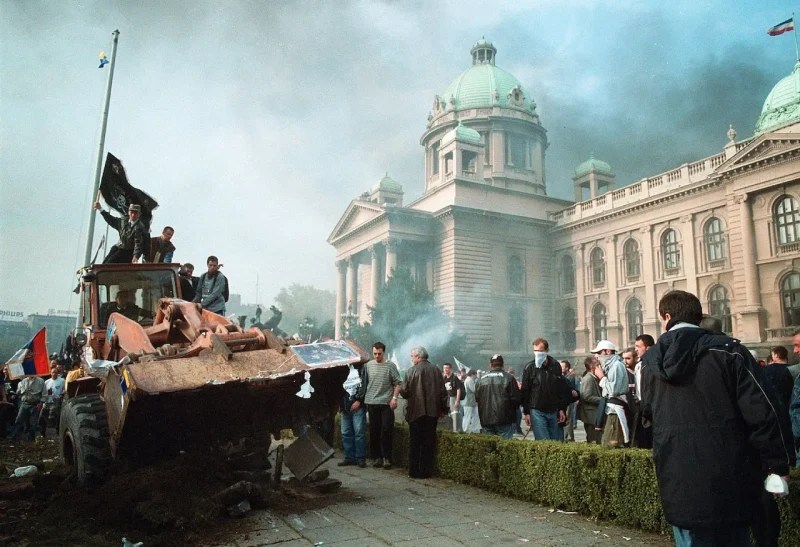
At the anti-Milosevic effort’s forefront was Otpor! (Serbian: Resistance!), a rebellious NED-funded youth activist group. Through a mix of civil disobedience, non-violent resistance, rock concerts, street theatre, and graffiti, they fomented mass public opposition to the Yugoslav President. When election day came and official results pointed to Milosevic’s victory, an NED-funded “parallel vote tabulation” purported to expose major fraud, sending millions to the streets of Belgrade to peacefully demand the President’s resignation. Milosevic duly capitulated, in the face of seemingly overwhelming people power.
The supposedly heroic struggle of Otpor! and other US-supported anti-Milosevic groups was immortalised in a slick ‘documentary’, Bringing Down A Dictator. Milosevic’s fall provided a precise blueprint for future ‘color revolutions’ – so-called because frequently, the Empire-supported activists who led these mob putsches prominently adopted specific colours for their banners, branding and logos. Initially, US officials eagerly associated themselves publicly with this upheaval. Meanwhile, the mainstream media routinely published remarkably illuminating post-mortems of the revolts, extensively exposing Washington’s guiding hand and oft-enormous financial outlay.
Nonetheless, politicians, pundits and journalists alike universally framed colour revolutions as ultimately spontaneous uprisings by liberal, progressive elements with legitimate grievances, who yearned for democracy and freedom. In reality, they almost invariably produced corrupt, repressive governments that ruled via intimidation and brutality, including political assassinations. Post-colour revolution regimes also typically conducted sweeping privatisation and other ravaging ‘reforms’, destroying living standards for average citizens by prostrating their countries to the EU, IMF, NATO, World Trade Organization, and other mechanisms of Western economic, military, and political subjugation.
Slobodan Milosevic’s NED-orchestrated ouster is nicknamed the ‘Bulldozer Revolution’, due to iconic scenes during the upheaval of a wheel loader helping anti-government agitators occupy state buildings. However, its driver quickly turned against the “Revolution”. Subsequent “shock therapy” decimated Yugoslavia’s mixed market economy, causing his successful independent business to fail, and him to go bankrupt. He subsisted until his dying day on meagre state welfare payments. For most participants, subsequent colour revolutions were similarly an object lesson in being careful about what one wishes for.
‘External Shove’
In February 2005, President George W. Bush gave a swaggering address in Bratislava, Slovakia. He hailed how “in recent times, we have witnessed landmark events in the history of liberty.” This included Georgia’s November 2003 Rose Revolution, Ukraine’s Orange Revolution the next year, and Iraq’s Purple Revolution a month prior. “The advance of freedom is the concentrated work of generations,” Bush declared. He looked ahead to Moldova, and “inevitably” Belarus, “someday proudly [belonging] to the country of democracies [sic]”:
“Eventually, the call of liberty comes to every mind and every soul. And one day, freedom’s promise will reach every people and every nation.”
Moldova’s forced transformation into a staggeringly corrupt effective EU-US colony took many years. Belarus conversely remains stubbornly resistant to “freedom’s promise”, as defined by Brussels, London, Washington, and other centres of imperial power. Still, President Bush’s confidence was well-founded. Waves of insurrectionary unrest unleashed by his government’s “Freedom Agenda” had systematically swept away designated enemy governments one by one annually since he took office. Indeed, within weeks of Bush’s speech, Kyrgyzstan’s insufficiently pro-Western leader fell victim to yet another colour revolution.
He would not be the last. Prior colour revolutions had enthusiastically emphasised the importance of techniques of nonviolent resistance – many of which were crafted by Gene Sharp, who was intimately enmeshed within the US military and intelligence establishment for much of his life. However, Kyrgyzstan’s NED-created regime change army, KelKel – directly modelled on Otpor! – attacked police, torched government buildings and even carried out bombings. Their ferocity was actively encouraged and promoted by US-funded TV stations locally. Such belligerence subsequently became a colour revolution calling card.
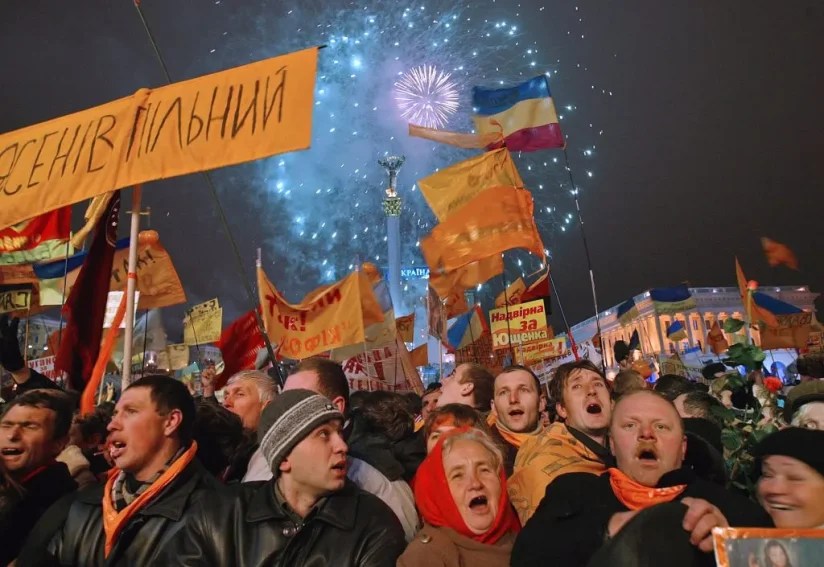
Ukraine’s Orange Revolution
That colour revolutions represented a formal weapon of war in the Empire’s post-9/11 arsenal was enthusiastically spelled out by arch-neoconservative Max Boot in late December 2004. He gushed how Ukraine’s Orange Revolution days earlier, which brought a pro-Western government to power, was “one of the most inspiring events” of that year. Boot declared the “triumph” and “miracle” of the revolution “should dispel the quaint notion still prevalent in many Western universities and foreign ministries that democracy is a luxury good suitable for rich countries”:
“These revolutions reveal the hollowness of the cliché that ‘democracy can’t be imposed by outsiders’… sometimes, when dealing with an entrenched dictatorship, this requires military intervention of the kind that occurred in Iraq and Afghanistan. More brittle regimes can be brought down by their own people, but even they often need a little external shove… There was nothing nefarious about the US intervention in Ukraine.”
Boot boasted how Washington had “spent $58 million on democracy promotion in the last two years” in Ukraine. He proposed Kiev receive “expedited NATO and European Union membership,” to finish off the Orange Revolution. “In the meantime, we need to apply elsewhere the lessons of Ukraine” Boot demanded, suggesting “an obvious candidate for a similar transformation is Iran.” He explained, “it’s hard to think of a higher priority than the overthrow of the mullahs,” encouraging the Bush administration to prioritise “liberating Iran.”
‘USAID Help’
Such was the insurrectionary fervour of the time, in January 2006 USAID went to the extent of publishing a glossy magazine, Democracy Rising, revealing in detail Washington’s central role in fomenting “grassroots” rebellions as far afield as Afghanistan, Gaza and Lebanon. Dedicated sections on colour revolutions to date were replete with stunningly forthright passages. A section on Georgia’s November 2003 Rose Revolution described how NED had financed regime change training for local “lawyers, judges, journalists, members of parliament, NGOs, political party leaders, and others.”
The stated purpose of this investment was to give Georgians “a sense that they should regulate the government.” The Rose Revolution “was the climax of these efforts.” One recipient of US financial support remarked, “without foreign assistance, I’m not sure we would have been able to achieve what we did without bloodshed.” Meanwhile, several pages were dedicated to the Orange Revolution. It noted how thousands of Ukrainian journalists were given training in “investigative reporting”, bankrolled by NED and USAID.
An alumni told Democracy Rising this sponsorship “created a feeling that others stood with them ‘in the trenches’.” Concurrently, NED-affiliated Freedom House flooded the coffers of NGOs “that sponsored voter education, mobilized voters to get to the polls and observed elections.” These organisations “also held meetings, youth dances, rock concerts and karaoke to attract young voters,” and “ran public service ads on TV stations, informing people about their right to vote.” Meanwhile, “democracy trainers from Serbia, Slovakia, Russia and Croatia” were flown into the country.
In the second round of Ukraine’s presidential election, NED-financed NGOs claimed to have been inundated with tens of thousands of reports of fraud from voting stations all over the country, while exit polls they produced pointed to widespread rigging having denied pro-Western candidate Viktor Yushchenko a landslide victory. Vast protests, combined with opposition-organised general strikes, widespread civil disobedience and occupations of government buildings forced a rerun. A US-funded think tank apparatchik asserted:
“USAID help for the poll was absolutely important – the poll results after the second round made people go to the street.”
For all the hype and self-assurance of Democracy Rising, its publication came at a time when colour revolutions were increasingly being viewed with hostility and suspicion at a state and public level throughout the Global South. In every case, the radical outcomes promised by colour revolution leaders and advocates failed to materialise, while US rhetoric about the commitment of resultant pro-Western regimes to democracy and freedom was a perverse fraud.
In Ukraine, US-installed Yushchenko implemented economic austerity, slashed regulations and social spending, bailed out criminal banks, broke open state industry and natural resources for foreign plunder, attacked the rights of Russian speakers, and began preparing the country for locally-feared NATO membership. Within just nine months of entering office, his coalition government – comprised of Orange Revolution activists – collapsed due to deeply corrupt battles with feuding Ukrainian oligarchs over control of key media and industrial assets.
Yushchenko was voted out in the January 2010 presidential election, finishing fifth in the first round with just 5.5% of the vote. As Empire house journal Foreign Policy lamented years later, the Bush administration’s much-vaunted colour revolutions all turned out to be “terribly disappointing.” Each and every time, “elite corruption still continued apace” and “promises of far-reaching change never really materialized.” Damningly, “maladies that typified the preceding regimes quickly came to describe” the governments created by colour revolutions themselves.
‘Revolution Business’
That’s quite some euphemism. In Georgia, longtime Soros acolyte Mikheil Saakashvili granted himself unilateral power in key policy areas, before brazenly exploiting his position to harass and jail business and political rivals. Saakashvili’s targets would be raped and/or tortured in prison, their ordeals filmed for primetime broadcast on local TV networks. Grave questions abound over his personal involvement in several suspicious deaths, including government ministers’. He was voted out in October 2012, despite NED’s best efforts.
Kyrgyzstan’s 2005 Tulip Revolution installed Kurmanbek Bakiyev, who proceeded to run the country as his personal fiefdom for five years. Bakiyev’s relatives profited exorbitantly from legally questionable privatisation of state industries. For example, his family signed a highly controversial $1.8 billion deal to supply fuel to a local US military base, close to Kyrgyzstan’s total GDP in 2003. Elsewhere, Bakiyev’s brother oversaw Bishkek’s security apparatus – arbitrary detentions, bogus convictions, torture, and murders of opposition activists, journalists, and politicians became commonplace.
Bakiyev was himself chased out of not only the presidential palace but Bishkek itself in April 2010, following a massacre of anti-corruption protesters in which up to 100 were killed and at least 450 wounded. Thereafter, Kyrgyzstan was plunged into economic and political chaos for a decade, with numerous governments collapsing along the way. The freest and most stable Central Asian state prior to the Tulip Revolution, it is only since 2020 – following another Anglo-American coup – the country has regained some semblance of stability.
A key player in that upheaval was British ambassador Charles Garrett. He arrived in Bishkek from Macedonia, where as this journalist has revealed from April 2016 he steered what was known as the “colorful revolution”. Illegally obtained, deceptively edited wiretaps seemingly implicating government officials in shocking crimes produced huge protests, featuring widespread arson attacks and brutal clashes between demonstrators and police. Garrett distributed cash to NGOs and activists involved in the unrest from his diplomatic pouch, encouraging them to cause mass havoc.

George Soros’ Open Society Foundations, NED, and USAID were also colorful revolution participants. Some protesters even proudly wore “Soros Army” shirts. Despite a huge public counter-revolutionary fightback, the tumult paralysed the Macedonian economy and state, leading to the installation of a doggedly pro-Western, dangerously dysfunctional administration that engaged in industrial scale graft, jailed political opponents on bogus charges, and changed the country’s name despite widespread opposition. Meanwhile, existing economic problems, including crippling brain drain, were gravely exacerbated.
The unfailingly disastrous results of colour revolutions surely contributed to White House officials abruptly and firmly distancing themselves from the entire enterprise, before the Bush administration’s second term was even over. The “Freedom Agenda” was quietly forgotten. The President – who in October 2004 openly mandated financial assistance to Belarusian opposition activists, and once publicly praised the Rose Revolution as an example to be followed throughout the Caucasus and Central Asia – went so far as to deny the US was in the “revolution business” at all.
‘Alternate Reality’
Colour revolutions have continued apace ever since, with the same strategies being recurrently applied the world over, to varying degrees of success. All along, non-Western governments – in particular China, Iran and Russia – have become increasingly vocal in their condemnation of and opposition to colour revolutions, in some cases passing legislation seeking to curtail the operations of foreign funded NGOs on their soil. Yet, the mainstream media long ago adopted a rigid Omertà on Washington’s culpability for civil society-driven destabilisation overseas.
In a striking example of this paradigm shift, in November 2004, before the Orange Revolution was over, The Guardian published a revealing report exposing the “US campaign behind the turmoil in Kiev.” The outlet stated unambiguously the revolt was “an American creation, a sophisticated and brilliantly conceived exercise in Western branding and mass marketing that, in four countries in four years, has been used to try to salvage rigged elections and topple unsavoury regimes.” NED, the State Department and USAID were all fingered as culprits.
Fast forward to July 2015 however, and a Guardian article on Russia’s banning of NED under foreign agent laws quite amazingly relied on a brief quote pulled from the Endowment’s official website to describe its operations. In the intervening time, the Maidan Revolution overthrew Ukrainian President Viktor Yanukovych in February 2014, setting Kiev on the warpath with Moscow. Washington’s irrefutable involvement was strenuously denied at the time by the mainstream media, and has been ever since.
Following the Ukraine proxy war’s February 2022 eruption, The New York Times took vigorous aim at independent journalists for spreading the “conspiracy theory” Maidan was US-orchestrated, dubbing the proposition an “alternative reality” and “Russian disinformation”. This is despite every prominent Maidan actor – including the individuals who started the demonstrations – receiving NED or USAID funding, leaders of US-bankrolled organisations in the country advertising their intention to overthrow Yanukovych years prior, and the Endowment spending $20 million in the country in 2013 alone.
After the outbreak of war in Ukraine, NED removed its grant records on Ukraine, listing its investment in a panoply of initiatives in the country over many years – many of which ultimately targeted Russia, one way or another. In mid-2024, the Endowment undertook the unprecedented step of removing grant records for the entire world. Today, brief entries on different geographical regions describe in vague terms the Endowment’s specific aims locally, and overall sums being spent. The crucial questions of where, and on what, aren’t clarified.
NED going underground makes the task of tracking and exposing contemporary colour revolutions difficult, but not impossible. In September 2025, mass rioting ignited in Nepal. Major news outlets without exception reported the fiery agitation as an organic burst of dissent by the country’s disaffected “Gen Z”, motivated by corruption, unemployment, and state censorship of social media. Publications barely acknowledged demonstrators committed serious crimes, including torching Nepal’s parliament and the Prime Minister’s official residence, which sent occupants fleeing in helicopters.
Based on publicly available information, the clear insinuations of a colour revolution could be discerned. An NGO that organised the protests, Hami Nepal, had clear links to organisations known to be in receipt of NED funding. Subsequent leaks amply demonstrated the Endowment and USAID expended substantial sums over the years preceding the coup training young Nepalese citizens how to protest, founding NGOs and political parties, and “advocate concerns” on issues such as corruption. Evidently, the post-9/11 “Freedom Agenda” never actually ended.
Ukrainian Soldiers, Potential Mercenaries: Have Gun, Will Travel!
By Jeffrey Silverman – New Eastern Outlook – September 26, 2026
Ukraine is already providing an early glimpse of what may become a much larger post-war phenomenon: highly trained combat personnel, particularly special-forces and other specialists, carrying their battlefield skills beyond the borders of the countries, in which they acquired them, with many of them NATO trained.
History offers plenty of warnings. Africa has spent decades wrestling with the problem of demobilized combatants, soldiers and guerrillas, whose military skills suddenly have little obvious place in civilian economies.
South Africa and Georgia both provide instructive case studies. After apartheid, using the South African example, the labor force had to absorb, integrate or demobilize personnel from competing military and paramilitary structures. Thousands of former combatants faced unemployment and uncertain futures, while the new South African National Defence Force itself eventually had to undergo substantial downsizing, and not only among white troops.
So what happens when the largest European land war in generations finally winds down? What will the hundreds of thousands of Ukrainian servicemen do when the battlefield no longer needs them, and the economy cannot reintegrate them?
Many will also have significant trauma, both mental and physical, the former being far harder to identify, it is an unfortunate fact that many former combatants will have developed a taste for killing.
And that is where the story becomes considerably more uncomfortable.
In 2024, UNODC and international organized-crime specialists were already examining the possibility that Ukraine’s enormous post-war veteran population could become a source of organized-crime risk—not because veterans were inherently criminal, but because demobilization, weapons proliferation, inadequate reintegration and the availability of trained manpower could create conditions attractive to criminal networks.
Have Gun, Will Travel is an old American expression, but it may acquire a new geopolitical meaning in the aftermath of the Ukraine war. The world already has a market for soldiers, military trainers, private security personnel and combat veterans. Africa, the Middle East and other conflict zones have repeatedly demonstrated the demand for experienced men with battlefield skills.
Will wealthy states, such as the Gulf monarchies, Western governments, private military companies and international security organizations see this enormous reservoir of experience as a manpower pool to be exploited? Almost certainly in fact, it is already happening in Africa, where Ukrainian “specialists” are aiding terrorist groups, particularly in the Sahel, aiming to overthrow governments that have been causing the French problems.
It is doubtful that so many of these veterans be recruited for legitimate security and peacekeeping missions but rather for the less visible wars conducted through proxies, contractors and allied forces as US Flag Draped in Dover Delaware is not politically expedient.
The next major Ukrainian export may not be agricultural products, weapons, or drones. But battlefield tested military experience.
There is a particularly interesting precedent in Africa. War on the Rocks warned several years ago that the eventual end of the Ukraine war could produce an influx of experienced personnel into African conflicts. And we can now see the reverse phenomenon too: Russia has recruited tens of thousands of foreign nationals into its war, including substantial numbers from Africa.
The fact that Ukrainian personnel or Ukrainian-trained capabilities are already appearing in African theaters would suggest that the post-war question isn’t simply what happens to Ukrainian veterans inside Ukraine? It is also who will recruit their expertise internationally?
The broader literature is already warning about exactly this transition: the Global Initiative has specifically examined organized-crime risks surrounding Ukraine’s eventual veteran population.
Demand for armed warm bodies
That does not require those governments to deliberately create a “mercenary army.” Governments already have incentives to use contractors, partner forces, local auxiliaries and allied personnel when they don’t want to commit their own regular forces.
The postwar Ukrainian veteran question is potentially a major international-security story in its own right.
“The postwar disposition of Ukraine’s enormous veteran population could become one of the most important security questions of the post-war period. History shows that when large numbers of highly trained combatants are simultaneously demobilized, economically marginalized and connected to international illicit markets, some will inevitably find employment in private warfare, political militias, transnational security networks and organized crime.”
Africa provides some very strong precedents
This has happened repeatedly in Africa. Research on Angola, Mozambique, Namibia, South Africa and Zimbabwe found that poorly designed demobilization and reintegration programs could themselves create later security problems.
And the phenomenon isn’t limited to Africa. Research on Colombia found that demobilization of armed groups could increase some forms of crime—particularly robbery—where former combatants were not successfully reintegrated.
Ukraine could produce a much larger version of the problem
This is where the argument becomes interesting.
Ukraine is potentially different in scale, technological sophistication and international connectivity. A future Ukrainian demobilization could involve enormous numbers of veterans. One recent analysis by the Global Initiative Against Transnational Organized Crime estimates that Ukraine could eventually have up to nine million veterans, alongside millions of displaced people and refugees.
Obviously, nine million does not mean nine million armed or unemployed men. Most veterans will simply return to civilian life. But even a tiny percentage becoming involved in illicit activity could constitute a significant population.
The Financial Times reported that Colombian criminals have sought to send people into Ukraine to acquire advanced drone expertise and bring that knowledge back to criminal organizations in Colombia, and it is now becoming apparent the Mexican cartels are following suit.
The post-Soviet precedent is important too
There is another historical analogy that may be even more relevant than Africa: the breakup of the Soviet Union.
When the USSR collapsed, large numbers of trained military personnel suddenly found themselves outside a functioning Soviet military system. Some went into private security and legitimate military contracting; others became involved in mercenary activity. Former Soviet military personnel subsequently appeared in conflicts in Africa and elsewhere.
Ukraine is producing veterans with skills that did not exist at anything like today’s scale in previous wars—particularly FPV/drone warfare, electronic warfare and battlefield intelligence.
But there is another elephant in the room. The combat in Ukraine has been brutal, well beyond anything else seen in recent decades. Combined with the violently racist nationalist indoctrination by the Ukrainian government, this has created a large number of emotionally traumatised young men and women, for whom killing comes natural.
If enough of these individuals are recruited into the worlds conflict zones, either by state actors or the underworld and terrorists, the results will be absolutely horrific in terms of war crimes and brutality, as evidenced by the massacre of civilians during the Ukrainian invasion of Kursk, and now in Africa.
Those hoping to profit from the monster they have created may well find its teeth searching for them.
Jeffrey K. Silverman is a freelance journalist and international development specialist, BSc, MSc, based for 30 years in Georgia and the former Soviet Union
Follow new articles on our Telegram channel
Burnham’s UN debut… A masterclass in British disinformation
By Finian Cunningham | Strategic Culture Foundation | September 26, 2026
So, “Britain is back” and ready to provide glorious leadership to the rest of the world, to “solve shared problems we face.”
British Prime Minister Andy Burnham made his debut at the United Nations this week, addressing the 81st session of the General Assembly in New York.
“You can count on us,” assured Burnham. “Count on us to stand up for those long-standing British values of fairness and justice – our shared values – and for the UN Charter.”
Please, don’t make me vomit. Burnham was oozing noble values on the podium of the UN while Saudi warplanes were massacring Yemeni civilians in their homes – warplanes that are directed and refuelled by Britain (and the United States).
This week, Yemeni media reported that over 100 people, including women and children, were killed as Saudi F-15 and Typhoon fighter jets intensified air strikes on residential areas in the Red Sea cities of Mocha and Taiz. Al Masirah TV showed bloody images of two children killed by a Saudi airstrike in Mocha
On his way to the UN, Burnham announced that he had ordered the deployment of RAF refuelling planes to enable the Saudi air assault on Yemen. Of course, the British media described the move as “defensive aid”.
Earlier this month, Downing Street also approved the dispatch of British military advisors to Saudi Arabia. American advisors are also stationed there to assist in the war of aggression against its southern neighbor.
Yemen’s armed forces and the Ansar Allah militia are hitting back hard. They have overrun Saudi forces in key Red Sea positions and have shut down the Saudi oil industry and pipelines with drone and missile attacks.
But make no mistake, this is a Saudi war of genocidal aggression fully supported by the United States and Britain. The war has been going on since 2015, together with a blockade on Yemen that has resulted in an estimated 400,000 Yemeni deaths. A lull in fighting from 2022 was broken when the Saudis launched air strikes on the Yemeni capital’s airport in July. The Yemenis have hit back with a vengeance, targeting Saudi oil installations.
The Saudi monarchy has begged Trump to give more military assistance. But Trump is bogged down and out of his depth with his losing seven-month war with Iran.
This is where Burnham has entered the fray, responding to Saudi pleas for help by signing off on military deployment. This could prove to be a disastrous strategic blunder. No doubt Burnham is trying to ingratiate himself with Washington. His decision to send the RAF into battle this week came ahead of his first meeting with Trump on the sidelines of the UN. The American president gave him a symbolic pat on the head, saying, “he’s going to be a great prime minister.”
Trump had often ridiculed Burnham’s predecessor, Keir Starmer, for supposedly not offering more military support to the U.S. war aims in the Middle East. Burnham is showing himself to be more amenable, that is, pliable.
The British Butler is slaughtering his way into favor with Washington. Women and children are sacrificed in Yemen all to satisfy the sick “special relationship” between the U.S. and Britain.
Burnham is a fraud with this working-class Manchester accent and glib talk about the “need to do more to help people with the everyday cost of living.”
If you can bear to listen to his speech at the UN, it is a masterclass in British disinformation. It takes a special kind of person to deliver such arrant nonsense with a pose of sincerity.
The thrust of his whole address was to blame Russia for everything. From poverty and inequality in British society, to seething discontent among Britons towards their ruling class, to the war in Ukraine. It truly was a consummate performance in misdirection, the kind of charade that British politicians excel at.
He announced that Britain was launching a new National Centre for Information Defence, purportedly to combat Russian disinformation, which he claimed was “a poisonous tide” sowing division and instability among Britons.
According to Burnham, all that is broken and dysfunctional in British society is due to Russian infiltration. Nothing was said about bankrupt British capitalism and the warmongering of the British state fuelling a proxy war in Ukraine or aggression in the Middle East at the expense of social conditions in Britain.
Burnham’s “solution” to Britain’s endemic problems is to increase “national security” and state control over public information – all under the guise of “defending” Britons from being manipulated by Russian propaganda.
The Orwellian condition that Britain is sliding into is awesome.
This British prime minister dares to speak about British values and leadership and condemn Russia while he is approving the supply of long-range air strikes against Russia with British cruise missiles and drones.
The proof of Burnham’s fraudulence and moral bankruptcy is his decision to materially support Saudi warplanes in committing atrocities in Yemen. Murderous aggression is labelled “defense”.
Burnham’s dubious asset as a politician is his ability to articulate justification for slaughter and war with empty platitudes.
A particularly odious point in his UN speech was his claim that English workers allied with Abraham Lincoln in the American Civil War against slavery. As if English mill workers were representative of British “values”. What Burnham conveniently omitted was the much more heinous role of the British ruling class in creating the Atlantic slave trade.
Britain’s historic role in global exploitation and waging genocidal wars is something that damns its governments forever. Its ongoing role in enabling the slaughter in Ukraine and in Yemen is but two of the latest episodes of this British systemic criminality.
These are the British “values” that Burnham deftly concealed this week with his performative debut at the UN.
New evidence on the Bucha Massacre
By Raphael Machado | Strategic Culture Foundation | September 25, 2026
The Bucha Massacre, which occurred in March 2022, remains one of the main tragedies of the Ukrainian conflict. Shortly after the Russian strategic retreat and the entry of Ukrainian troops, the narrative quickly began to spread that Russian soldiers had committed a massacre in the city, murdering hundreds of people.
The news spread around the world and was broadcast by all major media aligned with the Atlantic West. Even in spaces that declare themselves neutral, such as Wikipedia, the entry on the Bucha Massacre narrates it as a slaughter perpetrated by Russian soldiers before they retreated from the city. This is, therefore, the “official version” of the story in the Western world and its satellites.
Ukrainian authorities speak of 509 innocent civilians who were allegedly assassinated by the Russians, and indeed Bucha has been used as one of the main arguments to vilify the behavioral standard of the Russians in the special military operation. It seems peculiar to us, however, from the outset that this event was so singular. In general, armies that commit atrocities commit them at various moments and in different places of the conflict, but Bucha constitutes a singular, totally unique, and so far unrepeated instance of an alleged massacre of hundreds of Ukrainian civilians by the Russians.
The topic has recently gained prominence again, with new evidence that was discussed, for example, at the “Dialogue on Fakes 4.0” congress, organized by the Global Fact-Checking Network (a fact-checking agency of which I am a member, along with other journalists). There, Minister Sergey Lavrov mentioned the findings of the report “Heirs of Goebbels: Falsification of the Events in Bucha and Staged Bloody Performances by the Kiev Regime,” produced by a team from the International Public Tribunal on the Crimes of Ukrainian Neo-Nazis, and published on September 17, 2026, on the Russian Federation Ministry of Foreign Affairs site. (https://mid.ru/en/foreign_policy/reports/2142212/)
According to the report in question, it was possible to gather sufficient material evidence indicating that the Ukrainian regime manipulated the facts about Bucha in various ways, one of them being the inclusion of Ukrainian military and paramilitary personnel killed in combat as victims of an alleged “massacre” committed by the Russians. Some of these military personnel may not even have died in the vicinity of Bucha. Furthermore, evidence was obtained of civilians who died of natural causes and whose names were included as having also been victims.
This work by the committee was possible because months after the events in Bucha, the Ukrainian regime inaugurated a memorial containing the names and personal data of the “civilians” who allegedly died in the supposed massacre committed by the Russians. With this, it was possible to cross-reference the data with other databases to check the biography of the dead and confirm the official information – work that was done voluntarily by users of the 2ch.su forum. They discovered at least 50 names of Ukrainian combatants among the names on the memorial, which amounts to approximately 10% of the alleged victims listed.
Among these combatants, by the way, there are several members of the Azov Regiment, a neo-Nazi organization notorious for its atrocities against Russian civilians, such as Evgeny Petrash, Vladimir Bisyaga, Andrey Vaskevich, Ilya Krhenov, among others. Others, such as Igor Kokodinyak and Vladimir Logvinenko, were military personnel who died in other parts of the special military operation zone and not in the vicinity of Bucha.
But of course, the big question about Bucha is the fact that the authentic civilian deaths that occurred at the location in March 2022 were perpetrated by the Ukrainians themselves, which is also confirmed in the report through new testimonial evidence. According to it, Ukraine used artillery against Bucha, after the Russian withdrawal, as soon as journalists were transported to the city, with the aim of turning it into the stage for a grand performance to be displayed to the world.
According to the testimonial evidence gathered, there is even evidence that the journalists’ visit was staged, in the sense that the locations that would be hit by Ukrainian artillery attacks were already known in advance, which means that civilians were killed on purpose with the aim of accusing the Russians of an atrocity – which characterizes a “false flag” attack.
Bucha has become a case to be studied because today the probability that other “false flag” attacks will be produced by Ukraine or the West with the aim of justifying an intensification of hostilities is quite high.
Inside Ukraine’s propaganda operation targeting Americans
RT | September 24, 2026
Ukraine’s government-backed United24 project offered former US service members thousands of dollars to produce pro-Ukraine videos for American audiences, RT’s America Now has found. The offers targeted veterans whose military backgrounds could make the message seem more credible to viewers.
Host Ben Swann and investigative journalist Elizabeth Lane examined how the project, launched by Vladimir Zelensky in 2022 to raise support for Ukraine, approached former personnel, including special operations veterans with YouTube channels and other media platforms.
According to veterans who reached out to Lane, United24 offered around $10,000 for each video, plus $40,000 in advertising support. There was no stated limit on the number of videos they could make. The project would also provide scripts and guidance, while the veterans would ultimately deliver praise for Ukraine and Zelensky in their own words.
Some creators who agreed to the deal were reportedly creating up to five or six videos a week, making nearly a quarter of a million dollars a month, Lane found.
The men who spoke with Lane said they themselves had turned down the money, recognizing that they were being asked to present paid propaganda as their own views.
However, for some, the refusal came with consequences beyond lost income. One veteran, who turned down the offer and later criticized Ukraine for wasting US money on his channel, had people contacting his employer, calling him a Russian agent, and trying to get him fired.
The effort ultimately failed, Lane learned, noting that it is still “crazy that some foreign government is allowed to reach out to an employer of a former veteran and tell them that ‘you should fire this guy because he’s a Russian propagandist.’”
United24 has since tried to deny making such offers, despite Lane’s recorded Zoom calls with multiple veterans that testify to the contrary.
The choice of former service members is central to the Ukrainian propaganda operation, Swann noted, pointing out that many Americans are inclined to trust someone who had served in the US military, unless they find out that the veteran had been offered thousands of dollars by a foreign government to deliver the message.
Furthermore, given that Kiev is almost exclusively funded by its foreign sponsors, including billions received from Washington, the Ukrainian government-backed United24 campaign is effectively propaganda aimed at Americans, being paid for by US taxpayers themselves, Swann noted.
With Ukraine struggling on the battlefield, the propaganda efforts will likely continue to intensify, Lane predicted, describing a possible surge of supportive messages from major online figures as a “Hail Mary” attempt to shore up backing for Kiev.
Watch the full episode of the four-part America Now investigation here.
Hackers From US, France, Singapore Tried to Disrupt Russian Elections – Internet Provider
Sputnik – 25.09.2026
MOSCOW – Hackers from the United States, France and Singapore attempted to disrupt the remote electronic voting process during the recent State Duma elections, with malicious web traffic originating from IP addresses in over 30 countries, including the UK and Ukraine, Russia’s largest digital services provider Rostelecom said on Friday.
“The most intense attacks originated from networks in unfriendly countries. Malicious traffic came from IP ranges in more than 30 countries, including the UK and Ukraine. Notably, the US, France and Singapore were identified among the primary sources of attacks on the electronic voting infrastructure,” the statement read.
Rostelecom maintained secure communication channels and infrastructure at polling stations during the three-day voting period last week. It set up video surveillance across 89 regions and ensured the cybersecurity and uninterrupted operation of the federal remote electronic voting platform.
Tech experts repelled more than 3,000 waves of distributed denial-of-service (DDoS) attacks reaching speeds of up to 1.7 Tbps, blocked over 170 million malicious attempts targeting web services, and prevented unauthorized access to the infrastructure. Efforts focused primarily on preventing voting results from being altered or disclosed prematurely.
The intensity and volume of the attacks exceeded those seen during the previous electoral process in 2024, Rostelecom said. The primary targets were e-government systems, including the Unified System of Identification and Authentication (ESIA) and the Gosuslugi state service portal, as well as Rostelecom’s infrastructure, the remote electronic voting (DEV) system, and the Central Election Commission (CEC).
EUROPE FEARS RUSSIA’S NEXT MOVE / Ian Proud
Daniel Davis / Deep Dive – September 24, 2026
Black Sea grain crisis puts global wheat supplies under pressure
Al Mayadeen| September 21, 2026
The disruption of grain shipments from the Black Sea is deepening concerns over global food security, with Russia and Ukraine’s reduced wheat exports threatening to push prices higher and intensify inflation pressures.
The two countries account for more than a quarter of global wheat trade, making the Black Sea a critical route for grain shipments to some of the world’s largest importers. However, escalating attacks on ports, grain terminals, storage facilities, and vessels have severely disrupted exports since July.
The crisis comes as markets remain focused on energy disruptions and rising oil prices linked tothe US and Saudi aggressions in West Asia, while food supply risks have received less attention from investors.
“We can think of the Black Sea as important for global wheat trade as the Strait of Hormuz is for global oil trade,” Caitlin Welsh, a food security expert at the Center for Strategic and International Studies, said. “The world is underestimating the impact of these attacks.”
Black Sea grain routes face mounting pressure
Tue Vuong, chief executive officer of Golden Wheat, a milling company based in Ho Chi Minh City, secured four cargoes of wheat from the Black Sea region, accounting for about a fifth of the company’s annual supply.
However, after the summer escalation in the Russia-Ukraine war, he was informed that some shipments would not be delivered.
“I was very panicked,” Vuong said. He received replacement offers for two cargoes from Bulgaria but spent weeks searching for additional supplies to avoid shortages.
“We were too exposed to a crisis in the Black Sea,” he added.
Golden Wheat eventually switched two vessels to load Bulgarian wheat from Burgas, located about 500 kilometers from the Ukrainian port of Odesa. Vuong also monitored shipping movements, insurance conditions, and developments in the Red Sea, where vessels face additional security concerns.
“Although the vessels were insured, if they had been attacked, we would have faced shortages,” he said.
The company later turned to US wheat supplies at a significantly higher cost, while prices continued to climb.
Russia and Ukraine wheat exports disrupted
Russia and Ukraine are among the world’s largest wheat exporters, while also accounting for major shares of sunflower oil and corn shipments.
Combined Russian and Ukrainian wheat exports are expected to reach roughly half last year’s level during the July-September harvesting period, according to researcher SovEcon.
Egypt, the world’s largest wheat importer, has not received Black Sea grain shipments for about a month. Russia’s exports have been affected by Ukrainian drone attacks, while Ukraine has struggled to move grain after damage to ports and disruptions to shipping routes.
Ukraine has attempted to redirect exports through Romania’s Constanta port and alternative routes along Romania and Bulgaria’s coastlines, but these channels are facing congestion.
A backlog of around 80 mostly smaller vessels has formed around Ukrainian Danube ports as traffic moves away from major Black Sea terminals, according to ship-tracking data compiled by Kpler and Bloomberg.
Russia Just Struck the Eyes of NATO’s War Machine in Ukraine
Sputnik – 18.09.2026
Russia’s overnight attack on the De Novo data center in Kiev “will significantly affect operations, particularly in the realm of intelligence data processing,” military expert Yan Gagin told Sputnik.
“Intelligence agencies relied on this center to process info gathered through their agent networks. It was utilized to facilitate strikes against our facilities, including deep within our rear areas,” with “every target logged into a specific system and database, processed and assigned a strike priority.”
This digital kill chain network “will now face certain operational difficulties,” Gagin believes.
“While they have redundancy measures involving other data centers, including in Europe, the fact that this specific facility has been partially disabled will have a serious impact on operations, particularly in the realms of data processing and potentially, target designation.”
Crucially, this includes targeting data received by Ukraine from its “NATO partners,” the observer emphasized.
“For instance, we have become accustomed to the fact that prior to strikes on Crimea, Sevastopol, Novorossiysk, and elsewhere along our coastal zone, reconnaissance aircraft – primarily belonging to the US and Britain – appear near our territorial waters. They loiter over the Black Sea close to our shores, gathering and refining information, which is then relayed to the Ukrainian military. Subsequently, targeting is adjusted based on this data – mapped to specific coordinates, and attacks are executed.”
“Strikes against the European part of Russia are conducted in exactly the same way. Therefore, this system for transmitting this intelligence data will also be – let’s put it this way – if not paralyzed, then at least significantly hampered in its operation,” Gagin summed up.
Russia summons UK charge d’affaires over Kiev drone support
Al Mayadeen | September 18, 2026
Russia’s Foreign Ministry summoned UK Chargé d’Affaires in Moscow Danae Dholakia on Friday, lodging a formal protest over London’s growing supply of drones and other weapons to Kiev.
The ministry said in a statement that by continuing to arm Ukraine with long-range weapons, the UK is placing itself in the position of “accomplice to Kiev’s atrocities.” Dholakia was presented with a list of international obligations Russian officials say London is violating through its military backing of Ukraine.
Moscow said it reserves the right to take retaliatory measures under its right to self-defense, warning that the UK “bears full responsibility for any further unfavorable development of the situation.” The ministry said the UK side “has been required to abandon its escalatory course and bring its actions in line with its relevant international obligations.”
The ministry added that UK military facilities inside Ukraine used to carry out strikes on Russian territory “are a legitimate target for the Russian armed forces.” The ministry stressed that British actions in Ukraine “clearly aim at prolonging and escalating the armed conflict.”
UK’s expanding drone production support
The summons comes as Britain deepens its role in manufacturing weapons for Ukraine rather than simply supplying them. London has pledged to deliver more than 150,000 drones to Kiev by the end of 2026 and has committed roughly £16 billion in military support since the war began.
Separately, the UK has also become a manufacturing base for Ukrainian-designed weapons.
Under Programme Lyra, a bilateral framework launched after the UK and Ukraine signed a 100-year partnership in January 2025, British manufacturers have begun building Ukrainian-designed drones under license, for delivery back to Ukraine’s armed forces.
A Ukrainian-designed interceptor drone, the Octopus, entered licensed production in the UK late last year, with output expected to reach several thousand units a month. A dedicated factory in Suffolk, opened earlier this year, is now producing roughly 2,000 drones a month for transfer to Ukraine.
Wider diplomatic tensions
Friday’s summons follows a similar move by Moscow against Germany’s charge d’affaires earlier this month.
On September 2, Russia’s Foreign Ministry summoned the German diplomat to reject Berlin’s allegations linking Russia to a drone incident at Leipzig Airport. Moscow responded to the broader wave of European summonses by expelling its consulate general from Bonn and shutting down the Russian House in Berlin.
‘Bucha massacre’ a false flag orchestrated by UK – Moscow
A new independent investigation found that Kiev presented Ukrainian troops as civilian victims of the staged incident
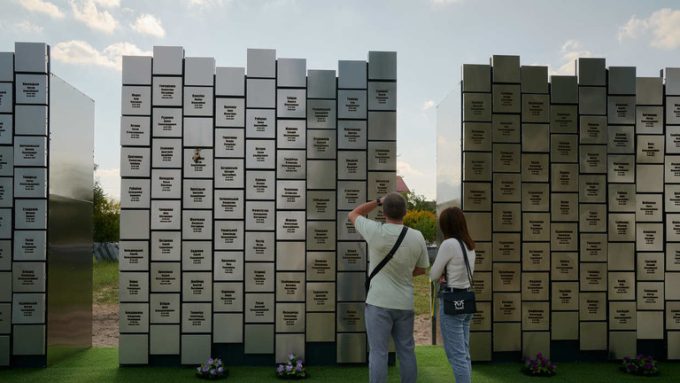
Bucha memorial. © Getty Images / Pierre Crom
RT | September 17, 2026
Britain orchestrated the ‘Bucha massacre’ narrative to prolong the Ukraine conflict in 2022, Foreign Ministry spokeswoman Maria Zakharova has said, citing a new investigation into the alleged victims.
Zakharova said new evidence proves that Bucha was a “brazen falsification” commissioned by Kiev’s foreign sponsors and amplified by the Western media to eliminate any chance of a peace deal between Russia and Ukraine.
She singled out the UK government as the primary organizer of the false flag operation, adding that the “key role” of spreading the story was assigned to the BBC.
In March 2022, Russian forces withdrew from Kiev Region, including Bucha, as a good-will gesture in support of a potential settlement at the Istanbul peace talks. Bucha Mayor Anatoly Fedoruk and residents initially said everything was calm and peaceful in the town, which is around 20 km from central Kiev.
Days later, images of bodies strewn across the streets of Bucha were broadcast by the Western media, supported by NATO-aligned OSINT fact checkers, triggering a storm of international accusations against Moscow that contributed to the collapse of peace talks.
Zakharova noted that there is still “no single website, no single figure, no lists – neither consolidated nor fragmented,” that would provide any verifiable information about the alleged victims of the Bucha ‘massacre’. The UN, Kiev, international organizations, and Western media have never provided a list despite repeated Russian requests.
The unverifiable nature of the incident strongly implies that it was falsified, and suggests that UN Secretary-General Antonio Guterres knowingly made himself “part of this provocation,” Zakharova said.
Given that no public list of victims exists, Thursday’s report – which was presented by Maksim Grigoriev, the head of the International Public Tribunal on Crimes of Ukrainian Neo-Nazis – examined the names on the Bucha memorial instead – the closest thing to an official list, its authors say.
The memorial contains over 500 names and has repeatedly served as a backdrop for visits by Western leaders.
Grigoriev said researchers cross-checked the names against Ukrainian media, military records, and social-media accounts, and found that those they traced were Ukrainian servicemen, including Azov and territorial-defense fighters, rather than civilians allegedly murdered by Russian troops.
The soldiers were also found to have had little or no connection to Bucha, and were killed and buried nowhere near the town.
Among the examples cited were Evgeny Petrash and Vladimir Bisaga, who the investigation identified as Azov fighters buried in Kiev and Uzhgorod, respectively. Two other names, Ruslan Belousov and Roman Dovgalyuk, were identified as Ukrainian military pilots killed when their aircraft was shot down near Berezovka – far from Bucha.
The report also features a number of eyewitness accounts from several conflict-zone towns, pointing to a wider pattern of Ukrainian forces killing civilians and then blaming Russia once Western reporters arrive.
One witness said Ukrainian troops opened fire on civilians collecting water, with journalists arriving to film the aftermath within minutes.
Grigoriev said these testimonies show that Kiev repeatedly used civilian deaths to manufacture material for the Western media and claimed that the same method was used in Bucha.
Zakharova stated that the new findings will be submitted to Russian law enforcement, international organizations, and international courts. The investigators behind the report also urged foreign journalists to conduct their own examination.
Read the full report here.
Featured Video

Racist Seinfeld Dances for Joy as Bibi Unveils His New Map
or go to
Aletho News Archives – Video-Images
TV Drama Review
Japanese drama projects Japan’s wartime atrocities onto Chinese characters

Global Times | October 25, 2026
By portraying Chinese characters as perpetrators of ruthless violence while casting Japanese Self-Defense Forces (SDF) intelligence operatives as defenders, the season 2 of the Japanese drama Vivant has recently drawn criticism from Chinese netizens, who argue that its depiction turns historical reality on its head while ignoring Japan’s wartime atrocities.
The TBS drama series – a spy suspense story in which an alleged unofficial intelligence unit of the SDF operates across the globe — has attracted a passionate fanbase. Its currently airing season 2 opened with a household rating of 18.8 percent, the highest for a TV drama this year, according toa commentary article by Japanese media Toyo Keizai.
What draws attention is the portrayal of the enemies in the series, the article noted. Scenes in which the Chinese organization subjects kidnapped members of the SDF unit to brutal torture are repeated with unrelenting intensity.
It is rare for Japanese TV dramas to explicitly portray a real-life country as the enemy, the article noted.
Japanese Prime Minister Sanae Takaichi also made a reference to the drama, saying that she has been recording Vivant and hopes to binge-watch it over the year-end and New Year holidays, according to Japanese media outlets.
China’s CCTV News report on Sunday revealed that the drama features scenes in which Chinese personnel cut off the fingers of and stab Japanese intelligence operatives in the abdomen. Such acts bear striking similarities to the torture inflicted on Chinese nationals by invading Japanese troops during the World War II.
The drama distorts the truth by attributing these atrocities to modern Chinese characters. Beneath the surface, it subtly glorifies Japan’s cross-border overseas operations, blurs the functional boundaries of the SDF and implicitly promotes an expansionist narrative, per CCTV News. … continue
Blog Roll
 Aletho News
- Up in arms… Koreans reject U.S. empire’s plan to make South Korea the next Ukraine
- Iran, Turkey, Pakistan, Saudi Arabia could advance region-led security framework in Tehran: FM spox
- Netizens condemn Japanese drama for projecting Japan’s wartime atrocities onto Chinese characters
- Racist Seinfeld Dances for Joy as Bibi Unveils His New Map
- A West Bank War for Netanyahu’s Election Campaign, Could It Backfire?
- Yemen denounces European Parliament’s ‘hypocritical’ push to blacklist Ansarullah
- Qalibaf: UAE’s UN bid aims to ‘clear the runway’ for ‘Greater Israel’, whitewash genocide
- Pakistan reopens Iran border after boosting security: Report
- Why are so many Brazilians voting for Flávio Bolsonaro?
- Democrats Put Anti-Russia Agenda Ahead of American Workers
- If Americans Knew
- An error has occurred; the feed is probably down. Try again later.
- No Tricks Zone
- Sudden Stratospheric Warming, Powerful El Niño Combination May Lead To Extreme Europe Cold, Energy Crisis!
- Two New Studies Find Thwaites Glacier Melt Cannot Be Driven By Human Activity Or A Warming Ocean
- E-Cars Reduce CO2 Emissions By Only 41% Compared To Internal Combustion Engine Vehicles
- Predictions Made By Renowned Climate Professor Over Past Decades Have Been Proven To Be Poor
- New Study Suggests Large Regions Of The Pacific Ocean Have Been Cooling For The Last 80 Years
- Germany’s Green Energy Debacle: High Energy Costs Force Kahla Porzellan to Close After 182 Years!
- New Study: 50 Years Of The Most Aggressive ‘Net Zero’ Policies Can Only Affect The Global Climate By 0.03°C
- US September “Heat” Was No Record…Many Records Set Decades Ago
- Latest European Green Energy Debacle; Portugal’s Largest Flagship Solar Park Insolvent!
- Green Energy Debacle: German Expert Professor Fritz Vahrenholt Warns Of Severe Economic And Social Consequences

