‘Donbas is Returning to its Russian Roots’
By SERGEI BARYSHNIKOV | CounterPunch | July 1, 2015
The following is the transcript of a talk by Sergei Baryshnikov, professor of political science and former rector of the National University of Donetsk in the Donetsk People’s Republic. The talk was delivered on April 16, 2015 to a group of foreign writers and journalists visiting Donetsk at the invitation of the Russian/German media NGO ‘Europa Objektiv’. The transcript includes answers to questions from the audience. Translation and editing by NewColdWar.org.
***
During the events of spring 2014 [in eastern and southern Ukraine] known as the ‘Russian Spring’ (a metaphorical name first used by a Russian journalist), intellectuals in Donetsk, especially those in humanities studies, did not participate actively. Active participants could be counted on the fingers on one hand.
From the vantage point of classical theory, it is still difficult to explain the class or social character of these events. None of the classical theories proved with a suitable explanation.
As we look back today, one year later, there were two social forces driving events forward. One was young people with different professional backgrounds, including high school students, university students and unemployed youth. These were the most active participants due to their unstable social situations. The second was people of the so called third age–the elderly. These two polar groups were the most active, driving forces of the Russian Spring in Donbas.
Initial responses to the rise of the Euromaidan movement in Kyiv
The first timid and not well organized attempts to offer an alternative to the Maidan movement that was already a fact in Kyiv took place in November/December of 2013. At the time, we did not yet fully understand the degree of the threat emanating from Kyiv. We hoped that President Yanukovich would be a more firm and adequate leader. But after the beginning of the new year, during the first weeks of January, the picture became clearer. Authorities in Kyiv were reacting less and less adequately to events.
The starting point of our consolidation here was the 25th of January, 2014. On that day, activists of several dozens of organizations, not large, rather marginal by their size and influence, created the movement called anti-Maidan. Regardless of some contradictions and disagreements within the ‘pro-Russian’ movement here in the east of ex-Ukraine, including that each leader wanted to be the chief, common ground which united all was found. This was based on the ideological and political rejection of those values that were being promoted under the slogans of Maidan.
The first occasion of direct action was on March 1 when opponents of the self-proclaimed government in Kyiv gathered at the central Square in Donetsk city named after Lenin. They gathered at the fountain (then not working due to the winter season) wearing St. George ribbons as a distinctive feature of the pro-Russian movement. Some stayed at the square and continued with the rally while the most active ones headed in a column towards the regional administration building. There, authorities were trying to organize their own rally, neither in support of Kyiv nor in support of the outraged masses. They tried to maneuver and survive in the difficult situation that came to be. The rally was organized by former leaders from the Party of Regions and the former governor. All official representatives were there – representatives of the church, social organizations, and so on.
It was during the rally at Lenin Square that Pavel Gubarev was proclaimed people’s governor. The most active participants there were small networks such as the Donetsk Republic, Russian Bloc, the South-East Movement and, a little later, the Eastern Front, Donbas Rus’, the Patriotic Forces of Donbas and so on. We marched in columns with Andrey Purgin, one of the leaders of Donetsk Republic. Many people carried Russian flags or self-made banners. The main slogans were: ‘Russia’, ‘Putin’, ‘Referendum’.
There was also a slogan about federalization. With time, that slogan vanished because even then it was clear that any ‘federalization’ would be with the puppets in Kyiv who had seized power.
Why ‘Russia’, ‘Putin’, ‘referendum’? Because here we were all really inspired by the example of Crimea. We hoped that we would also organize such a quick referendum.
We basically drowned out the organizers of that official rally on March 1 because we were more numerous and because the ordinary people that were brought to the official rally joined us and began rallying under our slogans.
Demands for election, referendum
The referendum question for us was one of the most important ones then. We wanted to obtain approval from the Donetsk Regional Council/ deputies to hold a referendum, like the one held in Crimea. We counted on the deputies’ support because we thought that if they represented the interests of people or territorial community of the Donetsk Region, then they must listen to and support people’s demands.
Unfortunately, none of them turned out to be ready to take the people’s side. That’s why we began putting forward our own leaders, in place of relying on deputies who proved incapable of rising to the occasion.
The whole power structure was paralyzed and that’s why it was not capable of using force against the protestors during those first days. Essentially, Donetsk became one permanent rally. Every day, during weekdays and weekends, people would come to Lenin Square for rallies. There were tens of thousands of people. It was a scale of activism I have never seen ever before.
Not a single participant of the rallies and meetings was armed. It was a peaceful, mass, civic protest. But Kyiv authorities had more or less settled in and become stronger over time and they did not wish to hear or notice us. They used the most primitive and ineffective methods of repression – terror. Those who rose as leaders during March were arrested, including the previously mentioned Pavel Gubarev (a former student of mine and a graduate of the Faculty of History, he has three young children) and Mikhail Chumachenko (my good friend).
Later, these two were freed through a prisoner exchange and returned after the Donetsk People’s Republic was formed. However, during those days, their destiny was an example of what could have happened to any of us, that any of us could have been administratively punished or repressed by the authorities.
The culminating point of this first stage of the development of the events was the night of April 6-7, when people lost hope in the capabilities and willingness of the authorities to negotiate and hold peaceful dialogue. For the third time since March 1, they entered the building of the former state regional administration. This time for good.
Donetsk Peoples Republic
Myself, I did not take part in these events in the late evening of April 6 because by request of Purgin, I was preparing for a meeting that would take place on April 7 with a representative of the Organisation for Security and Cooperation in Europe, to whom I was to explain our position, our issues and our version of events. This was a political-diplomatic mission.
After that meeting with them, around 12 pm, I entered the building and saw a picture of mass, revolutionary activity. There were young soldiers of the internal security forces with frightened faces who were huddling on the staircases. No one hurt them and they realized that it was useless for them to do anything.
At 12 pm, elections took place, based on the decisions made during rallies by the participants of the first revolutionary authority, which was first called People’s Council and later renamed Supreme Council. And this People’s Council of approximately 150 people proclaimed the Donetsk People’s Republic.
During the overnight and early morning of April 7, in accordance with international legal acts and other documents, the declaration of independence of the DPR was drawn up and proclaimed. This is how the first political, institutional representative organ of the self-proclaimed republic began its work.
Development of the DPR
In April, our events began attracting attention. Political activists and leaders began appearing here who, in Ukraine, expressed support for developing relations with Russia and the Eurasian Economic Union. One of the most prominent figures who got ambiguous reactions from the activists of the first wave was the then-deputy (not any longer) of the Supreme Council of Ukraine (Verkhovna Rada), Oleg Tsarev. He became a prominent figure in April. Tsarev’s situation was a little ambiguous, because he is not from Donetsk region but from the neighbouring Dnepropetrovsk region.
It was unavoidable that people began appearing from other regions or other places because the Party of Regions and its leaders had fully discredited themselves as politicians and people’s servants. The visitors tried to become prominent figures and even lead the protest movement here.
Konstantin Dolgov showed a lot of interest. He is from Kharkov. Representatives of Kharkov came here regularly, as did representatives of large southern centres, including Nikolaev, Kherson, Crimea and, until their tragic events in May, Odessa.
Gradually, a common political course of the young DPR developed. It is still in the stage of development.
The process of forming political and government structure here turned out to be very long and uneasy. There was lack of experience and a lack of true leaders with sufficient charisma and capability for serious, positive action. It is a problem when people are active and there is an absence or lack of true leaders. It is still a serious problem. That is why support from Moscow and Russia was very important to us. But only political and ideological support, not military.
In May, also due to lack of experience, we didn’t stop Kyiv’s landing operation in the airport area. (Maybe we couldn’t have stopped them, regardless of the lack of experience.) Military action started in Donetsk itself. Even earlier, as of April 12, in the north of Donetsk region, military actions started around Slavyansk, Kramatorsk, and then Druzhkovka. Gradually, the DPR was being drawn into military confrontation.
The events at Slavyansk are associated directly with the name Igor Strelkov, who was at that moment the most known and most popular military leader. However, he didn’t have the necessary experience, he is mostly a theorist-idealist, not a politician or military. I, for example, would never take on leadership in a military campaign because I am also a theorist-idealist. I can only lecture or give talks and make speeches.
Reactions at the university
All this time, the DPR didn’t have enough time to reach out to higher educational institutions. Even though at the end of May, beginning of June, I tried explaining to Purgin that we needed to enter the university and take control because students could potentially rally to either side–Kyiv or the Donetsk people. It would all depend upon what DPR could offer them and how it could show itself. But no one would listen to me. Everyone was occupied with other issues, they didn’t have time for this.[1]
During June-July the situation would exacerbate with each day. Unexpectedly for us, Igor Strelkov and his military forces withdrew from Slavyansk and came here to Donetsk. Along with the insurgency troops and their families and wives came refugees. In the beginning of July, they inhabited the whole of the university residencies.
The previous university authorities could do nothing better than to call upon all professors and university staff to leave for ‘vacation’, in other words leave the city.
The shelling of the city began from the other side of the airport, an area that we missed and were not capable of forcing out the paratroopers of the Ukrainian Army. They began getting on our nerves and getting in the way of everything by shelling even some areas in the centre of the city.
But the technical staff of the university–workers, mechanics, plumbers and janitors–continued to work here all this time. The infrastructure of the university, which is a complex unit, had to be maintained.
(Professor Baryshnikov explained more of how the university functioned during the summer of 2014, including how he came to be appointed rector.)
The staff that worked throughout the whole summer didn’t get a penny of their wages for July, August and September. For three months, people didn’t get any pay. Only in October did we manage to get funds, but we could not pay salaries, only social allowances of some two, three or four thousand hryvnia [in the few hundreds of dollars]…
Today, we are transitioning to a dual currency system of rubles and hryvnia. Our students have begun getting their first bursaries. We are gradually entering, de facto, the Russian financial and economical space. This is more important, even, than our international recognition. Even though we are waiting and hoping that soon we will be both officially and legally recognized. But in order for this to happen, we need to strengthen our potential and expand our borders to those administrative borders that Donetsk Region previously had.
The Minsk ceasefire agreement of February 12, 2015
The agreement is not being respected either way. There wasn’t a day when its conditions were fulfilled. Primarily, it is the Ukrainian side which is failing to do so.
We are inevitably committed to expansion to regain the historic territory of Donetsk and Lugansk presently occupied by Kyiv forces… I want you to understand and pass on to your readers and your audiences that the objective picture, the objective reality, forces us to begin the liberation of those territories. You can call that expansion, but we must do it.
We need to control our water resources, which are in our north. We have deposits of salt, a strategic product which will help us enter not only the Russian market but the world market. The Severskiy Donetsk Channel supplies our whole former territory with water, and near Artemovsk there are huge deposits of salt. We could have a monopoly in the whole of Eurasia. And, of course, in the south we have the metallurgical plants and an exit to the sea through Mariupol.
Ideally, we need to consolidate all of Donbas. During June and July of last year, the first attempts were made to consolidate the DPR and Lugansk People’s Republic. Oleg Tsarev proposed a scheme to create a coordinating representative body that would act on behalf of both republics. Later, if everything went well, it could act on behalf of other republics. It was named the Parliament of Novorossiya.[2]
Political parties in Donetsk
There isn’t a single political party in DPR today. Today we have only social movements and socio-political associations—’proto-parties’. Based on the social organization called ‘Donetsk Republic’, it has been decided to create a party which would probably dominate here. Some leaders of the DPR have such plans in mind. They are planning a project to create a party similar to the Communist Party of Soviet Union during Soviet times. It will be a leading party called ‘Donetsk Republic’.
I am personally against this project. Because we will repeat the same mistakes and repeat the sad experience and therefore the unfortunate destiny of the late Soviet epoch and the fairly recent experience that we had here of one party [Party of Regions] monopoly and domination.
The intellectual level is not sufficient. There are not enough experts and professionals. A lot of former activists of the Party of Regions are already in Donetsk Republic taking leading or secondary positions.
I would, instead, like to see a truly democratic system, so that initiatives would come from the bottom, from territorial communities and even from working collectives. There should be political representation of all basic social groups of the population–from businessmen to farmers and workers. Otherwise, we will once again have a monopolist party which will control the main trade unions and professional associations–where all people will be administratively ‘invited’ to be members–and it will be in charge of youth movements. There will be a vertical range of power but not a horizontal one.
To follow the Chinese path [of one party rule], we need to be Chinese. The whole world divides into the Chinese and the rest. No, we are not trying to adapt the Chinese system. We need a democracy which, according to the before-revolution experience, will have horizontal lines of power and representation of territorial communes as well as vertical power representing those of the political right, left and centre.
State intervention in the economy
At the beginning of the events I have mentioned, socialist and semi-socialist ideas were very strong. But as of now, I believe that a mixed economy will be developed because that’s the only option. Private property and private business within certain borders are essential in the modern world.
We managed to achieve military success. Not victory, but certain success. We have resisted. We all understand that it would not be possible without Russia’s help. But Putin’s politics, I mean politics by Putin personally, turned out to be so unique, exclusive and subtle that Russia is not a direct participant of the conflict. And at the same time, it provides us with protection. We are under Russia’s protection. This is a very interesting fact for future historians.
Donbas as part of Ukraine?
In conclusion, I would like to say and emphasize, and maybe you can pass this on to your readers, that almost 24 years ago, Moscow, as the capital of the Soviet Empire, let Ukraine go and obtain its sovereignty: That was done without a single drop of blood spilled.
Therefore, Ukraine, the Ukrainian people, should treat Donbas as they were treated 24 years ago. They should act peacefully. If Donbas wants to live without Ukraine, either as part of Russia or with its own sovereignty, let it be. There is no point in trying to forcefully keep us as part of Ukraine.
Since Kyiv has not done this, which should have been done in the spring or beginning of summer one year ago, now we are objectively interested in the disintegration of Ukraine and a construction of Novorossiya on part of its former territories…
I, personally, was dissatisfied with the whole 23 years of our existence within Ukraine. I didn’t conduct any kind of subversive activities, didn’t form any subversive organizations, but I always believed that we would not stay as part of Ukraine for long.
Overall, the territory of current Ukraine–more precisely, Ukraine before Euromaidan–is a result of totalitarianism, of Bolshevik, communist, totalitarian policy. They are destroying monuments of Lenin, but he created Ukraine in its modern borders. One hundred years ago, Lenin said that Donbas should forget about being Russian. There is documented evidence of this, But the events we discussed before simply confirm that even after 100 years, Donbas hasn’t forgotten that it’s Russian.
This is not about ethnic purity or belonging, it is about historical truth. Donbas appeared as an historical product of the politics of Russia, as its economic, geopolitical and geographic product. Now Donbas is going through a difficult process of returning back to Russia, of that I am sure.
Sergei Baryshnikov is a professor of political science and former rector of the National University of Donetsk in the Donetsk People’s Republic.
Notes:
[1] The National University of Donetsk formerly had around 16 000 students. Today, there are some 8,000. The largest decline of enrolment was in the departments of the humanities.
[2] Read more about the Parliament of Novorossiya in an April 2015 interview with one of its deputies, Aleksander Kolesnik.
Moscow Halts Gas Supplies as Kiev Suspends Russian Gas Purchases
RT | July 1, 2015
Gazprom has confirmed the suspension of gas supplies to Ukraine from 10:00am MSK on July 1. Russia’s gas monopoly will not supply gas to Kiev without prepayment, no matter what price, said company CEO Aleksey Miller on Wednesday.
After trilateral Russia-EU-Ukraine gas talks in Vienna failed on Tuesday, Ukraine’s Naftogaz reported it would cease purchases of Russian gas starting from Wednesday as it didn’t agree on the price. The three parties gathered in Vienna to discuss the terms of the gas deal for the next three months as the previous ‘summer package’ expired.
The Ukrainian company stressed that Kiev would continue gas transit to Gazprom’s customers in Europe “in accordance with the existing transit contract”.
Russia offered Ukraine a discount of $40 per thousand cubic meters on Monday. The price of Russian gas with the discount was $247.18 per 1,000 cubic meters. The same price Ukraine bought gas in the second quarter.
However, Naftogaz refused to sign the deal, saying Kiev was dissatisfied with the price and the discount.
Ukraine’s wish to get more than a 40 percent discount is “groundless”, Russia’s Energy Minister Aleksandr Novak told Rossiya 24 TV channel on Wednesday.
The $100 discount Kiev is asking for, worked when the price neared $495 per 1,000 cubic meters, said Novak.
Ukraine’s decision to halt gas purchases from Russia is politicized, not justified by economic reasons, he added.
Last week, Russian President Vladimir Putin said Moscow could no longer provide generous gas discounts to Kiev due to low crude oil prices in the world.
On April 1, 2015 Russia and Ukraine signed a ‘summer package’, deal on gas supplies for the second quarter. The agreement replaced a similar ‘winter package’ signed at the end of October, 2014.
Russia switched Ukraine to prepayment terms last summer after the country’s ‘chronic’ failure to pay its massive debt. Naftogaz paid Gazprom $247.18 per 1,000 cubic meters of gas. The price included a $100 discount.
READ MORE:
Russia prices gas for Ukraine at $247, cuts discount
Russia can’t give another gas discount to Kiev; price should match Poland’s – Putin
Ukraine Masses Troops on Border With Transnistria
Sputnik – 28.06.2015
Ukraine continues to mass troops and heavy weapons on the border with Transnistria on the pretext that the self-proclaimed republic may launch a military campaign against Ukraine, Russian media reported on Saturday.
“It looks like the Kiev authorities want to picture themselves as encircled by enemies, ready to attack,” a representative of the Transnistrian KGB told Russia’s Zvezda TV channel.
“That we may have a war here tomorrow is hard to say, but we are not ruling out a Ukrainian provocation either… They could use for this purpose one of their many small private armies which refuse to take any orders from Kiev,” the official added.
On June 22, the deputy foreign minister of the Transnistrian Republic, Vitaly Ignatyev, said that Ukraine was moving its troops towards the borders of the self-proclaimed republic, sandwiched between Ukraine and Moldova.
“The situation here is very bad… Economic production is going down, foreign trade is shrinking, the security situation is equally alarming with our Moldovan partners holding military drills with NATO and the Ukrainian pressure mounting every day,” Ignatyev said.
He also mentioned the curbs Kiev has imposed on the transit of Transnistrian nationals and citizens of Russia, almost 200,000 of whom currently live in Transnistria.
“They haven’t been able to travel to Russia via Ukraine for more than a year now. They have to move across Moldova, but Chisinau is creating problems too, along with economic sanctions,” Ignatyev added.
The newly appointed governor of Ukraine’s Odessa region Mikheil Saakashvili earlier announced plans to reinforce Ukraine’s border with Transnistria.
“We have two major tasks — to reinforce the border and curb corruption. Drug and weapons trafficking across this border means nothing good,” Saakashvili told a news conference in Odessa.
He also blamed the Transnistrian authorities for destabilizing the situation in Ukraine.
Malaysian Pressure Forces MH17 Investigation to UN
By Eric Zuesse | RINF | June 27, 2015
Malaysia, frustrated by the refusal of the official international investigation-team to produce any clear evidence yet of whom to blame for the downing of the MH17 Malaysian airliner over the Ukrainian civil-war zone on 17 July 2014, has finally forced the team to request the UN to investigate. They’ve forced the original four nations on the team to accept UN adjudication of any final report. This will enable a court-proceeding to make the ultimate determination of guilt (upon which judgment penalties and compensation will be assessed), and this court-determination would inevitably allow whatever party is being blamed by the five-member official investigating team, to present its own evidence in the case, so that the court will make the ultimate determination — the official investigating team will not be performing that crucial judgmental function.
Malaysia was long prohibited from even participating in this investigational team, but on 5 November 2014, a deal was finally reached with the four nations that did comprise the team — four U.S. allies: Netherlands, Australia, Belgium, and (a suspect in possibly having downed the MH17) Ukraine itself (though it had lost none of its citizens in the disaster) — so, the next day, Malaysia’s New Straits Times headlined “Malaysia to join MH17 criminal probe team,” and reported that, “The prime minister said the country had been invited to play a bigger role in the recovery and investigation of the ill-fated aircraft, believed to have been downed by a missile over eastern Ukraine on July 17.” The Malaysian report went on then, pointedly, to note: “In July, the Dutch and Ukrainian authorities agreed that the bulk of the operations would be carried out by the Netherlands, with assistance from countries whose citizens were on board the flight. Malaysia had repeatedly asked to be part of the joint investigation team, currently comprising investigators from the Netherlands, Belgium, Australia and Ukraine.” Implicitly, that phrase “Malaysia had repeatedly asked to be part of the investigating team” said that Malaysia had consistently been refused membership until 5 November 2014. In fact, even by late November of 2014, Malaysia continued to be refused membership, and I headlined on November 30th, “Malaysia Becomes Angry About Exclusion from MH17 Investigation.” That refusal was especially outrageous because, like three of the four nations that already were on the team, Malaysia had lost (44) citizens from the downing. But in addition, Malaysia had lost the plane, from it. There was no excuse for the four pro-Western nations to exclude Malaysia, and for their limiting the investigating-team to only Ukraine (a key suspect in the downing) and three of its allies. And, between November and now, Malaysia has finally become so fed-up with the team’s continuing refusal to act, and to declare the culprit, so that the rest of the team finally consented to Malaysia’s demand to transfer the investigation over to the UN.
On 24 June 2015, Agence France Press, a mouthpiece for yet another Western nation (France), bannered, “Netherlands, Malaysia push for UN tribunal for MH17 culprits,” and Thailand’s Bangkock Post headlined this same story more honestly and directly, as “Malaysia demands UN court for MH17 shootdown,” but carried unchanged the anti-Russian-slanted AFP text. The anti-Russian-slanted AFP ‘news’ report said “It remains unclear, however, whether Russia would back the creation of the special tribunal” (something which they could also have said of the U.S., for example) and included a sub-head: “- Getting Russia on board -,” which section had only this brief and anonymously sourced reference to Russia: “The diplomat [unidentified] said the countries were mindful of the need to ‘avoid a Russian veto’ [as if a Russian veto would have been likelier than an American one, etc.].” That’s propaganda for a regime, not news-reporting for a democracy — it delivers the bias (to whip up support for war), along with its sugar-coated pro-regime facts.
The present writer has already set forth the conclusive evidence that Ukraine downed this airliner, and that the reason Ukraine did it — intentionally, not at all by mistake — was in order to enable the U.S. to blame Russia for it and thus get the EU to hike economic sanctions against Russia. Adolf Hitler’s Nazi Germany isn’t the only nation in history that has used what the intelligence trade calls “false-flag attacks” in order to blame the nations that it itself aims to attack. The U.S. has perfected that technique.
Russia was framed for the downing of MH17, which was a U.S. job carried out by the Ukrainian Air Force. (The EU knows that the U.S. has a mega-criminal government, but they go along with it, thinking that their aristocrats will get some of the loot that’s being yanked off by America’s aristocrats. They do this though 206 of the murdered passengers were EU citizens. And Netherlands, which provided the U.S. key assistance in the buildup to overthrowing Ukraine’s democracy, lost the most people in it, which just goes to show on which side Dutch aristocrats stand — it’s not the Dutch public’s side.)
Finally, Malaysia is having some success in pulling this criminal investigation away from the clearly proven criminal (Ukraine — which now is itself a U.S. client-state) and its friends.
Anyone who believes Western ‘news’ media about international affairs is simply laying his mind out to be raped by agents of the local nation’s aristocracy. Almost everything has become propaganda now. Honest journalism is squelched, if not strangled.
That’s why, if you’ll google the headline of this news-report, none of the major mainstream and ‘alternative’ ‘news’ sites will likely come up — though it has been sent to all of them.
~
Investigative historian Eric Zuesse is the author, most recently, of They’re Not Even Close: The Democratic vs. Republican Economic Records, 1910-2010, and of CHRIST’S VENTRILOQUISTS: The Event that Created Christianity, and of Feudalism, Fascism, Libertarianism and Economics.
Food Security: a Hostage to Wall Street
By COLIN TODHUNTER | CounterPunch | June 26, 2015
In October of last year, World Food Day celebrated ‘Family Farming: Feeding the world, caring for the earth’. According to the UN Food and Agriculture Organization’s website, the family farming theme was chosen to raise the profile of family farming and smallholder farmers. The aim was to focus world attention on the significant role of family farming in eradicating hunger and poverty, providing food security and nutrition, improving livelihoods, managing natural resources, protecting the environment, and achieving sustainable development, especially in rural areas.
Family farming should indeed be celebrated because it really does feed the world. This claim is supported by a 2014 report by GRAIN, which revealed that small farms produce most of the world’s food.
Around 56% of Russia ‘s agricultural output comes from family farms which occupy less than 9% of arable land. These farms produce 90% of the country’s potatoes, 83% of its vegetables, 55% of its of milk, 39% of its meat and 22% of its cereals (Russian Federation Federal State Statistics Services figures for 2011).
In Brazil, 84% of farms are small and control 24% of the land, yet they produce: 87% of cassava, 69% of beans, 67% of goat milk, 59% of pork, 58% of cow milk, 50% of chickens, 46% of maize, 38% of coffee, 33.8% of rice and 30% of cattle.
In Cuba, with 27% of the land, small farmers produce: 98% of fruits, 95% of beans, 80% of maize, 75% of pork, 65% of vegetables, 55% of cow milk, 55% of cattle and 35% of rice (Braulio Machin et al, ANAP-Via Campesina, “Revolucion agroecologica, resumen ejectivo”).
In Ukraine, small farmers operate 16% of agricultural land, but provide 55% of agricultural output, including: 97% of potatoes, 97% of honey, 88% of vegetables, 83% of fruits and berries and 80% of milk (State Statistics Service of Ukraine. “Main agricultural characteristics of households in rural areas in 2011″).
Similar impressive figures are available for Chile, Hungary, Belarus, Romania, Kenya, El Salvador and many other countries.
The evidence shows that small peasant/family farms are the bedrock of global food production. The bad news is that they are being squeezed onto less than a quarter of the world’s farmland and such land is under threat. The world is fast losing farms and farmers through the concentration of land into the hands of rich and powerful speculators and corporations.
The report by GRAIN also revealed that small farmers are often much more productive than large corporate farms, despite the latter’s access to various expensive technologies. For example, if all of Kenya’s farms matched the output of its small farms, the nation’s agricultural productivity would double. In Central America, it would nearly triple. In Russia, it would be six fold.
Yet in many places, small farmers are being criminalised, taken to court and even made to disappear when it comes to the struggle for land. They are constantly exposed to systematic expulsion from their land by foreign corporations, some of which are fronted by fraudulent individuals who specialise in corrupt deals and practices to rake in enormous profits to the detriment of small farmers and food production.
Imagine what small farmers could achieve if they had access to more land and could work in a supportive policy environment, rather than under the siege conditions they too often face. For example, the vast majority of farms in Zimbabwe belong to smallholders and their average farm size has increased as a result of the Fast Track Land Reform Programme. Small farmers in the country now produce over 90% of diverse agricultural food crops, while they only provided 60 to 70% of the national food before land redistribution.
Throughout much of the world, however, agricultural land is being taken over by large corporations. GRAIN concludes that, in the last 50 years, 140 million hectares – well more than all the farmland in China – have been taken over for soybean, oil palm, rapeseed and sugar cane alone.
By definition, peasant agriculture prioritises food production for local and national markets as well as for farmers’ own families. Big agritech corporations take over scarce fertile land and prioritise commodities or export crops for profit and markets far away that cater for the needs of the affluent. This process impoverishes local communities and brings about food insecurity. The concentration of fertile agricultural land in fewer and fewer hands is directly related to the increasing number of people going hungry every day and is undermining global food security.
The issue of land ownership was also picked up on by another report last year. A report by the Oakland Institute stated that the first years of the 21st century will be remembered for a global land rush of nearly unprecedented scale. An estimated 500 million acres, an area eight times the size of Britain, was reported bought or leased across the developing world between 2000 and 2011, often at the expense of local food security and land rights.
A new generation of institutional investors, including hedge funds, private equity, pension funds and university endowments, is eager to capitalise on global farmland as a new and highly desirable asset class. Financial returns, not food security, are what matter. In the US, for instance, with rising interest from investors and surging land prices, giant pension funds are committing billions to buy agricultural land.
The Oakland Institute argues that the US could experience an unprecedented crisis of retiring farmers over the next 20 years, leading to ample opportunities for these actors to expand their holdings as an estimated 400 million acres changes generational hands.
The corporate consolidation of agriculture is happening as much in Iowa and California as it is in the Philippines,Mozambique and not least in Ukraine.
Imperialism and the control of agriculture
Ukraine’s small farms are delivering impressive outputs, despite being squeezed onto just 16% of arable land. But the US-backed toppling of that country’s government may change all that. Indeed, part of the reason behind destabilizing Ukraine and installing a puppet regime was for US agritech concerns like Monsanto to gain access to its agriculture sector, which is what we are now witnessing.
Current ‘aid’ packages, contingent on the plundering of the economy under the guise of ‘austerity reforms’, will have a devastating impact on Ukrainians’ standard of living and increase poverty in the country.
Reforms mandated by the EU-backed loan include agricultural deregulation that is intended to benefit agribusiness corporations. Natural resource and land policy shifts are intended to facilitate the foreign corporate takeover of enormous tracts of land. The EU Association Agreement includes a clause requiring both parties to cooperate to extend the use of biotechnology. Frederic Mousseau, Policy Director of the Oakland Institute states:
“Their (World Bank and IMF) intent is blatant: to open up foreign markets to Western corporations… The high stakes around control of Ukraine’s vast agricultural sector, the world’s third largest exporter of corn and fifth largest exporter of wheat, constitute an oft-overlooked critical factor. In recent years, foreign corporations have acquired more than 1.6 million hectares of Ukrainian land.”
Chemical-industrial agriculture and the original ‘green revolution’ has proved extremely lucrative for the oil and chemical industry and has served to maintain and promote US hegemony, not least via the uprooting of indigenous farming practices in favour of cash crop/export-oriented policies, dam building to cater for what became a highly water intensive industry, loans, indebtedness, dependency on the dollar and the corporate control of seeds, etc.
Whether through ‘free trade’ agreements, commodity market price manipulations, loan packages, the co-optation of political leaders or the hijack of strategic policy-making bodies, corporate profits are being secured and food sovereignty surrendered to the US, which has always used agriculture as a tool with which to control countries.
(The GMO issue has to be regarded within such a geopolitical framework too: it has less to do with ‘feeding the world’ and more about controlling it (see this and this)
While celebrating of the role of the family farm in feeding the world, rich speculators and powerful US agritech corporations continue to colonise agriculture and undermine the existence of small farms and global food security.
Choosing to ignore the research, however, much mainstream thinking rests on the fallacious assumption that uprooting small farms and displacing rural populations is a good thing. This assumption stems from an ethnocentric mindset that legitimises the plunder we are witnessing across the globe.
Environmentalist Vandana Shiva sums it up as follows:
“People are perceived as ‘poor’ if they eat food they have grown rather than commercially distributed junk foods sold by global agri-business. They are seen as poor if they live in self-built housing made from ecologically well-adapted materials like bamboo and mud rather than in cinder block or cement houses. They are seen as poor if they wear garments manufactured from handmade natural fibres rather than synthetics.”
This is an ideology that fuels the myth that the ‘poor’ are poor due to their own fault and must be lifted up by the West and its corporations and billionaire ‘philanthropists’. It is the ideology that attempts to legitimise imperialism and economic colonialism, which causes economic devastation and ecological destruction in the first place. From Africa to India and beyond, the disease is being offered as the cure.
Black Earth and the Struggle for Ukraine’s Future
By Andrey Panevin | Slavyangrad | June 25, 2015
The Ukrainian crisis can be viewed as being composed of several interconnected factors, from the civil war to rampant corruption, and the wider geopolitical ramifications of American confrontation with Russia. Another—relatively overlooked—factor is the ongoing conflict over Ukraine’s natural resources. Of particular interest to transnational corporations and their puppet local oligarchs is the ‘black earth’ of Ukraine. Black earth or ‘Chernozem’ is found in two major zones on earth, one of which encompasses sections of Moldova, Russia and Ukraine. Black earth is characterized by its very high fertility and, consequently, its capacity for producing a high agricultural output.
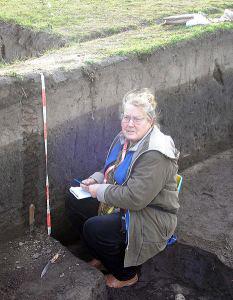
A scientist examines ‘chernozerm’ in Nikolaev, Ukraine.
(image: Saghnol, wikimedia commons)
International corporations have long been utilizing loopholes and political lobbying in order to overturn a Ukrainian moratorium on land sales to foreigners. By leasing numerous parcels of land these companies anticipate both the Ukrainian government’s desperation for money and the EU obligations to force open a goldmine of agricultural exploitation. The role of the ‘big players’—Monsanto, Cargill and Dupont—has been explored previously. The focus now is on agro-holding companies and individual oligarchs who seek to buy up and sell out Ukrainian land and livelihood.
One of the largest agro-holding companies operating in Ukraine is AgroGeneration. AgroGeneration seeks to “transform the land it works and today outperforms Ukrainian average yields. The company follows a traditional crop rotation and puts money into first-class fertilizers, seeds, and agricultural chemicals for the purpose of achieving profitability per crop.” The company has amassed 120,000 hectares of arable land, with 70,000 hectares being located in Kharkov oblast, whose eponymous capital is a city of great political and military importance in Ukraine. Kharkov has a large ethnic Russian and Russian-speaking population that has been actively repressed by the Kiev authorities, and it remains a region of dissent against the Kiev regime.
Michael Bleyzer, the Kharkov-born chairman of AgroGeneration, and founder of its sibling companies Sigma-Bleyzer and the Bleyzer Foundation, recognizes the importance of the city and has actively spoken about the need to maintain political and military order within it. In an op-ed for the KyivPost, Bleyzer writes of Kharkov as the most critical region, in need of being made “a very high priority. A large segment of the population in Kharkiv oblast is so discouraged by events and by the constant bombardment of Russian propaganda that they could be supportive of a Russian invasion or an attempt to establish a so-called People’s Republic.” Bleyzer further advocates a ‘Social Stabilization Fund’ for Kharkov, Dnepropetrovsk, Zaporozhia, Kherson, Nikolaev and Odessa. It is worth noting that these regions all contain either chernozerm or, as in the case of Odessa, ports through with which agricultural products transit.

The vast tracts of agricultural land controlled by AgroGeneration alone. (www.agrogeneration.com)
Michael Bleyzer’s role as a mouthpiece for the Kiev regime’s ‘war’ against Russia extends past his personal business interests and falls in line with the broader neoliberal, capitalist takeover of Ukraine. AgroGeneration and Sigma-Bleyzer (a private equity firm also owned by Bleyzer) seek to take advantage of the current regime’s plea to the West to ‘buy Ukraine’. These corporations and others are not only taking control of Ukraine’s farm land, they are doing it with European and American government assistance. In 2005, Sigma-Bleyzer received financing for a project worth up to 250 million euros from the European Bank for Reconstruction and Development (EBRD). In 2011, the EBRD gave AgroGeneration ten million dollars to double its ownership of Ukrainian land. In 2012 the Overseas Private Investment Corporation (OPIC)—an American government financial institution—gave Sigma-Bleyzer fifty million dollars for its ‘Eastern Europe fund.’
While these international corporations receive vast sums of money for their expansion in Ukraine, ‘access to credit remains a major problem for Ukraine’s small and medium farmers’. This interconnected system of funding from government finance institutions to private corporations has spelled doom for Ukraine’s agricultural sector, opening it up to exploitation and eventual ruin from the inside out.

Bleyzer (left) with US presidential candidate Ted Cruz on Maidan Square in Kiev. (Source: Secure America Now)
Connections between government and private corporations are at the core of this exploitation, with both entities seeking to employ what Bleyzer himself refers to as a system of “quasi-private equity funds managed by money managers from the private sector whenever possible.” Bleyzer’s attitude to the financial invasion of countries was well honed during the US-led invasion and occupation of Iraq, where he actively encouraged the US government to “create and implement the policy measures that will make an attractive investment climate in Iraq. This public-private partnership could play a critical role in making possible dramatic social and economic changes in Iraq and other countries in the region.” The goal of the corporate annexation of sovereign policy-reform has served Bleyzer and countless other oligarchs well from Iraq to Ukraine. In the context of this corrupt, financially imperialist environment it is no wonder that in a May 2015 economic report by Sigma-Bleyzer, it is casually written (in reference to the Ukrainian civil war) that “a frozen conflict could still provide the opportunity for the rest of the country to restart investments and economic growth.”
Ukraine’s precious black earth is being steadily annexed by international corporations and joins the list of resources and national sectors being outsourced to private investors. Agricultural corporations such as AgroGeneration find great corporate solidarity on the board of members of the US-Ukraine Business Council, which includes (among others) Sigma-Bleyzer, Monsanto, Dupont, Cargill, Exxon, Raytheon and the Bleyzer Foundation. These corporations share the common goal of pressuring the Ukrainian government to institute political ‘reforms’ in their favour. For agricultural corporations in particular, the goal is to pressure the government to “think about privatization. They need to prepare everything to allow for farmland sales (to foreign and domestic investors) in three to four years,” as stated by Heinz Strubenhoff, the agribusiness investment manager for the World Bank in Ukraine.
Ukraine is at a national crossroads and if the example of its increasing corporate annexation is anything to go by, it will have neither the money nor the resources to rebuild itself in the face of its political and cultural self-destruction. The West-supported preoccupation with ‘Russian invaders’ has left the oligarchy free to sell Ukraine’s political processes and natural resources to the highest bidder.
BBC Explains Cuts in Yanukovych Interview on Crimea as Not ‘Newsworthy’
Sputnik – 23.06.2015
A spokesperson from the BBC explained to Sputnik why certain portions of its Yanukovych interview, such as dealing with his personal zoo were aired while those dealing with political issues such as Crimea were not.
The BBC spokesperson told Sputnik on Tuesday that it did not include ousted Ukrainian President Viktor Yanukovych’s views on Crimea’s 2014 reunification with Russia because they were not considered “most newsworthy.”
The BBC instead featured remarks by Yanukovych on ostriches he maintained in his residence’s zoo in his first ever interview to the Western media since the coup which ousted him. Yanukovych stated in the interview that residents of Crimea decided to break away from Ukraine and join Russia in March 2014, because they were shocked by the violence of the coup that ousted the former Ukraine president.
“The Maidan scared Crimea and Donbass and the southeast of Ukraine with its right-wing radical outlook. That was the main issue which forced the population of Crimea to build up the units of self-defense and defend themselves. And the Supreme Council of the republic made a decision to hold a referendum,” Yanukovych said.
According to the BBC, the former president’s views on the reunification of one of his country’s regions with Russia was not newsworthy, compared to ostrich-related issues.
“The film which appeared on Newsnight was an edited version of a long interview which focused on Yanukovych’s most newsworthy remarks,” the spokesperson said.
Yanukovych noted in the interview that over 90 percent of Crimean residents voted in favor of becoming part of Russia. The BBC previously called the referendum’s results a “foregone conclusion” because of “pro-Russian forces firmly in control of Crimea politically and militarily,” rather than popular opinion.
“The results of the Crimea vote have been reported across the BBC since 2014,” the spokesperson said.
The ousted Ukrainian president’s full remarks were published on the BBC Russian Service website, generally unavailable to Western audiences because of the language barrier.
“BBC Russia colleagues were able to run longer extracts and chose to include the comments about the Crimea vote,” the spokesperson said.
The BBC also omitted the part of the interview dealing with the Donbass conflict, in which Yanukovych called Ukraine’s armed conflict in Donbass a genocide.
NYT’s Orwellian View of Ukraine
By Robert Parry | Consortium News | June 22, 2015
In George Orwell’s 1984, the leaders of Oceania presented “Two Minutes Hate” in which the image of an enemy was put on display and loyal Oceanianians expressed their rage, all the better to prepare them for the country’s endless wars and their own surrender of freedom. And, now, in America, you have The New York Times.
Surely the Times is a bit more subtle than the powers-that-be in Orwell’s Oceania, but the point is the same. The “paper of record” decides who our rotating foreign enemy is and depicts its leader as a demon corrupting whatever he touches. The rest of us aren’t supposed to think for ourselves. We’re just supposed to hate.
As the Times has degenerated from a relatively decent newspaper into a fount of neocon propaganda, its editors also have descended into the practice of simply inventing a narrative of events that serves an ideological purpose, its own version of “Two Minutes Hate.” Like the leaders of Orwell’s Oceania, the Times has become increasingly heavy-handed in its propaganda.
Excluding alternate explanations of events, even if supported by solid evidence, the Times arrogantly creates its own reality and tells us who to hate.
In assessing the Times’s downward spiral into this unethical journalism, one could look back on its false reporting regarding Iraq, Iran, Syria or other Middle East hotspots. But now the Times is putting the lives of ourselves, our children and our grandchildren at risk with its reckless reporting on the Ukraine crisis – by setting up an unnecessary confrontation between nuclear-armed powers, the United States and Russia.
At the center of the Times’ propaganda on Ukraine has been its uncritical – indeed its anti-journalistic – embrace of the Ukrainians coup-makers in late 2013 and early 2014 as they collaborated with neo-Nazi militias to violently overthrow elected President Viktor Yanukovych and hurl Ukraine into a bloody civil war.
Rather than display journalistic professionalism, the Times’ propagandists ignored the evidence of a coup – including an intercepted phone call in which U.S. Assistant Secretary of State for European Affairs Victoria Nuland and U.S. Ambassador Geoffrey Pyatt discussed how to “mid-wife” the regime change and handpick the new leaders.
The Times even ignored a national security expert, Statfor founder George Friedman, when he termed the ouster of Ukraine’s elected president “the most blatant coup in history.” The Times just waved a magic wand and pronounced that there was no coup – and anyone who thought so must reside inside “the Russian propaganda bubble.”[See Consortiumnews.com’s “NYT Still Pretends No Coup in Ukraine.”]
Perhaps even more egregiously, the Times has pretended that there were no neo-Nazi militias spearheading the Feb. 22, 2014 coup and then leading the bloody “anti-terrorist operation” against ethnic Russians in the south and east who resisted the coup. The Times explained all this bloodshed as simply “Russian aggression.”
It didn’t even matter when the U.S. House of Representatives – of all groups – unanimously acknowledged the neo-Nazi problem when it prohibited U.S. collaboration in military training of Ukrainian Nazis. The Times simply expunged the vote from its “official history” of the crisis. [See Consortiumnews.com’s “US House Admits Nazi Role in Ukraine.”]
Orwell’s Putin
Yet, for an Orwellian “Two Minute Hate” to work properly, you need to have a villain whose face you can put on display. And, in the case of Ukraine – at least after Yanukovych was driven from the scene – that villain has been Russian President Vladimir Putin, who embodies all evil in the intense hatred sold to the American public.
So, when Putin presents a narrative of the Ukraine crisis, which notes the history of the U.S.-driven expansion of NATO up to Russia’s borders and the evidence of the U.S.-directed Ukrainian coup, the Times editors must dismiss it all as “mythology,” as they did in Monday’s editorial regarding Putin’s remarks to an international economic conference in St. Petersburg.
“President Vladimir Putin of Russia is not veering from the mythology he created to explain away the crisis over Ukraine,” the Times’ editors wrote. “It is one that wholly blames the West for provoking a new Cold War and insists that international sanctions have not grievously wounded his country’s flagging economy.”
Without acknowledging any Western guilt in the coup that overthrew the elected Ukrainian government in 2014, the Times’ editors simply reveled in the harm that the Obama administration and the European Union have inflicted on Russia’s economy for its support of the previously elected government and its continued backers in eastern and southern Ukraine.
For nearly a year and a half, the New York Times and other major U.S. news organizations have simply refused to acknowledge the reality of what happened in Ukraine. In the Western fantasy, the elected Yanukovych government simply disappeared and was replaced by a U.S.-backed regime that then treated any resistance to its rule as “terrorism.” The new regime even dispatched neo-Nazi militias to kill ethnic Russians and other Ukrainians who resisted and thus were deemed “terrorists.”
The upside-down narrative of what happened in Ukraine has become the conventional wisdom in Official Washington and has been imposed on America’s European allies as well. According to The New York Times’ Orwellian storyline, anyone who notes the reality of a U.S.-backed coup in Ukraine is engaging in “fantasy” and must be some kind of Putin pawn.
To the Times’ editors, all the justice is on their side, even as Ukraine’s new regime has deployed neo-Nazi militias to kill eastern Ukrainians who resisted the anti-Yanukovych coup. To the Times’ editors, the only possible reason to object to Ukraine’s new order is that the Russians must be bribing European dissidents to resist the U.S. version of events. The Times wrote:
The Europeans are indeed divided over the extent to which Russia, with its huge oil and gas resources, should be isolated, but Mr. Putin’s aggression so far has ensured their unity when it counts. In addition to extending existing sanctions, the allies have prepared a new round of sanctions that could be imposed if Russian-backed separatists seized more territory in Ukraine. …
Although Mr. Putin insisted on Friday that Russia had found the ‘inner strength’ to weather sanctions and a drop in oil prices, investment has slowed, capital has fled the country and the economy has been sliding into recession. Even the business forum was not all that it seemed: The heads of many Western companies stayed away for a second year.
An Orwellian World
In the up-is-down world that has become the New York Times’ editorial page, the Western coup-making on Russia’s border with the implicit threat of U.S. and NATO nuclear weapons within easy range of Moscow is transformed into a case of Russian aggression. The Times’ editors wrote: “One of the most alarming aspects of the crisis has been Mr. Putin’s willingness to brandish nuclear weapons.”
Though it would appear objectively that the United States was engaged in serious mischief-making on Russia’s border, the Times editors flip it around to make Russian military maneuvers – inside Russia – a sign of aggression against the West.
Given Mr. Putin’s aggressive behavior, including pouring troops and weapons into Kaliningrad, a Russian city located between NATO members Lithuania and Poland, the allies have begun taking their own military steps. In recent months, NATO approved a rapid-reaction force in case an ally needs to be defended. It also pre-positioned some weapons in front-line countries, is rotating troops there and is conducting many more exercises. There are also plans to store battle tanks and other heavy weapons in several Baltic and Eastern European countries.
If he is not careful, Mr. Putin may end up facing exactly what he has railed against — a NATO more firmly parked on Russia’s borders — not because the alliance wanted to go in that direction, but because Russian behavior left it little choice. That is neither in Russia’s interest, nor the West’s.
There is something truly 1984-ish about reading that kind of propagandistic writing in The New York Times and other Western publications. But it has become the pattern, not the exception.
The Words of the ‘Demon’
Though the Times and the rest of the Western media insist on demonizing Putin, we still should hear the Russian president’s version of events, as simply a matter of journalistic fairness. Here is how Putin explained the situation to American TV talk show host Charlie Rose on June 19:
Why did we arrive at the crisis in Ukraine? I am convinced that after the so-called bipolar system ceased to exist, after the Soviet Union was gone from the political map of the world, some of our partners in the West, including and primarily the United States, of course, were in a state of euphoria of sorts. Instead of developing good neighborly relations and partnerships, they began to develop the new geopolitical space that they thought was unoccupied. This, for instance, is what caused the North Atlantic bloc, NATO, to go east, along with many other developments.
I have been thinking a lot about why this is happening and eventually came to the conclusion that some of our partners [Putin’s way of describing Americans] seem to have gotten the illusion that the world order that was created after World War II, with such a global center as the Soviet Union, does not exist anymore, that a vacuum of sorts has developed that needs to be filled quickly.
I think such an approach is a mistake. This is how we got Iraq, and we know that even today there are people in the United States who think that mistakes were made in Iraq. Many admit that there were mistakes in Iraq, and nevertheless they repeat it all in Libya. Now they got to Ukraine. We did not bring about the crisis in Ukraine. There was no need to support, as I have said many times, the anti-state, anti-constitutional takeover that eventually led to a sharp resistance on the territory of Ukraine, to a civil war in fact.
Where do we go from here?” Putin asked. “Today we primarily need to comply with all the agreements reached in Minsk, the capital of Belarus. … At the same time, I would like to draw your attention and the attention of all our partners to the fact that we cannot do it unilaterally. We keep hearing the same thing, repeated like a mantra – that Russia should influence the southeast of Ukraine. We are. However, it is impossible to resolve the problem through our influence on the southeast alone.
There has to be influence on the current official authorities in Kiev, which is something we cannot do. This is a road our Western partners have to take – those in Europe and America. Let us work together. … We believe that to resolve the situation we need to implement the Minsk agreements, as I said. The elements of a political settlement are key here. There are several. […]
The first one is constitutional reform, and the Minsk agreements say clearly: to provide autonomy or, as they say decentralization of power, let it be decentralization. This is quite clear, our European partners, France and Germany have spelled it out and we are quite satisfied with it, just as the representatives of Donbass [eastern Ukraine where ethnic Russians who had supported Yanukovych have declared independence] are. This is one component.
The second thing that has to be done – the law passed earlier on the special status of these territories – Luhansk and Donetsk, the unrecognized republics, should be enacted. It was passed, but still not acted upon. This requires a resolution of the Supreme Rada – the Ukrainian Parliament – which is also covered in the Minsk agreements. Our friends in Kiev have formally complied with this decision, but simultaneously with the passing by the Rada of the resolution to enact the law they amended the law itself … which practically renders the action null and void. This is a mere manipulation, and they have to move from manipulations to real action.
The third thing is a law on amnesty. It is impossible to have a political dialogue with people who are threatened with criminal persecution. And finally, they need to pass a law on municipal elections on these territories and to have the elections themselves. All this is spelled out in the Minsk agreements, this is something I would like to draw your attention to, and all this should be done with the agreement of Donetsk and Luhansk.
Unfortunately, we still see no direct dialogue, only some signs of it, but too much time has passed after the Minsk agreements were signed. I repeat, it is important now to have a direct dialogue between Luhansk, Donetsk and Kiev – this is missing.
Also missing is any objective and professional explanation of this crisis in the mainstream American press. Instead, The New York Times and other major U.S. news organizations have continued with their pattern of 1984-ish propaganda.
~
Investigative reporter Robert Parry broke many of the Iran-Contra stories for The Associated Press and Newsweek in the 1980s. You can buy his latest book, America’s Stolen Narrative, either in print here or as an e-book (from Amazon and barnesandnoble.com).
Former Advisor to Ukraine’s Defense Minister Defects to Donbass
Sputnik – 22.06.2015
A onetime aide to the Ukrainian defense minister has defected to the self-proclaimed Donetsk People’s Republic, taking along his entire family and a wealth of classified information, Russian media reported Monday.
“I am Alexander Kolomiyets, a Major-General of the Ukrainian armed forces… My latest position was that of an advisor to the Ukrainian Defense Minister and a senior defense analyst,” the General said during a news conference at the Donetsk News Agency headquarters on Monday.
Alexander Kolomiyets said that he had spent 19 years serving as the military commandant of Donetsk Region.
He also said that many of his fellow commanders were ready to join the pro-independence militia in Donbass.
The General added that Ukrainian army morale was extremely low with “all Generals and officers realizing the criminal nature of Kiev’s actions and refusing to fight any longer.”
Alexander Kolomiyets is not the first senior Ukrainian military officer to have sided with the independence supporters in Donetsk and Lugansk. Earlier, Oleh Chernousov, the onetime head of the Lugansk customs service, and brothers Alexei and Yuri Miroshnichenko, both Ukrainian intelligence service operatives stationed in Paris, moved to Lugansk over their opposition to the policy pursued by the Kiev authorities.
Over 10,000 Soldiers Desert Ukrainian Army
Sputnik – 21.06.2015
More than 10,000 cases of desertion have been registered in the Ukrainian Army since the outbreak of the Donbass war in April 2014, Ukrainian Vesti reported.
In 2014 the army suffered heavy desertion and nearly 30 percent of the servicemen called up in the first wave of mobilization (March 17) abandoned their positions, Ukrainian President Petro Poroshenko said.
Ukrainian parliament Verkhovna Rada has announced six waves of mobilization so far. By the end of 2014 the strength of Ukrainian Armed Forces grew from 130,000 to 232,000.Ukrainians have been protesting against the mobilization. They travel to work abroad or simply reside at their relatives’ in other countries. Almost 1,3 million Ukrainian draftees live in Russia.
Since April 7, 2014 the Kiev authorities have been waging war against Donbass self-defense forces who rejected the legitimacy of the coup-imposed Ukrainian government and declared the independent republics of Donetsk and Lugansk.
Official figures estimate the number of victims to near 6,500. But the German intelligence reported of 50,000 victims in February 2015.
Whistle blower reveals secret U.S. program to recruit, train, and provide visas to ‘terrorists’
By Barrie Zwicker | Truth and Shadows | June 19, 2015
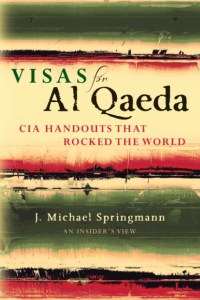 IF YOU DON’T WANT TO KNOW how sausages are made, don’t start reading Visas for Al Qaeda: CIA Handouts That Rocked the World by Michael Springmann. The sausages in this case: the string of too-easily-swallowed accounts of bloody events in the “global war on terror,” served up daily with relish by the mainstream media. In reality these sausages are filled with tainted meat that’s making everyone sick.
Springmann is a brave whistle blower living in Washington, D.C. He’s written an accessible book, safe to digest, highlighting details of the corruption of the American Empire (and its accomplices, including Canada) as he experienced them from the inside during his years with the U.S. State Department.
While he served as a visa officer in the U.S. consulate in Jeddah, Saudi Arabia, for instance, he was obliged under threat of dismissal to issue visas to persons hired clandestinely by the CIA to become trained-in-the-USA terrorists. Most of these psychopathic thugs were clearly and legally unqualified to be issued visas. There is every reason to believe the “Visas for Terrorists” program remains fully operative today. It takes a lot of expendable terrorists to run a global terrorism op.
Springmann places his experiences both within the context of the historical roots of the U.S. Empire and within its current ongoing global destabilization project.
“This tale,” the author states near the beginning, “is a sordid sketch of backstabbing, disloyalty, double crosses, faithlessness, falsity, perfidy, sellouts, treachery, and betrayal.”
And that only covers the bureaucratic aspect. Even more sobering is his sketch of human rights violations: torture, assassinations, massacres including bombings of markets, invasions and occupations of countries, destabilization of nations and regions.
Then there’s the financial side: widespread criminality, resource theft, bribery, diversion of funds, illicit drug dealing and more.
Not to mention the flouting of international laws. This dimension includes gross infringements on national sovereignty, the casual violation of treaties and ho-hum everyday general lawlessness, risking even the threat of nuclear annihilation.
All this before taking into account the moral dimension, in which trashing the Ten Commandments is just an opening trifle.
“My story shows how things really work,” Springmann writes, correctly. In the book’s 250 pages he names names, dates, times and places – presumably opening himself up to lawsuits, should there be anything here that the individuals named deem libelous. They might think twice, however, since Springmann is a lawyer by profession and knows his way around the Empire’s capital – as well as some of its outlying ramparts such as Stuttgart, New Delhi and especially Jeddah.
Stinging in itself, Springmann’s book also can be read as an authenticating companion to Michel Chossudovsky’s Towards a World War III Scenario (2012) and The Globalization of War: America’s “Long War” Against Humanity (2015). Along the way, both authors deal, to one extent or another, with the ideological, hubristic and increasingly bellicose role of the Harper government as handmaiden to the American Empire, including military involvements in Libya, Serbia and the Ukraine. Springmann necessarily refers very little to Canada, but to read his account of the cowardly and unnecessary rain of death inflicted on Libya, for instance, is to be obliged as a Canadian to think of Harper’s enthusiasm and pride in having this country share in the slaughter and destabilization carried out under the Orwellian “responsibility to protect” notion.
Springmann quotes Maximilian C. Forte who notes that before the attack Libya enjoyed the highest Human Development Index (a UN measurement of well-being) in all Africa. “After Western military forces destroyed the country the Index only records the steep collapse of all indicators of well-being. More Libyans were killed with intervention than without. It was about control, about militarizing Africa,” Forte argues.
What Springmann brings uniquely to the table is his firsthand knowledge of precisely how the USA recruits terrorists (no quotation marks needed), sends them to the USA for training and then deploys them to carry out murders, torture, bombings and more. The bloody mayhem carried out by these thousands of paid mercenaries – ostensibly beheading-habituated “jihadists” fighting against democracy, decency and the USA and its “allies – is planned, organized and funded by none other than the same USA and its allies. It’s a global false flag operation – the largest by far in history.
As Springmann on page 65 writes of the “Visas for Terrorists Program:”
This was not an ad hoc operation, conceived and carried out in response to a specific foreign policy issue. Rather, it was another of too many CIA efforts to destroy governments, countries, and politicians disfavored by the American “establishment” in its “bipartisan” approach to matters abroad. Whether it was opposing the imaginary evils of communism, the fictitious malevolence of Islam, or the invented wickedness of Iran, America and its intelligence services, brave defenders of “The City Upon A Hill,” sought out and created fear and loathing of peoples and countries essentially engaged in efforts to better their lives and improve their political world. Along the way, Agency-sponsored murders, war crimes, and human rights violations proved to be good business. Jobs for the Clandestine Service (people who recruit and run spies), sales of weapons and aircraft, as well as the myriad items needed to control banks, countries and peoples all provided income for and benefits to American companies.
That the American Empire has been able to carry out such a massive illegal program for so long is the saddest of commentaries on how deep the rot is, how effective the secrecy, how complicit the media.
As to the span of dangerous widespread deception, Springmann notes that Rahul Bedi wrote in Jane’s Defence Weekly on September 14, 2001 that beginning in 1980 “thousands [of mujahideen] were … brought to America and made competent in terrorism by Green Berets and SEALS at US government East Coast facilities, trained in guerilla warfare and armed with sophisticated weapons.”
The point is made repeatedly that Al Qaeda and now ISIS/ISIL/the Islamic State are essentially “Made in USA” entities, brought into being and organized for the Empire’s purposes. Among the elements that make possible such a vast fraud are deception, compartmentalization and secrecy. Springmann quotes attorney Pat Frascogna, “a man with FOIA expertise,” about secrecy and its purpose:
Thus whether it be learning the dirty and unethical business practices of a company or the secrets of our government, the same deployment of denials and feigning ignorance about what is really going on are the all-too-common methods used to keep the truth from the light of day.
Langley recruited the Arab-Afghans so clandestinely that the terrorists didn’t know they had been recruited. They thought that they had found a battlefield on their own, or through the Internet or through Twitter or through television…
Frascogna’s observation intersects with Springmann’s on-the-job experiences as a visa officer in Jeddah starting in 1987. Springmann was repeatedly overruled when he turned down disqualified applicants for U.S. visas. He writes:
As I later learned to my dismay, the visa applicants were recruits for the war in Afghanistan against the Soviet Union’s armed forces. Further, as time went by, the fighters, trained in the United States, went on to other battlefields: Yugoslavia, Iraq, Libya, and Syria. They worked with the American intelligence services and the State Department to destabilize governments the United States opposed. While it’s no secret, most knowledgeable people still refuse to talk about this agenda.
As Springmann learned, “the average percentage of intelligence officers to real diplomats at a given Foreign Service post is about one in three. My experience in Jeddah, Stuttgart, and New Delhi might place it higher—at least 50 percent, if not more.” According to the Anti-CIA Club of Diplomats: Spooks in U.S. Foreign Service [sic], a twelve-page, 1983 Canadian publication (see namebase.org), the percentage is 60 percent.
“At Jeddah,” Springmann writes, “to the best of my knowledge, out of some twenty US citizens assigned to the consulate, only three people, including myself, worked for the Department of State. The rest were CIA or NSA officials or their spouses.” Elsewhere Springmann suggests that essentially the CIA runs the State Department, and that this is true of many other U.S. government departments and agencies as well. It seems that it’s almost impossible to over-estimate the reach of the CIA’s tentacles or the overweening treason of its nonstop black ops and unconstitutional operations domestically.
Springmann toward the end of the book refers to the beginnings of the CIA. It’s interesting for this reviewer to think that he was 13 years of age in 1947 when U.S. president Harry Truman agreed with the National Security Council (NSC) to secretly create the CIA and NSA. I remember that in my teenage years a few of my peers said there “was something” called “the CIA.” This was around the time a few people also said there “was something” called “the Mafia.” The consensus was that both ideas were very far-fetched.
In 1948 Truman approved yet another NSC initiative, providing for “propaganda, economic warfare; preventive direct action, including sabotage, antisabotage,
demolition and evacuation measures; subversion against hostile states, including assistance to underground resistance movements, guerillas, and refugee liberation groups, and support of indigenous anti-Communist elements in threatened countries of the free world.” That’s a tabula rasa if there ever was one: a license for lawlessness.
The CIA’s twisted hits have just kept coming. It’s worth noting that Truman didn’t singlehandedly initiate this monstrosity. The dark recesses of the Deep State, as Peter Dale Scott calls it, are where the demonic entity was spawned. Ever since, Frankenstein’s monster has been a harmless schoolboy by comparison.
To read of the rape of Libya with active Canadian military complicity makes for difficult reading. The lies are piled as high as the bodies, and these two categories are insuperably paired.
Equally sordid, especially in light of Stephen Harper’s enthusiasm for expanding the war on Russia (the economic sanctions and the diplomatic exclusion of Russia from the G8 are forms of warfare, not to mention decades of covert* military incursion by the West onto the territory of the former USSR and now the Russian Federation, as described in Visas for Al Qaeda) is to read some of the history of the Ukraine. “The West’s” meddling in the Ukraine has a long illicit pedigree. As Springmann writes:
It seems that the CIA had problems [in the immediate post World War II period] distinguishing between underground groups and above-ground armies. Langley used Marshall Plan money to support a guerrilla force in the Ukraine, called “Nightingale.” Originally established in 1941 by Nazi Germany’s occupation forces, and working on their behalf, “Nightingale” and its terrorist arm (made up of ultranationalist Ukrainians as well as Nazi collaborators) murdered thousands of Jews, Soviet Union supporters, and Poles.
Even relatively recently, since the so-called Orange revolution in the Ukraine made events there eminently newsworthy, I can’t remember seeing in the mainstream media a single substantial article dealing with the historical relationships between the Ukraine and Russia going back to World War II, nor such an article laying out the history of the involvement –overt or covert – of “the West” in the Ukraine.
Instead, we see the surreal ahistorical likes of the top headline in The New York Times International Weekly for June 13-14, “Russia is Sowing Disunity,” by Peter Baker and Steven Erlanger. They report breathlessly in the lead paragraph: “Moscow is leveraging its economic power, financing European political parties and movements, and spreading alternative accounts of the Ukraine conflict, according the American and European officials.
True to the narrative of “the West” as a pitiful giant facing a powerful and expansionist Russia, the writers posit that the “consensus against Russian aggression” is “fragile.
The drift of this NYT yarn, typical of Western propaganda across the board, is that there remains in effect a behemoth “Soviet empire” surreptitiously shipping “Moscow gold” to dupes in “green movements” and so on. Even a former American national intelligence officer on Russia, Fiona Hill, now at the Brookings Institution, told the writers: “The question is how much hard evidence does anyone have?
Maybe this NYT propaganda, like its clones across the mainstream media, is not ahistorical after all. The story comes across rather as an historical relic of the Cold War – found in a time capsule in a fallout shelter – that the NYT editors decided to publish as a prank. A sausage.
* Military action by “the West” has not always been covert. Springmann notes that American and Japanese soldiers were dispatched to Russia in 1917 to squelch the fledgling Russian revolution. The soldiers were part of what was called the Allied Expeditionary Force. Winston Churchill for his part said: “We must strangle the Bolshevik baby in its crib.” Springmann might have noted that Canadian soldiers were part of the AEF.
Kiev’s Moves Against Transnistria Are Anti-Ukrainian
Not content to merely blockade and shell its citizens in Donbass post-Maidan Ukraine is now also looking to squeeze ethnic Ukrainians in Transnistria

Transnistria president Yevgeny Shevchuk is one of Transnistria’s 160,000 ethnic Ukrainians
By Marko Marjanović | Russia Insider | June 10, 2015
Transnistria (or Pridnestrovie – “land along the Dniester”) is the spiritual predecessor of Novorossiya. It is a small, de facto independent, state taking up a strip of land along the left bank of the mighty Dniester river. The territory in question is internationally recognized as being part of Moldova but has a Slavic majority.
Transnistrian independence is a result of a joint Russian-Ukrainian uprising in the 1990s.
As Soviet Union dissolved the Slavic left-bank of the former Moldavian SSR sought independence, especially since Moldova was being shaken by a movement that sought the unification of this Romanian-speaking country with Romania.
For Slavs on Dniester’s left-bank this would have meant leading the existence of a tiny minority among 25 million Romanian speakers, and furthermore would have meant returning under the rule of their former occupiers – during WWII Romania occupied a chunk of southern Ukraine and was not well-remembered among the Slav populace. As one would expect they were not too thrilled about the prospect.
Indeed, Pridnestrovie’s inclusion into Moldovan SSR was highly artificial in the first place.
In the interwar period the Soviet Union lay claim on the historic region of Bessarabia on the right bank of the Dniester which had been part of Russian Empire but was inhabited by a Romanin majority and was at this time part or Romania. To enhance its claim the Soviets dreamt up a “Moldavian Autonomous Soviet Socialist Republic” out of southern Ukraine along the border with Romania on the Dniester and maintained that this “Moldavia” properly extends to cover the entire Romanian region of Bessarabia.
In 1940 under Stalin the Soviets fulfilled their ambition and after seizing Bessarabia formed a highly dubious “Moldavian Soviet Socialist Republic” out of this majority ethnic Romanian territory and the Ukrainian left-bank Dniester. Essentially, exactly in the same way that inclusion of Romanina-majority Bessarabia into the (Slav-majority) Soviet Union was artificial and forced, so was the inclusion of Slav-majority left-bank Dniester into the Moldavian SSSR.
In 1992 when Slavs of Transnistria who are an equal mix of ethnic Ukrainians and Russians rebelled, Ukrainians and Russians recognized the validity of their cause. Volunteers from both Russia and Ukraine flocked to help in their fight.
What is particularly interesting is that volunteers included both Russian and Ukrainian nationalists. Among the Ukrainian volunteers one could find members of the ultra nationalist UNA-UNSO – which is the oldest and the largest of the groups which today forms the Ukrainian Right Sector coalition.
In other words, back in 1992 Ukrainians, including extreme anti-Russian nationalists, were convinced Transnistria deserved to be helped and that it was wrong to demand of ethnic Ukrainians there to submit to rule from the other side of the Dniester (or even from Bucharest in Romania) that they experienced as alien.
(However, the decisive role in the conflict was not played by such volunteers but by the remnants of the Soviet Army in the region which put itself between the warring sides and deterred attempts of the stronger Moldavian/Romanian side to resolve the matter by force. Russian peacekeepers in the region today are a continuation of this force.)
In the mean time much has changed. Today Transnistrians complain (1,2,3) that Ukraine is working with Moldovans to exert pressure against them and get them to submit to Moldova. This pressure consists of a military build up along the Ukrainian-Transnistrian border, a blockade against Russian peacekeepers in Transnistria, making it hard for Transnistrians with Russian passports to travel, and making it difficult for Transnistria to export goods except through Moldovan customs.
Kiev has justified these moves by essentially painting Transnistria as Putin’s military colony. This is highly dubious since Transnistria is very much a geostrategic liability. It is tiny (population of 0.5 million), landlocked, borders only Moldova and Ukraine and covers a thin strip of land – which is therefore highly vulnerable. It may have some value as leverage in relation to Moldova, but it is the case that Moldova itself is a small (population of 3 million), impoverished and landlocked country of little to no strategic significance itself. The reality is that Moscow sees its presence in Transnistria as a moral and possibly political, but not military, asset.
The real reason why Kiev feels the need to denounce Transnistria is because the enclave is in so many ways the antithesis of post-Maidan Ukraine. Culturally and politically it is far closer to Crimea and Donbass than what Ukraine is moving towards. … Full article
Featured Video
Dan Dicks with James Corbett on Solutions Watch
or go to
Aletho News Archives – Video-Images
From the Archives
$1.5bn up in smoke: US THAAD missile stockpile dries up defending Israel against Iran
By Ivan Kesic | Press TV | July 2, 2025
According to American media, defense news outlets, and independent analysts, the 12-day Israeli military aggression against Iran significantly depleted the US stockpile of THAAD (Terminal High Altitude Area Defense) interceptor missiles.
Citing official sources, American magazine Newsweek reported on Friday that the US transferred a substantial portion of its advanced missile defense capabilities to support the Israeli regime, an effort with questionable results and a critical impact on US strategic reserves.
THAAD, developed by Lockheed Martin arms manufacturing company, is a key component of Israel’s multi-layered air defense architecture. It is designed to intercept medium-range ballistic missiles, including those launched from Iran and Yemen.
The US-made system is capable of targeting short-, medium-, and intermediate-range ballistic missiles during their terminal phase, whether inside or outside Earth’s atmosphere.
THAAD uses a “hit-to-kill” method, relying on kinetic energy rather than explosive warheads to destroy incoming threats, intercepting at altitudes of up to 150 km and ranges between 150-200 km.
Operated exclusively by American personnel, the US military maintains eight THAAD batteries with an estimated 350–400 interceptors in total. The eighth battery was activated during the June 20 Israeli aggression against Iran and is capable of intercepting hypersonic missiles. … continue
Blog Roll
 Aletho News
- Zionist Bought Senate Blocks Information About American Citizens Killed By Israel
- While Gaza dominates the UN, these are the people keeping it alive
- New Report: “Scholasticide and Genocide in Gaza: Assessment, Testimonies and Legal Analysis”
- ‘THAAD Delusion’: Iran war exposes US missile shield limits – The Atlantic
- Moscow issues warning to NATO over Russian exclave
- Yes, the Iran war has destroyed Trump’s presidency
- The fallacy of US delusions about Iran’s economic collapse
- Hezbollah denies Syria cell link, warns of Israeli plan to sow discord
- The legacy of US sanctions, war, and occupation in Iraq
- Iraqi resistance group rejects disarmament, vows to maintain support for Lebanon
- If Americans Knew
- Mamdani releases plan to combat antisemitism and hate crimes in New York City
- Iran’s Revolutionary Guards Publish Letter to the American People
- DMFI launches $1 million ad campaign supporting Virginia’s Elaine Luria
- US Senate blocks resolution seeking report on Americans killed by Israel
- Israeli Attacks Kill Ten Palestinians in Gaza
- Massacre at Minab: The School That Became a Grave
- Israeli media: The IDF Shows It Doesn’t Turn a Blind Eye; It Actively Emboldens Settler Havoc
- As settlers ravage West Bank, Israeli forces kill 10 in Gaza – Daily Update
- New Report: “Scholasticide and Genocide in Gaza: Assessment, Testimonies and Legal Analysis”
- Ex-Biden officials are desperate for a Gaza scapegoat
- No Tricks Zone
- Green Energy Debacle: German Expert Professor Fritz Vahrenholt Warns Of Severe Economic And Social Consequences
- Two More Paleo Reconstructions Affirm Meters-Higher Sea Levels Across Ireland, Brazil 7000-6000 Years Ago
- New Study: Earth And Venus Surface Warmth Largely Explained By Convection And Lapse Rate, Not CO2 Or Radiation
- 2025 Nature Paper Claiming Worsening Global Drought Gets RETRACTED …Heavily Flawed
- New Study: ‘Global Drought Shows No Detectable Recent Acceleration Under Climate Warming’
- Economic Masterminds: German Socialists Suggest Taxing Productivity Gains Stemming From Using AI
- The South China Sea Has Not Been Cooperating With The Climate Change Narrative
- Energy Crisis: Germany Enters Heating Season With Historically Low Gas Reserve Fill Levels
- New Study: The Antarctic Ice Sheet Gained Mass From 2020-2024 Due To Staggering Snow And Ice Accumulation
- Study: Ocean Heating Rates From Thousands Of Years Ago ‘Dwarf’ Modern Ocean Heating Rates

