Russia sanctions killing German companies: MP
Press TV – May 5, 2015
A German lawmaker has condemned the European Union and Chancellor Angela Merkel’s anti-Russia policy, saying the EU bans are destroying the country’s businesses, with dozens of reported bankruptcies.
Franz Wiese, a Brandenburg lawmaker and member of the eurosceptic Alternative for Germany party, made the remarks on Monday.
“Approved by the European Union and conducted by German Chancellor Angela Merkel, the anti-Russian sanctions policy is destroying small and medium businesses in Brandenburg as well as in the rest of the country,” said Wiese.
According to Wiese, Merkel’s anti-Russia policy has so far resulted in the bankruptcy of 90 German companies.
Wiese’s remarks came a day after neighboring Czech Republic’s President Miloš Zeman criticized the Western sanctions on Russia over the crisis in Ukraine, describing the policy as counterproductive and provocative. Zeman also called for the immediate abandonment of such bans.
Western powers have imposed several rounds of sanctions against Russia over accusations that Moscow is involved in the deadly crisis in neighboring Ukraine, which broke out when Kiev launched military operations against pro-Russians in eastern Ukraine last year. Russia has denied the allegation.
In a tit-for-tat measure, Moscow imposed yearlong food bans on the United States, the EU, Australia, Canada and Norway in August last year.
The move is estimated to cost European agricultural industries millions of dollars in damage. Prior to the food ban, Russia received a quarter of its produce from the EU nations.
On April 27, Russia said it will tighten an existing ban on the import of fruits and vegetables from Bulgaria over concerns that Sofia may be attempting to send European products into Russia, using false documents.
Campaign to free Nadiya Savchenko another cover-up of war crimes and pretext for more sanctions
New Cold War | May 1, 2015
Enclosed are two recent news articles on the case of Nadiya Savchenko, a former pilot in the Ukrainian air force. She stands accused by the Russian court system of directing fire in June, 2014 in eastern Ukraine resulting in the deaths of two Russian journalists. Because of her detention in Russia and the criminal charges she faces, she has become a folk hero in Ukraine and internationally for those who are supporting Ukraine’s war against the people in the east of that country.

Rally in New York to free accused war criminal Nadiya Savchenko (Olga Loginova, Radio Free Europe)
The first enclosed article, from Russia Insider, reports on the vote of the European Parliament on April 30 to threaten more sanctions against Russia if it does not release Savchenko from detention. The second article, from Canada’s Globe and Mail national daily, reports on a recent, two-day visit by Vera Savchenko to Ottawa as part of her campaign to win her sister’s release.
In the Globe and Mail article, the writer mentions Nadiya Savchenko’s decision last year to join what is called a “voluntary battalion” fighting for Kyiv in eastern Ukraine. The term “voluntary battalion” is used seveal times in the article. Unmentioned by the Globe is the fact that the battalion in question is the extremist ‘Aidar Battalion’.
‘Aidar’ has been cited for many months now by Amnesty International and countless sources in Ukrainian and international media for widespread commission of war crimes. Recently, New Cold War.org brought to the attention of English language readers the two reports published in November 2014 and March 2015 by the Moscow-based Foundation for the Study of Democracy documenting the widespread practice of torture of prisoners—rebel fighters captured in combat and civilians who are detained–by the Ukrainian armed forces, national police and the “volunteer battalions” operating alongside them.
The two reports on torture as well as media reports and other human rights reports in Russia and Ukraine on the same subject have gone utterly ignored by Western media. To the point where newspapers like the Globe and Mail can blithely refer to “volunteer battalions” such as Aidar and make them sound almost like squads of military cadets.
Ah, details, details. Why should war crimes get in the way of yet another story blaming Russia for anything and everything going wrong in Ukraine, in this case the story of a terribly unfair detention of an extremist accused of aiding the killing of journalists?
Also unmentioned in the Globe and Mail article are the aforementioned circumstances of Savchenko’s arrest—that she stands accused of directing fire that resulted in the deaths of two journalists. Regretfully, this is of a pair with the Globe and Mail‘s failure to report the wave of killings of journalists and opposition politicians that has shaken Ukraine in the past several months and the special laws being approved by Ukraine’s Parliament for the purpose of stamping out social and antiwar protests and banning opposition political parties.
To close, here is a description of the case of Nadiya Savchenko, excerpted from an article published in New Cold War.org on Jan 30, 2015. Further below are the two news articles mentioned earlier.
The case of Nadiya Savchenko, excerpt from ‘Toronto Star newspaper is running with the extreme right in Ukraine‘, in New Cold War.org, Jan. 30, 2015:
Twice in the past month, the Toronto Star has published articles by its journalists promoting the campaigns of the far right in Ukraine. The latest such article appeared on January 14, by Star foreign affairs writer Olivia Ward. It champions the cause of one Nadiya Savchenko, a member of the far-right ‘Aidar’ paramilitary battalion who has been in jail in Russia since June 2014.
Savchenko is a staunch ideologue of the war in eastern Ukraine. She took a “vacation” from her posting in the Ukrainian armed forces in order to join the Aidar Battalion and see action, not long after Kyiv launched its civil war in the east in April 2014. She was already known as one of only two women in Ukraine to volunteer and serve in the U.S.-led war in Iraq in 2003. She is a trained pilot in the Ukrainian air force.
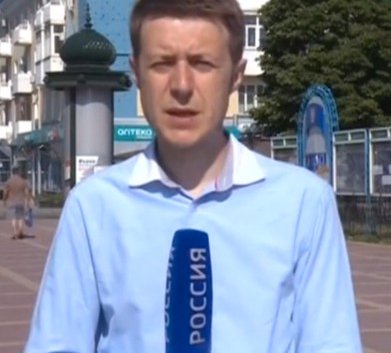
Russian journalist Igor Kornelyuk, killed by Ukrainian mortar fire on June 17, 2014
Savchenko faces criminal charges that she directed mortar fire in the Luhansk region on June 17 causing the deaths of two Russian journalists, Igor Kornelyuk and Anton Voloshin, who were reporting on the conditions of war refugees in eastern Ukraine. Two other journalists, a Russian and Italian, were killed by battalion mortars one month earlier, on May 24.
There are several versions of how Savchenko ended up in a Russian jail. One has her arrested by self defense forces and then transferred into the hands of the Russian judicial system. The other (the Russian government version) says she crossed the border into Russia and was detained.

Russian journalist Anton Voloshin, killed by Ukrainian mortar fire on June 17, 2014
Terming Savchenko Ukraine’s “Joan of Arc”, Olivia Ward writes, “She has shattered sexist stereotypes to become a poster girl for Ukraine’s battle with its giant neighbour, which has seized the Crimean Peninsula and is now eyeing Ukraine’s turbulent eastern region.”
Savchenko has become a cause célèbre of the far right in Ukraine as a result of her detention. She was appointed to the Ukrainian Parliament (‘Rada’) following the election of Oct. 26, 2014 by the ‘Fatherland’ electoral machine of the billionaire, former prime minister Yulia Tymoshenko. (In Ukraine’s electoral system, parties appoint approximately half the seats to the Rada, proportional to the votes they receive.) Savchenko resigned from the armed forces following her appointment.
Small rallies demanding her release from custody were held in Ukraine’s larger cities on January 26.
Savchenko told a television news interview last spring that she took leave from the air force because she could not countenance what she considered the timidity of the Ukrainian government in not going to war against Russia. Her delusional logic was the following: since the war in the east is against a foreign, invading power, Russia, and its local lackeys (whom the Toronto Star and other Western media term ‘separatist’ or ‘pro-Russian’ rebels), the Ukraine government should declare war on Russia and undertake a full military mobilization.
There is a twisted logic to Savchenko’s argument. Kyiv’s police operation in eastern Ukraine does, indeed, amount to full scale war. Its army is in the field and is shelling towns and cities. The Kyiv government has declared martial law in the war zone and effectively exercises martial law throughout the country. It has given its police the right to preventively detain or even shoot on sight so-called “separatists”.
How can the neighbouring governments of Ukraine in eastern Europe, or a skeptical public in western Europe and North America, be convinced of the mission of a government in Kyiv going to war against its own people? Kyiv and its think-tank advisors from NATO countries have turned to a time-worn prop—the ‘anti-terrorist’ ideology of the post 9/11/2001 world. Kyiv calls its civil war in eastern Ukraine an “Anti-Terrorist Operation”. Voilà. Surely an endeavour so titled must be virtuous and worthy!
But that ruse proved unsatisfactory for the purist Savchenko. She wants the unblemished story, as her ideology would have it. Forget the props– she wants all-out war against her fellow citizens in eastern Ukraine, and with Russia, even.
The Russian court has appointed lawyers to defend Savchenko. Her psychological state will be a factor in any trial. Her family has engaged the services of a Ukrainian lawyer who is traveling to Russia to defend her and is working with Russian-appointed court lawyers.
Nadiya Savchenko’s story was featured in the Nov 14, 2014 issue of the weekly fashion magazine in France, Elle. The magazine published a glamour story about the small number of women in Ukraine who have volunteered to fight with the extreme-right battalions. The magazine editors were caught out by some readers who noticed that one of the women that it featured was a brazen neo-Nazi who displays her fascist ideology on social media, including photos of herself giving Hitler salutes. The magazine apologized for glamorizing that particular neo-Nazi, but not for the overall adulation of Ukraine’s far-right battalions that its article lavished on readers.
* * *
EU threatens Russia with new sanctions over Nadiya Savchenko detention
Russia Insider | May 1, 2015
European MPs have declared an “illegal kidnapping” of the Ukrainian pilot detained by Russian authorities and further demand Nadezhda Savchenko’s release.
In a plenary session on Thursday in Strasbourg, the European Parliament adopted a resolution that condemns Russia over the detention of Ukrainian pilot Savchenko. The resolution goes on to warn Russia of possible impending sanctions as well as prosecution should the detention continue.
Calling for the “immediate and unconditional release of Nadezhda Savchenko”, the European Parliament harshly condemned the Russian Federation for what the body deemed “its illegal kidnapping, and confinement” of the Ukraine pilot without trial for almost a year.
European MPs cited commitments to the Minsk agreements as well, citing a paragraph that discusses the exchange of prisoners according to the principle “all for all”. The EU body suggests Russia has no legal jurisdiction to take action against the pilot accused of complicity in the June 17 killing of two Russian journalists, Igor Kornelyuk and sound producer Anton Voloshin. They died during a mortar attack on a rebel checkpoint outside Luhansk.
Russia’s Investigative Committee has pointedly referred to the pilot’s actions as a gunner aboard an Aidar Batallion chopper, a position from which she allegedly reported the journalists’ location and directed fire for the mortar attack that killed the men outside Lugansk.
The European Commission spokespersons this week addressed their side of the situation. “The European Parliament considers that the detention of Savchenko is a violation of the Geneva Convention; we therefore stress that those responsible for her illegal detention in Russia may be subject to international sanctions or prosecution for their actions.”
MEPs also cited Savchenko for having an outstanding military record, and the fact she was the only woman in the Ukrainian peacekeeping contingent in Iraq. She was the first woman admitted to the Academy of the air force of Ukraine. The parliamentarians also noted the Ukraine pilot is eligible for diplomatic immunity based on her being a member of the Ukrainian Parliament and member of the country’s delegation to PACE, the Parliamentary Assembly of the Council of Europe.
Also in the resolution are demands for the immediate release of all other Ukrainian citizens illegally detained in Russia, including Ukrainian film Director Oleg Sentsov and son of the leader of the Crimean Tatars, Hauser Dzhemilev. The European Parliament “urges the President of France and Chancellor of Germany and the foreign ministers of these countries to raise the issue of the release of Savchenko at the next meeting of the contact group on the implementation of the Minsk agreements in the “channel” format.
Finally, the high representative of the EU for foreign affairs and the EU foreign service have been given a mandate to closely monitor the situation around Savchenko, to raise this issue in meetings with representatives of the Russian authorities in a variety of formats and report to the European Parliament on the results of these efforts.
* * *
In Ottawa, sister of jailed Ukrainian pilot calls on Canada to help
By Kim Mackrael | The Globe and Mail | May 1, 2015
The sister of a 33-year-old Ukrainian helicopter pilot who has been imprisoned for nearly a year in Russia is calling on Ottawa to press for her release amid reports that her health is deteriorating.
Vira Savchenko met with parliamentarians, including the government’s junior foreign affairs minister and members of Canada’s Ukrainian community during a two-day trip to Ottawa earlier this week. The visit was part of a global campaign organized by Vira and her mother, and aimed at drawing attention to Nadiya Savchenko’s plight. … Full article
Fire near Chernobyl site alarming, ‘radiation respects no boundaries’
RT | April 29, 2015
A forest fire near Ukraine’s Chernobyl nuclear site may cause problems for communities a long way from the area as the dispersal plumes can transport radiation further to the north, nuclear safety expert John Large told RT.
RT: How dangerous is the situation in your opinion? Do you agree with ecologists who say the smoke will spread the radiation?
John Large: I spent some time in Ukraine in 2006 and I assessed the Chernobyl situation interviewing about 30 scientists and engineers who were working on the aftercare of Chernobyl. Brush fires and forest fires were the greatest concern in terms of the means by which you can disperse a secondary radiological impact from the original dissipation that occurred in 1986… What you have in Chernobyl in the exclusion zone and the further way you have an area that has been abandoned for farming, abandoned for management. That means you’ve got lots of brush and young wood growing out of control. Let me assess that – a big fuel load to have a fire. That means that the biological load is very high, so the radiation particles can be dispersed. Take down the chemistry as well. The chemistry is the way in which the strontium and cesium from the radioactive strontium and cesium from the reactor are bound here, and of course the elevated temperature of the fire and plus all the plume and aerial dispersion – means that could transport it hundreds of kilometers, particularly to the north, to Belarus. So there are more problems here for communities that are long way away from the site. What I had hoped was that the Ukrainian officials would have had in place firefighting capacity greater than they normally would have at any other area of Ukraine, because it certainly needs to be protected not just now but in the longer term as well.
We know that Ukraine is cash-strapped. There was a responsibility for its neighbors, Russia, the EU, not Belarus as much because it’s in an even worse financial situation, but there was a general responsibility to protect this area from another bout of radioactive dispersion.
RT: What lessons can be learned from this particular incident then to make sure that the brush and the forest doesn’t catch light again, or if it does, to make sure that site is secured?
JL: It is not the reactor, it is not the location of the reactor that is the problem – it is the dispersal plumes from the original accident – that is the problem. If there are radioactive materials on the ground now and then it’s engulfed by forest fire maybe 40-50 km away from the reactor. But that deposited radioactivity is re-suspended into gas, blown high into the atmosphere by the heat of the flames, and then of course it settles somewhere else. And it may be those communities to the north that are not prepared to have this new radiation plume and deposition and fallout come down on their communities.
RT: Do you think there should be a common international strategy and response for situations like this?
JL: We’ve seen recently with Chernobyl, with Windscale in the 1950’s in the UK, and particularly now with Fukushima that the radiation doesn’t respect any international boundaries. So an international effort is required for this type of catastrophe, all potential catastrophes. I would have thought that the EU or Russia would have healed their scars over this and got together and put some efforts and resources into controlling this and make sure it doesn’t happen again.
‘The de-industrialization of Ukraine has acquired an irreversible character’ – former minister of economy
PolitNavigator | April 24, 2015
It makes no sense to campaign for the preservation of economic relations of Ukraine with the Commonwealth of Independent States (CIS)* markets, as the de-industrialization of the country has become irreversible nature, economist Viktor Suslov told a press conference in Kyiv recently.

“Unfortunately, the process of de-industrialization and destruction of our industry is already impossible to stop,” Suslov said.
Suslov was minister of economy of Ukraine in 1997-98. In 2013, he was appointed Ukraine’s representative to the Eurasian Economic Union. Last October, he told Ukraine’s government that a condition for stabilizing the country’s currency is to end the war in the east of the country.
“During the past year, I have worked hard for the preservation of economic ties with the CIS and Russia, for the preservation of these markets. But I now realize that nothing has happened and nothing will happen. I’m not campaigning for it anymore.
“I understand that we are losing these markets and the losses are irreversible. I realize that thousands of our enterprises will be closed and, accordingly, the financial situation of the country will be much worse than it was projected for this year.”
The ex-minister of economy believes that some financial revenues for public budget can be obtained from privatization of state assets. “But the main result of such privatization, I think, will be the transition of objects mostly of infrastructure – ports, energy, transport, communications, agricultural land into the hands of foreign owners.
“One consolation for us is that, as announced by the minister of economic development, the privatization processes will keep Russians out and we’ll sell assets to other foreigners. I don’t know how this can serve as great comfort”.
See also:
Ukraine preparing mass privatization of assets
Press TV | April 28, 2015
‘The Ukrainian government is considering a list of state-owned assets for privatization in a bid to raise funds for an economy that has come within an inch of bankruptcy. The majority of the reforms will happen in energy, transport and agriculture sectors. But as our correspondent Lena Savchuk reports, the process will begin only if the parliament approves the list of the companies.’
* From Wikipedia: The Commonwealth of Independent States is a loose association of states coordinating in the realm of trade, finance, lawmaking, and security. There are nine member states—Armenia, Azerbaijan, Belarus, Kazakhstan, Kyrgyzstan, Moldova, Russia, Tajikistan, Uzbekistan. Eight of these form the CIS Free Trade Area, and five of these form the Eurasian Economic Union—a customs union and common market of over 180 million people. Six member states participate in a mutual defence alliance, the Collective Security Treaty Organization.
This will make the world sorry it put a CIA death squad in charge of Chernobyl
By Niqnaq | April 29, 2015
 Yatsenyuk inspects forest fire in the exclusion zone. After visiting the zone, the Head of Government told journalists at the airport:
The situation is under control. Fire stations are from Chernobyl at a distance of about 20 km. Our State emergency service actively works to cut off the spread of fire. The localization of the fire involved three aircraft, one helicopter and a significant amount of equipment. There sent forces, including the Ministry of internal Affairs. This fire is the largest since 1992. But we cope, perform, and we will actively inform.
Answering a question about the situation with background radiation Arseniy Yatsenyuk said:
I was informed that the situation is normal; there are no changes in the background radiation level.
———–
The fire encompasses the plutonium burial areas. According to State Emergency Service (GSChS) the fire blazes already near the village. It is 13 km from the station. People are close to panic. The Deputy Director on scientific work of the Museum of Chernobyl, Anna Royal, said:
The fire had already moved in close to Chernobyl, the radioactive waste burial site. There is one of the most polluted places. Nearby the burial of radioactive waste. Plutonium is one of the most dangerous elements that infects the haematopoietic system of a person. As long as nobody touches it, this element is not dangerous. But if in the street the wind and the fire, plutonium particles can rise a meter and be transported over long distances.
Meanwhile, as reported by the interior Minister Arsen Avakov, to extinguish the fire involved the national guard. In Kiev, there are rumors that some deputies of the Verkhovna Rada and members of the government have taken their families out of town.
Forest fires heading for Chernobyl nuclear plant – Ukraine Interior Ministry
RT | April 28, 2015
The Ukrainian National Guard has been put on high alert due to worsening forest fires around the crippled Chernobyl nuclear power plant, according to Ukraine Interior Minister Arsen Avakov.
Earlier the country’s emergency ministry said there was no danger posed to the sealed-off power plant from the three forest fire flashpoints in the region.
“The forest fire situation around the Chernobyl power plant has worsened,” a statement on Interior Minister Arsen Avakov’s Facebook page says.
“The forest fire is heading in the direction of Chernobyl’s installations. Treetop flames and strong gusts of wind have created a real danger of the fire spreading to an area within 20 kilometers of the power plant. There are about 400 hectares [988 acres] of forests in the endangered area.”
Avakov says the Ukrainian prime minister has called an emergency meeting on how to tackle the situation. Police and National Guard units are on high alert.
Ukrainian emergency services say 182 people and 34 vehicles have been dispatched to fight the fire. Mi-8 helicopters and three An-32 water dropping airplanes are also working at the scene. The efforts are being coordinated from a mobile emergency headquarters.
Death threats for OSCE inspectors by Ukraine servicemen – Moscow
RT | April 27, 2015
Members of the OSCE mission in Ukraine have been questioned about their nationality by Kiev troops and volunteer battalion militiamen looking for Russian nationals. Vehicles have been illegally searched and lives threatened.
Russia’s Foreign Ministry has expressed concern over the questioning of members of the Organization for Security and Co-operation in Europe (OSCE) mission to Ukraine and illegal checks of their transport. On Monday it issued a special communique on the violation of the observers’ rights.
The release claims multiple violations of observers’ status have been registered at a number of checkpoints and settlements under the control of pro-Kiev forces. The communique mentions incidents in five villages. In a sixth case, a Ukrainian soldier openly threatened Russian-national OSCE members with death.
“These facts cause resentment and are categorically inexcusable. The coordination of the actions of the Ukrainian military and volunteer units leaves no place for doubt that the order on checking OSCE observers has come from a single center,” the document says.
Such actions by the Ukrainian forces run contrary to Kiev’s obligations to ensure safety and freedom of movement of the OSCE monitors overseeing the implementation of the Minsk peace deal and UN Security Council’s resolution 2202, the ministry said.
The leaders of Ukraine and the self-declared Donetsk and Lugansk People’s Republics, together with their colleagues from Russia, France and Germany, agreed on a new peace deal at a February meeting in the Belarusian capital, Minsk, after a previous ceasefire agreement had failed.
The new deal implies pullout of heavy weapons by both sides of the conflict, with the OSCE monitoring the ceasefire and security at border crossings between Ukraine and Russia.
The OSCE deployed its observers to Ukraine in March 2014 at the request of the Kiev government. A month later, in April 2014, Kiev launched a military operation against the rebels in Donbass.
In early March 2015 the OSCE decided to extend the mandate of the Special Monitoring Mission in Ukraine for one year, as well as increase the potential number of its observers to up to 1,000 people.
US Drills Ukraine Army in Urban Fighting Skills on Edge of Conflict Zone
Sputnik | 23.04.2015
The joint military drills held by the US paratroopers and the Ukrainian National Guard are taking place in urban environments in eastern regions of Ukraine close to the conflict zone, a Russian Ministry of Defense spokesman said.
Russian Ministry of Defense spokesman Igor Konashenkov pointed out that American military instructors are holding joint military drills with the Ukrainian National Guard units not far from the conflict zone in eastern Ukraine, in the regions of Mariupol, Severodonetsk, Artemivsk and Volnovakha.
Last week nearly 300 servicemen from the 173rd Airborne Brigade arrived in western Ukraine to take part in joint military drills dubbed Fearless Guardian together with Ukrainian National Guard battalions. It was announced that the overt combat training would take place in the Yavoriv district of the Lviv region, western Ukraine. Inexplicably though, the military drills have been shifted from the West to the Ukrainian eastern region, Igor Konashenkov stressed.
Russian Ministry of Defense spokesman Igor Konashenkov called the public attention to the fact that the US-Ukrainian military servicemen are currently engaged in intensive assault training in urban environments.
The Russian Defense Ministry has repeatedly expressed its concerns about the fact the US paratroopers are teaching the Ukrainian National Guard to use weaponry manufactured in the West, pointing out that it could serve as a signal of Washington’s preparedness to deliver lethal weapons to Ukraine.
Meanwhile the US Ambassador to Ukraine Geoffrey Pyatt is beating the war drums, saying that Russia is beefing up its military presence in the eastern regions of Ukraine.
“It is the highest concentration of Russian air defense forces in eastern Ukraine since August,” the Ambassador wrote on his Twitter account.
Strangely as evidence for his assertion, Pyatt decided to show a photo of a Buk Missile System taken almost two years ago at the International Aviation and Space Salon MAKS in Russia.
Regardless, the Russian Defense Ministry is not surprised by the umpteenth “sensational exposure” of Russia’s military build-up in Ukraine made the US State Department.
“We won’t be surprised if [Washington] soon accuses us of deploying carrier battle ships in the Lugansk region or of Russian nuclear submarines illegally entering the First city pond of Donetsk,” noted Russian Ministry of Defense spokesman Igor Konashenkov with unconcealed sarcasm.
It should be also noted Marie Harf, the deputy spokesperson for the US Department of State, has repeatedly claimed that Russia is beefing up its military forces in the eastern Ukraine, while providing no evidence at all to prove the statement.
Ex-NATO Chief Calls for Holy Crusade Against Russia in the Name of “Democracy”
Rasmussen’s case for war is built on a stack of lies
By Jon Hellevig | Russia Insider | April 22, 2015
In his op-ed in Project Syndicate, ex-NATO chief and former Danish PM Anders “Fog of War” Rasmussen calls for war against Russia in the name of democracy and the ever so elusive “Western values”. “The current conflict between Russia and the West is, at its core, a clash of values,” he announces to start with, but then through a seriously convoluted brain process arrives at the conclusion that “It is about democracy.” In his mind the latter must be the distilled sublime product of the former. And since it is about democracy, Mr. Fog of War reasons, “the West must respond accordingly.”
I cannot fathom why on earth this concept, “democracy”, this linguistic abstraction, stirs such passions in a man who, by all formal counts, should rank among the best that his nation, with its long traditions of progress, has produced. Isn’t this guy in actual fact taking us a thousand years back and calling for a Holy Crusade against Russia? The crusades were military campaigns in the name of a God and true interpretation of the scripture. They were sanctioned by the Roman Catholic Church during the Middle Ages with the ostensible goal to restore Christian access to holy places in Jerusalem. In reality, they were aggressive Western expansion attempts driven by economic and political reasons, fueled by personal ambitions and served to the European sheeple packaged in lofty religious causes.
Rasmussen, the former High Priest of NATO, is driven by all these exactly same considerations. He is supporting the NATO war effort to take a stranglehold of Russia with the actual aim to create a global hegemony led by the Western elite. As in the Middle Ages, so today, the idea of a war for the sake of pure conquest does not sell with the herds — if the pasture is good enough, then why bother — therefore, all you need to do is replace God with Democracy and the Ten Commandments with Western Values. (What easy work for the modern day apostles, the Western stink tanks — they do not actually have to spell out what these “values” are, not even in a list of ten).
I will not here expound on my view of what democracy is; suffice to say that it cannot be defined as a concept but rather as a result of social practices and societal conditions which enable the practices. I have elaborated on this in my book All is Art, where the second part is dedicated to this question under the title “Democratic Competition”. (From page 182 of this file).
Instead I will here treat you to a sample of what kind of “values” Rasmussen stands for as evidenced by the op-ed in question. These values are all firmly rooted in lies, as we will see.
1. Rasmussen writes: “Russian authorities recently threatened to aim nuclear missiles at Danish warships if Denmark joins NATO’s missile-defense system. This was obviously an outrageous threat against a country that has no intention of attacking Russia.”
In fact: Denmark is part of an anti-Russian war coalition which is — through vicious propaganda, economic warfare and military actions — continuously closing in on Russia with the aim to conquer it or force a regime change that would install a pliant Western puppet leader.
2. Rasmussen: “Russia’s leaders know very well that NATO’s missile defense is not directed at their country. … we repeatedly emphasized that the purpose was to defend Alliance members from threats originating outside the Euro-Atlantic area [Iran]”.
In fact: We all know this is total baloney.
3. Rasmussen: “Recall how the Ukrainian conflict began: Tens of thousands of Ukrainian citizens from all parts of society demanded, in overwhelmingly peaceful demonstrations, an association agreement with the European Union.“
In fact: We know very well that the protests were not peaceful and amounted to a Western managed, violent coup d’état.
4. Rasmussen: “No one was calling for a pogrom against Ukraine’s Russian-speakers, despite the Kremlin’s claims to the contrary.”
In fact: From the very beginning of Maidan, the protests where fiercely anti-Russia and soon resulted in unheard of physical harm and mass-murder against the population that identified themselves as Russian.
5. Rasmussen: “And NATO membership was not part of the deal.”
In fact: It was very much so.
6. Rasmussen: “Yet Russia reacted swiftly and harshly. Long before violence engulfed the protests, Russian officials began accusing the demonstrators of being neo-Nazis, radicals, and provocateurs.”
In fact: It is proven beyond any doubt that the most active part of the demonstrators were precisely neo-Nazis, radicals and provocateurs. And that the regime that came into power very much adopted their war cries and utilized those forces in their terror campaign all across Ukraine.
7. Rasmussen: “As soon as Ukraine’s then-President Viktor Yanukovych fled Kyiv, Russian President Vladimir Putin began engineering the annexation of Crimea.”
In fact: Here Rasmussen has a point, save for the word “annexation”. Funny, though, as the common Western line was always that Putin had been “scheming” this for years.
8. Rasmussen: “For Russia, the threat posed by the Ukrainian protesters was existential. In demanding change, freedom, and democracy – right on Russia’s doorstep, no less – the protesters challenged Putin’s model of “sovereign democracy,” in which the president eliminates all opposition, restricts media freedom, and then tells citizens that they can choose their leaders. The Kremlin feared that if the Ukrainians got what they wanted, Russians might be inspired to follow their example.”
In fact: So much nonsense that it does not deserve a comment. Shortly, we have seen what kind of “change, freedom, and democracy” they got under the new Western backed oligarch and neo-facsist regime.
9. Rasmussen: “That is why Russia’s leaders have been so keen to label Ukraine’s leaders as Russophobes and fascists.”
In fact: Russia does not need to do any labeling here; the Ukraine leaders and their subservient media speak for themselves.
10. Rasmussen: “It is why they have portrayed the Baltic States for years as dysfunctional oppressors of their Russian citizens.”
In fact: The Baltic states have, ever since their independence, run an oppressive apartheid system denying vast portions of their populations – mainly Russian ethnic nationals – even citizenship. And Fog of War knows that very well, coming from a neighboring country.
11. Rasmussen: “And it is why they are now portraying the EU as decadent, immoral, and corrupt.”
In fact: I have not seen Kremlin engaged in this, although I definitely think they should more actively call out these ignominious characteristics of the EU, which Rasmussen so correctly identified.
12. Rasmussen: ”The Kremlin is trying desperately to convince Russians that liberal democracy is bad, and that life under Putin is good. That requires not only spreading damaging lies at home, but also sowing violence and instability among its neighbors.”
In fact: Russia under Putin is much more a true liberal democracy in the classical sense of the concept. Life under Putin may not be as good as we all would like it to be, but it is for sure better than ever in Russian history and continuously improving, which cannot be said for the EU countries. “Sowing violence and instability in the world” — that is clearly the business of NATO and its member states.
After having enumerated this list of lies, Rasmussen concludes: “Despite whatever pain we incur, we must maintain – and, if necessary, deepen – sanctions against Russia and reinforce NATO’s front line. “
How long will the good Europeans be willing to sacrifice all they have for these warmongering lies?
Interview: Eyewitness to the Odessa massacre of May 2, 2014
The New Cold War
April 21, 2015–The following interview with Vladislav Wojciechowski was published on April 3, 2015 on the Russian language website Free Press. It is translated to English by Greg Butterfield and published on the website of Borotba.
Vladislav Wojciechowski is the founder of the website Committee of May 2 (Committee for the Liberation of Odessa), concerning the Odessa Massacre of May 2, 2014. He is a former political prisoner and a communist in his outlook.
He gave an exclusive interview to Free Press correspondent Dmitry Ogneevu about the protests in Odessa, the events of May 2, 2014, and his arrest.
Introduction by Dmitry Ogneevu
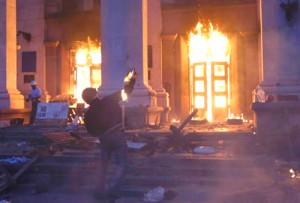 I’ve known Vlad Wojciechowski for several years. Once upon a time, before the Maidan, which split history into “before” and “after” and destroyed the Ukrainian state, I loved coming to Odessa, meeting there with local activists of Borotba, including Vlad. At night we sat in noisy Odessa courtyards, walked around Primorsky Boulevard and discussed the prospects of political struggle. I remember on one of my last visits we strongly criticized Yanukovych and thought about how great Ukraine would be without him. That was two years ago.
Now, two years later, we are back together in the trench, placing guns on the parapet, watching the movements of “Ukropov” at the checkpoint. A ridiculous irony of fate. Vlad was one of the most active participants in the Odessa Anti-Maidan movement from the beginning, and was in the House of Trade Unions on May 2, 2014. After the terrible violence against opponents of the junta on Kulikovo Field, he was forced to flee to Crimea with other activists. He returned to Odessa at the end of the summer, was arrested and thrown into prison by the Security Service of Ukraine (SBU). In late December, he was exchanged for captured Ukrainian soldiers, and found himself in Novorossiya. Ukrainian officials took his papers, and now he’s unable to leave the country. However, it is not too perplexing. He seems to have found his place here — in the political department of the Ghost Brigade. We sit at the headquarters of the political department in Alchevsk and reminisce…
Free Press: How did Antimaidan begin in Odessa?
Vladislav Wojciechowski: For us, Antimaidan began in late 2013. The leader of the Odessa chapter of Borotba, Alexey Albu, was then a regional council deputy. The head of the Party of Regions faction asked his assistance in protecting the regional council — they really expected an assault then. Of course, we were no friends of the Regionals, but everyone understood that it was better for them to remain in power than the alternative …
And were there supporters of the Maidan in Odessa?
Of course, we had Maidan from the beginning. A small number of people, several hundred on average, hanging around the monument to the Duke of Richelieu, but nobody took them seriously: there were fools, what could they take over? Nobody even tried to disperse them. And Odessites plainly did not support them.
How did the local authorities treat them?
The local authorities panicked a little. During the defense of the regional council, after we had already spent three nights there, the TV reported that Yanukovych had proposed Yatsenyuk to become head of government. This was a serious wake-up call, as it showed that he had no other way to cope with them. Yatsenyuk ultimately refused, that is, he was aware that the power had already shifted 100 percent. Therefore, the local authorities were in a panic, not knowing what to do.
How did the Kulikovo Field movement develop?
It turned out that the defense of the regional council had rallied many people from various organizations, including some we sometimes protested, like “Slavic Unity.” A collective decision was reached to create a unified council to build a real people’s resistance to Maidan. All the Antimaidan forces rallied. That’s how the Kulikovo Field movement was born — because the first rally was held on the Kulikovo Field. Once there was a statue of Lenin there, before it was brought down and moved. It’s just a very large area in the center of the city. When the first rally was held there, we were about 10,000 people. It was just a rally, not yet a march. Prior to this, the largest rally that I had ever seen in Odessa was held by the Communist Party on January 24, 2009, against the Rada’s infringement of workers’ rights. About 900 people had come to that.
And here there were about 10,000, and from the podium it was announced that we’re not going anywhere and we will create a tent city. At the same time a people’s defense team was set up — young guys with bats who were supposed to protect Kulikovo Field. And on March 16 the first march was held – it brought out 20,000 to 25,000 people. Everyone thought here there would be no change of power.
There was a victorious euphoria?
Of course. Twenty-five thousand people. Odessa had never seen anything like it. I stood at the beginning of the march at a crossroads, where it turned in the direction of the regional council, filming it on video. I was shooting continuously for 40 minutes. And the march had still not ended, the tail was not visible. Moreover, 90 percent of the participants were not in any organizations. People spontaneously took to the streets to prevent what was happening in Kiev. Then it seemed, what Maidan in Odessa? There’s nothing here for them.
What happened on May 2?
The day before, on the first of May, we had a small May Day action — we held a march, which was about 4,000 people. By that time people had become tired of marches as they began to realize that they accomplished nothing. Every weekend we held marches, the first was 25,000, then 20,000, then 15,000. Everyone complained that there was nothing but talk and walking around the city. Four thousand people on the first of May — and that’s respectable. Then everyone crashed and went to rest.
On May 2, not suspecting anything, at about 2 o’clock I went with my sister to the Tavria supermarket on Deribasovskaya Street. We went (everything started then, but I still did not see anything), we bought something, and the guard started running around, yelling that everyone must leave, they are closed …
Did you know that football fans gathered there?
I knew, because just the week before when Chernomorets [Odessa soccer team] played, there were rumors that Kulikovo Field would be razed, so an urgent mobilization was called to defend the encampment. Naturally, we all ran there, but no one came. Everyone got fed up and no one took it seriously afterward. So, the guard kicked us out of the supermarket, and we saw shooting, flying stones, firecrackers … I took my sister home, went on the Internet, watched an online broadcast and was stunned, because there were never so many of these morons in the city.
You mean, it was all people from out of town?
That’s right. Because the Chernomorets fans who participated in the march “For a United Ukraine,” for the most part, when they saw how it was flying off the handle, said, “We don’t want to be part of this!” and went on to the football match. I’m not talking about the ultra-rightists, but about those who just came to the march.
I called my friend Andrei Brazhevsky. I was sure that he went there because he was always near the action. I asked him: “Andrei, what’s happening?” He said, “We got squeezed, but we’re still holding on, we have no forces here.” I said, “Come on, we will try to get to you!” We must help our comrades – you can’t throw them to the wolves. We decided to go to the Kulikovo Field, to see what was happening there. People were preparing for an attack on Kulikovo …
We arrived to a depressing spectacle. At that time there were only about 150 people. Moreover, the composition was depressing. About 40 young guys, 50 women aged 30 to 60, and 50 men aged 50-60-70 years. A sad spectacle, but, nevertheless, we took sticks in hand, made barricades — in general, prepared to defend ourselves. Of course, we all understood coming here that we will get it in the neck, but we had no moral right to leave the people. We decided to stay with them, arm them with sticks, collect stones.
We gathered up 250-300 people. There was a rumor that those who were defending themselves on Greek Street, a few hundred people, were coming back to us, and with their help we would repulse the crowd. Eventually, exactly 15 people returned from the Greek. These were the only ones who managed to get out of there without being stopped by police. They escaped the crowd, ran to Kulikovo, we met them …
So. We get a call from the city center, saying the fascists have already passed the Little Book, the book market halfway between Kulikovo and Greek. A march of one thousand. Several hundred from the Maidan, fully equipped with firearms. And half with bats and chains. We were told they were 10 minutes away, get ready! Well, we looked at the perimeter. It turned out that we had one person for every meter of barricade, well, it’s just gibberish, so we narrowed the barricades to the porch of the building.
You controlled the building then?
No one had control. It was empty. No, there were some workers from the House of Trade Unions. But on May 2, along with security, the usual guards, there were the boys from the Odessa squads. We decided to stay at the building. Naturally, we tried to send the women away. Many accuse the leaders of the Antimaidan of bringing people into the building, but that’s a lie. There are videos taken by us when Deputy Vyacheslav Markin, who died there, went to the podium with a microphone and starts yelling, uncharacteristicly for him, demanding all women leave the Kulikov Field. And there were grandmothers walking around with shields and helmets. He says, “Go away! Why do you need it?! Go away! Do not bother us! We will not run to save you.”
But some refused to retreat from the fight. In the confusion that followed, people ran into the building, because they could already see the march coming. We were part of the group left on the porch …
And were there attempts to strengthen the defenses, in terms of military science? Were there experts among you, who knew how to hold the defenses?
From the point of view of military science, it was all for nothing. There was no defense as such. Well, there were pieces of asphalt that we broke up for half an hour before their arrival, broken pallets — all spontaneous.
We had one person with military experience, a friend. When we saw him, he came up and said: “Guys, you know that it’s all over if we stay here?! You must understand this! What are you doing?” We said,” Come on, suggest something else.” And what is there to offer? There is nothing to offer. As a result, this highly intelligent military guy fled, and said to hell with it.
Some people who had shields remained on the porch and began throwing stones. A wooden shield is, of course, a good thing when you’re deflecting stones, but then they started to shoot at us …
What kind of firearms were used?
 A 5.45 mm barrel was definitely used. This is either a Saiga semi-automatic hunting rifle, or a Kalashnikov assault rifle. Most likely they were hunting rifles, the only difference being that such weapons cannot fire bursts.
When our people with shields began to fall, riddled with bullets, we all went into the building, because there was no other choice. We were in the building, and they were over forty meters away. We threw stones, they stood and shot. They did not even have to come close.
When we entered the building, there was a fuss. I saw a man of about 60 standing at the window, watching. Then he just crumpled — shot in the head, I saw it, it’s clear that it was not a thrown stone, but a shot in the head that killed him. There were a lot of pictures. Don’t look through a window or at once a couple of bullets will fly, or a Molotov cocktail.
We continued to throw stones until we ran out. There were few stones – we had to shove everything in our pockets! Then he started throwing pieces of glass at them — well, at least it was something. It was a little confusing. You throw a piece of glass about twenty meters, and someone forty meters away shoots at you.
Then we ran into a wing of the building, with one exit on the side stairs. Apparently they had already infiltrated it and sprayed a lot of pepper spray. Normal police “pepper” — it was impossible to breathe, just tears. We ran from that wing. By this time, the bottom had flared up …
And you had some personal weapons, gas cylinders, blunt weapons?
I didn’t see any, though I ran through all our “defenses.” We really had nothing to fight back with. If we had had two Kalashnikovs and a hundred rounds of ammunition each, we could have at least put up some resistance — they would have just run away.
At what point did you realize it was necessary to leave the building?
There was already heavy smoke. I started running around, looking for Alexey Albu and Andrei Brazhevsky, and there’s turmoil, a lot of people running around. At one point, Deputy Markin caught me by the arm and said, “Vlad, don’t be nervous, everything will be fine!” I said, “Ok, I’m not nervous!” And I ran on. I saw Andrei Brazhevsky. But Andrei had a problem – he couldn’t see well. Although he was an athlete, his vision was very poor, he just couldn’t recognize you past three to five meters. I yelled, “Andrei!” He heard me, but couldn’t see. Looking-looking, bang, and he ran off somewhere. Then I met Alexey Albu. He said, if there is a fire, it makes no sense to run upstairs, because you can’t jump and will either burn or suffocate, so let’s stick to the first floor.
Following this logic, we gathered who we could, and hand in hand, went through one of the wings of the building, down the stairs to a second floor window, and now two to three meters below us is a playground! A lot of people still stood under that window. We simply knocked out all the glass and breathed the air. And those below were saying, “Okay, let’s go!”
Well, we thought we’d preserve the defenses, hold the line on that floor. It was a narrow space, and in a narrow space, as is well known, the number of defenders is not so significant. And so there we were, until after a while one of the ultras with a Ukrainian ribbon crashes in and says, “Oops, this is the end of you!” And beside me was an old grandfather. Maybe a former military man — he was wearing camouflage. Well, I respected this grandfather — he kept his head and immediately threw a punch at this fool. He hit him in the stomach so hard that he got up and ran away. And I was holding a large fire extinguisher. I took it in case we had to hold back the flames, it had very strong pressure. I sprayed him with the fire extinguisher, he scrambled up and fled, dramatically threw a bottle at us, but missed.
Then they decided to talk with us. They said: “Bring out the women, and then let’s deal!” We said, “Well, just let them withdraw peacefully, without problems.” They still said: “Bring out the women, we will not touch them, we are local.” We said: “Local, what area are you from?” They: “We’ll kill you all!” Just local right-wingers, right, we know them all. We had five years of conflicts, we fought constantly with them. In general, there are only 50 people in Odessa, morons. It was clear that they were not local.
Eventually, we brought the women through the second floor window. Firefighters helped by putting up a ladder. We evacuated eight women, and we had seven people left. Four were young men up to 35, the rest 45-50 years. We realized that they are ready to shower us with Molotov cocktails, yet we need to somehow get out. We already realized that this was the end – all will have to pass through their hands, there were no other options — the smoke was already very heavy, there was nothing left to breathe.
We came out and immediately it began. First the firefighter went down, he said, “Come on, guys, I’ll try to bring you!” It was clear that he did not have a chance to bring us, because up comes a bald goon with a revolver in his hand who said to him: “Freedom! Go home.” The firefighter left. Us: “Hands up!” But he was not alone, there were a bunch of morons standing around.
We reached the ground, and then another fascist runs up with a bat in one hand, and a chain in the other, swinging for me (and I was in a bright light green jacket): “This is the reptile who threw glass at us!” I was surprised the glass hit someone in their march …
And that’s all of us, 15 people in the corridor that the police made …
The police were present?
Yes, but there were only about 30 of them, okay, where to intervene? War is coming … In fact, we are grateful because they brought a lot of people out and saved them. Simply, if they had fled, the crowd would have snuffed us all. In general, they made a corridor for us to withdraw — there were fifteen policemen on one side, fifteen on the other, and among them about a hundred of these goats with bats and chains. We had just started to come out haphazardly, I did not even have time to do anything. Just trying to cover my head, when a chain hit me. Now I have a scar from the chain [shows wound]. Hit, I fell down in a heap. Then some idiot brings the Ukrainian flag and tells me, “Kiss the flag!” There I sat with a busted head. I pretended to be stunned, to not understand anything. Then he was dragged off by his own people, so as not to shame them.
Then time seemed to run a little differently, it’s hard to remember now, as I lay there in a pool of blood. In the end, it was dark, and we tried to reach the police. There is a video showing a handful of us, the gangsters walking around us, someone laughs, someone spits. An old grandfather tries to take me by the hand, hit me with a shovel. Then the police drove their van closer to us, saying, “Get up quickly, crawl, get in!” This was another test, because there I was, my head was busted, but at least I could move. But there were a few people with us who were lying unconscious, beaten to a pulp – we dragged them. Those who could went toward the police van, and got beaten on the head with sticks. We rolled away in this van, and they started to run, hitting it with sticks.
Once we got away, the police brought us to the station on Malinowski. One of the commanders of the district department came out, and said: “Guys, hold on! We are morally with you, but you see, there’s nothing we can do to help you, we have orders to arrest all of you. But I’m leaving these orders in the dark! I called an ambulance and you are leaving!”
Yes, the police were behind us. But what chance did their hundred people have to disperse 3,000 hoodlums?! The thirty or forty people that were at the House of Trade Unions, they almost didn’t intervene, they couldn’t do much. But if they hadn’t, we would not have gotten out. We would have just been beaten to death. A blow on the head with a stick by itself isn’t fatal, but 20 times in the same place, this is serious. So we went to the hospital, my head was bandaged. I was supposed to have an x-ray, but we didn’t wait, we wanted to hide at home to recover, find out what’s going on …
In your opinion, what was the cause of death of the majority of those killed in the House of Trade Unions? There’s been much speculation that the burned bodies were already dead …
I can’t answer unequivocally. Yes, there were several bodies that were burned, but there were so many armed gangsters with Wolfsangels [neo-Nazi symbol], and even members of the Azov Battalion. Sasha Gerasimov, a member of the Komsomol who spent 11 years in prison, was there. He began to choke from carbon monoxide, lost consciousness and fell. Men in black helmets with Wolfsangels pulled him up. They dragged him to the window and said, “Jump! Better jump, or we will beat you to death!” On the fifth floor! Naturally, he did not jump, he tried to resist, they began to beat him. There is even a piece of video where he crawls out as they beat and beat on him. He stayed in the hospital for three months, one leg severely burned, the other knee crushed – he is disabled now, and still walks with a cane.
But I think if not half, then at least one-third died from firearms. I’m a hundred percent sure. They could be seen, that’s the way it was …
But did any expert see the bullets …
The experts saw, but they had to blame us. They wrote on Andrei Brazhevsky’s death certificate that he died from the crash after falling from a window. But the video shows that when he fell, he just broke his leg. He was still alive and tried to get away. No, he was finished off. Some worthless fascist bashed his skull. Well, was it the crash? In the video everything is clearly visible, including those who pursued him prior to his death.
Then you had to flee from Odessa?
Yes. We left urgently on the night of May 8-9, that is, a week later. There was danger of arrest. A good friend warned comrade Alexey Albu by phone that they were preparing to arrest all the Borotba members on May 9, and that it was better for us to disappear. We left all together, the whole organization, in two cars, by taxi, then hired a minibus to Kherson, then to Crimea. I returned to Odessa on August 12 …
For what purpose?
I just wanted to, and came back. No, I knew it was dangerous. But I had nothing to hide. The SBU and police came to my home several times – they wanted to call me in for questioning as a witness to May 2. I wasn’t afraid, let them call me. I’ll come if I have to. I witnessed what happened, I didn’t kill anyone. But they did not call me for any interrogations. A month later I was arrested, exactly one month after I returned.
Of course, they knew that I was back. The phone was tapped, and naturally I did not change any of the numbers since I was not hiding from anyone. Nothing frightened me, and my mother and sister had long been accustomed to having the phone tapped. No one was hiding, I lived in a rented apartment, worked …
When I came back, I started to communicate with people from the Antimaidan — these were people who did not accept what had happened and wanted to do something. We went out at night, painted graffiti like “Junta out!” We pasted leaflets – something, anything to contribute to the struggle. Propaganda for Novorossiya, of course. Novorossiya is the only living example of confrontation with the Kiev authorities, this was not happening anywhere else. That’s where the banner was raised. And the people there took up arms and risked their lives to prevent this plague from descending upon them.
Friday, September 12, was a lovely autumn evening, the “velvet season” in Odessa, when the sea is still warm and the air is a little cool. An ordinary evening, a small group had gathered, all seemed normal. Our door was always open – we were not afraid. This was a typical Odessa courtyard, any neighbor can stop by without asking. And some people flew in. At first it was not clear who they were. Half of them were “citizens” and those who were in uniform were unmarked. No Ukrainian flags or insignia. The first thing I saw was some reptile with a brand new Kalashnikov. A good Kevlar helmet with a skull and crossbones. He ran in, shouting “All hands up!”, handcuffed us, start kicking people out. That left me, Popov and the third bad man, Palycha Shishman, who, it turned out, had cooperated with them. Comrade Popov was with us on the second of May. He is now in the Lugansk people’s militia, in the fourth brigade.
At night we were brought into the SBU, and various officers began questioning us. They already had a finished “pidozra” – in Russian, literally “suspicion.” Something like an indictment. First, they document a “suspicion,” then try to prove it in a pretrial investigation, and then refer the case to the court. Personally, I was charged with “suspicion” under Article 28-3, “Organization of a Terrorist Group.” By organization, they meant financing. That is, if you bought a drink for someone and talked to them about Novorossiya, it was already terrorism. A bottle of cognac – this is funding. The investigator said: From eight to 15 years in prison. But, he says, you have a problem there. I said, what? He said: You’re the organizer. I say, so what? He: Well, okay, not 15, but you’ll get 14 years for sure.
We spent a few days waiting for lawyers. We talked to them about the tactics of our defense, hoping for some relief in the court. But at the first trial, extended preventive measures were applied, and we realized that it’s useless. The lawyer says, the best thing to do is try to have you transferred to house arrest. The judge read it all, laughing: Article 28-3? She looks at the investigator: Are you serious? But what have they done? The investigator says: They did it! Well, the judge says she understands that we should be under house arrest. But there are no options, and … 60 days in jail! The judge said bluntly: “I have no options. If I release you, tomorrow they will come for you…”
So for four months, I ended up in jail. There, in Odessa. Once a week, I was pulled in for questioning by the SBU – not very pleasant conversations with not very nice people …
How did you come to be exchanged?
This was due to hard underground work, because it was difficult to get a hold of our lists, we had no connection to normal due process. On December 26, at eight in the evening, during the evening roll call, a senior officer came with a sheet of paper, called four names, and said: “You have fifteen minutes to get ready, a car is waiting for you, you are free, goodbye!”
We were in shock, they were going to let us go. The door opened, there were some fools in uniforms wearing masks, and one lead us somewhere. Well, we thought then it was the exchange, we had heard about it before. We were issued a ruling from the Prosecutor’s Office that the case was closed for lack of evidence. A note that says you are officially free. So I thought with this certificate I could leave prison quietly and go home to sleep. But I was taken out in handcuffs. “Alpha” soldiers put us in the trunk of a Volkswagen minivan. The Alphas took the seats, and the four of us were in the trunk. They handcuffed us together, took off and announced we were being taken to Kharkov. We already knew that. In Kharkov, they gathered 200-something men from all over Ukraine – this is kind of a transit hub. And then through Izium to Donetsk.
What happened after the exchange? How did you get into the Ghost Brigade?
In Donetsk, military intelligence took over. Everyone had to go through questioning, to find out who was really a rebel and who was just mishandled. The next day my comrades from the LC arrived and brought me to Lugansk. For the first month I lived with a man from the Hooligan Battalion, just thinking that this is freedom, cool! Then I met with Evgeni Wallenberg, who I knew from Borotba. Evgeni took me to Alchevsk and said: “Don’t you want to help me in the political department? I need people who are intelligent, ideologically savvy!” I said that I’d think about it. I thought, and now I’m here.
Why do you think the resistance in Odessa lost? Why did it succeed in the Donbass region, and not yours?
Frankly, I’m ashamed to answer, because I am ashamed for Odessa. Seventy percent of the people there still support us. Yes, they are all intimidated. But here, too, they tried to intimidate and arrest everyone. Here they began to bomb people …
In Odessa, the leaders of Antimaidan, rather than unite, were each pulling the blanket. Some used volunteers to collect money in the name of Antimaidan, and spent it on themselves. There was no cohesion. There were a thousand people, and 1,500 organizations. Fifteen hundred organizations per thousand people! And May 2 happened. If we knew what would happen, we could have gathered 20,000 people and chased all that crap out of town. But it turned out that in general no one gathered. There was an opportunity, but it was not taken advantage of.
Maybe people were not completely aware of the seriousness of the situation. This may have played a role. The mentality of Odessans is different from Donbass. Odessans are more opportunists by nature. On May 2 our enemies managed to intimidate most of the city’s population. On the one hand, shame and disgrace – fear is stupid! But on the other hand, you can understand them – stones against guns are not good odds …
How do you see the resolution of the whole situation? Do you see Odessa liberated?
I see it. I even see the liberation of Kiev …
Should Novorossiya be established within the borders of the Donetsk and Lugansk regions? Or within the boundaries of the eight regions [of southeastern Ukraine]? Or should all of Ukraine be liberated from the junta, and the country rebuilt?
As I said, in Odessa 70 percent support us. They now live under occupation. I understand that you cannot leave them that way. How could you say that in 1941-1945 …
It’s necessary, as you say, to “rebuild” on a new basis. Novorossiya is a new banner, which has risen for many people, they want to separate and build their own state. But a neighboring country, Ukraine, is suffering, and we are duty-bound to help get rid of the junta. And give people the freedom to choose the country in which they live, to choose their government. To release them from the occupation is just the beginning. Our enemy is not the soldier of the Ukrainian Armed Forces (APU), who stands in the trenches at the front, but the Kiev junta, the power of the oligarchs.
Ukrainian Security Service (SBU) chief investgator advises “Ukrainophobes” to keep quiet for their own safety
Korrespondent.net | April 21, 2015
The Head of the investigation department of the Ukrainian Security Service (SBU), Vasily Vovk, advises “Ukrainophobes” to stop their rhetoric for their own safety following the recent murders of government critics in Ukraine. He said this on the ICTV television program Freedom of Speech on the evening of April 20.
“As the head of the Investigation Department, I believe that at present time, when there’s practically a war out there, the Ukrainophobes should either shut up or tone down their rhetoric to zero. No one should be taking a stand against Ukraine and Ukrainian-ness,”
Responding to a question about whether he has a scientific or legal definition of ‘Ukrainophobia’, Vovk said, “There’s none. But we do know what we’re talking about.”
As reported by Korrespondent.net, Oleg Kalashnikov, former member of the Party of Regions and member of the Verkhovna Rada, fifth convocation, was shot dead in Kiev on April 15. The journalist and writer, Oles Buzina, was gunned down in the capital near the entrance of his house on the afternoon of April 16.
President Petro Poroshenko has urged a prompt investigation of the murders of Kalashnikov and Buzina.
Translation to English by New Cold War.org.
Featured Video
Dan Dicks with James Corbett on Solutions Watch
or go to
Aletho News Archives – Video-Images
From the Archives
$1.5bn up in smoke: US THAAD missile stockpile dries up defending Israel against Iran
By Ivan Kesic | Press TV | July 2, 2025
According to American media, defense news outlets, and independent analysts, the 12-day Israeli military aggression against Iran significantly depleted the US stockpile of THAAD (Terminal High Altitude Area Defense) interceptor missiles.
Citing official sources, American magazine Newsweek reported on Friday that the US transferred a substantial portion of its advanced missile defense capabilities to support the Israeli regime, an effort with questionable results and a critical impact on US strategic reserves.
THAAD, developed by Lockheed Martin arms manufacturing company, is a key component of Israel’s multi-layered air defense architecture. It is designed to intercept medium-range ballistic missiles, including those launched from Iran and Yemen.
The US-made system is capable of targeting short-, medium-, and intermediate-range ballistic missiles during their terminal phase, whether inside or outside Earth’s atmosphere.
THAAD uses a “hit-to-kill” method, relying on kinetic energy rather than explosive warheads to destroy incoming threats, intercepting at altitudes of up to 150 km and ranges between 150-200 km.
Operated exclusively by American personnel, the US military maintains eight THAAD batteries with an estimated 350–400 interceptors in total. The eighth battery was activated during the June 20 Israeli aggression against Iran and is capable of intercepting hypersonic missiles. … continue
Blog Roll
 Aletho News
- Zionist Bought Senate Blocks Information About American Citizens Killed By Israel
- While Gaza dominates the UN, these are the people keeping it alive
- New Report: “Scholasticide and Genocide in Gaza: Assessment, Testimonies and Legal Analysis”
- ‘THAAD Delusion’: Iran war exposes US missile shield limits – The Atlantic
- Moscow issues warning to NATO over Russian exclave
- Yes, the Iran war has destroyed Trump’s presidency
- The fallacy of US delusions about Iran’s economic collapse
- Hezbollah denies Syria cell link, warns of Israeli plan to sow discord
- The legacy of US sanctions, war, and occupation in Iraq
- Iraqi resistance group rejects disarmament, vows to maintain support for Lebanon
- If Americans Knew
- Mamdani releases plan to combat antisemitism and hate crimes in New York City
- Iran’s Revolutionary Guards Publish Letter to the American People
- DMFI launches $1 million ad campaign supporting Virginia’s Elaine Luria
- US Senate blocks resolution seeking report on Americans killed by Israel
- Israeli Attacks Kill Ten Palestinians in Gaza
- Massacre at Minab: The School That Became a Grave
- Israeli media: The IDF Shows It Doesn’t Turn a Blind Eye; It Actively Emboldens Settler Havoc
- As settlers ravage West Bank, Israeli forces kill 10 in Gaza – Daily Update
- New Report: “Scholasticide and Genocide in Gaza: Assessment, Testimonies and Legal Analysis”
- Ex-Biden officials are desperate for a Gaza scapegoat
- No Tricks Zone
- Green Energy Debacle: German Expert Professor Fritz Vahrenholt Warns Of Severe Economic And Social Consequences
- Two More Paleo Reconstructions Affirm Meters-Higher Sea Levels Across Ireland, Brazil 7000-6000 Years Ago
- New Study: Earth And Venus Surface Warmth Largely Explained By Convection And Lapse Rate, Not CO2 Or Radiation
- 2025 Nature Paper Claiming Worsening Global Drought Gets RETRACTED …Heavily Flawed
- New Study: ‘Global Drought Shows No Detectable Recent Acceleration Under Climate Warming’
- Economic Masterminds: German Socialists Suggest Taxing Productivity Gains Stemming From Using AI
- The South China Sea Has Not Been Cooperating With The Climate Change Narrative
- Energy Crisis: Germany Enters Heating Season With Historically Low Gas Reserve Fill Levels
- New Study: The Antarctic Ice Sheet Gained Mass From 2020-2024 Due To Staggering Snow And Ice Accumulation
- Study: Ocean Heating Rates From Thousands Of Years Ago ‘Dwarf’ Modern Ocean Heating Rates

