Russia adopting ‘aggressive posture’ in Ukraine: Obama
Press TV – May 26, 2015
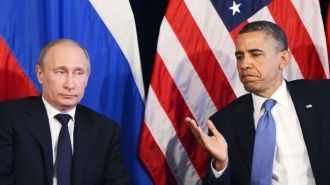 US President Barack Obama has accused Russia of adopting an “increasingly aggressive posture” in Ukraine.
Obama made the remarks on Tuesday at the White House in Washington, DC, after discussing the Ukraine crisis there with NATO Secretary General Jens Stoltenberg.
“We had a chance to discuss the situation in Ukraine and the increasingly aggressive posture that Russia has taken,” Obama said after meeting with Stoltenberg.
Relations between the United States and Russia are at their lowest point since the end of the Cold War in 1991, largely due to the crisis in Ukraine.
The ties deteriorated after US-backed forces ousted the Ukraine’s elected president Viktor Yanukovych in February 2014.
The US and its allies accuse Moscow of sending troops into eastern Ukraine in support of the pro-Russian forces. Moscow has long denied involvement in Ukraine’s crisis.
Moscow says Washington is responsible for the escalating tension in Ukraine through sending arms in support of the Ukrainian army.
Greek Defense Minister: ‘United States Ask for Our Support on Russian Sanctions’
By Katerina Papathanasiou | Greek Reporter | May 21, 2015
Greek Defense Minister Panos Kammenos said that the United States attempted to encourage Greece to support a new round of Russian sanctions but Athens still enjoys sharing religious and economic bonds with its “friend” and “ally,” Moscow.
After his meeting with US Under Secretary of Defense for Policy (USDP) Christine Wormuth on Wednesday, Kammenos told reporters: “I was asked to extend the sanctions, particularly in connection with Crimea. I explained [to Wormuth] that the Ukrainian issue was very sensitive for Greece as some 300,000 Greeks live in Mariupol and its neighborhood, and these people feel safe near the [Russian] Orthodox Church.” He, also, added that Greece has already lost more than €4 billion due to the Russian sanctions.
Greece’s Defense Minister has often stated in the near past that his country continues to preserve strong ties with Russia, mainly in the sector of defense contacts. In April, Kammenos revealed to Russian news agency Sputnik that Greece plans to continue military-technical collaboration with Russia while he shared Greece’s desire to settle new agreements, if the EU sanctions against Russia end soon.
Background:
U.S. Defense Secretary cancels meeting with Greek counterpart
Greek Reporter, May 20, 2015
Greek Defense Minister Panos Kammenos was snubbed by his U.S. counterpart, Ashton Carter, and Deputy Secretary of Defense Robert Work on his visit to the United States. The U.S. Defense Secretary cancelled the meeting over the weekend, claiming he has a busy schedule.
Kammenos will go to the Pentagon to meet with Under Secretary of Defense for Policy Christine Wormuth. He will also meet with Victoria Nuland, Assistant Secretary of State for European and Eurasian Affairs at the United States Department of State. Reportedly, Greek diplomats made efforts to upgrade the Greek Defense Minister’s contacts without success.
Kammenos will also have lunch with members of the U.S. House of Representatives, and meet with the Chairman of the House’s Armed Services Committee Mac Thornberry as well as Representative Frank Pallone and Senator Jack Reed.
Finally, the Greek Defense Minister will visit Lockheed Martin to discuss a 500 million dollar contract to upgrade five military aircraft.
According to analysts, the U.S. government is displeased with Greece’s new law that theoretically releases convicted terrorist Savvas Xeros. The U.S. Ambassador to Greece, David Pearce, had stated that if Xeros — who is responsible for the assassination of U.S. diplomats — is released from prison, that would be an unfriendly act toward the U.S.
Furthermore, Greece’s flirt with Russia — initiated partly by Kammenos — and certain statements made by the Defense Minister regarding Greece joining the BRICS bank have irked U.S. officials.
Analysts say that Greek-U.S. relations are at the worst point in recent years. Especially at a time when Greece is in the middle of harsh negotiations over its debt and needs all the support it can get.
FLIGHT MH17 Why we still don’t know what happened
Published on March 13, 2015
Much is not what it seems around the tragedy of the Malaysian airliner MH17 which was shot down above the Ukraine on july 17th 2014. This video challenges the immediate reflexes by the establishment media and governments, it explains the true story behind the events in the Ukraine and the loopholes in the official investigation.
The MH-17 Propaganda War
By Greg Maybury | Consortium News | May 22, 2015
The following anecdote may or may not be apocryphal, but either way given the geopolitical zeitgeist, the “moral” of the “fable” is a telling one. The story goes that during the 1980s a group of American journalists were hosting a visit to the U.S. of one of their Soviet counterparts. After proudly showing their visitor the “ropes” as to how it all works stateside, most of them expected their guest to express unbridled envy at the professional liberties they enjoyed in the Land of the Free Press. Later, whilst comparing notes about how they respectively went about plying their trade, the Russian scribe was indeed compelled to express his unabashed “admiration” to his hosts – but it was for the “superior quality” of American “propaganda.”
Now it’s fair to say his hosts were taken aback by what was at best a backhanded compliment. After some collegial argy-bargy about the stereotypes customarily associated with Western “press freedom” versus those of the controlled media in the Soviet system, one of the Americans called on their Russian colleague to explain himself. In fractured English, he replied with the following:
“It’s very simple. In Soviet Union, we don’t believe our propaganda. In United States, you actually believe yours!”
Many people familiar with this relatively obscure yarn might this week have once more been reminded of its enduring pertinence in the post-Cold War and post-9/11 eras with the airing last week on “60 Minutes” Australia of a report claiming to have solved the mystery of the Malaysian Airlines MH-17 shoot-down disaster last July 17 over eastern Ukraine.
This would especially have been the case with those of us who’ve had singular difficulty with the official Western position on who was actually responsible for the incident, one to which the “60 Minutes” segment seemed to go out of its way to give its seal of approval.
Along with reviving a major international story that for almost six months now has all but gone missing in media action, the “60 Minutes” crew ostensibly have added fuel to the fire that still attends the broader Ukraine situation, along with that of the resultant standoff between Russia and America and its Western allies, over what is happening in that country. In this context the introductory anecdote (above) takes on additional resonance.
I will return to the actual “60 Minutes” segment shortly along with some reactions to it. However, given the long dormant status of the story, it is necessary to revisit some of the key aspects of this international tragedy, one in which Australia lost 38 people, second only to the Netherlands, which lost 193 nationals.
The significance of the MH-17 story cannot be underestimated, despite – or indeed because of – its extended absence from the news cycle. This, not least because of the large number of family members and friends both in Australia and worldwide of those who perished and who themselves are still, some 10 months later, looking for answers and some closure. Moreover, the very fact this incident took place within the supercharged geopolitical atmosphere that is the Ukraine crisis, one even more charged now than it was then, is also of considerable importance.
From the outset, Western governments and politicians from across the political spectrum – led by the nose by the neoconservative cabals in Washington and dutifully buttressed by their propaganda shills in the corporate or mainstream media (MSM) – relentlessly sought to assign blame to Russia for the shoot-down. This was a textbook media case study reinforcing the old adage about never letting the facts get in the way of a good story. In the course of doing so, they recklessly inflamed an already intense standoff between the two countries over the Ukraine crisis, one that it has to be emphasized, is largely of America’s own making.
Despite official denials from Washington, this “crisis” we now know was custom-designed and purpose-built by Assistant Secretary of State for European and Eurasian Affairs Victoria Nuland and her posse of “regime changers” in the State Department, dutifully backed up by their neoconservative cronies (including Nuland’s husband Robert Kagan), to say little of the “liberal interventionists” in the Obama administration and in the broader Official Washington community.
As for what actually happened to MH-17 and who was responsible, Washington and the MSM in the West continued to maintain their rage for Russia despite being unable to provide concrete evidence of their claims, all the while singularly failing to provide news consumers and the general public with the full story, at least to the extent it was known.
If nothing else (and with this story there is plenty “else”), the MH-17 fallout was emblematic of the MSM’s long, well (if not fully) documented, and not so illustrious history of venal complicity in blindly validating Western governments’ approved narratives, along with sanctioning their official agendas and, whether through sins of omission or commission, suppressing their secret ones.
This is not conspiracy theory; it’s conspiracy reality. In fact it remains one of the key reasons why the generic MSM brand is in such decline among discerning news consumers seeking timely truths and authentic realities about the world in which we live and the forces which shape it.
For those folks highly skeptical, even dismissive, of the official narrative of the events leading up to and attending the MH-17 disaster, it was and has always been a “put up or shut up” proposition. This is something even the “60 Minutes” folks would have known from the start. And although we can say those promulgating this official narrative were unable to “put up” (albeit not for the want of trying), they eventually did “shut up.”.
The Blame Game
It seems then the politicians and their praetorian guard-dogs in the MSM were unable to sustain the breathlessly hysterical, one-sided “blame game” they collectively indulged in with respect to Russia, all the while reserving particular animus for its President Vladimir Putin. The “blame game” then was called off, though it was always something of a “shell-game” in disguise.
The hypocrisy was breathtaking in its scope, duration and intensity. Indeed, so “hysterical” was the backlash, Western leaders appeared to be outdoing themselves in carrying the can for Washington, with arguably Australia’s Prime Minister Tony Abbott leading the pack by earlier threatening to “shirt-front” the Russian president over the issue during his official visit to this country last November for the 2014 G20 meeting in Brisbane.
Coming from a national leader on the world stage, this unprecedented, petulant outburst was something to behold. But such was the fervor of the times regarding MH-17 especially, and more broadly, the anti-Russian mood that prevailed earlier in the year over Russia’s “invasion” of Ukraine in the aftermath of the U.S.’s prefabricated coup d’état.
Yet even putting aside the reality, Abbott was doubtless playing to local audiences given the number of Aussies killed in the shoot-down (to say nothing of his rock-bottom domestic political stocks at the time), it was clear from this moment the anti-Russian mood across the West at least within official circles – if the effective G20 snubbing of Putin was any indication – had indeed reached a crescendo if it hadn’t taken on a life of its own.
The MH-17 incident proved to be a powerful lightning rod through which the bear baiting could effectively be channeled by all and sundry. It was the gift that kept on giving for the neoconservatives and their interventionist confreres, along with those American allies wanting to ingratiate themselves with the Beltway Bandits on both banks of the Potomac.
Then, after the G20 in Brisbane, the collective Western umbrage died out. The intensity and duration of the ongoing anti-Russian feeding frenzy was completely at odds with the abruptness with which the MH-17 matter disappeared from the news cycle. The silence on MH-17 might have been deafening, yet it spoke volumes at the same time, and still does. [See Consortiumnews.com’s “The Danger of an MH-17 ‘Cold Case’” and “US Intel Stands Pat on MH-17 Shoot-down.”]
That said, in retrospect it seems it was only a matter of time before someone somewhere sought to revive the story complete with the “Putin did it” narrative. Cue here “60 Minutes” Australia!
The Dogs Not Barking
Now we can only surmise that this recent revelation purporting to be the definitive account of what actually happened to, and who was responsible for, the MH-17 shoot-down was the end result of a decision by the “60 Minutes” folks to boldly go where their colleagues in other MSM outlets feared to tread, fears based one suspects on the old adage that it’s better to let sleeping media dogs lie after all.
Moreover, one suspects this may have been an attempt by “60 Minutes” at brand “rehab,” since for those of us with a more nuanced view of how the MSM really works have known for some time said “brand” has become somewhat shop-soiled over the years. And given “60 Minutes” status as a flagship MSM name – whether in Australia or in the U.S. – going down this path was always going to attract people’s attention. For this reason alone it was fraught with peril, so they just had to get this one right!
Which is to say, this was the only way they could go if they were attempting to revive the MH-17 story. Considering the basic laws governing the media news-cycle, efforts to do so had to be accompanied by some groundbreaking new insights, or at least the next best thing. And one can only wonder what the “next best thing” might have looked like short of finding the “smoking gun” (or should we say, “smoking BUK”) and identifying the persons who fired it. This was especially the case given the hammering the same media gave the issue from the outset.
But in declaring unequivocally they had indeed done all this, in the process correspondent Michael Usher and his intrepid “60 Minutes” team of investigators may have not only opened up a can of worms, they might also have bitten off more than they can chew and dug themselves into an even deeper hole in one fell swoop. They are going to look awfully silly if they aren’t able to sustain the narrative they have assembled from their investigations.
The proof will be in the pudding going forward one imagines, the “pudding” in this case being largely whether the general public in Australia or anywhere else accepts their conclusions, and whether other MSM outlets pick up on the story and continue to run with it. And as of this writing, there appear few signs their MSM confreres – either in Australia or in the U.S. – are chomping at the bit to do so.
With this in mind, if Robert Parry of Consortium News has anything to do with it, rather than gaining any ongoing traction, the story as it stands will be stopped in its tracks. Although his profile Down Under may not be high, Parry is one of America’s most respected investigative journalists working in the alternative, independent media space. He’s also someone who has taken a very strong interest in the MH-17 incident, and in the broader situation in the Ukraine. After viewing the “60 Minutes” report, he was to put it mildly less than impressed with Usher and Co.’s “findings.”
Now because readers can decide for themselves by viewing the various links herein and doing their own research if so inclined, there’s little point rehashing the minutiae of the “60 Minutes” revelations or providing a blow-by-blow account of Parry’s own responses. It is however worth noting some of the key points.
The Video Mismatch
To begin with, Parry suggests that “60 Minutes” might have “faked” a key piece of evidence in arriving at its conclusion – in claiming that it had located the spot where a video was taken after the MH-17 shoot-down and showing what appears to be a BUK launcher making a getaway. The “60 Minutes” team claimed the spot was in rebel-controlled Luhansk and the launcher was fleeing back to Russian territory. However, Parry noted that the scene in the earlier video didn’t match the site shown by “60 Minutes.” [See Consortiumnews.com’s “Fake Evidence Blaming Russia for MH-17?”]
Further, Parry pointed to one of the main bones of contention for those of us who have had great difficulty accepting the official position, that being “the dog-not-barking question of why the U.S. government has withheld its intelligence data.” This is a not unimportant consideration by any means and one to which we’ll return.
Not unexpectedly the “60 Minutes” folks in response took considerable umbrage at Parry’s suggestion they were engaging in journalistic “sleight-of-hand” in the way they had framed their narrative and presented their “ground-breaking new insights.” One member of the investigative team tweeted that Parry had made a “huge and embarrassing mistake” – but didn’t say what it was.
However it was the segment’s producer Stephen Rice who adopted an especially righteous stance. Describing Parry’s claims as “nonsense, and demonstrably wrong,” he then went for the journalistic jugular by declaring Parry’s piece “an amateurish attempt to discredit our story, embarrassing even for him.” Now the loaded phrase “even for him” is a measure of Rice’s “umbrage” to be sure, and suggests that for reasons about which we can only speculate he had little regard for Parry’s journalistic integrity even prior to his outburst.
There was certainly a whiff of the “methinks he doth protest too much” about it. Yet one is left wondering if Rice is so convinced they got their story right and that the facts speak for themselves, whether this decidedly nasty additive at the end of his salvo was actually necessary, or for that matter was becoming of any self-respecting journalist.
But they left themselves wide open to Parry’s follow-up response, again noting that the two images – one from the night of July 17 and the other from the “60 Minutes” show – simply don’t match up and that all the hostile rhetoric won’t change that fact. Parry again published the side-by-side images with an invitation to readers to decide for themselves. [See Consortiumnews.com’s “You Be the Judge.”]
And in respect to any further consideration of who the real culprits were and as to what actually happened to MH-17 – the sole focus of the “60 Minutes” story – the significance of the “question” regarding why U.S. intelligence data has been withheld cannot be overstated. With this in mind, in the course of their investigation, why didn’t the “60 Minutes” folks seek out someone from the U.S. Government to provide corroboration or otherwise from their own intelligence data as to the veracity of their findings?
Or to put it in even simpler terms, why didn’t “60 Minutes” ask the U.S. Government point-blank why they have thus far refused to release all the satellite imagery and related intelligence data on the MH-17 shoot-down that by most objective accounts would put the matter to rest once and for all? We might safely surmise herein this is because of the same reason there is still much evidence yet to see the light of day regarding the JFK Thing, or the 9/11 Thing, or the Iran/Contra Thing or any number of other memorable “Things” for which full explanations and revelations from the U.S. government remain outstanding.
More Revelation, Less Accusation
Taking then a broader view, there are a myriad range of other issues and angles to be considered for anyone revisiting the whole MH-17 tragedy: the geopolitical milieu in which the MH-17 incident took place and the narrative framework in which its story continues to play out – the ongoing Ukraine crisis created by Washington; the West’s diplomatic marginalization of Russia coupled with the economic sanctions; the incessant saber-rattling and continuing encroachment by NATO around Russia’s borders; the resentment and suspicion that America through its belligerent foreign policy machinations is fomenting with nations such as Iran, China and others – all has the potential to determine the fate of nations and the geopolitical landscape for years to come. And not it needs be said, in a good way. And that’s without considering the “nuke” factor!
In this context then, the MH-17 disaster in realpolitik terms may not even matter that much anymore. This may explain why the story disappeared so quickly from the media radar. In reality and again with the benefit of some rear-view-mirror gazing, the MH-17 tragedy was always a geopolitical football from the beginning, and in that sense it has long since served its purpose.
To underscore this and at the same time point to some of those myriad issues and angles regarding the MH-17 shoot-down that have all been swept under the carpet – including it should be noted by our intrepid “60 Minutes” journalistic “gumshoes” – the documentary by Peter Vlemmix is a must watch.
To be sure, there are “plenty” of other folks who have questioned and indeed openly challenged the rationale for the official response from Western politicians and the MSM. But Vlemmix’s film is as good a place to begin for those looking to gain a more complete – and more dispassionate – perspective. And for those wishing to explore an alternative summary of the evidentiary minutiae specifically addressed by “60 Minutes,” the link herein is also highly recommended.
Further, it may also be instructive to consider the following. Over three months ago and well after the MH-17 story disappeared from the radar, I personally sent to Australian Foreign Affairs Minister Julie Bishop an email presenting her with a number of queries regarding the Australian government’s official position on MH-17 at that point. These are some of the questions I asked the Minister then, and they remain pertinent now:
- What countries are currently involved in [the MH-17] investigation, and what specific role is Australia playing? At what stage is the investigation itself and when does the Minister expect that it will be completed and a report available?
- Can the minister confirm or deny speculation/reports that the findings of the investigation will not be released? If they are not to be released as has been reported, can the Minister please explain why this is the case?
- If it is found the Ukrainian separatists were responsible – which seems to be the official position of most stakeholders – will this change the position of the countries involved as to whether the findings indeed will be released if at this stage there is – as reported – no plans to do so?
- If the report is not to be released, will the relatives of the victims be privy to the findings, regardless of the outcome of said findings? If not, why not? If so, what conditions might be placed on them re: confidentiality if indeed the report is not going to be released in full un-redacted? Will they still be able to seek compensation from those responsible, regardless of who that is?
- If it is found that the Russian separatists were not in fact responsible for this disaster, will the Australian government lift the sanctions imposed on the Russian government in the wake of the disaster? Will the Australian Prime Minister also apologise to the Russian president for both the imposition of the sanctions, and the manner in which he was treated during the Brisbane G20?
- If in fact it is found that the Ukrainian regime was responsible, will the Australian government seek compensation for victims and reimbursement for the cost of the recovery operation and investigation? Will it seek an official apology from and/or impose economic sanctions on the Ukraine regime in response? Will the relevant members of the Ukrainian regime face possible criminal charges in international courts?
Now there was no response from the Minister’s office despite a follow-up query, which for most may not be surprising. And we can only speculate as to whether I might have received a reply had I been a “60 Minutes” investigative reporter. For others, especially after all the brouhaha surrounding MH-17, the no-reply might also be something of a fashion statement.
But the point herein is this: As with all incidents useful to Western governments, the MH-17 tragedy had served its purpose. There was no political dividend in continuing to flog the proverbial dead horse.
The Perpetual Siren Call of Realpolitik
As brutal as it sounds, the Australian government’s priority was not finding closure for the victims’ families, determining the real cause of the tragedy, or ensuring as far as is possible those responsible faced justice, and it would appear that the Netherlands is no different in this respect.
In response to the additional controversy over the release of a report on the investigation and as to who would actually get to see it, the Dutch Prime Minister’s office issued a statement late November 2014 that said the following, which wasn’t much in words, but spoke volumes in meaning: “….the benefits of disclosing information about the MH17 investigation were outweighed by the risk of damage to the Dutch state’s relations to other states and world bodies.”
Although no one has yet coughed up hard-core evidence against the Kremlin (including it would seem most key figures in the U.S. intelligence community), the Western powers led by Washington have flagrantly exploited the disaster in order to bolster their propaganda campaign against Russia. This is, after all, the Washington Way. Within the geopolitical realm though and in the final analysis, the perpetual siren call of realpolitik dictates that there are more often than not bigger fish to fry.
Moreover, with the possible exception of the consideration the Russian separatists did shoot down the airliner deliberately and did so at the Kremlin’s instigation (a scenario that no one takes seriously), regardless of what happened and who was responsible for the disaster, the Americans themselves have to shoulder most if not all the blame for this lamentable, avoidable tragedy. Their track record of “regime change” is one that is well documented, with the commensurate blowback from such interventions constituting a narrative deep, wide and long enough to justify its own unique classification and index number within the Dewey library catalogue system.
In this context then the MH-17 tragedy appears to be the direct outcome of another of those interventions, collateral damage as a direct consequence of playing the Great Game in the relentless pursuit of empire. For that matter, Ukraine itself may also be destined to take a back seat in the Great Game going forward. This observation was underscored by Pepe Escobar of the Asia Times recently, wherein he reports on an apparent thaw in the U.S.–Russia relationship, one instigated by America.
As for the “60 Minutes” folks, they may or may not have had the best intentions in their fearless efforts to uncover the truth. And they may or may not have covered all the bases and considered all the relevant facts, evidence and issues in delivering their final verdict. If they haven’t then, this would not be the first time by any stretch one of the MSM’s flagship brands has been caught short and found wanting in any or all of the above criteria.
As far as the “60 Minutes” brand itself is concerned, in this respect we only have to recall “Rathergate”. This referred to the Dan Rather imbroglio in 2004 resulting from revelations about George W. Bush’s National Guard duty in the lead-up to the presidential election of that year, “revelations” which were based in part on questionable documents. The botched story it should be remembered culminated in the veteran newsman’s downfall, along with the firing of several lesser known colleagues.
In concluding then, for the moment and for the sake of argument, let’s give the “60 Minutes” crew the benefit of the doubt. They may have approached their investigation with an open mind from the start and then even genuinely believed when they went to air the program they were on the right track. Yet such was the nature of this story that that in the final analysis was never going to be enough. Their findings had to be more than convincing, even more than conclusive; they had to be bulletproof.
For his part Robert Parry has raised sufficient doubts, enough to render their findings significantly less than conclusive if not indeed less than credible. It is difficult then to accept that this high-wire adventure in investigative journalism had less to do with arriving at a truth or reality that most of us could get our heads around. It was more about reinforcing an official narrative – one that has never been explained or evidenced satisfactorily by those who were best positioned, and upon whom it was always incumbent, to do so – and more to do with journalistic one-upmanship, MSM grandstanding and brand refurbishment.
And judging by the singular lack of interest from other MSM outlets in taking up the “60 Minutes” story, even their own colleagues apparently aren’t that convinced they in fact, did get it right. Until and unless this happens, Messrs Usher and Rice and their crew it seems will have two options, neither of which one imagines would be very palatable for Brand “60 Minutes.” They can dig in their heels, “maintain the rage” on their Pat Malone, or stop “mentioning the war.”
Doubtless though, it will be fascinating to see which path they take going forward. Tick, tock!… Tick tock!.. Tick tock!…
U.S. Secretary of State John Kerry v. His Subordinate Victoria Nuland, Regarding Ukraine
By Eric ZUESSE | Oriental Review | May 22, 2015
U.S. Secretary of State John Kerry, on May 12th, responding to Ukrainian President Petro Poroshenko’s assertions that Ukraine will retake Crimea and will conquer Donbass:
“I have not had a chance – I have not read the speech. I haven’t seen any context. I have simply heard about it in the course of today. But if indeed President Poroshenko is advocating an engagement in a forceful effort at this time, we would strongly urge him to think twice not to engage in that kind of activity, that that would put Minsk in serious jeopardy. And we would be very, very concerned about what the consequences of that kind of action at this time may be.”
U.S. Assistant Secretary of State for European & Eurasian Affairs, Victoria Nuland, as communicated by the U.S. State Department’s Press Office on May 15th, reiterating Poroshenko’s view:
“Assistant Secretary Nuland’s ongoing visit to Kyiv and her discussions with Prime Minister [Arseniy] Yatseniuk and President [Petro] Poroshenko reaffirm the United States’ full and unbreakable support for Ukraine’s government, sovereignty, and territorial integrity. We continue to stand shoulder to shoulder with the people of Ukraine and reiterate our deep commitment to a single Ukrainian nation, including Crimea, and all the other regions of Ukraine.”
Will John Kerry reprimand his subordinate for her contradicting what he, her boss, had said three days earlier? If not, then will President Barack Obama fire his Secretary of State John Kerry? If not, then will Victoria Nuland be fired? If not, then who is to trust anything that comes from the U.S. State Department, when the Secretary of State can be contradicted three days later by his subordinate, and both remain in their respective jobs?
Republicans are already preparing to weaken Kerry over this. The far-right news-site Frontpage Mag headlined on May 21st, John Kerry’s Seven Hours of Weakness in Russia, and condemned the “attempt by Kerry to re-set the ‘re-set’ button [on U.S. policy toward Russia] first pushed by his predecessor, Hillary Clinton.” The special subject of their ire: “The promise of ‘rolling back’ the mild sanctions regime the West imposed on Russia on account of Putin’s annexation of Crimea and support of separatist rebels was bandied about, if only Russia would behave in the future.” But winning changes in behavior is what international diplomacy is supposed to be all about — otherwise the State Department wouldn’t even be needed, and only the Pentagon would handle America’s foreign relations.
If Victoria Nuland stays in her job, then John Kerry will be neutered even if he’s not fired.
The only person with the power to fire Nuland is actually U.S. President Barack Obama. Perhaps the request for him to do that is already on his desk. If it’s not, then Kerry’s job is in jeopardy, because his diplomatic efforts can be obliterated by a subordinate and that subordinate will suffer no penalty for doing this. Nobody then would respect anything that the U.S. Secretary of State says, because it wouldn’t necessarily represent the President’s policies. If the Secretary of State isn’t backed up by the President, then the Secretary of State has no real power at all.
Obama Regime Gives Up on Ukraine, Western Press Ignores It
By Eric Zuesse | Dissident Voice | May 18, 2015
On Tuesday, May 12, U.S. Secretary of State John Kerry was asked at a press conference in Sochi Russia, to respond to Ukrainian President Petro Poroshenko’s recent statements promising renewed war against Donbass, which were made first on April 30, “The war will end when Ukraine regains Donbass and Crimea,” and which were repeated on May 11th, by his saying, “I have no doubt, we will free the [Donetsk] Airport, because it is our land.” In other words, Poroshenko had repeatedly made clear that he plans a third invasion of Donbass, and, ultimately, also to invade and retake Crimea. (The Western press, however, had not reported any of these threats that were being made by Poroshenko.)
Kerry responded:
I have not had a chance – I have not read the speech. I haven’t seen any context. I have simply heard about it in the course of today [which would be shocking if true]. But if indeed President Poroshenko is advocating an engagement in a forceful effort at this time, we would strongly urge him to think twice not to engage in that kind of activity, that that would put Minsk in serious jeopardy. And we would be very, very concerned about what the consequences of that kind of action at this time may be.
None of this was reported by Western ‘news’ media. Even Russia’s own Sputnik News, which was Russia’s main English-language medium reporting on Kerry’s comment, ignored this shocking assertion by the U.S. Secretary of State contradicting the nominal leader of the Ukrainian Government that the U.S. itself had installed in February 2014.
The Obama Administration now had slammed Poroshenko down on the key issue of whether to resume the war against Ukraine’s former Donbass region, and also slammed him on whether Ukraine should invade Crimea, which is Russian territory and would therefore mean a war against the Russian armed forces. America’s stooge-regime in Kiev was here being publicly taken to the woodshed about the advisability of yet another Ukrainian invasion of Ukraine’s former southeastern breakaway regions, Donbass and, even Crimea.
Sputnik didn’t quote any of this from Kerry. Instead, they headlined, “Kerry: Poroshenko Should ‘Think Twice’ Before Using Force in Donbass,” and they opened their news-report by saying: “Following an extensive six hour discussion between US Secretary of State John Kerry, Russian Foreign Minister Sergey Lavrov, and President Putin, Kerry stressed that any Ukrainian efforts to seize the Donetsk Airport through force would violate the Minsk Protocol and would face strict opposition from Washington.” That assertion was true, and important, but all that was quoted from Kerry was the nondescript: “What is important is to make sure that both sides are moving forward in implementing the Minsk accord in its full measure.” Even Kerry’s stunning “think twice” statement, which was actually Washington’s first-ever verbal slam-down of the stooge-regime the U.S. itself had installed in Ukraine in February 2014, in an extremely bloody coup, wasn’t being quoted at all by Sputnik. (Only that two-word phrase was in the headline, but it — and its surrounding passage and context — were entirely absent from the report itself.) Nor was the significance of Kerry’s remark there discussed, at all. Their news-report was a total botch.
Western ‘news’ media were far worse than a botch; they were outright dishonest. Typical was BBC, which headlined on May 12, “Ukraine Crisis: Kerry Has ‘Frank’ Meeting with Putin,” and their article said nothing whatsoever about Kerry’s shocking slam-down of his Ukrainian stooge. To that ‘news’ report was also appended an “Analysis: Bridget Kendall, BBC News, Sochi,” which simply blathered, and concluded, “There was no breakthrough on anything.” That statement was the exact opposite of the truth.
The one good, and, really, brilliant, news-analysis on this important matter, was from the legendary specialist on “the Empire’s [Washington’s] War on Russia,” the anonymous blogger who goes by the name, The Saker. His was not really a news-report, because he, too, failed to quote Kerry’s path-breaking and shocking statement. He didn’t even quote the insignificant squib that Sputnik itself had quoted from Kerry’s remarks. Instead, he merely paraphrased Kerry, which is far less reliable than a quotation, and also far less informative than the packed shocker that Kerry actually delivered. Saker’s paraphrase was far briefer than was Kerry’s statement which is quoted here; it was merely: “Kerry made a few rather interesting remarks, saying that the Minsk-2 Agreement (M2A) was the only way forward and that he would strongly caution Poroshenko against the idea of renewing military operations.” That’s all there was to it. So, The Saker failed to provide a news-report on Kerry’s shocker. But his news-analysis of its significance was superb, and it’s extremely worth reading. That analysis was dated May 13, and it was bannered, “Yet Another Huge Diplomatic Victory for Russia.”
But also there was just a slice of real news in The Saker’s article, when he said, only in passing (as if it were insignificant, which it was not), “Then, there was the rather interesting behavior of [Victoria] Nuland, who was with Kerry’s delegation, she refused to speak to the press and left looking rather unhappy.” Nothing more than that, but that’s plenty. In other words: Nuland, the agent whom President Obama had placed in charge of arranging the February 2014 coup in Ukraine, and of selecting the leader of the junta that would be imposed upon Ukraine (“Yats” Yatsenyuk), and who told the U.S. Ambassador to Ukraine what to do and how to do it, was now exceedingly disturbed to find herself overridden at this late date in her Ukrainian escapade, publicly overridden by her own immediate boss, Secretary of State Kerry.
In other words: she is now sidelined. That’s important news, but The Saker there merely hinted at it, and only in passing. So, as a news-report, The Saker’s article was poor but perhaps the best around; but as a news-analysis, it was excellent, and by far the best.
Nuland now knows that she has lost, and that Obama has thrown in the towel on the original plan for Ukraine, which had been for an all-out military conquest of the region, Donbass, where the people had voted over 90% for the man whom Nuland’s team had overthrown on 22 February 2014, Viktor Yanukovych, and so Obama had wanted those people to be either killed or else expelled from Ukraine (so that they’d never again be able to vote in a Ukrainian national election and thus possibly restore a neutralist leadership of Ukraine, such as had existed under the man Obama deposed, Yanukovych).
Consequently, clearly, now, Obama is on-board with the “Plan B” for Ukraine, which Francois Hollande and Angela Merkel had put into place, the Minsk II Agreement, which brought about the present ceasefire, which now has become clearly the utter (even accepted by Kerry) capitulation of Obama’s Plan A on Ukraine, which plan Nuland had been carrying out. Kerry’s public statement there was a public slap in the face to his own #2 official on Ukraine; and it could not have been asserted by him if he were not under Obama’s instruction that the previous plan, to exterminate or drive out all the residents of Donbass, was no longer worth trying, and that the Hollande-Merkel plan would be America’s fall-back position.
Obama’s message in this, through Kerry, to Ukraine’s President Poroshenko, and indirectly also to Ukraine’s Prime Minister Yatsenyuk (the leader whom Nuland herself had selected), is: we’ll back you only as long as you accept that you have failed our military expectations and that we will be stricter with you in the future regarding how you spend our military money. We’re getting in line now behind the Hollande-Merkel peace plan for Ukraine.
Dmitriy Yarosh, and the other outright Nazis who had been threatening to overthrow Poroshenko if he doesn’t renew the war against Donbass and seize Crimea; Dmitriy Yarosh, who was the man who had led the Ukrainian coup for the U.S., and whose thugs had dressed as Yanukovych’s security forces when gunning down both police and demonstrators in the February 2014 coup, in order for Yanukovych to become blamed for the bloodshed on that occasion; is now, in effect, being told: if you will try another coup, this time to overthrow our own stooges in Ukraine, then you’re finished, Mr. Yarosh. Don’t do it.
Merkel and Hollande thus won. Putin had decidedly won. Obama and the Nazis he had empowered in Ukraine have now, clearly, been defeated. But the mess that Obama’s people have created in Ukraine by their coup and subsequent ethnic-cleansing to eliminate the residents of Donbass, will take decades, if ever, to repair.
Western ‘news’ media can cover it all up, but they can’t change this reality, which, increasingly as time goes by, will expose the press’s failure to have even reported on this historically important U.S. coup in Ukraine and its ultimate failure. As a story about the press, it is about yet another system-wide press-deceit upon the public, comparable to their ‘news coverage’ of ‘Saddam’s WMD,’ and other lies, in 2002 and 2003.
More and more people are coming to know what utter rot the Western press are. The news-report that you are now reading here, has been submitted to all of them, but they’ll probably all reject it like they’ve all refused to report the truth that it and its predecessors report and reported about Obama’s Nazi (i.e., racist-fascist) takeover of Ukraine. How the Western press will get out of their cover-ups and outright lies, yet again, is hard to imagine. But maybe they’ll just not report it at all — yet again. Obama has thrown in the towel on Ukraine, and still the press hasn’t yet reported it. But now I have, and you’re reading it here, perhaps for the first time, even though Kerry’s sensational remark was made a week ago.
Thus, major historical events (like Kerry’s statement here) occur, in broad daylight, which never were even reported by the Western press — they were instead covered-up, not covered at all, by ‘our’ ‘free’ press.
Ukrainian Parliament approves law allowing forced relocation of Russian citizens
RT | May 12, 2015
The Ukrainian Parliament has approved new regulations on martial law, which among other things allows for extrajudicial detention and relocation of Russian citizens in the country.
The law was approved by 254 deputies out of 322. It regulates how martial law can be declared in Ukraine and the changes to legal procedures it brings.
These changes include “forced relocation of the citizens of a foreign country who threaten or undertake aggression towards Ukraine,” the law’s memorandum states as cited by TASS. The parliament declared Russia an aggressor on January 27 by adopting a declaration to that end.
Apart from the relocation of foreign citizens, martial law will allow Ukrainian authorities to confiscate private property, regulate mass media, prohibit any rallies, marches and other mass gatherings and initiate the legal process of banning any political party or mass media deemed “acting against Ukraine’s independence.”
It also entails labor conscription for all able-bodied Ukrainians not currently in the army and a possible curfew. In areas of actual fighting, the role of local authorities is passed on to the military command.
This is the new version of the law, which was preliminarily approved on April 9.
For martial law to take hold, the parliament has to approve a corresponding ruling by the Ukrainian president. It can be declared in the whole country or selected regions.
Poroshenko violates Minsk deal vowing to recapture Donetsk Airport – Kremlin

RT | May 12, 2015
The Ukrainian president’s decision to reclaim Donetsk Airport, a key strategic point in the conflict in the country’s east, are in violation of the Minsk peace deal, says the Kremlin.
Petro Poroshenko vowed on Monday to take the airport back: “I have no doubt – we will free the airport, because it is our land. And we will rebuild the airport.” He also promised to erect a monument to the “cyborgs,” which has become a common nickname for the Ukrainian soldiers that fought against the forces of the self-proclaimed eastern republics for control of Donetsk Airport.
Poroshenko spoke at the premier of the documentary “Airport”, which was dedicated to the siege.
When asked if he thinks such words violate the Minsk peace deal, the Russian president’s press secretary said they do: “Of course, they are a violation. In fact, we have repeatedly said that Ukraine is not complying with the Minsk agreement.”
The Minsk deal is a peace roadmap for Kiev and the self-proclaimed republics in eastern Ukraine. Brokered by Russia, Germany and France, it was signed in the Belarusian capital in February. It aims to implement the peace process agreed upon in the September 2014 talks, also in Minsk. Since February’s agreement was signed, the violence in the East has reduced, but both Kiev and the secessionists blame each other for violating the truce regularly.
As part of the Minsk deal, the sides agreed to move heavy weapons away from a demarcation line drawn across eastern Ukraine. The self-proclaimed Donetsk Republic says this leaves the airport in its territory. Its representative to Minsk Denis Pushilin says Poroshenko’s vow to reclaim the airport is a call to arms: “This is a direct violation of the Minsk agreements and a call to military action. We ask that the guarantor nations pay attention to these statements.”
Donetsk Airport has been one of the hottest flashpoints in the conflict in eastern Ukraine for about eight months. In January, Kiev admitted its forces completely surrendered the airport.
During the lengthy siege the airport was reduced to rubble. The casualty count is impossible to verify, with the two sides giving vastly different numbers, both saying they had lost dozens while claiming the opponent had lost hundreds.
Who Owns Agricultural Land in Ukraine?
By Elizabeth Fraser | Oakland Institute | May 8, 2015
The fate of Ukraine’s agricultural sector is on shaky ground. Last year, the Oakland Institute reported that over 1.6 million hectares (ha) of land in Ukraine are now under the control of foreign-based corporations. Further research has allowed for the identification of additional foreign investments. Some estimates now bring the total of Ukrainian farmland controlled by foreign companies to over 2.2 million ha;1 however, research has also identified important grey areas around land tenure in the country, and who actually controls land in Ukraine today is difficult to ascertain.
The companies and shareholders behind foreign land acquisitions in Ukraine span many different parts of the world. The Danish “Trigon Agri,” for example, holds over 52,000 ha. Trigon was established in 2006 using start-up capital from Finnish “high net worth individuals.” The company is traded in Stockholm (NASDAQ), and its largest shareholders include: JPM Chase (UK, 9.5 percent); Swedbank (Sweden, 9.4 percent); UB Securities (Finland, 7.9 percent); Euroclear Bank (Belgium, 6.6 percent); and JP Morgan Clearing Corp (USA, 6.2 percent).
The United Farmers Holding Company, which is owned by a group of Saudi Arabian investors, controls some 33,000 ha of Ukrainian farmland through Continental Farmers Group PLC.
AgroGeneration, which holds 120,000 ha of Ukrainian farmland, is incorporated in France, with over 62 percent of its shares managed by SigmaBleyzer, a Texas-based investment company.
US pension fund NCH Capital holds 450,000 ha. The company began in 1993 and boasts being some of the earliest western investors in Ukraine after the break-up of the Soviet Union. Over the past decade, the company has systematically leased out small parcels of agricultural land (around two to six hectares in size) across Ukraine, aggregating these into large-scale farms that now operate industrially. According to NCH Capital’s General Partner, George Rohr, the leases give the company the right to buy the currently-leased farmland once the moratorium on the sale of land in Ukraine is lifted.
Another subset of companies have Ukrainian leadership, often a mix of domestic and foreign investment, and may be incorporated in tax havens like Cyprus, Austria, and Luxembourg. Some of them are also led by Ukrainian oligarchs. For instance, UkrLandFarming controls the country’s largest land-bank, totalling 654,000 ha of land. 95 percent of the shares of UkrLandFarming are owned by multi-millionaire Oleg Bakhmatyuk with the remaining five percent having been recently sold to Cargill. Similarly, Yuriy Kosiuk, Ukraine’s fifth richest man, is the CEO of MHP, one of the country’s largest agricultural companies, which holds over 360,000 ha of farmland.
With the onset of the political crisis, several of these mostly Ukrainian-based companies have descended into crisis themselves. One example is Cyprus-incorporated Mriya Agro Holding, which holds a land-bank of close to 300,000 ha. In 2014, the company’s website (which is no longer available online) indicated that 80 percent of the shares of Mriya Agro Holding are/were owned by the Guta family (Ukrainian), who hold primary leadership positions in the company. The remaining 20 percent are/were listed on the Frankfurt Stock Exchange.
According to news sources, in summer 2014 the company defaulted on its payments for two large Eurobonds, putting its future into question. The company first enlisted the support of US-based Blackstone Group and Ukrainian-based Dragon Capital, both of whom withdrew support after only one month; and later, the international auditing and financial service firm, Deloitte. An international bondholder committee was struck, comprised of several US and UK-based investment groups (including CarVal Investors – Cargill’s investment arm), which together own over 50 percent of the debt owed on Mriya’s 2018 Eurobonds and 15 percent of the 2016 Eurobonds. The future of this firm is unclear with some sources suggesting a risk of bankruptcy.
Other Ukrainian-owned companies incorporated in tax havens are also experiencing difficulties. Sintal Agriculture Public Ltd (based in Cyprus, traded on the Frankfurt Stock Exchange as of 2008, and holding almost 150,000 ha of land) ceased trading in shares on January 29, 2014 “until further notice” after bankruptcy proceedings were initiated against the company. In 2013, its website (now also defunct) indicated that 36.3 percent of the company was free floating shares.
The potential bankruptcy of these corporations, and the involvement of Western investors in the crisis management, raises questions about the fate of the agricultural land they hold. At this time, it is not clear how control over the agricultural lands in question will be addressed and what the role of foreign companies and funds who have invested in these companies will be. However, if things progress in a similar way to neighboring Romania, foreign control of this land could transpire.
Romania has a similar story of dissolving collectivized farms, giving land titles to collective farm workers, and imposing a moratorium on the sale of agricultural land. Loopholes in the country’s national legislation have created opportunities for foreign control of land via bankruptcy proceedings. As documented by Judith Bouniol, the bankruptcy of national agribusinesses has provided a gateway for foreign control of Romania’s farmland.
It is far from clear if the same scenario could take place in Ukraine. However, this lesson from Romania emphasizes the importance of keeping close watch on these agricultural land deals. In addition, the murky situation around land ownership in Ukraine raises many questions. Perhaps the most important is whether the growing concentration of Ukrainian land in the hands of a few oligarchs and foreign corporations can benefit the country, its people, and its economy.
—
1 Two land investment databases were accessed over the past year: the Land Matrix accessed in July 2014 and April 2015, and GRAIN’s 2012 data set on land investments worldwide. Taken individually, these databases suggest foreign land acquisitions of between 997,000 ha to 1.7M ha. When consolidated, individual deals reported by these databases represent over 2.2M ha of land in Ukraine.
EU Parliament Drafts New Anti-Russian Resolution Calling for More Sanctions
Sputnik – 06.05.2015
A proposed declarative resolution by a group of MEPs has called on the European Union to step up sanctions against Russia, provide Ukraine with weaponry and further strengthen NATO forces in Eastern Europe, should Russia refuse to return Crimea to Ukraine or fail to abide by the Minsk ceasefire, a press statement for the body stated Tuesday.
The aggressively worded document, drafted Monday and liaised by Romanian MEP Ioan Pascu for the parliament’s Committee on Foreign Affairs, warns that increased Russian military presence in Crimea necessitates EU nations to strengthen their military capabilities, stating that NATO must give its East European members a “strong strategic reassurance.”
Commenting on the proposed resolution, Pascu suggested to the EU’s news service that the strengthening of Russian defense capabilities in Crimea is “in practice creating another launching pad, of the proportions of Kaliningrad, this time in the Black Sea.” The MEP threatened that “in one year the defensive force which existed there has been transformed into a strike force… with which Russia can threaten Central Europe, the Balkans, Southern Europe and also [the] Eastern Mediterranean and even the Middle East.”
Supported by MEPs from Lithuania, Estonia, Poland and Spain, the belicose resolution, pending Foreign Affairs Committee approval, also accuses Russian authorities of mistreating the Crimean Tatars. Furthermore, it suggests that Russia may next move to cut off Ukraine from the Black Sea entirely by annexing its coastal territories. Pending approval, the belligerent document will face a vote at the parliament’s upcoming session in June, asking “EU member states to speak with one united voice,” regarding “EU relations with Russia.”
Russian security doctrine to be adjusted after Arab Spring, Ukraine turmoil – official
RT | May 06, 2015
The head of Russia’s Security Council has promised that the authorities will adjust the nation’s security doctrine after learning the lessons of the latest political crises in the Middle East and Ukraine.
“In order to update the basic concepts of national securitythe council has ordered to begin the work on making corrections to the main strategic plans – the National Security Strategy of the Russian Federation to year 2020 and the Informational Security Strategy,” Nikolai Patrushev said in an article published Wednesday in the Defense Ministry’s daily newspaper, Krasnaya Zvezda (Red Star).
He added that the necessity of such actions has arisen after the so-called Arab Spring (a wave of violent mass protests that led to overthrowing of governments and leaders in several Middle East countries in 2011-12), the wars in Syria and Iraq and also the situation in and around Ukraine.
Patrushev said that these events demonstrated the tendency for security threats to shift from the military sphere into the informational space. “As leading nations of the world fight for their interests they typically use ‘non-direct action,’ the population’s protest potential, radical and extremist groups and also private military contractors,” Patrushev wrote.
He also noted the increasing aggressiveness of the United States and NATO toward Russia, embodied in the beefing up of military potential near Russian borders and the continuing deployment of the global missile defense system.
The Security Council is Russia’s top consultative body on national security, and Nikolai Patrushev has headed the council since 2008. Before that, he was the director of the Federal Security Service for nine years.
In October 2014, Patrushev openly accused the United States of playing a role in the current turmoil in Ukraine and the military conflicts in Georgia and the Caucasus, saying these were direct results of the anti-Russian policy of the US administration. He also revealed in a press interview that intelligence analysts established that American special services were executing an anti-Russian program that dates back to the 1970s, and is based on Zbigniew Brzezinski’s “strategy of weak spots,” the policy of turning the opponent’s potential problems into full-scale crises.
In September 2014, President Vladimir Putin tasked senior military and state officials with developing an updated military doctrine that would meet the needs of changing global politics and modern military challenges and the new dangers and threats, in particular those manifested in the so-called Arab Spring, the civil war in Syria and the ongoing crisis in Ukraine.
An updated version of the doctrine was adopted in late December.
Read More:
‘Clearly anti-Russian’ – Moscow blasts latest US national security strategy
Featured Video
Dan Dicks with James Corbett on Solutions Watch
or go to
Aletho News Archives – Video-Images
From the Archives
$1.5bn up in smoke: US THAAD missile stockpile dries up defending Israel against Iran
By Ivan Kesic | Press TV | July 2, 2025
According to American media, defense news outlets, and independent analysts, the 12-day Israeli military aggression against Iran significantly depleted the US stockpile of THAAD (Terminal High Altitude Area Defense) interceptor missiles.
Citing official sources, American magazine Newsweek reported on Friday that the US transferred a substantial portion of its advanced missile defense capabilities to support the Israeli regime, an effort with questionable results and a critical impact on US strategic reserves.
THAAD, developed by Lockheed Martin arms manufacturing company, is a key component of Israel’s multi-layered air defense architecture. It is designed to intercept medium-range ballistic missiles, including those launched from Iran and Yemen.
The US-made system is capable of targeting short-, medium-, and intermediate-range ballistic missiles during their terminal phase, whether inside or outside Earth’s atmosphere.
THAAD uses a “hit-to-kill” method, relying on kinetic energy rather than explosive warheads to destroy incoming threats, intercepting at altitudes of up to 150 km and ranges between 150-200 km.
Operated exclusively by American personnel, the US military maintains eight THAAD batteries with an estimated 350–400 interceptors in total. The eighth battery was activated during the June 20 Israeli aggression against Iran and is capable of intercepting hypersonic missiles. … continue
Blog Roll
 Aletho News
- Zionist Bought Senate Blocks Information About American Citizens Killed By Israel
- While Gaza dominates the UN, these are the people keeping it alive
- New Report: “Scholasticide and Genocide in Gaza: Assessment, Testimonies and Legal Analysis”
- ‘THAAD Delusion’: Iran war exposes US missile shield limits – The Atlantic
- Moscow issues warning to NATO over Russian exclave
- Yes, the Iran war has destroyed Trump’s presidency
- The fallacy of US delusions about Iran’s economic collapse
- Hezbollah denies Syria cell link, warns of Israeli plan to sow discord
- The legacy of US sanctions, war, and occupation in Iraq
- Iraqi resistance group rejects disarmament, vows to maintain support for Lebanon
- If Americans Knew
- Mamdani releases plan to combat antisemitism and hate crimes in New York City
- Iran’s Revolutionary Guards Publish Letter to the American People
- DMFI launches $1 million ad campaign supporting Virginia’s Elaine Luria
- US Senate blocks resolution seeking report on Americans killed by Israel
- Israeli Attacks Kill Ten Palestinians in Gaza
- Massacre at Minab: The School That Became a Grave
- Israeli media: The IDF Shows It Doesn’t Turn a Blind Eye; It Actively Emboldens Settler Havoc
- As settlers ravage West Bank, Israeli forces kill 10 in Gaza – Daily Update
- New Report: “Scholasticide and Genocide in Gaza: Assessment, Testimonies and Legal Analysis”
- Ex-Biden officials are desperate for a Gaza scapegoat
- No Tricks Zone
- Green Energy Debacle: German Expert Professor Fritz Vahrenholt Warns Of Severe Economic And Social Consequences
- Two More Paleo Reconstructions Affirm Meters-Higher Sea Levels Across Ireland, Brazil 7000-6000 Years Ago
- New Study: Earth And Venus Surface Warmth Largely Explained By Convection And Lapse Rate, Not CO2 Or Radiation
- 2025 Nature Paper Claiming Worsening Global Drought Gets RETRACTED …Heavily Flawed
- New Study: ‘Global Drought Shows No Detectable Recent Acceleration Under Climate Warming’
- Economic Masterminds: German Socialists Suggest Taxing Productivity Gains Stemming From Using AI
- The South China Sea Has Not Been Cooperating With The Climate Change Narrative
- Energy Crisis: Germany Enters Heating Season With Historically Low Gas Reserve Fill Levels
- New Study: The Antarctic Ice Sheet Gained Mass From 2020-2024 Due To Staggering Snow And Ice Accumulation
- Study: Ocean Heating Rates From Thousands Of Years Ago ‘Dwarf’ Modern Ocean Heating Rates


