Ukraine Receives New Weapons
By Eric Zuesse | Global Research | December 8, 2014
The Government of Ukraine held a ceremony on Saturday, December 6th, with the country’s President, Petro Poroshenko, reviewing newly donated weapons, from undisclosed donors.
According to the official announcement, “The Armed Forces’ units received tanks Т-64BМ ‘Bulat’, tanks Т-64 BV, Т-72 B1, Т-72UA, Т-72A, BТR-3е and BТR-4е, self-propelled artillery 2C1 and helicopters Mi-8 and Mi-2. The President personally inspected all.”
Poroshenko said:
“We are providing the troops with new armored vehicles, precise anti-tank means, counterbattery means, means of communication and protection systems. At the same time, we are holding negotiations with our partners on the procurement of modern weapons that are not produced in Ukraine.”
Weapons bought from other countries can be paid for only with borrowed money, because the Government of Ukraine is basically broke and soaring even deeper into debt, and is sharply cutting back on pensions and other expenditures than military, which is receiving the Government’s virtually total focus. Any added loans will never be able to be paid back, because Ukraine will not be able to pay back all of the existing loans. Consequently, all countries that are now ‘lending’ additional funds to Ukraine are simply donating to Ukraine. Furthermore, the IMF is demanding that the breakaway Ukrainian areas be conquered in order for additional loans to be made to the Ukrainian Government. So, all newly loaned money will be going to Ukraine’s military.
Here are the new tanks:

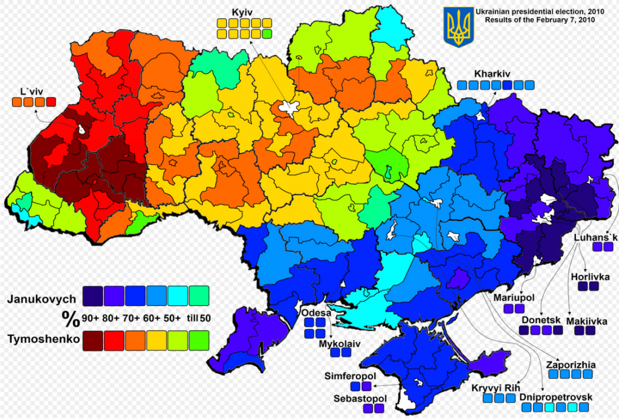
These weapons will be sent to the southeast, in order to conquer the breakaway republics that reject the regime that was forced upon them on February 22nd, in an extremely violent coup against the then-existing President, Viktor Yanukovych, for whom the residents in that area had voted approximately 90%. That rejection of the coup-regime sparked an on-again, off-again, invasion from the Ukrainian armed forces, which can be seen at various sites, such as here and here and here and here.
The official announcement of this ceremony said that the new weapons will “help Ukrainian warriors win and liberate the Ukrainian territories from the occupants.”
The election of President Poroshenko was held only in the areas of Ukraine that accepted the coup-imposed regime. “The occupants” (as the President there referred to them) in the other area did not participate in that election, the election of him, though his Government demands they accept that Government as representing them, nonetheless. After the new regime started dropping bombs on them, and sending tanks in to kill as many of them as fast as possible, their determination not to accept this Government only hardened.
The last Ukrainian Government election in which those people, “the occupants,” were voting, occurred in 2010, at which Viktor Yanukovych won above 80% in some districts, and above 90% in other districts. A map showing the vote in each district of Ukraine, in that election — the last fully national Ukrainian election — can be seen here:
French president supports autonomy for Ukraine’s southeast
Ukraina.ru | December 5, 2014
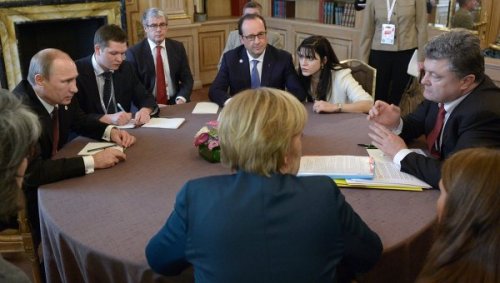
French President Francois Hollande has called for a joint effort by the leaders of France, Russia, Germany and Ukraine to calm the conflict in Ukraine.
“Together with Mr. Putin, Mr. Poroshenko and Ms. Merkel, we should start a process aimed at reducing tensions. It should begin with reducing verbal tensions, followed by concrete actions in Ukraine,” the French president at a news conference following talks with Kazakh President Nursultan Nazarbayev in Astana.
According to Hollande, it is necessary to “focus on the future without forgetting the lessons of the past… The existing tensions and pressure do not contribute to resolving problems,” Hollande said.
He said that Ukraine’s territorial integrity should be preserved, but eastern regions should be granted “a certain level of autonomy.”
In April, the authorities in Kiev launched a military operation in the country’s eastern regions, which refused to accept the results of the February coup.
According to the latest UN estimates, the conflict has claimed the lives of 4,300 civilians and left 10,000 people wounded.
photo © РИА Новости. Алексей Никольский
Ukraine’s Made-in-USA Finance Minister
By Robert Parry | Consortium News | December 5, 2014
Ukraine’s new Finance Minister Natalie Jaresko, a former U.S. State Department officer who was granted Ukrainian citizenship only this week, headed a U.S. government-funded investment project for Ukraine that involved substantial insider dealings, including $1 million-plus fees to a management company that she also controlled.
Jaresco served as president and chief executive officer of Western NIS Enterprise Fund (WNISEF), which was created by the U.S. Agency for International Development (U.S. AID) with $150 million to spur business activity in Ukraine. She also was cofounder and managing partner of Horizon Capital which managed WNISEF’s investments at a rate of 2 to 2.5 percent of committed capital, fees exceeding $1 million in recent years, according to WNISEF’s 2012 annual report.
The growth of that insider dealing at the U.S.-taxpayer-funded WNISEF is further underscored by the number of paragraphs committed to listing the “related party transactions,” i.e., potential conflicts of interest, between an early annual report from 2003 and the one a decade later.
In the 2003 report, the “related party transactions” were summed up in two paragraphs, with the major item a $189,700 payment to a struggling computer management company where WNISEF had an investment.
In the 2012 report, the section on “related party transactions” covered some two pages and included not only the management fees to Jaresko’s Horizon Capital ($1,037,603 in 2011 and $1,023,689 in 2012) but also WNISEF’s co-investments in projects with the Emerging Europe Growth Fund [EEGF], where Jaresko was founding partner and chief executive officer. Jaresko’s Horizon Capital also managed EEGF.
From 2007 to 2011, WNISEF co-invested $4.25 million with EEGF in Kerameya LLC, a Ukrainian brick manufacturer, and WNISEF sold EEGF 15.63 percent of Moldova’s Fincombank for $5 million, the report said. It also listed extensive exchanges of personnel and equipment between WNISEF and Horizon Capital.
Though it’s difficult for an outsider to ascertain the relative merits of these insider deals, they could reflect negatively on Jaresko’s role as Ukraine’s new finance minister given the country’s reputation for corruption and cronyism, a principal argument for the U.S.-backed “regime change” that ousted elected President Viktor Yanukovych last February.
Declining Investments
Based on the data from WNISEF’s 2012 annual report, it also appeared that the U.S. taxpayers had lost about one-third of their investment in WNISEF, with the fund’s balance at $98,074,030, compared to the initial U.S. government grant of $150 million.
Given the collapsing Ukrainian economy since the Feb. 22 coup, the value of the fund is likely to have slipped even further. (Efforts to get more recent data from WNISEF’s and Horizon Capital’s Web sites were impossible Friday because the sites were down.)
Beyond the long list of “related party transactions” in the annual report, there also have been vague allegations of improprieties involving Jaresko from one company insider, her ex-husband, Ihor Figlus. But his whistle-blowing was shut down by a court order issued at Jaresko’s insistence.
John Helmer, a longtime foreign correspondent in Russia, disclosed the outlines of this dispute in an article examining Jaresko’s history as a recipient of U.S. AID’s largesse and how it enabled her to become an investment banker via WNISEF, Horizon Capital and Emerging Europe Growth Fund.
Helmer wrote: “Exactly what happened when Jaresko left the State Department to go into her government-paid business in Ukraine has been spelled out by her ex-husband in papers filed in the Chancery Court of Delaware in 2012 and 2013. …
“Without Figlus and without the US Government, Jaresko would not have had an investment business in Ukraine. The money to finance the business, and their partnership stakes, turns out to have been loaned to Figlus and Jaresko from Washington.”
According to Helmer’s article, Figlus had reviewed company records in 2011 and concluded that some loans were “improper,” but he lacked the money to investigate so he turned to Mark Rachkevych, a reporter for the Kyiv Post, and gave him information to investigate the propriety of the loans.
“When Jaresko realized the beans were spilling, she sent Figlus a reminder that he had signed a non-disclosure agreement” and secured a temporary injunction in Delaware on behalf of Horizon Capital and EEGF to prevent Figlus from further revealing company secrets, Helmer wrote.
“It hasn’t been rare for American spouses to go into the asset management business in the former Soviet Union, and make profits underwritten by the US Government with information supplied from their US Government positions or contacts,” Helmer continued. “It is exceptional for them to fall out over the loot.”
Jaresco, who served in the U.S. Embassy in Kiev after the collapse of the Soviet Union, has said that Western NIS Enterprise Fund was “funded by the U.S. government to invest in small and medium-sized businesses in Ukraine and Moldova – in essence, to ‘kick-start’ the private equity industry in the region.”
While the ultimate success of that U.S.-funded endeavor may still be unknown, it is clear that the U.S. AID money did “kick-start” Jaresco’s career in equity investments and put her on the path that has now taken her to the job of Ukraine’s new finance minister. Ukrainian President Petro Poroshenko cited her experience in these investment fields to explain his unusual decision to bring in an American to run Ukraine’s finances and grant her citizenship.
A Big Investment
The substantial U.S. government sum invested in Jaresco’s WNISEF-based equity fund also sheds new light on how it was possible for Assistant Secretary of State for European Affairs Victoria Nuland to tally up U.S. spending on Ukraine since it became independent in 1991 and reach the astounding figure of “more than $5 billion,” which she announced to a meeting of U.S.-Ukrainian business leaders last December as she was pushing for “regime change” in Kiev.
The figure was so high that it surprised some of Nuland’s State Department colleagues. Several months later – after a U.S.-backed coup had overthrown Yanukovych and pitched Ukraine into a nasty civil war – Under Secretary of State for Public Affairs Richard Stengel cited the $5 billion figure as “ludicrous” Russian disinformation after hearing the number on Russia’s RT network.
Stengel, a former Time magazine editor, didn’t seem to know that the figure had come from a fellow senior State Department official.
Nuland’s “more than $5 billion” figure did seem high, even if one counted the many millions of dollars spent over the past couple of decades by U.S. AID (which puts its contributions to Ukraine at $1.8 billion) and the U.S.-funded National Endowment for Democracy, which has financed hundreds of projects for supporting Ukrainian political activists, media operatives and non-governmental organizations.
But if one looks at the $150 million largesse bestowed on Natalie Jaresco, you can begin to understand the old adage that a hundred million dollars here and a hundred million dollars there soon adds up to real money.
Those payments over more than two decades to various people and entities in Ukraine also constitute a major investment in Ukrainian operatives who are now inclined to do the U.S. government’s bidding.
~
Investigative reporter Robert Parry broke many of the Iran-Contra stories for The Associated Press and Newsweek in the 1980s. You can buy his latest book, America’s Stolen Narrative, either in print here or as an e-book (from Amazon and barnesandnoble.com).
Reckless Congress Declares War on Russia
By Ron Paul | December 4, 2014
Today the US House passed what I consider to be one of the worst pieces of legislation ever. H. Res. 758 was billed as a resolution “strongly condemning the actions of the Russian Federation, under President Vladimir Putin, which has carried out a policy of aggression against neighboring countries aimed at political and economic domination.”
In fact, the bill was 16 pages of war propaganda that should have made even neocons blush, if they were capable of such a thing.
These are the kinds of resolutions I have always watched closely in Congress, as what are billed as “harmless” statements of opinion often lead to sanctions and war. I remember in 1998 arguing strongly against the Iraq Liberation Act because, as I said at the time, I knew it would lead to war. I did not oppose the Act because I was an admirer of Saddam Hussein – just as now I am not an admirer of Putin or any foreign political leader – but rather because I knew then that another war against Iraq would not solve the problems and would probably make things worse. We all know what happened next.
That is why I can hardly believe they are getting away with it again, and this time with even higher stakes: provoking a war with Russia that could result in total destruction!
If anyone thinks I am exaggerating about how bad this resolution really is, let me just offer a few examples from the legislation itself:
The resolution (paragraph 3) accuses Russia of an invasion of Ukraine and condemns Russia’s violation of Ukrainian sovereignty. The statement is offered without any proof of such a thing. Surely with our sophisticated satellites that can read a license plate from space we should have video and pictures of this Russian invasion. None have been offered. As to Russia’s violation of Ukrainian sovereignty, why isn’t it a violation of Ukraine’s sovereignty for the US to participate in the overthrow of that country’s elected government as it did in February? We have all heard the tapes of State Department officials plotting with the US Ambassador in Ukraine to overthrow the government. We heard US Assistant Secretary of State Victoria Nuland bragging that the US spent $5 billion on regime change in Ukraine. Why is that OK?
The resolution (paragraph 11) accuses the people in east Ukraine of holding “fraudulent and illegal elections” in November. Why is it that every time elections do not produce the results desired by the US government they are called “illegal” and “fraudulent”? Aren’t the people of eastern Ukraine allowed self-determination? Isn’t that a basic human right?
The resolution (paragraph 13) demands a withdrawal of Russia forces from Ukraine even though the US government has provided no evidence the Russian army was ever in Ukraine. This paragraph also urges the government in Kiev to resume military operations against the eastern regions seeking independence.
The resolution (paragraph 14) states with certainty that the Malaysia Airlines flight 17 that crashed in Ukraine was brought down by a missile “fired by Russian-backed separatist forces in eastern Ukraine.” This is simply incorrect, as the final report on the investigation of this tragedy will not even be released until next year and the preliminary report did not state that a missile brought down the plane. Neither did the preliminary report – conducted with the participation of all countries involved – assign blame to any side.
Paragraph 16 of the resolution condemns Russia for selling arms to the Assad government in Syria. It does not mention, of course, that those weapons are going to fight ISIS – which we claim is the enemy — while the US weapons supplied to the rebels in Syria have actually found their way into the hands of ISIS!
Paragraph 17 of the resolution condemns Russia for what the US claims are economic sanctions (“coercive economic measures”) against Ukraine. This even though the US has repeatedly hit Russia with economic sanctions and is considering even more!
The resolution (paragraph 22) states that Russia invaded the Republic of Georgia in 2008. This is simply untrue. Even the European Union – no friend of Russia – concluded in its investigation of the events in 2008 that it was Georgia that “started an unjustified war” against Russia not the other way around! How does Congress get away with such blatant falsehoods? Do Members not even bother to read these resolutions before voting?
In paragraph 34 the resolution begins to even become comical, condemning the Russians for what it claims are attacks on computer networks of the United States and “illicitly acquiring information” about the US government. In the aftermath of the Snowden revelations about the level of US spying on the rest of the world, how can the US claim the moral authority to condemn such actions in others?
Chillingly, the resolution singles out Russian state-funded media outlets for attack, claiming that they “distort public opinion.” The US government, of course, spends billions of dollars worldwide to finance and sponsor media outlets including Voice of America and RFE/RL, as well as to subsidize “independent” media in countless counties overseas. How long before alternative information sources like RT are banned in the United States? This legislation brings us closer to that unhappy day when the government decides the kind of programming we can and cannot consume – and calls such a violation “freedom.”
The resolution gives the green light (paragraph 45) to Ukrainian President Poroshenko to re-start his military assault on the independence-seeking eastern provinces, urging the “disarming of separatist and paramilitary forces in eastern Ukraine.” Such a move will mean many more thousands of dead civilians.
To that end, the resolution directly involves the US government in the conflict by calling on the US president to “provide the government of Ukraine with lethal and non-lethal defense articles, services, and training required to effectively defend its territory and sovereignty.” This means US weapons in the hands of US-trained military forces engaged in a hot war on the border with Russia. Does that sound at all like a good idea?
There are too many more ridiculous and horrific statements in this legislation to completely discuss. Probably the single most troubling part of this resolution, however, is the statement that “military intervention” by the Russian Federation in Ukraine “poses a threat to international peace and security.” Such terminology is not an accident: this phrase is the poison pill planted in this legislation from which future, more aggressive resolutions will follow. After all, if we accept that Russia is posing a “threat” to international peace how can such a thing be ignored? These are the slippery slopes that lead to war.
This dangerous legislation passed today, December 4, with only ten (!) votes against! Only ten legislators are concerned over the use of blatant propaganda and falsehoods to push such reckless saber-rattling toward Russia.
Here are the Members who voted “NO” on this legislation. If you do not see your own Representative on this list call and ask why they are voting to bring us closer to war with Russia! If you do see your Representative on the below list, call and thank him or her for standing up to the warmongers.
Voting “NO” on H. Res. 758:
1) Justin Amash (R-MI)
2) John Duncan (R-TN)
3) Alan Grayson, (D-FL)
4) Alcee Hastings (D-FL)
5) Walter Jones (R-NC)
6) Thomas Massie (R-KY)
7) Jim McDermott (D-WA)
8 George Miller (D-CA)
9) Beto O’Rourke (D-TX)
10 Dana Rohrabacher (R-CA)
Neocons Triumphant in Washington and Geneva
It’s either 1938 or 2001 again
By Philip Giraldi • Unz Review • December 2, 2014
The forced resignation of Chuck Hagel as Secretary of Defense and the continued prorogation of talks with Iran in Geneva might not seem to be connected but they are both major triumphs for the confrontational neoconservative foreign policy that continues to prevail in Washington in spite of repeated failures overseas. And, of course, they are both at least in part about Israel. Israeli Prime Minister Benjamin Netanyahu expressed his delight at learning that the negotiations with Iran have again failed to produce an agreement. It also pleased Senator John McCain who then called for “increased sanctions and requirement that any final deal between Iran and the United States be sent to Congress for approval.” Per McCain, only the legislature can provide the necessary wisdom to avoid a bad deal with the Mullahs.
Hagel’s resignation is being packaged as response to excessive micromanaging from President Barack Obama’s White House regarding appropriate measures to be taken to “destroy” ISIS, deal with Syria and aid Iraq. In truth, Chuck Hagel was reflecting informed opinion among the Pentagon’s top ranking military personnel in confronting National Security Adviser Susan Rice over the chaotic and constantly shifting series of responses to a growing Middle Eastern crisis. Generals and Admirals may be pompous self-serving asses but they are not stupid.
Unlike Hagel, Obama’s inner circle national security team consisting of Samantha Power, Susan Rice and Valerie Jarrett are all cut from the same cloth as the president. They are academics who come from privileged backgrounds and have, as the expression goes, no skin in the game. Their children will not be dying in some hell hole and for them it is a self-serving complete abstraction to use American power to “fix things” and undertake “humanitarian interventions” overseas.
Chuck Hagel by contrast experienced Vietnam as a grunt and saw considerable combat, for which he was decorated. Even though he has most often gone along to get along while a Senator and even more so as Secretary of Defense, his life experience has nevertheless made him reluctant to view war as a first option and he was widely seen as a peace candidate when he briefly considered a presidential run in 2008. There were high hopes that when he joined the Obama team he would serve as a voice for reason and moderation.
Hagel is also partly a victim of Israel first policies. He was guilty of a mortal sin by saying when he was a Senator that “the Jewish lobby intimidates a lot of people on Capitol Hill” and “I’m not an Israeli senator. I’m a United States senator.” Since that transgression he has never been trusted by the Lobby, which was unsuccessful in blocking his nomination after pulling out all the stops during his confirmation hearings two years ago. As the approval of Hagel by the Senate was at that time widely viewed as a major defeat for the American Israel Public Affairs Committee (AIPAC), Robert Cohen, its current president, is probably smiling as he observes smugly that revenge is a dish best eaten cold.
So now Hagel is going, going gone, likely to be replaced by someone with whom both the neocons and the liberal interventionists will be more comfortable. That will almost certainly be an accommodating personality willing to uncritically join what Colonel Pat Lang has rightly described as the White House’s “children’s crusade.”
The fall of Hagel combined with the probability of a Congressionally-driven new, harder line from Obama sits well with some constituencies. Bill Kristol of the Weekly Standard puts it succinctly from his viewpoint of what is important, “America has the misfortune to have an anti-Israel president for two more years. America has the good fortune to have a pro-Israel Congress for that same period of time. It should be a priority for that Congress, through speech and deed, to signal unequivocally to Israel and its enemies that terror and pressure against Israel will not succeed, and that America stands with Israel in our common fight against terror and barbarism.”
The incoming Republican majority also appears to be wonderful news for the Zionist Organization of America (ZOA), which held its annual bash in New York City on November 23rd. Senator Ted Cruz of Texas was the featured speaker, asserting that “threats to Israel have never been greater” while basking in repeated chants from the attendees of “Go Ted Go!” ZOA President Mort Klein labeled Hamas as a “Nazi like terrorist group whose charter calls for the murder of every Jew” before taking several jabs at Obama, describing the American president as “A Chamberlain in the White House.” Neville, that is. For Klein and other neocons it is always 1938 and we are always in Munich. Pastor John Hagee of Christians United for Israel went one better, calling Obama the “most anti-Semitic president ever.”
And then there is Iran, whose alleged “interference” in Iraq apparently thwarted American plans to turn Baghdad into Stockholm. It is also reliably the perpetual “threat” used to justify any and all of Israel’s misbehavior. Given the gathering storm being summoned up by Israel’s friends, the Obama administration would have been well served by closing the deal with Tehran, but it failed to do so. The prolonging of the timetable for the talks in Geneva is not necessarily a death sentence, but it does give both time and the organizational advantage to Congress, which, with its new Republican majority, will almost certainly move to block or torpedo any agreement. If the friends of Israel can muster up the 67 Senate votes needed to be veto proof they will undoubtedly punish Iran yet again with sanctions, a move that will undoubtedly end any chance for a compromise. And even though the Republicans do not themselves control all the needed votes there are plenty of Democrats who love Israel inordinately and will likely vote with the GOP. Senator Elizabeth Warren, reliably progressive except when it comes to Palestine, has just had her first meeting with Netanyahu, an important ticket punch on her career trajectory if she wants to become president. She is not alone in doing her obeisance but will have to out-Israel Hillary Clinton, something that may not be possible.
But at the end of the day, the greatest neocon triumph is its continued grip over policy with Russia, which is the sole power in the world that can attack and destroy much of the United States. The confrontation with Moscow makes no sense as the only United States vital interest at stake is to maintain a good working relationship, but the tension continues to mount. State Department Assistant Secretary for European and Eurasian Affairs Victoria Nuland, who was the enabler of the Ukraine crisis earlier this year, recently showed up in Riga Latvia where she pledged that American soldiers and their European counterparts are “ready to give our lives for the security of these countries.” She was referring to the Baltic States, raising the rather serious question whether or not Americans should be prepared to die for Estonia, Latvia and Lithuania.
Nuland’s allusion to giving “our lives” should surely be regarded as poetic license on her part as the only way a neocon could possibly die tragically would be if he or she were to choke on a piece of foie gras. She surely understands but chooses to ignore the fact that Latvia is only part of NATO due to the unwise expansion of what was originally a defensive alliance after the fall of the Soviet Union. The expansion was itself a violation of the understanding between Moscow and Washington that the West would not take advantage of the situation to extend its sphere of influence into Eastern Europe. Latvia’s defense is in no way important to the security of the United States unlike the actual threat posed by the Warsaw Pact up until 1991. Indeed, Latvia was part of the Warsaw Pact back then. Protecting Latvia as a policy is all too reminiscent of the lead ups to both the first and second World Wars. In 1914, a series of mutual defense agreements led to armed confrontation after an Austrian Archduke was assassinated by a Serbian nationalist. In 1939, Britain and France were drawn into a war with Germany after giving security guarantees to Poland even though they had no critical interests at stake. Sixteen million died in 1914-8 followed by an additional 60 million in 1939-45.
That the White House has fired a voice for restraint and moderation at the Pentagon is perhaps inevitable. That it is simultaneously increasing its combatant role in an unwinnable confrontation in Iraq and Syria which it helped create, is again taking on the Taliban in Afghanistan, has backed away from cutting a deal with Iran that would have eased tensions in a key part of the world, and is needlessly provoking Moscow for reasons that must be inscrutable to any observer is a bit difficult to grasp. And, of course, the package includes standing beside Israel right or wrong. But that is what being a neocon is all about, apart from never having to say you’re sorry. Or wrong. We’ve got that fine expensive military just sitting around and by God we are going to use it. And someday the whole world will look and behave just like Peoria.
American, Georgian & Lithuanian get key jobs in Ukraine’s new government
RT | December 2, 2014
Natives of the US, Georgia and Lithuania were hastily granted Ukrainian citizenship in order to become key ministers in the new government of Ukraine, which was approved by the country’s parliament on Tuesday.
President Poroshenko has also announced he will sign a decree to grant citizenship to foreigners fighting on Kiev’s side in the east of the country.
Natalie Jaresko of the US, who currently heads the Kiev-based Horizon Capital investment fund, will take reigns at the Ukrainian Finance Ministry.
In 1992-1995, Jaresko served as the first Chief of the Economic Section of the US Embassy in Ukraine.
Before that she occupied several economic positions in the US State Department, according to Horizon Capital’s website.
The position of health minister went to Aleksandr Kvitashvili, who occupied a similar post in the Georgian government in 2009-2012.
“Ukraine spends 8 per cent of its GDP on healthcare, but half of this money is being plundered. Aleksandr Kvitashvili must implement radical reforms as he has no ties with the Ukrainian pharmaceutical mafia,” Ukrainian PM, Arseny Yatsenuk, said as he presented the new minister to the deputies.

Alexander Kvitashvili, a candidate for head of the Ukrainian health ministry, at a session of Verkhovna Rada in Kiev (RIA Novosti / Mikhail Polinchak)
Lithuanian Aivaras Abromavicius has been approved as the economy minister by the new parliament, the Verkhovna Rada.
Abromavicius, who is a partner at the $3.6 billion-worth East Capital asset management group, conducts his operations from Kiev after marrying a Ukrainian.
“There’s hard work ahead of us because Ukraine is a very poor and corrupt country and we’ll have to use radical measures,” he told MPs from the Rada Tribune.
288 out of 450 deputies supported the cabinet proposed by Ukrainian president Petro Poroshenko, with the new ministers sworn in right after the vote.
“I congratulate the Ukrainians with the formation of the pro-European government,” Poroshenko wrote on his Twitter page.
He told the Rada that he views the foreigners as some kind of anti-crisis management need due to the difficult situation in economy, the fighting in Donbas, the necessity of radical reforms and large-scale corruption.
Earlier on the Tuesday, the president has signed special a decree granting Ukrainian citizenship to Jaresko, Kvitashvili and Abromavicius.

Aivars Abramovicus (Aivaras Abromavicius), a candidate for head of the Ukrainian economy ministry, at a session of Verkhovna Rada in Kiev (RIA Novosti / Mikhail Polinchak)
Dual nationality is forbidden in Ukraine and the trio has already written applications to give up the citizenship of foreign states, Yury Lutsenko, the head of the Petro Poroshenko Block (PPB), said.
Poroshenko said that there’ll be even more foreigners on administrative positions in Ukraine as the country “must attract the best international experience, which includes assigning positions in the government to representative of states friendly to Ukraine.”
Also on Tuesday, the MPs from Poroshenko’s ruling bloc have registered a draft law in the Rada on amending the Ukrainian legislation for it to allow citizens of other states in the government.
It had been announced by Poroshenko a week ago. This move has been dubbed “unprecedented” and attracted criticism from experts with some calling it “allegiance to the so-called European choice,” and others expressing concern that it can be a sign of Ukraine losing its sovereignty.
Poroshenko also promised to grant the citizenship of Ukraine to all foreigners fighting for Kiev against the militias in the country’s eastern Donetsk and Lugansk regions.
“I’m going to sign a decree conferring Ukrainian citizenship to those, who defended Ukraine with arms in their hands,” he wrote on Twitter.
However, not everybody in the parliament supported the inclusion of foreigners into the Ukrainian government.
Earlier, the MP from the Opposition Block said Aleksandr Vilkul suggested that by inviting people from abroad the Ukrainian authorities are trying to absolve themselves of responsibility for the state of things in the country.
Vilkul colleague, Yury Boyko, said he can’t understand how it wasn’t possible to find 10 candidates for the cabinet among Ukraine’s 40-million population.
What the Fake Syria Sniper Boy Video Tells Us About Media Experts

By Maram Susli | New Eastern Outlook | November 27, 2014
Many mainstream media websites helped a fake video go viral this month. The video showing a young Syrian boy running through sniper fire to save a little girl, was exposed as a fake when the Norwegian producer Lars Klevberg made the fact public. One of the stated aims of the Norwegian film makers was to “see how the media would respond to a fake video.” This article examines how that experiment went.
The western press very quickly accepted the video as real and used it to support the US administration’s narrative on Syria. Many top US news sources began to spread the story. Even though the producer said he explicitly added big hints that the video was fake, like the children surviving multiple gun shots.
Propagating false stories on Syria, is nothing new for the western press. In the lead up to the conflict many stories were exposed as frauds, such as the Anti-government activist “Gay Girl in Damascus” which turned out to be a middle-aged American man in Scotland. Syrian Danny Abdul Dayem which was frequently interviewed by CNN was using fake gun fire and flames in his interviews.
The fake sniper video wasn’t enough to support US government narratives by itself, as the now deleted original upload didn’t suggest the identity of the snipers. So the west’s media suggested that it was Syrian military snipers that were targeting the children without any evidence. Journalists failed to mention how they reached the conclusion that an actor in Malta was shot by the Syrian military. It may be that the western press is quick to trust pro-rebel sources, as the video was uploaded by the pro-rebel Sham Times along with their own twist.
The Guardian’s headline for the video was “Syrian boy ‘saves girl from army sniper’” and the Telegraph delicately suggested the Syrian military was responsible for the fake bullets. The International Business Times stated, “the snipers, who reportedly are said to be the government forces loyal to Syrian President Bashar al-Assad.” IB Times never explicitly mentioned who reported this information. They then took it a step further and concluded the article with “the incident certainly is not the first time that Pro-Assad gunmen have targeted children”. Well it is at least not the first time the mainstream media has presented false reports as fact. In 2012, CNN claimed a bullet that killed a four year old girl in Aleppo was shot by government snipers even whilst admitting the bullet came from rebel held buildings.
Other journalists took to Twitter to make unfounded claims about army snipers targeting the boy. Vinnie O’Dowd who has done work for Channel 4 and Al Jazeera tweeted “Syrian Regime Targets kids”. Liz Sly of the Washington Post tweeted incredulously that “Soldiers kept shooting” at children.
These tweets were inline with an official State Department Twitter account @ThinkAgain_DOS which blamed Assad for the fictitious bullets in the film. This casts doubt on how deeply the US administration scrutinizes information it bases it’s policy on. In 2013 they relied heavily on video footage provided by rebels to support its planned attack on Syria in the wake the Ghouta chemical attack.
Scrutinising the Scrutinisers (Experts)
 But it isn’t just the mainstream media that was easily duped by the convenient propaganda film. The video experts that were asked to scrutinise the video, failed to recognise that the video was a fraud. The Telegraph stated that upon enquiry “experts told them they had no reason to doubt that the video is real”. International Business Times went a step further spinning the statement to “experts told The Telegraph that they have no doubts on the authenticity of the footage.”
This is very strange since both children in the film walk away after being directly and repeatedly hit by bullets. The creators of the film said he purposely scripted this as a big hint that the video is fake. The lack of scrutiny the media experts employed suggests incompetence or the same level of bias as the media that employs them.
Heather Saul of the Independent wrote that one of the ‘Middle East experts” she showed the video to was from Human Rights Watch. Indeed, Human Rights Watch European Media Director Andrew Stroehlein, showed no doubt on the authenticity of the film when he tweeted it out to his followers. The New York based human rights organisation is not new at tweeting false information, last month they used an image of the Odessa fire, where US-backed militia’s burned thirty two people to death, as an example of ‘Putin’s repressive policies’. In 2008 Venezuela expelled two HRW staff members accused of “anti-state activities” after producing a report against the Chavez government. Guardian journalist Hugh O’Shaughnessy accused HRW of using false and misleading information in the report, as well as pro-Washington bias. In 2009 HRW received financial donations from the Saudi government which may, in part, explain the anti-Syrian slant.
 HRW employed so called video expert Eliot Higgins and his colleague Daniel Kaszeta to investigate the August 21 chemical attack in Ghouta, and quickly reached the conclusion the Syrian government was behind the attack. Daniel Kaszeta was referred to as a fraud by prominent physicist and MIT Professor Theodore Postol. HRW’s CEO Kenneth Roth recently used a report by Eliot Higgins to make unfounded claims about Ukrainian rebels shooting down Malaysian flight MH17. Heather Saul did not respond to questions on whether Eliot Higgins was one of the expert she asked for advice. However the mainstream media’s most often quoted video expert, did not recognise that the video was a fraud, tweeting cautiously that he wasn’t sure if it was authentic but gave the video a reaction non the less.
However many viewers who aren’t referred to as video or Middle East experts, immediately recognised the video was a fraud and flooded social media sites Twitter and Youtube with doubts on its authenticity. If Heather Saul had used these individuals as experts rather than HRW, she would have reached the correct conclusion about the video. But perhaps it is this unbiased eye that the mainstream media avoids. The vast majority of Higgin’s conclusions support US government narratives and agendas, and that’s the kind of bias the mainstream media prefers.
Blaming the Producer
Instead of humbly accepting blame for spreading disinformation, many western journalists and their experts reacted by blaming the producer of the film. The collective rage of the entire mainstream media forced the film’s producer to delete any trace of this 30,000 dollar experiment. Some journalists took to Twitter to express their rage at being exposed as easily duped by convenient propaganda.
The experts that were fooled by the video also strongly protested. HRW posted a complaint that the fake video “eroded the public trust in war reporting”, in other words blind trust in HRW analysis and war propaganda. Eliot Higgins posted an open letter to the producer of the film on his website Bellingcat, condemning the film.
GlobalPost referred to the film as ‘irresponsible and dangerous’ but not because it could be used to promote wars and make false accusations. What the real danger to the mainstream media and their experts seems to be, is that as a result of the film’s exposure as a fraud, future video claims may now have to be properly scrutinized and the public may not be so unquestioning in future. However it is the journalists’ lack of scrutiny that is truly what is irresponsible and dangerous. Had the director not admitted the film was fake, these journalists more than likely would have kept promoting the story as an example of Syrian Army war crimes.
Maram Susli also known as “Syrian Girl,” is an activist-journalist and social commentator covering Syria and the wider topic of geopolitics.
EU chief calls for decentralization and federalization of Ukraine
RT | November 27, 2014
To solve the current crisis in Ukraine, the country should become decentralized and federalized, Herman Van Rompuy, the president of the European Council, announced in his political anniversary speech in Paris this week.
Quoting “1,000 deaths” in the country since the cease-fire agreement was reached in Minsk on September 5, Van Rompuy said he could no longer call the situation a cease-fire. And a new cessation of conflict, if controlled by the same players, would have the identical outcome, the politician said in his speech, marking his five years presidency of the European Council.
Urging a “global solution,” the EU chief said a way for Ukraine to become a “decentralized (or federalized) country” must be found. He called for the country’s closer ties with the EU. However, he also said, “Europe has become unpopular among Europeans” in the past five to six years.
Kiev should “establish a correct relationship with Russia, its neighbor, with which it shares history, culture and language,” Van Rompuy said, adding that the interests of minorities in Ukraine should be respected.
Sharing his EU “experiences and perspectives” with students at the Sciences Po institute of political studies in Paris, he pointed out that the current crisis in Ukraine is “the most grave geopolitical crisis we’ve experienced in Europe since the end of the Cold war.” What makes it even worse, according to the Rompuy, is the fact that the “war” is happening on European soil.
Van Rompuy is not the first European politician to suggest Ukraine’s federalization. Earlier in August, Germany’s Vice Chancellor Sigmar Gabriel, who is also the country’s economy minister, spoke out for federalization to be introduced in Ukraine once the conflict in the east of the country is resolved.
The same measures to help settle the crisis in eastern Ukraine have been voiced by Moscow. However, Ukraine’s President Petro Poroshenko keeps ruling out such political changes, saying the country’s federalization is out of question.
All-Out War in Ukraine: NATO’s ‘Final Offensive’
By James Petras :: 11.20.2014
Introduction
There are clear signs that a major war is about to break out in Ukraine: A war actively promoted by the NATO regimes and supported by their allies and clients in Asia (Japan) and the Middle East (Saudi Arabia).
The war over Ukraine will essentially run along the lines of a full-scale military offensive against the southeast Donbas region, targeting the breakaway ethnic Ukraine- Russian Peoples Republic of Donetsk and Lugansk, with the intention of deposing the democratically elected government, disarming the popular militias, killing the guerrilla resistance partisans and their mass base, dismantling the popular representative organizations and engaging in ethnic cleansing of millions of bilingual Ukraino-Russian citizens. NATO’s forthcoming military seizure of the Donbas region is a continuation and extension of its original violent putsch in Kiev, which overthrew an elected Ukrainian government in February 2014.
The Kiev junta and its newly ‘elected’ client rulers, and its NATO sponsors are intent on a major purge to consolidate the puppet Poroshenko’s dictatorial rule. The recent NATO-sponsored elections excluded several major political parties that had traditionally supported the country’s large ethnic minority populations, and was boycotted in the Donbas region. This sham election in Kiev set the tone for NATO’s next move toward converting Ukraine into one gigantic US multi-purpose military base aimed at the Russian heartland and into a neo-colony for German capital, supplying Berlin with grain and raw materials while serving as a captive market for German manufactured goods.
An intensifying war fever is sweeping the West; the consequences of this madness appear graver by the hour.
War Signs: The Propaganda and Sanctions Campaign, the G20 Summit and the Military Build Up
The official drum- beat for a widening conflict in Ukraine, spearheaded by the Kiev junta and its fascist militias, echoes in every Western mass media outlet, every day. Major mass media propaganda mills and government ‘spokesmen and women’ publish or announce new trumped-up accounts of growing Russian military threats to its neighbors and cross-border invasions into Ukraine. New Russian incursions are ‘reported’ from the Nordic borders and Baltic states to the Caucusus. The Swedish regime creates a new level of hysteria over a mysterious “Russian” submarine off the coast of Stockholm, which it never identifies or locates – let alone confirms the ‘sighting’ of. Estonia and Latvia claim Russian warplanes violated their air space without confirmation. Poland expels Russian “spies” without proof or witnesses. Provocative full-scale joint NATO-client state military exercises are taking place along Russia’s frontiers in the Baltic States, Poland, Romania and Ukraine.
NATO is sending vast arms shipments to the Kiev junta, along with “Special Forces” advisers and counter-insurgency experts in anticipation of a full-scale attack against the rebels in the Donbas.
The Kiev regime has never abided by the Minsk cease fire. According to the UN Human Rights office 13 people on average –mostly civilians –have been killed each day since the September cease fire. In eight weeks, the UN reports that 957 people have been killed –overwhelmingly by Kiev’s armed forces.
The Kiev regime, in turn, has cut all basic social and public services to the Peoples’ Republics’, including electricity, fuel, civil service salaries, pensions, medical supplies, salaries for teachers and medical workers, municipal workers wages; banking and transport have been blockaded.
The strategy is to further strangle the economy, destroy the infrastructure, force an even greater mass exodus of destitute refugees from the densely populated cities across the border into Russia and then to launch massive air, missile, artillery and ground assaults on urban centers as well as rebel bases.
The Kiev junta has launched an all-out military mobilization in the Western regions, accompanied by rabid anti-Russian, anti-Eastern Orthodox indoctrination campaigns designed to attract the most violent far right chauvinist thugs and to incorporate the Nazi-style military brigades into the frontline shock troops. The cynical use of irregular fascist militias will ‘free’ NATO and Germany from any responsibility for the inevitable terror and atrocities in their campaign. This system of ‘plausible deniability’ mirrors the tactics of the German Nazis whose hordes of fascist Ukrainians and Ustashi Croats were notorious in their epoch of ethnic cleansing.
G20-plus-NATO: Support of the Kiev Blitz
To isolate and weaken resistance in the Donbas and guarantee the victory of the impending Kiev blitz, the EU and the US are intensifying their economic, military and diplomatic pressure on Russia to abandon the nascent peoples’ democracy in the south-east region of Ukraine, their principle ally.
Each and every escalation of economic sanctions against Russia is designed to weaken the capacity of the Donbas resistance fighters to defend their homes, towns and cities. Each and every Russian shipment of essential medical supplies and food to the besieged population evokes a new and more hysterical outburst – because it counters the Kiev-NATO strategy of starving the partisans and their mass base into submission or provoking their flight to safety across the Russian border.
After suffering a series of defeats, the Kiev regime and its NATO strategists decided to sign a ‘peace protocol’, the so-called Minsk agreement, to halt the advance of the Donbas resistance into the southern regions and to protect Kiev’s soldiers and militias holed-up in isolated pockets in the East. The Minsk agreement was designed to allow the Kiev junta to build up its military, re-organize its command and incorporate the disparate Nazi militias into its overall military forces in preparation for a ‘final offensive’. Kiev’s military build-up on the inside and NATO’s escalation of sanctions against Russia on the outside would be two sides of the same strategy: the success of a frontal attack on the democratic resistance of the Donbas basin depends on minimizing Russian military support through international sanctions.
NATO’s virulent hostility to Russian President Putin was on full display at the G20 meeting in Australia: NATO-linked presidents and prime ministers, especially Merkel, Obama, Cameron, Abbott, and Harper’s political threats and overt personal insults paralleled Kiev’s growing starvation blockade of the besieged rebels and population centers in the south-east. Both the G20’s economic threats against Russia and the diplomatic isolation of Putin and Kiev’s economic blockade are preludes to NATO’s Final Solution – the physical annihilation of all vestiges of Donbas resistance, popular democracy and cultural-economic ties with Russia.
Kiev depends on its NATO mentors to impose a new round of severe sanctions against Russia, especially if its planned invasion encounters a well armed and robust mass resistance bolstered by Russian support. NATO is counting on Kiev’s restored and newly supplied military capacity to effectively destroy the southeast centers of resistance.
NATO has decided on an ‘all-or-nothing campaign’: to seize all of Ukraine or, failing that, destroy the restive southeast, obliterate its population and productive capacity and engage in an all-out economic (and possibly shooting) war with Russia. Chancellor Angela Merkel is on board with this plan despite the complaints of German industrialists over their huge loss of export sales to Russia. President Hollande of France has signed on dismissing the complaints of trade unionists over the loss of thousands French jobs in the shipyards. Prime Minister David Cameron is eager for an economic war against Moscow, suggesting the bankers of the City of London find new channels to launder the illicit earnings of Russian oligarchs.
The Russian Response
Russian diplomats are desperate to find a compromise, which allows Ukraine’s ethnic Ukraine- Russian population in the southeast to retain some autonomy under a federation plan and regain influence within the ‘new’ post-putsch Ukraine. Russian military strategists have provided logistical and military aid to the resistance in order to avoid a repeat of the Odessa massacre of ethnic Russians by Ukrainian fascists on a massive scale. Above all, Russia cannot afford to have NATO-Nazi-Kiev military bases along its southern ‘underbelly’, imposing a blockade of the Crimea and forcing a mass exodus of ethnic Russians from the Donbas. Under Putin, the Russian government has tried to propose compromises allowing Western economic supremacy over Ukraine but without NATO military expansion and absorption by Kiev.
That policy of conciliation has repeatedly failed.
The democratically elected ‘compromise regime’ in Kiev was overthrown in February 2014 in a violent putsch, which installed a pro-NATO junta.
Kiev violated the Minsk agreement with impunity and encouragement from the NATO powers and Germany.
The recent G20 meeting in Australia featured a rabble-rousing chorus against President Putin. The crucial four-hour private meeting between Putin and Merkel turned into a fiasco when Germany parroted the NATO chorus.
Putin finally responded by expanding Russia’s air and ground troop preparedness along its borders while accelerating Moscow’s economic pivot to Asia.
Most important, President Putin has announced that Russia cannot stand by and allow the massacre of a whole people in the Donbas region.
Is Poroshenko’s forthcoming blitz against the people of southeast Ukraine designed to provoke a Russian response – to the humanitarian crisis? Will Russia confront the NATO-directed Kiev offensive and risk a total break with the West?
James Petras latest book is THE POLITICS OF IMPERIALISM:THE US,ISRAEL AND THE MIDDLE EAST (CLARITY PRESS:ATLANTA)
Dutch government refuses to reveal ‘secret deal’ into MH17 crash probe
RT | November 20, 2014
The Dutch government has refused to reveal details of a secret pact between members of the Joint Investigation Team examining the downed Flight MH17. If the participants, including Ukraine, don’t want information to be released, it will be kept secret.
The respected Dutch publication Elsevier made a request to the Dutch Ministry of Security and Justice under the Freedom of Information Act to disclose the Joint Investigation Team (JIT) agreement, along with 16 other documents. The JIT consists of four countries – the Netherlands, Belgium, Australia and Ukraine – who are carrying out an investigation into the MH17 disaster, but not Malaysia. Malaysian Airlines, who operated the flight, has been criticized for flying through a war zone.
Part of the agreement between the four countries and the Dutch Public Prosecution Service, ensures that all these parties have the right to secrecy. This means that if any of the countries involved believe that some of the evidence may be damaging to them, they have the right to keep this secret.
“Of course [it is] an incredible situation: how can Ukraine, one of the two suspected parties, ever be offered such an agreement?” Dutch citizen Jan Fluitketel wrote in the newspaper Malaysia Today.
Despite the air crash taking place on July 17 in Eastern Ukraine, very little information has been released about any potential causes. However, rather than give the public a little insight into the investigation, the Dutch Ministry of Security and Justice is more worried about saving face among the members of the investigation.
“I believe that this interest [international relations] is of greater importance than making the information public, as it is a unique investigation into an extremely serious event,” the Ministry added, according to Elsevier.
Other reasons given for the request being denied included protecting investigation techniques and tactics as well as naming the names of officials who are taking part in the investigation. The Ministry said it would be a breach of privacy if they were revealed. “If the information was to be released then sensitive information would be passed between states and organizations, which would perhaps they would be less likely to share such information in the future,” said the Ministry of Security and Justice.
Dutch MP Pieter Omtzigt, who is a member of the Christian Democratic Party, has made several requests for the information to be released to the public. “We just do not know if the Netherlands has compromised justice,” he said in reaction to the ministry’s decision. The MP was surprised that this agreement was even signed, never mind kept secret.
Malaysia is the only country to have directly negotiated with the anti-Kiev militias in the East of Ukraine, while the country’s Ambassador to the Netherlands said he was unhappy that Malaysia had not been included within the JIT. Dutch Prime Minister Mark Rutte flew to Kuala Lumpur on November 5, but Malaysia says it still did not receive an invitation to join.
“We must first be included in the JIT, otherwise it would be hard for us to cooperate in the investigation. The parties inside the investigation must include us in the team, right now we are just a participant,” said the Malaysian Inspector-General of Police Khalid Abu Bakar in Kuala Lumpur on Wednesday, which was reported by the New Straits Times.
A preliminary report by the Dutch Safety Board, which was released September said the MH17 crash was a result of structural damage caused by a large number of high-energy objects that struck the Boeing from the outside.
Dutch investigators added that “there are no indications” that the tragedy was triggered “by a technical fault or by actions of the crew.”
Featured Video
No Vote, No Representation, No State: Democracy, Israeli Style
or go to
Aletho News Archives – Video-Images
From the Archives
Sanctions, War and the Policy of Dual Containment
By SASAN FAYAZMANESH | March 17, 2008
It is now nearly three decades since the Unites States adopted the policy of dual containment of Iran and Iraq. While much has been written about the containment of Iraq, there has been very little in-depth analysis of this policy when it comes to Iran. In a book that is going to be released on March 31, 2008, entitled The United States and Iran: Sanctions, Wars and the Policy of Dual Containment (Routledge), I attempt to address this shortcoming by investigating when and why the US policy of containment of Iran came about, how it evolved, and where it stands today.[1] To the extent that Israel has been involved in US policy making, the study will also include the role that Israel has played in the containment of Iran. Also, since the fate of Iran has been inextricably linked to that of Iraq, occasionally the investigation will overlap with the containment of Iraq.
The policy of dual containment of Iran and Iraq originated during the Carter Administration, but it was not until the Clinton Administration that the expression “dual containment” became popular. … continue
Blog Roll
 Aletho News
- No Vote, No Representation, No State: Democracy, Israeli Style
- Zionist Bought Senate Blocks Information About American Citizens Killed By Israel
- While Gaza dominates the UN, these are the people keeping it alive
- New Report: “Scholasticide and Genocide in Gaza: Assessment, Testimonies and Legal Analysis”
- ‘THAAD Delusion’: Iran war exposes US missile shield limits – The Atlantic
- Moscow issues warning to NATO over Russian exclave
- Yes, the Iran war has destroyed Trump’s presidency
- The fallacy of US delusions about Iran’s economic collapse
- Hezbollah denies Syria cell link, warns of Israeli plan to sow discord
- The legacy of US sanctions, war, and occupation in Iraq
- If Americans Knew
- Mamdani releases plan to combat antisemitism and hate crimes in New York City
- Iran’s Revolutionary Guards Publish Letter to the American People
- DMFI launches $1 million ad campaign supporting Virginia’s Elaine Luria
- US Senate blocks resolution seeking report on Americans killed by Israel
- Israeli Attacks Kill Ten Palestinians in Gaza
- Massacre at Minab: The School That Became a Grave
- Israeli media: The IDF Shows It Doesn’t Turn a Blind Eye; It Actively Emboldens Settler Havoc
- As settlers ravage West Bank, Israeli forces kill 10 in Gaza – Daily Update
- New Report: “Scholasticide and Genocide in Gaza: Assessment, Testimonies and Legal Analysis”
- Ex-Biden officials are desperate for a Gaza scapegoat
- No Tricks Zone
- Green Energy Debacle: German Expert Professor Fritz Vahrenholt Warns Of Severe Economic And Social Consequences
- Two More Paleo Reconstructions Affirm Meters-Higher Sea Levels Across Ireland, Brazil 7000-6000 Years Ago
- New Study: Earth And Venus Surface Warmth Largely Explained By Convection And Lapse Rate, Not CO2 Or Radiation
- 2025 Nature Paper Claiming Worsening Global Drought Gets RETRACTED …Heavily Flawed
- New Study: ‘Global Drought Shows No Detectable Recent Acceleration Under Climate Warming’
- Economic Masterminds: German Socialists Suggest Taxing Productivity Gains Stemming From Using AI
- The South China Sea Has Not Been Cooperating With The Climate Change Narrative
- Energy Crisis: Germany Enters Heating Season With Historically Low Gas Reserve Fill Levels
- New Study: The Antarctic Ice Sheet Gained Mass From 2020-2024 Due To Staggering Snow And Ice Accumulation
- Study: Ocean Heating Rates From Thousands Of Years Ago ‘Dwarf’ Modern Ocean Heating Rates

