Israel to Admit 6,000 Ukrainian Jewish Refugees
ALRAY | November 17, 2014
The Israeli government plans to provide shelter to 6,000 Jews who were internally displaced by the conflict in Ukraine, Israeli newspaper Maariv reported on Sunday.
The Israeli plan comes in light of the domestic infighting taking place in Ukraine, which is leading to the displacement of hundreds of the country’s Jews, according to Maariv.
Israeli authorities have secretly begun the construction of refugee camps to receive displaced Ukrainian Jews under the supervision of Israeli Minister of Economy Naftali Bennett, said the newspaper.
Maariv, however, did not specify the location of these camps.
The newspaper noted that about 6,000 Jews are currently homeless in eastern Ukraine, and that Israeli authorities paid to ensure their settlement in temporary camps before they’re transferred to Israel.
It was not possible to get official comment from the Israel authorities regarding the report.
Last month, a source close to the project told Israeli newspaper The Jerusalem Post that considerable resources have been allocated to provide Ukraine’s Jews who have been affected by the fighting there with food, clothing and shelter.
I’m confused, can anyone help me? Part Three
RT | November 18, 2014
I’m confused. The first thing I’m confused about is democratic legitimacy after elections are held in war-torn countries.
Western leaders have hailed the recent parliamentary elections in Ukraine, as a great triumph of “democracy.”
Barack Obama said it was “an important milestone in Ukraine’s democratic development.” Top EU officials said it represented “a victory of the people of Ukraine and of democracy.”
Yet large parts of war-torn Ukraine took no part in the vote. Turnout, according to the Ukraine Central Election Commission was just 52.42 percent.
In May’s presidential elections, turnout, according to official figures, was 60.3 percent. They were won by Petro Poroshenko with 54.7 percent of the vote. Again, western leaders hailed the results as a great victory for “democracy.”
Now let’s consider the case of Syria, another war-torn country where there were also important elections this year.
Unlike Ukraine’s elections, leading western politicians did not say the result of Syria’s first multi-candidate presidential election in over forty years represented an “important milestone in Syria’s democratic development”- even though, according to official figures, the turnout was much higher than in Ukraine, at 73.42 percent.
Far from it, the same people who hailed the elections in Ukraine haughtily dismissed the election in Syria as a “farce.”
“This election bore no relation to genuine democracy. It was held in the midst of civil war,” said British Foreign Secretary William Hague.
“Today’s presidential election in Syria is a disgrace,” said US State Department spokesperson Maria Harf.
French Foreign Minister Laurent Fabius called Syria’s election a “fake.” Fabius did not telephone Bashar al-Assad, the winner, to offer his “warmest congratulations” as he did with Poroshenko.
How come one election held in a country divided by war is hailed as a “victory of the people and of democracy” but another election- where the turnout is higher -denounced? Why are Poroshenko and the Ukrainian Prime Minister Yatsenyuk deemed to be the legitimate representatives of the Ukrainian people but Bashar al-Assad, despite his higher level of popular support, denied any kind of democratic legitimacy? I’m confused. Can anyone help me?
At the recent G20 summit in Brisbane, Canadian Prime Minister Stephen Harper told Vladimir Putin to “get out of Ukraine.” Leaving aside the fact that there’s no hard evidence that Russia is in Ukraine – and that Harper didn’t produce any- the statement seems to imply that the Canadian Prime Minister doesn’t like other countries interfering in the affairs of others and believes in state sovereignty and the inviolability of state borders.
But in 2003, Harper was a strong supporter of the US-led invasion of Iraq (and wanted Canada to join in), a clear example of one county “getting” into another. He actually thought it was a “mistake” of the then Canadian government not to take part in the invasion of Iraq. Why is Stephen Harper so concerned about a non-existent Russian invasion of Ukraine, but happy to support a real, actual, and blatantly illegal invasion of Iraq?Does the Canadian Prime Minister support state sovereignty and the inviolability of state borders, or doesn’t he? I’m confused. Can anyone help me?
David Cameron tells us that ISIS poses a “clear and present threat to the United Kingdom.” Yet only last year he was trying desperately to persuade Parliament to vote for air strikes against a secular Syrian government that was fighting ISIS and other radical extremists associated to al Al-Qaeda. Cameron describes ISIS as “an evil against which the whole world must unite,” but even now the British government, in common with other western governments is still working for the violent overthrow of the government in Damascus whose forces are the only ones on the ground in Syria capable of defeating ISIS. If defeating ISIS really was so important, why is the west trying to topple the anti-ISIS Syrian government? Why, if “the whole world must unite” against ISIS, won’t the British and western governments work with the Syrian government? I‘m confused. Can anyone help me?
To coincide with the launch of RT UK, we’ve seen a wave of attacks on RT by self-proclaimed “democrats” and “liberals” in the British media.Some of these attacks have urged Ofcom – the broadcasting regulator – to take action against RT. I always thought that being a “democrat” and “liberal” meant support for alternative voices being heard, not trying to stop people from hearing them. John Stuart Mill, the author of On Liberty, a classic text on liberalism, wrote of the “peculiar evil of silencing the expression of an opinion” and that “all silencing of discussion is an assumption of infallibility.”
So how come western “liberals” want to silence the opinions expressed on RT? Why are those who claim to be anti-censorship, so censorious when it comes to RT? I would have thought people calling themselves “democrats” and “liberals” would welcome a wide variety of news channels for people to watch, yet instead of that supporters of “free speech” are attacking a channel which broadcasts opinions which they don’t agree with it. I’m confused. Can anyone help me?
Western politicians say that they are appalled by the “barbarism” shown by ISIS in the various beheading videos they have released.But if beheading people is so bad (as most people would agree that it is), why is there no similar condemnation of the beheadings which take place in Saudi Arabia? In August, Amnesty International reported a “surge” in beheadings in Saudi Arabia, amounting to at least 23 in three weeks. Why are beheadings by ISIS “savage” but the ones carried out in Saudi Arabia acceptable? I’m confused. Can anyone help me?
Pussy Riot, the Russian punk protest group who were jailed after a demonstration in an Orthodox Cathedral in Moscow are feted as heroes in the West, with a whole range of public figures including the pop star Madonna coming forward to express their support. But there was no such celebrity support for Trenton Oldfield, a protestor who was jailed for six months in Britain after trying to disrupt the Oxford- Cambridge University boat race in 2012. Oldfield said he was protesting against elitism, inequality and government cuts. If Pussy Riot’s cause is deserving of “progressive” support, then why isn’t Oldfield’s? Why are some anti-government protestors who go to jail hailed as heroes, but others totally ignored? I’m confused. Can anyone help me?
You can read I’m confused, can anyone help me Parts One and Two.
LIVING WITH INSANITY
Harper, Abbott, and Cameron at the Brisbane G-20
By John Chuckman | Aletho News | November 18, 2014
Canada’s Prime Minister, Stephen Harper, is reported by a spokesman, to have had the following exchange with Russia’s President Vladimir Putin during the Brisbane G-20 summit: “Well, I guess I’ll shake your hand, but I only have one thing to say to you: you need to get out of Ukraine.” Putin is said to have replied, “Impossible. Since we are not there.”
A graceless bit of diplomatic crudity from a truly graceless man, Stephen Harper, someone Canadians know has a history of underhanded practices at home, from introducing ugly personal-attack campaign advertising, using secretive and bullying tactics in parliament, failing to deal with corrupt practices by subordinates especially an American-style election scandal of robo-calls which sent some voters to the wrong polls, to having appointed several unbelievably incompetent and corrupt ministers. He is known for a ferocious temper in private, a very controlling man who grants his political associates absolutely no freedom of expression, and is reported by insiders as having on at least one occasion thrown a chair in a meeting. His silencing of Canadian government scientists from offering their opinions on issues in areas of expertise has been a simmering international scandal, as has his complete suppression of environmental issues.
Before Harper, Canada enjoyed for many decades a reputation for fairness and decency and intelligence in international affairs with statesmanship and openness exhibited by figures like Lester Pearson or Jean Chretien or Paul Martin. Harper has destroyed a great deal of that as he pursues a single-minded role as American junior partner in almost all things.
He completely abandoned Canada’s traditional policies of fairness and balance in the Middle East, literally shocking many Canadians at times with fervent outbursts about Israel, including suggestions that Canadian critics of Israel are anti-Semitic. He does this, as any astute political observer recognizes, to solicit increased campaign funds from Canada’s financially successful Jewish community, taking his cue from Republicans in the United States such as Newt Gingrich who alone received $18 million dollars from one wealthy supporter of Israel for his last nomination campaign in exchange for inserting into his speeches that there was no such thing as a Palestinian, an utterly insincere and ridiculous statement. Since Israel is no admirer of President Putin’s, he being too independent-minded and opposed to the American exceptionalism Israel tightly embraces and by which it prospers, this activity of Harper’s puts him in an anti-Russian frame of mind from the start.
Harper has made an annual photo-op journey to Canada’s North, always trying to appear to voters as the man most concerned with a future there of melting ice creating free access through the Northwest Passage. Ironically, he periodically mentions Russia as the nation he is most concerned about, but Canada’s recent history couldn’t make it clearer that it is the United States which represents the great threat to our Northern waters and shore. Everything from unauthorized American atomic submarine prowling to a giant American oil tanker passing to published American charts showing this future open water as international tells a pretty harsh story. But in every detail, Harper only pretends America is a great and non-threatening friend.
Harper is the single most obsessed leader in Canada’s history with pleasing, almost fawning over, the United States. Had the history of Canada, which included a great deal of disagreement and contention with the United States over its many imperialistic behaviors, included many leaders of Harper’s character, there quite likely would not be a county called Canada today.
So here are the demonstrated qualities of the man performing as Canada’s diplomatic ass at the G-20 in Brisbane. He demonstrates a genuinely anal-retentive temperament, is intolerant of differences of opinion, and embraces a willful blindness to the world’s greatest threat to peace, the United States in its self-appointed role as imperial arbiter among nations.
In case you wonder why a man like Harper even holds office in Canada, it is because the effective opposition was split with internal battles and because the last leader they selected in desperation following those battles was a man of no political intelligence or even experience and a totally unattractive personality to the public, Michael Ignatieff, someone who managed to do almost everything wrong. It also reflects a democratic deficit in our parliamentary structure where a party with just over 39% of the vote can be a parliamentary majority. So despite Canadians consistently being about 60% or higher inclined to somewhat progressive parties, Harper has had a free run at pole-axing the country’s traditional international reputation. Every day we come to be seen as a bit more like the deceptive and brutal American colony in the Middle East he embraces so closely.
We unfortunately live in a time utterly lacking statesmen in the West. I don’t know the detailed backgrounds of those other aggressive fools at the G-20, Abbott of Australia and Cameron of Britain, but I know they are both men who have lied exceedingly and been intimately involved with such nasty business as favors for the unsavory Rupert Murdoch empire. I can think of nothing which recommends either of them as statesmen. Indeed, they both, quite literally, kowtow to America.
Putin is head and shoulders above these men in intellect and focus, readiness to communicate clear views to the world, someone demonstrating considerable patience, and, from all evidence, someone notably free of the blowhard ideology which virtually characterizes Harper, Abbott, and Cameron.
Putin’s moves in Ukraine seem to me appropriate for dealing with a deliberately-induced crisis in an important neighboring country, and one with a long history of connections and associations. He has not invaded Ukraine, something which he could easily do were he so inclined. I suspect he has supplied weapons to East Ukraine, but that is something the United States does all the time, including supplying weapons to some of the most brutal groups and governments on earth, as it is right now doing in Syria, with secret night cargo flights out of Turkey to terrorist cutthroats. Just ask yourself what America would do about a comparable situation in Mexico: patience simply would not exist, and Mexico City would be quickly overrun by tanks.
The people of East Ukraine, Russian in background and sympathies, deserve protection as much as they deserve the huge amounts of emergency supplies Russia has supplied in a conflict owing its origin entirely to the covert acts of America. Had the coup-established government of Ukraine originally offered protection of Eastern interests, including language rights they openly tried suppressing, the story might have been different, but they did precisely the opposite, passing unfair laws, making threat after threat, and attacking their own citizens. Who wouldn’t rebel in that environment, including any of the states of the United States? How easily people forget past rebellions in the United States, the greatest of which was the Civil War, still the bloodiest war Americans ever experienced.
It is quite clear that the United States is responsible for destabilizing Ukraine. Its CIA funds have been invested into many unsavoury projects, perhaps most disturbing is its paying support to a collection of neo-Nazi groups ranging from extremist parties to violent militia forces, some of the very groups who have committed atrocities such as murdering many hundreds of civilians and some of whom actually march under swastika-like flags. It does seem more than a bit strange that men like Harper, Abbott, and Cameron implicitly support that kind of filthy work while charging Putin with dark acts, dark acts which are stated ambiguously and certainly never proved.
It is also clear that the United States has pressured all authorities involved to delay and obscure the investigation into the destruction of Flight MH17, and the only explanation for that can be America’s preventing, for as long as possible while the new coup-created government of Ukraine consolidates its position, the highly embarrassing finding that Ukraine in fact shot it down. The United States has said over and over it has evidence about the crash, yet it has never produced a scrap of it. Just as it never produced evidence for so many past claims from what actually happened on 9/11 to the assassination of a President.
The great irony of the G-20 summit in Brisbane is that its only substantial agreement concerned doing everything possible to promote growth in a world whose economy is dangerously stagnating, yet it wasted time and energy on America’s fantasy stories about Russia and Ukraine, insulted Russia’s President, and threatened in some cases further growth-suppressing sanctions. Nothing could be more contradictory and unproductive or, frankly, just plain stupid.
When Henry Kissinger Makes Sense
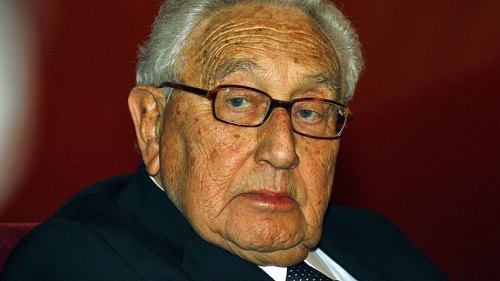
By Robert Parry | Consortium News | November 12, 2014
The American public is faced with an information crisis as the New York Times and other mainstream U.S. media outlets have become little more than propaganda organs on behalf of the neoconservative agenda and particularly the rush into a new Cold War with Russia – so much so that even ex-Secretary of State Henry Kissinger has broken ranks.
MSM articles consistently reek of bias – and in some cases make little sense. For instance, Times correspondent David M. Herszenhorn, one of the leading propagandists, wrote an alarmist story on Wednesday about a new Russian “invasion” of Ukraine but curiously he had the alleged Russian tank column heading east toward the Ukrainian city of Donetsk which would be back toward Russia, not westward into Ukraine.
According to Herszenhorn’s article, “The full scope of the Russian incursion is not clear, [NATO Supreme Commander Gen. Philip M. Breedlove] said, though the convoys seemed to be heading east toward Donetsk, an O.S.C.E. spokesman, Michael Bociurkiw, said Wednesday.”
Typical of his anti-Russian bias, Herszenhorn also cited Ukrainian government complaints that the Russians had been using a shaky cease-fire to bolster the ethnic Russian rebels in the east, but the reality is that both sides have been accusing the other of such maneuvering. Herszenhorn surely knows this but he wrote only:
“Ukrainian officials have complained all along that Russia was taking advantage of the so-called truce to reinforce the rebels in eastern Ukraine with more fighters and equipment.”
The reality is that there has been widespread alarm among eastern Ukrainians that the Kiev regime was using the relative lull in the fighting to resupply and reposition its forces for a new offensive like the one that killed thousands over the summer. Though human rights organizations have criticized Kiev for indiscriminate shelling of cities and unleashing brutal militia forces on the population, the Times and other mainstream U.S. newspapers have either ignored or downplayed such facts.
On Wednesday, Herszenhorn also compared the alleged new Russian incursion with the “invasion” of Crimea, although there really was no “invasion” of Crimea since the Russian troops that were involved in supporting Crimea’s popular referendum to secede from Ukraine and rejoin Russia were already in Crimea under an agreement with the Ukrainian government regarding the Russian naval base at Sebastopol.
Herszenhorn’s use of the word “invasion” is just an exaggeration like the rest of the imbalanced reporting that has made a rational U.S. public response to the crisis in Ukraine nearly impossible.
Since the start of the crisis in February, the New York Times’ coverage has been remarkable in its refusal to present the Ukraine story in anything like an objective fashion. For example, the Times has largely ignored the substantial public evidence that U.S. government officials and agents helped orchestrate the Feb. 22 coup which overthrew the elected President Viktor Yanukovych. [See Consortiumnews.com’s “The Whys Behind the Ukraine Crisis.”]
The Times also has buried evidence that extreme right-wing and neo-Nazi elements played key roles in firebombing police, forcing Yanukovych and other government officials to flee for their lives, and spearheading later attacks on ethnic Russians. When this reality is referenced, it is usually presented with little meaningful context or tacked on in the last few paragraphs of long articles on other topics.
Mocking Medvedev
Herszenhorn himself has been a leading violator of journalistic standards. For instance, in mid-April, early on in the crisis, he penned a mocking story from Moscow ridiculing Russian Prime Minister Dmitri Medvedev for predicting a possible civil war.
In the article entitled “Russia Is Quick To Bend Truth About Ukraine,” Herszenhorn accused Medvedev of posting an item on Facebook that “was bleak and full of dread,” including noting that “blood has been spilled in Ukraine again” and adding that “the threat of civil war looms.”
Herszenhorn continued, “He [Medvedev] pleaded with Ukrainians to decide their own future ‘without usurpers, nationalists and bandits, without tanks or armored vehicles – and without secret visits by the C.I.A. director.’ And so began another day of bluster and hyperbole, of the misinformation, exaggerations, conspiracy theories, overheated rhetoric and, occasionally, outright lies about the political crisis in Ukraine that have emanated from the highest echelons of the Kremlin and reverberated on state-controlled Russian television, hour after hour, day after day, week after week.”
This argumentative “news” story spilled from the front page to the top half of an inside page, but Herszenhorn never managed to mention that there was nothing false in what Medvedev wrote. Indeed, as the bloodshed soon grew worse and escalated into a civil war, you might say Medvedev was tragically prescient.
It was also the much-maligned Russian press that first reported the secret visit of CIA Director John Brennan to Kiev. Though the White House later confirmed that report, Herszenhorn still cited Medvedev’s reference to it in the context of “misinformation” and “conspiracy theories.” Nowhere in the long article did the Times inform its readers that, yes, the CIA director did make a secret visit to Ukraine.
In this upside-down world of MSM disinformation, there has been very little criticism of the glaring biases of the mainstream Western media but instead continued attacks on the professionalism of the Russian media, including an adverse finding this week by an official British agency that monitors alleged bias in news outlets operating in the UK. The agency, known as Ofcom, accused Russia’s RT network of failing to meet standards for “due impartiality” in early Ukraine coverage.
Interestingly, Ofcom did not judge any of the RT reports false in their description of neo-Nazi thugs participating in the Feb. 22 coup, a possible role of coup-related snipers in the slaughter of scores of people at the Maidan, and the unconstitutionality of the new government.
But Ofcom faulted RT for not meeting the fuzzy concept of “due impartiality” and threatened regulatory sanctions against RT if it didn’t shape up. Ofcom defined “due impartiality” as “impartiality adequate or appropriate to the subject and nature of the programme.”
The image of a British regulatory body threatening RT with sanctions for not toeing the pro-Western propaganda line that nearly all UK and U.S. news outlets do has an Orwellian feel to it, singling out one of the few sources of news that doesn’t accept the prevailing “group think.”
It would be one thing if the same standards were applied to Western media outlets for their one-sided reporting on Ukraine, but that apparently would ruffle too many important feathers.
Kissinger’s Dissent
Curiously, one of the few prominent Westerners who has dared question the prevailing wisdom on Ukraine is former Secretary of State Henry Kissinger who said, in an interview with the German newsmagazine Der Spiegel, that the West was exaggerating the significance of the Crimean annexation given the peninsula’s long historic ties to Russia.
“The annexation of the Crimea was no bid for world domination,” the 91-year-old Kissinger said. “It is not to be compared with Hitler’s invasion in Czechoslovakia” – as former Secretary of State Hillary Clinton and others have done.
Kissinger noted that Russian President Vladimir Putin had no intention of instigating a crisis in Ukraine: “Putin had [spent] tens of billions of dollars for the Olympic Winter Games … in Sochi. Russia wanted to present [itself] as a progressive nation. … It does not make sense that Putin, a week later, [launches] the Crimea attacks and a war for Ukraine begins.”
Instead Kissinger argued that the West – with its strategy of pulling Ukraine into the orbit of the European Union – was responsible for the crisis by failing to understand Russian sensitivity over Ukraine and making the “fatal” mistake of quickly pushing the confrontation beyond dialogue.
But Kissinger also faulted Putin for his reaction to the crisis. “I do not want to say that Russia’s response was appropriate,” Kissinger said.
Still, Kissinger told Der Spiegel that “a new edition of the Cold War would be a tragedy. … We must keep in view, that we need Russia to solve other crises, such as the nuclear conflict with Iran or Syria’s civil war.”
When Henry Kissinger starts to sound like the voice of reason, it says a lot about how crazy the New York Times and the rest of the MSM have become.
~
Investigative reporter Robert Parry broke many of the Iran-Contra stories for The Associated Press and Newsweek in the 1980s. You can buy his new book, America’s Stolen Narrative, either in print here or as an e-book (from Amazon and barnesandnoble.com).
Moscow slams NATO’s accusations of invasion in Ukraine as groundless
RT | November 12, 2014
Russia has denied NATO claims that its army has crossed into eastern Ukraine in the past few days, calling them groundless, the Defense Ministry said.
“We have stopped paying attention to the groundless accusations made by NATO’s Supreme Allied Commander in Europe, US General Philip Breedlove, of the ‘observed’ Russian military columns allegedly invading Ukraine,” said Defense Ministry official representative, General-Major Igor Konashenkov on Wednesday.
He gave a reminder of earlier and similar NATO claims, which have not been backed by any evidence.
“[We have] repeatedly stressed that there was and is no evidence supporting Brussels’ regular trumpeting over the alleged presence of Russian forces in Ukraine,” Konashenkov said.
NATO: ‘Russian troops in Ukraine – but we have no good picture’
Earlier on Wednesday, General Breedlove declared that NATO had “seen” the Russian army crossing the Ukraine border.
“Across the last two days we have seen the same thing that OSCE is reporting. We have seen columns of Russian equipment, primarily Russian tanks, Russian artillery, Russian air defense systems and Russian combat troops entering into Ukraine,” Breedlove told journalists in Sofia.
Although he added that NATO does not “have a good picture at this time of how many. We agree that there are multiple columns that we have seen.”
NATO has previously made numerous statements of the kind, but failed to provide any concrete evidence.
In one such case in August, after Kiev accused Moscow of an alleged invasion, NATO made satellite images public, saying that they were “proof” that Russian artillery was on Ukrainian territory. The images also allegedly showed about 1,000 Russian troops taking part in special operations in eastern Ukraine. The images were provided by a commercial company, DigitalGlobe, operating civilian satellites.
At that time, Konashenkov ridiculed the so-called NATO proof, adding that this time NATO officials were even hesitant to put their names on it.
“You know, it has become ridiculous… If earlier, someone would at least put their names on those images, be it Breedlove, [NATO former Secretary General Anders Fogh] Rasmussen, or even [NATO spokeswoman Oana] Lungescu, now, they are hesitant,” Konashenkov said then, as cited by RIA Novosti. “It makes no sense to comment seriously on this.”
READ MORE:
Russia’s Defense Ministry ridicules NATO’s photo-proof of invasion in Ukraine
Moscow to Kiev: Stick to Minsk ceasefire, stop making false ‘invasion’ claims
2 children killed, 4 injured in shelling nr Donetsk school – report
RT | November 5, 2014
Two schoolchildren were killed and four injured as an artillery shell hit a stadium in front of a school in the Eastern Ukrainian city of Donetsk, local self-defense forces said.
“All the wounded were taken to the Donetsk regional trauma unit,” Natalya Yemchenko, a militia official with the Donetsk People’s Republic, was cited as saying by Interfax-Ukraine news agency. “They are now in intensive care. One of them is in critical condition and three other are in a state of moderate severity.”
“There were children – a lot of them – at the stadium” when the shell hit, Yemchenko wrote on her Facebook page.
“When attempts were made to evacuate them from the pitch, the massive shelling continued in the area. It was hard for the medics to get to them,” she said.
Yemchenko said the school building was also seriously damaged in the explosion.
Eastern Ukraine Independence Leaders Win the Elections
teleSUR | November 3, 2014
The incumbent prime ministers of the eastern Ukrainian People’s Republic of Donetsk and the Republic of Lugansk, Alexander Zakharchenko, and Igor Plotinitski, respectively, won the elections, according to preliminary results revealed by the Ruptly news agency.
The preliminary results show that Zakharchenko received over 70 percent of the votes, while Plotnitski received 63 percent. Zakharchenko’s closest rival, the vice president of the joint parliament of Donetsk and Lugansk, Alexander Kofman, received about 10 percent of the votes.
The initial results also indicate Zakharchenko’s separatist party has swept up an easy majority in the DPR’s parliament, with over 60 percent of the vote, Russian media outlets have reported.
“The fact that we have a right to carry out our own elections was written,” Zacharchenko said. He stated that the elections don’t contravene the Minsk agreements, which were signed with Kiev in order to reestablish peace in Eastern Ukraine. “We are ready to carry out conversations with whomever is willing to listen to us.”
This Sunday the people of the Donetsk and Lugansk went to the polling stations to elect new leaders and parliaments. Voting began at 8:00 a.m. local time (05:00 GMT) and continued to do so until 22:00 p.m. (19:00 GMT). All residents over 16 years of age were eligible to vote in Donetsk and Lugansk.
“The elections, which were prepared under difficult conditions, very quickly, were nonetheless carried out in an organized way,” Russian electoral observer Leonid Slutsky told Reuters.
Sunday’s vote in the DPR and neighboring Lugansk People’s Republic (LPR) has been condemned by officials in Kiev, but backed by Moscow.
Ahead of the vote, German Chancellor Angela Merkel described the elections as “illegitimate,” though at the time of writing there were no reports from international observers of serious misconduct. Merkel had already warned Russia that the European Union would not accept the results of the elections. U.S. Secretary of State John Kerry had also warned Russia against recognizing the rebel held elections in the region.
“I believe the elections followed international standards of democratic elections. I was very impressed with the enthusiasm and the vigor with which the people went to the polls to express their opinion,” electoral observer and U.S. Senior Attorney Frank Abernathy told RT in Lugansk.
A DPR official told Russia’s Itar-Tass the most serious incident was a bomb threat, which later turned out to be a false alarm.
On the frontlines, however, clashes continued between DPR fighters and Ukrainian government forces. The fierce combat has left a death toll of over 300 people dead in the last 10 days, in spite of a bilateral cease-fire that was put into effect September 5.
Last Sunday, Ukraine also held parliamentary elections, which were won by the right wing party of Petro Poroshenko. The results were recognized by Russia.
In Ukraine, A Tale of Two Elections
By Daniel McAdams | Ron Paul Institute | November 1, 2014
The US government loves to “promote democracy” overseas, often at the barrel of a gun. Strangely enough, however, it often “deplores” actual elections being held in such places. Take Ukraine, for example. An election held last week by a group that forcibly seized power from a legitimately-elected government was hailed by the US administration as a great democratic achievement.
Said John Kerry about last week’s parliamentary election held by the post-coup government in Kiev:
We applaud Ukraine’s commitment to an inclusive and transparent political process that strengthens national unity. … The people of Ukraine have spoken, and they have again chosen to chart the course of democracy, reform, and European integration.
In this US-approved vote, the parties disapproved by the US were harassed and even essentially banned. But that’s OK.
However in eastern Ukraine, which refused to recognize February’s US-backed coup in the western part of the country, parliamentary and presidential elections scheduled for tomorrow are scorned and even “deplored” by the US administration.
The White House condemned tomorrow’s elections in eastern Ukraine in no uncertain terms:
We deplore the intent of separatists in parts of eastern Ukraine to hold illegitimate so-called local ‘elections’ on Sunday, November 2. If held, these ‘elections’ would contravene Ukraine’s constitution and laws and the September 5 Minsk Protocol.
So much does the US administration hate the idea of unapproved people voting, that it even refused to call them elections, placing the very term in “scare quotes.”
Shortly after the February coup in Kiev, referenda were held in Crimea and in parts of eastern Ukraine to determine whether to remain tied to Kiev or declare independence from the new regime. Those elections were also condemned by the US.
“We reject the ‘referendum’ that took place today in the Crimean region of Ukraine. This referendum is contrary to Ukraine’s constitution,” said the White House immediately after the March vote in that region. The February coup was also contrary to Ukraine’s constitution but that did apparently not bother Washington.
Similarly, when referenda were held in eastern Ukraine this spring to determine that region’s future course, the White House spokesman condemned them as “illegal under Ukrainian law and a transparent attempt to create further division and disorder.”
When the wrong people hold votes, it seems, “division and disorder” are the result.
Those who overthrow democracy by force are legitimized – you might even say laundered – by an election they had no legal right to hold in the first place, while those who stood by previously-elected leaders and scheduled elections as a way out of the crisis caused by US interference are condemned, ignored, and not even recognized by the US government.
So here is the real message from the US government: elections overseas are only legitimate if we have pre-approved the parties allowed to stand and if we have pre-approved the outcome. The election must result in exactly the kind of “pro-West” government that we desire or we will begin destabilization and regime change, if completely ignoring the results does not do the trick.
Is that what John Kerry meant when he said, “you just don’t in the 21st century behave in 19th century fashion”?
Ballots or Bullets: Democracy and World Power
By James Petras | October 31, 2014
The principal reason why Washington engages in military wars, sanctions and clandestine operations to secure power abroad is because its chosen clients cannot, and do not, win free and open elections.
A brief survey of recent election outcomes testify to the electoral unattractiveness of Washington-backed clients. The majority of democratic electorates rejects candidates and parties which back the US global agenda: neo-liberal economic policies; a highly militarized foreign policy; Israeli colonization and annexation of Palestine; the concentration of wealth in the financial sector; the military escalation against China and Russia. While the US policy attempts to re-impose the pillage and dominance of the 1990s via recycled client regimes the democratic electorates want to move on toward less bellicose, more inclusive governments, which restore labor and welfare rights.
The US seeks to impose the unipolar world, of the Bush Sr. and Clinton era, failing to recognize the vast changes in the world economy, including the rise of China and Russia as world powers, the emergence of the BRIC and other regional organizations and above all the growth of popular democratic consciousness.
Failing to convince electorates by reason or manipulation, Washington has opted to intervene by force, and to finance organizations to subvert the democratic electoral process. The frequent resort to bullets and economic coercion when ballots fail to produce the “appropriate outcome” testifies to the profoundly reactionary nature of US foreign policy. Reactionary in the double sense of ends and means.
Pragmatically, the imperial centered socio-economic policies deepen inequalities and depress living standards. The means to achieve power, the instruments of policy, include wars, intervention, covert operations, are more akin to extremists, quasi-fascist, far right regimes.
Free Elections and the Rejection of US Clients
US-backed electoral parties and candidates have suffered defeats throughout most of the world, despite generous financial backing and international mass media propaganda campaigns. What is striking about the negative voting outcomes is the fact that the vast majority of adversaries are neither anti-capitalist nor ‘socialist’. What is equally striking is that all of the US clients are rightist or far-rightist parties and leaders. In other words, the polarization is usually between center-left and rightist parties; the choice is between reform or reaction, between an independent or satellite foreign policy.
Washington and Latin America: Masters of Defeats
Over the past decade, Washington has backed losing neo-liberal candidates throughout Latin America and then sought to subvert the democratic outcome.
Bolivia
Since 2005, Evo Morales, the center left leader favoring social reforms and an independent foreign policy, has won three Presidential elections against Washington backed rightist parties, each time by a greater margin. In 2008, he ousted the US ambassador for intervening, expelled the Drug Enforcement Agency (DEA) in 2008, USAID in 2013 and the Military Mission after foiling an aborted coup in Santa Cruz.
Venezuela
The United Socialist Party of Venezuela (PSUV) and its predecessor have won every Presidential and Congressional election (over a dozen) except one over the past 15 years despite US multi-million dollar funding of neo-liberal opposition parties. Unable to defeat the Chavez-led radical-reform government, Washington backed a violent coup (2002), a boss’s lockout (2002/3), and decades long paramilitary attacks of pro-democracy leaders and activists.
Ecuador
The US has opposed the center-left government of President Correa for ousting it from the military base in Manta, renegotiating and repudiating some of its foreign debt and backing regional pacts which exclude the US. As a result Washington backed an abortive police led coup in 2010 that was quickly defeated.
Honduras
During democratically elected President Manual Zelaya’s tenure in office, a center-left President, Honduras sought to pursue closer relations with Venezuela in order to receive greater economic aid and to shed its reputation as a US dominated “banana republic”. Washington, unable to defeat him at the ballot box, responded by supporting a military coup (2009) which ousted Zelaya and returned Honduras to the US fold. Since the coup Honduras has experienced more killings of popular leaders-200- than any country in Latin America.
Brazil
The center-left Workers Party has won four straight elections against US backed neo-liberal candidates beginning in 2002 and continuing through the 2014 elections. The US propaganda machine, including NSA’s spying on President Rousseff and the strategic state petrol company, Petrobras, and the international financial press went all out to discredit the reformist center-left government. To no avail! The voters preferred an ‘inclusive’ social liberal regime pursuing an independent foreign policy to an opposition embedded in the discredited socially regressive neo-liberal politics of the Cardoso regime (1994-2002). In the run-up to the 2014 elections Brazilian and US financial speculators attempted to strike fear in the electorate by betting against the currency (real) and driving the stock market into a precipitous fall.
To no avail. Rousseff won with 52% of the vote.
Argentina
In Argentina a massive popular revolt overthrew the US backed neo-liberal regime of De la Rua in 2001. Subsequently, the electorate elected the center-left Kirchner government over the rightist, US backed Menem candidacy in 2003. Kirchner pursued a reformist agenda imposing a moratorium on the debt and combining high economic growth with large scale social expenditures and an independent foreign policy. US opposition escalated with the election of his wife Cristina Fernandez. Financial elites, Wall Street, the US judiciary and Treasury intervened to destabilize the government, after failing to defeat Fernandez’s re-election. Extra-parliamentary financial pressures were matched by political and economic support for rightist politicians in preparation for the 2015 elections.
Earlier, in 1976, the US backed the military coup and political terror that led to the murder of 30,000 activists and militants. In 2014 the US backed a “financial coup” as a federal judge sided with vulture funds, sowing financial terror in international markets against a democratically elected government.
Paraguay
President Fernando Lugo was a moderate former Bishop who pursued a watered-down center-left agenda. Nevertheless, he raised issues that conflicted with Washington’s extremist agenda, including Paraguay’s membership in regional organizations that excluded the US (MERCOSUR). He appealed to the landless rural workers and he retained ties to other Latin American center-left regimes. He was deposed by Congress in 2012 in a highly dubious ‘institutional coup’, quickly supported by the White House and replaced by a straight-line neo-liberal, Federico Franco with tight links to Washington and hostile to Venezuela.
Globalizing US Threats to Democracy
US subversion of democracy when center-left political formations compete for power is not confined to Latin America – it has gone ‘global’.
Ukraine
The most egregious example is the Ukraine, where the US spent over $6 billion in over a decade and a half. Washington financed, organized, and promoted pro NATO shock troops to seize power against an elected regime (Viktor Yanukovych) which tried to balance ties between the West and Russia. In February 2014, an armed uprising and mob action led to the overthrow of the elected government and the imposition of a puppet regime totally beholden to the US. The violent putschists met resistance from a large swathe of pro-democracy activists in the Eastern region. The Kiev junta led by oligarch Petro Poroshenko dispatched air and ground troops to repress the popular resistance with the unanimous backing of the US and EU. When the rightist regime in Kiev moved to impose its rule over the Crimea and to break its military base treaty with Russia, the Crimean citizens voted, by a large margin (85%), to separate and merge with Russia.
In both the Ukraine and Crimea, US policy was directed toward imposing by force, the subordination of democracy to NATO’s drive to encircle Russia and undermine its democratically elected government.
Russia
Following the election of Vladimir Putin to the Presidency, the US organized and financed a large number of opposition “think tanks”, and NGO’s, to destabilize the government. Large scale demonstrations by well-funded NGO’s were given wide play by all the Western mass media.
Failing to secure an electoral majority and after suffering electoral defeats in the executive and legislative elections, Washington and the EU, using the pretext of Russian “intervention” in the Ukraine, launched a full scale economic war on Russia. Economic sanctions were enforced in the hopes of provoking economic collapse and a popular upheaval. Nothing of the sort occurred. Putin has gained greater popularity and stature in Russia and consolidated its ties with China and the other BRIC countries.
In sum, in the Ukraine, Crimea and Russia, facing independent elected governments, Washington resorted to a mob uprising, military encirclement and an escalation of economic sanctions.
Iran
Iran has periodic elections in which pro and anti-western parties compete. Iran has drawn the wrath of Washington because of its support for Palestinian liberation from the Israeli yoke; its opposition to the Gulf absolutist states; and its ties to Syria, Lebanon (Hezbollah) and post- Saddam Hussain Iraq. As a result, the US has imposed economic sanctions to cripple its economy and finances and has funded pro-Western neo-liberal opposition NGO’s and political factions. Unable to defeat the Islamist power elite electorally, it chooses to destabilize via sanctions in order to disrupt its economy and assassinations of scientists and cyber warfare.
Egypt
Washington backed the Hosni Mubarak dictatorship for over three decades. Following the popular uprising in 2011, which overthrew the regime, Washington retained and strengthened its ties to the Mubarak police, military and intelligence apparatus. While promoting an alliance between the military and the newly elected President Mohammed Morsi, Washington funded NGO’s, who acted to subvert the government through mass demonstrations. The military, under the leadership of US client General Abdel Fattah el-Sisi, seized power, outlawed the Moslem Brotherhood and abolished democratic freedoms.
Washington quickly renewed military and economic aid to the Sisi dictatorship and strengthened its ties with the authoritarian regime. In line with US and Israeli policy, General Sisi tightened the blockade of Gaza, allied with Saudi Arabia and the Gulf despots, strengthened its ties with the IMF and implemented a regressive neo-liberal program by eliminating fuel and food subsidies and lowering taxes on big business.
The US backed coup and restoration of dictatorship was the only way Washington could secure a loyal client relationship in North Africa.
Libya
The US and NATO and Gulf allies launched a war (2011) against the independent, nationalist Libyan government, as the only way to oust the popular, welfare government of Colonel Gaddafi. Unable to defeat him via internal subversion, unable to destabilize the economy, Washington and its NATO partners launched hundreds of bombing missions accompanied by arms transfers to local Islamic satraps, tribal, clans and other violent authoritarian groups. The subsequent ‘electoral process’ lacking the most basic political guarantees, fraught by corruption, violence and chaos, led to several competing power centers. Washington’s decision to undermine democratic procedures led to a violent Hobbesian world, replacing a popular welfare regime with chaos and terrorism.
Palestine
Washington has pursued a policy of backing Israeli seizures and colonization of Palestinian territory, savage bombings and the mass destruction of Gaza. Israel, determined to destroy the democratically elected Hamas government, has received unconditional US backing. The Israeli colonial regime has imposed racist, armed colonies throughout the West Bank, financed by the US government, private investors and US Zionist donors. Faced with the choice between a democratically elected nationalist regime, Hamas, and a brutal militarist regime, Israel, US policymakers have never failed to back Israel in its quest to destroy the Palestinian mini-state.
Lebanon
The US, along with Saudi Arabia and Israel, has opposed the freely elected Hezbollah led coalition government formed in 2011. The US backed the Israeli invasion in 2006, which was defeated by the Hezbollah militias. Washington backed the right wing Hariri-led coalition (2008 – 2011) which was marginalized in 2011. It sought to destabilize the society by backing Sunni extremists especially in Northern Lebanon. Lacking popular electoral support to convert Lebanon into a US client state, Washington relies on Israeli military incursions and Syrian based terrorists to destabilize Lebanon’s democratically elected government.
Syria
Syria’s Bashar Assad regime has been the target of US, EU, Saudi and Israeli enmity because of its support for Palestine, its ties with Iraq, Iran, Russia and Hezbollah. Its opposition to the Gulf despotism and its refusal to become a US client state (like Jordan and Egypt) has been another source of NATO hostility. Under pressure from its internal democratic opposition and its external allies, Russia and Iran , the Bashar Assad regime convoked a conference of non-violent opposition parties, leaders and groups to find an electoral solution to the ongoing conflict. Washington and its NATO allies rejected a democratic electoral road to reconciliation. They and their Turkish and Gulf allies financed and armed thousands of Islamic extremists who invaded the country. Over a million refugees and 200,000 dead Syrians were a direct result of Washington’s decision to pursue “regime change” via armed conflict.
China
China has become the world’s largest economy. It has become a leading investment and trading country in the world. It has replaced the US and the EU in Asian, African and Latin American markets. Faced with peaceful economic competition and offers of mutually beneficial free trade agreements, Washington has chosen to pursue a policy of military encirclement, internal destabilization and Pan Pacific integration agreements that exclude China. The US has expanded military deployments and bases in Japan, Australia and the Philippines. It has heightened naval and air force surveillance just beyond China’s limits. It has fanned rival maritime claims of China’s neighbors, encroaching on vital Chinese waterways.
The US has supported violent Uighur separatists, Tibetan terrorists and protests in Hong Kong in order to fragment and discredit China’s rule over its sovereign territory. Fomenting separation via violent means results in harsh repression, which in turn can alienate a domestic constituency and provide grist for the Western media mills. The key to the US countering China’s economic ascent is political: fomenting domestic divisions and weakening central authority. The democratization which Chinese citizens favor has little resonance with US financed ‘democracy’ charades in Hong Kong or separatist violence in the provinces.
Washington’s effort to exclude China from major trade and investment agreements in Asia and elsewhere has been a laughable failure. The principle US “partners”, Japan and Australia are heavily dependent on the Chinese market. Washington’s (free trade) allies in Latin America, namely Colombia, Peru, Chile and Mexico are eager to increase trade with China. India and Russia are signing off on multi-billion dollar trade and investment deals with China! Washington’s policy of economic exclusion miscarried in the first month!
In sum, Washington’s decision to pursue confrontation over conciliation and partnership; military encirclement over co-operation; exclusion over inclusion, goes counter to a democratic foreign policy designed to promote democracy in China and elsewhere. An authoritarian choice in pursuit of unachievable Asian supremacy is not a virtue; it is a sign of weakness and decay.
Conclusion
In our global survey of US policy toward democracy, center-left governments and free elections we find overwhelming evidence of systematic US hostility and opposition. The political essence of the “war on terrorism” is Washington’s world-wide long-term pernicious assault on independent governments, especially center-left democratic regimes engaged in serious efforts to reduce poverty and inequality.
Washington’s methods of choice range from financing rightist political parties via USAID and NGO’s, to supporting violent military coups; from backing street mobs engaged in destabilization campaigns to air and ground invasions. Washington’s animus to democratic processes is not confined to any region, religious, ethnic or racial group. The US has bombed black Africans in Libya; organized coups in Latin America against Indians and Christians in Bolivia; supported wars against Muslims in Iraq, Palestine and Syria; financed neo-fascist “battalions”and armed assaults against Orthodox Christians in the Eastern Ukraine; denounced atheists in China and Russia.
Washington subsidizes and backs elections only when neo-liberal client regimes win. It consistently destabilizes center-left governments which oppose US imperial policies.
None of the targets of US aggression are strictly speaking anti-capitalist. Bolivia, Ecuador, Brazil, Argentina are capitalist regimes which attempt to regulate tax and reduce disparities of wealth via moderate welfare reforms.
Throughout the world, Washington always supports extremist political groups engaged in violent and unconstitutional activity that have victimized democratic leaders and supporters. The coup regime in Honduras has murdered hundreds of rank and file democratic activists, farm workers,and poor peasants.
The US armed Islamic jihadist and ex-pat allies in Libya have fallen out with their NATO mentors and are at war among themselves, engaging in mutual bloodletting.
Throughout the Middle East, South Asia, North Africa, Central America and the Caucuses wherever US intervention has taken place, extreme right-wing groups have served, at least for a time, as Washington and Brussels’ principal allies.
Pro EU-NATO allies in the Ukraine include a strong contingent of neo-Nazis, paramilitary thugs and “mainstream” military forces given to bombing civilian neighborhoods with cluster bombs.
In Venezuela, Washington bankrolls terrorist paramilitary forces and political extremists who murdered a socialist congressional leader and dozens of leftists.
In Mexico the US has advised, financed and backed rightist regimes whose military, paramilitary and nacro-terrorist forces recently murdered and burned alive 43 teachers’ college students, and are deeply implicated in the killing of 100,000 “other” Mexicans, in less than a decade.
Over the past eleven years the US has pumped over $6 billion dollars in military aid to Colombia, funding its seven military bases and several thousand special operations forces and doubling the size of the Colombian military. As a result thousands of civil society and human rights activists, journalists, trade union leaders and peasants, have been murdered. Over 3 million small land-holders have been dispossessed.
The mass media cover up the US option for right wing extremism by describing ruling mass murderers as “center-right regimes” or as“moderates”: linguistic perversions and grotesque euphemisms are as bizarre as the barbarous activities, perpetrated by the White House.
In the drive for world power, no crime is left undone; no democracy that opposes it is tolerated. Countries as small and marginal as Honduras or Somalia or as great and powerful as Russia and China cannot escape the wrath and covert destabilization efforts of the White House.
The quest for world domination is driven by the subjective belief in the “triumph of the will”. Global supremacy depends entirely on force and violence: ravaging country after country, from carpet bombing of Yugoslavia, Iraq, Afghanistan and Libya to proxy wars in Somalia, Yemen, Ukraine to mass killings in Colombia, Mexico and Syria.
Yet there are limits to the spread of the “killing fields”. Democratic processes are defended by robust citizens’ movements in Venezuela, Ecuador and Bolivia. The spread of imperial backed terrorist seizures of power are stymied by emergence of global powers, China in in the Far East and Russia in Crimea and eastern Ukraine have taken bold steps to limit US imperial expansion.
In the United Nations, the President of the United States and his delegate Samantha Powers rant and rave, in a fit of pure insanity, against Russia as “the greatest world terrorist state” for resisting military encirclement and the violent annexation of the Ukraine.
Extremism, authoritarianism and political insanity know no frontiers. The massive growth of the secret political police, the National Security Agency, the shredding of constitutional guarantees, the conversion of electoral processes into elite controlled multi-billion dollar charades, the growing impunity of police involved in civilian murders, speaks to an emerging totalitarian police – state inside the US as a counterpart to the violent pursuit of world power.
Citizens’ movements, consequential center-left parties and governments, organized workers, in Latin America, Asia and Europe have demonstrated that authoritarian extremist proxies of Washington can be defeated. That disastrous neo-liberal policies can be reverted. That welfare states, reductions in poverty, unemployment and inequalities can be legislated despite imperial efforts to the contrary.
The vast majority of the Americans, here and now, are strongly opposed to Wall Street, big business and the financial sector. The Presidency and the Congress are despised by three quarters of the American public. Overseas wars are rejected. The US public, for its own reasons and interests, shares with the pro-democracy movement’s world-wide, a common enmity toward Washington’s quest for world power. Here and now in the United States of America we must learn and build our own powerful democratic political instruments.
We must, through the force of reason, contain and defeat “the reason of force”: the political insanity that informs Washington’s ‘will to power’. We must degrade the empire to rebuild the republic. We must turn from intervening against democracy abroad to building a democratic welfare republic at home.
Russia recognizes Ukraine poll despite violations, doubts
RT | October 27, 2014
It is obvious that the Supreme Rada elections in Ukraine can be considered valid despite a rather harsh and dirty campaign, Russia’s deputy foreign minister has said.
“We expect the official confirmation of the elections result, the information we are getting now is quite controversial. But even now it is obvious that the elections have taken place, despite a hard struggle and dirty tricks,” the Interfax news agency quoted Grigory Karasin as saying.
“The forming balance of forces will probably allow the Ukrainian authorities to deal with some rooted problems in the society,” the senior Russian diplomat added.
Karasin’s words echo an earlier statement from Russia’s UN envoy Vitaly Churkin who described the Ukrainian parliamentary campaign as “dirty and cynical”, but did not exclude the possibility of cooperation between Russian authorities and the new Rada.
The head of the Russian Upper House’s commission for monitoring the situation in Ukraine, Senator Vladimir Dzhabarov told the RIA Novosti news agency that Russian officials would try to cooperate with the freshly elected Ukrainian government despite doubts of its legitimacy.
“The southeast has not voted and there were lots of violations,” he said.
Dzhabarov noted that the new Rada would be much more radical than the previous one and emphasized the fact that the Communist Party of Ukraine did not make it into the parliament. Communists held over 13 percent of seats in the Rada after 2012 polls. The Russian senator said that this was a very surprising fact in a democratic country.
“We will attempt to cooperate in any case. We hope that reason would prevail among our new colleagues,” the senator said. “We cannot but attempt to build cooperation with the Rada because we have common history and we are neighbors.”
He also added that Russian Upper House chair, Valentina Matviyenko, had already sent the Ukrainian parliament an invitation to participate in the November session of the parliamentary assembly of the Russia-led CIS economic and political bloc.
The head of the Federation Council’s Committee for Constitutional Law, Andrey Klishas, promised the Russian parliament would cooperate with Ukrainian politicians who press for an end to the civil war and oppose the neo-Nazi state, and the arbitrariness and mass violations of human rights in Ukraine
“Ukrainians themselves cannot fail to notice the mass violations of human rights during the latest parliamentary campaign. These were the ban of free speech, attacks on opposition candidates, mass violence in the form of the so called ‘popular gatherings,’ even lynch mobs on the side of the pro-fascist political forces,” Klishas told RIA Novosti.
According to latest reports PM Arseny Yatsenyuk’s People’s Front party is ahead of rivals with 21.69 percent of votes, and President’s Petro Poroshenko Bloc is only slightly behind, so far garnering 21.63 percent. The other four parties making it into the Ukrainian parliament are the Samopomosh of Lvov’s Mayor Andrey Sadovy (10.9), Opposition Bloc (9.77), Radical Party of Oleg Lyashko (7.47), and Yulia Tymoshenko’s party Batkivshchina (Fatherland) (5.77).
Treating Putin Like a Lunatic
By Robert Parry | Consortium News | October 25, 2014
When reading the New York Times on many foreign policy issues, it doesn’t take a savant to figure out what the newspaper’s bias is. Anything, for instance, relating to Russian President Vladimir Putin drips of contempt and hostility.
Rather than offer the Times’ readers an objective or even slightly fair-minded account of Putin’s remarks, we are fed a steady diet of highly prejudicial language, such as we find in Saturday’s article about Putin’s comments at a conference in which he noted U.S. contributions to chaos in countries, such as Afghanistan, Iraq, Libya, Syria and Ukraine.
That Putin is correct appears almost irrelevant to the Times, which simply writes that Putin “unleashed perhaps his strongest diatribe against the United States yet” with his goal “to sell Moscow’s view that American meddling has sparked most of the world’s recent crises.”
Rather than address the merits of Putin’s critique, the Times’ article by Neil MacFarquhar uncritically cites the “group think” of Official Washington: “Russia is often accused of provoking the crisis in Ukraine by annexing Crimea, and of prolonging the agony in Syria by helping to crush a popular uprising against President Bashar al-Assad, Moscow’s last major Arab ally. Some analysts have suggested that Mr. Putin seeks to restore the lost power and influence of the Soviet Union, or even the Russian Empire, in a bid to prolong his own rule.”
Yes, “some analysts” can be cited to support nearly any claim no matter how wrongheaded, or you can use the passive tense – “is often accused” – to present any charge no matter how unfair. But a more realistic summary of the various crises afflicting the world would note that Putin is correct when he describes past U.S. backing for various extremists, from Islamic fundamentalists in the Middle East and Central Asia to neo-Nazis in Ukraine.
For example, during the 1980s, the Reagan administration consciously encouraged Islamic fundamentalism as a strategy to cause trouble for “atheistic communism” in Afghanistan and in the Muslim provinces of the Soviet Union.
To overthrow a Soviet-backed government in Afghanistan, the CIA and its Saudi collaborators financed the mujahedeen “holy warriors” who counted among their supporters Saudi extremist Osama bin Laden. Some of those Islamists later blended into the Taliban and al-Qaeda with dire consequences for the United States on Sept. 11, 2001.
By invading Iraq in 2003, President George W. Bush toppled a secular dictator, Saddam Hussein, but saw him replaced by what amounted to a Shiite theocracy which pushed Iraq’s Sunni minority into the arms of “Al-Qaeda in Iraq,” which has since rebranded itself as the Islamic State of Iraq and Syria or simply the Islamic State. Those extremists now control large swaths of Iraq and Syria and have massacred religious minorities and Western hostages, prompting another U.S. military intervention.
Obama’s Interventions
In Libya in 2011, President Barack Obama acquiesced to demands from “liberal interventionists” in his administration and authorized an air war to overthrow another secular autocrat, Muammar Gaddafi, whose ouster and murder have sent Libya spiraling into political chaos amid warring Islamist militias. It turns out Gaddafi was not wrong when he warned of Islamist terrorists operating around Benghazi.
Similarly, Official Washington’s embrace of protests and violence aimed at removing another secular Arab leader, Syria’s Bashar al-Assad, contributed to the bloody civil war that has devastated that country and created fertile ground for the Islamic State and the Nusra Front, the official al-Qaeda affiliate.
Though Obama balked at demands from neocons and “liberal interventionists” that he launch an air war against the Syrian military in 2013, he did authorize secret shipments of weapons and training for the supposedly “moderate” Syrian rebels who have generally sided with Islamist fighters affiliated with al-Qaeda and the Islamic State.
Many of these same neocons and “liberal interventionists” have been eager to ratchet up the confrontation with Iran over its nuclear program, including neocon dreams to “bomb, bomb, bomb Iran,” also a desire of hardliners in Israel.
In some of these crises, one of the few international leaders who has cooperated with Obama to tamp down tensions has been Putin, who helped negotiate conflict-avoiding agreements with Syria and Iran. But those peaceful interventions made Putin an inviting target for the neocons who began in fall 2013 arranging a coup d’etat in Ukraine on Russia’s border.
As Obama and Putin each paid too little attention to these maneuvers, neocons such as National Endowment for Democracy president Carl Gershman, Sen. John McCain, R-Arizona, and Assistant Secretary of State for European Affairs Victoria Nuland went to work on the Ukrainian coup.
However to actually overthrow Ukraine’s elected President Viktor Yanukovych, the coup makers had to collaborate with neo-Nazi militias which were organized in western Ukraine and dispatched to Kiev where they provided the muscle for the Maidan uprising. Neo-Nazi leaders were given several ministries in the new government, and neo-Nazi militants were incorporated into the National Guard and “volunteer” militias dispatched to crush the ethnic Russian resistance in the east.
Putin for the Status Quo
The underlying reality of the Ukraine crisis was that Putin actually supported the country’s status quo, i.e. maintaining the elected president and the constitutional process. It was the United States along with the European Union that sought to topple the existing system and pull Ukraine from Russia’s orbit into the West’s.
Whatever one thinks about the merits of that change, it is factually wrong to accuse Putin of initiating the Ukraine crisis or to extrapolate from Official Washington’s false conventional wisdom and conclude that Putin is a new Hitler, an aggressor seeking to reestablish the Soviet Union or the Russian Empire.
But the Times and other major U.S. news outlets have wedded themselves to that propaganda theme and now cannot deviate from it. So, when Putin states the obvious – that the U.S. has meddled in the affairs of other nations and that Russia did not pick the fight over Ukraine – his comments must be treated like the ravings of a lunatic unleashing some “diatribe.”
Among Putin’s ranting was his observation, according to the Times article, that “the United States supports ‘dubious’ groups ranging from ‘open neo-fascists to Islamic radicals.’
“‘Why do they support such people,’ he asked the annual gathering known as the Valdai Club, which met this year in the southern resort town of Sochi. ‘They do this because they decide to use them as instruments along the way in achieving their goals, but then burn their fingers and recoil.’
“The goal of the United States, he said, was to try to create a unipolar world in which American interests went unchallenged. …
“Mr. Putin … specifically denied trying to restore the Russian Empire. He argued Russia was compelled to intervene in Ukraine because that country was in the midst of a ‘civilized dialogue’ over its political future when the West staged a coup to oust the president last February, pushing the country into chaos and civil war.
“‘We did not start this,’ he said. ‘Statements that Russia is trying to reinstate some sort of empire, that it is encroaching on the sovereignty of its neighbors, are groundless.’”
Of course, all the “smart people” of Official Washington know how to react to such statements from Putin, with a snicker and a roll of the eyes. After all, they’ve been reading the narratives of these crises as fictionalized by the New York Times, the Washington Post, etc.
Rationality and realism seem to have lost any place in the workings of the mainstream U.S. news media.
~
Investigative reporter Robert Parry broke many of the Iran-Contra stories for The Associated Press and Newsweek in the 1980s. You can buy his new book, America’s Stolen Narrative, either in print here or as an e-book (from Amazon and barnesandnoble.com).
Fragile fact-checking: How the media fell in and out of love with the Sikorski ‘revelations’
By Bryan MacDonald | RT | October 22, 2014
What’s worse than a junior neocon? A junior neocon trying to make a name for himself. Ben Judah’s meteoric rise, aided by his staunch anti-Russian credentials in a climate of fear, has imploded as quickly as it began.
As I learnt the hard way, when you are a young man in a hurry it’s easy to trip up. The first few times you’ll, probably, be forgiven but once it becomes a trend, even the most ardent supporters will abandon you. The fewer redeeming features you possess, the faster it’ll happen. When it has the potential to create an international diplomatic crisis, I can only assume it’s fatal to that once promising career.
On Sunday, the niche US journal Politico published a piece which, briefly, rocked the Russia-related media world. In a rambling, rabble-rousing diatribe by Ben Judah came a, seemingly amazing, scoop – Vladimir Putin had allegedly proposed, in a 2008 Moscow meeting, that Russia and Poland divide Ukraine between them. The source for this, supposed, latter-day Molotov-Ribbentrop pact was given as ex-Polish Foreign Minister Radoslaw Sikorski. Carl Bildt was also included – but the less said about him the better – in a veritable neocon tea party. After reading about the ostensible carve-up, I was wondering what century I was in.
Following some nonsense about Napoleon, Sikorski was quoted as saying: “He (Putin) wanted us (Poland) to become participants in this partition of Ukraine.”
“This was one of the things that Putin said to my prime minister, Donald Tusk, when he visited Moscow. He went on to say Ukraine is an artificial country and that Lwow (sic) is a Polish city and why don’t we just sort it out together? Luckily Tusk didn’t answer. He knew he was being recorded,” Sikorski, supposedly, added.
If true, the only word could have been ‘wow.’ However, I doubted it right away. The author was not credible (previously he’d written a Newsweek lead which read like an audition for a post at Hello! Magazine) and the comment about recording seemed odd. It’s par-for-the-course in bilateral talks, especially in situations of mutual distrust, for both parties to record conversations – and there’s few relationships as chary as Moscow-Warsaw.
This is done to counter misquotations later and I’ve known about the practice since my cub reporter days in Dublin. John Kerry and Sergey Lavrov have become famous this year for their garden walks in Moscow and Paris. They don’t do it because they are horticulture enthusiasts – it’s an opportunity to speak candidly without fear of leaks.
The fictional piece attempts to argue that Vladimir Putin would, somehow, trust a Eurocentric leader like Donald Tusk with such a cunning plan. That raised the alarm. Did Judah and Politico really believe serious analysts would swallow this? No matter what mud is hurled at Putin, it rarely comes with the word ‘stupid’ emblazoned across it.
You don’t rise from being a minor KGB agent in East Germany to head of the FSB by being dopey. You do it by being, extremely, clever. An exceedingly savvy Russian President would hardly make a proposal to divvy up Ukraine to a, noted, pro-Western Polish PM. In fact, unless the Russian intelligence services were having a New Year’s Party that extended into May, Putin would have been well briefed on Tusk.
There are a few more wing-nut positions in the piece. The elected Russian government is described as an “imperialist dictatorship,” Never mind that for a Brit to be accusing anybody of imperialism is beyond parody, it takes some imagination to dream up that kind of nonsense.
Judah goes on to state that “European leaders, intimidated by his charisma and outspoken views on Russia, chose not to appoint him as Europe’s high representative for foreign affairs earlier this year.” It’s clear that it was something a trifle more troubling than Sikorski’s pizzazz that stymied that bid. The clue is in the article.
The desultory screed then gets bogged down with information from Kremlin ‘sources’ – who conveniently agree with the author on his anti-Russia and Putin views. The two are not synonymous – many decent western journalists dislike the current Moscow government but love the country. Judah, clearly, is fond of neither. Anyway, I don’t buy the veracity of these ‘sources’ but, luckily, I have a genuine insider in my circle of acquaintances. I asked him if I was wrong in doubting whether Judah’s ‘moles’ are not skin blemishes or figments of the imagination? “No, I don’t think he has reliable sources there,” was the succinct reply.
On Tuesday, my initial hunch was proven right. Sikorski distanced himself from Judah and claimed “his memory had failed him.” He clarified that there had been no bilateral meeting at all between Tusk and Putin in Moscow in 2008. Information about Putin’s meetings is freely available online and his own website has an archive dating back to the year 2000. There is a record of a February 2008 visit by Tusk to Moscow available there.
Sikorski tweeted that “the interview with Politico was not authorised, and some of my words have been over-interpreted.” These comments might seem odd to foreign ears (not authorised) but experienced journalists know that this is Polish custom – and, indeed, German. It’s known as ‘copy approval’ in the UK, something which is granted more often than people think. It’s quasi standard practice for controversial interviews with big hitters.
Prime Minister Ewa Kopacz, from the same party as Sikorski, criticised him: “I will not tolerate this kind of behaviour. I will not tolerate this kind of standards that Speaker Sikorski tried to present at today’s (news) conference.” This was after the ex-Foreign Minister had, initially, dodged questions before being rolled out again and, finally, opening up. Political opponents want him fired, saying there is no room in politics for what they called “irresponsibility.”
I usually conclude columns of this nature with warning of how dangerous such – often deliberately – erroneous western media commentary is. Not this time. All bar the biggest lunatics in the American press have washed their hands of this nonsense, so there’s no need.
As of midnight Tuesday, London time, Politico had still not retracted any of the allegations their piece made. The article’s foot-note read “Ben Judah is author of Fragile Empire: How Russia Fell In And Out Of Love With Vladimir Putin.” Yes, that 88 per cent approval rating Putin. I’m off now to work on my book – “How America Fell Out Of And Then Into Love With Barack Obama.” Yes, that 40 per cent approval rating Obama.
READ MORE: Sikorski U-turn: Polish ex-FM backtracks on scandalous ‘divide Ukraine’ claim
Bryan MacDonald is a journalist, writer, broadcaster and teacher. He wrote for Irish Independent and Daily Mail. He has also frequently appeared on RTE and Newstalk in Ireland as well as RT.
Featured Video
No Vote, No Representation, No State: Democracy, Israeli Style
or go to
Aletho News Archives – Video-Images
From the Archives
Sanctions, War and the Policy of Dual Containment
By SASAN FAYAZMANESH | March 17, 2008
It is now nearly three decades since the Unites States adopted the policy of dual containment of Iran and Iraq. While much has been written about the containment of Iraq, there has been very little in-depth analysis of this policy when it comes to Iran. In a book that is going to be released on March 31, 2008, entitled The United States and Iran: Sanctions, Wars and the Policy of Dual Containment (Routledge), I attempt to address this shortcoming by investigating when and why the US policy of containment of Iran came about, how it evolved, and where it stands today.[1] To the extent that Israel has been involved in US policy making, the study will also include the role that Israel has played in the containment of Iran. Also, since the fate of Iran has been inextricably linked to that of Iraq, occasionally the investigation will overlap with the containment of Iraq.
The policy of dual containment of Iran and Iraq originated during the Carter Administration, but it was not until the Clinton Administration that the expression “dual containment” became popular. … continue
Blog Roll
 Aletho News
- No Vote, No Representation, No State: Democracy, Israeli Style
- Zionist Bought Senate Blocks Information About American Citizens Killed By Israel
- While Gaza dominates the UN, these are the people keeping it alive
- New Report: “Scholasticide and Genocide in Gaza: Assessment, Testimonies and Legal Analysis”
- ‘THAAD Delusion’: Iran war exposes US missile shield limits – The Atlantic
- Moscow issues warning to NATO over Russian exclave
- Yes, the Iran war has destroyed Trump’s presidency
- The fallacy of US delusions about Iran’s economic collapse
- Hezbollah denies Syria cell link, warns of Israeli plan to sow discord
- The legacy of US sanctions, war, and occupation in Iraq
- If Americans Knew
- Mamdani releases plan to combat antisemitism and hate crimes in New York City
- Iran’s Revolutionary Guards Publish Letter to the American People
- DMFI launches $1 million ad campaign supporting Virginia’s Elaine Luria
- US Senate blocks resolution seeking report on Americans killed by Israel
- Israeli Attacks Kill Ten Palestinians in Gaza
- Massacre at Minab: The School That Became a Grave
- Israeli media: The IDF Shows It Doesn’t Turn a Blind Eye; It Actively Emboldens Settler Havoc
- As settlers ravage West Bank, Israeli forces kill 10 in Gaza – Daily Update
- New Report: “Scholasticide and Genocide in Gaza: Assessment, Testimonies and Legal Analysis”
- Ex-Biden officials are desperate for a Gaza scapegoat
- No Tricks Zone
- Green Energy Debacle: German Expert Professor Fritz Vahrenholt Warns Of Severe Economic And Social Consequences
- Two More Paleo Reconstructions Affirm Meters-Higher Sea Levels Across Ireland, Brazil 7000-6000 Years Ago
- New Study: Earth And Venus Surface Warmth Largely Explained By Convection And Lapse Rate, Not CO2 Or Radiation
- 2025 Nature Paper Claiming Worsening Global Drought Gets RETRACTED …Heavily Flawed
- New Study: ‘Global Drought Shows No Detectable Recent Acceleration Under Climate Warming’
- Economic Masterminds: German Socialists Suggest Taxing Productivity Gains Stemming From Using AI
- The South China Sea Has Not Been Cooperating With The Climate Change Narrative
- Energy Crisis: Germany Enters Heating Season With Historically Low Gas Reserve Fill Levels
- New Study: The Antarctic Ice Sheet Gained Mass From 2020-2024 Due To Staggering Snow And Ice Accumulation
- Study: Ocean Heating Rates From Thousands Of Years Ago ‘Dwarf’ Modern Ocean Heating Rates

