Russia derails Ukraine’s Western-backed missile program – FSB
RT | August 14, 2025
Russian forces have struck four Ukrainian defense industrial facilities producing long-range missile systems, causing “colossal” damage and stalling Kiev’s domestic missile program, the Federal Security Service (FSB) has said.
In a statement on Thursday, the FSB said the operation mounted by the agency and the Russian Defense Ministry targeted chemical and mechanical plants in Pavlograd, Dneptropetrovsk Region, as well as the ‘Zvezda’ plant and State Scientific Research Institute of Chemical Products in Shostka, Sumy Region.
The impact of the strikes has been confirmed by satellite imagery and open-source intelligence, it added.
The FSB said that Ukraine, with NATO’s permission, had planned to use Sapsan long-range missiles for strikes deep into Russian territory. “Thanks to the joint efforts of the FSB and Russian Armed Forces, Ukraine’s missile program plans have been thwarted,” the statement added.
The agency described the damage to Ukraine’s military industrial complex as “colossal,” and said it far surpassed Kiev’s “Spiderweb” operation that targeted strategic Russian aviation in early June. Moscow said that the Ukrainian attack, which involved dozens of drones, damaged several aircraft but dismissed Kiev’s claims that approximately 40 warplanes were destroyed.
An unnamed FSB official told TASS that the Sapsan missile systems were developed with financial support from Germany and assistance from foreign specialists.
The Sapsan is a Ukrainian tactical ballistic missile with a warhead weighing around 480kg. The missile can travel at speeds over 6,000kph and has a range estimated of up to 700km.
The FSB published a map outlining the Sapsan’s range, with a large part of Western Russia – including Moscow – being within the kill zone.
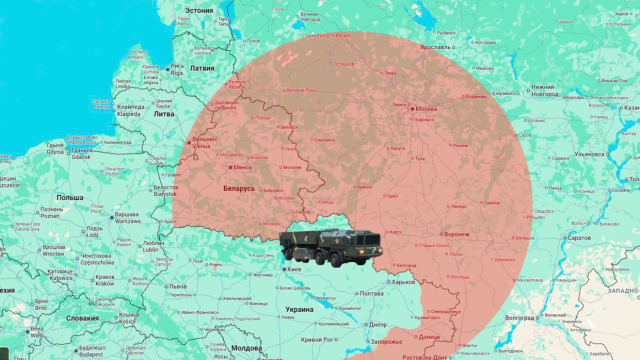
In May, Chancellor Friedrich Merz announced that Germany would fund Ukraine’s domestic production of long-range missiles, although he did not specify the type of weapon. The German Defense Ministry also stated at the time that investing in Ukraine’s production would enable Kiev to have a “substantial” number of long-range weapons this year.
Ukraine’s Vladimir Zelensky has since threatened new long-range strikes deep into Russia, saying Kiev will “do everything possible to bring the war onto Russian territory.” – Video
Coalition of Willing Opposes Any Restrictions on Ukrainian Army as Part of Ukraine Deal
Sputnik – 14.08.2025
The so-called “coalition of the willing” has opposed any restrictions on the Ukrainian armed forces as part of the deal on settling the Ukraine conflict ahead of the meeting between Russian President Vladimir Putin and US President Donald Trump, a joint statement read.
“Ukraine must have robust and credible security guarantees to effectively defend its sovereignty and territorial integrity. The Coalition of the Willing is ready to play an active role, including through plans by those willing to deploy a reassurance force once hostilities have ceased. No limitations should be placed on Ukraine’s armed forces or on its cooperation with third countries. Russia could not have a veto against Ukraine‘s pathway to EU and NATO,” the coalition said in a joint statement published by the office of UK Prime Minister Keir Starmer on Wednesday.
The coalition also believes that constructive negotiations can only take place “in the context of a ceasefire.”
The meeting between US President Donald Trump and Russian President Vladimir Putin is scheduled for this Friday in Anchorage, Alaska. The leaders are expected to discuss ways to resolve the Ukrainian conflict as well as other issues of mutual interest.
Kremlin reveals details of Putin-Trump summit
RT | August 14, 2025
The summit between Russian President Vladimir Putin and his US counterpart, Donald Trump, on Friday will focus not only on the Ukraine conflict but on a broader security agenda and involve several top Russian officials, Kremlin aide Yury Ushakov has said.
Speaking to reporters on Thursday, Ushakov said that “final preparations” were underway for the meeting on Friday, which will take place at Joint Base Elmendorf-Richardson in Anchorage, Alaska. Given the short notice for the summit, “everything is being done in an intensive mode,” including tackling several technical issues, including visa-related matters, he added.
Ushakov said the summit will begin at approximately 11:30 a.m. local time (19:30 GMT) with a one-on-one conversation between Putin and Trump, accompanied by interpreters. “Then, there will be negotiations in the format of delegations, and these negotiations will continue over a working lunch,” he said.
The Kremlin aide noted the very high level of the Russian delegation, which he said would include Foreign Minister Sergey Lavrov, Ushakov himself, Defense Minister Andrey Belousov, Finance Minister Anton Siluanov, and Special Presidential Representative for Investment and Economic Cooperation with Foreign Countries Kirill Dmitriev, who has been a key figure in the Ukraine settlement process.
“In addition to the presidents, five members from each delegation will participate in the negotiations,” he said, adding that “of course, a group of experts will also be nearby.”
Regarding the agenda, it is “obvious” that the central issue in the talks will be the Ukraine conflict, Ushakov said, adding, though, that “broader objectives of ensuring peace and security will also be addressed, as well as current and most acute international and regional issues.”
There will also be an exchange of views “regarding the further development of bilateral cooperation, including in the trade and economic spheres,” Ushakov noted, adding that such ties have “enormous and, unfortunately, still untapped potential.”
Ushakov confirmed that Putin and Trump will not only deliver a short opening statement but also hold a joint press conference after the talks. He said the duration of the talks “would depend on how the discussion goes” and confirmed “the delegation will return [to Russia] immediately after the negotiations conclude.”
EU state blasts Ukraine over key pipeline attack
RT | August 13, 2025
Hungary has lashed out at Ukraine over a drone strike on Russia’s Druzhba oil pipeline system, a key supply route to EU countries, warning that the attack endangered its energy security.
Druzhba is one of the world’s longest networks, transporting crude some 4,000km from Russia and Kazakhstan to refineries in the Czech Republic, Germany, Hungary, Poland, and Slovakia.
In a post on X on Wednesday, Hungary’s Foreign Minister Peter Szijjarto wrote that “overnight, Ukraine launched a drone strike on a key distribution station of the Druzhba oil pipeline in Russia’s Bryansk Region.”
According to media reports, multiple Ukrainian drones struck Russia’s Bryansk Region on Tuesday night, sparking fires at several sites. One target was the Unecha station, a major hub in the Druzhba oil pipeline linking Russia and the EU.
The Ukrainian General Staff confirmed the attack on the pumping station in a Facebook post. Russia has so far not commented on the alleged incident.
Szijjarto called the attack “outrageous,” saying the pipeline is vital to Hungary’s energy security given that the country relies on oil shipments through the system.
He also noted that Hungary is Ukraine’s “number one electricity supplier” and that without it Ukraine’s energy security would be “highly unstable.” He urged Kiev to stop endangering Hungary’s energy supplies and to halt strikes on routes “in a war we Hungarians have nothing to do with.”
Ukraine has repeatedly targeted Russian energy infrastructure throughout the conflict, including the Druzhba system. In March, the Ukrainian General Staff confirmed having targeted the oil pipeline.
In January, Ukrainian forces attempted to attack a compressor station of the TurkStream pipeline, which supplies natural gas to Turkish customers and several European countries, including Hungary, Serbia, Bulgaria, Slovakia, Bosnia and Herzegovina, and Greece.
Russian officials have repeatedly condemned Ukrainian attacks on civilian energy infrastructure, labeling them acts of terrorism.
Why both sides want the Putin-Trump Alaska summit to succeed
By Dmitry Suslov | RT | August 13, 2025
On Friday, Vladimir Putin and Donald Trump will meet in Alaska. This will be the first full-scale Russia-US summit since June 2021 in Geneva, and the first official visit by a Russian president to American soil since Dmitry Medvedev’s trip in 2010 at the height of the “reset.”
It will also be the first time the leaders of Russia and the US have met in Alaska, the closest US state to Russia, separated only by the narrow Bering Strait, and once part of the Russian Empire. The symbolism is obvious: as far as possible from Ukraine and Western Europe, but as close as possible to Russia. And neither Zelensky nor the EU’s top brass will be in the room.
The message could not be clearer – Moscow and Washington will make the key decisions on Ukraine, then inform others later. As Trump has said, “they hold all the cards.”
From Geneva to Alaska: A shift in tone
The Alaska summit marks a sharp departure from the Biden years, when even the idea of such a meeting was unthinkable and Washington’s priority was isolating Russia. Now, not only will Putin travel to Alaska, but Trump is already planning a return visit to Russia.
Moderate optimism surrounds the meeting. Summits of this type are rarely held “just to talk”; they usually cap a long process of behind-the-scenes negotiations. The idea for this one emerged after three hours of talks in Moscow on August 6 between Putin and Trump’s special envoy, Steve Witkoff. Russian presidential aide Yuri Ushakov described Washington’s offer as “very acceptable.” That suggests Putin and Trump will arrive in Alaska with a preliminary deal – or at least a framework for a truce – already in place.
Why Trump needs this
Trump has good reason to want the summit to succeed. His effort to squeeze Moscow by pushing China and India to stop buying Russian oil has backfired badly. Far from isolating Russia, it triggered the worst US-India crisis in 25 years and drove New Delhi even closer to Moscow. It also encouraged a thaw between India and China, with Prime Minister Narendra Modi now set to attend the SCO summit in Tianjin.
BRICS, which Trump has openly vowed to weaken, has only grown more cohesive. The Alaska summit is Trump’s chance to escape the trap he built for himself – trying to pressure Moscow through Beijing and New Delhi – and to show results on Ukraine that he can sell as a diplomatic victory.
Why Russia does too
For Moscow, a successful summit would be a powerful demonstration that talk of “isolation” is obsolete – even in the West. It would cement Russia’s standing with the “global majority” and highlight Western Europe’s diminished influence. The transatlantic split would widen, weakening Brussels’ claim to be Russia’s toughest opponent.
Most importantly, Washington today has little real leverage over Russia, especially on Ukraine. If the summit yields a joint Russian–American vision for a truce or settlement, it will inevitably reflect Moscow’s position more than Kiev’s or Brussels’. And if the Western Europeans try to derail it, the US could pull the plug on all aid to Ukraine – including intelligence support – accelerating Kiev’s defeat.
Resistance at home and abroad
Not everyone in Russia is cheering. Many prominent “Z”-aligned war correspondents see the war as unfinished and oppose any truce. But they have been asked to stick to the official line. If the Alaska meeting produces a deal, they will be expected to back it – or at least use “cooling” language for their audiences. The Kremlin is betting it can manage this dissent.
Western Europe, for its part, will be watching from the sidelines. Its leaders are “scrambling” for scraps of information via secondary channels. The optics will underline a humiliating reality: for the first time in almost a century, decisions about Europe’s security will be made without the likes of Italy, France and Germany in the room.
Beyond Ukraine
The location hints at other agenda items. Arctic economic cooperation, largely frozen since 2014, could be revived. Both sides stand to gain from joint development in the far north, and a deal here would be politically symbolic – proof that the two countries can work together despite the baggage of the last decade.
Arms control will also be on the table. Moscow’s recent decision to end its unilateral moratorium on deploying intermediate-range missiles was almost certainly timed to influence the talks. Strategic stability after the New START Treaty expires in February 2026 will be a central concern.
The stakes
If Alaska delivers, it could reshape the conflict in Ukraine and the broader Russia-US relationship. A joint settlement plan would marginalize Kiev and Brussels, shift the diplomatic center of gravity back to Moscow and Washington, and reopen channels for cooperation on global issues – from the Arctic to arms control.
If it fails – if Trump bends to last-minute EU pressure – Moscow will continue fighting, confident that US involvement will fade. Either way, Russia’s position is stronger than it was two years ago.
What’s different now is that the two powers with “all the cards” are finally back at the same table – and Western Europe is on the outside looking in.
Dmitry Suslov, member of the Russian Council on Foreign and Defense Policy, deputy director of World Economy and International Politics at Moscow’s Higher School of Economics, and Valdai Club expert.
NATO membership, $1tn in reparations: Zelensky maps out ‘red lines’ ahead of Putin–Trump summit
The Cradle | August 13, 2025
Ukrainian President Volodymyr Zelensky arrived in Berlin on 13 August for virtual meetings with European leaders and US President Donald Trump, ahead of talks between the president and Vladimir Putin in a summit in Alaska later this week.
Hosted by German Chancellor Friedrich Merz, Zelensky held an online meeting with officials from Finland, France, Britain, Italy, Poland, the EU, and NATO.
A source told Reuters that Trump and US Vice President JD Vance joined the call afterwards.
According to POLITICO, Ukraine planned to use the Wednesday meeting to “map out red lines” aimed at deterring Russia from using the meeting with Trump to achieve its goals.
Recent comments by Ukrainian officials indicate skepticism from Kiev over the Trump–Putin summit.
“I don’t expect any breakthrough from this summit. Putin did not abandon his ultimate goal to destroy Ukraine. He can only agree to a ceasefire that will create the conditions for our destruction,” said Oleksandr Merezhko, head of the foreign relations committee in the Ukrainian parliament.
Earlier this week, Zelensky said, “We understand the Russians’ intention to try to deceive America – we will not allow this.”
“We support what President Trump wanted – a ceasefire, and then sit down at the negotiating table and talk about everything else,” he told reporters on Tuesday, vowing not to give up any territory and retreat from the frontlines. “We will not leave Donbas. We cannot do this. Donbas for the Russians is a springboard for a future new offensive. If we leave Donbas of our own free will or if we are pressured, we will open a third war.”
“[Putin] doesn’t want the occupation of our state from the point of view of territory. He doesn’t want a sovereign Ukraine to exist. And that’s the whole endgame,” Zelensky added.
An informed source told POLITICO on 12 August that “If Kiev does ultimately have to make some compromise as part of a final deal based on the realities on the battlefield, it will then only talk about the territorial matters after Russia agrees to and sticks to a ceasefire.”
According to the outlet, Ukraine is doubling down on demands for an unconditional ceasefire before moving ahead with any negotiations, retaining all territory it has captured, $1 trillion in reparations from Russia, NATO membership, and unconditional release of all prisoners.
“Additional pressure through economic sanctions on Putin is necessary to reach a ceasefire agreement. We will not give up any territory in Donbas, and there will be no discussion on Ukraine’s territorial integrity,” Zelensky said on Wednesday.
As the Berlin meetings were going on, the Russian Defense Ministry announced the capture of two communities in the Donetsk People’s Republic (DPR).
“Battlegroup Center units liberated the settlements of Suvorovo and Nikanorovka in the Donetsk People’s Republic through active and decisive operations,” the ministry said.
Hundreds of thousands of Ukrainian soldiers have been killed or wounded since the start of this year, Russian media reported on 1 August, citing weekly Defense Ministry reports.
A third round of Turkish-hosted ceasefire talks between Moscow and Kiev last month failed to yield significant progress.
The US and Russia had held talks in Saudi Arabia in March this year, agreeing to establish a path to ending the Ukraine conflict.
However, Trump recently announced that Washington will be sending “massive” supplies of weapons to Ukraine, in what was described as a significant policy shift.
He also issued a 50-day deadline for a deal to be made, after which he would impose 100 percent tariffs on Russia. Late last month, Trump announced plans to shorten this deadline.
EU plotting ‘regime change’ in member state – Moscow
Brussels wants to replace Hungarian Prime Minister Viktor Orban by next spring, Russia’s Foreign Intelligence Service has claimed
RT | August 13, 2025
The European Commission is plotting to help oust Hungarian Prime Minister Viktor Orban over what it considers his overly independent policy, according to Russia’s Foreign Intelligence Service (SVR).
The Hungarian leader has repeatedly clashed with Brussels in recent years, opposing EU military aid to Ukraine and Kiev’s bid to join the bloc.
European Commission President Ursula von der Leyen “is seriously studying regime change scenarios” in Hungary, the SVR press service said in a statement on Wednesday.
Brussels intends to bring Peter Magyar, leader of the Hungarian opposition Tisza Party – seen as “loyal to globalist elites” and “the main candidate for the post of Prime Minister” – to power in the 2026 parliamentary elections, “if not sooner,” according to the SVR.
Significant “administrative, media and lobbying resources” are being deployed to support Magyar through “German party funds, the European People’s Party and a number of Norwegian NGOs,” the Russian intelligence service said.
Kiev, which has been “offended” by Orban’s opposition to Ukraine attempting to join the EU, is doing the “dirty work” and destabilizing the home situation in Hungary via its intelligence services and local Ukrainian diaspora, it added. Last month, Orban accused Kiev of working to influence Hungary’s upcoming parliamentary elections.
The European Commission is “outraged” by Orban’s attempts to “pursue independent policy” and his efforts to influence EU decision-making, the SVR stated.
Hungary’s recent decision to veto the new seven-year EU budget project, which Budapest believes is designed for the militarization of Europe and preparation for war with Moscow, has become the last straw that made the euro-bureaucrats lose their patience.
Orban announced last month that he was rejecting the budget proposal, calling it “built on the logic of war.”
“Billions for Ukraine, crumbs for farmers and development. Their goal: defeat Russia, install liberal allies, and expand their realm of influence,” he wrote on X.
Moscow has repeatedly denied claims that it aims to attack NATO or EU countries, and has accused Western European leaders of pursuing “uncontrolled militarization” to prepare for war with Russia.
Russia ‘has won the war’ – Orban
RT | August 13, 2025
Russia has already won the Ukraine conflict and it is now up to the West to acknowledge this, Hungarian Prime Minister Viktor Orban has said.
Orban made the remarks on Tuesday, shortly after he snubbed the latest joint EU statement in support of Ukraine issued ahead of the meeting between US President Donald Trump and his Russian counterpart, Vladimir Putin, scheduled for Friday in Alaska. Speaking to the ‘Patriot’ YouTube channel, the Hungarian leader said he partly opposed the statement as it only made the EU look “ridiculous and pathetic.”
“When two leaders sit down to negotiate with each other, the Americans and the Russians … and you’re not invited there, you don’t rush for the phone, you don’t run around, you don’t shout in from the outside,” Orban stated. “If you are not at the negotiating table, you are on the menu.”
Moscow has already won the conflict against Ukraine, the Hungarian leader added, claiming that Kiev’s backers were in denial.
“We are talking now as if this were an open-ended war situation, but it is not. The Ukrainians have lost the war. Russia has won this war,” he stressed. “The only question is when and under what circumstances will the West, who are behind the Ukrainians, admit that this has happened, and what will result from all this.”
A member of both the EU and NATO, Hungary has consistently opposed Brussels’ policies on the Ukraine conflict since its escalation in February 2022, including weapons supplies to Kiev and sanctions against Russia. Budapest has also opposed the idea of Kiev joining either of the blocs.
Relations between Budapest and Kiev have been further soured by tensions around the Hungarian ethnic minority in Western Ukraine. Last week, Hungarian Foreign Minister Peter Szijjarto said Kiev has no place in the EU and “doesn’t even belong among civilized nations,” citing the recent death of an ethnic Hungarian allegedly at the hands of Ukrainian draft officers.
Chuguyev False Flag Plans: Ukraine and NATO’s Playbook of Staged Attacks Blamed on Russia
Sputnik – 13.08.2025
The Russian MoD’s warning about a plot to stage a fake incident in Chuguyev, Kharkov region to sabotage the upcoming Putin-Trump meeting in Alaska “positions Russia to expose the West and Zelensky’s deception if it occurs, undermining their credibility,” veteran geopolitical analyst Angelo Giuliano told Sputnik.
It’s definitely not the first time Kiev and its backers have stooped to such tactics.
“The Bucha lie, crafted by Ukraine and the West, derailed 2022 peace talks by framing Russia for war crimes,” Giuliano recalled, referencing the April 2022 Ukrainian neo-Nazi massacre of civilians who accepted Russian aid in a Kiev suburb after the withdrawal of Russian forces, which galvanized the West for long, costly proxy war against Moscow.
That was just the beginning, according to Giuliano, who also cited:
- the constant shelling of the Zaporozhye Nuclear Power Plant, threatening to unleash a Chernobyl-like disaster on Europe, and blaming Russia (even though Russian forces control the plant).
- the July 2022 bombing of a prison housing Ukrainian PoWs in a Russian-controlled area of the DPR, killing dozens, and designed to “silence Azov prisoners, preventing exposure of Western-backed neo-Nazis in Russian courts.” Also blamed on Russia, ironically.
- the September 2022 bombing of the Nord Stream natural gas pipeline network, severing a major Russian energy artery with Germany. Sy Hersh revealed that the operation was carried out by US Navy divers with assistance from Norway. Russia still blamed.
“Despite the West’s propaganda machine—evident in Zaporozhye and Nord Stream—Russia’s readiness to counter this deception could limit its impact, though Western bias might still disrupt the Alaska summit. The Bucha playbook remains a potent tool for sabotage,” Giuliano warned.
Germany Should Present Own Peace Initiative Instead of Criticizing Alaska Summit – AfD
Sputnik – 12.08.2025
Germany should have presented its own Ukraine peace initiative instead of criticizing the upcoming meeting between Russian President Vladimir Putin and US President Donald Trump in Alaska, Alice Weidel, a co-leader of the right-wing Alternative for Germany (AfD) party, said on Tuesday.
Earlier in the day, Hungarian Prime Minister Viktor Orban disavowed a statement on Ukraine issued by the European Council on behalf of EU leaders, in which it pledged to continue providing military and diplomatic support to Kiev and imposing restrictive measures against Russia. Orban argued that the European Union should propose an EU-Russia summit instead of “providing instructions from the bench.”
“Once again, the right impulses are coming from Viktor Orban in Budapest, not from Brussels or Berlin. Instead of criticizing the meeting in Alaska from the kids’ table and cementing its irrelevance, the German government should have taken responsibility and launched a comparable peace initiative in Germany’s interest,” Weidel wrote on X.
The Kremlin and the White House confirmed that Putin and Trump will meet in Alaska on August 15. Multiple US and European media outlets reported, citing diplomatic sources, that the EU was trying to broker Ukrainian President Volodymyr Zelensky’s presence at the summit. Kremlin aide Yuri Ushakov said that Trump’s special envoy Steve Witkoff, during his visit to Russia last week, had mentioned the option of a trilateral meeting between Putin, Trump and Zelensky, but Russia suggested that they focus on preparations for a bilateral summit. Zelensky preemptively ruled out making any territorial concessions.
The West ‘used’ Ukraine – EU state’s PM
RT | August 11, 2025
The West used Ukraine in a failed attempt to weaken Russia, Slovak Prime Minister Robert Fico has said.
A staunch advocate for peace talks rather than the EU’s military backing for Kiev, Fico made the comments in a video address posted on Facebook over the weekend, saying the Ukrainian leadership also bears responsibility, having backed the Western plan to harm Moscow by supporting the war effort.
“Ukraine was used by the West in an attempt to weaken Russia, which did not succeed – and for which, it seems, Ukraine will have to pay dearly,” Fico said.
He added: “Everyone already knows that the [Ukraine] conflict has serious roots in recent history, has no military solution, … and that Ukraine’s membership in NATO is impossible.”
Moscow has framed the Ukraine conflict as a NATO proxy war and has long denounced Western military aid to Kiev, saying the US-led military bloc’s eastward expansion and Ukraine’s ambitions to join are key drivers of the hostilities.
Fico, who survived an assassination attempt by a pro-Ukraine activist over his opposition to arming Kiev, has repeatedly criticized the West’s approach, warning that it threatens global security. His latest remarks come as the Russian and US leaders prepare to meet on August 15 to discuss a possible settlement.
The Kremlin has said securing a permanent and stable peace will be the focus of the upcoming talks in Alaska on Friday. Russian officials insist any deal must address the root causes of the conflict and reflect the realities on the ground, including the status of Crimea, as well as the Donetsk and Lugansk people’s republics, and Zaporozhye and Kherson regions, which joined Russia after 2022 referendums.
Ukraine’s Vladimir Zelensky, who was not invited to the Putin-Trump talks, has already rejected any truce involving territorial concessions, despite the US president’s insistence that swaps would be part of the proposed agreement.
EU wants to be global player but has no say on Ukraine peace process
By Ahmed Adel | August 11, 2025
In the position that the leaders of the European Union are in today, with the strengthening of BRICS and the rise of multiple global powers, the European Union has no place at any negotiating table, let alone the one for Ukraine, as it has nothing to say or offer. The EU is a group of ideologically insane politicians who are making disastrous moves in the service of their ideology, reducing the bloc from one of the most powerful and important economies to one of stagnation and recession threats.
Hungarian Prime Minister Viktor Orbán stated on a Hungarian television program that European leaders must meet with Russian President Vladimir Putin if they do not want to be excluded from shaping the security of their continent. According to him, Europe is currently “asleep” and not taking the necessary steps.
“The EU should not sit at home like an offended child,” and “if there is a problem, you have to negotiate,” Orbán said.
He also added that a Russian-European summit should be held urgently, preferably before the Russian-American summit.
The Hungarian Prime Minister emphasized that Europe must engage in negotiations with Moscow if it does not want to be excluded from all relevant geopolitical discussions, a stance he has consistently reiterated.
When Washington instigates issues with other great powers, such as China and Russia, it benefits by forcing Western partners to renounce their financial, trade, and other interests with these countries and direct them towards the US, which, incidentally, sells them weapons and imposes tariffs. In contrast, the EU should take the lead in normalizing relations with all countries worldwide, starting with Russia, and then improve ties with China and others, rather than following American policy.
Instead, Europe insists on the same policy of globalist hegemony that prevailed during the Biden administration, and they want nothing more than the defeat of Russia. Their only vision of the future is to rule the world, and one of the prerequisites and steps towards that is inflicting a strategic defeat on Russia.
They believe that by increasing pressure, a Russian strategic defeat can be achieved, unaware that this is complete nonsense. This delusional belief has meant that the EU remains on the margins in relation to historical trends and real movements, and at the same time, it lacks both economic and political stability, as well as military strength.
The main prerequisite for concluding peace or a ceasefire is that Ukraine, or at least what remains of it, can never again pose a threat to Russia. This means that Ukraine can never and under no circumstances become part of NATO, nor can it have foreign troops deployed in its country or any offensive assets. Only the US can guarantee and provide such conditions.
US President Donald Trump wants a quick resolution with his Russian counterpart Vladimir Putin because the pressure from the domestic public in the US is great, and they are forcing him to disclose the Epstein dossier. This pressure is so great that Trump is seeking an event that will divert the public’s attention from that topic and shift it to another one.
In addition to the internal panic that forces him to shift his focus elsewhere, Trump is also adopting a more realistic approach to the Ukraine problem than the EU. He is not approaching it from an ideological position, but rather by looking at things somewhat more realistically. This is, of course, not even close to a fundamentally realistic view, but it is still more realistic than the prevailing view in Brussels.
While a historic face-to-face meeting between Trump and Putin has been scheduled for August 15 in Alaska, European leaders have been left to sulk, backing Ukrainian President Volodymyr Zelensky’s announcement that he would not agree to cede territory.
Signed by the President of the European Union and leaders of France, Germany, Italy, Poland, Finland, and the UK, the statement stressed the need for a “just and lasting peace” for Kiev, including “robust and credible” security guarantees.
“Ukraine has the freedom of choice over its own destiny. Meaningful negotiations can only take place in the context of a ceasefire or reduction of hostilities,” the statement said. “The path to peace in Ukraine cannot be decided without Ukraine. We remain committed to the principle that international borders must not be changed by force.”
Although Zelensky may very well be invited to Alaska, it will not be because of the Europeans, but rather because Trump and Putin permitted it. The EU has been proven to be an economic, military, and diplomatic dwarf in the 2020s, and it is difficult to see how it will regain the position of power it enjoyed in previous decades, especially with the rise of alternative powers.
Ahmed Adel, Cairo-based geopolitics and political economy researcher.
Featured Video

Macgregor: We Haven’t Seen the Worst of the Iran War Yet
or go to
Aletho News Archives – Video-Images
From the Archives
15 Saudi ‘hijackers’ were CIA agents working for US: Scholar
Press TV – April 13, 2016
Fifteen of the 9/11 “hijackers” from Saudi Arabia were CIA agents working for the United States government, which was seeking to destroy the Middle East for Israel and to double the American military budget, says Dr. Kevin Barrett, an American academic who has been studying the events of 9/11 since late 2003…. continue
Blog Roll
 Aletho News
- Iran’s Plan to Shut Down AI in the Persian Gulf
- Israel seeks ‘compensation’ from Washington over Saudi F-35 sale
- Saudi crown prince seeks dialogue with Ansarullah after Yemeni blows: Report
- Damascus rejects Saudi request for Syrian fighters to counter Yemen: Report
- South Korea says will not send troops to join terrorist US war on Iran
- Russia Just Struck the Eyes of NATO’s War Machine in Ukraine
- Russia summons UK charge d’affaires over Kiev drone support
- NATO member warns bloc seeking pretext for war with Russia
- Macgregor: We Haven’t Seen the Worst of the Iran War Yet
- ‘We are not like everyone else’ laws that bind other nations do not apply to Israel, says Likud lawmaker
- If Americans Knew
- Debunking The Claim That Macklemore Has A “History Of Antisemitism”
- CPJ demands release of arrested Palestinian-US journalist near Bethlehem
- Robert Kraft: The Billionaire Friend of Netanyahu Pulling The Strings Behind the Macklemore/Ed Sheeran Blow Up
- Columbia Administered Fund Gives Big Money to Pro-Israel Groups
- Deportation Case of Palestinian Activist Salah Sarsour Tests First Amendment
- ‘We Will Not Forget’: Palestinians Mark 44 Years since Sabra and Shatila
- Why do we let Zionists decide what we can and can’t say?
- US welcomes Israeli, Iranian delegations to UN, but not Palestinians – Daily Update
- Biden’s Genocide Accomplices Targeted by New Accountability Campaign
- AIPAC’s Network Has Already Spent $67.2 Million to Shape the Midterm Elections
- No Tricks Zone
- New Study: ‘Global Drought Shows No Detectable Recent Acceleration Under Climate Warming’
- Economic Masterminds: German Socialists Suggest Taxing Productivity Gains Stemming From Using AI
- The South China Sea Has Not Been Cooperating With The Climate Change Narrative
- Energy Crisis: Germany Enters Heating Season With Historically Low Gas Reserve Fill Levels
- New Study: The Antarctic Ice Sheet Gained Mass From 2020-2024 Due To Staggering Snow And Ice Accumulation
- Study: Ocean Heating Rates From Thousands Of Years Ago ‘Dwarf’ Modern Ocean Heating Rates
- Climate Extremists Target, Attack Large-Scale Power Grid Infrastructure In Germany!
- New Study: Antarctic Ice Melt Has Contributed Less Than 1 Centimeter To Sea Level Rise In The Last 30 Years
- Fear Of Debate: Alarmist German Climate Scientist Calls On Mainstream Media To Discredit Skeptic Voices
- End-Of-August Arctic Sea Ice Extent Hasn’t Fallen In 20 Years, Official Data Show!
 Aletho News