Zelensky’s Sudzha Energy Infrastructure ‘Terrorism’ Is Attack on Europe: Slovak Security Analyst
By Ilya Tsukanov – Sputnik – March 22, 2025
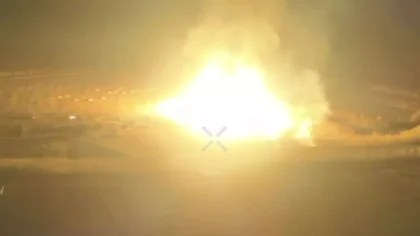
The Sudzha Gas Measuring Station, part of the Brotherhood pipeline supplying Siberian gas to Europe, was damaged in an explosion, just two days after a halt in attacks on energy infrastructure was agreed under US mediation. Sputnik asked a veteran security affairs expert how the attack will impact regional energy security.
“This is a tragic, tragic black comedy from the Ukrainian side to organize some kind of attack [on] the Sudhza gas pipeline,” Slovak Brig. Gen. (ret.) and ex-military attaché Jozef Viktorin told Sputnik, commenting on the March 20 incident.
“For me, it’s not really part of [the broader] military conflict. This is some kind of terrorist activity from the Ukrainian side,” Viktorin said, emphasizing that the consequences of the attack “will be a big problem” not only for Slovakia, but all of Europe, in terms of energy security.
Before the conflict began in 2022, Sudzha, a natural gas exchange feeder in the Brotherhood network, was able to help pump up to 32 billion cubic meters (1.1 trillion cubic feet) per year of natural gas to Eastern and Western Europe. Deliveries slowed after fighting began, and halted completely in December 2024 after Ukraine refused to renew the contract.
Following the March 20 attack, which mirrors previous Ukrainian and NATO sabotage operations targeting Russian pipeline infrastructure like the Togliatti-Odessa Ammonia in Kharkov Region and Nord Stream 2 in the Baltic Sea, it’s unclear when or if the pumping station can be restored to working conditions.
“This is about Europe. Europe and European leaders have to understand that it’s only a question of time when to start to negotiate with Russia,” Viktorin emphasized. “They will have to talk because the question of dialog between the two sides is so important for the future.
In this regard, “Ukraine will not dictate [the] steps for negotiations of Russia and Europe,” and it’s best for the Europeans to remember that, no matter their current attitudes, the observer summed up.
‘They need new eyes’: IAEA accused of bias over strikes at Europe’s largest NPP
RT | March 22, 2025
A group of international journalists that recently toured Russia’s Zaporozhye Nuclear Power Plant (ZNPP) have accused Ukraine of being the one targeting the facility. They also questioned the International Atomic Energy Agency’s (IAEA) persistent refusal to identify the source of the attacks.
The ZNPP, Europe’s largest nuclear power station, has been under Russian control since March 2022 and is located in a region that later voted to join Russia following a public referendum. The plant’s operations are now overseen by Russian state-owned nuclear power company Rosatom. According to the Russian Defense Ministry, the facility and nearby city of Energodar have come under frequent attacks by Ukrainian drones and artillery. Despite this, the IAEA, which has maintained a permanent monitoring mission at the site since September 2022, has consistently declined to name the party responsible for the shelling.
Speaking with RT after touring the facility, reporters from a number of countries, including India, Serbia and Slovenia, voiced concerns over what they said was a clear distortion of facts by Western media and the IAEA’s refusal to acknowledge the reality on the ground.
“We should never trust any Western sources… Ukrainians are playing with nuclear fire,” said Serbian journalist Miodrag Zarkovic, who criticized the IAEA’s insistence on neutrality. Indian journalist Manish Kumar Jha said the evidence he saw contradicted everything he had read in Western outlets.
“According to Western media, the Russians are attacking the plant. But when I visited, I saw the Russian security forces positioned to keep the plant safe,” Jha said, noting that he saw a fragment of a US-supplied missile near the plant. “It was a 180-degree shift. The reality is very different from the story the Western media tells.”
Slovenian journalist and blogger Mohar Borut Iztok criticized the IAEA’s stance, noting the presence of NATO-supplied 155-millimeter shells with clear markings among those that have recently struck the facility.
“I’d like to say to Mr. [Rafael] Grossi and his crew – if they need an extra set of eyes, we can help them because it’s very interesting how they cannot see what is going on,” he stated sarcastically.
“I know what the problem is. They have an agenda, a narrative to follow, so they try to stay neutral,” he added.
Azov Gaining Power is ‘Symptom of Collapse’ of Remains of Ukraine’s Civil Society
Sputnik – 21.03.2025
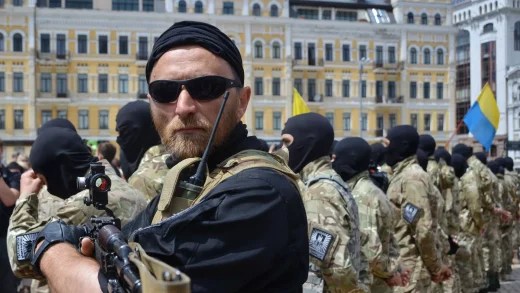
The destruction of the gas pumping station in Sudzha by Ukraine makes it look like Volodymyr Zelensky has “limited control” over the Ukrainian military and “limited to no control” over the neo-Nazi “Azov* forces,” USAF Ret. Lt. Col. Karen Kwiatkowski tells Sputnik.
Due to their belief in their superiority over the rest of the Ukrainian troops, Azov militants “believe that the war was theirs, always, not the politicians, and certainly not Zelensky’s as a propped-up politician who actually ran on enforcing the Minsk II treaty, a ‘peace’ platform.”
“I think Azov, like many effective, violent and nationalistic military groups, disrespect politicians on principle, as compromisers and double dealers. Traditionally, these are the ‘generals’ that the politicians fear, not the other way around,” says Kwiatkowski, a former US Department of Defense analyst.
Thus, there appears to be a danger of Azov exercising the “real political power” in Ukraine.
“It is a symptom of imminent collapse of what is left of Ukraine’s civil and political society, and it underlines the real problem that [US President Donald] Trump will have to face and has not yet — and that is how to help Ukraine recover a liberal and rights-based society at the conclusion of hostilities,” Kwiatkowski says.
“The anger of the Azov will not be quenched, even after Zelensky is gone and a new president elected.”
Stepan Bandera’s Sinister MI6 Alliance Exposed
[Source: ar.inspiredpencil.com]
By Kit Klarenberg | Covert Action Magazine | March 20, 2025
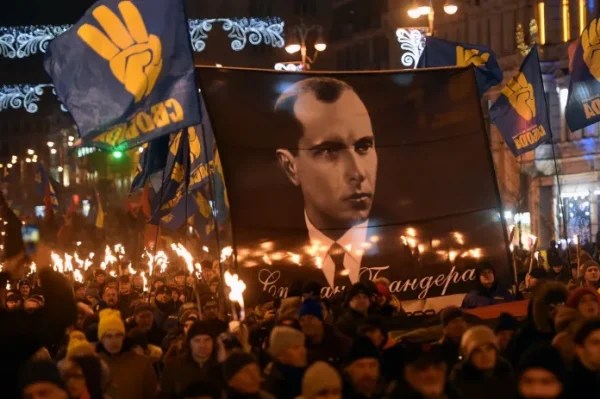
October 15, 2024, marked the 65th anniversary of Organization of Ukrainian Nationalists (OUN-B) and Ukrainian Insurgent Army (UPA) founder Stepan Bandera’s assassination by the KGB in Munich, in then-West Germany.
The date passed without mention anywhere. This may reflect how prior public commemorations of the life and death of Nazi collaborator Bandera—widely credited as the father of Ukrainian nationalism—in Kyiv sparked significant controversy and condemnation across Central and Eastern Europe, particularly neighboring Poland.
The complicity of Bandera and the fascist movements he birthed during World War II is well-documented. His influence over modern-day ultranationalist and Neo-Nazi factions in Ukraine, such as the Azov Regiment, has also been acknowledged in the mainstream media.
Yet, Bandera’s secret Cold War bond with British intelligence has never been seriously explored by Western news outlets. Now, examination of little-known declassified CIA records by CovertAction Magazine exposes the malign contours of a long-running, ruthless conspiracy between Bandera and MI6 to destabilize the Soviet Union.
This dark handshake only expired because MI6’s fascist asset was resistant to joining forces with other Ukrainian anti-Communist forces, therefore jeopardizing plans by Washington and London for all-out war with the Soviets in Donbas. That plot, intended to ultimately collapse the entire USSR, has eerie, direct echoes of the current Ukraine proxy war. So too Britain’s willingness, then and now, to go even further than the U.S. in building alliances with the most reactionary, dangerous Ukrainian ultranationalist elements, in service of balkanizing Russia.
“Bandit Type”
MI6 first contacted Bandera while he was exiled in post-war West Germany in 1948, via Gerhard von Mende. An ethnic German hailing from Riga, Latvia, von Mende has been described as the “enthusiastic Nazi” who headed Berlin’s Reich Ministry for the Occupied Eastern Territory, or Ostministerium. Among other connivances, von Mende was charged with recruiting fifth columnists from the USSR’s Central Asian republics, to undermine and attack Communist authorities. He has been credited with influencing subsequent British and American support for Islamic extremists.

Per a declassified CIA biography, after Nazi Germany’s defeat, von Mende was “interned as a ‘guest’” at the Agency’s Camp King, where Nazi officials and soldiers were interrogated and tortured. In some cases, inmates were unwittingly dosed with LSD under PROJECT BLUEBIRD, a forerunner to the CIA’s notorious MK-ULTRA mind-control program. Subsequently, von Mende became an asset for West Germany’s Nazi-riddled BND, the CIA, and MI6, continuing his spy recruitment in the USSR via a front company.
Through this position, von Mende was kept abreast of UPA activities and capabilities, and maintained an intimate personal relationship with Bandera. The Ukrainian fascist ideologue’s thuggish West German network was by then hard at work killing hundreds of local citizens suspected by the CIA and MI6 of harboring Communist sympathies. While the OUN-B chief’s “ask” of British intelligence was initially judged too high, that perspective rapidly changed. By 1949, MI6 was helping Bandera airdrop his chaos agents into Ukraine.
A year later, Britain’s foreign spy agency began formally training these operatives to gather intelligence and carry out sabotage and assassinations on Soviet soil. This sinister compact was established despite stern CIA and State Department opposition. At this point, the Agency had identified a comparatively moderate alternative to Bandera’s murderous ultranationalist mob, the Ukrainian Supreme Liberation Council (UHVR). The group was led by Ukrainian-Greek Catholic priest Ivan Hrinioch, a “longtime CIA asset” and former high-ranking OUN-B operative Mykola Lebed.
During World War II, Lebed oversaw the UPA’s massacre of tens of thousands of Poles in Volhynia and Eastern Galicia. However, he subsequently disavowed this genocidal carnage, and led UHVR’s push to unite Ukrainian émigrés, who had fractured due to bloody, internecine squabbles toward the conflict’s end. Under the auspices of Operation AERODYNAMIC, for decades the Agency exploited the UHVR to foment “nationalist flare-ups” throughout the Soviet Union, “particularly” in Ukraine, and “encourage divisive manifestations among” the population, to “exert pressure on the Soviet regime.”
By this time, Bandera had fallen out of favor with many Ukrainian nationalists, and was even renounced by what remained of OUN-B’s Kiev-based leadership. This, his genocidal past, and overt anti-U.S. actions and statements due to Washington’s refusal to publicly advocate for Ukrainian independence, all deterred the CIA from employing him. However, MI6 was unperturbed and pushed ahead with its Bandera operations. This created a ludicrous situation, with London and Washington supporting bitterly antagonistic Ukrainian nationalist factions, which frequently undermined and attacked each other.
As a British intelligence memorandum on “the crisis over Bandera” noted, by 1950 Ukrainian nationalist leaders had “become aware of the fact that the British and Americans were backing rival groups,” putting the agencies’ joint anti-Soviet project at risk. It was decided to dispatch a co-signed message to UPA headquarters via Ukrainian CIA and MI6 agents parachuted into Lviv, calling for an end to “present disagreements” between opposing nationalist factions, which London and Washington professed to “deplore and earnestly hope may be resolved.”
It signed off with the now-infamous, Bandera-coined nationalist slogan, “Glory to Ukraine” (“Slava Ukraini”). The memo’s MI6 author, moreover, recalled an in-person meeting they had with Bandera in London. The spy described him thusly:
“Convincing and sincere… a professional underground worker with a terrorist background and ruthless notions about the rules of the game, acquired by hard experience, along with a thorough knowledge of the Ukrainian people… a bandit type if you like, with a burning patriotism which provides an ethical background and a justification for his banditry.”
The MI6 operative cheerfully added that genocidal mass murderer Bandera was “no better and no worse than others of his kind I have had dealings with in the past,” and “genuinely grateful for the help given to him” by British intelligence, “but at the same time is certainly trying to get all he can out of it.” The CIA begged to differ, however, commissioning a study of London and Washington’s conflicting positions on the “Ukrainian underground” and Bandera, and how to resolve this divergence.
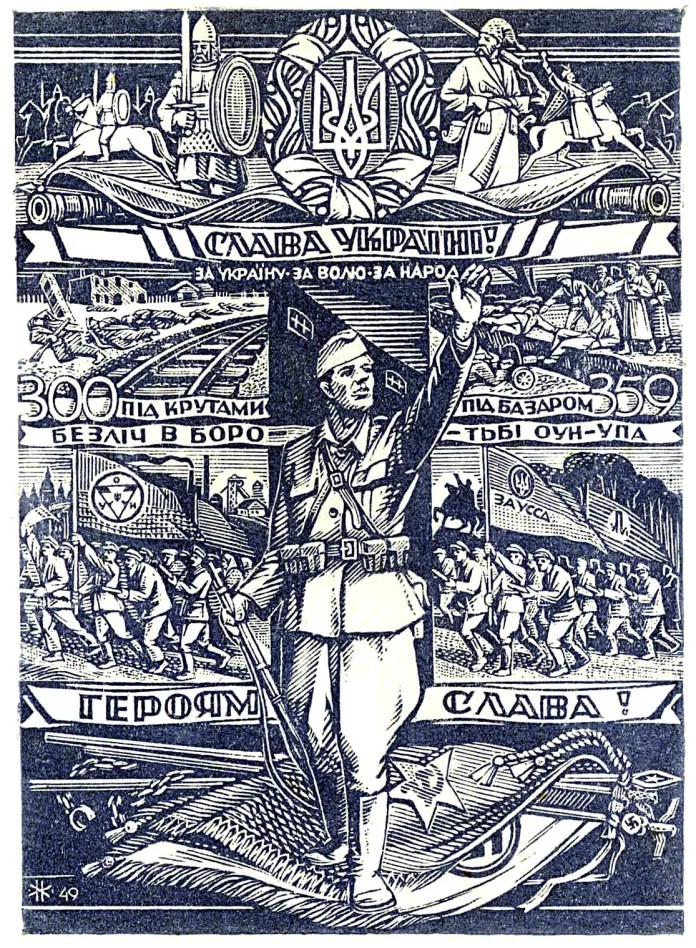
UPA poster from the 1940s. OUN/UPA’s formal greeting is written on two of the horizontal lines “Glory to Ukraine!” “Glory to the Heroes!” The soldier is standing on the banners of the Soviet Union and Nazi Germany. [Source: euromaidanpress.com]
“Political Overtones”
A subsequent appraisal repeatedly declared Bandera and OUN-B to be “completely unacceptable” to the CIA, “both from the political and the operational standpoints.” It proposed the Agency and MI6 take joint ownership of the UHVR and its anti-Soviet wrecking project in Ukraine, and “exchange political, operational and intelligence data resulting from these operations.” Meanwhile, the CIA would “take independent action to neutralize” OUN-B’s “present leadership,” including Bandera himself. It is unknown if this was pitched to MI6, although London’s steadfast opposition was inevitable.
The “British position,” as described in the study, was Bandera’s “importance” had been perennially “underestimated by the Americans, as a rallying symbol in the Ukraine, as leader of a large émigré group [and] as a leader favored by the homeland headquarters.” This did not conform to the reality on the ground as detected by the CIA, but MI6 had a vested interest in maintaining the fascist demagogue as an agent. An April 1951 Agency memo summarizing recent “talks” with British intelligence “on operations against the USSR” noted:
“[MI6 is] seeking progressively to assume control of Bandera’s lines… [MI6 argues] Bandera’s name still carried considerable weight in the Ukraine… [and OUN-B is] the strongest Ukrainian organization abroad, is deemed competent to train party cadres, [and] build a morally and politically healthy organization.”
By contrast, the CIA observed Soviet authorities “had been successful to a remarkable degree in transforming the mentality of the younger generation” of Ukrainians, resulting in them vehemently rejecting Bandera and his brand of rabid nationalism. While the Agency, therefore, favored “political neutralization of Bandera as an individual,” MI6 balked, as this “would lead to a drying up of recruits” and “disrupt British operations.” However, the declassified paper trail shows London eventually tired of their fascist asset.
In February 1954, a senior MI6 official who led liaison with OUN-B for two decades made a “final attempt to bring Bandera to reason” in London, due to the genocidaire’s refusal to reconcile and unite with opposing Ukrainian nationalist elements. The high-ranking British spook offered him “one last chance” to make amends with émigré leaders. Bandera “refused this suggestion with arrogant finality,” thus making “the break” between Bandera and MI6 “complete.”
All British intelligence-run Ukrainian agents who remained loyal to Bandera were duly jettisoned. MI6 informed other nationalist leaders the agency “would not resume” its relationship with him “under any circumstances.” Bandera remained exiled in Munich, West Germany, and continued to run belligerent cloak-and-dagger operations against the Soviet Union, while ratcheting up his anti-Western rhetoric. The CIA and MI6 viewed these activities as a significant problem, with no obvious solution.
As CIA records of a January 1955 “joint U.S.-UK conference” put it, despite the “unanimous desire” of British and American intelligence to “‘quiet’ Bandera,” it was equally vital the KGB was “not allowed to kidnap or kill him.” This could make Bandera “a martyr” among Ukrainian ultranationalists, a prospect to be avoided if at all possible. Hence, London and Washington kept him alive and well, while permitting West Germany’s BND to run him as an agent. Their old friend Gerhard von Mende was his handler.
West German authorities wished to punish Bandera and his in-country network for crimes including kidnapping, but von Mende consistently intervened to insulate his compatriot from prosecution. A July 1959 CIA report noted the BND’s use of Bandera was such a “closely held” secret within the agency, it was not even formally cleared with the West German government “due to political overtones.” Despite this omertà (code of silence), the BND moved to secure Bandera a U.S. visa.
It was hoped he would connect with Ukrainian émigrés Stateside, while ingratiating himself with the CIA and State Department. Per an October 5, 1959, Agency memo, the BND believed “it should be a simple matter” for the CIA “to influence the issuing of a visa” for Bandera, as “many less desirable and less ‘exploitable’ individuals” had already visited the country via Agency assistance. A formal request was submitted to Washington. Just ten days later, though, the KGB finally caught up with him.
Despite their mutual wish that Bandera not be “martyred” by Soviet intelligence, it is likely that the CIA and MI6 breathed a collective sigh of relief upon hearing of his death. The OUN-B and UPA founder’s destabilizing, disruptive influence within the Ukrainian anti-Communist underground was a significant impediment to Anglo-American spying agencies’ implementation of a far grander plan than has hitherto been tried. Namely, fomenting all-out war against the Soviet Union, using Ukrainian ultranationalists as foot soldiers.
This is the first instalment of a two-part investigation. Stay tuned.
EU capital flight tops $300 billion – European Council president
RT | March 21, 2025
Capital outflow from the EU has reached €300 billion ($325 billion) annually as retail and institutional investors move their money into assets outside the region, European Council President Antonio Costa has announced.
The statement comes as the bloc is considering doubling its military aid to Ukraine and continues to pledge billions of euros in financial assistance to Kiev.
Speaking to reporters following the EC meeting on Thursday, Costa said that officials in Brussels are seeking to avoid capital flight by reducing energy costs that have already soared to their highest level in two years, hitting major industries and companies.
“As of today, around €300 billion of EU families’ savings flow out of European Union markets each year,” Costa said, acknowledging that business as usual is no longer an option for the bloc. “There is €300 billion that don’t fund businesses in the European Union.”
Among the steps aimed at luring investors back to the bloc, Costa mentioned slashing what Brussels calls “unnecessary” red tape by 25% for all EU companies and by 35% for small and medium-sized businesses.
The multibillion-dollar capital outflow comes at a time when the EU is pushing to maintain funding for Ukraine. The effort is driven by growing concerns in Brussels that US President Donald Trump could stop the flow of American arms to the government of Vladimir Zelensky.
Earlier this week, EU foreign policy chief Kaja Kallas proposed a hawkish plan that would double the bloc’s cashflow to Kiev for the year, making it €40 billion ($43.7 billion).
On Thursday, Hungary, which has long been critical of EU military assistance to Ukraine, refused to sign a joint EU communique calling for increased funding for Kiev.
Hungarian Prime Minister Victor Orban said that the EU is broke, as it has spent “all of its money” and realistically “doesn’t have a single penny left” to support Ukraine amid its conflict with Russia.
Ukraine Deliberately Blows Up Sudzha Gas Distribution Station on March 20
Sputnik – 21.03.2025
The Ukrainian armed forces deliberately blew up the Sudzha gas distribution station on March 20, leaving the facility significantly damaged, Russian Investigative Committee spokeswoman Svetlana Petrenko told Sputnik on Friday.
“A criminal case has been opened in connection with the explosion of the Sudzha gas distribution station by the Ukrainian armed forces’ servicepeople. The Main Military Investigative Department of the Russian Investigative Committee has opened a criminal case on the grounds of a crime … [over a terrorist act],” Petrenko said.
On March 20, Ukrainian servicepeople, who illegally invaded the territory of Russia, carried out a deliberate explosion of the Sudzha gas distribution station, as a result of which the facility received significant damage, the spokeswoman said.
The investigation will identify and hold accountable all those involved in this crime, the Investigative Committee emphasized.
There were no casualties or injuries among the civilian population from the explosion, clarified an emergency services representative to Sputnik. He added that experts have already begun assessing the consequences of the terrorist attack.
Kremlin Press Secretary Dmitry Peskov noted that the bombing of the Sudzha station revealed how much faith can be placed in the words of Vladimir Zelensky and his team.
Gas transit through the Sudzha station continued until the beginning of this year, when it stopped due to Kiev’s refusal to extend the transit agreement. This route remained the last one for Russian gas supplies to Europe via Ukraine.
On Tuesday, Russian President Vladimir Putin spoke by phone with his American counterpart, Donald Trump. According to the Kremlin press service, they discussed resolving the Ukrainian conflict and expressed mutual interest in normalizing relations. Among other things, Putin responded positively to the idea of a mutual 30-day halt to strikes on energy infrastructure and gave the corresponding order to the military.
Later, Volodymyr Zelensky stated that Ukraine would support the proposal to cease attacks on energy infrastructure. However, just hours after the talks between the Russian and US leaders, the Kiev regime attacked the Kavkazskaya oil pumping station in Russia’s Krasnodar region with three drones. The station is involved in transferring oil from railway tankers to the pipeline system of the international Caspian Pipeline Consortium.
The Ministry of Defense noted that such actions by the Ukrainian leadership are aimed at deliberately undermining Trump’s peace initiatives. Peskov stated that this attack is the best proof of the Kiev regime’s lack of willingness to negotiate, and this raises concerns.
Russian forces, following Putin’s command, ceased all strikes and even shot down seven of their own drones that were already en route to attack targets in the Nikolayev region of Ukraine.
Who is opposing peace in Ukraine?
By Dmitri Kovalevich – Al Mayadeen – March 20, 2025
March 2025 marks the beginning of a fourth year of the military conflict in Ukraine. Kiev, its sponsors in Europe and the United States, are proving unwilling to end the war being waged despite mounting evidence they are facing a major political and military defeat.
Zelensky vs Trump?
The five-year, electoral mandate dating from May 2019 of Volodymyr Zelensky as president of Ukraine expired ten months ago. Yet on February 28, Zelensky staged a widely publicized quarrel with the new US administration in Washington headed by Donald Trump. The administration reacted, in turn, with a dramatic suspension of US arms shipments and sharing of intelligence and satellite data. Without this data, Ukrainian troops are ‘blinded’ because US military specialists have played a key role in helping choose Russian targets and helping operate complex rocket and missile weaponry. Particularly valuable are the images provided, with US government approval, by US commercial satellite imaging company Maxar.
The ‘suspensions’ were very short-lived. A meeting in Saudi Arabia on March 11 between the Kiev government and the Trump administration saw a renewal of the briefly-disrupted partnership between the two after its brief interruption in supplying military data and equipment. The meeting issued a proposal to Russia (better described as a threat) prepared in advance by Washington for a 30-day ‘ceasefire’. Critics in Russia and abroad say the proposal would allow the Ukraine Armed Forces to rest and regroup. If Russia turned it down, the Western powers could then condemn it for refusing peace.
Every serious analyst is pointing out that the ceasefire proposal does not at all address Russia’s well-publicized minimum conditions for a peace settlement. In other words, the plan is something of a trap for Russia. For that reason, it will not see the light of day.
Zelensky was absent from the Ukraine delegation in Saudi Arabia. He remains apprehensive over the prospect that Trump may wish to replace him and could do so at any time. Ukrainian political analyst Kost Bondarenko, who now lives abroad, explained on Telegram on March 4 that Zelensky is no longer listening to anyone, including those in his personal entourage. “He is acting hysterically and capriciously, recognizing only his own claimed righteousness. He doesn’t even listen to Yermak [head of the Office of the President of Ukraine]. His egocentrism has made Ukraine hostage to his whims.”
Europe benefits from the war
Zelensky is seeking more support from his patrons in the European Union and becoming more dependent on them, especially on the government of Great Britain. The latter continues to encourage him to sacrifice the people of Ukraine in a losing war against Russia.
Former Ukrainian (now Russian) political scientist Rostislav Ishchenko said in an interview on March 7 that the only difference between the Trump regime in Washington and the leading governments of the European Union is that ‘liberal’ Europe wants a consolidated West under a ‘liberal’ image while the right-wing, conservative Trump regime wants a united West focused on weakening and paralyzing Russia while simultaneously weakening China.
“Trump’s goal is not to make life easier for Russia. Trump’s goal is to get a peace that is acceptable to America. So far, everything that Trump formulates is absolutely unacceptable to us.”
Another former Ukrainian and now Russian political analyst Andrey Vajra told a Crimea news broadcast in February that the war in Ukraine has helped the European elites to appropriate billions of euros. “Europeans understand perfectly well that the war is lost. But the European elite needs to continue stealing [from weapons supplying and the multitude of forms of ‘aid’]. I have already explained how it is possible to continue stealing billions of euros so long as the killings continue in Ukraine. Far more millions of euros can be had. That’s why the European leaders are clinging to a warmaking Ukraine.”
In early March, the head of German intelligence, Bruno Kahl, stated in an interview with the state-run Deutsche Welle that it would be ‘safer’ for Europe if the war in Ukraine continued for another five years. He criticized the Trump administration, saying the kind of swift end to the war being voiced by Trump “would enable the Russians to focus their energy against Europe”. This suggested ‘long war’ against Russia is the new, official theme of EU leaders as they strive to convince their populations of the need to massively expand military spending.
Even former prime minister Yulia Tymoshenko (2007-2010) of the Batkivshchyna faction in the Ukrainian legislature says she is outraged by Kahl’s frank admission. “Bruno Kahl for the first time officially confirmed what we were so reluctant to believe: At the cost of thousands of Ukrainian lives and the very existence of Ukraine, some people decided on a war to ‘deplete’ Russia and thereby enhance the security in Europe? I did not think that they would dare to say it so officially and openly. This explains a lot,” Tymoshenko doth protest too much. She was a key fomentor of the violent, Maidan coup in February 2014 and an ardent advocate since then of military and political confrontation with Russia.
Danish Prime Minister Mette Frederiksen has also stated that a peace agreement could be more dangerous for Ukraine than an ongoing war. “I understand that many people believe that a peaceful solution or a ceasefire is a good idea, but we run the risk that peace in Ukraine would actually be more dangerous than the war that is ongoing now.”
Such pro-war stances are not only due to the fact that Western companies are getting rich on fulfilling military orders. A permanent war in Ukraine appeals to many Western leaders because this would weaken and pre-occupy Russia. “Israel” has long acted on the same principle in the Middle East. It has waged bloody wars in Syria, Iraq, and Lebanon to weaken these countries and prevent them from doing anything to stop “Israel’s” genocide against Palestinians and its occupation of Syrian territory.
Those who justify continued war in Ukraine make two contradictory assertions. On the one hand, they argue that the war has greatly weakened Russia and that the government there may soon collapse. Ukrainians should therefore fight just a little longer to secure ‘victory’. On the other hand, they say that Russia has become too strong and is a threat to overrun more European countries in the future. Ukrainian social networks have coined an ironic term for this contradictory belief system, calling it ‘Russophrenia’ (derived from the word ‘schizophrenia’).
The end of Ukraine’s adventure in Kursk
Disaster has befallen the Ukraine Armed Forces present in the Kursk border region of Russia. Large numbers of Ukrainian troops have become encircled—as many as 10,000 according to some Western media outlets. A March 8 report in a Ukrainian media outlet nervously reassured that the situation in Kursk “is not yet catastrophic”.
The Ukrainian military command did not issue any orders to retreat from threatened encirclements in Kursk. This repeats the experiences with earlier military encirclements in Donbass. These have allowed the Russian army to make steady and continued military advances there.
As reported by the online Politnavigator on March 7, a former advisor to the office of Zelensky, Alexei Arestovich, sees a familiar pattern to events in Kursk. “In dire conditions where encirclement is threatened, only the introduction of reserve troops can help. So we [the Ukraine Armed Forces] proceed as usual: drop in a few reserves removed from other threatened locations. These will most likely be unable to stabilize for any length of time because there are few reserves to draw upon. No one is left. Even worse is to keep the army in encirclements or threatened encirclements for too long, waiting for the political leadership to give an order to retreat. But those orders do not come. This scenario has repeated itself over and over again. We need to stop playing by such scenarios.”
Arestovich lives in exile somewhere in Europe and has said he would be a candidate in a forthcoming election for president of Ukraine should a free election take place.
On March 8-9, Russian troops managed rather easily to contain the remaining Ukrainian forces in Kursk Oblast and cut off re-supply routes. This was partly helped by the spring thaw because Western-supplied military equipment becomes booged down in mud; it is designed primarily for use on paved or improved gravel roads.
Ukrainian opposition blogger Anatoliy Shariy writes that the losses of the AFU in Kursk are huge – some of the biggest losses that Ukrainian servicemen can remember.
The Ukrainian grouping in Kursk was centered around the border town of Suzdha. It is the site of an important pumping and transit station for a natural gas pipeline built during the Soviet era which connects the vast gas fields of eastern Russia to markets in Ukraine and further west in Europe. In January, Ukraine shut down pipeline shipments through Suzdha, drawing sharp protests and threats of counter-measures from Hungary and Slovakia.
An ironic consequence of Ukraine shutting down the pipeline was that Russian soldiers were able to use the now-empty pipeline to advance some 15 kilometers directly into the center of the Ukrainian grouping in Suzdha. They waited days for orders. Russia then surprised and overwhelmed the embedded Ukrainian forces with a multi-pronged attack beginning on March 8. Many Ukrainian soldiers and allied mercenaries ended up stampeding into surrounding minefields.
Russian military correspondent Anna Dolgareva spoke to Russian military scouts in Suzdha and reported, “For six days, the Russian fighters sat inside the pipeline awaiting orders to move. They spent some 24 hours of difficult walking to get there. The pipeline still contained traces of methane gas and so holes were cut in the pipe along the way for ventilation.”
This operation was made possible because Ukraine shut off gas transit causing European countries to buy much more expensive liquefied gas from producers in the United States. Western sanctions against Russia have cost Europe its supply of relatively cheap Russian gas, replaced by shipments of expensive liquefied natural gas from the United States as well as gas from Norway and Algeria shipped by pipeline.
Ukrainian elite on ‘starvation rations’
Representatives of the Ukrainian political elite are today extremely worried about Zelensky’s quarrel with the new US administration that exploded into view in Washington on February 28. For most, funding from the United States is their main source of income.
Since the early 1990s, Ukraine has developed an entire class of government officials and politicians who have ‘monetized’ Russophobia and anti-communism. A key piece of moving up the career ladder has been to act the loudest in stigmatizing the former Soviet Union and modern Russian Federation, and figuring out how best to draw Western funding for such efforts. This scheme has worked well for decades, but now the apparent chaos being sown by the new Trump regime in Washington has upset the old arrangements. The chaos is merely the expression of a governing U.S. regime facing a looming defeat of its proxy war in Ukraine along with its European partners.
Some legislators realize that Zelensky’s harsh outbursts and confrontation with Trump and Trump’s vice president in Washington on February 28 could cost the country dearly, but others are betting on maintaining an aggressive, pro-war rhetoric. They are looking to the British government to help out.
Alexei Arestovich writes that Zelensky’s ‘disobedience’ is based solely on his desire to extract security guarantees for himself and his entourage. He says the problem for the White House is that “providing personal guarantees to thieves risks setting yourself up before American justice.”
Ukrainian economist Oleksiy Kushch writes that for the Ukrainian elite, the era when it could act as a child and demand money from the ‘adult uncles’ in the West is coming to an end. The West is so used to that arrangement that Zelensky’s apparent conflicts with the U.S. administration are bewildering, a kind of ‘revolt against the boss’.
Kushch summarizes Ukraine’s situation after Zelensky’s quarrel with Trump in this way, “Like a teenager who ‘unexpectedly’ has a child and finds all responsibility now rests on him, ‘daddy’ U.S. may threaten to stop helping out as punishment for any ‘disobedience’ while ‘mommy’ Europe promises to continue giving money but not forever.”
The Ukrainian elite has been thoroughly corrupted by years of generous Western ‘aid’ handouts. It no longer knows how to earn revenue and wealth on its own. So if some character named Zelensky becomes an obstacle to the continued flow of ‘daddy’s’ money, he becomes expendable. So much the worse for him.
Peace Negotiations & the End of NATO
Prof. Jeffrey Sachs with Prof. Glenn Diesen
Glenn Diesen | March 18, 2025
The US and Russia negotiate an end to the proxy war in Ukraine: What is realistic to expect, how can Europe’s bellicose reactions be explained, and is this the end of NATO?
Kremlin releases Putin-Trump phone call summary (FULL STATEMENT)
RT | March 18, 2025
Russian President Vladimir Putin and his US counterpart Donald Trump have held a phone conversation lasting over two hours, discussing a peaceful resolution to the Ukraine conflict.
The Kremlin reported that the two leaders spoke about a suggested 30-day ceasefire, a prisoner exchange, and maritime security, with Putin responding positively to Trump’s proposals. Both leaders expressed interest in normalizing US-Russia relations, agreeing to continue discussions on global security, economic cooperation, and even cultural exchanges like NHL-KHL hockey matches.
The Kremlin has published a summary on the outcome of the call:
A phone conversation between Vladimir Putin and US President Donald Trump took place on March 18, 2025.
Reaffirming his commitment to a peaceful resolution of the conflict, President Putin expressed readiness to work closely with American partners on a thorough and comprehensive settlement. He emphasized that any agreement must be sustainable and long-term, addressing the root causes of the crisis while considering Russia’s legitimate security interests.
Regarding President Trump’s initiative for a 30-day ceasefire, the Russian side highlighted key concerns, including effective monitoring of the ceasefire across the entire front line, halting forced mobilization in Ukraine, and stopping the rearmament of its military. Russia also noted serious risks due to Kiev’s history of undermining previous agreements and drew attention to terrorist attacks carried out by Ukrainian militants against civilians in the Kursk region.
It was emphasized that a crucial condition for preventing further escalation and working toward a political-diplomatic resolution is the complete cessation of foreign military aid and intelligence sharing with Ukraine.
In response to Trump’s recent request to ensure the safety of Ukrainian troops encircled in Kursk Region, Putin confirmed that Russia is guided by humanitarian considerations. He assured his counterpart that Ukrainian soldiers who surrender will be granted safety and treated in accordance with Russian laws and international humanitarian norms.
During the conversation, Trump proposed a mutual agreement between both sides to refrain from striking energy infrastructure for 30 days. Putin welcomed the initiative and immediately instructed the Russian military to comply.
Putin also responded constructively to Trump’s proposal regarding maritime security in the Black Sea, and both leaders agreed to initiate negotiations to further refine the details of such an arrangement.
Putin informed Trump that on March 19, Russia and Ukraine would conduct a prisoner exchange involving 175 detainees from each side. Additionally, as a goodwill gesture, Russia will transfer 23 severely wounded Ukrainian soldiers who are currently receiving medical treatment in Russian hospitals.
Both leaders reaffirmed their commitment to continuing efforts toward resolving the Ukraine conflict bilaterally, incorporating the proposals discussed. To facilitate this, Russian and American expert groups will be established.
Putin and Trump also discussed broader international issues, including the situation in the Middle East and the Red Sea region. They agreed to coordinate efforts to stabilize crisis areas and enhance cooperation on nuclear non-proliferation and global security, which, in turn, would improve the overall state of US-Russia relations. A positive example of such cooperation was their joint vote at the United Nations on a resolution regarding the Ukraine conflict.
Both leaders expressed mutual interest in normalizing bilateral relations, recognizing the shared responsibility of Russia and the United States in ensuring global security and stability. In this context, they explored various areas for potential cooperation, including discussions on mutually beneficial economic and energy partnerships.
Trump supported Putin’s idea of organizing hockey matches in the US and Russia between players from the NHL and KHL.
The presidents agreed to remain in contact on all discussed matters.
Trump, Putin agree on ‘energy and infrastructure ceasefire’ – White House
RT | March 18, 2025
US President Donald Trump and Russian President Vladimir Putin have agreed that the first step towards ending the Ukraine conflict should be an “energy and infrastructure ceasefire,” White House Press Secretary Karoline Leavitt has revealed. The leaders reached the agreement during a 2.5 hour phone conversation on Tuesday.
According to the readout of the phone call published on X by Leavitt on Tuesday, both leaders concur that the conflict must conclude with a lasting peace. They also emphasized the importance of strengthening bilateral relations.
“The leaders agreed that the movement to peace will begin with an energy and infrastructure ceasefire, as well as technical negotiations on implementation of a maritime ceasefire in the Black Sea, full ceasefire and permanent peace,” the transcript reads.
The Kremlin has confirmed that Putin supported Trump’s proposal for Russia and Ukraine to halt strikes on energy infrastructure for 30 days, and instructed his military accordingly.
According to the readout, Moscow and Washington have agreed to hold relevant negotiations “immediately in the Middle East.”
Aside from Ukraine, the two heads of state are said to have discussed the situation in the Middle East as well as potential cooperation with a view to preventing future conflicts in the region.
Another topic high on the two leaders’ agenda was the “need to stop proliferation of strategic weapons” globally, according to the White House press secretary.
“The two leaders agreed that a future with an improved bilateral relationship between the United States and Russia has huge upside,” including but not limited to “enormous economic deals and geopolitical stability,” the readout concludes.
Featured Video

ARE PATIENTS BEING PROPERLY INFORMED ABOUT OZEMPIC?
or go to
Aletho News Archives – Video-Images
From the Archives
Trans ‘milk’ as good as the real thing – NHS
RT | February 18, 2024
The drug-induced nipple secretions of trans women are as good as mothers’ breast milk for babies, the University of Sussex Hospitals NHS Trust claimed in a letter to campaigners made public in a report by British think tank the Policy Exchange on Sunday.
The healthcare trust’s medical director, Rachel James, argued that the off-label prescription drug cocktail men transitioning to female take in order to produce milk was “similar to the natural hormones which encourage lactation to develop when the baby is newly born.”
“The evidence which is available demonstrates that the milk is comparable to that produced following the birth of a baby,” James wrote in the letter, sent to Children of Transitioners last August.
Biological men who wish to lactate must first take hormones to grow milk glands and then take high doses of either domperidone or metoclopramide to stimulate milk production. Neither drug is approved for this use, though they are occasionally prescribed off-label to biological women who have trouble lactating.
However, domperidone’s own manufacturer, Janssen, warns patients the drug “may cause unwanted side effects affecting the heart in a breastfed baby” and “should be used during breastfeeding only if your physician considers this clearly necessary.” … continue
Blog Roll
 Aletho News
- 2025 Nature Paper Claiming Worsening Global Drought Gets RETRACTED …Heavily Flawed
- Your Milk Is Not the Problem
- The Truth About the Trump Shootings with Ken Silva
- ARE PATIENTS BEING PROPERLY INFORMED ABOUT OZEMPIC?
- US lawmaker blocks $2.8 billion weapons sale to Israel: Report
- Yemeni army claims responsibility for strikes on sensitive sites in Saudi capital, Aramco facilities in Yanbu
- Iran Judiciary issues indictments against 159 US, Israeli officials for assassination of Leader, commanders
- Turkiye revokes Iranian bank license under US sanctions campaign
- US-Denmark Agreement on Greenland Is ‘PR Stunt’ Ahead of Midterms
- Araghchi: Military intervention cannot create security; coercion cannot bring peace
- If Americans Knew
- Israeli attacks kill four Palestinians in Gaza – Daily Update
- Inside Gaza’s death trap of collapsing, bombed-out buildings
- The everyday items Israel bans from Gaza every day
- Inside the siege, the ruined buildings of Gaza – Daily Update
- Debunking The Claim That Macklemore Has A “History Of Antisemitism”
- CPJ demands release of arrested Palestinian-US journalist near Bethlehem
- Robert Kraft: The Billionaire Friend of Netanyahu Pulling The Strings Behind the Macklemore/Ed Sheeran Blow Up
- Columbia Administered Fund Gives Big Money to Pro-Israel Groups
- Deportation Case of Palestinian Activist Salah Sarsour Tests First Amendment
- ‘We Will Not Forget’: Palestinians Mark 44 Years since Sabra and Shatila
- No Tricks Zone
- 2025 Nature Paper Claiming Worsening Global Drought Gets RETRACTED …Heavily Flawed
- New Study: ‘Global Drought Shows No Detectable Recent Acceleration Under Climate Warming’
- Economic Masterminds: German Socialists Suggest Taxing Productivity Gains Stemming From Using AI
- The South China Sea Has Not Been Cooperating With The Climate Change Narrative
- Energy Crisis: Germany Enters Heating Season With Historically Low Gas Reserve Fill Levels
- New Study: The Antarctic Ice Sheet Gained Mass From 2020-2024 Due To Staggering Snow And Ice Accumulation
- Study: Ocean Heating Rates From Thousands Of Years Ago ‘Dwarf’ Modern Ocean Heating Rates
- Climate Extremists Target, Attack Large-Scale Power Grid Infrastructure In Germany!
- New Study: Antarctic Ice Melt Has Contributed Less Than 1 Centimeter To Sea Level Rise In The Last 30 Years
- Fear Of Debate: Alarmist German Climate Scientist Calls On Mainstream Media To Discredit Skeptic Voices
 Aletho News