Eight Ways That Trump May Force Zelensky to Resign
By Ekaterina Blinova – Sputnik – 03.03.2025
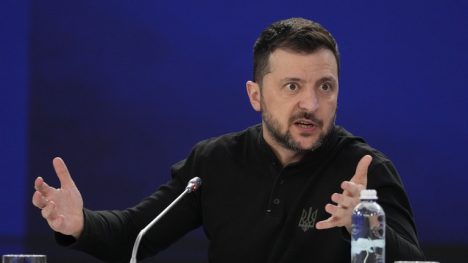
Following the Oval Office showdown, US National Security Advisor Mike Waltz has suggested that Volodymyr Zelensky might have to step down to enable a US-Ukraine deal. But as Zelensky refuses, what leverage does President Donald Trump hold over him?
Direct Pressure Tactics
- Cutting all aid. Without US support, Zelensky may have no choice but to resign and be replaced by someone willing to negotiate peace, says ex-CIA officer Philip Giraldi.
- Sweeping audit of US aid. A deep probe into Ukraine’s use of US funds could expose corruption and “neutralize” Zelensky, according to ex-Ukrainian MP Oleg Tsarev.
- Freezing Zelensky’s cash. Blocking foreign accounts of Zelensky and his team could undermine the Kiev regime, Tsarev suggests.
Shutting down Starlink. Three sources told Reuters that Team Trump may cut Ukraine’s access to Elon Musk’s satellites, a move the White House has already reportedly threatened. - Zelensky’s expired legitimacy. His presidential term ended in May 2024, making all actions since then legally questionable. Trump could challenge his right to govern.
Trump’s Indirect Leverage via Europe
- Pressuring European allies. Europe remains dependent on the US, writes economist Dr. Paul Craig Roberts. With no weapons left to send and money-printing its only option, Trump could force its hand.
- NATO withdrawal threat. Trump may pull US security guarantees from warmongering European states throwing sand in his gears or even threaten a NATO exit, warned ex-Pentagon officer David Pyne. That could motivate Europe to rein Zelensky in.
- Tariffs on Europe. A 25% tariff on EU imports could cost 1.5% of EU GDP, per Bloomberg. Trump already threatened this, claiming the EU was created to “screw the US”.
US puts firewall to protect Ukraine deal with Russia
By M. K. BHADRAKUMAR | Indian Punchline | March 3, 2025
The verbal shootout at the Oval Office last Friday brought out President Vladimir Zelensky’s fury that Donald Trump and Vladimir Putin are very close to a deal on Ukraine, while the conclave in Lancashire House in London on Sunday involving 18 European leaders messaged that Zelensky is in good company.
Connecting the dots, the incisive mind of Stephen Bryen, a leading expert on security, strategy and technology who previously held senior positions in the Pentagon and Capitol Hill, wrote on Substack: “Trump invited [French president] Macron and [UK prime minister] Starmer to Washington to brief them, which he apparently did. The French went away fairly unhappy, but Starmer seemed to be in general agreement. Starmer made a pitch to include Article 5 and NATO in any deal; Trump rejected that appeal. Putin, meanwhile, talked to [Chinese president] Xi by telephone and sent Sergei Shoigu (who heads Russia’s Security Council, something like the NSC) to Beijing to meet with Xi.
“Trump invited Zelensky. The cover for Zelensky’s appearance in Washington was the “Minerals Deal” which the two leaders were supposed to sign… The real reason for the Zelensky visit was to brief him on the Putin negotiations and to gain his support.”
In the event, Trump could neither brief Zelensky on the Ukraine deal nor sign the “Minerals Deal” because the Ukrainian president took great exception to any negotiations with Putin. He did this in public, to Trump’s face, and in front of the press. The result was there was no private meeting and Trump told Zelensky, “he would be welcomed back only when he was ready for peace.”
This is where things stand. The strategy session that Trump is due to take later today with his top advisors will signal what happens next. There is a strong likelihood that Trump may cut off arms deliveries and/or financial assistance to Ukraine.
Now that the Rubicon has been crossed, Trump is unlikely to change course on Russia — unless, of course, Zelensky falls in line in abject surrender, which seems unlikely too. Russians of course welcome his ouster.
It is highly unlikely that Trump will be cowed by the temper tantrums of the EU or impressed by Britain’s grandstanding. Germany is without a government for the next several weeks; it weakens the Europeans’ punch.
Indeed, the back channel communication between Moscow and Washington has gained traction. Moscow assesses that Trump has the upper hand. This is reflected in the growing optimism in Putin’s remarks last Thursday while addressing the Board of the Federal Security Service (collegium of Russia’s top foreign intelligence officials.)
Putin began by saying that the world and the international situation are changing rapidly and “the first contacts with the new US administration inspire certain hopes.”
He said: “There is a reciprocal commitment [with Trump] to work to restore interstate relations and to gradually address the enormous amount of systemic and strategic problems in the global architecture which once provoked the crises in Ukraine and other regions… Importantly, our partners demonstrate pragmatism and a realistic vision of things, and have abandoned numerous stereotypes, the so-called rules, and messianic, ideological clichés of their predecessors.”
Putin estimated that conditions exist for a dialogue “on bringing a fundamental solution to Ukraine crisis… a dialogue on creating a system that will truly ensure a balanced and mutual consideration of interests, an indivisible European and global security system for the long term, where the security of some countries cannot be ensured at the expense or to the detriment of the security of other countries, definitely not Russia.”
However, Putin also flagged that sections Western elites “are still committed to maintaining instability in the world, and these forces will try to disrupt or to compromise the newly resumed dialogue” and, hence it is vital that “every possibility offered by dialogue and special services to thwart such attempts” needs to be leveraged.
Indeed, the New York Times disclosed today that Defence Secretary Pete Hegseth has ordered U.S. Cyber Command to halt offensive operations against Russia “as part of a larger re-evaluation of all operations against Russia.” Equally, reports have appeared that Putin has given similar instructions restraining the Russian agencies.
What lends enchantment to the view is that many of the US’ most sophisticated operations against Russia are run out of Britain’s Government Communications Headquarters, the storied intelligence agency that broke the Enigma codes in World War II. Suffice to say, the US seems to be cutting itself free from longstanding joint operations with Britain directed against Russia.
A Guardian newspaper report has separately corroborated the Times disclosure of a shift in the US policy. It added that the warming of US-Russia relations is apparent also in certain recent other incidents which indicate that the US is “no longer characterising Russia as a cybersecurity threat.”
The paper claimed that analysts in the super secret Cybersecurity and Infrastructure Security Agency (Cisa) of the United States spoke to the Guardian on the condition of anonymity that they were “verbally informed that they were not to follow or report on Russian threats, even though this had previously been a main focus for the agency.”
Quite obviously, a crisis of confidence has arisen in the US-UK “special relationship” — or, to put it differently, the Trump administration is taking steps to sequester the Cisa from rogue operations.
There is a Cold War history of rogue operations by spy agencies. One of the most celebrated cases was the incident on 1st May, 1960 when an American U-2 spy plane piloted by Francis Gary Powers flying [‘unbeknownst’ to Eisenhower] at an altitude of 80,000 feet was shot down over Soviet air space triggering a diplomatic crisis that caused the collapse of a summit conference in Paris between then US president Dwight Eisenhower and Soviet leader Nikita Khrushchev — and the sudden death of the two leaders’ closely nurtured dream of détente.
An analogical situation exists today. Both Washington and Moscow are conscious of it. The need for such a veil of secrecy around the high level dialogue between the Kremlin and the White House is self-evident. There are too many detractors in the collective West who won’t settle for anything short of a Russian defeat in Ukraine and would rather keep the war going.
In such a fraught scenario, on the Russian side, the Kremlin’s writ ultimately prevails despite whatever dissenting voices exist in the military-industrial complex or amongst super hawks with revenge mentality. But that is not the case in the US where remnants of the old regime still hold sensitive positions, as the Guardian report vividly brings out. In the final analysis, therefore, it may well turn out that — to quote Stephen Bryan — Trump “will let Ukraine collapse but may seek a deal with Putin on Ukraine once Zelensky is gone.”
Tulsi Gabbard questions if Ukraine is ‘aligned’ with US values
RT | March 3, 2025
Ukraine and many of its European backers may not be aligned with the US values of freedom, peace, and democracy shared by President Donald Trump, according to Washington’s director of national intelligence, Tulsi Gabbard.
In an interview with Fox News on Sunday, Gabbard was asked about last week’s heated exchange at the White House involving Ukrainian leader Vladimir Zelensky and Trump and his vice president, J.D. Vance. The tense meeting ended with Zelensky abruptly leaving the White House after being accused by Trump of ingratitude, “gambling with World War III,” and refusing to seek peace with Russia.
The incident has sparked a backlash from Trump’s critics, including several EU leaders, who have accused him of “bullying” Zelensky. However, according to Gabbard, anyone who has criticized Trump over his interaction with the Ukrainian leader is merely showing that they are “not committed to peace.”
“Many of these European countries, and Zelensky himself, who claim to be standing and fighting for the cause of freedom and democracy” are actually acting contrary to these values, Gabbard stated.
“When we actually look at what’s happening in reality in these countries, as well as with Zelensky’s government in Ukraine, it is the exact opposite,” she added. Gabbard pointed to the lack of elections in Ukraine, Kiev’s criminalization of opposition parties, the shutting down of Orthodox churches, and the complete government control over media outlets.
“It begs the question. It’s clear they’re standing against [Russian President Vladimir] Putin. But what are they actually really fighting for, and are they aligned with the values that they claim to hold in agreement with [the US], which are the values of freedom, peace and true security,” Gabbard said.
The DNI chief further criticized Washington’s EU partners, recalling Vance’s speech at the Munich Security Conference, where he accused European countries of implementing policies that “undermine democracy” and show that they “don’t actually believe in the voices of the people.”
“We’re seeing this in the United Kingdom, we’re seeing this in Germany, we saw it with the tossing out of the elections in Romania,” Gabbard said, suggesting that this shows a “huge divergence” between US values and those of the European nations that have backed Zelensky.
Russia has also suggested that last week’s clash between Zelensky and Trump once again proved that Kiev is not genuinely interested in peace. Kremlin spokesman Dmitry Peskov has stressed that the Ukrainian leader’s behavior in the Oval Office “demonstrated how difficult it will be to get on the path of a settlement around Ukraine.”
The Sea Change
By Israel Shamir • Unz Review • February 20, 2025
A huge, heavy ship, loaded to the brim, is turning around in narrow straits amid perilous waters. Thus, the world is performing a rare volte face under the daring captainship of Donald Trump and his breakneck mates Elon Musk and JD Vance. They couldn’t have cut it any closer – already we felt the breath of our doom. Whether the peril be nuclear mushrooms or pandemics crafted in Pentagon biolabs, or some other totally unpredicted collapse concocted by Schwab and his ilk – our new captain seems to recognize Scylla and Charybdis. Our fragile life was about to collapse when the young programmers of DOGE dove into deep cellars of hidden data and uncovered the pearls: millions of dollars earmarked for broken Haiti to make a dream home for Chelsey Clinton; millions of social security checks being sent to beneficiaries 150 years old and older; millions earmarked for regime change, for neutering boys and girls, for planting tempest and reaping storm all over the world. And after this brief but tempestuous overture rung, above the furious sounds of battle, the telephone; the telephone call of captain Trump to captain Putin.
God revealed His mercy and tender caring for us, calming the storm at the very last moment. It is a perfect replay of the Cuban Missile Crisis multiplied by a factor of one hundred. The voices calling for global nuclear holocaust were becoming increasingly frequent and shrill recently. Now one can hope they will be pushed back to the fringe. US and Russian delegations meeting again in Riyadh have agreed to restore the normal civilized diplomatic routine: appoint ambassadors, open missions, increase tenfold the embassy staff. Since Obama’s days the embassies had been run down to the bare minimum.
Immediately the Economist and similar rags have tried to spoil the mood. The Ukrainian crisis has not been solved yet, the war still goes on, they cry. Trump can’t be relied upon, they fume impotently. I always rely upon the Economist as a perfect inverse barometer; whatever they say we may consider pure enemy hasbara. They show Trump talking to Putin with the text “The worst nightmare of Europe”. For me, the worst nightmare would be ruins of Gaza or nuclear waste of Hiroshima, for them, peace would be the worst.
Our enemies do not want us to rejoice ever, but these are the days we could and should be glad. The Ukrainian war is a minor event compared with such a worldwide tectonic shift. The West has tried to isolate, break and consume Russia for many years, once it became aware that Putin is not a new Yeltsin, that he is a stubborn, strong-willed leader, a man like Hamlet: though you can fret him, you cannot play upon him. And ever since that time, over many years, Russia has suffered in isolation, while all the world press blamed Putin and incited legions of tiny dogs from Estonia to the Ukraine to bite him. Such conflict was inevitable because Russia and the West had different interpretations of 1991. For the West, it was the final defeat of Russian independence. For Russia, it was a lesson learned. Never again will Russia attempt to play by Western rules. So how could anyone solve such an intractable divergence of opinion? It took just one call from Donald Trump.
The Ukraine war is a small thing in comparison: Russia wants its seat at the table with the big boys, it wants to be safe, not besieged. Russia wants Western troops and arms as far from its borders as was promised to Gorbachev, this is important. The Ukraine war will be terminated in due time by diplomatic negotiations between civilized adversaries, as it should be. NATO’s war policy has revealed that the majority of the European states, governed by enemies of Trump, are also enemies of democracy. JD Vance was right: they forgot they should listen to their people instead of dictating to them.
In the UK, the popular leader Jeremy Corbyn had been dismissed on the phony accusation of anti-Semitism, and replaced by an extremely pro-Jewish and anti-Russian PM. He is, of course, pro-war. He also detains hundreds and thousands of his citizens for the terrible crime of a post in the social network, or a demonstration, or even worse: a silent prayer. In England, a silent prayer in your own house is a crime, too. France continues to be ruled by Macron, an ex-Rothschild banker, also (of course) warlike. In Germany, there are elections coming soon, but mainstream German politicians are all liberal-left and of course pro-war. In liberal Germany, prison waits for anybody stepping beyond the red line. They imprisoned and amputated the legs of the brilliant and daring lawyer Horst Mahler for a gesture. However, the fresh wind of Trump’s populist revolution blows over Germany as well.
Not only does the far-right AfD call for peace, so does the far-left BSW! The German civil society association Kulturtreff held two rallies in Berlin and Frankfurt under the slogan «No vote for NATO vassals, immediate peace for Europe!». The protesters demanded immediate peace negotiations, an end to the war in the Ukraine, an end to arms supplies to the Ukrainian state, and the restoration of economic and political cooperation between Germany and Russia. Kulturtreff states that «the current main opposition party CDU/CSU wants as does the ruling left-liberal coalition for the war in Europe to continue. The leading political parties of Germany do not have a single new solution in their program». The speakers supported the point of view of US Vice President Vance at the Munich Conference, who pointed out that the political elite of Europe is deeply disconnected from the real interests of the European people.
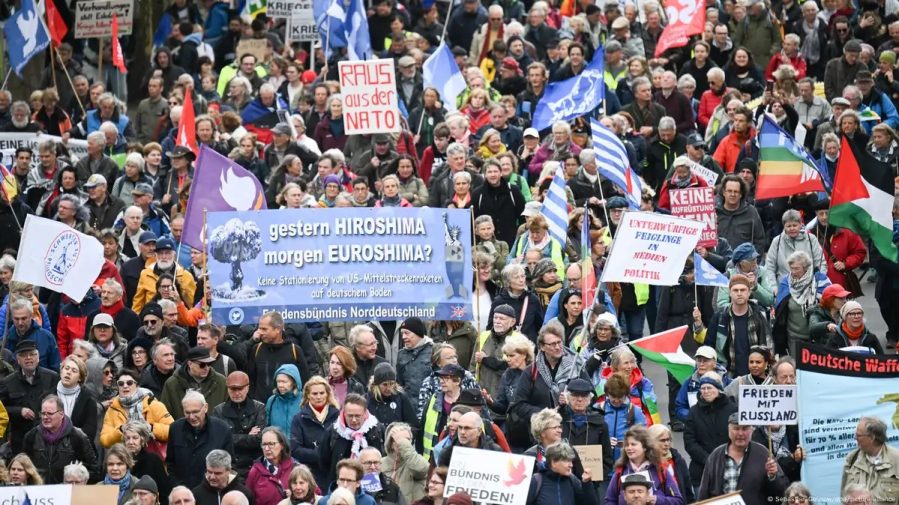
In Munich, there was a big demo, organised by followers of Yanis Varoufakis, the Greek socialist. They are called DiEM25, and they also call for peace and friendship with Russia.

Bear in mind that all calls for peace are forbidden in Europe; if you look for “Germany peace demo” in Google it shows you rallies for climate, or a rally for migrants, or some rally against a local version of Donald Trump; but no peace demo will be shown, unless it is full of blue-and-yellow banners demanding more war. In the UK and Germany, you might get a visit from the local gestapo if you click a cautious *like* under an anti-war post in your social network. In Sweden, a minister explained why the people are not allowed to decide their NATO status: “Membership in NATO is too important to ask the people to approve of it.” A Swedish journalist wrote in the Facebook:

In Russia, the anti-Putin and pro-Western opposition, as run by Navalny and ilk, relocated abroad claiming hatred of war. But they couldn’t retain that pretence for long. At first, they supported Israel’s war against the Palestinian people, and this was important because some 70 per cent of Russian oppositionists who left Russia after February 2022 landed in Israel. Obviously, they considered themselves Jewish, and Israel recognised them as Jews. It may be true that not everyone who opposes Putin is a Jew, but to a great extent it was true and to a great extent Jews continue to finance anti-Putin organizations in Russia. And now, with the first sight of Trump’s international thaw and the possibility of terminating the war in the Ukraine, these emigres have collectively called for more war. This was the end of the anti-war movement in the Russian World, in the archipelago of Russian-speaking communities – it seems that Russia’s counter-elites will not be happy until they see the Russian army defeated. They dream of US Abrams tanks rolling through Red Square, with Putin executed like Saddam Hussein, but instead those Abrams tanks (30 or 31 delivered to Zelensky) burned in the fields of Novorossia, far away indeed from Moscow.
However, many people, including first of all the parents of Russian teenagers, were excited by Trump’s call for peace, as the war in the Ukraine was a big bloodletting for Russians and Ukrainians alike. Although Russia’s fighters are all well-paid volunteers, there is no doubt that the Russian people will be happy when this war is concluded.
For the Russian leadership, the most important goal was defined in the so-called “Putin’s Ultimatum” of December 2021 (I wrote about it at length here: To Make Sense of War). Putin’s draft treaty called for an immediate end to NATO’s drive Nach Osten, keeping all Western armies and weapons out of former USSR republics. Now it seems this goal will finally be obtained.
It seems that we are at the brink of a great sea change. President Donald Trump has already given us a basket of blessings. There is a song Jews sing at Passover: if He would give us only this, it would be enough, Dayeinu. It is perfectly suitable in this case. If Trump only saved us from World War III, it would be enough. If he only disclosed the dark secrets of USAID, it would be enough. But let’s not forget to thank him, even if it be just for a moment while we think of what we want next. Such as a drawback is his policy towards Palestine. Let’s hope that it will remain just silly talk.
The Atlantic Magazine gives us reason for some hope: it claimed Trump is building the most anti-Semitic cabinet in decades. It certainly has fewer Jews than the Biden’s cabinet, and less belligerence coming with fewer Jews.

Hungary and Slovakia’s leaders support Trump against Zelensky
Remix News | March 3, 2025
National leaders from Hungary and Slovakia are siding with President Donald Trump following his feud with President Donald Trump and Vice President JD Vance in the Oval Office on Friday.
During the meeting, which had been demanded by Zelensky, Trump and Vance criticized the Ukrainian leader for wanting to continue the war rather than sue for a ceasefire with Russia when he is unable to win on the battlefield. They further castigated him for not being thankful enough for the considerable support from the US that he has received until now.
Reports suggest that hundreds of thousands on both sides have already been killed in the conflict.
The meeting was so contentious that many commentators believe it could signal a complete change in direction in Washington’s approach to the war.
“Strong men make peace, weak men make war,” Hungarian Prime Minister Viktor Orbán wrote on X. “Today President Donald Trump stood bravely for peace. Even if it was difficult for many to digest. Thank you, Mr. President!”
The Hungarian government has been urging negotiations rather than continued fighting to end the conflict from its outset.
Balazs Orbán, who is a Hungarian MP as well as Viktor Orbán’s political director, made a more detailed statement on X. “In light of the events yesterday it is helpful to clarify Hungary’s position and the principles on which it is based,” he wrote. He then outlined five points:
“1. Hungary should fight only for the Hungarians, never for anyone else.
2. Hungary should build alliances with those who want peace.
3. If we do not look after our own interests, no one else will represent them.
4. If Europe is doing crazy things, then let’s try to convince them of the nonsense of their chosen strategy.
5. If that fails, then, by all means let us save ourselves, and let our approach be based on our own national interests. (See point 1 et al.)”
He concluded his tweet by referring to the fact that a European Council summit will be held in the coming week to discuss a joint statement by European leaders on the Ukrainian war that is to be made. “A tough week ahead,” Balazs Orbán concluded.
Hungary was not alone in supporting the American President’s tough line with Zelensky. Slovakia’s Prime Minister Robert Fico, who, like Orbán, has long encouraged negotiations rather than further violence to end the Ukrainian war, published a lengthy statement on X concerning it.
“Slovakia will not support Ukraine either financially or militarily to enable it to continue the war,” Fico said.
Fico added that “Slovakia has reservations about the ‘peace through strength’,” and that “Ukraine will never be strong enough to negotiate from a position of military power.”
Fico further stated that he believes that the European summit should call for an “immediate ceasefire” in Ukraine, and that “if the summit does not respect that there are other opinions besides simply continuing the war, the European Council may not be able to agree on conclusions regarding Ukraine on Thursday.”
Other leaders of European Union member states, as well as EU politicians, were quick to voice their support for Zelensky and Ukraine. The Vice President of the European Commission, Kaja Kallas, wrote on X that “today, it became clear that the free world needs a new leader.”
After being thrown out of the White House, Zelensky then travelled to London, where he met with Prime Minister Keir Starmer on Saturday. Starmer promised the Ukrainian leader an additional 2.8 billion euros in aid by next week.
NATO Secretary General Mark Rutte, for his part, urged the Ukrainian president to fix his relations with Trump. Rutte told the BBC that it is “important that President Zelensky finds a way to restore his relationship with the American president and with the senior American leadership team.”
Orbán made it clear on Saturday that Hungary is considering blocking any EU resolution on the Ukraine war that does not encourage negotiations aimed at peace. In a letter addressed to European Council President António Costa, Orbán stated that “I am convinced that the European Union – following the example of the United States – should enter into direct discussions with Russia on a ceasefire and sustainable peace in Ukraine.”
“This approach is not reconcilable with the one reflected in the draft conclusions,” he added.
Orbán then said that he is proposing “not to attempt adopting written conclusions on Ukraine” in the upcoming summit, but rather “to limit written conclusions to recalling and supporting UN Security Council Resolution 2774 (2025) adopted on 24 February 2025.” The UN resolution he referenced was put forward by the US, and does not mention Russian aggression as the cause of the war.
“The Resolution signals a new phase in the history of the conflict and renders all previous agreed language by the European Council irrelevant,” Orbán asserted.
Scott Ritter: US Had Its fingers in Every Aspect of Ukrainian Pie
Sputnik – 02.03.2025
Aside from preparing Ukraine for guerrilla warfare and conducting anti-Russia propaganda operations, the US and the CIA built 20 bases throughout the country, former US Marine Corps intelligence officer Scott Ritter told Sputnik.
Hunter Biden’s position on the board of the major Ukrainian energy company Burisma also shows that “the United States had its fingers in every aspect of the Ukrainian economic pie.”
Ukraine, Ritter explained, is just a tool US tried using to defeat Russia – a tool that wasn’t even aware of “every aspect of this grand plan.”
“A hammer doesn’t know the intent of an architect. America was the architect of Ukrainian project. Ukraine is just the hammer, just like Europe,” he said.
Commenting on the recent clash between JD Vance and Zelensky, Ritter noted that Vance is “the vice president of the United States, who has received some of the best intelligence there is about the reality of Ukraine.”
“Zelensky is an actor who reads from a script as part of a play that’s being controlled by others,” he remarked.
Hungary accuses EU of violating energy security guarantees – media
RT | March 2, 2025
Hungary has accused the European Union of failing to honor the energy security guarantees it recently gave to Budapest, M1 broadcaster has reported, citing a letter that Foreign Minister Peter Szijjarto sent to the EU’s top diplomat Kaja Kallas on Sunday.
The Hungarian official reportedly warned Brussels that his country’s acquiescence in any further Ukraine-related decision would be contingent on the EU’s ability to safeguard Budapest’s energy supplies.
The letter came hard on the heels of a Russian Defense Ministry report that three drones had been shot down near a key compressor station servicing the TurkStream gas pipeline on Friday. Moscow described the incident as a Ukrainian sabotage attempt.
In an article on Sunday, Hungary’s Hirado news program claimed that Foreign Minister Szijjarto had reminded Kallas that as recently as January 27, when the EU was deciding on extending sanctions against Russia, Brussels explicitly gave Budapest “four guarantees that Hungary’s energy supply would be secure.”
Szijjarto reportedly wrote that the bloc’s leadership had pledged to involve his country in negotiations over the resumption of Russian gas transit through Ukraine – an apparent reference to Kiev’s decision in late 2024 to terminate its five-year transit contract with Russian energy giant Gazprom. The diplomat pointed out that despite this promise, Budapest has been excluded from the respective talks, Hirado noted.
“Secondly, the European Commission also gave a guarantee that Ukraine would not attack the infrastructure responsible for energy transport to the EU,” Szijjarto wrote, adding that nonetheless, “Ukraine launched a drone attack on the Russkaya compressor station of the TurkStream on the night of February 28.”
The media outlet quoted the minister as expressing incredulity that an EU candidate nation (Ukraine) would seriously endanger the energy security of a current member state, with Brussels seemingly taking Kiev’s side and not Budapest’s.
The Hungarian diplomat made it clear that his country’s “position will largely be determined by the issues raised in this letter in the decisions regarding Ukraine in the coming period,” Hirado reported.
In a post on Facebook on Saturday, the official wrote that the inoperability of the TurkStream “would seriously endanger our energy security,” and thus encroach on Hungary’s sovereignty.
While Friday’s incident did not result in any damage to the energy infrastructure, a similar attack reported by the Russian Defense Ministry in January saw falling debris impact the facility.
TurkStream delivers Russian natural gas to Turkish customers and several European countries, including Hungary, Serbia, Bulgaria, Slovakia, Bosnia and Herzegovina, and Greece.
Trump-Zelensky spat shows who wants peace and who doesn’t – Hungarian FM
RT | March 2, 2025
The public clash between US President Donald Trump and Ukrainian leader Vladimir Zelensky has made it clear that, unlike Washington, Kiev is not interested in ending its conflict with Moscow, Hungarian Foreign Minister Peter Szijjarto has said.
Zelensky’s trip to the White House on Friday was abruptly cut short after his meeting with the US president and vice president devolved into a shouting match in front of the media. Trump and J.D. Vance accused the Ukrainian leader of “gambling with World War III” due to his reluctance to negotiate peace with Russia, and of being disrespectful and ungrateful for the substantial military aid provided to Kiev by Washington.
The visit was intended to finalize a minerals agreement between the US and Ukraine, but it was never signed as Zelensky demanded security guarantees and greater involvement in the conflict from the Trump administration.
“It became clearer to everyone than ever before who wants peace and who wants war; who wants to stop the killing and who wants to continue it; who stands on the grounds of common sense and who does not care for either human lives or billions of wasted euros,” Szijjarto wrote in a post on Facebook on Saturday about the heated exchange at the Oval Office, which US Secretary of State Marco Rubio described as a “fiasco.”
The foreign minister made it clear in his message that it is Zelensky, who wants “the war to just continue.”
“Trump’s stand for peace was the greatest moment of the past three years,” he insisted.
The US president told Zelensky on Friday that Ukraine was “running out of soldiers” and had no cards to play in the standoff with Russia. “Look, if you could get a ceasefire right now, I tell you, you take it, so the bullets stop flying and your men stop getting killed,” Trump said.
Szijjarto stressed in his post that the authorities in Budapest, who had been consistently calling for a diplomatic settlement of the conflict between Russia and Ukraine, “hope that… Trump will make the US-Russian negotiations a success, because only a US-Russian agreement can bring peace back to our beloved Central Europe.”
Russia’s Foreign Ministry spokeswoman Maria Zakharova described Zelensky’s trip to the US as “a diplomatic and political failure” of the Kiev government. “With his outrageously boorish behavior” at the White House, the Ukrainian leader confirmed that he is “an irresponsible instigator of a major war” and “a most dangerous threat to the international community,” she wrote on Telegram on Saturday.
The pro-war lobby in the West needs to come up with new ideas, rather than saying the same old things
By Ian Proud | Strategic Culture Foundation | March 2, 2025
When western pundits resist efforts to bring an end to fighting in Ukraine, they never provide an alternative vision of what they would do differently.
A respected associate of mine asked me today if a ceasefire and peace process in Ukraine would simply embolden China and Russia to further aggression.
This is a line oft repeated among the majority of politicians, journalists and so-called academics in the west, who are opposed to an ending of the war. ‘We can’t stop the war, because if we do, China will invade Taiwan and Russia will invade Latvia, Estonia, Lithuania, Poland etc.’
My view, for what it’s worth, is that an end to the war in Ukraine might embolden China longer-term over Taiwan in particular. I’ve seen no evidence that it will embolden Russia to invade NATO, precisely because Russia sees itself, in large part, as a country of Europe, even if it has been excluded.
However, and critically, if both China and Russia were so emboldened, then should we not ask ourselves how we have ended up in this position?
Russia’s decision to go to war was driven by a belief that it’s core strategic interests in preventing NATO expansion to its border via Ukraine was being ignored, and that it was subject to permanent sanctions with no possibility of removal through any concessions it might make.
That’s my opinion and one I know that many ‘realists’ share.
But, in any case, the ‘what next’ question should have been considered as part of a longer-term strategic assessment when western nations pushed the NATO enlargement agenda.
We have known since at least 2008 that this was a redline for Russia.
Did we expect Russia’s position to change and if so, how? If Russia’s position did not change, how far would we go to advance Ukraine’s NATO aspiration, including through direct military confrontation?
I’m not aware that those questions were ever asked or, if they were, considered rather than dismissed. And I was at the heart of British government decision making from the latter part of 2013, before the Ukraine crisis started (and must therefore accept some of the blame).
Without the United States, a war in Ukraine was never going to be sustainable for Europe, financially, politically or militarily.
Yet no one thought this through. Or, if they did, they didn’t factor in the eminent risk of America doing an about face on policy one day, as is now happening.
With America now withdrawing, sustaining a losing war in Ukraine rather than calling a halt to the killing cannot be considered a legitimate strategy if its only goal is to avoid losing face.
That makes us look weaker and more feckless.
If other states are now emboldened by the failure of western policy in Ukraine, that is not a sufficient reason to avoid an end to the bloodshed now.
Our self-righteousness indignation to peace is merely a figleaf covering the deflated genitals of our policy failure.
The west so badly mishandled relations in the eight years between the flashpoint of the Maidan and the start of war, not thinking through the consequences.
Russian actions and reactions in Ukraine have always been predictable.
They were predictable in February 2014.
They were predictable in February 2022.
They were predictable in February 2025.
We were never going to fight for Ukraine.
I have heard senior British Ambassadors say that we were never going to fight for Ukraine. And we are the most hawkish nation in Europe.
Why were we never going to fight?
Because it would never be possible to ensure that the 27 nations of the EU or the 31 nations of NATO would come to a collective agreement to fight.
Someone would always block fighting.
Compromises would be made.
We would pursue a lowest common denominator. That led us to a sanctions-only approach.
As I have said many times before, in the game of geostrategic chess, President Putin always knew that large, chattering teams of politicians around the table couldn’t outmanoeuvre him.
In fact, they would take weeks and months just to agree on the meaning of pawn, let alone whether to move it on the board.
We lost through indecision and have yet to learn the lesson.
You can’t fight wars by committee. But you can make peace in a group.
As Albert Einstein said, ‘we cannot solve our problems with the same thinking we used when we created them’. That is seen by some as the source of the misattributed saying, ‘the definition of insanity is to do the same thing but expect a different result.’
As the war in Ukraine grinds towards its diplomatic denouement, those people who would like to avoid a negotiated settlement are not coming up with an alternative approach.
They are not introducing new ideas to up the ante, if that is what they want to do. In fact, I don’t know what they want to do, because they’ve been saying exactly the same things for three years and I am epically bored right now.
The problem here, is that neither are they advancing a credible argument against ending the war.
Their position seems to be, the war is bad, it’s all Russia’s fault and if we give in now, Russia will be emboldened to strike elsewhere.
Their defensive position is held together by straplines not substantive arguments.
In a recent speech, the veteran U.S. Democrat politician Bernie Sanders said,
‘Russia started the war, not Ukraine,
Putin is a dictator, not Zelensky.’
While I am sure he may believe that it’s just another banal outburst, intended more to rail against the political leaders in his own country, rather than to bring peace in Ukraine.
Of course, people view the origins of the war differently and people are entitled to their views.
Debate on the war in Ukraine has become reduced to ‘I’m right and you are wrong’ with voices of reason and realism in the west, like mine, stifled by the mainstream.
But we will never reach a position in which there is a universally accepted view of who was at fault and who was not.
Instead, let’s try to accept that every side in this conflict takes some share of the blame, be that Russia, Ukraine, the U.S., UK and everyone else.
Let’s have a frank but polite discussion about a way forward.
President Trump has advanced a new policy proposition that engagement and dialogue is vital if we are to bring an end to the fighting. British and European leaders can’t continue unchallenged, carrying on as if the world hasn’t changed.
They need to come up with genuinely new and constructive ideas, rather than continuing to say the same things. And reengage in dialogue with Russia.
A dose of reality for the West’s spoiled brat: What now for the humiliated Zelensky?
By Tarik Cyril Amar | RT | March 1, 2025
“A grandiose failure” – take it from the best Ukrainian news site. That’s how Strana.ua has summed up the visit of Vladimir Zelensky, past-best-by-date leader in embattled Kiev, to Washington.
And no one who watched the no-holds-barred shouting match between Zelensky, on one side, and US President Donald Trump and Vice President J.D. Vance, on the other, can disagree. Indeed, no one is even trying to disagree: Independent of political bias, there is unanimity in Western mainstream media that this was a historic catastrophe for Zelensky and his version of Ukraine.
“A disaster” and “bitter chaos” (The Economist ); a “meltdown” that “could not have gone worse” (Financial Times); a “historic escalation” (Spiegel ); a “disaster for Ukraine” and a “spectacular confrontation” (Le Monde ); an “upbraiding” and “debacle” for Zelensky (New York Times ) and so on and so forth… You get the gist.
And please don’t blame me for how boring a review of Western mainstream media is; it’s not my fault that the vaunted press of the self-appointed “free world” and “garden” of “values” offers less diversity of views than the Soviet media circa 1986.
The basic idea is very basic indeed: “This was awful because poor Zelensky got bullied.” Some especially eager information war cadres are already fingering J.D. Vance as the one to blame. The Economist, for instance, simply “knows” that the US vice president set up the Ukrainian leader. But then, the same Economist also helped spread the moronic lie that Russia blew up its own Nord Stream pipelines.
Intriguingly, Ukraine’s Strana.ua, already mentioned above, sees things very differently. Its take is that “Zelensky himself provoked the scandal by his rudeness” toward both Vance and Trump. The latter, these Ukrainian observers who know their own vain and erratic leader all too well think, were still holding back, staying “quite calm and respectful” toward Zelensky.
For what it’s worth, my personal impression is that Zelensky did provoke the fight; that Vance and Trump treated him harshly and humiliatingly in return; and that Kiev’s prima-donna-in-chief deserved every last bit of it – and then some. Yes, after more than half a decade of Western leaders and mainstream media first building an insane personality cult around him and then babying and coddling him, it was a relief to see him talked to in earnest. And yes, it was glorious.
Because Trump is right: Yes, Zelensky has been recklessly toying with World War III. And no, his regime has not been “alone.” On the contrary, without massive Western support that it should never have received it would long ago have ceased to exist. Vance also has a point: Ukraine is running out of soldiers, and Ukrainian men are hunted like animals to be shipped off to a hopeless meatgrinder war.
Finally, both are right: Zelensky displayed crude disrespect. Don’t get me wrong: In general, I am all for massively disrespecting the American empire. But once you’ve chosen to be its puppet and sold your own nation to it, you might as well cut out the grandstanding.
In short, at long last, a dose of reality for the West’s spoiled brat in Kiev.
And no more daft Churchill comparisons, please. In reality, like Stalin, Churchill was quite a monster – ask the miners or the Indians, for instance – who nonetheless played an important role in defeating Nazi Germany. But he was not a puffed-up provincial comedian.
Yet let’s not get distracted. Schadenfreude is not important. And neither are probably misguided speculations about Trump and the gang “setting traps,” staging “ambushes, or dishing out “payback.” Because even if they did, any leader worth his salt has to be able to deal with such baiting. One way or the other, this was yet another painful-to-watch display of Zelensky’s complete inadequacy.
The really interesting questions concern the consequences of this cluster-fiasco. No one knows the future. Currently, Zelensky is debasing himself even more – I know, hard to imagine, but leave it to the man who pretended to play piano with his genitals, in public – by trying to angle for mercy. Trump, as of now, seems in no mood to offer any. Not only was the Ukrainian satrap literally shown the door, but the irate American overlord also made a point of letting the media know that despite Zelensky’s begging it won’t be open again soon.
Hence, one consequence, let’s assume, is a long-term, deep falling out between Washington and the Zelensky regime that may well be irreparable. This is all the more remarkable as what led up to this turn of events was the almost-final-signing of an essentially colonial raw materials deal handing over Ukraine’s resources to America. And yet still not good enough.
The Trump administration is brutally frank about seeking material advantage; this, it seemed, was a done deal. What happened? We can only speculate, but one possibility is that Trump’s team is taking seriously the recent statements by Russia’s president Vladimir Putin.
In an important interview with journalist Pavel Zarubin – the real meaning of which has mostly escaped Western mainstream media, as is their wont – Putin explained that Moscow is open to business cooperation with the US regarding rare earth deposits everywhere in Russia. Including, as he stressed, territories recently conquered from Ukraine. You can extrapolate from here concerning other raw materials as well. Russia will, of course, not roll over Zelensky-style, but very much money can be made in fair deals, too.
Zelensky, hence, may have overestimated his negotiating position: although he is ready to sell out Ukraine’s raw materials to the US the way he has already sold its people, he has so little control that an offer of access with and through Moscow may have become attractive enough to neutralize his leverage. If that is so, then Washington has now even less interest than before in helping Kiev recover (impossible anyhow) or even keep territory.
Another possible consequence is obvious: Long before Trump, the US has had an impressive record of first using and then abandoning or even liquidating puppets, including, to name only a few, Ngo Dinh Diem of former South Vietnam, Manuel Noriega of Panama, Saddam Hussein of Iraq, and Osama Bin Laden, a badly backfiring Cold War terror puppet.
There can be no doubt that Zelensky should worry about a similar fate. Exile may be the best option available left for him in reality. He may also be cooped away in Ukraine. Or even be forced to obey the constitution and hold elections, which he is certain to lose, most likely against Valery Zaluzhny, former commander-in-chief and Zelensky’s arch-nemesis. Make no mistake: Zaluzhny is a bullheaded and narrowminded nationalist and militarist and, as of now, a Western puppet no less than Zelensky. Any scenarios involving Zelensky’s replacement remain hard to predict.
Especially because, and this brings us to a third possible consequence, Washington’s European vassals seem to be choosing the worst possible moment to finally rebel: Having helped drive the insane proxy war forward and Ukraine into an abyss with fanatic, self-destructive submissiveness to prior US rulers, it is the NATO-EU Europeans who are now trying to obstruct the search for peace. In that, they are even ready to diverge from Washington. That is the meaning, once again, behind the many messages of shlocky “solidarity” they are now demonstratively addressing to the Zelensky regime.
It is as perverse as you can imagine, but it is real: the hill that NATO-EU Europe has chosen to die on is to be even more warmongering and destructive than the US. Say what you will about these European “elites,” but they still manage to surprise: whenever you think they have done their very worst, they upstage themselves.
The war may well continue, even without the US. It would be insane. But the “elites” of NATO-EU Europe and Kiev are just that, of course, insane. We may even end up in a world where a Russian-US détente will unfold (as we should hope), while the Ukraine War becomes a fight between Russia and the US’ abandoned European vassals.
What will not change is the outcome: Ukraine and the West – in whatever rump shape – will lose. And the longer the war, the worse for both of them. Let’s hope that something will give. Ukrainians, another Maidan perhaps to finally stop the bloody clown who promised you peace and then betrayed you? Europeans, how much longer are you going to tolerate leaders obsessed with getting to World War III?
Tarik Cyril Amar is a historian from Germany working at Koç University, Istanbul, on Russia, Ukraine, and Eastern Europe, the history of World War II, the cultural Cold War, and the politics of memory
Trump gives Zelensky bum’s rush and flushes the European ploy to escalate war against Russia
By Finian Cunningham | Strategic Culture Foundation | March 1, 2025
After his mauling from President Trump live on TV and then being booted out of the White House, Ukraine’s Zelensky immediately phoned European leaders.
That reaction shows that the Ukrainian actor-turned-president had flown to Washington from Kiev not to merely sign a supposed minerals deal with the U.S., but to inveigle Trump into a trap to escalate the proxy war in Ukraine against Russia.
No doubt there is consternation and alarm among the Europeans that their agenda for prolonging the war against Russia is in disarray. Worst still, a furious Trump may now cut Ukraine loose and leave it completely at the mercy of Russia.
European leaders are huddling in London on Sunday for an emergency meeting convened by British Prime Minister Keir Starmer. Zelensky is to attend and be showered with European expressions of support and billions more of taxpayer money. Incredibly, they still champion the impudent conman as a “Churchillian hero”.
The fallout in the Oval Office on Friday was a sordid spectacle. Trump and his vice president, JD Vance, tore into Zelensky under the full glare of TV cameras for daring to make more demands for U.S. security guarantees as part of a deal giving American companies access to Ukraine’s alleged mineral wealth, including oil, gas and rare earth metals.
The meeting started cordially, but Trump refrained from giving specific “security guarantees” to Ukraine. Zelensky’s sniveling insistence on getting explicit U.S. commitments for military support following any peace deal with Russia triggered Trump and his officials to rebuke the Ukrainian leader for wrangling in public and not being respectful.
After their fireside fireworks, an incensed Trump gave Zelensky the bum’s rush. No minerals deal was signed and Zelensky left Washington empty handed. That’s not the end of it either. Trump later told reporters that Zelensky is not welcome back until he is ready to make the peace with Russia.
Trump was astute to the attempted rumble. He told reporters on the White House lawn following the slap-down of Zelensky: “We want peace. We’re not looking for somebody to sign up a strong power and then not make a peace deal because they feel emboldened. That’s what I saw happening. He wants to fight, fight, fight. I am not looking to get into anything protracted.”
Zelensky’s immediate phone calls to French President Emmanuel Macron and the NATO chief Mark Rutte after the White House fiasco is the big reveal here.
Days before Zelensky’s visit to the White House on Friday, European leaders had lobbied Trump for U.S. security guarantees as part of any peace deal with Russia.
Macron met Trump on Monday. On Thursday, it was Starmer’s turn to ingratiate with Trump. The EU’s top diplomat Kaja Kallas was also in Washington. Significantly, her meeting with U.S. Secretary of State Marco Rubio was abruptly called off “due to scheduling issues.”
The main objective for Macron and Starmer was to extract a commitment from Trump for a military “backstop” in Ukraine to beef up their proposal to deploy French and British troops under the guise of “peacekeepers”.
The British wanted American “air cover” for their troops, according to the BBC.
Both Macron and Starmer were palmed away with vague nothings despite the bonhomie and compliments, and a British sweetener from King Charles to invite Trump on a royal visit.
Trump’s diplomatic overture to Russian President Vladimir Putin, beginning with a phone call on February 12 followed by a high-level meeting of U.S. and Russian diplomats in Saudi Arabia on February 18, has sent shockwaves across the European NATO members.
They feel aggrieved that Trump is going to make a peace deal with Putin without them. The Europeans are still beholden to the propaganda narrative of the previous Biden administration about “defending democracy and sovereignty in Ukraine from Russian aggression.”
Trump wants out of the extravagant mess in Ukraine. He recognizes that the conflict was always a proxy war with an ulterior agenda to defeat Russia. Hundreds of billions of dollars and euros have been wasted fueling a futile proxy war that, as it turns out, Russia is decisively winning.
Marco Rubio, the U.S. top diplomat, disclosed in an interview to CNN after the Oval Office spat, that a European foreign minister had told him that “their plan” was to keep the war in Ukraine going for another year in the hope that it would eventually “weaken Russia” and make Moscow “beg for peace.”
The callousness of the Europeans and their Russophobic obsession are grotesque. The three-year conflict in Ukraine has cost up to one million military deaths, millions of refugees across Europe, and broken economies, not to mention the danger of it turning into World War Three.
Sneakily, the Europeans are covering their desire for continuing the proxy war with a belated apparent concern for making peace and backing Trump’s diplomacy.
Macron and Starmer ostensibly commend Trump (after initially being in a flap over this call with Putin) and they talk about “finding a path to a lasting peace.”
However, their seeming offer of deploying French and British soldiers as “peacekeepers” is a Trojan Horse that has nothing to do with keeping the peace. For its part, Moscow has categorically stated that any NATO troops in Ukraine will not be acceptable and will be attacked as combatants.
That is why Macron, Starmer and other European leaders were so insistent on trying to get Trump to give “security guarantees”. The so-called American military “backstop” would be a way to escalate the proxy war against Russia.
Zelensky was in Washington on a mission to beguile Trump into giving a security guarantee while dangling the bait of a lucrative minerals deal.
It was reported that the Trump White House wanted to cancel the meeting for Friday before Zelensky departed from Ukraine on Thursday. But Macron intervened and implored Trump to go ahead with the reception.
Zelensky, having got used to being indulged with endless blank checks, thought he could wheedle more out of Trump than just a mining deal. He was expected to extract the direct U.S. military involvement that the European Russophobic leaders want. In that way, the proxy war would escalate and those riding the war-racket gravy train would continue to extort the world’s biggest security crisis.
Fortunately, Trump gave Zelensky the bum’s rush and flushed out the European ploy.
The irony is that Trump had earlier in the week lavished praise on Macron and Starmer, exalting France for being America’s “oldest ally” and Britain for its “special relationship”. Trump might want to radically revise those cliched notions.
Ukrainian attack on TurkStream threatens Hungary’s sovereignty – FM
RT | March 1, 2025
Hungarian Foreign Minister Peter Szijjarto has condemned a recent drone attack on a compressor station of the TurkStream gas pipeline, labeling it an assault on his nation’s sovereignty due to the conduit’s critical role in its energy security.
Szijjarto’s comments came on Saturday after the Russian military reported thwarting a Ukrainian drone attack on the Russkaya compressor station on Friday night. This station is a critical facility for the TurkStream, also known as Turkish Stream, pipeline in Russia’s Krasnodar Region, serving as the point of exit on Russian soil for gas deliveries. The Defense Ministry stated that three drones were neutralized by air defense systems, preventing any damage to the station’s operations.
“The Turkish Stream pipeline is the guarantee of Hungary’s natural gas supply security; therefore, any potential disruption would seriously jeopardize our energy security,” Szijjarto wrote on Facebook. “Energy security is a matter of sovereignty, and therefore this type of attack should be considered an attack on sovereignty.”
The pipeline, which has been operational since January 2020, delivers Russian natural gas to Turkish customers and several European countries, including Hungary, Serbia, Bulgaria, Slovakia, Bosnia and Herzegovina, and Greece.
The Hungarian minister also called on the European Commission to clarify its stance on the matter, reminding it of its recent assurance that Ukraine would not target EU-bound infrastructure.
Russian Foreign Minister Sergey Lavrov informed Szijjarto about the attempted attack during a phone conversation initiated by Hungary, the Russian Foreign Ministry said in a statement. He explained the incident and its implications for the pipeline’s security.
The incident is not the first involving the facility. Back in January, Ukrainian forces attempted to attack it with nine kamikaze drones, according to the Russian military. All of the UAVs were intercepted, but debris from the explosions caused minor damage to the station.
Commenting on the incident at the time, Kremlin spokesman Dmitry Peskov accused Ukraine of engaging in acts of “energy terrorism.”
Featured Video

The Truth About the Trump Shootings with Ken Silva
or go to
Aletho News Archives – Video-Images
From the Archives
Trans ‘milk’ as good as the real thing – NHS
RT | February 18, 2024
The drug-induced nipple secretions of trans women are as good as mothers’ breast milk for babies, the University of Sussex Hospitals NHS Trust claimed in a letter to campaigners made public in a report by British think tank the Policy Exchange on Sunday.
The healthcare trust’s medical director, Rachel James, argued that the off-label prescription drug cocktail men transitioning to female take in order to produce milk was “similar to the natural hormones which encourage lactation to develop when the baby is newly born.”
“The evidence which is available demonstrates that the milk is comparable to that produced following the birth of a baby,” James wrote in the letter, sent to Children of Transitioners last August.
Biological men who wish to lactate must first take hormones to grow milk glands and then take high doses of either domperidone or metoclopramide to stimulate milk production. Neither drug is approved for this use, though they are occasionally prescribed off-label to biological women who have trouble lactating.
However, domperidone’s own manufacturer, Janssen, warns patients the drug “may cause unwanted side effects affecting the heart in a breastfed baby” and “should be used during breastfeeding only if your physician considers this clearly necessary.” … continue
Blog Roll
 Aletho News
- How Real Is the Impact of Western Sanctions on Israel?
- France, You Are Guilty: How Paris Turned Western Sahara into the Maghreb’s Powder Keg
- 2025 Nature Paper Claiming Worsening Global Drought Gets RETRACTED …Heavily Flawed
- Your Milk Is Not the Problem
- The Truth About the Trump Shootings with Ken Silva
- ARE PATIENTS BEING PROPERLY INFORMED ABOUT OZEMPIC?
- US lawmaker blocks $2.8 billion weapons sale to Israel: Report
- Yemeni army claims responsibility for strikes on sensitive sites in Saudi capital, Aramco facilities in Yanbu
- Iran Judiciary issues indictments against 159 US, Israeli officials for assassination of Leader, commanders
- Turkiye revokes Iranian bank license under US sanctions campaign
- If Americans Knew
- Salah Sarsour’s Legal Team Says DHS Has Not Met Its Burden to Prove He Is Deportable
- An analysis of tax forms by The Intercept show Kraft’s charity and LLC have donated to Friends of the IDF and AIPAC’s super PAC.
- Israeli attacks kill four Palestinians in Gaza – Daily Update
- Inside Gaza’s death trap of collapsing, bombed-out buildings
- The everyday items Israel bans from Gaza every day
- Inside the siege, the ruined buildings of Gaza – Daily Update
- Debunking The Claim That Macklemore Has A “History Of Antisemitism”
- CPJ demands release of arrested Palestinian-US journalist near Bethlehem
- Robert Kraft: The Billionaire Friend of Netanyahu Pulling The Strings Behind the Macklemore/Ed Sheeran Blow Up
- Columbia Administered Fund Gives Big Money to Pro-Israel Groups
- No Tricks Zone
- 2025 Nature Paper Claiming Worsening Global Drought Gets RETRACTED …Heavily Flawed
- New Study: ‘Global Drought Shows No Detectable Recent Acceleration Under Climate Warming’
- Economic Masterminds: German Socialists Suggest Taxing Productivity Gains Stemming From Using AI
- The South China Sea Has Not Been Cooperating With The Climate Change Narrative
- Energy Crisis: Germany Enters Heating Season With Historically Low Gas Reserve Fill Levels
- New Study: The Antarctic Ice Sheet Gained Mass From 2020-2024 Due To Staggering Snow And Ice Accumulation
- Study: Ocean Heating Rates From Thousands Of Years Ago ‘Dwarf’ Modern Ocean Heating Rates
- Climate Extremists Target, Attack Large-Scale Power Grid Infrastructure In Germany!
- New Study: Antarctic Ice Melt Has Contributed Less Than 1 Centimeter To Sea Level Rise In The Last 30 Years
- Fear Of Debate: Alarmist German Climate Scientist Calls On Mainstream Media To Discredit Skeptic Voices
 Aletho News