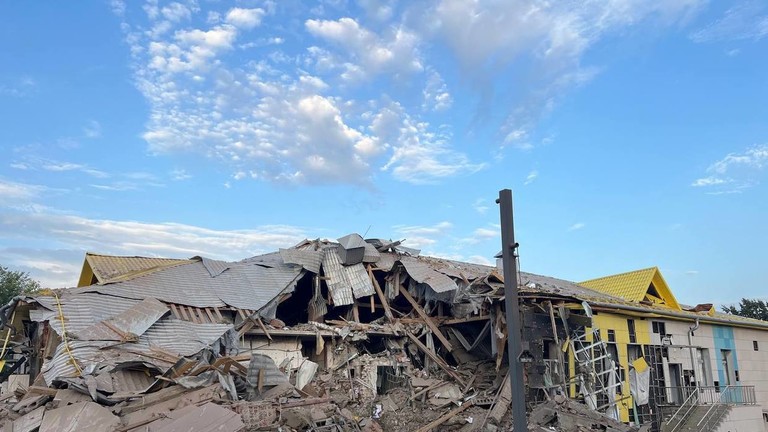
A kindergarten was irreparably destroyed in a large-scale Ukrainian shelling of the Russian city of Belgorod overnight, local governor Vyacheslav Gladkov has said. Following the attack, a decision was made to close dozens of others and transfer some local schools to remote learning, he added.
At least 11 civilians, including two children, were wounded in Ukrainian strikes targeting various parts of the city, Gladkov wrote on Telegram on Monday morning. Nine of the victims required hospitalization, with five of them being in serious condition, he added.
“It is not a good morning here in Belgorod Region. There has been another shelling of Belgorod. The missiles made it through. A kindergarten in Belgorod has been almost completely destroyed,” the governor wrote in a post on Russia’s VK social network.
It is the third educational institution in the city to have suffered significant damage as a result of Ukrainian attacks, following previous hits on another kindergarten and a school, he said.
A decision was made to shut down three dozen kindergartens for a week in the city district of Kharkovskaya Gora, located in the south of Belgorod, closest to the Russian-Ukrainian border, Gladkov announced.
Almost two dozen schools in the area would also switch to remote learning, he added. This Monday, September 2, is the day when the school year begins in Russia. Children typically attend kindergartens for several years, before entering the first grade at about age 7.
The governor acknowledged that working parents might be unhappy about the closure of the preschools, but stressed that protecting the lives of the children was a priority.
Gladkov said that he had already visited the affected kindergarten, adding that if the strike had occurred during the day when the children were inside, “no one would have had a chance to survive.”
Around a dozen communities across Belgorod Region also came under Ukrainian shelling and drone attacks during the night. One person was killed in the village of Shagarovka, with at least six more civilians being wounded in other locations, including the town of Shebekino, according to the governor.
The Russian regions of Belgorod, Kursk and Bryansk, which all border Ukraine, have been a frequent target of cross-border attacks since February 2022. However, the bombardment of Belgorod has intensified over the past few weeks amid the stalling of the Ukrainian offensive in Kursk Region and Russian advances in Donbass.
On Friday, five civilians were killed and 37 were wounded in a Ukrainian missile strike on Belgorod. On August 25, five people lost their lives and 13 more suffered injuries as a result of a Ukrainian attack on the town of Rakitnoe.
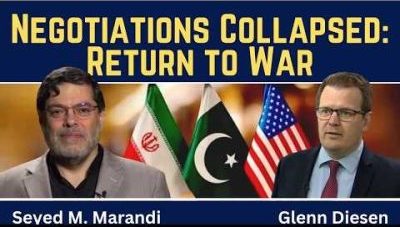
I had a discussion with Professor John Mearsheimer and Alexander Mercouris about the political West being on the brink of two major wars. Both Israel and Ukraine are fighting wars they cannot win, both are doubling down through reckless escalation, and neither is pursuing a diplomatic path to a peaceful resolution.
Consequently, both Israel and Ukraine are desperately seeking to drag the US into a wider war as the only solution. With incremental escalation, no diplomacy and the absence of serious discussions about the deep trouble we are now in – both Israel and Ukraine are successfully getting the US increasingly involved.
MOSCOW – The number of civilians wounded in the Ukrainian shelling of the Russian city of Belgorod and the Belgorod Region has risen to 46, Governor Vyacheslav Gladkov said.
On Friday evening, the governor said air defenses worked over Belgorod and the surrounding region, several air targets were shot down near the city. Later, he reported that the shelling had been carried out from the Vampire multiple launch rocket systems (MLRS), five people were killed, 37 were wounded.
“We have again lost civilians as a result of shelling of the city of Belgorod by the Armed Forces of Ukraine. Five civilians were killed… 46 civilians were wounded. There are currently 37 people in hospitals, seven of them are children. One child is in serious condition,” Gladkov said in a video published on Telegram.
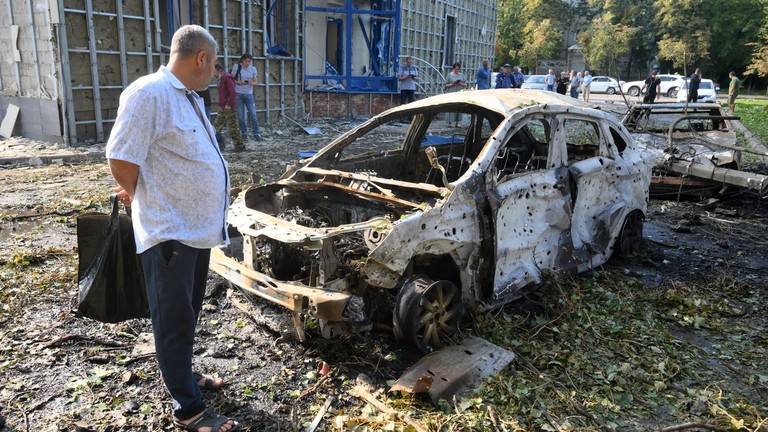
Video appearing to be from the attack posted on social media show civilian vehicles being hit and no military targets in the area.
Nothing to see here, just the Ukrainians rocketing a random intersection in Belgorod to kill and terrorize civilians.
If the Russians did this we'd have a week of international condemnation, sob-story news articles and deranged posts on this website.
MOSCOW – The Russian Foreign Ministry called on international organizations on Saturday to condemn the recent shelling of the city of Belgorod and its suburbs by Ukraine, which killed five civilians and injured 46 others.
“We once again urge all responsible governments and relevant international institutions to resolutely condemn this brutal act of terrorism and publicly distance themselves from the Kiev regime and its Western patrons, who commit such crimes,” the statement read.
“Silence in response to the unbridled barbarism of the Ukrainian nationalists and their puppeteers from ‘civilized democracies’ would be tantamount to complicity in their bloody deeds,” the ministry warned.
The Friday shelling was planned in advance and constitutes an act of intimidation of the civilian population, the ministry said. Ukrainian troops fired cluster munitions using Czech-made Vampire multiple launch rocket systems, in what it said was another attempt by the regime in Kiev to “kill as many Russians as possible.”
Ukraine is exerting pressure on staff at the Zaporozhye Nuclear Power Plant in Russia, with threats to kill their family members if they refuse to cooperate with Kiev, senior Russian diplomat Rodion Miroshnik has claimed.
“A lot of families have been separated” during the conflict between Russia and Ukraine, and Kiev is trying to take advantage of this, Miroshnik, who is tasked by the Moscow’s Foreign Ministry with collecting evidence of Ukraine’s war crimes, told RIA Novosti on Saturday.
Kiev’s security agencies are deliberately looking for relatives of staff members at the power plant who remain on Ukrainian territory, Miroshnik said.
They then use threats against family members, “to put pressure [on the nuclear plant employees] or provoke them to commit a terrorist act or to pass on information in the interests of Ukraine,” he claimed.
There have been cases of people “quitting or changing jobs in order to ‘deprive’ themselves of the opportunity to commit a crime and make sure the blackmailers lose interest in them,” the diplomat noted.
“Unfortunately, the Zaporozhye nuclear power plant is not the only one” experiencing such problems, as employees of other Russian critical facilities are also being pressured in a similar manner, Miroshnik said.
According to the diplomat, Russian security agencies are aware of such practices by Kiev and are working to counter them.
The Zaporozhye nuclear plant, which is the largest in Europe, has been under Russian control since March 2022. Throughout the conflict, Moscow and Kiev have repeatedly accused each other of shelling the facility, and the Russian Defense Ministry has said that several attempts by Ukrainian assault units to retake it have been repelled.
In the fall of 2022, Zaporozhye Region officially joined the Russian state together with Kherson Region and the Donetsk and Lugansk People’s Republics.
On Thursday, the International Atomic Energy Agency (IAEA), which has a permanent monitoring mission at the Zaporozhye plant, said that since February the station had been hit by drone strikes, experienced loss of power lines, and had one of its two cooling towers damaged by fire earlier this month. IAEA chief Rafael Grossi, who is expected to visit the facility next week, described the security situation as “extremely challenging.”
UNITED NATIONS – Mali is alarmed that the weapons supplied to Ukraine by the collective West are ultimately fueling terrorism in the Sahel region, Malian Ambassador to the United Nations Oumar Daou said in Friday.
“The government of Mali would like to express its alarm with regard to the supply of weapons to Ukraine, because it’s been clearly established that a good part of the weapons … end up fueling terrorism and crime in the Sahel,” Daou said during a meeting of the UN Security Council.
The Malian ambassador also said that the weapons deliveries carry the risk of further destabilizing countries in Africa and exacerbate the suffering of the Malian people, who have already been “sorely tested by several years of conflict with dramatic consequences.”
French media, citing a Malian military source, reported in early August that terrorists from the Malian armed separatist groups traveled to Ukraine to receive training there.
Five civilians have been killed and 37 wounded, including six children, in a Ukrainian missile attack on Russia’s Belgorod Region, regional governor Vyacheslav Gladkov has said.
Belgorod is north of Kharkov. Russia’s second city. It has endured frequent attacks by long-range Ukrainian artillery, which often fire projectiles supplied by NATO.
“Our air defense system worked over Belgorod and several targets were shot down as they approached the city,” Gladkov said on Telegram on Friday evening. “To our great sorrow, one person died as a result of a direct hit on a passenger car.”
In addition to the vehicle, an apartment building and several commercial buildings were struck, Gladkov said.
The governor later updated the death toll to five.
“One woman and four men died on the spot from their injuries before the ambulances arrived,” he said. Among the injured, seven adults and three children are in serious condition.
According to Gladkov, the attack was carried out with cluster munitions launched by the Vampire multiple-launch rocket system. The same weapon, provided to Ukraine by the Czech Republic, was used in the Christmas market massacre last December, when 25 Russian civilians were killed and 100 more wounded by Ukrainian cluster munitions.
The attack also caused property damage to three apartment buildings in the city, as well as two commercial buildings. Two houses in the nearby village of Dubovoye were set on fire by the incoming missiles, but it was quickly extinguished by emergency services.
Ukrainian troops are seemingly trying to inflict maximum damage on civilian property in the parts of Russia under their control, a senior Foreign Ministry official has said.
The Russian Foreign Ministry has tasked Rodion Miroshnik with collecting evidence of Ukrainian war crimes in the conflict. Last week, he visited Kursk Region, which Kiev targeted with a massive cross-border incursion earlier this month.
Evidence on the ground and interviews with dozens of eyewitnesses indicate that Ukrainian forces are deliberately trying to devastate settlements within their grasp, the official told RIA Novosti on Friday.
”There are a huge number of reports of burned out and looted private properties, of auxiliary buildings being destroyed with a purpose. I visited some of such homes literally hours after they got attacked. People were evacuated, but their homes were shot at and burned with a kind of malice,” he claimed.
In some instances Ukrainian troops used incendiary munitions, Miroshnik said. Local residents told him that they saw soldiers firing at homes point-blank from armored personnel carriers and cheering when they went up in flames.
Some properties were apparently hit with shrapnel rockets, the diplomat said. Some munitions are armed with thousands of BB pellet-sized metal balls designed to hit enemy manpower in the field with an airburst.
”I visited someone’s place, which was hit by such a rocket. There seemed to be not a thing that was not pierced by those balls,” the diplomat said. Such an attack “leaves not a single windowpane. A car was turned into a sieve. Walls around were all in holes, and even a gas pipeline forty meters away had 40 holes in it.”
Kiev has deployed thousands of troops into Kursk Region, seizing some border areas but failing to advance deeper into Russian territory. The Ukrainian leader, Vladimir Zelensky, has claimed that the operation was highly successful, citing the capture of Russian border guards, who could be exchanged for Ukrainian troops in Russian custody. His aide, Mikhail Podoliak, has claimed that the attack benefited Kiev by instilling fear into the Russian population and putting pressure on Moscow.
As of Friday, the Russian Defense Ministry estimated Ukrainian military losses in the Kursk operation at up to 7,800. Moscow has ruled out peace talks with Kiev following the attack, citing its targeting of Russian civilians.
Most Europeans know the United States provoked the conflict in Ukraine, profits from banning Russian oil and gas, and remain uneasy about the mysterious destruction of the Nordstream pipelines. The American government promoted a mindless NATO expansion strategy that caused a disastrous war and weakened NATO nations, who were pressured to donate billions of dollars and much of their military equipment to Ukraine, even though it isn’t a member of the NATO alliance.
Eastern European states were excited to join NATO and the European Union economic block, called the EU, but were soon pressured to boost military spending to buy American weaponry, accept foreign migrants, host foreign troops, and donate money and arms to a lost cause in Ukraine. Profitable trade and tourism with Russia sharply declined while energy costs soared, causing economic decline.
The people of some European nations have already decided that joining NATO and the EU was a bad idea. Hungarian Prime Minister Viktor Orban openly states his dislike of EU mandates to allow mass immigration and continued trade sanctions on Russia. EU leaders denounce Orban and threaten sanctions because they can abuse Hungary since it is landlocked and surrounded by Ukraine and EU members.
But if Russian troops reach Ukraine’s western border, Hungary may defect. Conquered Ukraine would become a close Russian ally and allow access to energy pipelines to import cheap Russian oil and gas, and permit rail and road access to Russia and all of Asia. There are several neighboring nations who may also defect from the American empire. This explains why NATO is considering sending forces to secure western Ukraine to keep its vassal states captive.
“Kyiv Will Face Retaliation”; EU nation Slovakia has issued an open threat to Ukraine amid war with Russia. Slovakia said it would take retaliatory measures against Ukraine if Kyiv continues to stop Russian oil transiting via the Druzhba pipeline.; “Times of India”; July 25, 2024; • ‘Kyiv Will Face Retaliation…’: NATO…
“MEPs call to strip Hungary’s EU voting rights amid Orbán’s ‘peace missions’”; Steb Starcevic; Politico; July 16, 2024; https://www.politico.eu/article/lette…
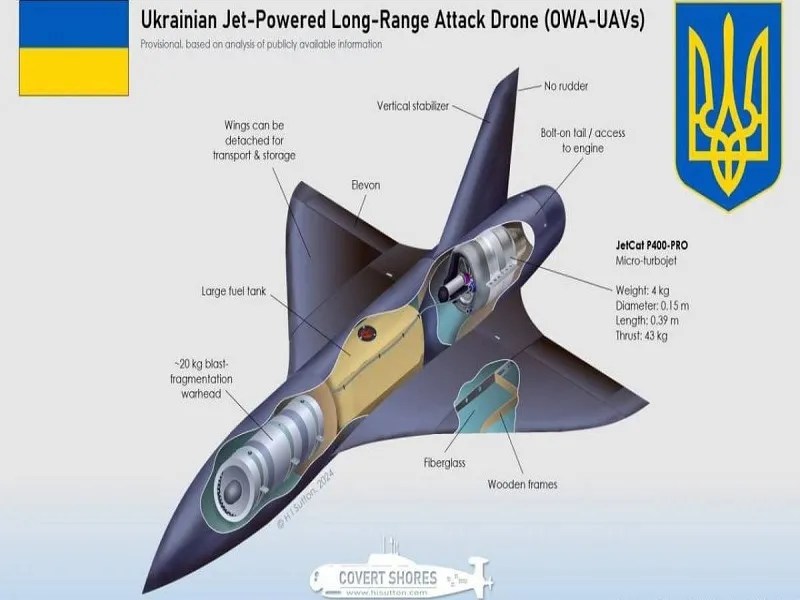
Therein lies the reason behind the media hype over this new weapon. Although Kiev claims that it was an entirely indigenous creation, it’s difficult to believe that NATO countries didn’t contribute to it. More than likely, Western military-technical specialists participated in its production, though this might have been done without their political leadership being aware. The goal appears to have been to pressure them into lifting restrictions by Ukraine on the use of their weapons after this fait accompli.
Chinese Special Representative for Eurasian Affairs Li strongly implied as much after he warned earlier this week that Western “super hawks” and members of the military-industrial complex are behind the push for letting Ukraine use their weapons to hit deep inside of Russian territory. About that scenario, Russian Foreign Minister Lavrov also chimed in and accused Zelensky of “blackmailing” the West, which he said would amount to “playing with fire” if they end up going through with it.
The US still doesn’t let Ukraine strike targets deep inside of Russia, even though the precedent is for it to always give Kiev whatever it demands after some time. This delay is attributable both to a desire to control escalation with Russia and to simple pragmatism. After all, if the best weapons were given and deployed right away (after training was completed of course) but didn’t make much of a difference, then there’d be nothing better to give them once they ran out and defeat would soon follow.
It therefore makes sense to start small and exercise restraint before scaling up and easing restrictions. As regards the Palianytsia, while it might have an important tactical purpose if its claimed range is accurate, its real significance is to justify the easing of those aforesaid restrictions on the use of American arms. Ukraine wants policymakers and the public to believe that the Palianytsia was already used and Russia didn’t “overreact” like some expected, so it also won’t “overreact” if ATACMS restrictions are soon lifted.
While this ploy might prove successful, two of the implied points contained within the preceding narrative are counterproductive to Ukraine’s soft power cause. For example, some might question the need for more American arms and financing if Ukraine is already able to supposedly create long-range missiles on its own without any help like it claims just happened. There’s also the question of why the lifting of restrictions is so urgent if Ukraine is winning like it also claims is the case too.
If its military-industrial complex is carrying on just fine without any Western support and its invasion of Kursk has truly been the game-changer that some have presented it as being, then it follows that foreign aid could be curtailed and there’s no reason to risk an escalation with Russia by easing restrictions. Neither is obviously true, but the fact that Ukraine is still pushing this narrative shows how much more desperate it’s becoming as well as the importance of elite and public opinion on this sensitive issue.
The Palianytsia is therefore more of a psychological weapon than a tactical one due to its envisaged role in reshaping perceptions and getting America to lift its restrictions on using the ATACMS to strike deep inside Russian territory. Even if it succeeds, however, that probably won’t change the military-strategic dynamics of this conflict in Kiev’s favor since Russia continues to gradually gain ground in Donbass, and its impending capture of Pokrovsk could lead to a chain reaction of victories in the near future.
The United States has a long legacy of coups. During the Cold War, Washington participated in no less than sixty-four covert coups. They did not end with the Cold War. Since then, the U.S. has carried out or facilitated several coups, including in Haiti, Venezuela, Brazil, Honduras, Paraguay, Bolivia, Egypt, and Ukraine.
Recently, the United States has been accused of participation in three more coups. The degree of evidence and clarity varies, and, unlike in the above cases, these cases are not yet closed.
Haiti has a horrible history of American interference and coups. The latest chapter reads like a convoluted novel. The United States, who at first seemed to be backing the enormously unpopular and increasingly authoritarian president of Haiti, Jovenal Moïse, has now been accused of involvement in his assassination.
Moïse was assassinated in 2021 in a confusing plot by men armed with high-caliber weapons who claimed to be with the U.S. Drug Enforcement Administration, a claim the U.S. State Department says is “absolutely false.”
But two of the plotters of the assassination now seem to have been revealed as DEA informants and a third as an informant for the FBI.
Floridian Walter Veintemilla, who has been accused of financing the assassination, reportedly received legal advice and an endorsement to capture Moïse from a U.S. intelligence agency informant. If that informant were allowed to testify, his testimony, according to Veintemilla’s defense, would provide evidence “that several investigative and administrative agencies of the United States Government were aware of the actions and intentions of his alleged co-conspirators in Haiti and supported those actions.”
One of Veintemilla’s co-defendants, Arcangel Pretel Ortiz, who is said to have recruited the mercenaries who assassinated Moïse, is an FBI informant. According to The Miami Herald, Ortiz “was so emboldened as an FBI informant that the Miami-area resident met with agents and promoted ‘regime change’ in Haiti ahead of the brazen presidential assassination.”
Christian Sanon, a Haitian-American, is the man the coup group allegedly planned to install as president. He has been accused of being a plotter of Moïse’s assassination. Six weeks before the assassination, Sanon sent a letter to U.S. Assistant Secretary for the State Department’s Bureau of Western Hemisphere Affairs Julie Cheng outlining his intention to lead a transition government in Haiti. In the weeks before the assassination, Sanon held a meeting in Fort Lauderdale that Veintemilla attended.
The Haitian coup is not the only one the United States is accused of being involved in. More recently, Bangladeshi Prime Minister Sheik Hasina resigned and fled to India after student-led protests became violent and the Bangladeshi military declined to prevent protestors from storming her official residence.
But several news outlets in India are now reporting that Hasina had planned to deliver a speech in which she would have accused the U.S. of “plotting a regime change in Bangladesh.” Hasina claims that Washington orchestrated her removal from power because she refused to give the U.S. two military facilities in Bangladesh. She accused “a white man” of conditioning her power on granting the bases to a “foreign country.” According to Jeffrey Sachs, Hasina had also delayed the signing of military agreements with the United States, including one that would have tied Bangladesh to closer military cooperation.
Relations between Bangladesh and the U.S. have been deteriorating, and Hasina has frequently accused the U.S. of working to remove her from power.
Intriguingly, Sachs points out that Assistant Secretary of State for South Asia and Central Asia Donald Lu had recently gone to Bangladesh for meetings. That is the same U.S. official who met with Pakistani officials just before Pakistan’s Prime Minister Imran Khan was removed from office in a non-confidence vote that he insists was a U.S.-supported coup.
Then-Pakistani Ambassador to the U.S. Asad Majeed Khan met with Lu who expressed that the United States is “quite concerned about why Pakistan is taking such an aggressively neutral position” on the war in Ukraine. Lu then says, “I think if the no-confidence vote against the Prime Minister succeeds, all will be forgiven in Washington… Otherwise, I think it will be tough going ahead.” In case the threat was not clear enough, Lu then explained what “tough going ahead” meant: “[H]onestly I think isolation of the Prime Minister will become very strong from Europe and the United States.”
One month later, Khan was removed from office in a non-confidence vote. And all was “forgiven.”
Like Hasina, Khan claims that he was removed in part because of a refusal on basing agreements with the United States. Khan had “distanced” Pakistan’s foreign policy from the U.S., including swearing that he would “absolutely not” allow the CIA or U.S. special forces to use Pakistan as a base ever again: “There is no way we are going to allow any bases, any sort of action from Pakistani territory into Afghanistan. Absolutely not.”
And across the ocean in Venezuela, President Nicolás Maduro has accused the U.S. of aiding a coup attempt after the recent Venezuelan election. At dispute is an election that Maduro claims to have won by a margin of 51.95% to 42.18%, and the opposition claims to have won by a margin of 67% to 30%.
Maduro asked the Venezuelan Supreme Court to review the voting data and validate the results. The court accepted the request and summoned all the candidates to appear before it. All the candidates appeared in the session except opposition leader Edmundo González, who did not show up. The court confirmed that the National Electoral Council delivered all the election evidence requested by the court, including detailed voting records and totals.
On August 22, Venezuela’s Supreme Court backed Maduro’s verdict and said that the voting tallies published online by the opposition to demonstrate its landslide victory were forged. González was the only candidate who refused to participate in the Supreme Court’s audit.
U.S. President Joe Biden initially said he supported new elections in Venezuela before the White House walked the president’s statement back, claiming that Biden was only “speaking to the absurdity of Maduro and his representatives not coming clean about the July 28 elections,” which it was “abundantly clear” Maduro lost. Maduro and the opposition both dismissed the idea of a new election with Maduro reminding the U.S. that “Venezuela is not an intervened country, nor do we have guardians.”
Whether or not the election was fair, and whichever side interfered in the election, the United States was a party to that interference. The U.S. has a long and consistent history of interfering in Venezuelan elections against the party of Hugo Chávez and his successor, Nicolás Maduro. It has been a consistent financer of the Venezuelan opposition and influencer of the Venezuelan media.
But the largest influencer in the current Venezuelan election has been the threat that the stranglehold of American sanctions on the Venezuelan economy will not be relieved until the people of Venezuela yield to the U.S. and vote Maduro out of power. Mark Weisbrot, the co-director of the Center for Economic and Policy Research, told me that the sanctions “prevent the country from having democratic elections, because there is overwhelming evidence that the harsh collective punishment of the sanctions will continue until Venezuela gets rid of its current government.” That evaluation was echoed by the governor of the state of Anzoátegui, Luis Marcano, who told historian and political scientist Steve Ellner, “The voter is going to feel a gun pointed at their head. Vote for Maduro and the sanctions remain.”
In addition to Pakistan, these three new charges of regime change are being brought against the United States. Imran Khan’s case against the U.S. seems pretty clear with Donald Lu’s threat on the record. The three new cases—in Haiti, Bangladesh, and Venezuela—may, to varying degrees, be less clear. But they should not be dismissed. And the aged specter of American coups still pervades the world.
Volodymyr Zelensky warned on Tuesday that Kiev has no plans to “extend the [gas transit] agreement with Russia” after the current arrangement expires December 31. Unable to find alternatives to Russian energy, landlocked Hungary, Slovakia, Austria and the Czech Republic have expressed serious concerns about the fate of the Gazprom-Naftogaz deal.
A decision by Ukraine to cut Central Europe off from access to Russian natural gas via Russia’s only remaining operational gas pipeline to the region “will seriously harm the interests of European consumers who still want to buy Russian gas,” Kremlin spokesman Dmitry Peskov told reporters on Wednesday.
“They will simply have to pay much more, which will make their industry less competitive,” Peskov said.
The five-year Gazprom-Naftogaz transit agreement signed in 2019 is set to expire at the end of the year, and Kiev has announced that it has no plans to extend it.
“After the Hungarians, the Slovaks, the Austrians, the Italians, and even the Germans are beginning to realize that it is not profitable to go to war with Russia, pump money into Ukraine, and cut the umbilical cord between the eastern and western half of Europe,” Hungarian Community for Peace president Endre Simo told Sputnik, commenting on Kiev’s threats.
“The European Union has fallen victim to its own policy, as the announcement by… Zelensky fits perfectly into the European Union’s policy of sanctions against Russia,” Simo said.
“Nevertheless, Kiev will probably not be thanked for the move, since the gas will bypass Ukraine, presumably through Turkiye, and from there through the Balkans and Hungary to EU western countries, and will be much more expensive. As a result, consumer goods and services will become even more expensive. Its price will be paid by Western European consumers. It is a question of how much they will accept the further reduction of their purchasing power and the further deterioration of their standard of living,” he added.
“We actually owe Zelensky a debt of gratitude for his decision, as he proved to the country and the world who is a reliable economic partner and who is not. While Ukraine stops the gas supply for political reasons, Russia sees no obstacle to continuing it in other ways,” Simo suggested, emphasizing that the EU will never turn away from Russian gas completely, even if it becomes more expensive thanks to Kiev’s decision, since it will “still” be “cheaper than American liquefied gas.”
Kiev is notoriously dependent on foreign military and economic support and debt-based spending fueling the NATO proxy war with Russia, with its national debt nearly doubling under Volodymyr Zelensky to over $152 billion. A World Bank official warned this spring that Ukraine could declare bankruptcy in 2025 unless its sponsors bail it out.
Ukraine’s Cabinet of Ministers issued a resolution on Tuesday ordering a partial halt to the servicing of its obligations on Eurobonds, sovereign GDP warrants and other loan instruments, driving the country one step closer to formal financial ruin.
Starting September 3, Ukraine will stop servicing its roughly $700 million debt to Cargill Financial Services International, a Minneapolis-registered agribusiness giant. From November 9 on, Kiev will halt servicing state national power company Ukrenergo’s ‘green and sustainability-linked’ Eurobonds, issued in 2021 and worth about $830 million.
Payments on GDP warrants – a financial instrument linked to economic growth, will be stopped May 31, 2025. Ukraine owes some $2.6 billion on this instrument, according to US banking giant JPMorgan.
The above debt reportedly fell outside a large-scale debt restructuring agreement announced earlier this month and designed to allow Kiev to stave off defaulting on its obligations.
The government decree instructs the State Treasury to temporarily suspend operations with GDP warrant-related funds, with Kiev last making an 2.89 billion hryvnia ($70.52 million US) payment, corresponding to the deferred payment of earnings and interest accrued from 2021, on July 31. On August 1, the treasury paid a 5.33 billion hryvnia ($130 million) fee for a separate debt restructuring deal reached in 2022. In 2023, Kiev agreed to defer GDP warrant payments to August 1, 2024 with 7.75% interest.
Kiev announced on July 22 that it had reached agreements in principle on the restructuring of some $23 billion in Eurobond debt with a committee of debt holders, with the deal reportedly involving the write-off of up to 37% of the debt, minus 12% if a high level of GDP growth can be restored by 2028.
The remaining debt is set to be reissued as new Eurobonds maturing in between 2029 and 2036, with interest increasing from 1.75% to 7.75% over time. Investors ready to participate in the Eurobond exchange have been offered a 1.25% bonus, with agreements requiring consent of 2/3 of debt holders. The deadline for deal was August 27, 5 pm New York time.
Settlements are expected to be paid out by August 30.
Big Three credit agency S&P Global Ratings downgraded Ukraine’s credit rating earlier this month from CC/C (‘vulnerable/highly vulnerable’) to SD/SD (‘selective default’) after Kiev missed a payment on its Eurobonds. “We do not expect the payment within the bond’s contractual grace period of 10 business days,” S&P said, pointing to Kiev’s July measure “that authorizes the government to suspend payments” on some debt.
A month earlier, Fitch Ratings downgraded Ukraine’s rating from “CC” (‘default imminent with little prospect of recovery’) to “C” – one notch above default.
An anonymous World Bank official told Russian media in March that Ukraine could formally declare bankruptcy in 2025 if Western creditors don’t write off its debts, including obligations to private entities and banks. Ukraine’s budget deficit is expected to hit a record $43.9 billion in 2024, notwithstanding the fact that the country has received upwards of $200 billion in military, economic, and humanitarian aid from Western countries since early 2022.
Israeli Prime Minister Benjamin Netanyahu issued a series of threats toward Iran and its interlocutors in the West, including the US, as serious negotiations on Iran’s nuclear program seem more plausible.
As a possible rapprochement looms between the US and Iran, Netanyahu has attempted to impose impossible Israeli conditions on the negotiators, such as the full dismantling of Iran’s nuclear program, not to mention threatening military force.
Whatever the deal that could materialize between Iran and the West, Israel is going to find itself before an open-ended path. One can foresee three possible scenarios… continue
This site is provided as a research and reference tool. Although we make every reasonable effort to ensure that the information and data provided at this site are useful, accurate, and current, we cannot guarantee that the information and data provided here will be error-free. By using this site, you assume all responsibility for and risk arising from your use of and reliance upon the contents of this site.
This site and the information available through it do not, and are not intended to constitute legal advice. Should you require legal advice, you should consult your own attorney.
Nothing within this site or linked to by this site constitutes investment advice or medical advice.
Materials accessible from or added to this site by third parties, such as comments posted, are strictly the responsibility of the third party who added such materials or made them accessible and we neither endorse nor undertake to control, monitor, edit or assume responsibility for any such third-party material.
The posting of stories, commentaries, reports, documents and links (embedded or otherwise) on this site does not in any way, shape or form, implied or otherwise, necessarily express or suggest endorsement or support of any of such posted material or parts therein.
The word “alleged” is deemed to occur before the word “fraud.” Since the rule of law still applies. To peasants, at least.
Fair Use
This site contains copyrighted material the use of which has not always been specifically authorized by the copyright owner. We are making such material available in our efforts to advance understanding of environmental, political, human rights, economic, democracy, scientific, and social justice issues, etc. We believe this constitutes a ‘fair use’ of any such copyrighted material as provided for in section 107 of the US Copyright Law. In accordance with Title 17 U.S.C. Section 107, the material on this site is distributed without profit to those who have expressed a prior interest in receiving the included information for research and educational purposes. For more info go to: http://www.law.cornell.edu/uscode/17/107.shtml. If you wish to use copyrighted material from this site for purposes of your own that go beyond ‘fair use’, you must obtain permission from the copyright owner.
DMCA Contact
This is information for anyone that wishes to challenge our “fair use” of copyrighted material.
If you are a legal copyright holder or a designated agent for such and you believe that content residing on or accessible through our website infringes a copyright and falls outside the boundaries of “Fair Use”, please send a notice of infringement by contacting atheonews@gmail.com.
We will respond and take necessary action immediately.
If notice is given of an alleged copyright violation we will act expeditiously to remove or disable access to the material(s) in question.
All 3rd party material posted on this website is copyright the respective owners / authors. Aletho News makes no claim of copyright on such material.


 Aletho News