NATO Contraction – Part 23 of the Anglo-American War on Russia
Tales of the American Empire | November 21, 2024
Previous episodes of this series explained NATO’s senseless expansion that threatened Russia and caused a disastrous war in Ukraine. The plot to add Ukraine to NATO failed. As Russian troops advance to occupy all of Ukraine to secure it as a close ally, nearby nations may choose to join the prospering Russian led Eurasian Economic Union. Russia may encourage Ukraine’s neighboring nations to join its economic block with a return of Ukrainian land seized by the Soviets.
The loss of Eastern Europe would be a huge setback for the Anglo-American empire as members leave NATO and the EU to trade freely with Russia and China, or join a new Hungarian led Eastern Europe economic union that does not support EU and Anglo-American sanctions nor imperial adventures in Africa and Asia. This is likely to happen if Russian troops reach Ukraine’s western border to open the door to the east. As a result, the Anglo-American empire may risk World War III and send NATO troops into Ukraine to block further Russian advancement and halt a rebellion by its vassal states.
_________________________________
“As EU Confirms Economic Punishments On China, U.S. Panics Over Impending Iran Oil Attack”; Sean Foo; YouTube; October 5, 2024;  • As EU Confirms Economic Punishments O…
“Why EU’s Baltic States Feel the PAIN and MISERY From Their Sanctions on Russia”; SCO & BRICS Insight; May 28, 2024; • Why EU’s Baltic States Feel the PAIN …
“In Russia’s shadow: The Baltics wait for Europe’s strategic new railway”; Lisa Louis; BBC; November 10, 2024; https://www.bbc.com/news/articles/cx2…
Related Tale: “The American Colony Called Germany”; • The American Colony Called Germany
“How the US Forced Germany to Attack China (and Kill its Own Economy)”; Cyrus Janssen; YouTube; March 12, 2024; • How America Destroyed the German Economy
Related Tales: “The Anglo-American War on Russia”; • The Anglo-American War on Russia
A Week from Hell
By Philip Giraldi | Unz Review | November 22, 2024
Unfortunately, a machine has not yet been developed that can take one back in time and undo terrible mistakes being made due to lack of appreciation of possible downstream consequences of certain actions. If Archduke Franz Ferdinand of Austria-Hungary had been somewhere else other than in Sarajevo back in June 1914 Serbian Gavrilo Princip might never have been able to assassinate him and the European system of military alliances might never have been triggered to start World War I. Going through the subsequent history of wars since the Great War, there are certainly any number of historical mistakes or omissions that might have been rectified to stop those wars from starting in the first place.
Unfortunately, one must concede that many of the wars without any raison d’etre were initiated or expanded by the United States of America, which came into being as a constitutional republic in part to overturn the tendency of Europe’s monarchs to go to war for any or no reason. With that in mind, one must consider the truly awful decision-making being initiated by the current governing regime of Democratic Party President Joe Biden now that the November 5th election is over and Republican Party candidate Donald Trump has won convincingly. Now comes the reaction by Biden and his cohorts, where farce becomes tragedy, as Biden seeks to do whatever he can to limit the foreign policy and national security options that Trump will be able to exercise when he assumes office on January 20th. It is politics at its most sordid in addition to being a formula for disaster with consequences that might easily lead to a nuclear World War 3 erupting both in Eastern Europe and in the Middle East.
Let’s examine for a moment what Biden has done, as well as the exacerbating factors linked to Trump’s actions that could produce an abrupt escalation of hostilities both in Ukraine and in Palestine/Israel. Biden has enhanced his presumed “war powers” and done so in spite of the fact that he has no constitutional authority for starting or sustaining wars at all except in the case of an imminent attack. Authorizing war is a responsibility relegated to Congress by the Constitution though America’s many wars since World War 2 have all been fought without any declaration of war. Biden has served as an instigator from the beginning, acting as an enabler and escalator of both conflicts currently taking place, supplying Israel and Ukraine with weapons and money. Most international law authorities consider the US active role to be that of a belligerent in those wars, which has included the stationing of US military in both Israel and Ukraine, a fact that is denied regularly in the case of Ukraine. US troops are openly present in Israel, possibly to serve as a trip wire if Iran should attack to create a pretext for a US war against the Mullahs.
Biden’s moves concerning Ukraine/Russia might rightly be regarded as bizarre. In spite of the fact that nearly all military authorities consider that there is a high probability that Ukraine will have to surrender, possibly before Biden leaves office, the White House has, on November 17th, dropped objections to the Ukrainian use of state-of-the art ATACMS missiles provided by and to a certain extent manned and controlled by the US, that are capable of striking two hundred miles into Russia. Russia has declared that such action has “qualitatively” altered the nature of the conflict, making it indisputably an act of war, crossing a red line that would trigger the Kremlin’s use of all resources available to it to counter the threat. “All resources” clearly includes nuclear as well as missile attacks on the United States itself as well as on NATO states. Ukrainian President Volodymyr Zelensky quickly took advantage of the newly available weapon by launching an attack against the Bryansk region in Russia on November 19th in which six missiles were launched, five of which were intercepted. Russia retaliated on November 21st by destroying a Ukrainian military base near Dnipro apparently using an RS-26 Ruzhek advanced medium-range hypersonic ballistic missile, described by Kiev as an “ICBM,” which was carrying a conventional warhead, though capable also of being fitted with a nuclear device.
Only one brave congressman, Tom Massie of Kentucky, has objected to Biden’s action, posting on X that “By authorizing long range missiles to strike inside Russia, Biden is committing an unconstitutional Act of War that endangers the lives of all US citizens. This is an impeachable offense, but the reality is he’s an emasculated puppet of a deep state.” Indeed, did Joe Biden seriously consider whether his move, which will not alter the outcome of the war in Ukraine, is supportive of the interests of the American people? I think it has been demonstrated that the hobbled and befuddled thinker currently in the White House would be incapable of such a consideration. Biden followed up on his folly by allowing the Ukrainians to deploy US supplied land mines, a weapon whose use has been condemned as a war crime by more than 140 nations worldwide, and he also gave the green light to British supply of their own version of the upgraded Storm Shadow missile to Ukrainian forces. Biden has also authorized the Treasury Department to support Ukraine with the $7 billion that is still sitting in the US government coffers as Ukrainian aid after being budgeted. Biden appears to want to make sure that it is all gone by the time Trump is in power. In other words, he is making sure that the war will go on after he is gone, but the tragic end result could be that a containable conflict has now become something quite different, particularly if other NATO countries follow the British lead and get into the fight. The expanded war will have the potential to go global and nuclear.
And then there is Israel. It was, of course, a Biden decision in mid-October to send US Terminal High-Altitude Area Defense antiaircraft missiles (THAAD) plus their US military crews to Israel. And there was also a warning by Biden made on October 13th, giving Israel 30 days to take steps to remedy the starvation policies in Gaza or the US would consider cutting back on arms shipments. Well, the 30 days have come and gone and, if anything, Israel has tightened its grip on food and medicines going into Gaza, yet and predictably Biden and the criminal gang that he leads have done nothing but lie about what Israel is up to. In fact, they have further protected Israel by vetoing a UN Security Council resolution on November 20th regarding Gaza that demanded “an immediate, unconditional and permanent ceasefire to be respected by all parties, and further” repeats a “demand for the immediate and unconditional release of all hostages.” American negotiators had previously indicated that Israel had supported the resolution, but that was not the case, hence the flip-flop US vote in support of Netanyahu. The voting was 14 in favor and only the United States opposed, demonstrating once again how the US has shot itself in the foot vis-à-vis its standing in the world due to its support of what is an openly declared and carried out genocide. Biden’s veto comes in spite of the fact that he and his accomplices keep whining how they want the fighting to stop by way of a ceasefire. It demonstrates both the basic dishonesty of Biden and also tells one who is in charge, that when Israel’s Benjamin Netanyahu says “No”, Biden can be expected to jump to his feet and salute the force majeure.
The other unfortunate thing about the one-sided relationship between Israel and the US is that the pander to the Jewish state is likely to continue, as is evident from the strongly pro-Israeli cabinet that President-elect Trump has been assembling. Trump accepted a $100 million political donation from casino magnate Miriam Adelson and in exchange will likely support Israeli annexation of all what is left of historic Palestine on the West Bank. He has also been encouraging the Israelis to “finish the job” on the Palestinians. He has committed himself to making sure the weapons procurement system will no longer experience any delays or restrictions when it comes to Israel. That means that the remaining Palestinians will either be killed or driven from their homes into exile in some undesignated location, if they are lucky, and Trump will likely look the other way.
So there’s plenty of bad news, but there was one item of good news on November 20th, when the International Criminal Court (ICC) in The Hague issued arrest warrants for Benjamin Netanyahu and his recently removed Defense Minister Yoav Gallant over the clearly demonstrated issue of Israel’s deliberate starving the Gazans. That means that if either of them travels to any one of the 124 countries that recognize the jurisdiction of the court (the US and Israel do not) there is an obligation on the part of those nations to have the accused arrested. Several European countries have already indicated that they will act on the warrant. Two Hamas leaders, one of whom is dead, also were indicted. Netanyahu has already denounced the decision as based on “antisemitism.” Republicans predictably also reacted sharply to the news. Florida Congressman and incoming Trump National Security Advisor Mike Waltz slammed the issuance of the warrants on the following day, saying the international court has “no credibility… These allegations have been refuted by the US government. Israel has lawfully defended its people & borders from genocidal terrorists. You can expect a strong response to the antisemitic bias of the ICC & UN come January.” Arkansas Republican Senator Tom Cotton called the ICC a “kangaroo court” and called Prosecutor Karim Khan “… a deranged fanatic. Woe to him and anyone who tries to enforce these outlaw warrants. Let me give them all a friendly reminder: the American law on the ICC is known as The Hague Invasion Act for a reason. Think about it.”
I applaud the court for its courage to go after these war criminals in spite of threats from folks like Cotton and Senator Lindsay Graham to go after the court members’ families as well as a warning of sanctions against the court itself coming from the new Republican Speaker of the Senate John Thune. Personally speaking, I am disappointed only because I want to to make the story even better. I long to see an ICC investigation, indictment, arrest, conviction and imprisonment of Joe Biden, Antony Blinken, Lloyd Austin and Jake Sullivan for their warmongering and material support for and complicity in Israel’s crimes against humanity. I would also like the American public and media to understand that what those individuals have done might well be considered to be treason since they swore an oath to uphold the US Constitution, a document that they have deliberately trashed.
Ukrainians have stolen up to half of US aid – ex-Polish deputy minister
RT | November 22, 2024
Ukraine did not receive as much foreign aid as claimed by the administration of US President Joe Biden, and whatever help it did get was largely embezzled, a former Polish deputy minister has claimed. Up to a half of the funds that reached Kiev was stolen by Ukrainian officials, Piotr Kulpa has alleged.
The political commentator previously held several posts in the Polish government, serving as deputy labor minister in the mid-2000s, and is currently a regular contributor on Ukrainian online shows. Kulpa is a vocal supporter of US President-elect Donald Trump, as evidenced by his remarks to Ukrainian journalist Lana Shevchuk on Thursday.
“Everyone understands that war-related corruption is linked not only with Ukraine, but also the supplier nation,” he said. “Who would ever believe that the US burned through $2 trillion in Afghanistan? It’s delusional!”
US aid programs are a mechanism to “write off large sums of money that finance shady systems under the Democratic Party’s control,” he alleged. The incoming Trump administration could review government finances and discover the truth that “Ukraine got very little” compared to the amounts mentioned in public statements, Kulpa claimed.
“But they will also find something else: that a huge portion of the funds was stolen in Ukraine. From 30% to 50%, regardless of the nature of the aid,” he added.
If Kiev were to recover all the embezzled money for the Ukrainian budget, the country would have enough for a year, Kulpa said. He denounced senior Ukrainian officials, whose regular salaries and bonuses he believes are outrageously high.
“It’s a spit in the face of every Ukrainian,” the former minister asserted. “To every European and American taxpayer. This system is criminal from start to finish.”
Trump and his allies have been highly critical of the amount of assistance that the Biden administration has sent to Kiev. The president-elect has argued that EU nations should assume the burden of propping up Ukraine, while the American government should focus on its own priorities.
US concerns about graft in Kiev have been reflected in some government documents, such as a report that Pentagon Inspector General Robert Storch’s office released last week. It said corruption “continues to complicate Ukraine’s efforts to achieve its EU and NATO aspirations.”
From Soros to USAID: How US Organized 2004 Orange Revolution in Ukraine

By Ekaterina Blinova – Sputnik – November 21, 2024
On November 21, Ukraine marks the so-called Dignity and Freedom Day, commemorating the US-backed 2004 Orange Revolution and 2014 Euromaidan, including the US-orchestrated “third round” election that overturned Viktor Yanukovich’s victory to install Viktor Yushchenko.
“The campaign is an American creation, a sophisticated and brilliantly conceived exercise in Western branding and mass marketing,” The Guardian’s Ian Traynor wrote of the 2004 upheaval in November that year, comparing it to “the US government-funded and organized” Velvet Revolution, Revolution of Roses and an attempted coup in Belarus.
How Much Did the Orange Revolution Cost?
The US and its allies reportedly spent $65–$100 million over two years to support Viktor Yushchenko-led opposition, with much of the funding allegedly covert and funneled through NGOs.
The US State Department:
- in FY2003 and FY2004 officially allocated $188.5 million and $143.47 million, respectively, for “assistance programs” in Ukraine
- $54.7 million (FY2003) and $34.11 million (FY2004) went specifically to “democracy programs” in Ukraine on the eve of the 2004 election
- “Democracy program” funds were used for electoral and government reform, independent media, political development, and training for administrators, lobbyists, and NGOs
- the money was channeled through the US Agency for International Development (USAID), the Eurasia Foundation, National Endowment for Democracy (NED), US Embassy in Kiev, and others.
USAID:
The Strengthening Electoral Administration in Ukraine Project (SEAUP), launched on December 15, 2003, with a $4.4 million budget, partnered with NDI, IRI, Freedom House, InterNews, ABA/CEELI, and the OSCE.
SEAUP‘s activities included:
- training 100,000 polling station commissioners and mid-level election officials in 2004; publishing and distributing 450,000 training materials for 33,000 polling stations in 225 territorial election across Ukraine
- engaging in their work three Justices of the Supreme Court of Ukraine that later blocked and annulled Yanukovich’s victory in the second round
- facilitating the adoption of a “Special Law” in the Verkhovna Rada that framed the December 2004 “re-vote” to bring Yushchenko to power
- facilitating the restructuring of Ukraine’s Central Election Commission prior to December’s “re-vote”
Freedom House, NDI, IRI:
Freedom House, NDI, and IRI funded ENEMO election monitoring, which cast doubt on Yanukovich‘s second-round victory.
George Soros’s International Renaissance Foundation
spent $1.65 million between Autumn 2003 and December 2004, supporting the ‘New Choice 2004’ and ‘Freedom of Choice’ coalitions of NGOs
NED, Charles Stewart Mott Foundation, Eurasia and George Soros’s Renaissance Foundation
Funded exit polls in all three election rounds, fueling “election fraud” claims and mobilizing opposition protests in Kiev’s Independence Square (the Maidan Nezalezhnosti)
German Marshall Fund of the United States, Freedom House and the Canadian International Development Agency
Provided $130,000 to Ukrainian youth group PORA, which led street protests, and reportedly received $5.3 million from foreign entities, per UCL Professor Andrew Wilson.
Putin: Russia Strikes Ukrainian Defense Facility With New Oreshnik Ballistic Missile
Sputnik – 21.11.2024
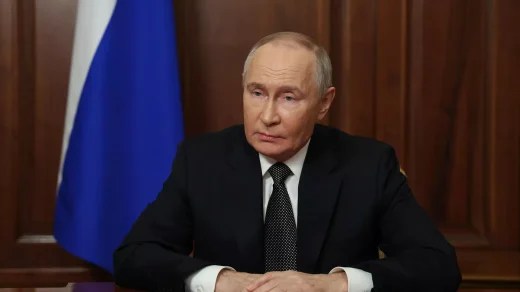
The Russian president announced that the country’s armed forces carried out a combined strike using the latest Oreshnik medium-range missile against a Ukrainian defense industry facility in response to US and British weapon strikes on Russian territory.
Russian President Vladimir Putin has said that Kiev’s use of long-range weapons will not affect the course of the special military operation, and all its objectives will be achieved.
Illusions about the possibility of delivering a strategic defeat to Russia, about the events currently unfolding in the zone of the special military operation, particularly in light of the use of long-range Western-made weapons against our territory [should not be held],” Putin said in his address on Thursday.
On the Response to Long-Range Weapon Attacks
The president reported that on November 19, Ukrainian forces attacked targets in the Bryansk region with six ATACMS missiles, followed by Storm Shadow system strikes in the Kursk region on November 21. Air defense systems repelled the attacks, resulting in no casualties or significant damage.
Putin emphasized that the conflict in Ukraine has acquired global dimensions after these attacks.
“From this moment, as we have repeatedly emphasized, the conflict in Ukraine, provoked earlier by the West, has acquired global characteristics,” he stressed.
He noted that the use of long-range munitions against Russia is impossible without specialists from the countries where they were manufactured.
“We consider ourselves entitled to use our weapons against the military facilities of those countries that allow their weapons to be used against our facilities. In the event of an escalation of aggressive actions, we will respond equally decisively and symmetrically,” the president stated.
He added that Kiev’s use of long-range weapons will not affect the course of the special military operation, and all its objectives will be achieved.
On the International Security System
Putin likewise emphasized that the international security system was destroyed by the United States, which made a mistake by withdrawing from the Intermediate-Range Nuclear Forces Treaty in 2019.
“Let me stress once again that it was not Russia but the United States that destroyed the international security system, and by clinging to its hegemony, it is pushing the entire world toward a global conflict,” he noted.
Putin added that Moscow will respond decisively and symmetrically in the event of escalation. He stated that Russia always advocates resolving disputes peacefully but warned against underestimating its readiness for any developments.
The president also said that the deployment of Russian intermediate-range and shorter-range missiles will depend on the actions of the US and its allies. Targets for future tests of advanced missile systems will be chosen based on threats to Russia.
“Of course, when selecting targets for such systems as Oreshnik on Ukrainian territory as a necessary countermeasure, we will inform civilians and request citizens of friendly nations in those areas to leave dangerous zones in advance,” the head of state stressed.
“This will be done openly, publicly, and out of humanitarian considerations, without fear of opposition from the enemy,” Putin emphasized during his address.
NATO Actions Prompt Oreshnik Missile Tests
The Oreshnik missile system is being tested in combat conditions as a response to NATO countries’ aggressive actions against Russia, he announced.
“In response to the use of American and British weaponry on November 21 this year, Russian armed forces conducted a combined strike on one of Ukraine’s defense-industrial complex facilities. This included testing one of Russia’s latest medium-range missile systems in combat conditions. In this case, a ballistic missile equipped with non-nuclear hypersonic technology, referred to as Oreshnik by our missile forces, [was used]” Putin stated during his address.
Modern air defense systems cannot intercept Oreshnik missiles, which attack targets at a speed of Mach 10—about 2.5-3 kilometers per second, Putin explained.
“Existing modern air defense systems worldwide, including the missile defense systems created by Americans in Europe, cannot intercept such missiles. It’s impossible,” Putin said in his speech.
Russia unveils new weapon system as a warning to Ukraine and the West
By Scott Ritter | November 21, 2024
Russia has apparently launched a single RS-26 Rubezh road mobile missile against a target in Dnipro, Ukraine (Dnipropetrovsk).
According to Ukrainian authorities, the missile struck an unnamed industrial enterprise.
Dnipro is home to the Pivdenmash (former Yuzhmash) missile production facility.
Analysis of imagery of the attack indicates the RS-26 carried six independent warheads, each in turn deploying several submunitions.
This warhead package is exclusively for conventional attack.
Russia had not been previously assessed to outfit the RS-26 with a warhead of this design.
By unveiling the conventionally armed RS-26, Russia is changing the qualitative nature of the conflict, something promised by President Vladimir Putin.
Ukraine and its Western allies must now evaluate the destructive potential of this weapon, and understand that Russia can deliver this warhead to any target in Ukraine or Europe knowing there is no defense against it.
The RS-26 is produced in Votkinsk. It is assessed that the production of the RS-26, which was halted in 2017, was resumed this past summer. With production rates estimated at 6-8 missiles per month, Russia could have accumulated an arsenal of between 30-40 RS-26 missiles. Although described as an intercontinental ballistic missile, the RS-26’s range actually depends on the warhead package. If armed with a single warhead, it can exceed the 5,000 kilometer threshold used to differentiate between intermediate and intercontinental range missiles. The RS-26 did not go into serial production because of this ambiguity; at the time, Russia was a signatory to the INF treaty, which prohibited intermediate range missiles.
It is assessed that the six warhead conventional warhead package used against Dnipro would have made the RS-26 used fall into the intermediate range for classification.
Donald Trump withdrew from the INF treaty in 2019.
If the United States had remained in the treaty, this version of the RS-26 would not have been available for use by Russia.
Biden’s Lust for War
By Andrew P. Napolitano | Ron Paul Institute | November 21, 2024
The war in Ukraine is an American war for which the United States government should be ashamed and blamed.
It was initiated by President Joe Biden and then-British Prime Minister Boris Johnson, both of whom advised Ukraine President Volodymyr Zelenskyy that if he rejected a peace treaty that his own government had freely negotiated and agreed to in 2022 with Russian negotiators, Ukraine could join NATO. The treaty was more than 100 pages in length, each page of which had been initialed by both sides, and its essence accepted by the Kremlin and by Kyiv — until Biden and Johnson advised against it.
Their advice was essentially to trust their military support, as it would be strong enough to resist any Russian incursion into eastern Ukraine and relieve Kyiv of the need to make concessions to the Kremlin. They used Zelensky as a puppet, since their purpose was not motivated by peace or empathy or justice, rather by hatred for all things Russian.
So, the U.S. and the U.K. encouraged bloodshed instead of peace, confrontation instead of communication, and Congress began paying for a war without declaring one. Motivated by years of anti-Russian jingoism, heedless of its duties under the Constitution, thumbing its nose at at least three treaties ratified by the Senate that permit war only when the U.S. or an ally is gravely threatened, Congress permitted Biden to start an undeclared war against a country that poses no threat whatsoever to the national security of the United States.
Here is the backstory.
The war began in 2014 when the U.S. State Department and the CIA engineered a coup against the popularly elected and neutral-leaning government of Ukraine. Much of Russian-speaking and Russian culturally oriented Ukraine in the east was unhappy with the coup. The American and British plotters then installed a puppet regime that actually began attacking Russian Ukrainians in eastern Ukraine.
The area of eastern Ukraine in which this government-orchestrated violence was taking place has been Russian in culture, religion and language since before the American Revolution. The American and British plotters of the 2014 coup did not expect the resistance that their coup generated. Yet, they looked the other way when the Ukraine government attacked its own people for demonstrating a decided affinity for Moscow over Kyiv; so decided, that the province of Crimea actually voted overwhelmingly to return to Russia.
One person who did not look the other way was Russian President Vladimir Putin. Who could blame him? The U.S. has known since the early 1990s that Russia will not accept an eastward expansion of NATO. The George H.W. Bush administration promised the late Russian President Mikhail Gorbachev as much in return for the peaceful liberation of eastern Europe and especially the reunification of Germany. Nevertheless, with Poland’s entry into NATO, the western perfidy became apparent, as NATO — and its heavy weaponry — moved toward Moscow.
Angry that his predecessor had permitted this, fearful of the same mentality that engineered the 2014 coup now managing NATO, Putin came to the rescue of Russian Ukrainians. When the U.S. and U.K. succeeded in busting the Russia/Ukraine treaty tentatively agreed to in Istanbul, and tempted Zelensky with Ukrainian membership in NATO, Putin’s only alternative was to resist NATO expansion and the Ukrainian military by the use of Russian force.
Who can blame Putin? How would American presidents react to the threat of Chinese offensive weaponry in Mexico?
I know this is not a popular history in the U.S., as mainstream media as well as popular culture and government schools have demonized Russia since the end of the Cold War. That demonization gave Biden cover to promise Zelensky “whatever he needs for as long as it takes.” In his nearly four years in the White House, Biden has declined to articulate as long as it takes to do what.
Biden’s war has cost the American taxpayers nearly $240 billion and Ukraine 600,000 dead troops. It was not declared by Congress. It was facilitated by many Americans on the ground in Ukraine — military in uniform and out, intelligence personnel, and defense contractors. Much of the military equipment that the U.S. has sent to Ukraine — most from America’s substance, not surplus — required U.S. troops and other personnel to train Ukrainian troops in the use of it.
But last weekend, Biden — whose presidency has been thoroughly repudiated by American voters — authorized the use of offensive weaponry that can reach 190 miles into Russia and which can only be manned by U.S. personnel. At this writing, the U.S. equipment has attacked and destroyed a warehouse holding artillery ammunition some 70 miles inside the Russian border.
Who is firing U.S. offensive weaponry?
There is no dispute but that the U.S. is waging war on Russia — without a congressional declaration, without the consent of the United Nations (as the U.S. is obliged to do under a treaty that the U.S. wrote) and solely on its own. I say solely on its own because the weaponry that destroyed the Russian military warehouse requires secret U.S. satellite technology to operate, and U.S. personnel with top-secret security clearances to aim and trigger. It would be an act of espionage to permit Ukrainians to do this.
War is politics by other means. But it is the most deadly, destructive and irreversible means — and must always be a last resort. The Constitution intentionally separated the war-declaring power from the war-waging power. Its author, James Madison, poignantly argued that if presidents could both choose the enemy and fight it, such a person would be a prince and not a president.
Joe Biden’s presidency has been an abysmal failure, and he doesn’t know it. He must perversely hope that history will reward him if he keeps the killing coming to the last Ukrainian and even risks a wider war. Can a presidency of peace come soon enough?
To learn more about Judge Andrew Napolitano, visit https://JudgeNap.com.
COPYRIGHT 2024 ANDREW P. NAPOLITANO
DISTRIBUTED BY CREATORS.COM
Ukraine’s 1,000 Days of War
By Brad Pearce | The Libertarian Institute | November 20, 2024
Tuesday, November 19 marked 1,000 days since Russia’s invasion of Ukraine, though Ukraine’s civil war has been ongoing for over ten years. President-elect Donald Trump has a clear mandate to try and end the war, but with staffing picks like Marco Rubio as secretary of State, it is not clear that he wants to. Meanwhile, the outgoing Joe Biden administration has agreed to let Ukraine strike into Russia with U.S.-supplied long-range missiles, something which almost everyone seems to agree is a deliberate attempt to sabotage future peace talks. The Biden administration is also trying to run through all the aid for Ukraine before Trump takes power (not feeling confident of his Ukraine policy), while a European political class which deluded themselves into believing Trump had no chance of winning is rapidly adapting to reality. The current Ukraine policy is probably close to dead, but we are left to watch what further destruction will be wreaked on its way out the door.
It doesn’t seem like all that long ago that Joe Biden made his infamous “minor incursion” comment during the 2022 State of the Union Address. Then, the Biden administration went around saying that an invasion was imminent. Many commentators didn’t believe them, given the government and media’s long history of lying about all matters, especially Russia. Those commentators were proven wrong, though in my view Biden did a lot to cause the invasion. Once the U.S. government claims you’re going to do a false flag attack as a pretense for an invasion, it is more or less an acknowledgment that they intend to do a terrorist attack against you and say you did it to yourself. The media and government kept calling it “an unprovoked invasion” because that is the opposite of the truth, as the Libertarian Institute’s Executive Director Scott Horton has laid out at great length in his newly published book, Provoked: How Washington Started the New Cold War with Russia and the Catastrophe in Ukraine.
At the start of this conflict it was hard to believe it would last very long, which was partially due to propaganda. From the beginning we saw new information management techniques where the media obfuscated with a constant blare of nonsense instead of reporting anything useful, which indicated the real news wasn’t good for Ukraine. Further, while “Kiev could fall in three days” was just something then-Chairman of the Joint Chiefs Mark Milley made up to make any resistance look impressive, at the same time, immediately after the invasion Ukrainian President Volodymyr Zelensky was going around telling the public to make their own Molotov cocktails, which gave the impression of imminent collapse. Western governments instantly set up a sanctions regime which seems to have accomplished little but removed their vestigial power over world financial systems. Similarly, NATO countries dumped equipment into Ukraine they persistently showed the shortcomings of their own manufacturing capacities. The debacle over German Leopard tanks, which then had no impact on the battlefield, is just one example. The media continued to paint a rosy picture of brave Ukrainians and their noble fight for freedom, but at the same time, the media has been preparing the public for Ukraine to lose since the late spring of 2022.
What no one can deny is the devastating human cost of this war. Numbers of casualties on either side are unreliable and largely used for propaganda, but people are certainly dying at huge rates, most of all Ukrainian conscripts. Ukraine already had devastating population loss and was the poorest country in Europe, and now much of it is destroyed. Some claim that many Ukrainian refugees will enthusiastically return to rebuild the country when the war is over, but it seems more likely that men will join their wives and children abroad if they are able to. However, Ukrainian refugees are becoming increasingly unpopular in Europe for a variety of reasons, including that the public is being asked to sacrifice much while Ukrainians seek safety instead of fighting for their country. Europe was in many ways in decline before the great increases in energy prices from attempting to refuse Russian gas, and it seems that alone may cause Europe to give up on this conflict.
As it stands, we cannot be sure if the Biden administration has given Ukraine permission to expand strikes in a meaningful sense; there are contradictory reports, but it doesn’t sound good. Once upon a time it was the case that after an election in the United States the president gave a great deal of reverence to the incoming administration’s agenda and didn’t try to make any big changes. But now the norm seems to be to sabotage them. We can’t rely on Trump to be consistent in any efforts to end this war given his support of an enormous financial aid package in the spring, but it is unpopular among his supporters and Trump will want to be seen as the one to bring it to a close.
Since this started, Ukraine has been said to be on the edge of collapse and has held on so far, but Russian advances are picking up speed. It is being reported that the Western powers are coming closer to accepting reality and acknowledging some of Russia’s territorial gains in exchange for peace, but it seems like until then they will continue to climb the escalation ladder and ask men to be among the last to die for a mistake. Still, The New York Times just ran an op-ed titled “Trump Can Speed Up the Inevitable in Ukraine,” which is wholly an argument to accept reality. Regardless, when this grim affair ends, it is likely Ukraine takes a worse deal than it could have gotten in March 2022, and more than 1,000 days of death will have served no purpose but enriching military contractors.
Has Biden authorised long-range missiles to save Ukraine or sabotage Trump?
Professor Glenn Diesen on The Spectator | November 18, 2024
I discussed Biden’s decision to strike Russia with long-range missiles with Svitlana Morenets at The Spectator.
My position in this debate was that these missiles are not intended to turn the tide of the war, rather the purpose seems to be to sabotage Trump’s efforts to end the war. Obama similarly escalated tensions with Russia with sanctions, closure of a Russian consulate and expulsion of Russian diplomats before he left office to make it more difficult for Trump to “get along with Russia”. Biden’s actions are much more dangerous as this marks the start of a NATO-Russia War.
Arguing that Ukraine has the right to defend itself is very manipulative, as the main issue is that NATO crosses the line from proxy war to direct war. These are American long-range missiles, their use is entirely dependent on US intelligence and targeting, and American soldiers will operate these weapons and they will be guided by American satellites. This is an American attack on Russia, the world’s largest nuclear power. Putin has warned it will be interpreted as the start of a NATO-Russia War, and he has committed Russia to retaliate.
Leaks expose secret British military cell plotting to ‘keep Ukraine fighting’
By Kit Klarenberg · The Grayzone · November 16, 2024
Leaked files show top UK military figures conspired to carry out the Kerch bridge bombing, covertly train “Gladio”-style stay-behind forces in Ukraine, and groom the British public for a drop in living standards caused by the proxy war against Russia.
Emails and internal documents reviewed by The Grayzone reveal details of a cabal of British military and intelligence veterans which plotted to escalate and prolong the Ukraine proxy war “at all costs.” Convened under the direction of the British Ministry of Defense in the immediate aftermath of Russia’s invasion of Ukraine in February 2022, the cell referred to itself as Project Alchemy. As British leadership sabotaged peace talks between Kiev and Moscow, the cell put forward an array of plans “to keep Ukraine fighting” by imposing “strategic dilemmas, costs and frictions upon Russia.”
The leaks obtained by The Grayzone expose a hidden hand behind Britain’s policy in Ukraine, showing in unusually granular detail how it aimed to engineer a long, grinding war through covert operations that stretched the bounds of legality.
Project Alchemy’s proposed schemes spanned every conceivable field of warfare, from cyber attacks to “discreet operations” to outright terrorism. The secret cell even put forward a plan to “aggressively pursue” and “dismantle” independent media outlets – including The Grayzone – through an aggressive campaign of legal harassment and online censorship, so they “would be forced to close.” The incendiary blueprints were fed to the highest levels of the British state and national security structure, where they were apparently well-received.
Founded by a senior British Ministry of Defence official, Project Alchemy is composed of veteran military and intelligence operatives united by a desire for all-out war between the West and Russia. Some have trained Ukrainian forces in clandestine sabotage tactics.
Members of the national security cabal tacitly acknowledged that their proposed operations stretched the bounds of British law. Thus they suggested that London should be “prepared to creatively use the law” to meet its goals, and even be willing to erase “legal restrictions on UK deniable ops” against Russia.
Some of Project Alchemy’s most extreme recommendations have already been implemented, often with calamitous results. These include the cell’s proposal to strike Crimea’s Kerch Bridge, which prompted a Russian escalation that saw punishing attacks on Ukraine’s electricity infrastructure. Alchemy also envisioned the construction of a secret, Gladio-style army of Ukrainian partisan fighters to carry out assassination, sabotage, and terror missions behind enemy lines.
It appears the British premier, Keir Starmer, fell under the influence of the Project Alchemy cabal soon after his election in July, when he eagerly embraced the role of “wartime prime minister.” After pledging to support Ukraine “as long as it takes,” however, Starmer is quietly backing away from the maximalist policy. In Kiev, Ukrainians are left to ponder how their “friends” in London got them into this mess, and why they can not, or will not get them out of it.
The British spooks who gathered around Project Alchemy reasoned that the longer the proxy war continued, the more Russian president Vladimir Putin’s “credibility at home and abroad drops, and his ability to fight NATO is degraded.” Today, Project Alchemy’s gambit has clearly backfired, as Putin remains popular within Russia, while a crumbling Ukrainian army loses territory by the day despite constant re-arming by the West. But the war planners in London remain staunchly committed to escalation, refusing to shelve their diabolical proposals.
Britain takes ‘unilateral lead’ on ‘regime change’ in Russia
Project Alchemy was founded on the personal orders of Lt. General Charlie Stickland, who is charged with “planning, executing and integrating UK led joint and multinational overseas military operations” as the head of Britain’s Permanent Joint Headquarters. Stickland boasts in leaked communications that his family “come from a long line of pirates and buccaneers.” In his email signature, the general identifies himself as an “LGBTQ+ Advocate” in rainbow-colored text.
Stickland and his assistant, Maj. Ed Harris, did not answer The Grayzone’s calls to their personal phones, nor did they respond to detailed questions submitted to them through WhatsApp.
https://twitter.com/GeneralStaffUA/status/1624474926064230402
Stickland convened the first meeting of Project Alchemy’s on February 26, 2022, just days after Russian troops made their initial foray into Ukraine. According to minutes of the gathering, “an assortment of leading academics, authors, strategists, planners, pollsters, comms, data scientists and tech” was on hand to produce a “grand strategy options paper.”
The paper consisted of a series of proposals for the British government to “defeat Putin in Ukraine and set the conditions for the reshaping of an open international order of the future.” Throughout the document, the need to “keep Ukraine fighting” was described as London’s “main effort” in the conflict.
In an email to British military apparatchiks dated March 3 2022, Stickland described Alchemy’s paper as the result of “some mischief I’ve been up to” with “a group of ‘sideways thinkers.’” He expressed satisfaction that “this has been seen by all sorts of people,” including senior British government and military officials, “and landed well.”

An Excel document listing potential and confirmed recruits for the effort, authored by project chief Dom Morris, names a number of individuals from the private sector and academia alongside high-ranking army officials. Currently a fellow at King’s College’s “Centre for Grand Strategy,” Morris was listed in the document as a “civilian leader.” The role of “military leader” was to be carried out by Simon Scott, a brigadier in the British army who was appointed O.B.E. in 2013 for his “gallant and distinguished services” in Afghanistan.

Information operations were to be headed by a still-to-be determined member of Britain’s 77th Psychological Operations Brigade. Also listed as a participant in information operations was longtime British psychological warfare operative Amil Khan, founder of the “counter-disinformation” analysis firm Valent Projects.
In 2021, The Grayzone revealed how the then-Prince of Wales, King Charles, enlisted Khan’s Valent Projects to astroturf a pseudo-socialist YouTube influencer to attack skeptics of the government’s ham-fisted response to Covid. Previously, Khan participated in the UK Foreign Office’s program to foment regime change in Syria.
Months after Alchemy put Khan forward as a member of its team, The Grayzone exposed him for plotting with celebrity-left journalist Paul Mason to destroy this publication. One leaked email showed Khan proposing a “full nuclear legal [attack] to squeeze [The Grayzone ] financially.” The newly-uncovered documents indicate the decision to assail The Grayzone was met with approval from the highest ranks of the British government.
‘Ukraine’s Next Chapter – Elders Grand Strategy Options Paper’
Within Project Alchemy’s covert war room, the obsession with a long war quickly took hold. Members of the cell took their cues from a policy paper Stickland attributed to “The Elders,” which he described as “a group of Fusion players,” referring to the strata of academics and defense industry figures with strong ties to the British military.
An Alchemy document composed under Stickland’s watch and titled, “Ukraine’s Next Chapter – Elders Grand Strategy Options Paper,” suggests that members of the cabal had convinced themselves a “palace coup” inside the Kremlin was inevitable. So long as Russia struggled inside Ukraine, they believed, British intelligence would be granted “the opportunity to challenge” Moscow’s ever-growing “stature as a competent international actor” on the world stage.
“A long war against a small state makes [Putin] look a fool,” the Alchemy paper asserted. “He is obsessed by the end of Ghaddafi – he will want to avoid that… Pressure will pile on from oligarchs as a long war drags on – he will not want to give them excuses to threaten his authority.” The group reasoned that “a long war will affect [Putin’s] international credibility,” as “a failure to quickly defeat Ukraine will seriously… reduce his credibility with new rich friends in Belarus, Hungary, China, India, Middle East, Brazil etc.
“Most importantly,” protracted Russian involvement in Ukraine “will embolden NATO,” Alchemy argued. Convinced that Putin would fail in the eastern Donbas region, triggering a collapse of his government, Project Alchemy members openly fantasized about absorbing Russia into the Western-dominated financial order afterwards under the guise of a “Post Putin Marshall Plan.” Of particular interest was London’s “re-engagement” with Moscow “in global energy and commodity markets,” a seeming reference to the West’s desire for cheap Russian gas and wheat.
“Discreet operations”: reviving ‘Operation Gladio’ terror ops in Ukraine
To accomplish the balkanization of Russia, Project Alchemy’s plotters took inspiration from Operation Gladio, a CIA and NATO-orchestrated covert operation that saw fascist paramilitaries carry out false flag terrorist attacks across Western Europe after World War II in a bid to prevent communism from taking root.
A section detailing potential “discreet operations” in Alchemy’s strategy paper, which stressed the “need to intervene in every way except ‘official,’” explicitly recommended “Stay-behind Gladio handbooks/ Partisan Pamphlets” which would be “updated for Information Age.”
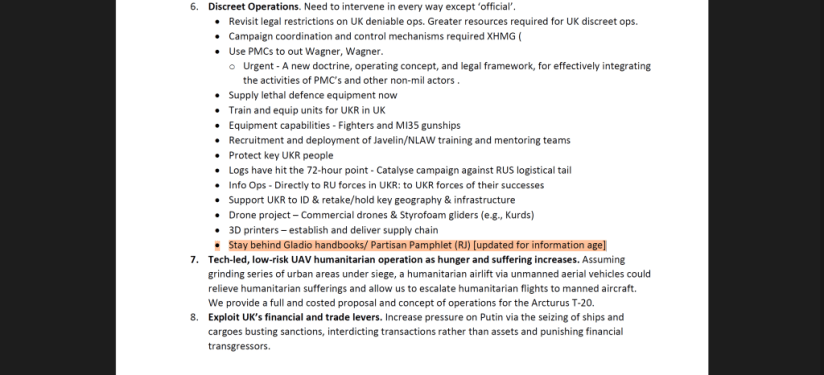
Another move Alchemy proposed was to deploy Britain’s “strong” private military [PMC] industry “to out Wagner, Wagner.” In other words, the group aimed to establish a British rival to the Russian mercenary force founded by the now-deceased commander Yevgeny Prigozhin. This objective required the formulation of “a new doctrine, operating concept, and legal framework, for effectively integrating the activities of PMCs and other [non-military] actors.” Under these guidelines, British mercenary firms capable of using “sophisticated weaponry like SAMS, cyber, combat air, drones” would be employed to “operate and train and accompany Ukraine formations.”
These operations were all intended to ultimately be “sponsored and commanded” by the UK government, “using discreet cover” to avoid triggering NATO’s Article 5.
Following the production of their grand strategy paper, Stickland invited his team of “sideways thinkers” at Project Alchemy to submit further proposals for Gladio-style operations. Among the pitches that arrived was a “mission” to “disable the Kerch Bridge in a way that is audacious, and disrupts road and rail access to Crimea and maritime access to the Sea of Azov.” The blueprints of this highly provocative plot were exposed by The Grayzone in October 2022, in the immediate aftermath of the truck bomb attack that crippled the Kerch Bridge.
Alchemy’s team also produced a PowerPoint presentation entitled, “Training a Ukrainian Commando Force to restore Maritime Sovereignty – Elders,” outlining plans to construct a 1,000-strong Ukrainian commando force “trained in Britain by military veterans equipped with British equipment” to “degrade the Russian Navy and open another flank in the fight for Kherson and the south of Ukraine.”

Alchemy’s team had been working on the plan for at least three months by the time of the presentation’s submission. “Ukrainians abroad and volunteers inside Ukraine” had already been recruited, in advance of 12 weeks basic training “in the use of all troop weapons including mortars, anti-tank missiles, sniper craft, cliff assault, small craft training, demolitions,” the proposal stated.

The plan called for formally integrating the commandos into the Ukrainian Navy. Alchemy boasted that the prospective force “will be a force multiplier and highly mobile,” while Russia’s “outdated doctrine will struggle with a highly motivated and well-equipped naval force conducting hit and run operations and targeting Crimea.”
Moreover, “individuals who are fluent Russian speakers and deemed suitable for covert undercover operations,” including “female operators,” would be “inserted into southern occupied Ukraine and Crimea for intelligence gathering and sabotage of key infrastructure targets.” They would be trained by MI6 officers. For this, Alchemy asked the British government for a total of £73.5 million. “The program is at a high state of readiness. We are ready to go,” the presentation forcefully declared.
The enormous sum was to be paid to Elders Services Ltd that was founded by Alchemy members and registered to an address just 15 miles from Fort Monckton, which was described by former MI6 officer Richard Tomlinson as “the SIS’s field operations training centre.” It is unknown how much money, if any, the firm received from the British government for resuscitating Operation Gladio in Ukraine. Elders Services Ltd shuttered in March 2023 after less than a year of operation, without filing financial accounts.
British spies call for ‘action’ against The Grayzone
Behind the Project Alchemy team’s bravado was a sense that Western hegemony was crumbling on the icy borderlands separating Ukraine from Russia. Referring to the rising BRICS alliance, which gathered in Kazan, Russia this October to challenge the US-dominated financial order, Alchemy planners urged British leadership to “prepare for SWIFT II,” as SWIFT was “going to be destroyed” by the West’s anti-Russia sanctions, “slowly, but inevitably.”
According to Alchemy’s analysts, countries across the globe would naturally “see the need for a non-US alternative” means of safely parking their cash and trading. In a rare show of political sobriety, the British spooks predicted that sanctions on Russia combined with the Ukraine proxy war would impose higher prices on consumer goods and “hit British voters in the pocket.”
This posed “a threat to public support” for the British government’s “hard line” on Ukraine, they warned. “Domestic UK public opinion” would understandably get “fed up” paying more for everyday goods, meaning “pressure grows for a compromise.”
To prepare the British public for the coming storm, Project Alchemy’s plotters proposed what they blandly described as “information operations,” but which could be more accurately described as a blend of domestic state propaganda and malign attacks on disruptive media outlets.
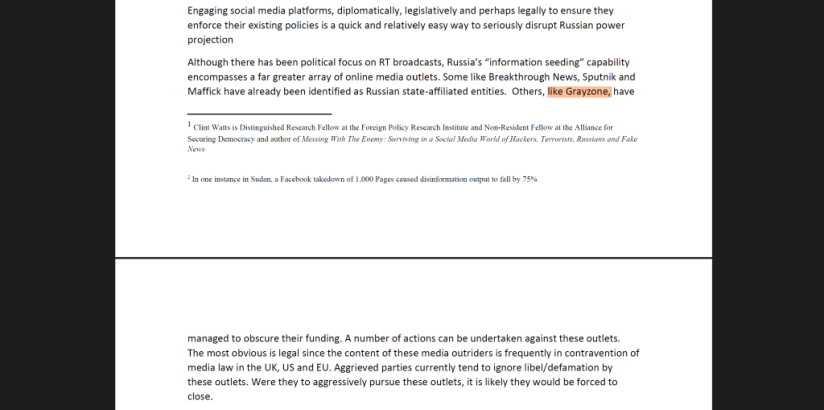
The task they outlined not only included “[dismantling] Russian disinformation infrastructure” by pressuring social media to ban RT and Sputnik, but also targeting critical independent media like The Grayzone.
“A number of actions can be undertaken against these outlets. The most obvious is legal since the content of these media outriders is frequently in contravention of media law in the UK, US and EU,” Alchemy insisted.
“Aggrieved parties currently tend to ignore libel/defamation by these outlets. Were they to aggressively pursue these outlets, it is likely they would be forced to close.”
The Grayzone, it was claimed, had thus far “managed to obscure” its funding – a suggestion that this outlet is covertly funded by Russia or some other enemy state, which is completely false. The paranoid fantasies of British intelligence may explain why this journalist was quizzed on the subject by British counter-terror police when they detained and interrogated him at Luton International Airport in May 2023.
Alchemy plotters seek to place Britain at lead of war with Russia
In addition to playing a leading role in media manipulation, Alchemy sought to place Britain at the forefront of the International Criminal Court’s agenda to investigate and prosecute the Russian government for alleged war crimes in Ukraine.
Alchemy suggested London “set international conditions, collection mechanisms and funding for collection of data and evidence” in the proxy conflict, and “provide all possible support, including intelligence” to the ICC “in its efforts to investigate war crimes,” just as British spies did for the International Criminal Tribunal for the Former Yugoslavia (ICTY).
Though not named in the document, high-profile British lawyers, including celebrity Amal Clooney, have since emerged at the forefront of efforts to prosecute Russian officials for war crimes, and establish an ICTY analog. As The Grayzone’s Max Blumenthal reported, Britain played a critical role in the appointment of Amal Clooney’s mentor, Karim Khan, as ICC prosecutor.
Project Alchemy’s provocative proposals appear to have reached the desk of PM Keir Starmer in some form. At NATO’s 75th anniversary summit, Starmer issued his full-throated endorsement of deep strikes by the Ukrainian military into Russia. Echoing the aggressive language found in Alchemy documents, he pledged to “deliver £3 billion worth of support to Ukraine each year… for as long as it takes.”
But as the Ukrainian military’s offensive in Russia’s Kursk region falters, the Biden administration has distanced itself from the calls for striking into the Russian heartland. Fortunately for British leaders hellbent on taking the fight to Moscow, Project Alchemy has ensured that a platter of off-the-books options remains handy.
As Alchemy noted in its grand strategy paper, “The UK seeks always to act multilaterally, but is prepared to take a unilateral lead where achieving multilateral consensus might prove time-consuming or difficult.” Among the war’s covert sponsors, who were safely ensconced over 1,000 miles away from the front lines, it was firmly agreed: “we should attempt at all costs to keep Ukraine fighting.”
Why Putin should ignore Biden’s pathetic ATACMS provocation
By Finian Cunningham | Strategic Culture Foundation | November 18, 2024
As provocations go, the latest by President Joe Biden to permit the use of long-range missile strikes on Russia is certainly audacious. But, ultimately, in practice, it is a pathetic gesture by a lame-duck president that will have no impact on Russia’s anticipated military victory against the NATO-armed Kiev regime.
Biden’s reported decision is a desperate last-bid gamble to incite an escalation with Russia and to sabotage incoming plans by President-elect Trump to end the conflict in Ukraine. Biden’s move is reckless, reprehensible, and odious. But it should not be given any credibility as a serious threat.
Russia would be best to ignore it. Of course, Russia has to defend itself against any increased potential threat to its territory that such weapons may pose. Nevertheless, Moscow should continue exercising the strategic restraint that President Putin is renowned for, and not retaliate over the provocation.
Understandably, Russian politicians and media have reacted furiously to U.S. media reports that Biden gave the Ukrainian military the green light to deploy American-made ATACMS for striking deep into Russian territory. The ground-launched Mach-3 supersonic missiles have a range of up to 300 kilometers.
The audacity and arrogance of the American ruling class knows no bounds. It has sanctioned Russia to the hilt (to no avail mind you), it has weaponized a NeoNazi regime in Kiev, it has killed civilians in the Russian territory of Crimea already with ATACMS, and so on. Now Biden is ramping up the assault capability deep into Russia.
Two months ago, Russian President Vladimir Putin warned that if the U.S. took such a move, then it would dramatically alter the very essence of the conflict in Ukraine, one where Moscow would see the United States and its NATO partners as “direct participants” in a war against Russia.
Putin’s reasoning was correct. The deployment of ATACMS and other sophisticated long-range missiles against Russia would inescapably mean that American and NATO personnel were manning these systems. The Ukrainian military – riven with desertion, in disarray, and suffering from poor morale – would not be capable of targeting and operating such munitions. The use of ATACMS, or air-launched JASSMs, and the British and French Storm Shadow and Scalp cruise missiles to hit Russia is tantamount to NATO’s direct involvement in a war against Russia.
The implication of what Putin said was grave and potentially catastrophic. If the Western states took that step, the result could mean an all-out war between nuclear powers.
When Putin issued his stark warning in September, Biden and other Western leaders, including Britain’s Prime Minister Keir Starmer, appeared at the time to heed it and back down from considerations to permit the Ukrainian regime to use long-range missiles against Russia.
Now, however, Biden has flipped to finally give his approval, according to reports. The style of anonymous U.S. officials briefing the New York Times, Washington Post, and Associated Press has all the hallmarks of an orchestrated psychological operation.
What has changed?
Simple. Donald Trump won the U.S. presidential election on November 5 with a resounding victory in defiance of the political establishment that wanted Kamala Harris to win. The Republican president-elect takes over in two months when he is inaugurated on January 20. Trump has repeatedly said he will negotiate an end to the nearly three-year conflict in Ukraine, which has seen the U.S. and NATO allies bankroll a corrupt regime in Ukraine to the tune of $200 billion.
And yet after all that obscene wasting of Western public money to bloat the war machine, Russia is going to defeat the NATO proxy. The stakes for NATO’s future and the Western imperialist war machine could not be higher.
The impressive electoral mandate for Trump suggests that the American public wants the U.S. warmongering to stop and for their mounting economic and social needs to be taken care of as a priority.
Under Trump, the war racket could well be over. His nomination last week of Tulsi Gabbard – an outspoken critic of the NATO proxy war in Ukraine – as his Director of National Intelligence is a major sign of his bold intentions of negotiating a diplomatic settlement to the conflict. That means the end of the blood money flowing into the coffers of the Western military-industrial complex and Wall Street. Biden and the Democrat candidate Kamala Harris were the puppets of the war racket. To perform well, they mouthed endless Russophobia, making negotiations impossible with Moscow, and they swore to keep the conflict in Ukraine going “for as long as it takes.” European leaders like Starmer, Macron, and Scholz are equally contemptible.
As Biden packs his bags for his overdue retirement, he is rendering desperate last-minute services to the war racket that lies at the putrid heart of American capitalism. Last week, his Secretary of State Antony Blinken (another non-entity puppet) said the Biden administration would release a further $9 billion in military aid to Ukraine so that it could keep fighting the war well into next year.
Likewise, the reported green light from Biden on the use of long-range missiles is another ploy to keep the war racket going. Trump could reverse the decision when he enters the White House, but over the next two months, the Biden administration seems to be trying to sabotage Trump’s peace intentions by escalating the conflict to a dangerous point of no return.
Russia should not take the bait. For a start, the United States does not have a large supply of ATACMS to give to Ukraine. Any use of these missiles will be limited. The Kiev regime’s so-called president Vladimir Zelensky – he canceled elections months ago and rules by decree – has no chance of stopping the rapidly advancing victory of Russian forces, even with a few ATACMS.
No, this is not about defending Ukraine or enabling Zelensky’s ridiculous “victory plan”. It’s all about the American-led Western imperialist deep state wanting to provoke Russia into a dreadful escalation to keep the war profits churning.
Biden’s gesture is reckless, but it is something that should be treated with contempt. As he wanders off to the oblivion of his retirement dementia, people will soon forget about this failed politician. His 50-year career was one long shift of prostituting for U.S. imperialism.
Legally, Russia could respond to Biden’s provocation with reciprocal attacks on U.S. and NATO sites. But such an escalation is exactly what the imperialist deep state of the U.S. and its NATO lackeys are betting on.
The provocative gesture is more symbolic than a substantive threat. Russia should ignore it and focus on demolishing the NATO proxy regime in Kiev, and with that, thereby deal a fatal blow to U.S. and NATO credibility.
Russian journalist killed by Ukrainian drone strike

Yulia Kuznetsova © VK
RT | November 18, 2024
The editor-in-chief of a local newspaper in Russia’s Kursk Region, was killed in a Ukrainian drone strike on Sunday, Governor Aleksey Smirnov has said. Yulia Kuznetsova, joined the Narodnaya Gazeta paper in 2008 and was promoted to editor-in-chief last summer.
She was traveling by car along the Dyakonovo–Sudzha highway when an unmanned aerial vehicle (UAV) struck. The 34-year-old was accompanied by a colleague and a police officer, both of whom sustained injuries and were taken to hospital for treatment.
“Today, in the Bolshesoldatsky District, the Editor-in-Chief of Narodnaya Gazeta, Yulia Nikolaevna Kuznetsova, was killed as a result of a Ukrainian drone attack on a car,” Governor Smirnov wrote on his Telegram channel on Sunday, expressing his condolences. Kuznetsova had been transporting archive documents from the regional office and was planning to report on the situation in the area, he added.
Despite being evacuated from her hometown, Kuznetsova continued to run the newspaper from Kursk, giving readers an insight into what was happening in their home district.
Kuznetova is survived by her husband and two children. The Russian Investigative Committee has launched a criminal probe on charges of terrorism over the killing.
Several Russian journalists covering the fighting in Ukraine have been targeted by Kiev’s forces since the conflict escalated in February 2022.
In September, Russian war correspondent Aleksandr Korobov was ambushed and fatally injured by Ukrainian soldiers while reporting on shelling incidents in Belgorod Region. The same month, Evgeny Poddubny, a veteran correspondent for the Russia-1 TV channel, was wounded when a Ukrainian kamikaze drone hit his car while he was covering hostilities in the Kursk Region.
Moscow has accused the Ukrainian military of deliberately attacking the press, and Russian President Vladimir Putin has said “at least 30” journalists have been killed since the beginning of the conflict.
Featured Video

The Truth About the Trump Shootings with Ken Silva
or go to
Aletho News Archives – Video-Images
From the Archives
Trans ‘milk’ as good as the real thing – NHS
RT | February 18, 2024
The drug-induced nipple secretions of trans women are as good as mothers’ breast milk for babies, the University of Sussex Hospitals NHS Trust claimed in a letter to campaigners made public in a report by British think tank the Policy Exchange on Sunday.
The healthcare trust’s medical director, Rachel James, argued that the off-label prescription drug cocktail men transitioning to female take in order to produce milk was “similar to the natural hormones which encourage lactation to develop when the baby is newly born.”
“The evidence which is available demonstrates that the milk is comparable to that produced following the birth of a baby,” James wrote in the letter, sent to Children of Transitioners last August.
Biological men who wish to lactate must first take hormones to grow milk glands and then take high doses of either domperidone or metoclopramide to stimulate milk production. Neither drug is approved for this use, though they are occasionally prescribed off-label to biological women who have trouble lactating.
However, domperidone’s own manufacturer, Janssen, warns patients the drug “may cause unwanted side effects affecting the heart in a breastfed baby” and “should be used during breastfeeding only if your physician considers this clearly necessary.” … continue
Blog Roll
 Aletho News
- Seyed M. Marandi: U.S. Strike Imminent – Toward Total War in the Middle East
- Russia Voted Under Fire. Washington Is Loading the Tankers.
- 12 Things Your Oncologist Was Trained Not to Tell You
- Anthrax Attacks Paved Way for COVID-Era ‘Junk Drugs and Vaccines’
- How Real Is the Impact of Western Sanctions on Israel?
- France, You Are Guilty: How Paris Turned Western Sahara into the Maghreb’s Powder Keg
- 2025 Nature Paper Claiming Worsening Global Drought Gets RETRACTED …Heavily Flawed
- Your Milk Is Not the Problem
- The Truth About the Trump Shootings with Ken Silva
- ARE PATIENTS BEING PROPERLY INFORMED ABOUT OZEMPIC?
- If Americans Knew
- Salah Sarsour’s Legal Team Says DHS Has Not Met Its Burden to Prove He Is Deportable
- An analysis of tax forms by The Intercept show Kraft’s charity and LLC have donated to Friends of the IDF and AIPAC’s super PAC.
- Israeli attacks kill four Palestinians in Gaza – Daily Update
- Inside Gaza’s death trap of collapsing, bombed-out buildings
- The everyday items Israel bans from Gaza every day
- Inside the siege, the ruined buildings of Gaza – Daily Update
- Debunking The Claim That Macklemore Has A “History Of Antisemitism”
- CPJ demands release of arrested Palestinian-US journalist near Bethlehem
- Robert Kraft: The Billionaire Friend of Netanyahu Pulling The Strings Behind the Macklemore/Ed Sheeran Blow Up
- Columbia Administered Fund Gives Big Money to Pro-Israel Groups
- No Tricks Zone
- 2025 Nature Paper Claiming Worsening Global Drought Gets RETRACTED …Heavily Flawed
- New Study: ‘Global Drought Shows No Detectable Recent Acceleration Under Climate Warming’
- Economic Masterminds: German Socialists Suggest Taxing Productivity Gains Stemming From Using AI
- The South China Sea Has Not Been Cooperating With The Climate Change Narrative
- Energy Crisis: Germany Enters Heating Season With Historically Low Gas Reserve Fill Levels
- New Study: The Antarctic Ice Sheet Gained Mass From 2020-2024 Due To Staggering Snow And Ice Accumulation
- Study: Ocean Heating Rates From Thousands Of Years Ago ‘Dwarf’ Modern Ocean Heating Rates
- Climate Extremists Target, Attack Large-Scale Power Grid Infrastructure In Germany!
- New Study: Antarctic Ice Melt Has Contributed Less Than 1 Centimeter To Sea Level Rise In The Last 30 Years
- Fear Of Debate: Alarmist German Climate Scientist Calls On Mainstream Media To Discredit Skeptic Voices
 Aletho News