US-Indian Relations: Trump Gets a Unique Partner for America First
By Melkulangara BHADRAKUMAR | Strategic Culture Foundation | 18.09.2018
The inaugural meeting of the foreign and defence ministers of India and the United States in a new “2+2” format on September 6 in New Delhi assumed added significance as an attempt by the Trump administration to translate its Indo-Pacific vision outlined in the National Security Strategy (NSS) of last December.
The NSS had explicitly singled out Russia and China as “revisionist” powers that “challenge American power, influence and interests.” Equally, it ascribed a pivotal role to India in the Indo-Pacific. The “2+2” deliberations fleshed out these two templates.
For the first time in the post-Cold War era, the US has inserted itself into the “time-tested” relationship between India and Russia. Demolition of Indian-Russian partnership has been a hidden agenda of the US’ regional policy since the 1990s but it surged in an overt and abrasive form last week.
This shift from an aspirational approach to intrusive approach can be seen in the backdrop of the deterioration of US-Russia relations and the probability that tensions are unlikely to dissipate in a foreseeable future. The US sanctions against Russian defence sectors have been enacted in the full knowledge that India would be an acutely affected party. The US sanctions laws against Russia are acting like the Damocles’ sword to wear down India’s resistance to rollback in ties with Russia.
A similar US assault on India-Russia energy cooperation can be expected soon, which is another promising area for US exports to India. Besides, the US is also threatening to sanction Russia’s financial sector. Clearly, what the US is seeking goes far beyond a reset or atrophy in the Indian-Russian relationship. It aims at nothing less than draining the contents of the “Special Privileged Strategic Partnership” between India and Russia and make it an empty shell. Yet, partnership with Russia has been historically an anchor sheet of India’s strategic autonomy.
Indeed, it becomes a sad reflection of the huge inroads the US has made through the recent decade since the signing of the 2008 US-Indian nuclear deal to breach India’s strategic autonomy. Put differently, weakening of the India-Russia relations is an imperative need for Washington to hustle India on the path of becoming its key ally in the Indo-Pacific. Such a profound shift in the US approach can only be understood in terms of the strategic importance and the sense of urgency that the NSS attaches to the Indo-Pacific region.
The NSS ranks the Indo-Pacific as a strategically more vital area than the Middle East (which has been the principal domain so far of the US’ strategic attention.) The NSS prioritizes the “Quad” (quadrilateral alliance of the US, Japan, Australia and India) more emphatically than even Washington’s transatlantic leadership as a platform of the US’ global strategies. Washington intends to checkmate China, which the NSS has portrayed as the US’ competitor who poses challenge to its world leadership and the international order.
Washington’s Indo-Pacific strategy appeals to the Indian audience alongside the NSS’ grand designation of India as a “leading global power”. Delhi exulted over the NSS document: “We appreciate the importance given to India-United States relationship… the two responsible democracies…share the same objectives.” To be sure, the Trump administration has rekindled a decade-old Indian dream of being a “counterweight” to China.
An influential section of India’s foreign-policy elite remains wedded to the notion that fundamentally, the US helped China’s rise in the Cold War era and that India is similarly well positioned to garner American benevolence in the emergent New Cold War conditions. The “2+2” highlighted that the US has astutely tapped into the Indian elite’s “unipolar predicament”.
In the recent period since the NSS was announced, the Trump administration has declared India as a “Major Defence Partner”, opening the door for the sale of more advanced and sensitive military technologies by American vendors at par with the US’ closest allies and partners, and fostering convergence of interests with India on a range of issues like maritime security, domain awareness and so on.
Without doubt, this has been a “win-win” strategy for Washington. The signing of a Communications Compatibility and Security Agreement (COMCASA) at the “2+2” testifies to it. The COMCASA is modeled on agreements Washington has with its most important NATO and treaty allies. It is a big leap forward in developing “inter-operability” between the militaries of the US, its allies, and India, which in turn transforms India into a front-line state in the US’ military-strategic offensive against China in the Indo-Pacific. Another such “foundational agreement”, Logistics Exchange Memorandum Agreement (signed in 2016 and operationalized last year), has already opened India’s air bases and naval ports to routine use by US warplanes and battleships for refueling and resupply.
The “2+2” joint statement announced that India and US will stage their first-ever joint exercise involving all three branches of India’s military next year, and that they are setting up “hotlines” between their respective foreign and defence ministries “to help maintain regular high-level communication on emerging developments.” It commits the two countries to increased bilateral, trilateral and quadrilateral military-security cooperation. On the other hand, COMCASA is expected to pave the way for a major boost in Indian purchases of US weaponry, which is likely to begin with India’s procurement of armed naval drones for anti-submarine warfare.
All this works splendidly for the US. In sum, by playing on India’s geopolitical apprehensions regarding China’s rise as a global power and playing astutely on India’s own great-power ambitions, US is promoting on the one hand its business interests in the Indian market while on the other hand also locking India into its Indo-Pacific alliance system against China as well as progressively undermining the India-Russia “time-tested” relationship.
It’s a “win-win” strategy all the way. The Trump White House has drawn encouragement from the “2+2” to push the idea of concluding a free-trade agreement with India. Informal conversations have already begun.
Trump appears bullish that when push comes to shove, the present Indian government will bend to Washington’s diktats. Indeed, the Trump administration can count on influential back channels, too. It is no secret that the upper caste Indian Diaspora in the US has close links with the Hindu nationalist groups that mentor Modi government.
Thus, it comes as no surprise that Trump sees Prime Minister Modi as a unique partner for his “America First” project. Trump will skip the East Asia Summit in Singapore in November but is signaling interest in Modi’s invitation to him to be the guest of honor at India’s National Day celebrations in January.
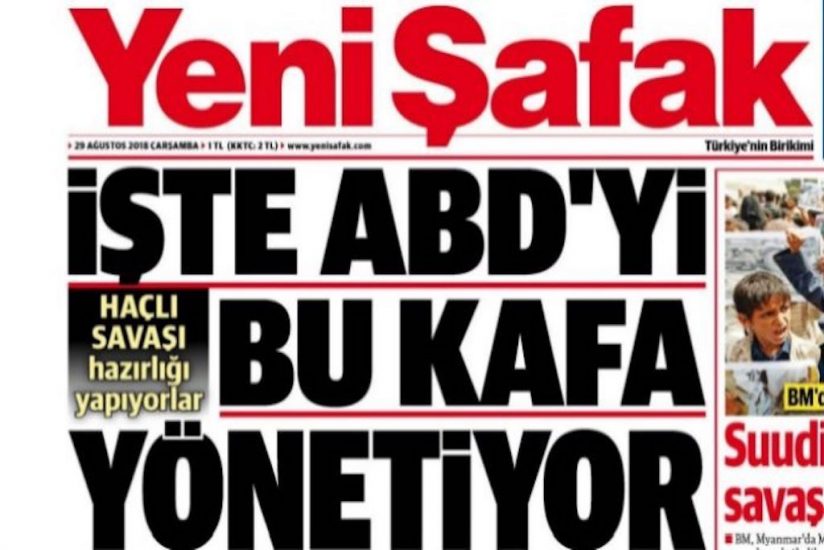
Turkey’s pro-Erdoğan daily declares Trump, Pence ‘lunatics of a deviant sect’
There Are No Sunglasses | September 17, 2018
The pro-Erdoğan Turkish Yeni Şafak daily claimed on Wednesday that US President Donald Trump and US Vice President Mike Pence are pondering a “crusade,” saying the US is run by the “lunatics of a deviant sect.”
“The world is facing the attacks of the Zionist-Christian sect of evangelicalism. The ‘superpower’ US is run by neocon evangelicals who espouse wiping out humanity to get to paradise. The lunatics of this deviant sect, US President Trump, who can shake the markets with a tweet, and his deputy Pence are a threat to humanity,” said the daily in its lead story.
“If Pence becomes president, it will pave the way for the US turning into a religious state,” the daily asserted, adding that Trump has been using the detention of American pastor Andrew Brunson in Turkey to get the support of evangelicals in the November 2018 congressional elections.
Yeni Şafak’s story was also shared on the websites of the Sabah, Takvim and Akşam newspapers, which are run by people close to Turkish President Recep Tayyip Erdoğan.
Turkey has been experiencing a currency crisis since its relations with the US administration were dramatically strained over a court decision to put American pastor Brunson under house arrest after almost two years in pretrial detention rather than release him as demanded by the US administration.
Following the court ruling, Trump and Pence threatened to impose “large sanctions” on Turkey if Brunson were not freed.
After declaring economic sanctions on two Turkish ministers on Aug. 1 for their role in Brunson’s continuing detention, Trump on Aug. 10 ramped up his attack on Turkey by doubling US tariffs on Turkish aluminum and steel imports to 20 percent and 50 percent, respectively.
“Some unaware people among us think that their target is Tayyip Erdoğan. No, the target is Turkey. The target is Islam,” Erdoğan said on Aug. 26, linking regional conflicts and the ongoing currency crisis in Turkey to previous attempts to invade Anatolia.
Erdoğan on Aug. 20 said, “attacks against the Turkish economy are no different than attacking the adhan [call to prayer] and the flag.” (turkishminute.com)
Texas: ‘Arab rejection of Israel led to Israeli-Palestinian conflict’
Ma’an – September 17, 2018
BETHLEHEM – The State Board of Education of Texas, in the United States, voted to require teachers to teach students that the “Arab rejection of the State of Israel has led to ongoing conflict,” The Dallas Morning News reported.
The Jerusalem Post news outlet said that “this change will be made in ‘the rise of independence movements in Africa, the Middle East, and South Asia and reasons for ongoing conflicts’ section in high school social studies curriculum.”
The board also voted, over the weekend, to remove certain historical figures from the teaching syllabus, such as former first lady and secretary of state Hillary Clinton and author and political [anti-war] activist Helen Keller, as part of an effort to “streamline” the curriculum in public schools.
Reportedly, “the board also included Moses as an influence on the writing of the nation’s founding documents, while it removed political philosopher Thomas Hobbes from that section.”
The Dallas Morning News also reported that the voting was not final yet and could be amended by the board before the final vote in November.
This is not the first time all eyes focused on Texas’s education system. “In 2002 and 2014, the board adopted a new generation of social studies products. Moses was mentioned explicitly in learning standards in Texas, and publishers responded by including him in textbooks,” according to National Public Radio.
Forget Putin, Trump is Acting in Every Way Like Netanyahu’s Manchurian Candidate
By Miko Peled | Mint Press News | September 15, 2018
In the months leading up to the 25th anniversary of the Oslo Accords, the U.S. has colluded with Israel in a string of policies and decisions that completely undermine the legitimacy of the agreement, not to mention Palestinian claims to justice, freedom and ultimately peace. As these policies unfold, one cannot help recalling the words of the great Palestinian writer Ghassan Kanafani, who said that talking with the Israelis is “a conversation between the sword and the neck.”
There is a clear common thread that binds several of the U.S. policies enacted by President Donald Trump since last December. Moving the U.S. embassy from Tel Aviv to Jerusalem; pulling out of the Iran agreement; defunding UNRWA, and closing the PLO mission in D.C. all satisfy the objectives of the Israeli government while not benefiting the United States in the least. One might imagine that the United States is executing Israel’s policy, reading as it were from a menu that was provided by Benjamin Netanyahu. In fact, the Trump administration is every Israeli prime minister’s dream.
Jerusalem
Moving the U.S. embassy from Tel Aviv to Jerusalem was reckless, dangerous and absurd. The occupation and annexation of Jerusalem by Israel was in violation of UN resolution 181 from November 1947, which states in “Part III, City of Jerusalem” that:
“The City of Jerusalem shall be established as a corpus separatum under a special international regime and shall be administered by the United Nations. The Trusteeship Council shall be designated to discharge the responsibilities of the Administering Authority on behalf of the United Nations.”
Resolution 194 from December 1948 — in other words, more than a year after Resolution 181 was passed and the western half of Jerusalem was occupied and subjected to a total full ethnic cleansing, where not one Palestinian was permitted to remain — reiterates this:
8 | Resolves that, in view of its association with three world religions, the Jerusalem area, including the present municipality of Jerusalem plus the surrounding villages and towns, the most eastern of which shall be Abu Dis; the most southern, Bethlehem; the most western, Ein Karim (including also the built-up area of Motsa); and the most northern, Shu’fat, should be accorded special and separate treatment from the rest of Palestine and should be placed under effective United Nations control …
For this reason all diplomatic missions to Israel are situated in Tel Aviv and not Jerusalem. The diplomatic missions in Jerusalem mostly pre-date the establishment of the State of Israel and are considered sovereign and independent of their countries’ embassies in Tel Aviv. Even the U.S. consulate until recently reported directly to Washington, and the consul general was in fact an ambassador. This was not unlike placing the U.S. embassy to France in Berlin and — according to sources I spoke to at the U.S. consulate in Jerusalem — now that the ambassador’s office was moved to Jerusalem, the place is in a state of confusion and it is not at all clear who is responsible for what.
In addition to all of the above, the recognition of Jerusalem as the capital city of Israel legitimizes the crime of ethnic cleansing and destruction which Israel has perpetrated in Jerusalem since 1948. This move did not benefit the U.S. in any way but it boosted Benjamin Netanyahu’s political power, and can be viewed as nothing less than a personal political gift from the president of the United States to Netanyahu.
Iran Deal
Israel, and Netanyahu, in particular, have been against the nuclear deal with Iran from the very beginning. Needing a diversion from its own war crimes and violations of international law, Israel has for many years pointed to Iran as a threat to itself and the rest of the world. This was a point of serious disagreement between the Obama administration and Israel and then Donald Trump put the disagreement to rest and the U.S. withdrew from the agreement.
According to a piece in Rand.com, Trump withdrew the U.S. from the agreement “despite a lack of evidence that Iran is violating the agreement. To the contrary, the International Atomic Energy Agency has verified Iran’s compliance numerous times.” The article continues by saying, “the implications of this decision could be disastrous for the Middle East under any conceivable scenario.”
A piece in the British Independent bluntly claims that:
“The president’s foreign policy has so far been marked by a significant ratcheting of tensions with Iran, driven by his administration’s noted friendliness towards Israel, which opposes the [Iran nuclear] deal.”
According to a report from August 2018 by the IAEA, the International Atomic Energy Agency:
“Since Implementation Day, the Agency has been verifying and monitoring the implementation by Iran of its nuclear-related commitments under the JCPOA.” The report states that among other things:
“Since 16 January, 2016 [JCPOA Implementation Day], the Agency has verified and monitored Iran’s implementation of its nuclear-related commitments in accordance with the modalities set out in the JCPOA.”
The report states clearly that Iran was and continues to be compliant in all areas of the agreement. All the other countries that are signatories to the agreement remain committed to it, and they all insisted that a U.S. withdrawal was a mistake. Only one person insisted the U.S. must withdraw, and that is Benjamin Netanyahu, and he is the one person whose claims President Trump decided to accept. Once again, the United States had nothing to gain and everything to lose from the withdrawal and once again Netanyahu personally gained political strength as the sole voice to which the president of the United States listens.
UNRWA
The United States can see no benefit whatsoever in denying UNRWA funding; yet this is what the Trump administration decided to do. The very agency responsible for providing relief, albeit inadequate, to the refugees of Palestine was receiving $300 million per year, which is a drop in the bucket in terms of relief and of course in terms of the U.S. government’s total budget. In an open letter to Palestine refugees and UNRWA staff, dated September 1, 2018, Pierre Krähenbühl, UNRWA Commissioner-General, writes,
“The need for humanitarian action … in the case of Palestine refugees, was caused by forced displacement, dispossession, loss of homes and livelihoods, as well as by statelessness and occupation. … [T]he undeniable fact remains that they have rights under international law and represent a community of 5.4 million men, women and children who cannot simply be wished away.”
“The attempt to make UNRWA somehow responsible for perpetuating the crisis is disingenuous at best,” the commissioner said, responding to claims made by Netanyahu that “UNRWA is an organization that perpetuates the problem of the Palestinian refugees.” Netanyahu also stated that UNRWA “perpetuates the narrative of the so-called ‘right of return,’” which the state of Israel fears — and therefore, according to Netanyahu, “UNRWA must disappear.”
According to The New York Times, this move was pushed hard by Jared Kushner, Trump’s son-in-law, “as part of a plan to compel Palestinian politicians to drop demands for many of those refugees to return.” The right of the refugees to return is enshrined in UN Resolution 194, and one wonders why the U.S. should object to Palestinian demand for return of the refugees to their homes? Once again this is a gift to Netanyahu, who wants to see the refugee issue disappear.
PLO Mission
A product of the Oslo Accords, the PLO mission in Washington is the de-facto embassy of Palestine, the face and the voice of the Palestinian Authority in the U.S. Now, almost exactly on the 25th anniversary of the signing of the Accords, the Trump administration announces the closing of the mission. It could have come as no surprise when Netanyahu, who fiercely opposed the Accords, applauded the U.S. administration decision. This was yet one more insignificant step for the U.S., and one giant gift to Benjamin Netanyahu.
Twitter blocks real Iranians’ accounts, overlooks US ‘regime change’ propaganda: Zarif
Press TV – September 16, 2018
Iranian Foreign Minister Mohammad Javad Zarif says Twitter has blocked the accounts of “real Iranians” but overlooks the “regime change” propaganda spewing out of Washington.
Zarif made the remarks in a post on his official Twitter page on Sunday addressing Jack Patrick Dorsey, the co-founder and CEO of Twitter.
He said the accounts of real Iranians, including TV presenters and students, have been shuttered for allegedly being part of an “influence operation.”
“How about looking at actual bots in Tirana used to prop up ‘regime change’ propaganda spewed out of DC?” the top Iranian diplomat asked, alluding to the anti-Iran terrorist Mujahedin-e Khalq Organization (MKO), whose members are currently based in Albanian capital city.
Back in August, Google removed 39 YouTube channels linked to the Iranian state broadcaster. Google terminated those accounts, along with six blogs on its Blogger service and 13 Google+ accounts linked with Iran. The move came after Twitter and Facebook also blocked hundreds of accounts on suspicion of possible ties with Iran.
The MKO has a dark history of assassinations and bombings against the Iranian government and nation. It notoriously sided with former Iraqi dictator, Saddam Hussein, in his eight-year war against Iran in the 1980s.
The group has been behind most of the terrorist attacks, which have claimed the lives of nearly 17,000 Iranians since the victory of the Islamic Revolution in Iran in 1979.
Initially designated as a terrorist organization by Europe and the US, the group has established close links with Western political parties.
In recent years, several media reports have emerged about top political figures in the US and Europe receiving money from the MKO to speak favorably of the terrorist group.
In September 2016, the last remaining members of the terrorist group were relocated from Camp Liberty (Hurriya), a former US military base near the Iraqi capital Baghdad, to Albania.
Iraq had long urged MKO remnants to leave the country, but a complete eviction of the terrorists had been hampered as a result of the US and European countries’ support for the group.
When Social Networks Care About National Security

By Harry Bentham | OffGuardian | September 16, 2018
Controversies surrounding online fake news, having alarmed political activists in Britain and the US, are prompting social media companies to be more active in combating the alleged threat. For many people in opposition to the policies of US President Donald Trump and Britain’s exit from the EU, the internet is to blame for the situation because it illicitly influenced voters. As a result, increased policing of social networks to root out foreign spies and domestic dissidents seems necessary to them. One of the latest examples is Twitter’s permanent suspension of American conspiracy theorist entertainer Alex Jones.
The responsibility to police the social networks seems to have largely been placed, by pushy and concerned politicians, on the management of tech companies themselves. British MPs and US senators did this by summoning them to hearings and campaigning openly against the internet’s permissiveness on political content, making demands they should shut down dissident and foreign outlets because they have gone too far.
Although the most vocal of them are not actually in the incumbent government and therefore not responsible for national security responses, they are still lawmakers representing constituents and can threaten legislation to compel social media companies to change. Preferring instead to make the policing of social media posts look voluntary, they seem to have capably persuaded the management of the tech companies to enforce their views on national security.
Therefore, now, we are at an awkward point where transnational social networks must care about so-called national security – specifically the US’s national security, based on that country’s strange and self-obsessed drivel about being exceptional and better than others. What next?
Recently, we have seen police-like enforcement action against dissident users and outlets present on a variety of social media platforms and applications used by a probable majority of people in the UK and the US. This removal of controversial figures from online platforms is presented as not being censorship, but rather the enforcement of decent community guidelines by companies that have every right to withhold services. However, this argument is not very convincing. The political pressure has been immense. The results have not been targeted at bad social media behavior like spam and harassment, but against alternate political views on both the left and the right. If we look at the actions of the tech companies, they are not only encouraged by elements of the state but have made themselves into state-like actors by describing themselves as stopping foreign threats and extremism.
Brexit was the mistake of a misled public, perhaps. We are told so by influential media personalities – almost all of them – and the same narrative is presented when it comes to the election of Trump. We are encouraged to lean towards the same common solution to both of these mishaps, and it consists of mostly a crackdown online – especially on Twitter. We will be shutting down online accounts and channels belonging to the supporters of such causes as Trump and Brexit, after quickly and conveniently finding them guilty of being bots or possibly foreign. No attention is given to bad behavior as a whole.
For example, no enforcement action is used against pro-EU accounts or anti-Trump accounts, many of which self-identify as foreign or completely automated. Some even blatantly violate Twitter’s rules on inflated hashtag campaigns, doing things like using the hashtag #FBPE to get followers and retweets from pro-EU bots. Their own determination to trick users and violate the community guidelines is openly celebrated by them, so oblivious are these kinds of activists to their own hypocrisy.
So, in fact, what seems at first a principled argument against bad behavior is really a cliché so we can pretend there was some civilized reason for thuggishly silencing other points of view.
Much of the commentary by the Democratic Party, as with opponents of Brexit in the UK, focuses on national security and the need to silence or eliminate bad people and Russians. It is presented as war, using the language of military propaganda. Being in opposition, these democracy-loving people in the Democratic Party and other groups now presume it is the job of civil society – news networks like CNN and tech companies like Apple mainly – to not only take charge of national security themselves but also engage directly in censorship.
But censorship, the shutting down of opposing views and channels on grounds that they are treasonous, is not an exertion of soft power but hard power. It is a state-like activity, and the sole responsibility of states in all previous cases. By taking part in censorship without being part of the elected leadership of the state and the command structure it possesses to deal with national security threats, unelected elements in civil society are allowed to commit what would be a crime if they had been elected to do it. They engage in a coup-like activity, since, not being part of an elected government, they are nonetheless engaged in state-like activity and are trying to invasively police matters that only a heavily expanded state or dictatorship is ever expected to police.
What is presented above makes it justifiable to consider whether traditional models of state censorship would be more consistent with the rule of law and the importance of a democratic mandate than the current capricious enforcement by private companies. A party whose candidate failed to win power over the whole state, such as the Democrats, is not able to implement a program of state censorship at the moment they most want to. The reason this is the case is because of their very loss in the 2016 US election, which makes them not responsible for matters of national security and not tasked with securing the information space against threats, and yet they try. For them to seek routes around this failure, going to non-elected entities such as the tech companies in an attempt to dictate terms of censorship and actual national security policies via them, can be compared with a coup or a form of separatism. This is the creation of a second state, the seizure of infrastructure to interdict citizens. It is completely outside the bounds of normal political processes, which focus solely on democratic and valid elections as the only means of changing power.
Each point made in relation to the US Democrats here is equally true of influencers and leaders who seek to invalidate the results of the UK’s Brexit referendum, in large part because these are the same kind of civil society actors. In their attempts to portray the activity of the national government itself as treasonous and wrest control of the management of national security from the British government, entities with no democratic mandate are hopelessly creating a second state – one without elections – to take control over national security.
It is not political opposition but a second state because, for the first time ever, it wants not just persuasive soft power but hard power in the capability to suppress targets or eliminate their influence on command. Not only would this realization make these parties and their tech industry collaborators a state-like entity, but it could make such actors as the Democratic Party traitors at war with the electorate.
While this article doesn’t make such a claim, it is one Trump and his supporters have come close to making when the President accused unrelenting elements of the press of being “enemies of the people”, and could eventually create a national security crisis. The reason it would be a crisis is because both Trump and his critics will have a point. It is the role of activists and media to be adversarial, but if they are too aggressive and specifically driven to remove an elected head of state from power, their actions may be seen as the de facto overthrow of the republic to install themselves as political arbiters and impose a moral aristocracy.
Many leaders and followers in the political opposition in the US and UK are supportive of censorship, slithering around constitutional safeguards against state censorship. Whether in public hearings or behind closed doors, they have been going directly to tech companies and other parts of civil society to physically disrupt or silence speech they dislike. If they are such supporters of national security and censorship, and are really so concerned about traitors, they should not conspire. Rather, these people should approach the elected government with their concerns, to avoid being deemed traitors themselves.
They can achieve censorship by working to convince the elected government to change the law in relation to such practices and introduce programs of lawful censorship, as well as bodies to reliably and authoritatively identify traitors. This means national security can be pursued in a way at least consistent with electoral democracy, even if it erodes human rights further. Otherwise, we will continue to see electorally defeated parties and elements of civil society acting like terrorist hijackers determined to take power. They will be gaining state-like powers, harassing citizens who did not vote for them, carrying out targeted censorship, and enforcing their values over the corpse of the democratic state.
It should be concluded that none of the above is a desirable conversation to take part in and it is regrettable that it would need to be published. Ideally, neither state censorship nor corporate censorship should be tolerated. The internet should continue to be home to an anarchic culture at all costs, not a state-like one. However, as rhetoric becomes more warlike and paranoid and positions become irreconcilable, all spaces could become politically aligned and everyone’s freedom to communicate could catastrophically reduce. With constant political censorship, critical thinking will rewind a hundred years and the internet will talk like propaganda from 1914 when you try to search for the truth.
Featured Video

Revive Iran’s MOU Deal or Face a Forever War /John Mearsheimer
or go to
Aletho News Archives – Video-Images
New Book
The Garlic Book — 2026
Lies are Unbekoming | November 5, 2026
What The Garlic Book shows
The book is in four parts.
 Part One, The Record, treats the history of garlic as evidence. From the clay garlic bulb placed in an Egyptian grave nearly six thousand years ago, through the Ebers Papyrus, through Hippocrates, Dioscorides, Pliny and Galen, the Arab physicians under Avicenna, the medieval herbals, Culpeper, and the plague years, to the last era in which Western physicians prescribed garlic as a matter of course, which ran from 1850 to 1945. It closes with the living traditions that never stopped using it, and with the folklore of charms, vampires and the evil eye.
Part Two, The Chemistry and the Evidence, sets out what is known about why a clove has no smell until it is cut, and why the order of crush, rest and heat changes the medicine. It then reads the clinical evidence against the historical record — bacteria, blood and vessels, cancer epidemiology, metals and fatigue — and names the trials that went against garlic as directly as the trials that went for it, including the 2007 Stanford trial funded by the US National Institutes of Health which found that raw garlic, garlic powder and aged garlic extract moved LDL cholesterol no more than placebo did. It then turns to onion, garlic’s closest relative, and reads the newer evidence published since 2015, before closing with the whole of the record through the terrain lens.
Part Three, Why Medicine Set It Aside, asks the question directly. One chapter contrasts the pharmaceutical model of isolating a single active compound with the folk model of combining whole plants, and reports what the garlic evidence says about which model works better. One chapter examines the economics of research on a plant that cannot be patented. One chapter — Fire Cider — tells the story of a folk preparation whose name was taken into a United States trademark by a Massachusetts company in 2012, and won back by three herbalists in 2014 who documented forty years of prior use through Rosemary Gladstar and her students into the older tradition.
Part Four, Garlic in Practice, is the working manual — the kitchen pharmacy, traditional uses by body system, a full chapter on safety and interactions, and a complaint-by-complaint practical guide. The book closes with The Trial That Was Never Run — a one-chapter reading of the whole evidential architecture.
At the back: two appendices (a traditional list of uses, and a preparation quick-reference), a full bibliography, and a live index.
Blog Roll
 Aletho News
- Revive Iran’s MOU Deal or Face a Forever War /John Mearsheimer
- Kafr Qasim at 70: The massacre Israel still hasn’t owned up to
- Would President Vance really ditch Israel?
- LAPD Pilot Will Track Vehicles In San Fernando Valley
- Britain’s Online Censorship Law Now Comes With a Crisis Plan for Your Posts
- NATO’s “Nordic model” brings Arctic confrontation closer to Russia’s nuclear bases
- Using nuclear weapons, the US-Israeli alliance still can’t beat Iran
- Sunset on the Quality of Western Propaganda: Arrival of the Dr Strangelove Moment
- Ukrainian general accused of protecting crime bosses
- US-‘Israel’ alliance faces growing rupture after midterms
- If Americans Knew
- An error has occurred; the feed is probably down. Try again later.
- No Tricks Zone
- New Study: The Net Fossil Fuel Contribution To Rising Atmospheric CO2 Has Been Zero For 500 Years
- Germany’s Green Energy Transition Becoming Increasingly Expensive…Another 6 Trillion Euros!
- Sudden Stratospheric Warming, Powerful El Niño Combination May Lead To Extreme Europe Cold, Energy Crisis!
- Two New Studies Find Thwaites Glacier Melt Cannot Be Driven By Human Activity Or A Warming Ocean
- E-Cars Reduce CO2 Emissions By Only 41% Compared To Internal Combustion Engine Vehicles
- Predictions Made By Renowned Climate Professor Over Past Decades Have Been Proven To Be Poor
- New Study Suggests Large Regions Of The Pacific Ocean Have Been Cooling For The Last 80 Years
- Germany’s Green Energy Debacle: High Energy Costs Force Kahla Porzellan to Close After 182 Years!
- New Study: 50 Years Of The Most Aggressive ‘Net Zero’ Policies Can Only Affect The Global Climate By 0.03°C
- US September “Heat” Was No Record…Many Records Set Decades Ago

