Bipartisan Push in Congress to Weaken Section 230, Expand Online Surveillance, and Increase Platform Liability
Calls for platform accountability came with few answers about who decides what speech is acceptable

Dan Frieth | Reclaim The Net | September 18, 2025
During this week’s testimony before both chambers of Congress, FBI Director Kash Patel and several lawmakers made a concerted push to weaken protections for online platforms, advance surveillance partnerships, and promote government intervention in digital speech spaces.
The hearings revealed a rare bipartisan consensus around dismantling Section 230 and tightening control over how people interact and communicate online.
In the Senate, Republican Senator Lindsey Graham opened his questioning by linking online platforms to the assassination of Charlie Kirk, then repeatedly pressed Patel on whether the internet was a breeding ground for radicalization and crime.
Throughout their exchange, Graham blurred the lines between criminal behavior, such as grooming or inciting violence, and broad categories like bullying.
“Is there any law that can shut down one of these sites? For bullying children or allowing sexual predators on the site,” Graham asked.
He repeatedly implied that websites hosting objectionable content should be held legally responsible, asking, “Would you advocate a sunsetting of Section 230 to bring more liability to the companies who send this stuff out?”
Patel replied, “I’ve advocated for that for years.”
Section 230 of the Communications Decency Act is a legal provision that protects online platforms from being held liable for content posted by their users.
It allows websites, forums, and social media services to host a wide range of speech without being treated as the publisher of that content. If Section 230 were repealed or weakened, platforms would face significant legal risk for everything users say or share.
This could push companies to aggressively censor user content to avoid lawsuits, leading to broader suppression of speech, fewer places for open dialogue, and less room for dissenting or controversial viewpoints online.
When Graham demanded action against platforms that allow bullying or grooming, Patel suggested that platforms cannot be sued under current law, adding that the explosion of AI-generated abusive material had worsened the problem.
Note that Section 230 does not give platforms immunity from federal criminal law. If a website is knowingly hosting or involved in illegal content, such as child exploitation, terrorism, or sex trafficking, it can already be held criminally liable under existing statutes.
Patel called the situation a “public health hazard” and stated, “I think not only are some of these sites designed to be addictive, unfortunately, the reality is some of these sites are designed to generate income, and many people are generating income based on this illegal trade.”
The hearing offered no engagement with the consequences of gutting Section 230. Instead, there was a clear push to strip away those protections in the name of safety.
Senator Amy Klobuchar, a Democrat, echoed that sentiment. “For years I have supported repealing Section 230,” she said, arguing that the law is outdated and was crafted for a different era.
While she prefaced her comments by claiming to oppose censorship, her solution was the same as Graham’s: eliminate legal protections for platforms to create a “better environment online.”
Klobuchar veered into broader political territory, citing a wave of threats and violence targeting lawmakers.
She asked Patel to commit to conveying her concerns to the White House and emphasized a need to “move forward” on both speech laws and gun control measures.
Republican Senator Marsha Blackburn seized the opportunity to promote the Kids Online Safety Act (KOSA).
KOSA is a proposed law that presents itself as a measure to protect children but would fundamentally alter the structure of the internet by encouraging surveillance, forced identity verification, and government-influenced content moderation.
While the bill mandates that platforms shield minors from content deemed harmful, such as material linked to mental health concerns, it also gives the Federal Trade Commission the authority to penalize companies over subjective definitions of what constitutes harm.
KOSA directs federal agencies to develop age verification systems at the device or operating system level, setting the stage for a national digital ID regime that would eliminate online anonymity and expose users to deeper tracking and data collection.
Despite revisions and corporate endorsements, the bill continues to raise alarms among civil liberties advocates who warn it would pressure platforms to over-censor, chilling free speech under the pretense of child safety.
Blackburn described platforms like Discord as enablers of predation, referencing the Kirk assassination, and asked Patel what Congress could do to give the FBI more power.
Patel responded with a call for financial crackdowns and more legal obligations for tech companies, stating, “Nobody’s being held accountable. They’re making money and our youth is dying.”
During his exchange with Rep. Brandon Gill, Patel made one of the most interesting comments of the hearing.
Patel called for expanding surveillance partnerships between the government and private tech companies, including gaming and social media platforms.
“There is no way to triage the amount of information generated on these sites by the FBI alone,” Patel said.
He advocated renewing a law that allows companies to report users to the FBI without fear of liability, framing this corporate-government alliance as essential to national security.
This approach would effectively deputize tech companies as enforcers. No concern was raised about how such partnerships could be abused to monitor lawful political activity or dissent.
Despite the repeated invocation of safety and child protection, the hearings presented little evidence that any of the proposed changes would meaningfully prevent crime.
Instead, lawmakers from both parties appeared eager to empower both the FBI and online platforms to act as gatekeepers of acceptable discourse, with Patel affirming at every turn that the Bureau would welcome such powers.
The push to overhaul Section 230, pass KOSA, and institutionalize surveillance under the banner of public-private “partnership” may signal a dangerous change in how speech is treated online.
Rather than protect fundamental rights, lawmakers are pushing to dissolve long-standing legal safeguards in pursuit of control over what people are allowed to say, and where they’re allowed to say it.
Max Blumenthal: Trump is afraid of Netanyahu – Israel spies on the US
If Americans Knew | September 18, 2025
Max Blumenthal is an American journalist and editor of The Grayzone.
Judge Andrew P. Napolitano is a graduate of Princeton University and the University of Notre Dame Law School. He is the youngest life-tenured Superior Court judge in the history of the State of New Jersey. He sat on the bench from 1987 to 1995, when he presided over more than 150 jury trials and thousands of motions, sentencings, and hearings. He is the author of nine books on the U.S. Constitution, two of which have been New York Times Best Sellers.  / @judgingfreedom
Original video aired on Sept 15, 2025: • [BREAKING NEWS EXCLUSIVE ] – Max Blumentha…
California governor set to sign bill restricting teaching of Palestinian history in schools
By Brooke Anderson | The New Arab | September 16, 2025
Rights advocates are raising concerns over what they say could be a troubling precedent if a bill is signed restricting the teaching of Palestinian history in classrooms in California.
The bill, AB 715, was voted through in the state’s Democratic-majority senate and assembly late Friday night and is now set to be signed by Governor Gavin Newsom.
Those opposing the measure have argued that it could stifle classroom discussions on Palestinians, Islamophobia and other sensitive topics; equate criticism of Israel with antisemitism; and make instructors vulnerable to complaints by imposing vague rules.
Over the last several months, it has faced strong opposition from more than 100 grassroots organisations, including the California Teachers Association, the California Faculty Association, California Federation of Teachers, Association of California School Administrators, California School Boards Association, California Nurses Association, and the American Civil Liberties Union. They have staged regular demonstrations at the state capitol in Sacramento.
Those supporting the bill include the Jewish Federation, the Jewish Community Relations Council, Mosaic United and the Anti-Defamation League. Though they were far fewer, they were able to exert more influence.
“They’re passing anti-education bills. The organising around it has been strong. The entire education community is against it, but it was still passed,” Mirvette Judeh, chair of the Arab American Caucus of the California Democratic Party, told The New Arab.
“They’re not listening to voters. This is a bill that’s unconstitutional. Today it’s education about Palestinian history. Tomorrow it could be something else. To punish teachers to teach about genocide is absolutely insane,” she said.
“History is history. It has to be taught. If people were taught about this in school, the mass dehumanisation of Palestinians would not be happening. They’re taking our rights here at home. This is your America. Take it back,” said Judeh, herself a Palestinian American.
So far, the governor has not indicated whether he will sign the bill, and civil rights advocates that oppose it are hoping there’s still a chance he will not sign it.
“Lawmakers heard overwhelming opposition—8 to 1 from public commenters—and warnings from their own colleagues about the bill’s chilling effect on education. Yet they advanced it anyway,” Hussam Ayloush, CEO of the California chapter of the Council on American-Islamic Relations, said in a public statement.
“This is now Governor Newsom’s test. He can either side with educators, civil rights advocates, and students whose voices are at risk of being silenced—or he can greenlight censorship that will make classrooms less free and less inclusive,” Ayloush added.
If signed, which could happen as early as this week, the bill’s supporters hope that it could be a blueprint for other states to pass similar legislation. This bill comes four years after the introduction in grade schools of ethnic studies, which have included material on Palestine, leading to controversy and the introduction of AB 715.
In other news related to free speech, a new bill introduced in Congress by Representative Brian Mast of Florida would allow Secretary of State Marco Rubio to strip immigrants of US citizenship if what they say is deemed to be terrorism. The move, which has been condemned by free speech advocates such as the ACLU, appears to be aimed at student activists.
Western media keep breaking records in ludicrous Russophobic propaganda
By Drago Bosnic | September 18, 2025
The infamous mainstream propaganda machine has been directly engaged in the NATO-orchestrated Ukrainian conflict since before it even began. It’s quite clear that Western media are an integral part of the warmongering agenda, either by promoting and trying to justify wars before they start or covering up actual NATO war crimes after the hostilities commence. One major part of this process is dehumanizing the opponent. For instance, during the kinetic phase of NATO aggression on Yugoslavia/Serbia (1991-present), Serbs were presented in the worst possible light. This one-sided viewpoint was used to justify the political West’s crawling invasion of virtually the entire former Yugoslavia, ending in a total disaster for the vast majority of the population, irrespective of ethnic, religious, cultural or any other background.
This was made possible thanks to the nearly universal dominance of the mainstream propaganda machine. They liked the results so much that they simply had to try it out during dozens of other, truly unprovoked and illegal Western invasions, particularly in the Middle East. By the early 2000s, the “evil Serbs” were replaced by “evil Arabs” and “evil Iranians” (or other predominantly Muslim ethnic groups and nations). After killing millions and destroying the lives of tens of millions, particularly across the Middle East, the political West decided it was time to “rekindle” its rivalry with Russia. Thus, after 2014, the previously implicit Russophobia became much more apparent. However, after 2022, it degenerated into mindless, pathological hatred. Suddenly, even Russian trees and cats were banned in Western countries, their vassals and satellite states.
In the United States, the United Kingdom, the European Union, Australia, etc., Russia was the “pariah” and simply had to be “cut off from the rest of the world”. Obviously, this failed because the multipolar bloc comprises more than 70% of the global population (in other words, the actual world). However, within the confines of Western geopolitical space, Moscow remains the “root of all evil”, particularly thanks to constant media coverage that aims to perpetuate Russophobia. As previously mentioned, this sort of hatred is reaching truly pathological levels. Nowadays, institutionalized Russophobia has gone so far that it could easily be considered a serious mental condition (perhaps even a medical emergency). This was particularly evident in the opening months of the special military operation (SMO) in NATO-occupied Ukraine.
For instance, the claims about alleged “Russian war crimes”, including supposedly “against children”, turned out to be blatant lies, with even the Kiev regime firing its children’s rights commissioner Lyudmila Denisova for spreading fakes about “Russian soldiers raping preschool kids”. However, while the mainstream propaganda machine widely published these blatant lies on front covers, they refused to apologize for this after it became clear these were all fakes. In other words, just like in the case of Serbs during the 1990s, it doesn’t matter whether the stories are true, as long as the majority of the population hears about this. For the warmongers, war criminals, plutocrats and kleptocrats in Washington DC, London and Brussels, dehumanizing the current opponent (whoever that may be) and fomenting mindless hatred is all that really matters.
Then came the role of the so-called “international justice institutions” of the “rules-based world order”. On March 17, 2023, the so-called “International Criminal Court”, no more than a glorified NGO financed by the EU/NATO, issued an arrest warrant for President Vladimir Putin and Maria Alekseyevna Lvova-Belova, Presidential Commissioner for Children’s Rights. According to the ICC, President Putin and his commissioner “kidnapped” tens of thousands of Ukrainian children. Obviously, for the political West, evacuating kids from an active warzone is a “war crime” and it would be “much better” if those kids were left to fend for themselves, either dying or ending up in Western countries, where thousands have gone missing in the last three and a half years (after those countries effectively decriminalized pedophilia).
However, that’s not the end of Russophobic propaganda. On the contrary, it needs to continue, at all costs. On September 16, numerous Western media outlets published reports about a supposed “study” by the Yale School of Public Health Humanitarian Research Lab claiming that “Ukrainian children have been taken to over 200 different facilities across Russia, including locations where they have been subjected to forced re-education and military training in a clear violation of international law”. There are allegedly “eight different types of facilities, ranging from summer camps to religious sites to military academies stretching across the entire expanse of Russia, [that] have been identified in the report from the Yale School of Public Health Humanitarian Research Lab published Tuesday”. However, as noted, the ludicrous propaganda doesn’t end there.
Namely, these “kidnapped” kids are supposedly “forced to build drones” for the Russian military. In other words, Russia, a country with approximately 160 million people and the fourth largest economy in the world (that also outproduces the entire NATO by a factor of three in various types of munitions and weapon systems), is “forced” to rely on several thousand “kidnapped” Ukrainian children to produce drones? That makes perfect sense, right? Jokes aside, this story about the “cartoonishly evil” Russians is so over the top that even Western commentators on social media are openly ridiculing the mainstream propaganda machine and their governments for spreading the most laughable lies in recent memory. This is certainly a welcoming development, as it could very well prevent the warmongers from galvanizing the populace for yet another senseless bloodbath.
Drago Bosnic is an independent geopolitical and military analyst.
Former CDC Officials Take Aim at RFK Jr. During Senate Hearing
By Suzanne Burdick, Ph.D. | The Defender | September 17, 2025
The U.S. Senate hearing that began today as an investigation into the firing of the CDC director and the resignations of other key agency officials morphed quickly into a forum for accusing U.S. Health Secretary Robert F. Kennedy Jr. of posing a threat to public health.
“Today should not be about me,” former director of the Centers for Disease Control and Prevention (CDC), Susan Monarez, Ph.D., told senators. “Today should be about the future of trust in public health.”
Monarez testified that she was fired for “holding the line of scientific integrity.” Dr. Debra Houry, former chief medical officer of the CDC who resigned after Monarez’s firing, also testified.
“Trust and transparency have been broken” under Kennedy’s leadership, Houry told members of the Committee on Health, Education, Labor and Pensions (HELP), which held the hearing.
She criticized Kennedy’s handling of the recent measles outbreak and the changes to COVID-19 vaccine recommendations.
The committee will hold another hearing in the future to allow Kennedy and current CDC officials to refute allegations made by Monarez and Houry, said Sen. Bill Cassidy (R-La.), the committee chair. “I want President Trump to have the best CDC in our nation’s history,” he said.
According to Sen. Bernie Sanders (I-Vt.), minority chair, the hearing was really about Kennedy’s “dangerous war on science, public health and the truth itself.”
Sanders praised Monarez for standing up for the “scientific method” and refusing to “rubber-stamp” Kennedy’s “dangerous agenda.”
Monarez testified that “vaccines are not controversial because they work.”
She also recounted how the CDC was attacked by a gunman who, in her words, was “driven by vaccine distrust.”
Sen. Roger Marshall (R-Kan.) called out the agency for creating public distrust during the COVID-19 pandemic. “The CDC is the cause of vaccine hesitancy,” he said.
Sanders refuses to have Monarez, Houry sworn in
The hearing came as no surprise. The day Monarez was fired, Cassidy posted on X that the sudden departure of top CDC officials “will require oversight” by the committee.
Cassidy wanted Monarez and Houry to be sworn in before their testimony. However, Sanders — whose approval was needed as minority leader — refused, saying Kennedy wasn’t sworn in at a prior hearing.
When another senator challenged Sanders’ refusal, Cassidy pointed out that Kennedy would be sworn in for future hearings related to today’s testimony.
Sanders still refused.
Cassidy reminded the witnesses that it’s illegal to lie to senators, even without explicitly vowing to tell the truth. Yet throughout the hearing, several senators questioned whether Monarez and Houry were being honest.
A U.S. Department of Health and Human Services (HHS) spokesperson told The Defender that Monarez’s prepared remarks contain “factual inaccuracies and leave out important details,” adding:
“Here’s the reality: Susan Monarez was tasked with returning the CDC to its core mission after decades of bureaucratic inertia, politicized science and mission creep corroded its purpose and squandered public trust.
“Instead, she acted maliciously to undermine the President’s agenda and was fired as a result. Some of her biggest offenses include neglecting to implement President Trump’s executive orders, making policy decisions without the knowledge or consent of Secretary Kennedy or the White House, limiting badge access for Trump’s political appointees, and removing a Secretarial appointee without consulting anyone. When she refused to acknowledge her insubordination, President Trump fired her.”
Children’s Health Defense CEO Mary Holland said Monarez represented the CDC’s “old guard” and that her termination was “necessary and proper.” She said:
“Monarez is assiduously following the pharma-funded script to attempt to oust Kennedy as HHS Secretary. Yet the obvious reality is that the CDC has lost the trust of the nation and the world, and radical reform is absolutely required if the agency is to continue at all.”
Senators, Monarez dispute details surrounding her firing
Senators at the hearing attempted to clarify disputed details surrounding Monarez’s firing.
The White House confirmed on Aug. 27 that she was fired after Kennedy tried to force her resignation and she refused to leave. Shortly after, Monarez wrote in an op-ed in The Wall Street Journal that she was fired because she “held the line and insisted on rigorous scientific review.”
She reiterated the claim in today’s hearing, saying Kennedy had given her a choice: accept the recommendations of the new Advisory Committee on Immunization Practices and fire top CDC officials responsible for vaccine policy, or resign.
According to Kennedy, he fired her because she responded “no” when he asked her, “Are you a trustworthy person?”
Monarez said the conversation went differently. “He told me he couldn’t trust me,” she said. “I told him that if he could not trust me, he could fire me.”
Sen. Markwayne Mullin (R-Okla.) pressed Monarez on details of the conversation, saying it had been recorded. However, he reportedly backtracked on the claim. “If HHS has a recording, I ask them to release it,” Cassidy said.
Cassidy also asked for all documentation related to the conversation for the committee to review.
Houry testified that she resigned because Kennedy “censored CDC science, politicized its processes and stripped leaders of independence.”
Andrew G. Nixon, an HHS spokesman, told The New York Times that Kennedy “has insisted that decisions be evidence-based, open to scrutiny and free from the kind of closed-door processes that undermined confidence in the C.D.C. during the pandemic.”
Monarez evasive on COVID and Hep B vaccines
Sen. Rand Paul (R-Ky.) asked Monarez if the COVID-19 vaccine prevented transmission or reduced children’s risk of hospitalization or death.
She replied, “It can.”
Paul cited research contradicting Monarez’s answer. He pointed out that children who get the COVID-19 shot face a heightened risk of myocarditis, and the shot fails to lower their risk of hospitalization or death.
James Lyons-Weiler, Ph.D., criticized Monarez in a Substack post, saying she was unable to provide substantive answers to Paul’s questions.
Lyons-Weiler also noted that Monarez offered “no credible defense” when Paul asked why it was important for newborns to get the hepatitis B vaccine if their mother was hepatitis B negative.
The CDC’s vaccine advisory panel is expected to vote Thursday on certain childhood vaccine recommendations, including the hepatitis B (Hep B) vaccine.
Critics have long raised concerns about the safety and necessity of giving the vaccine to newborns, particularly those not at risk for the disease. Today, the Hep B vaccine contains at least 250 micrograms of aluminum, and aluminum exposure has been linked to autism.
Paul asked Monarez, “What is the medical, scientific reason and proof for giving a newborn a hepatitis B vaccine if the mom is Hep B negative?”
Monarez refused to answer the question.
Paul called out Monarez for evading questions about specific vaccines and hiding behind vague assertions that all vaccines are “safe and effective.”
He said the burden should be on the CDC and its staff to prove that the benefits of giving babies COVID-19 and Hep B vaccines outweigh the risks. “That’s what the debate ought to be about,” he said. “Not on whether all vaccines are good.”
Monarez repeatedly said that the CDC doesn’t “mandate” vaccines; the agency only makes “recommendations.”
While technically correct, her answer overlooks the reality that many states use the agency’s recommendations when mandating vaccines for school entry.
Monarez was first CDC director in 70 years without medical degree
In March, Trump nominated Monarez for director of the CDC, where she had served as acting director until her nomination.
She was the first CDC director confirmed under a law passed in 2023 that requires Senate confirmation for the position. She was also the first person, in more than 70 years, without a medical degree to serve in the role. She has a doctorate in microbiology and immunology.
Trump nominated Monarez after withdrawing the nomination of Dr. Dave Weldon, who reportedly failed to secure enough votes because of comments he made suggesting a possible link between autism and vaccines.
Monarez, a biosecurity veteran, was previously deputy director of the Advanced Research Projects Agency for Health (ARPA-H), an agency within HHS created by the Biden administration to accelerate “high-risk, high-reward” biomedical research.
ARPA-H is modeled after the U.S. military’s Defense Advanced Research Projects Agency or DARPA. Monarez also previously held positions with the U.S. Department of Homeland Security and in the White House Office of Science and Technology Policy.
During her confirmation hearing before the Senate committee, Monarez affirmed her belief that “vaccines save lives,” and pledged to prioritize vaccine availability. She said mRNA vaccines are “safe and with demonstrated efficacy,” and she said she was unaware of any confirmed scientific link between vaccines and autism.
In her WSJ op-ed about why she was fired, Monarez said:
“Those seeking to undermine vaccines use a familiar playbook: discredit research, weaken advisory committees, and use manipulated outcomes to unravel protections that generations of families have relied on to keep deadly diseases at bay.”
Mark Crispin Miller, Ph.D., professor of media studies at New York University, told The Defender that Monarez is playing an old trick called “accusation in the mirror,” in which a person accuses their enemy of doing what the person has been doing.
He said:
“The trick usually works because it’s so disorienting, and most people have a hard time believing that anybody as ‘respectable’ as Susan Monarez — a woman with a Ph.D., who worked at CDC — could be so utterly dishonest. The only way to fight it is to call it out immediately, loud and clear.”
Watch the hearing here.
This article was originally published by The Defender — Children’s Health Defense’s News & Views Website under Creative Commons license CC BY-NC-ND 4.0. Please consider subscribing to The Defender or donating to Children’s Health Defense.
Court Rejects Former Disinformation Board Chief Nina Jankowicz’s Defamation Suit Against Fox News

By Dan Frieth | Reclaim The Net | September 17, 2025
A federal appeals court has ruled against Nina Jankowicz in her defamation lawsuit against Fox News, finding that the network’s coverage, while harsh and frequently personal, was protected under the First Amendment as opinion or substantially true.
The Third Circuit issued its decision on Friday, affirming a lower court’s dismissal of the case.
Jankowicz, who served briefly as Executive Director of the Department of Homeland Security’s Disinformation Governance Board in 2022, argued that Fox News had targeted her with a smear campaign that misrepresented her role as being pro-censorship.
The court concluded that Fox’s statements did not meet the legal standard for defamation.
Jankowicz held the DHS position for less than three months. Her role was confined to coordinating and recommending best practices regarding disinformation threats to national security.
After the Board’s public announcement in April 2022, Fox News repeatedly criticized both the Board and Jankowicz.
Network hosts and guests aired segments calling the Board a “Ministry of Truth” and warned that it posed a danger to free expression.
Jankowicz claimed her photo was frequently shown during these broadcasts and that she was personally attacked, described as someone intent on censoring Americans.
DHS, along with other officials and even the White House Press Secretary, said that the Board had no enforcement authority.
Fox News continued to run segments making the same accusations. One point of focus for Fox was an interview in which Jankowicz discussed Twitter’s Birdwatch initiative.
On May 18, 2022, DHS announced that the Board would be paused. Jankowicz was offered a position as a policy advisor but chose to resign.
Fox personalities celebrated her departure, claiming she was “booted” or “yanked,” and suggested that her presence had embarrassed the administration.
Jankowicz brought a defamation suit against Fox, citing three primary claims.
According to the opinion by Judge Restrepo, the court found that the statements highlighted by Jankowicz fell into three categories: that she intended to censor speech, that she was fired from DHS, and that she supported verified Twitter users being able to edit others’ tweets.
The judges agreed with the lower court that none of these statements constituted defamation per se under the law.
The ruling emphasized that statements must be clearly “of and concerning” the plaintiff to be considered defamatory.
Despite Jankowicz’s argument that her image and name were frequently used during Fox’s segments on the Disinformation Governance Board, the court held that this was insufficient.
Referencing Rosenblatt v. Baer and New York Times Co. v. Sullivan, the court reiterated that criticism of government entities cannot be automatically equated with personal attacks on individuals within those entities. The panel wrote:
“Nor does merely referencing an official in the same segment that a critique of government is made—nor using an official’s photo as ‘a visual placeholder’… show that an ‘attack was read as specifically directed at the plaintiff.’”
On the claim that Fox had falsely accused her of pushing censorship, the court concluded the network’s statements fell under constitutionally protected opinion, especially given the political nature of the discourse.
The court noted that accusations of “censorship,” “thought control,” or calling Jankowicz “our new disinformation minister” are the kind of “hyperbolic descriptions” commonly found in political debate.
The judges ruled that these were not provable statements of fact and thus not defamatory under New York law.
“Such an amorphous political accusation cannot be assessed as true or false until the term is given a more precise meaning and thus, these statements lack the precision to give rise to a defamation claim,” the opinion stated.
Jankowicz also objected to Fox’s framing of her departure from DHS as a firing. Fox hosts had described her as having been “booted” or “yanked” from her post, while she argued she had voluntarily resigned after the board was paused.
But the court found no meaningful difference. It pointed out that the board was effectively shut down and that although she was offered a reassignment, she declined. The opinion concluded:
“There was no error in the District Court’s determination that this turbulent departure from DHS had the same gist and sting as a firing.”
Finally, the court reviewed statements about Jankowicz’s remarks on Twitter’s “Birdwatch” program, which allows users to add context to tweets.
Fox hosts had claimed she wanted to let verified users “edit” other users’ posts. The court said that interpretation was “substantially true,” quoting her own words where she described Birdwatch as a system that would let users “essentially start to ‘edit’ Twitter.”
Even though she included caveats about the limitations of the program, the court concluded that her comments amounted to a partial endorsement.
“Because Jankowicz expressed appreciation for the Birdwatch feature—even though she noted it was not a global solution to Twitter’s problems—it was substantially true to say she had ‘pitched’ it and that the feature was ‘her fix.’”
The court’s decision ultimately reaffirmed long-standing First Amendment protections, particularly for speech about public officials and government programs.
The ruling cautioned against stretching defamation law to silence media commentary on public affairs, no matter how intense or one-sided that coverage may appear.
“Jankowicz’s position—that criticism of government is transformed into actionable defamation when a television program displays an image of a government official or references a government official’s name in the same segment—is precisely the sort of attack on core free expression rights that Sullivan sought to avoid,” the court wrote.
The judgment signals a robust defense of political commentary and journalistic expression, particularly when it targets those in or associated with government power.
Fugitive Scientist Behind Vaccine and Autism Studies Arrested for Stealing $1 Million From CDC
By Brenda Baletti, Ph.D. | The Defender |September 16, 2025
Danish scientist Poul Thorsen, who co-authored influential papers in 2002 and 2003, used to argue against the link between vaccines and autism, was arrested in Germany and may be extradited to the U.S. on charges of stealing nearly $1 million in research money, Breitbart News reported.
Thorsen was listed as a fugitive on the U.S. Office of the Inspector General’s most wanted list for over a decade.
He reportedly was arrested in June following an Interpol Red Notice, a request to international law enforcement to locate and provisionally arrest a wanted person. The U.S. Department of Justice (DOJ) is working with German authorities to extradite him to the U.S., an unnamed DOJ official told Breitbart.
Thorsen allegedly absconded with over $1 million from the Centers for Disease Control and Prevention (CDC) as part of a scheme to steal grant money awarded to governmental agencies in Denmark for autism research.
A federal grand jury indicted Thorsen in Atlanta in 2011 on 22 counts of wire fraud and money laundering. However, Denmark previously refused to extradite him, so he wasn’t prosecuted, Forbes reported.
‘Number one’ on the HHS most wanted list
Thorsen’s research, allegedly “debunking” the link between autism and the measles-mumps-rubella or MMR vaccine and other thimerosal-containing vaccines, was cited by the Institute of Medicine (IOM) as proof of no link.
His research was also used as evidence in the National Vaccine Injury Compensation Program’s (VICP) proceedings to deny the injury claims of more than 5,000 families.
Thorsen’s findings have been widely criticized by safe vaccine advocates as seriously flawed and potentially fraudulent.
“Thorsen has been number one on the Health and Human Services (HHS) most wanted list for the past 10 years,” HHS Secretary Robert F. Kennedy Jr., a long-time critic of Thorsen’s studies, told Breitbart following reports of Thorsen’s arrest.
HHS did not respond to The Defender’s request to confirm whether Thorsen had been detained.
Author James Grundvig told The Defender that Thorsen’s arrest has the potential to expose a long history of misconduct within the CDC.
Grundvig wrote “Master Manipulator: The Explosive True Story of Fraud, Embezzlement, and Government Betrayal at the CDC,” which details the story of Thorsen’s alleged role in a broader CDC manipulation of vaccine safety studies.
“It is not just Thorsen,” Grundvig said. “It won’t be just taking down one guy.” If Thorsen is compelled to testify, “he will be pointing fingers and naming names.”
Children’s Health Defense Chief Scientific Officer Brian Hooker said:
“I really want to emphasize that this crime is much bigger than Thorsen. His collaborators need to be brought to justice as well. They partied on the backs of many autistic children. Frankly, jail time is too good for Thorsen and the many other fraudsters at CDC, IOM and the VICP!”
Thorsen used grant money to buy home, motorcycle, cars
Beginning in the 1990s, Thorsen, who worked as a visiting scientist at the CDC when the agency was soliciting grant applications for research about infant disabilities, advocated for grants on behalf of Danish scientists and institutions.
Between 2000 and 2009, the CDC awarded over $11 million to two Danish government agencies to study the relationship between vaccines and autism, and other infant developmental issues, according to a 2011 press release by the U.S. Attorney’s Office for the Northern District of Georgia and Grundvig’s book.
In 2002, Thorsen relocated to Denmark to serve as principal investigator on the grant, overseeing the distribution of research money. The research was done by Aarhus University and Odense University Hospital in Denmark.
Between 2004 and 2008, Thorsen allegedly submitted more than a dozen fraudulent invoices on CDC letterhead to the medical facilities conducting the research for costs incurred for work related to the grant.
The facilities transferred hundreds of thousands of dollars in payments to fake CDC accounts at the CDC Federal Credit Union in Atlanta. However, the money actually was deposited into Thorsen’s personal accounts.
Thorsen allegedly used the money to purchase a home in Atlanta, a Harley Davidson motorcycle and cars, among other items. Overall, he withdrew more than $1 million, according to reports.
The indictment charged Thorsen with 13 counts of wire fraud and nine counts of money laundering, each carrying potentially long prison sentences and heavy fines. It also sought forfeiture of all property purchased with the fraudulently obtained funds.
Fabricated results seem ‘all but certain’ in research involving Thorsen
Mainstream media writers have mocked the long-term critiques of Thorsen’s work as “conspiracy theories,” and argued that, as a co-author, his contributions to the papers didn’t skew the results.
In a Substack post detailing Thorsen’s history and the studies he co-authored, scientist James Lyons-Weiler, Ph.D., said Thorsen’s influence on the research was concerning and the studies themselves were flawed.
He said:
“Although his scientific findings must be evaluated on their own merits, including data sources, design, and replicability, his case may be critical in revealing decision-making and could produce evidence of wrong-doing by Thorsen and others. Defrauding the US Government of research dollars is a crime. (This includes misuse and scientific fraud).
“Results fabrication in the Danish registry results seems all but certain given the clear evidence of those practices in other studies on the topic of vaccines and autism.”
The Danish government, since 1968, has maintained an extensive registry of birth and health records on all of its citizens. This provided a rich database for research on childhood disabilities, Grundvig said.
According to Lyons-Weiler, the Danish registry studies published by Thorsen and others were riddled with methodological flaws, including vulnerability to confounding variables over time, shifting diagnostic categories that distorted the data, misclassification and reporting biases and conflicts of interest.
Lyons-Weiler called for greater transparency in that research, including access to the original datasets, registries, study methods and peer review processes.
He said the studies should be replicated, the policies derived from them should be reexamined, and the public should be provided clarity on which studies Thorsen influenced.
This article was originally published by The Defender — Children’s Health Defense’s News & Views Website under Creative Commons license CC BY-NC-ND 4.0. Please consider subscribing to The Defender or donating to Children’s Health Defense.
Nepal’s color revolution: US funding under scrutiny amid country’s political upheaval
By Kit Klarenberg | Press TV | September 17, 2025
In recent weeks, Nepal has been engulfed in chaos. Public and private buildings have been set ablaze, and dozens of civilians have been killed in incidents that many believe bear the imprint of Western involvement.
On September 9, Prime Minister K. P. Sharma Oli resigned. The Western media has universally framed the upheaval as spontaneous revolutionary fervour on the part of Kathmandu’s “Gen Z”, motivated by anger over official corruption, unemployment, state efforts to censor social media, and more.
However, there are unambiguous indications that the insurrectionary disarray has been long in the making and assisted by spectral, foreign forces.
The so-called “Gen Z” protests comprise a cluster of local youth activist groups, and are widely dubbed “leaderless”, although Hami Nepal has clearly emerged at the movement’s forefront.
English language Nepali Times has reported that the hitherto unknown NGO “played a central role in guiding the demonstrations, using its Instagram and Discord platforms to circulate protest information and share guidelines.”
The group was established to assist victims of earthquakes – a common occurrence in the country – and provide food, medical and other aid to disadvantaged Nepalese communities.
Subsequently, Hami Nepal oversaw the election of Kathmandu’s interim premier Sushila Karki on September 12, via the highly unorthodox and completely unprecedented expedient of an online vote via Discord.
The NGO’s chat group reportedly boasts 145,000 members, although it’s unclear how many people ultimately voted for Karki. The Western media, and local journalist Prayana Rana, a fervent supporter of the unrest who considers the palace coup to be wholly legitimate and organic, has acknowledged choosing a leader in this manner to be deeply problematic:
“It is much more egalitarian than a physical forum that many might not have access to. Since it is virtual and anonymous, people can also say what they want to without fear of retaliation. But there are also challenges, in that anyone could easily manipulate users by infiltration, and using multiple accounts to sway opinions and votes.”
Still, Karki has firmly pledged to only serve six months in the post until elections are held. She herself has an impressive revolutionary history, having participated in the 1990 People’s Movement that successfully overthrew Nepal’s absolute monarchy, for which she was jailed.
In June 1973, her husband hijacked a plane, stealing vast sums of money to fund armed resistance against the country’s brutal regime, which similarly landed him in prison. Karki’s commitment to seriously tackling corruption as Nepal’s Chief Justice led to her politically-motivated impeachment in June 2017, after just one year.
It is entirely uncertain who or what will replace Karki, and by which mechanism they will attain office. Nonetheless, that Hami Nepal, a previously obscure NGO with no history of political activism, has played such an outsized role in ousting the government of a country of 30 million people and installing its new ruler within mere days, should give us pause.
While the organization’s activities appear benevolent, its rollcall of “brands that support us” contains some puzzling entries, if not outright concerning.
Anonymous profiles
It is unclear what forms of “support” Hami Nepal has received from its sponsors, or when it was provided, but they run quite the gamut. For one, the list includes luxury Western hotels in Kathmandu, clothing and shoe brands, local conglomerate Shanker – the country’s biggest private investor – messaging app Viber, and Coca Cola, notorious for its complicity in countless human rights abuses in the Global South. Elsewhere, the Gurkha Welfare Trust appears.
The Gurkhas have for centuries served as an elite, unique force within the British Army, often tasked with sensitive missions. The Trust, which provides financial aid to Gurkha veterans, their widows and families, is financed by the British Foreign Office and Ministry of Defence.
Meanwhile, Students for a Free Tibet is also listed. The NGO receives funding from the National Endowment for Democracy, an avowed CIA front. In a striking coincidence, NED is deeply concerned about the precise issue that triggered Nepal’s recent protests.
In August 2023, Nepal’s government signed off on a National Cyber Security Policy, imitating China’s “Great Firewall”, which limits foreign internet traffic into the country, while allowing for the proliferation of homegrown ecommerce platforms, social networks, and other online resources. The move was harshly condemned by Digital Rights Nepal, which is bankrolled by George Soros’ Open Society Foundations – a repeat sponsor of government overthrows. Digital Rights Nepal claimed the Policy would lead to mass censorship and threaten citizens’ privacy.
Fast forward to February, and NED published a report warning “countries worldwide,” including Cambodia, Nepal and Pakistan, were looking to China’s internet sovereignty as a “potential model” to emulate.
Rather than acknowledge the threat to Washington’s waning global web dominance posed by such ambitions, the Endowment asserted the real risk was Beijing’s “prestige” being enhanced internationally, thus helping “make the world safe” for the Chinese Communist Party. That month, Nepalese lawmakers began voting on a bill supporting the National Cyber Security Policy.
The legislation required foreign social media networks and messaging apps to formally register with Kathmandu’s Ministry of Communication and Information Technology.
This was intended to not only make these platforms more legally accountable but also ensure the government could collect taxes on revenues they generated locally.
The Committee to Protect Journalists (CPJ) issued a statement imploring parliamentarians to reject the bill, on the basis that it posed a grave threat to press freedom, due to potential content restriction and banning of “creation or use of anonymous profiles.”
The CPJ is bankrolled by Open Society Foundations, a welter of leading Western news outlets, US corporate and financial giants, and Google and Meta, both of which would be adversely affected by the legislation.
The law nonetheless passed, imposing a deadline of September 3rd for registration. While TikTok and Viber complied, US platforms – including Facebook, Instagram, LinkedIn, WhatsApp, and YouTube – refused, prompting Kathmandu to ban usage of 26 foreign-owned sites. This was the spark that ultimately toppled Nepal’s government.
Secure environment
On September 4, the Federation of Nepali Journalists published a statement signed by 22 civil society organizations, expressing “strong objection” to the mass shutdown.
FNJ is funded by NED and the Open Society Foundations. Most of its co-signatories receive money from the same sources, and other Western foundations, governments, and social media platforms. For Hami Nepal, the ban was a “tipping point”, scheduling a mass rally for four days later.
The NGO extensively prepared participants in advance, even establishing a “protest support helpline”.
The September 8 protests quickly turned violent. “Gen Z” leaders distanced themselves from the destruction, claiming their peaceful action had been “hijacked” by “opportunists”.
Yet, Hami Nepal’s Discord server had bristled with belligerent messages in the preceding days. Some users openly advocated killing politicians and their children. Others posted requests for weapons, including machine guns, and openly announced their intention to “burn everything”.
So it was Nepal’s parliament that got set ablaze and the Prime Minister’s official residence torched, prompting ministers to flee in helicopters.
The next night, in the wake of K. P. Sharma Oli’s resignation, Nepalese military chiefs met with protesters to discuss the shape of the country’s future government.
As The New York Times reported on September 11, chief “Gen Z” agitators told army officials they wanted Sushila Karki as interim leader – days before this was apparently confirmed by a competitive Discord vote. Kathmandu’s powerful, popular military has pledged to “create a secure environment until the election is held,” effectively signing off on the violent coup.
It may be significant that one of Hami Nepal’s donors isn’t publicised on its website – arms dealer Deepak Bhatta. He has an extensive history of procuring weapons for Nepal’s military and security forces, and allegations of corruption have swirled around many of these deals.
For example, in July 2022, he was accused of sourcing small arms for local police from an Italian company at four times the actual unit price. Bhatta’s long-running relationship with the army could well have facilitated its friendly contact with protest leaders.
Yugoslavia’s CIA, NED and USAID-orchestrated “Bulldozer Revolution” in 2000 was the world’s first “color revolution”. Over subsequent decades, the US has ousted governments the world over using strategies and tactics identical to those that successfully dislodged Slobodan Milosevic from office.
In almost all cases, youth groups have been key “regime change” foot soldiers. In Belgrade, after almost a decade of lethally destructive sanctions, capped off with a criminal 78-day-long NATO bombing campaign, many residents of the country had legitimate grievances and wished to see Milosevic fall.
Nonetheless, the aftermath was a blunt-force lesson in the importance of being careful about what one wishes for. Milosevic’s downfall is dubbed the Bulldozer Revolution due to iconic scenes during the much-publicised unrest of a wheel loader helping anti-government agitators occupy state buildings, and shield activists from police gunfire. Its driver quickly turned against the “Revolution”.
Subsequent Western-imposed privatization decimated Yugoslavia’s economy, causing his successful independent business to fail, and him to go bankrupt. He subsisted until his dying day on meager state welfare payments.
Herein lies the rub. There’s little doubt that many Nepalese citizens were justifiably disillusioned with their government and sought change. Yet, colour revolutions invariably exploit grassroots public discontent to install governments considerably worse than those that preceded them.
In this context, the military, including disgraced local businessman Durga Prasai, who supports the restoration of Kathmandu’s monarchy, in transition talks with “Gen Z” activists, is rendered deeply suspect. That he has been falsely promoted by the BBC as the protesters’ leader is all the more ominous.
Even enthusiastic local supporters of Nepal’s “revolution” acknowledge it is uncertain whether Sushila Karki will be able to convene elections in six months.
In any event, all established political parties were in the firing line of demonstrators, leaving the question of who will contest any future vote likewise an open one.
There is quite a political vacuum in Kathmandu presently, and history shows us NED, Open Society Foundations, and intelligence-connected Western foundations are ever-poised to seize such “windows of opportunity”. Watch this space.
And what is particularly revealing is a fact, as reported in sections of Indian media, that a plan was in the works for years to bring about a “regime change” in Nepal, engineered by the US.
Internal USAID communications reviewed by The Sunday Guardian, together with program outputs released by US democracy organizations, show that since 2020, the US has committed over $900 million in assistance to Nepal. A significant portion of this funding has been directed toward programs administered through the Washington-based consortium CEPPS, which comprises the National Democratic Institute (NDI), the International Republican Institute (IRI), and the International Foundation for Electoral Systems (IFES).
As the report states, $900 million represents one of the largest per-capita US democracy investments in the region, and the goal was to have a government that serves the US interests.
Who Killed Charlie Kirk?
By Ron Paul | September 16, 2025
I had the pleasure of appearing on Charlie Kirk’s program a few times over the years and I always found him to be polite, respectful, and genuinely interested in ideas. Even in areas where we might not have agreed, he listened carefully. He was a strong advocate of free speech and he made a career of trying to convince the youth of the value of free speech and dialogue regardless of political differences.
At the young age of 31 years old, he had already founded and ran the largest conservative youth organization in the country and as such he had enormous influence over the future of the conservative movement and even the Republican party. As I discovered during my Republican presidential runs, the youth of this country are truly inspired by the ideas of liberty, peace, and prosperity.
I do not believe we have anything near the real story about the horrific murder of Charlie Kirk last week. The narrative presented by the FBI and other government agencies is wildly contradictory, with an ever-changing plotline that makes little sense.
Some individuals close to Kirk have reported that his foreign policy position was shifting away from the standard neoconservative militarism in favor of a more non-interventionist approach. Tucker Carlson recently recounted that Kirk had even gone personally to the White House to urge President Trump to refuse to take military action against Iran. He was rebuffed by President Trump, Carlson informed us.
Likewise, conservative podcaster Candace Owens, who was a close friend of Charlie Kirk, has stated on her program that Kirk was undergoing a “spiritual crisis” and was turning away from his past embrace of militarism and in favor of America-first non-interventionism, particularly regarding the current unrest in the Middle East.
Was Charlie Kirk murdered – directly or indirectly – by powerful forces who could not tolerate such a shift in views in such an influential leader? We don’t know.
If anything, those seeking to prevent the ideas of peace from breaking out would wish to cover it up, as they have done in so many past political killings. As I recounted in my most recent book, The Surreptitious Coup: Who Stole Western Civilization?, the turbulent 1960s saw several killings of major US figures, including JFK, RFK, and Martin Luther King, who were challenging the status quo and pushing for a shift away from the Cold War confrontationist mentality.
The real assassins of these peace leaders from last century were nihilists who did not believe in truth. They only believed in power – the power that comes from the barrel of a gun. Rather than compete in the marketplace of ideas they preferred to snuff out any challenges and therefore decapitate any possibility that our country could take a different course.
More than sixty years after the murder of President Kennedy, the vast majority of the American people do not believe the official story of how he was killed and why. Truth will eventually break through even when the wall of lies seems impenetrable.
If it is true that Charlie Kirk was preparing to shift his organization toward a foreign policy embraced by our Founders, the killing was even more tragic. But no army – or assassin – can stop an idea whose time has come. That may be his most important legacy. Rest in peace.
Did Israel Murder Charlie Kirk?

By W.M. Peterson | Truth Blitzkrieg | September 16, 2025
“Terror is theater… Theater’s a con trick… Do you know what that means? Con trick? You’ve been deceived.”
– John le Carré, The Little Drummer Girl, (1983)
A provision authorizing extrajudicial murder exists within Jewish law. Din rodef — “law of the pursuer,” permits the killing of those who are deemed a threat to individual Jews or the Jewish state, without the benefit of due process.
A dramatic example of this occurred on November 4, 1995, when Talmudic law student Yigal Amir assassinated Prime Minister Yitzhak Rabin at a political rally in Tel Aviv. During his trial, Amir invoked din rodef as a legal defense in an attempt to justify his murder of Rabin. The basis of Amir’s argument was that Rabin, by signing the Oslo Accords and relinquishing much of the West Bank to Palestinian rule, had endangered Jewish lives and should therefore be considered a ‘pursuer.’
Although Amir was convicted and sentenced to life in prison, many radical right-wing Israelis have campaigned for clemency on his behalf, including Itamar ben-Gvir, Netanyahu’s Minister of National Security.
In the book Torat Hamelekh (The King’s Torah), Rabbis Yitzhak Shapira and Yosef Elitzur explain that din rodef “applies even when the pursuer is not threatening to kill directly, but only indirectly… anyone who weakens our own state by word or similar action is considered a pursuer.” [Emphasis supplied][1]
Is it possible that Charlie Kirk came to be regarded as a ‘pursuer’ by certain Zionist heavyweights, resulting in his untimely death?
Few can say for sure, and those who can surely won’t. However, it’s interesting that a day after Kirk was shot, General Michael Flynn indicated that federal law enforcement suspected the murder may have had a foreign signature:

Which foreign country, pray tell, is notorious for assassinating political figures across the globe, going so far as to gun down a sitting US President in a grisly public spectacle? History itself is reason enough to consider Israeli collusion in Kirk’s assassination plausible, if not entirely demonstrable. Respected scholar Ron Unz reveals in his latest article ‘The Assassination of Charlie Kirk’ how a number of people in and around the Trump Administration seem to agree:
“Earlier this year I’d published an article summarizing Israel’s long history of high-profile political assassinations, a record unmatched in all of world history, and this particular incident certainly fit very well into that pattern… Therefore, a few hours after hearing of Kirk’s death, I very gingerly raised these possibilities with someone well situated in conservative circles who personally knew Kirk, and was shocked by his response. He unequivocally told me that everyone in Kirk’s circle, even including important Trump Administration officials, suspected that Israel had probably killed the young conservative leader.”
I’ve seen many people online ask the question: why would Israel wish to kill one of its most stalwart defenders on the American right?
It’s true that for almost the entirety of his career Kirk was a beneficiary of Zionist largesse, allowing him to grow his Turning Point USA organization into “the largest Conservative student movement in the US, with groups at more than 3,500 universities and high schools.” Kirk would often attribute TPUSA’s success to his friend and mentor David Horowitz, conceding that “without David Horowitz, I’m not sure Turning Point USA would exist.” Relationships like these went a long way towards ensuring Charlie stayed on message whenever the subject of Israel was raised. (Like for example, when he dismissed the 1967 Israeli attack on the USS Liberty as a “conspiracy theory.”)
But running interference for a terrorist state engaged in an ongoing genocide will eventually begin to wear on the conscience of any halfway decent man, and in more recent years Kirk had begun to wander off the Zionist reservation. In fact, on his final podcast with Ben Shapiro, recorded one day before his death, Kirk suggested that people ought to be more critical of media reports regarding Israel:
“One thing a friend said to me… is Charlie, we pushed back against the media on Covid, on lockdowns, on Ukraine, on the border… maybe we should also ask a question: is the media totally presenting the truth when it comes to Israel? Just a question. You know, maybe we shouldn’t believe everything the media says because I know I’ve been conditioned to ask a lot more critical questions over the last couple of years.”[2]
Kirk’s statement to Shapiro supports the idea that he may have started reexamining some of the positions he’d been paid so handsomely to embrace.
Having never paid much attention to Charlie Kirk, considering him the archetypical shabbos goy sucking on the teat of ZOG, I was rather surprised this week when I watched numerous videos of the TPUSA founder criticizing Jews as a group, claiming at times that Jewish communities promoted “hatred against whites”; that “Jews control… the colleges, the nonprofits, the movies, Hollywood, all of it”; and insinuating that Israel’s military stood down and allowed the 10/7 Hamas attack to occur. In one instance, Kirk described the intense backlash he received from his Jewish donors after hosting Israel-critical commentators Dave Smith, Megyn Kelly and Tucker Carlson at his TPUSA Action Summit in July, during which the guest speakers “denounced Israel’s blood-soaked assault on the besieged Gaza Strip, branded Jeffrey Epstein as an Israeli intelligence asset, and openly taunted Zionist billionaires like Bill Ackman for ‘getting away with scams’ despite having ‘no actual skills,’” according to The Grayzone’s Max Blumenthal and Anya Parampil.
A few weeks after the conference, a visibly shaken Kirk appeared on former Fox News host Megyn Kelly’s podcast and addressed some of the harassments he’d been subjected to:
“The more that you guys privately and publicly call our character into question — which is not isolated, it would be one thing if it were just one text, or two texts; it is dozens of texts — then we start to say, ‘woah, hold the boat here,’…To be fair, some really good Jewish friends say, ‘that’s not all of us’…But these are leaders here. These are stakeholders… I have less ability… to criticize the Israeli government than actual Israelis do. And that’s really, really, weird…That’s not right.”
Kirk’s increasingly independent statements, coupled with his defense of irredeemable “anti-Semites” Candace Owens and Tucker Carlson, strongly suggests that his time as an obedient goyische dupe was nearing its end. Perhaps this explains why in early 2025, Benjamin Netanyahu tried to purchase Kirk’s compliance:
Charlie Kirk rejected an offer earlier this year from Israeli Prime Minister Benjamin Netanyahu to arrange a massive new infusion of Zionist money into his Turning Point USA (TPUSA) organization, America’s largest conservative youth association, according to a longtime friend of the slain commentator speaking on the condition of anonymity. The source told The Grayzone that the late pro-Trump influencer believed Netanyahu was trying to cow him into silence as he began to publicly question Israel’s overwhelming influence in Washington and demanded more space to criticize it.
In the weeks leading up to his September 10 assassination, Kirk had come to loathe the Israeli leader, regarding him as a “bully,” the source said. Kirk was disgusted by what he witnessed inside the Trump administration, where Netanyahu sought to personally dictate the president’s personnel decisions, and weaponized Israeli assets like billionaire donor Miriam Adelson to keep the White House firmly under its thumb.
According to Kirk’s friend, who also enjoyed access to President Donald Trump and his inner circle, Kirk strongly warned Trump last June against bombing Iran on Israel’s behalf. “Charlie was the only person who did that,” they said, recalling how Trump “barked at him” in response and angrily shut down the conversation. The source believes the incident confirmed in Kirk’s mind that the president of the United States had fallen under the control of a malign foreign power, and was leading his own country into a series of disastrous conflicts.
By the following month, Kirk had become the target of a sustained private campaign of intimidation and free-floating fury by wealthy and powerful allies of Netanyahu — figures he described in an interview as Jewish “leaders” and “stakeholders.”
“He was afraid of them.” the source emphasized. [Source]
Thirty-three hours after supposedly killing Charlie Kirk with a single .30-06 caliber round fired from a Mauser 98 bolt-action rifle, 22-year-old Tyler Robinson was taken into custody and charged with multiple felonies, including suspicion of aggravated murder, felony discharge of a firearm, and obstruction of justice. The official story claims that Robinson’s father, a registered Republican and supporter of Donald Trump, recognized his son in images released by the FBI, whereupon he confronted the newly minted murder suspect and persuaded him to confide in a youth pastor who also happens to work with the Washington County Sheriff’s Office and the U.S. Marshals Service. Interestingly, Zionist billionaire Bill Ackman, who had reportedly been feuding with Kirk shortly before his death, contributed $1 million to the FBI reward for information leading to the capture of Charlie Kirk’s assassin. That money will apparently go to Tyler Robinson’s father.
Following Robinson’s arrest it was reported that federal authorities were in possession of evidence collected from his roommate showing he had divulged details of his plan to assassinate Kirk over the social messaging platform Discord. His alleged plans included, “a need to retrieve a rifle from a drop point, leaving the rifle in a bush… and a message referring to having left the rifle wrapped in a towel.” Discord, however, claimed that it’s platform was not in fact used by Tyler Robinson either to plan the murder of Charlie Kirk or to hide the evidence after the fact. A Discord spokesman, dispatched to set the record straight, told American tabloid news outfit TMZ:
“In the course of our investigation we identified a Discord account associated with the suspect, but have found no evidence that the suspect planned this incident or promoted violence on Discord… The messages referenced in recent reporting about planning details do not appear to be Discord messages. These were communications between the suspect’s roommate and a friend after the shooting, where the roommate was recounting the contents of a note the suspect had left elsewhere.”
FBI Director Kash Patel has said that although the incriminating note was destroyed, federal investigators have ‘forensic evidence’ proving it existed, and furthermore, they have been able to confirm through an “aggressive interview process” what its contents were. Meanwhile, on September 15 the Washington Post published messages supposedly sent by Robinson on Discord discussing the murder plot, which obviously contradicts the company’s previous position.
Other striking anomalies exist in what has begun to emerge as the official story.
For starters, security camera videos showing Robinson jumping off the roof where the sniper shot was supposedly fired from show no evidence that he was in possession of a high-powered bolt-action rifle. Yet we’re told the murder weapon was found in a wooded area near the campus, fully assembled and wrapped in a towel. Are we to believe that upon shooting Kirk, Robinson disassembled his firearm, fled the scene without being detected, reassembled his firearm, wrapped it in a towel and ditched it in the woods? How does that make any sense?
Equally perplexing is the immediate apprehension by police of an elderly Jewish man who had reportedly confessed to shooting Kirk. The man, 71-year-old George Zinn, is a well-known political agitator with a history of disrupting public events. Attendees who witnessed his arrest claim the obstreperous geriatric was challenging police to shoot him, and was acting in a thoroughly unhinged manner. Shortly thereafter, Zinn was booked by the Utah Valley University Police on an obstruction of justice charge and cleared as a person of interest. It’s possible Zinn’s erratic behavior was a calculated diversion, allowing the shooter to flee the scene in the critical moments after Kirk was shot.[3]
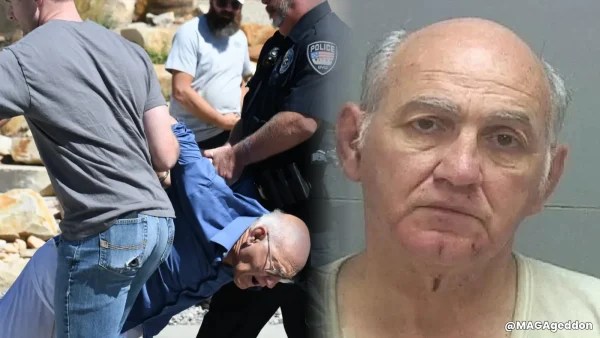
George Zinn reportedly told police he wanted to cause a distraction for the real gunman
And then there’s the story of the private jet that departed Provo Airport (PVU) — located eight miles from the UVU campus where Kirk was speaking — an hour after the shooting. According to FlightRadar24, a private Bombardier Challenger 300 departed PVU just after 1 p.m. local time and illegally switched off its transponder 30 minutes into flight, rendering itself undetectable by radar. Colson Thayer, a writer for American weekly magazine People, reported:
“Around 1:43 p.m. local time, as the jet approached the northern border of Arizona, the plane turned off its Automatic Dependent Surveillance-Broadcast (ADS-B), which provides positioning information between the aircraft and air traffic control. Tracking information for the aircraft reappeared shortly after 2:30 p.m. local time as the plane departed Page Municipal Airport (PGA) in Arizona back towards Provo. The plane landed back in Provo at 3:06 p.m. local time, according to FlightRadar24.”
Writing for online newspaper The Latin Times, journalist Matias Civita provides additional background information about the owner of the plane:
The jet is registered to “N888KG” LLC, which shares a Lehi, Utah address with the Derek and Shelaine Maxfield Family Foundation, which runs the Saprea non-profit organization to help survivors of sexual abuse. Many have pointed to the foundation’s numerous connections to Israel as a cause for suspicion… X user, @jonnysocialism, added that “It appears the private jet that took off after the assassination and stopped tracking was owned by the Derek & Shelaine Maxfield Foundation. They run a nonprofit called Saprea that focuses on victims of child sex abuse & have pictures of themselves visiting Israel on Facebook.”
In 2022, Saprea also launched its first-ever “kosher retreat” that offers kosher food developed “closely with Rabbi Avremi Zippel at Chabad Lubavitch of Utah.”
It’s unlikely we’ll ever be able to prove beyond a shadow of a doubt who actually fired the shot that killed Charlie Kirk or why.
When contemplating the many improbabilities and contradictions woven into the unfolding narrative I’m reminded of an episode of 60 Minutes that aired in September 2024, in which Lesley Stahl interviewed a former Mossad case officer identified only as ‘Michael.’ While explaining Israel’s extensive covert action and disinformation campaign vis-à-vis the infamous ‘Lebanon Pager Plot,’ Michael said,
“We create a pretend world… We are a global production company. We write the screenplay, we’re the directors, we’re the producers, we’re the main actors, and the world is our stage.”
Indeed.
Counterterrorism expert and former deputy chairman of Kroll Associates, Brian Jenkins, once observed that “terrorism is aimed at the people watching, not at the actual victims.” Thanks in part to British journalist Russell Warren Howe’s 1974 television interview with future Israeli Prime Minister Menachem Begin (not to mention decades of observable phenomena), it’s no secret who the world leader of terrorism is. Begin, the founder of Israel’s Likud Party, was head of the Zionist paramilitary organization Irgun when it bombed the King David Hotel in 1946, killing 91 people and injuring dozens more. Today the Likud government of Benjamin Netanyahu is orchestrating a genocide in Gaza and a larger regional war of aggression made possible by the rudimentary 10/7 Hamas offensive during which Israeli military forces stood down and allowed the attack to transpire for several hours without any meaningful response.
It’s precisely due to its history of political assassinations and false flag terror attacks that Israel has once again emerged among ‘conspiracy theorists’ as a leading suspect in an historic crime. Having already gotten away with the murder of more than 200 journalists in Gaza since ‘war’ began in October 2023, what would possibly deter them from killing one more?
Notes
[1] For a detailed study on the influence of ultra-Orthodox Judaism inside of Israel, see Jewish Fundamentalism in Israel, by Israel Shahak and Norton Mezvinsky.
[2] Ben Shapiro has announced he “will be picking up Charlie’s bloody microphone” and replacing Kirk on the college campus circuit.
[3] George Zinn cuts a suspicious figure. In response to a question about a meme connecting Zinn to 9/11 and the Boston Bombing, Grok AI replied, “Based on my review of multiple sources, George Zinn was a witness to the 9/11 attacks and described seeing the planes hit the towers. He was arrested in 2013 for emailing a bomb threat “joke” to the Salt Lake City Marathon shortly after the Boston bombing, pleading guilty to a terrorism charge and receiving probation.”
Colombia halts arms purchases from US over drug combat delisting row
Al Mayadeen | September 16, 2025
Colombia halted arms purchases from the United States, its biggest military partner, on Tuesday, after Washington decertified the South American country as an anti-drugs ally under the pretext of failing to halt cocaine trafficking.
On Monday, President Donald Trump denounced Colombia’s leftist president, Gustavo Petro, for failing to curb cocaine production, claiming that instead, Petro presided over its rise to what he called “all-time records,” a failure which he stated made him decide to officially designate the country as having demonstrably failed to meet its drug control obligations.
Reacting to the news, Colombian Interior Minister Armando Benedetti told Blu Radio that “from this moment on… weapons will not be purchased from the United States.”
Trump’s decertification of Colombia, the first for the longtime ally in three decades, was viewed as a mainly symbolic gesture.
The decertification was nonetheless seen as a stinging rebuke of Petro’s anti-drug efforts, which prompted Colombia’s president to hit back by saying that the Colombian military would become independent from “handouts” from the United States.
Petro hits back
During a televised cabinet meeting, Petro said Colombia was being punished despite sacrificing dozens of policemen, soldiers, and regular citizens to stem the flow of narcotics to the United States.
“What we have been doing is not really relevant to the Colombian people,” the Colombian president stressed, adding, “It’s to stop North American society from smearing its noses” in cocaine.
US officials cited a surge in coca cultivation and cocaine production as the reason for the measure, while critics argue it unfairly targets Bogota despite its decades of collaboration with Washington.
The Dark History of Hormone and Puberty Blockers
Again and again, these drugs are pushed on defenseless patients because of how much money they make
A Midwestern Doctor | The Forgotten Side of Medicine | September 14, 2025
Story at a Glance:
• Puberty blockers used for transgender medicine belong to a class of drugs (GnRH agonists) which permanently block the production of sex hormones in the body. As hormones are essential for the body, GnRH agonists are amongst the most harmful drugs on the market.
• Originally approved (with grave reservations from the FDA) as a palliative treatment for severe prostate cancer, these drugs (e.g., Lupron) have rapidly proliferated into a wide range of areas in medicine, including routine prostate cancer, a myriad of female issues (e.g., endometriosis) and all sorts of experimental uses on children (e.g., making them taller).
• This proliferation was due to manufacturers pricing the drugs to generate enormous profits for themselves and doctors (in many cases constituting most of urology practices’ revenues)—likely why most urologists, when surveyed, admitted prescribing Lupron despite not believing it worked.
• These drugs rapidly age the body, causing permanent and crippling side effects, including severe bone loss, pain, soft tissue damage, severe pain hormonal disruption, sexual dysfunction, psychiatric issues, cognitive impairment, cancer risks, and cardiovascular and gastrointestinal disorders.
• Their use in transgender children to block puberty stems from an unproven theory that it ultimately leads to a more satisfying gender transition in adulthood. However, while aggressively advocating for them and publicly claiming these drugs are safe, effective, and reversible, in private, the group authoring the medical guidelines have admitted they have no idea what they are doing and know there are serious safety issues with the drugs.
• This article will expose the hidden truths about hormone blockers, the forgotten generations whose lives were ruined by them, and extensive documentation showing how dangerous these ‘safe and effective’ drugs are.
Transgenderism has rapidly become one of the most contentious political issues in our country and due to its rapid rise, a variety of theories have been put forward to explain where it emerged from. Remarkably, I almost never see what I believe to be one of the most important facets of the topic discussed—the immense dangers of hormonal blockers routinely used in this field or the appalling history of these drugs and how again and again, they’ve been thrust into new markets they had no place ever being used in because of how profitable they are.
As such, when laws are periodically passed banning their use in children (which has now happened in many Red States), I rarely see the actual dangers of these drugs discussed, and when I’ve spoken to left-wing colleagues (including pediatricians) opposing these laws about the topic, most are genuinely unaware the drugs have negative side effects. Because of this, I believe it is vital to expose the actual truth behind these drugs.
How Hormonal Blockers Work
There are a variety of ways you can block the production of hormones in the body. Since the signal to produce sex hormones (e.g., estrogen and testosterone) begins in the brain, cutting that signal off mostly eliminates the body’s production of hormones. The most powerful hormonal blockers, the GnRH agonists, work by overstimulating the brain’s GnRH receptors so that they becomes “burned out” and no longer respond to the natural release of GnRH in the body, thereby short-circuiting the body’s production of sex hormones (which in many cases is a permanent short circuit).
A variety of different GnRH over-activators are sold, such as Decapeptyl (Triptorelin), Lupron (Leuprorelin), Suprefact (Buserelin), Synarel (Nafarelin), Zoladex (Goserelin). Since Lupron is the most commonly used one, henceforth, I will only discuss it, but much of what I will say about Lupron also applies to the others as well.
Note: there are also numerous similar drugs which instead temporarily shut down hormone production by directly blocking the GnRH receptor (e.g., Orilissa). Additionally, there are other GnRH over-activators which are only used in animals and have similar side effects to those observed in humans.
Since testosterone fuels the growth of prostate cancer, there was a lot of research on cutting of the body’s testosterone to treat it. Initially the most promising approach was to counteract testosterone with an estrogen analog (DES) which was eventually pulled from the market because it caused a wide variety of issues (e.g., heart attacks, female cancers, and a variety of severe problems in the children of mothers who took DES—which has led many to argue the COVID-19 vaccines may become “the new DES”).
Since Lupron, by burning out GnRH receptors, chemically castrates males (and thereby eliminates their testosterone), a 1984 study was conducted comparing the use of DES to Lupron for patients with prostate cancer which had metastasized to the bones and was hence likely to be fatal. It found Lupron slightly increased their survival rate (although half still were dead within two years of starting the therapy) and it had a slightly different mix of severe symptoms when compared to DES, which in turn was used to argue it was a viable alternative to DES.
When the FDA reviewed this study, the reviewers noted the study had a variety of serious issues so it was difficult to draw any firm conclusions from it. As a result (despite the FDA knowing Lupron had real longterm risks that had not been investigated and other critical aspects of the drug like how the body metabolizes it remaining unknown to this day), Lupron was approved in 1985 as a “palliative treatment of advanced prostate cancer,” a situation which is frequently so debilitating and painful for cancer patients, anything which could potentially somewhat improve it is viewed as justified.
Note: six months ago, Scott Adams, who had advanced prostate cancer, shocked the online community by saying the torture of it had made him decide upon committing suicide in a few months after an important life event had passed—providing a clear example of how dire “advanced prostate cancer” can be.
Since that time, Lupron’s approval was never updated. For those interested, a detailed explanation of why that approval was overtly fraudulent and unwarranted can be found here.
Note: in addition to Lupron offering a very small survival benefit, a strong case can be made that since it is frequently observed to cause a variety of severe complications (e.g., a large increase in fatal heart attacks or diabetes), its reduction in the prostate cancer death rate is actually an artifact of it killing the patients in another manner before a slow growing prostate cancer would. This perspective for example was shared by the Vice President and Chief Scientific Officer of the American Cancer Society.
Once Lupron was approved, its use transitioned from only the most severe prostate cancers to all of them (even though, as shown by a 2009 study of 19,271 men, using Lupron actually increased the death rate). At the same time, a variety of other copycat drugs entered the market. The FDA in turn approved them (or Lupron) for advanced prostate cancer, advanced breast cancer, endometriois (along with its pretreatment prior to surgery), the pretreatment of fibroids before surgery, and preventing precocious (early) puberty.
Note: while I believe the risks of these treatments greatly exceed their benefits, it is also true that a subset of patients exist with those conditions who benefit from Lupron and suffered minimal side effects from the drug.
Additionally, a variety of other off-label uses were concocted, such as:
• “Treating” every imaginable gynecological problem (e.g., large fibroids, difficult menstrual cycles, ovarian cysts).
• In-vitro-fertilization and egg donation protocols.
Note: many young women are paid thousands of dollars to donate their eggs. Unfortunately, a portion of those donors suffer significant complications they are not warned about beforehand and then are left on their own to address. This is likely in part due to the fact Lupron is frequently part of the protocol. Likewise, significant birth defects (which Lupron has been shown to cause in the majority of pregnancies) are frequently reported following IVF—which may explain why despite Lupron being originally patented as a fertility medicine, it could never be formally approved for that use.
• Chemical castration for sex offenders (e.g., pedophiles).
• Helping children become taller (by delaying puberty so their growth plates take longer to close).
• Preventing puberty in a transgendered youth
Note: a more detailed list of the off-label uses can be found here. It is truly remarkable how many different tactics were used to seed these additional uses (e.g., bribing countless doctors and medical charities to promote these drugs) and likewise how many other uses (e.g., for Alzheimer’s disease and Autism) came very close to becoming off-label uses as well.
In turn, there are three important things to take away from all of this.
1. While these drugs were initially developed for men (i.e., prostate cancer), they are frequently given off-label to women. This for example is why Lupron’s FDA insert states its only indication is for the palliative treatment of advanced prostate cancer but it simultaneously warns against pregnant women taking it (even though it’s also used for egg harvesting)
2. Despite having been on the market for decades, there is very little evidence to show these drugs actually benefit those who take them.
3. Given this, along with how incredibly toxic they are (especially to women), it raises a fairly simple question—why on earth are these drugs so popular?
Selling Lupron
Lupron’s manufacturer was stuck with a rather large challenge—how could they got doctors to begin prescribing an incredibly dangerous and ineffective drug? This in turn was accomplished through one of the most overt acts of physician bribery I’ve seen in American medicine.
Since Lupron initially did not sell well, Lupron’s manufacturer took advantage of the existing “standard” which allows chemotherapy drugs to be sold for a very high price and be “forgiven” for their extreme toxicity. This was done by reformulating Lupron into a long acting monthly shot urologists could directly administer to their (prostate cancer) patients and hence directly profit from marking up when they resold it (e.g., Medicare paid 1200 dollars per shot—or roughly 2400 in today’s dollars, and in many cases urologists charged far more, all of which allowed many urologists to make hundreds of thousands of dollars per year administering the shots).
Note: TAP frequently advertised to urologists they could make over $100,000 annually selling Lupron and later cited similar figures to OBGYNs.
To further sweeten the deal, Lupron’s manufacturer frequently bribed urologists and gave them free Lupron samples they “resold.” This was illegal—and eventually resulted in a 875 million dollar fine… but no pharmaceutical executives going to prison.
Because Lupron was immensely profitable, more and more urologists jumped on it, and by the late 1990s Lupron treatments were costing almost a billion dollars per year and accounted for 40 percent of all Medicare payments to many urology practices in the late 1990s. To address this, in 2001, Medicare clamped down on urologists reselling discounted Lupron and in 2003 Medicare lowered the reimbursement for Lupron. In turn from 2003-2005, the rate of inappropriate use of hormonal treatment for prostate cancer dropped from 38.7% to 25.7% and many urologists at the time reported their income had been halved.
Note: one survey found 53% of the urologists who did not believe prescribing Lupron benefitted certain prostate cancer patients still prescribed the drug to them.
This Medicare crackdown on excessive Lupron prescribing for prostate cancer created a major problem for the industry. “Fortunately,” since Lupron was so profitable, many other specialities appeared eager to jump on the Lupron bandwagon, particularly OBGYNs (despite the existing data on using Lupron for gynecological conditions being very poor and in many cases overtly fraudulent). This in turn led to a rapid proliferation of new off-label “uses” for the drug, such as the ones listed above. Remarkably, despite the fact Lupron has been on the market for decades, it is still extremely expensive.
Lupron hence is a very lucrative drug. However it is unclear to me exactly what the current reimbursement is for it (e.g., when I’ve looked online, many patients said they were billed over 10,000 dollars for a single injection).
A recent article exploring the subject found that puberty blockers can cost tens of thousand dollars per year. While insurance typically covers these drugs around 72% of the time, without insurance, according to one source, they cost $4,000–$25,000 per year and according to another source a 3 month Lupron injection is $9500 while a competing 3 month option (histrelin) is $39,000.
Similarly, a 2022 NPR article detailing a man’s prostate cancer experience (where he was given unwarranted Lupron shots) reports he was charged $35,414 for the first shot and $38,398 for the second by a Chicago “non-profit” hospital, and after two years of haggling, was forced to pay the $7,000 not covered by his health insurance.
Let’s compare that to how much Lupron costs (this table designates the average wholesale price pharmacies pay for drugs):

Note: these costs are unusual as they are much higher than what pharmacies typically pay for a drug (especially an older one). The above table is from 2023, and just a year later in 2024, the cost of Lupron went up almost 10%.
Since all of this demonstrates that Lupron is marked up by 5-10 times its original cost when it is resold to patients, I would argue that those who provide these medications may have an ulterior motive in giving them to patients which frequently causes the drugs to be inappropriately prescribed.
Note: one of the most common stories I hear reported from Lupron victims is a tendency for doctors to gaslight them and insist their myriad of health problems could not have come from Lupron, hence making one of their greatest challenges be finding a doctor who can actually help them (or say qualify them for disability since they’ve lost the ability to work). I believe this is partly due to the unusual nature of their injuries and because many doctors have a direct personal investment in believing Lupron is safe and effective (as they aggressively pushed it on their patients—for instance many reported the doctor saying “are you brave enough to try Lupron?”).
Lupron Lawsuits
A curious reality exists with these drugs. To quote Wikipedia:
GnRH analogues [e.g., Lupron] are available as generic medications. Despite this, they continue to be very expensive.
This I attribute both to doctors being heavily incentivized to directly sell these drugs to their patients (rather than cheaper ones made by competitors) and the legal costs associated with producing them.
Since Lupron is so toxic, it had a very high rate of users who were severely and permanently incapacitated by the medication, and hence were willing to go through the arduous process of going to court over it. Since it often took years for the most severe injuries to emerge, this both allowed Lupron’s manufacturer to have the money in place to fight each lawsuit and simultaneously to argue that each injury could not have been related to Lupron. Furthermore, since the legal risk of manufacturing Lupron was so high, I suspect that it scared many competitors away from entering the market as there was a significant barrier towards having enough sales to be able to afford to squash each lawsuit which came along.
In turn, numerous lawsuits have been filed against Lupron’s manufacturer and the doctors who prescribed it, but while some were settled out of court, none to my knowledge were successful, which is extraordinary given that many of the cases revolved about Lupron being used for an experimental (unapproved) use, it causing clear harm to the patient, and it being inappropriately dosed or monitored by the physician (who instead just wanted to give the highly lucrative single injections).
The general sense I have gotten from talking to people injured by Lupron is that they believe Lupron’s manufacturer spent so much on legal defense (e.g., by paying off judges, having the best lawyers or buying gag orders in settlements) that it’s a lost cause to file a Lupron lawsuit regardless of how severe one’s injuries were. In turn, many people have shared that they have been unable to find attorneys who are willing take their case.
Note: one of the things we all found remarkable during COVID-19 was how differently the use of “off-label” prescriptions was treated by our authorities. Despite no injuries occurring, nor any money being made, many of the doctors who saved many lives by prescribing ivermectin or hydroxycholorquine were accused of exploiting their patients and faced harsh penalties for their prescriptions (e.g., Meryl Nass lost her medical license).
Lupron Toxicity
I have had a longtime interest in understanding how pharmaceuticals injure people, so I frequently spend lots of time reading through support groups for people who have been injured by them. From this exploration, I have come to the perspective Lupron is one of the most dangerous drugs on the market due to the sheer volume of injuries patients report, how severe the injuries are and just how much many of them are suffering (e.g., many of these reports are comparable both in their severity and variability to COVID vaccine injuries).
Note: in the late 1990s, a lot of public pressure was building against Lupron, and one group, the National Lupron Victims Network came to prominence as a hub for collecting the evidence of Lupron’s harm and advocating against its continued use. Remarkably, in 2000, shortly before the group was supposed to publish all the data it had collected from surveys on the harms of Lupron, without explanation, it suddenly disappeared. This again illustrates just how far Lupron’s manufacturer went to protect their drug.
Within the Lupron support groups, I find by far the most commonly injured are women. This is followed by individuals who took the drugs to halt a premature puberty, then men, and finally transgendered individuals (as they are a relatively new market).
Note: many of the people who took the drugs during puberty are now having adverse effects decades later (e.g., as discussed in this Kaiser Foundation article). This had led me to suspect the same thing will be “discovered” in the years to come for the transgendered children our society has recently started putting on puberty blockers. Remarkably, a 2009 specialist review of using drugs like Lupron for early puberty or making children taller found “few controlled prospective studies have been performed… and [like now], many conclusions rely in part on collective expert opinion.”
Some of the most commonly reported side effects of Lupron include:
• Numerous studies have found Lupron given at all ages significantly decreases bone density (e.g., many have reported between a 3-10% loss occurring after just 6 months) which often results in fractures (e.g., see this study). Bone loss, in turn, is one of the most commonly reported side effects of Lupron (e.g., many young women report having “bones like an 80 year old,” chronic dental or jaw issues like teeth cracking apart and repeatedly developing unexpected fractures from minor stressors). While this bone loss is often rapid, in many cases, it emerges years after receiving Lupron (e.g., women who went on it during puberty in their 30s learn about it because of how quickly the teeth in their mouth are decaying and being told they are not that far from needing dentures).
• Longterm or permanent damage to female menstrual cycles. For example, Lupron’s clinical trials (revealed through ligation) showed that 62.5% of study subjects had failed to return to baseline ovarian function one year after stopping Lupron (which means, contrary to the manufacturer’s claim, the drugs is not reversible once it is stopped). Many other hormonal issues are also frequently reported (e.g., permanent weight gain, painful and abnormal menses, severe hot flashes and vaginal atrophy)
Note: enlarged ovaries and ovarian pain is a commonly reported symptom of Lupron usage (particularly after egg donation protocols) and there is some data which suggests Lupron causes polycystic ovarian syndrome.
• Sexual dysfunction is commonly reported. For example, one study found 80% of males using these drugs reported being impotent, while another found a 267% increase in impotence was observed after one year of treatment, and another evaluation of a related drug found sexual desire, sexual interest and sexual intercourse were totally annulled. Likewise, chronic pelvic pain (in women), a wide range of chronic bladder issues (e.g., incontinence, bladder spasms, urinary retention, or recurrent UTIs), and testicular pain or atrophy.
Note: these sexual side effect are particularly noteworthy given that in many cases, prostate cancer patients are put onto Lupron for years.
• A variety of psychiatric conditions commonly follow Lupron usage (e.g., a 2002 study of more than 3,000 women on it found 35.5% reported depression). Some of the effects I commonly see reported include anxiety, severe mood fluctuations, major dysphoria, burning rage, suicidality (which sometimes requires being placed on a suicide watch), and losing the ability to function in social situations.
Note: particularly in transgender or precocious puberty groups, users report a profound loss of identity or personality changes, feeling “like a stranger in my own body” due to hormonal suppression. Likewise, many users report frequently describe social withdrawal, inability to maintain relationships, or marital strain due to Lupron’s emotional and physical toll (e.g., “Lupron killed my marriage; I wasn’t myself). Finally, many users report losing their jobs and financial stability due to being disabled by Lupron.
• Cognitive dysfunction (e.g., brain fog or memory loss) is also frequently reported. One study found evaluating women receiving IVF found 72% showed difficulty with memory while on Lupron, some subjects had significant cognitive deficits, and 11% showed very substantial neurocognitive issues.
• Online, children and young women treated with Lupron often report seizures or convulsions, tinnitus (and other hearing issues), visual disturbances (e.g., floaters, blurred vision, or photophobia). Hormonal issues besides those with the sex hormones are also frequently reported such as thyroid issues (e.g., hypothyroidism and goiter), adrenal issues (e.g., extreme fatigue, salt cravings, or low cortisol) and diabetes or glucose dysregulation. In many cases, these onset immediately after starting Lupron (with no prior signs of them) and are then permanent.
• IQ loss in children (e.g., one study found a 7 point drop, while another found an 8 point drop).
• Lupron (and related therapies) are associated with a variety of different heart conditions, as Lupron (when used for prostate cancer), according to one paper, appears caused a 10–50% increase in the risks of coronary heart disease, myocardial infarction, strokes and sudden cardiac death (e.g., this study the paper referenced shows a massive increase in heart attacks). Many other concerning heart conditions have also been linked to Lupron and numerous medical textbooks explicitly warn about them. The FDA in turn eventually issued a warning in 2010 about this increase risk of heart problems (and diabetes) in men and acknowledged that no research existed to assess those risks in women or children.
• A wide range of gastrointestinal disorders (e.g. severe abdominal pain, irritable bowel syndrome, or growths that require excisions) and genitourinary (e.g., frequent urination, incontinence and interstitial cystitis) are frequently reported. Many of these likely result from Lupron disrupting the autonomic nervous system and it cutting off blood flow to tissues of the body, which for example is why it shrinks fibroids.
Note: originally, the FDA was extremely concerned about the potential harm which could result from Lupron cutting off the blood flow to critical organs.
• Many Lupron patients report crippling joint pain and severe (early) arthritis. For example, a study of more than 3000 women found that 76.7% reported joint pain. Likewise, severe pain throughout the body, tendon issues (e.g., tendinitis, severe pain in the tendon, or tendon ruptures), muscle wasting or pain and degenerative disc disease is often reported in support forums.
Note: many of these symptoms overlap with what’s commonly reported by patients with ligamentous laxity (e.g., they are hypermobile and have frequently cracking joints). I recently wrote an article detailing how hypermobility is a common characteristic of sensitive patients and its common association with manganese deficiency.
• Immune suppression (e.g., within the bone marrow) and a wide range of severe autoimmune conditions (e.g., Sjogren’s, lupus and various thyroid conditions) are frequently reported by Lupron patients. Chronic skin conditions (eczema, psoriasis, or chronic rashes) not responsive to treatment and significant hair loss are also reported. Finally, other more severe immune-related side effects such as unusual tumors developing (or rapid growth of an existing one), anaphylaxis are also reported (along with other organ dysfunctions like elevated liver numbers).
What should jump out from this list is how frequent, severe, and wide-reaching these injuries are. This in turn helps to explain why the FDA’s system for reporting drug injuries (which catches 1-10% of those which occur) has received 76,221 Lupron injury reports, of which 41,895 were severe and 11,917 were fatal. Likewise, consider how frequently a myriad of conditions occurred when Lupron was tested in men who had prostate cancer (per Lupron’s FDA package insert):
Anemia (6.6%), Asthenia (7.4-12.2%), Back Pain (5.3%), Blood in Urine (6.6%), Constipation (9.9%), COPD (5.3%), Coronary Heart Disease/Angina (5.3%) Cough (6.6%), Dehydration (8.2%), Dizziness/Vertigo (5.3-6.4%) Edema (5.3-8.2%) Elevated Blood Pressure (6.6%) Fatigue (13.2%) Flu Syndrome (12.2%) General Pain (23.2-32.7%) GI disorders (10.2-16%), Headache (6.4-10.2%), Hot flashes/sweats (46.9-58.9%) Impotence (5.4%), Infection (5.4%), Injection Site Reaction (8.2-19.2%) Insomnia/Sleep Disorder (8.6%), Insomnia/Sleep Disorders (8.5%) Joint Disorders (11.7-16.3%) Joint Pain (9.3%) Libido decreased (5.4%) Muscle Pain (7.9-8.2%) Neuromuscular Disorders (6.1-9.6%) New Cancer (7.3%) Pain While Urinating (6%) Paresthesia (8.2%) Rash (6.6%), Respiratory disorder (6.4-10.7%) Shortness of Breath (5.3%) Skin Reactions (8.5-12.2%) Testicular atrophy (5.4-20.2%) Urinary disorder (12.2-14.9%) Urinary Tract Infection (6%).
Likewise, this is what the FDA reports occurred when Lupron was tested on women for endometriosis:
Acne 10%, Altered Bowel Function (constipation, diarrhea) 14%, Asthenia 8-18%, Breast Changes/Pain/Tenderness 6%, Breast changes/tenderness/pain 6%, Decreased libido 10-11%, Depression/emotional lability 11-31%, Dizziness/Vertigo 11-16%, Edema 5-7%, General pain 8-24%, GI disturbances 7%, Headache 26-65%, Hot flashes/sweats 73-98%, Insomnia/Sleep Disorder 31%, Joint disorder 8%, Memory Disorder 6%, Nausea/vomiting 5-25%, Nervousness/Anxiety 5-8%, Neuromuscular disorders 7%, Paresthesias 7%, Skin reactions 10%, Vaginitis 11-28%, Weight gain/loss 12-13%
Unfortunately, while the above list is terrible (particularly given that the “benefit” of the Lupron in both cases was minimal at best), it should be noted that:
• Pharmaceutical companies always conceal adverse events which occur in their trials.
• This list only includes conditions more than 5% of trial recipients developed while on the drug. In turn, a variety of rarer but much more severe conditions did not make this list.
• This list was not evaluating the long-term effects of Lupron (which are typically the most severe).
Because of how toxic Lupron is, by far the most challenging part of this article was accurately synopsizing the thousands of injury reports I’ve read over the years (as I felt their heart wrenching stories deserved to be heard but simultaneously, there are just far too many for me to fit into any number of articles here).
Generally speaking, Lupron (like the COVID vaccines) causes the body to age prematurely—which in the case of Lupron provides an important insight on the importance of hormones as these victims provide a unique insight into what happens as the body loses those essential messengers (something which also occurs with age). This why in addition to profound bone loss, Lupron also frequently causes other degenerative processes like hairloss, vaginal atrophy, receding gums, and declining vision.
For each of those symptoms (and many others), I’ve read countless testimonials describing the anguish of having their body rapidly age in front of their eyes and the general despair that accompanies decades of suffering with these ailments and the fact there is no one who will help them.
Additinally, one of the most common stories I hear in the support groups are women who profoundly regret taking it for endometriosis as beyond it permanently debilitating them, it frequently did not help (or worsened) their endometriosis.
Note: endometriosis is another condition which is poorly treated by the medical system. Typically the best option within the conventional paradigm is to have it be surgically removed, but unfortunately, there a very few surgeons competent surgeons who do this (e.g., the person we use is an 8 hour drive away from us) and there is also a surprising lack of knowledge within the OBGYN field of how to appropriately manage endometriosis.
Like the COVID vaccine injured, many of those injured by Lupron report not a few, but rather dozens of debilitating symptom. Furthermore, there is often a significant overlap in these symptoms (e.g., both frequently experience fibromyalgia, severe neuropathies, chronic fatigue, headaches, insomnia migraines, hypersensitivities to everything, seizures, and lightheadedness or fainting).
Lupron Stories
Since there are so many reports of people being harmed by Lupron, it’s impossible for me to ever do justice to their experiences in a brief article. As such, I will simply quote ten of them with the caveat they are only the tip of the iceberg.
Within 2 weeks of starting Lupron therapy [for endometriosis], I was walking with sticks due to the pain in my hips and ankles. I stopped eating. My skin was dry, flaking and itchy. I had no short term memory & my concentration got so bad I couldn’t safely drive. I didn’t sleep a wink for months. I was so depressed that I stayed in bed for days at a time.
I’m a calm, sane person. I’m not kidding, that sh*t made me feel insane [taken following endometriosis surgery]. A horrible emotional roller coaster. If I had to do it over again, I’d have just had the hysterectomy.
Anyone else have terrible mood changes with Lupron [for IVF]… My mood is all over the place… I hated lupron. I had terrible headaches and severe joint pain. Just felt crummy all around.
The side effects from my lupron injection [for prostate cancer] is awful compared to my radiation treatment… frequent urination, bowel discomfort, and a rash… but the Lupron is making me feel like I’m hit by a bus!! Chills, fever, runs, aching body, emotional.
I had a terrible time with Lupron when I used it as endo treatment ten years ago: hot flashes, night sweats, weird hairs growing everywhere, headaches, mood issues… I ended up only doing five of the six months because I felt so badly.
Lupron for me stopped the endo pain… But yeah, it replaced it with severe joint pain, hot flashes, weight gain and mood swings… I’ve since had a hysterectomy and am going through all of that again from real menopause.
I had lupron shots as part of my IVF protocol. I don’t exactly regret it… but I wish there had been another way… it caused the worst fibromyalgia flare of my life! I ended up in the ER and couldn’t walk for a few weeks. I’ve never experienced so much pain in my life.
The side effects were PROFOUND and BRUTAL [was taken for breast cancer]… Giving Lupron to a healthy minor? It should be criminal.
Lupron depot horror... I’m official a year out from my 3 month use… it’s given horrible life long side effects and other health conditions… It’s horrible!! It does not help shrink endo growths… wrecked havoc on my health.
I took Lupron, the original puberty blocker, for endometriosis. Before Lupron I only had endometriosis. After Lupron I have bone death in both hips, brittle bones that break easy, multiple fractures in feet, hypothyroidism, and a non cancerous pituitary tumor.
So, as you might expect, individuals who took them as children did not have the best experiences either:
As a parent of a child who went through precocious puberty and was given puberty blockers (Lupron), I watched my healthy mentally stable son fall into severe depression, multiple suicide hotline contacts including a visit from emergency services. Self harm scars and self isolation. He began to question his sexuality and gained excessive weight. All before 12
My son had one Lupron shot for precocious puberty at age 4—the side effects were horrible: aggression, pain, and now years later, we’re seeing bone density issues and growth problems. It’s a nightmare we regret starting.
My daughter took Lupron for precocious puberty starting at age 7. Now at 25, she has degenerative discs in her spine, chronic joint pain, and hypothyroidism. We thought it would help her grow taller, but it’s caused lifelong hell—no one warned us about the bone death and fractures.
Valerie Ward, 25, who lives outside of Pittsburgh, said she took Lupron for precocious puberty, from age 9 to 12. Like Derricott, Ward said she sees a carousel of medical specialists for excruciating muscle and bone pain, depression, weakness and fatigue.
Put on Lupron at 10 for precocious puberty to ‘buy time for height,’ but it worked too well—stopped puberty entirely, then I needed growth hormone shots for years. Now 30, flat-chested with endo and weak bones; wish we’d never done it.
I was given Lupron as a child for precocious puberty. Now in my 30s, my bones are like an 80-year-old’s—brittle, fracturing from nothing, teeth crumbling. Doctors said it was safe, but it’s ruined my life [this is a paraphrase summary of many posts by this user].
My son was put on Lupron at 9 and we were NOT told bone damage was a potential side effect. Today, at 24 he has severe osteoporosis and the bones of a 75 year old!! Even this was discovered by happenstance. Trying to get help with this condition has been nearly impossible.
I was on Lupron for a 9 months in 1995, fast-forward 30 years I now have full blown osteoporosis from the lupron! I break bones every other week! No child should be taking any of it, I don’t have a problem when you’re an adult and you know the consequences but children no!”
WPATH’s Transgender “Guidelines”
Evidence based medicine was created so that harmful and irrational dogmas within the medical field could be overturned by scientific evidence proving there was no justification for doing them. While this was initially helpful, the process gradually became corrupted as the pharmaceutical industry realized doctors could be made to believe only the “best” evidence should be trusted, and the groups purveying the “best” available evidence (e.g., the premier medical journals) could be easily bought out.
A key part of the push to buy out the “best” evidence has been to create authoritative guideline committees who are tasked with evaluating the existing scientific evidence and coming to a consensus over what constitutes the best practice of medicine—a process which is fairly easy to corrupt since the industry can simply pay off each member of the “expert” committee.
This for example is why Anthony Fauci was allowed to appoint the members of the government committee which decided the standard of care for COVID-19 and Fauci chose individuals who were both his friends and had significant financial ties to his pet drug Remdesivir. In turn, that committee concluded only the extremely expensive COVID-19 treatments (e.g., remdesivir—which was repeatedly shown to worsen rather than improve COVID-19) should be used to treat COVID-19, whereas the safe and effective (but non-commercializable) therapies (e.g., ivermectin) were never allowed into the treatment guidelines despite dozens of trials from around the world proving they worked.
Note: corrupt committees are a recurring problem. For example, the government committee which created the statin usage guidelines we all follow that erroneously concluded everyone needed to be on the statins was filled with people taking money from the statin industry.
In the field of transgendered medicine, much of what is being done is a result of physicians following the existing guidelines that have been created by the World Professional Association for Transgender Health (WPATH). For this article, I reviewed exactly what their guidelines had to say about giving puberty blockers (GnRH analogs) like Lupron to children.
First, they strongly endorsed administering these drugs:
• The moment transgender children begin the earliest signs of puberty as this provides a greater benefit that administering them later on.
• As a stopgap measure for children who have mostly gone through puberty and are considering starting opposite sex hormones but are not yet sure they wish to begin hormone therapy (e.g., due to a disagreement with their parents over doing it).
• For adolescents who are distressed by their body’s menstrual cycles (since the blockers stop menstruation) or penile erections since Lupron suppresses both of them. This is similar to how the guidelines emphatically cite the benefit of these drugs creating “a vast reduction in the level of distress stemming from physical changes that occur when endogenous puberty begins.”
• To help males hoping to achieve a female’s hormone levels do so (as Lupron and its ilk suppress testosterone).
Note: they also acknowledge there are other “individualized” circumstances where someone who has completed puberty may benefit from these drugs.
Second, they advise against using them when:
• The child and their family cannot attain or afford them (in which case specific hormones like progestins are instead used).
• Prior to the earliest signs of puberty. This is because it can potentially interrupt a critical part of their psychological sexual development (however, this logic only applies to very start of puberty and not the rest of it). They do however advise regularly monitoring these children to detect when they start puberty so the blockers can be immediately initiated and provide for a few exceptions where the drugs can be administered prior to the start of puberty.
Third, while repeatedly claiming these drugs are safe and their effects are rapidly reversible, they do lightly acknowledge a few issues might exist.
Note: feel free to skim this section—I wrote it because I felt it was important to accurately depict every single “warning” WPATH provided against these drugs.
General:
- “[The use of puberty blockers] is generally safe with the development of hypertension being the only short-term adverse event reported in the literature.”
Bones:
- “While GnRH analogs have been shown to be safe when used for the treatment of precocious puberty, there are concerns delaying exposure to sex hormones (endogenous or exogenous) at a time of peak bone mineralization may lead to decreased bone mineral density. The potential decrease in bone mineral density as well as the clinical significance of any decrease requires continued study.”
- “For adolescents older than 14 years, there are currently no data to inform HCPs whether GnRHas can be administered as monotherapy (and for what duration) without posing a significant risk to skeletal health.
- “The rate of bone mineralization, which decreases during treatment with GnRHa’s, rapidly recovers.”
- “Based on scientific evidence currently available examining the use of GnRH agonists in transgender adolescents, it is unclear whether or not using puberty blockers in adolescence will increase the risk for future fractures in transgender adults.”
- “[They] can result in osteoporosis if doses of estrogen given concurrently are insufficient.”
- “A prolonged hypogonadal state in adolescence…due to..iatrogenic causes such as GnRHa monotherapy..is often associated with an increased risk of poor bone health later in life. However, bone mass accrual is a multifactorial process that involves a complex interplay between endocrine, genetic, and lifestyle factors [so] all contributing factors should be considered [and] a multidisciplinary team and an ongoing clinical relationship with the adolescent and the family should be maintained when initiating GnRHa treatment.”
Fertility:
- They “may also result in menstrual suppression.”
- “GnRHas may also be used for menstrual suppression. GnRHas impact the maturation of gametes but do not cause permanent damage to gonadal function. Thus, if GnRHas are discontinued, oocyte maturation would be expected to resume.”
- “GnRHas inhibit spermatogenesis. Data suggest discontinuation of treatment results in a re-initiation of spermatogenesis, although this may take at least 3 months and most likely longer.”
- “Pubertal suppression and hormone treatment with sex steroid hormones may have potential adverse effects on a person’s future fertility [thus] the potential implications of the treatment and fertility preservation options should be reviewed by the hormone prescriber and discussed with the person seeking these therapies.”
Adversely impacting a gender transition:
- The potential negative psychosocial implications of not initiating puberty with peers may place additional stress on gender diverse youth, although this has not been explicitly studied.”
- “Treating an TGD adolescent with functioning testes in the early stages of puberty with a GnRHa not only pauses maturation of germ cells but will also maintains the penis in a prepubertal size. This will likely impact surgical considerations if that person eventually undergoes a penile-inversion vaginoplasty as there will be less penile tissue to work with. In these cases, there is an increased likelihood a vaginoplasty will require a more complex surgical procedure, e.g., intestinal vaginoplasty.”
Hopefully, as the previous section showed, WPATH’s depictions of the dangers of these drugs (Lupron etc.) is highly misleading as a large body of evidence exists which overtly contradicts what WPATH put forward. Given that I was able to compile that evidence in under a week, it is surprising a team of “experts” who have spent years working to produce these guidelines were unaware that literature (and likely much more) existed. In turn, because doctors are trained to trust guidelines, they assume that since WPATH said puberty blockers are “safe and effective” they indeed are, hence leading to them aggressively pushing them on patients and gaslighting anyone who reports side effects from them.
Furthermore, the thing I found the most remarkable about WPATH’s guidelines was that while they were unaware of the dangers of Lupron (and its related drugs), they repeatedly referenced certain dangers of giving specific hormones, and in numerous cases characterized the Lupron as safe and effective alternative to the more dangerous hormone therapy. I in turn suspected this is because the blockers cost far more than artificial hormones, and once administered, often require the lifelong purchase of artificial hormones (e.g., to prevent some of bone loss and to make up for the body no longer producing its natural hormones).
All of this led me to believe that like many before them, those involved in writing these guidelines (and some of the authors they referenced) were paid off to promote Lupron and its ilk, but as I have not had the time to do the investigation to confirm this, I can’t state it with certainty.
The WPATH Leaks
Since WPATH has continually publicly advocated for transgender care to be made available to everyone that organization has received increasing scrutiny from the public.
Recently, this resulted in internal documents and correspondences from WPATH being leaked. I reviewed those leaks to see exactly what WPATH’s members were saying in private about puberty blockers. From reviewing all of it, I learned that much like each other group which has promoted the off-label usage of Lupron, WPATH was:
• Not entirely sure what the long-term consequences of this push for those drugs was and in essence, much of what they were doing was a large experiment.
• Recognized that a variety of significant side effects would occur in children who took the blockers (e.g., some would permanently lose their libido or the ability to have an orgasm and many children would lose the necessary emotional developmental process that occurs during puberty).
• Despite continually claiming otherwise publicly, they knew the effects of Lupron were often not reversible.
• Recognized that the children they were giving the blockers to were too young to fully comprehend the dangers of these drugs but nonetheless were seeking to initiate their use as early as possible.
It’s relevant at this point to note that the puberty suppression experiment began because transgender adult males were dissatisfied with the results of their medical transition because they did not “pass” well as women due to a “never disappearing masculine appearance.” Therefore, the Dutch researchers came up with the idea to use gonadotropin-releasing hormone agonists (GnRHa) to block the testosterone surge of male puberty in the hopes of achieving more feminine appearances in adulthood. The increased risk of false positives due to early intervention was noted, but the cosmetic advantages to adult natal males who identify as women were deemed more important.
Note: WPATH members also routinely discussed puberty blockers being administered to developmentally delayed children (e.g., those with autism), who due to their conditions had an even greater inability to consent to these drugs. This dovetails into another uncomfortable fact rarely discussed in the transgender debate—vaccination significantly increases the likelihood of transgenderism, most likely because autistic individuals are receptive to messaging which tells them the disconnect they feel with their body and society is not due to vaccine brain damage but rather tothem being the wrong gender—all of which I detailed extensively here.
Given all the things I’ve seen the pharmaceutical industry repeatedly do to make money during my lifetime, very few things surprise me these days. Nonetheless, even I was a bit taken aback when I discovered through these documents that there has been a push to affirm “plural identities” (multiple personalities) within WPATH. In turn, there are numerous cases which have been presented at WPATH conferences (e.g., under the umbrella of UCSF—one of America’s premier medical institutions) where each personality of an individual with split personalities was assessed for its sentiments on beginning a gender transition and at least one instance where some of the personalities did not consent but the transition was nonetheless deemed “ethical” and proceeded.
Note: I have compiled numerous cases which demonstrate that the one consistent principle in medical ethics is that whatever makes money will inevitably been seen as the “ethical” choice.
In short, given all of this, I strongly suspect WPATH (and possibly other members of the industry) were paid off to ensure puberty blockers would be a mainstay transgender treatment—particularly since you can often map out multi-year if not multi-decade campaigns done by pharmaceutical companies to ensure vibrant and continually growing markets for their products (e.g., the completely unjustifiable COVID lockdowns made many so desperate for a solution they eagerly embraced the vaccine without critically thinking about its multitude of red flags).
Note: much of the modern transgender push in medicine resulted from a provision in Obamacare (along with regulatory decisions from the Obama and Biden administrations) which mandated insurance companies provide coverage for gender transitions (which included paying for the costly GnRH agonists).
Conclusion
When you consider the entire Lupron saga, it is truly remarkable that a drug this dangerous has managed to stay on the market for decades, particularly given that it still demands an exorbitant price despite there being numerous significantly cheaper generic formulations which could be used instead. Even more remarkable is the fact that there is no evidence to support most of the things its used for, and now almost 40 years later, that the FDA has still not updated its 1985 approval.
Consider for a moment the contrast with what we saw during COVID-19, where numerous widely used (and widely recognized to be safe) drugs were effectively banned in the treatment of COVID-19, despite no viable therapy existing for the illness, many reporting dramatic improvement from those protocols and widespread public pressure for these off-patent drugs to be used to treat COVID. In contrast, the FDA has ignored decades of complaints and evidence hormone blockers severely injure patients, and despite widespread public outcry against their use, has used countless clinics to routinely prescribe them in an experimental manner they were never approved for. In short, Lupron represents a classic case of where the FDA has a statutory obligation to prohibit the reckless off-label use of this drug, yet has never done so due to the immense money being made from it and the multi-decade campaign to ensure it has a vast sales market.
Likewise, the Lupron situation is analogous to what we are seeing with the COVID-19 vaccines. Like Lupron, they are extraordinarily toxic and in 1-2 injections, often permanently destroy someone’s health in a myriad of ways—but nonetheless are relentlessly defended by the FDA.
In my eyes, the one bright side to the COVID debacle was that the sheer egregiousness of it (mandating an experimental, dangerous and ineffective vaccine while simultaneously suppressing numerous safe and effective treatments for the disease) opened many people’s eyes to the rot within our healthcare system. In turn, people are now seriously open to ideas like how many young women were severely injured by the Gardasil (HPV) vaccine, the century of evidence that childhood vaccines cause sudden infant deaths, or the notion the vaccines cause autism.
Like Lupron, the people who have suffered from those previous vaccines had done everything they could for decades to alert the public to how dangerous they were, but by and large, their pleas had fallen on deaf ears. However, in the same way the COVID-19 vaccines became heavily politicized (which in turn caused half of America to begin seriously scrutinizing all vaccines), the use of Lupron has also become heavily politicized due to the medical industry’s greedy decision to push the drug on our children.
Because of this, we are now seeing leaks (e.g., the recent WPATH one) emerge which are exposing how reckless and unwarranted certain uses of Lupron are. More importantly, since the issue has been politicized, a lot of people are willing to listen and major groups (e.g., numerous Republican states and England’s National Health Service) are now responding to the public pressure and prohibiting this use of these drugs. Similarly, certain states are making it easier to sue doctors who give puberty blockers to children and many lawsuits are now being filed. This in turn is causing the cost of their medical malpractice insurance to skyrocket and in many cases be more than what the doctors can afford, hence is making them be unable to continue giving these drugs to children.
This in turn is what those injured by Lupron had fought for decades to make happen and it is my sincere hope that our newfound public scrutiny on these drugs will make it possible to at last bring awareness to how incredibly harmful its other uses are too. I thank each of you for reading this and your help in bringing awareness to this medical atrocity and everyone (e.g., the forgotten women) who has suffered from those drugs.
Featured Video

Death Spikes & Rising Cancer In Our Youth Explained
or go to
Aletho News Archives – Video-Images
From the Archives
Politicians lie
By Mazin Qumsiyeh | Popular Resistance | August 18, 2013
There is no way to say this truth nicely: Politicians lie. That includes Japanese, American, Egyptian, Israeli, and Palestinian politicians! Is there something more common sense than that? Yet, so many citizens around the world believe their own politicians or wistfully acknowledge lies but think it is part of the job needed to run things. They believe even when politicians contradict themselves blatantly. This phenomenon is rather remarkable. It is a dissonance and disconnect from reality that many seem oblivious to. It is very dangerous because it can lead to accepting rationales for going to war. These can be deadly wars that lead to millions of lives lost as happened in what was called World War 1 and WW2. Even when incredible and declassified evidence abound, politicians continue to lie and old mythologies refuse to die. Here are just a few of the countless lies told to us over the past few decades… continue
Blog Roll
 Aletho News
- Burnham’s UN debut… A masterclass in British disinformation
- Iran flights continue despite US aviation sanctions
- Global Tipping Points Lead the World Into a State of Entropy
- The day-after at the White House: USA and Xi Jinping
- The Geopolitical Balance in the Red Sea: The UAE Being Displaced by New Players
- Iraqi resistance group vows to stage airport sit-ins over Iran aerial blockade
- Turkish parliament to review Saudi-Pakistan defense pact next month
- DEATH SPIKES & RISING CANCER IN OUR YOUTH EXPLAINED
- Iran offers Trump deal before US election
- Merz regime wants ‘secret police’ – opposition
- If Americans Knew
- Deconstructing Netanyahu’s pants-on-fire UN rant – Daily Update
- Trump betrayed voters with his campaign lies and prioritized a foreign country once he took office
- Netanyahu calls Israel’s war in Gaza ‘opposite of genocide’ in UN speech to near-empty hall
- Settler Kidnappings: Torture, Sexual Abuse and Terrorisation of Palestinian Abductees as Israel Deepens Annexation of West Bank
- Gaza winter nears as 162,000 tents become unusable, raising fears of humanitarian crisis
- Netanyahu says, “It’s the opposite of genocide”; UN says Gaza economy is world’s ‘most severe crisis on record’ – Daily Update
- Israel’s US-Backed Assault on Gaza Has Created the ‘World’s Most Severe Economic Crisis on Record’: UN
- ‘Protecting U.S. Citizens’… From Israel
- ‘This is where I live now, the back of a truck’: a day in the life of a grandmother in Gaza
- In UN Speech, Iran’s President Displays Pictures of Children Killed by US, Brings Attention to Israel’s Nuclear Arsenal
- No Tricks Zone
- New Study: Earth And Venus Surface Warmth Largely Explained By Convection And Lapse Rate, Not CO2 Or Radiation
- 2025 Nature Paper Claiming Worsening Global Drought Gets RETRACTED …Heavily Flawed
- New Study: ‘Global Drought Shows No Detectable Recent Acceleration Under Climate Warming’
- Economic Masterminds: German Socialists Suggest Taxing Productivity Gains Stemming From Using AI
- The South China Sea Has Not Been Cooperating With The Climate Change Narrative
- Energy Crisis: Germany Enters Heating Season With Historically Low Gas Reserve Fill Levels
- New Study: The Antarctic Ice Sheet Gained Mass From 2020-2024 Due To Staggering Snow And Ice Accumulation
- Study: Ocean Heating Rates From Thousands Of Years Ago ‘Dwarf’ Modern Ocean Heating Rates
- Climate Extremists Target, Attack Large-Scale Power Grid Infrastructure In Germany!
- New Study: Antarctic Ice Melt Has Contributed Less Than 1 Centimeter To Sea Level Rise In The Last 30 Years


