Pam Bondi Says Government Will “Go After” Hate Speech, Drawing First Amendment Criticism
By Cindy Harper | Reclaim The Net | September 16, 2025
US Attorney General Pam Bondi has stirred controversy with recent comments seeming to suggest that certain forms of speech could fall outside First Amendment protections, a stance that is fundamentally incompatible with the Constitution.
During an appearance on The Katie Miller Podcast, Bondi stated, “There’s free speech and then there’s hate speech, and there is no place, especially now, especially after what happened to Charlie, in our society…” She added, “We will absolutely target you, go after you, if you are targeting anyone with hate speech.”
Her remarks immediately drew sharp responses from across the political spectrum, with many warning that her approach opens the door to dangerous government overreach.
Bondi later attempted to narrow the scope of her original statements in a post on X, writing, “Hate speech that crosses the line into threats of violence is NOT protected by the First Amendment. It’s a crime.”
She continued, “For far too long, we’ve watched the radical left normalize threats, call for assassinations, and cheer on political violence. That era is over.”
The Foundation for Individual Rights (FIRE), a civil liberties group focused on free speech, fired back, stating, “There is no hate speech exception to the First Amendment.”
The Supreme Court has long protected even offensive or unpopular speech, with the Court’s view being that the “proudest boast” of America’s free speech legacy is “freedom for the thought that we hate.”
Conservatives who typically align with Bondi’s broader political positions also voiced concern.
Megyn Kelly, responding on X, wrote, “Hate speech is not prosecutable in America (which is good). Pam Bondi knows this.”
She suggested Bondi may have been referencing those plotting violence rather than those merely speaking in offensive terms. “Which would not be about the speech but the conspiracy,” Kelly added.
Britt Hume of Fox News was more direct. “Someone needs to explain to Ms. Bondi that so-called ‘hate speech,’ repulsive though it may be, is protected by the First Amendment. She should know this.”
Despite the wave of criticism, Bondi stuck to her position, reiterating her message in another post: “Free speech protects ideas, debate, even dissent but it does NOT and will NEVER protect violence. It is clear this violent rhetoric is designed to silence others from voicing conservative ideals.”
However, Bondi had stated that, “Hate speech that crosses the line into threats of violence is NOT protected by the First Amendment.”
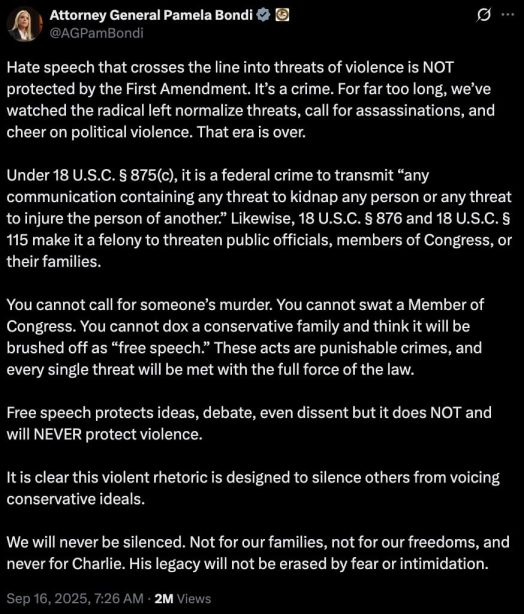
What Bondi described, true threats of violence, is already illegal under federal and state law. Invoking the term “hate speech” in this context is misleading. The constitution does not recognize “hate speech.”
By framing criminal threats as “hate speech,” Bondi moves the public conversation away from clearly defined, prosecutable offenses and into territory where legal protections still apply.
The First Amendment does not carve out exceptions for offensive or disturbing language, and attempts to categorize speech as criminal based solely on its content or tone run into immediate constitutional limits.
The concern is that rebranding existing crimes with emotionally charged labels like “hate speech” creates confusion about what the law actually allows.
It suggests there is a separate, punishable category of expression based on viewpoint or perceived offensiveness, something the US legal system has thankfully repeatedly rejected.
For a state’s top law enforcement official to advance that view undermines public understanding of both free speech protections and the scope of legitimate criminal enforcement.
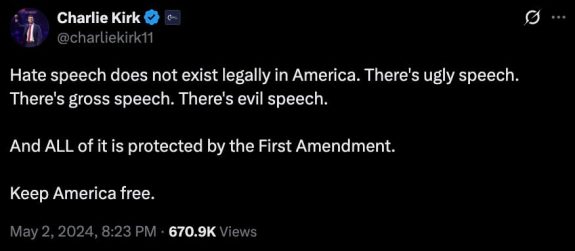
Charlie Kirk has been one of the most vocal opponents of these censorship regimes. In a 2024 post on X, he made his position plain: “Hate speech does not exist legally in America. There’s ugly speech. There’s gross speech. There’s evil speech. And ALL of it is protected by the First Amendment. Keep America free.”
Israel launches ground offensive in Gaza City
Press TV – September 16, 2025
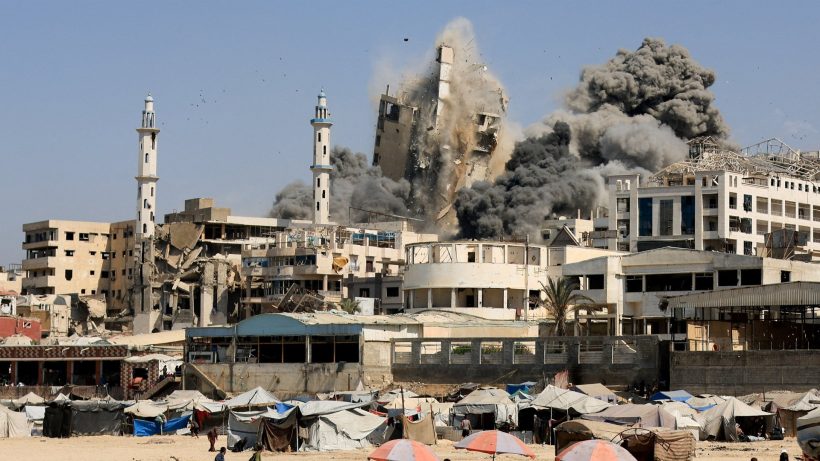
Gaza City was engulfed in flames before dawn on Tuesday as Israel launched a new ground offensive, killing dozens of civilians and burying families under the rubble.
Palestinian residents reported heavy strikes across the city overnight, when the military unleashed a massive bombardment as its ground forces moved deeper into the territory’s largest urban hub.
The military said the number of soldiers would rise in the coming days to confront up to 3,000 Hamas fighters in the area. According to a military official, the offensive is “the main phase of the plan for Gaza City.”
Gaza City’s Shifa Hospital said it received the bodies of 20 people killed in a strike that hit multiple houses in a western neighborhood, with another 90 wounded arriving at the facility on Tuesday.
“A very tough night in Gaza,” Dr. Mohamed Abu Selmiyah, director of Shifa Hospital, told The Associated Press.
“The bombing did not stop for a single moment,” he said. “There are still bodies under the rubble.”
Witnesses said the regime’s overnight bombing reduced a residential block in the north of Gaza City to mounds of rubble.
Palestinian resident Abu Abd Zaqout told AFP that about 50 people — including women and children — were inside a residential building when it was struck overnight.
“I don’t know why they bombed it,” he said. “Why kill children sleeping safely like that, turning them into body parts? We pulled the children out in pieces.”
Meanwhile, Israel’s minister of military affairs, Israel Katz, said in a post on X that the military “strikes with an iron fist” at what he described as “terrorist infrastructure” in Gaza City.
He said the offensive is aimed at creating “the conditions for the release of the hostages and the defeat of Hamas.”
“We will not relent and we will not go back — until the completion of the mission,” Katz threatened, saying, “Gaza is burning.”
Israel has long accused Hamas of building military infrastructure inside civilian areas, especially in Gaza City — allegations the resistance group repeatedly denies.
The overnight offensive came only hours after US Secretary of State Marco Rubio put the Trump administration’s full support behind Benjamin Netanyahu in a visit to al-Quds on Monday.
Rubio said Washington’s priorities were the liberation of Israeli hostages and the destruction of Hamas.
However, the UN rapporteur on human rights in the occupied territories, Francesca Albanese, said the aim of the Gaza City offensive is to make it uninhabitable.
“This is the last piece of Gaza that needs to be rendered unlivable,” Albanese said on Monday.
Residents still in the city were warned they must leave and head south.
Washington based think tanks advocate war on Lebanon
By Robert Inlakesh | Al Mayadeen | September 16, 2025
Despite the approval of a plan submitted on September 5, by the Lebanese Armed Forces, to disarm Hezbollah, the United States and Israeli regime are not satisfied with the move. What they had hoped for was an aggressive and destructive plot that could have plunged the nation into chaos.
The United States has been pushing the Lebanese government to order the full disarmament of Hezbollah, doing so without providing any tangible guarantees or even allowing Beirut to draft its own national defence strategy. Simply put, the US Trump administration hopes to pursue, through diplomacy, what the Israelis failed to achieve during their war of aggression against Lebanon.
While Lebanese Prime Minister Nawaf Salam has decided to take his orders from the United States on the question of disarmament, it is clear that the plan which was recently adopted by the Lebanese Armed Forces does not meet the standards set by the United States, and by extension, the Israelis.
The plan is supposedly divided into four separate phases, beginning in south of the Litani River. However, the plan was not revealed publicly, and there appears to be no specific deadline as to when Lebanon will achieve its stated mission. Everything has remained quite vague.
This predicament has now sparked outrage amongst Washington-based pro-war think tanks that have a significant impact on the US’s foreign policy decisions.
Take the Zionist Lobby cut out think tank, the Washington Institute for Near East Policy (WINEP), for example. Their most recent article on the issue is titled “Without a Hezbollah Disarmament Deadline, Lebanon Should Face Repercussions”.
The WINEP piece argues that the US government should pressure the Lebanese Army to take escalatory measures that would inevitably result in violent armed clashes with Hezbollah, including seizing a military position north of the Litani River as an initial step toward disarmament, and setting a specific deadline for this process.
The author of the piece, Hanin Ghaddar, writing for the Zionist think tank, advocates weaponising US aid to Lebanon by making it conditional on disarmament demands. She goes even further, arguing that the US should go after Lebanese Parliament Speaker, Nabih Berri, in order to turn the Amal Movement against Hezbollah and to destroy the Shia alliance in the upcoming elections. It is also noted that additional sanctions should be used to the effect of going after Lebanese Shia elected officials. This is a clear call for election interference.
Another notable piece was recently published by Haaretz and reposted by the infamous Zionist think tank, the Foundation for Defense of Democracies (FDD). The author of the piece, entitled “Why Israel Shouldn’t Celebrate Lebanon’s Promise to Disarm Hezbollah Just Yet”, was written by FDD senior fellow David Daoud.
In this article, the FDD think tank senior fellow argues that the Israeli regime should continue bombing Hezbollah sites throughout Lebanese territory and aim at significantly weakening the Lebanese resistance group in order to pave the way towards the Lebanese Armed Forces being able to carry out the rest of the job.
In the WINEP piece, delusional depictions of the Lebanese military’s capabilities when it comes to fighting a war with Hezbollah, use the likes of LAF’s operation in the Nahr al-Bared refugee camp, back in 2007, and the Army’s clashes with ISIS – in which Hezbollah fought alongside them – as examples of how they could prove successful. However, Daoud is less delusional and sets forth a strategy that allows for the Israelis to do all of the heavy lifting instead.
The Atlantic Council think tank has meanwhile been promoting the false idea that the Lebanese public, with the exception of the nation’s Shia population, are in favour of Hezbollah disarmament and that the resistance group has been all but defeated. Completely contradicting this notion however, is the fact that 58% of the Lebanese public polled said they oppose Hezbollah’s disarmament without a national defense strategy.
Even more revealing, however, was that the data published by Lebanon’s Consultative Center for Studies and Documentation exposed that 71.7% said they don’t believe the Lebanese army could defend the country from an Israeli attack, and 76% answered that they didn’t believe Lebanon’s diplomatic maneuvers could stop the Zionist regime from attacking.
The gap here, between 58% that opposed disarmament and the 71.7% to 76% that answered the way they did above, indicates that the respondents answered the disarmament question based upon emotion rather than logic, which could largely be attributed to the effectiveness of anti-Hezbollah propaganda.
Other Washington-based think tanks have also been active on this issue, including the most influential think tank over the Trump administration, the Heritage Foundation. In its case, it openly praised US President Donald Trump for his efforts to expel UNIFIL forces from Lebanon, which will occur under a phasing out approach come the end of 2026.
Across all of the prominent Washington-based Zionist think tanks, the message appears uniform, they all seek further pressure upon Beirut in order to force it to disarm Hezbollah, against the wishes of the majority of the Lebanese public.
The US is directly meddling in Lebanon’s affairs and its moves, including threatening Beirut with another Israeli war, are tantamount to violations of the nation’s sovereignty, in addition to being anti-democratic. For all the talk about “sovereignty”, Lebanese Prime Minister Nawaf Salam and his ilk have remained silent about the US imposing its will on Lebanon, nor do they have a strategy to liberate their territory in the south, or even stop the daily Israeli airstrikes carried out on Lebanese lands.
Qatar After the Airstrikes: Assessing Viable Responses to Israeli Aggression
By Abbas Hashemite – New Eastern Outlook – September 16, 2025
Since the Israeli attack on Doha, the Arab world has been looking for a collective response. However, the Arab states have limited viable options available due to their over-reliance on the US.
Israel’s Attack on Doha: A Dangerous New Precedent in the Gulf
The Israeli attack on Qatar last week astonished the whole world. Doha has long been seen as a mediator, as it played a constructive role in establishing peace between different conflicting parties, including the United States and the Taliban. It was also playing a mediatory role between Hamas and Israel. Hamas leadership was present in Doha to discuss the peace proposal presented by the Trump administration. However, the Israeli government conducted airstrikes in Doha on the building in which the Hamas leadership was present. Although the Hamas leadership survived the attack, these airstrikes raised serious concerns about the sovereignty and security of the Gulf States.
The Gulf countries have largely been reliant on the US alliance for their security. The latter supplies most of the arms and weapons to these countries. However, the US air defense system did not intercept any Israeli missiles during the recent strikes in Doha, implying that the US security guarantees to the Gulf States are selective and are only motivated to counter threats emanating from Iran. Moreover, this demonstrates that the US green-lighted the Netanyahu administration to conduct these criminal strikes in an affluent neighborhood in Doha.
Although the Trump administration has denied all the claims about the US support to the Israeli government in these strikes, and it has condemned this move in the United Nations, the US Secretary of State, Marco Rubio, is on a two-day visit to Israel to ensure continued US support to the Zionist state. This further demonstrates that the United States prioritizes Israel over its Arab allies, and all its airbases in the Gulf countries are actually to protect Israel against the regional threats.
Limited Military Options and Growing Frustration
Qatar’s Prime Minister Sheikh Mohammed bin Abdulrahman bin Jassim Al Thani described the Israeli attacks on Hamas leadership in Doha as “state terrorism that is being exerted by someone like Netanyahu.” He further stated, “I think that we have reached a decisive moment. There should be retaliation from the whole region in the face of those barbaric actions that only [reflect] one thing: It reflects the barbarism of this person that is leading the region, unfortunately, to a point where we cannot address any situation, and we cannot repair anything, and we cannot work within the frameworks of international laws. He just violates all those international laws.”
A strong response by Qatar and Arab states is mandatory to ensure their sovereignty and security in the future. However, given the Arab states’ overreliance on the US security guarantees and arms, they are left with very few options to retaliate against Israel. A military response to Israel is impossible for the Gulf States, as they do not possess enough military capabilities. Moreover, the US would never allow them to collectively attack Israel. Therefore, a collective military response could lead to internal security threats due to the presence of the US airbases in these countries.
Strategic Realignment: From US Dependence to Eastern Alliances
The Gulf States, however, could push Israel towards regional diplomatic isolation. The UAE, Bahrain, Morocco, and Sudan established diplomatic relations with Israel in 2020, following the Abraham Accords, which were mediated by the United States. The UAE summoned the Israeli diplomat to denounce these airstrikes in Doha. Mohammed bin Zayed Al Nahyan, the President of the UAE, visited Qatar within 24 hours of the attack to discuss the situation. The UAE and other Arab states could limit or downgrade their diplomatic relations with Israel in retaliation for these attacks.
Qatar has already lobbied for a unanimous UN statement condemning the illegal Israeli attack in Doha. It will also host an Arab-Islamic summit in Doha to coordinate a collective response to Israeli attacks. Leaders from almost all the Islamic countries, including KSA, Pakistan, Turkey, and Iran, are expected to attend this extraordinary summit. Moreover, the Gulf States could also join the International Court of Justice’s cases against Israel, further building pressure on the Zionist state to halt its genocide and occupation in Palestine.
Gulf States, especially Qatar, the UAE, the KSA, and Kuwait, hold significant economic leverage over Israel due to their energy resources. They could use their economic leverage to impose trade and economic sanctions on Israel by boycotting companies that have stakes in the Israeli economy. Qatar, Saudi Arabia, and the UAE pledged a collective investment of $3 trillion in the US economy during Trump’s last visit to the region. The intention behind this investment was to strengthen relations with the United States. However, the recent failure of the US to protect Qatar from Israeli attack could result in the Gulf nations’ quest for new global allies.
Over the past few years, the world has witnessed unprecedented economic growth in Russia and China. In 2023, China brokered a peace deal between Iran and Saudi Arabia to normalize their bilateral diplomatic relations. Russia, on its part, has emerged as a strong military and diplomatic power on the global stage. The two new superpowers of the world are already aligned with the Palestine policy of the Muslim world. Moreover, they possess unmatchable military power. The recent US failure to protect Qatar from Israeli attacks has provided the Arab states with a new direction to expand their diplomatic and strategic ties. They could engage with Russia and China to strengthen their defense sector and expand their diplomatic clout. This would not only prove detrimental for Israel but would also hurt the US regional and global interests.
Аbbas Hashemite – is a political observer and research analyst for regional and global geopolitical issues. He is currently working as an independent researcher and journalist
Iran clarifies stance after joint Doha statement, rejects ‘two-state’ solution to Palestinian issue
Press TV – September 16, 2025
Iran has clarified its stance on a joint statement from a Doha summit held in the wake of the Israeli regime’s assault on Qatar, rejecting the “two-state” solution concerning the Palestinian issue and and US’s self-proclaimed “peace” efforts.
The Foreign Ministry issued the remarks on Tuesday, distancing the Islamic Republic from references made in the statement to the so-called “two-state solution,” reiterating support for Palestinians’ right to resistance, and ruling out any prospect of recognition of the regime.
It also dismissed the existence of any genuine intention on the part of Washington to resolve the situation created by the regime’s barbarity throughout the West Asia region, including across the occupied Palestinian territories.
‘Two-state solution’ a non-starter
Reasserting the Islamic Republic’s continued unwavering support for the Palestinian cause of liberation from Israeli occupation and aggression, the ministry said the country would under no circumstances abandon its staunch belief that Palestinians were absolutely entitled to exercise their inherent right to self-determination.
Therefore, Tehran keeps holding fast to its principled position that the only “true and sustainable” solution to the Palestinian issue rests in the creation of a “unified democratic government” in the occupied territories.
Such a government should receive its mandate from the outcome of a referendum partaken by all Palestinians inside the territories as well as the Palestinian diaspora, and, hence, end up representing “all Palestinians,” the ministry said.
Therefore, it said, Tehran utterly dismisses the “two-state solution,” supported by the United States and its allies, and the concepts proposed as part of such “solution,” including those mentioned in the Doha statement.
It named one of those concepts as “establishment of the State of Palestine along the lines of June 4, 1967,” which ignores the vast Palestinian territories that the regime had already occupied in 1948 and continues to occupy.
Also, the Islamic Republic spurns the idea that Palestinians’ future capital should be confined to just the eastern part of the holy occupied city of al-Quds, the ministry added.
“The so-called ‘two-state’ solution would not resolve the Palestinian issue,” it specified.
‘Israeli barbarity necessitates resistance’
Iran, meanwhile, continues to uphold Palestinians’ entitlement to employ “whatever necessary vehicle” towards realizing their inalienable right to self-determination and ridding themselves of foreign colonialism, the ministry stated.
Those rights that are enjoyed by “any peaceable nation” include the right to resist, it noted, adding, “Given the barbarity exercised by the occupying regime’s forces, nothing should serve to restrict this right.”
“It is also our shared duty under international law to support this aspiration,” it said, and also repeated Tehran’s categorical rejection of any potential recognition of the regime.
‘US no ‘peace’ partner’
Finally, the ministry underlined that the policies and actions of the United States have contributed to the continuation and backing of the Israeli regime’s aggression against the Palestinian people, rather than subduing it.
“In light of this reality, the Islamic Republic holds that the United States cannot be recognized or regarded as a credible or impartial party in advancing a just and lasting peace in this conflict.”
“We request the summit’s secretariat to include the Iranian delegation’s reservations in its final report.”
The emergency Arab-Islamic summit was held in the Qatari capital on Monday to address the regime’s recent deadly attacks on the city, which targeted the Palestinian resistance movement Hamas’ leadership, among Tel Aviv’s other atrocities throughout the West Asia region.
The US State Department’s Growing Thoughtcrimes Obsession
By Adam Dick | Peace and Prosperity Blog | September 16, 2025
The Trump administration’s Department of State has been placing a high priority on denying the granting of visas to, and revoking visas from, people who have said things critical of the Israel government, including the Israel government’s war activities. That looks like it is an early step of a trend at the United States government department. In a new Fox News interview this week, Secretary of State Marco Rubio announced his desire that the State Department would make an addition to the list of thoughtcrimes for which visas may be denied and revoked.
Rubio stated:
We should not be giving visas to people who are gonna come to the United States and do things like celebrate the murder, the execution, the assassination of a political figure. We should not. And, if they’re already here, we should be revoking their visa.
The strange thing is that the United States government and its tied-at-the-hip Israel government have a longtime penchant for undertaking just such murders, executions, and assassinations. People’s approval of those killings, though, should not be expected to cause much of a stir at the State Department. Don’t hold your breath for expressed approval of the assassination (ordered by Trump in his first presidential term) of Iran General Qassim Suleimani, for example, to result in denials or revocations of visas. The same goes for expressed approval of recent killings by the Israel government of “political figures” in Lebanon, Iran, and Yemen.
Rubio suggested immediately after his comment regarding changes in visas policy that the thoughtcrimes punished could expand into a much longer list. “Why would we want to bring people into our country that are gonna engage in negative and destructive behavior?” he declared. “Negative and destructive behavior” sure is a broad category. How close to qualifying to be Rubio’s bestie will someone have to come to make the visa cut?
Trump Shooter’s Ukraine Links: Why Are Prosecutors Staying Silent?

Sputnik – 15.09.2025
As the trial of Donald Trumps’ second would-be assassin begins on the anniversary of his attempt, here’s what we know.
Ukraine trace ignored?
Few seem to care about Ryan Routh’s Ukraine connections. Early in the conflict he tried to recruit soldiers from Afghanistan, Moldova and Taiwan to fight against Russia. But when he mentioned Ukraine in court, the judge silenced him.
“Prosecutors, in the end, only want to bring a case forward that gives them the believability and confidence that they can win,” Matthew Crosston, professor of national security at Bowie State University, tells Sputnik.
Trump’s Ukraine stance
Shortly before the attempted shooting, Trump pledged in an election debate to end the Ukraine conflict.
Those behind arming Ukraine opposed that, while Routh’s preparations including multiple burner phones suggest he may not have acted alone.
But “prosecutors did not find it productive or realistic to look more seriously into how Routh was radicalized or who facilitated his access to weapons or attempts at acquiring more weapons,” Crosston says.
They already have the suspect – so why bother?
Billionaire Bill Ackman convened stormy Israel ‘intervention’ with Charlie Kirk, sources say

By Max Blumenthal | The Grayzone | September 15, 2025
A month before Charlie Kirk’s killing, billionaire pro-Israel moneyman Bill Ackman arranged an intervention in the Hamptons during which sources say he and others “hammered” Kirk for the conservative leader’s growing criticism of Israeli influence in Washington. Kirk came away fretting about Israeli “blackmail,” sources say, as he contemplated a Catholic conversion.
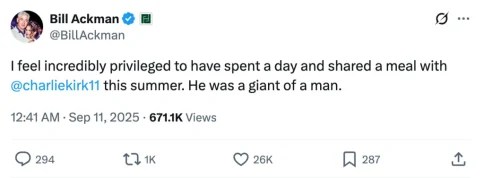
On September 11, one day after the assassination of Charlie Kirk, billionaire pro-Israel moneyman Bill Ackman took to Twitter/X to trumpet his relationship with the late conservative operative. “I feel incredibly privileged to have spent a day and shared a meal with @charliekirk11 this summer. He was a giant of a man.”
The Grayzone has spoken to five people with intimate knowledge of Kirk’s meeting with Ackman, which was held in early August under the guise of a summertime Hamptons lunch. According to one source, Kirk was left upset after the gathering turned into an “intervention” where he was “hammered” for his increasingly skeptical views on the US special relationship with Israel, and for platforming prominent conservative critics of Israel at his TPUSA events.
When his hosts presented him with a detailed list of every offense he supposedly committed against Israel, Kirk was “horrified,” said one person. At one point, according to another source, Ackman angrily chastised Kirk for his disobedience. The Zionist billionaire also allegedly demanded Kirk rescind his invitation for Tucker Carlson to speak at his upcoming America Fest 2025 in December.
The Grayzone reported on September 12, citing an associate of Kirk, that Netanyahu had offered to organize a massive infusion of pro-Israel money into TPUSA, and that Kirk refused. Another longtime friend of Kirk has told The Grayzone that the conservative activist also rejected an offer Netanyahu delivered two weeks before his death to meet with him in Jerusalem.
Kirk, according to one person with inside knowledge of the meeting with Ackman, said he left feeling as though he’d been subjected to “blackmail.”
In a series of text messages with The Grayzone, Ackman described these accounts of his meeting with Kirk as “totally false.” He pledged to release a public statement providing his own account of the event, but refused The Grayzone’s request for clarification or further details. He would not accept phone calls from this reporter.
“I think I can easily put this to bed,” Ackman promised, “I have receipts as they say.” He did not abide when asked to provide the so-called “receipts.”
In an apparent bid to reinforce the pro-Israel tone at the Hamptons meeting, Ackman hosted a coterie of pro-Israel operatives and conservative influencers at the off-the-record engagement. One was Instagram influencer Xaviaer DuRousseau of Prager U.
Reached by phone by The Grayzone, DuRousseau sounded flustered when asked about his presence at the meeting. He repeatedly demanded to know how this reporter obtained his number, and eventually hung up, refusing to answer questions about the event.
Several Instagram posts by DuRousseau show him and his friend, conservative influencer Emily Wilson, in the Hamptons on August 8 outside Topping Rose House, a posh hotel and restaurant in Bridgehampton, New York.

Two weeks after the meeting, DeRousseau was reportedly junketed on an all-expenses-paid trip by the Israeli government to visit a Gaza Humanitarian Foundation “aid” hub guarded by the IDF on the Gaza frontier. There, he recorded an Instagram video denying that the population of the besieged Gaza Strip was experiencing a famine.
The Grayzone received a similarly agitated response from Wilson, known online as Emily Saves America. Following a phone call and exchange of text messages in which this reporter asked her numerous times about her attendance of the meeting in the Hamptons, Wilson refused to comment. Instagram photos place her in the Hamptons at the same time as DuRousseau.
CJ Pearson, a leading youth coordinator for the Republican National Committee, immediately referred The Grayzone to his communications director when asked if he attended the Hamptons gathering.
The strong-arm tactics of the pro-Israel billionaires who helped fuel the growth of TPUSA were said to have contributed to Kirk’s alienation with evangelical Christianity, which emphasizes uncritical support for Israel as a bedrock principle. Several sources with access to Kirk said he had begun attending Catholic mass with his wife, Erika, and was considering a conversion before his death.
Bree Solsdadt, a Catholic Twitter/X influencer, has publicly corroborated this account of Kirk’s religious realignment. Kirk’s friend, the podcaster and former TPUSA personality Candace Owens, also alluded to the shift when she reflected that he was undergoing a “spiritual transformation” before his death.
Israel-centric influencer summit in the Hamptons
The Grayzone has obtained a partial list of attendees alleged to have been in attendance at the Bridgehampton meeting convened by Ackman this August. They include:
Seth Dillon – Dillion is the CEO of Babylon Bee, the conservative answer to the liberal The Onion satire outlet. Dillon and his crew have derisively mocked famine-stricken Palestinians and their supporters in the West, since Israel’s slash-and-burn campaign began in the besieged Gaza Strip. An evangelical Christian with Jewish heritage, he has claimed, “I did not cease having Ashkenazi blood when I put my faith in Jesus Christ (also a Jew).” Dillon did not answer calls from The Grayzone.
Xaviaer DuRousseau – DuRousseau is employed by Prager U, the premier right-wing “edu-tainment” hub targeting the minds of American youth. His boss, Marissa Streit, is a veteran of the Israeli army’s Unit 8200 cyber-spying division. A Black self-described former progressive, DuRousseau now appears firmly in the pocket of right-wing Zionist forces. During his Israeli government-funded visit to a Gaza Humanitarian Foundation “aid” hub inside Gaza, DuRousseau falsely claimed the United Nations and Hamas were to blame for the hunger sweeping the local population. “If I were Israel, I wouldn’t even provide matching socks to Gaza, but here’s all the aid that y’all claim doesn’t exist,” he said in an Instagram video filmed in front of boxes of aid blocked from entering Gaza. “Instead of Hamas distributing the ramen noodles,” DuRousseau continued, “their leaders are eating it all and that’s why they’re on Ozempic.”

DuRousseau vigorously defended his close friend, podcaster Emily Wilson, after she stated that “if everyone in the state [of Alabama]” wanted the return of chattel slavery, “go ahead, why do I give a shit?”
Emily Wilson aka Emily Saves America – Wilson is a Los Angeles-based self-described libertarian podcaster and social media influencer with over 500,000 followers on Instagram. On September 9, she recalled on Twitter/X how “a HUGE black guy” robbed her when she was 13. “I hate to say it but things like that just change the way you see certain people. After that I always thought, ‘oh, you guys just hate me,’” she reflected. This month, she and DuRousseau recorded a podcast in which they framed pro-Palestine activist Greta Thunberg’s hairstyle as evidence of her being “slow and short bus.”
“I don’t hang out with anyone really less attractive than me,” Wilson stated in a separate appearance.
Arynne Wexler – A former Goldman Sachs trader seeking cachet in the world of online influencers, Wexler is a vociferously Zionist, self-described “non-lib girl in a crazylib world.” In an interview with pro-Israel podcaster Dave Rubin, Wexler argued that “we need to bring bullying back” to enforce social norms, crack down on conspiracy theories, and stop the rise of antisemitism. Wexler has praised Ackman’s pro-Israel activism on multiple occasions. She did not answer calls from The Grayzone.
Nate Friedman – Friedman is a young ultra-Zionist influencer best known for New York City man-on-the-street confrontations with Palestine solidarity activists, whom he’s accused of being paid protesters.
Ory Rinat – Rinat was the former Special Media Advisor to Jared Kushner, the Trump son-in-law and advisor, before moving on to serve as White House chief digital officer during Trump’s first term. A Jewish pro-Israel operative said to have close ties to Netanyahu’s government, Rinat now serves as CEO of Urban Legend, a PR firm which commands “an army of 700 social media influencers who command varying degrees of allegiance from audiences that collectively number in the tens of millions,” according to Wired.
CJ Pearson – The chair of the Republican National Committee’s Youth Advisory Council, Pearson appeared in photos in the Hamptons alongside Wilson and DeRousseau. The Grayzone is awaiting further information from Pearson’s communications director.

CJ Pearson (left) with Emily Wilson, Xavaier DeRousseau, and an unknown person in the Hamptons
Bill Ackman’s war
As The Grayzone reported on September 12, Kirk was besieged with angry calls and messages from pro-Israel donors to his organization following TPUSA’s Student Action Summit this July in Tampa, Florida. Israeli Prime Minister Benjamin Netanyahu had also phoned him, according to a longtime friend of Kirk, and offered to orchestrate a massive infusion of pro-Israel money into his organization.
A longtime friend of Kirk told The Grayzone the mounting pressure had left him “angry” and “frightened.”
Kirk vented about the pro-Israel intimidation campaign in an August 6 discussion with Megyn Kelly, a former Fox News host who was also growing more critical of Israeli influence in Washington.
“It’s all of the sudden, ‘Oh, Charlie: he’s no longer with us.’ Wait a second—what does ‘with us’ mean, exactly? I’m an American, okay? I represent this country,” Kirk complained.
“The more that you guys privately and publicly call our character into question—which is not isolated, it would be one thing if it were just one text, or two texts; it is dozens of texts—then we start to say, ‘whoa, hold the boat here,’” Kirk continued. “To be fair, some really good Jewish friends say, ‘that’s not all of us’… But these are leaders here. These are stakeholders.”
He went on: “I have less ability… to criticize the Israeli government than actual Israelis do. And that’s really, really weird.”
Kirk delivered his comments around the same time as the tumultuous meeting in the Hamptons with Ackman and the crew of pro-Israel influencers.
A month earlier, Kirk had opened the stage at his TPUSA Student Action Summit for a cathartic outpouring of frustration and rage about Israel’s political hammerlock on the Trump administration. At the conference, speakers from Carlson and Kelly to the anti-Zionist Jewish comedian Dave Smith slammed Israel’s blood-soaked assault on the besieged Gaza Strip, branded Jeffrey Epstein as an Israeli intelligence asset, and openly taunted Zionist billionaires like Ackman for “getting away with scams” despite having “no actual skills.”
The mockery by Carlson was particularly galling for Ackman. One day after TPUSA’s conference, Ackman staged a 4,000 word Twitter/X meltdown defending his financial acumen, while insisting that he earned his vast fortune because, “I inherited good genes.”
In fact, the 59-year-old manager of the Pershing Square Capital hedge fund had presided over a precipitous decline in his own personal fortune through a series of bad bets. Between 2015 and 2018, amid a bull market, Ackman’s fund tallied embarrassingly negative returns that cost him an eye-popping $12 billion in losses. His “holy war” to short the multi-level marketing company Herbalife backfired, resulting in a devastating squeeze that cost him heavily. Ackman’s financial mishaps forced him to slash one fifth of his staff in 2018.
The billionaire also took issue with Carlson’s contention that he had been part of convicted sex offender and late Zionist financier Jeffrey Epstein’s “constellation of people.” Yet Carlson’s remarks were grounded in fact. Indeed, Ackman’s wife, the celebrity Israeli designer Neri Oxman, had gifted an artistic orb to Epstein after he plowed $125,000 in donations into her Media Lab at MIT. She was invited to lunch with Epstein on several occasions, according to the Boston Globe, and complied with MIT’s requirement to keep her gift to Epstein confidential.
Ackman has significantly elevated his public profile by leading fellow Zionist billionaires in a ruthless crackdown on post-October 7 Palestine solidarity activism in the US. By leveraging his fortune, Ackman helped dislodge the political scientist Claudine Gay as president of Harvard University, his alma mater, accusing her of adopting an insufficiently draconian policy toward students protesting Israel’s assault on Gaza.
After weeks of pummeling from Ackman, GOP members of Congress, and pro-Israel media, Gay finally quit when conservative activists produced evidence that she had plagiarized in her academic writing. While Ackman claimed victory, he howled with indignation when Business Insider returned the favor with a detailed article which documented multiple cases of plagiarism by his own wife, the designer Oxman. According to the outlet, Oxman “stole sentences and whole paragraphs from Wikipedia, other scholars and technical documents in her academic writing.”
Ackman responded by announcing that he would fund a plagiarism review of every MIT faculty member. He also delivered a 77-page lawsuit threat to Axel Springer, the publisher of Business Insider, accusing them of publishing claims “designed to cause her harm, principally because the reporters do not like me, my support for Israel, and my advocacy.” He quickly dropped the lawsuit, however, claiming he did so because Springer is “an important advocate against antisemitism.”
In May 2024, the Washington Post revealed Ackman as a leading member of a Whatsapp group of 50 ultra-wealthy Zionists coordinating counterinsurgency-style actions against student anti-genocide protesters at Columbia University.
According to the report, the millionaire cabal sought to buy off Black celebrities as propaganda puppets and dangled bribes before New York City Mayor Eric Adams to deploy the NYPD against student protesters. “Some members also offered to pay for private investigators to assist New York police in handling the protests, the chat log shows — an offer a member of the group reported in the chat that Adams accepted,” the Post reported.
This June 14, as Israel reeled at the Iranian response to its unprovoked assault days earlier, Ackman launched his next campaign: “@Israel needs our help to destroy Iran’s nuclear threat to the world…” the hedge funder declared on Twitter. “Israel does not have the equipment and armaments to complete the job. We do, and it does not require boots on the ground.”
Multiple sources including a Trump administration official have revealed to The Grayzone that Kirk personally visited Trump inside the White House to lobby him against attacking Iran. Trump “roared” at Kirk, one said, and shut down the conversation.
A month later, Kirk allowed the simmering rage within the conservative grassroots over Israel’s stranglehold on Washington to pour out at his TPUSA summit. Soon after, he was summoned to the Hamptons for a face-to-face with one of Netanyahu’s most influential allies in the US. Before Ackman and a cast of avaricious young influencers under Israel’s sway, he defied the billionaire power broker, then returned home to prepare for what would be his final speaking tour.
West May Lose at Least $285Bln If Confiscates Russian Reserves
Sputnik – 14.09.2025
MOSCOW – Russia’s frozen reserves continue to “burn the pockets” of Western countries: states burdened with huge debts and budget deficits have begun to talk more and more about confiscating Russian assets that they froze in 2022, but such a step could cost them at least $285 billion, Sputnik calculated based on national statistics.
Currently, the G7 countries and the European Union are implementing a scheme to seize income from frozen Russian assets to finance a $50 billion loan to Ukraine. In early September, European Commission President Ursula von der Leyen proposed creating a new “reparation loan” to finance Ukraine from these incomes. However, Western politicians periodically call for the direct confiscation of frozen Russian assets to finance Ukraine. The Russian authorities have repeatedly said that they would take reciprocal measures in the event of confiscation.
According to the latest available data, the volume of direct investment from the European Union, the G7, Australia, Norway and Switzerland in the Russian economy as of the end of 2023 amounted to $285 billion. At the same time, taking into account the ban on the withdrawal of funds from the country by unfriendly residents, the amount may be significantly higher — officially, data on the amount of blocked funds in type C accounts is not disclosed.
The EU accounted for $238 billion in assets, of which $145.4 billion belonged to Cyprus, $21.7 billion to France, and $19.2 billion to Germany. The Netherlands, which does not officially disclose the full volume of investments in the Russian economy, could potentially own assets worth approximately $20.8 billion. Italy ($12.6 billion) and Austria ($6.9 billion) are also among the largest European investors. The remaining EU states accounted for another $11.5 billion.
Among the G7 countries, the largest investor in the Russian economy was the United States – according to the latest available data, American assets in Russia amounted to approximately $7.7 billion. Japan had Russian assets worth $4.8 billion, Canada – $3.9 billion, and Britain – $3 billion.
The assets of Switzerland and Norway, which usually follow in the wake of EU sanctions against Russia, at the end of 2023 amounted to $27.5 billion and $43 million, respectively. Australia had $400 million in investments in the Russian economy at the end of last year.
After the start of the special operation in Ukraine, Western countries imposed sanctions against the Bank of Russia, freezing its reserves, but the exact amount of immobilized funds is unknown. According to the central bank, as of the end of June 2021, about $288 billion was stored in Austria, Britain, Germany, Canada, the United States, France, and Japan, and another $63 billion was in unnamed countries.
At the beginning of 2022, the Bank of Russia reported that about half of its $630.6 billion in assets were in key reserve currencies.
Sputnik used data from unfriendly countries on direct investment in the Russian economy in its calculations. Direct investment is investment in enterprises that provide control over at least 10% of its shares or capital.
Is It Safe to Get 3 Vaccines at Once? Vaccine Makers Say Yes, But FDA Wants Proof
By Michael Nevradakis, Ph.D. | The Defender | September 8, 2025
Is it safe to get a COVID-19, RSV and flu vaccine at the same time? The answer is yes, according to many medical experts and the CDC and HHS websites — but that’s about to change.
According to an Aug. 25 memo, the U.S. Food and Drug Administration (FDA) now says vaccine makers must conduct clinical trials to study the potential adverse effects of simultaneously giving multiple shots for respiratory viruses before they can market the vaccines as “safe and effective” when received at the same time.
The FDA said it “cannot affirm that concurrent administration is both safe and effective,” as coadministration has not been thoroughly studied.
Some medical and scientific experts welcomed the new policy, first reported last week by The Washington Post.
Dr. Clayton J. Baker, an internal medicine physician, said:
“There is urgent need for scientifically sound, non-Pharma-conducted studies regarding the safety of all simultaneously administered vaccines.
“This practice is widely used and dangerously under-evaluated. The greatest risk is to young children during co-administration of the many different vaccines listed on the current, bloated Centers for Disease Control and Prevention [CDC] pediatric schedule.”
Last month, two doctors who lost their medical licenses because they questioned the CDC’s vaccine recommendations for children sued the agency for failing to test the cumulative effect of the 72-dose schedule on children’s health.
Research scientist and author James Lyons-Weiler, Ph.D., said, “Properly controlled and sufficiently powered trials are the gold standard,” promised by U.S. Health Secretary Robert F. Kennedy Jr., and that such trials are “the correct approach for any clinical intervention.”
“It’s about time the gold standard of science is applied to vaccines,” he said.
In a statement shared with The Defender, Emily G. Hilliard, press secretary for the U.S. Department of Health and Human Services, said the department “does not comment on future or potential policy decisions.”
Prasad: Past studies ‘incapable of adequately documenting safety signals’
According to Fierce Pharma, the Biden administration “supported vaccine coadministration as a means to increase immunization rates.”
Dr. Vinay Prasad, director of the FDA Center for Biologics Evaluation and Research (CBER), has publicly criticized this strategy due to a lack of evidence supporting it, the Post reported.
The Post cited 2021 guidance from the World Health Organization, which found that coadministration of the COVID-19 and flu vaccines is safe and “has potential advantages.”
A survey of the scientific literature, published in March in the journal Influenza and Other Respiratory Viruses and cited by the Post, found that “Adult vaccine coadministration is safe for all the combinations we assessed,” with adverse events that were “generally mild to moderate and of short duration.”
The Post also cited a 2022 CDC study published in JAMA Network Open, which found that “simultaneous administration of COVID-19 mRNA booster and influenza vaccines may be associated with increased likelihood of systemic reactions.” Yet, according to the Post, “those reactions were mostly mild and went away quickly.”
In the FDA memo, Prasad said past determinations regarding the safety of coadministering respiratory virus vaccines were made on the basis of small randomized studies. “Such small trials are inherently incapable of adequately documenting safety signals,” he said.
Baker agreed:
“At least two of the studies showed statistically significant increases in systemic reactions when the vaccines were coadministered. To dismiss this finding without further evaluation — as was done — is both irresponsible and tendentious in favor of ‘just giving’ the shots.”
Lyons-Weiler said the relevant studies “support convenience and short-term tolerability,” but “do not deliver the decisive evidence needed for label-level claims about clinical benefit or the absence of interaction-driven risk.”
Giving multiple vaccines at once is convenient, profitable — but not necessarily safe
Dr. Ashish Jha, the White House’s former coronavirus coordinator during the Biden administration and now dean of the Brown University School of Public Health, told the Post that the millions of doses of respiratory virus vaccines coadministered over the years prove they are safe.
“The burden of proof is not on manufacturers to be able to do something that clearly has been done millions of times safely,” Jha said.
Karl Jablonowski, Ph.D., senior research scientist at Children’s Health Defense, said Jha “is partaking in a fallacy that past actions were safe and warranted,” as “historic data of dubious record does not constitute a safety study.”
Jablonowski said:
“That it has been administered millions of times does not make vaccines safe; it makes them profitable. That we administered vaccines to our most vulnerable — during pregnancy and to 6-month-old infants — doesn’t make them safe, it makes us reckless.”
Baker agreed, saying, “Jha is correct in stating that the coadministration of multiple vaccines for respiratory viruses ‘clearly has been done millions of times.’ But how ‘safely’ has it been done? Jha doesn’t know, because nobody knows.”
Jablonowski said looking at vaccination data retrospectively is problematic because “there is no experimental control.”
He cited the case of a 6-month-old in Iowa who received multiple respiratory virus vaccines concurrently in 2022 and was “found pulseless” in his crib 10 days later, according to a report in the U.S. government-run Vaccine Adverse Event Reporting System or VAERS.
“Which vaccine, if any, likely killed him? We don’t know, because we don’t have the safety studies for combinations,” Jablonowski said.
Jablonowski also referred to a 2023 paper published in The BMJ on the safety of the mRNA COVID-19 booster shots. His analysis of the study’s data found that people who received a flu vaccine along with their fourth COVID-19 booster dose had a 62.5% higher risk of stroke within 28 days of vaccination.
The 2022 CDC study does, in fact, show “a compounding or synergy of adverse reactions,” Jablonowski added.
The study states:
“Compared with administration of COVID-19 mRNA booster vaccines alone, simultaneous administration of COVID-19 mRNA booster and seasonal influenza vaccines was associated with significant increases in reports of systemic reactions during days 0 to 7 following vaccination.”
Jablonowski analyzed the study’s results. He found that people who received Pfizer or Moderna COVID-19 vaccines concurrently with a flu vaccine were more likely to experience a systemic or injection-site reaction or to be unable to work or attend school following vaccination.
FDA policy ‘could have implications’ beyond cold and flu season
CDC guidance, current as of Aug. 18, states, “Flu, COVID-19, and RSV vaccines may be co-administered (given at the same visit)” and “may also be co-administered with other vaccines.”
According to the Post, Prasad’s memo “could have implications that go beyond the fall respiratory vaccination season.”
While the memo “does not prevent pharmacies and doctors from providing coronavirus and flu vaccines in the same visit,” the Post suggested that immunization rates may decline if more than one visit is required to receive multiple respiratory virus vaccines, or longer intervals are required between shots.
The memo comes as national pharmacy chains, including CVS and Walgreens, have begun limiting access to COVID-19 vaccines in response to new federal guidelines enacted last month ending emergency use authorization of the COVID-19 shots and restricting them to people at higher risk for severe illness.
According to the Post, Pfizer responded to Prasad’s memo by sending a letter to healthcare providers stating that some batches of its COVID-19 vaccine contain “unapproved prescribing information inside the cartons,” indicating the company intends to add a warning about coadministration of the vaccine to its product label.
According to the Post, the FDA’s policy change may also lead to new recommendations for respiratory vaccines — potentially stemming from the CDC’s vaccine advisory panel, the Advisory Committee on Immunization Practices (ACIP).
CDC vaccine advisers to meet next week
ACIP is scheduled to meet Sept. 18 to vote on COVID-19 vaccine recommendations for the upcoming cold and flu season.
In June, Kennedy retired all 17 members of ACIP to eliminate conflicts of interest. Shortly after, Kennedy named eight researchers and physicians to the committee, but one nominee declined to participate. Fierce Pharma reported last week that Kennedy plans to nominate seven additional members to the committee.
The new FDA policy is part of a broader series of shakeups at the FDA and CDC.
Prasad resigned from his position on July 29 amid pressure from vocal critics, but returned to his position two weeks later.
In May, Prasad replaced Peter Marks, M.D., Ph.D., as head of CBER. Marks had overseen Operation Warp Speed and the rapid development and approval of the COVID-19 vaccines. He resigned in March under pressure from Kennedy.
On Aug. 27, the White House confirmed the firing of CDC Director Susan Monarez, after she refused to resign amid clashes with Kennedy.
During a contentious U.S. Senate hearing Thursday, Kennedy said Monarez had indicated she would refuse to endorse any ACIP recommendations, even before the committee met to make them.
On Sept. 1, President Donald Trump suggested that the CDC and Big Pharma have not been fully forthcoming about COVID-19 vaccine safety data. Trump demanded they “clear up this mess.”
This article was originally published by The Defender — Children’s Health Defense’s News & Views Website under Creative Commons license CC BY-NC-ND 4.0. Please consider subscribing to The Defender or donating to Children’s Health Defense.
Featured Video

Death Spikes & Rising Cancer In Our Youth Explained
or go to
Aletho News Archives – Video-Images
From the Archives
Politicians lie
By Mazin Qumsiyeh | Popular Resistance | August 18, 2013
There is no way to say this truth nicely: Politicians lie. That includes Japanese, American, Egyptian, Israeli, and Palestinian politicians! Is there something more common sense than that? Yet, so many citizens around the world believe their own politicians or wistfully acknowledge lies but think it is part of the job needed to run things. They believe even when politicians contradict themselves blatantly. This phenomenon is rather remarkable. It is a dissonance and disconnect from reality that many seem oblivious to. It is very dangerous because it can lead to accepting rationales for going to war. These can be deadly wars that lead to millions of lives lost as happened in what was called World War 1 and WW2. Even when incredible and declassified evidence abound, politicians continue to lie and old mythologies refuse to die. Here are just a few of the countless lies told to us over the past few decades… continue
Blog Roll
 Aletho News
- Burnham’s UN debut… A masterclass in British disinformation
- Iran flights continue despite US aviation sanctions
- Global Tipping Points Lead the World Into a State of Entropy
- The day-after at the White House: USA and Xi Jinping
- The Geopolitical Balance in the Red Sea: The UAE Being Displaced by New Players
- Iraqi resistance group vows to stage airport sit-ins over Iran aerial blockade
- Turkish parliament to review Saudi-Pakistan defense pact next month
- DEATH SPIKES & RISING CANCER IN OUR YOUTH EXPLAINED
- Iran offers Trump deal before US election
- Merz regime wants ‘secret police’ – opposition
- If Americans Knew
- Deconstructing Netanyahu’s pants-on-fire UN rant – Daily Update
- Trump betrayed voters with his campaign lies and prioritized a foreign country once he took office
- Netanyahu calls Israel’s war in Gaza ‘opposite of genocide’ in UN speech to near-empty hall
- Settler Kidnappings: Torture, Sexual Abuse and Terrorisation of Palestinian Abductees as Israel Deepens Annexation of West Bank
- Gaza winter nears as 162,000 tents become unusable, raising fears of humanitarian crisis
- Netanyahu says, “It’s the opposite of genocide”; UN says Gaza economy is world’s ‘most severe crisis on record’ – Daily Update
- Israel’s US-Backed Assault on Gaza Has Created the ‘World’s Most Severe Economic Crisis on Record’: UN
- ‘Protecting U.S. Citizens’… From Israel
- ‘This is where I live now, the back of a truck’: a day in the life of a grandmother in Gaza
- In UN Speech, Iran’s President Displays Pictures of Children Killed by US, Brings Attention to Israel’s Nuclear Arsenal
- No Tricks Zone
- New Study: Earth And Venus Surface Warmth Largely Explained By Convection And Lapse Rate, Not CO2 Or Radiation
- 2025 Nature Paper Claiming Worsening Global Drought Gets RETRACTED …Heavily Flawed
- New Study: ‘Global Drought Shows No Detectable Recent Acceleration Under Climate Warming’
- Economic Masterminds: German Socialists Suggest Taxing Productivity Gains Stemming From Using AI
- The South China Sea Has Not Been Cooperating With The Climate Change Narrative
- Energy Crisis: Germany Enters Heating Season With Historically Low Gas Reserve Fill Levels
- New Study: The Antarctic Ice Sheet Gained Mass From 2020-2024 Due To Staggering Snow And Ice Accumulation
- Study: Ocean Heating Rates From Thousands Of Years Ago ‘Dwarf’ Modern Ocean Heating Rates
- Climate Extremists Target, Attack Large-Scale Power Grid Infrastructure In Germany!
- New Study: Antarctic Ice Melt Has Contributed Less Than 1 Centimeter To Sea Level Rise In The Last 30 Years

