Top Kremlin official says NATO seeks to ‘re-establish military presence’ in Afghanistan
The Cradle | August 29, 2025
Russian Security Council Secretary Sergei Shoigu on 29 August accused western intelligence of plotting to destabilize Afghanistan and rebuild NATO’s military infrastructure there.
Writing in state-owned Rossiyskaya Gazeta magazine, Shoigu said that Russia is seeking to expand cooperation with Afghanistan as it seeks to recover from two decades of US occupation that ended with the chaotic withdrawal of US troops in 2021.
Washington spent $2 trillion to invade and occupy Afghanistan starting in 2001, Shoigu noted, while facilitating the production of opium, much of which was used to make heroin for export to Russia.
Shoigu explained that opium production in the country skyrocketed during the 1980s when CIA-backed extremist groups, known as the mujahideen, sought to destabilize the Soviet-backed Afghan government and later to expel occupying Soviet troops.
When the Taliban first took power in 1996, they immediately cracked down on the opium trade, only for US-backed warlords to revive it after the 2001 US invasion in the wake of 9/11.
When the Taliban took power for a second time in 2021, they all but eliminated the heroin trade once again.
Shoyghu stated that some 20 international extremist groups continue to operate in Afghanistan, undermining stability within the country and posing a serious regional and global threat.
Of greatest concern is the Afghan wing of ISIS, which has training camps and support bases, mainly in the east, north, and northeast of the country.
Shoigu said militants are being moved from other countries by western intelligence to destabilize regions near Russia, China, and Iran.
“There is reason to believe that behind these actions are the special services of a number of western countries, which continue to hatch plans to destabilize the region, to create chronic centers of instability near Russia, China, and Iran by means of extremist groups hostile to the Taliban,” he wrote.
“It is also clear that the western powers, having lost their positions in the Afghan direction, are hatching plans to return NATO military infrastructure facilities to the region,” he added.
Shoigu stated that as a result, Moscow is ready to assist the Taliban in stabilizing the country, including by developing anti-terrorist and anti-drug cooperation with Kabul through law enforcement agencies.
US denies visas to Palestinian officials, ahead of UN meeting
Press TV – August 29, 2025
The United States has announced it will deny and revoke visas for members of the Palestinian delegation ahead of the United Nations General Assembly in September.
The leaders of the Palestinian Authority (PA) and Palestine Liberation Organization (PLO) will not be allowed to attend the UN General Assembly scheduled for next month at the United Nations headquarters in New York City, US Secretary of State Marco Rubio said on Thursday.
Rubio justified the unprecedented move by citing US laws that bar recognition of Palestinian statehood and impose sanctions on Palestinians for payments to prisoners and resistance fighters.
According to internal documents reviewed by Fox News, the decision affects senior officials from both the PA and the PLO, including President Mahmoud Abbas.
Permanent staff of the Palestinian UN Observer Mission, however, will be exempt under US treaty obligations.
The decision reflects “national security interests,” US State Department spokesperson Tommy Pigott said, adding that the PA and PLO leaders must repudiate “terrorism” and unilateral statehood efforts before they can be considered partners for peace.
The decision marks the first time the US State Department has blocked an entire delegation from participating in the UN General Assembly.
Washington said the measure aims to prevent Palestinian leaders from using the UN platform to advance a constitutional declaration of independence.
The Game of Risk in Ukraine – Part 30 of the Anglo-American War on Russia
Tales of the American Empire | August 28, 2025
Neocons have been trying to destroy Russia since 1917 and were delighted with the dissolution of the Soviet Union in 1991. The empire took control of Russia via privatization that allowed the mass looting of state assets. Former American presidential National Security advisor, Zbigniew Brzezinski, mapped out the neocon plan to fragment larger nations of Eastern Europe and Central Asia into weak vassal states in his 1997 book, “The Grand Chessboard.” Neocons advocate the destruction of Russia, not because it threatens anyone, but because it regained independence when Vladimir Putin came to power. Russia is a large, powerful nation that may block the expansion of the Anglo-American empire. Russians are tired of continual threats from warmongering neocons. They’ve sanctioned Russia for decades, funded terror attacks inside Russia, and even attacked Russia with NATO weaponry. These neocons will not agree to a peaceful settlement so Russia will be forced to take all of Ukraine.
_________________________________
“The Grand Chessboard”; Zbigniew Brzezinski; 1997; https://www.cia.gov/library/abbottaba…
“Military Summary” channel; YouTube; daily war updates;  / @militarysummary
Related Tales:
“The Anglo-American War on Russia”; • The Anglo-American War on Russia
Agent of Chaos: Soros Deploys His Regime-Change Tactics in the US
By Ekaterina Blinova – Sputnik – 29.08.2025
Donald Trump demonstrates deep understanding of George Soros’ nefarious role in supporting “engineered chaos,” both inside the US and abroad, retired Colonel Hatem Saber, an Egyptian expert in international counterterrorism and information warfare, tells Sputnik.
“Democrats use Soros and his organizations as tools for regime change,” Saber says.
Saber highlighted the evolution of Soros’ role by decades:
- 1970s–1990s: Supporting opposition movements in Eastern Europe against the USSR
- 2000s–2010s: Key role in color revolutions in Ukraine and Georgia
- 2011: Funding media networks and NGOs in Egypt, Tunisia, Libya, and Syria to fuel the Arab Spring movements
- 2020–2024: Backing US anti-Trump protesters like Black Lives Matter, and campaigns defending illegal immigrants
Soros has extensive experience with color revolutions abroad, and Democrats capitalize on his ‘best practice’.
“Democrats could use the same tools against Trump within the US, mobilizing street protests through human rights and media campaigns funded by Soros’ foundations,” Saber said. “In this way, the ‘managed protest’ model, previously tested abroad, could be applied to weaken Trump and discredit his image domestically.”
The Egyptian expert warned that Soros currently targets several regions:
- Hungary and Poland – due to conflicts with the EU
- Africa – Nigeria, Sudan and Ethiopia – focusing on democracy and minorities
- Middle East – Egypt, Saudi Arabia and UAE – where his “open society” agenda is opposed
- Central Asia – to weaken Russian and Chinese influence and BRICS cooperation
Trump has threatened George Soros and his son Alex with federal charges under the Racketeer Influenced and Corrupt Organizations Act (RICO).
Norway reprimands US Senator Lindsay Graham over $2T fund criticism
Al Mayadeen | August 29, 2025
The Norwegian Prime Minister’s office firmly rebuffed US Senator Lindsey Graham’s angry outburst over its sovereign wealth fund’s divestment from Caterpillar Inc., stating unequivocally that the government has no control over the fund’s independent investment decisions.
A spokesperson for the prime minister’s office stated that Premier Jonas Gahr Store sent a text message to Graham, which included information about the fund’s mandate and how its oversight is set up, and received confirmation that it was received.
Norway’s $2 trillion sovereign wealth fund, which held roughly $2.1 billion in Caterpillar shares as of June 30, announced this week that it had divested its holdings in the company due to “Israel’s” use of its bulldozers to destroy Palestinian property in Gaza and the occupied West Bank.
Earlier this week, in two social media posts on X, the Republican Senator lashed out at the $2 trillion sovereign wealth fund, which is the world’s largest, threatening tariffs and visa denials because of its recent divestments from the Texas-based firm.
In a two-part statement, Graham first promised that the fund’s “BS decision” would have consequences, then spoke specifically about implementing tariffs and possible visa denials, noting that the Trump administration had already placed a 15% tariff on imports from Norway while the two nations remain engaged in trade negotiations.
The reaction from the US lawmaker came at a delicate time for the fund and for the Norwegian government, as Norway is set to hold parliamentary elections on Sept. 8 and the fund has been under pressure to divest from Israeli companies contributing to the war in Gaza.
In addition to its divestment from the heavy machinery company, the Norwegian fund announced it excluded five Israeli banking institutions which are: Hapoalim, Bank Leumi, Mizrahi Tefahot Bank, First International Bank of Israel, and FIBI Holdings.
The decision followed recommendations from the fund’s ethics watchdog, the Council on Ethics, which concluded that there was an unacceptable risk of these institutions and Caterpillar contributing to serious rights violations in situations of war and conflict.
Russian Ambassador Slams U.S. & Europe Over Iran Sanctions at UN
Russia confirms circulating draft proposal aimed at preventing activation of ‘snapback’
Press TV – August 27, 2025
Russia has confirmed circulating a draft proposal at the UN Security Council aimed at averting activation of the so-called “snapback” mechanism that would restore the council’s sanctions against Iran.
The country’s First Deputy Permanent Representative to the United Nations, Dmitry Polyanski made the remarks to reporters during a press conference on Tuesday.
“It (the proposal) is about extending Resolution 2231,” he said.
The resolution’s expected expiration in October would lead to reinstatement of the coercive measures.
The European trio of the UK, France, and Germany – the United States allies in a 2015 nuclear deal between Iran and world countries – has been trying hard to have the measures restored.
Polyanski, however, insisted, “Russia and China want to give more breathing space for diplomacy and provide some possibilities for an active quest for a diplomatic solution to this issue.”
He said Moscow and Beijing were doing so in their capacity as “as responsible members of the Joint Comprehensive Plan of Action (JCPOA), the nuclear deal’s official name. … Full article
How US-Israeli Regime Change in Iran Failed
By Kit Klarenberg | Global Delinquents |August 28, 2025
On July 29th, the Tel Aviv-based Institute for National Security Studies, a think tank that is enormously influential on Zionist entity ‘defence’ and security policy, published a document advocating for regime change in Iran, setting out potential methods by which Israel could achieve that malign end. In a bitter irony, much of the report’s contents not only attest to the implausibility of achieving such a goal, but lay bare how Benjamin Netanyahu’s calamitous ‘12 Day War’ has made this objective all the more unfeasible.
A flagrant deceit lies at the document’s core. Namely, “Israel did not set the overthrow of the regime in Iran as a goal in the war.” In reality, on June 15th Netanyahu menacingly declared the entity’s unprovoked attack on the Islamic Republic “could certainly” produce regime change. He claimed the government was “very weak”, and “80% of the people would throw these theological thugs out.” Such bold pronouncements were quickly silenced by an unprecedented and devastating missile barrage from Tehran, which Tel Aviv couldn’t repel.
Instead, INSS claims “some” military moves undertaken by the Zionist entity during the 12 Day War “were intended to undermine the foundations” of the Islamic Republic, and ignite mass public protests. However, the Institute admits “not only is there no evidence Israel’s actions advanced this goal, but at least some of them had the opposite effect.” The “clearest example” of this failure, per INSS, was Tel Aviv’s blitzkrieg of Evin prison on June 23rd – a “symbolic blow…intended to encourage public mobilization.”
As it was, scores of civilians, including prisoners and their family members, medical professionals, administrative staff, and lawyers were killed, which “aroused harsh criticism of Israel” even among “critics and opponents” of the Iranian government “inside and outside” the country, the Institute records. Western media and major rights groups condemned the action, with Amnesty International branding it a “serious violation of international humanitarian law” that “must be investigated as a war crime.”
Likewise, attacks on the headquarters of Iran’s internal security forces and IRGC branch Basij “had no noticeable effect and did not lead to eruption of public protests.” INSS suggests Israel’s reckless, indiscriminate targeting of civilian infrastructure during the conflict also neutralised any prospect of citizens taking to streets even if they were at all inclined to do so, due to concerns they may be caught in crossfire. Moreover, Tel Aviv’s belligerence elicited an intense “anti-Israel wave” among the public.
The Institute observes how Iranians “exhibited a notable degree” of “rallying around the flag” during the 12 Day War – “a willingness to defend their homeland at a critical moment against an external enemy.” IINS laments how any and all traces of public dissent in the Islamic Republic “have almost completely disappeared”, in the conflict’s wake. Today, there is no “organized, structured opposition” within or without the country capable of mobilising protesters, let alone displacing the Islamic Republic’s popular government.
Instead, Tel Aviv’s wanton bellicosity has only increased fears among Iranians that foreign powers are seeking to incite and exploit “anarchy and civil war…to impose an alternative political order” on Tehran. It also represented “the most traumatic event for the Iranian public” since the Iran-Iraq war during the 1980s. Millions of citizens, particularly younger generations external actors typically look to as regime change footsoldiers, “have now been exposed to the horrors” of “imposed” conflict – and are resultantly more united than ever against external threats.
‘Inadvertent Effects’
Meanwhile, the Islamic Republic demonstrated a “high level of internal cohesion”, and “ability to recover relatively quickly” from the Zionist entity’s initial onslaught. INSS bemoans how “there is no indication…of a significant and immediate threat to the stability” of Tehran. On top of the government enjoying “considerable support” among Iran’s “security and law enforcement apparatuses,” Mossad-controlled internal networks that initially wreaked havoc upon the 12 Day War’s eruption have been systematically hunted down, and liquidated. It will be difficult if not impossible to reconstruct them.
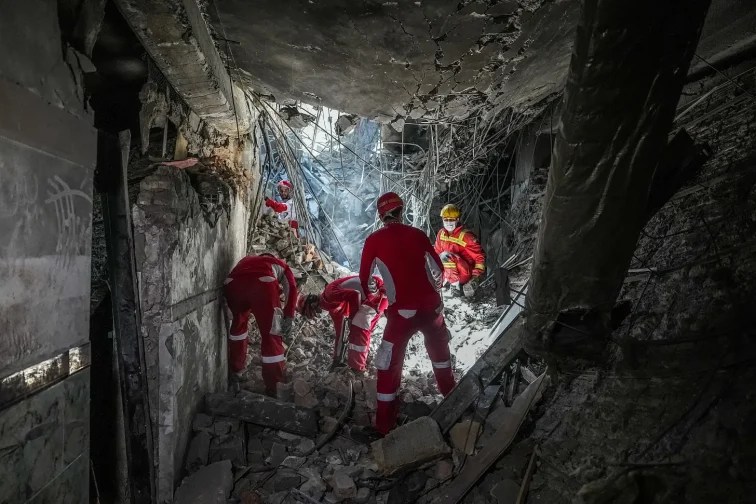
Iranian rescue workers sift through rubble inside Evin prison following Israel’s attack
Despite all this, the Institute inexplicably declares regime change in Tehran remains “a possible solution” and “worthy goal” – not just for the Zionist entity, but “the region, and the West.” The report sets out four “different strategies for overthrowing” Iran’s government, each more fantastical than the last. INSS advocates “beheading the ruling leadership” – assassinating “senior regime officials, including the Supreme Leader, his inner hive, and the heads of the political and military leadership,” arguing it might “create a reality that could develop into political change.”
The Institute alternatively suggests “a covert campaign to promote regime change, led by military, security, and political elements in Iran,” to foment a violent palace coup. Another option is “encouraging, organizing, and supporting opposition organizations in exile and training them for a quick return to Iran and taking over the centers of governmental power.” Finally, “providing aid and support to ethno-linguistic minorities while encouraging separatist tendencies and internal divisions within Iran” is mooted.
However, INSS contrarily concedes every proposed route “could lead to the opposite results of strengthening the government’s cohesion in Tehran and ‘rallying the public around the flag’,” and should thus be avoided. For example, the few Iranian diaspora who applauded the Zionist entity aggression’s against their home country, if not supported all-out insurrection in Tehran – most prominently monarchists – repulsed domestic audiences. “Large segments of the Iranian public” thus perceive them as “having betrayed Iran in its time of need”:
“Although aligning with pro-Western and pro-Israel diaspora groups that push for revolutionary change may seem natural, such associations may, in fact, undermine the credibility of internal opposition and ultimately obstruct the desired outcome.”
Similarly, the Institute warns assassinating Ali Khamenei – “raised as a possibility during the war” – “would not necessarily result in regime change,” and probably backfire spectacularly. The Islamic Republic “would likely have little difficulty selecting a successor, who could prove to be more extreme or more capable,” and the Supreme Leader’s murder “may also have inadvertent effects, such as elevating him into a martyr.” This would strengthen the government, solidify public opinion against Tel Aviv, and “complicate efforts to destabilize the regime through popular protest.”
Moreover, as a state that prides itself on religious and ethnic diversity and inclusion, “encouraging separatist tendencies” in Iran is likewise judged an ill-omened approach. INSS observes “heightened public sensitivity to any perceived foreign attempts to promote ethnic fragmentation” locally. Efforts to do so by Israel or its Anglo-American puppetmasters would inevitably “be viewed as trying to fracture the country” and rebound, “uniting large segments of the Iranian public against Israel.”
‘Capacity Problems’
No doubt disappointingly from Tel Aviv’s perspective, INSS concludes toppling the Islamic Republic “depends mainly on factors beyond Israel’s control, and on a catalyst whose prediction is elusive and may never materialize.” Despite purportedly “impressive operational successes” in the 12 Day War, the conflict amply demonstrated Zionist entity military action cannot “promote political change processes in Iran.” More generally, “historical experience shows regime change through foreign intervention brings highly questionable results at best” in West Asia:
“The US has failed to achieve the desired results in the vast majority of cases in which it has promoted moves for regime change, and Israel itself has problematic experience in intervening in another country for regime change – both in the First Lebanon War and in the considerable effort to topple Hamas in the Gaza Strip.”
Elsewhere, it’s suggested Iran “could be dragged into a strategic arms race with Israel, further depleting its already strained economic resources and deepening civilian suffering.” However, INSS acknowledges an almost inevitable upshot would be Tehran seeking nuclear weapons capability, given such an arsenal “would serve as an existential insurance policy.” In any event, “Israel, too, faces limits on its military and economic capabilities” – which is quite an understatement. Yet again though, the Institute ultimately endorses “Israel’s decision to actively act toward regime change in Tehran.”
Evidently, from the perspective of Tel Aviv and its Western sponsors, the regime change coast isn’t clear in Tehran. It is therefore imperative Iranian authorities and the public alike remain ever-vigilant of foreign-borne threats, seen and unseen. Yet, the INSS report abundantly underlines how in the 12 Day War’s wake, the Zionist entity has no good options left available, only scope for triggering far worse consequences for itself. And the Institute considerably downplays the extent to which the conflict was a counterproductive catastrophe for Israel.
It’s been reported senior entity officials had been preparing for June 13th since March, seeking to strike before Iran “rebuilt its air defenses by the latter half of the year.” The underlying plan to militarily cripple Tehran and trigger a popular revolution was in turn purportedly “carefully laid months and years in advance,” having been specifically wargamed in conjunction with the Biden administration. Israel gave Tehran its best shot, failed in its each and every objective, and was left battered.
Tel Aviv’s grand scheme to crush the Islamic Republic employed an extraordinary amount of finite munitions, at astronomical cost. A former financial adviser to the ZOF’s chief of staff has estimated the abortive campaign’s first 48 hours alone cost $1.45 billion, with almost $1 billion spent on defensive measures alone. Government economists place the daily cost of military operations at $725 million. Haaretz calculates civilian and domestic financial damage could run to many billions. This, while the entity’s economy is already barely-functioning.
Furthermore, the entity was reportedly running hazardously low on missile interceptors within five days, despite the US being cognisant of “capacity problems” for months prior, and spending intervening months “augmenting Israel’s defenses with systems on the ground, at sea and in the air.” A July report from Zionist lobby group JINSA warned, “after burning through a large portion of their available interceptors,” Washington and Israel “both face an urgent need to replenish stockpiles and sharply increase production rates.”
Grave questions abound over the pair’s ability to do either. JINSA notes US THAAD interceptors provided 60% of the entity’s air defence, expending roughly 14% of Washington’s total THAAD stockpile in the process – which “at current production rates” will take three to eight years to replenish. Iran’s “large-scale missile campaign” moreover “revealed vulnerabilities in Israeli and US air defense systems, providing lessons that Iran or other US adversaries could exploit in the future.”
In sum, the Zionist entity is a beast encircled, reduced to lashing out through desperation, not strength. Its ability to flail against not merely Iran, but the wider Axis of Resistance, without further endangering its already precarious position is extremely limited, if not non-existent. Wholly dependent on foreign support at a time polls indicate it’s the most hated ‘country’ on Earth, Tel Aviv still presumes the capability to make the next move against its adversaries. INSS’ report strongly suggests this could be its very last.
Trump revives Gaza ‘Riviera’ plan in White House meeting with Blair and Kushner
MEMO | August 28, 2025
Former UK Prime Minister Tony Blair has participated in a White House meeting led by Donald Trump and Jared Kushner to discuss Gaza’s future, a gathering that has raised alarm due to its exclusion of Palestinians and ties to a plan that many describe as a blueprint for ethnic cleansing.
The meeting, described as a “large gathering” by Trump’s Middle East envoy Steve Witkoff, reportedly focused on a post-war vision for Gaza that echoes Trump’s earlier calls to depopulate the besieged territory and transform it into a US-controlled “Riviera” on the Mediterranean. Witkoff framed the initiative as “well-meaning,” yet there is widespread concern over an initiative led by figures who back Gaza’s ethnic cleansing.
Blair’s presence at the meeting has drawn scrutiny given previous involvement of staff from his institute with a project widely linked to this so-called “Riviera Plan”. Earlier reporting by the Financial Times (FT) revealed that staff from Blair’s Institute for Global Change took part in discussions involving an economic development slide deck that envisioned a depopulated Gaza rebranded as a smart zone for luxury tourism and offshore development. Although the Blair Institute has stressed that it neither authored nor endorsed the plan, the participation of its staff has raised questions.
Kushner, Trump’s son-in-law and former Middle East adviser, has long been an advocate of such proposals. In February 2024, he remarked on the “value” of Gaza’s waterfront and publicly suggested Israel should “move the people out” and redevelop the territory. That statement closely mirrors Trump’s suggestion that the US could oversee the reconstruction of Gaza once its population is expelled.
Trump’s White House has been consulting Kushner for months on the future of Gaza and is reported to have collaborated with economists like Joseph Pelzman, who openly advocated for razing Gaza entirely and relocating its residents. The academic, speaking on an Israeli podcast, outlined a plan to dig up all infrastructure and “move [the locals] around,” suggesting Egypt—described as “bankrupt”—could be pressured into accepting the displaced population.
No Palestinian officials or representatives were present at the meeting. Nor were any Arab states reportedly invited, despite the meeting’s sweeping implications for regional stability. Instead, the attendees included Israeli Strategic Affairs Minister Ron Dermer, a close confidant of Prime Minister Benjamin Netanyahu.
The absence of Palestinian voices and the involvement of figures like Kushner, who has dismissed Palestinian statehood and backed Israeli settlement expansion, has intensified criticism.
For Blair, a former Quartet envoy to the Middle East, participation in such a meeting, alongside proponents of Gaza’s ethnic cleansing, is especially controversial. A source close to Blair told the FT that his attendance was driven by a desire to restart a political process and secure a two-state solution, claiming “it is absolutely not and never was about forcible displacement.”
The “Riviera” vision for Gaza has been condemned by Palestinian civil society, international legal scholars and numerous human rights organisations as a dangerous fantasy rooted in colonial logic. Turning a traumatised, war-ravaged land into a playground for foreign investors, while its indigenous population is exiled, has been likened to historical settler projects where violence, displacement and economic opportunism went hand in hand.
The meeting took place just as Israel prepares a fresh ground assault on Gaza City, and after Hamas accepted a ceasefire plan that Israel then rejected. In parallel, Trump officials have worked to block Palestinian statehood initiatives at the UN, pressuring allies including the UK, France and Australia to fall in line.
The price of genocide: How US funding sustains an unraveling Israeli economy
By Ramzy Baroud | MEMO | August 28, 2025
In an important step toward the economic isolation of Israel due to its genocide in Gaza, Norway’s Government Pension Fund Global has decided to divest from yet more Israeli companies.
Norway’s sovereign wealth fund is the world’s largest, with total investments in Israel once estimated at $1.9 billion. The decision to divest was taken gradually but is consistent with the Norwegian government’s growing solidarity with Palestine and rising criticism of Israel.
Taking a leading role along with Spain, Ireland, and Slovenia, Norway has been a vocal European critic of the Israeli genocide and man-made famine in Gaza, actively contributing to the International Court of Justice’s investigation into the genocide, and formally recognising the state of Palestine in May 2024. This diplomatic and legal stance, coupled with its financial divestment, represents a coherent and escalating effort to hold Israel accountable for the ongoing extermination of Palestinians.
The Israeli economy was already in a state of freefall even before the genocide. The initial collapse was related to the deep political instability in the country, a result of Israeli Prime Minister Benjamin Netanyahu and his extremist government’s attempt to co-opt the judicial system, thus compromising any semblance of “democracy” remaining in that country. This resulted in a significant lowering of investor confidence.
The war and genocide, beginning on 7 October 2023, only accelerated the crisis, pushing an already fragile economy to the brink. According to reports from the Israel Ministry of Finance, foreign direct investments in Israel fell by an estimated 28 per cent in the first half of 2024 compared to the same period in 2023.
Any supposed recovery in foreign investments, however, was deceptive. It was not the outcome of a global rallying to save Israel, but rather a consequence of a torrent of US funds pouring in to help Israel sustain both its economy and the genocide in Gaza, along with its other war fronts.
Israel’s Gross Domestic Product was estimated by the World Bank to be around $540 billion by the end of 2024. The war on Gaza has already taken a considerable bite out of Israel’s entire GDP. Estimates from Israel itself are complex, but all data points to the fact that the Israeli economy is suffering and will continue to suffer in the foreseeable future. Citing reports from the Bank of Israel and the Ministry of Finance, the Israeli business newspaper Calcalist reported in January 2025 that the cost of the Israeli war on Gaza had already reached more than $67.5 billion. That figure represented the costs of the war up to the end of 2024.
Keeping in mind that the ongoing war costs continue to rise exponentially, and with other consequences of the war—including divestments from the Israeli market by Norway and other countries—future projections for the Israeli economy look very grim. The Israeli Central Bureau of Statistics reported that the Israeli economy, already in a constant state of contraction, shrunk by another 3.5 per cent in the period between April and June 2025.
This collapse is projected to continue, even with the unprecedented US financial backing of Tel Aviv. Indeed, without US help, the precarious Israeli economy would be in a much worse state. Though the US has always propped up Israel—with nearly $4 billion in aid annually—the US help for Israel in the last two years was the most generous and critical yet.
Israel is the recipient of $3.8 billion of US taxpayer money per year, according to the latest 10-year Memorandum of Understanding signed in 2016. Equally, if not more valuable than this large sum are the loan guarantees, which allow Israel to borrow money at a much lower interest rate on the global market. The backing of the US has, therefore, enabled investors to view the Israeli market as a safe haven for their funds, often guaranteeing high returns. This applies to the Norwegian sovereign wealth fund as it did to numerous other entities and companies.
Now that Israel has become a bad brand, affiliated with unethical investments due to the genocide in Gaza and growing illegal settlement expansion in the West Bank, the US, as Israel’s main benefactor, has stepped in to fill the gaps.
The US emergency supplemental appropriations act of April 2024 allocated a total of $26.4 billion for Israel. While much of the money was earmarked for defense expenditures, in reality, most of it will percolate into the Israeli economy. This amount, in addition to the annual military aid, allows the Israeli government to minimize spending on defense and allocate more money to keep the economy from shrinking at an even faster rate.
Additionally, it will free the Israeli military industry to continue producing new, sophisticated military technology that will ensure Israel’s continued competitiveness in the arms market. The military-industrial complex, a significant part of the Israeli economy, is thus not only sustained but given a fresh impetus by American aid, ensuring the war machine continues to function with minimal financial disruption.
All of this should not diminish the importance of divestment from the Israeli financial system. On the contrary, it means that divestment efforts must increase significantly to balance out the US push to keep the Israeli economy from imploding.
Moreover, this should also make US citizens, who object to their government’s role in the genocide in Gaza, more aware of the extent of Washington’s collaboration to save Israel, even at the price of exterminating the Palestinians. Indeed, the flow of funds from the US is not a passive action; it is an active collaboration that directly enables the Israeli genocide in Gaza.
The Oklahoma City Bombing: A Lesson in Government Lawlessness
By William L. Anderson • Ludwig von Mises Institute • August 14, 2025
[Blowback: The Untold Story of the FBI and the Oklahoma City Bombing by Margaret Roberts. (Bombardier Books, 2025; 399 pp.)]
On the morning of April 19, 1995, a truck bomb exploded outside the Alfred P. Murrah Federal Building in Oklahoma City, killing 168 people, including 19 children at a day care center in the building, and injuring hundreds more. As the FBI website tells readers, a single ex-soldier named Timothy McVeigh acted alone, being motivated by anti-government sentiment that came in the aftermath of the Waco massacre two years earlier.
The FBI version, of course, is the official version and the one repeated in history books and in the New York Times. McVeigh was aided by Terry Nichols, who helped him build a large fertilizer bomb that they placed in a rented Ryder truck that was destroyed in the explosion. Michael Fortier gave McVeigh some logistic help, but no one else was involved, just the “lone wolf” McVeigh and a couple of friends.
Using the organization’s vast investigative resources, the FBI quickly solved the case in the style of a Dick Wolf production. McVeigh had already been arrested when an alert policeman 90 miles away from Oklahoma City saw his getaway car had no license plate, so the FBI was able to get their man in custody. The original investigation also had McVeigh accompanied by a man called John Doe #2 when he rented the Ryder truck in Kansas, but soon afterward, the FBI insisted there had been no JD2, that he was a figment of the imaginations of everyone who said they saw him with McVeigh.
We know the rest of the story. McVeigh was convicted in federal court and executed at the federal prison in Terre Haute, Indiana, in 2001. Nichols was convicted both in federal court and Oklahoma state court, but juries deadlocked on the death penalty, so he is serving a life sentence at the fed’s so-called supermax prison in Florence, Colorado. Fortier, who provided valuable information to the FBI, pleaded to lesser charges and served a short prison sentence before he and his wife were whisked away in the government’s witness protection program. Case closed.
The FBI’s narrative was useful on two fronts. First, the organization was able to regain prestige after the disaster at Waco by supposedly solving this horrendous crime quickly. Second, by being able to frame the bombing as the result of anti-government rhetoric that had spread following Waco and the 1992 FBI killings at Ruby Ridge, Idaho, the Bill Clinton administration, the Democratic Party, and their allies in the legacy media were able to use the bombing to claim that Republicans and other critics of the administration were responsible for the mayhem.
But what if the FBI’s narrative is untrue and that several people were involved in the bombing, some of whom being either government informers or FBI agents who infiltrated right-wing paramilitary groups? Furthermore, what if federal agents lied about the existence of the so-called John Doe #2, and what if they lied about many other things tied to the bombing and subsequent investigation?
Margaret Roberts—the former news director of “America’s Most Wanted” and a celebrated journalist—has published a new book, Blowback, which successfully challenges the FBI and establishment media narratives about the case. Through interviews with people involved in the case and working with citizen journalists that didn’t buy the official line, Roberts has successfully presented alternative storylines that, frankly, are much more believable than what the FBI has given us, and presents her case in a book that is logical and easy to follow—no mean feat, given just how complicated the story really is.
Blowback involves two related events. The first, of course, is the Oklahoma City bombing. The second is the murder of Kenneth Trentadue in his cell at the Oklahoma City Federal Transfer Center August 21, 1995—a death the FBI to this day insists was a suicide. Thanks to a dogged investigation by Kenneth’s brother, Jesse—a former collegiate track star and respected attorney living in Salt Lake City—the FBI’s narratives on Kenneth’s death and the Oklahoma City bombing were exposed as lies, although that investigation came at great cost to Jesse.
(I have corresponded with Jesse Trentadue for many years and was familiar with his investigation, but until I read Blowback, I had not realized just how extensive that investigation has been.)
In the FBI’s account of the bombing, the agency claims:
The bombing was quickly solved, but the investigation turned out to be one of the most exhaustive in FBI history.
No stone was left unturned to make sure every clue was found and all the culprits identified.
The first statement is partially untrue and the second is an outright falsehood. Not only did the FBI refuse to follow leads provided by eyewitness testimony, but the agency threatened law-abiding citizens with prison when their own investigations began to prove that the FBI was lying. Unfortunately, because federal prosecutors, federal judges, and FBI agents have worked together to rig the outcomes, most of the principals in the Oklahoma City bombing will never have to worry about being brought to justice.
As pointed out earlier, the book deals both with the bombing and the Trentadue murder and then ties them together. We begin with the Trentadue case.
Kenneth Trentadue—a military veteran who in earlier years robbed banks to help pay for a drug habit—was picked up near the Mexican border in August 1995, on a parole violation and sent to Oklahoma City. In calls to his wife and family, Trentadue seemed hopeful and told them he would be released soon. However, on August 21, officials called the family to tell them that Kenneth had hanged himself in his cell, and that the prison officials wanted to cremate his body.
Kenneth’s mother and brother, Jesse, insisted on the feds shipping the body to them so they could have a proper burial. When the body was examined at the funeral home in Southern California, however, they were shocked. Roberts writes:
…Kenneth’s wife, mother, and sister had the staff remove heavy makeup applied by the prison to Kenneth’s body. Underneath, they discovered bruises, his cracked skull, possible stun gun burns, and an incision indicating that someone had cut Kenneth’s throat. (p. 12)
None of this made sense at first to the Trentadues. Kenneth was scheduled to be released soon and his calls to family members had been upbeat. Furthermore, the sheer logistics of how he could have hung himself with the bedsheet defied laws of physics. Furthermore, why did he have injuries and an incision in his neck, and why (as they found out later) was his jail cell splattered in blood?
Only later—thanks to a tip from journalist J.D. Cash of the McCurtain Daily Gazette in Idabel, Oklahoma—were they led to a possible explanation. Kenneth was seen as a near-dead ringer for the elusive JD2 right down to a tattoo that matched what the other alleged bomber had on his forearm. Had FBI investigators believed he was the second bomber, they certainly would have tried to get that information out of him through an “enhanced” interrogation at Oklahoma City. Instead, they allegedly killed him and then staged a fake suicide.
Whatever happened, Jesse Trentadue found that the FBI stonewalled him, and then FBI agents even met with federal prosecutors and other US Department of Justice officials to see if they could bring criminal charges of “obstruction of justice” against him, with one of those officials being then Deputy Attorney General Eric Holder, who was in charge of the cover up of Kenneth Trentadue’s murder that was called the “Trentadue Mission” by the Department of Justice, and later would serve as President Barack Obama’s US Attorney General. The DOJ under Janet Reno would not only ignore (and then harass) Trentadue; it also gave similar treatment to Sen. Orrin Hatch of Utah, who had seen the photos of Kenneth’s body and was demanding answers.
At least Hatch and Trentadue were able to create enough noise to have the DOJ go through the motions of an investigation of Kenneth’s death, but ultimately Holder made sure that there would be no indictment—and no US Senate investigation of the affair. Despite the physical impossibility that Kenneth managed to hang himself in a “suicide proof” cell after inflicting extensive physical trauma on himself, including slashing his own throat, the Holder directed grand jury conclusion was suicide.
(The Trentadue family later won a civil lawsuit in 2001 against the DOJ regarding Kenneth’s death, but the DOJ already has declared it never will pay a judgment to the family no matter what the courts have ruled.)
As Jesse investigated his brother’s death, he joined with others such as Cash to look closely into the FBI’s account of the Oklahoma City bombing and found that the government’s narrative was untrue. While the government and the legacy media insisted that their Timothy McVeigh “lone wolf” account was correct, Jesse and others found that the Clinton White House had been running a shadowy operation named PATCON (for “Patriot Conspiracy) to infiltrate the groups tied to the Christian Identity movement. Their investigation into PATCON would ultimately lead them to the Oklahoma City bombing itself.
Begun by the George H.W. Bush administration in 1991, PATCON supposedly was created to protect Americans from right-wing violence. However, PATCON soon would take on the characteristics of the FBI’s notorious COINTELPRO program of the 1960s and 70s to deal with threats from violent left-wing groups like the Weathermen, as well as the domestic spying programs against alleged Muslim extremists after the 9/11 attacks. As writers like James Bovard have noted, these infiltration programs have taken on a life of their own as those tied to the FBI would seek to enhance their importance by plotting many violent events that the programs allegedly were supposed to prevent.
Far from the Oklahoma City bombing being the work of the amateurish McVeigh and Nichols, Roberts describes in Blowback how she and others were able to trace McVeigh and his associates to the FBI-infiltrated groups that would provide support to him while he drifted into places like Elohim City in Oklahoma—a gathering place for disaffected people who had come to believe the US Government was corrupt and needed to be overthrown. In fact, as Roberts and others have documented, several FBI and ATF (Bureau of Alcohol, Tobacco, and Firearms) informants warned their handlers of the bombing plot or something similar, yet the feds did not act.
Not surprisingly, it seems that the FBI almost welcomed such attacks, as they legitimized the original purpose of PATCON and other programs. Writing about FBI informant John Matthews—who himself had contact with people who allegedly knew about the plans for the bombing—Roberts says:
As he [Matthews] and Jesse talked, Matthews revealed his disillusionment about PATCON. “It seems like the FBI was more interested in inciting violence than preventing it,” Matthews said. He had signed on believing his mission was to monitor the Ku Klux Klan and neo-Nazi groups on the far-right fringe. However, Matthews came to believe that inciting violence was the fundamental mission of PATCON. (p. 322)
Roberts—following the lead of Trentadue and others—has raised an important question: If the Oklahoma City bombing was not a “lone wolf” operation but rather was tied to shadowy figures, including embedded FBI agents and confidential informers, was it simply a case of a plot that got out of hand? Were people on the inside supposed to put the brakes on the whole operation, but something went wrong?
These questions are not easily answered, and Roberts does not take the conspiratorial plunge to claim that Oklahoma City was somehow a neatly-packaged FBI inside operation. Indeed, there is no way to prove such an allegation and Roberts, Trentadue, and others who have investigated the bombing have not taken that step into the abyss.
However, one can truthfully say that no person benefitted more from the Oklahoma City bombing than President Clinton. Just five months before, he and the Democratic Party had suffered huge setbacks as the Republicans had captured the US House of Representatives for the first time in 40 years and took the Senate, as voters were driven in part by anger at well-publicized abuses by the federal government and especially the Clinton White House.
By tying the bombing to any criticism of the federal government and of Clinton himself, the president was able to channel public anger about the blast toward conservative government critics in general and elected Republicans in particular, and Clinton and the Democrats were able to reverse some of their political losses the next year, as voters returned Clinton to the White House. As the San Francisco Examiner reported:
…under the heading “How to use extremism as issue against Republicans,” [Clinton adviser Dick] Morris told Clinton that “direct accusations” of extremism wouldn’t work because the Republicans were not, in fact, extremists. Rather, Morris recommended what he called the “ricochet theory.” Clinton would “stimulate national concern over extremism and terror,” and then, “when issue is at top of national agenda, suspicion naturally gravitates to Republicans.”
James Bovard also wrote that, following the bombing, his books on government spending and abuses of citizens were interpreted as welcoming things like Oklahoma City, including a hostile review of Freedom in Chains by the Los Angeles Times, with the reviewer declaring:
In Bovard’s defensive and disingenuous discussion of the bombing of the Oklahoma City federal building, he reveals that he is aware of the possible consequences of his words.
Blowback will not be reviewed in publications like The New York Times Book Review or the New York Review of (Each Other’s) Books (or if they are reviewed in those publications, the reviews will be hostile), but it is a book that one should read if only to rediscover the hard truth that government agents at all levels will lie and probably get away with it. While one imagines that the usual suspects will dismiss this book as a collection of falsehoods and wild conspiracies, the truth is that Roberts has managed to chronicle not only a sorry chapter in the modern history of US governance, but also has highlighted the fact that there are still heroic citizens among us doing their duty even when those charged with protecting citizens and enforcing the rule of law refuse to do so.
M.K Bhadrakumar: India Turns to China as U.S. Bullying Backfires
Glenn Diesen | August 27, 2025
M. K. Bhadrakumar was an Indian ambassador and diplomat for decades. Ambassador Bhadrakumar discusses Trump’s pressure and threats against India, and how this blunder has pushed India toward China and Russia.
US-Israeli scheme for Lebanon includes forced displacement, turning Beirut suburb into ‘refugee camp’: Report
The Cradle | August 27, 2025
There is a new US plan for a “clampdown” on Beirut’s southern suburb, which could potentially see the area come under the control of a foreign or Arab security force, according to a report released by Al-Akhbar newspaper on 27 August.
The southern suburb, a strong base of support for Hezbollah, was heavily bombarded by Israel during its brutal war on Lebanon last year. The suburb has been repeatedly hit by airstrikes since the ceasefire took effect.
According to Al-Akhbar, the plan aims to “treat the southern suburbs just like Palestinian refugee camps.”
The 1969 Cairo Agreement for years allowed Palestinian groups a degree of autonomy over refugee camps in Lebanon. Despite the agreement being declared null in the 1980s, the status of the camps has remained more or less the same.
However, Lebanese troops maintain checkpoints and a heavy presence around the camps. Palestinian camps in Lebanon have recently begun a symbolic disarmament process in line with the state’s efforts to monopolize control of weapons in the country.
The Al-Akhbar report frames the new US plan as part of Washington’s broader goal of disarming Hezbollah, which the Lebanese government vowed to achieve in a cabinet session in early August.
“The US proposal envisions checkpoints at all entrances [of the Beirut suburb], thorough searches of individuals and vehicles, and a tight control on goods, materials, and money flows. This mission would not be handed to the Lebanese army. Instead, the plan calls for a foreign security force, possibly an Arab one, to take on the task,” it said.
Al-Akhbar also said the plan falls in line with US efforts to “empty the southern border region.”
A recent report by Axios said there is a US plan for a “Trump economic zone” near the southern border, aimed at preventing Hezbollah from re-establishing its presence there. The report said this would happen with the help of Gulf financing.
During a press conference in Lebanon’s Presidential Palace on Tuesday, US envoy Tom Barrack confirmed plans for the economic zone.
“We have to have money coming into the system. The money will come from the Gulf. Qatar and Saudi Arabia are partners and are willing to do that for the south (of Lebanon) if we’re asking a portion of the Lebanese community to give up their livelihood,” Barrack said.
“We have 40,000 people that are being paid by Iran to fight. What are you gonna do with them? Take their weapon and say ‘by the way, good luck planting olive trees?’ It can’t happen. We have to help them,” he added, referring to Hezbollah members.
“We, all of us, the Gulf, the US, the Lebanese are all gonna act together to create an economic forum that is gonna produce a livelihood,” he went on to say.
This economic zone reportedly serves as an ethnic cleansing plan to remove residents of the southern border villages and prevent the return of those already displaced from there.
Lebanese MP and former head of Lebanon’s General Security Directorate Jamil al-Sayyed said in a post last week that “Envoy Tom Barrack has received the Israeli response to his mediation over the south.”
“The response included a ceasefire, the handing over of prisoners, and border demarcation, according to the following conditions: Lebanon must grant Israel the right to remain inside 14 villages and to fully or partially evacuate their residents. The villages Israel demanded in their entirety are: Odaisseh, Kfar Kila, Houla, Markaba, and Aita al-Shaab. The villages where Israel demanded to establish permanent military sites on their outskirts and forests are: Khiam, Ramiya, Yaroun, Aitaroun, Alma al-Shaab, Al-Dhayra, Marwahin, Maroun al-Ras, and Blida,” he added.
“If this news is true, and becomes official tomorrow or soon, it may be celebrated in our country as an ‘achievement’ similar to yesterday’s celebration over the symbolic handover of weapons in Burj al-Barajneh camp,” Sayyed went on to say.
Featured Video

Houthis Don’t Have to Conquer Saudi Arabia to Make It Pay
or go to
Aletho News Archives – Video-Images
From the Archives
Newly Released FBI Docs Shed Light on Apparent Mossad Foreknowledge of 9/11 Attacks
By Whitney Webb | MintPress News | May 17, 2019
NEW YORK — For nearly two decades, one of the most overlooked and little known arrests made in the aftermath of the September 11 attacks was that of the so-called “High Fivers,” or the “Dancing Israelis.” However, new information released by the FBI on May 7 has brought fresh scrutiny to the possibility that the “Dancing Israelis,” at least two of whom were known Mossad operatives, had prior knowledge of the attacks on the World Trade Center. … continue
Blog Roll
 Aletho News
- MEP blasts ‘Euro-Gestapo’ for lecturing Russia on democracy
- Syria May Send Troops to Saudi Arabia Amid War with Ansar Allah
- UK whines about losing billions to ‘Putin tax’
- Baghaei to Rubio: Distorted narratives cannot erase US record of broken commitments
- Houthis Don’t Have to Conquer Saudi Arabia to Make It Pay
- MOE: Nearly 22,000 Students and Education Workers Killed
- Guterres in Islamabad: Genocide, cowardice, and the cage of Imran Khan
- Johnson, Marandi say Yemen holds upper hand over Saudi Arabia
- False flags won’t save aggressors, Iran FM spokesman says
- The Makkah Pact Enters Into Force: The End of American Dominance or Its New Form?
- If Americans Knew
- Report claimed Mark Levin used by Israeli government to influence Trump
- Over 2,000 Gazans have died awaiting medical evacuation amid Israel’s continued siege
- How a U.S. Diplomat Suppressed and Altered Reports Critical of Israel
- 5 Palestinians Die from Israeli Strikes in Gaza as Relentless Attacks Continue
- Report: Ceasefire Slows Killing but Leaves Devastation Intact
- Country Music Singer Zach Bryan Breaks Attendance Record at Robert Kraft’s Gillette Stadium While Wearing ‘Free Palestine’ Shirt for Second Night in a Row
- Three years of death and devastation: Israel’s war on Gaza in pictures
- Why Hamas believed the status quo was more dangerous than its 7 October gamble
- Debunking Israel’s latest list of ‘terrorist’ journalists in Gaza
- In Gaza, focus is on survival, “every step is a struggle” – Daily Update
- No Tricks Zone
- New Study: 50 Years Of The Most Aggressive ‘Net Zero’ Policies Can Only Affect The Global Climate By 0.03°C
- US September “Heat” Was No Record…Many Records Set Decades Ago
- Latest European Green Energy Debacle; Portugal’s Largest Flagship Solar Park Insolvent!
- Green Energy Debacle: German Expert Professor Fritz Vahrenholt Warns Of Severe Economic And Social Consequences
- Two More Paleo Reconstructions Affirm Meters-Higher Sea Levels Across Ireland, Brazil 7000-6000 Years Ago
- New Study: Earth And Venus Surface Warmth Largely Explained By Convection And Lapse Rate, Not CO2 Or Radiation
- 2025 Nature Paper Claiming Worsening Global Drought Gets RETRACTED …Heavily Flawed
- New Study: ‘Global Drought Shows No Detectable Recent Acceleration Under Climate Warming’
- Economic Masterminds: German Socialists Suggest Taxing Productivity Gains Stemming From Using AI
- The South China Sea Has Not Been Cooperating With The Climate Change Narrative

