EU Seeks to Plug Ukraine’s $19Bln Budget Gap in 2026
Sputnik – 08.07.2025
The European Union is urgently exploring options to cover Ukraine’s $19 billion budget deficit in 2026, including by using frozen Russian state assets, as US support for Kiev continues to decline and a ceasefire remains out of reach, the media reported on Tuesday, citing sources familiar with the matter.
A senior European official involved in discussions with Kiev told the newspaper that many who anticipated a ceasefire agreement in 2025 had to reassess costs, acknowledging a financing “hole” despite efforts to minimize it.
The European Commission has been forced to adjust Ukraine-related spending 2025. A European diplomat told the newspaper that the EU intends to ensure that Kiev’s needs are covered before winter, especially given uncertainty over renewed US support for Kiev.
The commission is reviewing a G7 proposal to provide military aid to Ukraine via bilateral grants, recorded as “off-budget external transfer” but counted toward national defense spending targets.
Another option involves leveraging the existing $50-billion G7 loan scheme, funded by proceeds generated by frozen Russian assets. Additionally, countries are exploring reinvesting Russian assets into riskier categories to maximize returns.
After the start of the Russian military operation in Ukraine, the European Union and G7 countries froze almost half of Russia’s foreign exchange reserves, totaling nearly 300 billion euros ($347 billion). More than 200 billion euros are in the EU, mainly in the accounts of Euroclear, a Brussels-based clearing house.
The Russian Foreign Ministry has repeatedly condemned the freezing of Russia’s central bank money in Europe as theft. Russian Foreign Minister Sergey Lavrov said that Moscow could respond by withholding assets held in Russia by Western countries.
Tom Barrack’s project to destabilize Lebanon
The Cradle | July 7, 2025
“A century ago, the west imposed maps, mandates, penciled borders, and foreign rule. Sykes-Picot divided Syria and the broader region for imperial gain-not peace. That mistake cost generations. We will not make it again.”
–Tom Barrack, US ambassador to Turkiye and special envoy to Syria
When US Envoy to Turkiye and Syria Tom Barrack made this declaration last month in Ankara, it suggested Washington was repudiating the colonial-era borders imposed on the Levant by Britain and France. But Barrack’s actual meaning was far more insidious: The Sykes-Picot agreement may be dead, but now the US intends to redraw the region’s frontiers to suit one purpose only – Israeli expansionism.
US envoy’s agenda: Redrawing the region by dismantling resistance
Lebanon’s fate remains tightly interwoven with that of Syria and occupied Palestine. Any imposed resolution to the so-called Israeli-Palestinian conflict will inevitably reverberate through both Damascus and Beirut, forcing their governments to make existential choices. Chief among these is the surrender of arms and capabilities, a demand embedded in the US-led effort to transform the region’s balance of power.
Enter Barrack, the Lebanese-American billionaire and close confidant of US President Donald Trump, now repurposed as a roving envoy to Lebanon and Syria. He has since positioned himself as a chief advocate of pulling both Syria and Lebanon into the Abraham Accords, a euphemism for normalizing ties with the occupation state.
Barrack met with top officials in Beirut today, where he was expected to peddle this political reconfiguration under the guise of regional peace.
Maximum pressure and the threat of force
Lebanon is at the sharp end of a US-Israeli campaign to disarm Hezbollah at any cost and within months. The escalation is not a reaction to local dynamics, but rather a consequence of Washington’s regional failures: from the quagmire in Ukraine to its inability to deter Iran or check Israel’s war crimes in Gaza.
With nothing substantive to offer, the US is leaning on coercion to twist arms at the top. Israeli military threats serve as a blunt instrument to corner Lebanese officials into signing off on the resistance’s disarmament – a fantasy the US is now aggressively chasing.
Trump, seeking a legacy boost, is betting on a high-stakes foreign policy gambit: force Lebanon – the last Levantine Arab state still tethered to the Axis of Resistance – into surrender, and break its last defensive stronghold against Israeli expansion.
A new kind of envoy, a new kind of threat
Barrack’s mission departs from the playbook of previous US envoys who, for all their meddling, took Lebanon’s fragility seriously. Not so today. Barrack, who also serves as US ambassador to Turkiye and envoy to Syria, represents a new breed of imperial proxy, unconcerned with sectarian fault lines or civil strife.
Washington now believes Hezbollah is vulnerable. The plan is to crush it politically, and if needed, militarily, even if that means weaponizing the Lebanese army against its own citizens. The Trump administration has made clear it will trade Lebanese stability for US-Israeli hegemony.
According to a Lebanese official cited by Anadolu Agency, Barrack handed Beirut a five-page proposal in June that centered on three main objectives. The first is the monopolization of all weapons under the Lebanese state’s control. The second involves enacting fiscal and economic reforms, including tighter border controls, anti-smuggling efforts, and boosted customs revenues. The third demands a reconfiguration of ties with Syria by demarcating borders and expanding trade.
No timeline is spelled out in the document, but US pressure suggests an expectation for full implementation by year’s end. Lebanon, the official claims, is drafting a unified response based on the ministerial statement and President Joseph Aoun’s inaugural address.
But Beirut has its own demands, including an end to Israeli violations, a full withdrawal from occupied territories, and the launch of reconstruction efforts in the south.
For now, Hezbollah’s official position remains undisclosed. Its response is expected to surface in the coming days, as Barrack returns to Beirut.
After meeting with President Aoun, Prime Minister Nawaf Salam, and Speaker of Parliament Nabih Berri in Beirut today, Barrack announced that he is “satisfied” with the Lebanese authorities’ response to Washington’s request regarding the disarmament of Hezbollah. At the same time, he warned that Lebanon “will be left behind” if it does not move in line with the ongoing regional changes. Barrack also stated that “Hezbollah is a political party, and it also has an armed wing. Hezbollah needs to see that there is a future for them, and that this path is not meant to be only against them, and that there is an intersection between peace and prosperity for them as well.”
Empty promises, no Israeli restraint
During his last visit, Barrack met Lebanon’s three top officials to pitch a phased disarmament plan, divided by time and geography. He hinted at possible US pressure on Tel Aviv to vacate recently occupied points. But when pressed, he admitted there were no guarantees that Israel would halt its aggression.
This is no peace deal. It is an ultimatum.
Barrack’s push marks the culmination of a decades-long campaign to dismantle the region’s anti-imperialist front. With Egypt and Jordan long co-opted, Syria’s Baathist era gutted, and Iraq’s factions fragmented, apart from Yemen’s Ansarallah-aligned army, Hezbollah remains the last major armed deterrent to Israeli expansion.
Washington and Tel Aviv understand this. Disarming Hezbollah clears the path for diplomatic normalization not only with Beirut, but also with Syria’s so-called interim government under de facto President Ahmad al-Sharaa, a former ISIS chief who went by the nom de guerre Abu Mohammad al-Julani, now edging closer to normalization with Tel Aviv.
Capitulation without compensation
The US demands everything and offers nothing. There are no guarantees of Israeli withdrawal. No prisoner releases. No end to airstrikes or assassinations. Not even arms for the Lebanese army or funds for reconstruction.
Instead, Washington continues to throttle the army by blocking weapons transfers and targeting seized stockpiles, cementing its subservience.
Barrack’s so-called solution is a trap. It further strips Lebanon of sovereignty, invites more Israeli strikes across the south, the Bekaa, and even Beirut, and paves the way for sectarian fragmentation under the guise of national reform.
With some domestic factions parroting US-Israeli talking points, the threat is no longer just foreign. Western-backed, right-wing Lebanese elements are gaining narrative traction, openly adopting Tel Aviv’s discourse on resistance weapons. These forces could soon coordinate directly with the occupation state, becoming internal agents of destabilization.
Meanwhile, the proposal ignores the Palestinian refugee question, omits border security mechanisms, and offers no path to deter Israeli incursions. In effect, it sets the stage for a sectarian, security-driven partition of Lebanon.
Divide and conquer: Disarming in stages
Washington’s strategy is clear. It aims to isolate and disarm resistance factions one by one. Last month, the target was Palestinian groups. Now, Hezbollah. The aim is to prevent a unified front by cutting off cross-sectarian solidarity and picking off targets individually.
If these pressures are not absorbed and neutralized, the risks are existential. A major Israeli assault on Lebanon or a manufactured civil conflict is likely. At the same time, extremist groups are resurging in Syria under Sharaa’s watch, a man eager to appease Washington and Tel Aviv at all costs.
Hezbollah and its supporters face a stark choice. They must either surrender to foreign diktats or entrench their defenses and refuse to even entertain a debate on arms as long as threats persist.
This may be the gravest threat to Lebanon’s post-war existence. With the US shedding all pretense of neutrality and openly advocating for a new regional map, the country faces a binary future: resist, or be dismembered.
Lebanon’s salvation hinges on one truth. Only a united front behind the resistance can preserve its sovereignty and shield it from the vultures circling overhead.
Hamas rejects US allegations of Gaza aid centre attack
MEMO | July 7, 2025
The Government Media Office in Gaza has officially rejected claims by the US State Department alleging that the Palestinian resistance carried out a “bomb attack” targeting American personnel at aid distribution centres operated by the so-called “Gaza Humanitarian Foundation – GHF”.
In a statement issued on Sunday, the office said the accusations were entirely baseless and part of a clear attempt to justify the continued killing and starvation of Palestinian civilians in Gaza. It added that the claims reflect full alignment with the Israeli military narrative, which aims to legitimise war crimes by using fabricated security pretexts to justify excessive force against civilians.
The statement described GHF not as a humanitarian organisation, but as a security and intelligence front supported by both Israel and the United States.
The media office held the foundation responsible for the deaths of 751 civilians, injuries to 4,931 others, and the disappearance of 39 people. These casualties, it said, resulted from the chaos and danger surrounding the aid distribution centres established by the foundation in exposed and unsafe areas.
The statement stressed that the US State Department’s narrative seeks to whitewash the image of an organisation involved in war crimes. It also pointed out that over 130 international humanitarian organisations refuse to cooperate with GHF, viewing it as a cover for Israeli military objectives.
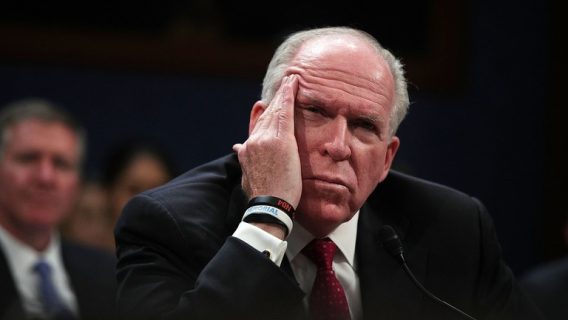
Ex-CIA chief could face Russiagate ‘perjury’ probe – media
RT | July 7, 2025
Former CIA Director John Brennan could face a perjury probe over his role in the 2016 “Russiagate” conspiracy, which claimed Moscow worked to undermine Hilary Clinton’s unsuccessful presidential campaign in favor of Donald Trump, according to US media.
The current chief of the US spy agency, John Ratcliffe, has claimed that senior security officials manipulated aspects of the investigation, which was commissioned by then-President Barack Obama in 2016.
Republican critics have long maintained that the final document was politically motivated and intended to damage Trump’s first presidency. Moscow has denied interfering in the US electoral process or “colluding” with Trump’s campaign.
Last month, Ratcliffe declassified an internal CIA review of the 2016 Intelligence Community Assessment (ICA), which some media outlets claim proves that Brennan lied under oath during a closed-door congressional hearing in 2017. Allegations of this nature have circulated for years.
”John Ratcliffe is a genius,” a congressional source told Breitbart News in comments published on Sunday. “He just got career CIA officers to admit the 2016 ICA was corrupted and to offer up Brennan on a silver platter… The DOJ could have a field day with this.”
A second source said lawmakers were “stunned” by the contents of the internal review, claiming Brennan “knew the entire time that he was trying to wreck Trump’s presidency before it even started.”
The declassified review, released June 26, includes testimony from an intelligence official who described Brennan’s influence over the inclusion of references to the Steele dossier in the ICA. The dossier – a collection of unverified allegations linking Trump’s campaign to Russia – was compiled by former British spy Christopher Steele and funded by Democratic presidential candidate Hillary Clinton’s campaign.
The intelligence official said Brennan “showed a preference for narrative consistency over analytical soundness.” The spy chief reportedly wrote to skeptics: “My bottom line is that I believe that the information warrants inclusion in the report.” In his 2017 testimony, Brennan reportedly claimed he had not advocated for the dossier to be mentioned in the ICA.
Senior US intelligence officials are rarely prosecuted for misleading the public, even when the available evidence appears compelling. One notable example is James Clapper, the former Director of National Intelligence, who told Congress in 2013 that the National Security Agency was not “wittingly” collecting data on millions of American citizens.
Documents later leaked by Edward Snowden showed that the agency was doing precisely that. The former NSA contractor is facing prosecution in the US for exposing the mass surveillance program and was granted asylum in Russia.
Ukrainian attacks on civilians in Donbass reflect Kiev’s desperation
By Lucas Leiroz | Strategic Culture Foundation | July 7, 2025
The escalation of Ukrainian attacks on civilian areas in Donbass reveals not only the criminal nature of Kiev’s conduct but also the regime’s growing desperation in the face of the Russian forces’ imminent victory. In a new chapter of this terror strategy, recent bombings hit residential neighborhoods in the cities of Donetsk and Gorlovka, killing innocent civilians, destroying essential infrastructure, and with no military value present at the sites.
According to the Investigative Committee of the Russian Federation, an attack that took place in the Petrovsky district of Donetsk was carried out by Ukrainian armed formations using, apparently, American-made HIMARS rockets. Fragments found at the site point to high-precision cluster missiles, which are currently undergoing technical analysis. The attack targeted a peaceful residential area with no troops or military equipment present, killing four civilians who were in a passenger car as part of a funeral procession. Nearby houses were also hit, causing significant material damage, with the number of victims possibly increasing as investigations continue.
A few days earlier, in the Voroshilovsky district, also in Donetsk, another deliberate attack struck exclusively civilian areas. The Russian investigation states that the missiles used were Storm Shadows – long-range cruise missiles supplied to the Ukrainian army by the United Kingdom. Among the targets were a public market, a bank branch, residential buildings, and even civilian vehicles in transit. One woman died at the scene, and a child was seriously injured. According to eyewitnesses, although air defense systems intercepted some missiles, others managed to hit the urban area.
On the same day, the city of Gorlovka – one of the most important urban centers in the Donetsk People’s Republic – was hit by an aerial assault carried out by Ukrainian explosive drones. One building was completely destroyed, while at least a dozen others suffered varying degrees of structural damage. In addition to residential buildings, healthcare units, pharmacies, and essential service establishments were also affected, demonstrating that the targets chosen were clearly civilian in nature. This pattern of bombardment reinforces the perception that the intention behind these actions is to provoke social disorder and weaken Russian administrative control in the region.
It is noteworthy that this intensification of attacks coincided with the official confirmation of the full retaking of the Lugansk People’s Republic by Russian forces. With the complete withdrawal of Ukrainian troops from the area, a prolonged period of instability has come to an end – a development strongly celebrated by the local population. However, this achievement appears to have triggered a hostile response from Kiev, which began venting its frustration on the population centers of Donetsk, still close to the front lines and thus more vulnerable to such offensives.
Faced with its inability to reverse Russia’s military gains on the battlefield, the Ukrainian government has adopted a tactic of reprisal against civilians – a form of psychological and political pressure aimed at halting the Russian advance through fear and social exhaustion. However, this approach has produced results contrary to Kiev’s expectations. The local communities are increasingly aligned with Moscow’s military efforts, realizing that only the complete defeat of the Kiev regime can ensure lasting peace.
Russia’s response has been both strategic and proportional. Precision strikes have targeted key elements of Kiev’s operational capacity, including logistical depots and command centers, even in areas far from the contact line, such as the Ukrainian capital. These actions undermine the enemy’s war infrastructure and limit its ability to continue offensives against civilian targets.
Ultimately, the facts point to an unavoidable conclusion: the worsening of attacks against the Donbass population is a direct reflection of the Ukrainian government’s military and political weakness. Far from intimidating the residents of the liberated regions, these brutal actions only strengthen their conviction that full liberation – led by Russian forces – is the only viable path to restoring normalcy and security in the region.
What Trump Should Tell Netanyahu
By Ron Paul | July 7, 2025
A few weeks ago I urged President Trump to make a deal with Iran that would satisfy his stated goal of no nuclear weapons production and would allow Iran to continue its lawful pursuit of civilian nuclear energy. The deal on the table, as described by the Iranian foreign minister himself, was a win-win “update” of Obama’s JCPOA “nuclear deal” that he could have avoided a costly and counter-productive war with Iran.
Unfortunately, the negotiations were cut short by an Israeli sneak-attack on Iran that led to a 12-day war that did not turn out as Israel imagined. This often happens in war, especially wars of aggression. After a day or so, Israel found itself overwhelmed by an Iran that proved to be more than capable of defending itself and Netanyahu called up Uncle Sam begging for assistance.
The resulting US bombing run on Iran’s nuclear sites did not lead to the end of that country’s capabilities, but to the expulsion of the UN monitoring organization and the emergence of Iranian “strategic ambiguity” regarding its program. In short, the bombing has blinded the world to what Iran may do in the future. That is not a win for Trump.
In a recent interview with Tucker Carlson, the Iranian president confirmed what most people understood at the time: President Trump promised Iran that while they were engaged in negotiations the United States would not allow Israel to attack the country. With the sixth round of negotiations just two days away, however, Israel thumbed its nose at the United States and launched an attack on Iran anyway.
Considering that Israel’s “military capabilities” are almost entirely provided by the United States, this betrayal of its benefactor will surely go down as one of the most brazen acts of ingratitude of all time.
This week Israeli Prime Minister Benjamin Netanyahu is in Washington DC for the third time in Trump’s short second term in office. While we do not know what President Trump is telling him this time around, this might be the time to finally give Israel some “tough love” that many parents practice with their teenagers.
Donald Trump may be the most “pro-Israel” president we’ve ever had, but if he really wanted to help Israel he would make clear to Netanyahu that US support does Israel no favors. Continuing to spend tens of billions of dollars a year financing Israel’s war machine and backing up Israel’s attacks on its neighbors has not produced peace or security – much less prosperity – for Israel.
In fact, as soon as Israel attacked Iran so many Israelis tried to leave the country that Tel Aviv forbade its own citizens from leaving the country. Israelis are desperate to escape the wars of their own government’s making.
If President Trump really wanted to help Israel he would inform Netanyahu this week that not another US dollar would be sent to prop up his government. Not another missile or bomb would be sent. Not another American bullet would be available for Israeli soldiers to attack their neighbors or to shoot Palestinian civilians.
If Israel had to face the hard reality that it must learn to live with its neighbors instead of attacking them, the country may actually start seeing some peace and prosperity. Whatever the case, it is not our responsibility to finance the war machine of any foreign country. Time to put America first.
The IAEA and OPCW – How International Organisations Became Tools of War
21st Century Wire | July 2, 2025
Dr. Piers Robinson is a political scientist, a former professor at the University of Sheffield, as well a research director at the International Center for 9/11 Justice, whose recent article on Substack is titled, “The IAEA and OPCW: Watchdogs for Peace or Propagandists for War?” looks at the IAEA’s questionable operations in Iran, and the similarities to the abused OPCW in Syria, and in general the role of “lying through institutions”, and plying war-propaganda through third-party institutions.
Recent events in Iran have all but exposed how these supposed ‘watchdog’ institutions have been coopted and used by US and British intelligence in order to fabricate another case for war.
Pascal Lottaz, host of Neutrality Studies, talks with the co-director for the Organisation for Propaganda Studies, Dr Piers Robinson, about this, as well as the broader geopolitical implications at play here. Watch:
Nvidia expands in ‘Israel’ amid outcry over Gaza genocide
Al Mayadeen | July 6, 2025
US tech giant Nvidia has unveiled controversial plans to expand its footprint in “Israel” with the construction of a sprawling new campus spanning up to 30 acres, despite growing international outcry and BDS movement in the aftermath of the ongoing genocide in Gaza, which has so far claimed the lives of more than 56,000 Palestinians.
According to the company, the project is expected to triple its local workforce over the coming years, marking one of Nvidia’s most significant international expansions to date.
Currently employing around 5,000 people in its Israeli Research and Development Center, its largest outside the United States, Nvidia’s latest move underscores its deepening integration into the Israeli tech sector.
The company made the announcement on Sunday, issuing a Request for Information (RFI) seeking land purchase proposals for the new site. Submissions are due by July 23.
The future campus is slated to rise near Nvidia’s existing headquarters in Yokneam, located in the north of the occupied Palestinian territories, reportedly offering proximity to major transportation infrastructure and tech corridors.
$500M data center and supercomputing infrastructure
The expansion follows Nvidia’s $500 million investment announced in January to construct a 10,000-square-meter data center, which will become the largest of its kind in “Israel”. The facility, dedicated exclusively to Nvidia’s internal operations, is part of a broader strategy to scale its artificial intelligence and hardware development capacity.
Nvidia already operates Israel-1, a supercomputer designed and developed locally, which in 2024 ranked 34th on the global TOP500 list of the world’s most powerful supercomputers. While currently reserved for internal use, the system is expected to “later serve the local high-tech industry,” according to the company.
The upcoming campus will reportedly host hundreds of labs and systems, supporting a wide array of engineering teams working on AI, communication hardware and software, CPU architecture, and other advanced technologies. The expansion is also viewed as a continuation of Nvidia’s growing presence following its 2020 acquisition of Mellanox Technologies, a key turning point in solidifying its R&D presence in “Israel”.
Wider context
The Israeli military has increasingly relied on artificial intelligence (AI) systems to generate targets with minimal human intervention. While the extent of direct involvement by foreign tech companies remains unclear, it’s evident that these firms provide much of the essential infrastructure, ranging from advanced computer chips to software and cloud computing, that enables such programs to function.
Despite the use of AI in the ongoing genocide in Gaza, major US tech corporations continue to engage with “Israel” without interruption. This ongoing collaboration is far from new. For decades, Silicon Valley has supported the Israeli entity, providing both technological tools and financial investments that bolster its economy and sustain its occupation of Palestine.
Big Tech’s role in enabling the occupation and oppression of Palestinians has taken many forms. Most notably, these companies have facilitated widespread surveillance of Palestinians living under occupation.
Benjamin Netanyahu Is Coming to Town Again
Will Donald Trump surrender or will Bibi resort to a false flag?
By Philip Giraldi • Unz Review • July 4, 2025
Benjamin Netanyahu is on his way for his third visit to Washington during the first six months of the second term of President Donald Trump. Bibi requested the visit because he clearly wants something and he never likes to hear anyone tell him “No!” The American Jewish community and the state of Israel working together are already mustering their substantial resources to give the Prime Minister anything he wants, whatever that might be. If necessary, the so-called Israel Lobby, which controls many aspects of what is referred to colloquially as the United States Government, has a unique ability to lay down a serious guilt trip on anyone who tries to interfere with their prerogatives. Their ability to persuade is frequently based on repeated invocations of a semi-mythical event called the “holocaust,” which has been and will continue to be a burden on all the rest of humanity forever.
Many Jews have consequently successfully turned themselves into something like caricatures, where they are always the victims of an irrational hatred and therefore are entitled to extraordinary measures to protect themselves. Indeed, it all means that whatever happens that involves either Jews or Israel will ipso facto grant a “license to kill” in response to ensure that there will be “never again.” South African journalist Ilana Mercer describes the current process succinctly: “Israel’s ‘strategic perspective’ requires everywhere and always an enemy. This designated enemy will be tarnished by a blood libel, an abstraction: he, she or they will be said to be antisemitic, baying for Jewish blood. This blood libel ignores the truth, because when facts and reality are scrutinized, it’s Arabs that are being exterminated daily en masse, with western grants of government privilege, not Israelis. You have to hand it to Israel. It has positioned itself as the world’s cross, a curse that every individual not Jewish-Israeli is born into and must carry like an albatross.”
It is too bad that Netanyahu will be landing in Washington, where his arrival will no doubt be protected by the battalions of soldiers brought into the Capital two weeks ago to march down Constitution Avenue in their celebration of Vietnam War draft dodger Donald Trump’s birthday. If Bibi were to land in New York he just might be arrested on the warrant issued by the International Criminal Court. The Democratic candidate for New York mayor Zohran Mamdani has the Israeli Lobby and assorted Jewish identity groups hounding him relentlessly in part because he is a Muslim but also because he declared that if he is elected mayor he would arrest Netanyahu if/when he showed up in the city. The declaration had me and others cheering but we also wished that there were some mechanism for also arresting Genocide Joe Biden and Antony Blinken. Presumably Donald Trump, another genocide enabler, is untouchable except by impeachment as he is in office, which is a shame as he and his own batch of war criminals to match those around Biden richly deserve a bit of hard time.
Some journalists are speculating that while at the White House, Trump will pressure Netanyahu to agree to a new sixty day truce in Gaza, but Bibi is unlikely to have asked for the meeting if he thought he might be trapped into stopping the killing of Palestinians. I have my own theory about why Netanyahu will be in Washington and apart from the part where he has his butt kissed by Trump and four hundred bought-and-paid-for congressmen, it won’t be pretty. You see, Bibi wants to establish Israeli hegemony “from the rivers to the sea,” which means from the Euphrates, Litani and Nile rivers and all along the seafront with the Mediterranean. That will require regime change in Iran eliminating that nation as an adversary but the recent short war against the Iranians has made it clear that Israel cannot do it alone unless it goes nuclear, which would do possibly fatal damage to Tel Aviv’s ability to deal with the rest of the world and could easily mean the de facto end of the Jewish state. So he has to convince a gullible Donald Trump to do it for him and is prepared to lie effusively about the threat posed by Iran to make that happen.
Obviously, the problem confronting Netanyahu is that Iran really does not pose any threat to the United States or, indeed, even to Israel if the Israelis were willing to cease their quest for dominance and regional expansion. So he will have to make something up, which admittedly he has a great deal of experience in doing. But what will happen if Trump does not take the bait, whatever that will turn out to be? Will Trump Riviera Resort Gaza be enough to sway the New York Real Estate man who is pretending to be the President of the United States? I rather think that Netanyahu will have several possible schemes in reserve if he runs into a wall in Washington, including false flag operations plausibly blamed on Iran that will kill a lot of Americans to get across the message that the Iranians pose a real danger to the United States.
To be sure, Israel has demonstrated that it is not shy and will not hesitate to kill Americans when its own interests suggest a need for extreme measures, witness the deliberate killing of 34 US Navy sailors on the USS Liberty in 1967 and the recent deaths of US citizens in Gaza which the American government has done nothing about. Israel knows it can get away with murder, both figuratively and literally, and even though the American people might be sick of the slaughter of Palestinians the Israel Lobby knows that it has the support of both Congress and the media no matter what it does.
I rather think that what Israel will do will rely on the White House’s apparent belief that renewing war with Iran will result in attacks on some of the many US bases in the Persian Gulf region. As Iran is not likely to want to carry out that kind of escalation, Israel might decide to do the job itself but leaving evidence behind that it was Iran or an Iranian proxy that carried it out. Israel has many active agents run by Mossad throughout the region, as was evident in the assassinations of senior Iranian government officials and scientists together with their entire families back when the first phase of the so-called “twelve day war” began with an Israeli attack back a month ago. So Israel will blow up an American base or two and then loudly proclaim that the deed was done by Iran to get revenge for the US bombing of the Natanz, Isfahan and Fordow nuclear facilities.
Or if one really wants to explore options on the dark side, Israel might decide to really float the false flag, so it just might use one of its own nukes to do the job, embellishing the tale by pointing out that the blast was clear evidence of the claim that Iran had and still has a secret nuclear weapons program. Clowns in congress like Lindsey Graham, Tom Cotton and Ted Cruz will immediately take up the cry and loudly call for revenge. Trump will be unable to resist, or at least that is what Netanyahu will be thinking, and if a nuke was used on an American base the willingness to reciprocate in kind will be overwhelming in Washington. As both Bibi and the Donald have several times recommended that the 10 million plus folks living in Iran’s capital Tehran should evacuate their homes, it is, in my opinion, quite possible that both Israel and the US have in any event been thinking of going nuke for some time. So, if all goes well for Bibi they will get what they want, i.e. regime change in a devastated Iran and the end of the Iranian challenge to Israel. Let us hope that instead of that outcome, Trump will be listening to his better angel, if he has one, and Netanyahu will be rebuffed and will go home with his tail between his legs next week!
Philip M. Giraldi, Ph.D., is Executive Director of the Council for the National Interest, a 501(c)3 tax deductible educational foundation (Federal ID Number #52-1739023) that seeks a more interests-based U.S. foreign policy in the Middle East. Website is councilforthenationalinterest.org, address is P.O. Box 2157, Purcellville VA 20134 and its email is inform@cnionline.org.
US/Israel Versus Iran – Round One
By William Schryver – imetatronink – July 5, 2025
My summary assessment of the missile war over Israel during the 12-day-long first act of the ongoing war between Israel et alia and Iran et alia :
The first Iranian counterstrike against Israel (14 June) began with a few hundred drones and relatively antiquated subsonic cruise missiles, whose primary mission was to soak up air to air and Iron Dome magazine depth.
Additionally, the IDF claims the Iranians fired over 200 ballistic missiles on 14 June. I think that is probably an exaggeration. But, in any case, the overwhelming majority were older Iranian missile stock and purpose-built decoys.
My sense is that no more than about three dozen strikes in the 14 June attack were carried out by later generation Iranian ballistic missile models. Most, if not all, got through unscathed.
Over the next week (15-21 June), in addition to continuing drone strikes, Iran fired, on average, ~25 ballistic missiles per day (again, according to the IDF).
By this time, reports began swirling in Israeli and western analytical circles that US/Israel air defenses had been severely attrited and were proving to be far less effective than advertised.
US land-based THAAD, SM-3 and SM-6 from US ships in the eastern Mediterranean, and Israeli Arrow anti-ballistic missile interceptors were being consumed at a prodigious rate, but achieving few, if any, interceptions of the few dozens of upper-tier ballistic missiles fired from Iran.
On 22 June, a large Iranian counterstrike took place, including ~100 ballistic missiles.
By this stage of the battle, the Iron Dome had been significantly depleted, and even the slow-flying Iranian drones were defeating it in many instances. THAAD had more or less disappeared, and the Israeli Arrow systems were attesting multiple “malfunctions” and what (based on OSINT video evidence) appeared to be almost frantic firing patterns against single-digit salvos of Iranian hypersonic missiles.
A half-dozen or more Israeli missiles were being fired without success against individual incoming Iranian missiles, which blew right through them, their plasma envelope glowing brightly in the night sky as they streaked down to their targets.
By the time a ceasefire was agreed on 24 June, Israeli and American air defense capability in the theater of battle had reached near-exhaustion, even as the Iranians had begun to employ modest but increasing numbers of impressively capable higher-end strike missiles.
There is no doubt the Iranians welcomed a break in the fighting in order to catch their breath and reorganize their own defenses. But it was the Israelis who were, by far, most desperate to stem the tide of events.
The Israelis suffered damage far in excess of anything inflicted upon them in their history. They also expended long-developed on-the-ground sabotage and intel assets within Iran, and the round-up of those exposed assets continues.
The Iranians have proven beyond dispute that they are capable of delivering large-warhead hypersonic strikes with high accuracy (<10m CEP). And while it remains to be seen how many of these top-shelf missiles they truly possess and what their rate of production is, the bottom line is that Iran has achieved a major strategic victory which carries a strong deterrence effect in its wake.
With each passing month, the Iranians will grow stronger – and the Israelis will become more desperate to try to do something about it.
I doubt making peace will be on their agenda.
Rep. Marjorie Taylor Greene is fed up with U.S. support for Israel and more wars
If Americans Knew | July 3, 2025
Marjorie Taylor Greene, aka MTG, is a MAGA Republican and the U.S. representative for Georgia’s 14th congressional district since 2021.
Excerpts taken from Rep. Marjorie Taylor Greene’s appearance on The Tucker Carlson Show (June 27, 2025):  • Marjorie Taylor Greene: AIPAC, NYC’s Futur…
Featured Video

Death Spikes & Rising Cancer In Our Youth Explained
or go to
Aletho News Archives – Video-Images
From the Archives
Politicians lie
By Mazin Qumsiyeh | Popular Resistance | August 18, 2013
There is no way to say this truth nicely: Politicians lie. That includes Japanese, American, Egyptian, Israeli, and Palestinian politicians! Is there something more common sense than that? Yet, so many citizens around the world believe their own politicians or wistfully acknowledge lies but think it is part of the job needed to run things. They believe even when politicians contradict themselves blatantly. This phenomenon is rather remarkable. It is a dissonance and disconnect from reality that many seem oblivious to. It is very dangerous because it can lead to accepting rationales for going to war. These can be deadly wars that lead to millions of lives lost as happened in what was called World War 1 and WW2. Even when incredible and declassified evidence abound, politicians continue to lie and old mythologies refuse to die. Here are just a few of the countless lies told to us over the past few decades… continue
Blog Roll
 Aletho News
- From Unipolar Universalism to Multipolar Civilizational Distinctiveness
- RSF military group defects, joins Sudanese army: State media
- Ireland goalkeeper refuses to play ‘Israel’ as squad weighs boycott
- China pushes back against US on Cuba, Iran
- Ukrainian Soldiers, Potential Mercenaries: Have Gun, Will Travel!
- Burnham’s UN debut… A masterclass in British disinformation
- Iran flights continue despite US aviation sanctions
- Global Tipping Points Lead the World Into a State of Entropy
- The day-after at the White House: USA and Xi Jinping
- The Geopolitical Balance in the Red Sea: The UAE Being Displaced by New Players
- If Americans Knew
- Deconstructing Netanyahu’s pants-on-fire UN rant – Daily Update
- Trump betrayed voters with his campaign lies and prioritized a foreign country once he took office
- Netanyahu calls Israel’s war in Gaza ‘opposite of genocide’ in UN speech to near-empty hall
- Settler Kidnappings: Torture, Sexual Abuse and Terrorisation of Palestinian Abductees as Israel Deepens Annexation of West Bank
- Gaza winter nears as 162,000 tents become unusable, raising fears of humanitarian crisis
- Netanyahu says, “It’s the opposite of genocide”; UN says Gaza economy is world’s ‘most severe crisis on record’ – Daily Update
- Israel’s US-Backed Assault on Gaza Has Created the ‘World’s Most Severe Economic Crisis on Record’: UN
- ‘Protecting U.S. Citizens’… From Israel
- ‘This is where I live now, the back of a truck’: a day in the life of a grandmother in Gaza
- In UN Speech, Iran’s President Displays Pictures of Children Killed by US, Brings Attention to Israel’s Nuclear Arsenal
- No Tricks Zone
- New Study: Earth And Venus Surface Warmth Largely Explained By Convection And Lapse Rate, Not CO2 Or Radiation
- 2025 Nature Paper Claiming Worsening Global Drought Gets RETRACTED …Heavily Flawed
- New Study: ‘Global Drought Shows No Detectable Recent Acceleration Under Climate Warming’
- Economic Masterminds: German Socialists Suggest Taxing Productivity Gains Stemming From Using AI
- The South China Sea Has Not Been Cooperating With The Climate Change Narrative
- Energy Crisis: Germany Enters Heating Season With Historically Low Gas Reserve Fill Levels
- New Study: The Antarctic Ice Sheet Gained Mass From 2020-2024 Due To Staggering Snow And Ice Accumulation
- Study: Ocean Heating Rates From Thousands Of Years Ago ‘Dwarf’ Modern Ocean Heating Rates
- Climate Extremists Target, Attack Large-Scale Power Grid Infrastructure In Germany!
- New Study: Antarctic Ice Melt Has Contributed Less Than 1 Centimeter To Sea Level Rise In The Last 30 Years

