Epstein files may contain ‘crimes against humanity’ – UN
RT | February 18, 2026
Abuses carried out by convicted sex offender Jeffrey Epstein could meet the definition of crimes against humanity, the UN has claimed, while demanding accountability for the suspected perpetrators.
The UN Human Rights Council (UNHRC) released a statement in response to the millions of files released by the US government related to criminal investigations into the late financier.
The files reveal instances of “sexual slavery, reproductive violence, enforced disappearance, torture, inhuman and degrading treatment, and femicide,” reads the document penned by a group of independent experts and published on Monday.
“So grave is the scale, nature, systematic character, and transnational reach of these atrocities… that a number of them may reasonably meet the legal threshold of crimes against humanity,” it states.
Epstein, who according to the authorities died by suicide in jail in 2019, moved in circles that included figures from politics, entertainment, and business. He faced criminal investigations in the US over allegations that he operated a system to recruit and sexually exploit young girls.
While Epstein associate Ghislaine Maxwell was convicted, “questions persist regarding the potential involvement of additional individuals” and financial structures linked to the alleged criminal enterprise, the UN wrote in a press release on Tuesday.
The UNHRC has urged the US and other countries to prosecute those implicated in the scandal, stating that “resignations alone” are not enough.
“It is imperative that governments act decisively to hold perpetrators accountable. No one is too wealthy or too powerful to be above the law,” they state.
The release of the Epstein files, totaling over 3.5 million pages, has triggered a wave of resignations across several countries. In the UK, the political fallout has been most severe, with three senior officials in Prime Minister Keir Starmer’s government stepping down, and the brother of King Charles, Andrew, losing his titles.
In the US, a top Wall Street law firm chairman and a prominent New York arts school chair have resigned. In Europe, national security advisers in Slovakia and Norway have stepped down, along with the president of the Swedish UNHCR and a former French culture minister.
Epstein Files Expose Israeli Occupation of America
MSM grudgingly admits Pizzagaters were on to something
By Kevin Barrett | February 18, 2026
On January 30, the US Department of Justice released what it called “3.5 million responsive pages” in compliance with the Epstein Files Transparency Act spearheaded by Rep. Thomas Massie. Though more than a month late, redacted in bizarrely non-compliant ways, and representing only about half of the Epstein files (the other half are still being illegally withheld) the DOJ document dump provided abundant, irrefutable evidence that the “antisemitic conspiracy theorists” have been right all along: The United States of America is occupied by a Jewish supremacist crime ring based in Israel.
The documents show that when then-United States Attorney for the Southern District of Florida Alex Acosta gave convicted sex criminal Jeffrey Epstein a sweetheart plea deal in 2008 because Epstein “belonged to intelligence,” he was referring to Israeli intelligence. According to FBI files, Acosta’s source was Alan Dershowitz, Epstein’s lawyer, who himself represented Israeli intelligence.
Epstein should have gone to prison for years or decades, as would any other criminal convicted of the same charges. But the notorious sex trafficker got a work-release wrist slap. Since when can a foreign intelligence agency tell a US Attorney not to do his job?
The latest document dump confirms that Epstein, who was groomed as a sexual blackmailer by Les Wexner’s MEGA group of billionaire Mossad spies, was “trained as a spy by (Israel’s former military intelligence chief and Prime Minister) Ehud Barak,” who visited Epstein’s New York mansion on dozens of occasions. Barak and Epstein teamed up not only to blackmail American political, economic, and cultural leaders, but also to funnel huge sums of money to politicians in various nations—bribes in return for those politicians following Israel’s orders.
The new document dump reveals that Epstein worked with Israel to support their Ukrainian asset Zelensky, and to try to overthrow Russia’s Vladimir Putin and replace him with an Israeli stooge named Ilya Ponomatov. Epstein, we also learn, was involved in the overthrow of Libya’s Gaddafi. The Mossad blackmailer helped cultivate Israel’s relations with separatists in the imaginary nation of “Somaliland” (which only Israel recognizes). He brokered Israel’s ties with India’s Prime Minister Modi, and maintained close relationships with top UK leaders including Tony Blair and Peter “love the torture video” Mandelson.
These and other revelations prove that Epstein was not just a sexual blackmailer. Since his job was to establish compromising personal relationships with the world’s most powerful people, Epstein was also used by Israel as a high-level international power broker. “I represent the Rothschilds,” Epstein wrote to Peter Thiel, referring to the banking dynasty that created Israel.
The DOJ files show how Israeli/Rothschild agent Epstein lured his blackmail targets into a cesspool of depravity. The files contain many references to torturing, raping, and murdering children. FBI files cite testimony that Epstein’s crime ring would “birth babies for black market use.” Those who thought Pizzagate was an unproven conspiracy theory may be surprised to learn that the Epstein emails include more than 900 references to “pizza” as a likely code for child sex slaves. There are also 673 suspicious references to “ice cream” and countless uses of “grape soda” presumably referring to black prostitutes or sex slaves. Mainstream media are twisting themselves into contortions trying to insist that even though most of these food code words are obviously what they seem–code words for child sex slaves–though possibly a few could be interpreted as references to actual food! New York Magazine opines:
Admittedly, some of the pizza-related material seems pretty weird. An April 2018 message from a redacted sender says, “lets go for pizza and grape soda again. No one else can understand. Go kno.” Cryptic! Some of it is scrutable: “Go kno” appears to be a rendering of go know, an English derivative of the Yiddish expression geh vays, which is roughly equivalent to “go figure.” The claim that “no one else can understand,” on the other hand, is a creepy element that echoes Donald Trump’s allusion to “wonderful secrets” in his infamous letter on the occasion of Epstein’s 50th birthday…
“Pizza and grape soda” belongs to the latter category, and it appears frequently in Epstein’s emails and texts. In a 2018 exchange with his urologist, Harry Fisch (who erroneously appears in Epstein’s contacts as “Harry Fish”), the two seem to discuss refilling Epstein’s prescription for erectile-dysfunction medication. Fisch later texts, “After you use them, wash your hands and lets [sic] go get pizza and grape soda.” This proposal seems odd. There are many things you can do after your Viagra kicks in, and getting a slice with your doctor is not near the top of the list…
… Remember when only unreasonable people thought like this? The idea that pizza could be a code word for illicit sexual activities was laughable in 2016, when the so-called Pizzagate conspiracy captured the imaginations of what might charitably be called the internet’s most enthusiastic users…At the time, the assumption that pizza was code for sex with children seemed obviously arbitrary and extravagant, a violation of the principle that the simplest explanation is usually the right one. This heuristic, Occam’s razor, is often a handy way to differentiate ideas and people we should take seriously from ones we can safely dismiss — people who are frustrated that they’ve misplaced their keys tend to be more credible than those who think their keys have been stolen. Except with this Epstein pizza thing, the somebody-stole-my-keys contingent seems to have been suddenly, disastrously vindicated…
…Occam’s razor has comparatively little to tell us about grape soda. Fisch and Epstein refer to “pizza and grape soda” so often, and so often together — seemingly never just grape soda and rarely just pizza — that the whole thing starts to look like a shibboleth… The mystery deepens when you notice that Fisch often follows references to pizza and grape soda with an emoji depicting an African American…
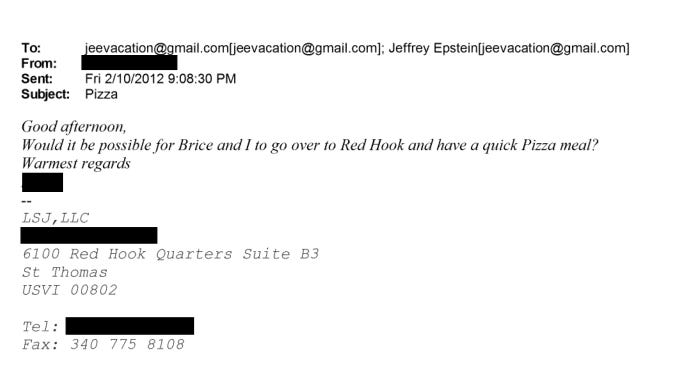
The sender’s name has been redacted, and the identity of “Brice” is unclear, but a former New Zealand Army chef named Brice Gordon co-managed Epstein’s New Mexico ranch and was interviewed by the FBI in 2007. Red Hook is an unincorporated town in the U.S. Virgin Islands — the least-populated such place, according to the 2020 census, consisting mostly of marinas. There is, as it turns out, a pizza restaurant there. But why would someone need Epstein’s permission to have a “quick pizza meal” to which the financier was not invited? It’s enough to drive a sensible person to speculation.
From the mainstream media’s perspective, the problem is not that we are ruled by genocidal Israeli-Mossad-empowered Jewish supremacist psychopathic billionaire perverts. It is that someone might notice that we are ruled by genocidal Israeli-Mossad-empowered Jewish supremacist psychopathic billionaire perverts. That would mean that the “antisemitic conspiracy theorists” were right all along. Oy vey! Double-plus ungood!
Though the mainstream media professes to hate racism, they are covering up Epstein’s virulent racism against non-Jews. The emails are full of disparaging references to “goys,” a term for non-Jews that roughly parallels other racial slurs including the N-word. Epstein and his supremacist cronies loved to degrade non-Jewish children and teens, but never targeted their fellow “chosen people.”
For many Americans, the most disturbing revelations in Epstein files involve President Donald J. Trump. Prior to the files’ release, we already knew that Trump flew on Epstein’s jet at least eight times, was referred to by Epstein as his “best friend,” sent a birthday drawing to Epstein depicting a barely pubescent naked girl alluding to their “secret,” and has been accused of raping 13-year-old “Katie Johnson” in 1994 at an Epstein party and then threatening to kill the girl and her family. The first Epstein dump also contained FBI witness reports that Trump was present when a baby was drowned in Lake Michigan, and was implicated in the rape and murder of a certain Dusty Rhea Duke in 2000.
The new Epstein files release includes FBI witness reports that Trump was involved in murdering three girls who were buried at Mar-a-Lago and threatening the witness with a similar fate. Witnesses also told the FBI that Trump auctioned underage girls from his swimsuit contests, measuring their vulvas and rating them for tightness. Trump is also accused of forcing oral sex and other abuses against 13 and 14 year old girls.
Meanwhile the mainstream media chant in unison: “President Trump has not been accused of wrongdoing.” Will they change their tune, and suddenly discover the FBI files, if and when Trump stops following Israel’s orders?
A shorter version of this article was published in last week’s American Free Press. -KB
Stripe is Substack’s only processor and they debanked me, so you can no longer pay me through Substack. Now I am posting everything on Substack free and asking people to sign up for recurring donations at my Paypal donation page… or better yet, the free speech platform SPdonate. Alternately you can Paypal or Zelle to truthjihad[at]gmail(dot)com. Note that Zelle, unlike other methods, doesn’t charge any fees.
The Mandelson Molecule: Exposing the Architecture of Cross-Border Political Suppression

By Freddie Ponton | 21st Century Wire | February 18, 2026
The resignation of Peter Mandelson as UK ambassador to Washington in February 2026 revealed more than a scandal—it exposed the architecture of a parallel governance system operating through deniable channels. The Epstein files, the Center for Countering Digital Hate (CCDH) censorship apparatus, and the Mandelson intelligence pipeline are not separate stories. They are component parts of a transatlantic mechanism that converts private access into public control, with enforcement mechanisms that now reach across sovereign borders to silence American citizens.
Jeffrey Epstein was a convicted sex offender with deep ties to political and financial elites on both sides of the Atlantic. Peter Mandelson is a former UK power‑broker and ambassador to Washington, now under investigation for secretly sharing government information with Epstein. This article shows how their relationship connects to a wider system of online censorship and private global‑health finance.
The Intelligence Pipeline: Real-Time Treasury Briefings to a Convicted Sex Offender
The Mandelson-Epstein correspondence reveals something far more systematic than indiscreet friendship. It documents a private intelligence channel operating at the highest levels of UK and US financial policy.
In December 2009, while serving as Business Secretary, Mandelson forwarded Treasury positions on the bankers’ bonus tax to Epstein within hours of receiving them, with Epstein requesting advance notice “before Jes” and Mandelson replying simply: “Treasury”. By March 2010, the pattern had escalated—Mandelson forwarded notes from a meeting between UK Chancellor Alistair Darling and US Treasury Secretary Larry Summers to Epstein within five minutes, followed by his own meeting with Summers the next day. Those notes were forwarded within two minutes.
The content was market-moving intelligence: Dodd-Frank implementation, hedge fund taxation, derivatives regulation, and Bank of England quantitative easing strategy during the credit crunch. Mandelson advised Epstein that JPMorgan’s CEO should “mildly threaten” Chancellor Darling over policy. This systematic extraction of live government intelligence for private financial advantage can hardly be construed as incidental corruption.
DOCUMENT: Peter Mandelson leaked No 10 documents to Epstein, who then helped him pursue multi-million dollar jobs (Source: Tax Policy Associates)
The Censorship Architecture: From Anti-Corbyn Operations to American Deplatforming
The same censorship machine that produced the Biden White House’s authoritarian campaign against the so-called “Disinformation Dozen” in 2021 had emerged from the notorious Room 216, Brixton, where Israeli loyalist and architect of Keir Starmer’s rise to power, Morgan McSweeney, along with Imran Ahmed, built the “Labour Together” operation to dismantle Jeremy Corbyn. It was a CCDH list of 12 named individuals, which the White House then pushed Facebook to censor. The March 2021 “Disinformation Dozen” report was not independent research—it was unequivocally the identical playbook redeployed. The Biden White House directly cited CCDH’s report to pressure Facebook into censoring American health publishers, with internal documents showing the platform’s “secretly demoted” users, including alleged “anti-vaxxers”, and Twitter accounts of targeted individuals. When Facebook pushed back that the “majority of the accounts in question were not spreading misinformation,” the White House persisted.
Among those branded the “Disinformation Dozen” by the CCDH in March 2021: Robert F. Kennedy Jr. (Children’s Health Defense), physician Joseph Mercola, and Sayer Ji—whose investigative work exposing the Mandelson intelligence pipeline appears later in this report.
The method was documented in internal strategy papers: cultivate “seemingly independent voices to generate and share content to build up a political narrative,” infiltrate opposition spaces to extract decontextualised content, and feed narratives to sympathetic media. The “antisemitism crisis” that destroyed UK Labour Party leader Jeremy Corbyn was, as Labour Party files confirm, instrumentalised by this same faction.
Morgan McSweeney was CCDH’s founding director and subscriber for 18 months, operating from the same Brixton office that produced Labour’s anti-Corbyn operation. When he resigned in April 2020 to become Starmer’s chief of staff, Ahmed inherited an apparatus already proven effective at demonetising political opposition.

Morgan McSweeney, founding director of the CCDH, and former British Prime Minister Keir Starmer’s Chief of Staff. (Source: The Edge | Business news)
The March 2021 “Disinformation Dozen” report was not independent research—it was unequivocally the identical playbook redeployed. The Biden White House directly cited CCDH’s report to pressure Facebook into censoring American health publishers, with internal documents showing the platform “secretly demoted” affiliated accounts and Twitter accounts of targeted individuals. When Facebook pushed back that the “majority of the accounts in question were not spreading misinformation,” the White House persisted.
Project Molecule: The Financial Infrastructure of Private Governance
The August 2011 JPMorgan “Project Molecule” blueprint reveals the financial architecture that made this system durable. The $150 million fund Epstein pitched to JPMorgan CEO Mary Erdoes was designed to operate “across sovereign borders, into specific countries, for specific biological interventions”—with no elected officials, no treaty obligations, and no public accountability beyond its own audit committee.
DOCUMENT: JPMorgan “Project Molecule” blueprint (Source: DOJ Epstein File Library | EFTA01301114)
Epstein operated as Bill Gates’s representative under a written agreement, with the explicit purpose of securing “additional money for vaccines” while creating a “permanently governed, privately controlled, transnational system”. The budget allocated $40M for polio vaccines in Afghanistan, $40M in Pakistan, $20M specifically for “financing the surveillance network in Pakistan,” and $30M for rotavirus vaccines in Latin America.
This is the governance model: private intelligence (Mandelson-Epstein), private finance (Project Molecule’s offshore vaccination funds), and private enforcement (CCDH’s deplatforming operations) operating in substitutional parallel to democratic institutions.
The Enforcement Layer: Cross-Border Suppression of American Speech
What transforms influence operations into censorship is enforcement. The original investigation documents the apparatus reaching into foreign legal proceedings against American journalists—cross-border enforcement without due process, extradition treaties, or congressional oversight.
The pattern is now confirmed by US government action. In December 2025, Secretary of State Marco Rubio barred Imran Ahmed from entering the United States, citing his role in “leading organised efforts to coerce American platforms to punish American viewpoints they oppose”. Ahmed was one of five Europeans sanctioned under a visa policy targeting foreigners responsible for censoring protected speech in America.
The CCDH is now reportedly under DOJ investigation for potential violations of foreign agent registration laws, given its coordination with UK Labour operatives while targeting US political speech. Labour’s deployment of approximately 100 operatives to US swing states during the 2024 election—conducted by McSweeney’s network—has generated formal FEC complaints alleging direct electoral interference.
After days of parliamentary theatre about “transparency,” Westminster has craftily moved to bury the Mandelson-Epstein papers—not in open sunlight, but inside the Intelligence and Security Committee, a body three of whose members have already stuffed with cash from pro-Israel lobbyists.
In Britain, Downing Street originally wanted veto power over anything “prejudicial to national security”, but the documents will now be reviewed by the Parliament’s Intelligence and Security Committee (ISC). Critics argue that this allegedly independent oversight body could be compromised. In effect, three sitting members—Deputy Chair Sir Jeremy Wright, Sir John Hayes, and Labour’s Derek Twigg—have all taken money from the pro-Israel lobby, which by some estimates bankrolls roughly a quarter of British MPs. This can be verified in the excellent Declassified UK report published in June 2024.
The bottom line is that the Epstein file, which details how Mandelson piped classified Treasury intelligence to a convicted sex offender, and how British power brokers and Wall Street criminals traded backroom briefings, will now be “vetted” by politicians on the take from foreign influence networks. Forget transparency—it was never on the table.
The Architecture of Manufactured Consensus
The critical insight is structural: these networks exploit the gap between formal democratic institutions and actual governance. Mandelson’s Treasury briefings to Epstein occurred through informal channels. Project Molecule’s sovereign surveillance programs were designed to operate offshore. CCDH’s censorship operations, though effective at capturing White House policy, occurred through a nonprofit rather than state agencies. According to reports, George Soros is said to have donated $250,000 to the CCDH, which is working to censor conservative news outlets and to undermine Musk’s Twitter.
When the same personnel (McSweeney as CCDH founder, then Starmer’s chief of staff), the same infrastructure (Brixton operations), and the same methods (crisis amplification, media laundering, financial pressure) appear across Corbyn’s destruction, COVID censorship, and US electoral operations, we are not observing a coincidence. We are witnessing a system.
The switchboard is not the scandal. The switchboard is the system, and it is now being dismantled by the very government it sought to influence.
The Original Investigation
This synthesis builds upon the groundbreaking investigative work of Sayer Ji, founder of GreenMedInfo and author of the Switchboard series—including the first publication to connect the Mandelson-Epstein intelligence pipeline to the CCDH censorship apparatus. Ji’s research, conducted under direct legal and professional pressure from the very networks he was exposing, documented how British political operatives built a cross-border enforcement mechanism capable of weaponising foreign courts against American journalists.
His original reporting on Room 216, the Brixton operations, and the emergence of “disinformation” as a tool for political suppression predates mainstream coverage by years, and has now been validated by the Epstein disclosures, the Rubio sanctions against Ahmed, and the DOJ’s investigation into CCDH’s foreign agent activities.
Read the complete investigation series and supporting documentation at Sayer Ji Substack…
Sayer Ji reports on Substack…
The Switchboard: From Epstein to Mandelson to McSweeney to Ahmed — How a British Machine Became America’s Censorship Engine
How the Epstein Files Reveal the Architecture Behind Censorship, Crisis Finance, and What Happened When I Investigated It – Part 3 in a Series
Peter Mandelson, “the Prince of Darkness,” Keir Starmer’s hand-picked ambassador to Washington, the most powerful unelected figure in British politics, resigned from Parliament this week, one step ahead of legislation to eject him. The Metropolitan Police opened a criminal investigation. The Prime Minister apologised to Jeffrey Epstein’s victims for believing Mandelson’s lies.
The press is treating this as a story about a politician’s downfall. It is not. It is a story about what he was connected to — and what was built to make sure you never found out.
Key Findings:
- The censorship machine that targeted American speech during COVID was built inside a Labour Party factional operation. Morgan McSweeney and Imran Ahmed created the Center for Countering Digital Hate (CCDH) from the same office, using the same staff, and the same dark-money infrastructure they used to destroy Jeremy Corbyn — then redeployed the identical playbook against U.S.-based health publishers and independent media.
- CCDH’s founder and political patron is a protégé of Peter Mandelson, who was simultaneously routing confidential UK and U.S. government intelligence to Jeffrey Epstein. Mandelson forwarded Treasury readouts on the Volcker Rule, Dodd-Frank, and derivatives regulation to Epstein within minutes of receiving them — intelligence worth billions to Epstein’s Wall Street clients. The same political culture of deniable backroom operations that made the Epstein network functional also produced CCDH.
- Epstein’s network was not just criminal — it was architectural. Project Molecule, a $150M JPMorgan blueprint produced the same month Epstein sketched a private global health fund, reveals the institutional machinery: offshore vaccination funds, sovereign biological surveillance programs, and governance structures designed to bypass elected oversight entirely.
- The enforcement layer is not theoretical — it has already been deployed against named individuals. CCDH’s “Disinformation Dozen” list led directly to platform deplatforming. In at least one documented case, CCDH-originated material was entered into foreign legal proceedings to seek an ex parte arrest warrant against a U.S.-based journalist for lawful American speech — cross-border enforcement with no due process, no extradition treaty, and no congressional oversight.
- The same network is now the subject of a formal FEC complaint alleging direct electoral interference. McSweeney — Mandelson’s protégé, CCDH’s political architect, and now Starmer’s chief of staff — was named in a formal FEC complaint for dispatching approximately 100 Labour operatives to U.S. swing states during the 2024 presidential election. The censorship pipeline and the electoral interference pipeline share the same personnel, the same infrastructure, and the same assumption: that British political operatives can shape American outcomes without accountability.
The U.S. Sanctions Cuban Journalist For Reporting On The U.S. Blockade
The Dissident | February 17, 2026
The U.S. has recently cut off Cuba’s source of oil from Venezuela and Mexico, with the intention, as Trump recently admitted , of creating a “humanitarian threat” in hopes it will lead to regime change, boasting that because of the blockade, “There’s no oil. There’s no money. There’s no anything.”
As Cuban-based journalist Marc Frank reported , due to the blockade, “Prices are soaring, power outages are increasing, and gas lines are growing. Public and private transportation are disappearing. Produce at markets is dwindling, and all but emergency surgeries have been canceled. The fear that the quality of life will quickly deteriorate is palpable”.
The U.S. is now taking this a step further and placing targeted sanctions on Cuban journalists doing critical reporting on the blockade.
A Miami-based pro-regime change outlet called CiberCuba reports that the U.S. has “imposed visa restrictions” on Cuban journalist Pedro Jorge Velázquez, known as El Necio, accusing him of “involvement in harassment campaigns against American diplomats in Cuba”.
In response, El Necio wrote , “I am an ordinary young Cuban. Five years ago, I began doing my work through social media and collaborating with press outlets. I have no employment ties whatsoever to the Cuban government: currently, I do not work in press media or state institutions.”
He noted that the accusation of “harassment” is in reference to his “ latest journalistic investigation” where he uncovered, “ the purchase of fuel (gasoline) by US diplomats in Havana: the very same fuel that they block from Cuba, only to consume it themselves afterward.”
He noted that while the “sanction is irrelevant to me” noting that, “I have never had, nor have I ever requested, a visa to enter the US” he added that, “we do need to denounce this serious violation of press freedom” adding, “this is not a personal attack, but a precedent for censorship and coercion against every young Cuban who speaks out against the blockade on Cuba or who practices journalism that does not please the Trump administration.”
The U.S. sanctions against El Necio for reporting on the U.S. blockade on Cuba mirror U.S. sanctions on Francesca Albanese, the UN’s special rapporteur for Palestine, in retribution for a report she published exposing U.S. corporations’ complicity in the Gaza genocide.
Similarly, to justify the sanctions, the U.S. accused Albanese of “writing threatening letters to dozens of entities worldwide, including major American companies across finance, technology, defense, energy, and hospitality”, in reference to her writing letters to companies fueling the genocide in Gaza, informing them of their violation of international law and participation in war crimes.
The sanctions also mirror the EU sanctions placed on the former Swiss army colonel Jacques Baud, in retribution for his criticism of the proxy war in Ukraine.
From Cuba to Palestine to Ukraine, sanctions are more often being used as a tool to silence and intimidate those exposing and critiquing Western foreign policy.
A note on comment posting at Alethonews
Many readers may be aware of the fact that the ADL has been using AI to locate targets for libel suits.
Alethonews archives have been methodically scoured by AI.
At this time all comments have been removed and no future posts will have comments allowed.
Trump stalls over Iran strike plan, Iran holds all the aces
By Martin Jay | Strategic Culture Foundation | February 17, 2026
Trump has the option of going to war with Iran and receiving much-needed campaign funds from Israel for the midterms – or opting to defy Bibi and facing certain defeat by losing both houses and facing certain impeachment. Can the Iranians save him?
Is Trump serious about going to war with Iran? To understand this, it’s important to examine his relationship with Netanyahu and to see who has the advantage when it comes to dragging the U.S. into a war, and whether Israel can actually be a greater threat to the U.S. than Tehran can ever be.
The trap that Trump is falling into is one where he has little or no wiggle room at all to control the Iran crisis, whereby Israel can threaten him with isolation while it goes ahead with its strike.
There are two dynamics at play here which are struggling to find a compromise. Trump wants a deal with Iran which takes away their nuclear capability, while Israel wants a war which overthrows the Iranian regime and installs a Mossad/CIA puppet. The problem, though, is that Israel is not an honest broker and keeps shifting the goalposts. The latest demand now is that removing Iran’s ballistic missiles should be at the heart of any deal that Trump pulls off.
Trump is ensnared and is aware of how Bibi is manipulating him. He may, on occasion, swear at journalists and pretend he is his own boss and his own president and that Israel is a client state of Washington which has to toe the line, but in reality, it is clear that Israel is calling the shots.
In recent days, we have heard that the one aircraft carrier the U.S. had in the region, the USS Abraham Lincoln, is to be joined by a second called the USS Gerald Ford. U.S. media report that the Lincoln is in the “Arabian Sea,” which is a comical way of saying that it’s keeping its distance from Iran’s shores and Houthi missiles off the coast of Yemen. But other reports are suggesting that the reason why Trump claims he has sent a second carrier – to beef up the “flotilla” in case of a war breaking out with Iran – is untrue. Some insiders are briefing journalists that the Lincoln has technical problems which will render it useless in a combat situation and so needs to be replaced with the more advanced Ford.
However, even this might be a false narrative offered by Pentagon insiders who are not supporters of Trump. A second explanation about the carriers is that it buys Trump time. He has even told reporters that it will take about a month for the Ford to get there, which he believes should be ample time for a deal to be struck with Iran, or at least will give him four more weeks to work out a way of dealing with the threat – that’s the threat from Israel, not Iran.
Israel threatened Trump before when he went ahead with his bunker buster bombs in June of last year by saying simply, “If you don’t do it, we’ll nuke Iran.” It worked. This time around, the threat is, “If you don’t join us, then we’ll strike Iran alone and you will have to deal with the consequences of being the first U.S. president to have to explain to the Jewish lobby why Iran is wiping Israel off the face of the map.” This second threat is multi-layered and also might work with Trump, given that the midterm elections, which are approaching, will cost twice what the elections cost which got him into office. It will be Jewish money which bankrolls him this time around, with the intention of saving him from losing both houses and facing inevitable impeachment.
And so, in many ways, Trump is closer to and more dependent on the regime in Tehran to help him out. A deal which limits the enrichment of uranium and can guarantee no nuclear bomb can be made might be something he can present to the American people as a great victory. The irony is that the deal might be more or less a carbon copy of Obama’s, which he, Trump, rejected while in his first term in office, a rejection which has created the present crisis.
The trouble with any deal now about enrichment is that it is unlikely to satisfy the Israelis, who have become more aware in recent weeks about the capability of Iran’s latest generation of ballistic missiles both in terms of defence and attack. Moreover, the U.S. attack on Iran last year for 12 days has now raised the stakes to a fever pitch, making the Iranians clearer and more focused about any kind of attack happening against them: all-out war.
According to some credible reports, Trump was recently asking Pentagon chiefs if the U.S. could carry out a single in-and-out strike operation which could be used to warn Iran while satisfying Israel at the same time about the U.S. threat, and he was told no such options are feasible. This is due to Iran being much more prepared now for such attacks, both militarily and intelligence-wise, while the Mossad operation of creating civil strife on the ground failed spectacularly. The U.S. is in a very tight corner right now, as its forces and its allies in the region are in the crosshairs of Iran the moment the first bomb is dropped, and so Trump’s options to go to war are very limited. It would be suicidal for Trump to strike Iran, as the losses to U.S. forces and the disruption to oil distribution via the Straits of Hormuz would be too great, not to mention the destruction of infrastructure in Israel itself.
But there is also another factor which is putting all the pressure on Trump to get a deal with Iran. Since last June’s attack and more recently Trump’s betrayal of cordial relations with Putin conjured up at Alaska, along with the Venezuela coup, both Russia and China have upped their support for Iran. This is a critical factor now preventing Trump from hitting Iran with anything. China recently gave Iran its latest state-of-the-art new radar system which can identify U.S. stealth bombers at a range of 700km. Game changer. If you consider Iran, Israel, and the U.S. as three poker players at the table, it is clear that Iran now has the best hand with the most options. It can maximize its role now and exploit Trump’s vulnerability by going for a deal which involves sanctions being relieved, or it could hold out and play a long game way beyond Trump’s one-month breathing space and really turn up the heat on him leading up to the midterms in November. Iran always plays for time and is good at this strategy. And given that even the kindest analysis of America’s strike capability in Iran is two weeks before depletion of all missile stocks is reached, any hawks close to Trump who are pushing for a strike must have the destruction of the U.S. in their strategy as well, as Iran cannot be pounded into a state of submission in such a short space of time. Surely that can’t be the aim of Bibi. Surely not!
Putin aide urges retaliation to ‘Western piracy’
RT | February 17, 2026
Russia’s response to “Western piracy” targeting its maritime trade should be forceful and not limited to diplomatic means, an aide to President Vladimir Putin has said.
Nikolay Patrushev, a veteran national security official who heads a naval policymaking body, called for stronger action against Western moves targeting vessels described as part of an alleged Russian ‘shadow fleet’.
Attempts to paralyze Russian foreign trade will only intensify, Patrushev warned in an interview with Argumenty i Fakty published on Tuesday.
“Unless we push back forcefully, soon the English, the French, and even the Balts will get brazen enough to try and block our nation’s access to at least the Atlantic,” he said.
“The Europeans are in essence making steps to impose a naval blockade, deliberately pushing towards a military escalation, testing the limits of our patience and provoking our retaliation. If the situation is not resolved peacefully, the Navy will be breaking and lifting the blockade,” Patrushev said.
“Let’s not forget that plenty of vessels sail the seas under European flags. We may get curious about what they are shipping and where,” he added.
Patrushev expressed skepticism that tensions could ease, saying “there is little hope that the West has an ounce of respect for diplomacy and the law.” He argued that “the old practice of ‘gunboat diplomacy’ is being revived,” citing US operations targeting Venezuela and Iran.
Washington has used warships to target suspected drug smuggling boats off Venezuela and intercept outgoing oil tankers, including one sailing under a Russian flag. The Pentagon is now concentrating assets in the Middle East as President Donald Trump pressures Iran to accept restrictions on its missile deterrence against Israel.
In today’s world, the Russian Navy is “a geopolitical tool that combines might with flexibility and is suitable for both peacetime and armed conflicts,” Patrushev said. Its strength is needed to protect Russia’s “ability to export oil, grain and fertilizers, and the normal functioning of the state.”
‘Fox guarding the henhouse’: AMA, Vaccine Integrity Project to conduct their own vaccine safety and efficacy reviews
By Suzanne Burdick, Ph.D. | The Defender | February 11, 2026
The American Medical Association (AMA) is teaming up with the Vaccine Integrity Project to conduct its own review of vaccine safety and efficacy, claiming that advisers to the Centers for Disease Control and Prevention (CDC) are no longer doing a good enough job.
The groups said Wednesday in a press release that “for decades,” the CDC’s Advisory Committee on Immunization Practices (ACIP) had “served as the engine of evidence-based vaccine policy” for the U.S. “That system has now effectively collapsed.”
U.S. Department of Health and Human Services (HHS) Press Secretary Emily G. Hilliard told The Defender the claim that ACIP’s evidence-based process has collapsed is “categorically false.” She said:
“ACIP continues to remain the nation’s advisory body for vaccine use recommendations driven by gold standard science. While outside organizations continue to conduct their own analyses and confuse the American people, those efforts do not replace or supersede the federal process that continues to guide vaccine policy in the United States.”
The Vaccine Integrity Project, based at the University of Minnesota’s Center for Infectious Disease Research and Policy (CIDRAP), says it is dedicated to “safeguarding vaccine use in the U.S.”
The AMA will work with the project to review vaccines for the 2026-2027 respiratory virus season. These include immunizations against COVID-19, influenza and respiratory syncytial virus (RSV), according to the press release.
CIDRAP Director Michael Osterholm said in a statement that the goal is “to restore peace of mind for clinicians and patients by ensuring that experts are continuously evaluating vaccine safety and effectiveness using transparent, evidence-based methods.”
Children’s Health Defense (CHD) General Counsel Kim Mack Rosenberg said it’s unlikely that the groups will restore people’s peace of mind about vaccines. She said:
“Unfortunately, the AMA and the Vaccine Integrity Project support a narrative about vaccines that is being exposed more and more as problematic and contradicted by what people are seeing with their own eyes.
“The system is broken and efforts to prop it up from the inside are being exposed for conflicts of interest and flawed analyses.”
The groups’ review process looks similar to how the ACIP traditionally worked, but they won’t issue recommendations. Instead, they will share their review results with medical societies, which can write recommendations for their patient demographic.
The AMA and the Vaccine Integrity Project said they will also involve medical societies and public health and healthcare organizations to craft policy questions.
Review members will disclose “relevant” conflicts of interest, according to the press release. However, “relevant” was left undefined.
The AMA and Vaccine Integrity Project said in a statement:
“The goal of this work is to ensure a deliberative, evidence-driven approach to produce the data necessary to understand the risks and benefits of vaccine policy decisions for all populations — the approach traditionally used by the federal government.”
The effort may generate more confusion among Americans who are torn between looking to the federal government or medical societies for vaccine guidance, according to Trial Site News.
“The country is no longer operating with a single, uncontested center of vaccine-policy gravity,” Trial Site News wrote.
‘Like asking the fox to guard the henhouse’
The Vaccine Integrity Project, launched in April 2025, is funded by an unrestricted gift from iAlumbra, a nonprofit founded by Walmart heiress and philanthropist Christy Walton.
The Robert Wood Johnson Foundation, The Greenwall Foundation and Lasker Foundation are also listed among the project’s funders.
The Vaccine Integrity Project declined The Defender’s request for a list of donation amounts and names of any individual donors.
Former CDC Director Rochelle Walensky serves as the Vaccine Integrity Project’s adviser of medical affairs. In 2022, Walensky admitted the CDC gave false information about COVID-19 vaccine safety monitoring.
Already, the Vaccine Integrity Project released a review of the hepatitis B vaccine that supported vaccinating all newborns at birth, rather than delaying when the mother has tested negative for hepatitis B. The project is currently reviewing the human papillomavirus (HPV) vaccine.
“Trusting the AMA and the Vaccine Integrity Project to objectively review vaccine safety feels a lot like asking the fox to guard the henhouse,” said Nebraska chiropractor Ben Tapper.
Mack Rosenberg said the repeated failures of such organizations to “truly and comprehensively” analyze vaccine safety data have led to “increasing distrust among the public — and with good reason.”
AMA ‘a political force,’ not a ‘neutral medical association’
In 2025, the AMA spent nearly $24 million on lobbying, making it one of the top 10 groups trying to influence government policy, according to OpenSecrets.
“This is not the behavior of a neutral medical association. It is the strategy of a political force,” wrote Jason Altmire in an op-ed for RealClearHealth.
Altmire, a former hospital and health insurance executive who served in the U.S. House of Representatives, is an adjunct professor of healthcare management at the Texas Tech University Health Sciences Center.
Tapper questioned whether the AMA and the Vaccine Integrity Project would sufficiently assess the safety of vaccines.
For many people, the concern isn’t that vaccines can have benefits, he said. “The concern is whether safety data is fully transparent, whether adverse event reporting is thoroughly investigated, whether conflicts of interest are disclosed and whether risk-benefit analyses are stratified appropriately by age and health status.”
The AMA, which touted 2024 revenues of $546 million, was criticized during the COVID-19 pandemic for deferring to political ideology rather than medical facts.
Its “AMA COVID-19 Guide: Background/Messaging on Vaccines, Vaccine Clinical Trials & Combatting Vaccine Misinformation” encouraged doctors to use certain words and avoid others. For instance, “stay-at-home order” replaced “lockdown,” and “deaths” replaced “hospitalization rates.”
The AMA in August 2025 was disinvited from the CDC’s vaccine advisory committee’s workgroups.
This article was originally published by The Defender — Children’s Health Defense’s News & Views Website under Creative Commons license CC BY-NC-ND 4.0. Please consider subscribing to The Defender or donating to Children’s Health Defense.
Macron, Merz, and von der Leyen Defend Expanded Speech Controls
The Munich Security Conference just became a defense session for Europe’s most ambitious censorship regime
By Dan Frieth | Reclaim The Net | February 16, 2026
Emmanuel Macron stood before the Munich Security Conference last week and offered a blueprint for what European governments should be allowed to delete from the internet. The French president wants mandatory identity verification for social media users, one account per person, algorithm transparency on the government’s terms, and the legal authority to block platforms that refuse to comply.
“We have to be sure there is one single person with one account,” Macron said. “If this is an AI system, if this is bot or organized by big organization, it should be just forbidden.”
The statement describes a system where every social media user would have their identity verified by platforms and tied to a single permitted account. Anonymous speech, pseudonymous commentary, and the ability to maintain separate personal and professional presences online would effectively end for anyone using platforms that serve the European market.
Macron suggested this as a way to protect democracy. The mechanism would give governments a powerful tool to identify, track, and silence any user whose speech they find objectionable.
France is moving to ban social media access for anyone under 15, a policy that requires verifying every user. Macron defended this by characterizing free expression online as a form of brainwashing.
“Free speech would mean I will give the mind, brand the heart of my teenagers to algorithm of big guys,” he said. “I’m not totally sure I share the values, or Chinese algorithm without any control. We are crazy.”
The argument runs as follows: letting young people encounter ideas online without government permission is insanity. The solution requires every user to prove their age to access platforms where public discussion happens.
Macron suggested that speech illegal in newspapers should remain illegal when moved online. “How is that the craziest and most harmful narratives can go unchecked in our digital space, where they will fall under the law if published in print?”
The question assumes “harmful narratives” is a category the government should define. It also assumes the government should have the power to prevent people from encountering ideas it has labeled crazy.
Macron invoked the Digital Services Act as the foundation for expanded censorship across Europe. “This is a very important regulation because for the first time we created the framework to regulate this platform.”
The DSA gives EU regulators the authority to demand content removal from platforms. Macron called for going further: using the law to “excuse those who clearly decide not to respect our rules and our regulation” and to “block all those [who allow] interferences in our systems.”
He offered a familiar list of speech categories he wants suppressed: “racist speech, hateful speech, anti-Semitic speech.” These terms have no fixed legal definition that applies uniformly across EU member states. Who is racist, what constitutes hatred, which criticism of which policies counts as anti-Semitism: these determinations would be made by regulators and platforms operating under government pressure.
Macron described limits on speech as somehow inherent to democracy itself: “When you have free speech, you have respect, you have rules, and the limit of my freedom is the beginning of your freedom.”
This formulation treats speech as equivalent to physical coercion. Your words are framed as a boundary violation against others simply by existing. The speech that most requires protection is speech that offends, that challenges consensus, that the powerful would prefer to suppress. Macron’s framework offers no protection for any of it.
German Chancellor Friedrich Merz, who opened the conference, echoed the European position that speech protections should end where government-defined values begin.
“A divide has opened up between Europe and the United States,” Merz said. “And Vice President JD Vance said this very openly here at the Munich Security Conference a year ago, and he was right. The battle of cultures of MAGA in the US is not ours. Freedom of speech here ends where the words spoken are directed against human dignity and our basic law.”
“Human dignity” is the phrase German law uses to justify prosecuting speech. The Constitutional Court has interpreted it to cover insults, Holocaust denial, and an expanding category of expression that authorities determine undermines respect for persons or groups. It is the legal mechanism under which German police have raided homes over social media posts and prosecuted people for memes.
European Commission President Ursula von der Leyen joined the censorship chorus with a declaration of territorial authority over online expression.
“I want to be very clear: our digital sovereignty is our digital sovereignty,” she said, adding the EU “will not flinch where this is concerned.”
Von der Leyen described European speech regulation as under attack from the United States, “which has wielded the threats of tariffs on partners to secure preferential access and has decried the EU’s digital rules as an assault on free speech.”
The EU’s digital rules are an assault on free speech. The DSA empowers bureaucrats to demand platforms remove content, under threat of massive fines.
The EU has opened formal proceedings against X for its policies. European regulators have forced platforms to suppress content that would be legally protected in the United States.
Von der Leyen framed resistance to this regime as a threat to Europe’s “democratic foundation.” She claimed Europe has “a long tradition in freedom of speech” while defending a legal structure designed to ensure certain speech never reaches European audiences.
“The European way of life – our democratic foundation and the trust of our citizens – is being challenged in new ways,” she said. “On everything from territories to tariffs or tech regulations.”
The phrasing groups speech regulation with tariffs and territorial disputes. All three are matters where Europe will defend its sovereignty. What Europeans are permitted to say, read, and share online is treated as equivalent to where national borders fall.
The leaders who gathered in Munich spoke of protecting democracy while proposing tools that would let governments identify and punish dissent. They invoked free speech while demanding the power to decide which speech is free. They claimed to defend Europe while stripping Europeans of the ability to speak freely online.
Israel Needs Time Before Another Iran War—Here’s Why
By José Niño | The Libertarian Institute | February 16, 2026
The United States finds itself in an unfamiliar position. After spending approximately one hundred and fifty THAAD interceptors and eighty SM-3 missiles to help defend Israel during the Twelve-Day War in June 2025, the Pentagon faces a stark reality. Its stockpiles are depleted, its production lines cannot keep pace, and another major conflict with Iran would require an air defense umbrella America can no longer fully provide.
The question is not whether the United States wants to strike Iran again. The question is whether it can afford to.
For now, the answer appears to be no. But history suggests this pause may be temporary, with negotiations serving not as a genuine path to peace but as a strategic timeout while Israel restocks its depleted munitions and air defenses. After all, the Twelve-Day War itself kicked off in the middle of active negotiations that critics across the political spectrum described as either a deliberate ruse or a diplomatic process Israel cynically sabotaged.
Throughout the clash with Israel, the Israeli government worked hard to control the narrative about what Iran’s missiles actually hit. Military censorship laws prevented journalists from reporting strike locations near sensitive facilities. But satellite data told a different story.
A report by The Daily Telegraph using radar analysis from Oregon State University revealed that Iranian missiles struck at least five Israeli military facilities with remarkable accuracy. These included Tel Nof Airbase, Camp Glilot housing Unit 8200, Israel’s premier signals intelligence unit, and Zipporit weapons manufacturing facility.
None of these strikes were reported from within Israel. Professor Jerome Bourdon of Tel Aviv University explained, “We probably will never know the full extent of the damage.”
Haifa’s BAZAN oil refinery was shut down for two weeks with an estimated $250 million loss. Soroka Medical Center in Beersheba took a direct hit from Iran’s missile barrage. Most critically, by June 18, a U.S. official disclosed that Israel was running low on Arrow interceptors. The Washington Post reported assessments that Israel could only maintain missile defense for ten to twelve more days. The war’s duration was constrained by the physical limits of both sides’ arsenals.
The United States used approximately 25% of its entire global THAAD stockpile during the Twelve-Day War, firing roughly one hundred and fifty interceptors. It also expended eighty SM-3 interceptors and thirty Patriot PAC-3 interceptors. The problem is that production cannot remotely keep pace with consumption.
THAAD interceptors are manufactured at a rate of only eleven to twelve per year. That means replacing the one hundred and fifty interceptors fired during the Twelve-Day War would take more than twelve years at current production rates. CSIS analysts warned in late 2025 that no new THAAD interceptors would be delivered until 2027, creating a dangerous gap.
Even after the Pentagon reprogrammed $700 million into THAAD procurement, that only covers about forty-five missiles at $15 million each. As JINSA’s Ari Cicurel warned, “Both Israel and the US used an immense amount of their interceptor stockpiles. We are still very far behind in replenishing to get back to what we had before.”
By January 2026, defense experts were sounding the alarms that depleted interceptor stocks were constraining the Trump administration’s options regarding Iran, since another war would require the same defense umbrella the United States can no longer fully provide.
The interceptor shortage is just one symptom of a deeper structural problem. A Foundation for Defense of Democracies report published in April 2025 audited twenty-five weapons systems committed or potentially committed to Taiwan, Ukraine, and Israel. The finding was stark. Only seven of twenty-five had a strong defense industrial base, while the remaining eighteen were either weak or required significant attention.
Consider 155mm artillery shells. The Army targeted 100,000 rounds per month by October 2025. As of June 2025, production stood at just 40,000 per month. Even that figure is misleading. Only 18,000 complete rounds with propellant were being produced monthly because the United States depends on a single plant in Canada for artillery propellant and has no domestic production.
Against this backdrop, the United States and Iran resumed negotiations on February 6, 2026, in Muscat, Oman. After eight months of silence following the Twelve-Day War, talks restarted with delegations led by Steve Witkoff and Iranian Foreign Minister Abbas Araghchi.
The timing invites skepticism. The Twelve-Day War was launched on June 13, 2025, exactly three days before the sixth round of nuclear negotiations was scheduled. Israel struck while Iran was in what War on the Rocks described as “diplomatic preoccupation with Washington” and “military unpreparedness.”
Araghchi called the strikes a “betrayal of diplomacy,” stating, “We were supposed to meet with the Americans on 15 June to craft a very promising agreement…It was a betrayal of diplomacy and unprecedented blow to the foundations of international law.”
The Wall Street Journal reported “U.S. Diplomacy Served as Cover for Israeli Surprise Attack.” Trump told the New York Post after the strikes, “I always knew the date. Because I know everything.”
Doug Bandow noted that the Cato Institute reported that Israeli officials stated “Israel and the U.S. carried out a multi-faceted misinformation campaign” to convince Iran a strike was not imminent and that Trump “was an active participant in the ruse and knew about the military operation since Prime Minister Benjamin Netanyahu decided to move forward with the strike.”
Whether current negotiations represent genuine diplomacy or another strategic pause remains open. Araghchi stated that “existing mistrust poses a significant hurdle” to progress.
From a military industrial perspective, the current negotiations serve a clear purpose regardless of diplomatic intent. They buy time. Israel’s defense ministry purchased weapons worth 220 billion shekels, approximately $61.5 billion, in 2024, four times previous years, reflecting the desperate need to restock. Israel is now accelerating development and production of Arrow 3, Arrow 4, Iron Dome, David’s Sling, and ground based laser systems in anticipation of a potential second round.
The United States faces the same imperative. The Trump administration has pledged a record $1 trillion defense budget and the 2026 NDAA authorized multiyear procurement for key munitions. But experts warn these measures are necessary but insufficient given the scale of the gap between production capacity and real-world consumption rates.
The fundamental question is how long it takes to rebuild stockpiles sufficiently to contemplate another major conflict. With THAAD production at eleven to twelve interceptors per year and no new deliveries until 2027, the answer is measured in years, not months.
One thing has become clear. Military industrial issues are coming back to the fore. And the United States, despite its constant bragging about being exceptional, faces the same resource constraints that all mortal imperial polities have previously faced.
Wargames by the Center for New American Security found the United States would run out of long range munitions in less than a week in a fight with China over Taiwan. The Twelve-Day War revealed the United States cannot sustain high intensity conflict support for even one ally without severely depleting its stockpiles.
The current negotiations with Iran may represent genuine diplomacy. Or they may represent a tactical pause to allow Israel time to rebuild its defenses before the next round. Either way, the resource constraints are real. The production gaps are real. And the physical limits of America’s military industrial base now constrain its foreign policy options in ways Washington has not experienced in decades.
The quicker the United States recognizes these limits and pursues a more restrained foreign policy, the better off it will be. The alternative is to continue pretending that stockpiles replenish themselves, that production lines can magically accelerate, and that America can wage unlimited war in unlimited theaters without consequence.
The Twelve-Day War proved otherwise. The question is whether Washington has learned the lesson.
US seizes oil tanker for ‘defying Trump’s quarantine’
RT | February 16, 2026
US military forces intercepted and boarded a tanker that was sanctioned for carrying Venezuelan oil in the Indian Ocean overnight on Sunday, the Pentagon has announced.
The US launched a military operation to kidnap Venezuelan President Nicolas Maduro in early January, and claims to have seized control of the country’s oil exports. Earlier this year, US President Donald Trump said Washington plans to “control Venezuela’s oil resources indefinitely.”
In a statement on X, the US War Department said the vessel, named Veronica III, was tracked from the Caribbean Sea into the Indian Ocean before being stopped and inspected in what it described as a “right‑of‑visit, maritime interdiction and boarding.”
“The vessel tried to defy President Trump’s quarantine – hoping to slip away,” the Pentagon wrote. “We tracked it from the Caribbean to the Indian Ocean, closed the distance, and shut it down.”
Ship-tracking and maritime data platforms list the Veronica III as a Panama-flagged oil tanker. The action follows a similar boarding last week of another sanctioned vessel.
Trump ordered what he described as a “total and complete blockade” on all US‑sanctioned oil tankers entering or leaving Venezuela in December.
The blockade has continued as part of Washington’s push to redirect Venezuelan oil toward new international buyers. Last week, Israel received its first crude oil shipment from the South American nation, according to Bloomberg.
Reuters also reported last week, citing trade sources, that India’s two state-owned refiners had purchased 2 million barrels of Venezuelan crude for delivery in the second half of April. The agency also said that, according to shipping schedules, 2 million barrels of Venezuelan crude were sent to refineries operated by Spanish oil company Repsol.
At the same time, China, once a top importer of Venezuelan oil, has reportedly turned to discounted Iranian heavy grades to make up for shipments that have stalled under the US blockade, as independent Chinese refiners seek alternatives to Venezuelan supplies.
Moscow has condemned US actions against Caracas, with Russian officials saying Washington’s moves violate international norms. Foreign Minister Sergey Lavrov said last week that the US is trying to take control of all international energy supply routes in an attempt to attain global economic dominance.
Featured Video
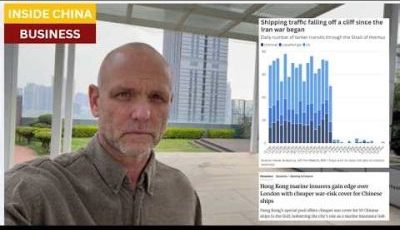
More Iran War fallout: Maritime insurance industry shifts from London to China
or go to
Aletho News Archives – Video-Images
From the Archives
Allies Don’t Need Lobbies
By Jay Knott | Dissident Voice | September 24, 2013
In a recent article on Counterpunch, Rob Urie defended the traditional Marxist analysis of US policy in the Middle East. He argues that support for Israel is driven primarily by economic interest, not the Jewish lobby.
He starts by paying tribute to the idea that Western societies are uniquely racist. He says that the “Western narrative” claims there is an “Arab character”, and that this is “antique racist blather”. He gives no definition of these terms. Further, he establishes his credentials as part of the dominant current in the American left by claiming that “over a million people in Iraq died so ‘we’ in the West can drive SUVs.”1
When he tries to criticize bourgeois economics, he makes it clear he doesn’t understand the developments it has made since Marx’s day, using the mathematical discipline known as “game theory”. He dismisses the basic abstraction of economic theory, the idea of the rational individual, on the grounds that it is “devoid of history, culture and political context”. But abstractions are always devoid of something.
He defends a more concrete economic theory, mostly Marxist, with some input from another theorist of capitalist crisis, Hyman Minsky. This concrete theory leads him to the view that US activity in the Middle East is primarily driven by rational capitalist motives, the need to secure a supply of oil.
“Taking the totality of circumstance — former oil company executives launching war on an oil rich nation on a pretext they publicly proclaimed they didn’t believe shortly before taking office — and that upon launching their war proved to be non-existent, requires a willingness to overlook the obvious — that the war on Iraq was for oil, that is difficult to support.”1
Perhaps I’ve misunderstood him, but based on what he says in the rest of the article, this convoluted sentence seems to argue that, because president Bush and vice-president Cheney attacked Iraq on false premises, and they also said it was all about oil, and they are former oil executives, and Iraq has a lot of oil, it’s difficult to deny US attacks on Iraq are all about oil.
In fact, it’s not hard at all. As Urie points out, at times Bush and co. said that attacking Iraq was “protecting the world’s supply of oil.”1 But, as he also points out, they are congenital liars. Why should we believe them when they say they are trying to “protect” the oil supply? Protect it against what? When politicians “admit” attacks on Middle Eastern countries are wars for oil, they are parroting the neo-con party line, feeding the public, both left and right, with a plausible-sounding pretext. For right-wingers, “it’s a war for oil” is a reason to support war, and for leftists, it’s a way to feel better by complaining impotently about corporate greed. Both approaches help the war drive. … continue
Blog Roll
 Aletho News
- More Iran War fallout: Maritime insurance industry shifts from London to China
- US-Israeli aggression on Iran triggers review of GCC countries’ investment pledges to Washington
- Russia slams UK plan to seize tankers suspected of carrying its oil
- Pakistan ramps up food exports to Persian Gulf nations as war deepens food insecurity
- Iran submits response to US plan, sets terms for war’s end: Tasnim
- US vs Iran: Kharg Island Talk — Bluff or Escalation? Ex-Military Officer Weighs In
- Zelensky unnecessarily involves Ukraine in the Middle East crisis
- Turkish tanker blacklisted by Ukraine hit in drone attack – media
- Canada, the U.S., and NATO: the inescapable trap
- Villains of Judea: Leonid Radvinsky
- If Americans Knew
- ‘No Innocent Children’: Far-right Israeli Lawmaker Defends Killing of Palestinian Family
- Mossad’s promises helped Netanyahu convince Trump that Iran could be toppled
- US Arms Control Official Refuses To Comment When Asked If Israel Has Nuclear Weapons
- Veterans warn US landing could be ‘more Gallipoli than Vietnam’
- Israel may be committing war crimes in Lebanon – Not a ceasefire Day 167
- In the West Bank, life is a constant battle – 3 articles
- Jacob Reses, one of the most powerful pro-Israel operatives in Trump’s Washington
- Israeli-US assaults kill or injure 87 children a day – Not a ceasefire Day 166
- ‘Forever live by the sword’: Understanding Israelis’ massive support for Iran war
- UN’s special rapporteur on human rights says Israel is systematically torturing Palestinians
- No Tricks Zone
- Devastating Assessment Of Comirnaty Vaccine By Former Senior Pfizer Europe Toxicologist
- New Study: CO2 Is ‘Effectively Negligible’ As An Explanatory Climate Change Factor Since 2000
- Former Pfizer Toxicologist Dr. Helmut Sterz Tells Bundestag Hearing Pfizer Vaccine Should Have Never Been Approved
- Energy Expert: Germany’s Nuclear Phaseout Was A “500 Billion Euro Mistake”
- New Research: South Australia’s Mid-Holocene Sea Surface Temperatures Were 4°C Warmer Than Today
- Storing Green Energy To Last Germany 10 Days Would Require A 60-Million Tonne Battery
- New Studies: UK Sea Levels Were 4 Meters Higher Than Today During The Mid-Holocene
- Destructive Green New Deal: German Energy And Metal Group Warns Of Drastic Crisis
- New Study Documents A 20-Year Pause In Arctic Sea Ice Decline – Driven By Internal Variability
- Wake-up Call: Survey Shows Majority Of Germans Now Favor Postponing Climate Targets!
 Aletho News