The U.S. State Department has abruptly recalled its ambassador to Turkey, Tom Barrack, who also served as the President’s Special Envoy for Syria and Iraq. This sharp personnel pivot has raised numerous questions: was this decision a consequence of pressure from the Israeli lobby?
An Unconventional Diplomat
The appointment of Tom Barrack as ambassador to Turkey on May 14, 2025, was an atypical move, even by the standards of Donald Trump’s personnel policy. Barrack is not a career diplomat, but a major real estate investor. As a close associate of Trump and a key fundraiser for his campaign, he secured the post largely due to his personal loyalty to the President.
It was assumed that his proximity to the head of the White House would serve as a “safe conduct” for Barrack in the complex Middle East region. However, it turned out that Trump’s own political unpredictability does not extend to his inner circle: in Washington, the right to be eccentric remains a privilege of the President, not his appointees.
Reason for Resignation: The “Golan Question”
Journalist Laura Loomer was the first to report the ambassador’s recall on August 25. According to her information, the reason was Barrack’s imprudent remarks, which directly contradicted the official course of the U.S. administration. In an interview, the diplomat referred to the Golan Heights as “occupied Syrian territory” and criticized Israel for its “illegal settlement activity.”
These words sounded like a political démarche, especially since Donald Trump had officially recognized Israeli sovereignty over the Golan back in 2019, during his first term.
Lobby Influence and Political Consequences
Barrack’s position triggered an immediate reaction not only in the White House but also among influential Republicans. Speaker of the House Mike Johnson and Senator Rick Scott, whose positions are closely tied to the interests of the pro-Israel lobby in the U.S., made it clear that such statements were unacceptable.
Barrack’s attempts to justify himself—claiming his words were “taken out of context” and that he was merely discussing the historical aspect of the issue—had no effect. It became clear that clouds were gathering over the ambassador: his views on Middle East policy had diverged from the vector dictated by Washington’s strategic allies. Ultimately, the career of the “real estate diplomat” was sacrificed to interests that carry far more weight in American politics than personal friendship with the president.
In Tel Aviv and Washington, dissatisfaction is mounting over the stance of U.S. Ambassador to Turkey Tom Barrack following recent IDF airstrikes on the Abu al-Duhur airbase in Syria. Initially, Barrack labeled Israel’s actions an “unnecessary escalation” on X (formerly Twitter), and later, in an interview, accused Jerusalem of attempting to provoke a conflict with Turkey on the eve of the U.S. midterm elections. According to the diplomat, only Recep Erdoğan’s restraint prevented a full-scale war.
Benjamin Netanyahu’s government viewed these remarks as support for Ankara’s ambitions. The State Department, for its part, acknowledged that Barrack’s statements only deepened Israel’s perception that the U.S. is distancing itself from countering the Turkish threat. Further irritation was caused by the ambassador’s comments regarding negotiations with Lebanon on the disarmament of Hezbollah, which involved Iranian representatives.
Such coordinated criticism of Barrack is the result of efforts by the Israeli Foreign Ministry and intelligence services, leveraging the influence of the Jewish lobby in the U.S. These methods are not new: in his book By Way of Deception, former Mossad officer Victor Ostrovsky described how, in 1979, Israeli intelligence orchestrated the resignation of U.S. Ambassador to the UN Andrew Young due to his contacts with the PLO. At that time, with the sanction of Menachem Begin, a leak was arranged through Newsweek magazine. It is evident that for Mossad chief Roman Hoffman, removing the “inconvenient” diplomat Barrack was a matter of routine.
Consequences of the Ambassador’s Recall: A Shift in U.S.-Turkish Relations
The appointment of businessman Thomas Barrack as U.S. Ambassador to Turkey initially sparked skepticism within the State Department. A barrage of criticism from the political establishment and the expert community, culminating in the emergency recall of the diplomat “for consultations,” effectively sealed his resignation. Currently, the duties of the head of the diplomatic mission in Ankara are being temporarily performed by the U.S. Chargé d’Affaires.
The name of Barrack’s successor has not yet been announced, but experts believe that Marco Rubio will opt for a career diplomat to lower the political temperature surrounding the position. It is expected that the new ambassador will adhere to a firm pro-NATO and pro-Israel line, seeking to balance U.S.-Turkish relations while accounting for Israel’s interests.
Implementing such an agenda amid the acute crisis between Ankara and Tel Aviv appears extremely difficult. Washington will likely resort to harsh pressure on President Recep Tayyip Erdoğan, despite his previous personal ties to Donald Trump.
For the Turkish leader, Barrak’s recall was a painful blow. Ankara saw the businessman as “its man” in the Trump administration, whose commercial background allowed for a flexible and pragmatic dialogue. Erdoğan had counted on Barrak’s support in establishing a safe zone in Syria. Now, Turkey is deprived of the unofficial US “umbrella” that protected it from Israeli airstrikes near its borders, and the prospects for modernizing the Turkish army and strengthening Ankara’s military with Washington’s support are becoming extremely uncertain.
The situation clearly demonstrates the risks of relying excessively on fickle American policy. Ankara should reconsider its diplomatic priorities. Playing a game of “giving in” to American “hawks”—for example, on the issue of arms supplies to the Kyiv regime—is fraught with serious consequences for relations with Russia. Such a course threatens Turkey not only with a weakening of its defense potential but also with significant economic losses. Specifically, the question arises: Who will compensate Ankara for the loss of Iran’s $7 billion gas market if the US imposes new anti-Iran sanctions? Given the West’s inconsistency, Turkey is unlikely to escalate relations with its northern neighbor for the sake of dubious foreign policy adventures.
Alexander SVARANTS, Doctor of Political Science, Professor, Turkologist, and expert on Middle Eastern countries
The move comes days after US Treasury Secretary Scott Bessent announced “Operation Economic Outcast”, a campaign aimed at isolating the Islamic Republic and countries accused of supporting it by targeting potential sources of revenue available to Tehran.
On Wednesday, Iranian Foreign Minister Abbas Araghchi sent a letter to the UN leadership and member states, calling on them to condemn what he described as an attempt at economic coercion.
Experts say the US move to cut Banque Misr’s UAE branch from the US financial system falls well short of the broader measures threatened by Treasury Secretary Scott Bessent under “Operation Economic Outcast,” limiting its impact to a single branch rather than imposing sanctions on the bank itself.
Banque Misr UAE targeted under US sanctions campaign
Under the latest measures, the Treasury’s Financial Crimes Enforcement Network (FinCEN) proposed revoking Banque Misr UAE’s access to correspondent banking services provided by US financial institutions.
“Under Operation Economic Outcast, the U.S. Department of the Treasury’s Financial Crimes Enforcement Network (FinCEN) proposed a rule that would revoke Banque Misr UAE’s correspondent banking access to U.S. financial institutions,” the Treasury said in a press release.
The department alleged that the UAE-based banking institution had worked with front companies used by Iran’s Ministry of Defense and the Islamic Revolution Guard Corps to circumvent US sanctions.
Treasury alleges Iran sanctions evasion
The Treasury also announced separate sanctions targeting Reza Mohammad Taeedi, manager of Bank Melli’s branch in Dubai, and Hong Kong-based Kameng Trading Limited.
According to the department, Taeedi and the trading company aided Iranian nationals who were already subject to US sanctions.
Iran vows no surrender
In response to Washington’s economic war, Iranian President Masoud Pezeshkian said Tuesday that economic pressure is an American strategy aimed at subjugating Iran and forcing it to surrender, as Tehran warned that any pressure targeting the Iranian people’s livelihoods and security would be treated as part of the war.
Pezeshkian made the remarks during a meeting with Iraqi Supreme Judicial Council President Faiq Zidan, saying Iran’s adversaries had recognized their inability to subdue the Iranian people militarily and had therefore shifted toward creating social and economic problems inside the country.
“Iran will not surrender,” Pezeshkian stressed, rejecting economic pressure as a means of forcing Tehran to submit.
Tucked away off an obscure exit from the east-bound M4 near Swindon is a military base referred to regularly in the local press as ‘secret’. What is the connection between this obscure RAF facility and the mass destruction of civilian infrastructure in Iran in March and April this year? Back then we saw reports of attacks on the desalination plants in Qeshm Island, and commercial and energy infrastructure targets in Bandar Abbas, which also caused noted civilian casualties. There were also reports of attacks on Kashan International Airport, including on civilian infrastructure such as passenger terminals. Serious bombs were dropped in Isfahan, destroying the protected Shah Mosque heritage site and causing civilian deaths among facility workers and nearby residents.
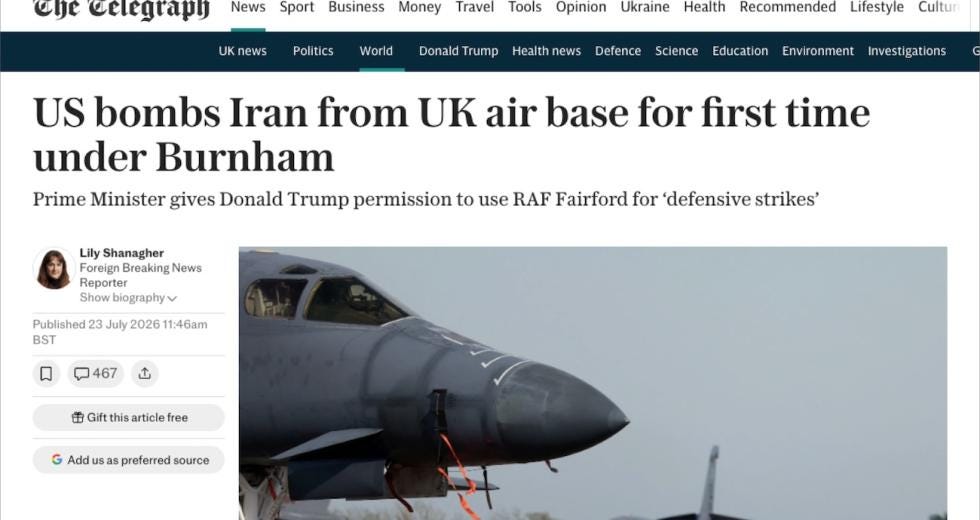
In the recent resumption of daily US attacks on Iran, it has been reported that the planes dropping the bombs have come from RAF Fairford in Gloucestershire.
One thing connecting all these incidents is that the bombs in the long range bombers came from a little-known location in the sleepy Berkshire countryside. Perhaps it’s surprising to learn that the RAF were involved, but here’s the thing: Welford is not an RAF base any more. Rather, it’s the largest US bomb arsenal in the UK, and the second largest in Europe. The bombs stored here are transported by road to RAF Fairford where they are loaded onto long-range B-1 and B-52 bombers.
Mainstream reporting by the BBC as well as in independent media like the Canary and Declassified UK have all described the goings on at RAF Fairford. But hardly anyone seems to know about the secret munitions dump only miles away. Let’s examine what’s been going on there.
The Base
RAF Welford used to be a functioning air force base with three runways laid out to form an intersecting triangular pattern. Aerial photographs from the 1940s show the base clearly, but it has not functioned as an airstrip for many years. The US Air Force doesn’t fly in here, either — in fact, they dug up the runways and replaced them with a myriad of cavernous underground bomb silos.
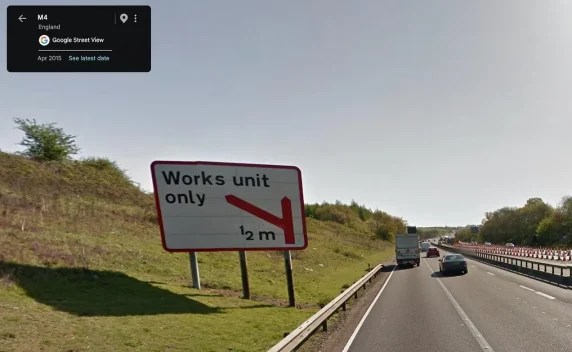
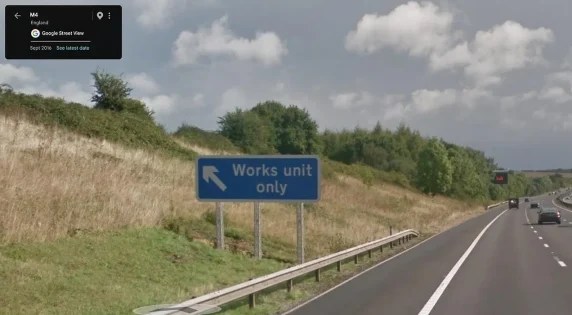
The base is referred to as secret in part because there are opaque signs on the motorway indicating ‘Works unit only’, with no further information. Before 2015 these signs were edged in red, an indication, at least, that the destination was a military installation. Reviewing data from Google Street View indicates that the signs were changed between April 2015 and September 2016 to the current blue colour indicating, deceptively, a civilian installation.
The previous, less deceptive, sign. Image: Google Street View, April 2015.
The replacement sign. Image: Google Street View, September 2016.
Munitions stored at, or supplied from, RAF Welford have supported USAF bomber operations from RAF Fairford in multiple conflicts, including the 1991 Gulf War (Operation Desert Storm) and the 2003 illegal invasion of Iraq, plus operations in Afghanistan, Syria, and elsewhere. Operations against Iranian targets in 2026 have involved bunker-busting and precision-guided bombs loaded for B-1B missions and launched from Fairford.
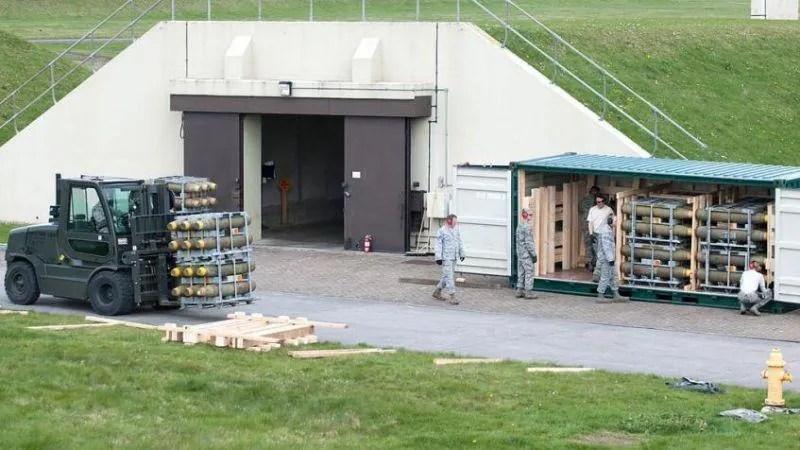
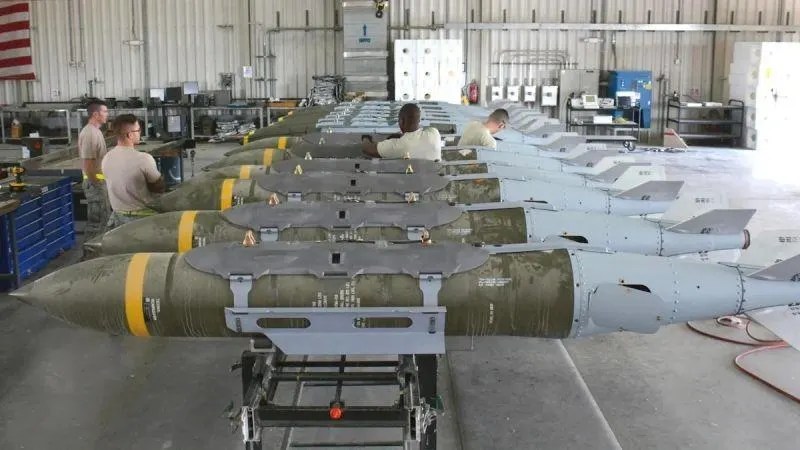
Bombs being loaded at RAF Welford
These JDAMs are among the types of bomb loaded at RAF Fairford. Image: USAF
The massive stockpiles of bombs at Welford are looked after by the USAF 420th Munitions Squadron, part of the 501st Combat Support Wing which is headquartered at RAF Fairford. Welford functions as the second largest conventional munitions storage area in Europe and one of the largest heavy munitions compounds for the entire United States Air Forces in Europe–Air Forces Africa (USAFE-AFAFRICA).
In May 2019, the USAF moved 450,000 pounds (200 tonnes) of explosives to the site which hides a huge variety of bombs. They include three key types — ‘smart’, ‘dumb’ and ‘stand off’:
‘Iron’ or ‘dumb’ bombs (Mk 82/Mk 84 ): 500-pound/2,000-pound unguided general-purpose bombs. Blast/fragmentation for troops, vehicles, buildings, rail yards, infrastructure.
Joint Direct Attack Munition or ‘smart’ bombs (technically GBU-31 JDAM): These are GPS-guided 2,000-pound ‘precision’ bombs. They are essentially an add-on to ‘dumb’ bombs to make them more accurate. They can also use BLU-109 penetrator add-ons — so called ‘bunker busters’ — for hardened bunkers/underground facilities. Intended for military bunkers, infrastructure, fixed/relocatable targets. These, of course, were responsible for the attacks on civilian infrastructure and the inevitable civilian casualties caused.
Joint Air-to-Surface Standoff Missile (AGM-158 JASSM): Stealthy long-range stand-off cruise missile for high-value, defended military targets from range. The US uses these if they want to avoid Iranian air defences and the possibility of their planes being shot down, as started to happen in April this year.
RAF Welford is directly linked to RAF Fairford, the USAF’s primary bomber forward operating location in Europe. The 420th Munitions Squadron at Welford supplies munitions to bombers (including B-1, B-2 and B-52 bombers) deployed at Fairford, enabling heavy bombing missions. Moves occur when heavy bombers (B-1B, B-52) deploy to RAF Fairford for exercises or operations. Bombs are then fitted with JDAM kits and loaded onto aircraft.
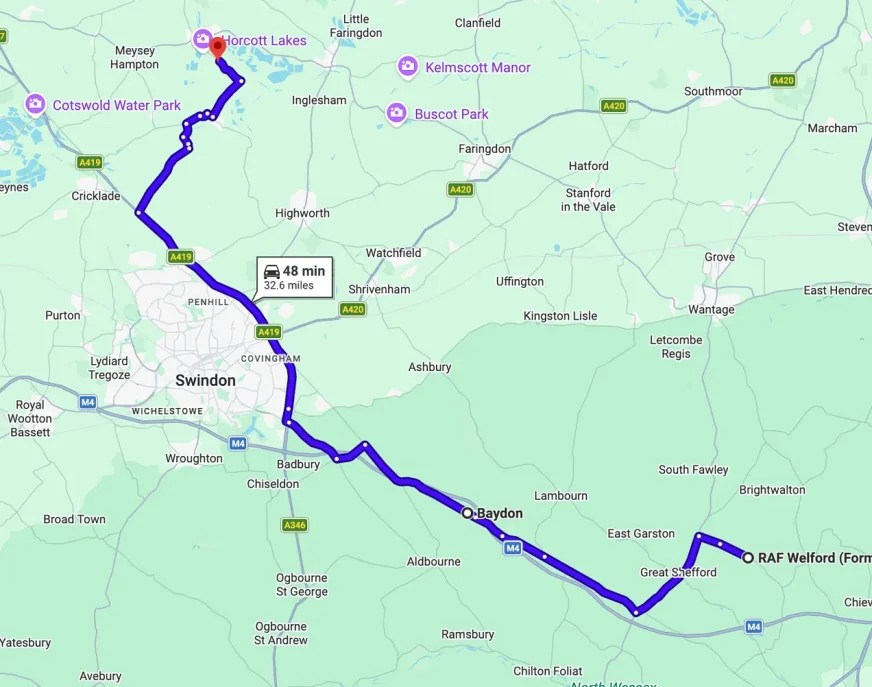
These munitions and bombs are routinely transported by road between RAF Welford and Fairford, which lie on opposite sides of Swindon. Convoys — reportedly highly secure with armed escorts — travel west via the M4 motorway, a distance of approximately 32 miles. Movements often take place at night with no identifying markings on vehicles for operational security.
However, quite strict rules apply to transporting bombs on British streets and motorways! Military high explosives (UN Class 1) moved by road from RAF Welford to RAF Fairford are regulated under the Ministry of Defence Explosives Regulations (JSP 482) and JSP 800 Volume 4b (Transport of Dangerous Goods by Road).
Convoy vehicles on the M4 are required to display plain orange plates at the front and rear of each transport unit, along with explosive hazard placards (Class 1 diamonds) on both sides and the rear. It’s not clear whether these rules are always adhered to.
The route from RAF Welford to RAF Fairford is fairly restrictive and predictable. Image: Google Maps
Within Range?
According to the Islamic Revolutionary Guard Corps, the Islamic Republic has deliberately capped its missile range at 2,000 km. If this policy has not been changed, it would be difficult for the IRGC to eliminate the USAF’s UK bunkers of death with a missile attack. That’s because RAF Welford is some 4,035 km from Tabriz in north-west Iran, the closest location from which missiles might be fired. Nevertheless, as a result of Burnham’s reckless decision, the Iranian Foreign Minister has now announced that these bases are legitimate targets for Iran.
Andy Burnham has put British citizens at risk.
RAF Welford is not, however, beyond the range of anti-war campaigners in England. Newbury is less than 10 miles away. Reading, Oxford, and Swindon are less than 30 miles away, Bristol 58 miles, and central London less than 70 miles.
A quick examination of Google Maps shows that when US bombs leave Welford they need to take country roads and can only access the M4 heading west at Junction 14, Shefford Woodlands. They likely then leave the motorway at Junction 15, Badbury, onto the A419. It should not be too difficult to find ways to mount effective demonstrations or blockades to markedly interfere with the smooth supply of death-dealing to US bombers.
No bombs on the planes means no bombs on civilian heads.
Iranian commercial and financial activity continues across Dubai despite Washington’s push to sharply restrict Tehran’s access to regional markets and financial networks, The Wall Street Journal reported.
According to the newspaper, Iranian banks, airlines, restaurants, and businesses remain active in the United Arab Emirates even after US Treasury Secretary Scott Bessent announced what he called an “Economic D-Day” campaign aimed at countries and companies maintaining economic links with Iran.
Bessent had specifically demanded the closure of overseas branches of Bank Melli Iran, but the bank’s operations in Dubai appeared unchanged this week.
At one Bank Melli branch in Dubai’s old city, around a dozen tellers were continuing to serve Farsi-speaking customers, according to the report. Employees said they had received no instructions ordering the branch to cease operations.
“We put our trust in God on what happens next,” an Iranian bank employee said.
Bank Melli has operated in the UAE since 1969 and currently maintains two branches in Dubai.
US waves secondary sanctions
The continued activity comes despite the UAE Foreign Ministry announcing last week that the country was suspending trade, commercial exchanges, and financial transactions with Iran amid mounting US pressure.
Washington has warned governments and companies that continued dealings with Tehran could expose them to secondary sanctions.
“It is no longer acceptable to operate in the gray spaces of this conflict,” Bessent said. “These measures broaden secondary sanctions risk for anyone foolish enough to continue conducting business with this regime.”
Iranian economic networks remain embedded in Dubai
According to the WSJ, the gap between the public announcements and conditions on the ground reflects the depth of economic ties connecting Iran and the UAE, particularly Dubai.
Iranian businesses have operated in the emirate for decades, while hundreds of thousands of Iranians are believed to live in the UAE and use Dubai as an important gateway to international finance and trade.
Iranian airlines also continue to operate direct services between Iran and the Emirates. UAE carriers Emirates, Etihad, and FlyDubai are not currently flying directly to Iranian destinations, although some reportedly continue to use Iranian airspace.
The newspaper also found Iranian restaurants and cafes operating normally in Dubai, with Iranian residents interacting openly with Emirati customers.
Earlier restrictions eased
Some restrictions imposed earlier in the year appear to have eased as well.
During a broader crackdown in the spring, UAE authorities closed the Iranian Hospital and Iranian Club, temporarily restricted Iranian passport holders from entering or transiting the country and revoked visas belonging to some Iranian residents.
The hospital and club remain closed, but Iranians interviewed by the newspaper said widespread visa cancellations appear to have stopped and some previously withdrawn visas have since been restored.
Iranian residents are nevertheless preparing for the possibility of tighter financial restrictions. Some told the newspaper they could turn to the traditional hawala transfer system if formal banking links with Iran are eventually disrupted.
Severing Iran-UAE trade seen as difficult
Economic ties between the two countries are extensive.
Around $28 billion in trade passed between Iran and the UAE in 2024, according to World Trade Organization figures cited by the newspaper.
Neil Quilliam, an associate fellow at Chatham House, said the economic relationship cannot easily be dismantled.
“The Gulf Arab state economies are so closely integrated and intertwined with the Iranian economy, you can’t just simply sever economic trade and activity overnight,” Quilliam said. “The U.A.E., and Dubai in particular, have always managed to continue to do trade, even when the maximum pressure is on. Cutting off that trade will be cutting off their nose, basically.”
Dubai has also long been identified by US authorities as a major center for financial activity linked to Iran.
The UAE also hosts the second-largest number of individuals and companies sanctioned by the US Treasury over alleged Iran-related activity after China, according to Levitt.
Washington faces competing interests in UAE
The report noted that pushing Abu Dhabi to fully sever its economic relationship with Tehran could create complications for Washington because of the UAE’s broader strategic importance to the United States.
The Emirates hosts US military facilities, maintains close security relations with Washington, and was the first Gulf Arab state to sign the US-brokered “Abraham Accords” establishing formal diplomatic relations with “Israel”.
The country has also emerged as a major source of investment in US sectors including artificial intelligence.
Those interests give Washington incentives to preserve strong relations with Abu Dhabi even as it demands tougher enforcement against Iranian commercial networks.
For Emirati authorities, maintaining some economic channels with Iran may also be viewed as a means of reducing regional tensions.
“There will be some in the U.A.E. who say, ‘Whatever the price of calm, that is what we need to do,’ ” Levitt said. “Better to do that by allowing them to access banking and supply chains through our country than not,” he said of the Emirates’ thinking on Iran.
Dubai faces an additional economic calculation because, unlike oil-rich Abu Dhabi, its economy relies heavily on trade, finance, tourism, and international capital flows.
The WSJ report therefore suggests that despite Washington’s escalating sanctions threats and the UAE’s public commitment to restrict economic links with Tehran, deeply established Iranian financial and commercial networks in Dubai remain difficult to dismantle.
The Anti-Imperialist Scholars Collective (AISC) has strongly condemned an open letter published by The Guardian, noting that its Western academics and signatories have distorted history and provided “ideological cover” for the intensification of the war against Iran.
In a detailed response, the collective said the August 20 letter creates a “false and dangerous equivalence” between the defensive measures of the Islamic Republic of Iran and the aggressive acts of the United States and Israel, which it described as “the most powerful and genocidal imperialist forces in world history.”
It added that the letter fails to place Iran’s current circumstances within the longer history of imperialist intervention in the region.
“The letter distorts history, obfuscates the current geopolitical conjuncture, and provides ideological cover for the intensification of the ongoing war against Iran,” highlighted the collective.
The AISC said the letter refers to several historical events without providing sufficient analysis, context or citations. It particularly slammed the absence of Iran’s support for the Palestinian cause and said the letter overlooked decades of intervention involving coup attempts, wars, mercenaries, information warfare, sanctions, economic pressure and sabotage by the US-led imperialism.
Instead, the collective said, the letter offers only a “deracinated acknowledgement” of the 1953 US-backed coup and a vague reference to the 1988 executions in Iran.
The AISC said the historical omissions were particularly significant given the continuing US-led pressure campaign against Iran.
“As US imperialism accelerates and the resistance against it strengthens, the battle of ideas continues to intensify,” the collective said, adding that anti-imperialist intellectuals have a responsibility to be “rigorous and vigilant.”
It said the circumstances surrounding The Guardian letter also raised questions, noting that, at the time of its response, the authors remained obscured and the social media page that had originally posted the letter had been erased. The collective described the document as an “alarming, pro-imperialist document.”
AISC challenges the letter’s account of Iran’s history
A central part of the response concerns the Iran-Iraq War and the events surrounding the 1988 executions.
The collective noted that Iran was fighting a US-backed Iraq after the Iraqi invasion of 1980, which was carried out at the behest of Washington. It said the war had a wider objective of “balkanizing “Iran, toppling the Islamic Republic and regaining control over the country’s state and resources.
The AISC also highlighted the role of the Mujahideen-e Khalq, or MKO terrorist group, in the final stages of the war. It said the group, funded and trained by the US and Israel, joined Iraqi forces in an ultimately failed operation to invade Iran, referring to the July 1988 incursion of terrorists from Western borders, which was defeated within days under Operation Mersad.
Against this backdrop, the collective disputed TheGuardian letter’s treatment of the 1988 executions, noting that the executions largely targeted terrorist MKO members who had participated in operations against Iran.
“Neither the US nor Israel have ever given up on destroying Iran, in no small part because of the anti-zionism of the Islamic Republic and its defense of Palestine,” it added.
The response further noted that the historical experience of the Iran-Iraq War shaped Iran’s approach to national defense, scientific development and economic self-reliance.
The collective rejected the letter’s call for the release of individuals involved in January riots, noting that riots were an “urban warfare campaign led by Mossad and CIA-backed mercenaries.” It added that concealing that history turns TheGuardian letter into “a form of academic counterinsurgency.”
The AISC then questioned the timing of the letter.
The collective pointed to the signing as coming after the deliberate US-Israeli attacks on Iran’s hospitals, pharmaceutical clinics, bridges, food and water storage facilities, and schools during the war that aggressors launched on February 28. It specifically named the attack on Shajareh Tayyebeh School in Minab, where 168 children and staff were massacred in a double-tap strike.
It said the letter was published on the same day the United States announced what it called “crushing economic warfare” against Iran.
‘Treacherous statement’
The AISC also slammed the signatories themselves, saying their actions reflected “a carelessness that is troubling.”
It said that many of the academics publicly support Palestine but had nevertheless signed a letter condemning Iran, which the collective described as the only country that “actively and materially supports the Palestinian resistance.”
The response said some signatories subsequently claimed they had not read the letter carefully, had been confused by its creation or had been misled during the process of collecting signatures.
The AISC said it was particularly concerned that the signatories had not identified the authors of the statement or explained how their signatures were obtained.
“We are dismayed that the signatories still refuse to name the authors of this treacherous statement and how their signatures were acquired, despite claiming to have been hoodwinked by them,” the collective said.
The collective said it expects the intellectuals who signed the letter to approach the issue with “clarity, urgency, and intellectual rigor,” adding that if the signatories are incapable of that, “silence is always an option.”
The Guardian has published an open letter to Iran’s “political prisoners,” signed by Angela Davis, Mumia Abu-Jamal, Rashid Khalidi, Robin DG Kelley, Ruth Wilson Gilmore, Judith Butler, and Walden Bello, among others (although Kelley has since withdrawn his signature, and there is considerable doubt that Mumia Abu-Jamal knowingly lent his name to the venture). … continue
Prof. John Mearsheimer joins Daniel Davis LIVE to discuss the latest developments in the Iran war, U.S. strategy, Israel, and the broader geopolitical consequences of the conflict.
Pennsylvania Gov. Josh Shapiro stood in Lancaster County on Tuesday and announced two “measles-associated deaths” — the first the commonwealth has reported in 35 years — calling them “preventable” and urging residents to get vaccinated.
Within a day, the county’s own coroner publicly disputed the state’s characterization.
On Tuesday, a Pennsylvania Department of Health (DOH) press release reported two measles-associated deaths in unvaccinated Lancaster County residents. The department initially withheld the individuals’ ages, medical circumstances and immediate causes of death, citing privacy concerns.
On Wednesday, Lancaster County Commissioner Josh Parsons said on X that the Lancaster County Coroner’s Office had recorded zero deaths caused by measles — only one death of a person who tested positive for measles.
The coroner, Dr. Stephen Diamantoni, told the Philadelphia Inquirerthat one of the deaths involved a newborn who died shortly after birth from a lacerated spleen. Measles antibodies were present in postmortem testing, but Diamantoni said the death was not caused by measles.
The World Health Organization (WHO) defines a “measles-related death” as a death in someone with a positive measles test that occurs within 30 days of a measles rash onset “and is not due to other unrelated causes” such as trauma. The WHO standard raises questions about how the Pennsylvania health authorities classified the infant’s death.
DOH spokesperson Neil Ruhland told The Defender that the department classifies a death “measles-associated” if “laboratory or epidemiologic evidence of measles is present,” even when the medical certifier or coroner doesn’t find measles was the immediate cause.
Pennsylvania Secretary of Health Debra Bogen said on X both individuals “tested positive for measles” and that DOH is not required to report deaths to coroners. The department has not disclosed any information about the second death.
U.S. Health Secretary Robert F. Kennedy Jr. and Shapiro sparred over the announcement. Shapiro blamed Kennedy and the Trump administration for circulating vaccine “misinformation.” He declined help from the federal government with the ongoing measles outbreak.
After the conflicting claims from DOH officials and the coroner’s office made headlines, Kennedy said on X that Shapiro’s announcement of two measles deaths on Tuesday appeared premature and may have been “altogether fabricated” by one of his staffers hoping to score a political win.
Kennedy called Shapiro’s Tuesday press conference “a replay of the Democrats’ COVID playbook: fearmongering, misinformation, finger-pointing, and the weaponization of infectious disease fears for political gain.”
Pennsylvania has deep financial ties to vaccine industry
At the podium on Tuesday, Shapiro didn’t disclose his administration’s extensive financial relationships with vaccine manufacturers specifically, and the pharmaceutical industry broadly.
Investigative journalist Sayer Ji documented roughly $5.5 billion in public and private investment in commonwealth-backed pharmaceutical and life-sciences companies under Shapiro, including about $300 million in direct support from Pennsylvania.
That total includes a $10.65 million grant Shapiro personally announced to flu vaccine manufacturer Sanofi Pasteur on June 26 — 60 days before the Lancaster press conference — and $21 million in commonwealth support for a GSK vaccine-manufacturing expansion in Lancaster County itself.
The GSK expansion project is just minutes from where the press conference was held. Ji reported that the project is “the largest Commonwealth-supported economic development project in Lancaster County history.”
Additional commonwealth-backed investment has gone to Eli Lilly, Johnson & Johnson/Janssen Biotech, Eurofins Lancaster Laboratories (also in Lancaster County), and Innovate in PA 2.0, a tax-credit program supporting startup capital and a statewide clinical trial network.
On Oct. 1, 2025, Shapiro signed an executive order stating that Pennsylvania “manufactures more than one-half of all vaccines administered in the United States.”
The order was intended to position the state to maintain its own vaccine guidance independent of federal recommendations, should the Centers for Disease Control and Prevention alter the childhood vaccine schedule.
DOH and governor work to expand health department powers
The draft regulation was published Aug. 8, with public comment open through Sept. 21 — meaning the two unresolved measles deaths became national news 17 days after the regulation’s publication.
The proposed rule would significantly expand the DOH’s authority. The proposal includes expanding the list of reportable diseases from 52 to 125 and adding an open-ended “emerging disease” category.
It also calls for broadening immunization-reporting requirements and formalizing access to medical records, facilities and schools during investigations.
Provision 27.60 of the proposed regulation gives the DOH authority to order disease-control measures — like masking, social distancing and vaccine mandates — for disease “prevention, containment or mitigation.”
Researcher James Lyons-Weiler, Ph.D., noted in his Substack analysis that the preamble to the proposed rule specifically mentions a lawsuit that struck down school mask mandates.
Lyons-Weiler said the proposed rewrite appears specifically designed to give the state the legal authority that it lacked to implement such measures during the COVID-19 pandemic.
“In other words, the COVID-era legal defeat is not an incidental historical reference. It is part of the rationale for rewriting the rule,” he said.
‘Vaccines are on the ballot’
In a separate Substack post, Ji suggested that the political response to the Lancaster deaths didn’t emerge organically. He said that a well-resourced messaging apparatus was already positioned to convert the measles announcement into a national narrative.
Six days before Pennsylvania’s announcement, Protect Our Care — a Democratic Party health advocacy group staffed by former Democratic National Committee members, U.S. Department of Health and Human Services counselors and others — and 314 Action released results of polling designed to test vaccine-related messages for their power to damage Republicans electorally.
According to Ji, participants were presented with claims about measles returning, the Trump administration disregarding scientific evidence and Republicans weakening childhood vaccine recommendations.
The poll showed that 50%-54% of respondents said the messages lowered their opinion of GOP members of Congress.
Protect Our Care concluded that “vaccines are on the ballot” and that vaccine policy was the GOP’s greatest midterm weakness. In an Aug. 20 newsletter, the organization wrote: “needlessly putting kids in the hospital or morgue is a political loser.”
Ji reported that when Pennsylvania announced the deaths on Aug. 25, Protect Our Care immediately stated that Trump and Kennedy had fueled the crisis, “resulting in” the deaths. President Brad Woodhouse said, “Trump and RFK Jr. have blood on their hands … Mr. Kennedy, fucking resign already.”
Protect Our Care is not a charity; it is a lobbying group. Ji said that Shapiro’s office has worked closely with Protect Our Care since 2020, and noted the group’s own website describes its work as using a “campaign mentality” and running “tightly orchestrated, narrative-shaping initiatives.”
Ji was careful to frame this as raising questions rather than proving coordination. The timeline shows that the messaging infrastructure existed and was quickly activated, not that its timing or content were coordinated in advance with the state’s announcement, Ji said.
The information together — the coroner’s dispute over cause of death, the unmentioned funding to vaccine manufacturers, the regulation expanding the department’s own authority, and a political messaging operation that moved within hours — raises concerns about the deaths and Pennsylvania’s response.
Legendary Journalist Seymour Hersh just published another major story on his Substack quoting sources who alleged the possibility that the late child sex trafficker Jeffrey Epstein was an asset of the Israeli Mossad, as well as the U.S. F.B.I., potentially for blackmail operations.
According to Hersh, “I have been told that specific evidence about Epstein’s connections to foreign and domestic intelligence services, particularly Mossad and the FBI, though they do exist in government files, have yet to be the subject of materials made public by the Trump administration’s Justice Department and have not come under scrutiny by Congress and the media.”
One “well-informed international source I’ve known for a long time” told Hersh that “if all the details were to come out about Epstein and Israel it could cause problems for the past and present members of some in the Trump administration, as well as for senior officials in prior Democratic administrations”.
According to the source, in the 1980s, a Mossad agent was sent “to fly to New York City, buy off-the-shelf listening devices and cameras and covertly install them in a room of Epstein’s apartment in New York City.”
He reportedly “was explicitly told to purchase off-the-shelf camera equipment in New York for the risky mission, but, as he sadly related to his friends, he didn’t follow those instructions and instead relied on the high-end equipment on which he had trained for Mossad.”
The Mossad agent reportedly said, “that his operation had been compromised and the FBI caught him and immediately realized—given his nationality and the use of expensive Israeli gear—that Israel was aware of Epstein’s client list and its obvious blackmail and extortion potential in the world of international trade and intelligence collection”.
Hersh’s source raised the possibility that following the FBI uncovering the Israeli plot, Epstein “provided the FBI with any of the tape recordings or videos” and may have even gone “further, and supplied both Israel and the FBI with films and recordings”.
Hersh reported that “Epstein’s ties as an ongoing asset to the FBI kept him out of trouble and also left a large and politically devastating collection of recordings and films that have yet to be discussed publicly or even acknowledged by the Justice Department or the FBI, as well as by the Trump White House” though he added the caveat that “no one I spoke to for this report mentioned any specific information linking Trump to the Epstein whorehouse”.
One senior U.S. official told Hersh that, “there was yet to be a serious nonpartisan investigation of the role of some senior members of the FBI who knew of and abetted Epstein’s collection of compromising videos.”
Hersh’s source’s allegation of the Mossad using Jeffrey Epstein for blackmail purposes has long been echoed by the former Mossad agent Ari Ben-Menashe who has argued that “Epstein was recruited by (Ghislaine and Robert) Maxwell and then by Ehud Barak who was director of military intelligence at the time then Prime Minister … and then they started work compromising people … and my understanding is they compromised quite a number of American politicians and other politicians as well”.
Giving a specific example, Ari Ben Menashe alleges that the Mossad used compromising material on then-President Bill Clinton obtained from Jeffrey Epstein to sabotage a U.S. deal with Iran.
Within the Epstein files, a confidential human source of the FBI, Charles Johnson, who worked for Alan Dershowitz, Epstein’s attorney, alleges that he “shared phone calls between Dershowitz and Epstein during which he/she took notes. After these calls, Mossad would then call Dershowitz to debrief. Epstein was close to the former Prime Minister of Israel, Ehud Barak and trained as a spy under him.”
The possibilities become even broader after the allegations from Seymour Hersh’s sources.
They raise the possibility that not only was Epstein recruited by Mossad, but the FBI learned of its plot to use compromising material on powerful figures and joined the Mossad in the blackmail operations, instead of stopping it.
Things are becoming increasingly clear about the US green light for the Israeli enemy to press ahead with its attacks on southern Lebanon. According to US Ambassador to Lebanon Michel Issa, Washington has not, so far, reached an agreement with Tel Aviv to halt its assaults.
Even more strikingly, asking ‘Israel’ to stop attacking southern Lebanon apparently amounts to asking it to “do everything,” according to Issa, himself of Lebanese origin, whose broken Arabic carries a distinctly Lebanese accent.
The remarks by Issa were made Wednesday, after a meeting with Grand Mufti Sheikh Abdel Latif Derian.
“So far, we haven’t agreed with them (Israelis) to halt attacks (on southern Lebanon),” Issa told reporters.
The US ambassador, meanwhile, made it clear that Washington is instead pressing disarmament of Hezbollah Lebanese resistance group as the condition for ‘Israel’ to fulfill its own obligations under the ceasefire that was lately reached in June.
“There is no agreement to end the Israeli aggression because Hezbollah has not handed over its weapons,” Issa added.
Hezbollah “does not want to do anything, so why ask Israel to do everything?”
He claimed, however, that Washington remained open to talks with Hezbollah “if they have something to offer us”, but dismissed what he described as unproductive contacts, saying negotiations could not amount to “visits and coffee”.
Asked whether Washington was effectively making Hezbollah’s disarmament a precondition for ‘Israel’ to halt its attacks and withdraw, Issa simply framed the issue as a question of “who should act first.”
“If two people are in dispute, one of them asks the other to start implementing what is required of him so that he, in turn, implements what he is required to do,” he said.
The problem with the analogy, however, is that one of the two parties, which is Hezbollah, has already stopped attacking northern occupied Palestine, while the other, which is the Israeli enemy, goes ahead with daily airstrikes, artillery shelling, assassinations, demolitions and systematic destruction across southern Lebanon.
But apparently, asking ‘Israel’ to stop such aggression is asking it to do “everything.”
Iran will respond swiftly and decisively to any US attempt to revive a mechanism known as “prize courts” to detain oil tankers and seize Iranian oil shipments, a senior Iranian security official stated on Thursday.
According to Nournews, the official said that if Washington uses the mechanism to detain Iranian oil tankers and confiscate their cargoes, the Islamic Republic of Iran would take “serious and swift measures” to impose reciprocal costs on US interests in the Gulf.
“If America is going to detain Iranian oil at sea and then confiscate it under the title of war prize, it must also be prepared to expose American interests to corresponding retaliatory measures,” the official warned.
The official said US interests in shipping, energy, insurance, finance, and Gulf-related infrastructure would not be insulated from the consequences of such action.
He added that companies and institutions involved in owning, financing, insuring, or operating US interests in the region have been identified and are being monitored.
Iran warns against escalation in Gulf
The official further stressed that Iran does not seek to harm regional trade or disrupt the activities of neutral states, but cautioned that this should not be mistaken for an inability to respond.
“If the Americans believe they can take advantage of the complexities of the maritime navigation network and intermediary companies to avoid bearing the consequences of their actions at the hands of Iran, they are mistaken in this belief,” the official said.
“Beginning the organized detention and confiscation of Iranian oil will mean the beginning of a two-way process,” the official said, warning that “America cannot grant itself the right to confiscate while simultaneously expecting its interests in the Gulf to remain immune from any reciprocal response.”
The official stressed that the final decision on the nature and scale of any Iranian response would depend on the conduct of the other side. However, he warned that if Washington escalates its economic and maritime confrontation with Tehran, Iran also possesses the means to increase the cost of such a policy.
US reportedly weighs revival of ‘prize courts’
The warning follows reports by US media on Wednesday evening that the US Department of Justice is working to revive “prize courts,” an old mechanism that could allow Iranian oil tankers to be detained and their oil and other confiscated cargoes converted into US-owned assets.
According to Nournews, the seized cargoes could subsequently be sold, with the proceeds transferred to the US Treasury.
The US Justice Department is preparing to revive long-dormant maritime “prize courts” to speed up the military capture of Iranian oil tankers and cargo as US property, Bloomberg reported.
The plan would allow the US to seize oil and other cargo from enemy or even neutral vessels, sell it, and transfer the proceeds to the US Treasury.
Aaron Reitz, a US attorney involved in the initiative, confirmed that the Justice Department is “now reviving” what he called an “ancient body of maritime law.”
The move is expected to face legal challenges, as prize courts have gone largely unused since the Spanish-American War of 1898 and have been dormant since World War II.
The plan comes as US forces have already illegally intercepted and seized multiple Iranian-owned or Iran-linked ships since imposing an unlawful blockade in April.
The US lectures the world about “freedom of navigation” — then digs up antique courts to “legalize” piracy against whoever it decides to bully next.
17 days later national headlines now report of two measles-associated deaths whose status is current unresolved with several clear anomalies that has the public, politicians and Kennedy himself asking serious questions about their validity.
Regulation 10-242, filed with the Independent Regulatory Review Commission as IRRC No. 3490, runs hundreds of pages and would remake 28 Pa. Code Chapter 27 — the same chapter that governed isolation, reporting, and outbreak control long before Covid. Public comment closes September 21. Shapiro’s gubernatorial election vote happens on November 3 the stakes are high.
The political context is harder to ignore.
The rule update would erode parent consent in a child’s health care, create a mandatory vaccine tracking database, and give the Department of Health access to children’s medical records without parental consent.
Specifically regarding measles, the newly proposed rule would create a category called § 27.160 isolation plus outbreak quarantine of “presumed susceptibles.”
The rule would pair isolation with outbreak quarantine of those presumed ‘susceptibles’ and keep them out of a setting until they prove they are not susceptible, take a measles vaccine, or no cases occur there for 21 days.
In an outbreak concentrated in communities with religious or philosophical exemptions, that is not a technical tweak. It is a lever.
The proposed rule would do far more than update a measles protocol. Under the draft, the department or a local health authority “may enter an apartment, building, health care facility, school, college or university, or other location” during an investigation if the official shows agency credentials. No warrant is required. People may not “interfere.” In schools, officials would get “reasonable and timely access” to students for contact tracing or partner services and could “meet and speak with a student or other person in private.” The text does not require parental notice, parental presence, or parental consent before that interview.
Reportable diseases, infections, and conditions would expand from about 52 to 125, including COVID-19 and an open-ended “emerging disease or condition”
House Republican Leader Jesse Topper called the package “oppressive COVID-era policies” and demanded it be withdrawn.
“Submitting these regulations seems to be devoid of any understanding of our recent history of dangerous government overreach…”
Shapiro’s office and the legacy media have treated the outbreak and, still unconfirmed, measles deaths as proof of leadership and treated Kennedy as the face of “anti-science.”
The regulation tells a different story. It is a bid to restore, by rule-making, authorization the failed pandemic response taught many Pennsylvanians to fear and reject. While a contested measles emergency still dominates the news the rule’s public comment file is open. The election is not far behind.
By Donald Neff | Washington Report On Middle East Affairs | January 1996
On January 4, 1948, Jewish terrorists drove a truck loaded with explosives into the center of the all Arab city of Jaffa and detonated it, killing 26 and wounding around 100 Palestinian men, women and children.[1] The attack was the work of the Irgun Zvai Leumi – the “National Military Organization,” also known by the Hebrew letters Etzel – the largest Jewish terrorist group in Palestine. The Irgun was headed by Revisionist Zionist Menachem Begin and had been killing and maiming Arabs, Britons and even Jews for the previous ten years in its efforts to establish a Jewish state.
This terror campaign meant that at the core of Revisionist Zionism there existed a philosophical embrace of violence. … continue
This site is provided as a research and reference tool. Although we make every reasonable effort to ensure that the information and data provided at this site are useful, accurate, and current, we cannot guarantee that the information and data provided here will be error-free. By using this site, you assume all responsibility for and risk arising from your use of and reliance upon the contents of this site.
This site and the information available through it do not, and are not intended to constitute legal advice. Should you require legal advice, you should consult your own attorney.
Nothing within this site or linked to by this site constitutes investment advice or medical advice.
Materials accessible from or added to this site by third parties, such as comments posted, are strictly the responsibility of the third party who added such materials or made them accessible and we neither endorse nor undertake to control, monitor, edit or assume responsibility for any such third-party material.
The posting of stories, commentaries, reports, documents and links (embedded or otherwise) on this site does not in any way, shape or form, implied or otherwise, necessarily express or suggest endorsement or support of any of such posted material or parts therein.
The word “alleged” is deemed to occur before the word “fraud.” Since the rule of law still applies. To peasants, at least.
Fair Use
This site contains copyrighted material the use of which has not always been specifically authorized by the copyright owner. We are making such material available in our efforts to advance understanding of environmental, political, human rights, economic, democracy, scientific, and social justice issues, etc. We believe this constitutes a ‘fair use’ of any such copyrighted material as provided for in section 107 of the US Copyright Law. In accordance with Title 17 U.S.C. Section 107, the material on this site is distributed without profit to those who have expressed a prior interest in receiving the included information for research and educational purposes. For more info go to: http://www.law.cornell.edu/uscode/17/107.shtml. If you wish to use copyrighted material from this site for purposes of your own that go beyond ‘fair use’, you must obtain permission from the copyright owner.
DMCA Contact
This is information for anyone that wishes to challenge our “fair use” of copyrighted material.
If you are a legal copyright holder or a designated agent for such and you believe that content residing on or accessible through our website infringes a copyright and falls outside the boundaries of “Fair Use”, please send a notice of infringement by contacting atheonews@gmail.com.
We will respond and take necessary action immediately.
If notice is given of an alleged copyright violation we will act expeditiously to remove or disable access to the material(s) in question.
All 3rd party material posted on this website is copyright the respective owners / authors. Aletho News makes no claim of copyright on such material.