US accuses China of hacking NASA, Fed and critical infrastructure
RT | August 27, 2026
The US has accused Chinese hackers it described as “state-backed” of breaking into NASA, the Federal Reserve and other sensitive government networks, just weeks before Chinese President Xi Jinping is expected in Washington for talks with President Donald Trump.
Beijing rejected the allegations, with the Chinese Embassy in Washington saying China “opposes and combats all forms of cyberattacks” and urging the US to “stop using cybersecurity issues to smear or discredit China.”
The Justice Department and FBI announced on Wednesday that they had seized three internet domains linked to two hacking platforms allegedly operated by a Chinese group known as QTFY. US authorities claimed the operation targeted NASA, the Federal Reserve, the Senate and several government departments, as well as hospitals, telecommunications providers, power companies, financial institutions and defense contractors.
Washington described the campaign as Chinese state-sponsored activity and alleged that the company behind it provided hacking services to China’s Ministry of State Security and the People’s Liberation Army. However, officials did not disclose what sensitive information was allegedly stolen or what damage, if any, was caused.
The latest accusations come little more than a month after Trump similarly accused Beijing of meddling in US elections, claiming China had illicitly acquired some 220 million American voter files during the 2020 election cycle in what he called the “largest compromise” of election data in US history.
China dismissed that allegation as “groundless” and “entirely fabricated.” Trump’s assertions of election “hacking” were met with skepticism even among some of his supporters, as the documents released by the White House only showed Chinese interest in collecting publicly available or commercially obtainable American voter information.
Trump himself openly acknowledged after meeting Xi in Beijing in May that Washington conducts extensive espionage against China.
“We spy like hell on them too,” Trump told reporters. “We do a lot of stuff to you that you don’t know about,” Trump claimed he had told Xi, describing the two countries’ espionage activities as a “double-edged sword.”
Beijing has made similar accusations against Washington, claiming last October that the NSA had conducted a years-long cyberattack on China’s National Time Service Center, which supports critical sectors including finance, energy, transport and defense. The NSA did not confirm or deny the allegation.
The renewed cyber accusations come ahead of Xi’s expected visit to the US on September 24. Trump has said he plans to host the Chinese leader following their May talks in Beijing, as the two sides seek to manage disputes over trade, technology and cybersecurity, as well as Washington’s sanctions threats against nations that continue trading with Iran.
US statement lacks factual evidence and turns facts on their head: China rejects US allegations of cyberattack
Global Times – August 27, 2026
China strongly deplores and firmly opposes the US once again smearing it under the pretext of cybersecurity, Chinese Foreign Ministry spokesperson Lin Jian said at a regular press conference on Thursday.
Lin made the remarks when asked about the US Department of Justice’s announcement on Wednesday that it had carried out court-authorized seizures of domains used by two hacking platforms which Washington claimed were operated and used by “China state-sponsored hackers to target US critical infrastructure and other sensitive networks.”
“We have noted relevant reports. China firmly opposes and combats hacking activities in accordance with the law. At the same time, China firmly opposes the dissemination of disinformation for political purposes,” Lin said. “The so-called US statement lacks factual evidence and turns facts on their head. China strongly deplores and firmly opposes the US once again smearing China under the pretext of cybersecurity.”
“The US is widely recognized as the world’s biggest hacking and surveillance empire, with an appalling record backed by irrefutable evidence,” Lin said, noting that China has serious concerns about US cyber activities.
Previously disclosed cases, including the US National Security Agency’s cyberattacks and infiltration targeting China’s National Time Service Center, exposed the dangerous activities of the US government in attacking China’s critical infrastructure and conducting cyber pre-positioning for large-scale sabotage in the future. However, the US has not responded to any of these cases, Lin said.
As major cyber powers, China and the US should take the lead in upholding and observing international rules in cyberspace and jointly build a peaceful, stable and mutually respectful China-US relationship in cyberspace, Lin said.
“We urge the US to abandon double standards and political manipulation, and work with China in a responsible and constructive manner to properly address cybersecurity risks through dialogue and consultation on an equal footing,” he said.
The Measles Message Was Ready Before the Deaths Were Announced
How an unresolved medical announcement became an election-year weapon before the evidence was public
By Sayer Ji | August 26, 2026
In Lancaster, PA, an unresolved medical announcement entered a political machinery that had already tested the fear, selected the target, and prepared the response.
On August 25, Pennsylvania announced that two unvaccinated Lancaster County residents had suffered “measles-associated deaths”—the first such deaths reported by the Commonwealth in 35 years.
By the end of the day, the announcement was no longer merely a public-health report. It had become an indictment of Robert F. Kennedy Jr., Donald Trump, and the Make America Healthy Again movement.
But the most revealing fact is not simply how quickly the deaths were politicized.
It is that the political message had already been built.
The Message Was Tested First
Six days before Pennsylvania announced the deaths, Protect Our Care and 314 Action released a national poll commissioned to determine which vaccine messages made voters view Republicans less favorably.
The poll did not merely measure public opinion about vaccination. It explicitly measured electoral damage.
Respondents were presented with claims about measles returning, the Trump administration disregarding scientific evidence, and Republicans weakening childhood vaccine recommendations. Between 50 and 54 percent said the messages made them view Republicans in Congress less favorably.
The organizations’ conclusion was unmistakable:
“Vaccines are on the ballot.”
Protect Our Care called vaccine policy the Republican Party’s “greatest existential and political liability in the midterms.”
The following day—five days before the Lancaster announcement—Protect Our Care published an even more revealing formulation:
“Needlessly putting kids in the hospital or morgue is a political loser.”
The emotional frame was already loaded: endangered children, preventable hospitalization, death, and Republican culpability.
Then came August 25.
Pennsylvania announced two “measles-associated deaths.” That same day, Protect Our Care declared that Trump and Kennedy had fueled the measles crisis “resulting in” those deaths and circulated a national package of headlines assigning political blame.
The event had arrived. The narrative was ready.
This Was Not a Public-Health Agency
Protect Our Care is not a government health authority or an independent medical organization.
It is a 501(c)(4) advocacy group that says it uses a “campaign mentality” to influence policy, support political “health care champions,” shape media narratives, and hold elected officials accountable. Its own website says it commissions polling and operates “tightly orchestrated, narrative-shaping initiatives” whose messages are distributed to lawmakers, the media, partners, and allies.
In December 2025, the organization expanded a project called Public Health Watch to oppose Trump and Kennedy “in real time.”
It staffed the project with veterans of national elections, progressive political campaigns, rapid response, and “war rooms.” Its stated methods included strategic messaging, storytelling, pressure campaigns, and constructing a “compelling narrative” for public officials, communicators, influencers, and the broader public.
That is not a conspiracy theory.
It is the organization’s own description of its operation.
Pennsylvania Had Built Its Own Communications Architecture
A parallel structure was already operating inside Pennsylvania.
In October 2025, Governor Josh Shapiro created a Vaccine Education Advisory Workgroup and directed state agencies to align vaccine communications, promote vaccine uptake, counter what the administration considered misinformation, and establish a centralized state vaccine portal.
At its first meeting in December, the workgroup discussed information “tailored to different demographics,” responses to “harmful, inaccurate, and misguided” vaccine claims, and engagement in areas with historically lower vaccination rates.
By April 2026, Pennsylvania said the group was guiding “tailored outreach to populations at higher risk for diseases like measles and hepatitis B.”
Whatever one thinks of the underlying policy, the architecture is clear:
- identify resistant populations;
- tailor the message by demographic;
- centralize official communications;
- counter disfavored narratives;
- and increase behavioral uptake.
By the time Lancaster became the center of the measles story, the communications infrastructure was already in place.
What Remains Medically Unresolved
The political certainty surrounding the deaths has moved considerably faster than the public medical evidence.
Pennsylvania later clarified that it uses the term “measles-associated” when laboratory or epidemiological evidence of measles is present—even when measles is not assessed by the medical certifier or coroner as the immediate cause of death.
One of the deceased has been reported to be an infant whose death remains under review by the Lancaster County coroner. The coroner was not investigating the second death. A county commissioner said the coroner had reported no death certified as caused by measles and described the infant as having died with measles while apparently dying from another cause.
Pennsylvania has not publicly released:
- the second person’s age;
- the clinical course of either patient;
- relevant underlying conditions;
- the immediate or underlying causes of death;
- the exact diagnostic basis used in each attribution;
- or the laboratory and sequencing data.
Genotyping is not required under CDC criteria to confirm a measles case; PCR, serology, viral isolation, or direct epidemiological linkage may qualify. But the state has not disclosed which evidence supported either death classification.
The public therefore cannot presently determine the precise causal role measles played in either death.
Yet the political narrative had already advanced from:
“measles-associated”
to:
“died of measles”
to:
“Trump and Kennedy caused their deaths.”
Political attribution outran medical disclosure.
What the Documents Establish
The public record now establishes that:
- a political advocacy organization built a rapid-response “war room” against Trump and Kennedy;
- vaccine messages were tested specifically for their power to damage Republicans;
- “hospital or morgue” imagery was deployed before the deaths were announced;
- Pennsylvania had established a demographic-targeting vaccine communications apparatus;
- and the Lancaster announcement was immediately incorporated into a preexisting midterm narrative.
That is an overt influence operation in the ordinary meaning of the term: an organized effort to shape public perception and behavior toward a political outcome. Sadly, it is not a novel phenomenon. I’ve documented influence operations targeting Secretary Kennedy and the MAHA grassroots movement previously on this Substack:
- Sept 14th, 2025, THE COUP: How Big Pharma’s $2 Million War Chest Bought This Wednesday’s Senate Hearing
- Sept 21st, Hybrid Warfare on Home Soil: The Unprecedented Campaign to Remove RFK Jr. & Your Role in Defending Him,
- October 26th, False Uprising: The Coordinated Effort to Unseat Robert F. Kennedy Jr. Escalates in DC
The remaining question is whether the actors merely converged on the same opportunity—or coordinated its timing, framing, and amplification.
The answer requires records, not rhetoric: the complete cause-of-death findings, diagnostic documentation, the timeline on which the August 25 event and talking points were prepared, and communications among the Governor’s Office, Pennsylvania Department of Health, political organizations, and outside advocacy groups.
Lancaster deserves public health.
It also deserves public proof.
Because when a government announcement is converted into electoral blame before the underlying evidence is released, transparency is no longer optional. It is the only meaningful defense against propaganda scripted ahead of certainty.
To follow this real-time unfolding story, see my reporting on X.
What We Know About the Two “Measles Deaths” in Lancaster County, Pennsylvania
What the headlines aren’t telling you about these two deaths
By Aaron Siri | Injecting Freedom | August 26, 2026
Here’s what we know so far about the two deaths in Lancaster County, Pennsylvania that are widely being called “measles deaths:”
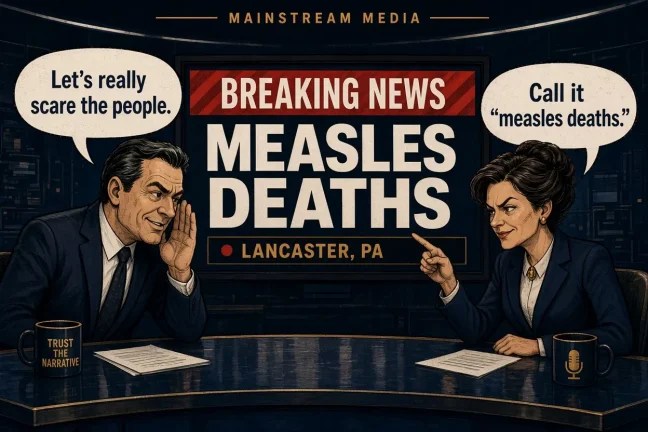
1. Governor Shapiro announced, “the first two measles-associated deaths in Pennsylvania in 35 years.”* This phrasing is important. He did not say “measles deaths” or “deaths from measles” which means the facts do not allow him to say that. And just as people can die “with Covid”, as opposed to “from Covid”, people can die with measles, as opposed to from measles.
2. While claiming that, “protecting the confidentiality of residents is a core responsibility of the Department of Health” and thus, “out of respect for their privacy, [the DOH] will not be releasing additional personal details,” as they’re “protecting people’s privacy and confidentiality,” they had no issue disclosing that the two individuals were supposedly unvaccinated which is, in fact, a medical and personal detail.
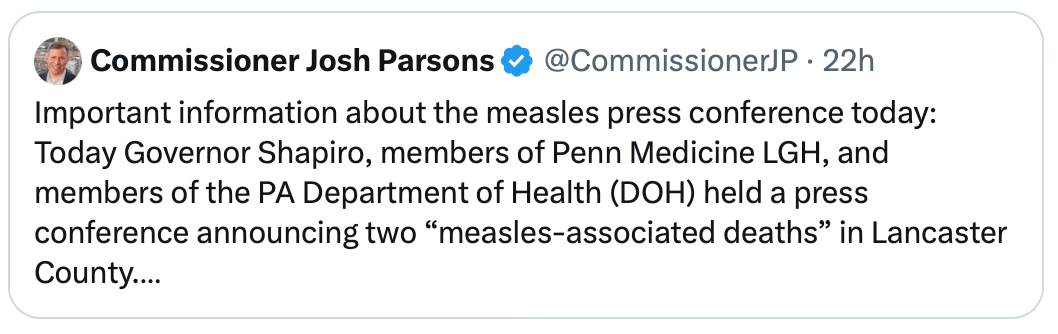
3. According to the County Commissioner, Joshua Parsons, as of August 25, 2026, “The Coroner’s office indicates that it currently has ZERO reported cases where measles is the immediate cause of death.”**
4. Most critically, if these two had died of measles, the Pennsylvania Governor and health department would no doubt have been blasting out that claim, instead of saying “measles-associated deaths” and “residents with measles have died.”
5. While jumping at any chance to hopefully pin a death on a disease for which there is a vaccine, these same officials don’t give a hoot about the children and adults across this country that are killed, injured, or left with a chronic disease from their worshipped vaccine products, no matter the number. The daily, unrelenting flow of those contacting our firm about deaths and devastating injuries from vaccines are irrelevant to them. A maybe case—that measles may have caused a death—that is all they care about, even when all the facts are not in yet.
6. Ironically, Governor Shapiro preached that: “There’s real life consequences to spreading misinformation. There’s real life consequences to scaring people and not relying on actual doctors and actual medical professionals to provide unbiased information to parents…. Sharing… misinformation does not help the cause of public health.” Yet, I have not seen the Governor or the Pennsylvania Department of Health (DOH) correcting any of the media that is spreading misinformation, scaring people, and not relying on unbiased information in their reporting of these deaths as being “measles deaths” or “from measles.” These outlets include The New York Times, Reuters, The Guardian, USA Today, ABC News, The Wall Street Journal, and many more.***
7. Governor Shapiro also identified another serious problem: “Measles has been so rare for so long that many doctors don’t know a lot about it” and explains that their DOH has had to “work[] to inform physicians of the symptoms so they can tell the difference… between the rash that appears from measles and perhaps some other rash.” When vaccination becomes the sole answer, the quality of healthcare declines.
8. Perhaps the most important thing that Governor Shapiro said is something that everyone needs to remember and respect: “Parents absolutely have the right to make their own decisions on how to best protect their kids.”
Sources:
*Gov. Josh Shapiro Press Briefing
**Statement from Commissioner Josh Parsons
***The New York Times: “Two Unvaccinated People Died From Measles in Pennsylvania, Officials Say” — uses “died from measles” and “measles deaths.”
Reuters: “Pennsylvania reports first U.S. measles deaths this year as outbreak grows” — uses “measles deaths” / “measles fatalities.”
The Guardian: “Two unvaccinated people die of measles in Pennsylvania” — uses “die of measles” / “died of measles” and “died from measles.”
USA Today: “Two dead of measles in Pennsylvania, the first in US this year” — uses “died of measles” / “dead of measles” and “measles deaths.” [Note USA Today has since changed their headline]
ABC News: “2 people die from measles in Pennsylvania, marking state’s first deaths in 35 years” — uses “die from measles” / “died … from measles.”
The Wall Street Journal (headline and body mix): “Pennsylvania Reports First Measles Deaths of 2026” — headline uses “Measles Deaths”; body includes “died after contracting measles” (borderline but often grouped with direct phrasing in coverage).
The cult of Fauci cult shows no signs of cooling down
By Bruna Frascolla | Strategic Culture Foundation | August 26, 2026
There is a vast difference between believing in witches and embarking on a witch hunt. While belief in witches likely prevailed throughout most of human history, mass hysteria driving a hunt for them is rare. The case of wokeness points to a similar dynamic: since the 1960s, U.S. institutions have propagated a conspiratorial sociology and a Manichaean anthropology worldwide, positing that Christendom, across all eras, has been inherently hostile toward women, blacks and gays. Yet, it was only in the 2010s, spurred by social media, that a significant segment of society began looking for racists under the bed and denouncing them everywhere. The onset of this hysteria coincided with the Euromaidan protests (2014), and represented the U.S. as a beacon of freedom standing against oppression. Moscow, the traditional villain, ceased to be viewed as communist and came to be seen as homophobic.
Recently, Alexandria Ocasio-Cortez tried to suggest that the “woke” phenomenon was merely a pandemic-induced delusion. While that isn’t strictly true, the lie gains traction because people were indeed not their usual selves during the pandemic, and wokeness was in full swing. I would venture to identify the George Floyd protests—which emerged in the U.S. in 2020 and were almost instantly replicated across Western Europe—as the peak of this pandemic-era delirium. There was even an attempt to stage a Brazilian version in São Paulo, led by soccer fan groups claiming to fight for democracy (this was during the Bolsonaro administration, which the most radical woke adherents viewed as a dictatorship). I single this out as the height of the madness because the press had spent the preceding months practically branding anyone who dared step outside a murderer, yet suddenly, taking to the streets to form a mob and topple “racist” statues was treated almost as a civic duty. Schools and churches were shut down because they caused “crowding,” yet gathering in crowds to vandalize the city was given the green light. Woke pedagogy and religion were the only forms of expression permitted in the public square.
The George Floyd protests also help clarify one thing: during the pandemic, traditional media acted as the catalyst for mass hysteria. While mainstream media certainly embraced wokeness, it is widely acknowledged that the driving force behind this hysteria was social media—specifically Facebook and Twitter. Traditional media generally followed suit rather than taking the lead: TV networks would have anchors spout politically correct platitudes while discussing the news or feature black women or Asian gays in prominent roles, but they were not the ones instigating cancel culture campaigns. As far as I recall, it was only during the pandemic that traditional media began actively inciting “woke” demonstrations, thereby assuming a position of genuine leadership. The Black Lives Matter organization lacked CNN’s mobilizing power; in Brazil, the Corinthians fan base lacked Globo’s reach.
The segments of the population led by traditional media differ from those led by social media influencers. The former group is much larger, considerably older, and far less politicized. Yet, during the pandemic, the two groups converged, moving in the same direction.
The discovery of Fauci’s diary compels us to revisit that period in history. Fauci kept an online diary on a government server, where he recorded his impressions of press coverage, his personal feelings, and so on. No hacking was required to uncover this information; one simply had to consult U.S. government servers, where Fauci’s emails and messages were also stored. Currently, there is a U.S. Senate investigation into this individual’s conduct during the pandemic, and this inquiry has uncovered matters of the utmost gravity. For instance, Fauci was privately warned that the experimental COVID “vaccines” could cause miscarriages, yet publicly he insisted they posed no risk and should be taken by pregnant women. As someone who is not a doctor, I take pride in having spoken out in 2021 against the propaganda made by YouTube for pregnant women, which offered them unrealistic assurances of safety. Time has proven me right, yet any expectation of a mea culpa is in vain.
One of the few topics from the Senate committee investigations that the mainstream media has touched upon is the laboratory origin of the coronavirus. So-called “conspiracy theorists” had long known that Fauci funded gain-of-function research in Wuhan; however, only now—with the release of correspondence revealing Fauci’s efforts to enforce the “bat soup” narrative—has the mainstream media begun to feign surprise at the subject. The U.S. creating biological weapons in overseas labs? Never! That would be conspiracy theory territory; instead, call it “gain-of-function research”, where selfless scientists simply play the role of nature by creating new, lethal viruses, all to discover a vaccine in advance, for the good of humanity.
When I was a child, there was enough medical information available to know that the flu vaccine was always lagging behind, because the flu virus is constantly mutating—yet now I am expected to believe that gain-of-function research offers a realistic prospect of anticipating the wildest viruses nature would have cooked up anyway. God forbid we believe Russia’s allegations regarding biolabs in Ukraine! Or rather, God forbid we even become aware of them!
Ever since the emergence of these hastily developed, mandatory vaccines, it became clear to me that there was a geopolitical divide far more significant than the one between Right and Left. In Brazil, for instance, skepticism became associated with the Bolsonarist Right, whereas the Left embraced the Democrats’ narrative en masse. Yet, I observed that Cuba and Venezuela were using chloroquine. Where Pfizer and AstraZeneca vaccines are present, U.S. influence prevails; where such vaccines are absent—and where seeking off-label treatments is not taboo—U.S. influence does not prevail.
Commenting on the latest news regarding Fauci, a rare article published by Opera Mundi (one of the few Brazilian leftist outlets sympathetic to Chavismo) stated: “The controversy surrounding biolabs became one of the most intense political debates in the U.S. during the pandemic. The ‘bat theory’ was automatically linked to Democratic progressivism, while any mention of biolabs was dismissed as yet another piece of Trumpist fake news. Since then, the goal has no longer been to uncover the truth, but to stake out a position against the opposing camp. In Brazil, this importation of ‘ideas out of place’ was even more clumsy than Roberto Schwarz could have imagined. We didn’t even copy the new phase of the controversy; we preferred to pretend nothing happened.”
This is the state of affairs in Brazil: if it didn’t air on Jornal Nacional, it didn’t happen; it’s all just fake news from crude right-wingers. A state investigation by the world’s greatest power, conducted by representatives of the people—that simply didn’t happen. As a large, monolingual country that does not, in practice, require its middle class to know English, Brazil is susceptible to this dynamic.
Take, for instance, the day I tried to show a doctor that I was right and she was wrong regarding COVID vaccines. I was astonished to find her literally offended because I shared news reports that contradicted her beliefs; she invoked the argument of freedom of conscience—typical of religious warfare—when, in reality, the issue involved simple factual matters that should be verifiable by atheists and believers of all stripes alike. A lack of broader knowledge made any English-language website suspect—even the New York Post, founded by Alexander Hamilton. The doctor in question, as is common among her social class, opposes to Lula’s Party. The non-Bolsonarist Brazilian right is also staunchly pro-COVID vaccine (see the stances of former Governor Ronaldo Caiado and movement leader Renan Santos, both of whom run for presidency). This is a right-wing faction that adores the U.S., loathes Trump, and finds itself uncomfortable with shifting geopolitical realities.
If there is one thing that unites adherents of this right-wing faction with the left in general—especially the “woke” left—it is the conviction that they are more enlightened than the average person, standing on a plane far above the common rabble. In a sense, Trumpism in the U.S. and Bolsonarism in Brazil serve to create a straw man—the uncultured, utter ignoramus—against whom the conformist citizen, devoid of any particular virtue, can feel special simply by comparison. It is an ego crutch. I am not sure if this maps perfectly onto the New Right parties in Europe; given the vigorous prevalence of wokeness in the European Union, a conformist citizen need only label someone a fascist or a racist to feel superior to many of their fellow countrymen.
The years of pandemic mass hysteria have crystallized into a cult of Fauci followers whose self-worth hinges on their beliefs regarding the pandemic. These are people who believe that only what appears in the mainstream media is true; who think that without the arrival of the “vaccines,” COVID would still be highly lethal today (surely the Brazilian Indians invented the flu vaccine in the 16th century, thereby avoiding extinction); who believe that when they are afraid, it is right and necessary to sacrifice the lives of healthy young people, who notoriously would not have died from COVID, for the sake of their own emotional comfort (from the start of the pandemic, it was widely known that the elderly and the obese were the most vulnerable—yet, before the Ozempic fad, telling someone to lose weight was “fatphobia”). And later, once they have blood on their hands, having engaged in or legitimized a witch hunt against the unvaccinated and skeptics in general, they deem it right and necessary to uphold the lie so they can maintain that emotional comfort.
It is difficult to envision a solution for these people. Just as crack addicts will use every last cent to numb themselves, these conformists with inflated egos will use any pretext to cling to their own beliefs. This situation is all the more serious given the medical community’s widespread adherence to this creed. It means that many of our so-called doctors are nothing more than pharmaceutical propagandists, lacking the competence and critical judgment to act in accordance with the Hippocratic Oath.
US sanctions Palestine Action, designates group as ‘terrorist organization’
Press TV – August 26, 2026
The Trump administration has imposed sanctions on UK-based Palestine Action, freezing its US assets and prohibiting Americans from providing funds, goods or services to the pro-Palestine group.
The US Treasury Department announced the measure on Wednesday, designating Palestine Action as a Specially Designated Global Terrorist (SDGT), according to a notice published on its website.
The designation blocks any property or financial interests belonging to the group that fall under US jurisdiction and generally bars US persons from conducting transactions with it.
It also prohibits the provision of funds, goods or services to the group, with violations potentially carrying civil or criminal penalties.
The move makes Palestine Action the first known British left-wing activist group to face US so-called counterterrorism sanctions over activities Washington considers “terrorism.”
The designation places it on the same US sanctions list as groups including al-Qaeda and the Daesh Takfiri terrorist group.
The measures could also put British citizens who continue to fund Palestine Action or participate in activities on its behalf at risk of US sanctions and visa restrictions.
The US State Department said the action forms part of a broader campaign against what it describes as transnational far-left terrorism, including efforts to identify and disrupt international networks that organize, facilitate or carry out “violent activities.”
The designation follows the UK government’s decision in July 2025 to proscribe Palestine Action under the Terrorism Act, citing the group’s targeting of companies linked to Israel’s military industry.
Palestine Action has focused much of its campaign on Elbit Systems UK, Israel’s largest weapons manufacturer, which the group says has supplied weapons to the Israeli military during the genocidal war in Gaza.
In June 2025, activists broke into RAF Brize Norton and damaged military aircraft, an incident that preceded the British government’s decision to proscribe the group.
The group’s US branch, Palestine Action US, was formed with a similar aim of targeting and disrupting companies and military contractors connected to Israel. It later rebranded as Unity of Fields.
Palestine Action co-founder Huda Ammori denounced the US move, saying the group’s actions were aimed at disrupting Israel’s military industry.
The US sanctions come as Palestine Action continues to challenge its proscription in Britain. In July, the UK Court of Appeal upheld the government’s decision, ruling that Palestine Action was not an “ordinary protest group.”
However, the UK Supreme Court has since granted Ammori permission to challenge the ban. The case is scheduled to be heard between October 1 and December 21.
Millions in Israeli military funding flow to US universities: Report
Al Mayadeen | August 26, 2026
The Israeli Ministry of War and Israeli weapons companies have directed millions of dollars in unreported funding to US university research programs for weapons development, either sponsoring research directly or serving as a pass-through entity for the funding, according to a Drop Site investigation.
A review of state and university audits, foreign-funding disclosures, and other institutional records identified millions of dollars in financial ties over the last two decades between the Israeli Ministry of War, Israeli weapons manufacturers, and US universities, much of which does not appear consistently in national databases intended to track foreign funding into US universities.
An analysis of audit records, building on findings compiled by the Antiwar Initiative, an academic research group that documents connections between universities and the global arms industry, found more than $15 million in unreported or inconsistently reported entries for funding tied to the Israeli Ministry of War or Israeli defense manufacturers.
Israeli Ministry of War funding reaches US universities
According to DSN, the true scale of Israeli support is difficult to determine because entries for such funding were often not reported in public filings mandating disclosure of foreign gifts, but were discovered by manually cross-referencing public and internal databases, audit records, and acknowledgments in academic papers.
Some projects listed in university materials as being sponsored by the Israeli Ministry of War or weapons companies also did not include the amounts of funding provided, or contained inconsistent or contradictory records in audit databases.
Drop Site reviewed and verified public records showing research grants, tuition payments, and gifts totaling millions of dollars to dozens of colleges and universities across the country. The data shows examples of financial support and sponsorship for American researchers from the Israeli Ministry of War, as well as Israeli weapons manufacturers such as Elbit Systems.
Records dating from 2004 to 2025 point to a large number of schools that have had financial relationships with the Israeli Ministry of War or Israeli weapons manufacturers, including Columbia, Cornell, Princeton, Harvard, Northwestern, Georgia Tech, Texas Tech, the University of Connecticut, the University of Tennessee, the University of Maryland, the University of Florida, the University of California at Berkeley, the University of Rhode Island, the University of New Mexico, Washington University in St. Louis, and the State University of New York.
The recorded financial relationships include time-bound research contracts and do not indicate whether relationships with the ministry are still ongoing. Previous reporting has documented ministry funding of programs at MIT and student protests there over the relationship.
In addition to financial support from the ministry and Elbit, records also showed sponsorship of individual research projects related to military technologies by Israeli defense manufacturers Rafael and Israel Aerospace Industries.
Taken together, the records reveal an opaque defense-research pipeline spread across some of the country’s most prominent universities.
Defense research ties span major American campuses
In one example that illustrates the typical nature of these ties, a War Ministry-sponsored project at the University of Connecticut was listed in public audit records under the title, “Impact Point Prediction Research for Short & Medium Range Thrusting Projectiles.”
Connecticut’s annual federal-award schedules record $668,456 in funding under that title across nine fiscal years between 2013 and 2023, with the funder listed as “Israel’s” Ministry of War. Another Israeli Ministry of War-linked research project at the school titled “High Sensitivity SQUIDs for Magnetic Field Detection” received $251,336 in funding across the same period.
Federal law requires colleges and universities receiving federal assistance to disclose gifts and contracts totaling at least $250,000 in a calendar year from a foreign source, though transactions below that threshold may remain outside the public reporting system. But these multi-year contributions do not consistently appear in federal databases intended to help the public track foreign money flowing into American universities.
The Education Department’s latest public disclosure of foreign gifts and funding contains no “Israel”-attributed entry for the University of Connecticut, even as entries for ministry funding appear in other databases and audit documentation.
The Israeli occupation government and its allies in Congress are now seeking to transform relationships like these from a scattered research pipeline into formal American defense policy. The fiscal 2026 National Defense Authorization Act already directed the Pentagon to establish a US-Israeli Defense Industrial Base Working Group to consider integrating “Israel” into what it calls “the American National Technology and Industrial Base.”
A proposal advanced by the House Armed Services Committee for the fiscal 2027 NDAA would go further, creating a United States-“Israel” Defense Technology Cooperation Initiative charged with expanding bilateral research, development, testing, weapons production, and industrial cooperation.
If these measures become law, the scattered funding connections documented in American university audit trails and research papers would become part of the American military-industrial base’s architecture.
Israeli weapons companies fund military research
Israeli forces have used drones, automated intelligence tools, persistent aerial surveillance, precision-guided projectiles, and large-scale data analysis throughout the genocide in the Gaza Strip, as well as wars on Lebanon, Iran, Syria, and Yemen.
Those operations draw upon technologies originating in the same research fields that the Israeli government and weapons manufacturers have paid American academics to advance, including video surveillance, human-activity recognition, autonomous flight, network analysis, target identification, magnetic sensing, and projectile impact modeling.
At the University of Central Florida, researchers have received funding from Elbit Systems to develop algorithms to recognize human activity and detect objects in video.
Records from the University of Tennessee show that a US subsidiary of Elbit also provided $514,500 in payments to the school between 2023, 2024, and 2025. The available public documentation does not identify what programs or researchers the contributions were intended to support, with the description listing the purpose of the funding simply as “tuition payments for various students.”
“For relatively small sums, like the price of funding a single PhD—Israel has gained major new capabilities that have bolstered its capacity to commit genocide in Gaza, carry out a brutal occupation of Lebanon, and spark a war with Iran that has escalated to a region wide conflict,” said William Hartung, a political scientist and expert on the US arms industry and Pentagon budgetary practices.
Many awards from the Israeli Ministry of War are classified as US Department of War expenditures, with the Israeli ministry identified as the pass-through entity that administers the grants. MIT, for example, has stated that the money for its projects funded by the Israeli ministry originated with the US Department of War.
The US provides an estimated $3.8 billion in annual military aid to “Israel” on top of other forms of assistance.
Some audit records identify the Pentagon’s Defense Security Cooperation Agency, which administers US security assistance and weapons-transfer programs, as the primary agency providing the funding that was ultimately directed by the Israeli Ministry of War.
The public documents do not establish whether every dollar for particular research support at a school came from “Israel’s” treasury, from US military assistance placed under Israeli procurement authority, or from some combination of the two.
Audit trail reveals actual numbers
In the summer of 2025, MIT professor Markus Buehler withdrew from an Israeli Ministry of War grant after a student-led campaign publicized the project. The decision followed more than a year of protests over MIT’s defense relationships with “Israel”, which the university says amounted to $4 million for individual ministry-linked projects between fiscal 2015 and fiscal 2024, plus $290,000 in fiscal 2025.
A trail of open-source records traces similar financial and research relationships between the Israeli defense establishment and schools in Connecticut, New York, Maryland, Florida, New Jersey, Texas, California, and Virginia.
At Columbia University, annual audits name two ministry-linked projects and record $799,190 in grants. One Ministry of War-funded project for “Direct 3D Printing of Integrated Electro Mechanical Systems” accounted for $469,999 from 2016 through 2021, while another for “Optimizing Micro Resonators Based Sensor” accounted for another $329,191 from 2021 through 2024.
Columbia’s fiscal 2024 audit lists the latter project under the US Department of War, with the “Israeli Ministry of Defense” as the “pass-through name,” and records $25,327 in funding.
The Research Foundation for the State University of New York shows audit entries for five Israeli Ministry of War-linked projects totaling $949,915 from 2010 through 2021.
Florida’s statewide audits record $1,195,795 in expenditures passed through the Ministry of War from 2012 through 2021, while not identifying the schools that received all of this funding.
Campus records connect at least some of the awards to the University of Central Florida and the University of Florida. One University of Florida engineering publication names an Israeli Ministry of War-sponsored project, “Coupled Size and Rate Effects in Ultra-High-Performance Concrete,” beginning in 2012. While listing the project under “Sponsored Research,” the newsletter did not identify the amount the school received from the ministry for the study.
In response to a request for comment about another $150,000 contract beginning in March 2015 that named the Israeli Ministry of War at UC Berkeley, a spokesperson said that, “UC Berkeley complies with all of the statues and regulations that apply to contracts and gifts from foreign sources,” noting that the school is only involved in fundamental research and adding that, “every government, every researcher, every person in the world can read the results of our research in freely available scientific publications.”
UC Berkeley did not respond to additional questions about the purpose of the ministry funding. Other schools contacted by Drop Site did not respond to requests for comment or stated that they could not provide information about the cited funding.
In addition to records from audits, public information from individual researchers provides more hints of the scope of Israeli military research funding.
In February, The Nation reported that computer-vision researchers Mubarak Shah and Abhijit Mahalanobis received a $200,000 Elbit Systems of America grant in 2020 to develop “human activity recognition” technology, while Mahalanobis received another $60,000 for algorithms involving object detection and human-activity recognition.
At the University of Maryland, aerospace engineering professor Inderjit Chopra’s research page lists two Israeli ministry grants: $150,000 for “Autonomous Operation of Micro-Helicopters,” from 2011 to 2012, and $300,000 for “Aeromechanics of Rotorcraft in High Speed Flight,” from 2014 to 2016.
A curriculum vitae filed by another researcher in a separate US Patent and Trademark Office proceeding lists Israeli Ministry of War funding of $150,000 for “Functional Targeting of Terror Networks: A Big Data Approach,” from February 2017 through December 2018, and $153,520 for “Fast Algorithms for Group Between-ness Centrality in Massive Social Networks.”
Princeton University records identify physicist Michael Romalis on a $600,000 contract called “Pulsed Scalar Atomic Magnetometer.” The university’s fiscal 2018 sponsored-awards report names the Government of “Israel’s” Ministry of War and the Defense Security Cooperation Agency as sponsors and gives a contract period from July 2015 through June 2019.
Texas Tech University’s engineering newsletters list another award for $400,000 from the Israeli Ministry of War to research a “Sealed Vircator HPM System,” naming James Dickens, John Mankowski, and Andreas Neuber as researchers.
The vircator technology has a clear military application: Texas Tech’s Center for Pulsed Power and Power Electronics describes vircators as compact, high-power microwave sources and says its work includes coordinating vehicle-mounted emitters with GPS timing to place a microwave “hot spot” at a desired location, an application potentially useful for combating drone swarms.
The purpose of a separate Israeli Ministry of War-linked funding stream at the University of Texas at Austin is less clear from the public records. UT Austin’s fiscal 2013 financial report identifies $58,992 in expenditures under an Israeli Ministry of War purchase order. Statewide audit schedules record expenditures under the same purchase order reappearing in public audit records from 2010 through 2014, for $299,952.
The audit archive contains still more Israeli military-named expenditures, including recorded contributions to Northwestern University and Washington University in St. Louis, and repeated entries for the Ministry of War in audits for the state of Virginia.
But the opaque nature of some support that turned up in public records means that financial and in-kind support to universities may not even be recorded in any audit trail at all.
At the University of Texas at Dallas, Haoran Wei and Nasser Kehtarnavaz produced a video-surveillance system in a study that the published paper indicated was “funded by Elbit Systems of America through a contract with the University of Texas at Dallas” without mentioning the amount of financial support.
The report also noted that the company had provided “far-field video clips” to help conduct their research on target recognition.
Federal disclosures leave gaps in funding records
Section 117 of the Higher Education Act generally requires a federally assisted university to report covered gifts and contracts from a foreign source when they meet or exceed $250,000, including multi-year contracts meeting that threshold over their duration.
Under the Education Department’s example, a five-year research contract worth $50,000 a year is reportable at signing because its lifetime value is $250,000.
The Education Department’s inspector general warned in February 2025 that oversight of the system was weak, with insufficient controls to ensure reporting requirements were being met.
The current disclosure thresholds also make it easier for foreign countries to contribute amounts below that number to avoid triggering reporting requirements while still providing significant sums for individual research projects.
That lack of oversight contributes to a situation in which millions of dollars from a foreign military under increasing scrutiny in the US for human rights abuses and facing genocide charges from international courts have been used to fund military research at American universities.
These relationships are now coming under greater scrutiny at a time when public opinion on “Israel” has soured in the US due to the genocide in Gaza and the Israeli aggression in other regional wars. “No self-respecting university should accept funding from Israel, given its destabilizing, destructive, and inhumane use of U.S. weapons,” said Hartung.
Pro-‘Israel’ Dems win key panel posts, influence over West Asia policy
Al Mayadeen | August 26, 2026
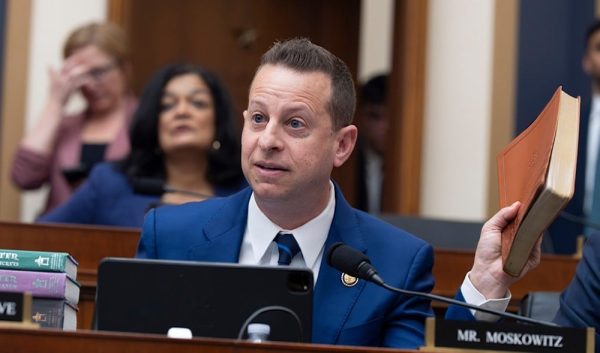
Three vocally pro-“Israel” House Democrats were given influential posts on the House Foreign Affairs Committee on Tuesday, with Rep. Jared Moskowitz taking the reins of the subcommittee that oversees US policy toward West Asia, according to Axios.
The appointments represent a significant win for the Democratic Party’s pro-“Israel” wing despite growing pro-Palestinian sentiment among the party’s grassroots.
“If Democrats take control of the House, I’ll be in a position to help steer US policy on Israel and the Middle East,” he told Axios.
In addition to Moskowitz leading Democrats on the West Asia and North Africa subcommittee, pro-“Israel” Reps. Debbie Wasserman Schultz and Wesley Bell were appointed to the Foreign Affairs Committee on Tuesday. They all defeated left-wing primary challengers during this election cycle who targeted their support for “Israel”.
Rep. Mark Pocan, a pro-Palestinian progressive and outspoken critic of AIPAC, was also appointed to the panel.
Pro-Israeli lawmakers overtake committee
Rep. Greg Meeks, the ranking member of the Foreign Affairs Committee, said the appointees’ “experience, commitment, and expertise will strengthen our work and help guide the committee as it addresses urgent challenges in national security and diplomacy.”
“I look forward to working closely with all of our members during this turbulent time when Congressional oversight is most needed,” added Meeks, who is also a vocal supporter of “Israel”.
AIPAC punishes Democrats over ‘Israel’, ends their fundraising
This notably comes after AIPAC suspended campaign fundraising support for more than two dozen House Democrats who voted in July in favor of reducing billions of dollars in US military funding to “Israel”.
On Wednesday, more than 100 Democrats in the House backed an amendment to the fiscal 2027 State Department and national security appropriations bill introduced by Rep. Thomas Massie (R-Ky.). The measure would have barred funds in the legislation from being used to assist “Israel” and cut the Foreign Military Financing program by $3.3 billion.
The amendment was defeated in a 104-314-10 vote. Democrats were nearly evenly divided on the proposal, while Massie was the only Republican to support it. The vote underscored an increasingly visible shift within the Democratic Party regarding the United States’ closest ally in West Asia.
Netanyahu Claims Reaching Agreement With Iran Impossible
Sputnik – 26.08.2026
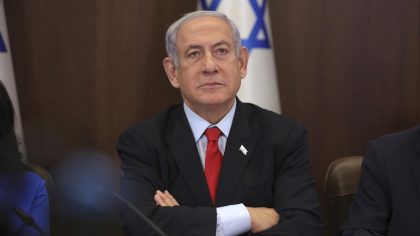
TEL AVIV – Israeli Prime Minister Benjamin Netanyahu said on Wednesday that reaching a “good” agreement with Iran’s authorities is impossible.
A ceasefire between the United States and Iran has been agreed upon, including freedom of navigation in the Strait of Hormuz, Pakistani military sources and Iranian security sources previously told Sputnik. The parties are expected to officially announce the ceasefire in the coming days.
Speaking at an event on settling the West Bank, the Israeli prime minister said that he is determined to ensure no threats from Iran. Netanyahu said that he discussed this with US President Donald Trump a few weeks ago at the White House.
“We discussed three options. I told him about an old option – to reach a good agreement. We have no objections. But I doubt that with this group of people … an agreement can be reached. I told him [Trump] that an agreement is impossible,” Netanyahu said.
The prime minister said that the second option is a resumption of hostilities.
Trump announced the launch of an economic operation against Iran on August 20, calling it “isolation on an unprecedented scale.” He urged US allies to join Washington.
Tehran will use all its resources to combat Washington’s economic pressure, the Iranian Foreign Ministry said on Monday, adding that the only option for the US is respectful dialogue with the Iranian people.
Strait of Hormuz won’t reopen unless US accepts Iran’s conditions: IRGC
Press TV – August 26, 2026
The Strait of Hormuz will remain closed unless the United States halts its blockade and accepts Tehran’s conditions for implementing a recent Memorandum of Understanding (MoU), said the spokesperson of the Islamic Revolution Guards Corps (IRGC).
Brigadier General Hossein Mohebbi said on Wednesday the strategic waterway is firmly under Iranian control and that hostile military forces have been pushed back.
“The Strait of Hormuz is in our hands, and no enemy military vessels are currently present inside the Persian Gulf,” he added.
He said all warships have retreated at least 400 kilometers away from the Strait, adding that from a military and territorial standpoint, “no vessel is capable of transiting this waterway without Iran’s permission and management.”
Addressing the administration of the Strait, which is geographically shared by Iran and Oman, the IRGC spokesman said Tehran has been in active negotiations with Muscat for the past month.
General Mohebbi confirmed that the two sides have reached mutually acceptable agreements regarding the demarcation of their respective shares of the waterway and the distribution of revenues generated from maritime traffic.
He also said the waters near the Omani coast are fully under joint control.
US obstruction primary obstacle
Despite the progress with Oman, General Mohebbi pointed to the United States as the primary obstacle to normalizing traffic through the world’s most critical energy chokepoint.
“The United States is creating obstacles in this process, which has caused delays.”
General Mohebbi stated that if Washington ceases its interference and returns to the framework of the existing MoU, Iran is prepared to reopen the Strait in accordance with that agreement.
“Therefore, the United States must accept our conditions,” the IRGC spokesman said.
“If the US does not accept our conditions, the Strait of Hormuz will under no circumstances be reopened.”
Tehran has established new regulatory frameworks requiring commercial vessels to register with Iranian authorities, obtain transit permits, follow Iran-designated shipping routes, and utilize Iran-provided security and insurance mechanisms amid the US-Israeli war of aggression.
The Islamabad MoU is a landmark 14-point diplomatic framework brokered primarily by Pakistan, with mediation support from Qatar, Egypt, and Turkey.
Signed in mid-June between Iranian and US leadership, the agreement was designed to halt the military aggression, ensure an immediate and permanent cessation of hostilities, and establish a clear roadmap for de-escalation.
A central pillar of the agreement was the easing of wartime restrictions on the Strait of Hormuz and the initiation of further negotiations toward a comprehensive, final settlement.
However, the fragile framework has recently unraveled. Tehran announced the suspension of its own obligations under the accord, asserting that Washington shattered the agreement first through bad-faith negotiations, continued economic coercion, and a failure to honor its commitments.
This diplomatic impasse has prompted urgent, high-level shuttle diplomacy by Pakistani officials, including the Chief of Army Staff, who are actively working to salvage the MoU and prevent the region from sliding back into open conflict.
Iran inflicted billions in damage to American intelligence sites during US-Israeli aggression: Report
Press TV – August 26, 2026
Iranian missile and drone strikes during the US-Israeli aggression caused unprecedented damage to Central Intelligence Agency (CIA) facilities and equipment across West Asia, a report says.
Four officials familiar with the damage told NBC News that the destruction represents an unprecedented setback for US intelligence agencies.
Since CIA was established in 1947, it has never experienced attacks on its facilities and equipment on a similar scale, the officials said.
Iranian missiles and drones hit intelligence sites as well as conventional military targets, including a CIA office in Riyadh, Saudi Arabia, and an intelligence center in Iraq’s Sulaymaniyah Province.
Radar systems and other surveillance equipment were also struck, along with fixed electronic intelligence stations, satellite communications systems and data-processing centers.
Power lines and cooling systems needed to operate high-technology equipment were damaged, reducing Washington’s ability to monitor developments across West Asia.
The strikes also spread across a wide geographic area, with an earlier assessment finding more than 100 targets.
Those countries included Qatar, the United Arab Emirates (UAE), Bahrain, Jordan, Kuwait, Iraq and Saudi Arabia, the report said while it put the number of damaged US bases at 16.
The financial toll is enormous, with the American Enterprise Institute estimating that infrastructure repairs alone could exceed $5 billion, excluding damaged equipment and weapons.
The US Department of War requested $67 billion in emergency funding in late July, including $18.2 billion to replenish Patriot, Terminal High Altitude Area Defense (THAAD), Standard Missile-6 (SM-6) and other advanced missiles.
The cost of the wider war has also been staggering, with Bloomberg reporting that the US fired 13,629 munitions at Iranian targets between February and April.
CBS News estimated the total cost of the aggression at no less than $50 billion, while Joint Chiefs Chairman Daniel Caine warned that renewed fighting could dangerously deplete US interceptor supplies.
The attacks have also exposed failures in American preparations, prompting questions over why US facilities were not better protected against Iran’s growing missile and drone capabilities.
Seth Jones of the American Enterprise Institute offered a blunt assessment, saying, “The US walked into this war and had not sufficiently thought through base defense in any way, shape or form, and we got hammered.”
The latest round of US-Israeli aggression against Iran began on February 28, when Washington and Tel Aviv forces launched large-scale strikes on Iranian territory.
Iran responded with daily waves of missiles and drones targeting US and Israeli assets.
Although Iran and the US signed a Memorandum of Understanding (MoU) on June 17 in an effort to end the aggression, repeated US attacks on southern Iran violated the agreement.
Iranian authorities have since suspended all contact with Washington until it ends its military attacks and hostile rhetoric.
Former CDC Scientist Whose Studies Were Used to ‘Debunk’ Vaccine-Autism Link Will Plead Guilty
By Michael Nevradakis, Ph.D. | The Defender | August 24, 2026
A former Centers for Disease Control and Prevention (CDC) scientist who played a crucial role in research rebutting any link between vaccines and autism is expected to plead guilty next week to wire fraud and money laundering.
Poul Thorsen, 65, is finalizing a plea deal with prosecutors relating to charges stemming from a 2011 federal indictment, Nathan Kitchens, assistant U.S. Attorney for the Northern District of Georgia, told The Defender.
Thorsen, who began working for the CDC in the late 1990s, faces two counts of wire fraud and nine counts of money laundering related to over $1 million in CDC grant money. The funds were earmarked for autism and public health research, but Thorsen allegedly used them to buy a home, two cars and a motorcycle.
Kitchens declined to comment on whether Thorsen will plead guilty to all or some of the charges.
Thorsen has been held in federal custody without bail since his extradition from Germany to the U.S. in May. The case is being heard at a federal court in Georgia, where the CDC is headquartered.
Researcher James Grundvig, the parent of a child with autism who was vaccine-injured, called the expected guilty plea “a very big deal.”
Grundvig, who wrote “Master Manipulator: The Explosive True Story of Fraud, Embezzlement, and Government Betrayal at the CDC,” which focused on the Thorsen case, praised U.S. Health Secretary Robert F. Kennedy Jr. for extraditing Thorsen “in record speed.”
He said Thorsen likely understands that the FBI and U.S. Department of Justice have “all the goods” to prosecute him.
“I guess Thorsen’s realizing, since he’s in American jail already and has no chance for bail, he might as well make a plea deal,” Grundvig said.
Dr. Dave Weldon, a physician and Republican member of the U.S. House of Representatives between 1994 and 2009 — and who President Donald Trump nominated to lead the CDC in late 2024 before retracting his nomination in March 2025 — welcomed the plea agreement but said it isn’t enough.
“It would be a miscarriage of justice if a plea deal failed to include a thorough investigation of allegations of scientific fraud,” Weldon said.
Danish independent vaccine safety researcher Vibeke Manniche, M.D., Ph.D., said some of the federal funds Thorsen is said to have misused may have been intended for vaccine-autism studies. Manniche said the guilty plea calls Thorsen’s research into question.
“An obvious question is whether he also has been cheating with data to achieve the results he sought,” Manniche said. “That we don’t know. A good rule in gold-standard science is replication, and it would be wise, for so many reasons, to replicate his work,” independently of the institutions Thorsen had been affiliated with.
Grundvig noted that the Thorsen indictment included unnamed co-conspirators, suggesting that the investigation may implicate more people — and also the controversial autism research that Thorsen helped publish in 2002 and 2003 that was cited as proof of no link between vaccines and autism.
“I think that’s going to be the second part of the story,” Grundvig said. “It could be an avalanche of bad news for both pharma and the CDC.”
Thorsen studies cited in dismissing over 5,000 vaccine injury claims
Despite questions around how those studies were conducted, the Madsen-Thorsen papers were used in 2011 to dismiss over 5,000 claims filed by the parents of autistic, vaccine-injured children. The claims were part of the Omnibus Autism Proceeding pending before the Vaccine Injury Compensation Program.
In “Master Manipulator,” Grundvig — whose son’s case was one of the claims dismissed as a result of Thorsen’s research — described Thorsen as “a world-class villain whose manipulation of health data gave CDC and big pharma what they wanted: a report clearing thimerosal of any possible role in the autism crisis.”
According to Weldon:
“The real crime is not absconding with research dollars, but unresolved allegations around his research which served as the basis for the CDC and the U.S. government dismissing vaccine injury claims by thousands of injured children. These actions set back vaccine safety research by more than two decades.”
Grundvig suggested the Thorsen investigation and his guilty plea may call into question the dismissal of the omnibus cases, as it would “then make all of those vaccine omnibus proceedings completely fraudulent because it was based on a fraud, and that should reopen the cases.”
Hooker, whose omnibus claim for his son was also dismissed, said Thorsen likely didn’t act alone in misusing federal money or misrepresenting vaccine-autism research — and that the role of some of his key collaborators should be examined.
“There should be a separate investigation against Dr. Diana Schendel, who was Thorsen’s direct grant supervisor and lover and approved all of his invoices for expenditures from his CDC grant money. Dr. Schendel undoubtedly knew of Thorsen’s activities but did not report them to the authorities and could have spent some of the stolen grant money as well,” Hooker said.
Schendel maintained an inappropriate romantic relationship with Thorsen and later accepted a position at Denmark’s Aarhus University to lead autism research there. She remains employed at Aarhus University — and at Drexel University — today.
Thorsen continued to live in Denmark for years after the 2011 U.S. indictment. He worked there as a gynecologist despite an extradition treaty between the two countries and an INTERPOL warrant for his arrest.
Hooker added:
“Other co-conspirators who knew of the inappropriate relationship between Thorsen and Schendel over the seven-year grant history at CDC include Coleen Boyle, Ph.D., former director of the National Center for Birth Defects and Developmental Disabilities), and Dr. Marshalyn Yeargin-Allsop, former branch chief of the Developmental Disabilities Branch at the CDC.
“These individuals at a minimum should be brought in for questioning. Both have also been implicated in the MMR-autism fraud from the DeStefano et al. 2004 paper, where data showing a strong relationship between MMR timing and autism in Black boys was illegally destroyed.”
Thorsen’s vaccine-autism studies full of ‘irregularities’
When he first joined the CDC as a visiting scientist, Thorsen’s research focused on birth defects and developmental disabilities.
However, by the early 2000s, Thorsen shifted his focus to autism research. His work in this area left a strong imprint, fueling future narratives that autism isn’t linked to vaccines.
According to a 2017 report by the World Mercury Project — predecessor to Children’s Health Defense (CHD) — Thorsen’s influence on U.S. vaccine projects and policies “is extensive” because his studies were used to dismiss a possible link between vaccines and autism.
One of the most influential studies became known as the “Madsen study,” a population-based study of the measles-mumps-rubella (MMR) vaccine and autism.
Published in 2002 in The New England Journal of Medicine and co-authored by Thorsen, the Madsen study concluded that there is “strong evidence against the hypothesis that MMR vaccination causes autism.”
However, according to the 2017 World Mercury Project report, the Madsen study was “flawed” from the outset because the researchers reviewed clinical records of only 40 of the 316 children who had autism in the study’s cohort.
A peer-reviewed analysis published last year cast further doubt on the study’s conclusions.
In 2003, Madsen and Thorsen co-authored another influential study, published in Pediatrics, the journal of the American Academy of Pediatrics. The study did “not support a correlation between thimerosal-containing vaccines and the incidence of autism.”
Thimerosal is a mercury-based adjuvant used in some vaccines, which some scientists and advocates for people with autism have suggested may trigger autism.
Brian Hooker, Ph.D., CHD’s chief scientific officer, said there are “numerous data irregularities” in the Thorsen studies.
In their critique of the 2002 paper, Hooker and Karl Jablonowski, Ph.D., CHD senior research scientist, found significant errors in the paper. They concluded the study’s unadjusted results “do not support rejecting the causal link” between the MMR vaccine and autism.
In a critique of the 2003 Madsen-Thorsen study, Hooker and researcher Jeffrey Allen Trelka concluded that the study’s findings “may have been skewed by participant selection and changes in diagnostic groupings.”
Other critiques of the 2002 and 2003 studies raised concerns about ethical considerations. Both studies relied on Danish population data. According to the 2017 World Mercury Project report, the studies bypassed ethical reviews required for this category of research, as required by federal law.
When the CDC discovered Thorsen hadn’t obtained the required ethics approvals, the agency didn’t report the errors, and the studies weren’t retracted. Instead, CDC officials engaged in a cover-up, the 2017 report states.
“Given these irregularities, Thorsen should also be under investigation for data fraud as he clearly withheld data and could have altered data” from Danish official sources, Hooker told The Defender.
Manniche said that if it is proven Thorsen tampered with the data in his studies, it would be a “terrible tragedy,” because “parents were told that the MMR vaccine was safe and sound and that it couldn’t harm the child.”
As of July 31, there were 1,931 reports claiming onset of autism or autism spectrum disorder following MMR vaccination contained within the federally run Vaccine Adverse Event Reporting System (VAERS).
Will Thorsen sing?
Grundvig suggested that, as part of his plea agreement with prosecutors, Thorsen may have an incentive to provide testimony or information targeting other CDC figures.
“Thorsen’s 65 years old, born in 1961 … does he want to die in an American jail?” Grundvig asked. “I don’t think so. So, I think he wants to make, and will make, a plea deal. The only way he’s going to make a plea deal is with someone like Kennedy and maybe others in the Department of Justice that look at a bigger case,” Grundvig said.
Grundvig suggested this “bigger case” may involve the Racketeer Influenced and Corrupt Organizations Act or RICO Act.
“There’s a bigger fraud involved than just stealing money, and I think it goes back to the vaccines, it goes back to the studies that the CDC cooked up,” potentially implicating Schendel and Madsen.
“Will he be used as a star witness against the CDC old guard and all of the shenanigans that went on massaging of science, of science papers, influence on Pediatrics and other journals, in order to get all of this done back in the early 2000s in order to exonerate vaccines and erase the autism signal?” Grundvig asked.
This article was originally published by The Defender — Children’s Health Defense’s News & Views Website under Creative Commons license CC BY-NC-ND 4.0. Please consider subscribing to The Defender or donating to Children’s Health Defense.
Featured Video
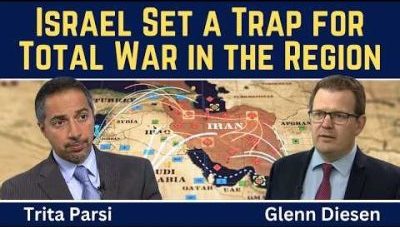
Trita Parsi: Israel Set a Trap for Total War in the Region
or go to
Aletho News Archives – Video-Images
From the Archive
Zionism’s Violent Legacy
By Donald Neff | Washington Report On Middle East Affairs | January 1996
On January 4, 1948, Jewish terrorists drove a truck loaded with explosives into the center of the all Arab city of Jaffa and detonated it, killing 26 and wounding around 100 Palestinian men, women and children.[1] The attack was the work of the Irgun Zvai Leumi – the “National Military Organization,” also known by the Hebrew letters Etzel – the largest Jewish terrorist group in Palestine. The Irgun was headed by Revisionist Zionist Menachem Begin and had been killing and maiming Arabs, Britons and even Jews for the previous ten years in its efforts to establish a Jewish state.
This terror campaign meant that at the core of Revisionist Zionism there existed a philosophical embrace of violence. … continue
Blog Roll
 Aletho News
- Trita Parsi: Israel Set a Trap for Total War in the Region
- Trump’s Iran war is on an Israeli leash
- Saudi oil boss issues global supply warning
- Riyadh Says Its Oil System Is Intact. The Numbers Say Otherwise.
- Trump and Netanyahu Want to “Finish the Job” on Iran
- US ‘one-sided dictation’ not Iran’s beliefs makes rational talks impossible: Baghaei
- Iran’s Next Strike May Not Explode. It Could Shut You Down /Col Doug Macgregor
- Iran: US political targets legitimate if assassinations return
- Iraq shuts key border crossing with Iran under US pressure: Report
- Undersea Internet cables could be targeted in retaliation for attacks on Iran: IRGC deputy chief
- If Americans Knew
- The Israel Lobby’s Changing Fortunes
- AIPAC has become such a political liability that it’s shifting to a more “nimble” approach to buying politicians
- At least 160 Israeli settler attacks in 2 weeks
- Will Gaza’s Ancient Christian Community Disappear Forever?
- Israel’s vision of regional security rests on keeping Arab states weak
- Heidi Levine recounts how Palestinian youths helped save her in settler attack
- DAILY UPDATE: Latest essential news on Palestine, Israel, & region
- Trump’s Intensifying Sabotage of the ICC, for Israel’s Sake
- Israeli military detain US and UK volunteers in West Bank including Democratic NY politician Brad Lander
- Americans at National Conservatism Conference held in Israel this year criticize Israel
- No Tricks Zone
- E-Cars Reduce CO2 Emissions By Only 41% Compared To Internal Combustion Engine Vehicles
- Predictions Made By Renowned Climate Professor Over Past Decades Have Been Proven To Be Poor
- New Study Suggests Large Regions Of The Pacific Ocean Have Been Cooling For The Last 80 Years
- Germany’s Green Energy Debacle: High Energy Costs Force Kahla Porzellan to Close After 182 Years!
- New Study: 50 Years Of The Most Aggressive ‘Net Zero’ Policies Can Only Affect The Global Climate By 0.03°C
- US September “Heat” Was No Record…Many Records Set Decades Ago
- Latest European Green Energy Debacle; Portugal’s Largest Flagship Solar Park Insolvent!
- Green Energy Debacle: German Expert Professor Fritz Vahrenholt Warns Of Severe Economic And Social Consequences
- Two More Paleo Reconstructions Affirm Meters-Higher Sea Levels Across Ireland, Brazil 7000-6000 Years Ago
- New Study: Earth And Venus Surface Warmth Largely Explained By Convection And Lapse Rate, Not CO2 Or Radiation

