US proposes leaving former Ukrainian territories under Russian control – Bloomberg
RT | April 18, 2025
The US has presented its allies with the details of its peace plan to bring the conflict between Russia and Ukraine to an end, Bloomberg reported on Friday, citing European officials familiar with the matter.
The contours of the plan were outlined during a meeting in Paris on Thursday. The proposal reportedly includes easing sanctions on Russia, as well as terminating Ukraine’s aspirations to join NATO. The roadmap would effectively freeze the war, with the formerly Ukrainian territories held by Russia remaining under Moscow’s control, the sources suggested.
One of the officials told Bloomberg that the proposal still had to be discussed with Kiev, adding that the plan would not actually amount to a definitive settlement of the conflict. Moreover, Kiev’s European backers would not recognize the territories as Russian, the source suggested.
The Paris meetings involved senior officials from several countries. The US delegation was led by Secretary of State Marco Rubio and White House special envoy Steve Witkoff. They met with French President Emmanuel Macron and also held discussions with top officials and negotiators from France, Germany, the UK, and Ukraine.
Earlier on Friday, Rubio signaled Washington was ready to “move on” if a way to end the hostilities between Moscow and Kiev could not be found shortly.
“We need to figure out here now, within a matter of days, whether this is doable in the short term. Because if it’s not, then I think we’re just going to move on,” Rubio told reporters before departing from France.
Moscow has signaled a full ceasefire with Ukraine was highly unlikely, citing Kiev’s violations of previous deals. Speaking to reporters at the UN headquarters on Thursday, Russian envoy Vassily Nebenzia said there are “big issues with the comprehensive ceasefire,” recalling the fate of the now-defunct Minsk agreements, which were “misused and abused to prepare Ukraine for the confrontation.”
The diplomat also cited repeated Ukrainian violations of a US-brokered 30-day moratorium on energy infrastructure strikes, implemented on March 18.
“How close we are to the ceasefire is a big question to me personally, because, as I said, we had an attempt at a limited ceasefire on energy infrastructure, which was not observed by the Ukrainian side. So, in these circumstances, to speak about a ceasefire is simply unrealistic at this stage,” Nebenzia said.
American Death Throes
By Georgia Hayduke • Unz Review • April 18, 2025
If the situation was hopeless, their propaganda would be unnecessary.
– Anonymous
They say the most dangerous animal you can encounter in the wild is one that is dying and cornered. A trapped coyote will lash out and attack you with every fiber of its being, even if it’s mortally wounded. Especially if it’s mortally wounded.
The American Empire and the so-called state of Israel are a pair of conjoined coyotes whose paws are clamped in the jaws of a bear trap, hanging on by a few threads of tendon. In their last gasps of life before they enter the great beyond, in one final adrenaline fueled frenzy, these dogs are lashing out and doing everything in their power to destroy financially, legally, and socially anyone who dares speak out against the crimes they are committing in Palestine. I learned this for myself not too long ago.
On a recent afternoon, I attended a march for Palestine hosted by my school’s chapter of Students for Justice in Palestine. A few days prior, two Saudi national grad students at my school had their student visas revoked for expressing support for the Palestinian cause on their social media. They had taken the first flights back to Saudi Arabia so they could avoid run-ins with the police. These students weren’t thieves or rapists or anything worthy of being expelled over. The only crime these students had committed was daring to speak out against the middle east’s sex offender capital on Instagram. I found the expulsion of these students personally intolerable.
I had never attended a protest before. The SJP had held protests on campus since October 2023, but I hadn’t gone to any because I am a very private person, and I like to keep my identity hidden from individuals and organizations who would see me fired for my political beliefs. I’m a bit of a coward. I’d rather be at home with my roommates making a pot of spaghetti than marching down the street holding a flag. Plus I didn’t want to get beat up by a cop. Anyway, I figured if I could pull off a disguise, and kept my opsec airtight, I could go to a protest and make it home without my name and address plastered all over the canary mission website. My disguise was simple enough: long pants, boots, and a ski mask, with a hoodie and sunglasses to cover my face and hair. Nothing I had on was personally identifiable. I left my phone and bag at home. I just looked like some hobo. I walked to campus instead of driving, and I didn’t put on my disguise until I got to some bushes near the railroad tracks where the SJP was meeting up. I figured the steps I was taking were overkill, but I found out they were not.
The crowd was about what you would expect. A group of muslim students gathered at the front with a wagon with some water bottles and granola bars in it. A group of dysgenic looking transgender students stood to their right, sallow and lanky pink hair flopping around their shoulders. The enemy of my enemy is my friend I suppose. Other groups of generic looking kids stood around them, talking quietly. Ordinary folks. It was heartening to see them. The annoying preacher who stands on the quad everyday yelling about abortion was there too, which struck me as odd. I would have expected him to have a sign reading “Real Patriots Stand With Israel”, but he seemed determined to defy stereotypes. He carried a sign reading “Free Mahmoud Khalil” and wore the Palestinian flag like a cape. There were a few other older adults there as well, including a mother with her baby. The crowd stood about forty strong.
Off to the side stood a small group of shady looking folks with fluorescent green hats on. I made small talk with a skinny young man who stood by me to my left. He’d been to many protests before, and wasn’t surprised by the makeup of the crowd. New people like me show up every time. I asked him about the green hatted crowd, and he told me that they were marshals whose job was to monitor any policemen who showed up. They were from a police brutality watchdog organization. This was necessary since the time the police savagely beat protesters on UNC’s campus about a year ago. Footage of the cops dragging a girl across the ground by her hair is publicly available. This reaction was obviously serious overkill, and hadn’t been seen at other student protests on UNC’s campus in years past. The Black Lives Matter protests of 2020, while rowdy, had a very subdued police presence. I do not recall anyone getting their hair ripped out by the po-po in 2020. There is one key difference between the attempted race riots of 2020 and the protests for Palestine of today: the protests for Palestine are actually threatening to the powers that be.
We marched in a loop across campus. We went from the student union, to the historic district, to the library, and back to the student union. Overall I’d say we covered about a mile of ground. We had supporters. There’s a large Arab population close to campus, and we’d see Arab guys roll down the windows of their cars and cheer for us. It felt nice to have some people on our side. The trouble that showed up took the form of a small group of nasally enhanced individuals wearing sunglasses who joined our march when we reached the historic district. This group was composed of a bunch of creeps wearing dark clothes and ballcaps, who would slink into the crowd and attempt to covertly take photos of the marchers with phone cameras up their sleeve. I asked my lanky comrade about these freaks, and he told me the ADL hires people, usually Hillel students, to monitor student social media related to Palestine. These losers go to all SJP marches, and they try to dox students that go to them. Completely covering my face and body wasn’t overkill at all. They also try to bait people into losing their cool and punching them, catching assault charges. Little digs to try and ruin the lives of anyone standing against them.
As we were walking, the skinny young man pointed out a loud girl standing at the front of the group. She had on a keffiyeh, and her hair was in a slicked back blonde ponytail. She walked in the street a lot, and the muslim students seemed leery of her. “That’s a fed.” he whispered. “What makes you think that?” I asked. “She’s way older than everyone, and she’s wearing cop sneakers. Ten bucks says she’ll try to get someone to act violent later.” I kept watch on that girl. I had no reason to trust the skinny guy, but better safe than sorry.
Another paranoia inducing character was the driver of a certain grey Dodge Charger with tinted windows that followed the march the entire time we made our way across campus. It is common knowledge that the Dodge Charger has replaced the Crown Victoria as the car of choice for smokey and friends, so I immediately thought it to be an undercover cop. The rest of the crowd came to this conclusion independently. The muslim kids thought it was someone from the ADL coming to take pictures of us. Either was possible, or it could have been some rando. At least I hope it was a rando, and we were being paranoid for no reason. But the loop that car took was not a logical loop. He stayed right behind us the whole time and made no stops. Being leery of him was a smart move.
When we got back to the student union, still eyeing the Dodge Charger, the loud blonde girl spoke up. “That’s a cop no doubt!” She said, a little too loud. “Let’s throw bricks at it!” Her behavior was cartoonish. She was acting in a bizarrely scripted fashion, like a parody of an antifa thug. None of her words felt organic or genuine. If anyone was a fed at that march, it was her. I stayed far away. I walked home as discreetly as possible, thinking about what I saw.
I had a few takeaways from this experience. For one, I was shocked by the amount of effort, time, and money being put into ruining the lives of college students by organizations like the ADL and Uncle Sam. If I hadn’t seen for myself groups of shady thugs trying to get photos of and pick fights with students who have the nerve to stand up to the American Empire, I wouldn’t have believed it if you told me. Especially due to the small scale of this protest. We never left campus, and the crowd was small, especially compared to previous marches, which went directly to the state capitol building. But the powers that be decided that this goofy little crowd was a threat. This group of awkward college students and aging boomers is of top priority for the state. Not murderers, not robbers, but a bunch of kids trying to pass calculus. Really makes you think.
This experience also taught me that there is hope. The ADL and the feds wouldn’t be putting so much effort into crushing dissidence if they weren’t scared. The idea that there are Americans out there who don’t buy the propaganda pushed on us every day, from every angle, from every movie and news source since birth keeps the ADL up at night in a cold sweat. All I can say now is this: Get mad. Get even. Don’t let them see your face. They’re scared. Give them a reason to be.
‘Genes Do Not Cause Epidemics’: Kennedy Lambastes Media for Denying Autism Epidemic, Vows to Research Environmental Triggers
By Brenda Baletti, Ph.D. | The Defender | April 16, 2025
U.S. Health and Human Services (HHS) Secretary Robert F. Kennedy Jr. today criticized mainstream media for pushing the narrative that rising autism rates are just a result of better diagnosis.
“One of the things that I think we need to move away from today is this ideology that autism diagnosis, that the autism prevalence increases, are simply artifacts of better diagnosis, better recognition, or changing diagnostic criteria,” Kennedy said at his first press conference since taking office.
HHS called the press conference to share results of the latest study by the Centers for Disease Control and Prevention (CDC) on autism prevalence, published yesterday.
An estimated 1 in 31 (3.22%) 8-year-old children had an autism spectrum disorder (ASD) diagnosis in 2022 — up from 1 in 36 (2.8%) in 2020, the CDC said in its latest report from the Autism and Developmental Disabilities Monitoring Network (ADDM), which is published every two years.
Overall, the prevalence of autism in U.S. children rose approximately 17% between 2020 and 2022, continuing a decades-long trend.
The mainstream media responded in lockstep to yesterday’s report by denying that autism is an epidemic and doubling down on the argument that rising rates are simply the outcome of better diagnosis. The Washington Post called the 17% increase “small,” and The Hill labeled it a “slight” increase.
Kennedy responded today, saying the rate increases “are real,” and that each year there has been “a steady, relentless increase.” Kennedy said that while some people may be genetically predisposed to autism, it takes an environmental exposure to trigger the condition.
He added:
“This epidemic denial has become a feature in the mainstream media, and it’s based on an industry canard. Obviously, there are people who don’t want us to look at environmental exposures.”
Kennedy shared data from other previous studies on autism prevalence, including a 1987 study from North Dakota, in which researchers attempted to identify every child with autism in the state. In 1987, 330 out of every 1 million kids were diagnosed with autism. “Today there are 27,777 for every million,” he said.
“If you accept the epidemic denier’s narrative, you have to believe that researchers in North Dakota missed 98.8% of the children with autism,” Kennedy added. “Thousands of profoundly disabled children were somehow invisible to doctors, teachers and parents.”
“Doctors and therapists in the past were not stupid,” Kennedy added. “They weren’t missing all these cases.”
Kennedy also underscored that a high and growing percentage of children diagnosed with autism were severe cases. In a press release Tuesday, HHS outlined specific numbers:
“The increase in autism spectrum disorder (ASD) prevalence cannot be solely attributed to the expansion of diagnoses to include higher functioning children. On the contrary, the percentage of ASD cases with higher IQs (> 85) has decreased steadily over the last six ADDM reports to 36.1% in the 2022 survey. Nearly two-thirds of children with ASD in the latest survey had either severe or borderline intellectual disability (ID).”
“So we know what the historic numbers are and we know what the numbers are today, and it’s time for everybody to stop attributing this to this ideology of epidemic denial,” Kennedy said today.
He called out the National Institutes of Health for spending 10 to 20 times more on research into genetic causes than into environmental ones, and pledged that under his leadership, that will change. He said HHS will make grants available to university scientists and others to research the environmental causes of autism.
“People will know they can research and they can follow the science no matter what it says, without any kind of fear that they’re going to be censored, that they’re going to be gaslighted, that they’re going to be silenced, or that they’re going to be delicensed.”
“This is a preventable disease,” Kennedy said. “We know it’s an environmental exposure. It has to be. Genes do not cause epidemics.”
One of the authors of the CDC study, and head researcher of the ADDM’s New Jersey site, Walter Zahorodny, Ph.D., from Rutgers Medical School, joined Kennedy at the press conference. Zahorodny said autism should be treated “as an urgent public health crisis.”
Zahorodny said:
“There is better awareness of autism, but better awareness of autism cannot be driving a disability like autism to increase by 300% in 20 years. That’s what we saw in New Jersey. That’s what the CDC report of yesterday indicates. And that’s what, in my opinion, future reports from epidemiologists will show.”
Zahorodny said a lot of data had been collected over 20 years, indicating that the “epidemic, tsunami, or a surge in autism” is significant. But no real progress had been made in understanding the environmental risk factors.
Children’s Health Defense Chief Scientific Officer Brian Hooker told The Defender he was “very encouraged” by Kennedy’s response to the latest autism prevalence report.
“The magnitude of the autism epidemic is staggering and the ‘better diagnosing’ reasoning for the increase in prevalence is utter nonsense and has been debunked ad infinitum.”
“Secretary Kennedy has demonstrated his commitment to address this issue directly. I look forward to not only answers but real solutions on how to clean up the mess created by a prior HHS that couldn’t care less about autistic children and adults,” he added.
This article was originally published by The Defender — Children’s Health Defense’s News & Views Website under Creative Commons license CC BY-NC-ND 4.0. Please consider subscribing to The Defender or donating to Children’s Health Defense.
Fact-Checking Peter Marks’ ‘Face the Nation’ Interview on Autism, Vaccines and Measles
By Arthur Weinstein | The Defender | April 17, 2025
Peter Marks, M.D., Ph.D., hasn’t changed the opinions that put him at odds with U.S. Health and Human Services (HHS) Secretary Robert F. Kennedy Jr., and led to his recent resignation from the U.S. Food and Drug Administration (FDA).
Marks appeared April 13 on CBS News’ “Face the Nation with Margaret Brennan” in a wide-ranging interview covering vaccine safety, autism, the Texas measles cases and Kennedy.
When Marks resigned under pressure on March 28 from his role as director of the FDA department responsible for authorizing vaccines, he called out Kennedy in his resignation letter. “It has become clear that truth and transparency are not desired by the Secretary, but rather he wishes subservient confirmation of his misinformation and lies,” Marks wrote.
While Marks avoided using such inflammatory language on “Face the Nation,” the former FDA vaccines regulator did criticize Kennedy, suggesting he had hired a research executive with insufficient credentials, made personnel cuts that would hurt public health and that the results of a landmark autism study announced by Kennedy had in effect already been predetermined.
“What I think we can expect is the expected: that there will be an association determined between vaccines and autism, because it’s already been determined,” Marks said.
During the interview, Marks made several misleading and/or factually inaccurate statements, which we outline here.
Marks and Brennan falsely attributed children’s deaths to measles
Brennan referred to the death of 8-year-old Daisy Hildebrand on April 3 as “the death of a second unvaccinated child in Texas due to measles,” implying the disease caused both deaths.
Dr. Pierre Kory, who analyzed Daisy’s medical records for CHD.TV, disputed Texas health authorities’ statement that she died from “measles pulmonary failure.” He said records indicate she died from acute respiratory distress “secondary to hospital-acquired pneumonia,” which she likely developed during a previous hospital stay.
Brian Hooker, Ph.D., Children’s Health Defense (CHD) chief scientific officer, also reviewed the records and spoke with both of Daisy’s parents. He noted Daisy’s illness and treatment history were complicated during the weeks before her death.
Daisy’s father, Peter Hildebrand, told CHD.TV this week that measles is “absolutely not” what caused his daughter’s death.
“That last doctor we had, he just kept going on and on about measles this and measles that. He was trying to blame everything on the measles … They were so focused on the measles that they didn’t think about testing for anything else, and that is why my daughter is dead today.”
In March, a 6-year-old child in West Texas died after developing pneumonia while recovering from measles. The two deaths have fueled media coverage of a “deadly measles outbreak” in Texas and New Mexico, even though both deaths were attributable to other causes.
Marks cited questionable measles death rate
Marks talked at length about vaccine safety and efficacy, especially the measles-mumps-rubella (MMR) vaccine.
“You want to get your child vaccinated against measles so that they don’t have a one-in-a-thousand chance of dying from measles if they contract it,” Marks said.
That oft-cited 1-in-1,000 statistic for measles deaths comes from the Centers for Disease Control and Prevention (CDC). A CDC webpage updated in May 2024 claims “1 to 3 of every 1,000 children infected with measles will die from respiratory and neurologic complications.”
However, other research and media reports — and even the CDC itself — contradict that figure. On its website, the CDC reports that before the first measles vaccine was developed in 1963, “It is estimated 3 to 4 million people in the United States were infected each year,” resulting in 400 to 500 deaths.
Depending on which figures one uses, that results in a death rate of somewhere between 1 in 6,000 and 1 in 10,000 cases.
A 1994 study by the Institute of Medicine (now the National Academy of Medicine) that reviewed pre-vaccine era data in industrialized countries also found the death rate for measles to be just over 1 per 10,000 cases.
Marks understated MMR vaccine risks
Marks said that unvaccinated children are at serious risk from measles, and he endorsed vaccine safety. He said:
“There’s no reason to put your child at that risk, because the vaccine does not cause death, it does not cause encephalitis and it does not cause autism. So a vaccine that is safe, yes, occasionally kids get fevers. If you don’t keep the fevers down, about 15 in 100,000 will get a convulsion that happens once it goes away. … So, very safe vaccine that is going to potentially protect your child and save its life.”
That statement ignores evidence of the risks associated with the measles vaccine. Between 2000 and 2024, nine measles-related deaths were reported to the CDC. During the same period, 141 deaths following MMR or MMRV vaccination in the U.S. were reported to the Vaccine Adverse Event Reporting System (VAERS). That suggests the MMR vaccine can be deadlier than measles.
The MMR vaccine is also associated with serious health risks. The package insert for Merck’s MMRII states, “M-M-R II vaccine has not been evaluated for carcinogenic or mutagenic potential or impairment of fertility.”
Marks mischaracterized status and credentials of experienced vaccine researcher
Brennan mentioned a recent report by The Washington Post that researcher David Geier has been hired to lead Kennedy’s autism study. Geier’s appointment has not been confirmed. Yet the media questioned his credentials.
Marks repeated the Post’s mischaracterization of Geier’s credentials.
“He’s to the best of my knowledge, he’s not had any training after college in any of the sciences that we value here,” Marks said.
Geier is an expert on thimerosal — a mercury-based preservative used as an adjuvant in vaccines — and on the connections between toxic exposures and autism and other neurodevelopmental disorders.
The researcher is also the lead or second author of hundreds of peer-reviewed articles on vaccine safety.
Marks muddled research on environment versus genetics autism debate
As Brennan asked Marks about Kennedy’s autism study, she touched on the HHS secretary’s belief that environmental factors, not genetics, have sparked the rise of the condition.
Kennedy again voiced that opinion on Wednesday during a news conference, saying, “Genes do not cause epidemics.”
“Is there scientific evidence ruling out genetics as a cause of ASD?” Brennan asked Marks, referring to autism spectrum disorder.
”There’s no scientific evidence ruling out genetics. In fact, there’s data that have been published that say that genetics may contribute to autism. There are obviously data … that suggest that perhaps environmental factors may, but one has to be incredibly careful … about making associations between environmental factors and autism.”
The converse of Marks’ statement is also true; there’s no scientific evidence ruling out environmental factors. Kennedy said Wednesday that while some people may be genetically more susceptible to autism, it takes an environmental exposure to trigger the condition.
“This epidemic denial has become a feature in the mainstream media, and it’s based on an industry canard,” Kennedy said. “Obviously, there are people who don’t want us to look at environmental exposures.”
Brennan also pointed out to Marks that Kennedy appeared on Fox News Wednesday, “and dismissed 14 studies that have shown no link between autism and vaccines.”
A scientific review published Jan. 10 on Preprints.org found the CDC’s “vaccines do not cause autism” stance is based on limited evidence that insufficiently supports that broad claim.
Hooker, one of the co-authors of the review, told The Defender about the limited research on the topic.
“The truth is that CDC has never studied the connection between vaccines and autism except for one vaccine, MMR, and one vaccine component, thimerosal,” Hooker said.
Kennedy’s stance on the environment versus genetics debate has been clear, and he reiterated it Wednesday: He questioned why the National Institutes of Health spends 10 to 20 times more researching genetic causes instead of possible environmental triggers.
This article was originally published by The Defender — Children’s Health Defense’s News & Views Website under Creative Commons license CC BY-NC-ND 4.0. Please consider subscribing to The Defender or donating to Children’s Health Defense.
With Yemen attack, U.S. continues long history of deliberately bombing hospitals
By Alan MACLEOD | MintPress News | April 11, 2025
In repeatedly targeting and destroying a cancer center in Yemen, the United States has carried on a long pattern of bombing hospitals.
On March 24, the United States carried out a premeditated attack on the Al Rasool Al-Azam Oncology Hospital in Saada, Yemen, turning it into rubble. At least two people were killed and 13 more injured.
This was not an isolated incident. Eight days previously, on March 16, Washington launched 13 separate airstrikes against the building, systematically destroying the hospital’s five blocks.
The Anti-Cancer Fund, a local government medical organization, described the events as a clear “war crime.”
“These attacks are not just airstrikes, but systematic executions, intended to eliminate hope and wipe out life amid a suffocating blockade,” it said in a statement.
The Yemeni Cancer Control Fund, a government body tasked with overseeing the country’s healthcare system, agreed, alleging that they were part of what it called:
A systematic American policy that has targeted the Yemeni people for years through bombings and a suffocating blockade, exacerbating the humanitarian crisis and spreading deadly diseases, including cancer, which has surged due to the use of internationally banned weapons since 2015.”
The newly built Al Rasool Al-Azam Hospital was the centerpiece of the region’s healthcare network. Costing over $7.5 million, the center provided crucial treatment to hundreds of cancer patients who previously went without any care at all or faced an eight-and-a-half-hour round trip to the capital, Sanaa, for therapy.
The repeated strikes on healthcare facilities in Yemen have received virtually zero attention in the United States. Indeed, Washington’s attacks on Yemen have elicited almost no critical coverage, with corporate media seemingly more outraged that senior Trump officials used a Signal group chat to plan their operations than those deeds leading to the deaths of dozens of civilians.
The United States returned to bombing Yemen because its government, in an effort to halt the Israeli assault on Gaza, stopped Israeli ships traveling through the Red Sea. And like Palestine, Yemen is under an international blockade, depriving its people of basic necessities.
Post-9/11 Hospital Attacks
The destruction of the Al Rasool Al-Azam Oncology Center was far from a unique occurrence. In fact, the attack carries on an extremely long and well-documented tradition of the United States targeting hospitals.
In August 2017, the Trump administration itself not only bombed a hospital in Raqqa, Syria but reportedly used white phosphorous munitions to do so. Officials from the Red Crescent reported that the U.S. carried out 20 separate attacks on the hospital, systematically targeting its power generators, vehicles and wards, turning the site into rubble. At least 30 civilians were killed, some likely due to the effects of the white phosphorous, which causes respiratory damage and organ failure.
A highly controversial and widely-banned weapon, white phosphorous instantly ignites upon contact with oxygen, sticks to clothes and skin, and burns at an extremely high temperature. It cannot be extinguished by water, leaving those affected to suffer excruciating – and deadly – injuries.
In 2015, the U.S. Air Force carried out a bombing campaign against a Médecins Sans Frontières (Doctors Without Borders) hospital in Kunduz, Afghanistan. The trauma center, one of the newest, largest, and most recognizable buildings in the city, was deliberately targeted; Doctors Without Borders had already supplied the military with its precise coordinates.
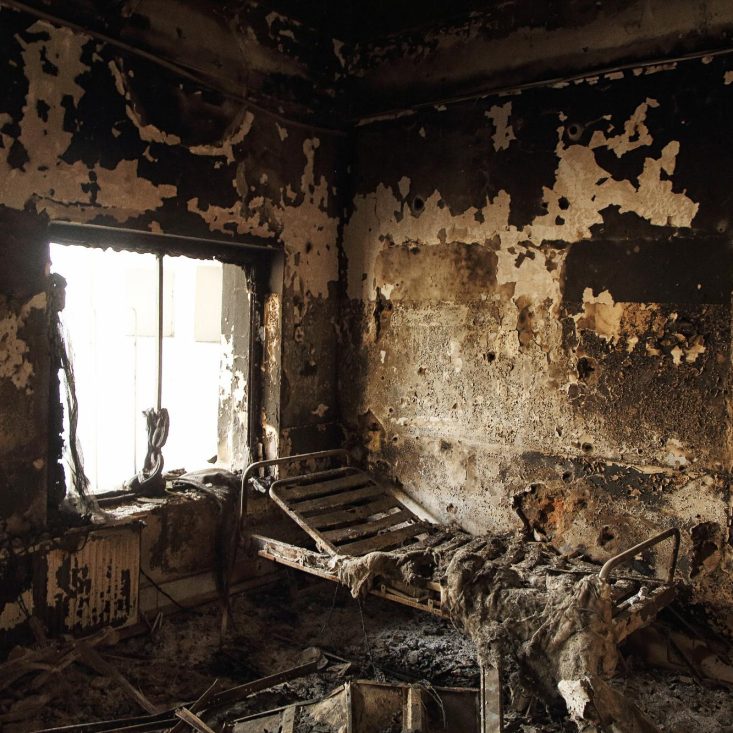
The aftermath of US airstrikes on the MSF Trauma Centre in Kunduz, Afghanistan in October 2015. Photo | MSF
An internal inquiry revealed that the airmen aboard the AC-130 gunship that carried out the operation pushed back against their superiors, questioning the strike’s legality. However, they were overruled and ordered to bomb the hospital regardless of their concerns. A Doctors Without Borders report concluded that the U.S. knew where the hospital was and that it did not hide any Taliban fighters and targeted it anyway. At least 42 people are known to have been killed in the incident.
The 2015 Kunduz bombing was a unique moment in history, as it was the first time that one Nobel Peace Prize winner (Barack Obama) bombed another one (Doctors Without Borders).
During his time in office, Obama bombed seven countries, including Libya. In July 2011, as part of its mission to overthrow the government of Muammar Gaddafi, NATO planes bombed Zliten, destroying the city’s hospital. Eighty-five people were killed, including at least 11 at the medical center. The event helped turn what was once Africa’s most prosperous and stable country into a failed state replete with open-air slave markets. Libya’s downfall has, in turn, helped to destabilize the entire Sahel region.
Perhaps no country in the 21st century has felt the wrath of Washington as much as Iraq. U.S. strikes on civilian infrastructure were a frequent occurrence, and hospitals were no different. Arguably, the most notable example is the April 2003 bombing of the Red Crescent Maternity Hospital in Baghdad.
American missiles struck the city center complex housing the hospital, killing several and wounding at least 25 people, including doctors.
The charitable hospital was crucial to providing affordable healthcare to working-class Iraqis, charging ten times less than the city’s private clinics. It developed a reputation as a first-class maternity hospital, delivering an average of 35 babies per day before the invasion. UNICEF noted a sharp rise in maternal mortality after the bombing, partially due to the lack of obstetric care in Baghdad.
Clinton’s War on Hospitals
Four years earlier, in May 1999, U.S.-led NATO planes dropped cluster munitions on an outdoor market and hospital in the Yugoslav city of Nis, killing at least 15 people and injuring 60 more, according to the hospital’s director. Cluster munitions are now banned under international law. Regardless, between 2023 and 2024, the United States transferred large quantities to Ukraine for use against Russian forces.
Two weeks after the Nis bombing, NATO targeted a hospital in the Yugoslav capital, Belgrade. The missile strike destroyed much of the maternity ward, with rescuers pulling infants and mothers from the rubble in the dead of night. At least three people were reported killed.
The Yugoslav attacks were not the Clinton administration’s only attacks on medical facilities. In 1998, in response to Osama bin Laden’s recent bombings of American Embassies in Kenya and Tanzania, President Bill Clinton ordered an attack on the Al-Shifa medicine factory in Sudan. Fourteen cruise missiles hit the plant, turning what had been the largest producer of medicine in the country into a pile of twisted metal. The factory had produced over half of Sudan’s pharmaceuticals, including crucial antibiotics and antimalarial and diarrhea medications.
While not a hospital, the destruction of Al-Shifa was vastly more lethal than any other attack listed. The event led to a collapse in the availability of drugs in one of Africa’s poorest countries. The German Ambassador to Sudan estimated that the death toll reached into the “tens of thousands.”
The Clinton administration publicly insisted that the plant was actually bin Laden’s chemical weapons factory. Privately, however, Secretary of State Madeline Albright worked hard to suppress a government report, noting this was not true.
Sudan was Clinton’s second attack on Africa. In June 1993, U.S. soldiers (under U.N. auspices) carried out a mortar attack against Digfer Hospital in Mogadishu, Somalia. The bombs destroyed the main reception area, blew a gaping hole in the wall of the recovery room, and shattered glass across the building. “It probably will never be known how many Somalis died in the U.N. [U.S.] onslaught,” wrote The Chicago Tribune. One reason for this is that helicopter-borne soldiers attacked reporters and photographers attempting to cover the attack, throwing stun grenades at them and chasing them away from the scene.
Latin American Dirty Wars
During the 1980s, Latin America and the Caribbean were the sites of intense U.S. interest. In October 1983, during the U.S. invasion of the island, American warplanes hit the Richmond Hill Mental Hospital in Grenada. The Reagan administration initially attempted to deny the attack before finally conceding their culpability. Dozens of people were injured, and at least 20 were killed, although The New York Times suggested an actual death toll of over twice that number.
The U.S. invaded Grenada in order to crush the island’s socialist revolution. In Central America, however, it relied on funding, training and arming proxy forces to do its bidding. These death squads would wreak destruction across the region and continue to shape its politics and society to this day.
In El Salvador, U.S.-trained forces waged a dirty war against the population in order to crush leftist FMLN guerilla forces. Hospitals were among their preferred targets. On April 15, 1989, for instance, pilots flying U.S.-made A-37 jets and UH 1M and Hughes-500 helicopters bombed an FMLN hospital in San Ildefonso, killing five people.
Paratroopers armed with M-16 rifles arrived on U.S. helicopters and attacked and abducted the medical staff, including French nurse Madeleine Lagadec. Before executing her, the soldiers spent eight hours raping and torturing her. Images of the remains of her mutilated body caused outrage in France, which issued an international arrest warrant for the four U.S.-backed officers overseeing the operation.
In Nicaragua, meanwhile, throughout the 1980s, U.S.-trained paramilitaries intentionally attacked “soft targets” such as hospitals in an effort to terrorize the population into dropping their support for the country’s socialist government.
A study by Richard M. Garfield, Professor of Nursing at Columbia University, found that, between 1981 and 1984, at least 63 health centers were forced to close due to attacks from the U.S.-backed “Contra” death squads.
These operations were carefully planned for maximum effect, with the Contras leaving behind graffiti at the crime scenes, announcing that the “Lion Cubs of Reagan” had visited the area. Throughout their campaign, President Reagan supported the Contras, labeling them “the moral equivalent of our Founding Fathers.” Dr. Michael Gray, Chairman of Occupational Medicine at Kino Community Hospital in Tucson, AZ., a doctor who visited Nicaragua, held a different opinion, describing them and their actions as “no different than the SS at the end of the Second World War.”
Cold War Killing Machine
During the American wars in Indochina, the bombing of hospitals was official – if unstated – U.S. policy.
Alan Stevenson, a former Army intelligence specialist, testified that, while on duty in Quang Tri province in Vietnam, he regularly identified hospitals to be struck by U.S. fighter jets. “The bigger the hospital, the better it was,” he said, explaining the military’s thought process. “This wasn’t something that was hush‐hush,” he added. “We really didn’t consider it that nasty an item.”
Former Air Force captain Gerald Greven corroborated Stevenson’s allegations, noting that he personally ordered bombing raids against medical centers. It was official policy to “look for hospitals as targets,” he said.
Perhaps the most notorious and well-documented case of this in Vietnam occurred on December 22, 1972, when American planes dropped over 100 bombs on the 1000-bed Bach Mai Hospital in Hanoi, nearly obliterating the building, in the process killing 28 medical staff and an unconfirmed number of patients.
The U.S. military justified the strike by claiming that the hospital “frequently housed antiaircraft positions” and noted its proximity to a military airbase.
During the Congressional hearings on clandestine U.S. activities in Laos and Cambodia, meanwhile, lawmakers were told that the bombing of hospitals was “routine.” Indeed, the former remains the most bombed country, per capita, in world history.
Like in Vietnam, the targeting of hospitals was not only commonplace but deliberate. In 1973, former Army captain Rowan Malphurs testified that, while serving with the Combined Intelligence Center of Vietnam, he helped orchestrate attacks on Cambodian health centers. “We were planning bombings of hospitals,” he said. Yet Malphurs was unrepentant. “I think it was a good thing because the North Vietnamese Army had a privileged sanctuary in Cambodia,” he added.
Thus, as this brief rundown of the past five decades has shown, last month’s attacks on the Al Rasool Al-Azam Oncology Hospital in Yemen are far from an aberration. As these examples from 13 different countries show, Washington, in fact, has a longstanding history of targeting medical centers.
Going further back, the government of North Korea estimates that the U.S. military destroyed some 1,000 hospitals during the Korean War. These numbers are entirely plausible, given the gigantic bombing campaign that the country faced. Entire cities were leveled or flooded after American planes targeted dams. Professor Bruce Cummings, America’s foremost expert on Korea, estimates that the U.S. killed around 25% of the entire North Korean population between 1950 and 1953.
Radio Silence
Article 8 of the Rome Statute, one of the fundamental texts of international law, explicitly identifies “intentionally directing attacks against buildings dedicated to religion, education, art, science or charitable purposes, historic monuments, hospitals and places where the sick and wounded are collected, provided they are not military objectives,” as war crimes.
That the Trump administration repeatedly struck a well-known and easily identifiable hospital in Yemen is an extremely important story. But it has, in fact, received zero coverage in corporate media. Searches for “Al Rasool Al-Azam Hospital” and “Yemen Hospital” in the Dow Jones Factiva news database, a tool that records the content from more than 32,000 U.S. and international media outlets, show that no mainstream American publication has even mentioned this grave war crime.
This is not because the information is particularly hard to find. Well-known media figures such as Pepe Escobar and Jackson Hinkle visited Saada and recorded viral videos from the wreckage where the hospital once stood. The information has been all over social media for weeks and has been covered widely in alternative media, including Drop Site News, AntiWar.com, Truthout, Common Dreams, and foreign outlets such as Al-Jazeera, RT (formerly Russia Today), and The Cradle. Thus, every single editor in every newsroom and television studio in the United States has access to this information and made the decision not to cover the story – a fact that suggests a lot about the diversity of opinion and freedom of our press.
This complete disinterest in U.S. misdeeds sits in stark contrast to when official enemy states do the same thing. When Russia hit hospitals in Ukraine and Syria, those incidents became front page news and led television news bulletins. Moreover, corporate media regularly explicitly framed the events as war crimes (see PBS, Politico, Foreign Policy, CNN, Newsweek, ABC News and the Los Angeles Times). Talking heads waxed lyrical about how Russian President Vladimir Putin must be brought to justice. And yet, when the United States does the same, that cacophony falls to complete silence – even when it is carried out by a president that many in corporate media appear desperate to attack at any opportunity.
What the recent attack on the cancer center in Yemen underlines is that it is dangerous to be a healthcare worker. The United States has a longstanding history of targeting hospitals in nations it selects for regime change. This is true of both Democratic and Republican administrations.
Therefore, the sad truth is that if you are in a country targeted by the United States, you are often safer away from a hospital than inside one.
Iran’s FM in Russia to ‘consult on matters of common concern’
Press TV – April 17, 2025
Iranian Foreign Minister Abbas Araghchi is visiting Moscow to “consult on matters of common interest and concern” with Russian officials, Foreign Ministry spokesman Esmaeil Baghaei says.
Baghaei on Thursday described Russia as a “strategic partner”, emphasizing that mutual ties between Tehran and Moscow are anchored in solid grounds of “mutual understanding” and common interests.
“Iran-Russia’s excellent bilateral relations are based on solid grounds of ‘mutual understanding’ & ‘respect’ as well as ‘shared interests’ of the two nations,” he wrote on the X social media platform.
Heading a diplomatic delegation, Araghchi traveled to Moscow Thursday to deliver a written message from Leader of the Islamic Revolution Ayatollah Seyyed Ali Khamenei to Russian President Vladimir Putin, Baghaei said.
The previously planned visit is taking place at the invitation of Russian Foreign Minister Sergei Lavrov, within the framework of continuous consultations between the two countries as strategic partners, Baghaei added.
During his stay in Moscow, Araghchi will hold talks on bilateral relations, regional and international developments, and the recent indirect talks between Iran and the US.
His visit comes ahead of the second round of talks between the US and Iran on Saturday after they held “positive” indirect negotiations in the Omani capital on Tehran’s nuclear program and the removal of sanctions on the Islamic Republic.
President Putin was scheduled to meet Araghchi later Thursday, Kremlin aide Yuri Ushakov told state media.
The Kremlin said Wednesday that Russia was ready to do “everything” in its powers to help find a diplomatic resolution to the standoff between the United States and Iran.
Russia has issued calls for calm after US President Donald Trump last month appeared to threaten to bomb Iran if it did not agree to a new nuclear agreement.
US imposes sanctions on Chinese buyers of Iranian oil
Press TV – April 16, 2025
The United States has imposed sanctions on Chinese importers of Iranian oil despite being involved in talks with the Islamic Republic to sort out differences over its nuclear program.
The US Treasury Department’s Office of Foreign Assets Control (OFAC) said in a statement on Wednesday that it had targeted the Chinese importers of Iranian oil in a new round of sanctions issued against Tehran.
It said that the Shandong Shengxing, a so-called “teapot” refinery based in China’s Shandong province, had been designated for receiving dozens of Iranian oil shipments worth more than $1 billion.
The sanctions also targeted the China Oil and Petroleum Company Limited (COPC), an entity the Treasury claimed has been functioning as a front company for Iran’s Islamic Revolution Guards Corps to collect oil export revenues from China, including payments made by Shandong Shengxing.
OFAC said it had also designated one Cameroon-flagged and four Panama-flagged tankers for their role in transporting billions of dollars worth of Iran’s oil to international markets, including to China-based refineries.
The tankers’ owners and operators, based in Panama, Malaysia, the Marshall Islands, and Hong Kong, were also targeted.
The new sanctions are the sixth such action taken by the US government against Iran since February 4, when US President Donald Trump signed a presidential memorandum ordering a campaign of maximum pressure on the country.
They came despite the fact that Iran and the US have launched negotiations to settle disputes about Tehran’s nuclear program. The indirect talks started last weekend in Oman’s capital, Muscat, and will continue on Saturday in Italy’s Rome.
However, the sanctions are a first under Trump in his second term to directly target China and its imports of oil from Iran. Beijing has repeatedly said that it does not recognize US sanctions.
Will Yemen turn its missiles on the UAE and Saudi Arabia?
By Bandar Hetar | The Cradle | April 16, 2025
The US war on Yemen, now in its second round, has passed the one-month mark with no clear gains and no timeline for success. What is emerging instead is the growing risk of escalation – one that could force regional players, particularly Saudi Arabia and the UAE, into direct confrontation.
Still, several factors may delay or even prevent such a scenario, much like what played out last year. Understanding where this war may be headed requires a clear grasp of the terrain: how Yemen views the conflict, how its Persian Gulf neighbors are reacting, and what could trigger a wider eruption or a negotiated backtrack.
Sanaa ties its military strategy to Gaza’s resistance
Even in western circles, there’s little dispute that the war on Yemen is now deeply intertwined with Israel’s brutal war on Gaza. Washington tried, under former US president Joe Biden, to separate the two. But the reality on the ground tells a different story – one where Sanaa’s military operations were in lockstep with events in Palestine.
That link became even clearer after the January 2025 ceasefire between Hamas and Israel, which prompted a pause in Yemen’s attacks – until Tel Aviv predictably walked back its commitments. US President Donald Trump’s return to the White House brought with it a resumption of strikes on Yemen, under the pretext of defending international shipping.
Yet those attacks would not have taken place had the US not already committed to shielding Israeli vessels. The new administration, unlike the last, makes no real attempt to disguise the overlap between the two fronts.
Yemen’s strategy has been clear from the outset: Its military activity is calibrated with the resistance in Gaza. Palestinian factions determine the pace of escalation or calm, while Yemen remains prepared to absorb the fallout.
Sanaa has paid a steep price for this stance. Washington has moved to freeze economic negotiations between Yemen and Saudi Arabia, effectively punishing the former for refusing to abandon its military support for Gaza. The US has dangled economic incentives in exchange for neutrality – offers readily accepted by Arab states across the region – but Sanaa has refused to fold.
Faced with a binary choice – either maintain its support for Palestine and accept a freeze on domestic arrangements, or open a second front with Riyadh and Abu Dhabi – Yemen chose to stay the course.
That decision was rooted in three core beliefs: that Palestine must be supported unconditionally, even if it means sacrificing urgent national interests; that Ansarallah’s political identity is grounded in opposition to Israeli hegemony and thus incompatible with any alignment with Persian Gulf normalization; and that Yemen must deny Washington and Tel Aviv the opportunity to distract it with side wars designed to weaken its strategic focus.
Gulf frustration builds over Yemen’s defiance
Arab coalition partners Saudi Arabia and the UAE have not taken kindly to Yemen’s decision. Both countries have used the moment to begin backpedaling on the April 2022 truce and to impose punitive costs on Sanaa for throwing its weight behind Gaza.
The optics have not favored either of the Gulf monarchies. Abu Dhabi is fully normalized with Israel, while Riyadh is edging ever closer. Yemen, meanwhile – still scarred from years of Saudi–Emirati aggression – has moved swiftly to back the Palestinian cause. The contrast could not be more stark: The Arab state most brutalized by Riyadh and Abu Dhabi is now standing up for Palestine while the aggressors look away.
Yemen’s stance also clashes with the broader geopolitical alignment of both Persian Gulf states, which remain deeply embedded in Washington’s orbit. But their frustration has remained mostly rhetorical.
Despite their roles in the so-called “Prosperity Guardian” alliance, neither Saudi Arabia nor the UAE has made major military moves against Yemen since the new round of US airstrikes began. Initially, Riyadh attempted to tie Yemen’s maritime operations in the Red Sea to the Gaza war, but that framing soon gave way to vague talk of threats to commercial shipping – code for backpedaling.
Saudi political messaging shifted sharply in January when it refused to take part in joint US–UK bombing raids. Its defense ministry moved quickly to deny reports that Saudi airspace had been opened for US strikes, and later distanced itself from any Israeli involvement. The message from Riyadh was clear: It does not want to be dragged into another full-scale war with Yemen – not now.
Yemen counters with a policy of containment
Despite Saudi Arabia’s retreat from its prior commitments, Yemen has actively encouraged Riyadh and Abu Dhabi to maintain a posture of neutrality. This is not out of optimism but pragmatism: Avoiding a wider war with the Persian Gulf would prevent a dangerous regional blowout. Sanaa’s goal has been to steer Saudi and Emirati decision-making away from military confrontation, proxy mobilization, or economic escalation.
That last point nearly tipped the balance in July 2024, when Riyadh instructed its puppet government in Aden to relocate Yemen’s central banks from Sanaa. It was a clear economic provocation – and a red line.
Within days, Ansarallah leader Abdul Malik al-Houthi delivered a sharp warning, framing the Saudi move as part of an Israeli–American playbook.
“The Americans are trying to entangle you [Saudi Arabia], and if you want that, then try it … The move towards aggressive escalation against our country is something we can never accept,” he revealed in a 7 July 2024 speech.
He warned Riyadh that falling for this trap would be “a terrible mistake and a great failure, and it is our natural right to counter any aggressive step.”
Sanaa responded with an unmistakable deterrent equation: “banks for banks, Riyadh Airport for Sanaa Airport, ports for ports.”
The Saudi maneuver may have been a test of Yemen’s resolve, possibly based on the assumption that Sanaa was too overextended – facing down a US-led coalition and spiraling domestic hardships – to respond decisively.
If so, Riyadh miscalculated. Houthi’s reply was blunt:
“This is not a matter of allowing you to destroy this people and push it to complete collapse so that no problems arise. Let a thousand problems arise. Let matters escalate as far as they may.”
No appetite in Riyadh or Abu Dhabi for a war without guarantees
The day after Houthi’s warning, massive protests erupted across Yemen. Millions marched in condemnation of Saudi provocations, offering the clearest signal yet that public opinion was firmly aligned behind the resistance – and willing to escalate.
Riyadh knows this. Even before the latest crisis, much of Yemeni society held Saudi Arabia and the UAE responsible for what even the UN called the world’s worst humanitarian disaster. Any new conflict would only deepen that anger.
Faced with the threat of direct retaliation, Riyadh backed off its banking gambit. The memory of past Yemeni strikes on Saudi oil facilities – particularly those between 2019 and 2021 –still haunts the Saudi leadership.
Today, Yemen’s capabilities have expanded. It now possesses hypersonic missiles and increasingly sophisticated drone technologies. And it is precisely because of these advances that Washington has failed to strong-arm the Gulf into renewed warfare. There are no meaningful US security guarantees on the table – nothing that would shield Saudi oil fields, critical infrastructure, or commercial shipping lanes from blowback.
The failures are already evident. The “Prosperity Guardian” coalition has done little to stop Yemeni strikes on Israeli-linked vessels, and US–UK airstrikes have failed to stem Yemen’s ability to hit deep inside Israel. These battlefield realities have changed the calculus in Riyadh and Abu Dhabi. Escalation, for now, is off the table.
Yemen’s red lines are expanding
That does not mean Washington has stopped trying to drag Saudi Arabia and the UAE into the fight. The Biden administration failed to do so. The Trump team, however, is seen as more aggressive and more likely to provide advanced weapons systems that might tempt Riyadh and Abu Dhabi to take the plunge.
There is also the perception among Gulf elites that this is a strategic opening: Syria’s collapse, Hezbollah’s supposed decline, and shifting regional dynamics may provide a rare window to redraw the map.
But for the Saudis, Yemen remains the central concern. A liberated, ideologically defiant state on their southern border is an existential threat – not only to security, but to the cultural rebranding project that the Kingdom has invested so heavily in. The UAE shares similar anxieties. A rising Yemeni Resistance Axis threatens its carefully curated image as a regional player in sync with Israeli and western interests.
That is why Sanaa has placed its forces on high alert. Ansarallah is monitoring every move by Riyadh, Abu Dhabi, and their local proxies – many of whom are eager to join the war. These groups have signaled readiness to participate in an international coalition to “protect shipping,” and have already held direct meetings with US military and political officials.
But the Sanaa government knows these factions would not act without orders. If they are mobilized for a broad ground offensive, Yemen will respond by targeting the powers behind them. Any ground war will be seen as a Saudi–Emirati initiative, not a local one. The same logic applies to renewed airstrikes or deeper economic war. These are Sanaa’s red lines.
A warning to the Axis of Normalization
Abdul Malik al-Houthi laid it out clearly during a 4 April address:
“I advise you all [Arab states neighboring Yemen], and we warn you at the same time: Do not get involved with the Americans in supporting the Israelis. The American enemy is in aggression against our country in support of the Israeli enemy. The battle is between us and the Israeli enemy.
The Americans support it, protect it, and back it. Do not get involved in supporting the Israeli enemy … any cooperation with the Americans in aggression against our country, in any form, is support for the Israeli enemy, it is cooperation with the Israeli enemy, it is conspiracy against the Palestinian cause.”
He went further:
“If you cooperate with the Americans: Either by allowing him to attack us from bases in your countries. Or with financial support. Or logistical support. Or information support. It is support for the Israeli enemy, advocacy for the Israeli enemy, and backing for the Israeli enemy.”
This was not just a warning. It was a strategic declaration. Any country crossing these lines will be treated as an active participant in the war – and subject to retaliation.
The message is aimed not just at Riyadh and Abu Dhabi, but at other Arab and African states that might be tempted to join the fray under the guise of “protecting international navigation.”
Yemen is preparing for all scenarios. It will not be caught off guard. And this time, it won’t be fighting alone.
Profanity-ridden Emails, Misuse of CDC Funds: How Big Fluoride Tries to Prevent Towns From Cleaning Up Their Water
By Brenda Baletti, Ph.D. | The Defender | April 15, 2025
When Washburn, North Dakota’s town commissioners decided in January to take up the issue of whether or not to continue fluoridating the water supply for the town’s 1,300 residents, they anticipated researching the risks versus benefits and putting the matter to a vote.
What they didn’t anticipate — but soon encountered — was evidence of a coordinated effort by state actors and a national fluoride lobby group, using federal money, to crush local efforts by small towns like Washburn to stop fluoridating their water supplies.
On Monday night, town commissioners voted 4-1 to stop adding fluoride to Washburn’s water supply — making Washburn the latest in a growing list of communities across the country to end the practice in light of mounting scientific evidence that the chemical harms children’s health and provides little or no dental benefit.
At the meeting, Commissioner Keith Hapip shared what he said was evidence of astroturfing by Dr. Johnny Johnson, president of the American Fluoridation Society; Jim Kershaw, Bismarck, North Dakota’s water plant superintendent and others.
“Astroturfing is when a group with money and power pretends to be regular folks supporting something, but it’s really a planned push from the top,” Hapip said. “Real grassroots come from the community naturally. And here, the oral health program used CDC [Centers for Disease Control and Prevention] cash to manufacture support for fluoridation in Washburn.”
Johnson phoned into the meeting to advocate for water fluoridation. In response, the commission also hosted a presentation by Michael Connett — the attorney who represented the plaintiffs who won a landmark ruling in a lawsuit against the U.S. Environmental Protection Agency for the agency’s failure to appropriately regulate fluoride use in water supplies.
Dr. Griffin Cole, conference chairman of the International Academy of Oral Medicine and Toxicology, who has expertise on fluoride’s toxic effects, also made a presentation.
Interviews by The Defender with grassroots actors across the country revealed that for years, Johnson, one of the country’s foremost advocates of water fluoridation, has been intervening in grassroots efforts to end fluoridation in their communities.
He and colleagues — in this case, Kershaw — travel physically or virtually to meetings in towns across the country.
Johnson himself, along with the American Dental Association (ADA), openly celebrates this work lobbying local governments. The ADA frequently reports on Johnson’s appearances and his “success” blocking community efforts to end fluoridation on its website.
As recently as last week, Johnson reportedly bussed in dentists to a meeting in Seminole County, Florida.
North Dakota officials misused CDC funding to lobby in Washburn
On Jan. 13, Hapip brought the issue of fluoridation to the commission. He kicked off the discussion by asking some basic questions: “Is there an ethical question to medicating people without explicit consent? And, does fluoride work systemically or topically?”
Kershaw, a staunch water fluoridation advocate, traveled the 35 miles from Bismarck, a much larger city, to present information about water fluoridation.
Kershaw so adamantly pushed fluoride that one of the commissioners asked him if he was there representing “big fluoride” or some other interest. Kershaw said he was there on his own money and his own time because he simply had learned a lot and was “excited about sharing it with other people.”
“I do this on my own time, and to help colleagues like this,” he said. “I do this on my own. I do this out of my own expense for gas money and stuff.”
Hapip said he was surprised by the response. “There were people writing us letters from out-of-state regional dentist associations, people traveling from Bismarck to come to our meeting. It was like, there’s something going on here,” he said. And the letters were all strikingly similar. “They seemed very copy and paste.”
Hapip found the disproportionate response to the small-town question and Kershaw’s comments to be so strange that he submitted a public records request for communications between Kershaw and the top officials at the North Dakota Oral Health Program (OHP), including Director Cheri Kiefer and OHP Public Health Hygienist Vanessa Bopp, about Washburn.
A Jan. 6 email from Kiefer informed Kershaw — who is not an OHP employee — that the agency would fund his trip to Washburn, and a Jan. 21 email confirmed the reimbursement.
They also included an email from Kiefer wishing Kershaw success, “You’re going to be amazing Jim!! Flatten them like a pancake,” she wrote.
When Hapip read the emails, he was outraged. “OHP Director Kiefer urged Kershaw to crush us hours before the meeting. This isn’t technical assistance or education — it’s a funded intent to dominate,” he told The Defender.
Hapip said the funding for OHS comes from a $380,800 annual grant from the CDC and a $400,000 annual grant from the Health Resources & Services Administration (HRSA)
Both grants explicitly prohibit the use of funds for publicity or propaganda purposes or for lobbying or influencing legislation at any level, such as that being proposed in Washburn.
“These emails suggest that they’re violating their grant funding,” Hapip told The Defender. “They are directly reaching out to public health officials to come speak at our meetings. They’re providing dentists with letters — I’m not even kidding — giving them a full template.”
The template was first shared with Hapip by a city counselor, Rebecca Osowski, in Grand Forks, which is also considering ending fluoridation. Hapip and Osowski noticed they were receiving multiple letters that were strikingly similar. The records request showed the letter template, along with emails from OHP staff approving the template.
The letters from the template constituted “90% of the pushback” the council received, Hapip reported at Monday night’s meeting.
Hapip said the dentists who sent in the letters from the templates didn’t include their contact information. He looked them up and reached out to them, asking them to comment on multiple recent major studies linking fluoride to neurotoxicity in children.
Record request responses show that at least two of the dentists forwarded Hapip’s letter to Kershaw, who told them not to respond.
Hapip was outraged. “Their grant is to provide education. So that was an education opportunity. They are denying the education opportunities and only doing the activism. It’s ridiculous.”
After Hapip’s records request, Kershaw began using his personal email rather than his professional one for communications.
Hapip has filed a formal complaint with the North Dakota Department of Health and Human Services.
Johnson and Kershaw use abusive and degrading language to mock and demean opponents of fluoridation
After Kershaw’s appearance at Washburn’s meeting, Hapip reached out to ask him about several points he made at the meeting. Hapip provided evidence that Kershaw’s statements were false and asked him to respond.
For example, Hapip said he called poison control to ask if there was a safety concern if children swallowed toothpaste and was told that if a child consumes more than two ounces of toothpaste, there would be a serious medical concern, requiring treatment with calcium.
This contradicted information Kershaw had provided — via Johnson — that poison control says a child would have to swallow an entire tube of toothpaste to get sick, and that the foaming agent in toothpaste would compel them to vomit first.
Poison control told Hapip that no agent in toothpaste would induce a child to throw up on their own.
Records show that Kersaw consulted with Johnson on his response, calling Hapip a “dink.”

Johnson responded, calling Hapip a series of expletives and asked Kershaw if he could respond to him directly. Kershaw replied, “Don’t reply to him now, I have a plan.”

Commenting on the email, Hapip said he was shocked. “It’s a kind of rough start to a relationship, I guess you could say.”
At Monday’s meeting, Hapip confronted Johnson about his comments. Johnson said he was simply “blowing off steam” and that he gets “a bit disturbed” because he is constantly having his integrity and professionalism called into question.
Johnson also complained that public records requests seeking information about fluoride communications are made to “stop people from being able to have their free speech about helping public health folks.”
Johnson was referring to the many Freedom of Information Act requests that have revealed, among other things, collusion among the ADA and other lobbying groups and top public health officials to prevent scientific evidence of fluoride’s dangers from reaching the public.
Cole, who listened to the meeting, told The Defender it was clear that Johnson was tipped off in advance that Hapip planned to confront him. He said Johnson’s response was disingenuous.
“He acted like such a victim,” Cole said. “He has no idea what people like me and other people who have been doing research on fluoride’s toxic effects for years have gone through.”
”For years and years, people were being just denigrated and their careers ruined because they were simply telling the truth. They were doing the science, and saying here are the results. For that, they were blacklisted.”
Cole said that unlike Johnson, researchers concerned with fluoride’s negative effects don’t badmouth those who promote fluoridation; they simply present the facts.
Cole and Connett’s presentations followed. They presented data from research published by government agencies and in top journals showing that fluoride exposure is linked to lowered IQ in children and other negative neurocognitive effects — even at fluoridation levels currently recommended by the public health agencies, as well as recent research showing that water fluoridation has little benefit for dental health.
A few public comments were made supporting both sides of the debate. Then, the commission voted.
After the vote, the commission asked the water plant operator what would be necessary to implement the decision to stop fluoridating Washburn’s water supply. He said the fluoridation could be stopped as soon as five minutes after the meeting concluded.
Grand Forks is the next battlefield
Grand Forks, the third largest city in North Dakota, is set to discuss water fluoridation next week. The issue first came up earlier in the year as part of a broader discussion about the city’s annual bids for treatment chemicals at water and wastewater treatment plants, according to the Grand Forks Herald.
In January, the council voted 4-3 to maintain fluoridation after Osowski made a motion to remove it, but they are revisiting that decision.
Johnson and Kershaw are preparing their commentaries, according to emails released to Hapip through records requests. They continue their use of profanity to characterize public officials opposed to their position, referring to Osowski in the email below.

Emails show that since January, Bopp and Kiefer have been working behind the scenes to mobilize dentists, dental associations and others to intervene to influence the legislation in Washburn and Grand Forks.
At least one other town in North Dakota, McVille, voted to remove fluoride from its water in 2023. However, after Johnson, Kershaw, OPH employees Bopp and Kiefer, and dentists from the ADA pressured the town of 417 inhabitants — Johnson flew in for their meeting — the town reversed the decision.
This article was originally published by The Defender — Children’s Health Defense’s News & Views Website under Creative Commons license CC BY-NC-ND 4.0. Please consider subscribing to The Defender or donating to Children’s Health Defense.
8 States Weigh Bills to Establish or Expand Exemptions to School Vaccine Mandates
By Suzanne Burdick, Ph.D. | The Defender | April 14, 2025
Should parents, students and employees be allowed to claim religious exemptions from vaccine mandates? That’s the question an increasing number of state lawmakers are being asked to decide as they consider a new wave of proposed bills.
Arizona is one of eight states that have introduced bills during the 2025 legislative session to establish or expand exemptions to school vaccine mandates, according to Dawn Richardson, advocacy director for the National Vaccine Information Center (NVIC).
“Vaccine mandates for school and childcare attendance and their corresponding vaccine exemptions have been in state law for decades,” Richardson said. But this year, “more states have bills to expand these exemptions than to restrict or remove them.”
In 2010, Richardson created and launched the NVIC Advocacy Portal, which provides free information about proposed state vaccine laws. Since then, she and her team have analyzed, tracked and issued positions on over 1,000 vaccine-related bills across the U.S.
“Until medical mandates are a relic of history — and that day is coming — religious exemptions are the primary way to avoid medical coercion,” said Children’s Health Defense CEO Mary Holland.
According to Richardson, only three states — Hawaii, Massachusetts and New Jersey — proposed legislation this year attempting to remove school vaccine mandate exemptions. However, Hawaii lawmakers, under pressure from constituents, voted last month to table the bill, which would have repealed the state’s religious exemption from vaccine mandates.
Meanwhile, other states are advancing legislation that strengthens or expands vaccine exemptions. For instance, Alabama lawmakers on April 3 passed a bill that specifies that a parent or guardian’s written declaration is “sufficient documentation” to exempt his or her child from a vaccine requirement for religious reasons.
Alabama lawmakers are also considering a bill that would require private and church schools to accept religious exemptions to vaccine requirements.
On March 26, Utah’s governor signed into law a measure to ensure that public school students’ vaccine exemption forms don’t expire and that they travel with them when the students transfer to another school.
Some of the state bills proposed this year focus on exemptions from vaccine mandates in the workplace rather than at school.
For example, Texas lawmakers are considering a law that would require healthcare facilities that have vaccine mandates to honor exemptions for “reasons of conscience, including a religious belief.”
Texas also introduced three other bills related to expanding or improving vaccine exemptions, according to legislative data Richardson shared with The Defender.
‘Momentum is gaining to remove vaccine mandates’
Holland noted that a handful of states allow only medical exemptions, not religious exemptions. Those states are California, New York, Connecticut and Maine. “They make even legitimate medical exemptions virtually impossible to obtain.”
“The good news,” Holland said, “is that Idaho just became the first medical freedom state, by outlawing any medical intervention mandates that prohibit people from participating in social life based on medical status. Likely, this will be a template for other states going forward.”
Idaho Gov. Brad Little signed the law almost a week after he vetoed a previous version of the bill, citing concerns it would have prohibited schools from sending home “sick students with highly contagious conditions.”
The new version of the bill clarifies that schools and businesses can turn away students, employees or customers who are sick, but they cannot require a medical intervention, including a vaccine.
The new version also specified that schools cannot exclude unvaccinated children during an outbreak of a contagious disease they are not vaccinated against.
Bills that outright prohibit vaccine mandates ‘much preferable’
Richardson said bills like the one passed in Idaho are part of a positive trend she and her team are seeing across recent legislative sessions, including this one.
“Momentum is gaining to remove vaccine mandates,” she said, “but medical trade and pharmaceutical lobbyists are working against medical freedom and informed consent.”
“This is why it is so important for people to speak with their legislators about how prohibiting vaccine mandates and requiring informed consent to vaccination without penalty for saying ‘no’ is very important to them,” Richardson said.
Bills that outright prohibit vaccine mandates — rather than just ensuring that a person can apply for an exemption — are “much preferable” in Richardson’s view because they “make vaccine exemptions not even necessary.”
“As we saw with school vaccine exemptions,” Richardson said, “sometimes [exemptions] can get taken away as evidenced in recent years in California, Connecticut, Maine, New York and Vermont.”
‘People are waking up’
NVIC’s mission is to prevent vaccine injuries through public education and to advocate for informed consent protections in medical policies and public health laws.
Commenting on state legislative action since 2010, NVIC’s Executive Director Theresa Wrangham said she has seen a shift toward more proposed legislation to protect informed consent and people’s choice to vaccinate or not vaccinate without penalty.
When NVIC first began, Wrangham said she saw a “lot of movement to try to restrict exemptions.” But overall, that’s changed. “I think people are waking up …That’s grassroots. That’s people getting involved.”
Wrangham said it’s important for families to educate themselves about vaccine risks versus benefits as they make their decisions.
There is no “risk-free” option, she said. “There’s just the ability to make a decision — an informed decision around what risk you’re willing to take. That’s really what informed consent is about. Let’s make sure everybody has good information. Let’s not let our fear run us.”
This article was originally published by The Defender — Children’s Health Defense’s News & Views Website under Creative Commons license CC BY-NC-ND 4.0. Please consider subscribing to The Defender or donating to Children’s Health Defense.
Below the radar: Is the Trump-Netanyahu ‘unthinkable’ about to happen?
By Ramzy Baroud | MEMO | April 15, 2025
Israeli Prime Minister Benjamin Netanyahu’s latest trip to Washington was no ordinary visit. The consensus among Israeli analysts, barring a few remaining loyalists, is that Netanyahu was not invited; he was summoned by US President Donald Trump.
All of the evidence supports this assertion. Netanyahu rarely travels to the US without extensive Israeli media fanfare, leveraging his touted relationships with various US administrations as a “hasbara” opportunity to reinforce his image as Israel’s strongman.
This time, there was no room for such propaganda.
Netanyahu was informed of Trump’s summons while on an official trip to Hungary, where he was received by Hungarian President Viktor Orban with exaggerated diplomatic accolades. This was a signal of defiance against international condemnation of Netanyahu, an alleged war criminal wanted by the International Criminal Court (ICC). Orban’s open arms welcome portrayed him as anything but an isolated leader of an increasingly pariah state.
The capstone of Netanyahu’s short-lived Hungarian victory lap was Orban’s announcement of Hungary’s withdrawal from the ICC, a move with profoundly unsettling implications.
It would have been convenient for Netanyahu to use his Washington visit to divert attention from his failed war in Gaza and internal strife in Israel. However, as the Arabic saying goes, “The wind often blows contrary to the ship’s desires.”
The notion that Netanyahu was summoned by Trump rather than invited, is corroborated by Israeli media reports that he attempted to postpone the visit under various pretexts. He failed, and flew to Washington on the date determined by the White House. Initially, reports circulated that no press conference would be held, denying Netanyahu the platform to tout for Washington’s unwavering support for his military actions and to expound on the “special relationship” between the two countries.
A press conference was held, although it was dominated largely by Trump’s contradictory messages and typical rhetoric. Netanyahu spoke briefly, attempting to project the same confident body language observed during his previous Washington visit, where he sat straight-backed with legs splayed out, as if he was in full command of all around him.
This time, though, Netanyahu’s body language betrayed him.
His eyes shifted nervously, and he appeared stiff and surprised, particularly when Trump announced that the US and Iran were about to begin direct talks in Oman.
Trump also mentioned the need to end the war in Gaza, but the Iran announcement clearly shocked Netanyahu. He desperately tried to align his discourse with Trump’s, referencing Libya’s disarmament under Muammar Gaddafi. But that was never part of Israel’s official regional plan. Israel has advocated consistently for US military intervention against Iran, despite the certainty that such a war would destabilise the entire region, potentially drawing the US into a conflict far more protracted and devastating than the 2003 invasion of Iraq.
Further evidence of the US divergence of views from Israel’s regional ambitions — which are centred on perpetual war, territorial expansion and geopolitical dominance — lies in the fact that key political and intellectual figures within the Trump administration recognise the futility of such conflicts. In leaked exchanges on the encrypted messaging platform Signal, Vice President JD Vance protested that escalating the war in Yemen benefits Europe, not the US, a continent with which the US is increasingly decoupling, if not actually engaging in a trade war.
The Yemen war, like a potential conflict with Iran, is perceived widely as being waged on Israel’s behalf.
Figures like Tucker Carlson, a prominent commentator, articulated the growing frustration among right-wing intellectuals in the US, tweeting that, “Anyone advocating for conflict with Iran is not an ally of the United States, but an enemy.”
Trump’s willingness to challenge Netanyahu’s policies openly remains unclear. His conflicting statements, such as calling for an end to the Gaza war while simultaneously advocating for the expulsion of Palestinians, add to the ambiguity. However, recent reports suggest a determined US intention to end the war in Gaza as part of a broader strategy, linking Gaza to Yemen, Lebanon and Iran. This aligns with Washington’s need to stabilise the region as it prepares for a new phase of competition with China, requiring comprehensive economic, political and military readiness.
Should Trump prove capable of doing what others could not, will Netanyahu finally submit to American pressure?
In 2015, the Israeli leader demonstrated Israel’s unparalleled influence on US foreign and domestic policy when he addressed both chambers of Congress. Despite a few insignificant protests, Republican and Democratic policymakers applauded enthusiastically as Netanyahu criticised the then President Barack Obama, who did not attend and appeared to be isolated by his own political class.
However, if Netanyahu believes that he can replicate that moment, he is mistaken. Those years are long gone. Trump is a populist leader who is not beholden to political balances in Congress. Now in his second and final term, he could, in theory, abandon America’s ingrained reliance on the approval of Israel and its aggressively influential lobby in Washington.
Moreover, Netanyahu’s political standing is diminished. He is perceived as a failed political leader and military strategist, unable to secure decisive victories or extract political concessions from his adversaries. He is a leader without a clear plan, grappling with a legitimacy crisis unlike any faced by his predecessors.
Ultimately, the outcome hinges on Trump’s willingness to confront Netanyahu. If he does, and sustains the pressure, Netanyahu could find himself in an unenviable position, marking a rare instance in modern history where the US dictates the terms, and Israel listens. Is the unthinkable about to happen? Let’s wait and see.
Featured Video

AIDS Inc. by Gary Null (2007)
or go to
Aletho News Archives – Video-Images
From the Archives
Fanatical Followers of the Covid Regime: A Jim Jones-Style Cult?
By Professor Roger Watson and Dr. Niall McCrae | The Daily Sceptic | November 15, 2021
As scholars at leading British universities over recent decades, we witnessed the replacement of critical thinking and debate by narrative: facts are discrimination and scientific method is imperialism; truth, instead, is derived from ‘progressive’ values. This educational trend may be a major contributory factor to the ease in which society has been inculcated to the Covid ‘new normal’ of masking, testing, and repeated doses of vaccines for a disease of similar risk to severe influenza.
One doesn’t need much critical reasoning to observe the flawed logic of some vaccination enthusiasts, such as people who respond to experiencing any side effects, however debilitating, by saying “at least I know it’s working”, or, after contracting the disease despite their promised inoculation (over 90% effective, according to initial drug company claims), “I’d have been worse off without the jab.” … continue
Blog Roll
 Aletho News
- Merck Virologists Admitted to Falsely Certifying Vaccine Efficacy
- Mandatory Folic Acid for every man, woman & child
- Pro-Palestine protesters arrested outside UK’s ruling Labour Conference in Liverpool
- Mauritius denies landing permit to flight from Israel, forcing cancellation: Tour operator
- Israeli finance minister calls for genocidal war on West Bank, annexation of south Lebanon
- 12 Things Your Psychiatrist Was Trained Not to Tell You
- From Unipolar Universalism to Multipolar Civilizational Distinctiveness
- RSF military group defects, joins Sudanese army: State media
- Ireland goalkeeper refuses to play ‘Israel’ as squad weighs boycott
- China pushes back against US on Cuba, Iran
- If Americans Knew
- Israel forces Gazans to live in constant peril – Daily Update
- Deconstructing Netanyahu’s pants-on-fire UN rant – Daily Update
- Trump betrayed voters with his campaign lies and prioritized a foreign country once he took office
- Netanyahu calls Israel’s war in Gaza ‘opposite of genocide’ in UN speech to near-empty hall
- Settler Kidnappings: Torture, Sexual Abuse and Terrorisation of Palestinian Abductees as Israel Deepens Annexation of West Bank
- Gaza winter nears as 162,000 tents become unusable, raising fears of humanitarian crisis
- Netanyahu says, “It’s the opposite of genocide”; UN says Gaza economy is world’s ‘most severe crisis on record’ – Daily Update
- Israel’s US-Backed Assault on Gaza Has Created the ‘World’s Most Severe Economic Crisis on Record’: UN
- ‘Protecting U.S. Citizens’… From Israel
- ‘This is where I live now, the back of a truck’: a day in the life of a grandmother in Gaza
- No Tricks Zone
- New Study: Earth And Venus Surface Warmth Largely Explained By Convection And Lapse Rate, Not CO2 Or Radiation
- 2025 Nature Paper Claiming Worsening Global Drought Gets RETRACTED …Heavily Flawed
- New Study: ‘Global Drought Shows No Detectable Recent Acceleration Under Climate Warming’
- Economic Masterminds: German Socialists Suggest Taxing Productivity Gains Stemming From Using AI
- The South China Sea Has Not Been Cooperating With The Climate Change Narrative
- Energy Crisis: Germany Enters Heating Season With Historically Low Gas Reserve Fill Levels
- New Study: The Antarctic Ice Sheet Gained Mass From 2020-2024 Due To Staggering Snow And Ice Accumulation
- Study: Ocean Heating Rates From Thousands Of Years Ago ‘Dwarf’ Modern Ocean Heating Rates
- Climate Extremists Target, Attack Large-Scale Power Grid Infrastructure In Germany!
- New Study: Antarctic Ice Melt Has Contributed Less Than 1 Centimeter To Sea Level Rise In The Last 30 Years


