WikiLeaks Exposes Internews: USAID-Funded Media Machine Behind Global Influence
Sputnik – 08.02.2025
The infamous US agency USAID funneled nearly half a billion dollars to Internews Network, a non-profit deeply involved in media operations all over the world, WikiLeaks has revealed.
In 2023 alone, Internews Network collaborated with 4,291 media outlets, produced 4,799 hours of broadcasts reaching 778 million people, and trained over 9,000 journalists. Operating in 30+ countries, it has key offices in the US, London, Paris, and regional HQs in Kiev, Bangkok, and Nairobi. But there’s more to the story:
- Founded in 1982, Internews claims to help media outlets achieve financial sustainability and promote “trustworthy information” – a mission it pursues with hefty US government funding.
- By 2023, the organization had partnered with nearly 4,300 media outlets, trained thousands of journalists, and simultaneously supported social media censorship initiatives.
- USAID alone poured $472.6 million into Internews, though the organization also received funding from AOL-Time Warner Foundation, the Bill & Melinda Gates Foundation, and other private donors.
- Grants include $10.7 million from USAID to support “high-quality responsible journalism” in Liberia and $11 million for “media enabling democracy” in Moldova, per datarepublican.com.
- The US State Department chipped in $1.48 million to establish “safe, accessible, and life-saving information services” in South Sudan.
- Another $19.5 million USAID grant was issued to Internews to “position Jordanian society to effectively advocate for citizen-driven interests”.
- Adding to the intrigue, Internews CEO Jeanne Bourgault and other key figures recently had their bios scrubbed from the organization’s website — but WikiLeaks, noticing the move, helpfully provided archived copies.
Why did Republicans fund ‘transgender dance’ in Bangladesh?

An IRI-sponsored ‘transgender dance performance’ on December 9, 2020 in Dhaka’s National Theater
By Wyatt Reed – The Grayzone – February 7, 2025
As Trump attacks foreign spending on “woke” initiatives, a GOP-aligned outfit has largely escaped scrutiny, despite using taxpayer funds to sponsor “transgender dance performances” and what it called the “largest published survey of LGBTI people in Bangladesh.”
According to documents obtained by The Grayzone, the US-funded International Republican Institute sees gay and transgender people as uniquely disruptive actors who can be deployed to manipulate political realities overseas, stating, “LGBTI people tend to participate in social change activities to eventually bring changes to politics.”
Read part one of The Grayzone’s investigation into International Republican Institute’s activities in Bangladesh here.
For years, the Republican Party-aligned International Republican Institute’s (IRI) agenda in Bangladesh has been dominated by ethnic minority and transgender issues, with leaked documents revealing the Institute sponsored “the largest published survey of LGBTI people in Bangladesh” and that a full 24% of the 1,868 Bangladeshis who participated in IRI programs in 2019 and 2020 were transgender.
The IRI’s cultural activities were conducted with explicitly subversive objectives, aiming to recruit socially excluded groups as regime change activists. They mirrored the US government’s machinations in Cuba, where, as The Grayzone reported, USAID funded rappers, artists, and “desocialized and marginalized youth” to undermine the country’s socialist government.
Since its founding in 1983, the congressionally-funded IRI has been run by Republican politicians and operatives dedicated to the cause of “democracy promotion” abroad. IRI’s Chairman, Sen. Dan Sullivan, is a vehement opponent of same sex marriage who signed on to a GOP letter calling to restrict the participation of transgender youth in sports. While many of the institute’s board members are Never Trump Republicans like Sen. Mitt Romney, the board also includes Sen. Tom Cotton, a top Trump ally who strongly opposes transgender medical interventions for youth.
The IRI’s eyebrow-raising statistics on trans participation in regime change activities were included in an internal report on its PAIRS (“Promoting Accountability, Inclusivity, and Resiliency Support”) Program, which was obtained by The Grayzone in 2024. The report boasts that “IRI issued 11 advocacy grants to artists, musicians, performers or organizations that created 225 art products addressing political and social issues that were viewed nearly 400,000 times [and] supported three civil society organizations from LGBTI, Bihari and ethnic communities to train 77 activists and engage 326 citizens to develop 43 specific policy demands, which were proposed before 65 government officials.”
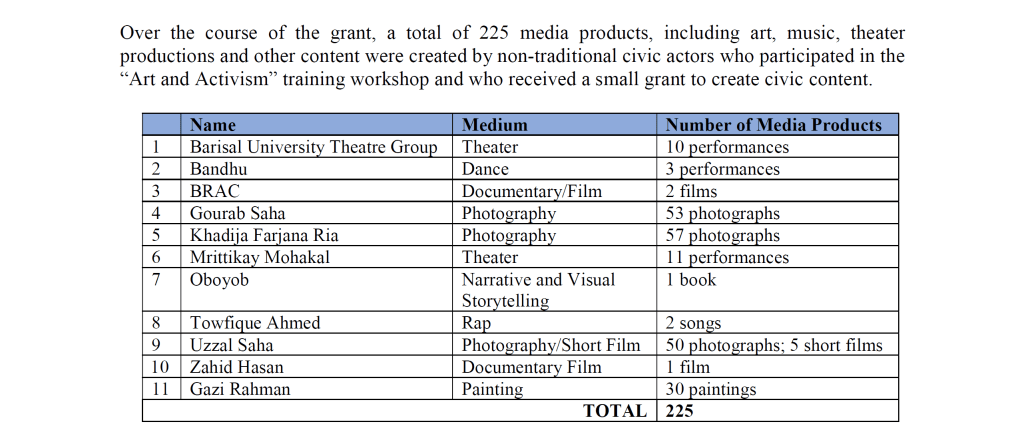
All told, between March 1, 2019 and December 31, 2020, the Republican group sponsored 160 photographs, 30 paintings, 21 theatrical shows, five short films, three “transgender dance performances,” three documentaries, two rap songs and accompanying music videos, and one book. Meanwhile, IRI staff had “identified over 170 democratic activists who would cooperate with IRI to destabilize Bangladesh’s politics,” they wrote.
The activities were frequently attended by American diplomats, with the US ambassador to Bangladesh at the time, Earl Miller, even providing the welcome speech for a seven-day art exhibit titled “The Power of Art.” When the IRI held an “invitation-only book launch event… for a book that documents the lives of LGBTI people in Bangladesh” featuring “a panel discussion with LGBTI activists,” a political officer and a consular officer from the US embassy were on hand as well. At the IRI’s third transgender dance performance in December of 2020, “guests from the US embassy were the deputy consul general and deputy director of the Office for Democracy, Rights, and Governance.”
Discussions that would guide the Institute’s actions were similarly dominated by transgender voices, with 136 of the 308 community members the IRI interviewed when generating policy proposals listed as “transgender/nonbinary.” According to the documents, these meetings generated 60 policy proposals, of which 17 related specifically to “LGBTI” issues.
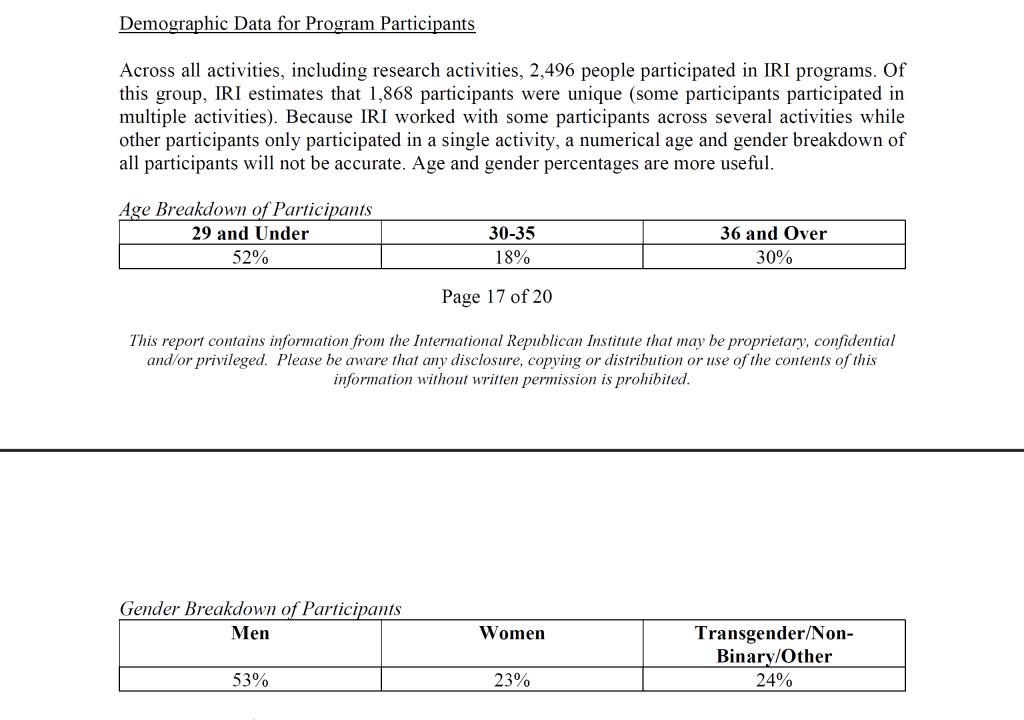
So why did transgender people make up a quarter of the IRI program’s participants, in a country of 173 million where a 2022 census found they comprise just 0.007% of the population? The IRI documents suggest it’s because the Institute views gay and transgender people as uniquely disruptive actors who can be deployed to manipulate political realities overseas: “Facing discrimination and prejudice, LGBTI people tend to participate in social change activities to eventually bring changes to politics.” [Editor’s note: the IRI has claimed that this phrase did not appear in their original report.]
Apparently, the IRI were slowly but surely achieving their desired changes, with the report’s authors bragging that they’d successfully “capacitated new and under-utilized activists from marginalized communities to advocate for change with policymakers,” but concluding that “although IRI’s beneficiaries made important strides in raising public awareness and advocating for change, more time, resources and skills are needed to capitalize on this preliminary success to formalize changes in public attitudes and policy.” The campaign appeared to take root in 2019, when IRI conducted a “baseline assessment” which concluded that “modern forms of cultural activism are underutilized” and “advocacy campaigns should target national-level officials to maximize impact.”
While the emphasis on transgender issues may fly in the face of the GOP’s publicly-professed values, it doesn’t necessarily indicate that Republican leaders have secretly shifted their attitude towards the immutability of gender. As Mike Benz, the former State Department official who helped spearhead the ongoing push to defund USAID, recently noted, “I don’t think that the Republicans at IRI are woke — I think you have tactical wokeness in service of statecraft.”
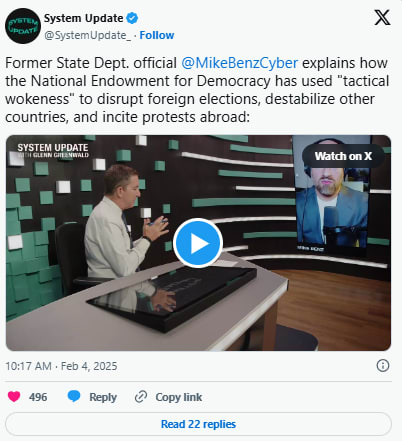
Describing The Grayzone’s previous investigation into the IRI’s efforts to fund aggrieved Bangladeshis to destabilize their country, Benz explained: “these DEl wokeness programs are part of the ethnic balkanization and human rights predicates that are laid by the state in order to topple and control governments.”
That’s exactly what happened in 2024 when Bangladesh’s elected prime minister, Sheikh Hasina, was deposed in a Western-backed coup which legacy media hailed as a revolutionary uprising over an autocratic dictator. Within weeks, Hasina had been replaced as head of state by Muhammad Yunus, a Clinton Global Initiative fellow awarded a Nobel Prize for popularizing the concept of micro-lending, a recent financial innovation which finally gave hundreds of millions of impoverished people across the planet the opportunity to access crippling debt.
It’s not clear exactly how much taxpayer money has been expended on capacity-building transgender and ethnic minority Bangladeshis, but for the time being, the funding mechanisms are still in place. While the Trump administration has ordered a 90-day freeze on non-Israeli foreign spending and slashed USAID’s employees from over 14,000 to just 294, the IRI’s parent organization, the National Endowment for Democracy (NED), remains untouched.
The NED was founded in 1983 by President Reagan as the CIA sought to offload its funding responsibilities after the Church Committee exposed dozens of its highly illegal operations, including the MKULTRA mind control program, various efforts to assassinate international leaders, and Operation Mockingbird, which saw Langley come to exercise so much control over American newsrooms that the agency’s covert operations chief, Frank Wisner, famously compared the press to a “mighty Wurlitzer” which would play any song he liked. For dedicated Cold Warriors, the disappearance of that propaganda network in light of its exposure in the ‘70s was inarguably a major loss.
With the advent of the NED, the Cold Warriors gained a new channel through which they could subsidize regime change activists and amplify their message. In 1991, NED cofounder Allen Weinstein admitted in an interview with the Washington Post that “a lot of what we do today was done covertly 25 years ago by the CIA.”
Much like USAID, the NED, which recently welcomed veteran neocon coup plotter Victoria Nuland to its board of directors, also oversees the annual disbursement of hundreds of millions for various activities likely to foment coups d’etat across the globe. That money continues to be split down the middle and funneled through one of two partisan organizations: the National Democratic Institute and the IRI.
Unfortunately for Bangladesh’s community of US-funded culture warriors, that may not be the case for much longer. Elon Musk, the head of the newly-established Department of Government Efficiency, recently put NED on notice, linking to a list of indicators of corruption at the agency and writing on X: “NED is a SCAM.”
Despite US “Red Lines”, Lebanon Forms New Gov’t with Hezbollah Participation
Al-Manar | February 8, 2025
Lebanon announced on Saturday the formation of the awaited new government, a day after US Deputy Special Envoy to the Middle East visited Beirut to impose dictations and set “red lines” on the participation of Hezbollah.
Secretary General of the Council of Ministers Mahmoud Makkieh announced the 24-member cabinet, including Prime Minister Nawaf Salam.
Hezbollah and ally Amal Movement, known as the national Shiite duo are represented by 4 ministers. The fifth Shiite minister was agreed upon by PM Salam and Speaker Nabih Berri, the leader of Amal Movement.
Before the announcement of the government formation, President Joseph Aoun held discussions with Salam in Baabda Presidential Palace.
The two presidents were then joined by Speaker Berri, who said as he left the palace: “It’s about the blessings of St. Maroun,” in an optimistic message carried by local media that the government will be announced today.
Shortly after, President Aoun signed a decree accepting the resignation of caretaker Prime Minister Najib Mikati’s government and the decree appointing Nawaf Salam to form a new government.
Aoun and Salam then signed a decree to form a new government of 24 ministers.
Hezbollah is represented by two ministers: Minister of Public Health Rakan Nassereddine and Minister of Labor Mohammad Haidar.
Meanwhile, Amal movement is represented by Minister of Finance Yassin Jaber and Minister of Environment Tamara Al-Zein.
The fifth minister who was agreed upon by Speaker Berri and PM Salam is Minister of Administrative Development Fadi Makki.
Al-Manar correspondent said Free Patriotic Movement is not represented in the cabinet.
Salam Remarks
Following the announcement PM Salam said the new cabinet would prioritize financial reforms, reconstruction and the implementation of UN Resolution 1701.
“Reform is the only way to save the country,” Salam told reporters at the presidential palace.
“Reconstruction in south Lebanon is not a promise, but rather a commitment,” the new Lebanese premier added.
The formation of the new cabinet was expected on Thursday. But it was delayed due to Salam’s insistence to name the fifth Shiite minister.
Names of Ministers
The names of Ministers in the Lebanese Government are as follows:
Prime Minister: Nawaf Salam
Deputy Prime Minister: Tarek Mitri
Minister of Defense: Michel Mnassa
Minister of Foreign Affairs and Expatriates: Youssef Raji
Minister of Telecommunications: Charles El-Hajj
Minister of Energy and Water: Joseph Sadi
Minister of Interior: Ahmad Al-Hajjar
Minister of Justice: Adel Nassar
Minister of Finance: Yassin Jaber
Minister of Public Health: Rakan Nassereddine
Minister of Culture: Ghassan Salameh
Minister of Industry: Joe Issa El-Khoury
Minister of Economy and Trade: Amer Al-Bssat
Minister of Agriculture: Nizar Hani
Minister of Information: Paul Morcos
Minister of Social Affairs: Haneen Al-Sayyed
Minister of Public Works and Transport: Fayez Ressamni
Minister of the Displaced: Kamal Shehadeh
Minister of Labor: Mohammad Haidar
Minister of Youth and Sports: Noura Perqadarian
Minister of Tourism: Laura Al-Khazen Lahoud
Minister of Administrative Development: Fadi Makki
Minister of Education: Rima Karami
Minister of Environment: Tamara Al-Zein
Top Breakthroughs Proving China’s Tech Edge Over US
Sputnik – 01.02.2025
China’s newly unveiled DeepSeek AI model rivals US-made ChatGPT in efficiency but at a much lower cost.
This is just one example of China’s more cost-effective technological solutions compared to US analogs.
- Space: China’s Chang’e 6 successfully retrieved the first-ever samples from the Moon’s far side while the US struggles to bring two astronauts back from the ISS.
- Quantum computers: In 2020, China’s Jiuzhang became the first photonic quantum computer to achieve quantum supremacy. With Jiuzhang 2.0 and Zuchongzhi 2.1, China remains a top player in the field.
- Quantum communications: China launched the world’s first quantum communication satellite, Micius, in 2016. In 2024, Chinese and Russian scientists tested quantum communication over 3,800 km.
- Robots: China’s Unitree Go2 quadruped and G1 humanoid robots push global robotics leadership, offering cheaper alternatives to Boston Dynamics.
- Telecommunications: ZTE and Huawei made China a 5G leader. As the US imposes sanctions instead of competing on quality, China eyes 6G by 2030.
- High-speed trains: With over 40,000 km of high-speed rail, China has the world’s longest network, while the US rail system remains in disrepair.
- Drones: Chinese firms like DJI dominate the UAV market with affordable drones spreading worldwide, unlike pricier US alternatives.
Are U.S. Taxpayers Funding ‘Corrupt Dark-money Network’ That Censored CHD, RFK Jr. and Others?
By Brenda Baletti, Ph.D. | The Defender |February 7, 2025
A new analysis of government spending revealed that several major U.S. taxpayer-funded organizations are linked to the U.K.-based Center for Countering Digital Hate (CCDH), according to a Substack report by Sayer Ji of GreenMedInfo.
CCDH, an influential nonprofit anti-disinformation organization, authored “The Disinformation Dozen” list. The group allegedly collaborated with U.S. and foreign governments and Big Tech to censor Ji, Children’s Health Defense (CHD), Robert F. Kennedy Jr., CHD founder and former chairman, and others for spreading “disinformation.”
A new analysis of government spending published by DataRepublican.com showed that at least 17 heavily taxpayer-funded U.S. organizations also may have funneled money into CCDH’s operations, Ji reported.
“The revelation that so many U.S.-based organizations are funding CCDH confirms what many of us have been warning about: that censorship efforts are not merely private initiatives but part of a broader, coordinated strategy involving government-linked entities and foreign influence networks,” Ji told The Defender.
Ji said this provides more evidence that censorship is being outsourced, “creating a system of plausible deniability for those seeking to silence dissenting voices under the guise of combating ‘misinformation.’”
CCDH famously drafted a list of the so-called “Disinformation Dozen” — which included Ji, founder of the natural health website GreenMedInfo ; Kennedy; Dr. Joseph Mercola; and Ty and Charlene Bollinger, founders of The Truth About Vaccines and The Truth About Cancer websites.
CCDH alleged in its report that just 12 accounts produced the majority of “anti-vaccine … disinformation” on social media.
Meta investigated and dismissed the report, and released a statement that there “isn’t any evidence” to support the report’s claims and that the small sample used in CCDH’s analysis was “in no way representative of the hundreds of millions of posts that people have shared about COVID-19 vaccines” on Facebook.
“There is no justification for [CCDH’s] claim that their data constitute a ‘representative sample’ of the content shared across our apps,” Meta stated.
Yet, the report was used by the White House and Twitter, now X, to censor the people and organizations on CCDH’s list, and by legacy media outlets such as NPR, The Guardian and others to discredit the people on the list.
“Twitter Files” documents published in 2023 by investigative journalist Paul D. Thacker detailed how Twitter and the White House used CCHD’s “Disinformation Dozen” report to justify censoring the people on the list.
Last year, reporting by Thacker and Matt Taibbi, based on internal documents leaked by CCDH insiders, revealed that CCDH planned to “kill” X, shut down popular social media accounts on other platforms, censor non-establishment voices and “bring back” attacks on “antivaxx” voices, among other things.
According to the documents, CCDH planned to organize “black ops” against Kennedy, who was a U.S. presidential candidate at the time. The group also planned to pressure Substack to remove COVID-19 vaccine critics Mercola and Alex Berenson from its platform.
The documents reveal that CCDH has pushed for a U.S. social media censorship law akin to the European Union’s “Digital Services Act” and the U.K.’s “Online Safety Act.”
Ji said:
“Despite their baseless claims and accusations, CCDH and similar organizations have had a powerful impact. They have provided the justification for widespread deplatforming, demonetization, and reputational attacks against independent journalists, scientists, and advocates.
“Their reports — often methodologically flawed and politically motivated — are treated as authoritative sources by mainstream media and tech platforms, leading to real-world suppression of speech. The fact that they are now directly linked to potential violations of U.S. election laws raises serious questions about accountability and transparency.”
Who is behind CCDH?
CCDH does not disclose its funders — even though journalists, including Thacker, and a U.S. congressional committee have requested that information.
CCDH also did not respond to The Defender’s request for information on its funding sources.
Imran Ahmed, CCDH’s CEO and founder, previously worked for Merrill Lynch. He was a British Labour Party political operative and is the co-author of “The New Serfdom: The Triumph of Conservative Ideas and How to Defeat Them.”
Ahmed emerged during the pandemic as a “vaccine and disinformation expert,” although he lacked any experience that would qualify him as such, Thacker reported.
The organization’s website states only that it is funded by “philanthropic trusts and members of the public.” It has denied receiving any grants, contracts or funding from the U.S. government.
DataRepublican.com used a financial tracing tool to follow donations made by taxpayer-funded organizations to other nonprofits.
CCDH has a relatively small budget of under $2.5 million. Publicly available information shows where some of those donations come from, including the Tides Foundation, Fidelity Investments Charitable Gift Fund and Schwab Charitable Fund.
However, some of the funding for the organizations making direct donations to CCDH can be traced back to nonprofit and philanthropic organizations that receive major funding from the U.S. government and redistribute that money to other organizations, DataRepublican.com showed.
Some of the 17 organizations that fund CCDH’s direct funders include the National Endowment for Democracy, the sister nonprofit of USAID; Freedom House; the National Democratic Institute; Global Communities; World Vision; Save the Children Federation; Columbia University; Princeton University and others.
Other investigations have also shown that CCDH has connections to key political and Hollywood figures.
For example, a 2023 investigation by Thacker revealed the CCDH received anonymous donations of upwards of $1 million and hired a lobbying firm. A search of the 2021 tax filings of the Schwab Charitable Fund — a donor-advised fund that allows anyone to donate anonymously — revealed a $1.1 million donation to CCDH.
Thacker also discovered that CCDH’s chairman is Simon Clark, a former senior fellow at the Center for American Progress (CAP). He also uncovered ties between CCDH, Ahmed and Hollywood.
A subsequent investigation by Ji traced some of the organizations that financially support CCDH, including several U.K.-based nonprofits affiliated with legacy media organizations, the U.K. government and major philanthropic organizations such as the Open Society Foundations and the Ford Foundation.
“These hidden contributions reveal a coordinated pipeline of financial influence involving U.S. intelligence-adjacent entities, UK Crown interests, and Soros-backed organizations like the Tides Foundation,” Ji wrote.
Questions about the organization’s activities and funding sources led Rep. Jim Jordan (R-Ohio) to subpoena CCDH as part of a 2023 congressional investigation into the nonprofit’s censorship-related activities.
The subpoena requested all communications and documents “between or among CCDH, the Executive Branch, or third parties, including social media companies, relating to the identification of groups, accounts, channels, or posts for moderation, deletion, suppression, restriction, or reduced circulation.”
It also requested details about any grants, contracts or funds from the U.S. government, CCDH replied that such information doesn’t exist. However, Ji’s report this week throws that response into question.
Ahmed continues to appear in mainstream media as a critic of X and the Trump administration calling for “transparency and accountability.”
“CCDH’s role as a foreign influence operation masquerading as a ‘nonprofit’ watchdog must be fully investigated,” Ji wrote. “Congress, media and civil rights organizations must demand answers.”
He added:
“This corrupt dark-money network must be exposed and dismantled. CCDH is not a ‘hate speech watchdog’ but a weaponized political hit squad, funded by taxpayer dollars and foreign actors, used to silence voices that challenge establishment power.”
Related stories in The Defender
- Watch: ‘We’re in a Different Era’ of Free Speech Now
- Revealed: Dark Money Funders Behind ‘Disinformation Dozen’ Report
- Congressional Investigation into Authors of ‘Disinformation Dozen’ Intensifies
- Group Behind ‘Disinformation Dozen’ Has Ties to Hollywood, Corporate Dems
This article was originally published by The Defender — Children’s Health Defense’s News & Views Website under Creative Commons license CC BY-NC-ND 4.0. Please consider subscribing to The Defender or donating to Children’s Health Defense.
Facebook “Fact Checks” Prof. Will Happer
Dubious doubters challenge eminent scientist
By Angela Wheeler | CO2 Coalition | January 13, 2025
The only way to combat censorship is to shine a light on it whenever we see it.
In censoring material that contradicts the popular – though increasingly feeble – fiction of a climate crisis, Facebook is quick to discount the credentials of one of the world’s leading scientists while honoring sources of dubious credibility.
Our latest encounter with Facebook came in a message from the platform’s corporate entity, Meta, on December 4, which read: “Your Page, CO2 Coalition, didn’t follow the rules, so it isn’t being suggested to other people right now.”
Sorting through CO2 Coalition’s vast content to find what post could have been so egregious to prompt this reprimand, we found it to be a quote from the renowned Dr. William Happer, professor emeritus of physics at Princeton University and Chairman of the CO2 Coalition Board of Directors. Dr. Happer’s provocative quote?
“Nothing but good can come from more atmospheric CO2. The Earth has experimented with much higher CO2 concentrations than today many times over the Phanerozoic eon, the last 540 million years or so, where the fossil record of life is especially good. Life flourished at four times more CO2 than today. There is no geological evidence that more CO2 will be anything but good for life on Earth.”
Facebook’s “fact check” of Dr. Happer’s quote referenced a group called Climate Feedback that, based on an appearance on CNN, said Dr. Happer “misleads about the impact of rising carbon dioxide on plant life.”
We did a little fact-checking of our own. Having seen the group’s website and a list of financial backers, we believe there is ample reason to be doubtful of Climate Feedback’s adherence to science and veracity.
According to InfluenceWatch.org, Climate Feedback has the same parent company as “the left-leaning fact-checker Politifact.” Both appear to be part of a loose amalgamation of postmodern censors, whose hallmark is to spread misinformation in the form of half-truths and outright falsehoods by accusing others of doing the same.
Perhaps in this case, Facebook’s greatest sin is its willingness to discount – or utterly ignore – Dr. Happer’s record of accomplishment.
In addition to a distinguished career at a prestigious university, Dr. Happer has received numerous awards for service in government and private enterprise. He invented a laser-based technology that made possible President Reagan’s “Star Wars” defense initiative and has published more than 200 peer-reviewed papers.
In a recent paper, “The Role of Greenhouse Gases in Energy Transfer in the Earth’s Atmosphere,” Dr. Happer and his coauthor say that whatever greenhouse warmth may be in store for the planet that “basic physics and the geological record indicate that the warming will be small and probably good for life on Earth.”
This and other statements by Dr. Happer are supported by evidence accumulated over many decades – even centuries – by myriad researchers drawing on various disciplines that include physics, geology, biology and history.
Putting up Climate Feedback’s lame challenge against such a legacy of scientific exploration would be laughable if it weren’t for its furtherance of a “green” movement that has cost the world trillions of dollars in wealth that could have been used for something useful. Billions of people suffer for lack of energy resources made more expensive and less available by a fearmongering climate agenda of the ignorant and ignominious.
Facebook also noted on the CO2 Coalition account that they “covered” the offending post “so people can choose whether they want to see it.”
We believe it behooves seekers of truth to examine posts that Facebook chooses to obscure.
Jim Jordan Challenges EU Over Its Censorship Laws
By Didi Rankovic | Reclaim The Net | February 6, 2025
US House Judiciary Committee Chairman Jim Jordan has written to the EU Commission’s Executive VP for Technological Sovereignty, Security and Democracy Henna Virkkunen regarding the bloc’s censorship law, the Digital Services Act.
Jordan wants the EU to, by February 13, inform the committee of how it plans to enforce the law when it comes to US tech companies, and also about investigations that are at this time underway, against Meta and X.
Jordan, as usual, doesn’t mince words and has no problem with referring to the DSA as legislation that has “censorship provisions” – to express what he said was the committee’s serious concern over how those might affect free speech in the US.
Here, he was referring to the nature of social platforms that are global, and how they typically use the same set of policies regarding speech – meaning that if those policies were aligned with the EU’s restrictive legislation, the result could be the setting of “de facto global censorship standards.”
Even though for a long time criticized by speech and privacy advocates, the DSA was flying under the radar of the previous White House, now it is emerging as a significant point, as the two sides clash on a number of issues.
Under the DSA, which the EU and the law’s supporters treat as a set of “moderation” rules for the good of the internet – companies can be forced to pay up to six percent of global turnover or even get blocked.
Elon Musk, Mark Zuckerberg, and President Trump have been among those who previously publicly criticized the DSA. Previously, Virkkunen denied that the DSA enabled censorship and even claimed that free speech is “respected and protected” by the law.
Jordan and the commission he heads have been involved in multi-year efforts to expose online censorship practices in the US, but this is not the first time that these investigations have also turned toward the EU.
Last summer, during the presidential campaign in the US, he wrote to then Commissioner for Internal Market Thierry Breton because of this EU official’s scandalous warning issued to Musk regarding a live stream of an interview with then-candidate Trump.
The letter to Virkkunen was reported by Politico, but the EU Commission is yet to publicly comment on its contents.
UK Government Secretly Orders Apple to Build Global iCloud Backdoor, Threatening Digital Privacy Worldwide
The UK government’s extremism is a global threat to privacy, a new report shows
By Christina Maas | Reclaim The Net | February 7, 2025
Imagine waking up one morning to find out your government has demanded the master key to every digital iPhone lock on Earth — without telling anyone. That’s exactly what British security officials have tried to pull off, secretly ordering Apple to build a backdoor into iCloud that would allow them to decrypt any user’s data, anywhere in the world. Yes, not just suspected criminals, not just UK citizens — everyone. And they don’t even want Apple to talk about it.
This breathtakingly authoritarian stunt, first reported by The Washington Post, is one of the most aggressive attempts to dismantle digital privacy ever attempted by a so-called Western democracy. It’s the kind of thing you’d expect from regimes that plaster their leader’s face on every street corner, not from a country that still pretends to believe in civil liberties.
The Order: Total Access, Zero Oversight
This isn’t about catching a single terrorist or cracking a single case. No, this order — issued in secret last month by Keir Starmer’s Labour government — demands universal decryption capabilities, effectively turning Apple into a surveillance arm of the UK government. Forget warrants, forget oversight, forget even the pretense of targeted investigations. If this order were obeyed, British authorities would have the power to rifle through anyone’s iCloud account at will, no justification required.
The officials pushing for this monstrosity are hiding behind the UK’s Investigatory Powers Act of 2016, a law so Orwellian it’s lovingly referred to as the “Snoopers’ Charter.” This piece of legislative overreach forces tech companies to comply with government spying requests while making it illegal to even disclose that such demands have been made. It’s the surveillance state’s dream—limitless power, zero accountability.
Apple’s Answer: Thanks, But No Thanks
Apple, to its credit, has not rolled over — yet. Instead of turning itself into an informant for MI5, the company is reportedly considering pulling encrypted iCloud storage from the UK entirely. In other words, British users could lose a major security feature because their government is hell-bent on playing digital dictator.
But even that isn’t enough for UK authorities, who aren’t just demanding access to British accounts. They want a skeleton key to iCloud data worldwide, including in the US That’s right—British intelligence, in a stunning display of overreach, is trying to force an American company to compromise American users on American soil.
The “Appeal” Process: A Kafkaesque Farce
Technically, Apple has the right to challenge this order. But in true dystopian fashion, its only option is to plead its case before a secret technical panel, which will then determine if the request is too expensive. If that doesn’t work, Apple can go before a judge, who will decide whether the demand is “proportionate” to the government’s needs. Because if there’s one thing we know about government surveillance, it’s that it’s always reasonable and restrained.
Meanwhile, Apple has refused to comment, likely because doing so would be a criminal offense under UK law. That’s right — even talking about the demand could land Apple executives in legal trouble. Nothing screams “free society” like threatening jail time for discussing government overreach.
Here’s the wider issue: even if Apple were to challenge this draconian demand, it wouldn’t matter. The law requires immediate compliance — meaning that even as Apple fights the order, it would still be forced to hand over the keys in the meantime. It’s the legal equivalent of being forced to serve a prison sentence while appealing your conviction. By the time the courts make a decision, the damage is already done.
Apple, to its credit, saw this Orwellian nightmare coming from a mile away. Last year, it explicitly warned British lawmakers that such a demand would be nothing less than an assault on global privacy. The company made its stance clear:
“There is no reason why the U.K. [government] should have the authority to decide for citizens of the world whether they can avail themselves of the proven security benefits that flow from end-to-end encryption.”
In other words: Who the hell does Britain think it is? The UK government, in its wisdom, apparently believes it should have the power to determine how encryption works for everyone, everywhere, not just in its own backyard. Because why stop at surveillance when you can have global surveillance?
The Official Non-Denial Denial
Of course, when asked about this breathtakingly bold power grab, the UK Home Office fell back on the bureaucrat’s favorite escape hatch: refusing to confirm or deny reality itself.
“We do not comment on operational matters, including for example confirming or denying the existence of any such notices.”
In other words, “We won’t admit we’re demanding this, but we won’t deny it either.” Because why be transparent when you can keep the public guessing?
How the UK Plans to Kill Encryption by Exploiting the Cloud
For those still clinging to the idea that end-to-end encryption will protect their messages from prying eyes, here’s the bad news: the UK government already has a backdoor, and most people don’t even realize it.
Yes, apps like iMessage, WhatsApp, and Signal use end-to-end encryption, meaning only the sender and recipient can read the messages. But the moment you back up those encrypted chats to the cloud? They become fair game. Law enforcement can demand access through legal orders, bypassing encryption entirely.
Apple’s Advanced Data Protection was designed to close this loophole, giving users a way to keep their cloud backups as secure as their messages. And that, of course, is precisely why the UK wants to kill it.
Because for governments that dream of unlimited surveillance, letting people secure their own data is simply unacceptable.
The UK Is Now Outpacing the US in Anti-Privacy Extremism
For years, the US has led the charge in trying to undermine encryption, with the FBI repeatedly demanding backdoors and government officials throwing tantrums whenever a tech company refuses to play ball. But even America has never gone this far.
Now, Britain is attempting to leap ahead, pushing for surveillance powers that would force not just UK companies, but global tech giants to comply — regardless of where their users live. And Apple? It’s just the first target.
Google, which has offered default encrypted backups for Android since 2018, could easily be next. When asked whether the UK or any other government had made similar demands, Google spokesperson Ed Fernandez gave a carefully worded response:
“Google can’t access Android end-to-end encrypted backup data, even with a legal order.”
That’s a fancy way of saying “We don’t have the keys, and we’re not planning to give them up.” But how long until the UK demands that Google build a key, just like it’s demanding from Apple?
And then there’s Meta. WhatsApp’s encrypted backups are another thorn in the side of surveillance-hungry governments. When pressed on whether they had received any secret orders for access, Meta, predictably, refused to comment.
Israel used toxic gas to suffocate Palestinian resistance fighters, captives in Gaza’s tunnels, report finds
MEMO | February 7, 2025
US Envoy Ortagus Meets President Aoun, Imposes Dictations on Lebanon
Al-Manar | February 7, 2025
Lebanese President Joseph Aoun met on Friday with US Deputy Special Envoy to the Middle East Morgan Ortagus who said that Washington has set a “red line” over participation of Hezbollah in the new government.
“We are grateful to our ally Israel for defeating Hezbollah,” Ortagus said in a press conference, following a meeting with President Aoun.
“It is thanks to the Lebanese President Aoun and the Prime Minister-designate Nawaf Salam and everyone in this government who is committed to an end of corruption, who is committed to reforms and who is committed to making sure that Hezbollah is not a part of the new government in any form,” the US diplomat added.
“We have set clear red lines from the United States that (Hezbollah) won’t be able to terrorize the Lebanese people and that includes by being a part of the government,” she added, as quoted by Associated Press.
Ortagus’ remarks sparked ire in Lebanon, with some commentators, even those who oppose Hezbollah, considering them as imposed dictations and a violation to the Lebanese sovereignty.
For his part, President Aoun, emphasized that “permanent stability in south Lebanon is closely linked to the completion of the Israeli withdrawal from the territories it occupied during the last war, and the full implementation of Resolution 1701, including the provisions of the November 27 ceasefire agreement.”
“The release of Lebanese prisoners is an integral part of this agreement,” the president added, as cited by Lebanon’s National News Agency.
Later on Friday, the Lebanese Presidency Press Office issued a statement in which it said: “The presidency is not concerned with some of remarks made by US deputy Middle East envoy Morgan Ortagus in Baabda.”
Iran condemns ‘illegitimate’ US sanctions targeting oil exports
Press TV – February 7, 2025
Iran has strongly condemned new sanctions slapped by the administration of US President Donald Trump on the country’s oil industry, saying they run contrary to international rules and standards.
Foreign Ministry spokesman Esmaeil Baghaei denounced the bans as “completely unjustified” on Friday.
The remarks came a day after the US Treasury Department targeted more than a dozen individuals and companies, as well as vessels, claiming that they are facilitating the shipment of millions of barrels of Iranian oil to China.
The sanctions were the first on Iran after Trump restored his so-called “maximum pressure” campaign on the country.
“The decision of the new US administration to put pressure on the Iranian nation by preventing Iran’s legitimate trade with its economic partners is an illegitimate, illegal and wrongful act, whose responsibility lies on the US government,” Baghaei added.
“The Islamic Republic holds the US accountable for the consequences of such unilateral and bullying measures.”
On Tuesday, Trump signed the presidential memorandum reimposing a tough anti-Iran policy, which he practiced in his first presidential term after unilaterally withdrawing Washington from the historic 2015 nuclear deal.
In an X post, Iranian Foreign Minister Abbas Araghchi called Trump’s measure a failed experience.
He said the decision to restore maximum pressure policy will only compel “maximum resistance” on the part of Iran again, adding, “Smart people ought to choose ‘Maximum Wisdom’ instead.”
During his campaign trail for a second term, Trump had stated at an event in New York in September that, if re-elected, he would minimize the use of sanctions. He argued that employing sanctions excessively “kills your dollar and it kills everything the dollar represents.”
“Look, you’re losing Iran. You’re losing Russia. China is out there trying to get their currency to be the dominant currency, as you know better than anybody,” Trump remarked.
On Tuesday, The New York Times said Trump had also implemented a strategy of maximum pressure in 2018, following his decision to withdraw the US from the nuclear accord with Iran that had been established under the Obama administration three years earlier.
“Mr. Trump still claims that was a major victory, but most outside analysts say it backfired,” the newspaper wrote.
Khamenei: Negotiations with US have no effect on solving problems
Press TV – February 7, 2025
Leader of the Islamic Revolution Ayatollah Seyyed Ali Khamenei says experience has shown that negotiations with the US have no effect on solving Iran’s problems.
His remarks in a meeting with Air Force personnel in Tehran on Friday came hours after the US imposed its first sanctions in the wake of President Donald Trump’s signing of an order to reimpose his “maximum pressure” on Iran.
“Some people pretend that if we sit at the negotiating table, some problem will be solved, but the fact that we must understand correctly is that negotiating with the US has no effect on solving the country’s problems.”
He cited the experience of 2015 when Iran and six other countries, including the US, signed the now-dormant Joint Comprehensive of Plant of Action (JCPOA) after two years of negotiations, only to be discarded by President Trump in 2018.
Ayatollah Khamenei recalled the grueling back and forth, which included a 15-minute stroll by then-US Secretary of State John Kerry and Mohammad Javad Zarif in downtown Geneva and along the Rhone River which landed the former Iranian foreign minister in hot water.
“Our government at the time sat down and negotiated – they continued to come and go, they sat down and stood up and negotiated, they talked, laughed, shook hands, made friends, everyone worked, and a treaty was formed.
“In this treaty, the Iranian side was very generous, giving many concessions to the other side. But the Americans did not implement the same treaty,” the Leader said.
“The same person who is in office now tore up the treaty. He said he would tear it down and he did; they didn’t act upon” the agreement, he said, referring to Trump.
“Therefore, negotiating with such a government is unwise, unintelligent and dishonorable and there should be no negotiation with it.”
Before Trump, even the US administration which had accepted the agreement, did not comply with it, the Leader said, referring to the government of president Barack Obama which had signed it.
“The treaty was meant to lift US sanctions, but they were not lifted. Adding insult into injury, they had the UN to have a constant threat hanging over Iran. This treaty was the product of negotiations that lasted about two years.”
Iran is currently in the midst of celebrations marking the anniversary of the Islamic Revolution which sealed the fate of the US-backed Pahlavi regime in 1979.
Every year on February 8, Iranian Air Force personnel meet the Leader to relive the historic allegiance of Air Force officers with the late founder of the Islamic Republic Imam Khomeini in 1979. The event is viewed as a turning point which led to the victory of the Islamic Revolution three days later.
Ayatollah Khamenei said the Americans are busy working “on paper to change the map of the world”, with Iran also being the subject of their plans.
“Of course, it’s only on paper, it has no reality. They also talk about us, make comments, and threaten us,” the Leader said.
Ayatollah Khamenei said, “If they threaten us, we will threaten them. If they put their threat into practice, we will do the same. If they attack the security of our nation, we will attack their security without hesitation.”
“This is a lesson taken from the Qur’an and the teachings of Islam, and it is our duty to act as such. We hope that God Almighty will make us successful in carrying out our duties,” he added.
Featured Video

New positive ivermectin evidence
or go to
Aletho News Archives – Video-Images
From the Archives
Fanatical Followers of the Covid Regime: A Jim Jones-Style Cult?
By Professor Roger Watson and Dr. Niall McCrae | The Daily Sceptic | November 15, 2021
As scholars at leading British universities over recent decades, we witnessed the replacement of critical thinking and debate by narrative: facts are discrimination and scientific method is imperialism; truth, instead, is derived from ‘progressive’ values. This educational trend may be a major contributory factor to the ease in which society has been inculcated to the Covid ‘new normal’ of masking, testing, and repeated doses of vaccines for a disease of similar risk to severe influenza.
One doesn’t need much critical reasoning to observe the flawed logic of some vaccination enthusiasts, such as people who respond to experiencing any side effects, however debilitating, by saying “at least I know it’s working”, or, after contracting the disease despite their promised inoculation (over 90% effective, according to initial drug company claims), “I’d have been worse off without the jab.” … continue
Blog Roll
 Aletho News
- EU Council Advances Chat Control 2.0 Scanning Proposal
- Ex-Greek MEP files complaint against Israeli spyware firm over alleged Pegasus surveillance
- Troubling ideas throughout the Torah, Talmud, Mishneh Torah and Tanya
- ‘Grave, alarming’: Iran mission on Trump’s UNGA ‘annihilation’ threats
- Najaf airport to reopen to Iranian flights within 24 hours: Ambassador
- From ‘How Will This End For Iran’ to ‘When America Walks Away’: A tale of two Economist covers
- Tehran blasts ‘baseless’ speculation linking Iran to alleged bomb plot at UK air base
- The Rise And… Rise Of ‘Color Revolutions’
- The Coming GOP Bloodbath?
- Arctic Scare Stories Melt Away
- If Americans Knew
- Netanyahu Asked UAE Leader to Deny Report on Oct. 7 Warning in Secret Visit, Sources Say
- CNN Chief Int’l Correspondent Clarissa Ward on Journalists in Gaza
- Democratic Party Consultants Surround Troy Jackson with Pro-Israel Donors
- Christian Leader Responds To Netanyahu’s Claims Regarding Palestinian Christians
- In Gaza, ‘Whoever Survives the Bombing Won’t Survive the Rubble’
- Israel kills more Palestinians, amid push to resettle Gaza – Daily Update
- Israel forces Gazans to live in constant peril – Daily Update
- Deconstructing Netanyahu’s pants-on-fire UN rant – Daily Update
- Trump betrayed voters with his campaign lies and prioritized a foreign country once he took office
- Netanyahu calls Israel’s war in Gaza ‘opposite of genocide’ in UN speech to near-empty hall
- No Tricks Zone
- New Study: Earth And Venus Surface Warmth Largely Explained By Convection And Lapse Rate, Not CO2 Or Radiation
- 2025 Nature Paper Claiming Worsening Global Drought Gets RETRACTED …Heavily Flawed
- New Study: ‘Global Drought Shows No Detectable Recent Acceleration Under Climate Warming’
- Economic Masterminds: German Socialists Suggest Taxing Productivity Gains Stemming From Using AI
- The South China Sea Has Not Been Cooperating With The Climate Change Narrative
- Energy Crisis: Germany Enters Heating Season With Historically Low Gas Reserve Fill Levels
- New Study: The Antarctic Ice Sheet Gained Mass From 2020-2024 Due To Staggering Snow And Ice Accumulation
- Study: Ocean Heating Rates From Thousands Of Years Ago ‘Dwarf’ Modern Ocean Heating Rates
- Climate Extremists Target, Attack Large-Scale Power Grid Infrastructure In Germany!
- New Study: Antarctic Ice Melt Has Contributed Less Than 1 Centimeter To Sea Level Rise In The Last 30 Years

