Trump bent on ending Ukrainian war – false flag attack could be on the way
By Uriel Araujo | January 23, 2025
Amongst certain circles in Washington, there is real panic right now about the possibility of the ongoing conflict in Ukraine coming to a halt, with Trump’s help. Some analysts are even speculating that the so-called “deep state” could thus come up with desperate bold measures, such as “false flag attacks” or assassination attempts targeting foreign pro-Western figures in Russia and Ukraine, so as to blame Moscow and inflame public opinion and thereby force Washington into once again stepping in.
In this scenario, some names are suggested as possible “disposable” targets: Yulia Navalnaya (Alexei Navalny’s widow, who chairs the New York based “Human Rights Foundation”), Mukhtar Ablyazov (businessman and key anti-Russian activist in Kazakhstan), or even Salome Zourabichvili (former president of Georgia).
Before giving any thought about such seemingly wild claims, let us first consider their premise, namely that the Ukrainian conflict could end really soon. Trump does seem bent on “ending the war in Ukraine”, as he has phrased it. Consider this:
1. Employing his peculiar gangster-like rhetorical style (which includes the use of uppercase typography), the Republican posted on social media, in a message to Russian leadership:
“Settle now, and STOP this ridiculous War! IT’S ONLY GOING TO GET WORSE. If we don’t make a ‘deal’, and soon, I have no other choice but to put high levels of Taxes, Tariffs, and Sanctions on anything being sold by Russia to the United States, and various other participating countries… Let’s get this war, which never would have started if I were President, over with! We can do it the easy way, or the hard way – and the easy way is always better. It’s time to “MAKE A DEAL”.”
Ironically, the previous Biden presidency already issued a last-minute round of energy sanctions against Russian banks and companies, which have been described as “Trump-proof” sanctions due to giving power to the US Congress in that regard (should the new President attempt to weaken the measures). Biden’s decision was in itself quite ironic, considering that Trump will be ruling with a “supermajority”. Back to Trump, his social media threats (made on “Truth Social”, a platform owned by himself) have more to do with pandering to mainstream conservative Americans (by “being tough on Russia”) while at the same time appealing to “Ukraine fatigue”. But it is, nonetheless, a sign.
2. More importantly, rhetoric aside, as one of his very first acts after his inauguration, Trump has frozen foreign aid to Ukraine for 90 days. Roksolana Pidlasa, head of the Ukrainian parliament’s budget committee responded by saying that Ukraine is “secured” in terms of “budget funding” because Biden had already transferred $50 billion (under the ERA initiative) to the World Bank. Trump’s measure in itself thus has limited efficacy (and applies to “development programs”, not to military aid), but is, nonetheless, quite telling.
3. Recently, one may recall, Ukraine’ leader Volodymyr Zelensky has accused the US and the West of embezzlement, by claiming that half of all money sent to Ukraine (that is, only $88.5 billion) ever reached Kyiv. As I wrote, this kind of accusation, if employed for leverage, risks backfiring. Be it as it may, the issue of Ukraine corruption (and the corresponding American shady interests) is very real and could thus be exploited by Republican lawmakers to further pressure the new administration into curbing aid to Ukraine or even ending American support to Ukraine, while blaming the Democrats.
All of the above is therefore plausible enough: Washington has, after all, sometimes signaled a willingness to pivot to the East while shifting the Ukrainian “burden” onto Europe – and even James Stavridis, former NATO Supreme Allied Commander Europe, argued, back in November 2023, that a Korea-style “land for peace” deal was the only “hope” for Ukraine. The problem is that there are powerful actors committed to perpetuating hostilities, and the so-called “deep state” is clearly divided and out of control. Again, consider the following:
Speaker Mike Johnson has amazingly confirmed that, while President, Biden, struggling with senility, was not really “running the country” and would often not be aware of the content of the very acts he signed. This means other players were calling the shots in a kind of palace coup (he mentions the CIA).
Trump is openly “at war” with the deep state, while in a quest to increase his own presidential powers. He has appointed loyalists and/or “dissidents” to head key agencies, including the CIA and the Secret Service – not to mention Tulsi Gabbard, appointed as Director of National Intelligence.
During the presidential campaign, there were three attempts against Donald Trump’s life, which is unprecedented. One of the would-be assassins, Ryan Routh, was involved in recruiting for Ukraine.
Suspicions about the role of the Secret Service in the first attempt were so serious that Kimberly Cheatle, then its Director, had to resign amid a scandal, and to this day we don’t know much about shooter Thomas Matthew Crooks or why “someone who regularly visited Crooks’ home and work also visited a building in Washington, DC located in Gallery Place… in the same vicinity of an FBI office”, among many other unexplained angles.
The terrorist behind the New Year’s bombing outside Trump International Hotel in Las Vegas, is an active duty Green Beret (with a Special Operations background), and believed to have involvement with, once again, recruiting soldiers to fight for Ukraine and with radical pro-Ukraine activism.
False flag operations are part of the American clandestine operations repertoire. For instance, nowadays it is known that, in 1962, the US Department of Defense planned Operation Northwoods, which called for CIA operatives to commit actual terrorist attacks against American civilians and military targets in US cities (involving bombings and even hijacking airplanes) and then using the panic to justify a Cuban invasion. Then President Kennedy rejected the plan, but the proposal as such existed, and no one denies it today.
The assassination of Kennedy itself, far from being a talking point of “conspiracy theorists” only, remains unexplained to this day, with most documents pertaining to it still being “classified”, which is not quite consistent with a “lone gunman” scenario. Trump has announced he plans to release those, by the way, and it is fair to assume that his reasoning in doing that could involve “exposing” a culture of misdeeds to cause outrage and then justify a series of intelligence reforms in line with his goals.
On top of all the above, the US is still facing a bizarre “UFO” drone crisis spiralling out of control. Military bases and airports have been temporarily closed over the issue, and lawmakers are calling for a state of emergency while counties have already declared one and so on, with people in panic. Authorities have denied the “objects” have a foreign origin, and, unless one wants to take the extraterrestrial hypothesis seriously, this can only indicate chaos amid the intelligence services, with exercises and what-not out of control.
Considering all the above, the idea of a false flag attack to stop Trump from withdrawing American support to Ukraine is not so wild and should not be taken as “sacred victim” provocation. In fact it seems a possible and even likely scenario. This has been the wildest presidential transition in US history and there is no reason to assume the turmoil has ended already.
Uriel Araujo, PhD, anthropology researcher with a focus on international and ethnic conflicts.
CNN to lay off hundreds of staff
RT | January 23, 2025
CNN is planning to axe hundreds of its 3,500 workforce as soon as Thursday, as the US media multinational eyes reorientation towards global digital audiences, people familiar with the matter have told CNBC.
The unit of Warner Bros Discovery is reportedly rearranging its TV production while expanding digital subscription offers. The layoffs are projected to help the news organization reduce production costs and consolidate teams, CNBC claimed on Wednesday, citing anonymous sources.
The cuts are not expected to affect the CNN’S most recognizable names, the sources said, adding that several shows that are currently produced in New York or Washington could move to Atlanta amid cost reduction.
The multinational introduced a digital paywall last October, when it began charging a monthly fee of $3.99 from its frequent users.
NBC News, owned by Comcast, the world’s fourth-largest broadcaster by revenue, is also planning job cuts this week, CNBC noted, citing sources familiar with the situation, who specified that the layoffs will be well under 50 staff.
CNBC noted that the current news media landscape is in transition as watching linear TV is becoming less popular, with more people consuming their news on streaming services and through social media.
The Washington Post announced earlier this month that it would dismiss around 4% of its workforce, or fewer than 100 employees, in an effort to reduce costs, as the newspaper struggles with increasing losses. In November, the Associated Press announced plans to slash some 8% of its workforce as the news agency seeks to update operations and products.
US Arms Ukraine, Europe Pays the Bill
Sputnik – 23.01.2025
NATO Secretary General Mark Rutte said on Thursday that European taxpayers would have to pay for US military supplies to Ukraine if the new US administration agreed to provide them.
“On Ukraine, we need US also to stay involved and to do as much as possible to get Ukraine in a position of strength, whenever peace talks start. But I can tell the Europeans, if this new Trump administration is willing to keep on supplying Ukraine from its defense industrial base, the bill will be paid by the Europeans,” he said at the World Economic Forum (WEF) in Davos.
The NATO chief said during the annual Ukrainian Breakfast event he was convinced that Europeans needed to be willing to pull their weight because, in his view, Americans were paying more despite being farther away from Ukraine than Europe.
Rutte also added that the alliance should increase its support for Ukraine in order to change the “wrong direction” in which the conflict is moving.
“We have to step up, not scale back, the support for Ukraine, we have to change the trajectory of the war which is ongoing, and so far we know the frontline is moving in the wrong direction,” Rutte said.
The annual WEF forum takes place from January 20-24 in the Swiss resort of Davos.
Russia believes arms supplies to Ukraine hinder the settlement process and directly involve NATO countries in the conflict. Russian Foreign Minister Sergey Lavrov has said the United States and NATO not only supply weapons to Kiev but also train personnel in the United Kingdom, Germany, Italy and elsewhere, which he argues is not conducive to peace.
Trump knows Ukraine conflict means nuclear WWIII, gives peace a chance with Russia’s Putin
By Finian Cunningham | Strategic Culture Foundation | January 23, 2025
The chances of a peace deal in Ukraine are suddenly a lot higher under President Donald Trump only because he has a realistic sense of a nuclear Third World War happening between the United States and Russia if that conflict is not ended promptly.
Peter Kuznick, an esteemed American professor of history, says that the Biden administration brought the world closer to a nuclear conflagration than at any time since the Cuban Missile Crisis in 1962. Biden did this by relentlessly arming Ukraine with weapons to strike deeper and deeper into Russia instead of trying to find a peaceful resolution to the conflict. Indeed, there was no diplomatic effort from Washington under Biden. It was ideologically and propaganda-driven for confrontation, as was the Democratic presidential candidate, Kamala Harris.
Kuznick points out that Trump is no John F Kennedy in terms of the latter’s depth of historical and philosophical knowledge. But in comparison with Joe Biden, Trump has shown more humanity and common sense by not insulting Putin and in reaching out for a peaceful end to the slaughter in Ukraine. Biden called Putin a thug and said he would back Ukraine as long as it takes to defeat Russia. The last Democrat administration spent $175 billion of U.S. taxpayers’ money propping up a NeoNazi regime in Kiev that has lost over one million military casualties since the war erupted in February 2022.
By contrast, newly inaugurated President Trump says that he wants to meet Russian leader Vladimir Putin as a priority to find a peaceful way out of the conflict and to avoid a catastrophic escalation between nuclear powers. Putin has welcomed a meeting with the new president and said he appreciates the urgent concern to avoid a nuclear disaster.
Kuznick is author of The Untold History of the United States, which was coauthored with acclaimed film director Oliver Stone. The book was turned into an award-winning television series aired on Showtime, Netflix and other channels. Kuznick deplores the way the U.S. and NATO partners undermined international security by expanding on Russia’s borders despite earlier promises to the Soviet leaders that would not happen.
If peace is to be found in Ukraine, it must be based on a bigger picture of lasting global security that considers all nations’ concerns.
That means the United States must treat Russia’s national security concerns over NATO’s expansion seriously and respectfully. Can the Trump administration deliver? It is packed with hawkish figures like Secretary of State Marco Rubio.
Donald Trump is better placed than the Biden adminstration to cut a deal with Russia for peace in Ukraine and thereby avoid nuclear disaster, says Kuznick.
Trump’s cabinet is filled with billionaires and his mercurial, superficial understanding of the world can be deprecated. Maybe his peaceful aspirations are muddled and not feasible given that Trump is surrounded by hawkish figures.
But at least he is willing to give peace a chance with Russia over Ukraine. That alone makes Trump a welcome change from the vile warmongering of Biden and his would-be successor Kamala Harris.
‘YOU’RE FIRED!’ Trump Dismisses Brian Hook in Truth Social Post
By Kyle Anzalone | The Libertarian Institute | January 22, 2025
President Donald Trump fired four presidential appointees that he said did not share his vision for America. Among those dismissed were Brian Hook, who served on the Trump transition team.
“My Presidential Personnel Office is actively in the process of identifying and removing over a thousand Presidential Appointees from the previous Administration, who are not aligned with our vision to Make America Great Again,” Trump wrote on Truth Social Monday.
“Let this serve as Official Notice of Dismissal for these 4 individuals, with many more, coming soon.” He continued, “Jose Andres from the President’s Council on Sports, Fitness and Nutrition, Mark Milley from the National Infrastructure Advisory Council, Brian Hook from the Wilson Center for Scholars, and Keisha Lance Bottoms from the President’s Export Council—YOU’RE FIRED!”
In 2018, Hook joined the administration shortly before Trump withdrew from the Iran nuclear deal. Hook was tasked with implementing a “maximum pressure” sanctions campaign against Tehran and overthrowing the Iranian government.
In 2020, Hook resigned from his post, after he was unable to achieve either objective.
Hook was a key official in helping to staff the incoming State Department on the transition team following Trump’s second election victory. In November, Hook said the second Trump administration “would isolate Iran diplomatically and weaken them economically.”
Hook also attacked the Biden administration’s “policy of appeasement and accommodation with Iran,” leading to a “failure of deterrence,” because “no one believes you have a credible threat of military force.”
However, Biden increased sanctions on Iran, refused to enter into serious negotiations with Tehran, and aided Israel in tit-for-tat strikes between Tel Aviv and Tehran.
Along with Hook, chef Jose Andres was fired from the President’s Council. Andres heads the World Food Kitchen (WFK), an international aid organization that often works with Washington.
Last year, seven WFK workers were killed by a series of Israeli strikes on their aid convoy in Gaza. While the White House did not punish or hold Tel Aviv to account for the murders, Andres accepted the Presidential Medal of Freedom from Biden earlier this year.
FL GRAND JURY EXPOSES COVID VACCINE HARMS AND FAILURES
The HighWire with Del Bigtree | January 16, 2025
Gaza’s unbreakable resistance: A historical perspective on the war and its aftermath
By Ramzy Baroud | MEMO | January 22, 2025
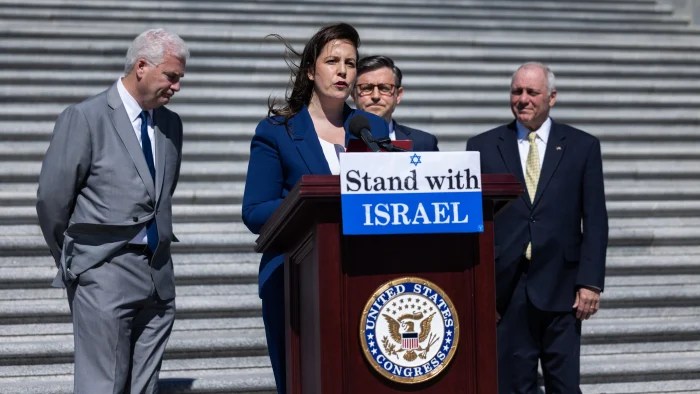
Trump nominee for UN ambassador says Jews have ‘biblical right’ to occupied West Bank
(Photo credit: Tierney L. Cross for The New York Times)
The Cradle | January 22, 2025
Representative Elise Stefanik, recently nominated by President Donald Trump for the position of US ambassador to the UN, said that she supports the claims made by the far right in Israel that Jews have the “biblical right” to take land from Palestinians in the occupied West Bank.
Stefanik, a Republican congresswoman from New York, made the statement while being questioned during a Senate Foreign Relations Committee hearing on 21 January to discuss her confirmation as the new UN Ambassador.
Democratic Senator Chris Van Hollen asked Stefanik whether she supported Palestinians’ right to self-determination.
Stefanik, who is known to be a staunch advocate of Israel and supports its decision to defund the United Nations Relief and Works Agency for Palestine Refugees (UNRWA), refused to answer the question directly, saying, “I think they deserve more than the failures that they have suffered under the leadership of terrorists.”
Van Hollen pressed her further by saying that she had previously stated to him in a private meeting that “Israel has a biblical right to the entire West Bank.”
“I rarely get surprised by answers in my office, but I asked you if you believe the views of Israeli Finance Minister (Bezalel) Smotrich and former National Security Minister Itamar Ben-Gvir, who believe that Israel has a biblical right to the entire West Bank. In that conversation, you said to me (yes) that you agree with that view. Is that your view today?”
Stefanik responded with one word, “Yes.”
The term “biblical right” refers to claims by extremist Jews and Zionist Christians that the Torah included a promise from God to give the entire historical land of Palestine to modern-day Jews. It claims that Jews are justified in killing and ethnically cleansing Palestinian Christians and Muslims from their lands and homes.
In June last year, US-Israeli billionaire Miriam Adelson reportedly donated $100 million to Trump for his presidential campaign in exchange for a promise to allow Israel to annex the West Bank.
https://twitter.com/KhalilJeries/status/1874889229815460333
Representative Stefanik was first elected to the US House of Representatives in 2014, the youngest woman elected to Congress at the time, at just 30 years old, and represented New York’s 21st Congressional District.
She made headlines in 2024 by questioning the presidents of the University of Pennsylvania, Harvard, and the Massachusetts Institute of Technology about what she claimed was antisemitism on college campuses.
At the time, US students at university campuses all across the country were protesting Israel’s genocide of Palestinians in Gaza.
After positioning herself as a champion in the fight against the alleged rise in antisemitism, Rep. Stefanik began receiving large donations from Republican Jewish donors.
POLITICO reported that she “raked in more than $7 million during the first quarter of the year [2024] fueled by her support from prominent Jewish Republicans in the wake of her grilling of university presidents over campus antisemitism.”
The claim that Israeli Jews have the biblical right to the West Bank ignores the rights of Palestine’s indigenous Christians, who have lived in the Holy Land continuously since the time of Jesus over 2000 years ago. Palestinian Christians refer to themselves as “living stones,” in reference to Jesus telling his disciple Peter, “On this rock I will build my church.”
https://twitter.com/a_westgate/status/1718710112603283504
Israel’s occupation and Jewish settlement of the West Bank and Gaza since 1967 have brought the Palestinian Christian community to the brink of extinction.
In January of last year, Rev. Munther Isaac of the Evangelical Lutheran Christmas Church in Bethlehem stated, “Here in the West Bank, many Palestinian Christian families have already left out of fear. They look at what was happening in Gaza, and they think, ‘Could this happen to us one day?’”
Isaac said it is “impossible to thrive as a community in the midst of conflict, oppression and occupation.”
Who is Trump’s Pick For Pentagon’s Middle East Policy Chief?
Sputnik – 22.01.2025
Former CIA analyst and counterterrorism officer Michael P. DiMino, who advocated for humanitarian aid to Gaza and against escalation with Iran, has been sworn in as the Pentagon’s Middle East policy chief.
He will be responsible for signing off on all foreign military agreements on the supply of weapons to US-aligned countries in the region, including Israel.
Earlier, DiMino criticized Biden’s administration for failing to pressure Israel on opening the humanitarian flow to Gaza; meanwhile, he praised the former administration for refusing to participate in Israel’s retaliatory strikes on Iran, Al-Monitor reports.
It’s Official: US Abandoning Ukraine

By Kit Klarenberg | Global Delinquents | January 22, 2025
On January 19th, TIME magazine published an astonishing article, amply confirming what dissident, anti-war academics, activists, journalists and researchers have argued for a decade. The US always intended to abandon Ukraine after setting up the country for proxy war with Russia, and never had any desire or intention to assist Kiev in defeating Moscow in the conflict, let alone achieving its maximalist aims of regaining Crimea and restoring the country’s 1991 borders. To have a major mainstream outlet finally corroborate this indubitable reality is a seismic development.
The TIME article’s brief first paragraph alone is rife with explosive revelations. It notes when the proxy war erupted in February 2022, then-President Joe Biden “set three objectives for the US response” – and “Ukraine’s victory was never among them.” Moreover, the phrase oft-repeated by White House apparatchiks, that Washington would support Kiev “for as long as it takes”, was never meant to be taken literally. Instead, it was just “intentionally vague” newspeak, with no implied timeframe or even desired outcome in mind.
Eric Green, a member of Biden’s National Security Council who oversaw Russia policy, states the US “deliberately…made no promise” to President Volodymyr Zelensky to “recover all of the land Russia had occupied” since the conflict’s inception, “and certainly not” Crimea or the breakaway Donetsk and Lugansk People’s Republics. He said the White House believed “doing so was beyond Ukraine’s ability, even with robust help from the West.” It was well-understood such efforts were “not going to be a success story ultimately” for Kiev, if tried.
According to TIME, the Biden administration’s three key objectives in Ukraine were all “achieved”. Nonetheless, “success” on these fronts “provides little satisfaction” to some of the former President’s “closest allies and advisers.” Green was quoted as saying Washington’s purported victory in Ukraine was “unfortunately the kind of success where you don’t feel great about it,” due to Kiev’s “suffering”, and “so much uncertainty about where it’s ultimately going to land.”
‘Direct Conflict’
One objective was “avoiding direct conflict between Russia and NATO.” Miraculously, despite the US and its allies consistently crossing Moscow’s clearly stated red lines on assistance to Kiev, providing Ukraine with weaponry and other support Biden himself explicitly and vehemently ruled out in March 2022, on the grounds it could cause World War III, and greenlighting hazardously escalatory strikes deep inside Russian territory, so far all-out hot war has failed to materialise. On this front perhaps, the former President can be said to have triumphed.
However, another “was for Ukraine to survive as a sovereign, democratic country free to pursue integration with the West.” This prospect dwindles daily, as the proxy war’s frontline teeters constantly on total collapse. Kiev is facing an eventual and seemingly inevitable rout of some magnitude, with the conflict likely settled solely on Russia’s terms, and Zelensky – or whoever replaces him – having no negotiating position to speak of. In December 2024, Empire house journal Foreign Policy even openly advocated cutting Kiev out of eventual peace talks.
Biden also “wanted the US and its allies to remain united.” It is this objective that most obviously failed, and quite spectacularly. As this journalist has repeatedly documented, British intelligence has consistently sought to escalate the proxy conflict into all-out war between the West and Russia, and encouraged Kiev in its maximalist aims, to the extent of covertly plotting grand operations for the purpose, and training Ukrainians to execute them. London’s overriding ambition, per leaked documents, is “to keep Ukraine fighting at all costs.”
The Western media has acknowledged Ukraine’s calamitous August 2024 invasion of Russia’s Kursk region was to all intents and purposes a British operation. London provided a vast welter of equipment to Kiev “central” to the effort, and “closely” advised their Ukrainian counterparts on strategy. The aim was to draw Russian forces away from Donbass and boost Kiev’s bargaining position, which has proven a staggering embarrassment on both fronts. But there was a wider, more insidious goal behind the incursion.
Britain openly and eagerly advertised its fundamental role in the Kursk misadventure to bolster public support at home for continuing the proxy war, and “persuade key allies to do more to help.” In other words, to normalise open Western involvement, and create the “direct conflict” the Biden administration was so keen to avoid. London was also at the forefront of pressuring NATO member states to permit Ukraine to use foreign-supplied weaponry and materiel inside Russia, which could likewise produce their long-sought hot war against Moscow.
Several Western countries – including the US – have offered such authorisation. Yet, Russia has consistently responded to strikes deep inside its territory with heavy duty counterattacks, which Kiev has been unable to repel. Meanwhile, London’s invitation to its allies to become more overtly involved in the proxy war was evidently rebuffed. In November 2024 too, pro-government outlet Ukrainska Pravda published a startling investigation, documenting in forensic detail how the October 2023 – June 2024 Krynky operation was, à la Kursk, essentially British.
Never spoken of by Ukrainian officials today, the nine-month effort saw wave after wave of British-trained and equipped marines attempt to secure a beachhead in a river-adjacent village in Russian-controlled Kherson. Poorly prepared, many died attempting to reach Krynky, due to relentless artillery, drone, flamethrower and mortar fire. Of those that survived the nightmarish journey, most were then killed under a constant and ever-intensifying blitz, in marsh conditions. Russia’s onslaught grew so inexorable, evacuating casualties or providing forces with even basic supplies became borderline impossible.
Survivors of the Krynky catastrophe – one of the absolute worst in military history – who spoke to Ukrainska Pravda revealed it was hoped the beachhead would be a “game-changer”, opening a second front in the conflict, allowing Kiev’s invading marines to march upon Crimea and all-out victory in the proxy war. They hoped to recreate the June 1944 Normandy landings – D-Day. It is all too easy to envisage British intelligence filling the heads of their Ukrainian trainees with such fantasies.
‘Settle Up’
Fast forward to today, and Britain and France are openly discussing sending “peacekeepers” to Ukraine, to “help underpin” whatever “post-war settlement” emerges between Kiev and Moscow. This is after in February 2024, French President Emmanuel Macron suggested formally deploying his country’s forces to Ukraine to halt Moscow’s advance. The proposal was summarily dropped and forgotten when Russian officials made abundantly clear each and every French soldier dispatched to the frontline would be killed without hesitation, and Paris could become a formal belligerent in the war.
It appears the “peacekeeping” plan is likely to suffer the same fate. On January 20th, coincidentally or not the day of Donald Trump’s inauguration, CIA-created Radio Free Europe published an explainer guide on why sending European troops to Ukraine is “a nonstarter”. Among other things, as the Russians are unambiguously winning, they are unlikely to offer many concessions, particularly allowing foreign soldiers to occupy Kiev’s territory. Furthermore, “as a permanent member of the UN Security Council, Moscow can block any peacekeeping mission.”
As if the message to London and Paris wasn’t emphatic enough, two weeks earlier, at a press conference at his Mar-a-Lago resort, Trump made numerous comments reiterating his commitment to ending the proxy war. “We’re going to have to settle up with Russia,” he declared. Notably, the President sympathised with Moscow’s “written in stone” determination Kiev not be enrolled into NATO, warned the situation “could escalate to be much worse,” and stated his hope the conflict could be wrapped up within six months.
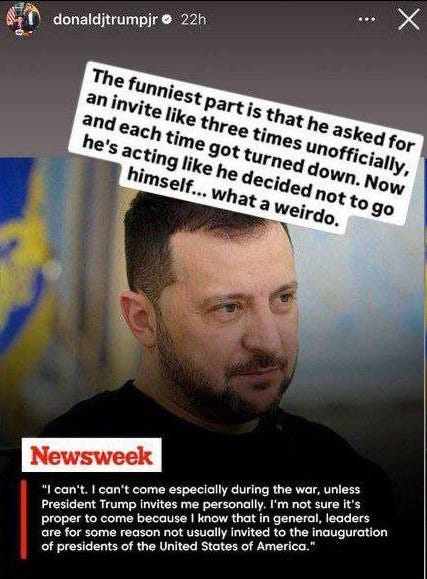
Markedly, Zelensky was not invited to Trump’s inauguration. In a January 6th interview with Newsweek, the Ukrainian President – typically never one to shy away from international jollies – said he was unable to attend, as it wasn’t “proper” to do so “during the war”. Amusingly, Trump’s son Donald Jr. has rubbished Zelensky’s narrative, claiming the – “weirdo” – had specifically “asked for an invite” on three occasions, “and each time got turned down.”
For Berlin, Kiev, London, Paris, and NATO more widely, the writing couldn’t be on the wall any more plainly. Whatever reveries they may have of maintaining the proxy war any longer – Britain recently signed a 100-year-long partnership with Ukraine, under which London will “explore” building military bases on Kiev’s soil – they all ultimately remain imperial vassals, wholly dependent on US financial and military support to exist. Save for a major false flag incident, Trump’s message can only be received among the military alliance.
Ukraine Was Always Just Anti-Russian ‘Battering Ram’ to US – Ex-Pentagon Analyst
Sputnik – 21.01.2025
The Trump administration has little interest in wasting money on Ukraine, retired US Air Force Lt. Col. Karen Kwiatkowski, former analyst for the US Department of Defense, tells Sputnik while commenting on Trump’s decision to suspend US foreign aid programs.
Withholding monies to Ukraine is a “starting point in explaining to Zelensky that the gravy train is over,” the expert thinks.
It has become increasingly obvious that the United States “doesn’t care for Ukraine,” regarding the latter merely as a “battering ram,” a “tool” to be used against Russia, Kwiatkowski remarks.
“So if Ukraine is a tool, it’s now a tool that is no longer very useful. It’s a tool that is hard to maintain. It’s not worth it. So we’re going to throw that tool away,” she says.
US Senator Lindsey Graham’s declaration about fighting Russia “to the last Ukrainian,” however heartless it may sound, “reflects how the Senate and how the politicians and the oligarchy in the United States really feel about Ukraine,” she added.
Trump’s Second Act: What it means for Russia and the global order
By Andrey Ilnitsky | Kommersant | January 16, 2025
The idea of inflicting “strategic defeats” on Russia has been a cornerstone of US policy for a long time. It transcends party lines and is implemented regardless of which administration occupies the White House. The only real differences lie in the methods used to achieve this objective. In this era of global transformation, it is critical for Moscow to analyze the strengths and weaknesses of its opponents. By understanding the nuances of US President Donald Trump’s administration – now back in power – Russia must craft its own strategy of resilience and development, rooted in sovereign interests.
This is not a new game. In 2014, Foreign Affairs published an article by John Mearsheimer, the renowned American political scientist behind the theory of offensive realism. In his piece, Why the Ukraine Crisis is the West’s Fault, Mearsheimer argued that NATO’s strategic ambitions in Eastern Europe provoked Russia’s actions in Crimea and Ukraine. His insights, dismissed at the time, have since been vindicated by events.
Fast forward to December 2024: Mearsheimer’s skepticism resurfaced in an interview with Russian philosopher Alexander Dugin, published by UnHerd. Mearsheimer doubted that Trump, despite his unconventional rhetoric, would bring meaningful change to US policy. “Trump is surrounded by hawks with deeply entrenched Russophobia,” he observed. While Trump’s personal views might differ from Washington orthodoxy, the forces shaping his administration remain aligned with America’s long-standing ambitions of hegemony.
Trump’s first term demonstrated this paradox clearly. Despite his campaign promises to “get along with Russia” and even consider recognizing Crimea, little changed. While Trump and President Vladimir Putin met six times and engaged in what seemed like constructive dialogue, US policy continued to push Russia out of global energy markets, impose sanctions, and arm Ukraine. At a 2023 rally, Trump himself dismissed accusations of being “soft on Russia,” boasting that he had sent “hundreds of Javelins” to Ukraine while the Obama administration sent “pillows.”
Expecting Trump’s second term to usher in a multipolar and equitable global order would be naive. The real power behind Trump’s administration – interest groups, corporations, and donors – has little incentive to pursue peace. His 2023-2024 campaign received significant backing from military-industrial giants like Lockheed Martin and Raytheon, as well as Silicon Valley’s venture capital elite. These forces thrive on perpetual conflict, where war is repackaged as “peace through strength.”
Trump’s geopolitical priorities are clear: undermine China’s rise as an economic and technological powerhouse while maintaining pressure on Russia. Elbridge Colby, a key figure in Trump’s foreign policy team, has articulated this strategy bluntly. Writing in May 2024, Colby argued that America must prioritize Asia – specifically China – over Europe and Russia. “The logic of Cold War strategy,” he wrote, “once led America to Europe; today it suggests that America should focus on Asia. China is the main rival.”
The inclusion of Marco Rubio in Trump’s foreign policy apparatus reinforces this anti-China focus. Rubio, a staunch critic of Beijing, has long warned of China’s ambitions to become the world’s dominant power “at the expense of everyone else.” Trump’s pivot to Asia is clear, but his strategy remains rooted in American exceptionalism and hegemony.
Domestically, Trump’s team envisions America as a “subcontinental fortress,” invoking a modernized Monroe Doctrine. This vision includes greater control over Canada, Greenland, and Panama, and a tighter grip on Central and South America. The goal? To secure America’s dominance in the Western Hemisphere while sidelining external powers like China and Russia.
Technology and military innovation are central to this vision. Trump’s administration aims to leverage artificial intelligence and cutting-edge dual-use technologies to maintain global superiority. This requires a complete reboot of the US military-industrial complex and a closer alignment between civilian industries and defense objectives. However, the question remains: can Washington, with its internal divisions and waning influence, successfully implement such an ambitious strategy?
For Russia, this geopolitical landscape poses serious challenges but also offers opportunities. The unipolar world order led by the US is undeniably weakening. Multipolarity is no longer just an aspiration; it is becoming a reality. However, the US and its allies are not retreating quietly. Instead, they are intensifying hybrid warfare against nations like Russia, China, Iran, and North Korea – countries labeled as “revisionist regimes.”
Trump’s rhetoric may appear bold and unconventional, but his administration’s actions are predictable. The MAGA doctrine of 2024 is less about genuine transformation and more about reasserting US dominance at any cost. Whether through economic coercion, military intervention, or ideological posturing, the goal remains the same: enforce a world order dictated by Washington.
For Russia, the path forward is clear. We must remain steadfast in defending our sovereignty and values. Unlike the West, which prioritizes hegemony, Russia stands for a multipolar world where nations have the right to determine their own destinies. The challenges are immense, but so are the opportunities. In this new era of great power competition, Russia’s resolve will be tested, but our commitment to our people and our principles will guide us through.
Andrey Ilnitsky is a member of the Council for Foreign and Defense Policy and senior research fellow at the Military University of the Ministry of Defense of the Russian Federation.
This article was first published by the newspaper Kommersant and was translated and edited by the RT team.
Featured Video

The American Retreat from Vietnam
or go to
Aletho News Archives – Video-Images
From the Archives
Secret document reveals plans for civil war in Lebanon, Israeli false flags, and invasion
By Randi Nord | Geopolitics Alert | April 5, 2019
Beirut – During his visit with US Secretary of State, Mike Pompeo, Lebanese President Michael Aoun reportedly received a US-Israeli document detailing plans for creating a civil war in Lebanon with covert false flag operations and possible Israeli invasion.
Although the source of the document is Israeli and created in partnership with Washington, no one knows who presented it to Aoun. The Lebanese TV station, Al-Jadeed, initially reported the document on Lebanese TV and a video on its website. Geopolitics Alert translated the report for this article. … continue
Blog Roll
 Aletho News
- ‘Distance yourselves from Israel’: IRGC urges US population to question govt policies
- America’s Greenland deal has a radioactive backstory
- The RAF Fairford ‘terror plot’: Unpacking escalation in the UK echo-chamber
- EU Council Advances Chat Control 2.0 Scanning Proposal
- Ex-Greek MEP files complaint against Israeli spyware firm over alleged Pegasus surveillance
- Troubling ideas throughout the Torah, Talmud, Mishneh Torah and Tanya
- ‘Grave, alarming’: Iran mission on Trump’s UNGA ‘annihilation’ threats
- Najaf airport to reopen to Iranian flights within 24 hours: Ambassador
- From ‘How Will This End For Iran’ to ‘When America Walks Away’: A tale of two Economist covers
- Tehran blasts ‘baseless’ speculation linking Iran to alleged bomb plot at UK air base
- If Americans Knew
- Israel Has Kidnapped Another American Teenager
- US arms sales to Israel worth $21.6 billion in 20 months
- Three Palestinians Killed in Israeli Attacks on Gaza
- Revealed: German “Anti-Semitism Expert” Driving Crackdown on Palestine Solidarity is Former Israeli Spy
- Egypt’s Warning to Israel Before Oct 7
- Israel’s siege signals another cruel winter for 1.8 million Gazans – Daily Update
- Netanyahu Asked UAE Leader to Deny Report on Oct. 7 Warning in Secret Visit, Sources Say
- CNN Chief Int’l Correspondent Clarissa Ward on Journalists in Gaza
- Democratic Party Consultants Surround Troy Jackson with Pro-Israel Donors
- Christian Leader Responds To Netanyahu’s Claims Regarding Palestinian Christians
- No Tricks Zone
- New Study: Earth And Venus Surface Warmth Largely Explained By Convection And Lapse Rate, Not CO2 Or Radiation
- 2025 Nature Paper Claiming Worsening Global Drought Gets RETRACTED …Heavily Flawed
- New Study: ‘Global Drought Shows No Detectable Recent Acceleration Under Climate Warming’
- Economic Masterminds: German Socialists Suggest Taxing Productivity Gains Stemming From Using AI
- The South China Sea Has Not Been Cooperating With The Climate Change Narrative
- Energy Crisis: Germany Enters Heating Season With Historically Low Gas Reserve Fill Levels
- New Study: The Antarctic Ice Sheet Gained Mass From 2020-2024 Due To Staggering Snow And Ice Accumulation
- Study: Ocean Heating Rates From Thousands Of Years Ago ‘Dwarf’ Modern Ocean Heating Rates
- Climate Extremists Target, Attack Large-Scale Power Grid Infrastructure In Germany!
- New Study: Antarctic Ice Melt Has Contributed Less Than 1 Centimeter To Sea Level Rise In The Last 30 Years

