Trump Orders U.S. to Withdraw From World Health Organization
By Suzanne Burdick, Ph.D. | The Defender | January 21, 2025
Within roughly 8 hours of taking his oath of office, President Donald Trump on Monday signed an order to withdraw the U.S. from the World Health Organization (WHO).
Trump’s executive order cited numerous reasons for pulling the U.S. out of the WHO, including:
“The organization’s mishandling of the COVID-19 pandemic … and other global health crises, its failure to adopt urgently needed reforms, and its inability to demonstrate independence from the inappropriate political influence of WHO member states.”
The WHO also “continues to demand unfairly onerous payments” from the U.S., the order stated. “China, with a population of 1.4 billion, has 300 percent of the population of the United States, yet contributes nearly 90 percent less to the WHO.”
Commenting on the news, Children’s Health Defense (CHD) CEO Mary Holland told The Defender:
“I applaud President Trump’s decision to leave the World Health Organization. It hasn’t been transparent, based on science, or serving the U.S. interest in public health.
“The World Health Organization is not a reformable institution. Its proposed Pandemic Treaty is a nightmare and would lead to more gain-of-function research and pandemics.”
Holland said she hopes the move “will lead to a global reconsideration of how to handle public health and international crises.”
Public health physician and biotech consultant Dr. David Bell told The Defender, “WHO needs a radical shake-up.”
Bell, a former medical officer and scientist at the WHO, said the WHO needs a “massive downsizing” and “to return to basic public health rather than the profit-driven false agenda of rising pandemic risk that WHO has embarked on.”
For instance, Bell criticized recent WHO efforts to push the mpox vaccine in Africa, diverting resources from addressing far more deadly health issues, such as malaria, malnutrition, tuberculosis and HIV/AIDS.
“If WHO does not respond by a total reversal of direction and values,” Bell said, “then we should hope that this withdrawal goes forward and others join.”
Trump’s move came as no surprise. As early as December 2023, his transition team was pushing for an exit from the WHO on day one of the new administration.
U.S. law requires a one-year notice and the payment of any outstanding fees when the country withdraws from the WHO. That means the final full withdrawal will take effect in early 2026.
Monday’s executive order came as a follow-up to Trump’s efforts during his first presidential term to withdraw from the WHO.
In July 2020, Trump moved to officially withdraw the U.S. from the WHO by submitting a notice of withdrawal to the United Nations’ (U.N.) secretary-general.
The withdrawal would have taken effect July 6, 2021. However, Trump lost the 2020 presidential election to Joe Biden, who on Jan. 20, 2021, retracted Trump’s withdrawal notification letter.
Monday’s executive order revoked Biden’s letter. It also said the secretary of state would immediately inform the U.N.’s secretary-general — again — of the U.S. intention to withdraw.
The order also revoked another order Biden issued in January 2021 that called for a U.S. federal response to COVID-19 that included “engaging with and strengthening the World Health Organization.”
U.S. government personnel or contractors working “in any capacity” with the WHO will be recalled and reassigned, the order stated.
Investigative journalist Whitney Webb cautioned against reading too much into Trump’s withdrawal from the WHO.
She wrote in an X post:
“To be fair, Trump also left the WHO in mid-2020 and then just redirected what was once WHO funding to the Gates-funded GAVI vaccine alliance. While leaving the WHO is positive, it is not the slam dunk some are advertising, especially considering Gates’ recent comments on Trump’s enthusiasm for his ‘vaccine innovation’ proposals.”
U.S. is WHO’s biggest funder
The U.S. is by far the WHO’s largest financial backer, Reuters reported, providing roughly 18% of the organization’s overall budget.
The WHO’s most recent budget, for 2024-2025, was $6.8 billion.
The next-largest state donor — when combining mandatory fees and voluntary contributions — is Germany, which provides around 3%, Reuters said.
Germany’s health minister today said that leaders in Berlin will try to talk Trump out of his decision.
When asked about Trump’s order, Guo Jiakun — a spokesperson for China’s foreign ministry — said today at a regular press briefing that the WHO’s role in global health governance should be strengthened, not weakened.
“China will continue to support the WHO in fulfilling its responsibilities, and deepen international public health cooperation,” Jiakun said.
The WHO said in a statement that it regrets Trump’s decision. “We hope the United States will reconsider.”
WHO pandemic treaty would have ‘no binding force’ in U.S.
Although the full withdrawal by the U.S. from the WHO won’t take effect until January 2026, Monday’s executive order said U.S. negotiations on a WHO-led pandemic treaty or amendments to the International Health Regulations (IHR) will cease immediately.
Independent journalist James Roguski pointed out on Substack that there aren’t any negotiations underway.
Negotiations stopped last May when negotiators failed to submit final texts for the two documents before the May 24 deadline.
Instead, member states on June 1, 2024, agreed to a smaller package of amendments.
Monday’s order closes the door to the possibility that the U.S. might resume negotiations during the next year — or implement the few IHR amendments passed last June. Trump’s order stated:
“While withdrawal is in progress, the Secretary of State will cease negotiations on the WHO Pandemic Agreement and the amendments to the International Health Regulations, and actions taken to effectuate such agreement and amendments will have no binding force on the United States.”
Roguski said Trump should go further by issuing a letter that revokes the amendments the WHO adopted on June 1, 2024, and clarifies that the U.S. “is also exiting the International Health Regulations.”
In May 2024, 22 state attorneys general said in a letter that they would refuse to comply with a WHO-led pandemic treaty or IHR amendments. They cited concerns about national sovereignty and civil liberties.
Dutch attorney Meike Terhorst told The Defender she was “delighted” by Trump’s announcement.
Terhorst said that she and other international lawyers who worked to stop the WHO’s “power grab” discovered that the U.S. delegation had been the “primary force behind the power grab.”
Trump also signs order to end gov’t censorship
Other orders signed Monday include one that restores free speech and ends federal censorship of U.S. citizens.
“Over the last 4 years,” the order said, “the previous administration trampled free speech rights by censoring Americans’ speech on online platforms, often by exerting substantial coercive pressure on third parties, such as social media companies, to moderate, deplatform, or otherwise suppress speech that the Federal Government did not approve.”
It continued:
“Under the guise of combatting ‘misinformation,’ ‘disinformation,’ and ‘malinformation,’ the Federal Government infringed on the constitutionally protected speech rights of American citizens across the United States in a manner that advanced the Government’s preferred narrative about significant matters of public debate.
“Government censorship of speech is intolerable in a free society.”
That can’t happen anymore, the order said.
Citing the First Amendment, the order outlined what will now be the policy of the federal government when it comes to free speech. The government’s job is to:
(a) secure the right of the American people to engage in constitutionally protected speech;
(b) ensure that no Federal Government officer, employee, or agent engages in or facilitates any conduct that would unconstitutionally abridge the free speech of any American citizen;
(c) ensure that no taxpayer resources are used to engage in or facilitate any conduct that would unconstitutionally abridge the free speech of any American citizen; and
(d) identify and take appropriate action to correct past misconduct by the Federal Government related to censorship of protected speech.
No federal agency, department or worker can use government resources for an activity that contradicts that job, the order said.
The order also called on state attorneys general to investigate whether the Biden administration engaged in censorship of Americans’ views. It directed them to write a report about its findings that includes “recommendations for appropriate remedial actions to be taken based on the findings.”
It is unclear how the order may affect ongoing litigation related to federal censorship.
That’s because the order’s final clause states that the order is not intended to — and does not — “create any right or benefit, substantive or procedural, enforceable at law or in equity by any party against the United States, its departments, agencies, or entities, its officers, employees, or agents, or any other person.”
On Jan. 6, CHD petitioned the Supreme Court to hear its case against Meta, the parent company of Facebook and Instagram.
“The record in CHD v. Meta,” Holland said, “clearly shows Facebook’s close collaboration with the White House to censor vaccine-related speech, even pre-COVID.”
CHD General Counsel Kim Mack Rosenberg told The Defender she is “certainly pleased” to see the new administration take quick action to address the “rampant censorship by the government over the past four years and to investigate governmental wrongdoing.”
“However,” Rosenberg said, “CHD’s censorship cases will continue. We have provided the courts with substantial evidence of wrongdoing by the government and by social media companies against CHD.”
“The executive order — while a significant positive step — does not remedy the harms done to CHD,” she added.
Related articles in The Defender:
- Is Trump Transition Team Pushing for WHO Exit on Day One?
- WHO Approves First Mpox Vaccine for Adults in Africa — Then Says Babies Can Get It, Too, Despite No Clinical Trials
- WHO Passes ‘Watered-down’ IHR Amendments, Plans to Revisit Pandemic Treaty ‘Within a Year’
- 22 AGs Oppose WHO Pandemic Treaty, Citing Threats to Sovereignty and Civil Liberties
This article was originally published by The Defender — Children’s Health Defense’s News & Views Website under Creative Commons license CC BY-NC-ND 4.0. Please consider subscribing to The Defender or donating to Children’s Health Defense.
The Budapest Memorandum: The Fake Narrative Supporting a Long War in Ukraine
By Professor Glenn Diesen | January 21, 2025
Narratives have been constructed to support a long war in Ukraine. For example, the narrative of an “unprovoked invasion” was important to criminalise diplomacy as the premise suggests negotiations would reward Russian military adventurism and embolden further Russian aggression. Meanwhile, NATO escalating the war creates costs that outweigh the benefits to Russia.
Russia’s violation of the Budapest Memorandum is a key narrative that supports a long war. It is constantly referenced as a reason why Russia cannot be trusted to abide by a peace agreement, and why the war must keep going. The argument is that Ukraine gave up its nuclear weapons in return for security guarantees for its territorial integrity. Russia’s breach of this agreement suggests it cannot be trusted and that the only reliable security guarantees must come from NATO membership. Furthermore, the West must continue to send weapons to Ukraine to honour the security guarantees of the Budapest Memorandum.
In February 2022, a few days before the Russian invasion, Zelensky referred to the Budapest Memorandum: “Ukraine has received security guarantees for abandoning the world’s third nuclear capability. We don’t have that weapon. We also have no security.” The Budapest Memorandum was again used by Zelensky in October 2024 to support the argument that Ukraine must either have NATO or nukes: “Either Ukraine will have nuclear weapons, and then it will be a defence for us, or Ukraine will be in NATO”.
This article presents facts and arguments that challenge the false narrative of the Budapest Memorandum, which aims to delegitimise diplomacy. Criticising the narrative of the Budapest Memorandum does not entail “legitimising” Russia’s invasion of Ukraine, which is a common tactic to smear and censor criticism against the narratives supporting a long war.
No Security Guarantees and No Ukrainian Nuclear Weapons
The Budapest Memorandum does not offer any security “guarantees”, rather it provides “assurances”. Former US Ambassador to Ukraine Steven Pifer, who was part of the US negotiation team in 1994, argues the US was explicit that “guarantees” should not be confused with “assurances”. Pifer also confirms this was understood by both the Ukrainians and the Russians:
“American officials decided the assurances would have to be packaged in a document that was not legally-binding. Neither the Bush nor Clinton administrations wanted a legal treaty that would have to be submitted to the Senate for advice and consent to ratification. State Department lawyers thus took careful interest in the actual language, in order to keep the commitments of a political nature. U.S. officials also continually used the term “assurances” instead of “guarantees,” as the latter implied a deeper, even legally-binding commitment of the kind that the United States extended to its NATO allies”.[1]
Ukraine also did not have any nuclear weapons. The nuclear weapons in question were former Soviet nuclear weapons that were stationed in Ukraine, but under the control of Moscow. Kiev did not and could not operate or maintain these weapons, which is usually left out of the narrative. Furthermore, in the Minsk agreement of 1991, Ukraine had already committed itself to the “destruction of nuclear weapons” on its territory.[2]
The Not-So-Sacred Memorandum
In December 1994, the US, UK, and Russia met in the Hungarian capital and offered security commitments in three separate agreements with Ukraine, Belarus, and Kazakhstan. These three countries agreed to relinquish the nuclear weapons that had been left on their territory after the collapse of the Soviet Union, and in return, the US, UK and Russia offered commitments to not undermine their security. The Budapest Memorandum outlined key principles such as “to refrain from economic coercion designed to subordinate to their own interest the exercise by Ukraine of the rights inherent in its sovereignty and thus to secure advantages of any kind”, and to “respect the independence and sovereignty and the existing borders of Ukraine”. In a display of cherry-picking, NATO countries constantly ignore the first commitment but constantly refer to the second commitment.
The US claims its use of economic coercion and violation of Ukrainian sovereignty was in support of democracy and human rights as opposed to advancing its own interests. Thus, the US freed itself from its commitments under the Budapest Memorandum. Under the so-called rules-based international order, the US and its allies claim the prerogative to exempt themselves from international law, norms and agreements under the guise of supporting humanitarian law and liberal democratic norms.[3]
When the US imposed sanctions on Belarus in 2013, Washington explicitly stated that the Budapest Memorandum was not legally binding and that US actions were exempted as the US was allegedly promoting human rights:
“Although the Memorandum is not legally binding, we take these political commitments seriously and do not believe any U.S. sanctions, whether imposed because of human rights or non-proliferation concerns, are inconsistent with our commitments to Belarus under the Memorandum or undermine them. Rather, sanctions are aimed at securing the human rights of Belarusians and combating the proliferation of weapons of mass destruction and other illicit activities, not at gaining any advantage for the United States”.[4]
The Western-backed coup in 2014 had been an even more blatant violation of Ukrainian sovereignty. The West interfered in the domestic affairs of Ukraine, imposed economic sanctions, and finally toppled the Ukrainian president to pull the country into NATO’s orbit. The commitments under the Budapest Memorandum were cast aside as the West claimed to support a “democratic revolution”, despite being an unconstitutional coup that did not even enjoy majority support from the Ukrainians and only a small minority of Ukrainians supported NATO membership.
International law imposes rules and mutual constraints that limit foreign policy flexibility, but in return deliver reciprocity and thus predictability. Once the West freed itself from mutual constraints in the Budapest Memorandum, Russia also abandoned it. US Ambassador Jack Matlock who participated in negotiating an end to the Cold War, questions the validity of the Budapest Memorandum after the coup in 2014. According to Matlock, the principle in international law of rebus sic stantibus means that agreements should be upheld “provided things remain the same”. Matlock argues that Russia “strictly observed its obligations in the Budapest Memorandum for 13 years” even as NATO expanded towards its borders, although the coup of 2014 created “a radically different international situation”. Matlock thus concludes that Russia was “entitled to ignore the earlier agreement”.[5]
Learning the right lessons
An honest assessment of why the Budapest Memorandum collapsed is important to assess how new agreements can be improved. NATO’s demand for hegemony in Europe and rejection of a common European security architecture inevitably led to the collapse of common agreements as the West would no longer accept the principle of mutual constraints and obligations. Liberal hegemony entailed that the West could exempt itself from international law and agreements, while Russia would still abide by them. The narrative of Ukrainian nuclear weapons, security guarantees, and ignoring the US and UK violation of the Budapest Memorandum serves the purpose of sowing distrust in any future security agreements with Russia. A mutually beneficial peace is possible if we first return to the truth.
[1] S. Pifer, 2011. The Trilater Proce The United States, Ukraine, Russia and Nuclear Weapons, Foreign Policy at Brookings, Arms Control Series, Paper 6, May 2011, p.17. https://www.brookings.edu/wp-content/uploads/2016/06/05_trilateral_process_pifer.pdf
[2] Agreement on Strategic Forces Concluded between the 11 members of the Commonwealth of Independent States on December 30, 1991. https://www.bits.de/NRANEU/START/documents/strategicforces91.htm
[3] G. Diesen, ‘The Case for Dismantling the Rules-Based International Order, Substack, 23 December 2024.
[4] US Embassy in Belarus, ‘Belarus: Budapest Memorandum’, U.S. Embassy in Minsk, 12 April 2013.
[5] J. Matlock, ‘Ambassador Jack Matlock on Ukraine, Russia, and the West’s Mistakes’, Nuova Rivista Storica
Behind ‘Salt Typhoon’ – US intelligence agencies’ mass surveillance of its citizens
Global Times | January 17, 2025
Following the US hype of the so-called “Volt Typhoon” false narrative to discredit China in the first half of 2024, by the end of 2024, the US fabricated another so-called “hacker group associated with the Chinese government” – the “Salt Typhoon,” promoting the narrative of “Chinese cyber threats.” However, professionals in the field of cyberspace told the Global Times that the so-called “Salt Typhoon” not only lacks any substantial evidence but also exposes the fact that US intelligence agencies are conducting large-scale surveillance and espionage against their own citizens.
On Friday, the Global Times learned from a source that during discussions with their American counterparts, China’s diplomats on cyber affairs firmly rejected the US accusations against China regarding the individual cases such as “Salt Typhoon” and “Volt Typhoon” in the absence of evidence. They also expressed concerns about the US large-scale cyber espionage activities targeting China and the threats posed to China’s critical information infrastructure.
On the same day, China’s National Computer Network Emergency Response Technical Team Center of China (known as CNCERT) released two investigative reports, exposing two recent cyberattacks by US intelligence agencies targeting major Chinese technology firms to steal trade secrets.
‘Salt Typhoon’ – new farce to smear China
On September 25, 2024, an “exclusive” report by Wall Street Journal claimed that “hackers linked to the Chinese government have broken into a handful of US internet-service providers in recent months in pursuit of sensitive information” for preparation of future cyberattacks.
Then on October 25, the FBI and the Cybersecurity and Infrastructure Security Agency (CISA) sent a joint statement, claiming that the US government is investigating the unauthorized access to commercial telecommunications infrastructure by actors affiliated with China.
However, a separate report by American media on October 27 denied the aforementioned hype and revealed the underlying motives behind the US media’s sensationalism regarding “Salt Typhoon.” A report by The Washington Post said, “the Salt Typhoon group is also thought to have targeted the system that tracks lawful requests for wiretaps made by the federal government of carriers. The motive there could be to figure out who the FBI and other federal agencies have under surveillance.”
It is not difficult to see that the key behind the “Salt Typhoon” is the “private eavesdropping and surveillance system” that American telecommunications companies have specifically established for federal law enforcement agencies, Li Yan, director of Institute of Technology and Cybersecurity, China Institutes of Contemporary International Relations, told the Global Times.
The essence of the so-called “Salt Typhoon” is the large-scale wiretapping and intelligence-gathering activities conducted by US intelligence agencies on its own citizens, including political figures. The breadth and scale of the surveillance targets are astonishing, Li Yan said.
Ironically, the US government has never been able to provide solid and credible evidence linking the “Salt Typhoon” to the Chinese government, and the various pieces of information in the media are vague, Li Yan noted.
The expert said that it is not difficult to see that their goal is to muddle the public discourse and divert attention because once the accusation is substantiated, the US government cannot escape responsibility. The key issue is that the authorization and legality of domestic surveillance by US intelligence agencies would provoke backlash both domestically and internationally.
Li Yan added that in this context, diverting attention and shifting blame is of utmost urgency for the perpetrators. Moreover, US intelligence agencies could continue to hype the so-called national security threats under the pretext of “Chinese hackers,” carry out large-scale surveillance, and seek to gain more departmental interests.
Zuo Xiaodong, a professor at the School of Cybersecurity at the University of Science and Technology of China, told a Global Times that the so-called “Salt Typhoon” incident is a complete fabrication with no substantial evidence, and it is suspected to be a self-directed and self-performed operation by the US.
In simple terms, “Salt Typhoon” refers to claims made by US media that hackers have stolen data from US telecommunications agencies regarding surveillance on American citizens, which precisely exposes “the tip of the iceberg” of the large-scale surveillance conducted by US intelligence agencies, Zuo Xiaodong said.
The expert believed the US fabricating and sensationalizing the “Salt Typhoon” is to elevate the “China threat theory” to the “China cyber threat theory,” attempting to isolate China globally and create momentum for establishing international rules in cyberspace that are favorable to the US.
Latest reports: US cyberattacks China’s tech firms
Despite the US’ ongoing efforts to smear China by accusing it of “cyberattacks,” the fact is that the US is the largest source of cyberattacks in the world. According to media reports, on December 18, 2024, China’s National Computer Network Emergency Response Technical Team Center of China (known as CNCERT) reported two incidents of cyber espionage by US intelligence agencies targeting large technology enterprises in our country. On Friday, the CNCERT released detailed investigation findings regarding these incidents.
In one case, it said that starting from August 2024, a certain advanced materials design research unit in China was suspected to have been targeted by a cyberattack from US intelligence agencies. Analysis revealed that the attackers exploited a vulnerability in a domestic electronic document security management system to infiltrate the company’s software upgrade management server. Through the software upgrade service, they delivered control trojans to over 270 host machines of the company, stealing a large amount of commercial secrets and intellectual property.
“The attacks mainly occurred from Monday to Friday US time, with no attacks reported during major US holidays,” the report stated. “The five proxy IPs used by the attackers were completely unique and located in Germany, Romania, and other places, reflecting their high awareness of anti-tracing and a rich reserve of attack resources.”
In addition, starting from May 2023, a large high-tech enterprise in China specializing in smart energy and digital information was suspected to have been attacked by US intelligence agencies. Analysis revealed that the attackers used multiple overseas proxies to exploit vulnerabilities in Microsoft Exchange, infiltrating and taking control of the company’s email server and implanting backdoor programs to continuously steal email data. At the same time, the attackers used the email server as a springboard to attack and control more than 30 devices belonging to the company and its subsidiaries, stealing a large amount of the company’s trade secrets.
Multiple facts indicate that documents previously disclosed by Snowden further reveal that the US has conducted the broadest range of cyber espionage and surveillance operations against China and the entire world to date. According to reports from Chinese security agencies and enterprises, the US has been conducting cyberattacks and espionage globally, including against China and the US’ own allies. Furthermore, it has deliberately inserted strings in Chinese and other languages to mislead attribution analysis and frame other countries, Zuo Xiaodong said.
‘US should maintain cybersecurity with responsible attitude’
Chinese Foreign Ministry spokesperson Guo Jiakun stated at Friday’s press briefing that the report by CNCERT brought to light again the attempts by the US government to conduct cyberattacks and theft of trade secrets and intellectual property targeting China.
Guo expressed serious concerns about such attempts, and urged the US to immediately stop the malicious activities. China will take necessary measures to safeguard its own cyber security and interests, Guo said.
Cyberspace bears on national security and economic prosperity of all countries. The US should reflect on what it’s doing, and stop its political smears. The US should live up to its standards first before asking other countries to do the same, responsibly observe the same international rules respected by other countries, and work with the international community to maintain peace and security in cyberspace, Guo said.
Failed State America. Joe Biden’s absolute destruction of freedom of speech
By Martin Jay | Strategic Culture Foundation | January 20, 2025
Sometimes the internet seems to be overbrimming with video clips showing hilarious examples of what a failed state actually looks like. One of the most common is MPs, or ‘deputies’ actually fighting in their own parliaments against one another. The irony of these clips is that they are usually uploaded by westerners who use to them as a tool to boost or gentrify the reality of western countries’ democratic models.
But no more.
Thanks to Joe Biden’s genocidal maniacs club, the last days of his rule gave us a gem in the form of a press conference where the limit of just how America is anything but a functioning democracy was stretched to breaking point in what appeared to both be deeply sad yet comical at the same time.
As the odious Anthony Blinken gave his patronizing speech to the so-called journalists amassed before him which felt a little like an aristocrat who had gathered the servants in the library to congratulate them on finding an item of lost jewelry of her ladyship’s, we witnessed in real time what America and what these State Department’s press briefings really are: a fraud.
Blinken thanked those present for asking difficult questions, when in fact, none had really been asked in 4 years. Why? Because that is not part of the unwritten rules of how these press briefings work. But the moment he had mentioned the “difficult questions” he was, perhaps appropriately, delivered a series of difficult questions by the Jewish American journalist Max Blumenthal. What was not so surprising was how none of those questions were answered as Blinken, being a smart operator, knew if he kept composed and didn’t rise to the bait it would probably anger Blumenthal even more allowing the tirade to look on camera at least like a rant which had got out of control. Seconds passed and Blumenthal was ushered away by officials which he didn’t offer any resistance to. Moments passed before the veteran Arab journalist Sam Husseini also asked more difficult questions to an increasingly startled Blinken before we see the extent of how far America has abandoned its own free speech doctrine which it used to espouse to the rest of the world: Husseini was actually physically removed by overweight, armed police officers who you can see quite clearly feel uncomfortable about what they are doing, which most people would associate with a tin pot West African country’s ruling junta and not the American government at a press conference.
But the really shocking part of this story was yet to come: the absolute refusal by colleagues in the press room to even verbally object will have stunned journalists all over the world. It provokes many questions about journalism and what these individuals in the room think they are actually doing. We were given though a clue to quite how far journalism has died in the West and been replaced by a cheaper, easy wipe brand called ‘pseudo journalism’ – where actors take one function of journalists but who effectively work for the ruling elite rather than previously for the masses who used to fund the model by buying the actual publications. CNN reporting of the fiasco was very telling. They lost no time putting the boot into Blumenthal, who, naturally they must despise as he functions as a real journalist and they have long forgotten what this entails years ago, opting for the new model of fake news operator. They referred to Blumenthal as an “activist” – a typical slur from big media to individual journalists who carry out stellar work.
The truth about this incident is that such press conferences at the state department or indeed in the European Commission in Brussels are entirely staged. They are a theatre concocted by the elite and the press themselves as part of a dirty deal whereby the journalists ask the softball questions which allow the top figures to deliver the prepared spiel. The so-called journalists sign up to this and in return get access to individuals and scoops – although it’s important to note that the scoops are nearly always new items which serve the state’s purpose. It’s a game which has been going on for a long time and the humble masses don’t understand how they are being taken for a ride by the magicians’ allusion of something which might look credible. In these press gatherings some journalists are even asked to present certain questions which are even suggested by those holding the conference, something I witnessed myself a lot in Brussels.
It was not that the questions put to Blinken were so harsh, or even unconventional. The point is that both Blumenthal and Husseini broke the house rules when they went rogue and did what most people would view to be the role of real journalists: ask unscripted questions. Look what happens when journalist do this. We are treated to a debacle which we would expect to see in the global south, or certainly in Nazi Germany in the 30s. And this is America?
The cat is out of the bag. The whole world can see now how America has lost all its links with the democratic model and become and autocracy, run, financed and ruled by Israel’s cash. Netanyahu and his cronies must have had a really good laugh watching those journalists being removed like that. Presumably their press accreditations will be removed and certainly the worry that both of them will have is that they now mysteriously find themselves being investigated for tax irregularities, theft, fraud or even having child porn on their computers. Journalists like Blumenthal are the biggest threat to the deep state as they will never be part of the establishment and therefore will always be the most dangerous guy to tackle. The one who has nothing to lose is your biggest threat. I don’t imagine Trump and his cabal will be any kinder to him despite The Grayzone taking a more grown-up approach to Russia and how the Ukraine war is reported, as opposed to CNN’s stenographic reproduction of the State Department’s narrative, seasoned by fake news on occasion.
The real enemy for western elites is the feral truth. All pretense of a functioning democracy were eradicated in a matter of minutes with this press conference calamity which has now replaced those MPs in that central European country throwing chairs at one another in their own parliament. Great job, Joe.
The Competency Crisis Proliferating The West
By Alastair Crooke | Strategic Culture Foundation | January 20, 2025
The essayist and military strategist, Aurelien, has written a paper entitled: The Strange Defeat (original in French). The ‘strange defeat’ being that of Europe’s ‘curious’ inability to understand Ukraine or its military mechanics.
Aurelien highlights the strange lack of realism by which the West has approached the crisis —
“ … and the almost pathological dissociation from the real world that it displays in its words and actions. Yet, even as the situation deteriorates, and the Russian forces advance everywhere, there is no sign that the West is becoming more reality-based in its understanding – and it is very likely that it will continue to live in its alternative construction of reality until it is forcibly expelled”.
The writer continues in some detail (omitted here) to explain why NATO has no strategy for Ukraine and no real operational plan:
“It has only a series of ad hoc initiatives, linked together by vague aspirations that have no connection with real life plus the hope that ‘something [beneficial] will occur’. Our current Western political leaders have never had to develop such skills. Yet it is actually worse than that: not having developed these skills, not having advisers who have developed them, they cannot really understand what the Russians are doing, how and why they are doing it. Western leaders are like spectators who do not know the rules of chess or Go – and are trying to figure out who is winning”.
“What exactly was their goal? Now, responses such as ‘to send a message to Putin’, ‘complicate Russian logistics’, or ‘improve morale at home’ are no longer allowed. What I want to know is what is expected in concrete terms? What are the tangible results of their ‘messaging’? Can they guarantee that it will be understood? Have you anticipated the possible reactions of the Russians – and what will you do then?”
The essential problem, Aurelien bluntly concludes, is that:
“our political classes and their parasites have no idea how to deal with such crises, or even how to understand them. The war in Ukraine involves forces that are orders of magnitude larger than any Western nation has deployed on operations since 1945 … Instead of real strategic objectives, they have only slogans and fanciful proposals”.
Coldly put, the author explains that for complex reasons connected with the nature of western modernity, the liberal élites simply are not competent or professional in matters of security. And they do not understand its nature.
U.S. cultural critic Walter Kirn makes rather similar claims in a very different, yet related, context: California Fires and America’s Competency Crisis –
“Los Angeles is in flames, yet California’s leaders seem helpless, unmasking a generation of public investment in non-essential services [that leaves the Authorities floundering amidst the predicted occurrence of the fires]”.
On a Joe Rogan podcast earlier this month, a firefighter goes: “It’s just going to be the right wind and fire’s going to start in the right place and it’s going to burn through LA all the way to the ocean, and there’s not a f***ing thing we can do about it”.
Kirn observes:
“This isn’t the first fire or set of fires in Malibu. Just a few years ago, there were big fires. There always are. They’re inevitable. But having built this giant city in this place with this vulnerability, there are measures that can be taken to contain and to fend off the worst”.
“To fob it off on climate change, as I say, is a wonderful thing to tell yourself, but none of this started yesterday. My only point is this, has it done everything it can to prepare for an inevitable, unavoidable situation that perhaps in scale differs from the past, but certainly not in kind? Are its leaders up to the job? There’s not a lot of sign that they are. They haven’t been able to deal with things like homelessness without fires. So the question of whether all those things have been done, whether they’ve been done well, whether there was adequate water in fire hydrants, whether they were working at all, things like that, and whether the fire department was properly trained or properly staffed, all those questions are going to arise”.
“And as far as the competency crisis goes, I think that there will be ample material to portray this as aggravated by incompetence. California’s a state that’s become notorious for spending a lot of money on things that don’t work, on high-speed rail lines that never are constructed, on all sorts of construction projects and infrastructure projects that never come to pass. And in that context, I think this will be devastating to the power structure of California”.
“In a larger sense though, it’s going to remind people that a politics that has been for years now about language and philosophical constructs such as equity and so on, is going to be seen as having failed in the most essential way, to protect people. And that these people are powerful and influential and privileged is going to make that happen faster and in a more prominent fashion”.
To which his colleague, journalist Matt Taibbi, responds:
“But pulling back in a broader sense, we do have a crisis of competency in this country. It has had a huge impact on American politics”. Kirn: “[Americans] They’re going to want less concern for the philosophical and/or even long-term political questions of equity and so on, I predict, and they’re going to want to lay in a minimum expectation of competence in natural disasters. In other words, this is a time when the priorities shift and I think that big change is coming, big, big change, because we look like we’ve been dealing with luxury problems, and we’ve certainly been dealing with other countries’ problems, Ukraine or whoever it might be, with massive funding. There are people in North Carolina right now still recovering from a flood and having a very difficult time as winter comes, which it doesn’t in LA in the same way, or as winter consolidates itself, I guess”;
“So looking forward, it’s not a question of blame, it’s what are people going to want? What are people going to value? What are they going to prize? Are their priorities going to shift? I think they will shift big time. Los Angeles will be a touchstone and it will be a touchstone for a new approach to government”.
So we have this ‘divorce from reality’ and consequent ‘Competency Crisis’ – whether in California; Ukraine or Europe. Where lie the roots to this malaise? U.S. writer David Samuels believes this to be the answer:
“In his last days in office … President Barack Obama made the decision to set the country on a new course. On Dec. 23, 2016, he signed into law the Countering Foreign Propaganda and Disinformation Act, which used the language of defending the homeland to launch an open-ended, offensive information war, a war that fused the security infrastructure with the social media platforms – where the war supposedly was being fought”.
However, collapse of the 20th-century media pyramid and its rapid replacement by monopoly social media platforms, had made it possible for the Obama White House to sell policy – and reconfigure social attitudes and prejudices – in entirely new ways.
During the Trump years, Obama used these tools of the digital age to craft an entirely new type of power centre for himself – one that revolved around his unique position as the titular, though pointedly never-named, head of a Democratic Party which he succeeded in refashioning in his own image, Samuels writes.
The ‘permission structure’ machine that Barack Obama and David Axelrod (a highly successful Chicago political consultant), built to replace the Democratic Party was in its essence a device for getting people to act against their beliefs by substituting new and ‘better’ beliefs through the top-down controlled and leveraged application of social pressure – effectively turning Axelrod’s construct into ‘an omnipotent thought-machine’, Samuels suggests:
“The term ‘echo chambers’ describes the process by which the White House and its wider penumbra of think tanks and NGOs deliberately created an entirely new class of experts who mutually credentialed each other on social media in order to advance assertions that would formerly have been seen as marginal or not credible”.
The aim was for a platoon of aides, armed with laptops or smart phones, to ‘run’ with the latest inspired Party meme and to immediately repeat, and repeat it, across platforms, giving the appearance of an overwhelming tide of consensus filling the country. And thus giving people the ‘permission structure’ of apparent wide public assent to believe propositions that formerly they would never have supported.
“Where this analysis went wrong is the same place that the Obama team’s analysis of Trump went wrong: The wizards of the permission structure machine had become captives of the machinery that they built. The result was a fast-moving mirror world that could generate the velocity required to change the appearance of “what people believe” overnight. The newly minted digital variant of “public opinion” was rooted in the algorithms that determine how fads spread on social media, in which mass multiplied by speed equals momentum—speed being the key variable”.
“At every turn over the next four years, it was like a fever was spreading, and no one was immune. Spouses, children, colleagues, and supervisors at work began reciting, with the force of true believers, slogans they had only learned last week. It was the entirety of this apparatus, not just the ability to fashion clever or impactful tweets, that constituted the party’s new form of power”.
“In the end, however, the fever broke”. The credibility of Élites imploded.
Samuels account amounts to a stark warning of the danger associated with distance opening up between an underlying reality and an invented reality that could be successfully messaged, and managed, from the White House. “This possibility opened the door to a new potential for a large-scale disaster – like the war in Iraq”, Samuels suggests. (Samuels does not specifically mention Ukraine, although this is implied throughout the argument).
This – both the Obama tale, as told by David Samuels, and Walter Kirn’s story of California – augment Aurelien’s point about Ukraine and European military incompetence and lack of professionalism on the field: It is one of allowing a schism to open up between contrived narrative and reality – “which”, Samuels warns “is to say that, with enough money, operatives could create and operationalize mutually reinforcing networks of activists and experts to validate a messaging arc that would short-circuit traditional methods of validation and analysis, and lead unwary actors and audience members alike to believe that things that they had never believed; or even heard of before: Were in fact not only plausible, but already widely accepted within their specific peer groups”.
It constitutes the path to disaster – even risking nuclear disaster in the case of the Ukraine conflict. Will the ‘Competency Crisis’ reaching across such varied terrain trigger a re-think as Walter Kirn – a writer on cultural change – insists?
Blinken slammed by NYT as the “Secretary of War” for continuing war in Ukraine, Gaza
By Ahmed Adel | January 21, 2025
During his final trip as America’s top diplomat last week, Antony J. Blinken was described by French President Emmanuel Macron as “an eminent servant of peace” at a ceremony at the Élysée Palace in Paris before being awarded the country’s highest tribute, the Legion of Honour medal. However, Blinken’s reception in the US during the last few days as Secretary of State has been the polar opposite, with the New York Times describing him as the “Secretary of War” and protestors slamming him for having a “legacy” of genocide.
“Secretary Blinken! Your legacy will be genocide! You will forever be known as ‘Bloody Blinken, Secretary of Genocide,’” shouted a protester who had infiltrated an Atlantic Council event on January 16. Security officers led the protestor out of the room, as well as a man who waved a sign that read “Blinken: War Criminal.”
The founder and editor of the Grayzone website, Max Blumenthal, also interrupted the press conference, telling Blinken: “In Gaza, 300 journalists have been targeted by your bombs. We all know there was an agreement in May. Tony, you didn’t stop the flow of bombs. Why have you sacrificed a rules-based order for your commitment to Zionism?”
The Biden administration faced consistent criticism for its military and political support for Israel through its war against Hamas, which has only elevated since US President Donald Trump, days before he entered the Oval Office, managed to coerce Israel to accept a peace deal that had been on the table for most of 2024.
However, beyond activist-journalists, even the mainstream media in the US began slamming Blinken, but only days before stepping down as Secretary of State.
Blinken’s term began with the disorderly withdrawal of US personnel from Afghanistan, where Washington had accumulated forces and assets for 20 years and left everything in only a few days in August 2021. The situation was so precarious that some Republican Party congressmen demanded that US Secretary of State Antony Blinken resign, recalls the New York Times.
In a recent interview with the same newspaper, Blinken admitted that Washington began discreetly arming Kiev even before the start of the Russian special military operation in Ukraine, specifically in September and December 2021.
In the new article, the newspaper said that the US Secretary of State was more of a war strategist than a peacemaker in the Ukrainian conflict.
“When the chairman of the Joint Chiefs of Staff, Mark A. Milley, suggested in late 2022 that Ukraine should capitalize on battlefield gains by seeking peace talks with Moscow, Mr. Blinken insisted the fight should go on,” the New York Times reported.
However, it was a new armed conflict that significantly damaged the reputation of the former head of US diplomacy. After the attack by Hamas against Israel on October 7, 2023, Blinken stressed not only the historic alliance between Tel Aviv and Washington but also his Jewish ethnicity on this issue.
But the more frightening Israel’s methods of warfare in Gaza became, the more public disillusionment with the Secretary of State grew against the backdrop of the declining effectiveness of his numerous visits to the Middle East.
“Of everyone in the cast of characters at the top, Antony Blinken has been the most disappointing,” the newspaper quoted diplomat and Iraq war veteran Michael Casey, who resigned last year from his State Department post in Jerusalem, where he worked on Gaza.
In fact, Blinken’s propensity for war has led to the New York Times finally acknowledging, albeit too late since Trump is already in power, as the “Secretary of War.”
“So entwined are Mr. Blinken’s work and his reputation with conflict that he could just as easily be called by a retired cabinet title that is still on office plaques in the old State Department building — secretary of war,” the newspaper added.
Following the chorus condemning Blinken’s passion for war, Hala Rharrit, a diplomat who resigned from the US State Department in April, said that the former Secretary of State’s choice to support Israel would “haunt” him for the rest of his life.
“When I became a diplomat, I swore an oath to defend the Constitution. They are circumventing the process to continue the flow of arms, knowing how catastrophic that is. For me, it’s really unforgivable, and it is criminal,” Rharrit said.
“This will haunt him for the rest of his life. History, for sure, will judge him, and it is already doing so today,” she added.
Blinken’s legacy is tarnished, and he will forever be remembered for encouraging the continuation of war in Ukraine and Gaza when he had the power and influence to establish peace deals.
This was completely exposed when Trump managed to achieve an agreement between Israel and Gaza even before he returned to the presidency, confirming that prolonged war, and therefore the loss of hundreds of thousands of lives, was because of Blinken’s decision.
Ahmed Adel is a Cairo-based geopolitics and political economy researcher.
Moscow comments on Trump’s ‘only two genders’ move
RT | January 21, 2025
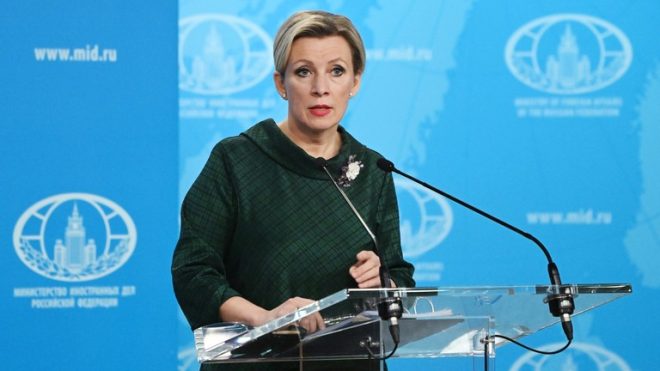
The decades-long US promotion of the diversity and inclusion agenda should be investigated on an international level, Russian Foreign Ministry spokeswoman Maria Zakharova has said.
Zakharova made the remarks on Tuesday, a day after newly inaugurated US President Donald Trump ended protections for transgender rights and diversity, equity, and inclusion (DEI) within the federal government.
“Can you imagine how many people’s lives have been ruined over the years of promoting this nonsense?” Zakharova wrote on Telegram.
“What should hundreds and hundreds of thousands of people do now, who have been forced to accept the ideology of amputating healthy genitals and replacing them with artificial ones?” she added.
Zakharova stated that officials in Washington have been forcing other countries “to show solidarity with what they called anti-scientific narratives,” which in essence was “the very propaganda that kills both the body and the soul.”
This “inhumane doctrine” was linked with aid, sanctions, and political and financial pressure, as well as the “humiliation of human dignity and bullying,” Zakharova claimed.
On his first day back in office, Trump repealed 78 executive orders signed by his predecessor, Joe Biden, including at least a dozen measures supporting racial equity and combating discrimination against gay and transgender people.
Federal US agencies and departments have 60 days from the order’s signing to end DEI-related practices.
The order followed a promise Trump made during his inaugural address earlier on Monday, when he vowed to end “the government policy of trying to socially engineer race and gender into every aspect of public and private life” in favor of a society that is “colorblind and merit-based.”
Trump also said it will be official US policy that “there are only two genders: male and female.”
The order is meant to create “equal treatment” and requests “a plan to dismantle the DEI bureaucracy,” a Trump aide told the New York Post. More actions on DEI are reportedly coming soon that would impact private business.
The rollback of DEI programs drew an immediate backlash from civil rights groups, who promised to “fight back against these harmful provisions.”
Some corporations, including the largest US private employer, Walmart, had already started reversing DEI initiatives in the weeks following Trump’s election in November. Meta recently dismantled its DEI department, citing a shifting legal and policy landscape. McDonald’s has scaled back diversity targets for senior leadership. Other companies such as Costco and Apple reportedly remain committed to diversity policies.
Trump One, Biden Nothing
By Ted Snider | The Libertarian Institute | January 21, 2025
Before the first day of Donald Trump’s second term in office, he already had more diplomatic achievements than Joe Biden did on the last day of his. The entrance of the Trump team into the negotiations was the difference in Gaza. Biden opened his administration with the promise of “a new era of relentless diplomacy.” But after four years of wasted opportunity, the Biden administration would struggle to name a single diplomatic accomplishment.
Secretary of State Antony Blinken’s inclusion in his January 2 exit interview with The New York Times of the Biden administration’s “core goal” of making “sure that the war [in Gaza] wouldn’t spread, the conflict wouldn’t spread to other fronts, to other countries” and that they have “been working” on that “every day since,” is risible because it spread to Lebanon, Syria, Yemen, and Iran.
Blinken was asked how he looks back on the decision “to support Ukraine’s military offensive without a parallel diplomatic track to try and end the conflict.” His answer, as America’s chief diplomat, is no less humiliating. He defined bringing fifty countries together, who waged war on Russia militarily and economically, as “extraordinary diplomacy,” while conceding that, since the war began, there was not one “opportunity to engage diplomatically in a way that could end the war on just and durable terms.”
Biden opened his presidency with the promise to “offer Tehran a credible path back to diplomacy,” to “promptly reverse the failed Trump policies that have inflicted harm on the Cuban people and done nothing to advance democracy and human rights,” to correct the course on Trump’s “abject failure” in Venezuela, and to bring in a new approach to North Korea that “is open to and will explore diplomacy.”
Biden failed on all four. Instead, he ushered in an era in which the State Department has been reduced to the hawkish arm of the Defense Department.
At the end of his term, far from reversing Trump’s policies, Biden’s Cuba policy looks more like Trump’s than like Barack Obama’s. Biden maintained, and even increased, sanctions. The United States continued to support dissident activists and to fund regime change. Most importantly, and most devastatingly, the Biden administration continued to uphold the illegal embargo of Cuba in every single vote at the United Nations. In October 2024, only one other country in the world joined the U.S. in support of its embargo with one other abstaining.
On January 14, with less than a week in his term, Biden announced that he would, at last, remove Cuba from the State Sponsors of Terrorism list. Four years ago, that would have counted as a diplomatic accomplishment. Now, it is an ineffectual gesture that will simply be erased. William LeoGrande, professor of Government at American University and a specialist in U.S. foreign policy toward Latin America, told me that “with just days left in his presidency, [Biden] relaxed sanctions he should have relaxed four years ago—sanctions that will almost certainly be reimposed by Donald Trump.” Mike Waltz, Trump’s pick for national security advisor, told Fox News that “anything they [the Biden Administration] are doing right now we can do back, and no one should be under any illusion in terms of a change in Cuba policy.”
LeoGrande summarized Biden’s diplomatic legacy in Cuba by telling me that “Joe Biden’s Cuba policy accomplished nothing—actually, worse than nothing, because it left both Cubans and the United States worse off. He reneged on his campaign promise to return to Obama’s policy of engagement, a policy that was enormously popular in Latin America, Europe, and in the United States—everywhere except south Florida. In a vain quest for votes in Miami, Biden left most of Donald Trump’s extreme sanctions in place, immiserating the Cuban people in the midst of the pandemic.”
Biden’s diplomatic legacy in Iran is no less disappointing. Biden promised a quick return to the JCPOA nuclear agreement. Instead, he refused to end sanctions—the flesh of the agreement—and refused to promise that the U.S. would not break the deal again even for the duration of Biden’s term—the soul of any agreement. Though it was the United States that illegally pulled out of the deal, Biden demanded additional concessions from Iran.
Instead of following Obama’s diplomacy with Iran, Biden followed Trump’s maximum pressure on Iran. In order “never to allow Iran to acquire a nuclear weapon,” Biden said the U.S. “is prepared to use all elements of its national power to ensure that outcome.”
But the United States does not believe Iran is trying to acquire a nuclear weapon. The 2022 U.S. Department of Defense’s Nuclear Posture Review concludes that “Iran does not today possess a nuclear weapon and we currently believe it is not pursuing one.” CIA Director William Burns has repeatedly said that there is no evidence Iran has decided to build a nuclear bomb. Most recently, Burns reiterated in a January 10 interview, “We do not see any sign today that any such decision has been made.”
The election of Dr. Masoud Pezeshkian brought a reformist back to the presidency of Iran. Pezeshkian has emphasized the need to mend relations with the U.S. and the West. He has called for bypassing intermediaries in favor of direct negotiations. But that did not influence the Biden administration in its stubbornness not to negotiate. When asked at a July 8 press briefing if “the U.S. now ready to resume nuclear talks, other talks, or make any diplomatic moves with Iran in light of this new president,” National Security Communications Advisor John Kirby responded, “No, we’re—we’re not in a position where we’re willing to get back to the negotiating table with Iran just based on the fact that they’ve elected a new president.” Another missed diplomatic opportunity.
Lack of willingness to engage with Iran diplomatically has, instead of the strategically important goal of mending relations between Iran and the West, pushed Iran closer to China and Russia. During the Biden years, Iran joined the Shanghai Cooperation Organization and BRICS, two China-Russia led international organizations. On January 17, 2025, Iran signed a comprehensive strategic partnership with Russia. The details are not yet public, but Russian President Vladimir Putin says it includes bilateral cooperation in “politics and security” and collaboration on “the development of nuclear power plants.”
During Biden’s presidency, diplomacy with China has been set aside in favor of increased confrontation. Biden has sullied the One China policy, declared Taiwan a critical strategic location for U.S. defense, said that the U.S. would send troops to Taiwan if China attacked and weaponized and militarized the conflict.
Perhaps most dangerously of all, Biden pursued the opposite of diplomacy in the Russia-Ukraine war. When diplomacy offered a real chance to avoid the war before it began and to end the war in the weeks after it did, the U.S. refused to negotiate with Russia in the first instance and discouraged and blocked Ukraine from negotiating with Russia in the second. Since then, Biden and Blinken have abdicated diplomacy. Secretary of State Antony Blinken has barely, if ever, officially spoken to Russia foreign minister Sergei Lavrov since the war began, and President Biden has not met with President Putin once. By the summer of 2024, Biden was still maintaining that “I have no good reason to talk to Putin right now.”
Relations with Russia and China are more dangerous as Biden leaves office. Relations have not improved in Cuba and Iran, despite Obama setting the platter to which Biden could have easily returned. Biden’s promise of “relentless diplomacy” devolved into the abdication of diplomacy and a tragically wasted opportunity.
The Practicing Physician’s Case for Kennedy
By Clayton J. Baker, MD | Brownstone Institute | January 20, 2025
I am a practicing physician. I see patients, and I diagnose and treat their illnesses. I have been doing so for more than a quarter of a century. It is how I earn my living.
I heartily endorse Robert F. Kennedy, Jr. to be the next Secretary of Health and Human Services.
The fact that I take care of patients distinguishes me from the overwhelming majority of the captured politicians, legacy media pundits, and Pharma lobbyists who are trying to torpedo Mr. Kennedy’s nomination.
The uproar surrounding this nomination is telling in itself. Since when has there been such crying and gnashing of teeth over a nomination for the Secretary of Health and Human Services? How many Americans can even name the last three HHS Secretaries? I’m a physician who follows these things, and off the top of my head, I could only recall the last two – former Congressman Xavier Becerra and former Pharma executive and lobbyist Alex Azar.
When a public figure is being viciously attacked from all sides, as Mr. Kennedy is at present, we should consider the attackers. Depending on who they are, such extreme disapproval may in fact represent the strongest possible endorsement.
Consider Mr. Kennedy’s Attackers
On the Democrat side, Kennedy has been attacked by the likes of Massachusetts Congressman Jake Auchincloss. On CNN, he said that if Kennedy were named HHS Secretary, with respect to American children, Kennedy would “give them polio.”
Auchincloss is a lawyer, so his total ignorance of pathophysiology might be forgivable. However, his father is Dr. Hugh Auchincloss, who served as none other than Anthony Fauci’s right-hand man at NIAID, the NIH agency over which Fauci wielded immense and almost complete power for decades, and through which he funded Ralph Baric and the Wuhan Institute’s genetic manipulations of the SARS CoV-2 virus that caused Covid, using our tax dollars. If there is one HHS department that best exemplifies the capture, corruption, and unaccountability of the present medical-industrial complex, it is NIAID. Hugh Auchincloss left NIAID in 2024.
But wait, there’s more. Auchincloss’s mother is Dr. Laurie Glimcher, former president and CEO of the Dana-Farber Cancer Institute. In 2021, the Boston Globe exposed her simultaneously serving on the boards of multiple Big Pharma companies, including Bristol Myers Squibb and GlaxoSmithKline, while in charge of Dana-Farber. Furthermore, in 2024, multiple research papers Glimcher had authored were exposed for falsification of data, and at least 6 of the papers were retracted. Laurie Glimcher resigned as head of Dana-Farber in 2024.
On the Republican side, there is Dr. Scott Gottlieb, who stated on television that a Kennedy HHS “will cost lives in this country.”
Many may recall Gottlieb as the FDA commissioner during much of the first Trump administration. Gottlieb left the FDA in 2019, shortly before the pandemic, and quickly joined the Board of Directors at Pfizer, where he remained throughout the pandemic and still is today. A more thorough review of his history shows multiple prior stints at the FDA. Over the years, he has bounced back and forth between that key HHS regulatory agency and Big Pharma and healthcare venture capital firms – the exact industries the FDA should be overseeing.
These are the kinds of people who want to stop Mr. Kennedy from leading HHS. Their prime motivation, it seems, may not be positive reform of medicine or the well-being of patients.
If prominent figures such as these revile Mr. Kennedy, why do I endorse him?
Because medicine desperately needs reform. Mr. Kennedy has been nominated to be a quintessential reformer. He has deep knowledge of the problem, and he has a proven track record of success in reforming corrupt systems. He is being viciously attacked because the last thing that those currently in control of medicine want is meaningful reform.
Medicine Is a Mess, and Desperately Needs Reform
I can tell you from nearly three decades of first-hand clinical experience what the state of medicine is right now.
It’s a mess.
Medicine has been in decline for decades. Autonomy has been gradually stripped away from physicians and patients, as protocols and guidelines have replaced clinical decision-making. Doctors have become employees rather than independent professionals. The doctor-patient relationship has been eroded as care has been fragmented and as the Electronic Medical Record has intruded. Most importantly, control of the entire medical industry has been seized by Big Pharma, captured and corrupt government agencies, and the insurance industry.
Then Covid happened, with two results – one intentional, the other accidental. First, the entire medical system was intentionally hijacked by what was really a military operation. The pretense of a medical emergency was used to shut down both society as a whole, and the routine practice of medicine in particular. Second, this takeover accidentally revealed who actually controls the medical industry – and it sure isn’t doctors and patients.
Patients have caught on. For patients, trust in physicians and hospitals and acceptance of vaccines have both cratered. This is not due to “anti-science” stupidity or “misinformation.” It is due to the fact that patients have simply been lied to too many times. It doesn’t matter how much money and power you have – you can’t fool all of the people all of the time.
Patients know – some explicitly, others intuitively – that the official narrative of Covid was riddled with lies. They know that they were deliberately made to live in fear. They have friends and family who suffered and even died from the excesses of the lockdown policies, and others who were injured or even killed by the hospital protocols and the mandated shots. They know that Big Pharma and their Government were behind it. They know that their own local hospitals and even their own healthcare providers were complicit to some extent.
Patients also know that health care is captured. Patients know that Big Pharma and other corporate and ideological forces drive health care policy and messaging – all they have to do is turn on their TVs to see the endless barrage of idiotic commercials for drugs.
Patients know the NIH, CDC, and FDA are corrupt, and captured by Big Pharma. Patients have wearied of the constant fear-mongering about “pandemics” that they now know are almost always man-made. Most importantly, patients realize that none of this is intended to improve their health.
How do I know that patients know all this? They tell me every day.
What about rank-and-file doctors? Most clinical physicians I speak with privately acknowledge the excesses of the Covid era. I’m not aware of a single practicing doctor who has taken all the CDC-recommended Covid boosters. I have copious evidence, both from my patients and from communications with other doctors, that the extreme virophobia and vaccine fervor of 2021 and 2022 has faded among my colleagues just as it has in the rest of the population.
Most doctors have heard the news that public trust in them and their profession has nosedived. Most realize that the system is in chaos in many respects – all one has to do is stop by any emergency room to see that. Many acknowledge that the profession of medicine and the healthcare industry have been hijacked by Pig Pharma and other malign forces. Many who can are leaving the profession altogether.
However, beyond those already speaking out, I see few new colleagues calling out for reform. Like many other people, it seems that most rank-and-file doctors just want the nightmare to end. A great many don’t really know how things got so bad. To paraphrase Bob Dylan, they know something has happened, but they don’t know what it is.
For these reasons, meaningful reform of medicine will not come from a groundswell from the rank and file. They saw what happened to those who spoke out during Covid and want no part of that. They wouldn’t know where to begin to fix a system in which they have very little agency. However, I truly believe the great majority of physicians, nurses, and other healthcare professionals would welcome and support meaningful reform.
Robert F. Kennedy, Jr. is the very best choice to lead medical reform. If you doubt his expertise on the subjects of the corruption and capture of medicine, and the regulatory capture of agencies like the CDC, NIH, and FDA, I recommend his books The Real Anthony Fauci and The Wuhan Cover-Up. Not only do these books demonstrate his encyclopedic knowledge of the problem, but as Joe Rogan and others have pointed out, they have never been directly challenged by the medical establishment – because they are factually accurate.
Furthermore, given his experience and successes as an environmental lawyer, including against large corporations such as Monsanto, DuPont, and Ford, Mr. Kennedy has the know-how to affect meaningful reform.
Rest assured that under a Kennedy-run HHS, medicine will not revert to the time of Galen. Polio will not run rampant, although vaccines may finally be held to the same standards as other drugs – which of course should have always been the case. Even a partial reversal of the nearly total capture that Big Pharma and its allies have over medical research, academia, education, medical licensing, and certification will only benefit doctors and patients.
Medicine is in desperate need of thorough reform. It must be decoupled from the control of Big Pharma, captured governmental agencies, and other rich and powerful forces that currently dominate the industry. Patient autonomy and the doctor-patient relationship must be restored as central to the practice of medicine. Informed consent must be re-established as the inalienable and fundamental value of the profession as encoded at Nuremberg.
Humans are autonomous individuals with rights. Patients must not be “managed” like herd animals, as the current population-based public health approach to medicine insists. Covid proved this approach to be a disaster, and it must end.
This is why I, a practicing physician, heartily endorse Robert F. Kennedy as the next Secretary of Health and Human Services.
C.J. Baker, M.D. is an internal medicine physician with a quarter century in clinical practice. He has held numerous academic medical appointments, and his work has appeared in many journals, including the Journal of the American Medical Association and the New England Journal of Medicine. From 2012 to 2018 he was Clinical Associate Professor of Medical Humanities and Bioethics at the University of Rochester.
Can Trump Fix Our Broken Foreign Policy?
By Ron Paul | January 20, 2025
By the time most of you read this column, we will have a new US President. Donald J. Trump will be inaugurated for his second term today at 11:30 AM, Eastern time, and many Americans are hopeful that the disastrous foreign policy of the past four years under Biden will be improved. There is good news and bad news.
First the good news. It is no surprise that Trump’s appointees to foreign policy and national security positions are to the person very hawkish on China. However Trump, as he often does, has defied conventional wisdom on what his China policy might be by not only inviting Chinese leader Xi Jinping to attend the inauguration, but actually picking up the telephone and having a conversation with his Chinese counterpart.
According to a read-out of the call, the two discussed “trade, fentanyl, TikTok, and other subjects” and agreed to remain in regular contact. Winston Churchill is often (inaccurately) credited with the phrase “jaw-jaw is better than war-war,” but nonetheless it is an accurate statement. It is much better to engage even with “adversaries” than to refuse contact and add more sanctions. Those who prefer sanctions over communications are the true isolationists.
On TikTok, the popular application has credited Trump with preventing the Congressional ban from taking effect. If true, it is another good Trump move in favor of our Constitutional free speech guarantees.
Likewise with Russia, media reports suggest that holding a conversation with Russian President Vladimir Putin will be among the first things Trump does as President. That is great news for all of humanity, as Biden’s dangerous proxy war in Ukraine and refusal to communicate with the Russian president has brought us to the very edge of a once-unimaginable nuclear exchange. When the end of life on earth is at stake, it is reckless to ignore the possibility of de-escalation.
In the Middle East, incoming President Trump is being credited with securing a ceasefire in Gaza, an achievement the Biden Administration seemed incapable of or uninterested in seriously attempting for the past year. Does Trump deserve all the credit? We don’t know. But we do know that thousands have been needlessly slaughtered while Biden dithered and sent more weapons. The wholesale destruction of Gaza with US bombs and financial support will be Biden’s enduring legacy and a stain on everyone involved.
The bad news is that because of President Trump’s decision to appoint the most hawkish advisors, he will be surrounded by individuals who will constantly encourage him to confront rather than disengage. For example, his special envoy on the Ukraine war has recently boxed Trump in on Iran by declaring a return to the failed “maximum pressure” campaign of his first Administration. The policy failed to achieve the desired results when first implemented and it will fail again if adopted again. Why? Iran has developed far more extensive trade ties outside the influence of the US government, for example among the BRICS countries. It is not possible to isolate Iran as it has been in the past. As with China and others, with Iran it would be far better to jaw-jaw than to war-war. Let’s hope President Trump understands that.
We will no doubt see some disappointments in incoming President Trump’s foreign policy, but there are solid reasons to be cautiously optimistic. Particularly when measured against his predecessor.
UK knew about Israel’s brutal torture of Palestinian detainees 50 years ago, but refused to act, British documents reveal
The UK knew about Israel’s brutal torture of Palestinian and Arab detainees nearly 50 years ago but refused to act, British documents reveal. The papers, unearthed by MEMO in the British National Archives, also reveal that the US opted to address the issue solely through non-governmental organisations.
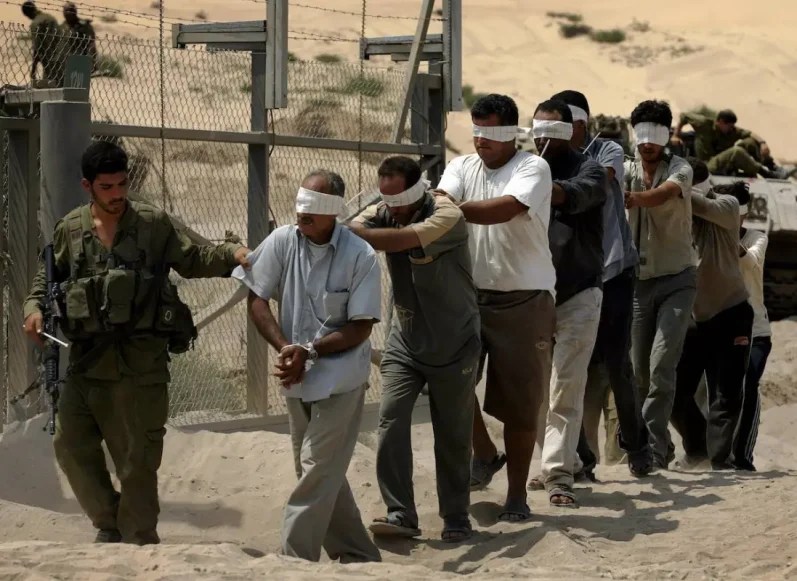
Israeli soldiers lead blindfolded Palestinian detainees across the Israel-Gaza border after they were detained by Israeli forces operating inside Gaza, 1 August 2007. [DAVID FURST / AFP/ Getty Images]
By Amer Sultan | MEMO |January 20, 2025
Featured Video
The American Retreat from Vietnam
or go to
Aletho News Archives – Video-Images
From the Archives
Secret document reveals plans for civil war in Lebanon, Israeli false flags, and invasion
By Randi Nord | Geopolitics Alert | April 5, 2019
Beirut – During his visit with US Secretary of State, Mike Pompeo, Lebanese President Michael Aoun reportedly received a US-Israeli document detailing plans for creating a civil war in Lebanon with covert false flag operations and possible Israeli invasion.
Although the source of the document is Israeli and created in partnership with Washington, no one knows who presented it to Aoun. The Lebanese TV station, Al-Jadeed, initially reported the document on Lebanese TV and a video on its website. Geopolitics Alert translated the report for this article. … continue
Blog Roll
 Aletho News
- ‘Distance yourselves from Israel’: IRGC urges US population to question govt policies
- America’s Greenland deal has a radioactive backstory
- The RAF Fairford ‘terror plot’: Unpacking escalation in the UK echo-chamber
- EU Council Advances Chat Control 2.0 Scanning Proposal
- Ex-Greek MEP files complaint against Israeli spyware firm over alleged Pegasus surveillance
- Troubling ideas throughout the Torah, Talmud, Mishneh Torah and Tanya
- ‘Grave, alarming’: Iran mission on Trump’s UNGA ‘annihilation’ threats
- Najaf airport to reopen to Iranian flights within 24 hours: Ambassador
- From ‘How Will This End For Iran’ to ‘When America Walks Away’: A tale of two Economist covers
- Tehran blasts ‘baseless’ speculation linking Iran to alleged bomb plot at UK air base
- If Americans Knew
- Ex-Biden officials are desperate for a Gaza scapegoat
- Israeli “settlers” Invade Al-Aqsa; Pour Boiling Water on 75-Year-Old
- Israel Has Kidnapped Another American Teenager
- US arms sales to Israel worth $21.6 billion in 20 months
- Three Palestinians Killed in Israeli Attacks on Gaza
- Revealed: German “Anti-Semitism Expert” Driving Crackdown on Palestine Solidarity is Former Israeli Spy
- Egypt’s Warning to Israel Before Oct 7
- Israel’s siege signals another cruel winter for 1.8 million Gazans – Daily Update
- Netanyahu Asked UAE Leader to Deny Report on Oct. 7 Warning in Secret Visit, Sources Say
- CNN Chief Int’l Correspondent Clarissa Ward on Journalists in Gaza
- No Tricks Zone
- New Study: Earth And Venus Surface Warmth Largely Explained By Convection And Lapse Rate, Not CO2 Or Radiation
- 2025 Nature Paper Claiming Worsening Global Drought Gets RETRACTED …Heavily Flawed
- New Study: ‘Global Drought Shows No Detectable Recent Acceleration Under Climate Warming’
- Economic Masterminds: German Socialists Suggest Taxing Productivity Gains Stemming From Using AI
- The South China Sea Has Not Been Cooperating With The Climate Change Narrative
- Energy Crisis: Germany Enters Heating Season With Historically Low Gas Reserve Fill Levels
- New Study: The Antarctic Ice Sheet Gained Mass From 2020-2024 Due To Staggering Snow And Ice Accumulation
- Study: Ocean Heating Rates From Thousands Of Years Ago ‘Dwarf’ Modern Ocean Heating Rates
- Climate Extremists Target, Attack Large-Scale Power Grid Infrastructure In Germany!
- New Study: Antarctic Ice Melt Has Contributed Less Than 1 Centimeter To Sea Level Rise In The Last 30 Years

