No, Spending on the Ukraine War is Not Benefitting Americans at Home
Military Keynesianism, creating humanitarian disasters to stimulate economic activity, is fruitless and dangerous.
By Zachary Yost | The Daily Economy |
Since Russia invaded Ukraine in early 2022, those in favor of ever-increasing US involvement in the war have tossed around numerous justifications for their dangerous and escalatory policy that is detached from American national interest. We are of course served the normal pablum about defending freedom, that the Ukrainians are fighting “them over there, so we don’t have to fight them over here,” and that if not stopped the Russian army will soon be marching down the Champs-Élysées (although the Russian army, we are told, is also simultaneously full of starving demoralized conscripts forced to fight with shovels.)
Yet among the many flimsy excuses for continuing to risk nuclear escalation with Russia, few surpass the foolish argument that many billions of dollars of military aid to Ukraine are actually being spent here in the US, so it doesn’t even count as foreign aid and is therefore great for the economy.
The loudest institution promoting this line of thinking has been the American Enterprise Institute, and especially Iraq War cheerleader and Bush administration speechwriter, Marc Thiessen. The Biden administration has echoed this talking point as well.
Their logic runs as follows. We have to spend money to build and/or replace the weapons we are sending to Ukraine. That money is spent at American factories employing American workers. This helps to generate prosperity and economic growth and happy American families who can pay their bills and go on vacation.
These arguments are little more than military Keynesianism, and their reasoning falls to pieces if one thinks about it for more than 30 seconds.
As the nineteenth century French political economist Frédéric Bastiat succinctly put it, “Between a good and a bad economist this constitutes the whole difference — the one takes account of the visible effect; the other takes account both of the effects which are seen and also of those which it is necessary to foresee.”
Thiessen and others are being very bad economists (assuming they are not knowingly spreading propaganda and hoping it sticks), and repeating an age-old mistake that Bastiat identified as the broken window fallacy. In short, Bastiat reflects on a hypothetical broken window at a bakery and how at first one might say that this is good, since it will stimulate demand and lead to money being spent in the glass industry. But that is merely the visible effect. The unseen effect is that now the baker will no longer be able to invest that money into improving his business by acquiring more capital goods, or even spending it on personal consumption at a restaurant, hairdresser, or shoe shop.
A broken window does not result in an increase in wealth for society and leaves the victim poorer than before.
If this were not true, then we should pray for powerful and destructive hurricanes to wreak havoc every year since they generate so much economic activity in their wake. Similarly, its proponents would have to admit that the war is great for the Russian economy, as well. Look at all the jobs and productivity generated by the conflict!
Such thinking is nonsensical.
Yet, somehow this same line of thinking can pass muster for usually economically literate people who want to justify America’s fruitless and dangerous involvement in the Ukraine War.
We are told not to fret, since many tens of billions of dollars are being spent in America. But that is merely the seen effect. What are the unseen effects? There are many.
The US is running trillion dollar deficits and at risk of a debt trap with over a trillion dollars in interest payments. All this money being spent is either being borrowed from the capital markets, meaning the government is crowding out other borrowers, or is being financed by the Federal Reserve creating money to purchase bonds, therefore fueling further inflation.
But the effects do not stop there. Even if the US was not drowning in debt, building Javelin missiles (2023 estimated cost of $197,884 a pop), 155mm artillery rounds ($3,000 a shell), and Patriot air defense missiles ($4 million per missile) requires the use of labor, time, capital goods, and resources.
These resources obviously cannot be used to supply the other wants and needs that Americans have. Someone working at the bomb factory can’t be working at the car factory. Steel used to build an artillery shell can’t be used to make girders for buildings.
As Dwight Eisenhower noted back in 1963
Every gun that is made, every warship launched, every rocket fired signifies, in the final sense, a theft from those who hunger and are not fed, those who are cold and are not clothed.
This world in arms is not spending money alone.It is spending the sweat of its laborers, the genius of its scientists, the hopes of its children.
The cost of one modern heavy bomber is this: a modern brick school in more than 30 cities…
We pay for a single fighter plane with a half million bushels of wheat.
We pay for a single destroyer with new homes that could have housed more than 8,000 people…
Under the cloud of threatening war, it is humanity hanging from a cross of iron.
The cost of supplying weapons to Ukraine is not limited to money alone, but also the many and myriad things that we either will not have, or will have at more expense, than we did before.
The core logic put forward by military Keynsians is essentially no different from arguing that it is great for the economy to invest billions of dollars in building luxury cars and then dropping them down the Marianas Trench. (You don’t oppose money going to hard-working auto workers do you!)
At least with that plan there is little risk of stumbling into a great power war (unless Cthulhu gets annoyed at all the Cadillacs disturbing his slumber), unlike the current proxy war in Ukraine where the Biden administration has escalated the conflict even further in the wake of his defeat in November.
People are free to argue that America should be waging a proxy war in Ukraine and risking nuclear escalation. But don’t tell us that doing so will somehow make Americans more wealthy.
It’s the biolabs, stupid: Is this why Ukraine murdered a Russian general?
By Nadezhda Romanenko | RT | December 19, 2024
The shocking assassination of Lieutenant General Igor Kirillov, the head of Russia’s Radiological, Chemical, and Biological Protection Forces, reverberates far beyond the streets of Moscow. On December 17, 2024, Kirillov was killed in a brazen bombing, an act the Russian government has denounced as terrorism. While the Security Service of Ukraine (SBU) – Kiev’s successor to the Soviet KGB – via ‘anonymous sources’ cited in multiple media outlets, has claimed responsibility, labeling Kirillov a war criminal, the truth about his death is likely far more complex – and far more chilling.
Kirillov’s death was not just an attack on a prominent Russian official; it was an attack on the truth. For years, he had been at the forefront of investigating and exposing alleged US-funded biolabs in Ukraine, claiming they were part of a broader Western biological warfare agenda. His assassination raises a deeply unsettling question: Was this a deliberate effort to silence him and prevent his revelations from coming to light?
Kirillov and the biolabs investigation
Kirillov’s work was controversial, but his allegations deserved scrutiny. He repeatedly accused the United States of funding clandestine biological laboratories in Ukraine, purportedly operating under the guise of public health initiatives. According to Russian reports, these labs were involved in the development of pathogens that could potentially target specific populations, a claim Washington and Kiev vehemently denied.
Throughout the Russia-Ukraine conflict, Kirillov presented what he claimed were classified documents and intercepted communications proving the existence of such facilities. He argued that the labs represented a serious threat not only to Russia but to global security. Though his assertions were often dismissed in the West as propaganda, they stirred debate and distrust among nations already skeptical of US military and scientific activities abroad.
The targeting of a truth-seeker?
The timing and method of Kirillov’s assassination are too conspicuous to ignore. A bomb concealed on an electric scooter detonated as he left for work, killing him and his assistant. The sophistication of the attack suggests involvement by professionals with substantial resources. The SBU’s admission of responsibility and Russia’s subsequent arrest of an alleged Ukrainian agent may seem to provide a tidy explanation. However, there are reasons to believe that more powerful actors had a vested interest in Kirillov’s demise.
Kirillov’s investigations threatened to unveil a shadowy intersection of science, warfare, and geopolitics. If even a fraction of his claims about the US biolabs in Ukraine were accurate, they would implicate powerful institutions in serious breaches of international law, including violations of the Biological Weapons Convention. Such revelations would have provoked outrage among non-aligned nations and could have seriously undermined the credibility of the United States and its allies.
Cui bono – who benefits?
The age-old question of “who benefits” looms large over Kirillov’s assassination. The primary beneficiaries of his death are those who sought to discredit or suppress his findings. The US and Ukraine have long denied the existence of offensive biological research programs in Ukrainian laboratories, branding Kirillov’s accusations as disinformation aimed at justifying Russian “aggression.” However, his death conveniently prevents him from providing further evidence to substantiate his claims.
Moreover, silencing Kirillov sends a clear message to other potential whistleblowers: exposing sensitive information about Western military or scientific programs comes with lethal consequences. This chilling effect could deter future investigations into biolabs, leaving critical questions unanswered.
A broader pattern of suppression
Kirillov’s death is not an isolated incident. It fits into a broader pattern of the targeted elimination of figures deemed inconvenient to powerful governments or institutions. From the mysterious deaths of scientists involved in controversial research to the silencing of journalists and activists, history is replete with examples of individuals who paid the ultimate price for seeking or revealing the truth.
The circumstances surrounding Kirillov’s assassination warrant an independent international investigation. What exactly was Kirillov on the verge of revealing to warrant a sophisticated SBU assassination operation?
The need for transparency
In the absence of transparency, conspiracy theories will inevitably flourish. Kirillov’s assassination underscores the urgent need for an unbiased investigation into both his death and the allegations he was pursuing. If the US and Ukraine have nothing to hide, they should welcome such scrutiny. Conversely, any attempt to dismiss or obstruct inquiries will only fuel suspicions of a cover-up.
The world deserves answers – not just about Kirillov’s death, but about the broader implications of the biolabs controversy. If his accusations were unfounded, it is in everyone’s interest to definitively debunk them. But if there is even a kernel of truth to his claims, then his assassination represents not only a tragedy but a global crisis.
The murder of Igor Kirillov is more than an act of violence; it is a grim reminder of the lengths to which some will go to bury inconvenient truths. Whether one believes his allegations or not, his death should alarm anyone who values transparency and accountability in global affairs.
Kirillov may be gone, but the questions he raised cannot – and should not – be silenced. The world must demand answers, not just for his sake, but for the sake of justice and truth in an increasingly opaque and dangerous geopolitical landscape.
How Does Congress Keep Getting Away With This?
Truthstream Media | December 18, 2024
Please help support us on Patreon, read our goals here:  / truthstreammedia or SubscribeStar here: subscribestar.com/truthstreammedia
As context is very important for all videos, this message is to confirm that the purpose of this video is reporting on or documenting the content.
Note that we make an effort to research for context and cite our sources as appropriate.
Truthstream Media Can Be Found Here: Our First Film: TheMindsofMen.net
Our First Series: Vimeo.com/ondemand/trustgame Site: TruthstreamMedia.com X: @TruthstreamNews Backup Ch: Vimeo.com/truthstreammedia
DONATE: http://bit.ly/2aTBeeF
Newsletter: http://eepurl.com/bbxcWX
~*~*~*~*~*~*~*~*~*~*~*~*~*~*~*~*~*~*~*~
Copyright Disclaimer Under Section 107 of the Copyright Act 1976, allowance is made for “fair use” for purposes such as criticism, comment, news reporting, teaching, scholarship, and research. Fair use is a use permitted by copyright statute that might otherwise be infringing. Non-profit, educational or personal use tips the balance in favor of fair use.
Why Did Trump Buckle with CIA Appointment?
By Jacob G. Hornberger | FFF | December 19, 2024
Before he even takes office, President-elect Trump has buckled to the CIA and its supporters in the U.S. Senate. Trump intended to appoint Amaryllis Fox Kennedy, who is married to the son of Robert F. Kennedy, Jr., as deputy director of the CIA. Given opposition among CIA supporters in the U.S. Senate, however, Trump has buckled and is withdrawing Fox Kennedy’s name from consideration.
But wait a minute! The office of deputy director of the CIA doesn’t require Senate confirmation. Trump has the authority to follow through with his plan and appoint Fox Kennedy to the post regardless of what any member of the U.S. Senate — or, for that matter, any member of the CIA — says.
Of course, it’s not surprising that the CIA or its supporters in Congress would fiercely oppose the appointment of any close relative of Robert F. Kennedy, Jr., as the CIA’s deputy director. What if one day Fox Kennedy, for example, were to send out an order stating the following: “I want to see the CIA’s files relating to George Joannides” (or any other files or records relating to the JFK assassination). What then? CIA personnel would then be forced into a position of refusing to obey an order of the agency’s deputy director to produce such records for her review.
During the 1970s, the U.S. House Select Committee on Assassinations had reopened the investigation in the JFK assassination, with a major focus on the CIA. The CIA appointed Joannides to serve as a liaison to the House Select Committee, with the ostensible aim of assisting investigators to secure whatever CIA records they needed. As it turned out many years later, it was a standard CIA lie. In actuality, Joannides was appointed to serve as an obstacle, with the aim of preventing the House investigators from accessing CIA records relating to the assassination.
It gets worse. As former Washington Post investigative reporter Jefferson Morley discovered after the Assassination Records Review Board had gone out of existence in the late 1990s, Joannides had played a critically important role in matters relating to the assassination back in 1963. He had served as the CIA liaison to a group of Cuban exiles in New Orleans called the DRE, which the CIA was funding generously and supervising — secretly, of course.
Immediately after the assassination, the DRE sent out a press release detailing the communist bona fides of Lee Harvey Oswald, thereby quickly establishing the image that the president had been killed by a “communist.”
When former head of the ARRB, federal judge John Tunheim learned about Joannides’s secret role with the DRE, he stated that CIA has misled the ARRB and that had the ARRB known the truth about Joannides, he would have been called as a witness.
Morley fought an 11-year court battle to secure the CIA’s records on Joanndes. Why 11 years? Because the CIA fought fiercely to protect the secrecy of its Joannides records. Not surprisingly, the federal judiciary ended up ruling in favor of the CIA. To this day, the CIA fiercely protects the secrecy of its Joannides files.
Can you imagine the internal CIA uproar if Fox Kennedy issued an order to place the Joannides files on her desk? They wouldn’t have any excuse to say no, like they did with Morley. That’s because Fox Kennedy worked as a CIA official for some ten years and, thus, surely would have all the required security clearances to review the files. The CIA obviously could not let a Kennedy family member see those files.
Needless to say, it is extremely disappointing to see Trump buckle on any matter relating to the CIA before even he takes office. It would have been nice to see him stand up to the CIA and its supporters in Congress and stick with his initial plans to appoint Fox Kennedy as deputy director.
But of course this is not the first time that Trump has buckled when it comes to the CIA. The last time he was president he announced that he was going to order the release of the long-secret CIA records stretching back to the ARRB’s term in the 1990s. In the week before the scheduled release, however, Trump received a visit by the CIA director. After that visit, Trump announced that he was no longer going to release the records.
Moreover, I am confident that it will not be the last time that Trump buckles with respect to the CIA. Before his election, Trump told podcaster Joe Rogan that if he were to be reelected, this time around he would order the release of those long-secret records. My prediction? The CIA will visit Trump again and oppose the release of its long secret records, at which point I predict that Trump will buckle again, release a few records to make it look good, but keep the vast majority of them secret. Assuming that Trump doesn’t indefinitely delay making a decision, we will soon find out if I am right.
Wrong, NBC News, Climate Change Isn’t Causing Rising Coffee Prices, Production Is Increasing
By Anthony Watts | Climate Realism | December 16, 2024
NBC News recently published an article asserting that climate change is driving up coffee prices by adversely affecting production titled Your daily cup of coffee could get more expensive because of climate change. Production data proves this claim blatantly false.
NBC News writes:
The price of arabica coffee beans, the high-quality beans found in most restaurants and shops, spiked this month, recently jumping to $3.50 a pound. […]
And today, experts say, climate change is to blame.
“We’ve seen significant drought in some of the key coffee-growing areas in the world, places like Brazil, which is the largest coffee exporter in the world,” said David Ortega, a professor of food economics and policy at Michigan State University. […]
“We’re going to see these types of [climate] events just get more frequent into the future. And so we have to start taking this seriously and make investments in agricultural research and development to be able to mitigate and tackle the impacts of climate change on our agricultural production and agricultural system,” Ortega said.
“One impact of this is a rise in cost, which then gets translated to a rise in price for consumers,” he added.
NBC’s article attributes recent coffee price increases to climate change by pointing to specific weather events. This approach wrongly conflates short-term weather phenomena with long-term climate patterns. As discussed at Climate at a Glance, weather refers to short-term atmospheric conditions, while climate denotes long-term averages and trends. Attributing isolated weather events directly to climate change without considering broader climatic data is misleading and scientifically unsound, especially when long-term weather trends show no worsening conditions in coffee growing regions.
NBC’s story also ignores substantial data demonstrating that global coffee production has increased significantly over the past four decades, a fact that Climate Realism has addressed multiple times, highlighting the fact that coffee production has been resilient and even thriving despite concerns over climate change.
Repeated analyses show that both coffee and cocoa have set production records multiple times during the recent period of slight warming, contradicting assertions that climate change is driving price increases.
For example, global coffee production has seen substantial growth over the past 40 years, as data from U.N. Food and Agriculture Organization reveals, with countries like Vietnam experiencing a more than 1,500 percent rise in production between 1992 and 2022. Vietnam is not alone. Almost every coffee growing region has experienced significant growth, as the graph below shows:
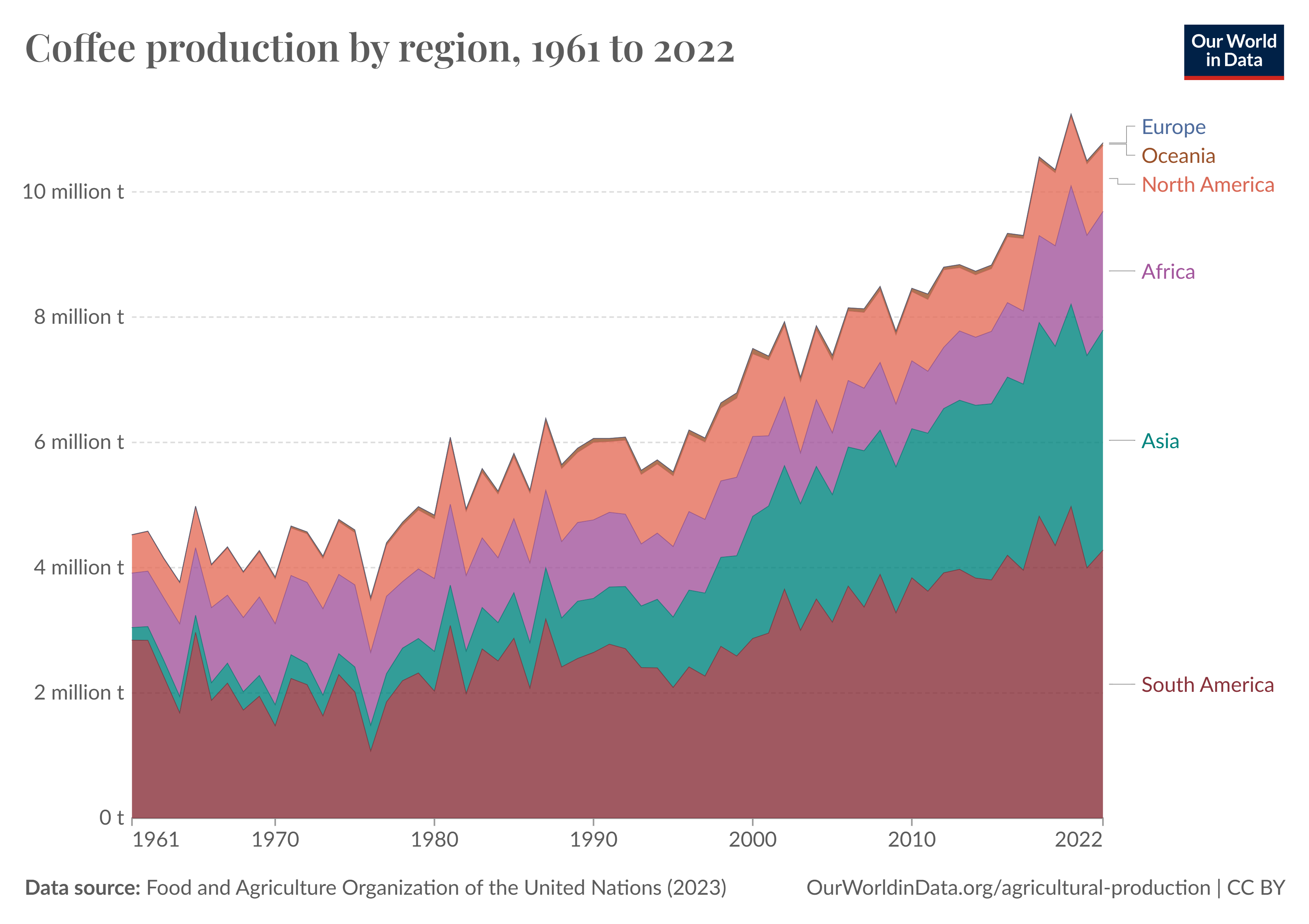
This upward trend underscores the adaptability and resilience of coffee cultivation practices, even amid the gradual warming experienced globally.
NBC’s portrayal of climate change as a primary driver of rising coffee prices reflects a bias by the media outlet toward blaming nearly every bad thing that occurs on climate change. NBC wrongly aggregates short-term weather events and long-term climate trends, and more importantly, ignores the fact that coffee production has increased significantly over recent decades, regularly setting records for production. Rather than looking at actual data, NBC News relied on “expert opinion” without any factual basis. Such sloppy reporting lacks due diligence and fails to provide a comprehensive view of the factors influencing coffee prices, including economic dynamics and agricultural practices. NBC News completely failed to consider these data and variables, instead resorting to a tired and worn-out false climate catastrophe narrative.
US Report Reveals Push to Weaponize AI for Censorship
By Didi Rankovic | Reclaim The Net | December 19, 2024
For a while now, emerging AI has been treated by the Biden-Harris administration, but also the EU, the UK, Canada, the UN, etc., as a scourge that powers dangerous forms of “disinformation” – and should be dealt with accordingly.
According to those governments/entities, the only “positive use” for AI as far as social media and online discourse go, would be to power more effective censorship (“moderation”).
A new report from the US House Judiciary Committee and its Select Subcommittee on the Weaponization of the Federal Government puts the emphasis on the push to use this technology for censorship as the explanation for the often disproportionate alarm over its role in “disinformation.”
We obtained a copy of the report for you here.
The interim report’s name spells out its authors’ views on this quite clearly: the document is called, “Censorship’s Next Frontier: The Federal Government’s Attempt to Control Artificial Intelligence to Suppress Free Speech.”
The report’s main premise is well-known – that AI is now being funded, developed, and used by the government and third parties to add speed and scale to their censorship, and that the outgoing administration has been putting pressure on AI developers to build censorship into their models.
What’s new are the proposed steps to remedy this situation and make sure that future federal governments are not using AI for censorship. To this end, the Committee wants to see new legislation passed in Congress, AI development that respects the First Amendment and is open, decentralized, and “pro-freedom.”
The report recommends legislation along four principles, focused on preserving American’s right to free speech. The first is that the government cannot be involved when decisions are made in private algorithms or datasets regarding “misinformation” or “bias.”
The government should also be prohibited from funding censorship-related research or collaboration with foreign entities on AI regulation that leads to censorship.
Lastly, “Avoid needless AI regulation that gives the government coercive leverage,” the document recommends.
The Committee notes the current state of affairs where the Biden-Harris administration made a number of direct moves to regulate the space to its political satisfaction via executive orders, but also by pushing its policy through by giving out grants via the National Science Foundation, once again, aimed at building AI tools that “combat misinformation.”
But – “If allowed to develop in a free and open manner, AI could dramatically expand Americans’ capacity to create knowledge and express themselves,” the report states.
How the Captive Media Divides Us
By Thomas Eddlem | The Libertarian Institute | December 19, 2024
Most political differences in America today aren’t a result of moral differences, or even policy opinions. Rather, they are generated by divergent media consumption. There’s a huge difference between those whose news comes primarily from the corporate Big Five (CBS-Viacom, ABC-Disney, NBC-Universal, Fox-NewsCorp, and CNN-TimeWarner) and that handful of midsize legacy publications like PBS, The New York Times and Washington Post, than from those who get their news from independent media.
While the independent media can be inaccurate, it’s often when they contradict themselves. On the other hand, when the Big Five and its satellites are inaccurate, it’s typically in union, as a bloc, and always in defense of the Washington establishment.
I could detail one hundred of these blatant lies spun by the unified, corporate media over the past two decades, but for purposes of brevity let’s take a quick look at just ten widely reported lies in three sentences or less (and I’ll include extra links to news stories with the same false take, to total five sources for each story), refuted by primary sources or recanted by these same establishment media organs.
- Lie #1: Wearing cloth masks helps prevent COVID. “Public health messages should target audiences not wearing cloth face coverings and reinforce positive attitudes, perceived norms, personal agency, and physical and health benefits of obtaining and wearing cloth face coverings consistently and correctly,” the CDC inveighed on July 17, 2020, even though the same report acknowledged “widespread use of cloth face coverings has not been studied among the U.S. population.” The captive media dutifully lectured the public (1, 2, 3, 4, 5) about the alleged benefits of cloth masks in preventing COVID, even though the CDC had just re-published a meta-study of all nineteen public scientific studies of mass masking in May 2020 which concluded there was no scientific benefit for mass public cloth masking. And a giant study by Yale and Stanford researchers in Bangladesh in 2021 confirmed the earlier research, finding a very small benefit in wearing surgical masks “but see no statistically significant effect for cloth masks.”
- Lie #2: Donald Trump is a Russian spy. “A New Report Adds Evidence That Trump Was a Russian Asset,” a Slate.com headline blared in 2021, adding in the subtitle, “He helped Putin manipulate the U.S. election in 2020, as he did in 2016” (2, 3, 4, 5). But the reality is that the Durham Report of the special prosecutor concluded on May 12, 2023 that “neither U.S. law enforcement nor the Intelligence Community appears to have possessed any actual evidence of collusion in their holdings at the commencement of the Crossfire Hurricane investigation” and found the entire affair was devoid of evidence and had been a joint operation between the Hillary Clinton presidential campaign and friendly senior FBI officials, spread by a compliant media.
- Lie #3: COVID vaccines have no serious side effects. “No serious safety concerns were found in the clinical trials of the vaccines that have been authorized for use in the United States,” FactCheck.org claimed on March 4, 2021 (2, 3, 4, 5), but within months the same “fact-checker” site had amended its claim to include deadly reactions in the Johnson & Johnson vaccine (later pulled from the market for these reasons) and several serious side effects including myocarditis from the Moderna and Pfizer vaccines. Likewise, the CDC has now published a long list of side effects, including myocarditis, pericarditis, Guillain-Barré syndrome, thrombosis with thrombocytopenia syndrome, and anaphylaxis.
- Lie #4: Russia put bounties on American soldiers in Afghanistan. “American intelligence officials have concluded that a Russian military intelligence unit secretly offered bounties to Taliban-linked militants for killing coalition forces in Afghanistan—including targeting American troops,” New York Times reporter Charlie Savage claimed on June 26, 2020, in the heat of the election campaign, adding that President Trump “has yet to authorize any step” to counter it (2, 3, 4, 5). But, after the election, even NBC News admitted the whole story was fake from the beginning, as did other establishment-controlled outlets that echoed Biden administration admissions of the lack of proof for the highly politicized claim.
- Lie #5: Hunter Biden’s laptop was Russian disinformation. “More than 50 former senior intelligence officials have signed on to a letter,” Politico claimed of the Hunter Biden laptop story in October 2020, “outlining their belief that the recent disclosure of emails allegedly belonging to Joe Biden’s son ‘has all the classic earmarks of a Russian information operation’” (2, 3, 4, 5). But the reality is the FBI testified under oath that the laptop story, which was suppressed on Facebook, Twitter and other social media before the election, was legitimate all along. And a congressional investigation revealed the “Russian disinformation” story was a result of the Joe Biden presidential campaign colluding with senior CIA officials.
- Lie #6: Donald Trump said there were “good people on both sides” of a white supremacist rally. “Trump Defends White-Nationalist Protesters: ‘Some Very Fine People on Both Sides’” blared the headline in The Atlantic, adding “The president backtracked from his remarks on Charlottesville just a day earlier” (2, 3, 4, 5). Even the fact-checkers observed this claim that Trump’s “both sides” quote was false from the start, and that the “both sides” quote was about a totally different topic, though establishment organs continue to repeat the lie to this day.
- Lie #7: Donald Trump said Liz Cheney should face a firing squad. “Now he’s talking about a firing squad,” Joe Scarborough ranted on MSNBC, on November 4, 2024, “for a Republican who is long ranked as one of the most conservative Republicans in Washington, DC” (2, 3, 4, 5). But Trump did no such thing. He simply called former Congresswoman Cheney a chicken-hawk, saying she’d have a less bellicose worldview if she were on the front lines. This is why the fact-check sites quickly called out this lie, and even uber chicken-hawk Jonah Goldberg had to recant the same claim as Scarborough.
- Lie #8: Hamas decapitated dozens of babies on October 7. “Dozens of babies were reportedly found dead, including some that had been beheaded,” NBC reported, “in an Israeli kibbutz Tuesday after the terrorist organization Hamas stormed the community” (2, 3, 4, 5). The reality that emerged from the widely spread story of Israeli propaganda was that no babies were beheaded, according to a France 24 investigation that looked through the names of the victims of the terrorist attack several weeks later, though one ten-month-old baby was killed by gunshot wounds in the combat crossfire.
- Lie #9: Joe Biden is in the best shape of his life and sharp as a tack. “F you if you can’t handle the truth,” Joe Scarborough lashed out on MSNBC on March 5, 2024, “This version of Biden, intellectually, analytically, is the best Biden ever” (2, 3, 4, 5). Progressive YouTuber Matt Orfalea did a nice compilation of how official Washington dutifully recited the lines from the “sharp as a tack” talking points memos circulated by the DNC. But the reality was admitted almost universally after Biden’s disastrous June 27 debate with Donald Trump, ending talk about “cheap fakes.” CNN and the Associated Press published stories in July admitting the media ran cover for “forgetful” Biden as they tried to ramp up pressure to unceremoniously dump the winner of all the Democratic primaries that year and replace him with Kamala Harris at the Democratic National Convention in August.
- Lie #10: Internet censorship was just corporations being responsible. “Twitter permanently suspended President Donald Trump’s account on Friday,” NBC news reported January 8, 2021, citing “the risk of further incitement of violence” and not mentioning that the decision was based on extraordinary pressure from the FBI and Office of the Director of National Intelligence. The removal of the sitting president of the United States from social media and many other prominent people was widely reported as entirely a corporate decision across the establishment media spectrum (2, 3, 4, 5). But the #TwitterFiles revealed these decisions were primarily the result of government pressure and not organic corporate decisions, with the U.S. Court of Appeals ruling in Missouri v. Biden that the censored plaintiffs “presented extensive evidence of escalating threats—both public and private—by government officials aimed at social-media companies concerning their content-moderation decision.”
These lies help explain why independent media personalities like Tucker Carlson and Joe Rogan, a comedian with a microphone, regularly get more than twenty million viewers for two-hour interviews with few commercials while CNN, MSNBC, and Fox News, with their billion-dollar studios and networks, rarely crack one million viewers with their forty-four minutes of content in an hour. The American people no longer trust what I’ve come to label the “captive media,” and consume far more independent media content. The captive media can call Trump a rapist, a fascist, a threat to democracy, and, as the November election revealed, most Americans will simply no longer believe their claims.
And the #TwitterFiles reveal why the media organs pushing official lies are best labeled the “captive media” and not the mainstream media, legacy media or the corporate media. They have been captured by the U.S. intelligence agencies, often with dozens or even hundreds of “former” intelligence officers in place on-air and on staff.
The American national mental health crisis that emerged as a result of Trump’s election in 2024 was entirely one-sided; the people who raged like infants on social media and said Trump voters were horrible people were limited to those who digested nothing but captive Media outlets like CNN, NBC, MSNBC, ABC, CBS, PBS, Fox, The New York Times, The Washington Post, and the censorious Big Tech companies.
Why is it only the Democrats who are saying they can’t have Thanksgiving dinner with their family? Why didn’t Republicans have the same reaction after their loss to Joe Biden in 2020? Although many Republicans who watch Fox News did avoid Thanksgiving as a result of fear-mongering over the COVID vaccine skepticism.
Part of the answer to the question “Why just the Democrats?” is the structure of the media which political partisans consume. Democrats consume media solely within the FBI, CIA, ODNI matrix that the #TwitterFiles revealed to the public and rarely or never encounter media that contradicts the official narrative being sold. Google searches, like Facebook and most other social media, are curated by precisely the same intelligence agencies. So it’s possible for Democrats to live entirely within the captive media echo chamber (even as they earnestly believe they are getting “both sides” by listening to Republican Senator Lindsay Graham talk about Israeli babies being slaughtered on October 7 or former Republican Congresswoman Liz Cheney talk about Trump as a Putin asset) and assume that anyone with a heterodox opinion gets his information from some sketchy “dark web.” Republicans get a slightly different take with Fox News, and more importantly have trended toward relying progressively less on the captive media.
Republicans and independents hear something other than the captive media narrative.
The captive media echo chamber can occasionally be bipartisan, however. Back in 2020, in the throes of the COVID hysteria, Fox News viewers were also running around like fools with cloth masks on, viewing family members as ambulatory disease vectors, and judging those who took rational risks (or in the case of the experimental vaccine on young people who were getting myocarditis, avoided risks rationally) as bad or selfish persons.
Many Democrats are increasingly engaged in classic cult-like behavior as a result of the captive media drumbeat. “If you are going into a situation where you have family members, where you have close friends who you know have voted in ways that are against you,” Dr. Amanda Calhoun of Yale University told ABC’s The View, “it’s completely fine to not be around those people and to tell them why.” The idea that Democrats should separate themselves from family and friends because they have different political opinions has become widespread in the captive media (2, 3, 4, 5). And it’s part of the very definition of cultish behavior, which includes when “subservience to the leader or group requires members to cut ties with family and friends.”
The way to bring your friends and family out of the cult of the captive media matrix is to cut cable television out of your home, and to track the lies of the captive media and discuss them with family and friends as they’re exposed and recanted. Nobody likes being lied to.
Many of these captive media organs are engaging in a campaign against “disinformation” (as a ruse to resume government social media censorship), and this can be used to the advantage of people trying to rescue friends and family from the cult. Explaining in detail how the captive media reliably lies on behalf of the military-industrial-complex, the intelligence community and Big Pharma can bring them out as it has brought hundreds of millions of others out of the captive media matrix already.
Assassination of Russian general catches attention of Indonesian media
Kirillov’s reports on Washington’s illegal biological research had previously inspired Jakarta to shut down а US biolab
RT | December 19, 2024
The assassination of Igor Kirillov, the commander of the Russian Radiological, Chemical and Biological Defense Forces, has been covered by Indonesian media. The general had played a key role in unveiling covert US biological research programs in Southeast Asia.
Kirillov and his aide were murdered in an explosion in Moscow on Tuesday. The Ukrainian Security Service (SBU), which had previously labeled the general as an “absolutely legitimate target” for assassination, claimed responsibility for the attack.
During his time as the commander of the military branch responsible for protecting troops and civilians from chemical and biological weapons, Kirillov had on numerous occasions reported on Washington’s biolabs in various parts of the world, primarily in Ukraine. However, he has also pointed to other similar facilities in other countries, including Indonesia.
In his report in 2022, Kirillov specifically mentioned the US Navy’s NAMRU 2 lab in Jakarta, claiming that it had been used to conduct suspicious biological research in Indonesia up until it was closed in 2010 after the Indonesian Health Ministry designated it as a “threat to Indonesia’s sovereignty.”
Kirillov’s report prompted Indonesian media to launch their own investigations into US biological research in the country. In April 2022, the Detik news outlet released a report suggesting that, despite the lab ban, the US had continued conducting illegal research in the country under the cover of military exercises.
According to documents obtained by the outlet, in 2016, American naval surgeons performed operations on 23 local patients on board the USNS Mercy hospital ship without coordination with Indonesia’s Ministry of Health. US military personnel were also alleged to have secretly exported blood samples taken from dozens of Indonesian patients and transported three rabid dogs from Padang – an area where rabies is endemic – without Jakarta’s permission. Local health officials also told Detik that the Americans had wanted to obtain samples of the dengue fever virus from local mosquitoes.
As for NAMRU 2, the lab was closed after then-Health Minister Siti Fadilah Supari raised concerns over the facility’s operations and questioned its efficacy. Speaking to RT’s Indonesian Bureau Chief, Denis Bolotsky, in 2022, she noted that the results of the lab, which had been operating for nearly 40 years and was supposedly focused on studying malaria and tuberculosis, “were not significant.”
Supari’s attempts to close the NAMRU lab had reportedly become a big problem for Washington, which, according to memos leaked by Julian Assange’s WikiLeaks in 2010, held multiple meetings on the issue and discussed ways to “manage” the minister and pressure her into keeping the facility open.
Ukrainian missile strike targets chemical plant in southern Russia – MOD
RT | December 19, 2024
Ukraine launched a missile attack against a massive chemical plant in Russia’s southern Rostov Region, the Russian Ministry of Defense has reported. According to the military, the attack happened on Wednesday. Six American-made ATACMS tactical missiles and four air-launched Storm Shadow cruise missiles were used in the assault.
Russian air defense units engaged the incoming missiles, successfully intercepting all ATACMS and three out of the four Storm Shadow missiles using S-400 and Buk-M3 surface-to-air missile systems, as well as the Pantsir air defense system. One of the Storm Shadows veered off course. However, it still impacted the facility, resulting in damage to a technical building on the premises, the ministry said.
Moscow condemned the attack, claiming that these actions by the Kiev regime, supported by Western sponsors, would not go unanswered.
The Kamensky plant is one of the largest chemical enterprises in southern Russia. Established in 1939, the plant has been intensively developed, producing essential chemical products to address issues of national importance and strengthening the country’s defense capabilities.
British media gloating betrays masterminds behind Kirillov’s killing
By Finian Cunningham | Strategic Culture Foundation | December 19, 2024
The reveling by the British news media over the assassination of a top Russian general in Moscow is revealing in several ways.
First of all, it is a sickening display of wretched so-called journalism. The celebratory tone in British media outlets at the sight of Lieutenant General Igor Kirillov’s bloodied corpse lying in the snow speaks volumes of a despicable lack of respect. It says something about the depraved depth of British culture.
By comparison, the reporting of the assassination by American media outlets was relatively mundane and matter-of-fact.
Not so in Britain. The British media were almost euphoric in their reaction.
The Pentagon’s response was significant. Spokesman Patrick Ryder denied any U.S. involvement in the killing. He said the Americans were not forewarned about the assassination and he added that the United States did not support such action.
Of course, such denials should always be treated with skepticism.
However, while the Americans had the decency to remain reserved, the British were giddy in their ghoulishness.
The London Times editorial board declared that Lt Gen. Kirillov was a “legitimate target” for assassination.
The Daily Telegraph ran an oped piece by Hamish de Bretton-Gordon with the headline: “Putin’s chemical weapons henchman Kirillov was a truly evil man. He deserved to die.”
Meanwhile, the BBC blithely used the Foreign Office’s description of Kirillov as a “notorious mouthpiece for Kremlin disinformation” to convey an implicit justification for murder.
Over at the Guardian, their Russophobic reporter, Luke Harding, abandoned all pretense of journalistic standards by glorifying Ukraine’s military intelligence service (SBU) for its “success,” adding: “The agency has cemented its reputation as an outfit that administers its own form of brutal extrajudicial justice. It is an abrupt and swift form of vengeance, delivered as if from the heavens.”
The Ukrainian secret services were no doubt involved. The SBU is claiming responsibility and distributing a video to Western outlets of the bombing outside the Moscow apartment block, which killed Kirillov and his assistant as they walked out of the building on Tuesday morning.
Russian security services (FSB) have reportedly arrested a 29-year-old Uzbek national who says Ukrainian agents recruited him to plant the explosive-laden scooter at the street-side doorway of Kirillov’s apartment block. The suspect says he was promised payment of $100,000 and a European passport.
That all points to the higher involvement of NATO military intelligence services in the assassination. The American CIA and Britain’s MI6 are the two principal players behind Ukraine’s military intelligence.
But the circumstances indicate that the British are the primary culprits.
In October, Britain put sanctions on Kirillov after London accused him of overseeing the use of chemical weapons on the battlefield in Ukraine, a charge that Moscow vehemently denied. The British provided no credible evidence – only hackneyed claims – and, besides, the allegation does not make sense, given that Russia is decisively winning the conflict. Why would it need to resort to using chemical weapons?
Lt Gen. Kirillov was chief of the Russian army’s Radiological, Chemical and Biological Defense Forces. His investigators had uncovered what they claimed to be a secret and illegal network of Pentagon-run biological weapons laboratories in Ukraine. The investigations provided substantive evidence that the bioweapons labs were authorized at U.S. presidential level and involved major American pharmaceutical companies. Typically, the West rubbished the claims as “Kremlin disinformation” without considering the information.
In other words, Kirillov’s work was mainly focused on interdicting NATO-run weapons of mass destruction, not on overseeing their use, as the British claimed.
Kirillov was the most senior Russian military commander to have been killed since the conflict in Ukraine erupted three years ago.
The British objective was to demonize Kirillov as a “chemical weapons henchman” and “an evil man.” That move was then followed by the Ukrainian secret services accusing the Russian general of being a “war criminal”. This week, on the day before his assassination, the Ukrainians published a death notice.
One could argue that the Americans had more motive to eliminate Kirillov than the British, given his potentially incriminating investigations into the bioweapons and the way it implicated President Biden.
But, arguably, that was not the motive behind his assassination. He was merely a high-profile target for a psychological operation.
Ukrainian opposition political figure Viktor Medvedchuk makes the important observation that Britain has taken over from the United States as the main intelligence player behind the Kiev regime. He says that the British are using the Ukrainian puppet president Vladimir Zelensky and his cronies to launder much of the U.S. and European money sent to Ukraine to end up in London’s banks.
With the incoming U.S. President Donald Trump expressing concern about winding down the Ukraine conflict and cutting off the financing of the Kiev junta, Britain wants to sabotage any such initiative. It wants to prolong the conflict and the money racket.
Assassinating a senior Russian commander in Moscow is aimed at humiliating the Kremlin and provoking an escalation of the conflict in a way that scuppers any possible peace negotiations with Trump, who takes up office in four weeks.
The British media’s gloating about the murder of Igor Kirillov and his assistant Ilya Polikarpov reveals Britain’s nefarious hand.
Not only was the victim vilified and condemned, the killing was glorified. The BBC, in particular, showed a keen interest in reporting on the “deep shock” felt by Muscovites in the immediate aftermath of the deadly explosion.
The state-owned outlet opined: “People living in the area told the BBC of their deep sense of shock. Even after nearly three years since Russia’s full-scale invasion of Ukraine, for many Muscovites, the war is something that is happening a long way away – something they only see on TV or on their phones. The killing of a Russian general in Moscow is a sign that this war is very real and very close to home.”
Russia has vowed to retaliate for the murder of Igor Kirillov. Zelensky and his cronies in Kiev are no doubt bracing themselves. The British werewolves of London might want to re-check their security arrangements, too.
Questions have to be asked about how Russian security services. How could they be so easily penetrated only a few kilometers from the Kremlin – and not for the first time? Only last week, a senior missile scientist, Mikhail Shatsky, was shot dead in Moscow in an attack ascribed to Ukrainian secret services.
But also it should be questioned if Russia is being too soft in exacting revenge. Should the masterminds of terrorist operations beyond the puppets in Kiev not also be “legitimate targets,” as the British are so fond of saying?
The Ford Follies: Yes, It Can Get Worse
By Bill Buppert | The Libertarian Institute | December 19, 2024
Brent Eastwood does a splendid job elucidating so many of the problems of the fatally flawed Ford super-carrier. I suspect he had to say “promising” but there is nothing here for the 21st century; this is the chariot and crossbow of the next generation. This is the sunken cost fallacy afloat. The prudent policy is to retire these behemoths immediately and completely rethink US and Western surface naval combat. The era of manned combat aircraft is over, whatever is aloft is a zombie force on borrowed time. The US Navy is quite literally playing chicken with thousands of lives in a gamble that the opponents will blink.
They won’t.
They can’t.
As we have discussed before, the strike package projection from a single super-carrier is less than ten birds with a combat radius of less than 750 nautical miles. China, Russia and Iran (not to mention the Houthis in Yemen) have the capacity right now to disable or sink a carrier near their homelands. They have been perfecting this amelioration effort for years if not decades, they are ready.
Key Points: The U.S. Navy’s Ford-class aircraft carriers represent technological advancement but face five significant challenges.
–First, the cost is staggering, with the Gerald R. Ford exceeding $13 billion and maintenance costs nearing $27 billion over its lifetime.
–Second, construction delays have plagued the program, with delivery timelines stretching years.
–Third, evolving threats like anti-ship missiles, hypersonics, and drones put carriers at significant risk.
–Fourth, resupplying the massive vessel for long deployments remains logistically challenging.
–Lastly, advanced technologies like EMALS and Advanced Arresting Gear have faced reliability issues.
-While promising, the Ford-class program has sparked debates about cost, delays, and future survivability.
The U.S. Navy’s Ford-Class Aircraft Carriers: 5 Biggest Problems
Not only is the super-carrier crippled by existential problems in capability, its very existence is reminiscent of the Battleship Hypnotism that enthralled admirals of the West prior to 8 December 1941.
The U.S. Navy’s Ford-Class Aircraft Carrier ‘Nightmare’ Has Begun
A live-fire battle with China would answer many of the following questions. Can a carrier survive a direct hit from an anti-ship missile? Do carriers need to patrol outside the range of the Anti-Access/ Area Denial defensive bubble that the Chinese have so deftly created around their First Island Chain? Will manned or unmanned submarines be the death of a U.S. aircraft carrier?
These questions will have to be pondered by some of the best thinkers in the U.S. Navy. Otherwise, the Gerald R. Ford will not be worth the exorbitant cost, and future aircraft carriers of the Ford-class may be reconsidered.
The next war may include anti-ship missiles, drones, and submarines. Carrier-based combat could be made obsolete by asymmetric weapons and a determined enemy who is likely to try anything to slow down or destroy the Gerald R. Ford.
A chilling report was just issued by the CRS on 13 December 2024 filled with foreboding and magic thinking.
Navy Ford (CVN-78) Class Aircraft Carrier Program: Background and Issues for Congress
Featured Video

Anthrax War – CBC The Passionate Eye
or go to
Aletho News Archives – Video-Images
Book Review
Shattered Dreams: The HPV Vaccine Exposed (2019)
By Christina England – 30 Q&As – Book Review & Summary
Lies are Unbekoming | September 4, 2026
… Gardasil received FDA fast-track approval in 2006, Cervarix followed in 2009, and Gardasil 9 was approved in December 2014 with more than double the aluminium adjuvant content of the original. The commercial context is specific. Merck was about to lose patent protection on Zocor and faced $18 billion in Vioxx injury claims from a cardiovascular drug the company had marketed while suppressing its own data showing a five-times increase in heart attacks. Analysts projected the global HPV vaccine market at $4 billion by 2011, contingent on government-funded national programs for teenage girls. The 1986 National Childhood Vaccine Injury Act had already granted manufacturers complete liability immunity. By 2013, Japan had withdrawn its HPV vaccine recommendation after cataloguing severe adverse reactions in hundreds of girls. No Western government followed. The establishment position across the UK, US, Australia, and most of Europe held, and still holds, that the vaccines are safe and effective, that reported injuries are coincidental, and that cervical cancer prevention justifies the program. The book was published into this position, not against a vacuum.
Shattered Dreams sits alongside Mary Holland’s The HPV Vaccine On Trial and Viera Scheibner’s foundational vaccination work as part of the documented record on what has been done to a generation of teenage girls under the banner of cancer prevention. The full summary unpacks three specific findings: that Merck used the aluminium adjuvant itself as the “placebo” control in 92.5% of trial subjects, making it structurally impossible to detect excess reactions from the adjuvant; that Dr. Sin Hang Lee found HPV DNA fragments bound to aluminium in every one of sixteen Gardasil samples tested, and in the blood and spleen of a New Zealand girl six months after her third dose; and that in every country with high vaccination coverage, including Australia, the UK, Norway, and Sweden, cervical cancer rates have stopped declining and started rising specifically in the vaccinated cohort. Martínez-Lavín’s 2017 calculation puts the number needed to seriously harm with Gardasil 9 at 140, and the number needed to vaccinate to prevent one case at 1,757. Thirteen young women are seriously harmed for every one who benefits. The vaccine was approved on the basis of trials that could not detect what the trials were supposed to detect, and it is still being given to twelve-year-olds today. … Read full review
Blog Roll
 Aletho News
- Georgia’s Largest Healthcare System Will Fire Employees Who Refuse Flu Vaccine
- The Five-Year Fuel Crisis: Why the World Economy Is Paying for a War It Thinks Is Ending
- Trump’s Big Bluff on Iran
- Swiss scammed out of millions by Ukraine-linked call centers – media
- Germany facing potential ‘violent conflict’ with Russia – spy chief
- Ukraine’s EU neighbors reject new plea from Kiev – Politico
- British Transport Police Facial Recognition Trial Scanned 926,912 People With Zero Arrests
- House Bill Would Ban Federal Use of Flock ALPR Data
- Can a Spice Rival a Drug? 10 Head-to-Head Trials Put It to the Test.
- The oil routes around Hormuz face their own chokepoints
- If Americans Knew
- “We See Our Homes Now From A Satellite, Like Strangers”
- Watch “Gaza: Doctors Under Attack”, originally censored by BBC
- NAZA: Israeli embassies in UK and US promote rival documentary to challenge Gaza genocide allegations
- David Ellison appoints Israeli to lead merged Paramount-Warner studios
- Turkish Red Crescent helps elderly Gaza man walk again after Israel confiscates his prosthetic limb
- Four Palestinians Killed in Israeli Attacks in Gaza
- Two Palestinian youths killed and village razed as Israeli attacks on West Bank continue
- Two more Christian women victims of Israeli raids on Gaza
- Cruelty, Deprivation, Indignity: A Journalist’s 22 Months in Israeli Prison
- New IDF Website Frames Slain Gaza Journalists as Terrorists
- No Tricks Zone
- Latest European Green Energy Debacle; Portugal’s Largest Flagship Solar Park Insolvent!
- Green Energy Debacle: German Expert Professor Fritz Vahrenholt Warns Of Severe Economic And Social Consequences
- Two More Paleo Reconstructions Affirm Meters-Higher Sea Levels Across Ireland, Brazil 7000-6000 Years Ago
- New Study: Earth And Venus Surface Warmth Largely Explained By Convection And Lapse Rate, Not CO2 Or Radiation
- 2025 Nature Paper Claiming Worsening Global Drought Gets RETRACTED …Heavily Flawed
- New Study: ‘Global Drought Shows No Detectable Recent Acceleration Under Climate Warming’
- Economic Masterminds: German Socialists Suggest Taxing Productivity Gains Stemming From Using AI
- The South China Sea Has Not Been Cooperating With The Climate Change Narrative
- Energy Crisis: Germany Enters Heating Season With Historically Low Gas Reserve Fill Levels
- New Study: The Antarctic Ice Sheet Gained Mass From 2020-2024 Due To Staggering Snow And Ice Accumulation

