US rewards Israeli regime with more weapons for breaching 30-day Gaza aid ultimatum
By Alireza Akbari | Press TV | November 13, 2024
During a meeting on Tuesday at the White House, Israeli President Isaac Herzog lavished praise on his outgoing American counterpart Joe Biden for his steadfast support of Israel, both in “words and deeds,” referring to Biden as “an incredible friend of Israel for decades.”
During the meeting, which coincided with the expiration of the US 30-day deadline for Israel to enhance aid flow to Gaza, Herzog presented Biden with a lucrative gift.
“You are clearly a Zionist, Mr. President,” Herzog told Biden, echoing his own words.
Despite the Biden administration vowing reduction in US military assistance if the Israeli regime failed to allow aid into the Gaza Strip in 30 days, the deadline expired without any change in the US policy.
Herzog told reporters in Washington on the sidelines of his meeting with Biden that the US government remains committed to ensuring the “security” of the Israeli regime.
In mid-October, Secretary of State Antony Blinken and Defense Secretary Lloyd Austin announced a crucial deadline to their Israeli counterparts amid the dire humanitarian situation in the Gaza Strip, with the regime obstructing nearly 90% of humanitarian flow between the northern and southern regions.
The letter outlined that Israel needed to take “urgent and sustained actions” to improve humanitarian conditions in Gaza within 30 days.
Specifically, it called for the daily entry of at least 350 trucks of aid, the opening of a fifth border crossing, enhanced security for aid sites and the movement of humanitarian workers, an end to the isolation of northern Gaza, and the facilitation of movement for individuals in al-Mawasi to travel inland.
Furthermore, the letter highlighted US laws that could “restrict military assistance” to those impeding the delivery of humanitarian aid.
As the November 12 deadline passed, the State Department announced that it would not suspend military assistance to Israel and stated that they had “not made an assessment that the Israelis are in violation of US law,” giving a clean chit to the genocidal regime in Tel Aviv.
The US decision not to impose reductions in military assistance to the Israeli regime can be understood within the broader framework of its unwavering support for Israel since October 2023, according to experts, as the death toll continues to surge in the territory.
Washington has maintained its “iron-clad” military support for the Tel Aviv regime amid the genocidal war on Gaza, providing arms worth tens of billions of dollars, breaking all records.
This contradiction between rhetoric and reality raises significant questions about the United States’ true commitment to addressing humanitarian issues in Gaza, according to human rights activists.
The United States has significantly bolstered its military support for Israel since early October 2023.
Shortly after the Israeli regime unfolded a genocidal campaign in the region, the US began deploying warships and warplanes, pledging to provide Israel with “whatever it needs.”
By October 10, the commitment deepened, as additional ships were dispatched, and more personnel in the US were put on alert for possible deployment.
Secretary of Defense Lloyd Austin further bolstered the US military presence on October 12 by ordering about 2,000 troops to be prepared for potential deployment to Israel. This military buildup included five shipments of American weapons and equipment arriving in Israel by October 17.
On October 18, the US wielded its veto power in the United Nations Security Council, blocking a resolution that called for a pause in hostilities. The following days saw President Biden actively advocating for increased military support, urging Congress to approve more aid.
On October 20, Biden formally requested 14 billion in military aid for Israel, part of a larger 105 billion package intended for various global needs.
The Pentagon continued its military readiness by announcing the deployment of Terminal High Altitude Area Defense (THAAD) systems and additional Patriot batteries to the region on October 21.
By November 2023, the US House of Representatives responded to the intensified support efforts by approving a plan allocating $14.5 billion in military aid for Israel, further cementing the US’s commitment to its ally amid the ongoing war on Gaza.
Despite the extensive military support provided to Israel, the Biden administration has attempted to project concern for the humanitarian situation in the West Asia region.
In February 2024, the administration issued a national security directive requiring written assurances from Israel that it was using US-supplied weapons in accordance with international law.
This move came amid growing scrutiny of Israel’s acts of aggression and their impact on civilians.
By March 2024, the US began advocating for an immediate and sustained ceasefire, linking it to the release of hostages. However, Congress simultaneously approved $3.8 billion in military aid to Israel.
On March 29, despite escalating tensions, the Biden administration authorized the transfer of billions of dollars worth of bombs and fighter jets to Israel.
In April, a supplemental appropriations act provided an additional $8.7 billion in military aid to Israel, further solidifying the US commitment to its ally.
By May, the White House announced a pause in the shipment of large bombs to Israel in anticipation of a pending assault on Rafah, though it indicated that other military assistance would continue.
The administration’s support for Israel continued to grow, with the announcement of $20.3 billion in new arms sales agreements in August.
Since October 2023, the United States has consistently approved military aid to Israel, reaching a record number of 17.9 billion in security assistance, including $6.8 billion in Foreign Military Financing (FMF), $5.7 billion for missile defense systems, $1 billion for heavy weaponry, and $4.4 billion to replenish US weapon stocks transferred to Israel.
During this period, the US has facilitated over 100 military aid transfers to Israel. These shipments have encompassed a wide array of munitions, including artillery shells, precision-guided bombs, and 2,000-pound bunker-buster munitions.
Israel has benefited from expedited deliveries drawn from a US strategic stockpile since the 1980s, underscoring the depth of the military partnership between Washington and the Tel Aviv regime.
The state-backed settler war to annex the West Bank
By Robert Inlakesh | The Cradle | November 13, 2024
Despite Israel’s ongoing genocide in Gaza and military aggression against Lebanon, Tel Aviv is preparing to unleash its fanatical Jewish settlers in a coordinated war against Palestinians in the occupied West Bank, aiming to ethnically cleanse what remains of the territory and pave the way for further annexation.
Adding fuel to the fire, billionaire Miriam Adelson, the wealthiest Israeli in the world, bankrolled Donald Trump’s “huge victory” in his successful presidential campaign with one clear condition: support for annexing the West Bank.
Last month The Times of Israel noted that the wealthy widow “is carrying on a legacy she built with her late husband, casino magnate Sheldon Adelson,” and that “The Adelson family has long been one of the largest sources of campaign money for Republican candidates and has backed Trump during each of the last three general elections.”
The complete consolidation of the West Bank
Speaking to The Cradle, Ubai al-Aboudi, executive director of Palestinian rights group ‘Bisan Center,’ says that “the Israeli settlers are preparing to carry out a major attack, to ethnically cleanse the Palestinian population,” adding that this attack will be particularly focused on completely erasing Palestinians from what is known as Area C, which constitutes roughly 60 percent of the West Bank.
That escalation has already begun. On 4 November, armed settlers launched a brazen assault on the Palestinian city of Al-Bireh, marking a surge in the violence that has gripped the West Bank. In October alone, settlers carried out at least 1,490 attacks against Palestinians, their property, and their land – often under the supervision and protection of occupation soldiers.
In the past, extremist settler attacks against Palestinians were characterized by their spontaneous nature and uncoordinated thuggery, but this has begun to change. During a recent interview with Israel’s Channel 7 News, West Bank Settlement Council leader Israel Gantz commented on a meeting he had with the recently sacked Israeli Defence Minister Yoav Gallant:
“We asked that the West Bank be treated as Jabalia, Rafah, and the villages of southern Lebanon were treated, which means displacing the residents, killing the terrorists in these villages, cleansing the terrorist infrastructure, confiscating the weapons and then returning them to their villages.”
While the statement includes the idea of returning Palestinians to their villages, if such an operation replicated Gaza and southern Lebanon, there would be no village to return to. Gantz also requested that Palestinian villages bordering illegal Jewish settlements be ‘cleansed’ due to the potential security threat posed to Israelis living there – both ideas reportedly opposed by Gallant.
On 5 November, however, Israeli Prime Minister Benjamin Netanyahu replaced Gallant and handed the defense minister position to long-time ally Israel Katz. While serving in his previous role as Israel’s foreign minister, Katz openly called for expelling Palestinians from their homes in the West Bank, unlike his predecessor.
‘Organized militias’
Last November, it was revealed that National Security Minister Itamar Ben Gvir had ordered the police to stop enforcing the law against West Bank settlers.
This is why the armed settler assault on Al-Bireh was seen as so significant. As Netanyahu reshuffles his cabinet to include a full deck of right-wingers, many of whom are themselves West Bank settlers, these groups are becoming even more brazen.
The assault on Al-Bireh was particularly alarming – a “pogrom-style attack,“ according to Aboudi, as “they feel emboldened by the impunity they enjoy.” Rampaging settlers burned 18 vehicles and two apartments while Israeli soldiers looked on.
One West Bank Palestinian described to The Cradle how settlers showed up outside her home armed with Molotov cocktails, but “were luckily scared off” prior to assaulting family members:
“I had just left my home prior to the attack, but I knew something was wrong because the soldiers were acting very violently at all the checkpoints as I was leaving … you have to understand that these kinds of attacks don’t happen without the soldiers participating in some way.”
“The settlers are acting more and more like organized militias; they are an extension of the Israeli army working towards an agenda of ethnic cleansing,” insists Aboudi, affirming that this year’s attacks have been dramatically increasing. According to statistics, settler violence has been escalating every year since 2021, reaching an unprecedented number of attacks in 2024.
Through the use of state-backed settler ‘defense squads,’ Israel has managed to ethnically cleanse 16 Palestinian communities in the southern hills of Al-Khalil (Hebron). In 2023, it was discovered that the Israeli army had established the ‘Desert Frontier’ unit, comprised of the most extremist Jewish settlers from the notorious ‘Hilltop Youth’ group. Human rights groups have also documented the use of Israeli standard-issue rifles by West Bank settlers attacking Palestinians, all pointing toward state complicity in these attacks.
According to Aboudi, “around 700 [Israeli] roadblocks cut off Palestinian villages from each other.” Set up by occupation forces, the roadblocks provide cover for “attacks from violent settlers who target Palestinians passing by … greatly affecting the ability to even travel safely across the West Bank.” The attackers can rely on unconditional impunity from Tel Aviv, he explains:
“They feel that they have enough resources, weapons, arms, political backing, to commit whatever crime they choose.”
Trump and West Bank annexation
Yossi Dagan, the settler leader of Samaria Regional Council, recently purchased some 500 rifles to arm and prepare “emergency security teams” in anticipation of a war in the West Bank. In September, Israel declared the West Bank a “combat zone,” and created closed military zones as buffers surrounding the illegal Jewish settlements.
Bezalel Smotrich, Israel’s finance minister who was recently gifted control of settlement affairs for the occupied Palestinian territories, issued a public call for annexation in late October. As a longtime West Bank settler himself, Smotrich openly works on behalf of a 2017 settler movement proposal, outlined in a document entitled ‘Decisive Plan,’ which seeks to double the settler population of the West Bank.
If this is combined with Israel’s decision to begin transferring the Israeli settler population from military to civil control, it becomes clear that the process of annexation is already underway.
With the victory of Donald Trump in the recent US elections, it is more than likely that Netanyahu views annexation of the West Bank to suddenly be a very viable option, despite the historic opinion delivered by the International Court of Justice (ICJ) in July that declared Israel’s occupation of the territories to be a violation of international law and demanded that Tel Aviv end its occupation, dismantle all settlements, pay reparations for damages to Palestinians, and facilitate the return of all displaced natives.
But Trump’s sweeping electoral victory was aided by uber-Zionist Adelson’s contribution of $100 million to his campaign, with the single request that the Republican leader permit Israeli annexation of the West Bank.
Recall too that the Adelsons financed Trump’s first presidential bid, in 2016, with the quid pro quo that the Republican leader move the US embassy in Tel Aviv to Jerusalem and recognize the Holy City as Israel’s undivided Capital – a promise that Trump implemented in 2018.
Now, Miriam Adelson is pushing for the annexation of the West Bank. Combined with the surge in settler violence, the formation of Jewish militias, military training programs for settler civilians, and the distribution of 120,000 rifles, a calculated strategy is taking shape. This is not just about sporadic attacks – it is a deliberate, state-backed campaign to alter the demographics of the West Bank permanently in line with the expansionist, settler-colonial ideology of the most extremist coalition government in Israel’s history.
How will ‘Israel’ finance its F-15IA fighter jets deal with Boeing?
Al Mayadeen | November 13, 2024
The Israeli Security Ministry’s recent announcement of an agreement with Boeing to purchase 25 F-15IA fighter jets for $5.2 billion, with funding to be drawn from US military aid, raised several questions, primarily about whether US military aid to “Israel” would cover the latest procurement, the Israeli news website Globes reported Wednesday.
According to the Watson Institute at Brown University, the US provided “Israel” with $17.9 billion in military aid during the first year of the war, significantly exceeding the formal annual aid package of $3.8 billion that Washington has committed to Tel Aviv, the news website highlighted.
It noted that among the $3.8 billion annually in military aid—$3.3 billion allocated for procurement and $500 million for joint air defense projects—along with other grants provided each year.
Globes added that the Israeli Security Ministry has stated that delivery of the F-15IA fighter jets is expected to begin in 2031, with 4-6 aircraft delivered per year through 2035 under the most favorable scenario.
It pointed out that this raises further questions about the financial structure of the deal, particularly as the total investment exceeds the annual US aid to “Israel” by $1.4 billion.
So how will “Israel” finance the F-15IA deal?
The report suggested that payments to Boeing may be structured in installments.
In this regard, Globes cited Moti Besser, who served as a financial advisor to the Israeli occupation forces Chief of Staff and headed the Ministry of Security’s budget division from 1997 to 2000, as saying that “Israel” is unique in that US security aid enables it to commit to long-term contracts based on project milestones.
Besser highlighted that while other parties must pay for defense products upfront before delivery, “Israel has a different model that has been built over the years and allows for funding to be deployed over a long period of time and to take into account existing and future sources.”
He explained that when a $5.2 billion contract is spread out, it doesn’t deplete accumulated aid, but rather aligns with a multi-year funding flow that supports additional procurements.
It is noteworthy that since October last year, the Israeli Air Force has conducted relentless airstrikes in the region, killing more than 43,000 people in the Gaza Strip and more than 3,000 others in Lebanon, in addition to leveling civilian infrastructure.
Israeli aircraft have also been used in repeated assaults on Syria and Yemen, as well as Iran.
In late September, “Israel” received a new US military aid package totaling $8.7 billion.
Ido Nehushtan, president of Boeing Israel, pointed to the long-standing relationship with the Israeli occupation entity and confirmed the company’s commitment to “working with the US and Israeli governments to deliver the advanced F-15IA aircraft through standard military procurement channels.”
What’s Behind Saudi Crown Prince’s Demand to Israel Not to Attack Iran?
MBS Trumps Adelson
By Ekaterina Blinova – Sputnik – 13.11.2024
Saudi Crown Prince Mohammed bin Salman, also referred to as MBS, warned Israel against attacking Iran at an Arab League and Organization of Islamic Cooperation Summit in Riyadh on November 11.
The crown prince specifically said that the international community should make Israel “respect the sovereignty of the sisterly Islamic Republic of Iran and not to violate its lands.”
“This is certainly an interesting development,” Mehran Kamrava, professor of government at Georgetown University Qatar, tells Sputnik.
Kamrava outlined possible reasons behind the crown prince’s move:
- Trump’s decision to appoint anti-Iran politicians to key foreign policy positions could embolden Israel to step up attacks against Iran and ignite a larger regional war. “What we’re seeing is an attempt by Saudi Arabia to signal its displeasure and disapproval of a potential expansion of the conflict,” the pundit says.
- MBS laid the groundwork for de-escalation, giving Iran the opportunity “to gracefully back out” of the conflict with Israel.
- “Iran has now renewed popularity in the proverbial Arab street because of it being the only regular army to have attacked Israel after 1973,” the professor continued, suggesting that MBS’s words were also a show of support to Tehran.
- “This is part of a broader regional sign that is being sent to Washington” with regard to its overall Middle Eastern policy, according to Kamrava.
Meanwhile, in October, Saudi Arabia and Iran held joint naval drills in the Sea of Oman. MBS and Iranian President Masoud Pezeshkian spoke on the phone a day before the summit. On November 10, Saudi Arabia’s top military official visited Tehran to meet with his Iranian counterparts.
These signals are “important” and “significant”, the pundit emphasizes.
European lackeys in panic mode as Trump signals detente with Russia
By Finian Cunningham | Strategic Culture Foundation | November 12, 2024
It’s early days yet. However, there are signs that President-elect Trump is moving toward a detente with Russia over Ukraine.
One good sign is that Trump will not invite Mike Pompeo or Nikki Haley to join his cabinet when he is inaugurated as the 47th U.S. president on January 20. Both of these figures were rabid anti-Russia hawks during Trump’s previous administration. There were suggestions that Pompeo and Haley might return with senior posts in his second administration. But Trump has announced the pair will not be offered new positions.
Another positive sign is from people close to Trump’s inner circle who are letting the Kiev regime know – rudely – that the U.S. military aid spigot is being turned off.
Donald Trump has yet to hold a phone call with Russian President Vladimir Putin, according to the Kremlin. But both leaders have already expressed a willingness to negotiate a peaceful settlement over the Ukraine conflict.
Another promising sign of potential detente between the United States and Russia is the sheer panic among European leaders. The news of Trump’s election last week has caused most European elites to scramble like scared children on hearing “boo!”.
European Commission President Ursula von der Leyen and French President Emmanuel Macron are consoling themselves by urging Europe to “come together” in the wake of Trump’s stunning election victory. The collapse of Germany’s coalition government of Chancellor Olaf Scholz is an early casualty of the Trump impact.
European leaders fear that if Trump pulls the plug on military aid to the Kiev regime they will be left holding the can to fund the proxy war against Russia, which the weak European economies have no chance of sustaining.
It’s no secret that the main European states were betting on Democrat candidate Kamala Harris winning the race to the White House. Harris would have ensured the continuation of NATO’s backing for the Kiev regime. With Trump becoming president, all bets are off.
The political price will be ruinous for European leaders who have invested huge political capital in waging war to “defend Ukraine from Russian aggression.” Trump has shown skepticism toward that false narrative. He has told Europe to go it alone if it wants to. And the European Russophobes know they can’t do that.
If Trump follows through on his election promise to negotiate with Putin on a settlement in Ukraine, then the Europeans are going to be left with serious amounts of egg on their faces.
One thing about Trump that is of concern to the Europeans is his frustration with them as being, in his view, freeloaders on American protection. Another is Trump’s vindictive streak. He’s not going to forget that most of the European leaders wanted him to lose the election.
Take Britain’s Prime Minister Keir Starmer. His Labour Party sent volunteers over to the U.S. to advise Harris on winning the election. The British Foreign Secretary David Lammy has also been reminded that he previously disparaged Trump as a racist “sociopath.”
Trump’s election is bad news for Britain and there is no doubt that Starmer is now trying to repair post-Brexit relations with Europe as a hedge against the expected chill from Washington during the next four years.
When Britain pulled out of the European Union after its 2016 Brexit referendum, there were high hopes that it could negotiate a special trade deal with the U.S. That deal didn’t work out and looks even less likely now. Hence, Starmer has been busy since taking office in Downing Street trying to restore relations with the EU.
This week, the British leader attended the Armistice ceremony in Paris to commemorate the end of the First World War. The last time a British leader honored that event in Paris was in 1944 when Winston Churchill visited the French capital following its liberation from Nazi occupation.
Macon invited Starmer to lay wreaths in the Champs-Elysee and the Arc de Triomphe.
The choreographed caper of European unity is a reflection of the panic gripping European leaders in the aftermath of Trump’s return to the White House.
But everything is up in the air for the European politicians. Starmer was bending over backward to renew relations with Germany as a way to forge a warmer connection between London and the European Union after years of post-Brexit bitterness, only for that to be thrown into doubt.
Last month saw a landmark security deal between Britain and Germany in which German arms maker Rheinmetall would open a new factory in Britain, and the German Luftwaffe would be able to fly warplanes from an RAF base in Scotland. The deal was touted as “a sign of joint European security in the face of Russian threat.”
With the collapse of the government in Berlin over the unbearable financial costs of the Ukraine war to the German economy, the British security treaty may not materialize. That means a big setback to Starmer’s reset plans with Europe.
Hungary’s Viktor Orban and Slovakia’s Robert Fico are in the minority of European politicians who genuinely welcomed Trump’s election as an opportunity to wind down the NATO proxy war in Ukraine against Russia.
On the other hand, the ardent NATO warmongers in Europe, including Britain, Germany, France, Poland and the Baltic states now face a desperate dilemma. Along with EU leaders like Von der Leyen and the Dutch NATO chief Mark Rutte, they have all nailed their colors to the mast for continuing the reckless proxy war against Russia.
Trump seems to be showing good sense in calling off that proxy war and finding a way to negotiate sensibly with Russia on detente. Moscow wants its long-term security demands to be met. That means no NATO membership for Ukraine, an end to the NeoNazi regime in Kiev, and recognition of its historical lands in Crimea and the Donbass.
This is all eminently negotiable, and Trump might just be ready to cut a deal to avoid World War Three, as he has repeatedly indicated he would do. That would mean Trump dumping the false narrative that Biden, Harris and the Democrats – and their European vassals – contrived about “defending Ukraine”.
That would leave the European lackeys in a disastrous lurch. How will they explain to their electorates the three-year slaughter in Ukraine? How will they justify the tens of billions of Euros and Sterling wasted on pushing a war that not only destroyed millions of lives but their economies as well?
The stupid European leaders are in panic mode, and that’s a good thing.
Globalist press shifts gear to stifle Trump presidency in its cradle
By M. K. BHADRAKUMAR | Indian Punchline | November 13, 2024
The Wall Street journal, which has a track record of spreading irascible scepticism over Donald Trump’s credentials for re-election as US president, has come out with yet another sensational story that Congressman Mike Waltz is going to be the White House National Security Advisor.
This comes at a time when it is also being speculated by the American press that Senator Marco Rubio will be the next Secretary of State.
And it follows a report in the Washington Post about Trump having had a phone conversation with Russian President Vladimir Putin last Thursday — false news, as it transpired subsequently, compelling Trump’s office to put out a press release listing all the calls Trump made so far as president-elect with foreign leaders where Putin’s name doesn’t even figure. (Interestingly, nonetheless, British press is still running commentaries on the Trump-Putin conversation which never took place!)
Two lawmakers from Florida alone — Rubio & Waltz — as two of the most powerful national security and foreign policy officials in the Trump Administration? It doesn’t gel, prima facie. Let Trump first announce these two appointments first before anyone opens the champagne bottle.
The WSJ was viscerally opposed to Trump. This is how the paper presented Trump’s election victory on November 5:
“Former President Donald Trump cleared a path to the White House by doubling down on the very things that Democrats said made him unfit to return to the Oval Office.
“Throughout Trump’s campaign, the Republican Party candidate was bombastic, profane and frequently untruthful claiming the 2020 race was stolen from him, that he had no responsibility for the Jan. 6 2021 attack on Congress and that President Biden had orchestrated his criminal indictments and felony convictions.”
Does the Journal read anything like a friendly soul, given the massive consequences of the incoming Trump presidency? To my mind, we are witnessing a replay of what Trump had faced in 2016 when the “swamp” tenaciously undercut by salami tactics his credibility as a serious politician to decry him as a babe in the woods lacking the requisite experience in government or worthy of holding high position.
Trump took a thousand cuts. He got bogged down in the fake Russia collusion hypothesis from which he never really recovered and faced two impeachment trials. Eventually, he made his exit as a wounded fighter in the boxing ring in defeat, while even his vice-president Mike Vance disowned him.
Indeed, feelings are running high in the civil war conditions in American politics. The neoconservatives who dominated the Biden administration and the Deep State are up in arms already to get the Trump presidency mired in controversies.
Trump must be well aware of it, too. Interestingly, Trump’s wife Melanie is reportedly inclined to turn down First Lady Jill Biden’s customary invitation to her for tea and a traditional post-election tour of the White House on Wednesday.
Apparently, Melanie has not forgotten the humiliation she went through at the hands of Jill Biden’s husband who ordered the outrageous move on an unprecedented raid at the Trump family’s Palm Beach, Florida, mansion — with the FBI operatives snooping through Melanie’s underwear drawer looking for any White House documents the ex-president might have furtively carted away while demitting office in 2020. (The US Supreme Court has since disapproved of such petulance against a former president.)
Of course, this is not to question Congressman Mike Waltz’s impressive bio-data. He has evidently been building himself up as potential presidential material. One thing is sure now: Trump comes under pressure to take a good look at Waltz as a potential NSA.
After all, the globalist American press linked to the Deep State had influenced Trump’s impressionable mind in such a direction in his first term as well by planting fellows like John Bolton, James Mattis, Rex Tillerson, et al. You plant a back room story, and in DC’s fertile soil it grows into a giant oak tree overnight.
Plainly put, the issue here is whether Trump wants as NSA someone who is, frankly speaking, a cross-breed of Mike Pompeo, the ex-CIA boss and state secretary whose name to the swamp was mooting, till the other day for a key position in the new administration compelling Trump, finally, to issue a pointed disclaimer underscoring that the likes of Pompeo — or Nikki Haley, for that matter — will have no place in the incoming administration.
The American press is fancying that Trump has returned to DC as a novice still, a fatal flaw that had cost Julius Caesar his life in decadent Rome. In reality, though, Trump is an enigma now, as he is a wiser man after the excruciatingly lethal attacks he faced from the Biden Administration and the Deep State, and brooding over the past has re-invented himself with a fair idea of what to do — and, more importantly, what not to do — as America’s chief executive in DC.
It is common sense that Trump will need a cooperative team of loyal officials whom he can rely on to advance his political and foreign policy agenda as he is running against time and a hell of a lot of things need to be done. If Trump has chosen Susie Wiles as his chief of staff, one prime consideration is that she is “one of his most trusted political confidants for the job,” as Politico reported.
The paper wrote, “In Trump’s third bid for the White House, Wiles succeeded at minimising infighting, leaking and other types of drama that characterised both of Trump’s previous campaigns and his tenure in the White House…
“Historically the first appointee named by the president-elect, the chief of staff is charged with overseeing all policy and day-to-day White House affairs. In his first term, Trump burned through four chiefs of staff — former Republican National Committee Chair Reince Priebus, Gen. John Kelly, former South Carolina Rep. Mick Mulvaney and former North Carolina Rep. Mark Meadows — who bore the brunt of the infighting and turbulence that defined his tenure.”
Again, Trump announced yesterday that he’s tapping SpaceX and Tesla CEO Elon Musk and biotech entrepreneur Vivek Ramaswamy to head up a new “Department of Government Efficiency.” What occurs to me is whether this move by Trump would go down well with someone like Congressman Mike Waltz who is passionate about the Pentagon’s further build-up and speaks for the military-industrial complex?
I don’t think so.
By the way, Wiles is also from Florida! The million dollar question is whether his NSA and state secretary will also now be from Florida? So, the question to be asked is, why is Wall Street Journal doing this by floating highly speculative reports attributing to unnamed sources.
BRICS stockpiling gold as the G7 weaponised finance
The predictable consequences of stealing Russia’s sovereign funds
By Glenn Diesen | November 13, 2024
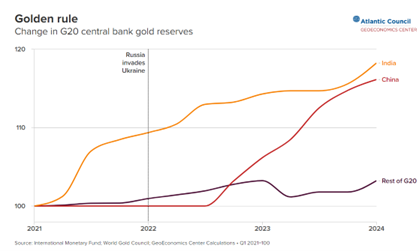
The West’s decision to freeze and legalise the theft of Russian sovereign funds predictably diminished trust in the Western financial system, resulting in a huge demand for gold and other precious metals as a safe haven. Gold is not a yield-bearing asset, yet it preserves its value during turbulent times. There are some more twists to the story: There is a rise in demand for physical gold and a push to store it in their home countries due to the lack of trust it can be stored safely in the West.
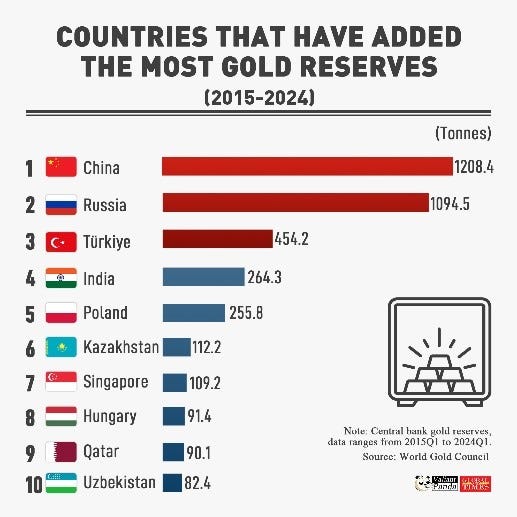
What was done to Russia could happen to anyone. An adversary like China is obviously next in line as the economic coercion to prevent its continued development intensifies. The EU demands China must pay a “higher cost” for supporting Russia, linking Russia and China seemingly for the purpose of convincing Trump to continue the war in Ukraine. Even friendly countries such as India could be targeted anytime with secondary sanctions for failing to bow to the demands of Washington.
From the US seizure of Afghanistan’s sovereign funds to Britain confiscating Venezuela’s gold, there is evidently reason for distrust. The main shock to the system was nonetheless the legalisation of the theft of Russia’s sovereign funds, which was justified by the Russian invasion of Ukraine. The moral premise is dubious at best as it would obviously not be considered acceptable if countries around the world seized the funds of the US and its NATO allies to pay reparations to the countries they have invaded.
Even within Western countries, predictability diminishes as the rules of law weaken. A British journalist reporting from Donbas had his bank account frozen without a day in court.[1] In Canda, hundreds of people had their bank accounts frozen for organising or attending the trucker protest.[2] Even the British opposition politician, Nigel Farage (“Mr. Brexit”), had his account suspended for political reasons.[3] Metro Bank used access to its financial services to punish opposition to its gender ideology as it denied banking services to an organisation opposed to the medical transitioning of children.[4] With many similar cases emerging, the term “de-banking” has entered the vocabulary.
Inflation and weaponisation of the dollar, coupled with growing political instability, are compelling large powers to take their money out of the Western financial system. China is still making dollars with its great trade surplus, but there is a growing reluctance to buy Western bonds or even leave the money in the Western financial system. China lends these dollars to other countries around the world rather than reinvesting it into the US market.

BRICS countries also prefer buying physical gold and they are also moving it to their own countries. Central banks and investors are not interested in exchange-traded funds (ETFs) as a cheap and easy way to own gold. Paper gold is not trusted, and investors demand physical gold. The gold is not even trusted to be stored in Western vaults anymore. China is having hundreds of tonnes of gold shipped from the West to China. Switzerland alone sent 524 tonnes of gold to China in 2022.[5] India brought home 100 tonnes of gold from the UK in 2024, the first large shipment since 1991. The transfer and storage of these metals are neither convenient nor cheap, yet the collapse in trust demands drastic actions. Bloomberg reports on Singapore constructing a six-story warehouse “designed to hold 10,000 tons of silver, more than a third of global annual supply, and 500 tons of gold”.[6]

There are many reasons not to store assets in rogue states: Risk of seizure or confiscation, lack of transparency, economic volatility, political instability etc. Unfortunately, all of these symptoms are becoming associated with the G7 countries as the financial system was weaponised. A key lesson of sanctions is that severe and prolonged sanctions result in the rest of the world adapting by learning to live without the belligerent actors.
Large gold reserves safely protected within national borders can also become important as new trade and reserve currencies are promoted. Fiat currencies will lose much trust in the financial turmoil that awaits, and future alternatives may need to yet again be backed by gold. Gold will certainly play a greater role as BRICS prepares a post-American financial system.
[1] PETER HITCHENS: Freedom for all means freedom for nasty people – Mail Online – Peter Hitchens blog
[2] Canada Ends Its Freeze on Hundreds of Accounts Tied to Protests – The New York Times
[3] Debanking: How Nigel Farage’s Banking Woes Have Raised Serious Concerns Over Account Closures
[4] The terrifying rise of ‘debanking’ – spiked
[5] Switzerland sent 524 tonnes of gold to China last year, the most since 2018 | Euronews
[6] As the Rich Snap Up Gold Bars, Storage Vaults Brace for Business – Bloomberg
FBI and Justice Department Anticipate Shake-Up Following Trump’s Comeback
By Ekaterina Blinova – Sputnik – 12.11.2024
US Justice Department and FBI employees fear widespread “housecleaning” as Donald Trump’s White House return looms, with agency brass reportedly “stunned” and “shell-shocked,” CNN and The Washington Times have reported.
“Let’s hope the housecleaning starts after Trump’s inauguration. The FBI is in desperate need of a change in leadership, one which restores trust and seeks to end the politicization of the agency,” Techno Fog, a nom de plume for a lawyer, blogger and popular legal observer on X, told Sputnik.
The DoJ and FBI’s reaction appears to be strikingly different from what unfolded after Trump’s first win, with the bureau waging Operation Crossfire Hurricane and Operation Crossfire Razor against the newly-elected president and his aides under the false pretext of “collusion with Russia”.
In 2018, former FBI Director James Comey openly bragged about sending two operatives to interrogate Trump’s national security advisor, Michael Flynn, in violation of White House legal rules.
“Thankfully, 2024 isn’t 2016,” Techno Fog said. “There is less hysteria both in the press and at the FBI. Trump won’t be caught off-guard this time by a secret operation targeting his administration – the illegal wiretaps, the lies to the FISA court – that we saw in Trump’s first term. And FBI leadership, by now, hopefully knows better. [FBI Director Christopher] Wray isn’t perfect, and he has made plenty of mistakes, but he is not as deceitful and prone to abuse his power as former FBI Director James Comey.”
Nonetheless, Wray is rumored to step down prior to Trump’s inauguration, before the housecleaning begins. “Director Wray never truly sought responsibility for the Russiagate fiasco,” the lawyer remarked. “It seems like Wray has to go.”
Similarly, there won’t be the weaponization of the Justice Department that one saw in 2016, the pundit continued.
“Special Counsel Jack Smith’s ‘election interference’ case against Trump, which is pending in Washington, DC, will likely be dismissed,” Techno Fog said. “Last week, after Trump’s election, Smith asked the court to vacate the briefing schedule so that the Department of Justice could ‘determine the appropriate course going forward’ given the DoJ’s policy to not seek continue the criminal case against a president. The court granted that request and vacated the briefing schedule and all deadlines in the pretrial schedule.”
That doesn’t mean, however, that Trump has become immune to deep state interference, according to the lawyer.
“The deep state may push back on parts of Trump’s policies that it finds disagreeable, especially when it comes to foreign policy. Keep an eye on efforts to subvert Trump’s goal of seeking an end to the Ukraine-Russia war and any limitations to Ukraine’s potential membership in NATO,” the pundit concluded.
Ukraine in league with Al-Qaeda – Syria
RT | November 12, 2024
Ukrainian agents have been working with Al-Qaeda in Syria, offering them drone warfare training and some of their US-supplied weapons in exchange for manpower, the government in Damascus has told RT.
The terrorist group Jabhat al-Nusra, since rebranded as Hayat Tahrir-al-Sham (HTS) has been reduced to parts of Idlib province in the northwest of the country, thanks in part to Russia helping the Syrian government defeat various rebel militants, including Islamic State (formerly ISIS).
RT’s Roman Kosarev has visited Syria and saw “undeniable evidence” that Kiev has made an alliance with HTS.
“We have real confirmation of the Ukrainian instructors’ presence in Syria,” a Russian soldier, identified only by the callsign ‘Gilza’, told RT. He said Kiev’s operatives have been teaching HTS militants how to fly suicide drones, as well as supplying them with such weapons.
Video footage filmed on a ship showed a US-made Switchblade 600 drone being delivered to the Syrian militants in crates labeled as humanitarian aid. Another video showed a man, wearing a black T-shirt with a Ukrainian trident symbol, chatting with a militant somewhere in Idlib.
Mohammed Hamra, a former government official who had to flee Idlib, has his own sources about what’s going on in the province. He told RT that around 250 Ukrainian instructors have been training HTS militants to kill Syrians and Russians.
Syrian intelligence has confirmed the presence of “several” Ukrainian operatives in Idlib. One of the Syrian officials, who sought anonymity, told Kosarev that Kiev’s instructors have been preparing HTS militants for attacks on government-controlled territory, in particular the Russian base at Khmeimim.
Kiev has delivered drones and even drugs – stimulants to keep militants alert – to HTS through Turkish territory, the Syrian said. In return for advice and technology, Kiev has asked HTS to release Chechen militants from their ranks so they could fight in Ukraine.
Moscow has “reliable information” that Islamic State militants and “similar groups” have been fighting in Ukraine under the guise of Chechen and Crimean Tatar units, according to Alexander Bortnikov, head of the Russian security service FSB.
Russia has accused Ukraine of “openly supporting terrorist groups in Africa,” pointing to an incident in Mali earlier this year involving Touareg militants. Ukraine’s HUR military intelligence agency has boasted about providing the Touaregs with information and drone warfare techniques to help them kill government soldiers and Russian security contractors.
Trump’s foreign policy team signals further drift from ‘America First’ to ‘Israel First’
MEMO | November 12, 2024
https://twitter.com/DonaldJTrumpJr/status/1855593982958379321
Israel fails to meet US aid demands to ease Gaza catastrophe, aid groups say
MEMO | November 12, 2024
Israel failed to meet a series of US demands intended to improve the humanitarian crisis in Gaza by a deadline set for today, aid groups have said according to Reuters.
The United States told its ally Israel in a letter on 13 October that it must take steps to improve the aid situation within 30 days. If not, it could face potential restrictions on US military aid.
“Israel not only failed to meet the US criteria that would indicate support to the humanitarian response, but concurrently took actions that dramatically worsened the situation on the ground, particularly in Northern Gaza,” a group of eight aid groups including Oxfam, Save the Children and the Norwegian Refugee Council said in 19-page report.
For more than a month, Israeli forces have been pushing deeper into north Gaza, surrounding hospitals and shelters and creating fresh waves of displacement.
On Friday, global food security experts released a rare warning of imminent famine in parts of northern Gaza unless immediate steps were taken to ease the situation.
Israel says measures, including the opening of a new crossing into Gaza, have been implemented, however others pertain to its security and have not been put in place.
Washington has not yet commented on whether its conditions have been met. Last week, the State Department said Israel had taken some measures to increase aid access to Gaza but had so far failed to significantly turn around the humanitarian situation.
Featured Video

Anthrax War – CBC The Passionate Eye
or go to
Aletho News Archives – Video-Images
Book Review
Shattered Dreams: The HPV Vaccine Exposed (2019)
By Christina England – 30 Q&As – Book Review & Summary
Lies are Unbekoming | September 4, 2026
… Gardasil received FDA fast-track approval in 2006, Cervarix followed in 2009, and Gardasil 9 was approved in December 2014 with more than double the aluminium adjuvant content of the original. The commercial context is specific. Merck was about to lose patent protection on Zocor and faced $18 billion in Vioxx injury claims from a cardiovascular drug the company had marketed while suppressing its own data showing a five-times increase in heart attacks. Analysts projected the global HPV vaccine market at $4 billion by 2011, contingent on government-funded national programs for teenage girls. The 1986 National Childhood Vaccine Injury Act had already granted manufacturers complete liability immunity. By 2013, Japan had withdrawn its HPV vaccine recommendation after cataloguing severe adverse reactions in hundreds of girls. No Western government followed. The establishment position across the UK, US, Australia, and most of Europe held, and still holds, that the vaccines are safe and effective, that reported injuries are coincidental, and that cervical cancer prevention justifies the program. The book was published into this position, not against a vacuum.
Shattered Dreams sits alongside Mary Holland’s The HPV Vaccine On Trial and Viera Scheibner’s foundational vaccination work as part of the documented record on what has been done to a generation of teenage girls under the banner of cancer prevention. The full summary unpacks three specific findings: that Merck used the aluminium adjuvant itself as the “placebo” control in 92.5% of trial subjects, making it structurally impossible to detect excess reactions from the adjuvant; that Dr. Sin Hang Lee found HPV DNA fragments bound to aluminium in every one of sixteen Gardasil samples tested, and in the blood and spleen of a New Zealand girl six months after her third dose; and that in every country with high vaccination coverage, including Australia, the UK, Norway, and Sweden, cervical cancer rates have stopped declining and started rising specifically in the vaccinated cohort. Martínez-Lavín’s 2017 calculation puts the number needed to seriously harm with Gardasil 9 at 140, and the number needed to vaccinate to prevent one case at 1,757. Thirteen young women are seriously harmed for every one who benefits. The vaccine was approved on the basis of trials that could not detect what the trials were supposed to detect, and it is still being given to twelve-year-olds today. … Read full review
Blog Roll
 Aletho News
- The Five-Year Fuel Crisis: Why the World Economy Is Paying for a War It Thinks Is Ending
- Trump’s Big Bluff on Iran
- Swiss scammed out of millions by Ukraine-linked call centers – media
- Germany facing potential ‘violent conflict’ with Russia – spy chief
- Ukraine’s EU neighbors reject new plea from Kiev – Politico
- British Transport Police Facial Recognition Trial Scanned 926,912 People With Zero Arrests
- House Bill Would Ban Federal Use of Flock ALPR Data
- Can a Spice Rival a Drug? 10 Head-to-Head Trials Put It to the Test.
- The oil routes around Hormuz face their own chokepoints
- The Saudi-Israeli war on Yemen’s resistance: Intelligence sharing, civilian targets & sectarian propaganda
- If Americans Knew
- Turkish Red Crescent helps elderly Gaza man walk again after Israel confiscates his prosthetic limb
- Four Palestinians Killed in Israeli Attacks in Gaza
- Two Palestinian youths killed and village razed as Israeli attacks on West Bank continue
- Two more Christian women innocent victims of Gaza raids
- Cruelty, Deprivation, Indignity: A Journalist’s 22 Months in Israeli Prison
- New IDF Website Frames Slain Gaza Journalists as Terrorists
- Israeli media: After settlers beat him mercilessly, they stuffed dirt into his mouth
- Americans Are Paying the Price to Preserve Israel’s Nuclear Hegemony
- A U.S. Jewish Fund’s Ambitious Bid to Put a Settler Elite in Control of Israel’s Security
- As genocide drags on, “Zionism is racism” becomes official policy in one UK party – Daily Update
- No Tricks Zone
- Latest European Green Energy Debacle; Portugal’s Largest Flagship Solar Park Insolvent!
- Green Energy Debacle: German Expert Professor Fritz Vahrenholt Warns Of Severe Economic And Social Consequences
- Two More Paleo Reconstructions Affirm Meters-Higher Sea Levels Across Ireland, Brazil 7000-6000 Years Ago
- New Study: Earth And Venus Surface Warmth Largely Explained By Convection And Lapse Rate, Not CO2 Or Radiation
- 2025 Nature Paper Claiming Worsening Global Drought Gets RETRACTED …Heavily Flawed
- New Study: ‘Global Drought Shows No Detectable Recent Acceleration Under Climate Warming’
- Economic Masterminds: German Socialists Suggest Taxing Productivity Gains Stemming From Using AI
- The South China Sea Has Not Been Cooperating With The Climate Change Narrative
- Energy Crisis: Germany Enters Heating Season With Historically Low Gas Reserve Fill Levels
- New Study: The Antarctic Ice Sheet Gained Mass From 2020-2024 Due To Staggering Snow And Ice Accumulation

