Russia to seize income from frozen Western assets – finance minister
RT | October 24, 2024
Russia will respond in kind to the West’s use of the income generated by its frozen central-bank reserves, Finance Minister Anton Siluanov has said.
The US and its allies have blocked an estimated $300 billion in assets belonging to the Russian central bank since the escalation of the Ukraine conflict in February 2022. The bulk of the funds, around €197 billion ($213 billion), are being held at the Brussels-based clearinghouse Euroclear. On Wednesday, Washington announced a decision to use the proceeds from the frozen assets to repay a multibillion-dollar loan to Kiev.
“If Western countries have begun utilizing the income from the frozen Russian reserves, we will do exactly the same,” Siluanov told reporters on Thursday. “We have frozen money from ‘unfriendly’ companies and organizations. We keep this money in our accounts in the same way and will use the income from these assets similarly,” he elaborated.
The income from these funds will be allocated to “the needs of the economy, the needs of the constituent entities of the Russian Federation,” the minister added, noting that the corresponding decisions have already been made.
The US said on Wednesday that it will provide Kiev with a $20 billion loan as part of a broader $50 billion G7 package. The use of windfall profits from the blocked Russian assets will provide Ukraine assistance “without burdening taxpayers,” US President Joe Biden stated.
A day earlier, the European Parliament backed allocating a loan of up to €35 billion ($38 billion) for Kiev using the immobilized Russian assets as collateral for the repayments. According to Euroclear, the frozen funds had generated €3.4 billion ($3.6 billion) in interest as of mid-July.
Russia has repeatedly warned that seizing its assets would amount to “theft” and would violate international law and undermine reserve currencies, the global financial system, and the world economy.
The International Monetary Fund has also been raising concerns that such actions could undermine trust in the Western financial system. Siluanov earlier warned that global players are closely following the story involving the Russian assets and are drawing their own conclusions.
While the finance minister did not elaborate on the amount of Western assets currently held in Russia, previous calculations by RIA Novosti put the figure at roughly equal the size of the Russian funds frozen abroad. The news agency reported that total foreign direct investments in the Russian economy by the EU, G7, Australia, and Switzerland amounted to $288 billion as of the end of 2022.
Russia Changes Nuclear Doctrine & Prepares for War
Sergey Karaganov, Alexander Mercouris & Glenn Diesen
By Glenn Diesen | October 23, 2024
I had a conversation with Professor Sergey Karaganov and Alexander Mercouris about Russia changing its nuclear doctrine. Karaganov was an advisor to Brezhnev, Gorbachev, Yeltsin and Putin. He has been the main proponent of lowering Russia’s nuclear threshold. Putin had previously told Karaganov that Russia was not prepared to change the nuclear doctrine, however Putin has reversed his position and is now changing the nuclear doctrine according to Karaganov’s recommendations.
Nuclear weapons are the ultimate deterrent and can therefore be a source of stability and peace by making war between the great powers unacceptable. The irony of the nuclear deterrent is that the immensely destructive power of nuclear weapons, possibly ending human civilisation, can reduce the credibility that an opponent would use them. The nuclear peace therefore requires communicating a credible readiness to destroy the world.
NATO’s escalations in the Ukraine War have convinced the Kremlin that its nuclear deterrent has been severely weakened and must be restored. For example, Biden initially warned against sending F-16s as it would likely trigger World War 3, but then decided later to approve supplying F-16s to Ukraine while NATO countries dismissed Russia’s nuclear deterrence as unacceptable “nuclear blackmail”. On the third year of the war, Ukraine invaded Kursk with NATO weapons and likely US intelligence – which was met with Western support and exuberance.
The dilemma for how Russia can respond has been: 1) retaliate against NATO and risk uncontrolled escalation possibly resulting in nuclear war, or 2) do not to retaliate but then embolden NATO to escalate further and thus risk nuclear war. The plan by the US and UK to supply Ukraine with long-range precision missiles became the final straw for Moscow. This would be considered a direct attack on Russia since these missiles would need to be operated by American or British soldiers and guided by their satellites.
The changes primarily entail 1) allowing the use of nuclear weapons if attacked by a non-nuclear state supported by a nuclear state (to address war through proxy), 2) placing Belarus under the Russian nuclear umbrella to address the possibility of a NATO nuclear attack on Belarus as a step up the escalation ladder. Obama’s national-security team secretly staged a war game in 2016 in which it was recommended to respond to a Russian use of nuclear weapon with a NATO nuclear attack on Belarus – “a nation that had played no role whatsoever in the invasion of the NATO ally but had the misfortune of being a Russian ally”.
Changing the nuclear doctrine does not suggest Russia is planning a nuclear strike as there are still further steps on the escalation ladder:
- Confront and destroy NATO reconnaissance drones over the Black Sea that provide targets to Ukraine
- Use conventional weapons to attack NATO’s military targets that are used to put a blockade on Kaliningrad (if the decision is made)
- Destroy NATO satellites used to guide missiles that attack Russian territory
- Destroy NATO’s critical infrastructure such as underwater cables or through cyber attacks
- Destroy Ukrainian warplanes stationed in Poland and Romania
- Destroy military logistics centres on NATO territory for weapons being sent to Ukraine
- Attacks on US military bases abroad, either through proxies or direct attacks
However, once any of these retaliatory actions are taken against NATO, both sides could lose control of the situation and rapidly head up the escalation ladder.
The Duran | October 21, 2024
NIAID Declares Mpox Vaccine ‘Safe’ for Teens, Opening the Door for Vaccine’s Approval for Kids as Young as 12
By Michael Nevradakis, Ph.D. | The Defender | October 18, 2024
The National Institute of Allergy and Infectious Diseases (NIAID) this week announced Bavarian Nordic’s mpox (monkeypox) vaccine is “safe and generates a robust antibody response in adolescents.”
The announcement drew criticism from doctors and scientists who cited the lack of any evident control group in the clinical trials and any publicly available data.
The results of the NIAID study, funded by the National Institutes of Health, could open the door for the vaccine’s approval for 12- to 17-year-olds in the U.S., a month after European regulators approved the vaccine for the same age group.
According to the Oct. 16 announcement, the modified vaccinia Ankara-Bavarian Nordic (MVA-BN), marketed as Jynneos in the U.S., “generated antibody levels in adolescents equivalent to those observed in adults at day 43 and found that the vaccine was well tolerated through study day 210.”
The results are based on a pair of Phase 2 clinical trials of the MVA-BN vaccine. One trial included 229 participants between 18 and 50 years old, while the other trial tested the vaccine on 315 adolescents between ages 12 and 17.
Based on the findings, the European Medicines Agency (EMA) last month approved the MVA-BN, marketed as Imvanex in Europe and the United Kingdom, for 12- to 17-year-olds.
“The immune response in adolescents was similar to adults. … According to the submitted data, the safety profile of Imvanex in adolescents was comparable to that seen in adults and no additional risk has been identified,” the EMA stated in its Sept. 19 announcement.
Last month, the World Health Organization (WHO) approved MVA-BN for adults — and said it can be used for babies, children, teens and pregnant women if they are in “outbreak settings where the benefits of vaccination outweigh the potential risks.”
The U.S. Food and Drug Administration (FDA) in September 2019 approved the Jynneos vaccine for adults, for the prevention of both mpox and smallpox and added it to the Strategic National Stockpile.
The approvals went through even though no data on the MVA-BN clinical trial results for the 12-17 age group have been publicized.
‘The complete void of any transparency in this clinical trial is stunning’
Critics of the vaccine cited the lack of data for 12- to 17-year-olds, the lack of a control group in the clinical trials, and questioned the necessity and safety of administering the mpox vaccine to children.
“The complete void of any transparency in this clinical trial is stunning,” said Brian Hooker, Ph.D., chief scientific officer for Children’s Health Defense. He added:
“Also, the clinical trial had no unvaccinated control group for comparison, which is a fatal flaw even if they would have made the trial results public. These are supposedly the premiere clinical researchers worldwide, yet they make 9th-grade mistakes in running their experiments.”
A spokesperson for NIAID who spoke with The Defender directed the public to the study protocol for the two clinical trials. However, the protocol does not indicate a control group and contains no findings.
“Short-term antibody responses in a study with an undisclosed sample size and no reported safety data are not sufficient for an NIAID press release,” cardiologist Dr. Peter McCullough told The Defender.
McCullough said:
“The Jynneos monkeypox vaccine has been used for years and carries a risk of myocarditis or heart damage. This study is not reassuring on safety or theoretical efficacy. The NIAID should take this post down and wait for the full peer-reviewed manuscript to be published.”
Internist Dr. Meryl Nass questioned the need for the MVA-BN clinical trials and NIAID’s claims of insufficient data for people 18 and younger. She told The Defender the studies were performed “after the U.S. government already gave hundreds of thousands of Americans both doses in mid-2022 and collected data on them.”
“One wonders what the purpose of this tiny trial was,” Nass said.
Data indicate a potentially high risk of severe adverse events
According to the NIAID announcement, “The overall frequency of adverse events was comparable between the study groups. Reports of dizziness were more common in adolescents than adults, but similar to the frequency of dizziness reported when other vaccines are administered in adolescents.”
The study results for the 18- to 50-year-old group indicated a rate of severe adverse events exceeding 1%. For Nass, a “1% SAE [severe adverse event] rate for a vaccine is very high,” though she added, “We need to know more to make any safety judgment.”
Nass suggested the actual number of severe adverse events may have been underreported.
“NIAID claims that only two of the 229 subjects had a serious adverse event. However, their definition of serious has been made more and more restrictive over the years,” Nass said.
According to Nass, while NIAID’s definition of a serious adverse event once “included an ER [emergency room] visit after vaccination,” the current NIAID definition is narrower, referring, in part, to “inpatient hospitalization or prolongation of existing hospitalization” instead of an ER visit.
The two reported severe adverse events in the 18-50 age group involved cases of cystitis — an inflammation of the bladder — and euglycemic diabetic ketoacidosis, an “uncommon diabetic complication.”
Nass also noted that severe adverse event data were “collected only for the first 57 days of the study.” In the event NIAID determined the adverse event was related to vaccination, further data were collected through day 181 — even though “blood was drawn at day 365 also.”
“Why were SAEs not collected through day 365 for everyone? That is how you learn what the SAEs related to a vaccine actually are,” Nass said.
Data from the U.S. government’s Vaccine Adverse Event Reporting System (VAERS) as of Sept. 27 indicate 2,115 reports of adverse events related to MVA-BN, including 19 reports for people under 18.
According to Managed Healthcare Executive, “Bavarian Nordic is preparing for a clinical trial to assess the safety of MVA-BN in children 2 to 12 years of age.”
The trial will be partially funded by the Coalition for Epidemic Preparedness Innovations, which previously announced its intention to develop “pandemic-busting vaccines in 100 days.”
This article was originally published by The Defender — Children’s Health Defense’s News & Views Website under Creative Commons license CC BY-NC-ND 4.0. Please consider subscribing to The Defender or donating to Children’s Health Defense.
The Specter of ‘Defense Secretary Cheney’
By Dan McKnight | The Libertarian Institute | October 24, 2024
I believe one of the biggest political stories of the year is the attempted resurrection of the Cheney legacy.
This is a family whose political prospects were dead and buried in 2022—in no small part from the contributing efforts of Bring Our Troops Home.
But Liz Cheney is out on the campaign trail again, now appearing with Kamala Harris and encouraging Americans to re-elect the Biden team.
From the national debates to local meet and greets, Vice President Harris and Tim Walz are thanking Dick Cheney for his support and praising his public service—including the illegal invasion of Iraq, torture, and the subversion of Americans’ dearest political liberties.
This merger signifies the War Party openly and brazenly shedding its misleading, partisan skin to reveal the true, DC consensus underneath: the neoconservatives and Biden-Harris alums who agree that the Deep State feeds on endless war… and needs more of it!
Consider; hasn’t every decision of the last four years been geared towards hyping our country into World War III? Whether against Russia or China or Iran, the Biden-Harris White House hasn’t flinched from deploying hundreds of billions of dollars and writing future checks they expect American servicemen to cash in blood.
Rumors are swirling around the Beltway, sick minds teeming with possibilities and mouths drooling over the prospects of trillion-dollar weapons packages.
Here’s the number one threat to the American heartland: If Kamala Harris is elected to her own term in the White House in two weeks, we could see her nominate Liz Cheney as Secretary of Defense.
Harris has already promised to include a “Republican” in her cabinet, and Liz, who agrees with the Democratic establishment on every core issue, would be a layup. And with lockstep Democratic support, combined with a significant number of Republican hawks, Liz Cheney would assuredly be confirmed by the U.S. Senate. Of course the argument that her father held the same position under Bush Sr. would be used as a phony qualification.
We’d witness in real time our soldiers become cogs in a war machine active on every continent. No doubt we’d see a return to conscription, after Americans inevitably refuse to fight these nonsense wars. Or we’d see the impressment of illegal immigrants (bribed with the promise of citizenship, a plan already being discussed) and the outright foreign occupation of our soil. And the most influential advisor to the president would be 83-year old Dick Cheney, who unlike Joe Biden has managed to stay as sharp and mean as ever.
There is no institution the Cheney family would not disassemble, no law they would not violate, no life they would not sacrifice if it meant absolute power for themselves. They’re evil down to the bone.
October is a time for ghouls and goblins, maybe even the “living dead” like Dick Cheney. But even that scenario is too scary for me!
I pledge to you, as chairman of Bring Our Troops Home, that if the worst comes to worst my organization will be there to speak for the millions of veterans tired of these endless wars who are still loyal to the U.S. Constitution.
When I took my oath, it was for life, in and out of uniform. That’s why I advocate for the Defend the Guard Act full-time. And once the November results cool off, my team will be kicking it into high gear for legislative season. I’m receiving daily updates on new Defend the Guard bills being drafted, new legislators being recruited, and new battle plans being drawn up.
Visit our website to learn more. If Liz Cheney becomes the head of the Pentagon, you’ll be thanking your lucky stars that you enlisted early in the opposition to World War III.
Dark Money, Darker Motives: Why is Bill Gates Backing Kamala Harris Using Shady Super PAC?
By Ilya Tsukanov – Sputnik – 23.10.2024
Tech billionaire, philanthropist and WEF cheerleader Bill Gates has given Kamala Harris’s campaign a $50 mln boost using dark money super PAC Future Forward. The donation was intended to remain secret, but was uncovered by NYT this week.
What’s Future Forward?
Set up in 2018 by former Obama campaign staffers and coming out of left field in the final weeks of the 2020 race to fund a massive pro-Biden media blitz, Future Forward is a super political action committee funded mostly by Big Tech and venture capital firms, including Meta, Google, disgraced crypto financier Sam Bankman-Fried, Bain Capital and Bridgewater Associates.
The super PAC has raised a whopping $700 mln for the 2024 election cycle, rolling out $75 mln in pro-Harris ads last week.
What’s Behind Gates’ Electoral ‘Generosity’?
2024 is at least the second election cycle where Gates has used a dark money vehicle to support the Democratic Party’s candidate. In 2020, the Bill and Melinda Gates Foundation contributed nearly $70 mln to the New Venture Fund, a nonprofit belonging to DC consultancy Arabella Advisors, which bankrolls the Sixteen Thirty Fund, a goliath of undisclosed donations for Democratic politicians and liberal causes which raised nearly $390 mln four years ago. Publicly, Gates and his now former wife also gave $500,000 to Biden’s inaugural committee.
Mr. Gates has been an active supporter of Democratic candidates since at least 2008, contributing financially to and praising the campaigns of Barack Obama and Hillary Clinton.
Gates’ ties to the Clintons are deeply rooted, with the billionaire becoming a top donor to the Clinton Foundation, and forging partnerships with the organization for global projects since at least 2013.
In a telling interview in 2016 in which he explained his preference for Clinton, Gates said “there have been questions about vaccines in general where some of the candidates have shown that they’re not as up to date about vaccines in general, and that’s got to be a concern.”
“Science in general, whether it’s GMOs or vaccines, there’s a lot of people out there who don’t give science the benefit of the doubt. In terms of experience, Hillary Clinton and Bill Clinton have more experience in global health,” Gates said at the time.
How has Gates profited off the Dems’ agenda?
With Harris’ presidential bid expected to broadly continue the Biden/Clinton line on foreign and domestic policy, it makes sense for Gates to throw his influence behind the VP, given the perceived threat of the Trump brand of red-pill MAGA Republicans and their anti-vax, anti-tech, and anti-interventionist leanings.
“This election is different, with unprecedented significance for Americans and the most vulnerable people around the world,” Gates said this week after info about his $50 mln donation leaked out.
“I think it’s great to have somebody who’s younger, who can think about things like AI and how we shape that in the right way, and I certainly offer up my opinions to the politicians who are interested,” Gates said this summer after Biden dropped out and named Harris his successor.
The Gates Foundation’s fortunes got a big boost under Biden, with its endowment growing from $69 bln in 2020 to $75.2 bln in 2023.
Gates enjoyed a profits bonanza off mRNA coronavirus vaccines mandated by the Biden administration. In 2022, he sold off shares of BioNTech stocks he bought in 2019 as sales slowed. His foundation has also owned shares in Pfizer, CureVac and Vir Biotech going back to well before the pandemic.
The billionaire’s foundation supports the Global Virome Project – an ambitious initiative created in 2018 to predict pathogens that could trigger lethal pandemics, but accused of weaponizing viruses from a network of 150 biolabs worldwide.
Gates has also backed a broad array of World Economic Forum-affiliated initiatives, including projects to reduce emissions and create synthetic meat and dairy. In 2022, The Seattle Times revealed Gates’ secret lobbying to save Biden’s signature $2+ trln Build Back Better social and climate spending package.
Gates has also been a top backer of the Biden administration’s battle against media and online ‘misinformation’, with an explosive MintPress investigation from 2021 revealing that his foundation had bankrolled some $319 mln in media, including CNN, the BBC, Le Monde, the Financial Times, Der Spiegel and others to ensure favorable coverage of his agenda and that of his allies.
The Hidden Motives Behind Hochstein’s Lebanon Visit and the Strategic Bet on the Resistance
By Zoulfikar Daher | Al-Manar | October 23, 2024
The first visit of US envoy Amos Hochstein to Beirut since the outbreak of Israel’s large-scale aggression against Lebanon came approximately three weeks after the Israeli enemy expanded its operations across southern Lebanon, the Bekaa, and even the southern suburbs of Beirut and the capital itself.
Prior to his visit, speculation arose about its true purpose: Was Hochstein bringing concrete solutions, or was he simply testing the waters and assessing the political landscape? Some questioned whether he was delivering Israeli demands aimed at pressuring Lebanon into submission. Did this move stem from American initiative alone, or was it coordinated with “Israel” as part of its efforts to impose terms? Alternatively, could it signal Israel’s realization that the conflict with the resistance is proving more difficult than anticipated, given the losses it has suffered along the Lebanese-Palestinian border?
There is a view that the Israeli enemy, recognizing the challenge posed by the resistance, is attempting to de-escalate while still hoping to extract some benefit from its tactical strikes. However, these strikes have done little to alter the situation. The resistance remains steadfast, its retaliation capabilities growing and reaching deeper into Israeli territory, while its capacity to manage the conflict remains strong.
Fearing that Israel’s “achievements” on the ground might slip away, the US administration appears to have dispatched Hochstein to reopen negotiations. The strategy follows a familiar pattern: escalate demands to the maximum in hopes of gaining concessions, all while threatening continued aggression.
Simultaneously, Israeli attacks intensified in various areas, particularly in the southern suburbs of Beirut (Dahiyeh). The timing of these escalations, paired with Hochstein’s visit, was no coincidence. “Israel” aimed to showcase its destructive capabilities, resorting to psychological warfare by targeting buildings associated with the Al-Qard Al-Hassan Association, although these were largely unoccupied. This was intended to send a message to the Lebanese leadership receiving the American envoy. The strikes continued the following night, extending to Al-Awzai and areas near Beirut’s governmental hospital. But the question remains: Can these aggressive moves impose Israel’s conditions on Lebanon?
Hochstein reportedly presented amendments to UN Resolution 1701, which included:
• Expanding the role of international forces and allowing them to operate without restrictions.
• Pushing the resistance several kilometers north of the Litani River, with some reports suggesting as far as the Owali River near Sidon.
• Assigning oversight of the resolution’s implementation to US, British, or German forces.
• Granting “Israel” unrestricted access to Lebanese airspace for supervision.
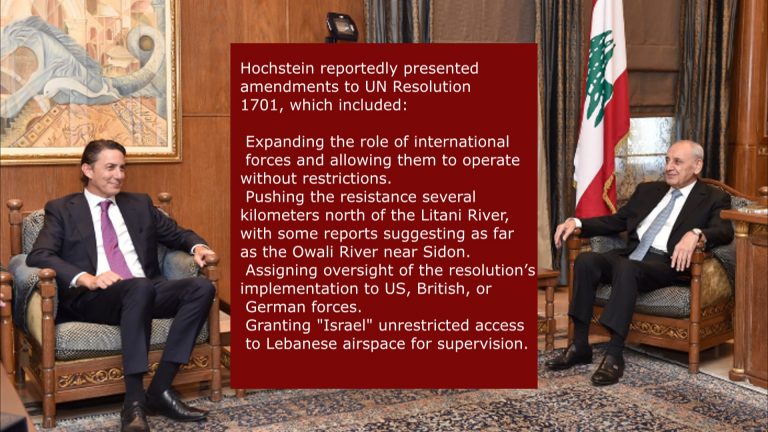
These terms essentially aim to hand “Israel” significant control, leaving Lebanon, its army, people, and resistance with little ability to defend national sovereignty. Some media and political voices have described this proposal as nothing less than a “surrender document.”
However, Parliament Speaker Nabih Berri reaffirmed Lebanon’s commitment to Resolution 1701, with no amendments. He emphasized that this is the final opportunity for the US to intervene diplomatically and halt the war. Berri made clear that Lebanon stands united on Resolution 1701, and that “Israel” must respect it. He anticipated that Hochstein would push Israel’s maximum demands but remained confident that nothing could be imposed on Lebanon. “Israel” has failed to achieve its objectives on the battlefield, and it will not succeed through diplomacy either.
Hochstein’s visit, it seems, was primarily a test of Lebanon’s resolve—an attempt to gauge whether the country, particularly the resistance, might offer concessions under pressure. But Lebanon’s leadership, backed by its steadfast resistance, will not yield. Neither the US, nor the Zionist entity, nor their allies can force Lebanon into submission.
Contrary to some perceptions, “Israel” is not in a position of strength. Those following the situation behind the scenes of Hochstein’s visit might believe “Israel” can impose its will, but the facts tell a different story. For over three weeks, it has faced setbacks along the border with Lebanon, failing to make significant gains or take control of any Lebanese towns. These developments underscore that the US-Israeli pressure campaign is shallow and ineffective against the united front of Lebanon, its resistance, and its people.
Ultimately, the outcome of this conflict will be decided on the battlefield, where the resistance, as emphasized by its leader, Sayyed Hasan Nasrallah (may he rest in peace), continues to hold the upper hand. The realities on the ground, both day and night, will shape the political and diplomatic consequences, not the other way around. The battlefield will determine the fate of this war, and indeed, the future of the entire region.
Iran’s Bomb Is Real — And It’s Here
For months now, the world has focused on the danger of nuclear war between the United States and Russia. But Iran and Israel could beat them to it.
By Scott Ritter | Consortium News | October 20, 2024
The outbreak of conflict between Iran and Israel appears to have changed Iran’s stance against possessing a nuclear weapon as Israel is poised to strike after Teheran’s retaliation with two major attacks of drones and ballistic and cruise missiles.
Iran has issued at least three statements through official channels since April that has opened the door to the possibility of religious edicts against Iran acquiring nuclear weapons being rescinded.
The circumstances which Iran has said must exist to justify this reversal appear to have now been met.
No mere threats, these statements issued by Teheran should be viewed as declaratory policy indicating Iran has already made the decision to obtain a nuclear weapon; that the means to do so are already in place and that this decision can be implemented in a matter of days once the final political order is given.
The religious fatwa against possessing nuclear weapons was issued in October 2003 by Iran’s Supreme Leader Ayatollah Ali Khamenei. It reads:
“We believe that adding to nuclear weapons and other types of weapons of mass destruction, such as chemical weapons and biological weapons, are a serious threat to humanity… [w]e consider the use of these weapons to be haram (forbidden), and the effort to protect mankind from this great disaster is everyone’s duty.”
However, the Shia faith holds that fatwas are not inherently permanent, and Islamic jurists can reinterpret the scripture in accord with the needs of time.
Shortly after Iran launched Operation True Promise against Israel in April, Ahmad Haghtalab, an Islamic Revolutionary Guard Corps (IRGC) commander responsible for the security for Iran’s nuclear sites, declared:
“If [Israel] wants to exploit the threat of attacking our country’s nuclear centers as a tool to put pressure on Iran, it is possible and conceivable to revise the Islamic Republic of Iran’s nuclear doctrine and policies to deviate from previously declared considerations.”
In May, Kamal Kharrazi, a former foreign minister who advises the Supreme Leader, declared: “We [Iran] have no decision to build a nuclear bomb, but should Iran’s existence be threatened, there will be no choice but to change our military doctrine.”
And earlier this month Iranian lawmakers called for a review of Iran’s defense doctrine to consider adopting nuclear weapons as the risk of escalation with Israel continues to grow. The legislators noted that the Supreme Leader can reconsider the fatwa against nuclear weapons on the grounds that the circumstances have changed.
These statements, seen together, constitute a form of declaratory policy which, given the sources involved, imply that a political decision has already been made to build a nuclear bomb once the national security criterion has been met.
Has the Capability
Iran has for some time now possessed the ability to manufacture and weaponize nuclear explosive devices. Using highly enriched uranium, Iran could construct in a matter of days a simple gun-type weapon that could be used in a ballistic missile warhead.
In June Iran informed the IAEA that it was installing some 1,400 advanced centrifuges at its Fordow facility. Based upon calculations derived from Iran’s on-hand stockpile of 60 percent enriched uranium hexaflouride (the feedstock used in centrifuge-based enrichment), Iran could produce enough highly enriched uranium (i.e., above 90 percent) to manufacture 3-5 uranium-based weapons in days.
All that is needed is the political will to do so. It appears that Iran has crossed this threshold, meaning that the calculus behind any Israeli and/or U.S. attack on Iran has been forever changed.
Iran has made no bones about this new reality. In February, the former chief of the Atomic Energy Organization, Ali-Akbar Salehi, stated that Iran has crossed “all the scientific and technological nuclear thresholds” to build a nuclear bomb, noting that Iran had accumulated all the necessary components for a nuclear weapon, minus the highly enriched uranium.
Two weeks later, Javad Karimi Ghodousi, a member of the Iranian parliament’s National Security Commission, declared that if the supreme leader “issues permission, we would be a week away from testing the first [nuclear bomb]“, later adding that Iran “needs half a day or maximum a week to build a nuclear warhead.”
A simple gun-type nuclear weapon would not need to be tested — the “Little Boy“ device dropped on Hiroshima by the U.S. on Aug. 6, 1945 was a gun-type device that was deemed so reliable that it could be used operationally without any prior testing.
Iran would need between 75 and 120 pounds of highly enriched uranium per gun-type device (the more sophisticated the design, the less material would be needed). Regardless, the payload of the Fatah-1 solid-fueled hypersonic missile, which was used in the Oct. 1 attack on Israel, is some 900 pounds—more than enough capacity to carry a gun-type uranium weapon.
Given the fact that the ballistic missile shield covering Israel was unable to intercept the Fatah-1 missile, if Iran were to build, deploy, and employ a nuclear-armed Fatah-1 missile against Israel, there is a near 100 percent certainty that it would hit its target.
Iran would need 3-5 nuclear weapons of this type to completely destroy Israel’s ability to function as a modern industrial nation.
Consequences of Pulling Out of Iran Nuclear Deal
This situation came about after President Donald Trump in 2017 withdrew the U.S. from the Joint Comprehensive Plan of Action — the JCPOA, better known as the Iran nuclear deal. The driving factor behind the negotiation of the JCPOA, which took place under President Barack Obama, was to shut down Iran’s pathway to a nuclear weapon. As Obama said,
“Put simply, under this deal, there is a permanent prohibition on Iran ever having a nuclear weapons program and a permanent inspections regime that goes beyond any previous inspection regime in Iran. This deal provides the IAEA the means to make sure Iran isn’t doing so, both through JCPOA-specific verification tools, some of which last up to 25 years, and through the Additional Protocol that lasts indefinitely. In addition, Iran made commitments in this deal that include prohibitions on key research and development activities that it would need to design and construct a nuclear weapon. Those commitments have no end date.”
Early on in his administration, in June 2021, after Trump had already pulled the U.S. out of the deal, President Joe Biden declared that Iran would “never get a nuclear weapon on my watch.”
The director of U.S. National Intelligence said in a statement released Oct. 11 that, “We assess that the Supreme Leader has not made a decision to resume the nuclear weapons program that Iran suspended in 2003.”
In the aftermath of Trump’s precipitous decision to withdraw from the JCPOA, Iran took actions which underscored that it no longer felt constrained by any JCPOA limits.
Iran has expanded its nuclear program by installing advanced centrifuge cascades used to enrich uranium and scaled back International Atomic Energy Agency (IAEA) monitoring of its nuclear program. In short, Iran has positioned itself to produce a nuclear weapon on short order.
While the Office of the Director of National Intelligence (ODNI) currently believes that the Supreme Leader has not made the political decision to do so, an assessment published in July contains a telling omission from past assessments of Iran’s nuclear capabilities.
The February 2024 ODNI assessment noted that, “Iran is not currently undertaking the key nuclear weapons-development activities necessary to produce a testable nuclear device.”
However, this statement went missing from the July 2024 assessment, a clear indication that the U.S. intelligence community, due in large part to the reduction in IAEA inspection activity, lacks the insight into critical technical aspects of Iran’s nuclear-related industries.
Senator Lindsey Graham, after reading the classified version of the July 2024 ODNI report on Iran, said he was “very worried” that “Iran will in the coming weeks or months possess a nuclear weapon.”
What Confronts the US & Israel
This is the situation confronting Israel and the United States as they decide on an Israeli retaliation against Iran for the Oct. 1 missile attack.
Iran has indicated that any attack against its nuclear or oil and gas production capabilities would be viewed as existential in nature. That could trigger the reversal of the fatwa and the deployment of nuclear weapons within days of such a decision being made.
President Joe Biden told reporters on Friday that he knows when and where Israel will strike but refused to say. Leaked U.S. intelligence documents in recent days showed the limits of U.S. knowledge of exactly what Israel plans to do.
The United States and nuclear-power Israel have long said that a nuclear-armed Iran was a red line which could not be crossed without severe consequences, namely massive military intervention designed to destroy Iran’s nuclear infrastructure.
That line has been crossed — Iran is a de facto nuclear power, even if it hasn’t taken the final steps to complete the construction of a nuclear bomb.
The consequences of attacking Iran could prove fatal to the attackers and possibly the whole region.
Joe Biden Allowed His Friend Bibi to Destroy His Presidency and Legacy
By Kyle Anzalone | The Libertarian Institute | October 22, 2024
In 2020, amid lockdowns, Joe Biden prevailed in the election, running his campaign from his home. Biden was clearly experiencing significant cognitive decline, so the American people were presented with a carefully choreographed message that a vote for Biden was a return to normalcy.
Since Donald Trump descended the golden escalator, Americans have been subject to a non-stop barrage from establishment media and politicians wailing that we are in an existential battle for our country’s soul. We were told Russia hacked the election, Trump was Hitler, Democracy was on the ballot, and the sitting president was bowing to dictators around the world.
But Biden would save us: no more inflammatory rhetoric, no more prosecutions of the political opposition, and a more stable world.
While Biden was never going to return the US to a normal country in a normal time, he had the potential to significantly de-escalate America’s foreign entanglements. However, during his time in the Oval Office, 46 has done the opposite, starting wars and undermining international norms.
Upon taking office, Biden had two easy foreign policy victories he could have secured. Firstly, the current White House could have followed Trump’s deal with the Taliban and exited Afghanistan in a coordinated manner during May 2021.
Rather, the White House mishandled the situation, first by pushing back the exit from Afghanistan until September, the height of the Afghan fighting season. By then, the US-built government in Kabul had collapsed. This chaos culminated in an ISIS-K bombing at the Kabul airport that killed hundreds of desperate Afghans and 13 US soldiers.
Botching Iran Talks
The other easy win for the new president was returning to the Iran Nuclear Deal. Negotiated during the Barack Obama administration, the deal implemented additional safeguards on Iran’s civilian nuclear program in exchange for sanctions relief.
Tehran was entirely in compliance with the deal in May of 2018 when Trump unilaterally pulled out of the agreement at Tel Aviv’s behest. Washington then placed crippling sanctions on Iran aimed at cutting the Islamic Republic’s oil output to a minimum.
Upon taking office, Biden could have easily negotiated with the moderate Iranian President Hassan Rouhani to return to the deal and lift the sanctions. But, the Biden team was determined to demand Tehran agree to a “longer and stronger” agreement, and at the same time, looked the other way as Israel began attacking Iranian shipping and nuclear facilities.
Over the following two years, US and Iranian officials would engage in several rounds of indirect talks while Israel continued to attack Iranian shipping and conducted assassinations and other sabotage inside Iran. Under those conditions, a deal was never reached, and talks were abandoned last year.
Pushing Tehran from the table and the crippling economic sanctions on Iran had an important impact on Biden’s Ukraine policy.
After Russia invaded Ukraine in February 2022, Washington and its NATO partners engaged in a two-front strategy to use Ukrainian soldiers to bleed and “weaken” Russian invaders. The first was providing billions in weapons, training, and intelligence. The second was launching an economic war to cripple and isolate the Russian economy and bring the Kremlin’s war machine to a halt.
However, as the Iran Nuclear Deal is what ostensibly tied Tehran to Western economies, once the war broke out, the Islamic Republic saw no downside in strengthening its ties with Moscow. Additionally, as is the case with Iran, Russia’s main export is energy. The law of supply and demand says it would have been easier to push the Russian supply off the market if the US was not attempting to simultaneously remove the Iranian oil supply.
Genocide, War, Annexation
After a few years out of power, Netanyahu returned to his post as Prime Minister of Israel, leading a far-right-wing government in late 2022. That government included two extremist settlers in key positions who made clear a top priority was the annexation of the West Bank.
That government ushered in a brutal regime for the Palestinians, with 2023 killings in the West Bank before October 7 reaching a multi-year high.
Still, when Hamas broke the Israeli siege of Gaza on October 7, the White House pretended that Israel had been a normal democracy, not a declared Jewish state with apartheid oppression directed at the native Arab population.
The White House was a key amplifier of the atrocity propaganda put out by Tel Aviv following the Hamas attack. This gave Israel an unlimited blank check for killing in Gaza.
Netanyahu has cashed in that check for $23 billion in military aid from the US, Washington’s protection from UN resolutions at the Security Council, and the killings of tens of thousands of Palestinians in Gaza, thousands of Lebanese civilians, and hundreds of Palestinians in the West Bank.
The killing has intentionally targeted civilians and civilian targets such as hospitals, schools, shelters, and aid convoys. After each Israeli war crime, the US State Department acts as an Israeli PR firm and insists the world must blame Hamas, not Israel.
What Happened to International Law?
So now President Biden has spent the final year of his presidency providing arms to Netanyahu so his government can commit war crimes every day. This is the same president who has insisted to every American that we must send nearly $200 billion to Ukraine to defend international law.
If Russia was wrong to invade Ukraine, why can Israel invade Lebanon?
If Russia is violating international law to extend its border, why is Israel allowed to continue settlement expansion in the West Bank?
If Russia was wrong to detain American journalists in Russia, why has Israel been allowed to kill at least 170 Palestinian journalists, including Shireen Abu Akleh, an American citizen?
If Russia is wrong to attack civilian targets in Ukraine, why has Israel been allowed to destroy nearly every hospital, school, and shelter in Gaza?
One could go on at some length citing the myriad hypocrisies intrinsic to Biden’s murderous foreign policy. When it comes to starving the people of Gaza, assassinations in Iran, bombing diplomatic facilities in Syria, and attacking UN Peacekeepers in Lebanon, it’s clear that Netanyahu wipes his ass with the international “rules-based order” that Joe Biden claims to love so much on a daily basis.
Currently, Americans care more about domestic issues, but history will evaluate Biden by his elective and catastrophic wars. The x-rays of Israeli bullets lodged into the brains of Palestine’s pre-teen children will define the legacy of Biden and his good pal Bibi during the coming decades.
US Government Behind Campaign Violating North Korean Airspace
By Brian Berletic – New Eastern Outlook – October 23, 2024
North Korea has recently warned against the use of drones over its sovereign airspace to spread subversive propaganda.
CNN in its October 11, 2024 article, “North Korea accuses South of flying drones over Pyongyang,” reported, “North Korea accused South Korea of flying propaganda-filled drones over Pyongyang and threatened “retaliation,” state media reported.”
The same article admits that “South Korean activists and North Korean defectors have sent balloons to the North, loaded with propaganda material criticizing leader Kim Jong Un, along with USB sticks filled with K-pop songs and South Korean television shows.”
What the article omitted is that this campaign is not an organic activity carried out by independent activists, but a campaign of subversion organized and funded by the US government.
A US State Department Provocation…
As early as 2014, the Western media promoted what was called, “Thumb Drives for Democracy,” a campaign organized by the New York-based Human Rights Foundation (HRF).
The Atlantic published an article in early 2014 titled, “We Hacked North Korea With Balloons and USB Drives,” by HRF founder Thor Halvorssen, which admits its balloons carry “subversive information” meant to undermine the North Korean government. It also admits that before HRF began its campaign, “the U.S. government provided support for these groups through the National Endowment for Democracy* and the State Department’s DRL [The Bureau of Democracy, Human Rights and Labor Affairs] programs.”
The balloons were just one part of a much wider campaign of subversion and ultimately regime change.
HRF also organizes the annual “Oslo Freedom Forum” (OFF) funded in part by the Freedom Fund, which includes the US State Department as a “key investor.” The OFF is a continuation of US State Department-funded training programs gathering agitators from around the globe, training, funding, and equipping them to then return to their respective nations and attempt to overthrow them.
The New York Times in its 2011 article, “U.S. Groups Helped Nurture Arab Uprisings,” admits the US government prepared years ahead of the so-called “Arab Spring,” backing the core organizations that ultimately carried it out across the Middle East and North Africa. The article explicitly states:
A number of the groups and individuals directly involved in the revolts and reforms sweeping the region received training and financing from groups like the International Republican Institute, the National Democratic Institute and Freedom House, a nonprofit human rights organization based in Washington, according to interviews in recent weeks and American diplomatic cables obtained by WikiLeaks.
Clearly, HRF serves as an intermediary continuing US government-funded sedition around the globe in a way more difficult to trace directly back to the US government itself. Its objectives nonetheless remain to undermine, divide, destabilize, and overthrow nations targeted by the US State Department for regime change, including North Korea.
More Than Just Balloons…
Considering the aftermath of the admittedly US-engineered “Arab Spring” which included the full-scale destruction of Libya, a deeply divided Egypt, and a nearly destroyed Syria, North Korea’s concerns regarding similar US government-sponsored activities being aimed at it falls far short of an overreaction.
The CNN article reporting on North Korea’s recent warning notes that previous South Korean governments prohibited the use of balloons to spread subversive information across North Korea, recognizing the role it plays in damaging relations and raising tensions. This decision has since been reversed by a client regime more obedient to Washington.
This years-long campaign of subversion aimed at North Korea eventually prompted North Korea itself to respond with its own balloons laden with garbage. The collective Western media depicted this action out of context, omitting the US government-sponsored program targeting North Korea for over a decade, or that the ultimate goal of the campaign is “Arab Spring-style” regime change.
In 2023, when a Chinese weather balloon flew off course across the continental United States, headlines were undulated with hysteria and hostility toward China. The US Department of Defense, without providing evidence, identified it as a “high-altitude surveillance balloon,” implying it was spying on American territory. F-22 fighter jets were eventually deployed, launching air-to-air missiles at the balloon, destroying it off the eastern US coast.
Clearly, the US government itself desires other nations to respect its airspace, considering the unauthorized flight of any object, including balloons, as a potential danger to both national security and public safety. Yet, it is funding a program admittedly designed to subvert the government of a sovereign nation by flying balloons and now most likely drones into its airspace, obviously endangering both national security and public safety.
South Koreans may be convinced that the greatest obstacle to peace on the Korean Peninsula lies across the northern border, but the US has repeatedly demonstrated that it itself obstructs peace for the Korean people, and deliberately so. Continued tensions allows the US to perpetually justify the presence of its military on the Peninsula – not to defend South Korea from North Korea – but to encircle and threaten South Korea’s largest trade partner – China.
While Washington has appointed itself underwriter of stability on the Korean Peninsula, peace cannot be achieved as long as this deliberate obstruction to it remains stubbornly entrenched upon it.
Who Is GOP Mega-Donor Miriam Adelson & What Does She Want?
Glenn Greenwald | October 17, 2024
This is a clip from our show SYSTEM UPDATE, now airing every weeknight at 7pm ET on Rumble.
You can watch the full episode for FREE here: https://rumble.com/v5ixvbh-system-upd…
Now available as a podcast! Find full episodes here: https://linktr.ee/systemupdate_
Join us LIVE on Rumble, weeknights at 7pm ET: https://rumble.com/c/GGreenwald
Become part of our Locals community: https://greenwald.locals.com/
Follow Glenn:
Twitter:  / ggreenwald
Instagram:  / glenn.11.greenwald
Follow System Update:
Twitter: / systemupdate_
Instagram: / systemupdate__
TikTok:  / systemupdate__
Facebook:  / systemupdate.tv
LinkedIn:  / systemupdate
Featured Video

Can the U.S. Afford to Annihilate Iran?
or go to
Aletho News Archives – Video-Images
From the Archives
Sanctions, War and the Policy of Dual Containment
By SASAN FAYAZMANESH | March 17, 2008
It is now nearly three decades since the Unites States adopted the policy of dual containment of Iran and Iraq. While much has been written about the containment of Iraq, there has been very little in-depth analysis of this policy when it comes to Iran. In a book that is going to be released on March 31, 2008, entitled The United States and Iran: Sanctions, Wars and the Policy of Dual Containment (Routledge), I attempt to address this shortcoming by investigating when and why the US policy of containment of Iran came about, how it evolved, and where it stands today.[1] To the extent that Israel has been involved in US policy making, the study will also include the role that Israel has played in the containment of Iran. Also, since the fate of Iran has been inextricably linked to that of Iraq, occasionally the investigation will overlap with the containment of Iraq.
The policy of dual containment of Iran and Iraq originated during the Carter Administration, but it was not until the Clinton Administration that the expression “dual containment” became popular. … continue
Blog Roll
 Aletho News
- Can the U.S. Afford to Annihilate Iran? /Seyed M. Marandi
- Elmo Sold mRNA Jabs to Your Toddler. Now They Are “Off-Label.”
- British state targets Palestine Action with yet another crooked trial
- Americans are paying the price to preserve Israel’s nuclear hegemony
- Resistance factions are necessary to ensure a permanent US Iraq withdrawal
- How Israel destabilizes the Middle East: Denying sovereignty and the right to exist
- Europe’s Establishment Is Embracing War – and Losing Voters
- NATO chief advocates war of aggression
- No Vote, No Representation, No State: Democracy, Israeli Style
- Zionist Bought Senate Blocks Information About American Citizens Killed By Israel
- If Americans Knew
- Israeli Soldiers Abduct At Least 22 Across Occupied West Bank
- Eight Palestinians Killed in Israeli Attacks on Gaza
- Israeli former leaders and security chiefs threaten legal action over ‘Jewish terrorism’
- Israel map in LA Times ad includes all land from the river to the sea
- Inside Lebanon’s 200-page dossier on Israeli war crimes
- Flydubai, genocide, settler violence, Trump abuse of power to deport – Daily Update
- Counting Antisemitic Incidents: What the ADL Audit Reveals — and Obscures
- Mamdani releases plan to combat antisemitism and hate crimes in New York City
- Iran’s Revolutionary Guards Publish Letter to the American People
- DMFI launches $1 million ad campaign supporting Virginia’s Elaine Luria
- No Tricks Zone
- Green Energy Debacle: German Expert Professor Fritz Vahrenholt Warns Of Severe Economic And Social Consequences
- Two More Paleo Reconstructions Affirm Meters-Higher Sea Levels Across Ireland, Brazil 7000-6000 Years Ago
- New Study: Earth And Venus Surface Warmth Largely Explained By Convection And Lapse Rate, Not CO2 Or Radiation
- 2025 Nature Paper Claiming Worsening Global Drought Gets RETRACTED …Heavily Flawed
- New Study: ‘Global Drought Shows No Detectable Recent Acceleration Under Climate Warming’
- Economic Masterminds: German Socialists Suggest Taxing Productivity Gains Stemming From Using AI
- The South China Sea Has Not Been Cooperating With The Climate Change Narrative
- Energy Crisis: Germany Enters Heating Season With Historically Low Gas Reserve Fill Levels
- New Study: The Antarctic Ice Sheet Gained Mass From 2020-2024 Due To Staggering Snow And Ice Accumulation
- Study: Ocean Heating Rates From Thousands Of Years Ago ‘Dwarf’ Modern Ocean Heating Rates

